1
Service user experiences of the Sequential Diagrammatic Reformulation (SDR)
in Cognitive Analytical Therapy (CAT): An Interpretative Phenomenological
Analysis.
Kimberley Taplin
8th June 2015
Supervised by:
Dr Beth Greenhill
Dr Claire Seddon
Professor James McGuire
Submitted in partial fulfilment of the Doctorate of Clinical Psychology
2
Acknowledgements
I will be forever grateful to Dr Beth Greenhill, and would like to extend my gratitude for her unfailing support, enthusiasm and containment across the research journey. I would also like to thank and acknowledge the contributions of Dr Claire Seddon and Professor James McGuire. Thank you to Dr Lucy Johnstone for her advice with the systematic review, and to Dr Susan Mitzman and Dr James Riley for their discussions and reflections on aspects of the empirical research. I am also grateful to my specialist placement supervisors, Dr Lisa Wright and Dr Claire Iveson, for their support and flexibility during the latter parts of the research. Thank you to Steve Potter and the therapists who helped with recruitment and the service-users who took part in the research. I feel privileged to have heard your stories and hope the research gives a voice to your experiences and contributes, in some way, to promoting earlier access to a range of psychological therapies within the NHS.
3
Contents
List of illustrations………...………7
List of appendices………8
THESIS OVERVIEW………...10
CHAPTER 1: SYSTEMATIC LITERATURE REVIEW………..11
Abstract………11
Introduction……….13
Types and attributes of formulation………..…13
Ways of conceptualising and researching formulation……….14
Service user involvement………..15
Rationale and aims of this review……….…15
Method………..16
Inclusion and exclusion criteria……….16
Risk of bias………..16
Search strategy………...……17
Search terms for electronic databases………18
Study selection………19
4
Data synthesis and appraisal………....26
Results………..29
Key themes from the qualitative papers………..29
Key themes from the quantitative papers………...38
Discussion………...39
Strengths of this review………..41
Limitations of this review………42
Clinical and professional implications………..42
Future research………...46
Conclusion………47
References………...48
CHAPTER 2: EMPIRICAL RESEARCH………..55
Abstract………55
Introduction……….57
Defining formulation………57
The evidence-base for formulation………..58
CAT theory and practice………59
Service user’s experiences of formulation………..60
5
Method………..65
Interpretative Phenomenological Analysis (IPA)………65
Rationale for IPA……….65
Ethical approval………...65
Procedure……….66
Data analysis and interpretation………...70
Quality in IPA………...70
Results………..71
Superordinate theme one: Chaos to clarity (a process of meaning making)...71
Superordinate theme two: The change process………73
Superordinate theme three: Relational dynamics………..76
Superordinate theme four: Focus on treatment context/options……….77
Discussion………...81
Findings in relation to the literature………..…...81
Strengths and weaknesses of this study……….85
Clinical implications………86
Future research………...…87
Conclusion………88
6
CHAPTER 3: APPENDICES……….98
7
List of illustrations
Chapter 1: Systematic literature review
Table 1 Essential features of psychological formulations………page 14
Table 2 Inclusion and exclusion criteria………..page 16
Table 3 Summary of quality assessment of qualitative papers………..page 22
Table 4 Summary of quality assessment of quantitative papers………page 23
Table 5 Key characteristics of included studies………page 27
Table 6 Primary outcome/conclusions………page 31
Figure 1 Flowchart of search strategy………..page 20
Chapter 2: Empirical research
Table 1 Essential features of psychological formulations………page 58
Table 2 Service user’s experiences of formulation………...page 61
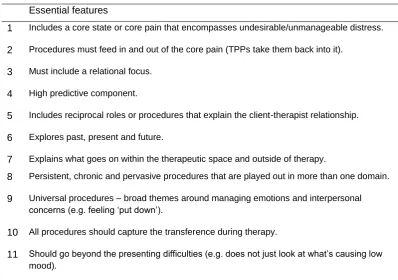
Table 3 Essential features of a CAT SDR………..page 67
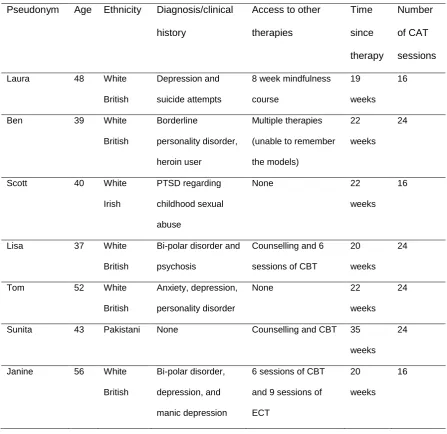
Table 4 Sample demographics………....page 68
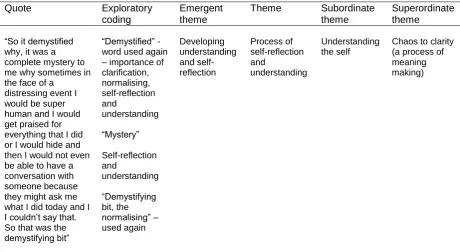
Table 5 Transcript extract……….page 70
8
List of appendices
Appendix A: Systematic review protocol
Appendix B: Email correspondence to expert in the area
Appendix C: Search terms and results
Appendix D: Quality appraisal tools
Appendix E: Characteristics of the formulation
Appendix F: Example SDR
Appendix G: Phenomenology, hermeneutics, idiography, epistemology and researcher’s perspective
Appendix H: Comparing and contrasting IPA to other methodologies
Appendix I: Excerpt from reflective journal
Appendix J: Excerpt from ethics approval letter
Appendix K: Therapist recruitment flyer
Appendix L: Participant information sheet
Appendix M: Consent form
Appendix N: Cover letter and opt-in sheet
Appendix O: Interview schedule/topic guide
Appendix P: Data analysis process
Appendix Q: Transcript sample from ‘Janine’ (exploratory coding and emergent themes)
9 Appendix S: Mater themes table for the group
Appendix T: Quality in IPA
Appendix U: Dissemination of research findings
10
THESIS OVERVIEW
This thesis is organised into two chapters: a systematic review; an empirical research paper; and relevant appendices. Each chapter is presented as a standalone component adding to current gaps in the literature.
Chapter 1 presents a systematic literature review of all current research aiming to understand service-users’ views of psychological formulation. A total of 297 studies were initially retrieved. 11 papers were included in the final review. A narrative synthesis of their findings is presented. The literature suggests several common themes include: responses to formulation; biopsychosocial understanding; practicable and tangible; collaboration; therapeutic relationship; process;
communication; change and diagnostic symptoms. Clinical implications, gaps in knowledge and the need for further research are discussed.
Chapter 2 extends the research discussed in the systematic review with a qualitative empirical paper exploring service-users experiences of the SDR. Interpretative Phenomenological Analysis (IPA) was used to explore/analyse the data. Four superordinate themes emerged from the data: ‘Chaos to clarity (a process of meaning making)’; ‘The change process’; ‘Relational dynamics’; and ‘Focus on
11
CHAPTER 1: SYSTEMATIC LITERATURE REVIEW
What are service-users’ views of psychological formulation? A systematic
review
Abstract
Purpose: Formulation is a unique skill of psychologically-based clinical professions. There has been recent interest in the quality of formulation and what formulation has to offer. Despite practice-based evidence promoting the usefulness of formulation within individual therapeutic work, teams and risk assessments - there is a lack of empirical research evidencing its quality, effectiveness, or usefulness, particularly from a service-user perspective. Therefore, the aim of this systematic review is to investigate service-user views of helpful and unhelpful aspects of psychological formulation.
Method: Key search terms identified in the research protocol were entered into electronic databases, and reference lists of relevant papers were hand searched to identify additional studies. Experts in the area and the Association of Cognitive Analytic Therapy (ACAT) were also consulted. Eleven eligible papers were included and quality appraised. Key findings are presented in a narrative summary.
Results: Key papers identified views and experiences of formulation are complex, diverse, and multifaceted. Key themes from the data are explored; including: responses to formulation; biopsychosocial understanding; practical and tangible; collaboration; therapeutic relationship; process; communication; change; and diagnostic symptoms. Gaps in knowledge, the need for further research, and clinical implications are also discussed.
12
13
Introduction
Types and attributes of formulation
Clinical psychologists consider formulation to be an essential skill across the range of applied clinical professions. Kinderman (2001) suggests the success of clinical psychology is, in fact, the success of formulation. Formulation can be traced back to the 1950s with clinical psychologists embracing the scientist-practitioner model, and engaging collaboratively with service-users to generate hypotheses about their presenting problems (Kennedy & Llewelyn, 2001). Literature exploring formulation as a process within therapy has often focussed on a Cognitive Behavioural Therapy (CBT) perspective (Bruch & Bond, 1998; Johnstone & Dallos, 2013. However, recent literature has focussed on formulation across a variety of psychological models such as psychodynamic (Leiper, 2006), social constructionist (Harper & Spellman, 2006), systemic/integrative (Dallos, Wright, Stedmon & Johnstone, 2006) and Cognitive Analytic Therapy (CAT; Dallos, 2006).
14
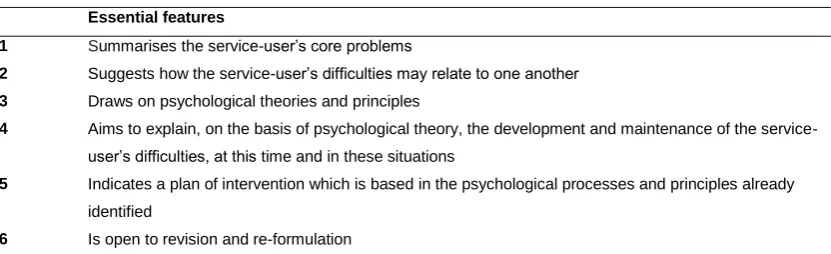
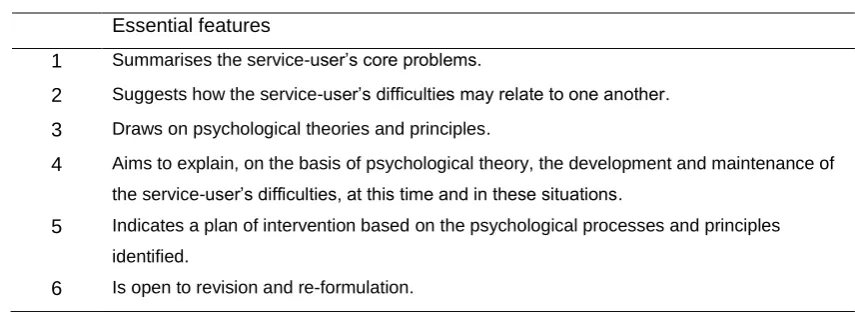
Table 1: Essential features of psychological formulations
Essential features
1 Summarises the service-user’s core problems
2 Suggests how the service-user’s difficulties may relate to one another
3 Draws on psychological theories and principles
4 Aims to explain, on the basis of psychological theory, the development and maintenance of the service-user’s difficulties, at this time and in these situations
5 Indicates a plan of intervention which is based in the psychological processes and principles already identified
6 Is open to revision and re-formulation
Ways of conceptualising and researching formulation
Psychiatric diagnostic systems (Diagnostic and Statistical Manual-fifth edition, DSM-V; International Classification of Diseases-tenth edition, ICD-10) are currently the dominant method of conceptualising mental health difficulties. Formulation offers an alternative/complementary framework. DSM-V is often presented as more scientific (i.e. testable, valid and reliable), despite a growing body of research challenging this viewpoint (Read & Bentall, 2012; Kinderman, Read, Moncrieff & Bentall, 2013).
The author of this review is not aware of any research exploring the accuracy of formulations, particularly from a service-user perspective. Constructing formulation objectively, and the focus on quantitative research methodology, may be reasons for the lack of qualitative research exploring service-users’ experiences of formulation.
15
fact. Therefore, the usefulness of formulation from a service-user’s perspective should be the focus of formulation research, instead of the search for a universal truth or diagnostic label.
Service-user involvement
Collaboration with service-users is pertinent to clinical psychologists both during training (HCPC, 2014) and post qualification (Department of Health User Group, 2001; NHS England, 2014). It is imperative services work together with service-users in developing services, due to the expertise service-service-users can offer from their own experiences. Specifically in relation to clinical psychology, service-user involvement should be part of the formulation process.
Rationale and aim of this review
Formulation is central to clinical psychology as a profession. Key frameworks state the importance of formulations being accessible to service-users, and ideally developed collaboratively (Hart & Logan, 2011; DCP, 2011). However, there is little evidence for this within the literature. The DCP’s guidelines on psychological formulation (DCP, 2011) were devised by professionals who consulted a service-user and carer liaison committee. However, we need to know more about what service-users think about formulation, how it makes them feel, and what they find more or less useful. Service-users’ subjective accounts of what they find helpful about formulation are likely to produce the outcomes that service-users and professionals want (i.e. recovery). Service-user perspectives will be essential in evaluating the therapeutic usefulness of formulation. A systematic review was conducted to explore this area further, to establish service-users’ views and
16
Method
The Preferred Reporting Item for Systematic Reviews and Meta-Analyses (PRISMA) statement was used to inform this review (Moher, Liberati, Tetzlaff, & Altman, 2009).
Inclusion and exclusion criteria
A systematic review protocol was developed (Appendix A) and a number of inclusion and exclusion criteria were defined (Table 2).
Table 2: Inclusion and exclusion criteria
Inclusion criteria Exclusion criteria
Papers focusing on individualised formulation. The DCP’s guidelines which detail the
characteristics of psychological formulation (DCP, 2011) were used to decide if a study was looking at formulation or other process/phenomena.
Team consultation/formulation papers
Service-user’s views/opinions/experiences (not professionals) of therapy/therapeutic
relationship/psychological formulation
English language
Professional views only (e.g. service-users not asked as part of the methodology). A main focus on therapeutic models/psychiatric medication (not psychological formulation)
Non-English language
All publication types (except professional opinion pieces)
Professional opinion pieces, books and book reviews
Peer reviewed publications and clinical psychology doctoral theses
Male or female participants of any age
Time period: any date regarding start date or publication date
No psychiatric diagnosis to be considered as an exclusion criterion
Risk of bias
17
relevant studies were identified and none were excluded on the basis of the reviewer’s pre-judgements. Two studies could not be obtained; these were doctoral thesis for which the reviewers had not given permission for their work to be disseminated. The reviewer utilised critical appraisal tools recommended by the International Centre for Allied Health Evidence (ICAHE) in an attempt to minimise bias during data extraction and analysis.
Search strategy
A scoping search was conducted in August 2014 to explore literature reporting service-users’ views about psychological formulation. The reviewer found no similar reviews were registered via the Cochrane Database of Systematic Reviews (Wiley Online Library 1996 to current) or on PROSPERO (Centre for Reviews and Dissemination’s international prospective register of systematic reviews). It was concluded that the current review was feasible, would add value to the evidence base, and may have useful implications for clinical psychology.
18
The reviewer was aware that cognitive analytical therapists often report details of ‘research in the pipeline’ on their website (www.acatme.uk). The reviewer consulted this webpage to ensure they were aware of any very recent research and identified one further paper for inclusion in the review.
Searches commenced on 3rd October 2014 (Appendix C). The following electronic databases were searched, dating back to: PsychINFO 1887; MEDLINE 1948; MEDLINE with Full Text 1949; and CINAHL Plus 1937. Searches terminated on 11th April 2015. Reference lists were also hand searched to identify further studies and duplicate citations were deleted.
Search terms for electronic databases
formulation or re-formulation or reformulation or “case conceptualisation” or “case formulation” or “SDR” or “sequential diagrammatic reformulation” or “sequential diagrammatic re-formulation” or letter AND “service-user” or “service-user” or client or patient AND experien* or perspective or understanding or feedback or view or opinion or satisfaction or impact AND "cognitive behavioural therapy" OR "CBT" OR "cognitive behavioural formulation" OR "cognitive analytic therapy" OR "CAT" OR "cognitive analytic formulation" OR "psychodynamic therapy" OR "psychodynamic formulation" OR "systemic therapy" OR "systemic formulation" OR "integrative therapy" OR "integrative formulation
OR
19
diagrammatic re-formulation” or letter AND experien* or perspective or understanding or feedback or view or opinion or satisfaction or impact AND "cognitive behavioural therapy" OR "CBT" OR "cognitive behavioural formulation" OR "cognitive analytic therapy" OR "CAT" OR "cognitive analytic formulation" OR "psychodynamic therapy" OR "psychodynamic formulation" OR "systemic therapy" OR "systemic formulation" OR "integrative therapy" OR "integrative formulation
Study selection
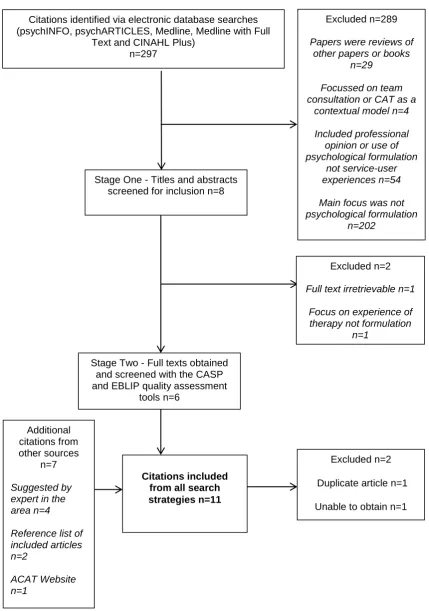
20 Figure 1:Flowchart of Search Strategy
Citations identified via electronic database searches (psychINFO, psychARTICLES, Medline, Medline with Full
Text and CINAHL Plus) n=297
Stage One - Titles and abstracts screened for inclusion n=8
Excluded n=289
Papers were reviews of other papers or books
n=29
Focussed on team consultation or CAT as a
contextual model n=4
Included professional opinion or use of psychological formulation
not service-user experiences n=54
Main focus was not psychological formulation
n=202
Stage Two - Full texts obtained and screened with the CASP and EBLIP quality assessment
tools n=6 Additional citations from other sources n=7 Suggested by expert in the area n=4
Reference list of included articles n=2
ACAT Website n=1
Excluded n=2
Duplicate article n=1
Unable to obtain n=1 Excluded n=2
Full text irretrievable n=1
Focus on experience of therapy not formulation
n=1
21
Quality assessment
The Critical Appraisal Skills Programme (CASP, 2014) is a methodological checklist providing key criteria relevant to qualitative research. The CASP ten-question appraisal tool was used to assess the quality of the qualitative studies included in this review. The EBLIP Critical Appraisal Checklist provides a thorough, generic list of questions which would determine validity, applicability and appropriateness of a study. The EBLIP Critical Appraisal Checklist was used to assess the quality of the quantitative studies included in this review. One of the papers included in this review utilised a mixed methodology (Shine & Westacott, 2010). The CASP tool was used to quality assess the qualitative aspects of the mixed method paper, and the EBLIP checklist was used to quality assess the quantitative aspects of the mixed method paper. These tools were chosen because the questions related well to the included papers (for example the main focus of the tools was not on intervention and/or comparator studies), and because the tools (Appendix D) are also recommended by the ICAHE (International Centre for Allied Health Evidence).
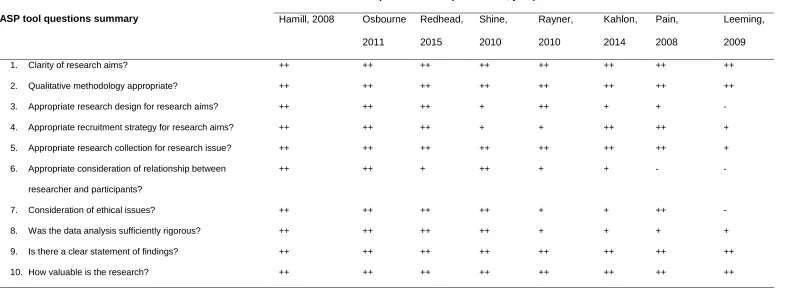
22 Table 3: Summary of quality assessment of qualitative papers using CASP tool
Key: ++ yes/high quality/adequate information provided to fully answer the question
+ Can’t tell/medium quality/information provided but additional detail would have more adequately addressed the question - No/low quality/information was not provided or suggested a negative response.
CASP tool questions summary
Papers assessed (first author, year)
Hamill, 2008 Osbourne
2011
Redhead,
2015
Shine,
2010
Rayner,
2010
Kahlon,
2014
Pain,
2008
Leeming,
2009
1. Clarity of research aims? ++ ++ ++ ++ ++ ++ ++ ++
2. Qualitative methodology appropriate? ++ ++ ++ ++ ++ ++ ++ ++
3. Appropriate research design for research aims? ++ ++ ++ + ++ + + -
4. Appropriate recruitment strategy for research aims? ++ ++ ++ + + ++ ++ +
5. Appropriate research collection for research issue? ++ ++ ++ ++ ++ ++ ++ +
6. Appropriate consideration of relationship between
researcher and participants?
++ ++ + ++ + + - -
7. Consideration of ethical issues? ++ ++ ++ ++ + + ++ -
8. Was the data analysis sufficiently rigorous? ++ ++ ++ ++ + + + +
9. Is there a clear statement of findings? ++ ++ ++ ++ ++ ++ ++ ++
23
Table 4: Summary of quality assessment of quantitative papers using EBLIP Critical Appraisal Checklist
EBLIP Critical Appraisal Checklist questions summary
Papers assessed (first reviewer, year) Chadwick,
2003
Shine, 2010 Evans, 2009 Evans, 1996
Section A: Population
Is the study population representative of all users, actual and eligible, who might be included in the study?
Y U Y Y
Are inclusion and exclusion criteria definitively outlined?
Y Y Y Y
Is the sample size large enough for sufficiently precise estimates?
N N U N
Is the response rate large enough for sufficiently precise estimates?
Y N Y U
Is the choice of population bias-free? Y Y Y Y
If a comparative study:
Were participants randomized into groups? Were the groups comparable at baseline? If groups were not comparable at baseline, was incomparability addressed by the reviewers in the analysis?
NA NA NA NA
Was informed consent obtained? Y Y Y Y
Section B: Data Collection
Are data collection methods clearly described? Y Y Y Y
If a face-to-face survey, were inter-observer and intra-observer bias reduced?
NA NA N NA
Is the data collection instrument validated? Y Y Y Y
If based on regularly collected statistics, are the statistics free from subjectivity?
24
Does the study measure the outcome at a time appropriate for capturing the intervention’s effect?
Y Y N Y
Is the instrument included in the publication? N N N N
Are questions posed clearly enough to be able to elicit precise answers?
Y Y Y Y
Were those involved in data collection not involved in delivering a service to the target population?
Y N Y Y
Section C: Study Design
Is the study type / methodology utilised appropriate? Y Y Y N
Is there face validity? Y Y Y Y
Is the research methodology clearly stated at a level of detail that would allow its replication?
U Y Y N
Was ethics approval obtained? Y Y U U
Are the outcomes clearly stated and discussed in relation to the data collection?
Y Y Y Y
Section D: Results Are all the results clearly outlined? Y Y Y Y
Are confounding variables accounted for? Y Y Y Y
Do the conclusions accurately reflect the analysis? Y Y Y Y
Is subset analysis a minor, rather than a major, focus of the article?
Y Y Y Y
Are suggestions provided for further areas to research?
N Y Y Y
25
Section A validity calculation: Valid Validity
questionable
Validity questionable
Validity questionable
Section B validity calculation: Valid Valid Valid Valid
Section C validity calculation: Valid Valid Valid Validity
questionable
Section D validity calculation: Valid Valid Valid Valid
Overall validity calculation: Valid Valid Valid Validity
questionable
Key: Y - Yes/high quality/adequate information provided to fully answer the question. N - No/low quality/information provided suggested a negative response.
26
Data synthesis and appraisal
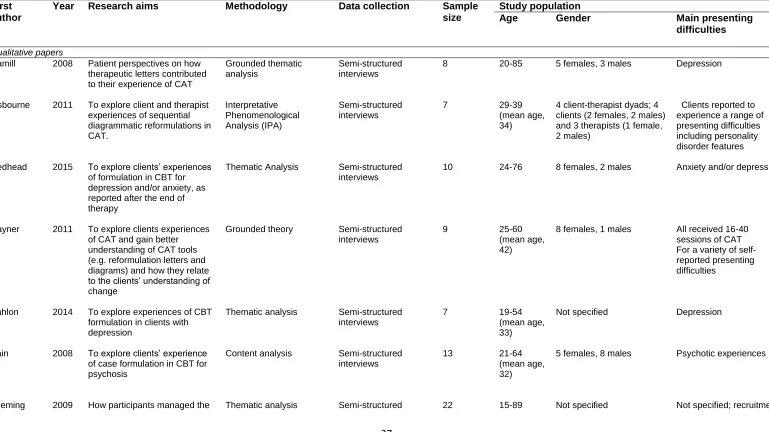
27 Table 5: Key characteristics of included studies
First author
Year Research aims Methodology Data collection Sample size
Study population
Age Gender Main presenting difficulties
Qualitative papers
Hamill 2008 Patient perspectives on how therapeutic letters contributed to their experience of CAT
Grounded thematic analysis
Semi-structured interviews
8 20-85 5 females, 3 males Depression
Osbourne 2011 To explore client and therapist experiences of sequential diagrammatic reformulations in CAT. Interpretative Phenomenological Analysis (IPA) Semi-structured interviews
7 29-39
(mean age, 34)
4 client-therapist dyads; 4 clients (2 females, 2 males) and 3 therapists (1 female, 2 males)
Clients reported to experience a range of presenting difficulties including personality disorder features
Redhead 2015 To explore clients’ experiences of formulation in CBT for depression and/or anxiety, as reported after the end of therapy
Thematic Analysis Semi-structured interviews
10 24-76 8 females, 2 males Anxiety and/or depression
Rayner 2011 To explore clients experiences of CAT and gain better understanding of CAT tools (e.g. reformulation letters and diagrams) and how they relate to the clients’ understanding of change
Grounded theory Semi-structured interviews
9 25-60
(mean age, 42)
8 females, 1 males All received 16-40 sessions of CAT For a variety of self- reported presenting difficulties
Kahlon 2014 To explore experiences of CBT formulation in clients with depression
Thematic analysis Semi-structured interviews
7 19-54
(mean age, 33)
Not specified Depression
Pain 2008 To explore clients’ experience of case formulation in CBT for psychosis
Content analysis Semi-structured interviews
13 21-64
(mean age, 32)
5 females, 8 males Psychotic experiences
28
potential for shame that can arise from experiencing difficulties which are often viewed pejoratively
interviews was from a CAMHS, two
CMHTs for older adults and a user group who campaigned against issues around stigma
Quantitative papers
Chadwick 2003 Two experiments (E1 and E2) to explore the impact of case formulation in CBT for psychosis on both therapeutic relationship and psychosis symptoms (including delusional and self-evaluative beliefs, anxiety and depression)
E1: Within-subjects repeated measures design
E2: Multiple baseline design Psychometric questionnaires and semi-structured interviews 13 4 Mean age, 31.5 20-56 (mean age, 39)
6 females, 7 males
2 females, 2 males
Symptoms of psychosis for at least 6 months Experience of distressing auditory hallucinations and related secondary paranoid delusions
Evans-Jones
2009 To investigate which factors are associated with the therapeutic relationship in CBT for
psychosis
Cross-sectional correlational design
Questionnaires 24 client-therapist dyads
20-53, (mean age, 31)
7 females, 17 males Schizophrenia spectrum diagnosis
Evans 1996 To evaluate the impact of reformulation in CAT with difficult to help clients
Multiple baseline design Psychometric questionnaires and semi-structured interviews
4 24-42
(mean age, 32)
4 females 2+ contact episodes with psychiatric services without significant change,
and one or more of the following:
2+ inpatient admissions; a history of overdoses or other self- injury, meeting DSM III-R criteria for major depressive disorder, OCD, BPD, or reluctance to engage
Mixed method
Shine 2010 To investigate if the
reformulation process in CAT had an impact on working alliance, and explore the client’s perspective of the reformulation process
Time series analysis and template analysis
Questionnaires and a semi-structured interview
5 22-63
(mean age, 42)
29
Results
A total of eleven studies were included in the review. Five of the studies were related to CAT, five were related to CBT, and one of the studies was not linked to a specific theoretical model. The quality assessment of included studies is summarised in Table 3 and Table 4. The quality of the qualitative papers varied but were considered good quality with the exception of one paper (Leeming et al., 2009). The quality of the quantitative papers varied but indicated an overall validity, with the exception of one paper (Evans & Parry, 1996). Consequently, the two papers with questionable validity (Leeming et al., 2009; Evans & Parry, 1996) should be interpreted with more caution. Key study characteristics are summarised in Table 5, grouped by their research methodology, and then presented in order of descending quality appraisal.
Key themes and findings from the qualitative papers
Data relevant to the review question were extracted (Table 6) for each study including primary outcomes and conclusions of the research studies. Data were organised primarily by research methodology, and then presented in order of descending quality appraisal.
K
ey findings are discussed below as a narrative synthesis, organised by methodology and prevalence across the papers. The qualitative and quantitative aspects of the mixed method paper have been reviewed separately.30
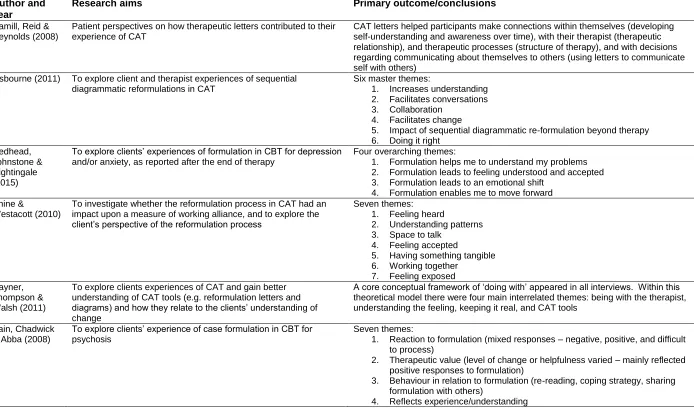
31 Table 6: Primary outcome/conclusions
Author and year
Research aims Primary outcome/conclusions
Hamill, Reid & Reynolds (2008)
Patient perspectives on how therapeutic letters contributed to their experience of CAT
CAT letters helped participants make connections within themselves (developing self-understanding and awareness over time), with their therapist (therapeutic relationship), and therapeutic processes (structure of therapy), and with decisions regarding communicating about themselves to others (using letters to communicate self with others)
Osbourne (2011) To explore client and therapist experiences of sequential diagrammatic reformulations in CAT
Six master themes:
1. Increases understanding 2. Facilitates conversations 3. Collaboration
4. Facilitates change
5. Impact of sequential diagrammatic re-formulation beyond therapy 6. Doing it right
Redhead, Johnstone & Nightingale (2015)
To explore clients’ experiences of formulation in CBT for depression and/or anxiety, as reported after the end of therapy
Four overarching themes:
1. Formulation helps me to understand my problems 2. Formulation leads to feeling understood and accepted 3. Formulation leads to an emotional shift
4. Formulation enables me to move forward Shine &
Westacott (2010)
To investigate whether the reformulation process in CAT had an impact upon a measure of working alliance, and to explore the client’s perspective of the reformulation process
Seven themes: 1. Feeling heard
2. Understanding patterns 3. Space to talk
4. Feeling accepted
5. Having something tangible 6. Working together
7. Feeling exposed Rayner,
Thompson & Walsh (2011)
To explore clients experiences of CAT and gain better understanding of CAT tools (e.g. reformulation letters and diagrams) and how they relate to the clients’ understanding of change
A core conceptual framework of ‘doing with’ appeared in all interviews. Within this theoretical model there were four main interrelated themes: being with the therapist, understanding the feeling, keeping it real, and CAT tools
Pain, Chadwick & Abba (2008)
To explore clients’ experience of case formulation in CBT for psychosis
Seven themes:
1. Reaction to formulation (mixed responses – negative, positive, and difficult to process)
2. Therapeutic value (level of change or helpfulness varied – mainly reflected positive responses to formulation)
3. Behaviour in relation to formulation (re-reading, coping strategy, sharing formulation with others)
32
5. Optimism/pessimism
6. Change in relation to formulation over time
7. Therapeutic relationship (positive reaction to therapist or therapeutic relationship)
Responses were varied within the key themes and highlight the complexity of formulation research
Kahlon, Neal & Patterson (2014)
To explore experiences of CBT formulation in clients with depression
Four superordinate themes:
1. Feeling trapped or restricted by depression
2. The development of the formulation – from coming to my own conclusions to something the therapist developed
3. From negative to mixed feelings regarding the reacting to the formulation during the therapeutic process
4. A new journey towards making a new sense of self Leeming, Boyle
& Macdonald (2009)
How participants managed the potential for shame that can arise from experiencing difficulties which are often viewed pejoratively
Two themes discussed:
1. Difficulties in using psychosocial explanations 2. Diagnosis as both salvation and damnation Chadwick,
Williams & Mackenzie (2003)
Two experiments (E1 and E2) to explore the impact of case formulation in CBT for psychosis on both therapeutic relationship and psychosis symptoms (including delusional and self-evaluative beliefs, anxiety and depression)
E1: Formulation in CBT for psychosis does not have a significant impact on alliance for clients, but may have a significant impact for therapists
Semi-structured interviews suggest clients found formulation helpful by enhancing their understanding of their own problems and showed them that the therapist understood them. They also reported positive emotions - feeling reassured, encouraged and more optimistic. Some clients reported a negative emotional response to the formulation, describing the experience as saddening, upsetting and worrying. Some clients reported positive and negative responses, indicating ambivalence about formulation. Some clients reported no emotional impact of the formulation, and some found them complicated. For therapists, formulation had a number of positive effects: powerful, validating, hopeful about therapy, enhanced alliance, understanding, collaboration and confidence in the model
E2: Formulation delivered over four separate sessions did not have a significant impact on strength of delusions, or negative self-evaluations. Formulation alone does not reduce belief strength for delusions or negative person evaluations. Changes are attributed jointly to cognitive restructuring and formulation Evans-Jones &
Peters (2009)
To investigate which factors are associated with the therapeutic relationship in CBT for psychosis
The presentation of a formulation was linked to a better therapeutic relationship
Shine &
Westacott (2010)
To investigate whether the reformulation process in CAT had an impact upon a measure of working alliance, and to explore the client’s perspective of the reformulation process
No significant impact of the reformulation process on measure of working alliance, either as a step-change or slope-change
Evans & Parry (1996)
To evaluate the impact of reformulation in CAT with difficult to help clients
33
34 Response to the formulation
All eight studies reported responses relevant to this theme. Participants’ responses to formulation were complex and multifaceted. Reactions were often contradictory within and between participants. Some reactions included finding the formulation unhelpful, complex, and emotionally difficult to engage with (Kahlon, Neale & Patterson, 2014; Rayner, Thompson & Walsh, 2011), leaving participants ‘feeling sad’ (Pain, Chadwick & Abba, 2008) or ‘distressed’ (Redhead, Johnstone & Nightingale, 2015). Other responses to formulation included feeling understood and accepted (Shine & Westacott, 2010; Redhead et al., 2015), providing relief (Pain et al., 2008; Redhead et al., 2015) and being on a new journey and finding a ‘new me’ (Kahlon et al., 2014).
Some participants’ responses highlighted the importance of considering ways formulation may support or hinder service-users in communicating their strengths and weaknesses to others. Some participants reported feeling exposed, and a sense of shame and failure (Leeming et al., 2009; Shine & Westacott, 2010) following the development and discussion of their formulation.
Biopsychosocial understanding
35
Patterson, 2014), while emphasising the potential for therapeutic change. In one study, formulations helped participants reduce their tendency to blame oneself while developing self-compassion and empathy (Rayner et al., 2010).
Practical and tangible
Six of the eight studies reported responses relevant to this theme. Participants found the visual element of formulation helpful. Having a visual representation provided something tangible that could be utilised and reflected on inside and outside of therapy (Hamill, Reid & Reynolds, 2008; Rayner, Thomspon & Walsh, 2010; Shine & Westacott, 2010). Participants referred to formulations as something you ‘do’ and ‘more than just talking’. Participants appreciated practical aspects of formulating, ‘real life’ metaphors and practising new skills. Diagrammatic formulations (compared to formulation letters) play a role in re-emphasising learning and reminding service-users of novel adaptive coping strategies (Kahlon et al., 2014; Rayner et al., 2010).
Collaboration
36
In one of the studies participants’ responses regarding the level of collaboration varied. Most participants reported exploring thoughts, feelings, behaviours and experiences with their therapist; however, responses varied regarding who was perceived to be more responsible for the development of the formulation, the participant or the therapist (Kahlon, Neal & Patterson, 2014).
Therapeutic relationship
Four of the eight studies where this emerged, reported responses relevant to this theme. Analysis across studies highlights the importance of formulation in developing a therapeutic relationship. Participants reported feeling heard, listened to and understood across the formulation process (Shine & Westacott, 2010). Formulations also conveyed the therapists’ respect, competence and a level of collaboration (Hamil, Reid & Reynolds, 2008). Some authors proposed that formulation can be represented as a tangible object which supports the service user to maintain a connection with the therapist and the therapeutic process (Hamil, Reid & Reynolds, 2008; Shine & Westacott, 2010).
Process
37 Communication
Four of the eight studies reported responses relevant to this theme. Participants reported formulation facilitated communication promoting a space to talk within therapy, particularly focusing conversations within therapy (Osbourne, 2011; Pain et al., 2008; Shine & Westacott, 2010), and presenting the opportunity to share formulation with others (Hamil, Reid & Reynolds, 2008).
Change
Four of the eight studies reported responses relevant to this theme. Participants reflected on whether formulation is designed to influence change at a diagnostic symptom level, or holistic level. Some participants conceptualised the impact formulation had on therapeutic change as a continuous process, rather than a cure (Rayner, Thompson & Wales, 2011). These changes were more person centred/holistic than symptom/diagnosis specific, including reduced self-criticism, enhanced levels of confidence, assertiveness and self-esteem.
38
wondered if the enhanced understanding provided by formulation was enough to facilitate change at an emotional and behavioural level.
Key findings from the quantitative papers
Therapeutic relationship
All four studies reported responses relevant to this theme. Findings from quantitative research assessing the impact of formulation on the therapeutic relationship are inconsistent. Some research reported no statistically significant impact of formulation on therapeutic relationship from the service-user perspective (Evans & Parry, 1996; Shine & Westacott, 2010). However, data suggested formulation impacts the therapeutic relationship from the therapists’ perspective (Chadwick, Williams & Mackenzie, 2003). Paradoxically, Evans-Jones, Peters and Barker (2009) reported formulation was linked to a better therapeutic relationship from the participants’ perspectives. There are mixed outcomes in relation to effects of formulation and working alliance, consequently these findings should be reviewed cautiously.
Diagnostic symptomatology
39
Discussion
The review aimed to summarise service-users’ views about formulation, with a focus on what is helpful and unhelpful about it. Findings provide insight into the under-researched area of formulation from service-user perspectives. At times the review findings were clear and consistent, and at other times, contradictory and complex.
Findings that were consistent across the qualitative papers were that formulation helped participants to synthesise complex information, develop an understanding of their problems, reduce self-blame and enhance self-compassion and empathy. Participants described formulation as a communication tool across settings and relationships. Participants also found formulation helpful in providing ‘real life’, personalised metaphors and practical management strategies, with an emphasis on ‘doing with’ and ‘not just talking’. Most of the qualitative papers found a visual and physical representation of a psychological formulation acts as a transitional object (Winnicott, 1953) and assists internalisation (Ryle, 2004) representing the therapeutic relationship beyond therapy itself.
40
Contradictory findings across the qualitative papers include participants’ responses to formulation, which were complex and multifaceted. Some participants experienced formulation as unhelpful, complex, emotionally difficult, and experienced a sense of shame and failure (when considering communicating it to others). Other participants found it reduced shame and provided a sense of control, empowerment and relief. For most participants, formulation evoked some painful emotions while also promoting hope. The role of formulation in promoting a sense of collaboration and ownership over formulation through transparency, teamwork and empowerment was mentioned across most papers. The extent to which participants felt it was a collaborative process varied. This was associated with perceived levels of collaboration in relation to the formulation. It is not clear if this varied due to the participant’s ability to understand and engage with psychological thinking or individual therapist style and training.
Findings from quantitative data were less detailed. Results revealed two topic themes: therapeutic relationship and diagnostic symptomatology. Findings were inconsistent, with some research suggesting formulation has no impact on the therapeutic relationship, and others suggesting it impacts positively. In relation to clinical symptoms, quantitative results suggested formulation did not make a significant impact upon symptoms of anxiety and depression as measured by the Hospital Anxiety and Depression Scale.
41
2011); what makes a ‘good’ formulation; and what methodology would be most appropriate to approach such questions. The lack of research into this area may also reflect the assumptions of clinical psychologists that formulation is a positive and helpful tool enhancing the therapeutic relationship and therapeutic change (Osbourne, 2011). It is not surprising qualitative methodologies are used most during these early stages of researching service-users’ views of formulation.
Strengths of this review
42
Limitations of this review
It was difficult to analyse and synthesise the included papers comprehensively due to the variation in research methodologies within, and across, the qualitative (grounded theory, IPA, thematic analysis, content analysis and template analysis) and quantitative (multiple baseline design and cross sectional correlational design) papers. The reviewer was aware of the range of psychiatric diagnoses upon which some of the research papers were based (e.g. anxiety, depression, personality disorder and psychosis) and the different therapeutic models (e.g. CAT and CBT) informing psychological formulation, adding to the heterogeneity of the data. Non-English language papers were excluded from the review. The screening of references, full text articles, quality assessment and data extraction were completed by the main reviewer. The quality assessment process is a subjective task, and despite the reviewer using standardised tools, this is a limitation relevant to all quality assessments. However, papers were not excluded on the basis of quality assessment. Two independent reviewers quality appraised a selection of the studies as a validity check. Additional validity checks at the data extraction phase would have strengthened this review. Due to the diversity in participant population, therapeutic modality and research methodology, it is difficult to generalise findings across the studies.
Clinical and professional implications
Response to formulation
43
distressing emotions as the formulation is being developed, with an acknowledgement of the learning process and promotion of hope. An area not reflected in the review findings is the potential importance of protective factors and promotion of resilience within formulation. Perhaps this is because formulations are often problem focussed. A number of participants mentioned formulations being difficult to experience at times due to their distressing content; including an individual’s strengths within a formulation may support service-users to engage with it.
Biopsychosocial understanding
Results emphasise how clinical psychologists can use formulation to support service-users to develop a holistic understanding of the self, including the attribution of meaning to distressing experiences which reduces self-blame and supports individuals to reflect on their own contribution to their mood states and maintenance of their difficulties (Osbourne, 2011; Shine & Westacott, 2010; Rayner et al., 2010). It is important that we continue to promote this framework of understanding as an alternative to the prevailing medical model. Findings from this review suggest formulation can be used to challenge the mad/bad dichotomy, and to promote understanding of the biopsychosocial model of distress. Furthermore, it emphasises the leadership role of clinical psychologists, including media and political influence at a public health and awareness raising level.
Practical and tangible
44
tasks. The use of ‘real life’, person-centred metaphors was indicated as a useful strategy when exploring abstract or complex concepts within a tangible framework (Kahlon, Neal & Patterson, 2014; Rayner et al., 2010).
Collaboration
There are no guidelines for the development and sharing of formulation letters; this is an area for development. Results suggest those who gained more had an active role in constructing a diagrammatic formulation and an experience of ‘doing with’ the therapist which seemed to translate to a feeling of being actively engaged in their own process of change (Osbourne, 2011; Shine & Westacott, 2010; Redhead et al., 2015).
Findings from this review suggest a variation in levels of collaboration with regards to development of formulation. It may be helpful for clinical psychologists to reflect on factors affecting their ability to work collaboratively and ways this can be enhanced to avoid a hierarchical and ‘expert role’ within the therapeutic relationship. Therapeutic training and individual therapist factors are likely to influence the style and level of collaboration. It is important to consider the purpose of formulations, who they are developed for, and who takes ownership of the formulation (the service-user, therapist, and/or the service).
Therapeutic relationship
45
therapeutic process/relationship (Hamil, Reid & Reynolds, 2008; Shine & Westacott, 2010). It may be helpful to explore other opportunities to meet this need within therapy, such as developing other means of providing transitional/attachment objects.
Process
Results suggest formulation is a process that continues outside therapy sessions and after therapy has ended (Hamil, Reid & Reynolds, 2008; Osbourne, 2011). An awareness of formulation as an ongoing process may provide an opportunity to support change through the provision of follow-up sessions to review progress and support any lapses. Time between sessions could also support service-users to reflect on discussions within therapy and promote the application of learning to other environments.
Communication
Service-users could be supported to use the formulation as a communication tool with key people in their life (Hamil, Reid & Reynolds, 2008). It is important that professionals ask service-users what they do, and do not, want to be shared with other professionals involved in their care and support them to share information either directly or indirectly in a way that decreases the feelings of shame and failure reported by Leeming, Booyle and Macdonald (2009).
Change
46
effects of psychological interventions. Service level and commissioning agreements may dictate the outcome measures that a service routinely uses. It is important that clinical psychologists also use individualised means of capturing holistic and meaningful client-centred change. This information should be shared with commissioners to ensure outcomes are captured and valued, in comparison to numerical changes on a symptom checklist, or worse still, change being quantified by a diagnostic checklist that is invalid and unreliable (Read & Bentall, 2012; Kinderman, Read, Moncrieff & Bentall, 2013).
Future research
47
research different time points after receiving a formulation, and to explore experiences of where therapy was not helpful. It will be valuable to operationalise what is ‘useful’ and to explore this further to establish both what is helpful and how. There is a lack of research regarding formulation generally; consequently it would be interesting to conduct a systematic review exploring professionals’ views of formulation. There is growing emphasis on psychology and leadership, therefore it would also be valuable to explore what MDTs think about formulation and if/how it influences their clinical practice.
Conclusion
48
References
Boland, A., Cherry, G., & Dickson, R. (Eds.). (2014). Doing a systematic review: a student's guide. London: Sage.
Boyatzis, R. E. (1998). Transforming qualitative information: Thematic analysis and code development. Thousand Oaks, CA: Sage.
Braun, V., & Clarke, V. (2006). Using thematic analysis in psychology. Qualitative Research in Psychology,3, 77-101.
Bruch, M., & Bond, F. W. (1998). Beyond diagnosis: case formulation approaches in cognitive-behavioural therapy. Chichester: Wiley.
Butler, G. (1998). Clinical formulation. In Bellack, A. S. & Hersen, M. Comprehensive clinical psychology. Oxford: Pergamon
Critical Appraisal Skills Programme (CASP). (2014). CASP Checklists. Oxford. CASP.
49 Dallos, R. (2006). Integrative formulation: CAT and ANT. In L. Johnstone & R.
Dallos (Eds.), Formulation in psychology and psychotherapy: making sense of people’s problems (pp. 182-207). London: Routledge.
Dallos, R., Wright, J., Stedmon, J., & Johnstone, L. (2006). Integrative formulation. In L. Johnstone & R. Dallos (Eds.), Formulation in psychology and
psychotherapy: making sense of people’s problems (pp. 154-181). London: Routledge.
Division of Clinical Psychology. (2011). Good Practice Guidelines on the use of psychological formulation. Leicester: British Psychological Society.
Department of Health User Group, (2001). Nothing About Us Without Us. Retrieved from
http://web.archive.org/web/20030315162917/http://www.doh.gov.uk/learning disabilities/access/nothingabout/nothing2.htm
Diagnostic and Statistical Manual 5th Edition. (2015, June 5). Retrieved from http://www.DSM5.org
Eells, T. D. (1997). Psychotherapy case formulation: history and current status. In T. D. Eells (Eds.), Handbook of psychotherapy case formulation. New York: Guilford Press.
Elliott, R., & James, E. (1989). Varieties of client experience in psychotherapy: an analysis of the literature. Clinical Psychology Review, 9, 443–467.
50
Evans, J., & Parry, G. (1996). The Impact of Reformulation in Cognitive-Analytic Therapy with Difficult-to-Help Clients. Clinical Psychology and
Psychotherapy,3(2), 109-117.
Hamill, M., Ried, M., & Reynolds, S. (2008). Letters in cognitive analytic therapy: The patient's experience. Psychotherapy Research, 18(5), 573-583. doi:10.1080/10503300802074505
Harper, D., & Moss, D. (2003). A different kind of chemistry? Reformulating ‘formulation’. Clinical Psychology, 25, 6-10.
Harper, D., & Spellman, D. (2006). Social constructionist formulation: Telling a different story. In L. Johnstone & R. Dallos (Eds.), Formulation in psychology and psychotherapy: making sense of people’s problems (pp. 98-125). London: Routledge.
Hart, S. D., & Logan, C. (2011). Formulation of violence risk using evidence-based assessments: The structured professional judgment approach. In Sturmey, P., & McMurran, M. (Eds.). (2011). Forensic case formulation. Chichester, UK: Wiley-Blackwell.
Health Care and Professions Council. (2014). Standards of education and training guidance. Retrieved from
http://www.hcpc-uk.org/assets/documents/10001A9DStandardsofeducationandtrainingguidan ceforeducationproviders.pdf
International Statistical Classification of Diseases and Related Health Problems 10th
51
Johnstone, L., & Dallos, R. (2013). Introduction to formulation. In L. Johnstone & R. Dallos (Eds.), Formulation in psychology and psychotherapy: making sense of people’s problems (pp. 1-16). London: Routledge.
Kahlon, S., Neal, A., & Patterson, T. G. (2014). Experiences of cognitive behavioural therapy formulation in clients with depression. The Cognitive Behaviour Therapist, 7, 1-15.
Kennedy, P. & Llewelyn, S. (2001). Does the future belong to the scientist-practitioner? The Psychologist, 2, 74-48.
Kinderman, P. (2001). The future of clinical psychology training. Clinical Psychology Forum,8, 6-10.
Kinderman, P., Read, J., Moncrieff, J., & Bentall, R. P. (2013). Drop the language of disorder. Evidence Based Mental Health, 16. pp. 2-3. doi:10.1136/eb-2012-100987
Leeming, D., Boyle, M., & Macdonald, J. (2009). Accounting for psychological problems: How user-friendly is formulation? Clinical Psychology Forum, 200, 12-15.
Leiper, R. (2006). Psychodynamic formulation: A prince betrayed and disinherited. In L.Johnstone & R. Dallos (Eds.), Formulation in psychology and
52
Moher D, Liberati A, Tetzlaff J, Altman DG, The PRISMA Group (2009). Preferred Reporting Items for Systematic Reviews and Meta-Analyses: The PRISMA Statement. PLoS Med 6(6): e1000097. doi:10.1371/journal.pmed1000097
Müller, K. F., Briel, M., D’Amario, A., Kleijnen, J., Marusic, A., Wager, E., Antes, G., Von Elm, E., Lang, B., Motschall, E., Gloy, V., Schwarzer, G., Altman, D.,
Meerpohl, J. J., & Bassler, D. (2013). Defining publication bias: protocol for a systematic review of highly cited articles and proposal for a new framework. Systematic Reviews, 2, 34. doi:10.1186/2046-4053-2-34
NHS England. (2013). Transforming Participation in Health and Care – ‘The NHS belongs to us all’. Retrieved from
http://www.england.nhs.uk/wp-content/uploads/2013/09/trans-part-hc-guid1.pdf
Osbourne, J., (2011). Client’s and therapists’ experience of sequential diagrammatic reformulations in cognitive analytic therapy. Unpublished DClinPsy, Royal Holloway, University of London.
Pain, C. M., Chadwick, P., & Abba, N. (2008). Client’s experience of case
formulation in cognitive behaviour therapy for psychosis. British Journal of Clinical Psychology 47, 127-138. doi:10.1348/014466507X235962
Rayner, K., Thompson, A., & Walsh, S. (2011). Clients' experience of the process of change in cognitive analytic therapy. Psychology and Psychotherapy, 84(3), 299-313. doi:10.1348/147608310X531164
53 Read, J., & Dillon, J. (2004). Models of madness: psychological, social and
biological approaches to psychosis. Routledge: London.
Redhead, S., Johnstone, L., & Nightingale, J. (2015). Clients’ experiences of formulation in cognitive behaviour therapy. Psychology and Psychotherapy: Theory, Research and Practice: The British Psychological Society
doi:10.1111/papt.12054
Ryle, A. (2004). Writing by patients and therapists in cognitive analytic therapy. In G. Bolton., S. Howlett., C. Lago., & J.K., Wright (Eds.), Writing cures: An
introductory handbook of writing in counselling and therapy. (pp. 59-71). London: Brunner-Routledge.
Shine, L., & Westacott, M. (2010). Reformulation in cognitive analytic therapy: effects on the working alliance and the client's perspective on change. Psychology and Psychotherapy, 83(Pt 2), 161-177.
doi:10.1348/147608309X471334
Taplin, K., Greenhill, B., Seddon, C., & McGuire, J. (2015). What are service-users’ views of psychological formulation? A systematic review. Unpublished DClinPsy, University of Liverpool.
Taylor, G. W. & Ussher, J. M. (2001). Making sense of S&M: A discourse analysis account. Sexualities, 4(3), 293-314. doi:10.1177/136346001004003002
54
55
CHAPTER 2: EMPIRICAL RESEARCH
Abstract
Objectives: Formulation is an essential tool in psychological therapy. However, there is a paucity of research evidencing the efficacy and credibility of formulation. CAT uses a model specific formulation tool (the Sequential Diagrammatic Reformulation (SDR/map). The evidence base for CAT is developing, however there is little evidence exploring how service-users experience the SDR. Published research suggests service-users have very often not been asked about their experiences of psychological formulation. This research aims to address a gap in the evidence base by exploring service-user experiences of the SDR.
Design: This research is a practice based study exploring service user experiences of the SDR.
Method: Seven participants who had an SDR and completed therapy within three to twelve months were interviewed using a semi-structured interview/topic guide. Data was analysed using Interpretative Phenomenological Analysis (IPA).
Results: Four superordinate themes emerged from the data: ‘Chaos to clarity (a process of meaning making)’; ‘The change process’; ‘Relational dynamics’; and ‘Focus on treatment context/options’.
56
study. Study strengths and limitations, clinical implications and future research ideas are discussed.
57
Introduction
Formulation offers an alternative or complementary framework to the prevailing medical model of human distress, and although the psychiatric classification system is often presented as scientific, a growing body of research challenges this viewpoint (Read & Dillon, 2004; Kinderman, Read, Moncrieff & Bentall, 2013). Whilst clinical psychology has a critique of the medical model, the evidence base for formulation itself needs to be developed, particularly from a service-user perspective.
Defining formulation
58 Table 1: Essential features of the psychological formulation
Essential features
1 Summarises the service-user’s core problems.
2 Suggests how the service-user’s difficulties may relate to one another.
3 Draws on psychological theories and principles.
4 Aims to explain, on the basis of psychological theory, the development and maintenance of the service-user’s difficulties, at this time and in these situations.
5 Indicates a plan of intervention based on the psychological processes and principles identified.
6 Is open to revision and re-formulation.
The evidence-base for formulation
It is challenging to research formulation due to its complex, idiosyncratic nature and difficulties applying formulation to an RCT study, alongside risks in standardising approaches to formulation. Despite formulation being valued within psychology there is a lack of research exploring the development, use, and effectiveness of formulation, (Aston, 2009; Rainforth & Laurenson, 2014).
Formulation has been shown to increase service-user’s understanding of their problems (Persons, 1989) and reduce emotional distress (Horowitz, 1997). Zuber (2000) reported service-users’ understanding of their problems is a stronger predictor of therapeutic outcome than psychiatric diagnosis. Formulation has also been reported to enhance the therapeutic relationship (Needleman, 1999).
59
clinical practice (Aston, 2009) discussed the need for research to explore service-user’s understanding and experience of formulations. A recent review of case formulation (Rainforth & Laurenson, 2014) suggests further research is needed to explore the efficacy, process and function of formulation.
CAT theory and practice
CAT was developed in 1979 as a time-limited, integrated approach to meet service-user’s needs within NHS settings. The model incorporates ideas from Vygotsky, Winnicott and Bakhtin (Ryle, 1991; Leiman, 1992). CAT integrates psychoanalytic and developmental theories, and is informed by attachment theory (Bowlby, 1969) personal construct theory (Kelly, 1955) and object relations theory.
60
The SDR is also used to explore any transference and counter-transference reactions within the therapeutic relationship.
Service-user experiences of formulation
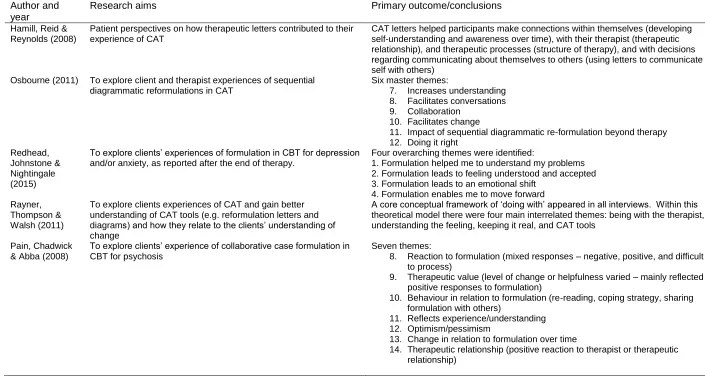
There is a paucity of research exploring service-user experiences of formulation. Research suggests a range of complex reactions subject to change across (and beyond) therapy. Table 2 summarises key research findings exploring service-user experiences of formulation in CBT and CAT. There is currently no outcome research exploring service-user experiences of formulation from other psychological models. Data has been organised by research methodology, and presented in order of descending quality appraisal.
61 Table 2: Service-user’s experiences of formulation
Author and year
Research aims Primary outcome/conclusions
Hamill, Reid & Reynolds (2008)
Patient perspectives on how therapeutic letters contributed to their experience of CAT
CAT letters helped participants make connections within themselves (developing self-understanding and awareness over time), with their therapist (therapeutic relationship), and therapeutic processes (structure of therapy), and with decisions regarding communicating about themselves to others (using letters to communicate self with others)
Osbourne (2011) To explore client and therapist experiences of sequential diagrammatic reformulations in CAT
Six master themes:
7. Increases understanding 8. Facilitates conversations 9. Collaboration
10. Facilitates change
11. Impact of sequential diagrammatic re-formulation beyond therapy 12. Doing it right
Redhead, Johnstone & Nightingale (2015)
To explore clients’ experiences of formulation in CBT for depression and/or anxiety, as reported after the end of therapy.
Four overarching themes were identified:
1. Formulation helped me to understand my problems 2. Formulation leads to feeling understood and accepted 3. Formulation leads to an emotional shift
4. Formulation enables me to move forward Rayner,
Thompson & Walsh (2011)
To explore clients experiences of CAT and gain better understanding of CAT tools (e.g. reformulation letters and diagrams) and how they relate to the clients’ understanding of change
A core conceptual framework of ‘doing with’ appeared in all interviews. Within this theoretical model there were four main interrelated themes: being with the therapist, understanding the feeling, keeping it real, and CAT tools
Pain, Chadwick & Abba (2008)
To explore clients’ experience of collaborative case formulation in CBT for psychosis
Seven themes:
8. Reaction to formulation (mixed responses – negative, positive, and difficult to process)
9. Therapeutic value (level of change or helpfulness varied – mainly reflected positive responses to formulation)
10. Behaviour in relation to formulation (re-reading, coping strategy, sharing formulation with others)
11. Reflects experience/understanding 12. Optimism/pessimism
13. Change in relation to formulation over time