Camera Motion Estimation for
Multi-Camera Systems
Jae-Hak Kim
A thesis submitted for the degree of Doctor of Philosophy of The Australian National University
This thesis is submitted to the Department of Information Engineering, Research School of Information Sciences and Engineering, The Australian National University, in fullfilment of the requirements for the degree of Doctor of Philosophy.
This thesis is entirely my own work, except where otherwise stated, describes my own research. It contains no material previously published or written by another person nor material which to a substantial extent has been accepted for the award of any other degree or diploma of the university or other institute of higher learning.
Jae-Hak Kim 31 July 2008 Supervisory Panel:
Prof. Richard Hartley Dr. Hongdong Li Prof. Marc Pollefeys Dr. Shyjan Mahamud
The Australian National University The Australian National University ETH, Z¨urich National ICT Australia In summary, this thesis is based on materials from the following papers, and my per-cived contributions to the relevant chpaters of my thesis are stated:
Jae-Hak Kim and Richard Hartley, “Translation Estimation from Omnidirectional Images,” Digital Im-age Computing: Technqiues and Applications, 2005. DICTA 2005. Proceedings, vol., no., pp. 148-153, Dec 2005, (80 per cent of my contribution and related to chapter 6)
Brian Clipp, Jae-Hak Kim, Jan-Michael Frahm, Marc Pollefeys and Richard Hartley, “Robust 6DOF Motion Estimation for Non-Overlapping, Multi-Camera Systems,” Applications of Computer Vision, 2008. WACV 2008. IEEE Workshop on , vol., no., pp.1-8, 7-9 Jan 2008, (40 per cent of my contribu-tion and related to chapter 7)
Jae-Hak Kim, Richard Hartley, Jan-Michael and Marc Pollefeys, “Visual Odometry for Non-overlapping Views Using Second-Order Cone Programming,” Asian Conference on Computer Vision, Tokyo, Japan, ACCV (2) 2007, pp. 353-362 (also published in Lecture Notes in Computer Sciences, Springer, Volume 4844, 2007), (80 per cent of my contribution and related to chapter 8)
Hongdong Li, Richard Hartley, and Jae-Hak Kim, “Linear Approach to Motion Estimation using a Generalized Camera,” IEEE Computer Society Conference on Computer Vision and Pattern Recogni-tion (CVPR 2008), Anchorage, Alaska, USA, 2008, (30 per cent of my contribuRecogni-tion and related to chapter 9)
Jae-Hak Kim, Hongdong Li and Richard Hartley, “Motion Estimation for Multi-Camera Systems using Global Optimization,” IEEE Computer Society Conference on Computer Vision and Pattern Recogni-tion (CVPR 2008), Anchorage, Alaska, USA, 2008, (80 per cent of my contribuRecogni-tion and related to chapter 10)
Jae-Hak Kim, Hongdong Li and Richard Hartley, “Motion Estimation for Non-overlapping Multi-Camera Rigs: Linear Algebraic and L∞ Geometric Solutions,” submitted to IEEE Transactions on Pattern Analysis and Machine Intelligence, 2008, (70 per cent of my contribution and related to chapters 9 and 10)
Acknowledgements
I would like to sincerely thank Prof. Richard Hartley for giving me the opportunity to study at the Australian National University and at NICTA and for supervising me during my Ph.D.
course. His guidance gave me a deep understanding of multiple view geometry and truly let
me know how beautiful geometry is. I would like to thank Dr. Hongdong Li, who gave me a lot of advice on my research work and encouraged me to conceive new ideas. I would
also like to thank Prof. Marc Pollefeys, who gave me a chance to visit his vision group at
the University of North Carolina, Chapel Hill, as a visiting student and inspired me to find a research topic for my Ph.D. thesis. I also thank Dr. Shyjan Mahamud, who directed my
approach to solving problems. I would like to thank National ICT Australia (NICTA) for providing Ph.D. scholarships during the last four years.
I would like to thank Dr. Jan-Michael Frahm for many discussions about this research as
well as other members of the vision group at the UNC-Chapel Hill – Dr. Jean-Sebastien Franco, Dr. Philippos Mordohai, Brian Clipp, David Gallup, Sudipta Sinha, Paul Merrel, Changchang
Wu, Li Guan and Seon-Ju Kim. They gave me a warm welcome and provided good research
atmosphere during my visit to UNC-Chapel Hill.
I would like to thank Prof. Berthold K. P. Horn and Prof. Steve Maybank who answered
my questions and discussed the history and terminologies of epipolar geometry via emails. I
would also like to thank Dr. Jun-Sik Kim who pointed out an error in a figure that has been used in this thesis.
I also thank Prof. Joon H. Han, Prof. Daijin Kim, Prof. Seungyong Lee, Prof. Yongduek
Seo and Prof. Jong-Seung Park. They have been my strongest support from Korea, and they have shown me how exciting and interesting computer vision is.
I would also like to thank people and organizations for providing me pictures and
illus-trations that are used in my thesis – AAAS, AIST, Breezesystems Inc., Dr. Carsten Rother, Google, The M.C. Escher Company, NASA/JPL-Caltech, Point Grey Research Inc., Prof.
Richard Hartley, Sanghee Seo, Dr. Simon Baker, Timothy Crabtree, UNC-Chapel Hill and
Wikipedia.
I am grateful to the RSISE graduate students and academic staff – Andreas M. Maniotis,
Dr. Antonio Robles-Kelly, Dr. Arvin Dehghani, Dr. Brad Yu, Dr. Chanop Silpa-Anan, Dr.
Chunhua Shen, Desmond Chick, Fangfang Lu, Dr. Guohua Zhang, Dr. Hendra Nurdin, Jae Yong Chung, Dr. Jochen Trumpf, Junae Kim, Dr. Kaiyang Yang, Dr. Kristy Sim, Dr. Lei
Wang, Luping Zhou, Manfed Doudar, Dr. Nick Barnes, Dr. Paulette Lieby, Dr. Pei Yean Lee,
Pengdong Xiao, Peter Carr, Ramtin Shams, Dr. Robby Tan, Dr. Roland Goecke, Sung Han
Cha, Surya Prakash, Tamir Yedidya, Teddy Rusmin, Vish Swaminathan, Dr. Wynita Griggs, Yifan Lu, Yuhang Zhang and Zhouyu Fu. They welcomed me to RSISE and helped me survive
as a Ph.D. student in Australia.
I would also like to thank Hossein Fallahi and Dr. Andy Choi, who were residents with me at Toad Hall.
I would like to thank my close friends from Korea – Jongseung Kim, Jaenam Kim,
Hui-jeong Kim, Yechan Ju, Hochan Lim, Kyungho Kim and Jaewon Jang – who supported me. I also thank my friends in POSTECH – Hyukmin Kwon, Semoon Kil, Byunghwa Lee,
Jiwoon Hwang, Dr. Kyoo Kim, Yumi Kim, Dr. Hyeran Kim, Hyosin Kim, Dr. Sunghyun Go,
Dr. Changhoon Back, Minseok Song, Dr. Hongjoon Yeo, Dr. Jinmong Won, Dr. Gilje Lee, Sookjin Lee, Hyekyung Lim, Chanjin Jeong and Chunkyu Hwang.
I would like to thank the Korean students in Canberra – Anna Jo, Christina Yoon, Eunhye
Park, Eunkyung Park, Haksoo Kim, Inho Shin, Jane Hyo Jin Lee, Kyungmin Lee, Mikyung Moon, Miseon Moon, Sanghoon Lee, Sangwoo Ha, Se-Heon Oh, Sung-Hun Lee, Taehyun
Kim, Thomas Han and Wonkeun Chang. They have been so kind to me as the same
interna-tional student studying in Australia. I will never forget the good times that we had together. In particular, I would like to thank Fr. Albert Se-jin Kwon, Fr. Michael Young-Hoon Kim,
Br. Damaso Young-Keun Chun and Fr. Laurie Foote. for provding spiritual guidance.
Last, but not the least, I would like to thank my relatives and familiy – Clare Kang, Gloria Kim, Natalie Kim, Yunmi Kim, Hyuncheol Kim, Hocheol Kim, Yeonmi Kim, my father and
my mother. I would especially like to thank my wife, Eun Young Kim, who supported me with
her love and sincere belief. Also, thank my little child to be borned soon.
Abstract
The estimation of motion of multi-camera systems is one of the most important tasks in
com-puter vision research. Recently, some issues have been raised about general camera models
and multi-camera systems. Using many cameras as a single camera is studied [60], and the
epipolar geometry constraints of general camera models is theoretically derived. Methods for
calibration, including a self-calibration method for general camera models, are studied [78, 62].
Multi-camera systems are an example of practically implementable general camera models and
they are widely used in many applications nowadays because of both the low cost of digital
charge-coupled device (CCD) cameras and the high resolution of multiple images from the
wide field of views. To our knowledge, no research has been conducted on the relative
mo-tion of multi-camera systems with non-overlapping views to obtain a geometrically optimal
solution.
In this thesis, we solve the camera motion problem for multi-camera systems by using
lin-ear methods and convex optimization techniques, and we make five substantial and original
contributions to the field of computer vision. First, we focus on the problem of translational
motion of omnidirectional cameras, which are multi-camera systems, and present a constrained
minimization method to obtain robust estimation results. Given known rotation, we show that
bilinear and trilinear relations can be used to build a system of linear equations, and singular
value decomposition (SVD) is used to solve the equations. Second, we present a linear method
that estimates the relative motion of generalized cameras, in particular, in the case of
non-overlapping views. We also present four types of generalized cameras, which can be solvable
using our proposed, modified SVD method. This is the first study finding linear relations for
certain types of generalized cameras and performing experiments using our proposed linear
method. Third, we present a linear 6-point method (5 points from the same camera and 1 point
from another camera) that estimates the relative motion of multi-camera systems, where
vii
eras have no overlapping views. In addition, we discuss the theoretical and geometric analyses
of multi-camera systems as well as certain critical configurations where the scale of translation
cannot be determined. Fourth, we develop a global solution under anL∞ norm error for the relative motion problem of multi-camera systems using second-order cone programming.
Fi-nally, we present a fast searching method to obtain a global solution under anL∞norm error for the relative motion problem of multi-camera systems, with non-overlapping views, using a
branch-and-bound algorithm and linear programming (LP). By testing the feasibility of LP at
the earlier stage, we reduced the time of computation of solving LP.
We tested our proposed methods by performing experiments with synthetic and real data.
The Ladybug2 camera, for example, was used in the experiment on estimation of the translation
of omnidirectional cameras and in the estimation of the relative motion of non-overlapping
Contents
Acknowledgements iv
Abstract vi
1 Introduction 1
1.1 Problem definition . . . 4
1.2 Contributions . . . 5
1.3 Overview . . . 5
2 Single-Camera Systems 7 2.1 Geometry of cameras . . . 7
2.1.1 Projection of points by a camera . . . 9
2.1.2 Rigid transformation of points . . . 10
2.1.3 Rigid transformation of cameras. . . 11
2.2 Epipolar geometry of two views . . . 13
2.2.1 Definitions of views and cameras . . . 13
2.2.2 History of epipolar geometry . . . 14
2.2.3 Interpretation of epipolar geometry . . . 17
2.2.4 Mathematical notation of epipolar geometry . . . 18
2.2.4.1 Pure translation (no rotation) case . . . 18
2.2.4.2 Pure rotation (no translation) case . . . 21
2.2.4.3 Euclidean motion (rotation and translation) case . . . 21
2.2.4.4 Essential matrix from two camera matrices . . . 22
2.2.4.5 Fundamental matrix . . . 23
2.3 Estimation of essential matrix . . . 26
Contents ix
2.3.1 8-point algorithm . . . 26
2.3.2 Horn’s nonlinear 5-point method . . . 30
2.3.3 Normalized 8-point method . . . 33
2.3.4 5-point method using a Gr¨obner basis . . . 34
2.3.5 TheL∞method using a branch-and-bound algorithm . . . 34
3 Two- and Three-camera Systems 36 3.1 Two-camera systems (stereo or binocular) . . . 36
3.2 Motion estimation using stereo cameras . . . 37
3.3 Three-camera systems (trinocular) . . . 39
3.4 Trifocal tensor . . . 39
3.5 Motion estimation using three cameras . . . 44
4 Multi-camera Systems 45 4.1 What are multi-camera systems? . . . 45
4.1.1 Advantages of multi-camera systems . . . 46
4.2 Geometry of multi-camera systems . . . 46
4.2.1 Rigid transformation of multi-camera systems . . . 47
4.3 Essential matrices in multi-camera systems . . . 48
4.4 Non-perspective camera systems . . . 49
5 Previous Related Work 55 5.1 Motion estimation using a large number of images . . . 55
5.1.1 Plane-based projective reconstruction . . . 55
5.1.2 Linear multi-view reconstruction and camera recovery . . . 58
5.2 Recovering camera motion usingL∞minimization . . . 60
5.3 Estimation of rotation . . . 60
5.3.1 Averaging rotations . . . 60
5.3.2 Lie-algebraic averaging of motions . . . 61
Contents x
5.5 Convex optimization in multiple view geometry . . . 62
6 Translation Estimation from Omnidirectional Images 64 6.1 Omnidirectional camera geometry . . . 65
6.2 A translation estimation method . . . 67
6.2.1 Bilinear relations in omnidirectional images . . . 67
6.2.2 Trilinear relations . . . 70
6.2.3 Constructing an equation . . . 71
6.2.4 A simple SVD-based least-square minimization . . . 73
6.3 A constrained minimization . . . 73
6.4 Algorithm . . . 75
6.5 Experiments . . . 75
6.5.1 Synthetic experiments . . . 75
6.5.2 Real experiments . . . 80
6.6 Conclusion . . . 83
7 Robust 6 DOF Motion Estimation for Non-Overlapping Multi-Camera Rigs 84 7.1 Related work . . . 85
7.2 6 DOF multi-camera motion . . . 87
7.3 Two camera system – Theory . . . 88
7.3.1 Geometric interpretation . . . 90
7.3.2 Critical configurations . . . 91
7.4 Algorithm . . . 92
7.5 Experiments . . . 94
7.5.1 Synthetic data . . . 94
7.5.2 Real data . . . 95
7.6 Conclusion . . . 101
Contents xi
8.2 Generalized essential matrix for multi-camera systems . . . 106
8.2.1 Pl¨ucker coordinates . . . 107
8.2.2 Pless equation . . . 108
8.2.3 Stew´enius’s method . . . 110
8.3 Four types of generalized cameras . . . 111
8.3.1 The most-general case . . . 114
8.3.2 The locally-central case . . . 114
8.3.3 The axial case . . . 116
8.3.4 The locally-central-and-axial case . . . 117
8.4 Algorithms . . . 118
8.4.1 Linear algorithm for generalized cameras . . . 118
8.4.2 Minimizing||Ax||subject to||Cx||= 1 . . . 120
8.4.3 Alternate method improving the result of the linear algorithm . . . 121
8.5 Experiments . . . 121
8.5.1 Synthetic experiments . . . 121
8.5.2 Real experiments . . . 122
8.6 Conclusion . . . 130
9 Visual Odometry in Non-Overlapping View Using Second-order cone program-ming 132 9.1 Problem formulation . . . 132
9.1.1 Geometric concept . . . 133
9.1.2 Algebraic derivations . . . 135
9.1.3 Triangulation problem . . . 135
9.2 Second-order cone programming . . . 136
9.3 Summarized mathematical derivation . . . 136
9.4 Algorithm . . . 137
9.5 Experiments . . . 138
Contents xii
9.6 Discussion . . . 142
10 Motion Estimation for Multi-Camera Systems using Global Optimization 143 10.1 TheL∞method for a single camera . . . 144
10.2 Branch-and-bound algorithm . . . 148
10.3 Theory . . . 149
10.4 Algorithm . . . 155
10.5 Experiments . . . 156
10.5.1 Synthetic data experiments . . . 156
10.5.2 Real data experiments . . . 158
10.5.2.1 First real data set . . . 158
10.5.2.2 Second real data set . . . 162
10.6 Conclusion . . . 167
11 Conclusions and discussions 168
Appendix 171
Bibliography 174
Chapter 1
Introduction
In this thesis, we investigate the relative motion estimation problem of multi-camera systems to
develop linear methods and a global solution. Multi-camera systems have many benefits such
as rigid motion for all six degrees of freedom without 3D reconstruction of the scene points.
Implementations of multi-camera systems can be found in many applications but few studies
have been done on the motion of multi-camera systems so far.
In this chapter, we give a general introduction to multi-camera systems and their
applica-tions, followed by our contributions and an overview of this thesis.
Recently, the popularity of digital cameras such as digital SLR (single-lens reflex) cameras,
compact cameras and mobile phones with built in camera has increased due to their decreased
cost. Barry Hendy from Kodak Australia [29] plotted the “pixels per dollar” as a basic measure
of the value of a digital camera and used the information to recommend a retail price for Kodak
digital cameras. This law is referred to as “Hendy’s Law”. On the basis of this law, it can be
concluded that the resolution of a digital camera is becoming higher and the price per pixel of
the camera sensor is becoming lower every year. It is no longer difficult or expensive to set up
an application that uses several cameras.
It is considered that multicamera systems (a cluster of cameras or a network of cameras)
have many benefits in real applications such as visual effects and scientific research. The first
study on virtualized reality projects that use virtual views captured by a network of cameras
was conducted by Kanade et al. in 1995 [54]. Their system was used to capture touchdowns
in the Super Bowl, which is the championship game of professional American football, and it
was used to look around the event from other point of virtual views. In 1999, a similar visual
2
Figure 1.1: A software controlling 120 cameras using 5 laptops.www.breezesys.com(Courtesy of Breezesystems, Inc)
effect known as “bullet time” was implemented in the film “The Matrix”, where the camera
appears to orbit around the subject of the scene. This was done by placing a large number of
cameras around the subject of the scene. Digital Air is a well-known company that produces
Matrix-like visual effects for commercial advertisements [9]. Another company, Breezesys,
Inc. [6], sells consumer-level software that allows the simultaneous capture of multiple images
by multiple cameras controlled by a single laptop, as shown in Figure 1.1. Thus, the use of
multi-camera systems in various applications is becoming popular and their use is expected to
increase in the near future.
In the last two decades, many studies have been conducted on the theory and geometry
of single-camera systems which are used to capture images from two views, three views and
multiple views [11, 10, 27]. However, the theory and geometry of multi-camera systems have
not been fully studied or clarified yet. This is because in addition to recording multiple views
of a scene using a network of cameras or an array of cameras, there are more challenging tasks
such as obtaining spatial and temporal information as the multi-camera system moves around
the environment.
This process of obtaining the orientation and position information is known as the “visual
odometry” problem or “the problem of estimation of relative motion of multi-camera systems”.
3
Figure 1.2: The Mars Exploration Rovers in motion. The rovers are equipped with 9 cameras: four
Hazcams are mounted on the front and rear ends for hazard avoidance, two Navcams are mounted on the head of the rovers for navigation, two Pancams are mounted on the head to capture panoramas, and one micoscopic camera is mounted on the robotic arm. (Courtesy NASA/JPL-Caltech)
landed on Mars in January 2004. As shown in Figure 1.2, these rovers were equipped with nine
cameras distributed between their heads, legs and arms. Although the rovers were equipped
with navigation sensors such as IMU (inertial measurement unit) and odometry sensors on
their wheels, the estimated distance travelled by the rovers on Mars was not very accurate.
This could have been due to several reasons, for example, the rover wheels could not obtain
a proper grip on the ground on Mars, which caused the wheels to spin without moving. This
resulted in the recording of false measurements by the odometry unit. Another reason could
have been the accidental failure of the IMU and odometry equipment. In such a case, visual
sensors such as the nine cameras might be used to determine the location of the rovers on Mars.
§1.1 Problem definition 4
motion of multi-camera systems. Hence, if we develop an optimal solution, it can be applied to
control the motion of planetary rovers, UAVs (unmanned aerial vehicles), AUVs (autonomous
underwater vehicles) and domestic robots such as Spirit and Opportunity on Mars, Aerosonde,
REMUS and iRobot’s Roomba.
In general, the motions of camera systems can be considered to be Euclidean motions that
have six degrees of freedom in three-dimensional (3D) space. So, the main aim of this study
is to estimate the motion for all six degrees of freedom. However, in single-camera systems
that capture two images, the relative motion can be estimated for only five degrees of freedom:
three degrees for rotation and two degrees for translation direction. The scale of translation
cannot be estimated from the single-camera system unless 3D structure is recovered. However,
in the case of non-overlapping multiple rigs, 3D structure recovery problem is not as easy as
in the case of systems with overlapping views such as stereo systems and monocular SLAM
(Simultaneous Localization and Mapping) systems.
1.1
Problem definition
In this thesis, we investigate the motion of multi-camera systems. We investigate motion
es-timation problems such as the translational motion of an omni-directional camera, the motion
of a non-overlapping 8-camera system on a vehicle using a linear method and the motion of a
6-camera system (Ladybug2 camera) using second-order cone programming (SOCP) or linear
programming (LP) underL∞norm.
In general, the motion of multi-camera systems is a rigid motion. Therefore, there are 6
degrees of freedom for rotation and translation. Taking advantage of the spatial information
(exterior calibration parameters) of cameras in multi-camera systems, we can estimate the
relative motion of multi-camera systems for six degrees of freedom.
Given known camera parameters, we capture image sequences using a multi-camera
sys-tem. Then, pairs of matching points are detected and found using feature trackers. Using these
pairs of matching points, we estimate the relative motion of multi-camera systems for all the
§1.2 Contributions 5
1.2
Contributions
In this thesis,
1. We show that if the rotation of the camera across multiple views is known, it is possible
to estimate the translation more accurately using a constrained minimization method
based on singular value decomposition (SVD).
2. We also show that the motion of non-overlapping images can be estimated from a
min-imal set of 6 points of which 5 points are from one camera and 1 point is from another
camera. Theoretical analysis of the critical configuration that makes it impossible to
solve the relative motion of multi-camera systems is also studied.
3. A linear method to estimate the orientation and position of a multi-camera system (or
a general camera model) is studied by considering the rank deficiency of equations and
experiments. To our knowledge, no experiments using linear methods have been
per-formed by other researchers in the field of computer vision.
4. Using global optimization and the convex optimization techniques, we solved the
prob-lem of estimation of motion using SOCP.
5. We solved the problem of estimation of motion using LP with a branch-and-bound
algo-rithm. Approaches 4 and 5 provide a framework to obtain a global solution for the
prob-lem of estimation of relative motion in multi-camera systems (even with non-overlapping
views) under theL∞norm.
We performed experiments with synthetic and real data to verify our algorithms, and they
mostly showed robust and good results.
1.3
Overview
In chapter 1, we provide a general overview of the problems in the estimation of multi-camera
§1.3 Overview 6
In chapters 2 to 4, we provide brief overviews of the single-camera system, two-camera
system, three-camera system, multi-camera system and their motion estimation problems. In
chapter 5, we discuss previous related works.
The main work of this thesis is presented in chapters 6, 7, 8, 9 and 10. In chapter 6, we
show how constrained minimization allows the robust estimation from omnidirectional
im-ages. In chapter 7, we show how using six points, we can estimate the relative motion of
non-overlapping views, and we also show that there is a degeneracy configuration that makes
it impossible to estimate the motion of non-overlapping multi-camera rigs. In chapter 8, we
re-veal a linear method for estimation of the motion of a general camera model or non-overlapping
multi-camera systems along with an intensive analysis of the rank deficiency in generalized
epipolar constraint equations. In chapter 9, we study the geometry of multi-camera systems
and demonstrate how using their geometry, we can convert the motion problem to a convex
optimization problem using SOCP. In chapter 10, we attempt to improve the method proposed
in chapter 9 by developing a unified framework to derive a global solution for the problem
of estimation of camera motion in multi-camera systems using LP and a branch-and-bound
Chapter 2
Single-Camera Systems
2.1
Geometry of cameras
In this section, we revisit the geometry of single-camera systems and present a detailed analysis
of the projection of points in space onto an image plane and the rigid transformations of points
and cameras.
Let us assume that the world can be represented using a projective spaceIP3. The structures
and shapes of objects are represented using points in the form of 4-vectors such asXinIP3.
The motion of these points is represented by a3×3rotation matrixRand a 3-vector translation
t. Let us now consider transformations of points and cameras in the projective spaceIP3.
Three coordinate systems are used to describe the positions of points, the locations of
cameras in the projective space IP3 and the image coordinates inIP2. In this study, we have
used right-hand coordinate systems, as shown in Figure 2.1. The first coordinate system is
the world coordinate system, which is used to represent the positions of points and cameras in
y
x
z
=
x
×
y
Figure 2.1: Right-hand coordinate system.
§2.1 Geometry of cameras 8
Xcamera
Zcamera
Ycamera
Zworld
Xworld
Yworld
(a) Camera and scene structure in the world coordinate system
Yimage
Ximage
[image:21.612.117.520.92.292.2](b) Projected image
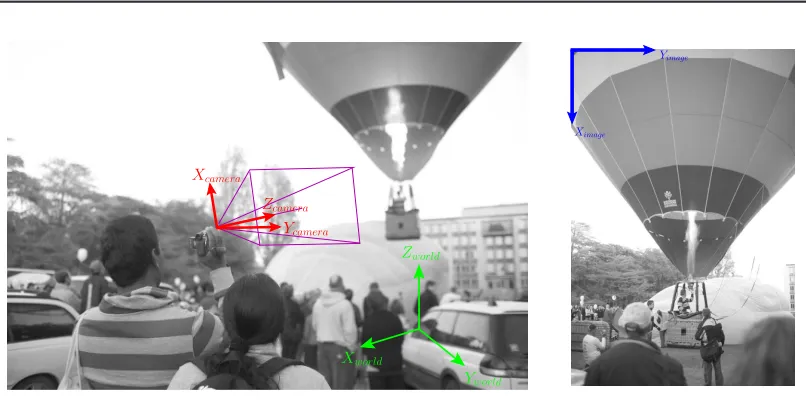
Figure 2.2: (a) The camera coordinate system (indicated in red) is represented by the basis vectors Xcamera,YcameraandZcamera, and the world coordinate system (indicated in green) is represented by the basis vectors Xworld, Yworld andZworld in 3D space. (b) The image coordinate system is represented by two vectorsXimageandYimagein 2D space.
the world. Hence, the positions of all points and cameras can be represented by an identical
measurement unit such as “metre”. The second system is the camera coordinate system, in
which the positions of the points are based on the viewpoints of the cameras inIP3. It should
be noted that a point in space can be expressed both in the world coordinate system and in the
camera coordinate system. The final coordinate system is the image coordinate system, which
is specifically used to define the coordinates of pixels in images. Unlike the first two coordinate
systems, the image coordinate system is inIP2. The image coordinate system uses “pixels” as
the unit of measurement.
Figure 2.2 shows the three coordinate systems. In Figure 2.2(a), we observe that the person
holding the camera is taking a picture of a balloon. A camera has its own two-dimensional
(2D) coordinate system for images. This 2D coordinate system is shown in Figure 2.2(b). The
camera is positioned with respect to a reference point in the world coordinate system. The
position of the balloon in the air can also be defined with respect to the reference point in
the world coordinate system. Therefore, the positions of the camera and balloon (structure)
§2.1 Geometry of cameras 9
coordinate system (indicated in red) is positioned at the centre of the camera and points toward
the object of interest.
2.1.1 Projection of points by a camera
If we assume that thez-axis of the camera is aligned with thez-axis of the world coordinate
system, and the two coordinate systems are placed at the origin, then the camera projection
matrix can be represented by a3×4matrix as follows:
P= [I|0] (2.1)
whereIis a3×3identity matrix.
Let a 4-vectorXcambe a point in space andXcambe represented in the camera coordinate
system. Then,Xcammay be projected onto the image plane of the camera through a lens. The
image plane uses a 2D image coordinate system, as shown in Figure 2.2(b). Therefore, the
projected pointxis represented as a 3-vector inIP2and can be denoted as follows:
x= [I|0]Xcam (2.2)
It should be noted thatxstill uses the same unit (say “metre”) as that of the world
coordi-nate system in (2.2). However, as we are dealing with images, this unit needs to be converted
to a pixel unit. Most digital cameras have a charge-coupled device (CCD) image sensor that
is only a few millimetres in size. For instance, the Sony ICX204AK1is a6-mm(= 0.24in)
diagonal, interline CCD solid-state image sensor with a square pixel array, and it has total of
1024×768active pixels. The unit cell size of each pixel is4.65µm×4.65µm2. Therefore, the units needed to be converted in order to obtain the coordinates of a pixel in the image. For
instance, in Sony ICX204AK CCD sensors, the size of a pixel is4.65×10−6
metres. Hence,
this value is multiplied by1/(4.65×10−6
)in order to convert the unit from metres to pixels.
It is also necessary to consider other parameteres such as the focal length, the principal
1Sony ICX204AK technical document [33]
21
§2.1 Geometry of cameras 10
points where the optical axis meets the image plane, and the skewness of the image sensor. All
these parameters are included in a3×3matrix, which is termed a “calibration matrix”. The
calibration matrix may be added in (2.2) and it is given as follows:
x=K[I|0]Xcam (2.3)
whereKhas focal lengthsfxandfy, and the skew parameters, and it is defined as
K=
fx s 0
0 fy 0
0 0 1
. (2.4)
The units of the focal lengthsfxandfyshould be converted from metres, the unit of the world
coordinate system, to pixels, the measurement unit of images.
2.1.2 Rigid transformation of points
A rigid transformationMof a pointXinIP3is given as follows:
X′ =MX, (2.5)
whereMis a4×4matrix used for transformation andX′is the position ofXafter transforma-tion ofX. This transformation may be considered to represent the pointXafter rotation and
translation. Thus, (2.5) may be rewritten as follows:
X′=
R −Rt
0⊤ 1
X, (2.6)
whereRis a3×3rotation matrix andtis a 3-vector translation. Please note that the pointX
is translated bytfirst and then rotated byRwith respect to the world coordinate system. This
§2.1 Geometry of cameras 11
y
X
′X
R
,
t
x
z
Figure 2.3: Rigid transformation of a point. A pointXis moved to a different positionX′by a rigid motion comprising rotationRand translationt.
2.1.3 Rigid transformation of cameras.
Let us now consider the rigid transformation of the coordinates of a camera, as shown in
Fig-ure 2.4. The camera is placed in the world coordinate system, so its coordinate transformation
has rotation and translation parameters similar to the transformation of points.
A camera aligned with the axis of the world coordinate system at the origin is represented
by a3×4matrix as follows:
P= [I|0], (2.7)
whereIis a3×3identity matrix.
If the camera is positioned at a pointc, the camera matrix is represented as follows:
P=
1 0 0 −cx
0 1 0 −cy
0 0 1 −cz
, (2.8)
where the vectorc= [cx, cy, cz] ⊤
is the centre of the camera. The left3×3submatrix inPis
not changed because the camera is still aligned with the world coordinate system.
§2.1 Geometry of cameras 12
c
X
y z x
x′
y′ z′
R, t
c′
Figure 2.4: Rigid transformation of a camera. A camera atcis moved to a positionc′ by a rigid motion comprising rotationRand translationt.
positioned camera matrix can be represented as follows:
P=R[I| −c] = [R| −Rc] = [R|t], (2.9)
wheret=−Rcis a vector represented by the translation3.
In particular, note that the camera is first translated by t and is then rotated by R with
respect to the world coordinate system. Finally, the camera is positioned atc. A pointXin
IP3is projected onto an image pointvinIP2by the camera matrixPas follows:
v=PX=R[I| −c]X, (2.10)
where v is a 3-vector in IP2 and is represented in the image coordinates. Hence, v can be
considered as an image vector originating from the centre of the camera to the pointX. IfX
is displaced by the motion matrixM, then the projection ofXis also displaced as follows:
v′ =PMX=R[I| −c]MX. (2.11)
3The vectortis also called a translation in other articles. However, probably it is more reasonable to definecas
a translation instead oftbecause it is more relevant to our geometrical concepts. For better understanding, in this
§2.2 Epipolar geometry of two views 13
Instead of moving X, let us imagine that the camera is moved to make the position of the
projected point the same as that ofv′. Therefore, from (2.11), the matrixP′of the transformed camera matrix is written as:
P′ =PM=R[I| −c]M. (2.12)
Let us consider two rigid transformations M1 and M2. Let the transformations be applied
in the orderM1 andM2 to a point X. The transformed point is denoted as X′ = M2M1X. In the same way, the transformed camera matrix can be given byP′ =PM2M1 instead of moving points.
2.2
Epipolar geometry of two views
In this section, we revisit the geometry of single-camera systems used to capture two images
from two different locations and also re-introduce methods to estimate the relative motion of
a camera between two views. In the following section, we distinguish between two terms
“views” and “cameras” in order to better understand multi-camera systems.
2.2.1 Definitions of views and cameras
Views. Views are defined as images taken by a single camera at different locations. As the
same camera is used, each view has the same image size and the same calibration parameters.
The phrase “two views”, implies that physically a single camera device is used to capture two
images from two different positions in space. On the other hand, the phrase “multiple views”
(saynviews) implies that physically a single camera device is used to capture multiple images,
which form a single image sequence, fromndifferent positions.
Cameras. Cameras are physical devices used to capture images. The image sizes and
cal-ibration parameters vary from camera to camera. Even if the cameras are identical and are
manufactured by the same company, they may have different focal lengths and/or different
principal points. The cameras may be located in the same positions while capturing images
§2.2 Epipolar geometry of two views 14
refers to two physically separated camera devices that are used together to capture two image
sequences. The phrase “multiple cameras” implies thatncamera devices are used together to
capture nimage sequences. Therefore, the phrase “3 views of 4 cameras”, means that four
cameras are used to capture four image sequences from three different positions (a total of 12
images).
2.2.2 History of epipolar geometry
The history of epipolar geometry is closely connected to the history of photogrammetry. The
first person to analyze geometric relationships was Guido Hauck in 1883 [28]. In his article
published in “Journal of Pure and Applied Mathematics”, he used the German term Kernpunkt
(epipole) as follows [28]:
Es seien (Fig. 1. a)S′ undS′′
zwei Projectionsebenen,O1undO2die zugeh¨origen
Projectionscentren. Die Schnittlinieg12 der zwei Projectionsebenen nennen wir
den Grundschnitt. Die VerbindungslinieO1O2m ¨oge die zwei Projectionsebenen
in den Punkteno′
2undo
′′
1 schneiden, welche wir die Kernpunkte der zwei Ebenen
nennen.
The English translation may be as given below:
LetS′
and S′′
be two projection planes, and O1 and O2 the corresponding
pro-jection centres (Fig. 1. a). We will call the intersection line of the two propro-jection
planes the Grundschnitt (basic cut). Let the line joiningO1O2cuts the two
projec-tion planes in the pointso′
2 ando
′′
1, which we will call the Kernpunkte (epipoles)
of the two planes.
Figure 2.5 shows the epipolar geometry and the two epipoles (Kernpunkte) o′′
1 ando
′
2, as
illustrated by Guido Hauck in his paper [28].
Epipolar geometry was studied first by German mathematicians and was introduced to the
English in the first half of the 20th century. As pointed out by J. A. Salt [65] in 1934, most of the
§2.2 Epipolar geometry of two views 15
Figure 2.5: Illustrations from Guido Hauck’s paper (Courtesy of wikipedia.org. The copyright of the
image has expired).
presented the first comprehensive description of how to determine the epipole in his Ph.D.
thesis [84]. In 1934, a German book entitled “Lehrbuch der Stereophotogrammetrie (Text book
of Stereophotogrammetry)” by Baeschlin and Zeller was published [3], and it was translated
into English in 1952 by Miskin and Powell with the title “Text book of Photogrammetry” [88].
It was the book that introduced English equivalent terms such as epipoles and epipolar planes.
The usage of the words related to epipolar geometry in photogrammetry is somewhat
dif-ferent from their usage in computer vision because it is assumed that aerial photographs are
used in phogrammetry. However, the essential meaning of the words is the same. According
to the glossary in the “Manual of Photogrammetry”. The terms epipoles, epipolar plane and
epipolar ray are defined as follows [70]:
epipoles – In the perspective setup of two photographs (two perspective
projec-tions), the points on the planes of the photographs where they are cut by the
air base4 (extended line joining the two perspective centers). In the case of a pair
4air base (photogrammetry) – The line joining two air stations, or the length of this line; also, the distance
in-§2.2 Epipolar geometry of two views 16
of truly vertical photographs, the epipoles are infinitely distant from the principal
points.
epipolar plane – Any plane which contains the epipoles; therefore, any plane
containing the air base. Also called basal plane.
epipolar ray – The line on the plane of a photograph joining the epipole and
the image of an object. Also expressed as the trace of an epipolar plane on a
photograph.
The concept of an essential matrix in computer vision is also related to that in photogrammetry.
In 1959, Thompson first presented an equation composed of a skew-symmetric matrix and an
orthogonal matrix to determine the relative orientation in photogrammetry [81]. In 1981, in
computer vision, Longuet-Higgins was the first to introduce a3×3matrix similar to that in
Thompson’s equation. This matrix was later termed an essential matrix and was used to explain
the relationships between points and the lines corresponding to these points in the two views
[46].
Following this, several studies were made to derive methods to determine the relative
ori-entation and translation of the two images. In 1991, Horn presented an iterative algorithm to
estimate the relative orientation [31]. In 1997, Hartley presented a linear algorithm known as
the “normalized 8-point algorithm” to estimate the fundamental matrix, which is the same as
the essential matrix except in this case, the cameras are not calibrated [25]. In 1996, Phillip [59]
introduced a linear method for estimating essential matrices using five point correspondences,
and it obtains the solutions by finding the roots of a 13th-degree polynomial. In 2004, Nister
improved on Philip’s method by finding the roots of a 10th-degree polynomial [57]. In 2006,
Stew´enius presented a minimal 5-point method that uses five matching pairs of points and finds
§2.2 Epipolar geometry of two views 17
Figure 2.6: Intuitive illustration of epipolar geometry.
2.2.3 Interpretation of epipolar geometry
In this section, we first present a simple illustration of epipolar geometry, as shown in
Fig-ure 2.6, before defining its mathematical equations. Let us imagine that there are two persons,
a lady and a gentleman, playing with a ball. From the viewpoint of the gentleman, he can see
both the ball and the lady. Although his eye is directly focused on the ball, both the image of
the ball and the lady are projected onto the retina of his eyes. Now, suppose we draw a line
from the eye of the lady to the ball. He can now perceive the ball, the eye of the lady and the
line. In epipolar geometry, the eye of the lady observed by the gentleman is called an epipole.
In addition, the line seen by the gentleman is known as an epipolar line. The epipolar line
cor-responds to the image of the ball seen by the lady. In the same way, considering the viewpoint
of the lady, the gentleman’s eye perceived by the lady is called an epipole. If we draw a line
from the eye of the gentleman to the ball, the line observed by the lady is another epipolar
line. Therefore, given an object in two views, we have two epipoles and two epipolar lines. It
is apparent that the ball, the eye of the gentleman and the eye of the lady form a triangle that
lies in a single plane. In other words, they are coplanar. In epipolar geometry, this property is
known as the epipolar constraint, and it yields an epipolar equation that is used to construct an
§2.2 Epipolar geometry of two views 18
essential matrix.
2.2.4 Mathematical notation of epipolar geometry
Epipolar geometry is used to explain the geometric relationships between two images. The two
images are captured by a single camera that is shifted from one place to another, or they can be
captured by two cameras at different locations. Assuming that the cameras are calibrated, the
epipolar geometry can be represented by a3×3matrix, which is called an essential matrix.
The essential matrix describes the relationships between the pairs of matching points in the
two images.
Letvandv′be points in the first image and in the second image, respectively, that form a matching pair. Without loss of generality, let us assume that a single camera is used to capture
the two images, hence, although the camera moves from one position to another, its intrinsic
parameters such as the focal length and principal points remain the same.
2.2.4.1 Pure translation (no rotation) case
If we assume that the motion of the camera is translational as it shifts between two positions
to capture two images, the essential matrix E, which is used to explain the relationships
be-tween point correspondence vand v′, becomes the simple form of a skew-symmetric matrix as follows:
v′⊤Ev = v′⊤[t]×v
= v′⊤(t×v)
= v⊤(v′×t)
= t⊤(v×v′)
=
t1 v1 v′1
t2 v2 v′2
t3 v3 v′3
§2.2 Epipolar geometry of two views 19
v′
t
c2
c1
X
v
(a) Pure translation to the side
t X
c2
c1 v′
v
(b) Pure translation forward
Figure 2.7: Epipolar geometry for a pure translational motion. The camera (indicated in red) at
positionc1moves to positionc2(indicated in blue) by pure translation indicated byt. A 3D pointX
is projected to image pointsvandv′in the first and second view, respectively. The three vectorsv,v′
andtare on an epipolar plane.
wheretis the translation of the camera and[a]×is a skew-symmetric matrix of any 3-vector
a. The translation vectort and the matching pairs of pointsvand v′ can be written ast =
(t1, t2, t3)⊤,v= (v1, v2, v3)⊤andv′ = (v1′, v
′
2, v
′
3)
⊤ .
Equation (2.13) is in the form of a scalar triple product of three vectors, v, v′ and t, but it is nothing more than a coplanar constraint on the three vectors. As shown in Figure 2.6,
the triangle is formed by three line segments joining three points such as the lady’s eye, the
gentleman’s eye and the ball. This triangle should lie in a single plane. There are three
coor-dinate systems in this situation. The first two coorcoor-dinate systems are 2D coorcoor-dinate systems
used by the two images taken by the camera. The third coordinate system is the world
coor-dinate system, which shows the position of the two cameras (viewpoints of the two persons)
and the ball. Because there is no rotation in this particular pure translation case, the directions
of these three vectors are not affected by other coordinate systems. Therefore, it is simply a
coplanar condition for three vectors to lie on a plane. The plane is called an epipolar plane in
the epipolar geometry.
As shown in Figure 2.7, the vector vis a projected image vector of a 3D pointXin the
first viewc1. The vector v′, corresponding tov, is a projected image vector of the 3D point Xin the second viewc2. The translation vectortis the same as the displacement of camera
§2.2 Epipolar geometry of two views 20
v
′2v
3′v
3v
′1v
1v
2(a) Pure translation to the side
e
v
′1v
′3v
′2v
2v
3v
1 [image:33.612.257.382.317.440.2](b) Pure translation to the forward
Figure 2.8: Overlapped image vectorsviandv′ion an image. (a) The vectors are parallel for sideways translational motion. (b) The vectors coincide at an epipoleefor forward motion.
v′1
v1
v′2
v2
e
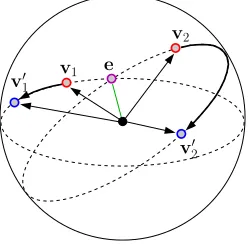
Figure 2.9: Image vectors on a sphere with an epipoleefor a pure translation.
is in the epipolar plane containing the two image vectors v and v′. Therefore, a great cirle (plane) joiningvandv′also contains the translation direction vectort.
We now define a property of pure translational motion. Suppose the image vectorsviand
v′i overlap, as shown in Figure 2.8. Then, for sideways translational motion, the overlapped image vectorsviandv′i will be parallel. On the other hand, in the case of forward motion,vi andv′iwill meet at a single point. This point is the same as the epipole in the first view.
In other words, this property can also be explained as follows. Suppose the image vectors
v and v′
are on a sphere, as shown in Figure 2.9. The image vectors vand v′
join a plane
(great circle). If there are more than two pairs of matching points such as vi and v ′
i, where
i = 1, . . . , n, and n is the number of point correspondences, then the intersection of these
§2.2 Epipolar geometry of two views 21
v′
2
v2
v′
1
[image:34.612.255.379.113.267.2]v1
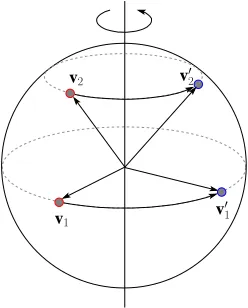
Figure 2.10: Image vectors on a sphere for the pure rotation case.
to estimate the relative orientation of two views.
2.2.4.2 Pure rotation (no translation) case
If the motion of the camera is purely rotational when the two images are captured by the
camera, the geometric relationships ofvandv′can be represented as a simple rotation about an axis, as shown in Figure 2.10.
2.2.4.3 Euclidean motion (rotation and translation) case
If the motion of the camera is both rotational and translational, a general form of the essential
matrixEfor a pair of matchings pointsvandv′may be written as follows5:
v′ ⊤Ev = v′ ⊤[t]×Rv (2.14)
= v′ ⊤R[R⊤t]×v (2.15)
= v′ ⊤R[c]×v, (2.16)
whereRis a relative rotation matrix andtis a translation direction vector. This can be explained
as rotating the image vectorvin the first view byRin order to align the image plane in the first
view with that in the second view. After all,Rvis the image vector in the first image rotated
into a coordinate system of the second camera.
5
§2.2 Epipolar geometry of two views 22
Rv
c1 e e′ c2
R
X
v′ v
Figure 2.11: Alignment of the first view (indicated in red) with the second view (indicated in blue) in
order to make the two views the same as those in the pure translation case. The virtually aligned view is marked as purple.
As shown in Figure 2.11, on aligning the image planes, the two image planes become
parallel, resulting in a situtation that is similar to the pure translation case. Instead of using the
vectorv, a rotated image vectorRvcan be used as the vector corresponding to the image vector
v. Because the aligned view (indicated in purple) is parallel to the second view (indicated in
blue) as shown in Figure 2.11, the image point vectors v′ and Rv also satisfy the epipolar co-planar constraint as follows:
v′⊤[t]×(Rv) = 0. (2.17)
2.2.4.4 Essential matrix from two camera matrices
Let the two camera matrices beP= [I|0]andP′= [R| −Rc] = [R|t], whereRis the relative orientation,cis the centre of the second view andt=−Rcis a translation direction vector. As
explained in the previous section, for a given pair of matching points, vandv′, the essential matrix may be written from the two camera matrices as follows:
v′⊤Ev=v′⊤[t]×Rv= 0. (2.18)
§2.2 Epipolar geometry of two views 23
For a general form of two camera matrices such asP1 = [R1 | −R1c1]andP2 = [R2| −
R2c2], the essential matrix from the general form of two camera matrices may be written as
follows:
v′⊤Ev=v′ ⊤R2[c1−c2]×R
⊤
1v= 0. (2.19)
It can be derived from (2.18) by multiplying a4×4matrix with the camera matricesP1and
P2as follows:
P1H = [R1 | −R1c1]
R⊤
1 c1
0⊤ 1
(2.20)
= [I|0] (2.21)
and
P2H = [R2 | −R2c2]
R⊤
1 c1
0⊤ 1
(2.22)
= [R2R⊤
1 |R2c1−R2c2] (2.23)
= R2R⊤
1[I|R1(c1−c2)]. (2.24)
From (2.21) and (2.24), the essential matrix can be constructed as follows:
E = [R2(c1−c2)]×R2R ⊤
1 (2.25)
= R2[c1−c2]×R⊤
1 . (2.26)
2.2.4.5 Fundamental matrix
The fundamental matrix is basically the same as the essential matrix except that a calibration
matrix is not considered. When calibrated cameras are given, point coordinates in images
are represented in pixel units. However, if we assumme that the cameras are calibrated, we
can eliminate the pixel units by multiplying the inverse of the calibration matrix with the
§2.2 Epipolar geometry of two views 24
directional vectors to the corresponding 3D points. Given calibrated cameras and directional
vectors of the image points, the essential matrix can be easily obtained. On the other hand, if
uncalibrated cameras and pixel coordinates of the image points are provided, we can obtain the
fundamental matrix. Simply, given a point correspondencexandx′ in pixel units, because of the presence of directional image vectorsv =K−1xandv′ =K−1x′, whereKis a calibration of the camera, the fundamental matrixFmay be written as follows:
v′⊤Ev= (K−1x′)⊤E(K−1x) =x′⊤K−⊤EK−1x=x′ ⊤Fx. (2.27)
Therefore,F=K−⊤EK−1.
Elements of the fundamental matrix Given a fundamental matrixF, its elementsFij may
be written as
F=
F11 F12 F13
F21 F22 F23
F31 F32 F33
. (2.28)
For this F, a pair of matching points x = (x1, x2, x3)⊤and x′ = (x′
1, x
′
2, x
′
3)
⊤
; hence, the
equation of epipolar constraints can be given as
(x′
1, x
′
2, x
′
3)F(x1, x2, x3)⊤= 0. (2.29)
The coefficients of the termx′
ixjin (2.29) correspond to the elements ofF. These elements of Fcan be determined from two camera matrices and the position of a 3D point using a bilinear
constraint, which will be explained in the following paragraphs.
Bilinear constraints Let A and B be two camera matrices. Then, a 3D point X can be
§2.2 Epipolar geometry of two views 25
non-zero scalar values. These two projections ofXmay be written as
A x 0
B 0 x′
X −k
−k′
=0. (2.30)
If we rewrite (2.30) using the row vectors of the matricesAandB, and the elements ofxandx′, we can determine the elements of the fundamental matrixF. Suppose the two camera matrices
are A= a⊤ 1 a⊤ 2
a⊤3
(2.31) and B=
b⊤1 b⊤2 b⊤3
, (2.32)
then, (2.30) is written as
a⊤1 x1
a⊤2 x2
a⊤3 x3
b⊤1 x′
1
b⊤2 x′
2 b⊤ 3 x ′ 3 X −k
−k′
=D X −k
−k′
=0. (2.33)
From the above equation (2.33), the coefficient of the termx′
ixj is determined by
eliminat-ing two rows and the last two columns of the matrixD, and by calculating the determinant of
§2.3 Estimation of essential matrix 26
as follows:
Fji = (−1)i+jdet
∼a⊤i
∼b⊤j
(2.34)
where∼ a⊤i is a2×3 matrix created after omitting thei-th rowa⊤i from the matrix Aand ∼b⊤i is a2×3matrix is created after omitting thei-th rowb⊤i from the matrixB. Equation
(2.34) is called a “bilinear relation” for two views. The relations for three and four views are
known as trilinear relations and quadlinear relations, respectively.
2.3
Estimation of essential matrix
2.3.1 8-point algorithm
Longuet-Higgins was the first to develop the 8-point algorithm in computer vision, which
estimates the essential matrix using 8 pairs of matching points across two views [46]. Unlike
Thompson’s iterative method using 5 point correspondences [81], which solves five third-order
equations iteratively, the 8-point method directly obtains the solution from linear equations.
Given the point correspondences v = (v1, v2, v3)⊤ and v′ = (v′1, v
′
2, v
′
3)
⊤
, the 3 ×3
essential matrixEcan be dervied as follows:
v′⊤Ev= (v′
1, v
′
2, v
′ 3)
E11 E12 E13
E21 E22 E23
E31 E32 E33
v1 v2 v3
§2.3 Estimation of essential matrix 27
A linear equation may be obtained from (2.35) as follows:
(v′1v1, v
′
1v2, v
′
1v3, v
′
2v1, v
′
2v2, v
′
2v3, v
′
3v1, v
′
3v2, v
′
3v3)
E11 E12 E13 E21 E22 E23 E31 E32 E33
= 0. (2.36)
It can be observed that equation (2.36) has nine unknowns parameters. However, if we assume
that the value of last coordinate of the matching points is one, for example,v3 = 1and v′3 = 1, the equation has eight unknowns to be solved. Therefore, as there are eight independent
equations for eight pairs of matching points, equation (2.36) can be solved directly.
In order to determine the relative orientation and translation of the camera system from the
estimated essential matrix, Longuet-Higgins proposed a method wherein the translation vector
can be obtained by multiplying the transpose of the essential matrix with (2.18) as follows:
EE⊤ = ([t]×R)([t]×R) ⊤
(2.37)
= ([t]×RR
⊤
[t]⊤× (2.38)
= [t]×[t]
⊤
×. (2.39)
If we perform the trace ofEE⊤, it becomes Tr(EE⊤) =Tr([t]×[t]⊤×) = 2||t||2. By assumingt to be a unit vector, i.e.,||t||= 1, the trace ofEE⊤can be given as
Tr(EE⊤) = 2. (2.40)
Therefore, the essential matrix E can be normalized by dividing it by
q
1
2Tr(EE
⊤
§2.3 Estimation of essential matrix 28
obtaining the normalized essential matrix, the direction of the translation vectortis determined
using the main diagonal ofEE⊤as follows:
EE⊤=
t23+t22 −t2t1 −t3t1
−t2t1 t23+t21 −t3t2
−t3t1 −t3t2 t22+t21
=
1−t21 −t2t1 −t3t1
−t2t1 1−t22 −t3t2
−t3t1 −t3t2 1−t23
, (2.41)
wheret21 +t22+t23 = 1because t is a unit vector. From the main diagonal ofEE⊤, we can obtain three independent elements of the translation vectort. However, the scale oftcannot
be determined.
In order to find a relative orientation, Longuet-Higgins used the fact that each row of the
rotation matrix is orthogonal to each row of the essential matrix. Let us suppose qi and ri
are thei-th column vectors of the essential matrixEand the rotation matrixRcontained inE,
respectively. They may be written as
E=
q1 q2 q3
(2.42)
and
R=
r1 r2 r3
. (2.43)
Then, because [a]×b =a×bsatisfies for any 3-vectoraandb, we can derive the following relations from (2.18) as follows:
qi=t×ri, (2.44)
whereqiis thei-th column vector of the essential matrixE, andriis thei-th column vector of
the rotation matrixR, wherei= 1, . . . ,3.
Because ri is orthogonal to qi and is coplanar with t, the vector ri can be written as a
linear combination ofqiandqi×t. If we define a new vectorwi=qi×t, then
§2.3 Estimation of essential matrix 29
whereλiandµiare any scalar values. Here, the unknown scalarµiis determined to beµi= 1
by substituting (2.45) into (2.44) as follows:
qi = t×ri (2.46)
= t×(λt+µiwi) (2.47)
= µi(t×wi) (2.48)
= µit×(qi×t) (2.49)
= µiqi. (2.50)
Because the rotation matrixRis an orthogonal matrix, the cross products of any two column
vectors ofRare the same as the elements of the remaining column vector ofR. For example,
r1 =r2×r3. Therefore, from (2.46), (2.45) andµ= 1, we obtain
r1 = r2×r3
λ1t+w1 = (λ2t+w2)×(λ3t+w3)
= (λ2t+w2)×(λ3t+w3)
= λ2λ3t×t+λ2t×w3+λ3w2×t+w2×w3
= λ2(t×w3)−λ3(t×w2) +w2×w3
= λ2q3−λ3q2+w2×w3
= λ2q3−λ3q2+ (q2×t)×(q3×t)
= λ2q3−λ3q2+det(q2t t)q3−det(q2t q3)t
= λ2q3−λ3q2+q⊤2(t×t)q3−q⊤2(t×q3)t
= λ2q3−λ3q2−q
⊤
2(t×q3)t.
Because w1, q3 and q4 are all orthogonal to t and the last term on the right in (2.51) is a
multiple oft, the above equation becomes
λ1t=−q
⊤
§2.3 Estimation of essential matrix 30
On substituting the above equation into (2.45), we obtain the final equation of each column
vector of the roation matrixRas follows:
r1 = w1+w2×w3 (2.52)
r2 = w2+w3×w1 (2.53)
r3 = w3+w1×w2. (2.54)
Although we have estimated the relative orientation and translation using 8 pairs of
match-ing points, there are four possible solutions if we consider signs of the orientations and
trans-lations. In order to identify the signs, Longuet-Higgins proposed a 3D-point reconstruction
method and determined the signs of the translation and rotation on the basis of the values of
the last coordinates of the reconstructed 3D points. If the values of the last coordinates of a
pair of 3D points are negative, then the sign of the translation changes. If the values of the last
coordinates of the 3D points are opposite in sign to each other, then the sign of the rotation is
reversed.
2.3.2 Horn’s nonlinear 5-point method
Horn proposed a method to determine the relative orientation (rotation) and baseline
(transla-tion) of the motion of a camera system using 5 pairs of matching points across the two views
[30]. The rotation of the first camera coordinate system with respect to the second camera is
known as the relative orientation. There are five unknowns parameteres – 3 for rotation and 2
for translation – in the essential matrix.
Given a pair of matching pointsvand v′,Rvis the image vector in the first view rotated into the coordinate system of the right view (or camera), whereRis the relative rotation with
respect to the other view. For these two views, there is a coplanar condition, known as the
epipolar constraint, for the image vectorsRv,v′and the translation vectortas follows: