IJSRSET1738225 | Received : 11 Dec 2017 | Accepted : 31 Dec 2017 | November-December-2017 [(3) 8 : 957-961]
© 2017 IJSRSET | Volume 3 | Issue 8 | Print ISSN: 2395-1990 | Online ISSN : 2394-4099 Themed Section : Engineering and Technology
957
Review of Automatic Generation Control in Restructured
Environment
Manjeet Singh Hooda
*, Pardeep Nain
Electrical Engineering Department, OITM Hisar, Haryana, India
ABSTRACT
This paper, presents critical literature review and an up-to-date and exhaustive bibliography on the AGC of power systems. Various control aspects concerning the AGC problem have been highlighted. AGC schemes based on parameters, such as linear and nonlinear power system models, classical and optimal control, and centralized, decentralized, and multilevel control, are discussed. Electric deregulation is the process of changing rules and regulations that control the electric industry to provide customers the choice of electricity suppliers who are either retailers or traders by allowing competition. Deregulation improves the economic efficiency of the production and use of electricity.
Keywords: AGC, AEC, Tie-Line, ISO, Bilateral Contracts, DPM, Restructured Power System
I.
INTRODUCTION
Now-a-days the requirement is to maintain a certain power system at a desired level according to frequency, voltage profile, load flow configurations. This can be done by regulating the active and reactive power generated in the system. This is done to avoid the mismatch between the generation and the load variations. Automatic Generation Control (AGC) is one of the most important issues in electric power system design and operation. The objective of the AGC in a power system is to maintain the frequency of the area. If interconnected power system is considered then the tie-line power is to be kept close to the scheduled values by adjusting the MW outputs the AGC generators so as to accommodate fluctuating load demands.
Automatic Generation Control (AGC) is a very important issue in power system operation and control for supplying sufficient and reliable electric power with good quality. AGC with load following is treated as an ancillary service that is essential for maintaining the electrical system reliability at an adequate level. The main objectives of the AGC in multi-area restructured power system [1] are maintaining zero steady state errors for frequency deviation and accurate tracking of load contracts demanded by DISCOS. In addition, the power system should fulfill the requested dispatch
conditions. In an open energy market, generation companies (GENCOs) may or may not participate in the AGC task. On the other hand, a distribution company (DISCOs) may contract individually with a GENCO or independent power producers (IPPs) for power in its area or other areas. Currently these transactions are done under the supervision of the independent system operator (ISO). The values of GENCOs participations and tie-line power exchanges are computed by some unique equations proposed by the authors and then validated by
II.
RESTRUCTURED POWER SYSTEM
Due to competition in the electric industry, the power prices are likely to come down which benefits the consumers.
The main objectives of the deregulated power market: To provide electricity for all reasonable
demands.
To encourage the competition in the generation and supply of electricity.
To improve the continuity of supply and the quality of services.
The important concepts of deregulation are:
Competition: The competition is at two levels in deregulated power industry: Wholesale (generation) and retail (distribution).
Deregulation: The rules governing the electric power industry are changed. The new structure introduces competition into the market, in place of a few large regulated companies.
Open Access: In deregulation of power system the Independent Power Producers (IPP) are permitted to transmit the power using utility transmission and distribution systems.
The benefits associated with deregulation are: Systems capacity will be used efficiently. Optimization of energy supply will takes place. Price of the electricity will become clearer. Consumer choice will be improved.
Bad technologies are ignored and good technologies are replaced in their place.
Electricity prices are reduced.
The usage efficiency is improved due to restructuring in price signals.
Power flow will takes place from surplus areas to shortage areas.
The cost of ancillary services is reduced by reserve sharing.
In the deregulation process, some new entities are expected to appear and hold major rules in power industry. The structural components representing various segments of the electricity market are:
Generation Companies (GenCos.) Transmission Companies (TransCos.) Distribution Companies (DisCos.) Independent Power producer (IPP) Independent System Operator (ISO) Power Exchange (PX)
Retail Energy Service Companies (RESCos.)
Figure1. Deregulated power utility structure
In the deregulated electricity market, increased infrastructure utilization increases capital returns and increased competition increases economic energy transactions. Due to introduction of less costly sources, there will be new power flow patterns. New transmission difficulties will be created and some existing transmission constraints will be binding more often and with more economic significance. The interconnections are used at their capacity due to increased interchanges in power markets. This reality has brought into focus the practical limitations of interconnections and the associated problem of transfer capability. All these issues will have to be considered when transmission planning for a project is undertaken.
Figure 3.1 explains the transition process from regulated industry to a deregulated one.
The word “deregulation” is relatively new to most of the countries. Due to the fact that it had only been in place in the power market for the past decade, and with the limited number of countries experiencing it, it is yet to be seen whether it is an opportunity or threat to the market. It can be a trend that is beneficial to one country and create problems for another. Constant review and monitoring of all the different markets is done to track the advancement of the power market. Up to date, the future of the market looks encouraging meeting the aims of deregulation.
III.
ORGANIZATION MODELS OF POWER
UTILITY RESTRUCTURING
Electric energy can be separated commercially as a product from transmission as a service. In past, electricity viewed as a product used only at the point of delivery and pain for in a single tariff. In recent 45 years, restructuring and reengineering of power industry is taking place in several countries. The possible organizations differ with different functions of electric supply, namely Generation (G), Transmission (T) and Distribution (D) to the Customers (C). The functions can be any of the following: A).Vertically integrated, B).Integrated model, C).Open access model, D).Retail competition model, E).Spot market model, and F).Decentralized generator model.
A). Vertically Integrated: The vertically integrated model is also termed as „monopoly at all levels‟. In this type of model, generation not subjected to competition and there is no choice of suppliers. A single company has monopoly of producing electricity and delivering it over the transmission network to distribution companies or customers. In a vertically integrated organization, the generation, transmission and distribution controlled by one utility.
B). Integrated Model: In this model, the generation and transmission functions are strongly coordinated on a long term basis. The generation and transmission entities are integrated or at least have cross ownership. The distribution can also be integrated to the generation-transmission utility. There exists a competitive integrated model where generation is open to competition, but independent power producers or Non-Utility Generators (NUG) have no access to the grid and can only sell to the utility to which they are connected on long-term contact basis. It is also termed as „purchasing agency model‟. A single buyer (purchasing agency) chooses from a number of different generators to encourage competition in generation. Access to transmission is not permitted. Purchasing agency has monopoly on transmission network. A designated purchasing agency is allowed to buy from independent power producers. This introduces competition in power generation. This model avoids some costs of deregulated system: transaction costs of spot markets and transmission access, increased cost of capital when generators bear technology risk. It usually requires
long-term contracts between the buyer and the independent power producers.
C). Open Access Model: In this, the integrated utilities exists but provision must be provided for grid access to independent power producer on non-utility generator either by wholesale wheeling where generators have a right to sell to other utilities (but not directly to consumers) generally on long term basis. This type of model is also termed as „wholesale competition model‟. Distribution or retail companies buy electricity directly from producer and deliver it over a transmission network. Distribution and retail companies still have monopoly over final consumers. There is open access to transmission lines. Distribution and retail companies authorized to buy directly from competing generators, but retain local franchise over retail customers. Generators must have access to transmission network, requiring trading arrangements for the network. In a wholesale access system, the competition is expanded, where all generators can sell too many customers. More buyers make the market more competitive and dynamic.
D). Retail Competition Model: This type of model is also called as „direct access model‟, where all the customers can choose their own suppliers. There is open access to transmission and distribution lines. The distribution is separate from retail activity and later is competitive retail wheeling. Retail competition makes the most of competitive forces, by bringing all final consumers into the market. Retail competition also greatly increases transaction costs by requiring more complex trade arrangements and metering.
E). Spot Market Model: In this model, the generation and transmission entities are separated, there exists a „spot market‟ organized by the transmission or grid entity under certain regulations where generators and consumers can compare their offers and demands. Spot market is only short term (a day ahead generally), and generators and distributers can have long-term contracts with consumers to generate the stability of prices.
security and quality of power supply, c) To seek private investment, d) To limit environmental consequences, e) To contribute to social and political objectives.
IV.
SPOT PRICE CALCULATION
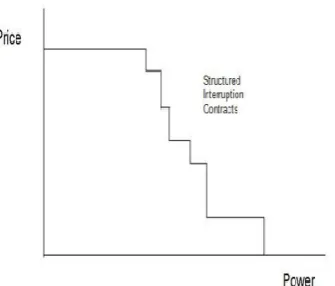
In competitive environment where the price keeps changing, it is determined by stochastic supply and demand functions. As a consequence of increased volatility, a market participant could make trading contracts with other parties to hedge possible risks and get better returns. Overloading transmission lines or transformers results in congestion thereby preventing the system operators from dispatching additional power from a specific generator. Following some reservations or rights prevent congestion to an extent and this guarantees a proficient use of transmission system capacity and also allocates the valued users appropriate transmission capacity. Interruptible contracts are the ones which allow a party to go back on supplying power to other parties over an agreed period for a certain number of times. Changes in power supply give rise to numerous interruptible contracts individually negotiated with various industrial customers. A demand curve developed by the Power Exchange (PX) depends on agreed demand bids for each hour or on a day-ahead basis, starting with the highest and ending at the lowest priced bids. This showcases the demand curves for next day on an hourly basis, each resembling a descending staircase - see Figure 2. Demand curve starts with highest price for un-interruptible power supply followed by reduced prices for different levels of acceptable interruptions.
Figure 2. A typical demand curve showing interruptible contracts
Figure 3. A supply curve showing change in price due to production method
Similarly a supply curve is prepared for each hour of the next day by aggregating supply bids in opposite order to the demand bids i.e. starting with the lowest priced bids from plants such as hydro or 50 nuclear and ending at the highest ones from plants operating on gas and oil. It leads to a supply curve, for every hour of the next day, as an ascending staircase pattern - see Figure 3.
Figure 4. Determination of spot price and required power production
V.
CONCLUSION
In this paper, basic concepts of the deregulation of power system, market power, organization models of power utility restructuring and spot price calculations are discussed.
VI.
REFERENCES
[2]. C. Concordia and L. K. Kirchmayer, "Tie line power and frequency control of electric power systems," Amer. Inst. Elect. Eng. Trans., pt. II, vol. 72, pp. 562-572, Jun. 1953.
[3]. L. K. Kirchmayer, Economic Control of Interconnected Systems. New York: Wiley, 1959. [4]. N. Cohn, "Some aspects of tie-line bias control on
interconnected power systems," Amer. Inst. Elect. Eng. Trans., vol. 75, pp. 1415-1436, Feb. 1957. [5]. "Considerations in the regulation of
interconnected area," IEEE Trans. Power Syst., vol. PAS-86, pp. 1527-1538, Dec. 1967.
[6]. J. E. Van Ness, "Root loci of load frequency control systems," IEEE Trans. Power App. Syst., vol. PAS-82, no. 5, pp. 712-726, 1963.
[7]. G. Quazza, "Noninteracting controls of interconnected electric power systems," IEEE Trans. Power App. Syst., vol. PAS-85, no. 7, pp. 727-741, Jul. 1966.
[8]. R. P. Aggarwal and F. R. Bergseth, "Large signal dynamics of load-frequency control systems and their optimization using nonlinear programming: I & II," IEEE Trans. Power App. Syst., vol. PAS-87, no. 2, pp. 527-538, Feb. 1968.
[9]. O. I. Elgerd and C. Fosha, "Optimum megawatt frequency control of multi-area electric energy systems," IEEE Trans. Power App. Syst., vol. PAS-89, no. 4, pp. 556-563, Apr. 1970.
[10]. N. Cohn, "Techniques for improving the control of bulk power transfers on interconnected systems," IEEE Trans. Power App. Syst., vol. PAS-90, no. 6, pp. 2409-2419, Nov./Dec. 1971.
[11]. H. G. Kwatny, K. C. Kalnitsky, and A. Bhatt, "An