White Rose Research Online URL for this paper: http://eprints.whiterose.ac.uk/74040/
Version: Published Version
Monograph:
Golden, Sarah, O'Donnell, Lisa, Benton, Tom et al. (1 more author) (2006) Evaluation of Increased Flexibility for 14 to 16 Year Olds Programme : Outcomes for the Second Cohort - Research Report. Research Report. DfES Research Reports . Department for Education and Skills (DfES) , Nottingham.
[email protected] https://eprints.whiterose.ac.uk/ Reuse
Items deposited in White Rose Research Online are protected by copyright, with all rights reserved unless indicated otherwise. They may be downloaded and/or printed for private study, or other acts as permitted by national copyright laws. The publisher or other rights holders may allow further reproduction and re-use of the full text version. This is indicated by the licence information on the White Rose Research Online record for the item.
Takedown
If you consider content in White Rose Research Online to be in breach of UK law, please notify us by
Evaluation of Increased Flexibility
for 14 to 16 Year Olds Programme:
Outcomes for the Second Cohort
Sarah Golden, Lisa O’Donnell,
Tom Benton and Peter Rudd
Evaluation of Increased Flexibility
for 14 to 16 Year Olds Programme:
Outcomes for the Second Cohort
Sarah Golden, Lisa OÕDonnell,
Tom Benton and Peter Rudd
National Foundation for Educational Research
The views expressed in this report are the authorsÕ and do not necessarily reflect those of the Department for Education and Skills.
page
Acknowledgements i
Executive summary iii
1. Introduction 1
1.1 Background 1
1.2 Aims and objectives 4
1.3 Research methods 4
2. Achievements of young people participating in the second cohort
of IFP 7
2.1 Introduction 9
2.2 Achievement of IFP qualifications 13
2.3 Total achievement at key stage 4 20
2.4 Achievement of Level 2 by IFP participants 33
2.5 Summary and conclusion 38
3. Post-16 destinations of young people participating in the second
cohort of IFP 41
3.1 Introduction 41
3.2 Location of destination post-16 41
3.3 Factors which appeared to influence progression into further
education or training 44
3.4 Conclusion 48
4. Conclusions 51
Appendix A: Representativeness of respondents 53
Appendix B: Points scores for qualifications 59
Appendix C: Variables included in the multi-level model analyses 61
Acknowledgements
The authors would like to express their sincere thanks to DfES for commissioning the research and particularly to Maura Lantrua, Project Manager, for her expert guidance and support throughout. We are most grateful to the members of the project steering group, in particular Lynda Lawrence and Charles Ritchie from the DfES and Karen Murray from the LSC, for their helpful feedback and guidance in completing the research.
The research team wish to gratefully acknowledge the contribution of the staff in schools and colleges who provided the data on studentsÕ achievements and destinations, on which this report is based. We recognise also the support of the Lead Partners and Local LSCs in supporting the evaluation of the first two cohorts of IFP.
Executive summary
Introduction
The Increased Flexibility Programme for 14 to 16 year olds (IFP) was introduced in 2002. The aim of the programme was to Ôcreate enhanced vocational and work-related learning opportunities for 14 to 16 year olds of all abilities who can benefit mostÕ Ð this included supporting provision of the GCSEs in vocational subjects. The first cohort of Year 10 students embarked on their programme in 2002 and this was followed by a second cohort in 2003 and subsequent cohorts in the following years.
The IFP was the first national programme which formalised partnership working between post-16 and pre-16 education providers to deliver a broader curriculum for young people at key stage 4. Since its inception, the programme has expanded in the context of a continuing focus on improving the curriculum and qualification routes for 14 to 16 year olds and integrating these into a 14-19 framework. Through the IFP, partnerships between colleges and training providers and around 2000 schools have been established along the lines set out in the 14-19 Implementation Plan, and these have continued to develop and mature since the second cohort embarked on their programme.
The DfES commissioned the National Foundation for Educational Research (NFER) to undertake a national evaluation of the first and second cohorts of IFP students, in order to examine the extent to which the aims and objectives of the IFP were being met.
This summary focuses on the outcomes for participants who participated in the programme between 2003 and 2005 (cohort 2) during a time of change in 14 to 19 policy. It should be stressed that this summary reflects the outcomes for only the second cohort of young people to participate in this new and developing approach to delivering a more flexible and vocational curriculum through institutions working in partnership. The evaluation of the second cohort of IFP participants aimed to:
¥ evaluate the extent to which the IFP has fulfilled its national aims, objectives and targets
Key findings
¥ The IFP exceeded its target in so far as the majority of young people made a positive transition. The majority (87 per cent) of young people who participated in the second cohort of IFP progressed into further education or training. This was consistent with the percentage of the first cohort who progressed.
¥ The IFP was also positively associated with the attainment of participants, but this was not consistent across all types of qualifications studied. Young people who took NVQs and GNVQs did better than might be expected, given their prior attainment, while those taking other vocational qualifications1 did less well. Young people taking GCSEs in
vocational subjects achieved at levels broadly commensurate with expectations.
¥ IFP appeared to be particularly advantageous for particular types of
students. Female students gained more points in their IFP qualification
than similar students who were male. However, male students who took NVQs gained more points than female students taking NVQs, once prior attainment and other factors were taken into account. Students with lower attainment at key stage 3 gained higher total point scores at key stage 4, relative to their prior attainment, than similar students with higher key stage 3 attainment.
Outcomes for IFP cohort 2: Achievement of qualifications
Using multi-level model analysis, the research examined the extent to which the IFP met its objectives in relation to the attainment of young people who participated in the programme. This analysis explored their attainment, compared with similar students who had not participated, in terms of:
¥ their achievement of the IFP qualifications they had undertaken
¥ their total points score at key stage 4 and their eight highest grades achieved
¥ their achievement of five A*-C GCSE grades or equivalent.
Early analysis2 revealed that students who participated in the second cohort of
IFP differed significantly from their peers in some key respects. They were significantly more likely to be male, white, in receipt of free school meals and recognised for school action or school action plus on the register of SEN than their peers in the same schools. Moreover, the attainment at key stage 3 was lower overall among the whole IFP cohort than for all students in their year
1 Ôother vocational qualificationsÕ in this report comprise all qualifications taken by IFP participants
that were not identified as GCSEs in vocational subjects, GNVQs or NVQs. This Ôother vocational qualificationÕ group includes all the entry-level qualifications, while the other three qualification types include level 1 and 2 qualifications.
2 Golden, S., Nelson, J., OÕDonnell, L. and Rudd, P. (2004). Evaluation of Increased Flexibilities
group not participating in the programme. These differences were taken into account in the statistical models.
Did the IFP participants achieve their IFP qualification and what influenced this?
¥ The majority of participants in the second cohort of IFP had achieved
the qualifications that they had undertaken through the programme
Overall, without taking into account prior attainment, 93 per cent of the GCSEs in vocational subjects undertaken were achieved at grades A* to G and 39 per cent at A* to C grades. Of the GNVQs undertaken 81 per cent were achieved. Around two-thirds (64 per cent) of NVQs, and 58 per cent of other vocational qualifications undertaken by a sample of young people, were achieved.
¥ StudentsÕ achievement of the qualification that they were undertaking through IFP was associated with their prior attainment. Higher attainment at key stage 3 was associated with higher attainment in studentsÕ IFP qualifications. However, the relationship between key stage 3 attainment and achievement of other vocational qualifications was less strong than was the case with the other types of qualifications studied which may suggest that they are assessing different skills and knowledge.
¥ Once prior attainment and other characteristics were taken into account,
female students achieved higher points in their IFP qualifications than
similar students who were male. However, male students who were taking NVQs gained more points than female students taking NVQs.
¥ The location where a young person pursued their IFP qualification did not
emerge as being significantly associated with their achievement of that qualification.
Did the IFP participants do as well as might be expected at key stage 4 and what affected this?
Overall, participation in IFP was positively associated with the attainment of participants, but this was not consistent across all types of qualifications studied. Young people who took NVQs and GNVQs did better than might be expected, given their prior attainment, while those taking other vocational qualifications did less well. Young people taking GCSEs in vocational subjects achieved at levels broadly commensurate with expectations.
More specifically:
¥ Taking the studentsÕ prior attainment and other background characteristics into account, young people who participated in IFP, and took NVQs and
GNVQs, achieved more points in total at key stage 4 than similar students
who did not participate in the programme and did not take these qualifications.
points achieved than their peers with higher attainment who took these qualifications.
¥ Young people who had taken other vocational qualifications through IFP gained fewer points at key stage 4 than similar students who had not taken any vocational qualifications once prior attainment and other background characteristics had been taken into account.
¥ However, this varied in relation to prior attainment. Young people who had lower attainment at key stage 3 (below level 4), and took other vocational qualifications, gained more points than might be expected while those with higher attainment gained fewer points than would be expected given their prior attainment and other background characteristics.
¥ The analysis of the achievement of young people who took GCSEs in
vocational subjects through IFP revealed a more mixed picture. It was
possible to compare these young people firstly with similar students who had not taken any vocational qualifications and secondly with similar students who had taken these qualifications but had not participated in IFP.
¥ It appeared that students who took GCSEs in vocational subjects through IFP achieved slightly but significantly more points in total at key stage 4, compared with students who had not taken any vocational qualifications and had not participated in IFP.
¥ However, this achievement was associated with the type of qualification studied. Students who took GCSEs in vocational subjects, but did not participate in IFP, also achieved more points in total at key stage 4 than similar students who did not take these qualifications. Moreover, they achieved more points still than similar students who had taken these qualifications and had participated in IFP.
¥ The achievement of young people taking GCSEs in vocational subjects appeared to differ in relation to some characteristics. Female students, and those of Black heritage, who undertook GCSEs in vocational subjects through IFP gained significantly more points than similar students who were male, or were White, once prior attainment and other characteristics were taken into account.
What was the overall achievement for students who discontinued their involvement in IFP?
¥ Around 15 per cent of the IFP cohort who had embarked on GNVQs and GCSEs in vocational subjects appeared to have discontinued their involvement prior to the end of Year 11. The analysis suggests that discontinuing involvement in IFP was associated with significantly lower attainment at key stage 4 than might have been the case had the student either sustained their involvement, or not embarked on IFP.
Did IFP participants achieve five A* to C grade GCSEs or equivalent?
¥ In terms of achieving the level 2 threshold of five GCSE passes at grades
A* to C, or equivalent, students who had participated in IFP had a lower
probability of achieving this compared to similar students who had not
participated in the programme, once prior attainment and other background characteristics had been taken onto account. It is worth noting, however, that 32 per cent of young people were undertaking qualifications through IFP at level 1, and six per cent were taking entry level qualifications, which would not contribute to the level 2 threshold.
¥ Young people who participated in the second cohort of IFP had a lower
probability of achieving the level 2 threshold including mathematics
and English, compared to students who were similar in terms of prior
attainment and other background characteristics but did not participate in the programme. Moreover, IFP participants achieved lower grades in English and in mathematics compared with similar students who had not participated in the programme and this difference was more marked among those taking NVQs and other vocational qualifications. However, further analysis suggested that IFP participants who undertook GCSEs in vocational subjects, NVQs and other vocational qualifications made significantly less progress between key stages 2 and 3, before they embarked on the programme, than might be expected given their prior attainment and other characteristics.
Did IFP participants progress into further learning post-16?
¥ The majority (87 per cent) of young people who participated in the second
cohort of the IFP were reported by schools to have continued into further
education or training after finishing Year 11, which exceeds the target
for IFP partnerships of 75 per cent.
¥ A range of variables emerged as being influential on young peopleÕs post-16 destination, including their IFP experience pre-post-16. Students who had taken an other vocational qualification through the programme had a
lower probability of continuing into further learning post-16 compared to
students in the IFP cohort who were similar in terms of prior attainment and other background characteristics but had taken NVQs, GNVQs and GCSEs in vocational subjects.
¥ While the reasons for this are not clear, the evaluation of the first cohort of IFP participants suggested that continuity in qualification type may support continued participation post-16 and that a smaller proportion of young people who took other vocational qualifications pre-16 continued into similar qualifications post-16 compared with those who took NVQs.
Summary
Overall, the majority of participants in the second cohort of IFP had achieved
their qualifications and had achieved in line with expectations given their
prior attainment and other background and school-level characteristics. Indeed, those taking NVQs and GNVQs had achieved more points in total than students who were similar in terms of their prior attainment and background characteristics but had not participated in IFP but who may have been undertaking vocational qualifications. The attainment outcomes for the second cohort of participants were similar to those of the first cohort in many respects. However, for cohort 2, those taking GCSEs in vocational subjects achieved less well compared with similar students taking the same qualifications: this was not the case with the first cohort.
The majority (87 per cent) of the representative sample of young people had
progressed onto further education or training after completing their
involvement in IFP. This proportion exceeded the target for the programme of 75 per cent of participants remaining in learning post-16.
Implications for policy and practice
The experiences of the first and second cohort of IFP participants may be helpful for informing the 14-19 Implementation Plan and similar programmes. The findings relating to the second cohort point to a number of possible implications for policy:
¥ Sustaining progression The finding that 87 per cent of cohort 2 IFP
participants progressed to further education, training or employment, is very similar to the destinations finding for cohort 1. This suggests, again, that studentsÕ experience of IFP usefully contributes to engaging them in learning post-16. It is worth noting, however, that it is not possible to know what these young people might have chosen to engage with post-16, had they not participated in IFP in Years 10 and 11. An interesting area of investigation would be to explore the extent to which these transitions can be sustained, so that the young people remain in learning until the completion of their post-16 course or programme of study, or indeed, continue into further learning in the longer term.
¥ Provision of appropriate qualification types It appears that studying
¥ English and mathematics provision within IFP programmes The analysis indicated that young people who participated in the second cohort of IFP had a lower probability of achieving the level 2 thresholdof the five GCSE passes at grades A* to C, or equivalent than similar students who had not participated in the programme. This was also the case when their achievement of level 2 including English and mathematics was examined. Moreover, on average, they achieved lower grades than similar students who had not participated in the programme in their English and mathematics GCSEs. Partnerships may wish to explore locally the reasons that could explain the apparent relationship between IFP participation and achievement in mathematics and English. This could entail investigating the extent to which they offer support to IFP participants in relation to their core subjects, where lessons in these subjects are missed as a consequence of participation, and whether, and in what ways support could be enhanced. Moreover, there may be value in examining approaches to timetabling and identifying good practice which enables young people to participate in such provision without missing core subjects.
¥ Addressing discontinuation A notable minority of young people
(around 15 per cent) appeared to have discontinued their involvement in IFP before the end of Year 11. Such discontinuation was associated with students achieving significantly fewer points at key stage 4 than similar students who had either not embarked upon IFP, or had sustained their involvement. It appears that young people who had lower attainment, were eligible for free school meals or were recognised for action on the register of SEN were over-represented among those who discontinued. Those responsible for the programme at a national level may wish to consider how the needs of this minority might best be addressed in the delivery of the programme. In addition, partnership staff may wish to identify young people with these characteristics early in the programme and consider the need to target additional support at them with the aim of minimising the risk of them discontinuing their involvement.
¥ Location of study The location where students pursued their IFP
qualification, such as school, college or a training provider, did not emerge as being significantly associated with differences in the achievement of qualifications. This is in contrast to the analysis of the first cohort of IFP participants, which drew on questionnaire data relating to delivery that was not available for the analysis of the second cohort, and found that students achieved more points where delivery was shared or they studied principally at school. The finding that the location of study does not appear to be associated with outcomes for young people in the second cohort, may suggest that staff responsible for delivery in college have built on their experience of the first cohort and may also have drawn more fully on school staffÕs knowledge and expertise. If this is the case, then these developments should be continued and consolidated.
Summary of research methods
second cohort of IFP was undertaken. IFP partnerships identified all of the schools that were involved in their partnership and the majority of these schools (63 per cent) identified the Year 10 students who were participating in the IFP. This data was matched to NFERÕs Register of Schools and the DfESÕs National Pupil Database (NPD) which contain background information on schools and pupils.
A representative sample of around 14,500 students in 496 schools in 100 IFP partnerships was identified, and schools were asked to provide details of the studentsÕ achievements and destinations at the end of Year 11. Consequently, details of studentsÕ achievements in this report are drawn from two sources of data:
¥ The DfESÕs National Pupil Database (NPD) Ð this contains details of all studentsÕ attainment in their key stage 3 assessments and the achievement of GCSEs, including GCSEs in vocational subjects, and GNVQs at key stage 4.
¥ Data provided by schools on the achievement of NVQs and other vocational qualifications for a sample of IFP participants.
In addition to indicating the achievements of students, school staff were asked to identify the destinations of students post-16, using a list of pre-coded options. A total of 233 schools responded, representing 5006 IFP participants. However, school staff were not always able to provide details of studentsÕ destinations, and consequently the destinations analysis is based on details for 3789 individuals. The sample of students for whom details of their achievements and destinations were provided, was broadly representative of the cohort as a whole.
Multi-level modelling techniques were used to examine the factors associated with studentsÕ attainment and destinations. This statistical technique enables variables at school-level, area-level and student-level (such as individualsÕ prior attainment) to be controlled for statistically. Consequently, the findings take into account these influential factors. However, the possible effect of, for example, studentsÕ motivation, learning preferences and personal circumstances cannot be taken into account, or explored, through this quantitative analysis as such data was not available.
1. Introduction
1.1 Background
The Increased Flexibility Programme for 14 to 16 year olds (IFP) was introduced in 2002 in response to The Green Paper: 14-19: extending opportunities, raising standards (2002).3 The Green Paper had set out a
proposal to further increase curriculum flexibility in order to enable pupils to learn at a pace which is appropriate to them and pursue individually focused programmes to help them meet their potential. It also announced the introduction of GCSEs in vocational subjects which would provide the opportunity for young people to achieve vocational qualifications which have parity of esteem with existing ÔacademicÕ qualifications.
The IFP aimed to broaden opportunities for young people through the creation of Ôenhanced vocational and work-related learning opportunities for 14 to 16 year olds of all abilities who can benefit mostÕ Ð including through supporting provision of the GCSEs in vocational subjects. The IFP built on developments in the education system over a number of years to enable the curriculum to better meet the needs of young people. For example, in 1998, schools had become able to disapply the National Curriculum and set aside up to two or three subjects in order that a student might follow an extended work-related learning programme. This was followed, in 2000, with regulations to enable schools to disapply the curriculum so that students could emphasise relevant areas of the curriculum or consolidate their learning.
Around 300 partnerships were established through the IFP to achieve the aims of the programme. Each of these had a ÔLead PartnerÕ, the majority of which were FE colleges. The partnerships involved links with schools and, in some instances, other colleges, training providers and employers. Funding to support these partnerships was channelled through Local Learning and Skills Councils (LLSCs) who also had responsibility for monitoring the process.
Although many schools and colleges had already developed partnerships through which school students could undertake taster sessions and courses at a further education (FE) college, the IFP was the first national programme to provide an opportunity to formalise these partnerships. It provided specific funding to post-16 education providers to develop and consolidate partnerships with schools, through which vocational provision could be
3 Department for Education and Skills (2002). 14-19: Extending Opportunities, Raising Standards.
delivered. It also provided formal recognition of these relationships through the local LSCÕs overall responsibility for the programme.
The first cohort of Year 10 students embarked on their programme in 2002 and this was followed by a second cohort in 2003, which is the focus of this report. Subsequent cohorts have followed, and the programme has continued to develop, in the following years. As the IFP, and 14-19 provision have continued to develop, the range of vocational qualifications which are available for use with pre-16 students has developed and expanded. In addition to more qualifications gaining recognition on the DfESÕs Section 96 list of qualifications approved for use with pre-16 students, awarding bodies for vocational qualifications have also developed new qualifications, such as Business and Technology Education Council (BTEC) First certificates. Therefore, qualifications are now available which students who were participating in the first two cohorts of IFP were not able to undertake, and the experience and outcomes for these cohorts reflect the nature and type of qualifications available at the time.
Since the inception of IFP, there has been considerable change and refocusing of provision for young people aged 14-19. Indeed, the expansion of the IFP took place in the context of a continuing focus on improving the curriculum and qualification routes for 14 to 16 year olds, providing increased flexibility in the curriculum and integrating these into a 14-19 framework. The Tomlinson Report (14-19 Curriculum and Qualifications Reform: Report of the Working Group on 14-19 Reform), published in October 2004, recommended a Ôstrengthening of the vocational offerÕ and called for Ôbetter vocational programmesÕ and Ôrationalised vocational pathwaysÕ.4 The
experience of IFP partnerships has informed the development of these changes. The 2005 White Paper: 14-19 Education and Skills, makes several mentions of the Increased Flexibility Programme, stressing its role in creating greater curriculum choice and offering a variety of locations of study.5 In
setting out the future development of 14-19 provision, the 14-19 Implementation Plan which followed the White Paper states that:
We must support every area to develop a system in which schools and colleges can offer more to young people through working together than they could on their own.6
Through the IFP, partnerships have been established along the lines set out in the Implementation Plan, between colleges and training providers and around
4 Working Group on 14-19 Reform (2004). 14-19 Curriculum and Qualifications Reform: Report of
the Working Group on 14-19 Reform. London: DfES. Chapter 8 and p. 8.
5 Great Britain. Parliament. House of Commons (2005). 14-19 Education and Skills (Cm.6476).
London: The Stationery Office.
6 Department for Education and Skills (2005). 14-19 Education and Skills Implementation Plan.
2000 schools. These partnerships aimed to fulfil the objectives of the IFP which were to:
¥ raise the attainment in national qualifications of participating pupils
¥ increase young peopleÕs skills and knowledge
¥ improve social learning and development
¥ increase retention in education and training after 16.
In meeting these objectives, the partnerships are working towards a set of targets that are as follows:
¥ one-third of the young people involved in IFP should gain at least one GCSE in a vocational subject at level 2 (over and above their predicted GCSEs)
¥ one-third of students should gain at least one NVQ at level 1 (over and
above their predicted GCSEs)
¥ three-quarters of IFP participants should progress into further education or training
¥ attendance rates of the young people involved should match those of the average key stage 4 cohort.
The DfES commissioned the NFER to undertake a national evaluation of the first and second cohorts of IFP students, in order to examine the extent to which the aims and objectives of the IFP were being met. The evaluation of the first cohort of participants7 found that the IFP had met its objectives in so
far as the majority of young people had achieved their qualifications and, in the case of those who took NVQs and GNVQs, had gained more points than would be expected. The majority of participants in the first cohort progressed on to further learning. Furthermore, there was evidence8 that participants had
improved their social skills and their confidence in their employability skills and had a more positive attitude towards school by the end of the programme than they had when they were in Year 10. In addition to the outcomes for the young people, evidence from the majority of schools and colleges revealed that they had more effective partnerships as a result of their involvement in IFP. As the partnerships had matured, contact between institutions had become more informal and frequent, and formal mechanisms for sharing information had been increasingly established.
7 Golden, S., OÕDonnell, L., Benton, T. and Rudd, P. (2005). Evaluation of Increased Flexibility for
14 to 16 Year Olds Programme: Outcomes for the First Cohort. (DfES Research Report 668). London: DfES.
8 Golden, S., OÕDonnell, L. and Rudd, P. (2005). Evaluation of Increased Flexibility for 14 to 16
This report focuses on the outcomes for the second cohort of participants who completed the programme in summer 2005. As such, it reflects the outcomes for only the second group of young people who were participating in a new and developing approach to delivering a more flexible and vocational curriculum through institutions working in partnership.
1.2 Aims and objectives
The evaluation of the second cohort of IFP participants aimed to:
¥ evaluate the extent to which the IFP has fulfilled its national aims, objectives and targets
¥ assess the impact of vocational qualifications and new work-related
learning opportunities on young peopleÕs attainment and post-16 progression.
Details of the research methods used for the evaluation are outlined below.
1.3 Research methods
In order to achieve the aims and objectives detailed above, the following research methods were adopted.
In the autumn term of 2003, a baseline data collection exercise which identified the schools and individual students who were participating in the second cohort of IFP was undertaken. IFP partnerships identified all of the schools that were involved in their partnership and the majority of these schools (63 per cent) identified the Year 10 students who were participating. This data was matched to NFERÕs Register of Schools and the DfESÕs National Pupil Database (NPD) which contain background information on schools and pupils. In addition to identifying the individual students participating in the programme, school staff provided details of the qualifications the students were pursuing and the location where they undertook these qualifications.
A representative sample of around 14,500 students in 496 schools in 100 IFP partnerships was identified and schools were asked to provide details of the studentsÕ achievements and destinations at the end of Year 11. Consequently, details of studentsÕ achievements in this report are drawn from two sources of data:
of GCSEs, including GCSEs in vocational subjects, and GNVQs at key stage 4.
¥ Data provided by schools on the achievement of NVQs and other
vocational qualifications for a sample of IFP participants.
As the NPD contains details for all students nationally relating to their GCSE and GNVQ attainment, it was possible to compare the outcomes for IFP participants with the outcomes in the same type of qualifications for students who did not attend schools that participated in IFP.
Details of the achievements of students who had undertaken NVQs and other vocational qualifications were provided in the autumn term of 2005 by a sample of schools. School staff were asked to indicate whether each student had achieved, or not achieved, the qualification that school staff had indicated in the autumn of 2003 that the student was undertaking. It is worth noting that the data provided by schools was, therefore, based on the understanding and interpretation of school staff of the qualifications that students were undertaking and whether they had achieved these qualifications.
Details of studentsÕ achievements were provided by 180 schools representing a total of 1877 NVQs and other vocational qualifications. In order to equate these studentsÕ achievements with those of students undertaking GCSEs, the NVQs and other vocational qualifications were ÔscoredÕ by the research team using the Qualifications and Curriculum AuthorityÕs (QCA) scoring system (see Appendix B for details). It should be noted that the number of points assigned to the qualifications vary according to the qualification type, level achieved and, indeed subject studied. In their guidance in relation to the use of the equivalence scores, QCA point out that higher points relate to the size of the qualification being studied and do not necessarily reflect a ÔbetterÕ qualification.9
In addition to indicating the achievements of students, school staff were asked to identify the destinations of students post-16, using a list of pre-coded options which were as follows:
¥ school sixth form
¥ FE college
¥ training provider
¥ apprenticeship
¥ other job with training
¥ job without training
¥ looking after home / family
9 Qualifications and Curriculum Authority (2005). FAQs about Figures for the School and College
¥ not in work
¥ something else
¥ destination unknown.
A total of 233 schools responded, representing 5006 IFP participants. However, school staff were not always able to provide details of studentsÕ destinations, consequently the destinations analysis is based on details for 3789 individuals.
The sample of students for whom details of their achievements and destinations were provided, was broadly representative of the cohort as a whole. Details of the representativeness of the respondents is provided in Appendix A.
The evaluation of the second cohort of IFP draws on the findings of the evaluation of the first cohort and early findings relating to the second cohort. These include analyses of the baseline data,10 the case-study visits,11 the
baseline surveys12 and the follow-up surveys of young people, schools and
colleges and training providers13 and the outcomes for the first cohort.14
10 Golden, S., Nelson, J., OÕDonnell, L. and Rudd, P. (2004). Evaluation of Increased Flexibilities
for 14 to 16 Year Olds Programme: Profile of Partnerships and Students 2002 and 2003 (DfES Research Report 558). London: DfES.
11 Golden, S., Nelson, J., OÕDonnell, L. and Rudd, P. (2004). Implementing the Increased Flexibility
for 14 to 16 Year Olds Programme: the Experience of Partnerships and Students (DfES Research Report 562). London: DfES.
12 Golden, S., Nelson, J., OÕDonnell, L. and Morris, M. (2004). Evaluation of Increased Flexibilities
for 14 to 16 Year Olds: the First Year (DfES Research Report 511). London: DfES.
13 Golden, S., OÕDonnell, L. and Rudd, P. (2005). Evaluation of Increased Flexibility for 14 to 16
Year Olds Programme: the Second Year (DfES Research Report 609). London: DfES.
14 Golden, S., OÕDonnell, L., Benton, T. and Rudd, P. (2005). Evaluation of Increased Flexibility for
2. Achievements of young people
participating in the second cohort of
IFP
Achievement of IFP qualifications
¥ The majority of participants in the second cohort of IFP had achieved the
qualifications that they had undertaken through the programme. A total of 93 per cent of the GCSEs in vocational subjects undertaken were achieved at grades A* to G and 39 per cent at A* to C grades. Of the GNVQs undertaken 81 per cent were achieved. Around two-thirds (64 per cent) of NVQs, and 58 per cent of other vocational qualifications, undertaken by a sample of young people were achieved. (Section 2.2)
¥ StudentsÕ achievement of the qualification that they were undertaking
through IFP was associated with their prior attainment. However, the relationship between key stage 3 attainment and achievement of other vocational qualifications was less strong than was the case with the other types of qualifications studied which may suggest that they are assessing different skills and knowledge. (Section 2.2.3)
¥ Female students achieved higher points in their IFP qualifications than
similar students who were male. However, male students who were taking NVQs gained more points than female students taking NVQs. (Section 2.2.3)
¥ Young people who pursued qualifications in the subjects areas of care
and childcare, science, arts, administration and business and sports, leisure and tourism achieved more points than similar students who did not take these subjects. (Section 2.2.3)
¥ The location where a young person pursued their IFP qualification did not
emerge as being significantly associated with their achievement of that qualification. (Section 2.2.3)
Total achievement at key stage 4
¥ Young people who participated in IFP gained slightly more points in their
total points achieved across all of their examinations than similar students who did not participate in IFP. However, they gained fewer points across their eight highest grades achieved. (Section 2.3.1)
¥ This achievement varied in relation to the types of qualifications studied
by IFP participants. Those who studied NVQs and GNVQs gained significantly more points, while those who studied other vocational qualifications and GCSEs in vocational subjects gained significantly fewer points. This contrasts with the outcomes for the first cohort of participants where those who had undertaken GCSEs in vocational subjects did not differ significantly from their peers. (Section 2.3.1)
¥ Compared to students in the same schools who had not participated in
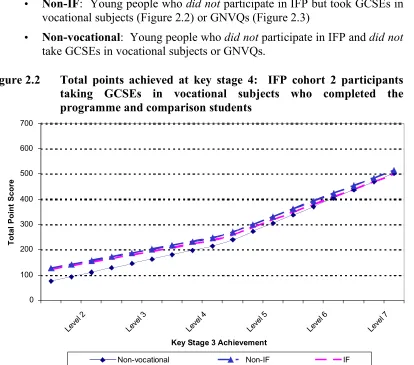
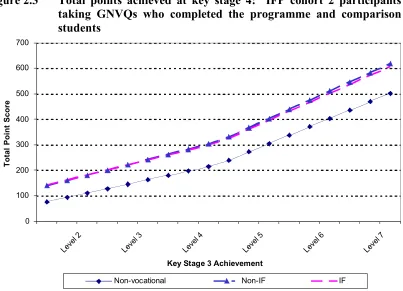
¥ Young people who participated in, and completed, IFP and took GCSEs in vocational subjects or GNVQs, gained fewer points in total at key stage 4 compared to similar students in the same schools who took the same types of qualifications. (Section 2.3.2)
¥ Female students, and those of Black heritage, who undertook GCSEs in
vocational subjects through IFP gained significantly more points than similar students who were male, or were White. (Section 2.3.2)
¥ Around 15 per cent of the IFP cohort who had embarked on GNVQs and
GCSEs in vocational subjects appeared to have discontinued their involvement prior to the end of Year 11. The analysis suggests that discontinuing involvement in IFP was associated with significantly lower attainment at key stage 4 than might have been the case had the student either sustained their involvement or not embarked on IFP. (Section 2.3.4)
¥ Those who had discontinued appeared to be more likely to be eligible for
free school meals, recognised for action on the register of SEN and have lower prior attainment, than might be expected given the profile of the cohort as a whole. (Section 2.3.4)
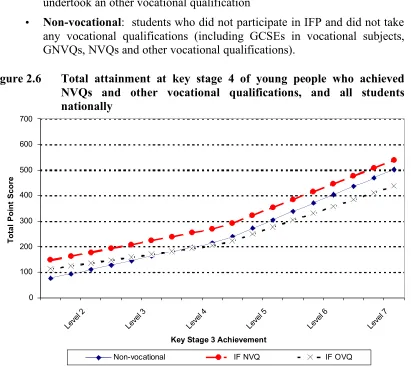
¥ Young people who participated in IFP, and undertook NVQs through the
programme, gained significantly more points in total than similar students who had not participated in IFP, and were not known to have undertaken any vocational qualifications including GCSEs in vocational subjects or GNVQs. However, IFP participants who had undertaken other vocational qualifications gained significantly fewer points. (Section 2.3.5)
¥ Participation in IFP, and taking NVQs and other vocational qualifications,
appeared to be particularly advantageous for students who had lower attainment at key stage 3. While the number of points they achieved was fewer than that of their peers with higher attainment at key stage 3, such students gained even more points than might be predicted in relation to their prior attainment. (Section 2.3.5)
Achievement of five A* to C grade GCSEs or equivalent
¥ In terms of achieving the level 2 threshold of five GCSE passes at grades
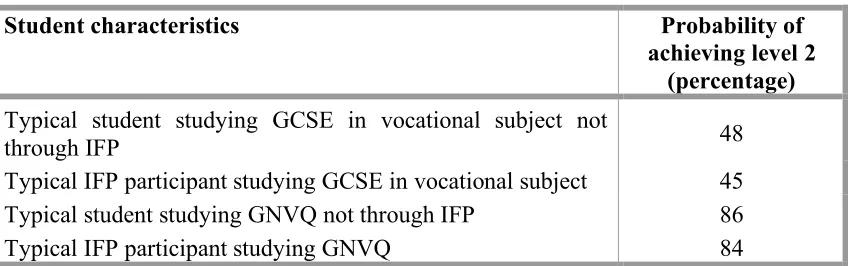
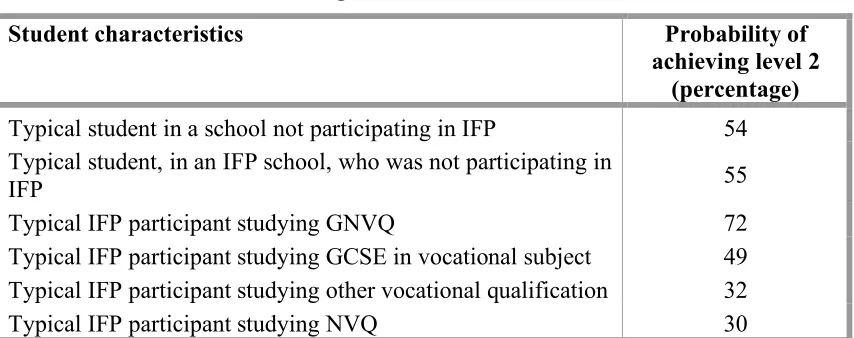
A* to C, or equivalent, students who had participated in IFP had a lower probability of achieving this compared to similar students who had not participated in the programme. It is worth noting, however, that 32 per cent of young people were undertaking qualifications through IFP at level 1, and six per cent were taking entry level qualifications, which would not contribute to the level 2 threshold. (Section 2.4)
¥ Young people who participated in the second cohort of IFP had a lower
2.1 Introduction
This chapter explores the achievement of young people at the end of Year 11, who participated in IFP, in terms of the qualifications they achieved. It examines:
¥ The extent to which young people achieved the qualification that they undertook through IFP and the factors associated with achievement of qualifications taken through IFP.
¥ The total achievement at key stage 4 of students who had completed IFP, taking into account background factors and prior attainment. This analysis provides, where possible, a comparison with similar students who did not participate in IFP.
¥ The outcomes for young people who embarked on the IFP, including those who subsequently discontinued their involvement in IFP before the end of Year 11, and the characteristics of such young people.
¥ The extent to which participation in IFP appears to have been more beneficial for specific sub-groups of young people.
A wide range of factors influence young peopleÕs attainment at key stage 4, including their individual characteristics and attainment, the school they attend and the area they live in. The multi-level model analysis seeks to take into account these factors and examines the extent to which their participation in IFP appears to be associated with their attainment over and above the range of other influential factors. A full list of the variables that have been included in the analysis is provided in Appendix C (Tables C1 and C2). The main factors which emerged as influencing young peopleÕs attainment at 16 were as follows:
¥ attainment at key stage 3 Ð higher attainment at key stage 4 was
associated with higher attainment at key stage 3
¥ sex Ð being female was associated with higher attainment at key stage 4
¥ English as an additional language Ð having English as an additional
language was associated with higher attainment at key stage 4
¥ Special Educational Needs (SEN) Ð being recognised for school action
and school action plus was associated with lower attainment at key stage 4
¥ local area Ð living in an area with comparatively high unemployment,
high levels of individuals with no qualifications, high levels of individuals engaged in routine occupations and high levels of council housing, were associated with lower attainment at 16
¥ pupil mobility Ð changing schools between key stage 3 and key stage 4
was associated with lower attainment at 16
¥ free school meals Ð being eligible for free school meals, or attending a
The analysis presented in this report explores the relationship between participation in IFP and attainment at key stage 4. It compares students who are similar in all respects except that they either participated, or did not participate, in IFP and presents the apparent influence of IFP on attainment over and above the range of variables explored in the statistical model.
In considering the outcomes for the second cohort of IFP participants, it is worth reflecting on the nature of the cohort. Analysis of the baseline data15
provided by schools indicated that students who participated in the second cohort of IFP differed significantly from their peers in some key respects. In detail, IFP participants were significantly more likely to be male, White, in receipt of free school meals and recognised for school action or school action plus on the register of SEN than their peers in the same schools. Moreover, they differed in terms of their key stage 3 attainment compared with their peers in the same schools, in that this was lower overall among the IFP cohort than for all students. This difference is illustrated in Figure 2.1 which shows the attainment at key stage 3 of young people who participated in IFP, and took GCSEs in vocational subjects, those who participated in IFP and took NVQs, other vocational qualifications and GNVQs, and all students in their year group in the same schools, and nationally. A similar difference was found in terms of their key stage 4 attainment in 2005 and students who attended IFP schools gained slightly, but significantly fewer points overall than similar students in other schools. This Ôschool effectÕ has been taken into account statistically in the analysis.
15 Golden, S., Nelson, J., OÕDonnell, L. and Rudd, P. (2004). Evaluation of Increased Flexibilities
Figure 2.1 Key stage 3 attainment of Year 10 students 2003-2004 (cohort 2)
Source: NFER evaluation of IFP Ð baseline data autumn 2003 and NPD 2003 All those for whom data was available on NPD
The majority of schools adopted some form of selection of students for the first cohort of participants16 and around half of schools17 said that they had
changed their criteria for selection of the second cohort and 42 per cent had altered their procedure. The criteria which schools took into consideration when selecting students to participate included their interest or strength in the vocational area, their attitude and learning preferences. However, while the statistical models can take into account a wide range of variables that might influence young peopleÕs attainment, they can only be based on available data. Consequently, the possible effect of, for example, studentsÕ motivation, learning preferences and personal circumstances cannot be taken into account, or explored, through this quantitative analysis.
Three outcomes for students are examined in the analysis:
¥ Total points achieved at key stage 4. This reflects the full achievement of
students in terms of the points achieved in all the examinations they undertook. As such it reflects the quantity of qualifications undertaken and a student could gain the same points by achieving less well in more
16 Golden, S., Nelson, J., OÕDonnell, L. and Morris, M. (2004). Evaluation of Increased Flexibilities
for 14 to 16 Year Olds: the First Year (DfES Research Report 511). London: DfES.
17 Golden, S., OÕDonnell, L. and Rudd, P. (2005). Evaluation of Increased Flexibility for 14 to 16
Year Olds Programme: the Second Year (DfES Research Report 609). London: DfES.
0 1 2 3 4 5 6 7 8 9 10 11 12 13 14 15
1.00 1.33 1.67 2.00 2.33 2.67 3.00 3.33 3.67 4.00 4.33 4.67 5.00 5.33 5.67 6.00 6.33 6.67 7.00 7.33+
Key Stage 3 Mean Level
%
o
f
s
tu
d
e
n
ts
qualifications as a student who achieves more points in fewer qualifications.
¥ Points achieved in the eight highest grades achieved at key stage 4. The Ôbest eightÕ outcome reflects the quality of the studentsÕ achievement, as distinct from its quantity. For example, a student who had achieved lower grades in more qualifications would not gain as many points as a student who may have taken fewer qualifications, but gained higher grades.
¥ Achievement of five A* to C grades, or equivalent, at key stage 4 (Level 2). This includes achievement of any subject at grades A* to C and achievement of five passes at grades A* to C including mathematics and English.
The analysis is based on QCA point scores where a C grade at GCSE (single award) is 40 points. Further details of the point scores for GCSEs, double award GCSEs, GNVQs, NVQs and other vocational qualifications are provided in Appendix B.
In order to explore fully the outcomes for IFP participants, different analytical models were constructed to make a number of comparisons. These were as follows:
¥ Comparisons within the IFP cohort of the factors associated with achievement of the qualification undertaken through IFP. This analysis examines whether achievement of IFP qualifications appears to differ according to studentsÕ prior attainment and other background characteristics such as their gender, ethnicity or free school meal eligibility (Section 2.2.3).
¥ Comparison of all students who embarked on IFP and all students who did not18 (Section 2.3.1).
¥ All students who had embarked on, and completed, IFP taking GCSEs in vocational subjects and GNVQs, compared with all students who did not participate in IFP and took these qualifications (Section 2.3.2).
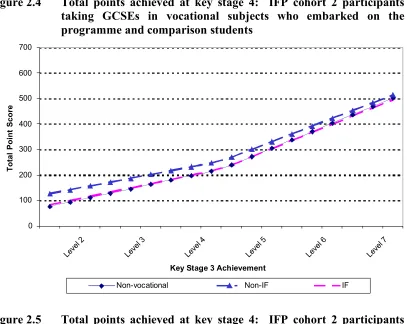
¥ Comparison between students who embarked on a course through IFP, and
may or may not have discontinued, undertaking GCSEs in vocational subjects and GNVQs, and students who had not taken any type of vocational qualification (Section 2.3.3).
¥ Comparison between students who embarked on GCSEs in vocational subjects and GNVQs and discontinued their involvement in these, and students who had not undertaken any vocational qualifications (Section 2.3.4).
¥ Comparison between students who embarked on a course through IFP, and may or may not have discontinued, undertaking NVQs and other
18 IFP students may or may not have completed the programme. Non-IFP students may or may not
vocational qualifications and students who had not undertaken any vocational qualifications (Section 2.3.5).
In addition, significant differences between the outcomes for students in the second cohort of IFP, and their peers who had participated in the first cohort,19
are presented as appropriate.
The analysis of the achievement of qualifications taken through IFP is based on the outcomes for around 15,500 IFP students taking four types of qualifications as follows:
¥ 11,928 students who embarked on GCSEs in vocational subjects
¥ 2450 students who embarked on GNVQs
¥ 543 students who took NVQs
¥ 662 students who took other vocational qualifications.
The data for students taking GCSEs in vocational subjects and GNVQs was drawn from the National Pupil Database and details of students taking NVQs and other vocational qualifications were provided for a representative sample of students by schools. Further details of the numbers of different types of students used for different analyses are provided in Appendix D.
2.2 Achievement of IFP qualifications
2.2.1 Overall achievement of IFP qualifications
The majority of the young people achieved the qualifications that they had taken through IFP. More specifically:
¥ 93 per cent of the 15,699 GCSEs in vocational subjects that were undertaken by IFP students were achieved at grades A* to G. Among these achievements, 39 per cent were at grades A* to C and six per cent at either A* or A grade.
¥ 81 per cent of the 2813 GNVQs that were taken by IFP participants were achieved. In more detail, 81 per cent of the Foundation-level GNVQs, and 78 per cent of the Intermediate GNVQs undertaken, were achieved.
¥ 64 per cent of the 807 NVQs undertaken by students in the sample were achieved.
¥ 58 per cent of the 1274 other vocational qualifications undertaken by students in the sample were achieved.
19 Golden, S., OÕDonnell, L., Benton, T. and Rudd, P. (2005). Evaluation of Increased Flexibility for
The proportions of IFP participants who had achieved GCSEs in vocational subjects and GNVQs were similar, albeit slightly higher, to those for young people who had participated in the first cohort of IFP (2002-2004). Among cohort 1 participants, 91 per cent had gained grades A* to G in GCSEs in vocational subjects and 36 per cent had achieved grades A* to C. In addition, 80 per cent of cohort 1 participants had achieved a GNVQ. The proportion who had achieved NVQs was similar, although slightly lower, among cohort 2 participants (66 per cent in cohort 1) and the proportion who achieved other vocational qualifications was notably smaller in cohort 2 compared with cohort 1 (67 per cent in cohort 1).
This sample of young people had undertaken a wide variety of different qualifications within the types of qualifications. The most widely taken qualifications for which data was provided by schools or was available on the NPD, included:
GNVQs
¥ GNVQ Intermediate information and communication technology (ICT)
¥ GNVQ Intermediate science ¥ GNVQ Intermediate business.
NVQs
¥ NVQ level 1 hairdressing
¥ NVQ level 1 performing engineering operations
¥ NVQ level 1 food preparation
¥ NVQ level 1 preparing and serving food
¥ NVQ level 1 sport, recreation and allied studies.
Other vocational qualifications
¥ CITB/City and Guilds level 1 foundation certificate in building craft occupations
¥ ABC level 1 certificate in motor vehicle studies
¥ CACHE level 1 award in caring for children
¥ Entry level certificate in skills for working life.
GNVQ and other qualifications taken by this sample of students were at level 1 and only a minority of other vocational qualifications were at entry level.
The GCSEs in vocational subjects undertaken by this sample of IFP participants are discussed in detail in the next section.
2.2.2 Achievement of GCSEs in vocational subjects
[image:31.595.84.506.256.415.2]Compared to the achievement of GCSEs in vocational subjects nationally, a slightly greater proportion of young people who participated in IFP achieved the qualifications at grades A*-C and A*-G than their peers, as can be seen in Table 2.1.
Table 2.1 Proportions of students achieving GCSEs in vocational subjects:
IFP participants and other students in IFP schools and nationally
IFP students in cohort 2
IFP students in cohort 1
All students at IFP schools
All students nationally
Total number of GCSE in
vocational subject entries 15,669 14,718 98,525 141,460
% A/A* 5.6 5.3 5.0 5.0
% A*-C 39.3 36.1 38.1 38.7
% A*-G 92.9 90.9 92.2 92.2
Source: Amended NPD 2005 and 2006 and NFER baseline data 2002 and 2003 The table indicates studentsÕ raw scores and does not take into account prior attainment
Table 2.2 Proportions of students achieving each GCSE in a vocational subject: IFP participants and other students in IFP schools and nationally
IFP students in cohort 2
All students at IFP schools
All students nationally
Number of art and design entries 660 4156 5575
% A/A* 19.7 15.3 15.2
% A*-C 59.7 53.8 53.9
% A*-G 97.6 95.5 95.3
Number of business entries 1755 14,198 20,638
% A/A* 9.7 8.2 8.3
% A*-C 49.4 48.5 48.6
% A*-G 93.4 93.3 93.2
Number of health and social care entries 3135 16,143 22,943
% A/A* 8.1 6.5 6.7
% A*-C 46.5 42.6 43.8
% A*-G 95.3 93.9 94.4
Number of leisure and tourism entries 2000 11,829 16,093
% A/A* 2.9 2.5 2.6
% A*-C 30.8 27.9 28.3
% A*-G 91.9 89.8 89.5
Number of manufacturing entries 495 3141 4327
% A/A* 2.4 2.9 2.4
% A*-C 23.4 26.5 25.1
% A*-G 87.3 88.4 87.8
Number of science entries 1638 12,180 17,207
% A/A* 1.7 1.5 1.4
% A*-C 38.5 32.9 32.5
% A*-G 98.0 96.9 96.6
Number of engineering entries 1981 5879 7603
% A/A* 1.8 2.1 2.4
% A*-C 26.0 24.6 25.4
% A*-G 89.4 89.5 89.4
Number of ICT entries 4005 30,999 47,074
% A/A* 4.7 4.3 4.4
% A*-C 38.9 38.6 39.2
% A*-G 90.9 90.3 90.5
Source: Amended NPD 2006 and NFER baseline data 2003
The table indicates studentsÕ raw scores and does not take into account prior attainment
not take into account the prior attainment and other characteristics of the IFP cohort.
Further multi-level model analysis, which controlled for the effect of a range of variables (see Appendix C for details) revealed that, as was found nationally, differences in attainment in each subject were not explained by studentsÕ prior attainment and other variables included in the models Nevertheless, once prior attainment and other background variables were taken into account, no significant differences emerged in the grades achieved between IFP participants and their peers who did not participate in the programme in terms of their achievements in each of the eight GCSEs in vocational subjects. In other words, the apparent differences illustrated in Table 2.2 in achievement in individual GCSEs in vocational subjects, between IFP participants and their peers are explained by differences in their prior attainment and gender. Moreover, there was no significant difference in the achievement in these subjects between students who attended schools that participated in IFP and those who did not. This suggests that there was no discernable wider effect of engaging in an IFP partnership on GCSEs in vocational subjects taught outside the programme in the wider school.
2.2.3 Factors associated with achievement of qualifications undertaken through IFP
As noted above, the majority of young people who participated in the second cohort of IFP achieved the qualification they undertook. This section examines a range of variables that may have an impact on achievement of IFP qualifications including:
¥ young peopleÕs personal background characteristics, such as attainment, gender and ethnicity
¥ characteristics of the IFP partnership, such as its size in terms of the number of participating schools
¥ the nature of delivery including location of delivery, qualification type
and the broad subject areas studied
¥ characteristics of the school young people attended, such as whether it
was comprehensive to 16 or had a sixth form
¥ features of the area where IFP participants lived, derived from the census, such as the proportion of home ownership and nature of employment.
similar student taking a GCSE in a vocational subject and 39 points for a similar student taking an other vocational qualification. These differences are taken into account in the analysis and the associations noted below occur over and above the effect of the qualification type.
StudentsÕ prior attainment at key stage 3 was, on the whole, associated with their achievement of the qualification that they had studied through IFP. Overall, students who had higher prior attainment scored more points in their IFP qualification than similar students with lower prior attainment. However, the analysis showed that the association between prior attainment and achievement of other vocational qualifications was less strong than was the case in relation to GCSEs in vocational subjects, GNVQs and NVQs. In other words, key stage 3 attainment was a less effective predictor of outcomes in other vocational qualifications. Moreover, further analysis suggested that a stronger relationship exists between key stage 3 attainment in mathematics and science and achievement of NVQs, while the relationship between attainment in key stage 3 English and GCSEs in vocational subjects and GNVQs was stronger. This may suggest that the assessment of other vocational qualifications is examining different skills to those assessed by key stage 3 assessments and, indeed, different skills to those assessed by the other types of qualifications undertaken through IFP.
StudentsÕ background characteristics were associated with differences in their attainment in their IFP qualification. It emerged that:
¥ Young people who were female achieved seven more points than similar students who were male. However, further exploration showed that male
students who took NVQs achieved more points than similar students who
were female who were taking these types of qualifications. This analysis cannot explain why, as was the case for the first cohort, male students appear to benefit more from NVQs than their female peers. However, the responses of participants in the first cohort to questionnaire surveys indicated that male students were significantly more likely to have a preference for practical applied learning, compared to their female peers.20
Such learning preferences may have been more suited to undertaking an NVQ than other qualifications.
¥ Students who were recognised for school action or school action plus on the register of SEN achieved fewer points than similar students not recognised for action.
¥ Those who were in receipt of free school meals achieved fewer points in their IFP qualification than similar students who were not in receipt of free school meals.
20 Golden, S., Nelson, J., OÕDonnell, L. and Morris, M. (2004). Evaluation of Increased Flexibilities
¥ The ethnic background of students was not significantly associated with differences in achievement in their IFP qualification, where there were sufficient numbers to conduct a robust analysis.
The qualifications that young people were undertaking were grouped into 17 broad vocational areas for previous analysis.21 These broad areas include
qualifications of all types which related to the vocational area. Analysis was undertaken to explore the extent of any differences between achievement in these broad vocational areas, taking into account the type of qualification, so that any differences reported are over and above the qualification type differences noted above. It appeared that students achieved more points where they had studied qualifications in the following subject areas than similar students who had not undertaken qualifications in these areas:
¥ care and childcare
¥ science
¥ arts
¥ administration and business
¥ sports, leisure and tourism.
This does not suggest that students taking other subjects do less well than might be expected but, rather, that the other subject areas did not emerge as making a significant difference.
While these differences emerged across the qualification types, further exploration revealed that students who were taking an other vocational qualification in the subject areas of administration and business or arts, gained significantly fewer points than similar students taking other types of qualifications in these two subject areas. There may be value, therefore, in exploring the nature of other vocational qualifications in these subjects and the extent to which they are appropriate for IFP participants.
The location where students pursued their IFP qualification, such as at school,
college or a training provider, did not emerge as being significantly associated with differences in the achievement of qualifications. Analysis of the first cohort of IFP participants, which drew on questionnaire data relating to delivery that was not available for the analysis of the second cohort, found that students achieved more points where delivery was shared or they studied principally at school.22 Although data on the extent of shared teaching was not
21 Golden, S., Nelson, J., OÕDonnell, L. and Rudd, P. (2004). Evaluation of Increased Flexibilities
for 14 to 16 Year Olds Programme: Profile of Partnerships and Students 2002 and 2003 (DfES Research Report 558). London: DfES.
22 Golden, S., OÕDonnell, L., Benton, T. and Rudd, P. (2005). Evaluation of Increased Flexibility for