We b Se r vic e s Se c urit y
a nd E-Busine ss
G. Radhamani
Multimedia University, Malaysia
Development Editor: Kristin Roth Senior Managing Editor: Jennifer Neidig
Managing Editor: Sara Reed
Copy Editor: Angela Thor
Typesetter: Cindy Consonery
Cover Design: Lisa Tosheff
Printed at: Integrated Book Technology
Published in the United States of America by
Idea Group Publishing (an imprint of Idea Group Inc.) 701 E. Chocolate Avenue
Hershey PA 17033 Tel: 717-533-8845 Fax: 717-533-8661
E-mail: [email protected] Web site: http://www.idea-group.com
and in the United Kingdom by
Idea Group Publishing (an imprint of Idea Group Inc.) 3 Henrietta Street
Covent Garden London WC2E 8LU Tel: 44 20 7240 0856 Fax: 44 20 7379 0609
Web site: http://www.eurospanonline.com
Copyright © 2007 by Idea Group Inc. All rights reserved. No part of this book may be repro-duced, stored or distributed in any form or by any means, electronic or mechanical, including photocopying, without written permission from the publisher.
Product or company names used in this book are for identification purposes only. Inclusion of the names of the products or companies does not indicate a claim of ownership by IGI of the trademark or registered trademark.
Library of Congress Cataloging-in-Publication Data
Web services security and e-business / G. Radhamani and G.S.V. Radha Krishna Rao, editors.
p. cm.
Summary: "This book provides an insight into uncovering the security risks of dynamically created content and looks at how proper content management can greatly improve the overall security. It also looks at the security lifecycle and how to respond to an attack, as well as the problems of site hijacking and phishing"--Provided by publisher. Includes bibliographical references and index.
ISBN 1-59904-168-5 -- ISBN 1-59904-169-3 (softcover) -- ISBN 1-59904-170-7 (ebook)
1. Computer networks--Security measures. 2. Web services. 3. Electronic commerce--Security measures. 4. Computer security. I. Radhamani, G., 1968- . II. Radha Krishna Rao, G.S.V., 1973- . TK5105.59.W434 2007
005.8--dc22
De dic a t ion
We b Se r vic e s Se c urit y
a nd E-Busine ss
Ta ble of Cont e nt s
Foreword ... viii S. S. Jamuar Universiti Putra Malaysia, Malaysia
Preface ... x Chapter I
Wireless LAN Setup and Security Loopholes ... 1 Biju Issac, Swinburne University of Technology, Malaysia
Lawan A. Mohammed, Swinburne University of Technology, Malaysia
Chapter II
Wireless Web Security Using a Neural Network-Based Cipher ... 32 Isaac Woungang, Ryerson University, Canada
Alireza Sadeghian, Ryerson University, Canada Shuwei Wu, Ryerson University, Canada Sudip Misra, Cornell University, USA
Maryam Arvandi, Ryerson University, Canada
Chapter III
RFID Systems: Applications vs. Security and Privacy Implications ... 57 Dennis M. L. Wong, Swinburne University of Technology, Malaysia
Chapter IV
Mobile Code and Security Issues ... 75 E. S. S. Samundeeswari, Vellalar College for Women, India
F. Mary Magdalene Jane, P. S. G. R. Krishnammal, India
Chapter V
A Survey of Key Generation for Secure Multicast Communication Protocols ... 93 Win Aye, Multimedia University, Malaysia
Mohammad Umar Siddiqi, International Islamic University Malaysia, Malaysia
Chapter VI
Security in Mobile Agent Systems ... 112 Chua Fang Fang, Multimedia University, Malaysia
G. Radhamani, Multimedia University, Malaysia
Chapter VII
Intrusion Detection System: A Brief Study ... 129 Robin Salim, Multimedia University, Malaysia
G. S. V. Radha Krishna Rao, Multimedia University, Malaysia
Chapter VIII
Node Authentication in Networks Using Zero-Knowledge Proofs ... 142 Richard S. Norville, Wichita University, USA
Kamesh Namuduri, Wichita University, USA Ravi Pendse, Wichita University, USA
Chapter IX
Web Services Security in E-Business: Attacks and Countermeasures ... 165 Wei-Chuen Yau, Multimedia University, Malaysia
G. S. V. Radha Krishna Rao, Multimedia University, Malaysia
Chapter X
Verifiable Encryption of Digital Signatures Using Elliptic Curve Digital
Signature Algorithm and its Implementation Issues ... 184 R. Anitha, PSG College of Technology, India
R. S. Sankarasubramanian, PSG College of Technology, India
Chapter XI
An Introductory Study On Business Intelligence Security ... 204 Chan Gaik Yee, Multimedia University, Malaysia
Secure Trust Transfer Using Chain Signatures ... 218 Amitabh Saxena, La Trobe University, Australia
Ben Soh, La Trobe University, Australia
Chapter XIII
Distributed Intrusion Detection Systems: An Overview ... 231 Rosalind Deena Kumari, Multimedia University, Malaysia
G. Radhamani, Multimedia University, Malaysia
Chapter XIV
Subtle Interactions: Security Protocols and Cipher Modes of Operation ... 239 Raphael C.-W. Phan, Swinburne University of Technology, Malaysia
Bok-Min Goi, Multimedia University, Malaysia
Chapter XV
Generic Algorithm for Preparing Unbreakable Cipher: A Short Study ... 262 R. A. Balachandar, Anna University, India
M. Balakumar, Anna University, India S. Anil Kumar, Anna University, India
Chapter XVI
A Robust Watermarking Scheme Using Codes Based on the Redundant Residue Number System ... 271
Vik Tor Goh, Multimedia University, Malaysia
Mohammad Umar Siddiqi, International Islamic University Malaysia, Malaysia
Chapter XVII
A Framework for Electronic Bill Presentment and Off-Line Message Viewing ... 306 Ezmir Mohd Razali, Multimedia Univerisity, Malaysia
Ismail Ahmad, Multimedia Univerisity, Malaysia
G. S. V. Radha Krishna Rao, Multimedia Univerisity, Malaysia Kenneth Foo Chuan Khit, NetInfinium Sdn. Bhd., Malaysia
Chapter XVIII
Propagation and Delegation of Rights in Access Controls and Risk Assessment Techniques ... 328
IPSec Overhead in Dual Stack IPv4/IPv6 Transition Mechanisms:
An Analytical Study ... 338 M. Mujinga, University of Fort Hare, South Africa
Hippolyte Muyingi, University of Fort Hare, South Africa Alfredo Terzoli, Rhodes University, South Africa
G. S. V. Radha Krishna Rao, University of Fort Hare, South Africa
Chapter XX
An Approach for Intentional Modeling of Web Services Security Risk
Assessment ... 363 Subhas C. Misra, Carleton University, Canada
Vinod Kumar, Carleton University, Canada Uma Kumar, Carleton University, Canada
Fore w ord
There has been a dramatic impact on our society due to multifold increases in the use of personal computers. Computer networking plays a crucial role in building a wireless information society. Internet services and their applications have provided us with tools to obtain any kind of information in a flash of time, and the real world has been converted into a virtual world due to the proliferation of computers. Web sites are now a key asset to organizations of all sizes, providing information and services to clients, suppliers, and employees. Unfortunately, these developments have also opened new security threats to the enterprise networks, and opened the door to an increasing number of threats to individual and business computers. There is a growing trend of hackers attacking networks via home and remote users. These attacks can be range from partial loss of data to making the system nonusable, and privacy can be com-pletely violated. Unauthorized users can use their computer to attack other computers by gaining access through the Internet. In the year 2005, new threats increased by almost 50%, as cybercriminals joined forces to create targeted malware attacks for financial gain.
Bringing together the understanding of security problems related to the protocols and applications of the Internet, and their contemporary solutions to these problems in this book, Web Services Security and E-Business, is both timely and purposeful. Cryptogra-phy has been introduced to understand the security protocols. The focus of the book is on architectures and protocols. Authors have provided an insight into uncovering the security risks of dynamically created content, and looks at how proper content management can greatly improve the overall security. They have also looked at the security life cycle and how to respond to an attack, as well as the problems of site hijacking and phishing.
Pre fa c e
The proliferation of Internet services and applications is bringing systems and Web services security issues to the fore. There is a consensus that a key, contributing factor leading to cyberthreats is the lack of integrated and cohesive strategies that extend beyond the network level, to protect the applications and devices at system level as well. Many techniques, algorithms, protocols, and tools have been developed in the different aspects of cybersecurity, namely, authentication, access control, availability, integrity, privacy, confidentiality, and nonrepudiation as they apply to both networks and systems.
The IT industry has been talking about Web services for many years. The benefits of having a loosely coupled, language-neutral, platform-independent way of linking ap-plications within organizations, across enterprises, and across the Internet, are becom-ing more evident as Web services are used in pilot programs and in wide-scale produc-tion. Moving forward, customers, industry analysts, and the press identify a key area that needs to be addressed as Web services become more mainstream: security. The purpose of this book is to bring together the technologies and researchers who share interest in the area of e-business and Web services security. The main aim is to promote research and relevant activities in security-related subjects. It also aims at increasing the synergy between academic and industry professionals working in this area. This book can also be used as the textbook for graduate courses in the area of Web services security. This book is comprised of 20 chapters that cover various as-pects of Web services security and e-business. The scope of the chapters is summa-rized hereunder.
concludes with practical security recommendations that can keep intruders at bay. The authors hope that any reader would thus be well informed on the security vulnerabili-ties and the precautions that are associated with 802.11 wireless networks.
The increasingly important role of security for wireless Web services environments has opened an array of challenging problems centered on new methods and tools to im-prove existing data encryption and authentication techniques. Real-time recurrent neu-ral networks offer an attractive approach to tackling such problems because of the high encryption capability provided by the structural hidden layers of such networks. In the second chapter, a novel neural network-based symmetric cipher is proposed. This ci-pher releases the constraint on the length of the secret key to provide the data integrity and authentication services that can be used for securing wireless Web services com-munication. The proposed symmetric cipher design is robust in resisting different cryptanalysis attacks. Simulation results are presented to validate its effectiveness.
In the third chapter, the business implications, as well as security and privacy issues of the widespread deployment of radio frequency identification (RFID) systems, were discussed. At first, the components that make up an RFID system to facilitate better understanding of the implications of each were discussed, and then the commercial applications of the RFID were reviewed. Further, the security and privacy issues for RFID systems, and what mechanisms have been proposed to safeguard these, were discussed. The topics discussed in this chapter highlight the benefits of using RFIDs for user convenience in ubiquitous and pervasive commercial services and e-busi-nesses, while maintaining the integrity of such systems against malicious attacks on the users’ security and privacy. This is vital for a business establishment to coexist with peers, and remain competitively attractive to customers.
Over the years, computer systems have evolved from centralized monolithic computing devices supporting static applications, into client-server environments that allow com-plex forms of distributed computing. Throughout this evolution, limited forms of code mobility have existed. The explosion in the use of the World Wide Web, coupled with the rapid evolution of the platform-independent programming languages, has promoted the use of mobile code and, at the same time, raised some important security issues. The fourth chapter introduces mobile code technology, and discusses the related security issues.
architec-tures, are investigated and analyzed here, and insight is given to their features and goals. The area of group key generation is then surveyed, and proposed solutions are classified according to the efficiency of the cryptographic algorithms and multicast security requirements. The open problems in this area are also outlined.
Agent technologies have grown rapidly in recent years as Internet usage has increased tremendously. Despite its numerous practical benefits and promises to provide an effi-cient way of mitigating complex distributed problems, mobile agent technology is still lacking effective security measures, which severely restricts their scope of applicabil-ity. The sixth chapter analyzes and synthesizes the different security threats and at-tacks that can possibly be imposed to the mobile agent systems. The security solutions to resolve the problems and the research challenges in this field are presented.
The seventh chapter introduces the intrusion detection system (IDS). It started with a brief explanation of history of IDS, proceeded with generic components of IDS. Besides highlighting current advances in IDS, the chapter describes recent challenges to the system. The authors hope that this chapter will shed a light for readers who are unfamil-iar with this domain.
ZKP-based authentication protocols provide a smart way to prove an identity of a node without giving away any information about the secret of that identity. There are many advantages, as well as disadvantages, to using this protocol over other authentication schemes, as well as challenges to overcome in order to make it practical for general use. The eighth chapter examines the viability of ZKPs for use in authentication protocols in networks. It is concluded that nodes in a network can achieve a desired level of secu-rity by trading off key size, interactivity, and other parameters of the authentication protocol. This chapter also provides data analysis, which can be useful in determining expected authentication times based on device capabilities. Pseudocode is provided for implementing a graph-based ZKP on small or limited processing devices.
Web services enable the communication of application to application in a heteroge-neous network and computing environment. The powerful functionality of Web ser-vices has given benefits to enterprise companies, such as rapid integrating between heterogeneous e-business systems, easy implementation of e-business systems, and reusability of e-business services. While providing the flexibility for e-business, Web services tend to be vulnerable to a number of attacks. Core components of Web ser-vices such as simple object access protocol (SOAP), Web serser-vices description lan-guage (WSDL), and universal description, discovery, and integration (UDDI) can be exploited by malicious attacks due to lack of proper security protections. These attacks will increase the risk of an e-business that employs Web services. The ninth chapter aims to provide a state-of-the-art view of Web services attacks and countermeasures. This chapter also examines various vulnerabilities in Web services, followed by the analysis of respective attacking methods. Further, this chapter also discusses preven-tive countermeasures against such attacks to protect Web services deployments in e-business, and finally address future trends in this research area.
chapter presents a new algorithm for multiplying two 2n bits palindromic polynomials modulo xp − 1 for prime p = 2n + 1 for the concept defined in Blake and Roth (1998) and it is compared with the Sunar-Koc parallel multiplier given in Sunar and Koc (2001). Finally, the chapter concludes that the proposed multiplication algorithm requires (2n2−
n+1) XOR gates, which is approximately 34% extra, as compared to 1.5(n2−n) XOR gates required by the Sunar-Koc parallel multiplier, and 50% less than the speculated result 4n2 XOR gates given by Sunar and Koc (2001). Moreover, the proposed multiplication algorithm requires (2n2− n) AND gates, as compared to n2 AND gates which is doubled that of the Sunar-Koc method
Firstly, the fact that business intelligence (BI) applications are growing in importance, and secondly, the growing and more-sophisticated attacks launched by hackers, the concern of how to protect the knowledge capital or databases that come along with BI or, in another words, BI security, has thus arisen. In the eleventh chapter, the BI envi-ronment, with its security features, is explored, followed by a discussion on intrusion detection (ID) and intrusion prevention (IP) techniques. It is understood, through a Web-service case study, that it is feasible to have ID and IP as counter measures to the security threats; thus, further enhancing the security of the BI environment or architec-ture.
In the 12th chapter, the concept of “trust transfer” using chain signatures will be pre-sented. Informally, transferring trust involves creating a trust (or liability) relationship between two entities, such that both parties are liable in the event of a dispute. If such a relationship involves more than two users, we say they are connected in a chained trust relationship. The members of a chained trust relationship are simultaneously bound to an agreement with the property that additional members can be added to the chain, but once added, members cannot be removed thereafter. This allows members to be incrementally and noninteractively added to the chain. We coin the term “chained signatures” to denote signatures created in this incremental way. An important applica-tion of chained signatures is in e-commerce transacapplica-tions involving many users. We present a practical construction of such a scheme that is secure under the Diffie-Hellman assumption in bilinear groups.
The recent increase in the malicious usage of the network has made it necessary that an IDS should encapsulate the entire network rather than at a system. This was the inspi-ration for the birth of a distributed intrusion detection system (DIDS). Different con-figurations of DIDSs have been actively used, and are also rapidly evolving due to the changes in the types of threats. The thirteenth chapter gives an overview and the structure of DIDS. The various agents that are involved in DIDS, and the benefits are given in brief. In the end, directions for future research work are discussed.
(ECB) mode, and show that in the absence of integrity, one could exploit this to aid in known- and chosen-IV attacks. Finally, this chapter also presents chosen-IV slide at-tacks on counter (CTR) and output feedback (OFB) modes of operation. Results show that protocol implementers should carefully select modes of operation, be aware of the pitfalls in each of these modes, and incorporate countermeasures in their protocols to overcome them. It is also important to realize that modes of operation only provide confidentiality, and that when used in the context of security protocols, these modes should be combined with authentication and integrity protection techniques.
The 15th chapter addresses the need of cryptographic algorithm to prepare unbreakable cipher. Though the performance of symmetric key algorithms is far better than asym-metric key algorithms, it still suffers with key distribution problem. It is highly evident that there is always a demand for an algorithm to transfer the secret key in a secure manner between the participants. This chapter argues that by providing the random-ness to the secret key, it would be increasingly difficult to hack the secret key. This chapter proposes an algorithm effectively utilizes the random nature of stock prices, in conjunction with plain text, to generate random cipher. This algorithm can be used to exchange the secret key in a secure manner between the participants.
In the 16th chapter, a watermarking scheme that utilizes error correction codes for added robustness is proposed. A literature survey covering various aspects of the watermarking scheme, such as the arithmetic redundant residue number system and concepts related to digital watermarking, is given. The requirements of a robust watermarking scheme are also described. In addition, descriptions and experimental results of the proposed watermarking scheme are provided to demonstrate the func-tionality of the scheme. The authors hope that with the completion of this chapter, the reader will have a better understanding of ideas related to digital watermarking, as well as the arithmetic redundant number system.
A security framework for secure message delivery and off-line message viewing of the electronic bills is presented in the seventeenth chapter. This framework is implementable towards smart applications such as electronic bill presentment and payment systems. Chapter XVIII, introduces the concept of access control and its objectives in fulfilling security requirements for the computing world. The main arrears in access control, namely DAC, MAC, and RBAC, will be covered; thus, giving enough background knowledge to the reader on existing policies and framework. Hence, the reader will be able to comprehend the concept of task delegation with regard to access control poli-cies, and how delegated tasks or roles can affect existing risk levels in an organization. Measuring risk has a two-fold benefit: one is that it enables security officials to be prepared with more accurate security measures with higher granularity and secondly, this will certainly be useful for security plans for mitigating potential risks.
stakeholder intentions. There are no similar approaches for modeling Web services security risk assessment in the existing pieces of literature. The approach is, thus, novel in this domain. The approach is helpful for performing means-end analysis; thereby, uncovering the structural origin of security risks in Web services, and how the root causes of such risks can be controlled from the early stages of the projects. The ap-proach addresses “why” the process is the way it is, by exploring the strategic depen-dencies between the actors of a security system, and analyzing the motivations, in-tents, and rationales behind the different entities and activities in constituting the system.
This book aims to help toward technical strategy and a roadmap whereby the industry/ academia can produce and implement a standards-based architecture that is compre-hensive, yet flexible enough to meet the Web services security needs of real busi-nesses.
References
Ac k now le dgm e nt s
We would like to thank all contributors/authors who worked very hard to complete their chapters in time. Without each of their contributions, this book would have never been accomplished.
Our grateful thanks to the external reviewers for their valuable comments and construc-tive criticism, which developed and improved the overall content of this book.
We would like to thank Professor Datuk, Dr. Ghauth Jasmon, president of Multimedia University, and Dr. Ewe Hong Tat, dean of Faculty of Information Technology for kind assistance and support.
Special thanks to Dr. Mehdi Khosrow-Pour, senior academic editor, and Kristin Roth, development editor, of Idea Group Inc., for production of this book. Their efficiency and amiable manner made working together a pleasure.
We are grateful to all others who have indirectly helped us in bringing out this book to be successful.
Dr. G. Radhamani
Chapter I
Wireless LAN Setup
and Security Loopholes
Biju Issac, Swinburne University of Technology, Malaysia
Lawan A. Mohammed, Swinburne University of Technology, Malaysia
Abstract
Introduction
Over the recent past, the world has increasingly becoming mobile. As mobile computing is getting more popular each day, the use of wireless local area network (WLAN) is becoming ever more relevant. If we are connected to a wired network, our mobility is undoubtedly affected. From public hotspots in coffee shops to secure WLAN in organizations, the world is moving to ubiquitous and seamless computing environments. IEEE 802.11 has been one of the most successful wireless technologies, and this chapter would be focusing more on this technology.
Mobility and flexibility has been the keynote advantages of wireless networks in general. Users can roam around freely without any interruption to their connection. Flexibility comes in as users can get connected through simple steps of authentication without the hassle of running cables. Also, compared to the wired network, wireless network installation costs are minimal as the number of interface hardware is minimal. Radio spectrum is the key resource, and the wireless devices are set to operate in a certain frequency band. 802.11 networks operate in the 2.4 GHz ISM band, which are generally license free bands. The more common 802.11b devices operate in the S-band ISM. In the next sections, we will be explaining the wireless LAN basic setup and implemen-tation, WEP encryption schemes and others, EAP authentication through RADIUS server and its brief implementation, WEP cracking procedure, war driving, 802.11b vulnerabilities with security attacks, and finally concluding with WLAN security safeguards.
Wireless LAN Network and
Technologies Involved
Network Infrastructure
Modes of Operation
IEEE802.11 WLAN can operate in two modes, namely ad hoc (or peer-to-peer) and infrastructure mode. These modes come under the basic service set (BSS), which is a coverage area of communication that allows one station to communicate to the other.Ad hoc mode has WLAN stations or nodes communicating with one another without an
access point to form an independent basic service set (IBSS). In contrast,infrastructure
mode has WLAN nodes communicating with a central AP that is, in turn, linked to a wired LAN to form a basic service set. Here, the AP acts as a relay between wireless stations or between wired and wireless stations. A combination of many BSS with a backbone distribution system (normally ethernet) forms an extended service set (ESS).
IEEE 802.11 Architecture and Standards
802.11 is a member of IEEE 802 family, which defines the specifications for local area network technologies. IEEE 802 specifications are centered on the two lowest layers of OSI model, namely the physical layer and the data link layer. The base 802.11 specification includes the 802.11 MAC layer and two physical layers namely, the frequency hopping spread spectrum (FHSS) layer in the 2.4 GHz band, and the direct sequence spread spectrum (DSSS) layer. Later revisions to 802.11 added additional physical layers like high-rate direct-sequence layer (HR/DSSS) for 802.11b and orthogonal frequency divi-sion multiplexing (OFDM) layer for 802.11a.
Joining an Existing Cell
There are three stages that a station has to go through to get connected to an existing cell, namely scanning, authentication, and association. When a station wants to access an existing BSS (either after power up, sleep mode, or just entering the BSS area), the station needs to get synchronization information from the access point (or from the other stations when in ad-hoc mode). The station can get this information by one of two modes: passive scanning and active scanning. Inpassive scanning mode, the station just waits
to receive a beacon frame from the AP and records information from it. The beacon frame is a periodic frame sent by the AP with synchronization information. This mode can save battery power, as it does not require transmitting. Inactive scanning mode, the station
tries to find an access point by transmitting probe request frames, and waiting for probe response frames from the AP. This is more assertive in nature. It follows the simple process as follows. Firstly, it moves to a channel to look for an incoming frame. If incoming frame is detected, the channel can be probed. Secondly, it tries to gain access to the medium by sending a probe request frame. Thirdly, it waits for a predefined time to look for any probe response frame and if unsuccessful, to move to the next channel. The second stage is authentication. It is necessary, when the stations try to communicate to one another, to prove their identity. Two major approaches that are specified in 802.11 are open system authentication and shared-key authentication. Inopen system
authen-tication, the access point accepts the mobile station implicitly without verification and
it is essentially a two-frame exchange communication. Inshared key authentication,
WEP (wired equivalent privacy) encryption has to be enabled. It requires that a shared key be distributed to stations before attempting to do authentication. The shared-key authentication exchange consists of four management frame exchanges that include a challenge-response approach.
The third stage is association, and this is restricted to infrastructure networks only. Once the authentication is completed, stations can associate with an access point so that it can gain full access to the network. Exchange of data can only be performed after an association is established. The association process is a two-step process further involving three stages: unauthenticated-unassociated stage, authenticated-unassociated stage, and authenticated-associated stage.
All access points (AP) transmit a beacon management frame at fixed intervals. A wireless client that wants to associate with an access point and join a BSS listens for beacon messages that contain information regarding service set identifier (SSID) or network names to determine the access points within range. After identifying which AP to associate with, the client and AP will perform mutual authentication by exchanging several management frames as part of the process. After getting authenticated, the client moves to second stage and then to third stage. To get associated, the client needs to send an association request frame, and the AP needs to respond with an association response frame (Arbaugh, Shankar, & Wan, 2001).
by sending gratuitous ARP (address resolution protocol) packets, so that the mobile station’s MAC address is mapped with the switch port connected to the access point. Reassociation is a procedure of moving the association from an old access point to a new one. It is also used to rejoin a network if the station leaves the cell and returns later to the same access point.
WLAN Association Table on CISCO Access Point
Figure 1 shows the details of a wireless node that is connected in a wireless LAN cell. The figure shows the details of CISCO Aironet 320 series AP and another client connected within the cell. This is a very simple wireless connection between a station and AP, with no encryption enabled and no authentication enabled. The forthcoming section shows how to make the setup more secure.
Encryption Mechanisms in
IEEE 802.11b and 802.11i
As WLAN data signals are transmitted over the air, it makes them vulnerable to eavesdropping. Thus, confidentiality of transmitted data must be protected, at any cost, by means of encryption. The IEEE 802.11b standard defines such a mechanism, known as wired equivalent privacy, which uses the RC4 encryption method. However, various security researchers have found numerous flaws in WEP design. The most devastating news broke out in 2001, which explained that the WEP encryption key can be recovered when enough packets are captured. Since then, this attack has been verified by several others and, in fact, free software is available for download that allows for capturing WEP packets and using those to crack the key.
Wired Equivalent Privacy
Wired equivalent privacy is a standard encryption for wireless networking. It is a user authentication and data encryption system from IEEE 802.11 that is used to overcome security threats. Basically, WEP provides security to WLAN by encrypting the informa-tion transmitted over the air, so that only the receivers who have the correct encrypinforma-tion key can decrypt the information. If a user activates WEP, the network interface card encrypts the payload (frame body and CRC) of each 802.11 frame, before transmission, using an RC4 stream cipher provided by RSA security. The receiving station, such as an access point, performs decryption upon arrival of the frame. As a result, 802.11 WEP only encrypts data between 802.11 stations. Once the frame enters the wired side of the network, such as between access points, WEP no longer applies. As part of the encryption process, WEP prepares a key schedule (“seed”) by concatenating the shared secret key supplied by the user of the sending station with a randomly generated 24-bit initialization vector (IV). The IV lengthens the life of the secret key because the station can change the IV for each frame transmission. WEP inputs the resulting ”seed” into a pseudorandom number generator that produces a key stream equal to the length of the frame’s payload plus a 32-bit integrity check sum value (ICV). The ICV is a check sum that the receiving station eventually recalculates and compares with the one sent by the sending station to determine whether the transmitted data underwent any form of tampering while intransient. If the receiving station calculates an ICV that does not match the one found in the frame, then the receiving station can reject the frame or flag the user (Borisov, Goldberg, & Wagner, 2001). The WEP encryption process is shown as follows:
1. Plaintext (P) = Message (M) + Integrity Check Sum of Message (C(M)) 2. Keystream = RC4(v, k), where v is the IV and k is the shared key 3. Ciphertext (C) = Plaintext (P)
⊕
Keystream4. Transmitted Data = v + Ciphertext
The decryption is done by using the reverse process as follows:
1. Ciphertext (C)
⊕
Keystream Plaintext (P)What is Wrong with WEP?
eventually uses the same IV for different data packets. For a large busy network, this reoccurrence of IVs can happen within an hour or so. This results in the transmission of frames having key streams that are too similar. If a hacker collects enough frames based on the same IV, the individual can determine the shared values among them; for instance, the key stream or the shared secret key. This leads to the hacker decrypting any of the 802.11 frames. The static nature of the shared secret keys emphasizes this problem. 802.11 does not provide any functions that support the exchange of keys among stations. As a result, system administrators and users generally use the same keys for weeks, months, and even years. This gives mischievous culprits plenty of time to monitor and hack into WEP-enabled networks. Some vendors deploy dynamic key distribution solutions based on 802.1x, which definitely improves the security of wireless LANs (Giller & Bulliard, 2004).
The major WEP design flaws may be summarized as follows (Gast, 2002, pp. 93-96):
•
Manual key management is a big problem with WEP. The secret key has to be manually distributed to the user community, and widely distributed secrets tend to leak out as time goes by.•
When key streams are reused, stream ciphers are vulnerable to analysis. Two frames that use the same IV are almost certain to use the same secret key and key stream, and this problem is aggravated by the fact that some implementations do not even choose random IVs. There are cases where, when the card was inserted, the IV started off as zero, and incremented by one for each frame. By reusing initialization vectors, WEP enables an attacker to decrypt the encrypted data without ever learning the encryption key or even resorting to high-tech techniques. While often dismissed as too slow, a patient attacker can compromise the encryp-tion of an entire network after only a few hours of data collecencryp-tion.•
WEP provides no forgery protection. Even without knowing the encryption key, an adversary can change 802.11 packets in arbitrary, undetectable ways, deliver data to unauthorized parties, and masquerade as an authorized user. Even worse, an adversary can also learn more about an encryption key with forgery attacks than with strictly passive attacks.•
WEP offers no protection against replays. An adversary can create forgeries, without changing any data in an existing packet, simply by recording WEP packets and then retransmitting later. Replay, a special type of forgery attack, can be used to derive information about the encryption key and the data it protects.•
WEP misuses the RC4 encryption algorithm in a way that exposes the protocol to weak key attacks and public domain hacker tools like Aircrack, and many others exploit this weakness. An attacker can utilize the WEP IV to identify RC4 weak keys, and then use known plaintext from each packet to recover the encryption key.•
WEP uses CRC for integrity check, encrypted using RC4 key stream. From a cryptography view point, CRC is not secure from an attack of frame modification, where the attacker modifies the frame data contents as well as the CRC value.In view of these WEP shortcomings, the IEEE 802.11 Task Group i (TGi) is developing a new set of WLAN security protocols to form the future IEEE 802.11i standard. These include the temporal key integrity protocol (TKIP) and the counter mode with CBC-MAC protocol (CCMP). The TKIP is a short-term solution that will adapt existing WEP implementations to address the WEP flaws while waiting for CCMP to be fully deployed. CCMP is a long-term solution that will not only address current WEP flaws, but will include a new design incorporating the new advanced encryption standard (AES).
The New 802.11i Standard
The new security standard, 802.11i, which was confirmed and ratified in June 2004, eliminates all the weaknesses of WEP. It is divided into three main categories (Strand, 2004):
1. Temporary key integrity protocol (TKIP): This is, essentially, a short-term
solution that fixes all WEP weaknesses. It would be compatible with old 802.11 devices, and it provides integrity and confidentiality.
2. Counter mode with CBC-MAC protocol (CCMP): This is a new protocol designed
with planning based on RFC 2610, which uses AES as cryptographic algorithm. Since this is more CPU intensive than RC4 (used in WEP and TKIP), new and improved 802.11 hardware may be required. Some drivers can implement CCMP in software. It provides integrity and confidentiality.
3. 802.1x port-based network access control: Either when using TKIP or CCMP,
802.1x is used as authentication.
TKIP and CCMP will be explained in the following sections. 802.1x is explained in detail in the section titled Radius Server and Authentication Mechanisms.
Temporary Key Integrity Protocol (TKIP)
TKIP is part of a draft standard from the IEEE 802.11i working group. TKIP is an enhancement to WEP security. The TKIP algorithms are designed explicitly for implemen-tation on legacy hardware, hopefully without unduly disrupting performance. TKIP adds four new algorithms to WEP (Cam-Winget, Housley, Wagner, & Walker, 2003):
at the transmitter; sends the resulting value as a CRC check or tag with the data to the receiver, where it recalculates the tag value; and compares the computed result with the tag accompanying the data. If the two values match, the receiver accepts the data as authentic. Otherwise, the receiver rejects the data as a forgery.
•
A new IV sequencing discipline to remove replay attacks has been added. TKIP extends the current WEP format to use a 48-bit sequence number, and associates the sequence number with the encryption key. TKIP mixes the sequence number into the encryption key and encrypts the MIC and the WEP ICV. This design translates replay attacks into ICV or MIC failures.•
A per-packet key mixing function, to decorrelate the public IVs from weak keys is added. TKIP introduces a new per-packet encryption key construction, based on a mixing function. The mixing function takes the base key, transmitter MAC address, and packet sequence number as inputs, and outputs a new per-packet WEP key. To minimize computational requirements, the mixing function is split into two phases. The first phase uses a nonlinear substitution table, or S-box, to combine the base key, the transmitter MAC address, and the four most significant octets of the packet sequence number to produce an intermediate value. The second phase mixes the intermediate value with the two least-significant octets of the packet sequence number, and produces a per-packet key.•
A rekeying mechanism is added to provide fresh encryption and integrity keys, undoing the threat of attacks stemming from key reuse. The IEEE 802.1x key management scheme provides fresh keys (Cam-Winget et al., 2003).Counter Mode with CBC-MAC Protocol (CCMP)
CCMP (counter mode with cipher block chaining message authentication code protocol) is the preferred encryption protocol in the 802.11i standard. CCMP is based upon the CCM mode of the AES encryption algorithm. CCMP utilizes 128-bit keys, with a 48-bit initialization vector (IV) for replay detection. The counter mode (CM) component of CCMP is the algorithm providing data privacy. The cipher block chaining message authentication code (CBC-MAC) component of CCMP provides data integrity and authentication. CCMP is designed for IEEE 802.11i by D. Whiting, N. Ferguson, and R. Housley.
Comparing WEP, TKIP, and CCMP
WEP, TKIP, and CCMP can be compared as in the following table. As it is quite obvious from the previous discussion, CCMP is the future choice, and TKIP is only an interim solution.
Radius Server and
Authentication Mechanisms
To address the shortcomings of WEP with respect to authentication, a solution based on 802.1x specification is developed that, in turn, is based on IETF’s extensible authentication protocol (EAP) as in RFC 2284. Its goal is to provide a foundation of architecture for access control, authentication, and key management for wireless LANs.
Table 1. Summary of WEP, TKIP, and CCMP comparison (Cam-Winget et al., 2003)
WEP TKIP CCMP
Cipher RC4 RC4 AES
Key Size 40 or 104 bits 128 bits encryption, 64 bits 128 bits
Key Lifetime 24-bit IV, wrap 48-bit IV 48-bit IV
Packet Key Integrity
Concatenating IV to base key
Mixing Function Not needed
Packet Data CRC-32 Michael CCM
Packet Header None Michael CCM
Replay Detection None Use IV sequencing Use IV sequencing
Key Management None EAP-based
(802.1x) EAP-based(802.1x)
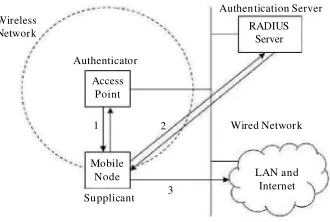
Figure 2. Authenticated wireless node can only gain access to other LAN resources (Strand, 2004) (See steps 1, 2, and 3 in the diagram)
Wireless Network
Authenticator Access
Point
Mobile Node Supplicant
1 2
3
Authentication Server RADIUS
Server
[image:27.612.225.390.561.672.2]EAP was designed with flexibility in mind, and it is being used as a basis for various network authentication protocols. WPA (wi-fi protected access) is proposed to enhance the security of wireless networks through specifications of security enhancements that increase the level of authentication, access control, replay prevention, message integ-rity, message privacy, and key distribution to existing WiFi systems. RFC 2284 states that, in general during EAP authentication, after the link establishment phase is complete (i.e., after establishing connection), the authenticator sends one or more requests to authenticate the peer (client). Typically, the authenticator will send an initial identity request, and that could be followed by one or more requests for authentication informa-tion. The client sends a response packet in reply to each request made by authenticator. The authentication phase is ended by the authenticator with a success or failure packet. Figure 2 shows a general EAP diagram.
RADIUS Overview
Remote authentication dial-in user service (RADIUS) is a widely deployed protocol enabling centralized authentication, authorization, and accounting for network access. RADIUS is originally developed for dial-up remote access, but now it is supported by virtual private network (VPN) servers, wireless access points, authenticating ethernet switches, digital subscriber line (DSL) access, and other network access types. A RADIUS client (here is referred to access point) sends the details of user credentials and connection parameter in the form of a UDP (user datagram protocol) message to the RADIUS server. The RADIUS server authenticates and authorizes the RADIUS client request, and sends back a RADIUS message response. To provide security for RADIUS messages, the RADIUS client and the RADIUS server are configured with a common shared secret. The shared secret is used to secure the traffic back and forth from RADIUS server, and is commonly entered as a text string on both the RADIUS client and server (Microsoft, 2000).
Simple 802.1x Authentication with RADIUS Server
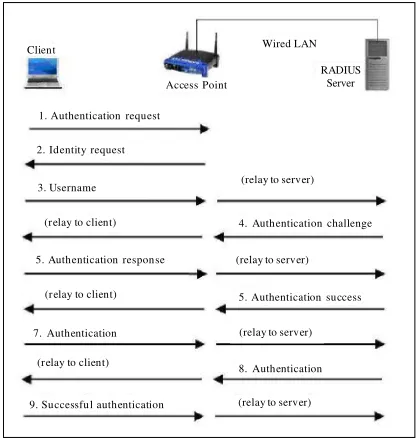
The following steps show the necessary interactions that happen during authentication (Gast, 2002).
1. The Authenticator (Access Point) sends an EAP-Request/Identity packet to the Supplicant (Client) as soon as it detects that the link is active.
2. The Supplicant (Client) sends an EAP-Response/Identity packet, with its identity in it, to the Authenticator (Access Point). The Authenticator then repackages this packet in the RADIUS protocol and passes it to the Authentication (RADIUS) Server.
this from RADIUS, repacks it into EAPOL (EAP over LAN), and sends it to the Supplicant (Client).
4. The Supplicant (Client) responds to the challenge via the Authenticator (Access Point), which passes the response onto the Authentication (RADIUS) Server. 5. If the Supplicant (Client) provides proper credentials, the Authentication
(RA-DIUS) Server responds with a success message that is then passed on to the Supplicant. The Authenticator (Access Point) now allows access to the LAN, restricted based on attributes that came back from the Authentication Server.
Figure 3 shows the details in a pictorial way, where client, AP, and RADIUS server interact. There are a few EAP types of authentication that include EAP-MD5, EAP-TLS, EAP-TTLS, LEAP, and PEAP with MS-CHAPv2. The PEAP authentication process consists of two main phases. Step 1: Server authentication and the creation of a TLS (transport layer security) encryption channel happens in this step. The server identifies itself to a client by providing certificate information to the client. After the client verifies the identity of the server, a master secret is generated. The session keys that are derived from the master secret are then used to create a TLS encryption channel that encrypts all subsequent communication between the server and the wireless client. Step 2: EAP conversation and user and client computer authentication happens in this step. A complete EAP conversation between the client and the server is encapsulated within the TLS encryption channel. With PEAP, you can use any one of several EAP authentication
Figure 3. Step-by-step extensible authentication protocol (EAP) sequences that include the client or user computer, the Access Point, as well as the RADIUS server
Client
Access Point 1. Authentication request
Wired LAN RADIUS
Server
2. Identity request 3. Username
(relay to client) 5. Authentication response
(relay to client)
(relay to client) 7. Authentication
9. Successful authentication
(relay to server)
(relay to server)
(relay to server)
(relay to server) 4. Authentication challenge
5. Authentication success
[image:29.612.190.399.142.361.2]methods, such as passwords, smart cards, and certificates, to authenticate the user and client computer.
PEAP-Microsoft challenge handshake authentication protocol version 2 (MS-CHAP v2) is a mutual authentication method that supports password-based user or computer authentication. During the PEAP with MS-CHAPv2 authentication process, both the server and client must prove that they have knowledge of the user’s password in order for authentication to succeed. With PEAP-MS-CHAPv2, after successful authentica-tion, users can change their passwords, and they are notified when their passwords expire.
Implementing EAP Authentication with RADIUS Server
This section shows the implementation of 802.1x port-based authentication of PEAP (protected extensible authentication protocol) with MS-CHAPv2 (Microsoft challenge handshake authentication protocol version 2) by setting up RADIUS servers on
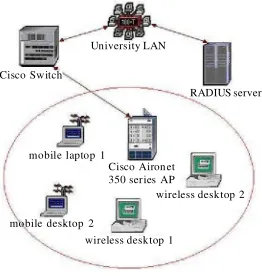
Win-Figure 4. Wireless network implementation. The WLAN is connected to the LAN where RADIUS server is used for authentication purpose
Figure 5. AP association table shows that the clients are EAP authenticated
University LAN
RADIUS server Cisco Switch
wireless desktop 2 mobile laptop 1
Cisco Aironet 350 series AP
[image:30.612.240.371.363.503.2]dows 2000 server and Linux Red Hat 9 as shown in Figure 4. Like what has been discussed in the authentication part, the purpose of this implementation is to allow authorized users to login to the WLAN. Authorized users are those users who are to register their usernames and their passwords with RADIUS server before they are allowed to access the WLAN.
The RADIUS server can be configured, as briefly explained next, on Windows 2000 server (with service pack 4) by configuring the IAS (Internet authentication server). In the IAS authentication service, there is a need to register the RADIUS client. Typically, that would be an access point, and its name and IP address with the shared secret are entered into IAS. Remote access policy needs to be configured to give proper access rights. EAP authentication needs to be selected as PEAP (protected EAP). Certificate services need to be configured, and certification authority details need to be entered to create the certificate that has to be used with IAS. The user account that uses wireless network needs to be given remote access rights in the active directory user management. On the access point, there is a need to do the authenticator configuration by adding the IP address of the RADIUS server and the shared secret details. On the client’s side, windows XP workstation has to be configured with a wireless card to negotiate with the AP that is doing RADIUS authentication through IAS server. The association table on CISCO AP in Figure 5 shows the details after the client’s EAP authentication with RADIUS server. Note the words‘EAP Assoc’ under the State column.
An example setup used by the authors can be explained as follows. The user guest who had an account in the RADIUS/Windows 2000 server, risecure.isecures.com (with IP address 172.20.121.15), had connected from a client, PC.isecures.com (with IP address 172.20.121.60), through a CISCO Aironet 350 access point (with IP address 172.20.121.57). The event viewer output (only selected lines are shown) after successful EAP authen-tication was as follows:
IAS event viewer output on Windows 2000 Server:
Event Type: Information Event Source: IAS Computer: RISECURES Description:
User ISECURES\guest was granted access.
Fully-Qualified-User-Name = isecures.com/Users/Guest NAS-IP-Address = 172.20.121.57
NAS-Identifier = AP350-577875 Client-Friendly-Name = isecureslab Client-IP-Address = 172.20.121.57
Policy-Name = Allow access if dial-in entry enabled Authentication-Type = EAP
EAP-Type = Protected EAP (PEAP)
To implement the RADIUS configuration in Linux platform, a GNU RADIUS software, known asFreeRADIUS, can be downloaded and be configured as the RADIUS server.
of the authentication messages (only selected lines are shown) when FreeRADIUS is run in a debug mode (i.e., radiusd - X) in Linux after successful EAP authentication can be as shown.
FreeRADIUS authentication output on red hat Linux: rad_recv: Access-Request packet from host
172.20.121.57:1151, id=119, length=195 User-Name = "guest"
Cisco-AVPair = "ssid=isecureslab" NAS-IP-Address = 172.20.121.57 Called-Station-Id = "0040965778XX" Calling-Station-Id = "00097c6f1dXX" NAS-Identifier = "AP350-577XX" … rlm_eap: EAP/peap
rlm_eap: processing type peap rlm_eap_peap: Authenticate rlm_eap_tls: processing TLS rlm_eap_peap: EAPTLS_OK rlm_eap_peap: Session established.
rlm_eap_peap: Received EAP-TLV response. rlm_eap_peap: Tunneled data is valid. rlm_eap_peap: Success
Login OK: [guest] (from client isecureslab port 37 cli 00097c6f1dbc) …
The authors had used FreeRADIUS 1.0.0 to setup the RADIUS server. The source was compiled and executable was created. Some configuration files were edited, like radiusd.conf, eap.conf and clients.conf, to allow user permission with password to configure PEAP-MS-CHAPv2 functions.
The WEP Cracking Procedure
Problems with WEP
Generally, attacks on WEP were based on the design of the system, which many people thought was sound. However, a paper written by Fluhrer, Mantin, and Shamir (2001) dispelled that notion. The authors found a flaw in the “key scheduling algorithm” of RC4 that made certain RC4 keys fundamentally weak, and they designed an attack that would allow a passive listener to recover the secret WEP key simply by collecting a sufficient number of frames encrypted with weak keys. Though they did not implement the attack, others did. The first public description was in 2001 from an AT&T Labs technical report (Stubblefield, Ioannidis, & Rubin, 2001).
key. Every WEP encrypted packet has an associated 3-byte (24 bits) initialization vector. Some IVs leak information about a certain byte of key and, thus statistically, the correct key emerges when a sufficient number of IVs have been collected. To recover a WEP key, it really depends on the way the IVs are distributed. Most of the time, one million unique IVs (thus about 2 million packets) are enough.
Practical Cracking
Both the 64-bit and 128-bit WEP key cracking were tested and analyzed by the authors. The cracking was done using an ACER laptop client station with appropriate software. Huge files from the Internet (around 650 MB) were downloaded by the wireless laptop to create sufficient packets for capturing. The laptop had a built in wi-fi network adapter used for connection to the Internet through access point network. An additional CISCO Aironet 350 series PCMCIA card was used on the same laptop for packet capturing on channel 6. The packet capturing was done using Link Ferret software (version 3.10). Once the PCMCIA card is configured for promiscuous capturing, it cannot be used for connecting to a wireless network. The list of equipment (hardware or software) used is shown in Table 2.
The 128-bit WEP key (alphanumeric) was cracked by capturing around 3- to 4-million packets with 264674 unique IVs. The cracking took only 2 seconds and is shown in Figure 6. Other random 128-bit alphanumeric keys were also cracked easily.
Thus, WEP does not use RC4 encryption algorithm in a proper way, in that it exposes the protocol to weak key attacks, and free software hacker tools like Aircrack or Airsnort or others exploit this weakness.
Table 2. Hardware and software used for WEP cracking
Equipment/Item Specification
Laptop Acer Laptop with Mobile Centrino Intel processor,256 MB RAM and 20 GB HDD with Windows XP. Network Detection
Software NetStumbler 0.4.0
Packets Capturing Software Link Ferret 3.10 (also used as analyzer)
Wireless Network Adapters Onboard wireless network adapter and CISCOAironet 350 series PCMCIA
War Driving and Packet Analysis
War driving is the process of driving around a place or city with a PC or laptop with a wireless card, running some wireless detection software and, preferably, connected to a global positioning system (GPS). The software detects the presence of wireless networks, and the war driver associates his device to the wireless network. This is due to the nature of all wireless networks, as they need to announce their existence so that potential clients can link up and use the services provided by the network. However, the information needed to join a network is also the information needed to launch an attack on a network. Beacon frames are not processed by any privacy functions, and that means that the 802.11 network and its parameters are available for anybody with a 802.11 card. War drivers have used high-gain antennas and software to log the appearance of Beacon frames and associate them with a geographic location using GPS.
Packet capturing can be done in various spots where wireless networks are detected through NetStumbler software alerts. Anyone would be quite surprised to see that quite a number of wireless networks were working without encryption. They simply had not enabled the WEP option. The authors had done war driving and packet capturing in eight different sessions for an average duration of around 30 minutes from different locations. The captured packet files are mainly from different locations that include petrol stations, banks, financial institutions, shopping complexes, and government organizations. It is unfortunate that the header of the wireless packets can reveal some interesting informa-tion, as it is transmitted in the clear. Sniffing and getting such details on a wired network is not that easy. Wireless frames/packets captured were a combination of control frames, management frames, and data frames. Control and management frames were much more in comparison to data frames. Some critical information captured were source, destina-tion, and BSSID (or AP) MAC addresses; source and destination node IP addresses; source and destination node open port numbers; checksum details; initialization vector (IV) value; and so forth. This information in itself is not very sensitive, but some of it can be used to launch attacks against a wireless LAN, especially the DoS attacks.
Encrypted packets showed signs of using a set of WEP keys (against using one static key), and in some packets, TKIP protocol was used.
Some data packets were captured that were not even encrypted. Even though some APs were using WEP encrypted transmission with TKIP enabled, quite a number of unencrypted fragmented IEEE 802.11 data frames (with frame control type=2, i.e., type=data frame) could still be collected. These can be used to get meaningful or sensitive information that can interest an intruder, if one uses appropriate tools and shows some patient effort. For example, EtherPEG and DriftNet are free programs (EtherPEG, 2005 and DriftNet, 2005) that show you all the image files, like JPEGs and GIFs, traversing through our network. It works by capturing unencrypted TCP packets, and then grouping packets based on the TCP connection (i.e. from details determined from source IP address, destination IP address, source TCP port, and destination TCP port). It then joins or reassembles these packets in the right order based on the TCP sequence number, and then looks at the resulting data for byte patterns that show the existence of JPEG or GIF data. This is useful when one gets connected “illegally” to a wireless LAN.
Overall, 50 access points or peers in wireless networks without WEP encryption, and 21 access points or peers with WEP encryption using NetStumbler were located. It is similarly easy to even connect to an encrypted peer wireless network by typing in a random password. The PC or laptop thus connected can be assigned an IP address. Packet Analyzers like Ethereal (2005), Packetyzer (2005) and Link Ferret monitor software (Link Ferret, 2005) can be used for the detailed analysis of packets. Using filters, one could simply list out the interested packets. Each of those packets could then be analyzed with its detailed contents.
Table 3 gives some statistical information on data frames/packets that are unencrypted, and Figure 7 shows the related graph. The captured packet files (pkt1 to pkt8) are from seven different locations during different times (Issac, Jacob, & Mohammed, 2005).
Table 3. Details of captured packet files
Packet file name
No. of total packets
No. of unencrypted data packets (UDP)
Average unencrypted data packet size (in bytes)
No. of unencrypted data packets/sec
pkt1.cap 32767 2532 1081.86 3.31
pkt2.cap 32767 7482 108.17 2.42
pkt3.cap 19321 1397 428.34 1.05
pkt4.cap 32767 1465 228.15 0.45
pkt5.cap 6073 2385 173.85 1.30
pkt6.cap 32767 3527 83.57 4.71
pkt7.cap 32768 1558 84.79 1.13
pkt8.cap 39607 2550 77.25 1.81
The data frames considered for tabular analysis fall into the following categories or groups — Data (frame type 32), Data + Acknowledgement (frame type 33), Data + CF-Poll (frame type 34) and Data + CF-Acknowledgement/CF-Poll (frame type 35). These data packets will be referred to as unencrypted data packets (UDP) from henceforth. Data frame type 32 dominates the population. The sample considered for analysis consists of unencrypted data frames and unencrypted fragmented data frames, both containing visible data sections in HEX format as viewed through Ethereal. The packet samples are
only indicative, and they are not very exhaustive.
Frames of type Data + Acknowledgement (No data, frame type 37), Data + CF-Poll (No data, frame type 38), Data + CF-Acknowledgement (No data, frame type 39), QoS Data (frame type 40) and QoS Null (No data, frame type 44) are not considered for tabular analysis, since they contain no data payload or irrelevant data. From Table 3, one can see that the average number of unencrypted data packets per second is 2, and the average unencrypted data packet size is around 241.
Using conditional probability on the eight samples collected, the following is observed.
Given an unencrypted packet, there exists a 15% average chance that it is a data packet.
Thus mathematically, Pavg(DP | UP) = ( ( ) )
UP P
UP DP
P ∩
= 0.15, where DP is data packet and UP is unencrypted packet. Grouping the captured packets based on the source company/ organization yielded Table 4. The 95% confidence interval was also calculated, assuming 5% error in captured packets. The results are quite revealing (Issac et al., 2005).
Figure 7. The graph showing the percentage of unencrypted data packets (UDP) captured from eight different sessions, based on Table 3.
45 40 35 30 25 20 15 10 5 0 22.835 7.73 7.235 4.475 39.27 10.765 4.755 7.78
1 2 3 4 5 6 7 8
Capture Sessions
IEEE802.11b Vulnerabilities
and Other Attacks
This section presents some vulnerabilities that are present in the wireless networks. While most of these also apply to wired-networks as well, they are particularly important in wireless networks. This is not because the same risks are present, but also because of the nature of wireless networks that has made it more vulnerable than wired networks. The main focus will be in the areas such as interception, impersonation, denial-of-service, theft-of-service, and the like.
Issues with Default Access Point Setup
Access points (AP) are like base stations; they are the nonmobile unit that connects the wireless network into a wired network. They behave like a bridge or router. Usually, APs from manufacturers come with a set of default configuration parameters. These default parameters need to be changed in line with the corporate security policies, or else the default setup may leave some loopholes for attacks. For instance (depending on the manufacturer), most APs have a default administrator password, SSID, channels, authentication/encryption settings, SNMP read/write community strings, and so forth. Since these default values are available in user manuals, vendor’s websites, and installation guides, they are well known to the general public, and may be used by wireless hackers to compromise WLAN security. Some default SSID based on different vendor products are shown in Table 5.
Table 4. Source of captured packets with 95% confidence interval calculation
Packet File name
Type of Company/ Organization
95% Confidence Interval
for the proportion of unencrypted data packets pkt1.cap Petrol Station & PrivateInstallations (7.44%, 8.02%)
pkt2.cap Bank/ Financial Institution (22.38%, 23.29%)
pkt3.cap Petrol Station (6.87%, 7.60%)
pkt4.cap Multistoried ShoppingComplex (4.25%, 4.70%)
pkt5.cap Bank/ Financial Institution (38.04%, 40.50%) pkt6.cap Bank/ Financial Institution (10.43%, 11.10%)
pkt7.cap Government Organization/Office (4.52%, 4.99%)
Aservice set identifier (SSID) is a 32-byte case-sensitive text string that identifies the
name of a wireless local area network (WLAN). All wireless devices on a WLAN must employ the same SSID in order to communicate with each other. SSID can be set either manually, by entering the SSID into the client network settings, or automatically by leaving the SSID unspecified or blank. A network administrator often uses a public SSID that is set on the access point and broadcast to all wireless devices in range. War drivers can scan for the SSIDs being broadcast by wireless LANs using software tools such as Netstumbler, Wellenreiter, and the like. Once they gain knowledge on the SSID, then they set that SSID on their client to attempt to join that WLAN. However, knowing the SSID name does not necessarily mean that rogue clients will be able to join the network, but it is part of the primary information required to carry on different forms of attacks. The use of a Web browser or Telnet program to access the setup console of an access point can be a possibility from default values used in an AP setup. This allows the attacker to modify the configuration of the access point. Unless the administrator creates user-ID and password for authentication for AP’s management console access, the network is in deep trouble with open access to the AP setup facility.
Rogue Access Point Installation
Easy access to wireless LANs is coupled with easy deployment. Any user can purchase an access point and connect it to the corporate network without authorization. Rogue access points deployed by end users pose great security risks. Many end users are not security experts and may not be aware of the risks posed by wireless LANs. Most existing small deployments mapped by war drivers do not enable the security features on products, and many access points have had only minimal changes made to the default settings. Unfortunately, no good solution exists to this concern. Software tools like NetStumbler allow network administrators to wander their building looking for unautho-rized access points, though it is quite an effort to wander in the building looking for new
Table 5. Types of default SSID and their vendors
Vendor Default SSID
Cisco Aironet tsunami
3Com AirConnect comcomcom
Symbol Technologies 101
Compaq WL -100/200/300/400 Compaq
D-Link DL -713 WLAN
SMC SMC2652W/SMC2526W WLAN
SMC SMC2682 BRIDGE
[image:38.612.202.399.130.257.2]