Thesis by
Kangchen Bai
In Partial Fulfillment of the Requirements for the
Degree of
Ph.D. of Geophysics and Seismology
CALIFORNIA INSTITUTE OF TECHNOLOGY
Pasadena, California
2019
© 2019
Kangchen Bai
ORCID: 0000-0002-9788-6404
First of all, I would like to thank my research advisors without whose support this
work would never have been possible. Prof. Jean-Paul Ampuero introduced me
to the topics of dynamic rupture and earthquake cycle simulation which greatly
practiced analytical skills and opened my eye to the area of super computing. His deep understanding of those topics and his brilliant physics intuition enabled us to
pierce through the complications and grasp the underlying simplicity. Prof. Don
Helmberger introduced me to global seismology. His great enthusiasm and passion
on seismograms really inspired me towards making discoveries from waveforms.
He also has masterful skills in modeling which I hope that I could have learned
more.
I thank my past and present advisory committee: Rob Clayton, Jean-Philippe Avouac and Jennifer Jackson and my minor program advisor Thomas Hou for their helpful
advises on course development and guidance at every critical stage of my doctoral
study. My attitude goes to Victor Tsai for providing me the experience as a teaching
assistant that greatly improve my skills to communicate abstract concepts and make
rigorous explanation. I also thank Jean-Philippe Avouac and Zhongwen Zhan
for fruitful discussions I had with them on my research projects. I thank Mike
Gurnis, Mark Simons, Nadia Lapusta, Joanna Stock for teaching me Geodynamics,
Geodesy, Fracture dynamics and Plate tectonics which completes my knowledge in
other apsects of Geophysics.
I am grateful to a lot of former seismolab students and postdocs: Daoyuan Sun,
Shengji Wei, Han Yue, Dunzhu Li, Yiran Ma, Asaf Inbal, Yingdi Luo, Yihe Huang,
Daniel Bowden and Vish Ratnaswamy for their helpful advices on my research and
career development. I thank my office mates: Yiran Ma, Semechah Lui, Voonhui
Lai, Jorge Castillo, Zhichao Shen and Valere Lambert for a lot of fun chats and
discussions. I am fortunate to have Xiaolin Mao as my classmate, together with
whom we overcame a lot of difficulties and challenges. I thank my friends who
are also pursuing Ph.D.s all around the globe: Xiaopeng Bian, Qingyuan Yang and Hongyu Zeng for their companion during the highs and lows.
I thank Priscilla Mclean, Sarah Gordon, Donna Mireles, Kim Baker-Gatchalian,
Rosemary Miller, Michael Black and Naveed Near-Ansari for caring about
I am deeply indebted to Xiaodong Song, Mingjie Xu and Ning Mi who are my
geo-physics teachers at Nanjing university for introducing me to the area of geogeo-physics.
My attitude also goes to my mentors in Schlumberger Houston namely, James Xu,
Kun Jiao, Xing Cheng, Dong sun and Denes Vigh, with whom I spent two summers
doing an intership. Our seamless collaborations led to considerable progress towards
new imaging techniques during which I learned a lot of valuable knowledge about
seismic imaging and industrial programming.
Finally, I would like to thank my family, my father and mother, my grandmother and my uncle Ben for their unconditional love and support 10,000 km away across the
In this Thesis, I report my Ph.D. research on two major issues that are devoted towards
constructing more realistic earthquake source model using computational tools: (1)
constructing physically consistent dynamic rupture models that include complexities
in fault geometry as well as heterogeneous stress and frictional properties inferred from observations; (2) study the effect of subducting slab structure on earthquakes
that occur inside it with a special focus on the teleseismic waveforms.
Fault step over is one of the most important geometric complexities that control the
propagation and arrest of earthquake ruptures. In Chapter 2, we study the role of
seismogenic depth and background stress on physical limits of earthquake rupture
across fault step overs. We conclude that the maximum step over distance that
a rupture can jump is approximately proportional to seismogenic depth. We also conclude that the pre-stress conditions have a fundamental effect on step over jump
distance while the critical nucleation size has a secondary effect.
Seismic wave carries information of source as well as structures along the path it
travels. It was found that seismic waves generated by shallow events in subduction
zones whose ray path coincide with the down going slab structure display waveform
complexities that feature multipathing. In Chapter 3, we study deep earthquakes
whose depth phases sample the slab structure on their way up to the surface.
Dif-ferential travel time sP-P analysis shows a systematic decrease of up to 5 seconds from Europe to Australia and then to Pacific which is indicative of a dipping high
velocity layer above the source region. Finite-difference simulations showed that a
slab shaped structure that follows the Benioff zone at shallow depth and steepens
beyond 400 km produces a model that can account for the sP-P differential travel
times of 5 seconds for oceanic paths. In Chapter 4, we design a slab operator that
can be applied on the 1D synthetics to generate 2D synthetics with slab structure.
We hope this operator can be used for generating more accurate Green’s functions
that could potentially serve earthquake source inversion.
In Chapter 5, we design a dynamic rupture model of the Mw 7.8 Gorkha, Nepal
earthquake. We employ a novel approach of integrating kinematic inversion results
which provide low frequency stress distribution and stochastic high frequency stress
motivated by earthquake cycle models and observations. By doing this, we are able
concentration of high-frequency radiation in the down-dip part of the rupture.
In Chapter 6, I report my on going work on the spectral element method based
earthquake cycle simulator. Large scale earthquake cycle simulation with
consid-eration of complicated velocity structure and fault geometry is a great challenge
for numerical modeling. I tried to push forward this boundary by extending the
existing spectral element earthquake cycle simulator to enable cycle simulations
on bi-material faults. This chapter includes a benchmark test in 2D that
demon-strates the correctness of this new algorithm and an application of this method on
Bai, Kangchen and Jean-Paul Ampuero (2017). “Effect of Seismogenic Depth and Background Stress on Physical Limits of Earthquake Rupture Across Fault Step Overs”. In:Journal of Geophysical Research: Solid Earth 122.12, pp. 10, 280– 10, 298. doi:10.1002/2017jb014848. url:https://doi.org/10.1002/ 2017jb014848.
Bai and Ampuero co-designed the study. Bai conducted all the 3D dynamic rupture
TABLE OF CONTENTS
Acknowledgements . . . iii
Abstract . . . v
Published Content and Contributions . . . vii
Table of Contents . . . viii
List of Illustrations . . . x
List of Tables . . . xxi
Chapter I: Introduction . . . 1
Chapter II: Effect of seismogenic depth and background stress on physical limits of earthquake rupture across fault step-overs . . . 4
Abstract . . . 5
2.1 Introduction . . . 6
2.2 Model . . . 7
2.3 Simulation results . . . 11
2.4 Theoretical relation betweenHc/W andS . . . 19
2.5 Discussion . . . 20
2.6 Conclusions . . . 27
Chapter III: Imaging subducted slab using depth phases . . . 29
Abstract . . . 30
3.1 Introduction . . . 31
3.2 Waveform Data and Processing . . . 33
3.3 Modeling efforts . . . 37
3.4 Results . . . 38
3.5 Conclusion and discussion . . . 41
Chapter IV: Path correction operator . . . 47
Abstract . . . 48
4.1 Introduction . . . 49
4.2 Methodology . . . 54
4.3 Advances in simulation . . . 55
4.4 Path correction operator . . . 58
4.5 conclusion . . . 62
Chapter V: Dynamic rupture simulation of the 2015 Mw 7.8 Gorkha Earthquake 64 5.1 Introduction . . . 64
5.2 Model . . . 65
5.3 Simulation results . . . 70
5.4 Discussion . . . 76
5.5 Conclusion . . . 82
Chapter VI: Some advances on the spectral element earthquake cycle simulator 84 6.1 Introduction . . . 84
LIST OF ILLUSTRATIONS
Number Page
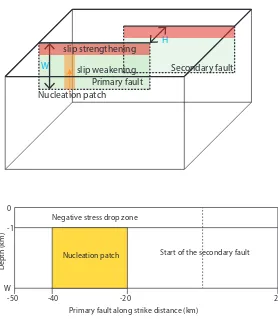
2.1 Canonical model of two parallel, vertical strike-slip faults with a
step-over. Top: 3D view. The step-over distance is H and seismogenic
depth is W. Bottom: Side view. Nucleation is enforced on the
primary fault in a rectangular area that covers the whole seismogenic
depth. A shallow zone of negative strength drop is prescribed. . . . 8
2.2 Critical values of the ratio of strength excess to stress drop, S, that
allows ruptures to jump (a) compressional and (b) dilational step-overs with different seismogenic depthW and step-over distance H.
Each symbol is the result of a suite of simulations with fixedHandW,
but varyingSuntil the maximumSvalue required for step-over jump
is found. This critical S value is reported by colors. Two different
symbols indicate the rupture speed regime on the first fault:
sub-Rayleigh (circles) or super-shear (diamonds). Open circles are cases
in which only super-shear ruptures can jump through the step-over;
we did not determine the criticalSfor those cases. . . 12
2.3 Critical step-over distanceHcfor sub-Rayleigh ruptures as a function of seismogenic depthW and strength excess ratioSfor (a)
compres-sional and (b) dilational step-overs. The solid lines are not contours
generated from simulation data, but the contours of critical S
pre-dicted by a relation Hc/W = 0.3/S2inspired by our near-field theory and constrained by our simulation data. They serve as a visual guide
cleation sizes Lc/W (indicated by colors). Cases with sub-shear and
super-shear ruptures on the second fault are distinguished by symbols
(see legend). For compressional step-overs, the simulation results are
consistent with an inverse quadratic relation Hc/W ∝ 1/S2 at large
S > 2 and an inverse linear relationHc/W ∝ 1/S at small S < 1.5. The linear regime has two branches corresponding to sub-Rayleigh
and super-shear ruptures on the second fault. For dilational
step-overs, the results are consistent with the quadratic relation and also display sub-Rayleigh and super-shear branches. In both
compres-sional and dilational step-overs, sub-Rayleigh ruptures have larger
Hcthan super-shear ruptures at givenS. Small values ofLc/W favor super-shear. For a givenSvalue, faults with smallerLc/W can jump
wider step-overs. . . 13
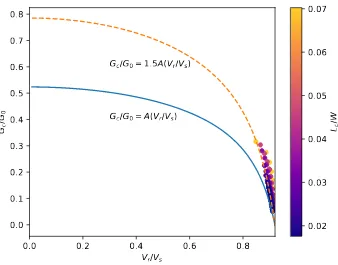
2.5 Final rupture speed on the first fault as a function of the ratio between
fracture energy Gc and static energy release rateG0. Rupture speed
Vr is normalized by shear wave speedVS. The blue solid line is the
theoretical curve for 2D mode II cracks with constant rupture speed. A constant factor of 1.5 is introduced to account for 3D effects, such as curvature of the rupture front. . . 15
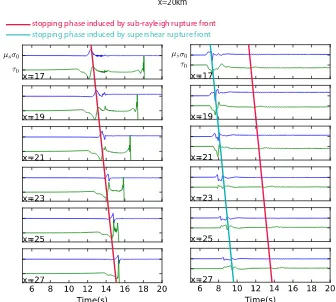
2.6 Comparison of dynamic stresses between a sub-Rayleigh rupture
(left) and a super-shear rupture (right). (a) Map view of the two
examples. Both have the same fault system geometry but different
S ratio (S = 1.27 for the sub-Rayleigh case and S = 0.64 for the super-shear case). An array of receivers (red) is placed along the
second fault near the end point of the first fault, between x = 17 km
and 27 km and at a depth of 14 km. (b) Transient shear stress τ(t) (solid green) and static strength µsσ(t)(blue) on the second fault of the sub-Rayleigh case (left) and super-shear case (right). Each panel
corresponds to a different location along the second fault (xposition
indicated by label). Stopping phases generated by sub-Rayleigh and
super-shear fronts are indicated by red and yellow lines, respectively.
The super-shear rupture did not breach the step-over because splitting
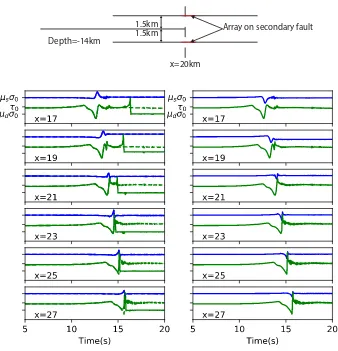
2.7 Comparison of dynamic stresses between compressional step-over
(left) and dilational step-over (right). (a) Map view of the two exam-ples. An array of receivers (red) is placed along the second fault near
the end point of the first fault, between x= 17 km and 27 km and at a
depth of 14 km. (b) Transient shear stressτ(t)(solid green) and static strengthµsσ(t)(blue) on the second fault of the compressional step-over (left) and dilational step-step-over (right). Each panel corresponds
to a different location along the second fault (x position indicated by
label). Dashed green curves are shear stresses computed in separate
simulations assuming the secondary fault remains locked. . . 18
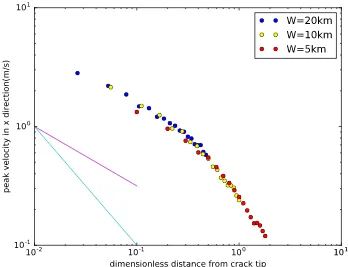
2.8 Peak ground velocity in thexdirection at 90 degree azimuth from the end of the first fault, as a function of distance to the end of the first
fault normalized by seismogenic depth. Three cases with different
seismogenic depthW are considered (see legend). . . 19
3.1 Modified from Zhan et al. (2014a). Waveform observations and
simulations for the 2009/09/10 Mw 5.9 inter-plate earthquake and the 2007/01/13 Mw 6.0 outer-rise earthquake. (A)Record-sections of observed (left panel, black) and synthetic (right panel, red)
seis-mograms for the 2009 inter-plate earthquake, aligned by the first P
arrivals. (B) Similar to (A) but for the 2007 outer-rise earthquake. (C) 2D finite-difference simulation of the 2009 inter-plate earthquake
(red star) with a high-velocity slab (outlined by the white line). The
inset shows the triangular velocity profile across the slab, with 5%
perturbation in the slab center. Black lines display the P wave ray
paths to tele-seismic distances of 30◦, 60◦and 90◦, respectively. (D)
Similar to (C) but for the 2007 outer-rise earthquake.(E) The red and
yellow stars are the interplate and outer-rise earthquakes respectively. 32
3.2 (a) PREM model with a 45° dipping slab model inserted in it. Black
and red curves are the ray path for the P and sP phases to both Eurasia (negative distances) and Pacific (positive distances). (b) Simulated
synthetic seismograms to the Pacific direction with the slab model
seismograms are color coded as red for stations in Eurasia continent
and blue for stations in the Pacific and green for stations in Australia. 35
3.4 A. CAP results of the travel time shifts between observations(black)
and synthetics(red) for P and sP phases. The lower red numbers are
the calculated double differential travel time (TsP - TP)observed-(TsP
- TP)PREM. B.The double differential travel times as a function of
distances and azimuths. C. The global map of the differential travel
time. . . 36 3.5 Comparison of synthetic predictions from the tomographic model
GyPSuM (Vs) and LLNL (Vp) given in black along with some
sam-ples of waveform data displayed in red as displayed in Figure 3.3. . . 39
3.6 We test slabs of different thickness. When the thickness of the slab
is comparable with the seismic wave length, the finite frequency
effect can be significant due to which travel time shift is very small.
But when the slab thickness is doubled in (b) the time shift become
evident. Considering our major period of 0.1s in observation, the
slab thickness should not be smaller than 60km. . . 39 3.7 A slab model that steepens within transition zone. We here show
the preferred model of the slab structure. Because an all 45 degree
dipping slab is not able to generate enough time shift due to the
steep take off angle of sP phase that are observed in the pacific. We
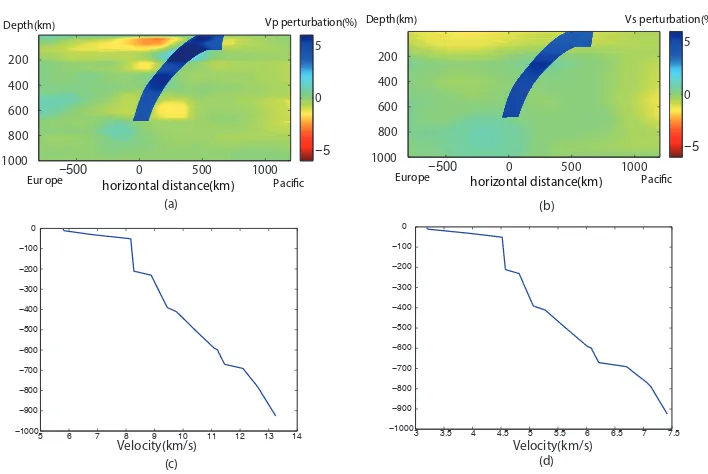
suggest that a slab model that steepens at depth can better explain the
observed travel time shift in Pacific region. (a) and (b) are the local
zoom in of the preferredVpandVs model with slab structure. (c) and
(d) are the corresponding 1D model based on which (a) and (b) are
built. . . 40 3.8 Slab model with 5% velocity perturbation that steepens at depth is
combined with tomography model. Our model is able to simulate
the differential travel time caused by slab structure but the waveform
3.9 The global P wave travel time residual compared with PREM model
estimated by CAP in frequency band 0.01−0.5 Hz for deep event (a) and shallow event (b). A deep event shows smaller travel time
devia-tion comparing with a shallow event, which may indicate complicated
subduction zone structure at shallower depth. . . 42
3.10 (A) Map view of the epicenter (yellow circle) and station distribution
for the 2013 Sea of Okhotsk Earthquake. Stations toward Pacific
and Europe are highlighted and shown in (C) and (D). (B) Vertical
velocity waveform at PASC with data in black (single station and
stacked) and the FK synthetics are shown in red (up+down), blue
(up-going) and green (down-going). Station azimuth (upper) and distance (lower) are shown at the beginning of the data. (C), (D)
show the displacement waveform of data (black) and synthetics (red)
with station names indicate at the beginning of each record. Peak
motion (in micro-meter) of data is shown at the end . . . 43
3.11 Figure 11A and 11B displays 2D cross-section along the pacific paths
sampling the slab model embedded in Lu and Grand (2016), along
with ray paths. Note the fast velocities sampled by the direct P wave.
Figure 11 C,D,E displays the differential travel times normalized to
PREM. The pP is not significantly early as suggsted for the aftershock results. . . 45
3.12 Paths towards the east Europe (A) and the west Pacific (B). The
differential travel time between depth phases and direct P shows
positive anormaly in (A) with depth phases arriving later while in (B)
the differential travel time is nearly 0. . . 46
4.1 Depth of Vs=2.5km/s in the Honshu region, the 3D velocity model is
obtained from NIED (National Research Institute for Earth Science
and Disaster Prevention). Note the 3D model stops at about 15km,
which is defined as the slip divided by the rise-time. (B) The revised
slip model based on the scheme described in Graves and Pitarka
(2010). The two circles indicate the sub-faults with their source time
function shown in (C) and (D). (C) The left panel shows the shape
of two source time functions used for the inversion (original) and for
forward calculation (rough), respectively. The length of the rough
source time function is proportional to the square root of the slip
amplitude. The right panel displays the amplitude spectra of the corresponding source time function. (D) Similar as (C), here an extra
scaling factor (0.5) is applied to determine the length of the revised
source time function (rough), thus this model has larger amplitude
spectra at high frequency bands. (E) Source time function with
flexible T1/T ratio (red) along with cosine-like source time function
(blue) . . . 52
4.3 Modified fromChu et al. (2011)0.01−0.5 Hz for deep event (a) and shallow event (b). A deep event shows smaller travel time deviation
comparing with a shallow event, which may indicate complicated subduction zone structure at shallower depth. . . 53
4.4 (A) Vs model with water layers. White star shows the position of
the sources position and triangles indicate the receivers . (B)
Ver-tical displacement for the model with water (red) and without water
(black). The waveform looks similar because the arrivals trapped in
the ocean are transmitted downward into the mantle and does not go
to the local receivers. (C) Snapshot of vertical velocity from a flat
water model (top) and a sloping water model (bottom). The source is
an explosion. The water phases are clear. A useful procedure for lo-cating off-shore earthquakes is to determine the water depth directly
above the event by modeling the various water phase arrivals, PwP
etc. Since the water depths are well known, it can help constrain the
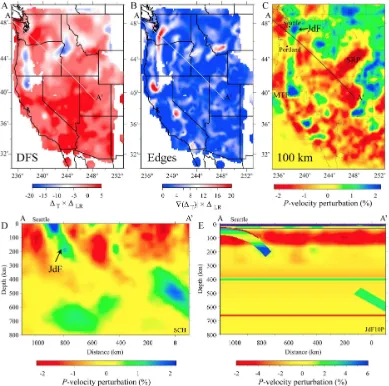
4.5 Figure modified fromChu et al. (2012). Seismic structures derived
from observed waveform complexities showing (a) dipping structure and (b) the edges of the Juan de Fuca Slab (Sun and Helmberger,
2010).(c) Map view of a tomographic image at 100km for the
west-ern United States (Schmandt and Humphreys, 2010). The location
of JdF slab derived from waveform complexity agrees with the slab
from travel-time tomography.(d) We show tomographic P wave
ve-locities of the Juan de Fuca (JdF) slab fromSchmandt and Humphreys
(2010)and (e) the hybrid model constructed from forward modeling
of waveform data and travel times. The location of the cross section
is shown as AA’ in the map. Note the difference between the color scales in Figure 2d and 2e. In Figure 2c, MTF refers to the Cape
Mendocino transform fault and SRP is the snake River Plain. . . 57
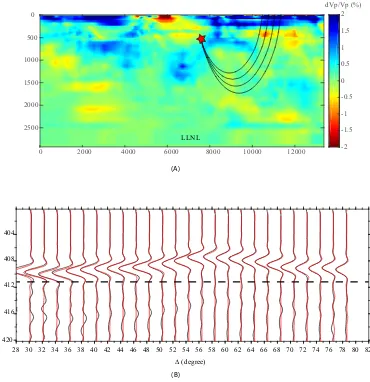
4.6 2D model and waveform comparisons. (A) 2-D cross-section of
the LLNL model from South America to the USArray. The red
star indicates the event location used in the simulation. The black
lines represent the 1-D raypaths at 50,55,60,65 degree away from the
source.(B) The waveform comparison between WKM (red) and FD
(black) using LLNL model. All traces are low-pass filtered with a
cutoff frequency of 0.4 Hz. . . 59 4.7 (A)(B) For shallow earthquakes, the ray path of the direct phases
and surface reflected phases are traveling through similar paths. So
we should assume that the slab effect on those phases to be similar.
Depending on the detailed geometric structure of the slab, when the
ray is entering or leaving the interior of the slab, multipath effect is
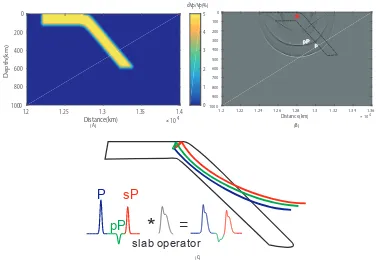
emphasized. We demonstrate concept of a slab operator in (C). . . . 60
4.8 Shows the finite frequency effect of a thin high velocity slab on
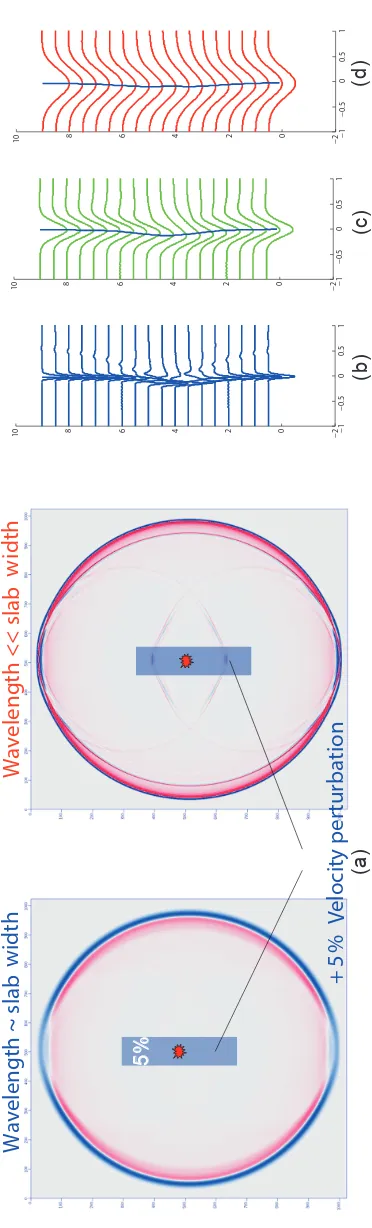
seis-mic wave field.(a) is a slab model 50km wide with uniform velocity
perturbation of 5%. In (b)(c)(d) we use three sources with three different wavelengths:10km, 50km and 200km. At very high
fre-quency(b), the travel time of the slab is very clear. There are also
reflected and converted phases generated at the boundary of the slab
which can be explained by classical ray theory. When the seismic
wave length is comparable with slab width (c), the travel time effect
is blurred. At even longer wavelength, the slab structure is ignored
synthetics with that generated by convolving 1D PREM synthetics
with the slab operator. Here the wavetrain is composed of P pP and
sP phases.(b) for a source depth of 40km and (d) 80km. . . 63
5.1 Multi-cycle quasi-dynamic simulation on a rate-and-state model of
fault containing small asperities. (A) Depth dependence of friction
parameters a and b. The seismogenic zone is in the depth range
where a < b. (B) Spatial distribution of shear stress on the fault (normalized by normal stress) right before a large event that ruptures the whole seismogenic zone. (C) Top: Spatio-temporal evolution of
shear stress along a horizontal cross-section through a large asperity
shown by a long white line in (B). Bottom: temporal evolution of
slip velocity at the center of the asperity. (D) Same as (C) but for the
small asperity indicated by a short white line in (B). . . 67
5.2 Model and initial conditions for the dynamic rupture simulations.(A)
simulation region with surface topography in the middle cubic with
semi-sphere wrapped regions which is aimed to absorbing out-going
seismic wave.(B) Cross-section of the meshed mega-thrust region. The mesh is specially refined near the fault plane. (C) Small stress
patches at bottom of the seismogenic zone are superpositioned onto
the long wavelength stress field computed from kinematic rupture
model. The stress patches are randomly generated with their radius
following polynomial distribution with power -2.5. (D) Dc value in
these small patches are also stochastically perturbed downward. . . . 68
5.3 Plot of the simulations and data of vertical velocity at the strong
motion station KTP. The simulations are those of the smooth models
with different combinations of (µs,Dc). The blue line plots the preferred model that will be used to develop the rough model since
its pulse width and timing make a best fit to the data (magenta line). 71
5.4 Rupture time(A), rupture speed(B) and final slip distribution(C) of
the dynamic rupture simulation. . . 72
5.5 . High frequency contents 0.5-2 Hz Low frequency contents 0.05-0.2
5.6 A and B. Comparison of data, kinematic model synthetics and
dy-namic model synthetics in time dimain(A) and spectral domain(B). KTP. Vertical (C) (D) North - South (E) (F) East - West . . . 75
5.7 A. Moment rate functions generated by our smooth model (blue) and
rough model (red). B. Moment rate spectrum generated from the
smooth model (blue) and the rough model (red), and inferred from
tele-seismic data byLay et al. (2017)(yellow). . . 77
5.8 Comparison of three component high rate GPS data (black) and
synthetics generated by smooth model (red) and rough model (blue).
All the time series are filtered to a frequency band of 0.02 Hz - 0.1
Hz to get rid of the basin resonance effect. Data source : Galetzka
et al. (2015). . . 78
5.9 A: Distribution of broadband (0-3 Hz) peak ground velocity from
our rough dynamic source model. B: High-frequency peak ground
velocity (1-3 Hz). The red shaded regions are the only two districts
with a fatality rate above 1%. The yellow shaded region is the
Kathmandu city region. . . 80
5.10 Vertical ground velocity time series (A) and spectra (C) produced by
the rough dynamic source model at sites located at different distances
from the rupture as indicated by blue triangles in the map (B). Curve colors indicate their site-source distance: from blue at near-source
distances to red at farther distances. . . 81
5.11 Back projection demonstration of single frequency source (A: 0.25 Hz,
B: 2 Hz) model generated using amplitude and phase information
from the dynamic model. Due to interference of the finite source,
constructive interference at 2 Hz only occurs at the down-dip part
where source amplitude and rupture speed vary rapidly. . . 83
6.1 Sketch of the elastodynamic boundary value problem. The elastic
body is denoted as Ω while the fault plane is denoted as Γ. The quantities displacement u and stress tensor Σ can be discontinuous
across the fault plane. . . 85
6.2 Settings of the numerical simulation.(a) Boundary conditions (b) and
(c) Initial conditions. In (c), φis defined as log( Ûδ0θ/Lc) . . . 91
6.3 Comparison of slip rate atx =0 for the two methods. After 4 seismic
0.5 mm slip occurring at x= 0. . . 92
6.5 The slip profile of a bi-material fault during a full earthquake cycle.
The slip is plotted every 10 time steps with the color indicating the
maximum slip rate on the fault at that time step. . . 93
6.6 The normal stress change during a full earthquake cycle. Note that
the vertical axis is not time but the number of time steps which is not
linear with time. The white asterisk line is the plot of maximum slip
rate. The black lines cross the whole domain is the log plot of slip velocity. v1, v2 is the critical velocity for transition from dynamic
solver to quasi-static solver and the other way around. . . 94
6.7 Plot of CPU hour cost with respect to number of elements in the
domain and fitted with a power relation . . . 95
6.8 An example of a fault boundary value problem with complicated fault
geometry. . . 96
A.1 Dilational step-over jump with three nucleation attempts. Successful
nucleation in the forward direction with respect to the primary fault’s
end point. Seismogenic depth isW = 10 km. Rupture time contours on (a) primary fault and (b) secondary fault. The fault overlap section
is 0 < x < 20 km. . . 99 A.2 Nucleation in the backward direction for a dilational stepover with
W = 20 km. . . 100
A.3 The dependence of angular pattern on rupture speed Vr at different
azimuths. The dependence is smooth and weak within the range of
azimuths and speeds we are interested in. . . 102
B.1 Point source response of a single frequency source of wavelength
λ.(B) plots the response with both amplitude (blue) and phase (red) as a function of spatial location of the test sources. We assume that
the receivers have slowness from 0.3/Vp to 0.5/Vp. The solid line plot the case with receiver cover an azimuth range from 0 °to 180 °.
The dashed line plot the case with receiver cover an azimuth range
B.2 Beam forming image of three experimental line sources. The red,
blue and green solid lines are the beam forming energy (left axis) for a uniform line source , a line source with varying rupture speed and
that with varying amplitude respectively. The red dashed line are the
rupture speed and amplitude of the uniform rupture. The blue dashed
line plots the rupture speed of the line source with varying rupture
speed. The green dashed line plots the amplitude of the line source
C h a p t e r 1
INTRODUCTION
Dynamic earthquake source modeling could provide key information for prediction
of large ground motion and long term fault evolution which is very important for
hazard analysis. The foundation of dynamic earthquake source modeling was laid
by Kostrov (1964), Burridge and Halliday (1971), Madariaga (1976), and Das
and Aki (1977a) who treat the modeling problem as an elastodynamic problem
governed by elastic wave equation with a predefined discontinuous plane inside the model domain. The relative motion across this discontinuous plane is governed
by friction laws that relate the relative motion to stress (boundary traction). With
input from laboratory rock friction experiments (Brace and Byerlee, 1966; Palmer
and Rice, 1973; Dieterich, 1994)and earthquake field observations (Stuart, 1979;
Stuart and Mavko, 1979) more realistic and robust frictional models (Andrews,
1976; Ruina, 1983) have been included into the simulations. With the advance
of both modeling techniques and frictional models, researchers are able to answer
some basic questions of earthquake mechanics such as what controls the earthquake
rupture speed(Andrews, 1976; Day, 1982; Dunham, 2007) and what controls the high frequency ground motion(Madariaga, 1977; Madariaga, 1983; Madariaga et
al., 2006).
With the accumulation of earthquake observations and the fast deployment of
super-computing power during the years, numerical simulations of large earthquakes with
fine scale details are now possible. The spectral element method was introduced
into computational seismology by Komatitsch and Vilotte (1998) and was later
developed into a scalable parallel computing software package (Komatitsch and
Tromp, 2002) that can model elastic wave propagation within the real 3D earth
which further leverages the immense power of GPU computing(Komatitsch et al.,
2010). Kaneko et al. (2008) and Galvez et al. (2014) developed a dynamic fault
friction solver to couple with this elastic wave propagation software enabling large
scale rupture simulations with realistic 3D fault geometry and velocity structure.
Of those fine scale details that influence earthquake rupture propagation, step-over is
one of the most common phenomenon that feature large earthquakes. Earthquakes
In Chapter 2, I did a series of numerical simulations to probe the factors that
control the jump of step-overs for large strike slip earthquakes. In particular, special
attention is paid to one controlling factor that has not been studied extensively which
is the seismogenic zone depth. If every rupture parameter scales with seismogenic
depth, so should the critical step-over width. However, there are some dynamic
quantities that don’t necessarily scale with seismogenic depth such as the critical
nucleation size. How will that affect the scaling relation between step-over width and seismogenic depth? We addressed this issue by exploring the parameter space
spanned by these quantities i.e. finding a critical step-over distance for each plausible
parameter combination. Our work shows that the scaling relation is approximately
true for a large range of parameter combinations. While the critical nucleation size
plays a secondary role on the fundamental scaling relation.
In Chapter 5, we conduct 3D dynamic rupture simulations and some following
research on the source processes of the Mw7.8 Gorkha earthquake. By incorporating
initial static stress from finite fault inversion results and superimposing on it a stochastic stress field at the down-dip portion inspired by the earthquake cycle
simulation, we built a dynamic source model whose rupture process is spontaneously
governed by friction law. Our dynamic rupture model was able to reproduce the
earthquake source moment rate spectra and near field strong motion acceleration
spectra that fits the observed data spectra better than the kinematic finite fault model.
We also study the resolution issue of the back-projection on high frequency radiations
using tele-seismic signals. We found that the back-projection with beam-forming
technique is only able to resolve high frequency radiation from a rough rupture that
has either rapid varying rupture speed or amplitude but not a smooth rupture.
In Chapter 6, I report my recent work on the spectral element method based
earth-quake cycle simulator. I extended the work of Kaneko et al. (2011) to enable the
simulation of mode II rupture with asymmetric material properties across the fault
plane by proposing and implementing a solver for a more generalized fault boundary
value problem. I benchmarked this solver with the original work of Kaneko et al.
(2011) which confirmed the correctness of the new method. The new method can
be applied to solve the problem of bimaterial fault evolution. The Preliminary
speed and density as a function of the earth radius. The model has been widely
used in applications such as locating earthquakes. However, the oversimplified one-dimensional model may not be suitable for locating subduction zone earthquakes.
Since the subducted slab is cooler than ambient mantle, it brings in a dipping high
velocity structure into the 1D velocity structure which substantially changes the
travel time and waveform when the source is inside the slab. In Chapter 3, we study
the effect of slab structure on the depth phases, i.e. seismic wave from deep event
traveling up to the earth surface taking route inside the slab body. Our differential
travel time approach excludes the effect of velocity anomaly on the traveling path
except the segment within the slab. In Chapter 4, we develop a slab operator for
shallow events occurring inside the slab structures. Convolving 1D synthetics with this operator will generate the correct effect of the slab structure including travel
EFFECT OF SEISMOGENIC DEPTH AND BACKGROUND
STRESS ON PHYSICAL LIMITS OF EARTHQUAKE RUPTURE
ACROSS FAULT STEP-OVERS
ABSTRACT
Earthquakes can rupture geometrically complex fault systems by breaching fault
step-overs. Quantifying the likelihood of rupture jump across step-overs is important
to evaluate earthquake hazard and to understand the interactions between dynamic
rupture and fault growth processes. Here we investigate the role of seismogenic depth and background stress on physical limits of earthquake rupture across fault
step-overs. Our computational and theoretical study is focused on the canonical case of
two parallel strike-slip faults with large aspect ratio, uniform pre-stress and uniform
friction properties. We conduct a systematic set of 3D dynamic rupture simulations
in which we vary the seismogenic depth, step-over distance and initial stresses. We
find that the maximum step-over distance Hc that a rupture can jump depends on
seismogenic depthW and strength excess to stress drop ratioS, commonly used to
evaluate probable rupture velocity, as Hc ∝W/Sn, wheren =2 whenHc/W < 0.2 (or S > 1.5) and n = 1 otherwise. The critical nucleation size, largely controlled by frictional properties, has a second-order effect onHc. Rupture on the secondary
fault is mainly triggered by the stopping phase emanated from the rupture end on the
primary fault. Asymptotic analysis of the peak amplitude of stopping phases sheds
light on the mechanical origin of the relations between Hc,W and S, and leads to
the scaling regime withn=1 in far field andn=2 in near field. The results suggest
that strike-slip earthquakes on faults with large seismogenic depth or operating at
high shear stresses can jump wider step-overs than observed so far in continental
this is not always the case: ruptures can also jump across step-overs. For example,
the 2013 Mw7.7 Balochistan earthquake rupture stopped at a dilational step-over at
its southern end (Zhou et al., 2016), whereas the 1992 Mw7.3 Landers earthquake
breached four major step-overs within the Eastern California Shear Zone(Sieh et al.,
1993).
Understanding the role of step-overs on rupture propagation and arrest has both
practical and fundamental significance. An important mechanism by which
earth-quakes become large is by breaking multiple fault segments, despite the structural
barriers that separate them (Meng et al., 2012; Hamling et al., 2017; Sieh et al.,
1993). In seismic hazard analysis, the likelihood of multiple fault segments
rup-turing during a single earthquake is a crucial consideration to determine the largest expected magnitude in a complex fault system (Field et al., 2014). An important
goal is to establish quantitative relations between the efficiency of step-over jumps
and the geometrical properties of step-overs. Efforts to achieve this goal empirically
have yielded seminal results (e.g. Wesnousky, 2006; Wesnousky and Biasi, 2011;
Biasi and Wesnousky, 2016) but are ultimately limited by the small number of
earth-quakes with sufficient rupture and fault observations. Mechanical models can offer
a complementary support to such efforts, for instance by providing
mechanically-motivated functional forms to guide the development of empirical relations and
physically expected bounds to supplement empirical models.
Step-overs and other geometrical features of faults are also the subject of basic
research, especially on the relation between the short time scales of dynamic rupture
and the long time scales of fault growth. The dynamic generation of damage
and branching during earthquake rupture contributes to the long-term evolution of
fault zones (Cooke, 1997; Herbert et al., 2014; Ampuero and Mao, 2017). One
mechanism of fault growth operates by coalescence of multiple fault segments
during which the step-overs are breached(Joussineau and Aydin, 2007). If the two
neighboring fault segments interact strongly throughout their earthquake cycles, simultaneous modeling of the whole fault system is required.
Continental strike-slip earthquakes rarely manage to jump step-overs larger than
about 5 km(Wesnousky, 2006; Xu et al., 2006; Elliott et al., 2009). This has been
1999; Oglesby, 2005; Lozos et al., 2014a; Lozos et al., 2014b), even if the second
fault segment is very close to failure. A critical step-over distance Hc = 5 km has been incorporated in seismic hazard assessment models such as the The Third
Uniform California Earthquake Rupture Forecast(Field et al., 2014).
However, some recent earthquakes may have jumped step-overs much wider than
5 km. The 2010 Mw-7.2 El Mayor-Cucapah earthquake ruptured a 120 km long
multi-segment fault jumping through an apparent step-over of more than 10 km
with the possible aid of intermediary fault segments(Wei et al., 2011; Oskin et al.,
2012). During the 2012 Mw 8.6 Indian Ocean earthquake, the rupture propagated
through a complicated orthogonal conjugate fault system. In the late part of this
earthquake, back-projection rupture imaging revealed a step-over jump as wide as
20 km(Meng et al., 2012). The 2016 Mw 7.8 Kaikoura, New Zealand earthquake
made an apparent jump through a compressional step-over of 15 km(Hamling et al.,
2017) taking advantage of several linking faults which have not been previously
mapped for hazard assessment. A common feature of the latter two events is their
particularly large rupture depth extent, compared to other strike-slip events. The
Indian Ocean earthquake has a centroid depth beyond 25 km; its rupture penetrated
into the upper mantle. These observations call for a re-examination of the factors
affecting the critical over distance. Existing models of the efficiency of step-over jumps do not account for the role of key observable physical parameters, such
as the seismogenic depth, and poorly constrained frictional parameters, such as
fracture energy. With ongoing advance in earthquake data gathering and source
inversion methods, this information can be obtained and help generating a more
accurate model.
In this computational and theoretical study, we determine key physical parameters
that control the critical step-over distance in large strike-slip ruptures using numerical simulations and asymptotic analysis. We keep the model as simple as possible so that
we can use fracture mechanics arguments to gain physical insight on the numerical
modeling results.
2.2 Model
We consider two vertical, parallel strike-slip faults in a 3D homogeneous isotropic
elastic half-space, as depicted in Figure 2.1. The elastic medium has density
2700 kg/m3, P wave speed 6000 km/s and S wave speed 3464 km/s. The faults
W
slip strengthening
slip weakening
Nucleation patch
Primary fault
Secondary fault
-50 -40 -20 20
Primary fault along strike distance (km)
Nucleation patch Start of the secondary fault
0
-1
W
D
epth (k
m)
[image:29.612.120.398.79.398.2]Negative stress drop zone
Figure 2.1: Canonical model of two parallel, vertical strike-slip faults with a step-over. Top: 3D view. The step-over distance is H and seismogenic depth is W. Bottom: Side view. Nucleation is enforced on the primary fault in a rectangular area that covers the whole seismogenic depth. A shallow zone of negative strength drop is prescribed.
two fault traces), and overlapping length D. In our simulations, L and D are
fixed while other parameters are variable. We focus on large-magnitude strike-slip
earthquakes whose rupture area have large aspect ratio L/W. The regional stress
is assumed homogeneous, resulting in a uniform normal stress of σ0 = 150 MPa
on the faults and uniform shear stress τ0 whose value is a model parameter. The
faults are governed by the linear slip-weakening friction law (Ida, 1972; Palmer
and Rice, 1973; Andrews, 1976), with uniform static and dynamic friction
Surface-induced supershear rupture(Kaneko et al., 2008)and nucleation at the free
surface on the secondary fault(Harris and Day, 1999)can substantially increaseHc for supershear ruptures (Hu et al., 2016, see also section 2.3). These two
phenom-ena have been reported in numerical simulations but not in earthquake observations.
They are thus suppressed in this study by setting a negative strength drop in the top
1 km of both faults. A linear slip-weakening friction with negative strength drop
mimics rate-and-state friction with velocity strengthening behavior whichKaneko et
al. (2008)adopted to suppress the free surface effect. Laboratory experiments
indi-cate that unconsolidated fault gouge at shallow depth exhibit velocity-strengthening
frictional properties(Marone and Scholz, 1988; Ikari et al., 2009).
Earthquake ruptures with large aspect ratio eventually turn into pulse-like ruptures
because of the no-slip constraint at the bottom of the seismogenic zone (Day,
1982; Ampuero and Mao, 2017). Their rise time is controlled by stopping phases
emanating from the lower limit of the seismogenic layer. Their rupture fronts tend
to become straight and vertical at large propagation distance. When such a vertical
rupture front suddenly changes speed, especially when it hits the vertical edge of the
fault and comes to a stop, it generates stronger coherent high-frequency radiation
than for instance a circular front (Madariaga et al., 2006). The short rise time of
a pulse-like rupture further enhances its high-frequency radiation. Hence the large aspect ratio of large ruptures exacerbates the dynamic stresses that promote
step-over jumps. However, theoretically, whenL/W is so large that the rupture becomes
a stationary pulse, the radiation strength of the stopping phase no longer depends
on rupture length (Day, 1982). Here we are interested in upper bounds on critical
step-over distance, hence we consider the limiting case of very elongated ruptures
and adopt an artificial nucleation procedure that favors straightness of the rupture
front.
To facilitate the application of our numerical model to different scales, we introduce
the following dimensionless quantities. The ratio of strength excess to stress drop,
as introduced by(Das and Aki, 1977b),
S = µsσ0−τ0
τ0−µdσ0
, (2.1)
quantifies the relative fault pre-stress level. The seismogenic depth is characterized
by the ratioW/Lc, where the length
Lc = µDc
σ0(µs− µd)
distance has been previously found to increase the critical step-over distance (Hu
et al., 2016). This can be explained by the fact that before reaching stationary
propagation, the peak slip rate of the slipping pulse keeps increasing(Day, 1982),
making the potential stopping phase stronger as fault length increases.
Ruptures are initiated by an artificial nucleation procedure intended to minimize
the curvature of the primary rupture front, which facilitates step-over jumps. We abruptly and simultaneously reduce the coefficient of friction to its dynamic value
within a vertical band extending through the full seismogenic thickness on the
primary fault . The horizontal width of this initiation band is set to 20 km in
this study by trial and error to make sure that the rupture with the largest S ratio
considered here (S = 4) can successfully nucleate on the primary fault. However,
a preferred approach to set the size of the initiation zone can be derived from the
accurate theoretical estimates developed for nucleation by over-stressed regions by
Galis et al. (2014).
The step-over geometry is characterized by the dimensionless step-over distance
H/W and overlap distance D/L. A previous study has shown a positive relation between the critical step-over distance Hc and D (Harris and Day, 1999). We fix
D/L to a large value(0.4)to ensure that the secondary fault is fully exposed to the stress change caused by the primary rupture. Our choices of values forL/Lc =140
andD/L =0.4 favor rupture across the step-over and are intended to yield an upper bound estimate ofHc/W.
Dimensional analysis of this basic problem indicates a relation between dimension-less quantities of the form
Hc/W = f(S,W/Lc) (2.3)
Here we conduct a systematic set of 3D dynamic rupture simulations to characterize
the yet unknown function f. We scan a range of values of H/W and W/Lc by
varyingWandHwhile holdingLcfixed. For each pair(H/W,W/Lc)we use binary search to find the maximumSratio(Sc)that allows the step-over to be breached.
The main focus of this study is on sub-Rayleigh ruptures (propagating slower than
Rayleigh wave speed). For super-shear ruptures (propagating faster than S wave
for a small amount of events in earthquake observations and their dynamics can
be more complicated. We nevertheless considered several super-shear cases for comparison with their sub-Rayleigh counterparts.
We use the spectral element method software SPECFEM3D(Komatitsch and Tromp,
1999). To enable this work, we extended the dynamic rupture solver implemented
by Galvez et al. (2014)to take advantage of GPU acceleration (Komatitsch et al.,
2010) which led to a decrease of 90% of the total computation time on Caltech’s
FRAM cluster. We use 5-th order spectral elements. Far from the fault we use a
coarse mesh with element size of 800 m. Within 10 km of the fault plane we refine
the mesh down to an element size of 266 m on the fault, equivalent to an average
node spacing of 66.5 m. The mesh resolves well the static process zone size≈ Lc (355 m).
2.3 Simulation results
Effects of seismogenic depthW and strength excess ratioSon critical step-over
distance
We varyWfrom 5 to 20 km with increments of 2.5 km and varyHfrom 0.5 to 3.5 km with increments of 0.5 km. This range of values covers the representative range of most strike-slip earthquakes. For each(W,H)pair, the maximumSvalue enabling step-over jumps is determined by binary search with an accuracy of 0.1 MPa. The resulting criticalScvalues for allW andHare shown in Figure 2.2.
The complete set of simulations includes both ruptures that propagated at
sub-Rayleigh speed and at super-shear speed on the first fault. For a given(W,H)pair, as S is decreased the following regimes are observed in most cases: sub-Rayleigh
rupture without step-over jump, sub-Rayleigh with jump, super-shear without jump,
and finally super-shear with jump. We then report in Figure 2.2 the two maximum
Svalues that yield a step-over jump in sub-Rayleigh ruptures (circles) and in super-shear ruptures (diamonds), respectively. There are also cases where one regime is
missing and the sequence at decreasing S is: sub-Rayleigh without jump,
super-shear without jump, and super-super-shear with jump. We did not determineScfor these
cases (open circles in Figure 2.2).
A characteristic pattern is found in the step-over jump behavior of sub-Rayleigh ruptures. The Sc values for the sub-Rayleigh cases are plotted separately in Figure
2.3, which points to a relation of the formH/W ≈ f(Sc).
Figure 2.2: Critical values of the ratio of strength excess to stress drop, S, that allows ruptures to jump (a) compressional and (b) dilational step-overs with different seismogenic depthW and step-over distanceH. Each symbol is the result of a suite of simulations with fixed H and W, but varying S until the maximum S value required for step-over jump is found. This criticalSvalue is reported by colors. Two different symbols indicate the rupture speed regime on the first fault: sub-Rayleigh (circles) or shear (diamonds). Open circles are cases in which only super-shear ruptures can jump through the step-over; we did not determine the criticalS for those cases.
(a) (b)
(a) (b)
Figure 2.4: Relation between critical step-over distance normalized by seismogenic depth, Hc/W, and strength excess S in (a) compressional and (b) dilational step-overs. Simulations span a range of normalized nucleation sizes Lc/W (indicated by colors). Cases with sub-shear and super-shear ruptures on the second fault are distinguished by symbols (see legend). For compressional step-overs, the simulation results are consistent with an inverse quadratic relationHc/W ∝1/S2at largeS > 2 and an inverse linear relationHc/W ∝1/Sat smallS < 1.5. The linear regime has two branches corresponding to sub-Rayleigh and super-shear ruptures on the second fault. For dilational step-overs, the results are consistent with the quadratic relation and also display sub-Rayleigh and super-shear branches. In both compressional and dilational step-overs, sub-Rayleigh ruptures have largerHcthan super-shear ruptures at givenS. Small values ofLc/W favor super-shear. For a givenSvalue, faults with smallerLc/W can jump wider step-overs.
function. This result can be re-interpreted as a relation between the critical
step-over distanceHcandWfor a fixedSvalue: Hc/W ≈ f(S), in which the ratioHc/W
is lower for largerS.
Further quantitative examination of the simulation results reveals the dependence of
Hc/W on Sand Lc/W. Based on the results presented in Figure 2.2 and following
the dimensional analysis leading to equation 2.3, we present in Figure 2.4 the
dependence of the ratioHc/W onSandLc/W.
In compressional step-overs, we find thatHc/Wis roughly proportional to 1/S2when
Sis large. At lowSthe sub-Rayleigh and super-shear cases are clearly separated: for a givenSvalue, sub-Rayleigh ruptures have largerHcthan super-shear ruptures. The
super-shear subset hasHc/W roughly proportional to 1/S, and the sub-shear subset
shows a hint of a similar trend at the lowestS values. The boundary between the
in dilational step-overs, for a given S value sub-Rayleigh ruptures have larger Hc
than super-shear ruptures. The simulation results at smallHc/W or largeSin both
compressional and dilational step-overs are adequately represented by the relation
Hc/W = 0.3/S2 (dashed lines in Figure 2.4). There is a slightly larger Hc/W on compressional step-overs than on dilational ones, which is consistent with previous
findings(Hu et al., 2016).
Effect of Lcon critical step-over distance and rupture speed
The ratio Lc/W modulates the relation betweenHc/W and S such that for a given
S, larger Lc/W gives smaller Hc/W (Figure 2.4). The mechanism underlying this observation is that, because the process zone scale Lc is also related to a critical
nucleation size (Uenishi and Rice, 2003; Ampuero et al., 2002), a smaller Lc/W
facilitates rupture nucleation on the secondary fault.
Apart from a nucleation effect, Lc also affects Hcby affecting the terminal rupture
speed on the primary fault. The terminal speed of sub-Rayleigh ruptures on the
primary fault depends onLc/W andS. More specifically, it depends on the ratio of
fracture energyGc = 12σ0(µs−µd)Dcto static energy release rateG0≈
W∆(τ0−µdσ0)
2µ ,
which is proportional to(1+S)2Lc/W. The smaller the ratioGc/G0is, the larger the
terminal rupture speed can be. In Figure 2.5 we show that the relation betweenVr
andGc/G0obtained in our simulations is consistent with the theoretical expectation
from fracture dynamics(Weng and Yang, 2017).
A more prominent effect of Lc on step-over jumps is related to its effect on
super-shear transitions. The criticalS ratio necessary for super-shear transition increases
as W/Lc increases, consistently with results of previous 3D studies (Madariaga
and Olsen, 2000; Dunham, 2007). Previous numerical simulations(Lozos et al.,
2014a; Hu et al., 2016) have shown that super-shear ruptures can breach a wider
step-over than sub-Rayleigh ruptures. In particular, when the S ratio decreases to
around 0.45, a step-over wider than 10 km can be breached by ruptures that have undergone super-shear transition assisted by free-surface effects(Hu et al., 2016).
On the contrary, in our simulations with free surface effect suppressed by a shallow
layer of negative stress drop, super-shear ruptures have shorterHcthan sub-Rayleigh
0.0
0.2
0.4
0.6
0.8
V
r/V
s0.0
0.1
0.2
0.3
0.4
0.5
0.6
0.7
0.8
G
c/G
0G
c/G
0= A(V
r/V
s)
G
c/G
0= 1.5A(V
r/V
s)
0.02
0.03
0.04
0.05
0.06
0.07
L
c [image:36.612.128.466.100.365.2]/W
Figure 2.5: Final rupture speed on the first fault as a function of the ratio between fracture energyGcand static energy release rateG0. Rupture speedVris normalized by shear wave speedVS. The blue solid line is the theoretical curve for 2D mode II cracks with constant rupture speed. A constant factor of 1.5 is introduced to account for 3D effects, such as curvature of the rupture front.
rupture front splits into a super-shear rupture front and a sub-Rayleigh rupture front
following the Burridge-Andrews mechanism (Andrews, 1976). These two fronts
are weaker than the original sub-Rayleigh front, hence less efficient at inducing
step-over jumps (Figure 2.6).
For most values ofH, we find two criticalSratios for step-over jump, a largerScfor
sub-Rayleigh ruptures and a smaller one for super-shear ruptures. However, there
are cases in the dilational step-overs where the step-over jump happens only when
rupture on the first fault is super-shear. In these cases, there is only one criticalS
ratio, the one corresponding to super-shear ruptures (open circles in Figure 2.2).
Effect of dynamic stresses
In principle, both static and dynamic stress transfer from the primary rupture to
stopping phase induced by supershear rupture front stopping phase induced by sub-rayleigh rupture front
x=20km 1.5km
1.5km Array on secondary fault
[image:37.612.135.471.176.478.2]Depth=-14km
by Oglesby, 2008 indicate that dynamic stresses, especially high frequency stress
peaks, are the dominant factor controlling the step-over jump behavior. He observed that the critical step-over distance depends on how sharp the initial stresses taper
at the end of the primary fault, which determines the abruptness of rupture arrest
and consequently the amplitude of stopping phases. In 3D, this effect of stopping
phases can be more complicated because the shape of the rupture front can vary
depending on S, W and nucleation processes, generating multiple high frequency
radiation phases when rupture fronts hit the boundary of the seismogenic region.
The analysis of the effect of stopping phases in 3D is made more tractable here by
forcing the rupture fronts to be straight, reaching the lateral end of the primary fault
almost simultaneously at all depths (section 2.2). As will be discussed in section 2.5, the straight rupture front assumption will generate an upper bound estimation onHc
due to the constructive interference of the stopping phases.
To demonstrate the predominance of dynamic stresses over static stresses, we show
that dynamic stresses are much larger than static stresses in our long rupture models,
in which the terminal rupture speed on the first fault is usually close to the Rayleigh
wave speed. We select a pair of compressional and dilational step-over simulations
with the following parameter settings: S = 1.27, H = 1.5 km and W = 15 km (Figure 2.7).
Static stress analysis would suggest that a dilational step-over is easier to breach
because the second fault is unclamped (subjected to normal stress reduction) by
rupture of the primary fault. However, when we consider the dynamic stresses,
results are much more complex. In the compressional step-over, static normal stress
increases in the second fault but a high frequency peak in dynamic stress brings it
to failure. In the dilational step-over example, the static normal stress on the second
fault decreases, lowering its strength and thus favoring the step-over jump, but the high frequency dynamic stress peak is not sufficient to bring the fault to failure. In
both cases, static stresses alone are not sufficient to breach the step-over, because of
their relatively small amplitude compared with dynamic stresses. A slightly larger
compressional step-over jump than a dilational one is also observed in most of the
examples presented by Hu et al., 2016 and in some of the cases in Lozos et al.
(2014a)andRyan and Oglesby (2014), especially in the sub-Rayleigh rupture cases.
This implies that the step-over distance Hc can be underestimated if only static
stress are considered, especially for a compressional step-over. Moreover, dynamic
x=20km 1.5km
[image:39.612.132.470.153.504.2]1.5km Array on secondary fault Depth=-14km
Figure 2.8: Peak ground velocity in thexdirection at 90 degree azimuth from the end of the first fault, as a function of distance to the end of the first fault normalized by seismogenic depth. Three cases with different seismogenic depthW are considered (see legend).
static Coulomb stresses. This pattern is determined by rupture speed and will be
discussed in section 4 and Appendix B.
2.4 Theoretical relation betweenHc/W andS
The theoretical relation between Hc/W and S cannot be derived analytically in
3D dynamic rupture problems. However, asymptotic 2D analysis provides a good
approximation to the problem. When a straight rupture front hits the lateral edge
of the seismogenic zone producing a line source of lengthW, the stopping phase
it radiates can be approximated as a cylindrical wave in the near field (0.01 < r/W < 0.1), whose amplitude decays as √1
r, and as a spherical wave in the far field(r/W > 1), decaying as 1r (Figure 2.8). Relations between the wave amplitude in these two distance ranges, fault geometry and dynamic rupture properties are
derived in Appendix A.
thresh-observed in the simulations: Hc/W ∝ 1/S2 when Hc/W < 0.1 (near field) and Hc/W ∝ 1/SwhenHc/W > 0.2 (far field).
The previous analysis of peak dynamic stresses provides a necessary condition for
step-over jump to happen. Lozos et al. (2014a)found qualitatively in 2D simulations
an inverse relation between Hc and the critical slip weakening distance Dc which is proportional to critical nucleation size. Treating the step-over jump problem as
a static stress triggering problem, they proposed that Coulomb failure has to be
reached within an area larger than the critical nucleation size on the secondary fault
to successfully initiate rupture. Here, we further investigate the problem by analysis
of the nucleation criterion for 3D ruptures. The stopping phase of the primary
rupture induces a stress pulse traveling atSwave speed on the secondary fault. This
pulse has a large aspect ratio, it extends vertically across the whole seismogenic
depth but has a short width in the along-strike direction. Galis et al. (2017)found
that if the nucleation zone has an aspect ratio greater than 10, spontaneous runaway
rupture happens only if its shortest edge length exceeds a critical nucleation size. If
S ≤ 3, this critical nucleation size is independent of S and is equal to the critical nucleation length by Uenishi and Rice (2003), which is close to Lc. If S > 3 the nucleation condition does not depend on the aspect ratio, it is equivalent to a critical
nucleation area rather than a critical length. However, the very low initial stress
when S > 3 correspond to cases where Hc < 0.03W in our simulations. Such small step-overs are usually ignored in fault trace mapping and hazard analysis due
to the higher likelihood of connection at depth (Graymer et al., 2007) promoting
through-going rupture. Thus, for cases of interest, the critical nucleation size Lcof
Uenishi and Rice (2003)is an appropriate criterion. Therefore, increasing Lctends
to decreaseHc(Figure 2.4 color coded byLc/W). This effect is weak whenLc/Wis
small. Our previous analysis based on the maximum distance for Coulomb failure
to occur hence provides an upper bound onHc.
2.5 Discussion
Comparison to empirical observations ofHc
it is slightly modulated by the nucleation sizeLc, which is explained by the effect of
nucleation on the secondary fault by dynamic stresses carried by stopping phases.
Our modeling results are in first-order agreement with empirical estimates of
crit-ical step-over distance (Wesnousky, 2006; Wesnousky and Biasi, 2011; Biasi and
Wesnousky, 2016). The ratio of shear stress to effective normal stress on the San
Andreas fault and other major inter-plate faults has been inferred to be around 0.2 to
0.3(Noda et al., 2009), which indicates anSratio to be greater than 1.5 considering
a dynamic friction coeffcient of 0.1 and a static friction coefficient of 0.6.
When S > 1.5, our simulation results for both compressional and dilational step-overs are well represented by Hc/W ≈ 0.3/S2, and hence Hc/W < 0.2. For a typicalW = 15 km for continental strike-slip faults we expect Hc < 3 km, which agrees with previous observations (Wesnousky, 2006) and numerical simulations
(Harris and Day, 1999). The above arguments demonstrate that our new model
is consistent with the previous "5 km recipe" when applied to typical continental
inter-plate strike-slip faults.
However, our results indicate that empirical criteria for step-over jumps may not be
readily applied to faults with differentWandSunder different tectonic settings, such
as oceanic and intra-plate strike-slip earthquakes. Our theoretical results provide a
more accurate estimate ofHc for givenS andW. For a specific region, a range of
Svalues can be constrained by information on regional stresses and fault geometry.
The stress state of a fault can be estimated by projecting the regional stress tensor
onto the fault plane. The seismogenic depthW can be estimated by the termination
depth of background seismicity or by geodetic inversion of locking depth. The
nucleation size Lc is a more uncertain parameter, which may be inferred from
seismological observations of large earthquakes(Mikumo, 2003; Fukuyama, 2003), but has only a second-order effect onHc.
Additional support for the major effect of seismogenic depth on critical step-over
distance is provided by the compilation of empirical observations by Biasi and
Wesnousky (2016). Their figure 9 shows that longer ruptures with similar rupture
depth extent are not necessarily stopped by wider step-overs. This is consistent
with our theoretical arguments in which the amplitude and reach of stresses near the
variability of seismogenic thickness. The first controlling factor is the geothermal
gradient, which controls the brittle to ductile transition of the crust and the deep
seismic to aseismic transition of faults. Cooling of an old oceanic crust increases this transition depth and makes the seismogenic layer thicker, which is consistent
with a largeHcin the 2012 Indian Ocean earthquake(Meng et al., 2012). The Indian
Ocean earthquake has an extraordinary penetration depth of 50 km(Yue et al., 2012)
which is 2-3 times the depth of an average continental strike-slip earthquake. So we
expect the maximum step-over width to be around 10-15 km considering the same
Sratio. Moreover, the Indian ocean earthquake is reported to have larger stress drop
(Meng et al., 2012) indicating a smallerS ratio, which makes the observed 20 km
step-over jump (Meng et al., 2012)a possible scenario. Subduction of an oceanic
crust greatly decreases temperature around it, which may deepen the brittle-ductile transition on crustal faults in the over-riding plate. This effect has been proposed to
explain a rupture depth of 25 km in the 2016 Mw7.8 Kaikoura earthquake inferred
from geodetic data(Hamling et al., 2017). For the same thermal reason, we expect
intra-plate earthquakes to have a thicker seismogenic layer(Copley et al., 2014)and
hence a largerHc than inter-plate earthquakes.
Dynamic processes that promote large rupture width can favor wider step-over
jumps. Ruptures can penetrate deeper into the velocity strengthening region where
ruptures cannot nucleate spontaneously. Our theory actually relates the critical step-over distance to rupture width, more fundamentally than to seismogenic width.
Hence larger step-over distances are expected for large earthquake ruptures that
penetrate below the seismogenic depth, for instance due to thermal weakening
processes(Jiang and Lapusta, 2016).
Our results on strike-slip faults have implications also for other faulting types. To
apply our model to dip-slip faults, we need to replace the Mode II stress intensity
factor with the Mode III one, which involves a factor of order 1 that depends on
Poisson’s ratio. In dip-slip faults, the seismogenic width is larger, W = h/sin(α) where h is the seismogenic depth and α the dip angle. We hence expect Hc to be larger for faults with shallower dip angleα. In addition, the step-over distance conventionally defined in map-view is larger than the fault distance defined here in