White Rose Research Online URL for this paper: http://eprints.whiterose.ac.uk/82250/
Proceedings Paper:
Babych, B, Hartley, A and Atwell, ES (2003) Statistical modelling of MT output corpora for information extraction. In: Archer, D, Rayson, P, Wilson, A and McEnery, T, (eds.)
Proceedings of the Corpus Linguistics 2003 conference. Corpus Linguistics 2003
conference, 28 - 31 March 2003, Lancaster University, UK. UCREL, Lancaster University , 62 - 70.
[email protected] https://eprints.whiterose.ac.uk/
Reuse
Unless indicated otherwise, fulltext items are protected by copyright with all rights reserved. The copyright exception in section 29 of the Copyright, Designs and Patents Act 1988 allows the making of a single copy solely for the purpose of non-commercial research or private study within the limits of fair dealing. The publisher or other rights-holder may allow further reproduction and re-use of this version - refer to the White Rose Research Online record for this item. Where records identify the publisher as the copyright holder, users can verify any specific terms of use on the publisher’s website.
Takedown
If you consider content in White Rose Research Online to be in breach of UK law, please notify us by
Statistical modelling of MT output corpora
for Information Extraction
Bogdan Babych
Centre for Translation Studies University of Leeds, UK Department of Computer
Science
University of Sheffield, UK
Anthony Hartley
Centre for Translation Studies University of Leeds, UK
Eric Atwell
School of Computing University of Leeds, UK
Abstract
The output of state-of-the-art machine translation (MT) systems could be useful for certain NLP tasks, such as Information Extraction (IE). However, some unresolved problems in MT technology could seriously limit the usability of such systems. For example robust and accurate word sense disambiguation, which is essential for the performance of IE systems, is not yet achieved by commercial MT applications. In this paper we try to develop an evaluation measure for MT systems that could predict their possible usability for some IE tasks, such as scenario template filling, or automatic acquisition of templates from texts. We focus on statistically significant words for a text in a corpus, which are used now for some IE tasks such as automatic template creation (Collier, 1998). Their general importance for IE was also substantiated by our material, where they often include name entities and other important candidates for filling IE templates. We suggest MT evaluation metrics which are based on comparing the distribution of statistically significant words in corpora of MT output and in human reference translation corpora. We show that there are substantial differences in such distributions between human translations and MT output, which could seriously distort IE performance. We compare different MT systems with respect to the proposed evaluation measures and look into their relation to other MT evaluation metrics. We also show that the statistical model suggested could highlight specific problems in MT output that are related to conveying factual information. Dealing with such problems systematically could considerably improve the performance of MT systems and their usability for IE tasks.
1. Introduction
State-of-the-art commercial Machine Translation (MT) systems do not yet achieve fully automatic high quality MT, but their output can still be used as input to some NLP tasks, such as Information Extraction (IE). IE systems, such as GATE (Cunningham et al., 1996), are mainly used for "scenario template filling": processing texts in a specific subject domain (such as management succession events, satellite launches, or football match reports) and filling a predefined template for each text with strings taken from it. On the one hand, IE systems usually do local analysis of the input text and it is reasonable to assume that they tolerate low scores for MT fluency (besides it is the most difficult aspect to achieve in MT output). But in certain cases mistranslation could inhibit IE performance. In this paper we try to develop MT evaluation metrics that capture this aspect of MT quality, and relate them to other evaluation measures, such as MT adequacy scores.
translated from English into Russian as " " ('to send a bill to a fisher'). Moreover, IE requires adequate translation of specific words which are significant for template filling tasks. These words are usually not highly frequent and have a very precise meaning. Therefore it is difficult to substitute such words with synonymous words. For example, the French phrase (1) was translated into English by one of our MT systems:
(1) French original: un montant global de 30 milliards de francs
Human translation: a total amount of 30 billion francs
Machine translation: a global 30 billion franc amount
The correct meaning of the word 'global' could be guessed by a human post-editor, but the phrase could be misinterpreted by a template-filling module of an IE system, e.g, as an 'amount related to company's global operations', etc. Similarly in the translation of the French sentence (2):
(2) French original: La reprise, de l'ordre de 8%, n'a pas été suffisante pour compenser la chute européenne.
Human translation: The recovery, about 8%, was not enough to offset the European decline.
Machine translation: The resumption, of the order of 8 %, was not sufficient to compensate for the European fall.
The word 'order'could be misinterpreted by a template-filling IE module as related to ordering of products, but not to uncertainty of information.
Developers of commercial MT systems often do not have sufficient resources to properly disambiguate such words, partly because they rarely occur in corpora that are used for the development and testing of MT systems, and partly because it is difficult to distinguish these problems from other types of issues in MT development. Therefore, it would be useful to have a reliable statistical criterion to highlight MT problems that are related to mismatches in factual information between human translation and MT output. This could be essential for improving the performance of IE systems that run on MT output.
Another important problem for present-day IE research is automatic acquisition of templates, which is aimed to making IE technology more adaptive (Wilks and Catizone, 1999). There have been suggestions to use lexical statistical models of a corpus and a text for IE to automatically acquire templates: statistically significant words (i.e., words in a text that have considerably higher frequencies than expected from their frequencies in a reference corpus) could be found in the text; templates could be built around sentences where these words are used (Collier, 1998).
selected as candidates for a template pattern based on MT output and one based on human translation.
On the other hand, even if corresponding sentences are selected, the value of template patterns could be diminished by errors in word sense disambiguation, made by MT systems, e.g.:
(3) French original: la reddition des armées allemandes
Human translation: the surrender of the German armed forces
Machine translation: the rendering of the German armies
Words 'surrender' and 'rendering' could induce different IE templates, even if corresponding sentences in MT output have been correctly identified as statistically significant. Therefore the requirement of proper word sense disambiguation of statistically significant words is central to usability of MT output corpora for IE tasks.
High quality word sense disambiguation for large vocabulary systems is a complex task, which requires interaction of different knowledge sources and where "best results are to be obtained from optimisation of a combination of types of lexical knowledge" (Stevenson and Wilks, 2001). However, it is also important to find out to what extent the output of different state-of-the-art MT systems is now usable for IE tasks.
In this paper we report the results of an experiment for establishing an evaluation measure for MT systems which contrasts the distribution of statistically significant words in MT output and in human translation and gives an indication of how usable the output of particular MT systems could be for IE tasks. The remainder of this paper is organised as follows: in Section 2 we describe the set-up of our experiment, establish the evaluation measure for MT output and discuss linguistic intuitions behind this measure. In Section 3 we present the results of evaluation of the output of 5 MT systems and a human "expert" translation on the data of the DARPA94 MT evaluation exercise, and compare these results with other measures of MT evaluation, available for this corpus. In section 4 we discuss conclusions and future work.
2. Experiment set-up and evaluation metrics
We developed and compared statistical models for a corpus which has been developed for the DARPA94 MT evaluation exercise (White et al., 1994). This corpus contains 100 human reference translations of newspaper articles, alternative human "expert" translations, and the output of 5 French-English MT systems for each of these texts. The length of each original French text is 300–420 words, with an average length of 370 words. For 4 of these systems scores of "fluency", "adequacy" and "informativeness" are also available.
We suggest the following method of measuring MT quality for IE tasks.
1. In the first stage we develop a statistical model for the corpus of MT output and for a parallel corpus of human translations. These models highlight statistically significant words for each text in the corpus and give a certain score of statistical significance for each highlighted word.
2. In the second stage we compare statistical models for MT output and for human translation corpora. In particular,
- 2.a - we establish which words in the MT output are "over-generated" – are marked as statistically significant, even though they are absent or not marked as significant in human translation – and what is the overall score of "statistical significance" for such words;
human translation of the same text – and what is the overall score of "statistical significance" of these words;
- 2.c- we establish which words are marked as significant both in MT and human translation, but which have different scores of statistical significance. Then we calculate the overall difference in the score for each pair of texts in the corpora;
- 2.d - we compute 3 measures that characterise differences in statistical models for MT and human translation of each text: a measure of "avoiding over-generation" (which is linked to the standard "precision" measure); a measure of "avoiding under-generation" (which is linked to the "recall" measure); and finally – a combined score based on these two measures (calculated similarly to the F-measure).
- 2.e - we compute the average scores for each MT system.
Besides general scores of translation quality, this method allows us to automatically generate lists of statistically significant words which have a problematic translation in MT output. Such lists could be directly useful for MT development and tuning MT systems for a particular subject domain. Further we present formulae used to compute the scores and we illustrate this process with examples from our corpus.
1. The score of statistical significance is computed for each word (with absolute frequency ≥ 2 in the particular text) for each text in the corpus, as follows:
(
)
] [
] [
] [ ]
[ ]
[ ln
corp all word
found not txts word corp
rest word text
word text
word
P
N P
P S
−
− −
− ×
− =
where:
Sword[text] is the score of statistical significance for a particular word in a particular
text
Pword[text] is the relative frequency of the word in the text;
Pword[rest-corp] is the relative frequency of the same word in the rest of the corpus,
without this text;
Nword[txt-not-found] is the proportion of texts in the corpus, where this word is not found
(number of texts, where it is not found divided by number of texts in the corpus)
Pword[all-corp] is the relative frequency of the word in the whole corpus, including this
particular text
“relative frequency” is (number of tokens of this word-type) / (total number of tokens).
The first factor (Pword[text] – Pword[rest-corp]) in this formula is the difference of
relative frequencies in a particular text and in the rest of the corpus. Its value is very high for proper names, which tend to re-occur in one text, but have a very low (often 0) frequency in the rest of the corpus. The higher the difference, the more significant is the word for this text.
The second factor Nword[txt-not-found] describes how evenly the word is distributed
across the corpus: if it is concentrated in a small number of texts, the value is high and the word has more chances of becoming statistically significant for this particular text. The third factor (1 / Pword[all-corp]) boosts statistical significance of low-frequent
We use the natural logarithm of the computed score to scale down the range of its values. Here we give an example of words ranked according to coefficient of statistical significance in Text 1 of the DARPA94 corpus:
Word S[word]
[text1]
Nwor d
[txt-
not-found]
(Pword[text]
–P word[rest-corp]) * 100%
P word[all-corp] * 100%
Expert translation, text 1:
urba-gracco 4.620857 0.99 1.098901 0.010710
pezet 4.620857 0.99 0.824176 0.008032
sanmarco 4.620857 0.99 0.549451 0.005355
laignel 4.620857 0.99 0.549451 0.005355
In the Marseille Facet of the Urba-Gracco Affair, Messrs. Emmanuelli, Laignel, Pezet, and Sanmarco Confronted by the Former Officials of the SPResearchDepartment
hearing 4.620857 0.99 0.549451 0.005355
facet 4.620857 0.99 0.549451 0.005355
emmanuelli 4.620857 0.99 0.549451 0.005355
presiding 4.200307 0.98 0.546747 0.008032
marseille 4.190050 0.97 1.093494 0.016065
deputies 3.907667 0.98 0.544043 0.010710
lyon 3.897411 0.97 0.544043 0.010710
directors 3.897411 0.97 0.544043 0.010710
confrontation 3.897411 0.97 0.544043 0.010710
appeals 3.729578 0.96 0.813361 0.018742
forgeries 3.679541 0.98 0.541339 0.013387
On Wednesday, February 9, the presiding judge of the Court of CriminalAppeals of Lyon, Henri Blondet, charged with
investigating the Marseillefacet of the Urba-Graccoaffair, proceeded with an extensive confrontation among several Socialistdeputies and formerdirectors of Urba-Gracco. Ten persons, including HenriEmmanuelli and Andre Laignel, former treasurers of the SP, Michel Pezet, and Philippe Sanmarco, former deputies (SP) from the Bouches-du-Rhône, took part in a hearing which lasted more than seven hours.
sp 3.592717 0.96 0.810657 0.021420
henri 3.481956 0.97 0.538635 0.016065
questioned 3.301939 0.95 0.535932 0.018742
confronted 3.301939 0.95 0.535932 0.018742
research 3.019206 0.93 0.530524 0.024097
affair 3.019206 0.93 0.530524 0.024097
former 2.714896 0.82 1.578053 0.085678
director 2.647501 0.83 1.047529 0.061581
socialist 2.641580 0.94 0.519709 0.034807
brought 2.575622 0.88 0.519709 0.034807
criminal 2.529820 0.91 0.517005 0.037484
department 2.444534 0.90 0.514301 0.040162
judge 2.418210 0.94 0.511597 0.042839
companies 2.396704 0.92 0.511597 0.042839
Besides these political personalities, three former Urba directors, Gérard Monate, chairman and managing director of Urbatechnic, Joseph Delcroix (editor of the "journals" detailing the internal operation of this exceptional researchdepartment), and Bruno Desjoberts, director of the Marseille regional delegation, participated in this confrontational hearing, which also brought together Bernard Pigamo, former campaign director for Mr. Pezet and director for "supporting associations" and a company head. All were questioned as part of a case bearing on acts of bribery, influence peddling, forgeries and the use of forgeries, and complicity in, or concealment of, these major crimes.
officials 2.340823 0.87 0.511597 0.042839
wednesday 2.263339 0.86 0.508894 0.045517
political 2.261380 0.84 0.764692 0.066936
case 2.206641 0.83 0.761988 0.069614
court 2.110550 0.85 0.753877 0.077646
together 1.970650 0.81 0.498078 0.056226
part 1.736603 0.78 0.487263 0.066936
three 0.837934 0.68 0.427780 0.125840
were 0.800100 0.59 0.656540 0.174034
also 0.658376 0.60 0.422372 0.131195
these 0.525725 0.66 0.398038 0.155292
but -0.478429 0.47 0.314220 0.238293
an -0.766620 0.30 0.671701 0.433747
Questions and answers turned mainly on the relationship and the operating methods implemented between Urba-Gracco and the Socialist Party. It was an opportunity for the examining magistrate to go further toward illuminating an organized financing system, since local decision makers and national politicalofficials, but also beneficiaries and intermediaries for sums paid by many companies were confronted with each other. The thirty-eight heads of companiesquestioned in the case had already been heard, but three of them were broughttogetherWednesday following the "political" confrontation.
from -1.536841 0.18 0.601402 0.503360
by -2.715982 0.10 0.548968 0.830009
which -3.039982 0.14 0.210413 0.615813
it -3.216353 0.23 0.081693 0.468553
with -3.230189 0.11 0.218525 0.607781
for -3.839087 0.03 0.691207 0.963881
and – 0.0 2.259603 2.158023
of – 0.0 2.210549 4.404402
a – 0.0 0.183472 2.016118
Table 1: expert translation of Text 1 and word list
Sword[text] is computed for all words with a positive difference Pword[text] – Pword[rest-corp].
However, many function words also receive this score simply due to the fact that their frequency in a particular text happened to be somewhat higher than their general frequency in the rest of the corpus. So, for comparing statistical models of different MT systems, we established a threshold – Sword[text] > 1. This threshold separates
content words and function words rather accurately, and words just above the threshold (“part” and “together” in the above example) are general “low-content” open-class words. The words with S[word][text1] > 1 are highlighted in the text.
2. In the second stage, the lists of statistically significant words for corresponding texts together with their Sword[text] scores are compared across different MT systems.
Comparison is done in the following way:
For all words which are present in lists of statistically significant words both in the human reference translation and in the MT output, we compute the sum of changes of their Sword[text] scores:
(
)
∑
−= [ . ] [ . ]
.diff wordtextreference word textMT
text S S
S
The score Stext.diff is added to the scores of all "over-generated" words (words that
do not appear in the list of statistically significant words for human reference translation, but are present in such list for MT output). The resulting score becomes the general "over-generation" score for this particular text:
∑
− − = + text words text generated over word diff text text generationover S S
S . ] [ . . .
The opposite "under-generation" score for each text in the corpus is computed by adding Stext.dif and all Sword[text] scores of "under-generated" words – words present in
the human reference translation, but absent from the MT output.
∑
+ = − text words text ated undergener word diff text text generationunder S S
S . ] [ . . .
It is more convenient to use inverted scores, which increases as the MT system improves. These scores, So.text and Su.text, could be interpreted as scores for ability to
avoid "over-generation" and "under-generation" of statistically significant words. The combined (o&u) score is computed similarly to the F-measure, where Precision and Recall are equally important:
text generation over text o S S . . 1 − = ; text generation under text u S S . . 1 − = ; text u text o text u text o text u o S S S S S . . . . . & 2 + =
The number of statistically significant words could be different in each text, so in order to make the scores compatible across texts we compute the average over-generation and under-over-generation scores per each statistically significant word in a given text. For the otext score we divide So.text by the number of statistically significant
words in the MT text, for the utext score we divide Su.text by the number of statistically
significant words in the human (reference) translation:
rdsInMT statSignWo text o text n S
o = .
; rdsInHT statSignWo text u text n S
u = .
; text text text text text u o u o o u + = 2 &
The general performance of an MT system for IE tasks could be characterised by the average o-score, u-score and u&o-score for all texts in the corpus.
MT Reverso;
Overgenerated words: motor, 4,565274; obligation, 4,565274; tires, 4,565274; debts, 3,841254; global, 3,404379; 12th, 3,255370; actions, 3,234316; franc, 2,839973; order, 2,829043; first, 1,042027
"Expert"human translation
Undergenerated words: tire, 4,564768; automobile, 4,143929;
fiscal, 4,143929; bonds, 3,840742; stock, 3,612322; reduce, 3,601959; debt, 3,403861; six, 2,839444; 12; 2,817465; amount, 2,716706; per, 2,657005; rates, 2,448991; itself, 2,128073; total, 2,068308; months, 1,956732; beginning, 1,745085; any, 1,297940; can, 1,294282
To reduce the cost of its debt Michelin throws a bond issue for 3,5 billion francs
To Reduce The Cost of Its Debt, Michelin Is Launching a Bond Issue for 3.5 Billion Francs
Michelin decided to proceed, from Wednesday, January 12th, to a bond issue convertible into 3,5 billion francactions. The first world manufacturer of tyres so intends to relieve his short-term debts, while bringing him capital necessary for his recovery in the middle of a crisis of the European motor market. This broadcast will be opened to the public on January 12th at the 255-franc price the obligation and will concern 9 445 700 titles. His annual interest rate will be 2,5 % and its rate of return actuariel raw product of 5,03 % in case of non-conversion. Of a duration of six years, eleven months and a day, he will be quoted in the Paris Stock Exchange.
Michelin has decided to begin issuing, beginning Wednesday, January 12, an issue bonds convertible into stock in the amount of 3.5 billion francs. In this way, the world's leading tire manufacturer wants to reduce its short-term debt while bringing in the capital needed to recover from the full-blown European automobile market crisis. This issue will be open to the public on January 12 at the price of 255 francs per bond, and will involve 9,445,700 bonds. Its annual interest rate will be 2.5% and its gross actuarial yield rate will be 5.03% in the event of non-conversion. The issue will have a maturity period of six years, eleven months and one day and will be quoted on the Paris Stock Exchange. According to Michelin, the conversion, at the rate of an
action for an obligation, can be made at any time from February 2nd, 1994. The loan will be altogether paid off itself on January 1st, 2001 at the 307-franc price. A priority period of signature will be reserved for the shareholders, inclusive from 12 till 21 January, at the rate of an obligation for fifteen actions.
According to Michelin, the conversion, at a rate of one share per bond can be made at any time beginning February 2, 1994. The loan itself will be repaid in full as of January 1, 2001 at the price of 307 francs. A subscription-priority period will be reserved for shareholders from January 12 through January 21, at the rate of one bond for fifteen shares.
This operation is going to allow Michelin not to weigh down too much its interest charges in this period of high interest rates, from which particularly suffered the clermontoise firm. A strong part of its debts, a global 30 billion franc amount, was it indeed with loans with floating interest rate.
This operation will enable Michelin to avoid burdening itself with finance costs during this period of high interest rates, which have hit the Clermont firm particularly hard. A large proportion of debt, in the total amount of 30 billion francs, was in fact borrowed at floating interest rates.
Especially since Michelin can hardly count on the European motor market to raise its accounts. His losses amounted to 3,45 billion francs in the first half of the year and should border the 4 billion francs for the fiscal year 1993, according to certain analysts. This result succeeds three negative exercises (11 million from francs to 1992, 1 billion in 1991 and 5,3 billion francs in 1990), in spite of two recovery packages ending in more than 30 000 abolitions of employments on a global strength of the order of 125 000 persons.
Especially since Michelin can no hardly count any longer on the European automobile market to rehabilitate its books. Its losses rose to 3.45 billion francs for the firstsixmonths and should approach 4 billion francs for fiscal year 1993, according to some analysts. This result follows three negative fiscal years (11 million francs in 1992, 1 billion in 1991, and 5.3 billion in 1990), despite two recovery plans ending with the elimination of 30,000 jobs cut out of a total work force of approximately 125,000 persons.
In 1993, both the market of the tires of first horsemanship (for the new cars) and that of the tires of replacement collapsed in Europe. In the United States, where Michelin is very present thanks to the acquisition in April, 1990 of Uniroyal-Goodrich, the resumption, of the order of 8 %, was not sufficient to compensate for the European fall.
In 1993, both the new car tire and the tire replacement markets collapsed in Europe. In the United States, where Michelin has a strong presence because of its acquisition of Uniroyal-Goodrich in April 1990, the recovery, about 8%, was not enough to offset the European decline.
otext = 0.612915 utext=0.585990; u&otext = 0.599452
Table 2: Overgenerated and undergenerated statistically significant words in texts
The words highlighted in Table 2 are different for MT output and for human
translation. In many cases these differences signal important problems in lexical well-formedness of the MT output which are related to word sense disambiguation or to necessary lexical transformations in the target text, e.g.:
(4) French original: marché automobile européen
(5) French original: une obligation pour quinze actions
Human translation: "one bond for fifteen shares" Machine translation: "an obligation for fifteen actions"
(6) French original: Ce résultat succède trois exercices négatifs
Human translation: "This result follows three negative fiscal years " Machine translation: "This result succeeds three negative exercises" (7) French original: sur un effectif global
Human translation: "out of a total work force" Machine translation: "on a global strength "
(8) French original: le marché des pneus de première monte (pour les voitures neuves) que celui des pneus de remplacement
Human translation: "the new car tire and the tire replacement markets " Machine translation: "the market of the tires of first horsemanship (for the
new cars) and that of the tires of replacement"
(Only statistically significant words are underlined). Differences in the statistical models of aligned MT output and human translation allow us to spot most serious factual mistakes automatically, and so improve an aspect of MT that is crucial for the performance of IE systems.
Note however, that the proposed scores could go beyond the range [0, 1], which makes them different from precision/ recall scores.
3. Results of MT evaluation based on statistical modelling
MT evaluation was performed using both human translations as a reference. But to have a complete picture, we also compared MT systems with each other, making each of them a reference system in turn. The results of comparing average scores for each of the MT systems and for "reference" and "expert" human translations are presented in Table 3 and Table 4.
HT ref HT expert MT systran
MT reverso
MT candide
MT ms MT
globalink
HT ref u=0.951
o=0.957 uo=0.954 u=0.786 o=0.763 uo=0.774 u=0.727 o=0.714 uo=0.721 u=0.800 o=0.629 uo=0.714 u=0.715 o=0.699 uo=0.707 u=0.675 o=0.651 uo=0.663 HT expert u=0.957
o=0.951 uo=0.954 u=0.776 o=0.752 uo=0.764 u=0.719 o=0.707 uo=0.713 u=0.811 o=0.634 uo=0.723 u=0.693 o=0.677 uo=0.685 u=0.677 o=0.651 uo=0.664 MT systran u=0.763 o=0.786 uo=0.774 u=0.752 o=0.776 uo=0.764 u=0.931 o=0.940 uo=0.936 u=0.824 o=0.659 uo=0.742 u=0.852 o=0.865 uo=0.859 u=0.902 o=0.879 uo=0.891 MT reverso u=0.714 o=0.727 uo=0.721 u=0.707 o=0.719 uo=0.713 u=0.940 o=0.931 uo=0.936 u=0.764 o=0.619 uo=0.692 u=0.833 o=0.837 uo=0.835 u=0.835 o=0.809 uo=0.822 MT candide u=0.629 o=0.800 uo=0.714 u=0.634 o=0.811 uo=0.723 u=0.659 o=0.824 uo=0.742 u=0.619 o=0.764 uo=0.692 u=0.621 o=0.761 uo=0.691 u=0.608 o=0.732 uo=0.670 MT ms u=0.699
o=0.715 uo=0.707 u=0.677 o=0.693 uo=0.685 u=0.865 o=0.852 uo=0.859 u=0.837 o=0.833 uo=0.835 u=0.761 o=0.621 uo=0.691 u=0.784 o=0.764 uo=0.774 MT globalink u=0.651 o=0.675 uo=0.663 u=0.651 o=0.677 uo=0.664 U=0.879 o=0.902 uo=0.891 u=0.809 o=0.835 uo=0.822 u=0.732 o=0.608 uo=0.670 u=0.764 o=0.784 uo=0.774 DARPA scores I=0.795 A=0.920 F=0.850 I=0.758 A=0.789 F=0.508 I=NA A=NA F=NA I=0.638 A=0.677 F=0.454 I=0.663 A=0.718 F=0.382
0 0.2 0.4 0.6 0.8 1 1.2
HT expert MT systran MT reverso MT candide MT ms MT globalink
[image:10.595.94.504.72.324.2]under-gen over-gen u&o
Table 4: MT evaluation S-scores for different MT systems
It can be seen from the table that scores for human "expert" translation are the best in relation to the other human translation – the "reference" translation. Scores for MT systems are substantially lower, which reflects the fact that they produce many more cases of lexical "under-generation" and "over-generation" of statistically significant words.
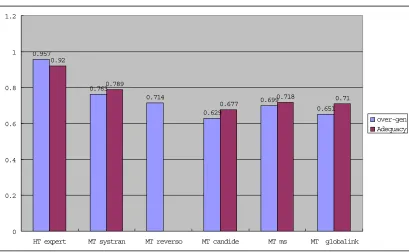
A correlation could be found between our evaluation metrics and some human MT evaluation measures. The best match has been found between our o-score (the score for avoiding lexical over-generation) and the adequacy scores in DARPA94 MT evaluation (Table 5). Correlation coefficient r for these series of data is 0.9936:
0.957
0.763
0.714
0.629
0.699
0.651 0.92
0.789
0.677
0.718 0.71
0 0.2 0.4 0.6 0.8 1 1.2
HT expert MT systran MT reverso MT candide MT ms MT globalink
over-gen Adequacy
[image:10.595.93.502.487.739.2]This close match could be interpreted as a fact that translation adequacy always involves avoiding over-generation: it requires that there were no "incorrect" or "misleading" meanings in translation.
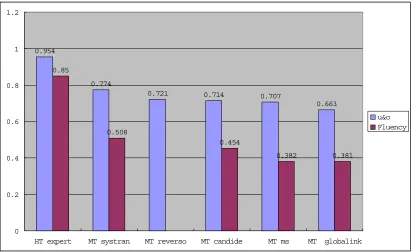
There is also a somewhat weaker correlation between ranking of MT systems according to our "u&o" combined score, and the DARPA94 fluency measures (Table 6). The correlation coefficient r for these series is 0.9868
0.954
0.774
0.721 0.714 0.707
0.663 0.85
0.508
0.454
0.382 0.381
0 0.2 0.4 0.6 0.8 1 1.2
[image:11.595.92.503.155.407.2]HT expert MT systran MT reverso MT candide MT ms MT globalink u&o Fluency
Table 6: combined u&o-scores and DARPA 94 Fluency scores. Correlation coefficient r = 0.9868
Note, that the proposed metrics measure only one aspect of MT, which we consider important for IE purposes, in particular – semantic appropriateness in translations of statistically significant words. We do not measure any other aspects, e.g, syntactic well-formedness.
U-score and any of the DARPA 94 human evaluation scores do not have strong correlation. DARPA 94 "informativeness" scores do not have strong correlation with any of automatic evaluation scores.
Several systems have a better "u&o" combined scores in relation to "reference" translation than in relation to "expert" translation. This might be due to the fact that the quality of the human "reference" translation is lower than that of the "expert" translation, so "reference" contains more cases of literal translation that better match MT output.
The exception to this rule is "Candide", which has a better u&o combined score for the "expert" translation. It also for some reason has a very high u-score, and considerably lower o-score.
combined u&o score, which has been found to match (to some extent) the DARPA “Fluency” score, but more work needs to be done to determine if it really correspond to any important aspect in the quality of MT).
This observation provides additional evidence for the suggestion made in (Wilks, 1994) that there are fundamental limits for improving pure statistically-based systems: “Candide” showed lowest scores for “avoiding over-generation of statistically significant words” among all tested MT systems. Over-generation and possibly other “precision-based” measures seem to be the weakest point for statistical MT. At the same time the measure of translation adequacy (which is found to be related to our “over-generation” scores) is considered to be the most important aspect of the translation quality in general.
4. Comparison with BLEU evaluation measure
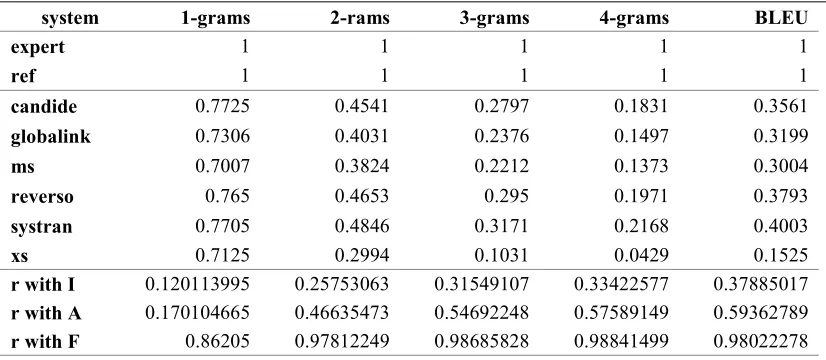
BLEU evaluation measure proposed in (Papineni et al., 2001) was applied to the DARPA evaluation data, and the results were compared with our MT evaluation scores based on “significance” S-scores. BLEU score was computed using the two translations available for the DARPA corpus: “reference” and “human”, with N-gram size =4. Each of the 100 texts in the corpus was treated as a single segment.
The BLEU results and r correlation coefficients are presented in the table 7:
system 1-grams 2-rams 3-grams 4-grams BLEU
expert 1 1 1 1 1
ref 1 1 1 1 1
candide 0.7725 0.4541 0.2797 0.1831 0.3561
globalink 0.7306 0.4031 0.2376 0.1497 0.3199
ms 0.7007 0.3824 0.2212 0.1373 0.3004
reverso 0.765 0.4653 0.295 0.1971 0.3793
systran 0.7705 0.4846 0.3171 0.2168 0.4003
xs 0.7125 0.2994 0.1031 0.0429 0.1525
r with I 0.120113995 0.25753063 0.31549107 0.33422577 0.37885017
r with A 0.170104665 0.46635473 0.54692248 0.57589149 0.59362789
[image:12.595.90.503.346.526.2]r with F 0.86205 0.97812249 0.98685828 0.98841499 0.98022278
Table 7: BLEU evaluation measures for the DARPA corpus
The BLEU scores strongly correlate with DARPA fluency scores, but correlation with other measures for adequacy is much weaker.
HT expert MT systran
MT reverso
MT candide
MT ms MT
globalink
under-gen 0.951 0.786 0.727 0.8 0.715 0.675
over-gen 0.957 0.763 0.714 0.629 0.699 0.651
u&o 0.954 0.774 0.721 0.714 0.707 0.663
Inform. 0.795 0.758 0.638 0.663 0.747
Adequacy 0.92 0.789 0.677 0.718 0.71
Fluency 0.85 0.508 0.454 0.382 0.381
[image:13.595.89.503.70.204.2]BLEU 0.4003 0.3793 0.3561 0.3004 0.3199
Table 8. S-score related measures, human evaluation scores and BLEU scores.
0.957
0.763
0.714
0.629
0.699
0.651 0.92
0.789
0.677
0.718 0.71
0.4003
0.3793
0.3561
0.3004 0.3199
0 0.2 0.4 0.6 0.8 1 1.2
HT expert MT systran MT reverso MT candide MT ms MT globalink
[image:13.595.96.497.228.467.2]over-gen Adequacy BLEU
Table 9: o-score, DARPA Adequacy score and BLEU (“Candide scores higher”)
0.954
0.774
0.721 0.714 0.707
0.663 0.85
0.508
0.454
0.382 0.381 0.4003
0.3793
0.3561
0.3004 0.3199
0 0.2 0.4 0.6 0.8 1 1.2
HT expert MT systran MT reverso MT candide MT ms MT globalink u&o Fluency BLEU
[image:13.595.99.503.481.750.2]r coefficient between the o-score and the DARPA Adequacy score = 0.99356356
r coefficient between the BLEU score and the DARPA Adequacy score = 0.59362789
r coefficient between the u&o-score and the DARPA Fluency score = 0.9868284
r coefficient between the BLEU score and the DARPA Adequacy score = 0.98022278
In general, the “significance-based” evaluation measures give comparable results with BLUE evaluation measure for the knowledge-based MT systems, but they also predict human evaluation scores for the statistical MT system more accurately than the BLEU method.
5. Conclusion
We have investigated a word-significance measure S which compares word frequency within the current text against frequency across the rest of the corpus; by setting a suitable threshold, S>1, we can eliminate high-frequency function words, leaving significant content words which characterise the text. A comparison of words flagged by this S metric in MT output and human translation highlights factual mistakes. Statistical modelling of MT output corpora has shown substantial differences in distribution of significant words with respect to human translation, which imply that the usability of MT systems for IE technology is still substantially limited. However, the suggested evaluation methodology also allows us to highlight the problems of MT which might be important for the IE task, if MT output is to be used for template filling or acquiring templates automatically. It might also help developers of the state-of-the-art MT systems to identify specific problems relevant for preserving factual information in MT. We proposed measures of lexical match for statistically significant words, and found that these correlate to DARPA MT evaluation measure of “adequacy”. This should allow prediction of the degree to which particular MT systems might be usable for IE tasks.
Future work will look at the problem of investigating stochastic models for the output of example-based MT systems, and comparing them with models for traditional knowledge-based applications and statistical MT. This could provide insights to establishing the formal properties of intuitive judgements about translation equivalence, adequacy and fluency both for human translation and for MT, and to investigating possible limits on improving MT quality with certain methodologies.
Other prospective directions of research would be investigating the actual performance of different modules of IE system (such as named entity recognition, template element filling and scenario template filling, summary generation) which use MT output of different quality. We will try to establish if this performance actually correlates with MT evaluation measures proposed in this paper and with other metrics proposed previously.
References
Berger A, Brown P, Cocke J, Pietra S, Pietra V, Gillett J, Lafferty J, Mercer R, Printz H, Ures L 1994 The Candide system for Machine Translation. Proceedings
of the ARPA workshop on Human Language Technology. San Mateo,
Morgan Kaufmann. pp. 152-157.
Cunningham H, WilksY, Gaizauskas R 1996 GATE -- a General Architecture for Text Engineering. Proceedings of the 16th Conference on Computational
Linguistics (COLING-96), Copenhagen, Aug, 1996.
Papineni K, Roukos S, Ward T, Zhu W-J 2001 Bleu: a method for automatic evaluation of machine translation. IBM research report RC22176 (W0109-022) September 17, 2001
Stevenson M, Wilks Y 2001 The integration of knowledge sources in word sence disambiguation. Computational Linguistics 27(3):321-349.
White J, O’Connell T, O’Mara F 1994 The ARPA MT evaluation methodologies: evolution, lessons and future approaches. Proceedings of the 1st Conference of the Association for Machine Translation in the Americas. Columbia, MD, October 1994. pp. 193-205.
Wilks Y 1994 Developments in MT research in the US. Aslib Proceedings, vol.46, no.4, April 1994. pp.111-116.