This is a repository copy of
The CLAWAR project
.
White Rose Research Online URL for this paper:
http://eprints.whiterose.ac.uk/690/
Article:
Virk, G.S. (2005) The CLAWAR project. IEEE Robotics and Automation Magazine, 12 (2).
pp. 14-20. ISSN 1070 - 9932
https://doi.org/10.1109/MRA.2005.1458308
[email protected] https://eprints.whiterose.ac.uk/ Reuse
Unless indicated otherwise, fulltext items are protected by copyright with all rights reserved. The copyright exception in section 29 of the Copyright, Designs and Patents Act 1988 allows the making of a single copy solely for the purpose of non-commercial research or private study within the limits of fair dealing. The publisher or other rights-holder may allow further reproduction and re-use of this version - refer to the White Rose Research Online record for this item. Where records identify the publisher as the copyright holder, users can verify any specific terms of use on the publisher’s website.
Takedown
If you consider content in White Rose Research Online to be in breach of UK law, please notify us by
I
n Europe, there are two main thematic groups focusing on robotics, the Climbing and Walking Robots (CLAWAR) project (http://www.clawar.net) and the European Robot-ics Network (EURON) project (http://www.euron.org). The two networks are complementary: CLAWAR is industrially focused on the immediate needs, and EURON is focused more on blue skies research. This article presents the activities of the CLAWAR project.CLAWAR is the oldest robotics thematic network in Europe. The well-established project commenced on 1 Febru-ary 1998 following a six-month exploratory phase in which over 60 active research groups were identified by the project coordinator, Prof. Gurvinder Singh Virk, who at that time was working at the University of Portsmouth, United Kingdom. At the start, 22 of the most active and experienced partners working in the area of applied mobile robotics were invited to set up CLAWAR as the first European robotic network under the industrially focused Brite Euram program. The network has been operating ever since and is now well placed to encourage the development of a robot component modularity that can be used by the entire robot research and development (R&D) community, from blue skies researchers to companies manufacturing and selling robot components and systems.
The traditional robot market is geared towards manufactur-ing applications. This well-established market has been stable for many years but is not likely to grow appreciably. In order to significantly widen the application base, CLAWAR has focused on new sectors that show good potential for adopting robotized solutions. In considering these new sectors, the main driver has been small companies that have been developing specific robots for small, high-value niche markets. The range of these applications is extremely wide and covers tasks that are hazardous or impossible to accomplish manually. Recently, the trend towards “edutainment” and biomedical/healthcare
sys-tems has been very encourag-ing. Considered in overall terms, these potential new sectors lead to an extremely wide and demanding range of
require-ments that are impossible to satisfy with a single machine. Hence, the approach has been to produce many simpler robot solutions, each designed and developed for a specific purpose. There has been no cross-fertilization in the various sectors, and this has resulted in considerable duplication and waste of resources on “reinventing the wheel”-type scenarios. The vast majority of applications have demanded that the systems should possess mobility of some form. Climbing has also been an important capability such that the mobile platforms can reach desired locations. This strong requirement for mobility is the primary reason why CLAWAR has focused on climbing and walking robots in the hope that locomotion in unstruc-tured and dangerous environments can be fully investigated and good robust methods realized. Many of the partners have specific and directly relevant expertise in CLAWAR technolo-gies, and this has been used to collect and generalize the over-all knowledge available to make it more widely applicable.
The first CLAWAR project lasted four years. During this period, it established a vibrant and active R&D partnership throughout Europe and beyond by its dissemination activi-ties, culminating in a series of conferences. The project ended on 31 January 2002, and, due to its success, a follow-on project was proposed and accepted by the European Commission (EC) under the GROWTH program (the Competitive and Sustainable Growth in Framework 5 Pro-gramme). CLAWAR 2 commenced on 1 May 2002 and is scheduled to last three years. It compr ises 38 funded
The CLAWAR
Project
BY GURVINDER SINGH VIRK
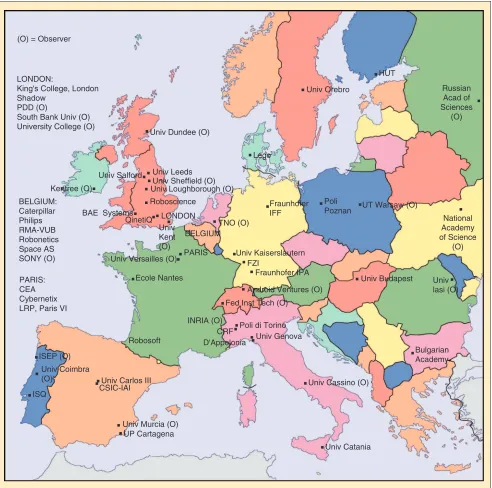
members and over 30 observers active in the area of mobile robotics and its applications. Figure 1 shows the main orga-nizations involved in Europe.
It should be noted that both CLAWAR projects are the-matic networks (TN) and not “normal” R&D projects that are set up to research and develop specific solutions. The EC has funded such TN projects so that much wider ranging issues can be addressed by bringing together the main stake-holders for a particular technology to share experiences and identify the key issues that need to be investigated in order to move the technology forward. In this respect, both CLAWAR projects have focused on the need to integrate, encourage, and widen the adoption of robotic devices in actual applications.
From its start in 1998, CLAWAR has stressed the importance of modularity and the development of open standards for robot components so that we can create and sustain a viable and vibrant robotics industry.
It is clear that the traditional manufacturing robotics industry is stagnant, and no new innovative technologies are being adopted in real businesses. The main thrust has been towards service robotics. This migration from manufacturing towards services has also been proposed by the International Federation of Robotics and the Japanese, who are very active in this field [1], [2]. The basic concepts for reinvigorating the robotics industry being developed by CLAWAR rely on open modular ity and the development of “plug-and-play”
[image:3.612.62.554.230.718.2]JUNE 2005 IEEE Robotics & Automation Magazine 15
Figure 1.CLAWAR coverage of Europe. (O) = Observer
LONDON:
King's College, London Shadow
PDD (O)
South Bank Univ (O) University College (O)
Univ Dundee (O)
Kentree (O)
Univ Salford Univ Leeds
Univ Sheffield (O) Univ Loughborough (O)
BELGIUM: Caterpillar Philips RMA-VUB Robonetics Space AS SONY (O)
PARIS: CEA Cybernetix LRP, Paris VI
ISEP (O)
Univ Coimbra (O)
Univ Versailles (O) Univ Kent (O)
TNO (O)
Univ Kaiserslautern FZI
Fraunhofer IPA
Univ Murcia (O) Univ Carlos III CSIC-IAI ISQ
UP Cartagena Robosoft
Ecole Nantes PARIS BELGIUM
BAE Systems LONDON
QinetiQ
Roboscience
Lego
Fraunhofer IFF
Poli
Poznan UT Warsaw (O)
Univ Orebro
HUT
Russian Acad of Sciences
(O)
National Academy of Science
(O)
Univ lasi (O) Univ Budapest
Bulgarian Academy
Univ Cassino (O) Univ Genova
Poli di Torino CRF
D'Appolonia INRIA (O)
Fed Inst Tech (O)
Android Ventures (O)
components using a formal design methodology that has wide applicability [3]–[13]. The intention is that such an approach can only work if the R&D community works together with industry to develop and use common tools and standards at the component level.
A brief summary of the CLAWAR project and the modu-lar design philosophy is presented next. This work covers technical and nontechnical issues to widen the application base for robotic systems and make them more acceptable to the general public. A description is given of the achievements made in bringing together all the stakeholders involved in robotics R&D; the impact that the CLAWAR conferences have made is also discussed. The importance of CLAWAR in the creation of innovative mobile robot demonstrator projects through the networking activities is also highlighted, and a few of the projects are mentioned. The critical mass of orga-nizations that have been brought together is leading to future plans to create an open component-level market that can support a supply-chain oriented robotics industry. This issue is also touched upon. Further information can be found on the project’s Web site at http://www.clawar.net or by con-tacting the author.
An Overview of CLAWAR
The first CLAWAR project brought together a group of orga-nizations that were able to focus on generic issues important in the area of applied mobile robotics. This collective body was able to carry out technical tasks, perform state-of-the-art surveys, and disseminate the group’s work very effectively via the CLAWAR conferences [14]–[18] and newsletters [23]. The technical work was carried out largely by sharing experi-ences and expertise between the partners so that the individ-ual-level knowledge could be generalized to make it more widely relevant. In total, 20 technical tasks were carried out in this manner over four years.
1) Modularity—Specifications and possible solutions: G.S. Virk, University of Portsmouth
2) Industrial requirements—Formulate specifications: R.N. Waterman, Portsmouth Technology Consultants Limited (PORTECH)
3) Operational environments—Specifications for robots: K. Berns, Forschungszentrum Informatik (FZI) 4) Nuclear operational maintenance applications: D.
Bark-er, Gravatom
5) Man-machine interface—Requirements and specifica-tions: M. Armada, Consejo Superior de Investigaciones Cientificas, Instituto de Automática Industrial (CSIC-IAI)
6) Modularity—Design aspects and practical solutions: G.S. Virk, University of Portsmouth
7) Industrial requirements—Rationalize specs into func-tionality modules: R.N. Waterman, PORTECH 8) Nuclear decommissioning applications—Requirements:
D. Myers, Gravatom
9) Humanitarian demining—Requirements: Y. Baudoin, Royal Military Academy (RMA)
10) Tele-operation—Definitions and requirements: M. Armada, CSIC-IAI
11) Functionality modules—Specifications and technical details: G.S. Virk, University of Portsmouth
12) Outdoor applications: Y. Baudoin, RMA
13) Computing requirements: G. Muscato, University of Catania
14) Construction industry: M. Armada, CSIC-IAI 15) Pipe and duct applications: D. Myers, Gravatom 16) Functionality modules—Design and practical details:
G.S. Virk, University of Portsmouth
17) Petrochemical industry and underwater applications: M. Armada, CSIC–IAI
18) Control and software requirements: G. Muscato, Uni-versity of Catania
19) Barriers to commercial exploitation: H.A. Warren, QinetiQ
20) Future applications of CLAWAR machines: K. Berns, FZI.
Extensive reports for each task have been produced [3]–[9], and it is the intention to publish some of these for wider dis-semination. The state-of-the-art reports [19]–[22] have focused on the details of the R&D being carried out throughout the world and the important projects and results achieved. It is clear that the main areas of activity are in the United States, Europe, and Japan. CLAWAR has focused on the European scene, and this networking has created a European-level entity that can coordinate R&D efforts in the robotics area and make an impact at the EU level with appropriate initiatives to move things forward. Good links with EURON are also maintained to ensure that the strategic vision of the researchers and imme-diate needs of industry and the community stay synchronized.
CLAWAR Modularity
CLAWAR has focused on strategic areas for developing the ideas of modularity, including haz-ardous environments (industrial and nonindustrial scenarios), edutain-ment, biomedical and healthcare sectors, and outdoor applications.
Following the huge success of CLAWAR 1, it was believed to be worthwhile to propose the establishment of CLAWAR 2, focusing on mobile robotic demonstrators and applications. For this, the consor tium was extended and observers were also
included from outside Europe. The project continues the modularity work to pursue the development of plug-and-play robot components and encourage the development of common design tools for use by the robot R&D communi-ty. Because CLAWAR does not have the resources to actu-ally develop the design tools needed, it is focusing on specifying the requirements, and future activities are planned to actually build the tool set.
R&D Project Clustering
Modularity is also being demonstrated by clustering. R&D robot projects are being run so that components developed in one project can be used in others. A list of 25 projects has been identified and studied to determine the most common modules in the following groups:
◆ Input modules: These are components that take input
signals/commands from the robot itself, its environ-ment, and users to use for the “processing” part of the system. Essentially, these are sensors and user interface devices from the command input side.
◆ Processing modules: These are software algorithms
that perform the various signal and information pro-cessing routines that enable the decision-making and control actions.
◆ Output modules: These are components that actually
produce an output from the robot to interact with its environment. They comprise actuators and user inter-face devices to provide user feedback.
◆ Infrastructure modules: These are components that
“support” the overall status and operation of the robot. They include power supplies, materials, communication channels, etc.
The grouping of robot modules can be conducted in many different ways, but the above is felt to be a generic and useful way of presenting and analyzing the information. Certainly, the CLAWAR community has found it extremely useful to study the modular aspects in this way, and this framework is being used to develop further plans to realize the open stan-dards needed for the robot components. The R&D project clustering activities have used this grouping to study the robot component aspects, focusing on designing a modular power
supply that can be used in several projects. The design of the power supply has been completed, and it is currently being built to demonstrate the “use and reuse” aspects that are key to ensuring the future successful growth in the adoption of robotic systems in new emerging mass markets.
Societal Needs
As already mentioned and widely recognized, the robotics industry is likely to grow significantly in the near future, and this growth is expected to be in the area of service provision rather than in the traditional manufacturing sectors. Much of this new activity will be driven by the current and future needs of society. In view of this, CLAWAR has been carrying out analysis and formative work for robotic system require-ments from the viewpoint of the needs of society. Specific societal needs are being investigated, including education and training, working conditions and safety, environment, health, employment, and quality of life.
Economic Prospects
In order to improve the commercialization of robotic systems, CLAWAR has been using the extensive experience available within the partnership to determine the reasons for poor acceptance of the new robotic systems being developed. The following barriers have been identified:
◆ No effective demonstrators exist, indicating immaturity
of the technology and leading to poor confidence in all sectors of society.
◆ Low-volume markets lead to high unit costs; this
cou-pled with the fact that no regulations exist for the new sectors causes significant safety concerns.
These conclusions have led the CLAWAR community to strongly pursue the development of a suitable modular approach so that the complex systems needed can be designed, developed, and supplied. This strongly suggests that an open component market needs to be encouraged since this offers the most promising approach for creating and sustaining a supply-chain based industry. As a consequence, standards and guidelines for the new robotic systems and their compo-nents need to be formulated via the establishment of appro-priate ISO working groups.
[image:5.612.208.554.63.208.2]JUNE 2005 IEEE Robotics & Automation Magazine 17
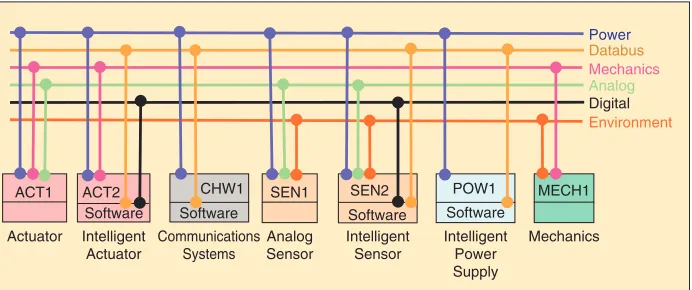
Figure 2.CLAWAR’s modular design principles using the “interaction space highways.”
Power
Mechanics
Analog
Databus
Digital Environment
Intelligent Actuator Actuator
ACT1 ACT2 CHW1 SEN1 SEN2 POW1 MECH1
Software Software Software Software Communications
Systems
Analog Sensor
Intelligent Sensor
Intelligent Power Supply
Dissemination
As part of the dissemination activities, the annual CLAWAR conference was initiated in 1998. The first conference was held in Brussels in 1998 and attracted about 90 delegates. This was followed by CLAWAR 1999 in Portsmouth with 140 dele-gates, CLAWAR 2000 in Madrid, Spain, with 150 deledele-gates, and CLAWAR 2001 in Karlsruhe, Germany, with 200 dele-gates. The fifth CLAWAR conference in Paris, France, was attended by 250 delegates and the sixth conference (CLAWAR 2003 conference in Catania, Italy) attracted 250 delegates. The seventh conference, CLAWAR 2004, was held in Madrid, Spain, and attracted 200 delegates. The eighth conference will be held in London on 13–15 September 2005 (visit http://www.iai.csic.es/clawar04). The CLAWAR conference is now well established on the annual calendar, and major researchers attend it to present their latest results and interact with the rest of the CLAWAR community. In addition to the annual conference, a Web site has been created (http://www.clawar.net), and a CLAWAR newsletter is pro-duced every six months and distr ibuted to nearly 900 researchers throughout the world.
Achievements
The CLAWAR project has created a good focus for the area of applied mobile robotics within Europe and beyond. The partnership has been able to propose many innovative R&D projects in new robotic applications as a direct result of the networking and the fact that there is now common thinking within the partnership. The funding (approximately €2.2
million) received from the EC for establishing the CLAWAR networking projects has led to the securement of approxi-mately €30 million for projects to carry out real R&D. A
few of these projects are presented next, and the robots developed are shown in Figure 3.
◆ ROWER (BRITE EURAM BE2-7229): Development
of shipbuilding methods using robots; Coordinator: CSIC-IAI; http://www.iai.csic.es/dca/rower1_i.htm
◆ AURORA (GRD1-1999-11153): Robot for cleaning
ship hulls; Coordinator: CSIC-IAI; http://europa.eu.int/ comm/research/growth/gcc/projects/shipyard.html#09
◆ ROBOVOLC (IST 1999-10762): Mobile robot able to
carry out monitoring and inspection tasks in volcanic environments; Coordinator: University of Catania; http://www.robovolc.dees.unict.it
◆ ROBTANK (G1RD-CT 2000-00230): Robot for
inspecting metal tanks; Coordinator: ISQ; http://www. clawar.com/clawar1/newsletters/issue7/robtank.htm
◆ ROBUG 3 (Project ref. FI2T0027): An articulated limb
climbing robot; Coordinator: PORTECH; http:// www.pbs.org/wgbh/nova/robots/hazard/meetrobug.html
◆ WIRED (ESPRIT 4): Robug 4-Walking intelligent
robot demonstrator; Coordinator: University of Southampton; http://www.it-innovation.soton.ac.uk/ research/decision_control.shtml
◆ NESTOR (ISP-1999-00030): Robotic courier for
transpor ting goods in hospitals; Coordinator : Robosoft; http://www.clawar.com/clawar1/newslet-ters/issue7/nestor.htm
◆ WorkPartner (National contract Tekes 40372/02):
Ser-vice robot for outdoor tasks; Coordinator: Helsinki University of Technology; http://www.automation.hut. fi/IMSRI/workpartner/
◆ ROBOCLIMBER (G1ST-CT-2002-50160):
[image:6.612.61.552.457.696.2]Tele-oper-ated climbing robot for slopes and landslides;
Figure 3.Prototype robots developed within the CLAWAR partnership for various R&D projects: (a) Rower: shipbuilding; (b) NESTOR: hospitals; (c) Portsmouth’s Robug 4 modular demonstrator; (d) ROBTANK: tanks; (e) Helsinki’s WorkPartner; (f) F-IPA’s RACCOON; (g) ROBOVOLC: volcanoes; and (h) Portsmouth’s Robug 3 rescue machine.
(a) (b) (c) (d)
Coordinator: ICOP SPA; http://www.dimec.unige.it/ PMAR/Pages/ricerca/roboclimber.htm
◆ RACCOON (Industrial Contract: Procter & Gamble):
Autonomous window cleaning robot; Coordinator: Fraunhofer-IPA; http://www.ipa.fhg.de/Arbeitsgebi-ete/BereichC/320/leistungsangebote/mechatronik/Pro duktblatt300_177RACCOON-Haushaltsrobotik.pdf
◆ ISAMCO (FP6-505275-1): Ionic polymer-metal
composites for microsensors and actuators in robotic applications; Coordinator : Consorzio Catania Richche, http://www.mediainnovation.it/progetti/ isamco/home.html.
In addition to these successes, CLAWAR also participated in the launch of the 6th Framework Programme (FP6) of the EC. CLAWAR was the only robotic project invited to contr ibute a stand for this event, and Figure 4 shows RoboDog, developed by one of the CLAWAR partners (Roboscience Ltd., United Kingdom; see http://www.robo-science.com), stealing the scene.
Future Activities
The overall activities of the CLAWAR projects have created tremendous enthusiasm and a sense of collegiality within the part-nership. From this has evolved the feeling that the R&D commu-nity needs to work together if it is to grow to meet the requirements for service robotics. The central theme within CLAWAR is to build on the modularity work to formulate an open approach capable of assisting in the creation of a new open component market that can support and sustain a supply chain-oriented robotics industry in Europe. This initiative is being pur-sued under the EC’s FP6, and over
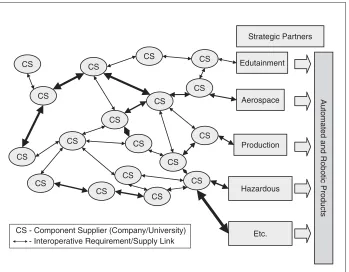
120 organizations have agreed to work towards realizing this goal. The intention is to create the tools and guidelines and demonstrate a supply chain culture for the area of robotics so that specific supply chains can be set up, as shown in Figure 5.
Conclusions
It is clear that networking is vital to ensure that research groups and companies can work together on common problems to make the advances that are required. Without such networking, it is inevitable that resources will be wasted through the duplication of effort. CLAWAR is now a mature robot-ics R&D community that has already proven itself capable of col-laborating and moving things for-ward. A common approach is vital if robotic technologies are to be produced to meet the needs that are emerging for providing services.
[image:7.612.311.553.62.398.2]JUNE 2005 IEEE Robotics & Automation Magazine 19
Figure 4.RoboDog in Brussels.
Figure 5.CLAWAR’s supply chain concept.
CS
Edutainment
Aerospace
Production
Hazardous CS
CS
CS CS
CS CS
Etc. CS
Automated and Robotic Products
CS
CS CS
CS
CS
CS
CS CS
CS CS
CS - Component Supplier (Company/University) - Interoperative Requirement/Supply Link
[image:7.612.207.556.438.710.2]In this respect, it is also vital that all the stakeholders are involved in these collaborations, from the pioneering “blue skies” researchers to application manufacturers and commercial organizations interested in developing products for specific mar-ket sectors. CLAWAR is doing exactly this, and this approach is the main reason for the great successes achieved to date. The intention is to increase these collaborations through future activities under FP6 and beyond, where the critical mass is being brought together to make the changes necessary to ensure progress. CLAWAR Ltd. has been set up to continue the activi-ties after the current CLAWAR project ends in October 2005. Only time will tell if the efforts succeed, but the feeling within the CLAWAR community is that open modularity is the only viable way forward whereby the “interconnection” between the components are widely available to everyone and the “inventive intellectual property” should be within the components.
Indeed, to make all this work we need to make the wires open and the boxes closed.
Acknowledgments
The author would like to acknowledge the support of the European Commission for funding the CLAWAR Thematic Network under contracts BRRT-CT97-5030 and G1RT-CT-2002-05080. He would also like to express his gratitude to all the CLAWAR partners and observers who have contributed to the various activities of the project.
Keywords
Robot components, modularity, new robot markets, service robots, standards.
References
[1] Japan Robot Association, Technology strategy for creating a “robot soci-ety” in the 21st century, [Online]. Available: http://www.jara.jp/en/ 06_topics/index.html
[2] Y. Kusuda, “JARA publishes a survey of technological strategy for creat-ing a robot society for the 21st century,” Indust. Robot, vol. 29, no. 1, pp. 32–34, 2002.
[3] G.S. Virk, “Modularity for CLAWAR machines—Specifications and possible solutions,” Univ. Portsmouth, UK, Task 1 Rep. EC Contract BRRT-CT97-5030, 1999.
[4] G.S. Virk, “Modularity for CLAWAR machines—Practical solutions,” Univ. Portsmouth, UK, Task 6 Rep. EC Contract BRRT-CT97-5030, 2000. [5] G.S. Virk, “CLAWAR functionality modules—Specifications and
tech-nical details,” Univ. Portsmouth, UK, Task 11 Rep. EC Contract BRRT-CT97-5030, 2001.
[6] G.S. Virk, “CLAWAR—Robot component modular ity,” Univ. Portsmouth, UK, Task 16 Rep. EC Contract BRRT-CT97-5030, 2002. [7] G.S. Virk, “Modularity—Application based guidelines,” Univ. Leeds,
UK, WP2 Rep. Year 1, EC Contract GIRT-CT-2002-05080, 2003. [8] G.S. Virk, “Modularity—Design tools,” Univ. Leeds, UK, WP2 Rep.
Year 2, EC Contract GIRT-CT-2002-05080, 2004.
[9] G.S. Virk, “CLAWAR year 1 technical tasks–task 1 modularity for CLAWAR machines–specs and possible solutions,” in Proc. Special Session at Int. Conf. on Climbing and Walking Robots (CLAWAR’99), Portsmouth, UK, pp. 737–747. [10] G.S. Virk, “Modularity of CLAWAR machines–practical solutions,” in
Proc. 3rd Int. Conf. Climbing and Walking Robots (CLAWAR 2000), Madrid, pp. 149–155.
[11] G.S. Virk, “CLAWAR modularity for CLAWAR—Functionality mod-ules,” in Proc. 4th Int. Conf. Climbing and Walking Robots (CLAWAR
2001), Karlsruhe, Germany, pp. 275–282.
[12] G.S. Virk, “CLAWAR—Robot component modularity,” in Proc. 5th Int. Conf. Climbing and Walking Robots (CLAWAR 2002), Paris, pp. 875–880.
[13] G.S. Virk, “CLAWAR modularity: The guiding principles,” in Proc. 6th Int. Conf. Climbing and Walking Robots (CLAWAR 2003), Catania, Italy, pp. 1025–1031.
[14] G.S. Virk, M. Randall, and D. Howard, Eds. CLAWAR ‘99 Proc. 2nd Int. Conf. Climbing and Walking Robots. London, UK: Professional Engineering, 1999.
[15] M. Armada and P. González de Santos, Eds. CLAWAR 2000 Proc. 3rd Int. Conf. Climbing and Walking Robots. London, UK: Professional Engi-neering, 2000.
[16] K. Berns and R. Dillman, Eds. CLAWAR 2001 Proc. 4th Int. Conf. Climbing and Walking Robots. London, UK: Professional Engineering, 2001.
[17] P. Bidaud and F. Ben Amar, Eds. CLAWAR 2002 Proc. 5th Int.Conf. on Climbing and Walking Robots. London, UK: Professional Engineering, 2002.
[18] G. Muscato and D. Longo, Eds. CLAWAR 2003 Proc. 6th Int.Conf. on Climbing and Walking Robots. London, UK: Professional Engineering, 2003.
[19] G.S. Virk, “CLAWAR state of the art 1998–99,” Univ. Portsmouth, Portsmouth, UK, EC Contract BRRT-CT97-5030, 1999.
[20] G.S. Virk, “CLAWAR state of the art 1999–2000,” Univ. Portsmouth, Portsmouth, UK, EC Contract BRRT-CT97-5030, 2000.
[21] G.S. Virk, “CLAWAR state of the art 2000–01,” Univ. Portsmouth, Portsmouth, UK, EC Contract BRRT-CT97-5030, 2001.
[22] G.S. Virk, “CLAWAR state of the art 2001–02,” Univ. Portsmouth, Portsmouth, UK, EC Contract BRRT-CT97-5030, 2002.
[23] CLAWAR Newsletters 1–12, M.O. Tokhi, Ed., Univ. Sheffield, UK.
Gurvinder Singh Virkholds the chair of Robotics and Con-trol and is head of the Intelligent Systems Group in the School of Mechanical Engineering, University of Leeds, United King-dom. He graduated with first class B.Sc. honors in electronic and electrical engineering from the University of Manchester and went on to obtain a Ph.D. in control theory from Imperial College, London. Since then, he has worked at Sheffield City Polytechnic and Southampton, Sheffield, Bradford, and Portsmouth universities. His main research interests include mobile robotics, with special emphasis on climbing and walking robots (CLAWAR) and smelling robots, building management systems, and the use of advanced model-based control for a variety of applications. Currently, he is coordinating the Euro-pean activity for the CLAWAR technology and has been involved in several projects to develop innovative robots for exploring volcanic environments, inspecting highway bridges and dams, and performing search and rescue operations in nuclear disaster scenarios. He is a fellow of the Institution of Electrical Engineers (FIEE), a fellow of the Chartered Institu-tion of Building Services Engineers (FCIBSE), and a fellow of the Institution of Applied Mathematics and its Applications. He has been awarded the Freedom of the City of London for his work in promoting information technology.