w w w . s y n g r e s s . c o m
Syngress is committed to publishing high-quality books for IT Professionals and delivering those books in media and formats that fit the demands of our cus-tomers. We are also committed to extending the utility of the book you purchase via additional materials available from our Web site.
SOLUTIONS WEB SITE
To register your book, visit www.syngress.com/solutions. Once registered, you can access our [email protected] Web pages. There you may find an assortment of value-added features such as free e-books related to the topic of this book, URLs of related Web site, FAQs from the book, corrections, and any updates from the author(s).
ULTIMATE CDs
Our Ultimate CD product line offers our readers budget-conscious compilations of some of our best-selling backlist titles in Adobe PDF form. These CDs are the perfect way to extend your reference library on key topics pertaining to your area of exper-tise, including Cisco Engineering, Microsoft Windows System Administration, CyberCrime Investigation, Open Source Security, and Firewall Configuration, to name a few.
DOWNLOADABLE E-BOOKS
For readers who can’t wait for hard copy, we offer most of our titles in download-able Adobe PDF form. These e-books are often availdownload-able weeks before hard copies, and are priced affordably.
SYNGRESS OUTLET
Our outlet store at syngress.com features overstocked, out-of-print, or slightly hurt books at significant savings.
SITE LICENSING
Syngress has a well-established program for site licensing our e-books onto servers in corporations, educational institutions, and large organizations. Contact us at [email protected] for more information.
CUSTOM PUBLISHING
Many organizations welcome the ability to combine parts of multiple Syngress books, as well as their own content, into a single volume for their own internal use. Contact us at [email protected] for more information.
Tom St Denis,
Elliptic Semiconductor Inc. and Author of the LibTom ProjectSimon Johnson
Cryptography
Developers
tion (collectively “Makers”) of this book (“the Work”) do not guarantee or warrant the results to be obtained from the Work.
There is no guarantee of any kind, expressed or implied, regarding the Work or its contents.The Work is sold AS IS and WITHOUT WARRANTY.You may have other legal rights, which vary from state to state. In no event will Makers be liable to you for damages, including any loss of profits, lost savings, or other inci-dental or consequential damages arising out from the Work or its contents. Because some states do not allow the exclusion or limitation of liability for consequential or incidental damages, the above limitation may not apply to you.
You should always use reasonable care, including backup and other appropriate precautions, when working with computers, networks, data, and files.
Syngress Media®, Syngress®, “Career Advancement Through Skill Enhancement®,” “Ask the Author UPDATE®,” and “Hack Proofing®,” are registered trademarks of Syngress Publishing, Inc. “Syngress:The Definition of a Serious Security Library”™, “Mission Critical™,” and “The Only Way to Stop a Hacker is to Think Like One™”are trademarks of Syngress Publishing, Inc. Brands and product names mentioned in this book are trademarks or service marks of their respective companies.
KEY SERIAL NUMBER
001 HJIRTCV764 002 PO9873D5FG 003 829KM8NJH2 004 GPPQQW722M 005 CVPLQ6WQ23 006 VBP965T5T5 007 HJJJ863WD3E 008 2987GVTWMK 009 629MP5SDJT 010 IMWQ295T6T PUBLISHED BY Syngress Publishing, Inc. 800 Hingham Street Rockland, MA 02370
Cryptography for Developers
Copyright © 2007 by Syngress Publishing, Inc. All rights reserved. Except as permitted under the Copyright Act of 1976, no part of this publication may be reproduced or distributed in any form or by any means, or stored in a database or retrieval system, without the prior written permission of the publisher, with the exception that the program listings may be entered, stored, and executed in a computer system, but they may not be reproduced for publication.
1 2 3 4 5 6 7 8 9 0 ISBN-10: 1-59749-104-7 ISBN-13: 978-1-59749-104-4
Acknowledgments
v
Syngress would like to acknowledge the following people for their kindness
and support in making this book possible.
Syngress books are now distributed in the United States and Canada by
O’Reilly Media, Inc.The enthusiasm and work ethic at O’Reilly are incredible,
and we would like to thank everyone there for their time and efforts to bring
Syngress books to market:Tim O’Reilly, Laura Baldwin, Mark Brokering, Mike
Leonard, Donna Selenko, Bonnie Sheehan, Cindy Davis, Grant Kikkert, Opol
Matsutaro, Steve Hazelwood, Mark Wilson, Rick Brown,Tim Hinton, Kyle
Hart, Sara Winge, Peter Pardo, Leslie Crandell, Regina Aggio Wilkinson, Pascal
Honscher, Preston Paull, Susan Thompson, Bruce Stewart, Laura Schmier, Sue
Willing, Mark Jacobsen, Betsy Waliszewski, Kathryn Barrett, John Chodacki,
Rob Bullington, Kerry Beck, Karen Montgomery, and Patrick Dirden.
The incredibly hardworking team at Elsevier Science, including Jonathan
Bunkell, Ian Seager, Duncan Enright, David Burton, Rosanna Ramacciotti,
Robert Fairbrother, Miguel Sanchez, Klaus Beran, Emma Wyatt, Krista
Leppiko, Marcel Koppes, Judy Chappell, Radek Janousek, Rosie Moss, David
Lockley, Nicola Haden, Bill Kennedy, Martina Morris, Kai Wuerfl-Davidek,
Christiane Leipersberger,Yvonne Grueneklee, Nadia Balavoine, and Chris
Reinders for making certain that our vision remains worldwide in scope.
David Buckland, Marie Chieng, Lucy Chong, Leslie Lim, Audrey Gan, Pang Ai
Hua, Joseph Chan, June Lim, and Siti Zuraidah Ahmad of Pansing Distributors
for the enthusiasm with which they receive our books.
vii
Lead Author
Tom St Denis
is a software developer known best for his LibTom
series of public domain cryptographic libraries. He has spent the last
five years distributing, developing, and supporting the cause of open
source cryptography, and has championed its safe deployment.Tom
currently is employed for Elliptic Semiconductor Inc. where he
designs and develops software libraries for embedded systems. He
works closely with a team of diverse hardware engineers to create a
best of breed hardware and software combination.
Tom is also the author (with Greg Rose) of
BigNum Math:
Implementing Cryptographic Multiple Precision Arithmetic
(Syngress
Publishing, ISBN: 1-59749-112-8), which discusses the deployment
of crypytographic integer mathematics.
Simon Johnson
is a security engineer for a technology outfit based
in the United Kingdom. Simon became interested in cryptography
during his teenage years, studying all aspects of conventional
soft-ware cryptography. He has been an active contributor to the
crypto-graphic usenet group Sci.Crypt since the age of 17, attends various
security conferences around the world, and continues to openly
promote safe computing practices.
ix
Contents
Preface . . . xix
Chapter 1 Introduction . . . 1
Introduction . . . .2
Threat Models . . . .3
What Is Cryptography? . . . .4
Cryptographic Goals . . . .4
Privacy . . . .4
Integrity . . . .6
Authentication . . . .8
Nonrepudiation . . . .10
Goals in a Nutshell . . . .10
Asset Management . . . .11
Privacy and Authentication . . . .12
Life of Data . . . .12
Common Wisdom . . . .13
Developer Tools . . . .15
Summary . . . .16
Organization . . . .16
Frequently Asked Questions . . . .18
Chapter 2 ASN.1 Encoding . . . 21
Overview of ASN.1 . . . .22
ASN.1 Syntax . . . .23
ASN.1 Explicit Values . . . .24
ASN.1 Containers . . . .24
ASN.1 Modifiers . . . .26
OPTIONAL . . . .26
DEFAULT . . . .26
CHOICE . . . .27
ASN.1 Data Types . . . .28
ASN.1 Header Byte . . . .28
Classification Bits . . . .29
Primitive Types . . . .30
ASN.1 Length Encodings . . . .31
Short Encodings . . . .31
Long Encodings . . . .31
ASN.1 Boolean Type . . . .32
ASN.1 Integer Type . . . .33
ASN.1 BIT STRING Type . . . .34
ASN.1 OCTET STRING Type . . . .35
ASN.1 NULL Type . . . .35
ASN.1 OBJECT IDENTIFIER Type . . . .36
ASN.1 SEQUENCE and SET Types . . . .37
SEQUENCE OF . . . .39
SET . . . .39
SET OF . . . .40
ASN.1 PrintableString and IA5STRING Types . . . .41
ASN.1 UTCTIME Type . . . .41
Implementation . . . .42
ASN.1 Length Routines . . . .42
ASN.1 Primitive Encoders . . . .45
BOOLEAN Encoding . . . .46
INTEGER Encoding . . . .48
BIT STRING Encoding . . . .52
OCTET STRING Encodings . . . .55
NULL Encoding . . . .57
OBJECT IDENTIFIER Encodings . . . .58
PRINTABLE and IA5 STRING Encodings . . . .63
UTCTIME Encodings . . . .67
SEQUENCE Encodings . . . .71
ASN.1 Flexi Decoder . . . .78
Putting It All Together . . . .83
Building Lists . . . .83
Nested Lists . . . .85
Decoding Lists . . . .86
FlexiLists . . . .87
Chapter 3 Random Number Generation . . . 91
Introduction . . . .92
Concept of Random . . . .92
Measuring Entropy . . . .94
Bit Count . . . .95
Word Count . . . .95
Gap Space Count . . . .95
Autocorrelation Test . . . .95
How Bad Can It Be? . . . .98
RNG Design . . . .98
RNG Events . . . .99
Hardware Interrupts . . . .99
Timer Skew . . . .101
Analogue to Digital Errors . . . .103
RNG Data Gathering . . . .104
LFSR Basics . . . .105
Table-based LFSRs . . . .105
Large LFSR Implementation . . . .107
RNG Processing and Output . . . .107
RNG Estimation . . . .112
Keyboard and Mouse . . . .113
Timer . . . .114
Generic Devices . . . .114
RNG Setup . . . .115
PRNG Algorithms . . . .115
PRNG Design . . . .115
Bit Extractors . . . .116
Seeding and Lifetime . . . .116
PRNG Attacks . . . .117
Input Control . . . .117
Malleability Attacks . . . .118
Backtracking Attacks . . . .118
Yarrow PRNG . . . .118
Design . . . .119
Reseeding . . . .120
Statefulness . . . .121
Pros and Cons . . . .121
Design . . . .122
Reseeding . . . .126
Statefulness . . . .126
Pros and Cons . . . .126
NIST Hash Based DRBG . . . .127
Design . . . .127
Reseeding . . . .131
Statefulness . . . .131
Pros and Cons . . . .131
Putting It All Together . . . .131
RNG versus PRNG . . . .131
Fuse Bits . . . .132
Use of PRNGs . . . .132
Example Platforms . . . .133
Desktop and Server . . . .133
Consoles . . . .134
Network Appliances . . . .135
Frequently Asked Questions . . . .136
Chapter 4 Advanced Encryption Standard . . . 139
Introduction . . . .140
Block Ciphers . . . .140
AES Design . . . .142
Finite Field Math . . . .144
AddRoundKey . . . .146
SubBytes . . . .146
Hardware Friendly SubBytes . . . .149
ShiftRows . . . .150
MixColumns . . . .151
Last Round . . . .155
Inverse Cipher . . . .155
Key Schedule . . . .155
Implementation . . . .156
An Eight-Bit Implementation . . . .157
Optimized Eight-Bit Implementation . . . .162
Precomputed Tables . . . .165
Decryption Tables . . . .167
Macros . . . .168
Key Schedule . . . .169
Performance . . . .174
x86 Performance . . . .174
ARM Performance . . . .176
Performance of the Small Variant . . . .178
Inverse Key Schedule . . . .180
Practical Attacks . . . .181
Side Channels . . . .182
Processor Caches . . . .182
Associative Caches . . . .182
Cache Organization . . . .183
Bernstein Attack . . . .183
Osvik Attack . . . .184
Defeating Side Channels . . . .185
Little Help From the Kernel . . . .185
Chaining Modes . . . .186
Cipher Block Chaining . . . .187
What’s in an IV? . . . .187
Message Lengths . . . .188
Decryption . . . .188
Performance Downsides . . . .189
Implementation . . . .189
Counter Mode . . . .190
Message Lengths . . . .191
Decryption . . . .191
Performance . . . .191
Security . . . .191
Implementation . . . .192
Choosing a Chaining Mode . . . .192
Putting It All Together . . . .193
Keying Your Cipher . . . .193
Rekeying Your Cipher . . . .194
Bi-Directional Channels . . . .195
Lossy Channels . . . .195
Providers . . . .197
Frequently Asked Questions . . . .200
Chapter 5 Hash Functions . . . 203
Introduction . . . .204
Hash Digests Lengths . . . .205
Designs of SHS and Implementation . . . .207
MD Strengthening . . . .208
SHA-1 Design . . . .209
SHA-1 State . . . .209
SHA-1 Expansion . . . .209
SHA-1 Compression . . . .210
SHA-1 Implementation . . . .211
SHA-256 Design . . . .217
SHA-256 State . . . .219
SHA-256 Expansion . . . .219
SHA-256 Compression . . . .219
SHA-256 Implementation . . . .220
SHA-512 Design . . . .225
SHA-512 State . . . .226
SHA-512 Expansion . . . .226
SHA-512 Compression . . . .226
SHA-512 Implementation . . . .226
SHA-224 Design . . . .232
SHA-384 Design . . . .233
Zero-Copying Hashing . . . .234
PKCS #5 Key Derivation . . . .236
Putting It All Together . . . .238
What Hashes Are For . . . .238
One-Wayness . . . .238
Passwords . . . .238
Random Number Generators . . . .238
Collision Resistance . . . .239
File Manifests . . . .239
Intrusion Detection . . . .239
Hashes Are Not MACs . . . .240
Hashes Don’t Double . . . .241
Hashes Don’t Mingle . . . .241
Working with Passwords . . . .242
Offline Passwords . . . .242
Salts . . . .242
Salt Sizes . . . .242
Rehash . . . .243
Online Passwords . . . .243
Two-Factor Authentication . . . .243
Performance Considerations . . . .244
Inline Expansion . . . .244
Compression Unrolling . . . .244
Zero-Copy Hashing . . . .245
PKCS #5 Example . . . .245
Frequently Asked Questions . . . .248
Chapter 6 Message-Authentication Code Algorithms 251
Introduction . . . .252
Purpose of A MAC Function . . . .252
Security Guidelines . . . .253
MAC Key Lifespan . . . .254
Standards . . . .254
Cipher Message Authentication Code . . . .255
Security of CMAC . . . .257
CMAC Design . . . .258
CMAC Initialization . . . .259
CMAC Processing . . . .259
CMAC Implementation . . . .260
CMAC Performance . . . .267
Hash Message Authentication Code . . . .267
HMAC Design . . . .268
HMAC Implementation . . . .270
Putting It All Together . . . .275
What MAC Functions Are For? . . . .276
Consequences . . . .276
What MAC Functions Are Not For? . . . .278
Replay Protection . . . .279
Timestamps . . . .280
Counters . . . .280
Encrypt then MAC? . . . .281
Encrypt then MAC . . . .281
MAC then Encrypt . . . .281
Encryption and Authentication . . . .282
Frequently Asked Questions . . . .293
Chapter 7 Encrypt and Authenticate Modes. . . 297
Introduction . . . .298
Encrypt and Authenticate Modes . . . .298
Security Goals . . . .298
Standards . . . .299
Design and Implementation . . . .299
Additional Authentication Data . . . .299
Design of GCM . . . .300
GCM GF(2) Mathematics . . . .300
Universal Hashing . . . .302
GCM Definitions . . . .302
Implementation of GCM . . . .304
Interface . . . .304
GCM Generic Multiplication . . . .306
GCM Optimized Multiplication . . . .311
GCM Initialization . . . .312
GCM IV Processing . . . .314
GCM AAD Processing . . . .316
GCM Plaintext Processing . . . .319
Terminating the GCM State . . . .323
GCM Optimizations . . . .324
Use of SIMD Instructions . . . .325
Design of CCM . . . .326
CCM B
0Generation . . . .327
CCM MAC Tag Generation . . . .327
CCM Encryption . . . .328
Choosing a Nonce . . . .340
GCM Nonces . . . .340
CCM Nonces . . . .340
Additional Authentication Data . . . .340
MAC Tag Data . . . .341
Example Construction . . . .341
Frequently Asked Questions . . . .346
Chapter 8 Large Integer Arithmetic. . . 349
Introduction . . . .350
What Are BigNums? . . . .350
Further Resources . . . .351
Key Algorithms . . . .351
The Algorithms . . . .351
Represent! . . . .351
Multiplication . . . .352
Multiplication Macros . . . .355
Code Unrolling . . . .359
Squaring . . . .362
Squaring Macros . . . .367
Montgomery Reduction . . . .369
Montgomery Reduction Unrolling . . . .371
Montgomery Macros . . . .371
Putting It All Together . . . .374
Core Algorithms . . . .374
Size versus Speed . . . .375
Performance BigNum Libraries . . . .376
GNU Multiple Precision Library . . . .376
LibTomMath Library . . . .376
TomsFastMath Library . . . .377
Frequently Asked Questions . . . .378
Chapter 9 Public Key Algorithms. . . 379
Introduction . . . .380
Goals of Public Key Cryptography . . . .380
Privacy . . . .381
Nonrepudiation and Authenticity . . . .381
RSA Public Key Cryptography . . . .382
Key Generation . . . .383
RSA Transform . . . .384
PKCS #1 . . . .384
PKCS #1 Data Conversion . . . .384
PKCS #1 Cryptographic Primitives . . . .384
PKCS #1 Encryption Scheme . . . .385
PKCS #1 Signature Scheme . . . .386
PKCS #1 Key Format . . . .388
RSA Security . . . .389
RSA References . . . .390
Elliptic Curve Cryptography . . . .391
What Are Elliptic Curves? . . . .392
Elliptic Curve Algebra . . . .392
Point Addition . . . .392
Point Doubling . . . .393
Point Multiplication . . . .393
Elliptic Curve Cryptosystems . . . .394
Elliptic Curve Parameters . . . .394
Key Generation . . . .395
ANSI X9.63 Key Storage . . . .395
Elliptic Curve Encryption . . . .397
Elliptic Curve Signatures . . . .398
Elliptic Curve Performance . . . .400
Jacobian Projective Points . . . .400
Point Multiplication Algorithms . . . .401
Putting It All Together . . . .402
ECC versus RSA . . . .402
Speed . . . .402
Size . . . .404
Security . . . .404
Standards . . . .404
References . . . .405
Text References . . . .405
Source Code References . . . .405
Here we are, in the preface of my 2
ndtext. I do not know exactly what to tell
you, the reader, other than this one is more dramatic and engaging than the
last. I do not want to leak too many details, but let’s just say that RSA has an
affair with SHA behinds MD5’s back. In all seriousness, let’s get down to
busi-ness now.
As I write this, nearly on the eve of the print date, I anticipate the final
product and hope that I have hit my target thesis for the text.This text is the
product of a year’s worth of effort, spanning from early 2006 to nearly
November of 2006. I spent many evenings writing after work; my only hope is
that this text reaches the target audience effectively. It certainly was an
enter-taining process, albeit at times laborious, and like my first text, well worth it.
First, I should explain who the authors are before I go into too much depth
about this text.This text was written mostly by me,Tom St Denis, with the
help of my co-author, Simon Johnson, as a technical reviewer. I am a computer
scientist from Ontario, Canada with a passion for all things cryptography
related. In particular, I am a fan of working with specialty hardware and
embedded systems.
My claim to fame and probably how you came to know about this text is
through the LibTom series of projects.These are a series of cryptographic and
mathematic libraries written to solve various problems that real-life developers
have.They were also written to be educational for the readers. My first project,
LibTomCrypt
, is the product of nearly five years of work. It supports quite a few
useful cryptographic primitives, and is actually a very good resource for this
text. Continuing the line of cryptographic projects, I started
LibTomMath
in
2002. It is a portable math library to manipulate large integers. It has found a
home with
LibTomCrypt
as one of the default math providers, and is also
inte-gral to other projects such as
Tcl
and
Dropbear
.To improve upon
LibTomMath
, I
wrote
TomsFastMath
, which is an insanely fast and easy to port math library for
cryptographic operations.
I wrote all of these projects to be free, not only in the sense that people can
acquire them free of charge, but also in the sense that there are no strings
attached.They are, in fact, all public domain. For me, at least, it was not enough
just to provide code. I also provide documentation that explains how to use the
projects. Even that was not enough. I also document and clean the source code;
the code itself is of educational value.The first project to be used in this
manner was the
LibTomMath
project. In 2003, I wrote a text,
BigNum Math:
Implementing Cryptographic Multiple Precision Arithmetic
(ISBN:1597491128),
which Syngress Publishing published in 2006.The project literally inserts code
from the project into the text. Coupled with pseudo-code, the text teaches how
to manipulate large integers quite effortlessly.
The LibTom projects are themselves guided by a simple motto that I’ve
developed over the years.
“Open Source. Open Academia. Open Minds”
What this means is that, by providing source code along with useful
docu-mentation and supporting material, we can educate others and open their
minds to new ideas and techniques. It extends the typical open source
philos-ophy in an educational capacity. For instance, it is nice that the GNU Compiler
Collection (GCC) is open source, but it is hardly an educational project.
Enough of this though; this line of thinking is the subject of my next text (due
sometime in 2009).
I continue to work on my LibTom projects and am constantly vigilant so as
to promote them whenever possible. I regularly attend conferences such as
Toorcon to spread the word of the LibTom philosophy in hopes of recruiting
new open-source developers to the educational path.
him as much time to help on this project as he would have liked, but his help
was still crucial. It is safe to say we can expect a text or two from Simon in the
years to come.
So what is this book about?
Cryptography for Developers
. Sounds authorative
and independent: Right and wrong.This text is an essential
guide
for developers
who are not cryptographers. It is not, however, meant to be the only text on
the subject.We often refer to other texts as solid references. Definitely, you will
want a copy of “BigNum Math.” It is an essential text on implementing the
large integer arithmetic required by public key algorithms. Another essential is
The Guide to Elliptic Curve Cryptography
(ISBN 038795273X), which covers, at a
nice introductory level, all that a developer requires to know about elliptic
curve algorithms. It is our stance that we do you, the reader, more good by
referring to well-read texts on the subject instead of trying to duplicate their
effort.There are also the standards you may want to pick up. For instance, if you
are to implement RSA cryptography, you really need a copy of
PKCS #1
(which is free).While this text covers PKCS #1 operations, having the standard
handy is always nice. Finally, I strongly encourage the reader to acquire copies
of the LibTom projects to get first-hand experience working with
crypto-graphic software.
Who is this book for? I wrote this book for the sort of people who send
me support e-mail for my projects.That is not to say this text is
about
the
pro-jects, merely about the problems users seem to have when using them. Often,
developers tasked with security problems are not cryptographers.They are
bright people, who, with careful guidance, can implement secure cryptosystems.
This text aims to guide developers in their journey towards solving various
cryptographic problems. If you have ever sat down and asked yourself, “Just
how do I setup AES anyways?” then this text is for you.
I would like to thank various people for helping throughout this project.
Greg Rose helped review a chapter. He also provided some inspiration and
insightful comments. I would like to thank Simon for joining the project and
contributing to the quality of the text. I would like to thank Microsoft Word
for giving me a hard time. I would like to thank Andrew, Erin, and the others
at Syngress for putting this book together. I should also thank the LibTom
pro-ject users who were the inspiration for this book.Without their queries and
sharing of their experiences, I would never have had a thesis to write about in
the first place.
Finally, I would like to thank the pre-order readers who put up with the
slipped print date. My bad.
Introduction
Solutions in this chapter:
■
Threat Models
■
What Is Cryptography?
■
Asset Management
■
Common Wisdom
■
Developer Tools
Chapter 1
1
Summary
Solutions Fast Track
Introduction
Computer security is an important field of study for most day-to-day transactions. It arises when we turn on our cellular phones, check our voice mail and e-mail, use debit or credit cards, order a pay-per view movie, use a transponder through EZ-Pass, sign on to online video games, and even during visits to the doctor. It is also often used to establish virtual pri-vate networks (VPNs) and Secure Shell connections (SSH), which allows employees to telecommute and access computers remotely.
The use, and often misuse, of cryptography to solve security problems are driven by one cause: the need for security. Simply needingsecurity does not make it so, a lesson all too often learned after the fact, or more importantly, after the exploits.
Notes from the Underground…
Known Exploit—
Dark Age of Camelot
URL: http://capnbry.net/daoc/advisory20040323/daoc-advisory2.html
In March 2004, an exploit for the video game Dark Age of Camelot(Mythic Entertainment) made use of the weak server authentication the game used to perform secure billing transactions. It allowed attackers to intercept communica-tion between a real server and client and read all the private billing data.
Even though the developers used a known and tested cryptographic library to provide core algorithms, they had used the algorithms incorrectly. As a result, the attackers did not have to break hard cryptographic algorithms such as RSA or RC4, just the weak construction in which they were used.
The Mythic exploit is a classic example of not knowing how to use tools properly. It is hard to fault the developer team.They are, after all, video game developers, not fulltime cryptographers.They do not have the resources to bring a cryptographer on team, let alone contract out to independent firms to provide the same services.
The circumstances Mythic was in at the time are very common for most software devel-opment companies throughout the world. As more and more small businesses are created, the fewer resources they have to pool on security staff. Security is not the goal of the end-user product, but merely a requirement for the product to be useful.
Because security is not a core product value, it is either neglected or relegated to a sec-ondary “desired” goal list.This is rather unfortunate, since cryptography and the deployment of is often a highly manageable task that does not require an advanced degree in cryptog-raphy or mathematics to accomplish. In fact, simply knowing howto use existing crypto-graphic toolkits is all a given security task will need.
Threat Models
A threat model explicitly addresses venues of attack adversaries will exploit in their attempts to circumvent your system. If you are a bank, they want credentials; if you are an e-mail ser-vice, they want private messages, and so on. Simply put, a threat model goes beyond the normal use of a system to examine what happens on the corner cases. If you expect a response in the set X, what happens when they send you a response Ythat does not belong to that set?
The simplest example of this modeling is the atoi() function in C, which is often used in programs without regard to error detection.The program expects an ASCII encoded integer, but what happens when the input is not an integer? While this is hardly a security flaw, it is the exact sort of corner cases attackers will exploit in your system.
A threat model begins at the levels at which anyone, including insiders, can interact with the system. Often, the insiders are treated as special users; with virtually unlimited access to data they are able to commit rather obtuse mistakes such as leaving confidential data of thousands of customers in a laptop inside a car (see, for instance, http://business.timesonline. co.uk/article/0,,13129-2100897,00.html).
The model essentially represents the Use Casesof the system in terms of what they potentially allow if broken or circumvented. For example, if the user must first provide a password, attackers will see if the password is handled improperly.They will see if the system prevents users from selecting easily guessable passwords, and so on.
The major contributing factor to development of an accurate threat model is to not think of the use cases in terms of what a proper user will do. For example, if your program submits data to a database, attackers may try an injection attack by sending SQL queries inside the submitted data. A normal user probably would never do that. It is nearly impossible to document the entire threat model design process, as the threat model is as complicated if not more so than the system design itself.
Simple Rules of Threat Model Design
1. How many ways can someone transition into this use case? i. Think outside of the intended transitions.
ii. Are invalid contexts handled?
2. What components does the input interact with? i. What would “invalid inputs” be?
3. Is this use case effective?
i. Is it explicitly weak? What are the assumptions? ii. Does it accomplish the intended goal?
What Is Cryptography?
Cryptography is the automated (or algorithmic) method in which security goals are accom-plished.Typically, when we say “crypto algorithm” we are discussing an algorithm meant to be executed on a computer.These algorithms operate on messages in the form of groups of bits.
More specifically, people often think of cryptography as the study of ciphers; that is, algorithms that conceal the meaning of a message. Privacy, the actual name of this said goal, is all but one of an entire set of problems cryptography is meant to address. It is perhaps most popular, as it is the oldest cryptography related security goal and feeds into our natural desire to have secrets. Secrets in the form of desires, wants, faults, and fears are natural emo-tions and thoughts all people have. It of course helps that modern Hollywood plays into this with movies such as Swordfishand Mercury Rising.
Cryptographic Goals
However, there are other natural cryptographic problems to be solved and they can be equally if not more important depending on who is attacking you and what you are trying to secure against attackers.The cryptographic goals covered in this text (in order of appear-ance) are privacy, integrity, authentication, and nonrepudiation.
Privacy
Privacy is the property of concealing the meaning or intent of a message. In particular, it is to conceal it from undesired parties to an information transmission medium such as the Internet, wireless network link, cellular phone network, and the like.
text contains the same amount of entropy (uncertainty, or simply put, information) as the plaintext.This means that a receiver (or recipient) merely requires the same secret key and ciphertext to reconstruct the original plaintext.
[image:28.612.64.457.229.501.2]Ciphers are instantiated in one of two forms, both having their own strengths and weak-nesses.This book only covers block ciphersin depth, and in particular, the National Institute for Standards and Technologies (NIST) Advanced Encryption Standard (AES) block cipher. The AES cipher is particularly popular, as it is reasonably efficient in large and small proces-sors and in hardware implementations using low-cost design techniques. Block ciphers are also more popular than their stream cipher cousins, as they are universal. As we will see, AES can be used to create various privacy algorithms (including one mode that resembles a stream cipher) and integrity and authentication algorithms. AES is free, from an intellectual property (IP) point of view, well documented and based on sound cryptographic theory (Figure 1.1).
Figure 1.1
Block Diagram of a Block CipherN
OTEURL: http://csrc.nist.gov/CryptoToolkit/aes/rijndael/
The Advanced Encryption Standard is the official NIST recommended block cipher. Its adoption is highly widespread, as it is the direct replacement for the aging and much slower Data Encryption Standard (DES) block cipher.
Secret Key
Plaintext
Cipher
Integrity
Integrity is the property of ensuring correctness in the absence of an actively participating adversary.That sounds more complicated than it really is. What this means in a nutshell is ensuring that a message can be delivered from point A to point B without having the meaning (or content) of the original message change in the process. Integrity is limited to the instances where adversaries are not actively trying to subvert the correctness of the delivery.
[image:29.612.48.440.257.469.2]Integrity is usually accomplished using cryptographic one-way hash functions.These func-tions accept as an input an arbitrary length message and produce a fixed size message digest. The message digest, or digestfor short, usually ranging in sizes from 160 to 512 bits, is meant to be a representative of the message.That is, given a message and a matching digest, one could presume that outside the possibility of an active attacker the message has been deliv-ered intact. Hash algorithms are designed to have various other interesting properties such as being one-way and collision resistance (Figure 1.2).
Figure 1.2
Block Diagram of a One-Way Hash FunctionHashes are designed to be one-way primarily because they are used as methods of achieving password-based authenticators.This implies that given a message digest, you cannot compute the input that created that digest in a feasible (less than exponential) amount of time. Being one-way is also required for various algorithms such as the Hash Message Authentication Code (see Chapter 5, “Hash Functions”) algorithm to be secure.
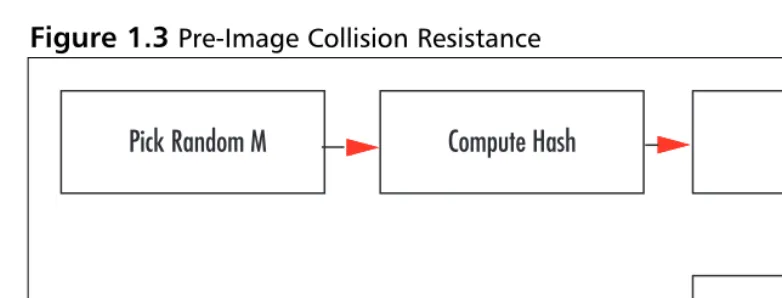
Hashes are also required to be collision resistant in two significant manners. First, a hash
Message
Hash Function
as 2nd pre-image resistance (Figure 1.4) is the inability to find two messages M1(given) and
[image:30.612.65.456.116.265.2]M2(chosen at random) such that hash (M1) = hash(M2).Together, these imply collision resistance.
[image:30.612.63.457.283.472.2]Figure 1.3
Pre-Image Collision ResistanceFigure 1.4
2nd Pre-Image Collision ResistanceHashes are not keyed algorithms, which means there is no secret information to which attackers would not be privy in the process of the algorithms workflow. If you can compute the message digest of a public message, so can they. For this reason, in the presence of an attacker the integrity of a message cannot be determined.
Even in light of this pitfall, they are still used widely in computing. For example, most online Linux and BSD distributions provide a digest from programs such as md5sum as part of their file manifests. Normally, as part of an update process the user will download both the file (tarball, RPM, .DEB, etc.) and the digest of the file.This is used under the assumption
Pick Random M
Compute Hash
Compare
Given Y
Given M1
Compute Hash
Compare
that the threat model does not include active adversaries but merely storage and distribution errors such as truncated or overwritten files.
This book discusses the popular Secure Hash Standard (SHS) SHA-1 and SHA-2 family of hash functions, which are part of the NIST portfolio of cryptographic functions.The SHA-2 family in particular is fairly attractive, as it introduces a range of hashes that produce digests from 224 to 512 bits in size.They are fairly efficient algorithms given that they require no tables or complicated instructions and are fairly easy to reproduce from specification.
W
ARNING!
The MD5 hash algorithm has long been considered fairly weak. Dobbertin found flaws in key components of the algorithm, and in 2005 researchers found full collisions on the function. New papers appearing in early 2006 are discussing faster and faster methods of finding collisions.
These researchers are mostly looking at 2ndpre-image collisions, but there
are already methods of using these collisions against IDS and distribution sys-tems.
It is highly recommended that developers avoid the MD5 hash function. To a certain extent, even the SHA-1 hash function should be avoided in favor of the new SHA-2 hash functions. For those following the European standards, there is also the Whirlpool hash function to choose from.
Authentication
Authentication is the property of attributing an identity or representative of the integrity of a message. A classic example would be the wax seal applied to letters.The mark would typi-cally be hard to forge at the time they were being used, and the presence of the unbroken mark would imply the documents were authentic.
Another common form of authentication would be entering a personal identification number (PIN) or password to authorize a transaction.This is not to be confused with nonre-pudiation, the inability to refute agreement, or with authentication protocols as far as key agreement or establishment protocols are concerned. When we say we are authenticating a message, it means we are performing additional steps such that the recipient can verify the integrity of a message in the presence of an active adversary.
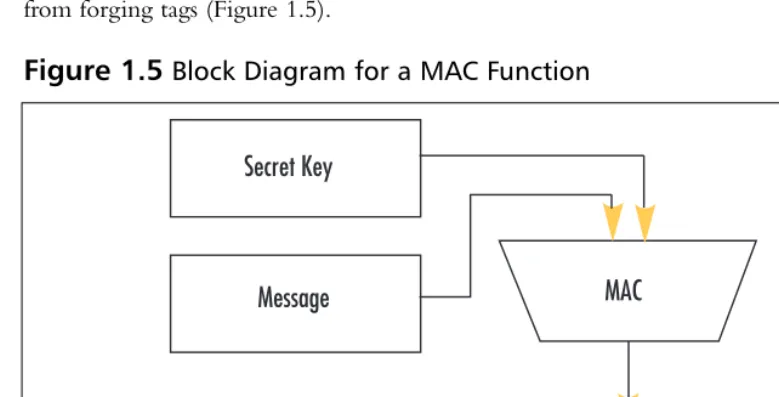
In the cryptographic world, these authentication algorithms are often called Message Authentication Codes (MAC), and like hash functions produce a fixed sized output called a message tag.The tag would be the information a verifier could use to validate a document. Unlike hash functions, the set of MAC functions requires a secret key to prevent anyone from forging tags (Figure 1.5).
Figure 1.5
Block Diagram for a MAC FunctionThe two most common forms of MAC algorithms are the CBC-MAC (now imple-mented per the OMAC1 algorithm and called CMAC in the NIST world) and the HMAC functions.The CBC-MAC (or CMAC) functions use a block cipher, while the HMAC functions use a hash function.This book covers both NIST endorsed CMAC and HMAC message authentication code algorithms.
Another method of achieving authentication is using public key algorithms such as RSA using the PKCS #1 standard or the Elliptic Curve DSA (EC-DSA or ANSI X9.62) standard. Unlike CMAC or HMAC, a public key based authenticator does not require both parties to share private information prior to communicating. Public key algorithms are therefore not limited to online transactions when dealing with random unknown parties.That is, you can sign a document, and anyone with access to your public key can verify without first com-municating with you.
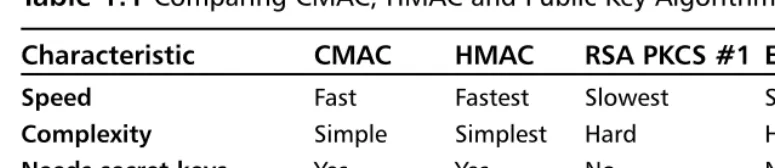
Public key algorithms are used in different manners than MAC algorithms and as such are discussed later in the book as a different subject (Table 1.1).
Secret Key
Message
MAC
Table 1.1
Comparing CMAC, HMAC and Public Key AlgorithmsCharacteristic CMAC HMAC RSA PKCS #1 EC-DSA
Speed Fast Fastest Slowest Slow
Complexity Simple Simplest Hard Hardest
Needs secret keys Yes Yes No No
Ease of deployment Harder Harder Simple Simple
The manner in which the authenticators are used depends on their construction. Public key based authenticators are typically used to negotiate an initial greeting on a newly opened communication medium. For example, when you first connect to that SSL enabled Web site, you are verifying that the signature on the Web site’s certificate was really signed by a root signing authority. By contrast, algorithms such as CMAC and HMAC are typically used after the communication channel has been secured.They are used instead to ensure that commu-nication traffic was delivered without tampering. Since CMAC and HMAC are much faster at processing message data, they are far more valuable for high traffic mediums.
Nonrepudiation
Nonrepudiation is the property of agreeing to adhere to an obligation. More specifically, it is the inability to refute responsibility. For example, if you take a pen and sign a (legal) contract your signature is a nonrepudiation device.You cannot later disagree to the terms of the con-tract or refute ever taking party to the agreement.
Nonrepudiation is much like the property of authentication in that their implementa-tions often share much of the same primitives. For example, a public key signature can be a nonrepudiation device if only one specific party has the ability to produce signatures. For this reason, other MAC algorithms such as CMAC and HMAC cannot be nonrepudiation devices.
Nonrepudiation is a very important property of billing and accounting that is more often than not improperly addressed. For example, pen signatures on credit card receipts are rarely verified, and even when the clerk glances at the back of the card, he is probably not a handwriting expert and could not tell a trivial forgery from the real thing. Cell phones also typically use MAC algorithms as resource usage authenticators, and therefore do not have nonrepudiation qualities.
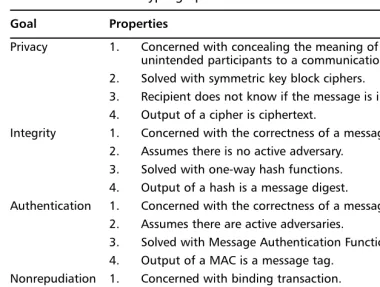
Goals in a Nutshell
Table 1.2
Common Cryptographic GoalsGoal Properties
Privacy 1. Concerned with concealing the meaning of a message from unintended participants to a communication medium. 2. Solved with symmetric key block ciphers.
3. Recipient does not know if the message is intact. 4. Output of a cipher is ciphertext.
Integrity 1. Concerned with the correctness of a message in transit. 2. Assumes there is no active adversary.
3. Solved with one-way hash functions. 4. Output of a hash is a message digest.
Authentication 1. Concerned with the correctness of a message in transit 2. Assumes there are active adversaries.
3. Solved with Message Authentication Functions (MAC). 4. Output of a MAC is a message tag.
Nonrepudiation 1. Concerned with binding transaction.
2. Goal is to prevent a party from refuting taking party to a transaction.
3. Solved with public key digital signatures. 4. Output of a signature algorithm is a signature.
Asset Management
A difficult challenge when implementing cryptography is the ability to manage user assets and credentials securely and efficiently. Assets could be anything from messages and files to things such as medical information and contact lists; things the user possesses that do not specifically identify the user, or more so, are not used traditionally to identify users. On the other hand, credentials do just that.Typically, credentials are things such as usernames, pass-words, PINs, two-factor authentication tokens, and RFID badges.They can also include information such as private RSA and ECC keys used to perform signatures.
Assets are by and large not managed in any particularly secure fashion.They are rou-tinely assumed authentic and rarely privacy protected. Few programs offer integrated security features for assets, and instead assume the user will use additional tools such as encrypted file stores or manual tools such as GnuPG. Assets can also be mistaken for credentials in very real manners.
agents did not check photo identification while traveling inside Canada.The system assumed possession of the credit card meant the same person who bought the ticket was also standing at the check-in gate.
Privacy and Authentication
Two important questions concerning assets are whether the asset is private and whether it has to be intact. For example, many disk encryption users apply the tool to their entire system drive. Many system files are universally accessible as part of the install media.They are in no way private assets, and applying cryptography to them is a waste of resources. Worse, most systems rarely apply authentication tools to the files on disk (EncFS is a rare exception to the lack of authentication rule. http://encfs.sourceforge.net/), meaning that many files, including applications, that are user accessible can be modified. Usually, the worse they can accomplish is a denial of service (DoS) attack on the system, but it is entirely possible to modify a working program in a manner such that the alterations introduce flaws to the system. With authentication, the file is either readable or it is not. Alterations are simply not accepted.
Usually, if information is not meant to be public it is probably a good idea to authenti-cate it.This provides users with two forms of protection around their assets. Seeing this as an emerging trend, NIST and IEEE have both gone as far as to recommend combined modes (CCM and GCM, respectively) that actually perform both encryption and authentication. The modes are also of theoretical interest, as they formally reduce to the security of their inherited primitives (usually the AES block cipher). From a performance point of view, these modes are less efficient than just encryption or authentication alone. However, that is offset by the stability they offer the user.
Life of Data
Throughout the life of a particular asset or credential, it may be necessary to update, add to, or even remove parts of or the entire asset. Unlike simply creating an asset, the security implications of allowing further modifications are not trivial. Certain modes of operation are not secure if their parameters are left static. For instance, the CTR chaining mode (discussed in Chapter 4, “Advanced Encryption Standard”) requires a fresh initial value (IV) whenever encrypting data. Simply re-using an existing IV, say to allow an inline modification, is entirely insecure against privacy threats. Similarly, other modes such as CCM (see Chapter 7, “Encrypt and Authenticade Modes”) require a fresh Nonce value per message to assure both the privacy and authenticity of the output.
The concept of in-order data flow stems from the requirement to have stateful commu-nication. For example, if you were sending a banking request to a server, you’d like the request to be issued and accepted only once—specially if it is a bill payment! A replay attack
arises when an attacker can re-issue events in a communication session that are accepted by the receiving party.The most trivial (initially) solution to the problem is to introduce times-tamps or incremental counters into the messages that are authenticated.
The concept of timestamps within cryptography and computer science in general is also a thorny issue. For starters, what time is it? My computer likely has a different time than yours (when measured in even seconds).Things get even more complicated in online proto-cols where in real-time we must communicate even with skewed clocks that are out of sync and may be changing at different paces. Combined with the out-of-order nature of UDP networks, many online protocols can quickly become beastly. For these reasons, counters are more desirable than timers. However, as nice as counters sound, they are not always appli-cable. For example, offline protocols have no concept of a counter since the message they see is always the first message they see.There is no “second” message.
It is a good rule of thumb to include a counter inside the authentication portion of data channels and, more importantly, to check the counter. Sometimes, silent rejection of out of order messages is a better solution to just blindly allowing all traffic through regardless of order.The GCM and CCM modes have IVs (or nonces depending), which are trivial to use as both as an IV and a counter.
T
IPA simple trick with IVs or nonces in protocols such as GCM and CCM is to use a few bytes as part of a packet counter. For example, CCM accepts 13 byte nonces when the packet has fewer than 65,536 plaintext bytes. If you know you will have fewer than 4 billion packets, you can use the first four bytes as a packet counter.
For more information, see Chapter 7.
Common Wisdom
There is a common wisdom among cryptographers that security is best left to cryptogra-phers; that the discussion of cryptographic algorithms will lead people to immediately use them incorrectly. In particular, Bruce Schneier wrote in the abstract of his Secret and Lies
text:
Seven years ago, I wrote another book: Applied Cryptography. In it, I described a mathematical utopia: algorithms that would keep your deepest secrets safe for millennia, protocols that could perform the most fantastical electronic interactions—unregulated gambling, unde-tectable authentication, anonymous cash—safely and securely. In my vision, cryptography was the great technological equalizer; anyone with a cheap (and getting cheaper every year) computer could have the same security as the largest government. In the second edition of the same book, written two years later, I went so far as to write, “It is insufficient to protect ourselves with laws; we need to protect our-selves with mathematics.”
Abstract. Secret and Lies, Bruce Schneier
In this quote, he’s talking abstractly about the concept that cryptography as a whole, on its own, cannot make us “safe.”This is in practice perhaps at least a little true.There are many instances where perfectly valid cryptography has been circumvented by user error or physical attacks (card skimming, for example). However, the notion that the distribution of crypto-graphic knowledge to the layperson is somehow something to be ashamed of or in anyway avoid is just not valid.
While relying solely on security experts is likely a surefire method of obtaining secure systems, it also is entirely impractical and inefficient. One of the major themes and goals of this book is to dispel the notion that cryptography is harder (or needs to be harder) than it really is. Often, a clear understanding of your threats can lead to efficient and easily designed cryptosystems that address the security needs.There are already many seemingly secure prod-ucts available in which the developers performed just enough research to find the right tools for the job—software libraries, algorithms, or implementations—and a method of using them that is secure for their task at hand.
Keep in mind what this book is meant to address. We are using standard algorithms that already have been designed by cryptographers and finding out how to use them properly. These are two very different tasks. First, a very strong background in cryptography and mathematics is required. Second, all we have to understand is what they are meant to solve, why they are the way they are, and how not to use them.
rithms exist, how to implement them in a variety of manners, and the perils of their deploy-ment and usage. A text can both address the ingredients and cooking instructions.
Developer Tools
Throughout this book, we make use of readily access tools such as the GNU Compiler Collection C compiler (GCC) for the X86 32-bit and 64-bit platforms, and ARMv4 proces-sors.They were chosen as they are highly professional, freely accessible, and provide intrinsic value for the reader.
The various algorithms presented in this book are implemented in portable C for the most part to allow the listings to have the greatest and widest audience possible.The listings are complete C routines the reader can take away immediately, and will also be available on the companion Web site. Where appropriate, assembler listings as generated by the C com-piler are analyzed. It is most ideal for the reader to be familiar with AT&T style X86 assem-blers and ARM style ARMv4 assemassem-blers.
For most algorithms or problems, there are multiple implementation techniques possible. Multiplication, for instance, has three practical underlying algorithms and various actual implementation techniques each. Where appropriate, the various configurations are com-pared for size and efficiency on the listed platforms.The reader is certainly encouraged to benchmark and compare the configurations on other platforms not studied in this book.
Some algorithms also have security trade-offs. AES, for instance, is fastest when using lookup tables. In such a configuration, it is also possible to leak Side Channelinformation (discussed in Chapter 4).This book explores variations that seek to minimize such leaks.The analysis of these implementations is tied tightly to the design of modern processors, in par-ticular those with data caches.The reader is encouraged to become familiar with how, at the very least, X86 processors such as the Intel Pentium 4 and AMD Athlon64 operate a block level.
Occasionally, the book makes reference to existing works of source code such as TomsFastMath and LibTomCrypt.These are public domain open source libraries written in C and used throughout industry in platforms as small as network sensors to as large as enter-prise servers. While the code listings in this book are independent of the libraries, the reader is encouraged to seek out the libraries, study their design, and even use them en lieu of re-inventing the wheel.That is not to say you shouldn’t try to implement the algorithms your-self; instead, where the circumstances permit the use of released source can speed product development and shorten testing cycles. Where the users are encouraged to “roll their own” implementations would be when such libraries do not fit within project constraints.The projects are all available on the Internet at the www.libtomcrypt.com Web site.
Summary
The development of professional cryptosystems as we shall learn is not a highly complicated or exclusive practice. By clearly defining a threat model that encompasses the systems’ points of exposures, one begins to understand how cryptography plays a role in the security of the product. Cryptography is only the most difficult to approach when one does not understand how to seek out vulnerabilities.
Construction of a threat model from all use of the use cases can be considered at least partially completed when the questions “Does this address privacy?” and “Does this address authenticity?” are answered with either a “yes” or “does not apply.”
Knowing where the faults lay is only one of the first steps to a secure cryptosystem. Next, one must determine what cryptography has to offer toward a solution to the problem—be it block ciphers, hashes, random number generators, public key cryptography, message authentication codes or challenge response systems. If you design a system that requires an RSA public key and the user does not have one, it will obviously not work. Credential and asset management are integral portions of the cryptosystem design.They determine what cryptographic algorithms are appropriate, and what you must protect.
The runtime constraints of a product determine available space (memory) in which pro-gram code and data can reside, and the processing power available for a given task.These constraints more often than not play a pivotal role in the selection of algorithms and the subsequent design of the protocols used in the cryptosystem. If you are CPU bound, for instance, ECC may be more suitable over RSA, and in some instances, no public key cryp-tography is practical.
All of these design parameters—from the nature of the program to the assets and cre-dentials the users have access to and finally to the runtime environment—must be constantly juggled when designing a cryptosystem. It is the role of the security engineer to perform this juggle and design the appropriate solution.This book addresses their needs by showing the what, how, and why of cryptographic algorithms.
Organization
The book is organized to group problems categories by chapter. In this manner, each chapter is a complete treatment of its respective areas of cryptography as far as developers are con-cerned.This chapter serves as a quick introduction to the subject of cryptography in general. Readers are encouraged to read other texts, such as Applied Cryptography,Practical
Cryptography, or The Handbook of Applied Cryptographyif they want a more in-depth
treat-ment of cryptography particulars.
also useful for generic data structures, as it is a standard and well understood set of encoding rules. For example, you could encode file headers in ASN.1 format and give your users the ability to use third-party tools to debug and modify the headers on their own.There is a sig-nificant “value add” to any project by using ASN.1 encoding over self-established standards. This chapter examines a subset of ASN.1 rules specific to common cryptographic tasks.
Chapter 3, “Random Number Generation,” discusses the design and construction of standard random number generators (RNGs) such as those specified by NIST. RNGs and pseudo (or deterministic) random number generators (PRNGs or DRNGs) are vital por-tions of any cryptosystem, as most algorithms are randomized and require material (such as initial vectors or nonces) that is unpredictable and nonrepeating. Since PRNGs form a part of essentially all cryptosystems, it is logical to start the cryptographic discussions with them. This chapter explores various PRNG constructions, how to initialize them, maintain them, and various hazards to avoid. Readers are encouraged to take the same philosophy to their designs in the field. Always addressing where their “random bits” will come from first is important.
Chapter 4, “Advanced Encryption Standard,” discusses the AES block cipher design, implementation tradeoffs, side channel hazards, and modes of use.The chapter provides only a cursory glance at the AES design, concentrating more on the key design elements impor-tant to implementers and how to exploit them in various tradeoff conditions.The data cache side channel attack of Bernstein is covered here as a design hazard.The chapter concludes with the treatment of CBC and CTR modes of use for the AES cipher, specifically concen-trating on what problems the modes are useful for, how to initialize them, and their respec-tive use hazards.
Chapter 5, “Hash Functions,” discusses the NIST SHA-1 and SHA-2 series of one-way hash functions.The designs are covered first, followed by implementation tradeoffs.The chapter discusses collision resistance, provides examples of exploits, and concludes with known incorrect usage patterns.
Chapter 6, “Message Authentication Code Algorithms,” discusses the HMAC and CMAC Message Authentication Code (MAC) algorithms, which are constructed from hash and cipher functions, respectively. Each mode is presented in turn, covering the design, implementation tradeoffs, goals, and usage hazards. Particular attention is paid to replay pre-vention using both counters and timers to address both online and offline scenarios.
share a particular multiplication.The reader is encouraged to first read the treatment of the LRW mode in Chapter 4 before reading this chapter.
Chapter 8, “Large Integer Arithmatic,” discusses the techniques behind manipulating large integers such as those used in public key algorithms. It focuses on primarily the bottle-neck algorithms developers will face in their routine tasks.The reader is encouraged to read the supplementary “Multi-Precision Math” text available on the Web site to obtain a more in-depth treatment.The chapter focuses mainly on fast multiplication, squaring, reduction and exponentiation, and the various practical tradeoffs. Code size and performance compar-isons highlight the chapter, providing the readers with an effective guide to code design for their runtime constraints.This chapter lightly touches on various topics in number theory sufficient to successfully navigate the ninth chapter.
Chapter 9,“Public Key Algorithms,” introduces public key cryptography. First, the RSA algorithm and its related PKCS #1 padding schemes are presented.The reader is introduced to various timing attacks and their respective counter-measures.The ECC public key algorithms EC-DH and EC-DSA are subsequently discussed.They’ll make use of the NIST elliptic curves while exploring the ANSI X9.62 and X9.63 standards.The chapter introduces new math in the form of various elliptic curve point multipliers, each with unique performance tradeoffs. The reader is encouraged to read the text “Guide to Elliptic Curve Cryptography” to obtain a deeper understanding of the mathematics behind elliptic curve math.
Q:
When should the development of a threat model begin?A:
Usually alongside the project design itself. However, concerns such as runtime con-straints may not be known in advance, limiting the accuracy of the threat model solu-tions.Q:
Is there any benefit to rolling our own cryptographic algorithms in place of using algo-rithms such as AES or SHA-2?A:
Usually not, as far as security is concerned. It is entirely possible to make a more effi-cient algorithm for a given platform. Such design decisions should be avoided, as they remove the product from the realm of standards compliance and into the skepticcate-Frequently Asked Questions
The following Frequently Asked Questions, answered by the authors of this book, are designed to both measure your understanding of the concepts presented in this chapter and to assist you with real-life implementation of these concepts. To have your questions about this chapter answered by the author, browse to
Q:
What is certified cryptography? FIPS certification?A:
FIPS certification (see http://csrc.nist.gov/cryptval/) is a process in which a binary or physical implementation of specific algorithms is placed through FIPS licensed validation centers, the result of which is either a pass (and certificate) or failure for specific instance of the implementation.You cannot certify a design or source code.There are various levels of certification depending on how resistant to tampering the product desires to be: level one being a known answer battery, and level four being a physical audit for side channels.Q:
Where can I find the LibTomCrypt and TomsFastMath projects? What platforms do they work with? What is the license?ASN.1 Encoding
Solutions in this chapter:
■
Overview of ASN.1
■
ASN.1 Syntax
■
ASN.1 Data Types
■
Implementation
■
Putting It All Together
Chapter 2
21
Summary
Solutions Fast Track
Overview of ASN.1
Abstract Syntax Notation One (ASN.1) is an ITU-T set of standards for encoding and rep-resenting common data types such as printable strings, octet strings, bit strings, integers, and composite sequences of other types as byte arrays in a portable fashion. Simply put, ASN.1 specifies how to encode nontrivial data types in a fashion such that any other platform or third-party tool can interpret the content.
For example, on certain platforms the literal character “a” would be encoded in ASCII (or IA5) as the decimal value 97, whereas on other non-ASCII platforms it may have another encoding. ASN.1 specifies an encoding such that all platforms can decode the string uniformly. Similarly, large integers, bit strings, and dates are also platform sensitive data types that benefit from standardization.
This is beneficial for the developer and for the client (or customer) alike, as it allows the emitted data to be well modeled and interpreted. For example, the developer can tell the client that the data the program they are paying for is in a format another developer down the road can work with—avoiding vendor lock-in problems and building trust.
Formally, the ASN.1 specification we are concerned with is ITU-T X.680, which docu-ments the common data types we will encounter in cryptographic applications. ASN.1 is used in cryptography as it formally specifies the encodings down to the byte level of various data types that are not always inherently portable and, as we will see shortly, encodes them in a deterministic fashion. Being deterministic is particularly important for signature protocols that require a single encoding for any given message to avoid ambiguity.
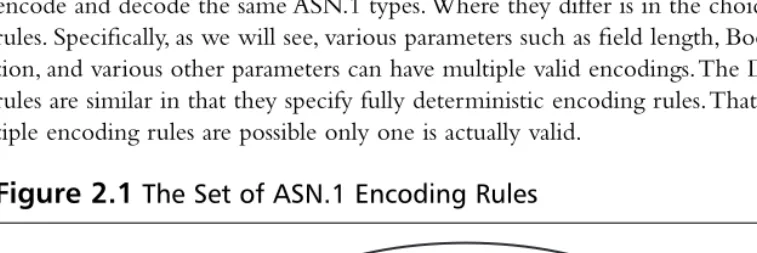
[image:45.612.62.441.446.572.2]ASN.1 supports Basic Encoding Rules (BER), Canonical Encoding Rules (CER), and the Distinguished Encoding Rules (DER) (Figure 2.1).These three modes specify how to encode and decode the same ASN.1 types. Where they differ is in the choice of encoding rules. Specifically, as we will see, various parameters such as field length, Boolean representa-tion, and various other parameters can have multiple valid encodings.The DER and CER rules are similar in that they specify fully deterministic encoding rules.That is, where mul-tiple encoding rules are possible only one is actually valid.