Extempore
The design, implementation and application
of a cyber-physical programming language
Andrew Sorensen
June 21, 2018
A thesis submitted for the degree of
Doctor of Philosophy of
The Australian National University
Andrew Carl Sorensen
Abstract
There is a long history of experimental and exploratory programming supported by
systems that expose interaction through a programming language interface. These live
programming systems enable software developers to create, extend, and modify the
be-haviour of executing software by changing source code without perceptual breaks for
recompilation. These live programming systems have taken many forms, but have
gen-erally been limited in their ability to express low-level programming concepts and the
generation of ecient native machine code. These shortcomings have limited the
eec-tiveness of live programming in domains that require highly ecient numerical processing
and explicit memory management.
The most general questions addressed by this thesis are what a systems language
de-signed for live programming might look like and how such a language might inuence the
development of live programming in performance sensitive domains requiring real-time
support, direct hardware control, or high performance computing. This thesis answers
these questions by exploring the design, implementation and application of Extempore,
a new systems programming language, designed specically for live interactive
Acknowledgements
I feel incredibly lucky to have had three friends to share my PhD journey with. Without
the companionship of Henry, Alistair and Ben, my PhD would have been a far shallower
experience.
Firstly, my thanks go to Henry Gardner for his patient supervision and unwavering
enthusiasm for the projectafter eight years no less! Henry's friendship and good humour
have made my PhD experience a joy, from beginning to end.
I am deeply grateful to Alistair Riddell for generously hosting me in Canberra. You
made your house my home and I will never forget our conversations long into the night.
I have been incredibly fortunate to have had Ben Swift at ANU throughout my PhD
studentship. Initially as a fellow PhD student and increasingly as a collaborator and as
a friend.
I would also like to thank Alex McLean, whose Hacking Perl In Nightclubs marks
the beginning this journey.
List of Listings 10
1 Overview 14
1.1 Thesis Plan . . . 14
1.1.1 Chapter 1. Overview . . . 14
1.1.2 Chapter 2. Introduction . . . 14
1.1.3 Chapter 3. The design of a live language . . . 15
1.1.4 Chapter 4. The implementation of a live language . . . 15
1.1.5 Chapter 5. The application of a live language . . . 16
1.1.6 Chapter 6. Conclusions, reections and future work . . . 16
1.1.7 Appendix A. . . 16
1.1.8 Appendix B. . . 16
1.1.9 Appendix C. . . 17
1.1.10 Appendix D. . . 17
1.2 Contributions of the thesis . . . 17
1.2.1 Research Publications . . . 18
1.2.2 Presentations . . . 19
1.2.3 Public Performances . . . 19
2 Introduction 22
2.1 Prelude . . . 22
2.2 Liveness in Programming . . . 23
2.3 Live Programming . . . 26
2.4 Live Systems Programming . . . 28
2.5 Live programming Full-Stack . . . 30
2.6 Live programming as a Performance . . . 32
2.7 Cyber-physical systems . . . 35
2.8 Cyber-physical programming . . . 37
2.9 Musical live-coding as cyber-physical programming . . . 39
3 The design of a live language 42 3.1 Half-stack live-coding . . . 42
3.1.1 Higher-level Languages . . . 44
3.1.2 Language and framework coupling . . . 45
3.1.3 Concurrency . . . 49
3.1.4 Time . . . 52
3.1.5 Latency . . . 56
3.2 Full-stack live coding . . . 58
3.2.1 Leaky Abstractions . . . 59
3.2.2 The Language Interface . . . 61
3.2.3 Designing for reasonable performance . . . 63
3.2.4 Live cyber-physical programming systems . . . 66
3.2.5 Code specialisation . . . 68
4 The implementation of a live language 72
4.1 Architectural Overview . . . 72
4.2 Process Model . . . 78
4.3 Temporal Recursion . . . 83
4.4 XTLang . . . 92
4.5 XTLang and Scheme . . . 93
4.6 Type System . . . 95
4.7 Generics . . . 99
4.8 User Dened Types . . . 103
4.9 Memory Management . . . 107
4.9.1 The Stack and the Heap . . . 107
4.9.2 Zone Memory . . . 109
4.9.3 Zones and Processes . . . 114
4.10 Closures . . . 118
4.11 Extensibility . . . 123
5 The application of a live language 129 5.1 Introduction . . . 129
5.2 High Performance Computing . . . 129
5.2.1 Introduction . . . 129
5.2.2 Cannibalizing a Particle-in-Cell (PIC) code . . . 130
5.2.3 Steering . . . 135
5.2.4 Rapid Prototyping . . . 136
5.2.5 Resource Management . . . 138
5.2.6 Visualisation and Analysis . . . 138
5.3 A Computer Music Language . . . 140
5.3.1 Introduction . . . 140
5.3.2 Background . . . 141
5.3.3 Integrating the Audio Device . . . 142
5.3.4 On-the-y DSP . . . 146
5.3.5 DSP by the numbers . . . 147
5.3.6 Higher level structure . . . 150
5.4 The Physics Playroom . . . 160
5.4.1 Introduction . . . 160
5.4.2 Overview . . . 162
5.4.3 Computational steering . . . 164
5.4.4 The State of Things . . . 168
5.4.5 Extempore for product development . . . 168
6 Conclusions, reections and future work 170 6.1 Reections . . . 170
6.2 Future work . . . 177
6.2.1 Bootstrapping XTLang . . . 177
6.2.2 Running on-the-metal and time predictable architectures . . . 178
6.3 Conclusion . . . 179
References 181
A The Expression Problem 192
B List 196
List of Figures
2.1 The author live-coding music with two robotic pianos in the Hofburg
Palace Vienna. . . 33
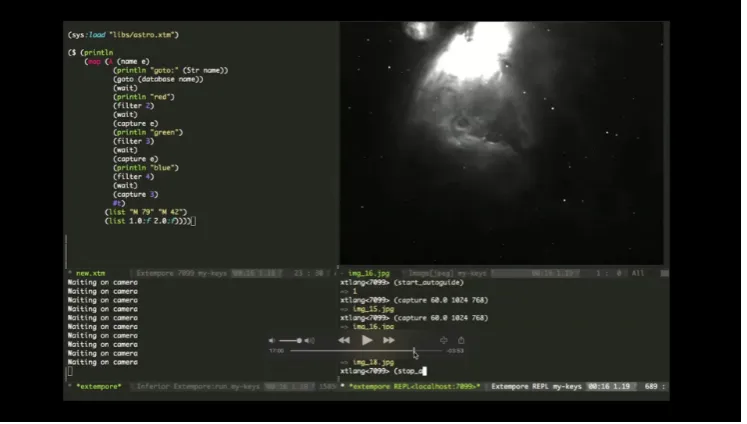
2.2 Cyber-physical programming a robotic telescope with Extempore. . . 38
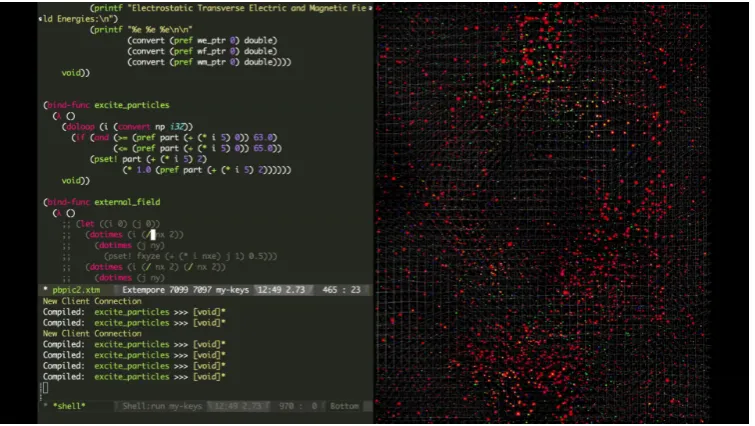
5.1 Steering a PIC simulation in Extempore. . . 137
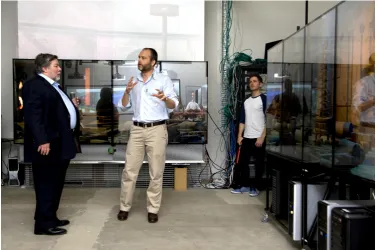
5.2 The author demonstrating Extempore and the Physics Playroom to Steve
Wozniak . . . 161
5.3 Australian Prime Minster Julia Gillard and Queensland State Premier
Campbell Newman visit the Physics Playroom. . . 165
5.4 Always on! Live programming the Physics Playroom in situ. This kind of
live interaction between the live programmer, and an otherwise oblivious
group of users turned out to be extremely valuable in practice. . . 167
1 XTLang source code . . . 75
2 XTLang Intermediate representation . . . 76
3 LLVM Intermediate Representation . . . 76
4 x86 Assembly . . . 77
5 Reactive online/oine event processing . . . 81
6 Recursions . . . 84
7 Temporal Recursion . . . 85
8 Encapsulated state . . . 86
9 Encapsulated shared state . . . 87
10 Aperiodic schedules . . . 88
11 Time lag! . . . 88
12 Time regulation . . . 89
13 Time constraints . . . 90
14 sys:sleep - full implementation . . . 91
15 Synchronous iterators? . . . 92
16 Scheme implementation of GCD . . . 94
17 XTLang implementation of GCD . . . 94
18 GCD annotated with a 32bit integer literal . . . 98
19 GCD explicit 32bit arguments . . . 99
20 Parametric polymorphic GCD . . . 101
21 Test of parametric polymorphic GCD . . . 102
23 Product Type . . . 103
24 Named type constructor . . . 104
25 Dening a recursive type . . . 104
26 Dening a type with named elements . . . 105
27 Dening a recursive type . . . 106
28 Algebraic Data Types . . . 106
29 Stack allocation . . . 108
30 Allocate and de-allocate heap memory . . . 109
31 Stack with HOF . . . 110
32 Memory Zone with closure . . . 112
33 Memory Zone. . . 113
34 Three nested memory zones . . . 115
35 Zone copying . . . 116
36 Manual zone management . . . 117
37 Zone reset . . . 118
38 Procedure Abstraction and Application . . . 119
39 Local Binding . . . 119
40 Global Binding . . . 119
41 Closure memory zone . . . 120
42 oscillator with global state . . . 120
43 oscillator with phase passed by reference . . . 121
44 oscillator with encapsulated zone memory . . . 121
45 higher order oscillator with encapsulated memory . . . 121
46 An application of a higher order oscillator . . . 122
48 Loading a library . . . 126
49 PIC overview in C . . . 131
50 PIC overview XTLang . . . 132
51 Add visualisation to run loop . . . 133
52 Add external electric eld . . . 134
53 Deposit charge on grid . . . 135
54 Setting up an OSX CoreAudio callback Part 1 . . . 143
55 Setting up an OSX CoreAudio callback Part 2 . . . 144
56 DSP on-the-y . . . 146
57 White noise with Gain . . . 147
58 A sinusoid . . . 148
59 Noise from left, sinusoid from right . . . 148
60 Abstracting an Oscillator . . . 149
61 Playing the DSP routine . . . 151
62 Music routine 2 . . . 153
63 Music Routine 3 . . . 155
64 Music Routine 4 . . . 156
65 Music Routine 5 . . . 157
66 Music Routine 6 . . . 158
67 Music Routine 7 . . . 159
68 The Expression Problem Part1 . . . 193
69 The Expression Problem Part2 . . . 194
70 The Expression Problem Part3 . . . 195
72 List Library Part2 . . . 198
73 Convolution Reverb Part 1 . . . 199
74 Convolution Reverb Part 2 . . . 200
Overview
1
This thesis explores the cyber-physical system that is the coupling of programmer,
pro-gram, machine and environment; a relationship between the live programming language
(in the broadest sense) and the physical environment. Live programming is particularly
sensitive to issues of time and space and requires programming languages, and
environ-ments, capable of expressing these ideas eectively. The primary contribution of this
thesis is the design, implementation and application of the cyber-physical programming
language and environment Extempore.
1.1. Thesis Plan
The thesis is organised into 6 chapters and 4 appendices. This plan briey describes the
contents of each Chapter, making note of relevant publications and other activities by
the author.
1.1.1. Chapter 1. Overview
Chapter One provides a structural overview of the thesis; highlights the contributions
and limitations of the research; and relates the thesis chapters to publications and other
activities carried out by the author during the PhD.
1.1.2. Chapter 2. Introduction
Chapter Two introduces the central motivation of the thesis cyber-physical
program-ming as the live programprogram-ming of some physical process. Liveness in the context of a
practice is introduced. Cyber-physical systems are introduced and the live programming
of cyber-physical systems articulated. Throughout the thesis the term cyber-physical
programming is to be understood as the live programming of cyber-physical systems.
Material and ideas from chapter 2. have been previously published in [77], [81] and
[80].
1.1.3. Chapter 3. The design of a live language
Chapter Three addresses many of the core concerns for the design and building of live
programming languages and environments. Issues of time, concurrency, coupling,
reason-ing, code specialisation and memory management are discussed. Two broad categories
of half-stack and full-stack are established to help demarcate a boundary between
those live programming systems capable of coordinating cyber-physical systems on-the-y
(half-stack), and those that are capable of both coordinating and building cyber-physical
systems on-the-y (full-stack).
Material and ideas from chapter 3. have been previously published in [77] and [80].
1.1.4. Chapter 4. The implementation of a live language
Chapter Four provides an overarching description of Extempore's implementation, with
a particular focus on the Extempore language (XTLang). XTLang is a new systems level
programming language designed specically for the live programming of cyber-physical
systems for cyber-physical programming. The design, development and application of
Extempore (and XTLang), is the central contribution of this thesis.
Material and ideas from chapter 4. have been previously published in [77], [81] and in
1.1.5. Chapter 5. The application of a live language
Chapter Five demonstrates the application of Extempore to a number of substantial
case studies. Applying Extempore to nontrivial problems demonstrates cyber-physical
programming in-the-wild and the Extempore system's ability to tackle a variety of
real-world cases.
The three case studies are:
A scientic particle-in-cell (PIC) simulation, with material previously published in
[85]
A Computer Music Language with material previously published in [77] and [44]
A large interactive installation, The Physics Playroom with material previously
published in[70]
1.1.6. Chapter 6. Conclusions, reections and future work
Chapter Six concludes with reections and future work.
1.1.7. Appendix A.
Philip Wadler's expression problem is often used as a barometer of a programming
lan-guage's range of expression. Appendix A, shows XTLang solving the expression
prob-lem.
1.1.8. Appendix B.
Appendix B demonstrates an implementation of List, taken directly from the Extempore
core library. This monadic List code provides a reasonably concise demonstration of
1.1.9. Appendix C.
Appendix C shows XTLang's core library implementation of a partitioned spectral
convo-lution reverb. A partitioned spectral convoconvo-lution reverb is a computationally demanding
real-time DSP eect. Live programming this style of high-performance, real-time
prob-lem, on-the-y, is what Extempore was designed for.
1.1.10. Appendix D.
Appendix D is a website containing an assortment of web resources, including videos of
presentations, performances and screencasts, by the author, directly pertaining to this
thesis. Many of the thesis code Listings are provided as live video screencasts. While
the website is not a core component of the thesis, the video documentation helps to
convey a level of liveness that is dicult to express in text alone. This dynamic
content, will help to convey a greater sense of Extempore's liveness in practice, and
provides important documentary evidence of the Extempore artefact.
The URL is repeated here for convenience: http://extempore.moso.com.au/phd.
html
1.2. Contributions of the thesis
This thesis's contribution has been to identify the priorities that have been implicit
in the design of live programming environments and to highlight limiting factors that
have restricted the general application of live programming environments to a variety of
real-world problems particularly to those problems to which general purpose systems
languages are commonly applied.
of cyber-physical systems. Cyber-physical programming presents a number of challenges
to extant live programming environments and Extempore has been developed to address
these challenges.
Extempore, which incorporates the new systems programming language XTLang (a
contraction of Extempore language), is the primary contribution of this thesis.
Extem-pore has been pragmatically motivated by a desire to support live programming in
real-time physical systems contexts (i.e. cyber-physical programming). Extempore is publicly
available https://github.com/digego/extempore and has been deployed widely in
re-search, education, arts, sciences and industry.
Three real-world case studies, from three separate application domains, help to
ground Extempore in practice. These case studies provide a practical and pragmatic
grounding for a study of cyber-physical programming practice, and Extempore's ability
to support such a practice.
1.2.1. Research Publications
This is a complete list of publications made by the author, as primary or co-author,
during the course of the PhD.
2010 Onward! (OOPSLA, ACM) [77]
2010 International Computer Music Conference [76]
2013 Interactive Tabletops and Surfaces (ACM ITS) [70]
2013 Visual Languages & Human Centric Computing (VL/HCC) [83]
2013 Live Programming (1st International Workshop) [86]
2014 Computer Music Journal (MIT CMJ) [81]
2016 Supercomputing Frontiers and Innovations [85]
2017 Onward! (Splash, ACM) [80]
1.2.2. Presentations
During the course of the PhD the author has presented on Extempore, and cyber-physical
programming, at over 50 international conferences. Listing only the author's keynote
presentations during this period:
Lambda Jam (Chicago)
GOTO (Copenhagen, Aarhus)
OSCON (Portland)
Pioneers (Vienna)
CodeMania (Auckland)
SOSCON (Seoul)
ICLC (Hamilton, Canada)
GEECON (Krakow)
Compose (Melbourne)
1.2.3. Public Performances
The author has performed Extempore live-coding concerts all around the world from
nightclubs in London to palaces in Vienna and concert halls in Copenhagen. Video
1.3. Limitations of the thesis
This thesis has been motivated by a pragmatic desire to investigate new physical
do-mains for live programming experiment and practice. To support this exploration,
Ex-tempore has developed into a substantial distributed and heterogeneous computational
platform, targeting a wide range of systems from single board ARM computers, through
to high-performance computing clusters and accelerators. Extempore supports a robust
compiler, a stable real-time run-time system, and a substantial core library. Extempore
is supported on all commodity operating systems (OSX, Linux, Windows).
A consequence of this building and of the pragmatic focus of the thesis is that a
thorough theoretical foundation for Extempore, and XTLang more specically, is not
at-tempted here. Instead, the thesis focuses attention on exploring and applying Extempore,
and cyber-physical programming more generally, to problems in-the-wild.
Addressing problems in-the-wild imposes some additional limitations on the thesis.
Given a new programming practice (cyber-physical programming) and a new
program-ming language (XTLang), it was decided that a series of end-user studies targeting
real-world domain problems was unrealistic. Instead, the thesis has adopted a practice based
approach, where a number of non-trivial case studies are developed and explored in detail
by the author.
There is a danger in practice-based research that the reections of the researcher, as
both tool-maker and tool-user, lack generality. How then to provide the reader with
condence about the thesis's integrity? First, and foremost, Extempore is an artefact
that can be interrogated. This is a signicant, and non-trivial statement; it is common in
Computer Science research for the artefact to be of secondary concern to its theoretical
foundation and such a focus results in artefacts that are frequently only partial
practical as vehicles for validation. That is not the case for the work in this thesis.
Second, all of the claims made about Extempore in this thesis can be tested and veried
independently, by building and using the Extempore software. Extempore is an
open-source project hosted on GitHub https://github.com/digego/extempore that, at the
time of publication, has been forked by 103 people. The project is actively maintained
with 4,637 commits made by 32 contributors. Thirdly, this thesis references a substantial
amount of additional video documentation http://extempore.moso.com.au/phd.html
that can be used to verify many of the thesis' claims without the reader having to directly
run Extempore. This video documentation is a core component of the thesis' empirical
evidence and includes documentation for all of the included case studies. By building
infrastructure supporting signicant explorations across a number of independent
do-mains, the thesis attempts to explore the boundaries of a general purpose programming
Introduction
2
Computer science is an empirical discipline. . . Each new program that is
built is an experiment. It poses a question to nature, and its behavior oers
clues to an answer.
Allen Newell (1975)[64, p.114]
2.1. Prelude
Your robotic space probe is 100 million miles away from earth when it manifests a race
condition. Luckily for you, your space craft is running Lisp, giving you the opportunity
to live (re)program the space robot without interrupting the ongoing execution of its
critical subsystems. By 5pm the race condition is xed, the mission is back on track, and
you are o home for dinner. Fanciful?
Of the many compelling examples of live interactive programming it is hard to go
past the story of the NASA spacecraft Deep Space 1. Launched on October the 24th
1998 Deep Space 1 was NASA's rst ion propelled spacecraft[63]. When it was over
100 million miles away from Earth a race condition was identied, and rectied, via a
Lisp read-eval-print-loop(REPL)[36]. The REPL, which (R)eads a programmer's input,
(E)valuates the entered expression, (P)rints any results and then (L)oops back to the read
state, allowed Ron Garret, a NASA engineer, to make on-the-y changes1 to the space
craft's software mid-ight. Ron Garret's experience live programming Deep Space 1 is
summarized on his website:
million miles away is an interesting experience. Having a read-eval-print
loop running on the spacescraft proved invaluable in nding and xing the
problem[28].
This thesis explores the design, implementation and application of a systems language
designed to support live programming as a rst class concern. A primary motivation
for this work is to explore the possibilities aorded by an open and ongoing dialogue
between the programmer, the program, the machine and the environment.
2.2. Liveness in Programming
Live programming[34, 58], live coding[20], interactive programming[65], just-in-time
pro-gramming[73, 69], cyber-physical programming[77] and on-the-y programming[96], are
phrases used to describe a programming practice that places a strong emphasis on a
pro-grammer's ability to manipulate a program's computation via direct source code edits.
For such a live programmer, the program's source code is the program's human
com-puter interface, and human comcom-puter interaction is, at least in part, mediated through
a program's representation.
The activity of programming is intrinsically tied to a program's source representation,
be that graphical, textual, or some other form of notation. To be engaged in the activity
of programming is to be either editing, or comprehending, a program's source code. Live
edit and live comprehension introduces both program and programming liveness into the
activity of programming.
Steve Tanimoto, whose 4 (subsequently 6) levels of liveness[88] provided an early
theo-retical model of programming liveness suggests that In live programming, there is only
as various editing events occur[87, p.31]. This ongoing liveness relationship between the
programmer and the program is signicant, as it places the human at the centre of the
computational system.
Live programming aords liveness relationships for both editing and comprehending a
program's source code. These are two sides of a bi-directional liveness relationship
be-tween the program's source code and the program's computational unfolding; a
compu-tational unfolding that often occurs through time, as is the case in a traditional program
execution model; but may alternatively occur in space, as a timeless retroactive data
structure[65].
What distinguishes a live edit from any other source code edit is the direct impact
that the change is expected to have upon the program's ongoing computational state.
All programmer source code edits are live in the sense that the programmer is actively
engaged in changing the program's representation in real-time. Here the term live edit is
used more specically in reference to environments that support some ability to modify
a program's ongoing behaviour in direct response to program edits. Live edits induce
live feedback.
One way in which live feedback can be realized is in the relationship between
edits to a program's representation and its computational unfolding(s). At its
most extreme this relationship can be presented as a timeless computational expansion
where the programmer's edits are made directly to the computational unfolding. Roland
Perera presents this computational unfolding as a persistent, reactive data structure[65].
Perera's presentation of live programming enables live edits to be directly reected as
alternate computational unfolding's; as future histories. These alternate future histories
allow a complete computational unfolding to be presented to the programmer as a direct
Jonathon Edwards states in regard to his SubText language that the representation of
a program is the same thing as execution[26, p.505]. Edwards highlights the degree to
which this style of live programming is focused inwardly on the improved understanding
of the domain of programming itself an important, and understandable motivation
from within the domain of programming to improve its own comprehension.
An alternative path to live feedback can be found in the relationship between edits
to a program's representation and its ongoing eect in the world. This view
of live feedback focuses attention on the task domain rather than the program domain.
Edits to the program's source representation are reected in eective changes in the task
domain. In this view of live edit the program's source representation need not be a direct,
nor indeed even a complete representation of the program's ongoing computational state.
Instead the program's source representation serves as an interface for dening procedural
action; a loose coupling of a program's source representation and its execution. This is live
comprehension, not in the service of a software artefact, but rather in the production of
some physical eect, and through that eect some greater comprehension of the physical
world.
With regards to the physical world, a program can be considered to be more or less
live in relation to the natural ow of events that surround it; in relation to the subject,
or task domain to which it is applied. A distinction is commonly drawn between online
and oine processing systems, between real-time and non real-time systems, and
between interactive and non-interactive systems. These are commonly understood
liveness relationships in computing based on a systems ability to keep up with the
world around it. Signicantly, in the context of live programming (live edit) the source
code at any point in time will only ever provide a partial view of the active run-time
for intervention rather than a static specication, or a live representation.
This thesis focuses on the application of liveness to the external comprehension of the
domain problem, rather than the internal comprehension of the program itself. From
the programmer's perspective, a focus on liveness in the world rather than liveness in a
computational unravelling. More concretely, the focus here is not primarily with the live
inspection and interrogation of a computation, but instead with the live inspection and
interrogation of a physical process. Code as a transient interface for interacting with the
world.
2.3. Live Programming
By focusing attention on the relationship between edits to a program's representation and
its ongoing eect in the world the attention is focused on a coupling of programmer,
pro-gram, machine and environment; a liveness relationship between the human programmer
and the task domain. Live programming a system that keeps up with the world around
it integrates the human programmer into an ongoing ow of natural events; a ow of
natural events that the human programmer is able to sense and act (procedurally) upon.
In the context of live programming, a natural ow of events that must ultimately bear
some relevance to the human programmer to the programmer's sense perceptions.
Ultimately, if the ongoing environmental eect of the computation bears no relevance to
the human programmer then there is little point in live programming as a programming
practice.
A focus on task eectiveness prescribes that algorithmic description and evaluation
occur within a temporal quantum that is appropriate to a given task domain. As Richard
. . . the goal of [live programming] is to allow users to prot from their
task-time algorithmic insights by programming. Instead of automating with
software what was carefully designed and implemented much earlier, the user
recognises an algorithm and then creates the software to take advantage of it
just before it is needed, hence implementing it just in time.[69]
Potter's emphasis on the user as a spontaneous algorithm creator is fundamental to
live programming and distinguishes it from other more traditional design-centred software
engineering practices. Live programming promotes the idea that computer programming
can be a method of production whose artefact is not primarily a software product. Once
the programmer has manifest a graphic on a computer screen, a sound wave, moving a
robotic arm, a blinking LED etc., any source code written, executed or modied during
the process of creation may be modied in anticipation of future action, or potentially
discarded entirely. During a live programming session source code that was valid at the
start of the session is very likely to be re-appropriated for a dierent purpose by the end.
Source code will expand, contract and morph during the course of a session. Signicantly
the source code at any point in time will only provide a partial view of the active run-time
system. Live programming is ephemeral.
Live programming aligns with an iterative and incremental development cycle common
to Agile software development methodologies[8]. Like Agile methods, live programming
advocates a style of negotiated development between programmer and computational
work. Agile methods acknowledge the limitations of formal specication in the
develop-ment of real-world projects and attempt to systematise the developdevelop-ment cycle to
accom-modate unknown, or poorly known, requirements[8]. Where live programming diverges
from Agile thinking is that live programming is fundamentally more transient in nature.
about experimentation rather than manufacturing. In the words of Erik Sandewall:
The average Lisp user writes a program as a programming experiment ... in
order to develop the understanding of some task, rather than in expectation
of production use of the program.[75, p.39].
2.4. Live Systems Programming
In the context of live programming what it means for a program to be relevant to the
world around it, and what is required for it to keep up, is ultimately a subjective
quali-cation made by the live programmer himself or herself. Live programming is a human
centred activity and any assessment of liveness will ultimately be a personal
assess-ment by a given live programmer. Nevertheless, certain liveness criteria can be assumed
in relation to human perception and the physical processes being engaged with.
There is liveness in a Unix shell session, where commands such as ls, cd, pwd, mv etc.
form an ongoing dialogue between the user and the operating system. A shell session
establishes a style of call and response single shot executions of small programs designed
to provide feedback about the current and ongoing state of the operating system. A shell
session is a dialogue with past queries and responses helping the user to build a mental
model about the state of the system over time. Unix shell expressions such as find .
-name \*.cpp -exec grep "TODO" {} \; can be reasonably considered programming,
and Unix shells (bash, csh, tcsh, zsh etc.) are live programming environments.
The one-shot nature of these shell examples, with each command issued waiting on a
singular response, might more commonly be regarded as interactive programming rather
than live programming. In this thesis these terms are considered to lie on a continuum of
per-ception and the domain of interest. For interrogating a le system, shell commands seem
to provide an appropriately live dialogue. Furthermore, there is clearly a sophisticated
and very live real-time system underlying these shell examples the operating
sys-tem. Moreover live edits can run ongoing interventions and queries against this real-time
operating system, which may be purposed to provide continuous feedback.
For many interactive dialogues the rate of feedback supported by a shell script, or a
Lisp REPL is more than adequate. However, there are many task domains which require
considerably higher rates of feedback, (often with considerably more complex
calcula-tions) than a standard Unix script is able to support. For computationally demanding,
low-level and real-time tasks the Unix programmer invariably turns to C.
There are two primary reasons that C is such a popular systems language for task
domains requiring high rates of feedback in computationally demanding domains. First,
as the lingua franca of operating systems the lowest level Application Programming
In-terface (API) available on most Operating Systems is a C inIn-terface. For this reason,
C invariably provides the most extensive interface for directly programming the
operat-ing system. Secondly, the C language's close relationship to the physical machine has
often been described (in antipathy as often as in reverence!) as a portable assembly
language[9]. The most important quality bestowed on C by these two factors is great
exibility, enabling C to be eective in many dierent domains where performance
mat-ters.
Unfortunately for the live programmer, while C is an excellent candidate for live
feed-back, C is not well equipped for live edits. While there are interactive interpreters for
the C language, and C debuggers provide some basic live edit capabilities, C and the C
language's infrastructure more broadly, were never designed, nor intended, to support
text is compiled into a static binary image, removed from its source code (debugging
aside).
Shell scripting provides C programmers with a level of live programmability by making
their C programs available in end-user shell sessions. However, this interaction only
goes so deep, with a signicant divide separating interactivity in the Unix shell, from
interactivity at the C source code level. C provides a level of run-time performance and
access to the physical machine that Unix shell scripting environments do not. C provides
the ability to program across the full application stack, while shell scripting is limited
to only part of the application stack. As live interaction is limited to the shell it can
be argued that this also limits a Unix programmer's ability to live program to only
half-stack live programming half in the non-literal sense of something less than full.
Unix programmers can live edit some, but not all of their environment.
2.5. Live programming Full-Stack
The general ideal of full-stack live programming can be traced back at least as far
as Smalltalk. Alan Kay envisaged a future where computer users would be computer
programmers - computer programmers empowered with the magic to conjure new
ma-terials from the machine as if from a crucible[2]. Central to this ideal was not simply the
Smalltalk programming language, but more profoundly the Smalltalk operating
environ-ment - Smalltalk as operating system. Programming Language as operating system
was also at the core of Lisp Machine Operating Systems, such as Genera[95].
Both Alto Smalltalk and Lisp Machines provided a full-stack interactive development
experience. Full-stack, in the sense that both of these environments provided the ability
to make substantive changes to the end-user's real-time run-time operating system in a
Lisp Machines communities include implementing and testing low-level network
proto-cols, graphical interface stacks and operating system scheduling[14][45] all programmed
interactively and on-the-y.
The two most signicant factors that distinguish a full-stack experience from a
half-stack experience are; accessibility to low-level operating system features; and the
perfor-mance required to adequately express these low-level operating system features.
Acces-sibility is required to re-implement the network stack on-the-y, and good performance
is required to make those changes eective.
In reference to Smalltalk, Daniel Ingalls highlights accessibility of the kernel along
with incremental compilation as providing high productivity, deriving from the
elimi-nation of conventional loading and system generation cycles[45, p.22].
Smalltalk's incremental compilation and accessibility of kernel code
encour-ages you to make the change while the system is running, a bit like performing
an appendectomy on yourself.[45, p.22]
Ingalls goes on to highlight that speed, as well as accessibility is required for true
full-stack operation.
Speed comes into play here, because if the kernel is not fast enough it will
not support certain functions being implemented at a higher level.[45, p.22]
Smalltalk attempts to be accessible by utilizing a relatively minimal microcode kernel
(which might be C or ASM depending on implementation), above which the Smalltalk
OS is written in Smalltalk. By minimizing the footprint of the inaccessible kernel,
Smalltalk makes most of the operating system available for on-the-y Smalltalk code
modication, and hence for live programming full-stack2. Lisp Machines go one step
further by tailoring the machine's architecture to the execution of Lisp (in this sense
there is no layer too deep for live programming on a Lisp Machine[14]).
Yet, despite the substantial inuence that these systems have had on the landscape of
computing, and computing folklore, they remain a relatively obscure blip in the history
of programming practice. It is dicult to fully appreciate why this might be the case,
but three issues seem likely. Firstly, these systems were expensive and not widespread.
Secondly, both the original Smalltalk systems and Lisp Machine systems, were plagued
throughout their lifetime with complaints of poor overall system performance. Finally,
they were worlds unto themselves, and not easily integrated into or with other computing
platforms.
Meanwhile, Unix and the C programming language have thrived. What Unix and
C made possible, was more eective utilization of the available hardware and a more
open development platform. What was sacriced was an integrated, and interactive
development experience, that allowed people to re-program systems full-stack and
on-the-y, right down to the hardware.
2.6. Live programming as a Performance
At the dawn of the new millennium a number of digital artists were beginning to explore
live programming in musical performance, with the program's source code projected for
all the audience to see. These early live-coding3 pioneers[20] integrated programming
languages into their sound processing environments. Along the way they developed
several ad-hoc half-stack live-coding environments that coupled high-level scripting
languages onto low-level native audio processing frameworks[20, 96, 78].
3Live-coding is a term used in this thesis to denote a live programming sub-domain centred around
With these new live-coding environments in hand, these software artists began
ex-ploring the notion of sound as a direct representation of a program's state. Live-coders
embraced live programming, not only as a means to explore an artistic design space, but
also as a performance practice, an unveiling of the often hidden world of a program's
source code. Show us your screens was an early demand from the TopLap
mani-festo[92], a reactive stance against both the obscurantism of Laptop Music (is that guy
actually doing anything, or just pressing play in iTunes?) and a society that is completely
beholden to software, and yet is largely ignorant of the source code from which it is
[image:33.595.110.487.298.536.2]derived[54].
Figure 2.1.: The author live-coding music with two robotic pianos in the Hofburg Palace Vienna.
Over the intervening years, the community of live-coding practitioners has grown in size
and has increasingly grown away from its largely academic computer music roots.
Live-coders, including the author, are regularly invited to demonstrate live-coding practice at
what is interesting about this popularity is not that software developers are surprised
that code can be used to generate music (although that is surprising), but that they are
often surprised that this style of on-the-y programming can be accomplished at all
at a technical level.
As highlighted earlier, live programming is not a new concept and its roots stretch
back to the birth of computing. The ability to change and modify a program's behaviour
in situ are common-place in many industries. The games industry makes extensive use of
live in game scripting, and has been doing so for at least as long as musical live-coding
has been commonly practiced. Yet there does seem to be something about live-coding
music that is dierent, somehow separate and distinct from the live programming of the
past. While it is dicult to point to specic factors that distinguish live-coding, it is
possibly found in the instant the now.
The meaning of an instant in time is a problem that has long preoccupied philosophers
and psychologists. In signal processing, engineers also give much thought to appropriately
modelling an instant in time from a stream of data. The treatment of an instant in music
is recognized by musicians as being intrinsically tied to notions of performance, virtuosity
and improvisation.
What appears to be unique to musical live-coding, is that live programming is intrinsic.
Live-coding was born of live programming, and does not exist in any form separate from
it. Games programmers may engage in live experiments by live programming game
state changes, but they do not write entirely new games on-the-y, in someone's lounge
room, just ahead of the player. A live-coder, on the other hand, is programming a
bespoke piece of music, in someone's auditorium, just ahead of the audience. Without
live programming there is no concept of live-coding.
more accurately place[25, p.89], that arguably appear more strongly in live-coding
prac-tice, than in wider live programming practices. Live-coders must listen to the sounds
that their algorithms are producing in real-time. They must be reactive to those sounds,
supporting the ability to rapidly respond to changes in acoustic conditions that may
support, or negate their eorts. They commonly perform with others, both acoustic and
digital musicians, and must naturally t within a collaborative and physical acoustic
whole. They perform, they (generally!) care about their audience, and they make every
eort to produce something of value, unique to a particular time and place. They do all
this within an extremely demanding technical environment that embeds the live-coder
as an integral component in a complex cyber-physical system.
2.7. Cyber-physical systems
It can be argued that the dominant computing paradigm of the modern era is neither
"number crunching", nor information processing; although both of these are still very
important. Instead, the majority of new microprocessors are being embedded in an
assortment of manufactured goods, where their primary purpose is to regulate the
be-haviour of highly dynamic systems. As these systems become increasingly interconnected
(to each other and to the physical world around them) and their behaviours more
so-phisticated, their software systems become increasingly complex. These interconnected
physical computing systems are known as cyber-physical systems.
Cyber-physical systems are integrations of computation with physical processes[51].
While they are derived from embedded computing systems, cyber-physical systems are
marked by a particular set of requirements that make them unique in their own right.
Reactive A reactive system's interaction with its environment is ongoing. Where a
classical computations correctness can be captured with a mathematical function
mapping inputs to outputs, a reactive system's correctness is naturally described by
a sequence of observed inputs and outputs and their correspondence to acceptable
behaviours.
Concurrent Concurrent computation involves multiple parallel processes of execution
communicating information in the service of a coordinated goal. For sequential
computation the Turing machine provides a canonical model of computation. No
such agreed formal model exists for concurrent computation. Instead there are
many competing formal models for concurrent computation. Broadly these can be
broken down into synchronous and asynchronous modes. Cyber-physical systems
make extensive use of both synchronous and asynchronous models.
Feedback A control system interacts with the physical environment via a feedback from
sensor readings to actuator adjustments and round again in a continuous
feed-back loop. Control systems, and their integration with discrete digital computing
systems, are one central concern of cyber-physical systems.
Real-time Programming languages and the supporting infrastructure of operating
sys-tems and processor architectures, typically do not support an explicit notion of
real-time[4, p.4]. And yet a notion of continuous real time is required to support
the control systems central to cyber-physical systems.
Safety-critical It is often the case that cyber-physical systems have a strong safety
com-ponent. Fly-by-wire systems for aircraft ight control are safety critical
cyber-physical systems.
language designers: reactive programming, concurrent programming, real-time
program-ming, embedded-systems programming and security programming. On top of this set of
programming requirements the underlying motivation of this thesis is to know whether
it is feasible, to not simply program cyber-physical systems, but more radically to live
program cyber-physical systems creating cyber-physical systems that intrinsically
in-corporate a human programmer within-the-loop.
2.8. Cyber-physical programming
The term cyber-physical programming denes a live programming practice where the
target domain is a cyber-physical system. A premise of this thesis is that there are
domains for which the addition of a human agent (the programmer) is either necessary,
or highly advantageous, for success in a particular task domain.
physical programming provides a model for human supervised systems.
Cyber-physical programming diverges from fully autonomous systems by integrating a human
programmer in-the-loop. Cyber-physical programming also diverges from most
semi-autonomous systems by shifting the focus of human interaction away from direct
ma-nipulation and towards meta information processing the directed orchestration and
ongoing maintenance of many concurrent information processing sources. From an
infor-mation perspective the cyber-physical programmer fulls a meta role, selectively
inu-encing a continuous stream of real-time information. This information is sieved through
the system by the careful manipulation of higher level processes. The cyber-physical
programmer does not directly manipulate the ow of information but instead programs
a network of cyber-physical agents to intervene on the programmers behalf. This places
the programmer within-the-loop but also above-the-loop.
Figure 2.2.: Cyber-physical programming a robotic telescope with Extempore.
second order. The human agent may also provide a primary duty as an additional, and far
more complex, sensory organ and information analyser; an active and direct participant
in the behaviour of the system. What cyber-physical programming attempts to provide
is a balance between automation and control from a human perspective.
What distinguishes cyber-physical programming from a more traditional programming
practice are the real-time constraints imposed by the cyber-physical system being
devel-oped/controlled. These real-time constraints aect the overall performance of both the
programmer and the underlying cyber-physical system. By making software development
a real-time activity, software itself must become run-time malleable. It must become
amenable to change in real-time at run-time. As cyber-physical programming targets
the building, as well as the orchestration, of cyber-physical systems, the tools of the
cyber-physical programmer must adequately address Rajeev Alur's ve key concerns for
cyber-physical systems, as outlined in the previous section. Signicantly, cyber-physical
2.9. Musical live-coding as cyber-physical programming
Live-coding is a form of live programming that is highly concurrent, reactive, real-time
and involves signicant feedback between the programmer and the sonic environment.
Whilst musical live-coding may be considered to be cyber-physical in nature, in the
context of this thesis, the term cyber-physical programming is used more specically in
relation to systems that are not only capable of orchestrating an audio signal processing
system on-the-y, but also of building and/or modifying that audio signal processing
system on-the-y.
Live-coding converges with cyber-physical programming when the target of on-the-y
development is an audio signal processing system a rm real-time system[17].
Al-though live-coding systems are not hard real-time systems, a failure to meet all scheduled
deadlines during a musical live-coding concert, in front of a live audience, is extremely
detrimental to the overall performance, and highly embarrassing for the performer. In
ex-treme cases, such as high decibel concerts, it is even possible to cause audience members
physical (aural) damage. Missed deadlines in the underlying audio stream, measured in
microseconds, represent a failure of the system, not simply a quality-of-service (QOS)
issue. Time, becomes a correctness issue, rather than a QOS issue for the live-coder[50].
A core concern for cyber-physical programming, and of live-coding practice, is the
programmer's ability to orchestrate a concurrent set of ongoing cyber-physical processes.
Through the writing, editing and execution, of a program's source code, the
program-mer builds and modies the behaviour of computational processes within the temporal
bounds of the performance; within the temporal bounds of the task domain. Success is
predicated on the programmer's ability to build, execute, and modify these processes in
a timely manner. For a musical concert, a timely performance would meet the audience's
The piece would be expected to conclude within a certain time period; might include an
introduction of material, followed by a development and conclude with a recapitulation
of ideas; would introduce novelties into the form at regular intervals etc.. In short, the
programmer would be expected to change the program regularly in order to successfully
construct a meaningful performance. Where meaning within this context is a cultural
phenomenon realised in a social place, not merely within a physical space[25].
There are then two central temporal concerns demanded of a cyber-physical
program-ming system. There is a requirement that the cyber-physical programprogram-ming system
pro-vide a language interface that supports the programmer's desire to orchestrate
compu-tational processes in real-time (higher-level compucompu-tational support). Whilst at the same
time, this same system must be capable of realising the programmer's source code
(inten-tions) into real-time computational processes capable of meeting the physical demands
of the task domain (low-level computational support). A general purpose programming
environment for cyber-physical programming must support both the timely
orchestra-tion of computaorchestra-tional processes through a programming language interface, as well as
the strict rm real-time computational demands necessary to interface correctly to the
physical environment in the case of live-coding, to the sonic environment.
In order to realise this high level of performance and exibility on modern multi-core
architectures, low-level access to the machine is as important today as it has ever been.
High performance audio-visual code is highly parallel (multi-core), vectorized (SIMD),
memory aware (NUMA), and often makes extensive use of extended CPU instructions,
on heterogeneous architectures (x86,ARM,PHI,GPU,DSP).
Live-coding presents a challenging scenario for cyber-physical programming systems
developers. Not only must the system provide the high numerical performance and
ap-plications, it must also manage these real-time demands whilst providing the human
programmer with on-the-y access to the tool-chain compiler, linker, debugger.
Ultimately the tools of cyber-physical programming must meet the real-time
con-straints demanded by rm real-time systems, not just in the domain of audio and motion
graphics, but across a broad spectrum of domains from sensor networks, to robotics, to
machine-learning and data mining, to high performance computing and interactive
dis-play technologies. This is the broader context of live-coding as cyber-physical
The design of a live language
3
The following sections discuss the design of a cyber-physical programming
environ-ment. The discussion is broken into two halves. The rst half investigates half-stack live
programming environments. The second half then builds from half-stack live
program-ming design to more fully incorporate the idea of a full-stack cyber-physical programprogram-ming
environment.
Throughout this thesis full-stack refers to a hierarchy of software abstractions reaching
down to, and into, the operating system kernel. Simply speaking, a full-stack
program-ming environment is any programprogram-ming environment that allows the programmer to work
at all levels of the software stack; in principle allowing the Operating System's kernel
it-self to be written or updated on-the-y. By contrast, a half-stack environment is any live
programming environment that falls, for one reason or another, short of this expectation.
3.1. Half-stack live-coding
The primary motivation for building a half-stack live programming environment is
to introduce a degree of programmability to some extant real-time system. To
augment the functionality of some existing real-time system through the
introduc-tion of a programming language interface. In principle to provide a more
power-ful/exible/abstract/expressive interface for the human control of the underlying
real-time system than would otherwise be available for run-real-time interaction.
In the music live-coding community, the primary motivation has been to provide
greater expressive control of real-time digital audio signal processing systems. These
almost exclusively written in either C or C++, with a few prominent examples
includ-ing CoreAudio, ASIO, DirectX, OpenGL, PortAudio, Jack, SuperCollider Server, VST,
AudioUnits, Open Frameworks, and Dirt. C/C++ provides the performance and
deter-ministic run-time behaviour that make it not only the lingua franca of operating systems
development, but also the lingua franca of real-time systems development, including
rm real-time multi-media systems. Unfortunately C and C++ oer limited out-of-box
support for live edit making them generally unsuitable as live programming interfaces.
It is possible to introduce live edit post hoc to these extant real-time systems by
overlaying a higher-level orchestration language. While the orchestration language will
not generally support the ability to change the internal implementation of the real-time
C/C++ library, it will provide the ability to orchestrate the C/C++ library at its public
interface exactly as the Unix shell is able to orchestrate the behaviour of the operating
systems at its public interface.
A standard approach to developing audio-visual live-coding environments has been to
take an existing, managed higher-level programming language, such as Ruby(Sonic Pi[1]),
JavaScript(Gibber[71]), Scheme(Impromptu[78], Fluxus[30]), Clojure(Overtone[1]), and
to couple that managed language environment to a native C/C++ code framework.
The same approach is common in other live programming environments; computer
game engines being the most prominent example. Computer game engines commonly
use managed languages (particularly common are JavaScript and C#) as higher-level
scripting languages coupled to low-level native C/C++ real-time game engines. The
Unity environment provides one such example[93], although most game engines support
some form of higher-level end-user scripting over a real-time C/C++ engine. There is
also a signicant history of visual languages that take a similar approach by providing
frameworks[39].
What these environments share with musical live-coding environments is the coupling
of a managed high-level language with a real-time native time system. A native
run-time system written in a low-level systems programming language distinct, and ultimately
removed, from the coupled high-level live programming language interface.
The following discussion of half-stack live programming languages breaks into
impor-tant qualitative dimensions: of (i) high-level languages (ii) coupling (iii) concurrency (iv)
time and (v) latency.
3.1.1. Higher-level Languages
Higher-level languages are often associated with words like interpreted, dynamic and
managed. A (very) short list of higher-level languages would include Perl, Ruby, Python,
Lisp (Scheme and Clojure), JavaScript, and Smalltalk as well as the domain specic
audio live-coding language SuperCollider (sclang). These languages all share the
com-mon themes of being interpreted (either direct or byte-code interpreted), dynamic (late
binding and dynamically typed), and memory managed (garbage collected or reference
counted)1. These high-level dynamic languages share a number of features that make
them particularly well suited to live programming.
1. Dynamic languages generally support late binding, as opposed to the early binding
common to systems languages such as Ada, C/C++ and Fortran. Dynamic binding
provides the ability to look-up the target of a symbol at run-time, introducing a
level of indirection into the control ow. A useful consequence of this indirection
is that late binding usually makes it straightforward to redirect a symbol's target
at run-time, a feature common to most dynamic languages.
2. Dynamic languages are generally interpreted languages, which require run-time
in-terpretation to translate program statements into appropriate calls to pre-compiled
native code routines. Taken as a whole, these native code routines are usually named
interpreter, or virtual machine. Due to the inherent run-time nature of this
in-terpretation process, which takes program statements and dynamically translates
them on-the-y to target pre-compiled executable routines, dynamic languages have
a natural run-time relationship between source code and execution. The
interpre-tation unit is also generally more ne-grained than batch compilation - often down
to the level of a single expression.
3. The run-time interpreter required by dynamic languages (as described by point
2.), necessitates a more substantial run-time system than is generally required for
systems languages. One positive consequence of this necessary run-time system, is
that this additional run-time tooling often makes it straightforward to incorporate
direct programmer intervention into the system. A typical extension oered by
interpreted languages is an interactive shell, or REPL, which integrates the parser
(R-read) and interpreter (E-eval) into a top level interaction (P-print) loop
(L-loop).
3.1.2. Language and framework coupling
When coupling a higher-level dynamic language, to a lower-level systems framework, a
decision must be made about how tight or loose to make that coupling. From a high-level
perspective a decision must be made between intra versus inter process communication.
Intra-process communication within a shared address space (e.g. within a single Unix
between separate Unix processes).
Intra-process communication requires that the language and the framework share the
same memory address space. Generally speaking this means that the language and the
framework must be coupled within the same process2. Intra-process communication has
the advantage of supporting direct calls from the language to the framework, generally
mediated through a Foreign Function Interface (FFI). FFIs can be developed to bridge
between any two languages Application Binary Interfaces (ABI), although by far the
most common FFI bridge is to the C language.
Most higher-level languages ship with some form of C-ABI FFI; and despite the
in-creasing adoption of higher-level languages, the C-ABI has remained a common target
for language agnostic native systems frameworks. A well written C library can be readily
adopted by any number of higher level languages.
Intra-process communication, through an FFI, is often the most exible and ecient
vehicle for coupling systems3 from both a machine architecture and human productivity
perspective. The ability to interface directly to a native framework, on the framework's
own terms (i.e. using the frameworks ABI) supports communication never anticipated
by the frameworks (or programming languages) authors. Although the C-ABI has no
denitive standard, C's dominance in operating system development ensures that, in
practice, there are well dened platform ABI's for C. As a result, C-FFI's are common in
practice, and C libraries are a popular option for cross language frameworks. Signicantly
intra-process communication through a C-FFI makes it possible to interface with C
libraries that were never intended to be coupled to a higher-level live edit language. A
signicant advantage for tight coupling is that it can make possible the use of an extant
2Process in the traditional Unix context
3 Although certainly not always. Poorly designed FFI's can very often make direct calls inecient
code base that was never intended to support live programming.
This style of intra-process communication has been adopted by many live-coding
en-vironments including ChucK[96], Impromptu[78] and Fluxus[30]. Being both ecient
and exible, intra-process communication oers an attractive option for integrating
live-coding languages with extant low-level audio-visual frameworks - OpenGL, STK,
Core-Audio, QuickTime, DirectX, ALSA, JACK, PortCore-Audio, and PortMidi to name a few.
There is however, a serious disadvantage with the tight coupling of language with
framework; the tight coupling of failure! Any catastrophic failure in any of the tightly
coupled components, either language of framework, results in failure across the entire
system. This becomes increasingly signicant as the number of coupled systems increases
(i.e. as more frameworks are supported by the live-coding system).
An alternative approach to the tightly coupled intra-process FFI approach is a more
loosely coupled inter-process communication (IPC,Actors/Message Passing).
Inter-process communication supports the idea of coupled components each operating within
their own private process address space. Inter-process communication has two signicant
advantages over the tightly coupled intra-process approach.
Firstly, it is safer to run the language, and the coupled frameworks, in their own
memory address spaces. Any catastrophic failure in one process space is isolated by the
operating system, potentially at least, from the other coupled processes. This isolation
helps to restrict the overall damage that a single rogue component can cause.
Secondly by isolating the language interface from the coupled frameworks, it makes
it far simpler to couple incompatible ABIs. Language X, with an interpreter written
in Standard ML, can be coupled considerably more simply with a framework, written
in Java for example, when each is able to run in its own process address space. A
An added benet of the inter-process model, is that distributed communication is very
often achieved for free. This, due to the fact that many inter-process communication
mechanisms also support inter-node/networked communication.
In the live-coding community the most well known inter-process example is
Super-Collider (version 3)[57]. SuperSuper-Collider provides an OpenSoundControl[98] (TCP/UDP)
connection between the framework (SuperCollider server) and the language
(SuperCol-lider language - SCLang). The SuperCol(SuperCol-lider communications protocol is extremely rich,
providing a level of expression usually associated with a more tightly coupled approach.
This is not surprising as versions 1 and 2 of SuperCollider were designed as tightly
cou-pled systems; that is with tight coupling between language and audio signal processing
framework. In version 3 McCartney moved SuperCollider to a loosely coupled design,
separating the audio signal processing framework into its own distinct SuperCollider
Server separate to the SuperCollider language SCLang.
The SuperCollider 3 server is a good example of decoupled interface design[57], and
has been a popular framework choice for many live-coding environments. IXILang[53],
Overtone, and Sonic PI[1], are just a few of the well known live-coding environments that
provide language front-ends (i.e. are loosely coupled) to the Supercollider server.
The generally accepted wisdom in the software development community is that tight
coupling is bad and loose coupling is good. However, while the added safety and security
of inter-process communication is attractive, the signicant downside to this approach is
its limited exibility out of the box. An inter-process communication approach usually
requires a considered, and generally task specic interface. This requires more work, on
both sides of the interface. The fact that exible coupling can generally occur without any
modication of extant third party frameworks is a signicant advantage for intra-process
In practice both approaches are valuable and provide utility, and in Extempore's
devel-opment it has often been valuable to begin with tight coupling and move to lose coupling
overtime. In Extempore development it is often the case that tight coupling to a legacy
C library proceeds a bespoke decoupled XTLang solution. The exibility to move freely
between these alternatives leads to a form of 'cannibalisitic' on-the-y software
devel-opment where new bespoke XTLang code is developed on-the-y to replace C library
code. Cannibalisitic in the loose sense that bespoke XTLang code is written on the y
to slowly cannibalise a tightly bound C library piece by piece.
3.1.3. Concurrency
Live-coding systems are fundamentally concurrent. On single-core systems, this
con-current behaviour must inevitably be realised by slicing CPU time into divisions small
enough that many concurrent actions appear, to human perception, to be running in
parallel. The trick is to ensure that each concurrent activity is given enough CPU slices,
at the correct times, to maintain the ction of continuity; enough precision, with the
correct temporal accuracy.
There are two broad strategies for maintaining this ction:
Pre-emptive multitasking where user-space programs are interrupted non-deterministically.
The operating system will generally set an interrupt timer that forces control back
to the scheduler at the end of each time slice. The behaviour is non-deterministic
as the programmer has no guarantee about where or when his program will be
interrupted.
Cooperative multitasking where user space programs are required to yield execution
control back to the scheduler. The behaviour is deterministic as the programmer is