This is a repository copy of
First Time Customers
.
White Rose Research Online URL for this paper:
http://eprints.whiterose.ac.uk/73352/
Monograph:
Williams, T, Astin, M and Ditch, J (1995) First Time Customers. Research Report.
Department of Social Security Research Report, No. 36 . HMSO , London.
[email protected] https://eprints.whiterose.ac.uk/ Reuse
Items deposited in White Rose Research Online are protected by copyright, with all rights reserved unless indicated otherwise. They may be downloaded and/or printed for private study, or other acts as permitted by national copyright laws. The publisher or other rights holders may allow further reproduction and re-use of the full text version. This is indicated by the licence information on the White Rose Research Online record for the item.
Takedown
If you consider content in White Rose Research Online to be in breach of UK law, please notify us by
Department of Social Security
Research Report No. 36
First-time Customers
A study of the claiming experiences of first-time customers
of the Benefits Agency
A survey carried out on behalf of the Department of Social Security
by the Social Policy Research Unit
Tim Williams
Maureen Astin
John Ditch
COCrown copyright 1995
Applications for reproduction should be made to HMSO Copyright Unit First published 1995
ISBN 0 11 762317 2
ISSN 0961 5695
Views expressed in this report are not necessarily those of the Department or of any government department.
A full list of other publications in this
series is shown on page 162
HMSO
Standing order service
Placing a standing order with HMSO BOOKS enables a customer to receive future titles in this series automatically as published. This saves the time, trouble and expense of placing individual orders andavoidsthe problem of knowing when to do so. For details please write to HMSO BOOKS (PC 13A/1), Publications Centre, PO Box 276, London SW8 5DT quoting reference 24 02 058.
Contents
Acknowledgements
List of Tables and Figures
Executive Summary
Chapter 1 Introduction
Background
Research design and methods Structure of the report
Chapter 2 Routes into the System
Introduction
The process of claiming Child Benefit Summary
The process of claiming Retirement Pension Summary
The process of claiming Income Support Summary
The process of claiming One Parent Benefit Summary
Chapter 3 Customer Expectations
Introduction
The process of claiming Child Benefit Conditions at the office
Writing to the Benefits Agency Telephoning the Benefits Agency Summary
The process of claiming Retirement Pension Conditions at the office
Writing to the Benefits Agency Telephoning the Benefits Agency Summary
The process of claiming Income Support Conditions at the office
ng to the Benefits Agency Telephoning the Benefits Agency
Summary
The process of claiming One Parent Benefit Conditions at the office
Writing to the Benefits Agency Telephoning the Benefits Agency Summary
Conclusion
Page
vi
vii
Chapter 4 The Service Received: The Customers' Perspective Introduction
The process of claiming Child Benefit The service in general
Particular aspects of claiming Seeking information and reassurance Talking to the staff
The service at the local office Telephoning the Benefits Agency Summary
The process of claiming Retirement Pension The service in general
Particular aspects of claiming Seeking information and reassurance Talking to the staff
Conditions at the office
Telephoning the Benefits Agency Writing to the Benefits Agency Summary
The process of claiming Income Support The service in general
Particular aspects of claiming No contacts
Calling into the office Talking to the staff
Telephoning the Benefit Agency Writing to the Benefit Agency Summary
The process of claiming One Parent Benefit The service in general
Particular aspects of claiming Calling into the office Talking to the staff Conditions at the office
Telephoning the Benefits Agency Writing to the Benefits Agency Summary
Conclusion
Chapter 5 The Staff Perspective
Introduction
Routes into the system Summary
Customer expectations of service Summary
The process of delivering benefits Conclusion
Chapter 6 Unnecessary Contacts
Introduction
The process of claiming benefits Conclusion
Chapter 7 Meeting the Needs and Improving the Service
Introduction
The service in general
102 103 103 104 104 105 106 106 106 107 107 108 109 Visiting the office
Telephoning the Benefits Agency Writing to the Benefits Agency Explaining satisfaction
Receipt of benefit
General aspects of claiming General comments
Suggestions for improvement
The influence of successful versus unsuccessful claims on levels of satisfaction Reporting of satisfaction by men and women
Satisfaction with the service by customer type
Satisfaction with the service by age of the respondents Conclusion
Chapter 8 Conclusions and Recommendations
Introduction
Main findings and recommendations
References
Appendix 1 The Qualitative Research
Appendix 2 Quantitative Research: The Postal Survey
Appendix 3 Quantitative Research: The Face-to-face Survey
Appendix A Sample Letter
Appendix B Questionnaires
111 111
114
116
118
120
123
Acknowledgements
We are grateful to the first-time customers of Child Benefit, Retirement Pension, Income Support and One Parent Benefit who kindly gave up their time for this study. We are also grateful to those members of staff in the Benefits Agency's District Offices and Directorates and also in the Remote Processing Centre who agreed to answer our questions and participate in discussions.
Anne Corden, Russell Mannion, Andrew Nocon and Roy Sainsbury from the Social Policy Research Unit gave invaluable advice throughout the research.
From the Department of Social Security, Juliet Whitworth provided useful advice in the early stages of the research. Also from the Department of Social Security, Dr Jane Mark-Lawson and Anne Harrop were the nominated officers for the project and we appreciated their help and support throughout the research.
Finally, we would like to thank Jenny Bowes and Teresa Anderson of the SPRU secretarial staff for their assistance in preparing tables and texts for the final report. Our special thanks go to Sally Pulleyn and Lorna Foster for their hard work in the preparation and production of this report.
Tim W illiams
Maureen A stin
List of Tables and Figures
Tables Page
Table 2.1a Where people found out about their eligibility for Child
Benefit 7
Table 2.lb Where Child Benefit customers obtained further
information 8
Table 2.2a Where people found out about their eligibility for
Retirement Pension 12
Table 2.2b Where Retirement Pension customers obtained further
information 13
Table 2.3 Main reasons for claiming Income Support 14
Table 2.4 Where customers found out about their eligibility for Income
Support 17
Table 2.5 Income Support customers receiving or having received
other benefits in the last three years 17
Table 2.6 Where Income Support customers obtained further
information 18
Table 2.7 How Income Support customers obtained their claim foul s 19 Table 2.8 Where customers found out about their eligibility for One
Parent Benefit 22
Table 2.9 One Parent Benefit customers receiving or having
received other benefits in the last three years 22
Table 2.10 Where One Parent Benefit customers obtained further
information 23
Table 3.1 What Child Benefit customers thought dealings
with the BA would be like 27
Table 3.2 Child Benefit customers' expectations of BA staff 28
Table 3.3 Child Benefit customers' expectations of conditions
of the local office 28
Table 3.4 Child Benefit customers' expectations of telephoning
the BA 29
Table 3.5 What Retirement Pension customers thought
dealings with the BA would be like 30
Table 3.6 Retirement Pension customers' expectations of BA staff 31 Table 3.7 Retirement Pension customers' expectations of conditions
of the local office 32
Table 3.8 Retirement Pension customers' expectations of telephoning
the BA 32
Table 3.9 What Income Support customers imagined the
BA would be like 33
Table 3.10 What Income Support customers expected to find
when visiting the local office 34
Table 3.11 Important aspects of service to Income Support
customers when they visited the office 36
Table 3.12 Finding out where to go and what to do 36
Table 3.13 Decoration and facilities in the office 37
Table 3.14 Telephoning the local office 38
Table 3.15 What One Parent Benefit customers imagined the
Table 3.16 What One Parent Benefit customers expected to find
when visiting the local office 40
Table 3.17 Important aspects of service to customers when
they visited the office 41
Table 3.18 Finding out where to go and what to do 41
Table 3.19 Decoration and facilities in the office 42
Table 3.20 Telephoning the local office 42
Table 4.1 Child Benefit customers' satisfaction with the service 45 Table 4.2 Child Benefit customers' reasons for dis/satisfaction
with the service 45
Table 4.3 Why Child Benefit customers thought the service
was better or worse than expected 46
Table 4.4 Why Child Benefit customers contacted the local office
after sending in their claim forms 47
Table 4.5 The service provided by BA staff: customers' experiences 48 Table 4.6 The service at the local office: customers' experiences 50 Table 4.7a Customers' experiences of telephoning the local office 51 Table 4.7b The service provided by staff on the telephone:
customers' experiences 51
Table 4.8 Retirement Pension customers' reasons for dis/satisfaction
with the service 52
Table 4.9 Why Retirement Pension customers thought the service
was better or worse than expected 53
Table 4.10 The main reasons why Retirement Pension customers contacted the local office after they returned their
claim forms 55
Table 4.11 The service provided by BA staff: customers' experiences 56 Table 4.12 The service provided at the local office: customers'
experiences 57
Table 4.13a Customers' experiences of telephoning the local office 58 Table 4.13b The service provided by staff on the telephone
customers' experiences 58
Table 4.14 Customers' experiences of writing to the local office 58 Table 4.15 Mean length of time waited before first Income Support
payment was received 61
Table 4.16 Reasons for initial visits to the local office 62
Table 4.17 The service provided by BA staff: customers' experiences 66 Table 4.18 The service provided at the local office: customers'
experiences 67
Table 4.19 Number of times people telephoned the local office 68
Table 4.20 What happened when people got through on the telephone 68
Table 4.21 First-time customers' opinions of claiming 71
Table 4.22 One Parent Benefit customers' satisfaction with
the levels of privacy during their meetings with BA staff 77 Table 4.23 The service provided by BA staff: customers' experiences 77 Table 4.24 The service provided at the local office: One Parent
Benefit customers' experiences 78
Table 4.25 Level of satisfaction with the service in general by benefit 80
Table 6.1 Further information required by first-time customers 92
Table 7.1 Satisfaction with the service overall by weeks before the
first payment 104
Table 7.2 Percentage time spent waiting in local office by level of
satisfaction with the service 105
Table 7.3 Satisfaction with service by whether in receipt of benefit 107 Table 7.4 The level of overall satisfaction with the service
reported by gender 107
Table 7.5 Satisfaction with the overall service by the five groups
of customers in the survey 108
Table 7.6 Satisfaction with the overall service by age of customers
Figures
Figure 4.1 A reasonable time to wait?: Income Support payments 61
Figure 4.2 Length of time to travel to local office 63
Figure 4.3 Costs of travelling to local office 63
Figure 4.4 Time spent waiting in the local office: Income Support
customers 64
Figure 4.5 Time spent with staff in the local office: Income Support
customers 65
Figure 4.6 A reasonable time to wait?: One Parent Benefit payments 73
Figure 4.7 Length of time to travel to local office 74
Figure 4.8 Costs of travelling to local office 75
Executive Summary
Introduction
The Social Policy Research Unit was commissioned in May 1993 to undertake a study of the expectations, claiming experiences and information requirements of the Benefits Agency's first-time customers. For this purpose first-time customers are defined as those people who are applying for a particular benefit for the first time; they may, however, have applied for other benefits on previous occasions. The Benefits Agency was especially interested in the routes followed by customers entering the Social Security system for the first time.
Background
The background to the study lies in the Benefits Agency's commitment to provide a service which is prompt, accurate and sensitive to the diverse needs of different customer groups. A number of initiatives, designed to improve the quality and efficiency of benefit delivery, including the One Stop Service and the introduction of integrated benefit sections, are changing the character of the Social Security system. The annual Benefits Agency National Customer Survey, launched in 1991, monitors customer attitudes to Social Security benefits and the claiming experience. However, the BA National Customer Survey does not collect information on the expectations or experiences of first-time customers: the sample design does not generate sufficient numbers to allow for meaningful secondary analysis.
This study seeks to fill that gap in the research literature and provide information about the first contact between the customer and the agency. First impressions can be lasting impressions and the Benefits Agency is keen to ensure that everything is done to create a favourable encounter.
Objectives
The population for the study included those applying for Child Benefit, Retirement Pension, Income Support and One Parent Benefit. The agreed objectives for the research were
• to examine the events which trigger customers' first contact with the Benefits Agency
• to identify first-time customers' expectations of service prior to contact with their local office or Benefit Directorate
• to assess the experiences of first-time customers at their local offices and the Directorates in Newcastle and Washington
• to investigate the current service for first-time customers and evaluate the extent to which it meets their requirements
• to examine how first-time customers' access to the benefits system can be improved
• to identify occasions of unnecessary contact between first-time customers and Benefits Agency staff, and suggest ways by which this can be minimised
Child Benefit
Research methods
In view of the four distinct groups of first-time customers specified for the research and the inherent complexity of the questions to be addressed, it was necessary to deploy an integrated methodology consisting of a literature review on the take-up of benefits (Corden, 1993) which explored the relationship between the structure of benefits, the administrative systems responsible for their delivery and the perceptions and actions of customers. In addition the following empirical studies were undertaken
• Qualitative fieldwork: In-depth interviews were conducted with a total of 24 first-time customers who between them claimed Child Benefit, Retirement Pension, Income Support and One Parent Benefit. Interviews and group discussions were also held with staff of various grades in three contrasting District Offices, at two Benefit Directorates (responsible for Retirement Pensions and Child Benefit), and at a Remote Processing Centre. Customers were asked about the expectations and experiences of claiming, and staff were asked about the particular needs and circumstances of first-time customers. The fieldwork was conducted in the summer and autumn of 1993.
• Postal survey: A postal questionnaire was completed by 886 Child Benefit customers and 1,342 Retirement Pension customers: this represented a response rate of 72% for both samples. Customers for each benefit were asked about the events which triggered their application, the number and nature of contacts with the Benefits Agency, their attitudes to staff and their perception of the appropriateness of the BA's response to the needs of first-time customers.
• Face-to-face survey: A large and nationally representative sample of 900 customers of Income Support and 300 One Parent Benefit customers were
interviewed in their own homes about their expectations and experiences of claiming either benefit for the first time. The topics covered included: the reasons for claiming benefit, the expectations of service before contact, the number and nature of contacts with the Benefits Agency, satisfaction with specific aspects of the service received and overall satisfaction with service.
Key findings
Most customers, most of the time, had an entirely trouble free relationship with the Benefits Agency. They had easy access, courteous and prompt service, and a high level of overall satisfaction: 87% of Child Benefit first-time customers were very/fairly satisfied with the service received; 86% of Retirement Pension first-time customers were very/fairly satisfied; 82% of first-time Income Support customers were very/fairly satisfied; 94% of first-time One Parent Benefit customers were very/fairly satisfied. However, some first-time customers do, on some occasions, encounter delay, misunderstanding, discourtesy and express dissatisfaction. However, less than four per cent of Child Benefit, Retirement Pension or One Parent customers profess to be fairly/very dissatisfied. First-time Income Support customers are more likely to express dissatisfaction: nine per cent. This report explores the reasons for dissatisfaction and makes suggestions for improvement. Clearly, however, first-time customers are not greatly different to other customers and the Benefits Agency is regarded by the clear majority of first-time and other customers as providing an entirely satisfactory service. There is marginal room for improvement in a number of respects but the overall standard of service to first-time customers is good.
Routes, expectations and experiences of service
or polite. When visiting local offices, short waiting times, privacy and being able to understand staff were regarded as being more important than cleanliness, tidiness and facilities in the office. Overall levels of satisfaction were high and only three per cent expressed dissatisfaction. Fifty-three per cent found the service to be better than expected: only five per cent thought it was worse. Eighty per cent had no further contact with the BA after submitting their claim form.
Retirement Pension For most Retirement Pension customers the event which triggered their claim was
the arrival of a BA infoiination pack and claim form. Some customers experienced delay because the information pack had not arrived, or because of confusion over their eligibility for benefit. Over three-quarters of all first-time Retirement Pension customers had not claimed any other Social Security benefit in the previous three years. Forty-six per cent expected a good service but 22% expected a poor service. Overall rates of satisfaction were high; only four per cent were dissatisfied. Fifty-four per cent thought the service had been better than expected and only Fifty-four per cent considered it to be worse. Some women had difficulties establishing their entitlement to benefit. Sixty per cent had no further contact after submitting their claim form.
Income Support The most complicated set of routes can lead to Income Support: a necessarily
complex benefit to administer. Nevertheless, 49% of all Income Support first-time customers believed that the availability of the benefit was common knowledge. Seventy-nine per cent had previous experience of claiming another benefit. The guidance and advice literature was generally regarded as being helpful. Customers expected a high quality service which was prompt and efficient. Eighty-two per cent were very or fairly satisfied with the service; 22% did not agree that the BA provided a good service to its first-time customers. Thirty-eight per cent thought claiming Income Support was not straightforward. Thirty per cent thought the levels of privacy in local offices were less than expected. Nevertheless, 82% were satisfied with the way their interviews had been conducted.
A high proportion of customers for One Parent Benefit (57%) found out about the benefit from friends, relatives or through common knowledge. Every One Parent Benefit customer had previously claimed another benefit (most frequently Child Benefit) in the previous three years. Eighty-eight per cent thought the claim forms were easy to complete, and overall 94% were satisfied with the service received; only three per cent expressed dissatisfaction. However, 16% thought the BA could do more to meet the needs of first-time customers. Thirty-eight per cent thought there should have been more privacy in the local offices.
The views of staff
Chapter 1 Introduction
At the heart of the activities of the Benefits Agency (BA) is a relationship with a public who are reliant upon a large and complex organisation for the provision of financial assistance. The success of this relationship depends upon the supply of prompt, accurate advice and payment by expert and committed staff who both satisfy customers' needs in a friendly, accessible environment and provide value for money. Within the Benefits Agency, the adoption of the four corporate core values of customer service, value for money, caring for staff and bias for action has led to a thorough re-examination of the methods and dynamics of benefit delivery. A raft of developments, including the One Stop Service initiative, is underway and a Quality Assessment Package was launched to monitor the economy, efficiency and effectiveness of the organisation and the service it provides. Within this Package, an annual Customer Opinion Survey is administered to a representative sample of benefit recipients. This provides general information about levels of customer satisfaction for each benefit and for the service as a whole. It does not, however, distinguish between the experiences and information requirements of those people claiming for the first time and those people who are the Agency's repeat customers.
In 1993, the Department of Social Security (DSS) commissioned the Social Policy Research Unit (SPRU) to undertake a study of the claiming experiences, expectations, and information requirements of the Benefits Agency's first-time customers. It also wished to know about the routes into the Social Security system followed by these customers. The population for the study, First Time Customers, was defined to include those who had never claimed any Social Security benefit before, and those who were claiming a particular benefit for the first time. The population therefore included those without any experience of claiming a benefit, together with those who had previous experience of claiming another benefit. The assumption was that the process of claiming would vary according to benefit, and that experience of one claim would not be a predictor of experience in relation to another benefit. First-time customers of Income Support, One Parent Benefit, Child Benefit and Retirement Pension were studied and were grouped into the following client categories: new parents, lone parents, pensioners, unemployed, and sick or disabled people.
The objectives of the research were
• to examine the events which trigger customers' first contact with the Benefits Agency
• to identify first-time customers' expectations of service prior to their contact with their local office or a Benefit Directorate
• to assess the experiences of first-time customers at their local offices and the Directorates in Washington and Newcastle
• to investigate the current service for first-time customers and evaluate the extent to which it meets their requirements
• to examine how first-time customers' access to the benefits system can be improved
• to identify any other issues of concern to first-time customers.
Background
Context The recent structural changes to the Civil Service introduced under the Next Steps
proposals (Ditch, 1993; Green, 1993) in the late 1980s resulted in the creation of six agencies within the Department of Social Security. The establishment of the Benefits Agency as the largest Social Security Agency, together with the ascendancy of both the concept of consumerism within the public services (Hambleton et al., 1989) and the Government's commitment to the Citizen's Charter (1991), forms the political and administrative backdrop to this research project.
The growing prominence given to the consumer in BA policy (and benefits delivery) and the conscious abandonment of what some have styled the paternalistic organisational behaviour of the past (Green, 1993) spawned a myriad of new initiatives to serve benefit customers more economically, efficiently and effectively. The Benefits Agency produced its own Customer Charter (1992b) and declared its commitment to improving quality, raising standards, increasing choice and securing better value for money in all of its operations.
As a result of these stated aims, a range of new strategies was developed and implemented as part of the Agency's thorough and ongoing re-examination of the methods and dynamics of benefit delivery. The One Stop Service proposals (BA, 1992c), the setting up of integrated benefit sections in some District Offices and the development of expert computer systems, such as the Integrated Benefit Information System, Random Access Terminals, and the Benefit Office Support System, to help both customers and staff negotiate the intricacies of the benefit system, are some examples of these exciting new initiatives.
Concomitant with these new developments, and in line with the increasing demands from the public, pressure groups and Government for more openness, more customer care and more accountability, the Benefits Agency built on the previous initiative to introduce a Quality Assessment Package to monitor service to benefit claimants and recipients (Elam, 1991). The annual Benefits Agency National Customer Survey started in 1991, placed more emphasis on customer opinion, which the Agency actively sought to obtain. These national surveys, together with more detailed reviews undertaken by the customer service branches responsible for Child Benefit, One Parent Benefit and Retirement Pension, provided much valuable information about the levels of consumer satisfaction with the service. They also shed light upon the claiming experiences, infolmation needs and service requirements of customers for each individual benefit and for the business as a whole. However, variables such as age, gender, disability and economic activity were not always analysed in appropriate detail often because the sample was too small. Ethnic origin data is not analysed in the BA National Customer Survey because it is not possible to weight the data to reflect the correct distribution of BA customers. The annual survey reports were not designed to distinguish between different District Offices. Most importantly, the surveys did not distinguish between first-time and repeat customers.
Previous research Over the past 30 years much research has been undertaken into the process of
claiming Social Security benefits both in Britain and abroad. In this country, a mixture of independent and Government commissioned academic and market research studies has provided much useful and enlightening information on the experiences, expectations and requirements of Social Security customers. Much of this literature has been reviewed by Craig (1991) and by Corden (1993) and will be discussed only briefly here.
influential of these postulated a series of thresholds through which customers must pass in a set sequence on the way to claiming a benefit. Other contemporary models looked at the choices made by individuals when deciding whether or not to claim benefits, the alternative strategies open to them and the process of trade-off undertaken between the positive and negative aspects of claiming. Further research refined these models and tested them on different customer groups and, while finding them useful, also found them to be lacking in certain key areas. Gradually, opinion began to shift away from the mechanical rigidity of the early models and towards the view that the claiming process was not so much a series of steps taken by the individual but, rather, the accumulation and formulation of sets of clusters of attitudes, experiences and events which promoted or inhibited claiming. This was a dynamic process which took place over weeks, months and years and was influenced both by factors unique to the individual and by wider social, political, economic and administrative contexts.
Although the many studies undertaken in the 1970s and 1980s helped to inform debate on the claiming process, the focus was predominantly at the client level and the burden of responsibility for taking up a benefit was placed firmly upon the individual. Only a few writers noted the importance of household and community influences upon claiming behaviour; even fewer mentioned the importance of the structural, administrative and information environment in which individual decisions to claim or not to claim were made (Stevenson, 1973; Hill, 1976; Smith, 1986; Buckland and Dawson, 1989).
Publication of a number of reports at the end of the 1980s and in the early 1990s helped to refocus the debate, expand its scope and enable a better understanding of the broad totality of the claiming process (NAO, 1988; Moodie et al., 1988; Adler and Sainsbury, 1990; NACAB, 1991). These reports examined the service provided to Social Security customers by local offices, Benefit Directorates and by the Department as a whole. Client information, access requirements, customer expectations and experience of service during the claim process were evaluated and
these informed and complemented the burgeoning consumer research
commissioned under the DSS's Quality Assessment Package. Claiming decisions by individuals and families began to be located within a complex network of structural and administrative factors and influences.
Recent research undertaken in Europe, but of great significance for the study of British benefit customers, has developed new models of claiming which attempt to analyse and organise the totality of influences affecting take-up (Van Oorschot, 1991). Policy makers, administrators and clients are given roles of equal status and prominence in these models. Factors influencing take-up are discerned at three levels: that of the benefit scheme, that of the administration, and that of the client level. The events that trigger customers' claims for benefit, the routes by which clients come into the benefit system, their experiences at benefit offices and with benefit staff and the extent to which the service provided by administrators meets their requirements are regarded as equally important influences on claiming.
This recent research has led some to argue for the abandonment of the concepts of take-up and non-take-up and for their replacement by the terminology of inclusion and exclusion rates encompassing benefit structure, administration and individual and household claiming behaviour (Corden, 1993).
Previous research over the past 30 years has gradually encompassed the totality of the claiming experience and some reports have touched upon some of the issues
raised in claiming a benefit for the first time. No studies however, have set out consciously to examine specifically the expectations, experiences and information
Research design and methods
It was decided that a pluralistic methodology comprised of qualitative and quantitative methods was the most appropriate way to address the research questions. The research design consisted of a literature review, in-depth interviews and group discussions, a postal survey questionnaire and a face-to-face survey questionnaire.
The literature review This review assessed critically the relevant literature about the take-up of Social
Security benefits from the perspective of customer demand. It examined the literature concerning the supply side implications of organisational structures and objectives for take-up. It analysed the publications pertaining to the interactions between staff and customers, customers' experiences of claiming benefits and the roles played by status, dignity, and complexity in the claiming process (Corden, 1993).
The qualitative fieldwork The purpose of the qualitative interviews was to assess first-time customers'
perceptions, awareness and understanding of the benefit for which they had applied and of the claiming process in particular. The in-depth interviews recorded information about personal histories and experiences, and the group discussions were used for generating ideas, propositions and suggestions about the claiming process. Both were carried out in the summer and autumn of 1993.
In-depth interviews took place in three District Office areas with a total of 24 first-time customers of Child Benefit, One Parent Benefit, Retirement Pension and Income Support distinguished by customer group, and with nine Benefits Agency officers from three District Offices, two Benefit DirectoratesT
and one Remote Processing Centre. Six group discussions were held in the District Offices, the Benefit Directorates and the Remote Processing Centre. Appendix 1 gives details of the research design, methodology and topic guides used for the qualitative fieldwork.
The postal survey A postal survey questionnaire was completed by 886 Child Benefit customers and
questionnaire 1,342 Retirement Pension customers: a response rate of 72% for both samples was
achieved. It was hypothesised that these customers would respond favourably to a questionnaire of this kind because of the likelihood of their claim process having been easier and more trouble free compared to other benefit customer types. The questionnaire was organised and administered from SPRU in autumn 1993. Customers for each benefit were asked about the events which led to their application; the nature and number of contacts with the Benefits Agency; their attitudes to staff and their perception of the strengths and weaknesses of the BA's response to the needs of first-time customers. Appendix 2 gives details of the research design, survey form and methods used for this part of the quantitative fieldwork.
The face-to-face survey Twelve hundred first-time customers of Income Support and One Parent Benefit
questionnaire were interviewed face to face with a survey questionnaire designed and developed
by SPRU but organised and administered by PAS Ltd in the autumn of 1993. It was hypothesised that these customer groups were more likely to have experienced problems with the claiming process and, therefore, would be less likely to fill in and return a postal questionnaire form. Appendix 3 gives details of the research design,
survey form and methods used in this part of the quantitative fieldwork.
References to sources Verbatim quotations from individual interviews, questionnaires and group in the report discussions are included in the main text of the report. These illustrate the words
and phrases that staff and customers used when talking about the experiences, expectations and information requirements of claiming benefit(s) for the first time. In order to maintain anonymity the type of respondent is identified as, for example, an Income Support unemployed customer or an L02 (staff grade within the BA) or a receptionist. If the source is from one of the local offices or Directorates visited during fieldwork we refer to District Office A or Directorate B. Otherwise we refer to the area from which the source comes; for example, inner London, provincial city, etc. The quotations should be read only in the context of the main text. The presence, absence or length of quotations should not be interpreted as indicating the relative importance of the points made. All names have been changed.
Structure of the report
Chapter 2
Routes into the System
Introduction
This chapter focuses on the events and experiences which trigger customers' first contacts with the Benefits Agency.
Previous research into the claiming process has shed light upon the many routes by which benefit customers first encounter the Social Security system (Craig, 1991). Customer-centred models of the claiming process which, perhaps, overemphasized the importance of individual or household decision making, were superseded by Craig's concept of claiming as a dynamic process. This process involved the formation, accumulation and reproduction of clusters of attitudes, events and experiences which influenced the take-up of benefits. Other research (Corden, 1993) which concentrated on the system, the supply and delivery of benefits, (such as the market research, academic studies and customer surveys undertaken by the Benefits Agency, the DSS and others), complemented Craig's analyses of the claiming process. Van Oorschott's (1991) analysis of the administrative and schematic influences upon clients' decisions to claim Social Security benefits took the debate a stage further. The political and ideological supply side influences upon claiming have yet to be researched adequately.
System, administration and client-based analyses of the process of claiming, help to inform the total and dynamic perspective required for a rigorous understanding of how a first-time customer comes to contact, or to be contacted by, the Benefits Agency and makes, or does not make, a claim for a Social Security benefit. Events which trigger a first-time customer's claim may well be preceded by active information-seeking or passive receipt of advice from formal or informal sources, or might be influenced by the suggestions and experiences of friends, relatives or neighbours. Equally, there may not be one trigger event to claiming at all; the decision to claim and the subsequent process embarked upon may well grow out of a series of ongoing processes within the customer's own or family's life, experiences or circumstances.
In this chapter, we examine the routes into the Social Security system taken by those claiming benefits or a particular benefit for the first time in their lives. We follow the first-time customers' claim process from the initial trigger event or events, through their search for information, advice and a claim form to initial contacts with the Benefits Agency. We adopt a `benefit by benefit' approach.
The process of claiming Child Benefit
Invalidity Benefit, or a Social Fund grant or loan, or Family Credit respectively within the last three years. Less than one per cent had applied for or received Attendance Allowance, Mobility Allowance, Severe Disablement Allowance, Disability Allowance or Widow's Benefit respectively.
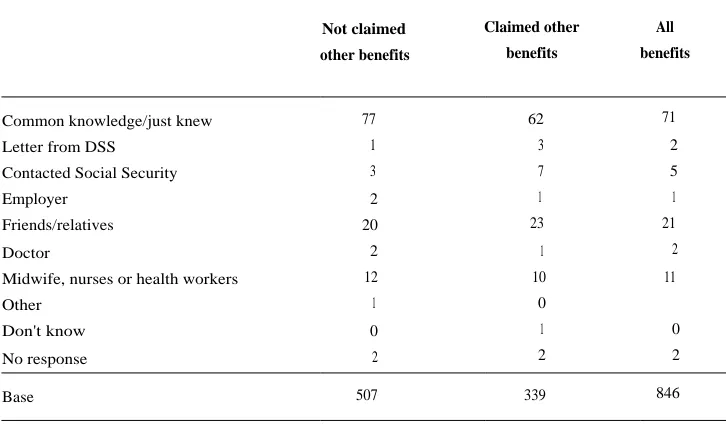
The majority, however, some 507 respondents (60%), had no previous contact with the benefits system within the last three years. Nevertheless, 71% of all respondents (77% of those who had not claimed benefits before and 62% of those who had) felt that the potential eligibility for Child Benefit was common knowledge amongst the population as a whole (see Table 2.1a). Younger respondents (under 26 years of
[image:20.595.193.556.283.495.2]age) were less likely to think that entitlement to Child Benefit was common knowledge. Twenty-one per cent of all respondents found out about Child Benefit from friends or relatives, 11% were informed by midwives, nurses or health workers, and five per cent were told of their eligibility at their local Social Security office. Of those who had been or were in receipt of other benefits, seven per cent found out about their entitlement to Child Benefit from their local Benefits Agency office, compared to three per cent of those who had never claimed benefits before.
Table 2.1a Where people found out about their eligibility for Child Benefit
Not claimed other benefits
Claimed other benefits
All benefits
Common knowledge/just knew 77 62 71
Letter from DSS 1 3 2
Contacted Social Security 3 7 5
Employer 2 1 1
Friends/relatives 20 23 21
Doctor 2 1 2
Midwife, nurses or health workers 12 10 11
Other 1 0
Don't know 0 1 0
No response 2 2 2
Base 507 339 846
Note: does not sum to 100% because of multiple response
In the qualitative research, some respondents were a little confused about whether or not Child Benefit was means-tested, whether it came automatically once the baby was born and registered, or whether it was necessary to apply for it at the local Benefits Agency office. In the postal survey, for example, one respondent wrote that she `thought that once my baby was registered I would automatically receive my benefit'.
Most respondents in the qualitative research mentioned that they had, at least, browsed through the Babies and Benefits booklet published by the Benefits Agency. Others mentioned that they had read the Health Education Council's info 'mation
Although most respondents had seen a Benefits Agency publication concerning Child Benefit, 28% of postal survey respondents wanted further information and advice before they claimed Child Benefit. Of all the respondents who wanted more information, 65% wanted to know how much they would receive, 36% wanted information on other benefits that they might be entitled to, and 24% wanted details on how, when and where to claim. One commented that `new mothers should be made more aware of the procedure'. Rather surprisingly, 57% of those who had claimed benefits before said that they wanted more information about their entitlements to other benefits, compared to only 20% of those who had never claimed.
Most of the postal survey respondents (68%) who needed further information knew where they could obtain it. Although not all wanted additional information, among those who did 45% went to their local Social Security office, 25% read a Benefits Agency leaflet to answer their questions, and 17% consulted their friends or relatives. Other sources of further information were social workers, midwives, health visitors, Freeline Social Security and the Washington Child Benefit Centre. One respondent found the Freeline staff to be `very friendly and very helpful'. Only ten people did not get the further information they required (see Table 2.1 b).
Table 2 lb Where Child Be efit ustomers obtained further information
Local SS office 45
Benefit Enquiry LinelFreeline 7
DSS/BA leaflet 25
Friends/relatives 17
Poster in PO/doctor's surgery 6
Social worker 1
Did not get further information 4
Hospital/midwife/health visitor 4
Other 1
Not answered 3
Base 236
Note: does not sum to 00% because of multiple response
However, a few respondents in the postal survey who visited their local offices for the first time for more information were not happy with the information that they received from the Benefits Agency staff. For example, one commented, `I wasn't given all of the information that I needed the first time I visited the office'. Another felt that the staff did not 'ully understand the system well enough to provide satisfactory answers'. Others did not like the manner in which they were treated on their first visits. One said that the staff just seemed as if they wanted you out as quick as possible; the woman reminded me of the DSS person in the television
programme "Bread'''. Another complained, `Iarrived 20 minutes before closing time
and the staff said I should have got there earlier"not easy with a week old baby', she added. A postal survey respondent who telephoned for advice on how to claim reported that `the person who answered was not very helpful and sounded as though she didn't want to answer'.
In the qualitative research there was some confusion among respondents about where and when to get the form. One obtained the form seven weeks before her child was born, another waited until three weeks after the birth, and one did not know where to begin until a work colleague helped her. Some postal survey respondents also commented that, initially, they did not know how to get an application form. For example, one said that
I went down to obtain my Child Benefit claim form from my local DSS; I was
Another wrote that she `did find it frustrating that no one told me where to get the form from'.
Nevertheless, 53% of all Child Benefit customers in the postal survey obtained their claim forms by post from either their local offices or from the Child Benefit Centre. Those with previous experience of the Social Security system were more likely to pick up the claim forms personally from the local offices; 45% of those who had claimed benefits before got their forms through the post, compared to 59% of those who had not claimed benefits before. Thirty-six per cent of all respondents collected their claim forms in person from their local or District Benefits Agency office. Child Benefit claim forms were also obtained from some hospitals, midwives, CABx, employers, local authorities and Registrars' departments; some nine per cent of customers acquired their forms from these sources. Two per cent did not know or failed to answer the question.
Although some respondents were surprised to see `new bright offices and friendly
helpful staff , several postal survey respondents, and all of the customers
interviewed in the qualitative research, had unpleasant experiences when they visited their local offices to collect their Child Benefit claim forms. Some had to stand, heavily pregnant or with very young babies, in long queues, smoky atmospheres and hot rooms with drunken, rowdy and raucous fellow-customers. One postal survey customer said that she `had to queue in a smoke-filled office for one hour just to get an application form with my voung baby', and another asked `why should my baby inhale these fumes?' One postal survey respondent was very distressed after collecting her claim form from her local district office but, nevertheless, had great praise for the staff behind the counters. She reported:
A fter going to my local DSS office during my last weeks of pregnancy, I would always deal with them by telephone as I found it to be a very degrading experience. I got very wound up about the people in there (mainly New A ge
travellers) who were shouting abuse, and I came out of there sobbing
uncontrollably and it took me a long time to calm down. The staff were very helpful and offered me a seat and a glass of water.
Once obtained, respondents in the qualitative research found little difficulty completing their claim forms. One found that it was like any `normal government form'; another thought it was well laid out and was `what I expected', and only one postal survey respondent had any real problems with the claim form. This respondent said that `none of the questions seemed to apply to my situation as I had worked overseas'.
Summary
• For most Child Benefit respondents the event which triggered their claim was the birth of a child.
• Forty per cent of first-time customers for Child Benefit had previous experience of claiming other benefits.
• Once they had completed their claim forms most had no further contact with the Benefits Agency.
• Most (71%) felt that the availability of Child Benefit was common knowledge.
A large majority (62%) had read a leaflet or a booklet concerning Child Benefit.
• Most (83%) found the Benefits Agency's literature helpful.
• A quarter of the respondents wanted more information before they claimed.
• Most (68%) knew where to obtain this information.
• Just over half (53%) obtained their claim forms from the Washington Child Benefit Centre.
• Just over a third (35%) obtained their forms from their local offices.
Those who had claimed Social Security before were more likely to obtain their claim form at their local office.
• When they visited their local Benefits Agency office for the first time many respondents complained about the queues and the smoke.
• Few mentioned that they had had problems completing their claim forms.
The process of claiming Retirement Pension
For most Retirement Pension customers the main trigger event preceding their applications was the receipt of a Retirement Pension information pack and claim form from the Benefits Agency a few months prior to their retirement at the age of 60 or 65 years. However, this was not the case for a minority of postal survey and qualitative interview respondents, particularly disabled people, women and those who had changed address frequently. For these groups, the routes into the Retirement Pension system were sometimes difficult, confusing and, for some, ultimately disappointing.
Some six per cent of postal survey respondents reported that they did not receive an information pack or a Retirement Pension claim form before they retired either at 60 or 65 years. Many, including those who had at some stage previously read a leaflet or applied for a Retirement Pension Forecast from the Newcastle Benefit Directorate, were concerned at the lack of information from the BA, knew that their Pension did not come automatically and, therefore, contacted their local offices or the Retirement Pension Centre for an application form. One customer said `I hadn't been informed about my pension as the literature states and I had to take the initiative', and another commented, `I thought that I would receive some sort of communication from the DSS that I should apply for the pension', but did not. Some of these respondents explained that the Benefits Agency had held incorrect or out-of-date addresses in its files or computer systems. One respondent who telephoned to enquire about not receiving an information pack found out that it had been sent to an address that `we left 25 years ago', and another learnt that the Retirement Pension centre staff thought that he lived in a house he moved from
`30 years ago'. A clerk at the Longbenton site commented that `If maybe, they
haven't claimed any benefit or they've had no contact with the Department, we could have an address from 40 years ago'.
Some women reported that they had delayed claiming Retirement Pension until they were in their sixties because they thought that either they were not entitled to any, or that they could not claim until their husbands reached pensionable age, or were advised by friends or employers to carry on working and defer their pensions. One woman complained, `I wasn't aware that I could get a pension at all until a
relative told me that their wife had one', and another thought that `many women are
Retirement Pension of her own because she had not paid any national insurance contributions. She reported that she was advised to wait until her husband reached
65 years of age and then apply jointly with him. Her husband became unemployed at the age of nearly 64 years and because there was little money coming into the house she decided to try and claim her own Retirement Pension. She thought that she would be entitled to some pension because she said
`I
see people come here from abroad, they don't do a day's work and they get money here'. She telephonedthe Retirement Pension centre at Longbenton, obtained an application form by return of post, completed it and sent it back. However, her claim was refused, and despite contacting her local office, the Retirement Pension centre and her local CAB, she said that she `couldn't get any money and didn't receive any'.
For approximately six per cent of the postal survey respondents the trigger events and the decisions to claim Retirement Pension were neither quick nor simple and a process of weighing up the pros and cons of applying was undertaken. For example, some, particularly those who were disabled or those who had a disabled
spouse, were concerned about the relationship between Invalidity Benefit, Retirement Pension and income tax, and decided to delay their claims for Retirement Pension until they were either 65 or 70 years old because they thought that they would be better off financially staying on Invalidity Benefit.
One respondent in the qualitative research in the provincial city was typical of this group of first-time customers.
Mrs Roberts was claiming Sickness Benefit and worked part-time in a cafe kitchen cooking food until she was a little over 60 years. She then said that her doctor advised her to give up her job and claim Invalidity Benefit and Retirement Pension as she was `ten per cent disabled' and was on her feet all day. She decided to claim Invalidity Benefit not Retirement Pension, but then changed her mind a few months later after a discussion with her sons who
were both claiming Income Support. She said that she received no advice or information from any other formal or informal source. She thought that the process of claiming Retirement Pension was very easy and straightforward and did not visit the Benefits Agency office or contact Benefits Agency staff at all during her claim. Her sons obtained her claim form and she had no difficulty in completing it. She said that if she had been able to get out and catch the bus down to the office, then she expected that the staff would have been as polite with her as she was with them. She said that she was a little confused about the merits or demerits of staying on or coming off Invalidity Benefit and would not know whether or not she had made the right decision until her first Retirement Pension payment arrived. This was due in the fortnight after she was interviewed.
Despite these variations from the normal trigger events and routes into claiming Retirement Pension, the majority of respondents received their information packs and claim forms in good time. One customer services manager who was thinking about how her customers began their routes into the benefits system noted that Retirement Pension was `the only benefit that we actually invite people to claim'. Although only 25% of the 1,257 respondents had previous contacts with the benefits system in the past three years, most needed little prompting in the initial stages of their claim process. Table 2.2a shows that 61% of those who had not claimed benefits and 56% of those who had in the last three years said that the
doctors, nurses, health workers and tax officers were among the other sources of information mentioned by a very small minority of respondents.
Only three per cent of those who had claimed benefits before reported that they had found out about Retirement Pension from their friends or relatives, compared to eight per cent of those who had not come into contact with the benefits system in the previous three years; most of those who found out about Retirement Pension entitlements via this route were women.
Table 2.2a Where people found out about their eligibility for Retirement Pension
Not claimed other benefits
Claimed other benefits
All
benefits
Common knowledge/just knew 61 56 60
Letter from DSS 29 36 31
Contacted Social Security 11 11 11
Employer 3 2 3
Friends/relatives 8 3 7
Doctor 1 1
Other 0 1
Don't know 0 0 0
Not answered 2 2 2
Base 936 321 1,257
Note: does not sum to 100% because of multiple response
Of those who had had recent contact with either the Benefits Agency, the Department of Employment or their local authority benefit departments, ten per cent had claimed Sickness or Invalidity Benefits, seven per cent were or had been in receipt of Income Support, and nine per cent had applied for Council Tax or Community Charge benefits. Some five per cent had claimed Housing Benefit, three per cent had applied for Unemployment Benefit or Attendance or Mobility Allowance, and two per cent had received Widow's Benefit. A further two per cent had put in a claim for either Disability Allowance and/or Severe Disablement Allowance and a very small minority had been in receipt of Child Benefit, Family Credit or War Pension payments.
Although most respondents received an information pack and claim form and although 55% had read a Benefits Agency leaflet, nearly 40% of all respondents reported that they needed further information before they filled in their application forms and claimed Retirement Pension. Of those who had read some information from the Benefits Agency, most (82%) found it either very or fairly helpful and only six per cent found it unhelpful. A third of those who had read the leaflets thought that no improvements were necessary, 26% found the language contained in them was a little complicated, 23% thought that the layout could be better and less confusing, and 19% thought that more details should be provided. Some nine per cent felt that the print should be enlarged or made clearer, and a very small minority thought that less, rather than more, details should be included.
Nearly 76% of all the postal survey respondents who wanted more information wanted to know how much pension they would receive. A further 13% wanted to know whether there were any other benefits that they might be entitled to,and a further five per cent wanted to ask about the claim procedure and deferring their pension. Eight per cent wanted to enquire about their national insurance contributions, the effects of Retirement Pension on their benefits and the dates that Retirement Pension payments commenced. A higher proportion of those who had classified themselves in the higher social groups were more likely to want further information.
office, 12% telephoned either the Benefits Enquiry Line or Freeline Social Security, eight per cent obtained further information from a BA leaflet, and six per cent asked friends or relatives to help them. A very small minority contacted CABx, solicitors, accountants or employers or read articles in newspapers or magazines. Four per cent said that they got the information from a pension forecast and a further four per cent said that they did not get the further information that they needed. Thirty-three people who said that they needed more information failed to say where they got the information from (see Table 2.2b).
Table2.2b Where Retirement Pension customers obtained further information
%
Local DSS office 62
Benefit Enquiry Line/Freeline 12
BA leaflet 8
Friends/relatives 6
Poster in PO, doctor's surgery etc. 1
Social worker 1
Did not get further information 4
Pension forecast 4
CAB 2
Other 2
Not answered 7
Base 478
Note: does not sum to 100% because of multiple response
One postal survey respondent who contacted her local office for more information said that she had
high praise for the service Ireceived when I first contacted the DSS regarding
my pension rights. The whole procedure was pleasantly and efficiently
conducted and I felt confident that my details were being expertly handled by caring human beings.
Over three-quarters of the postal survey respondents obtained their Retirement Pension claim forms by post from the Benefits Agency local offices or Benefit Directorate, 20% collected their claim forms in person from their local or District Offices and some respondents' relatives or friends picked up the claim forms for them. Many of the respondents interviewed in the qualitative research expressed reservations about visiting their local or District Offices to pick up application forms or seek further information. One inner London customer commented, `I wouldn't go in there on my own; it's just the types of people in there', and another respondent from the provincial city said that he did not want to mix with the
`dossers that you find in there'.
The vast majority made no comment about the application form itself. Of those who did, a very small minority felt that its `size and length' were `surprising'. For example, one of the inner London respondents in the qualitative research thought that the time he had to spend answering all the questions on the form was `a
pain',and the respondent from Jamaica had to ask her daughter to fill it in for her.
However, the other respondents in the qualitative, in-depth customer interviews thought that the form was easy to fill in and, for example, just like a taxform'. Summary
• For most Retirement Pension customers the main trigger event which preceded their claims was the receipt of an information pack and claim form from the BA.
• A minority, however, had delayed entries into the benefits system.
• The reasons for their delay in applying for Retirement Pension were
confusion about their eligibility.
confusion over the relationship between Invalidity Benefit, Retirement Pension and taxation.
• Three-quarters of the Retirement Pension respondents had not claimed any Social Security benefit in the past three years.
• Sixty per cent thought that the availability of Retirement Pension was common knowledge.
• Nearly 40% needed further information before they claimed.
• Most of those who had read a leaflet or booklet found the Benefits Agency's literature helpful.
• Most of those who wanted further information knew where to obtain this information from.
• Three-quarters of the respondents obtained their claim forms by post.
The process of claiming Income Support
For most Income Support customers, a whole range of individual or linked life experiences preceded their applications for benefit. For many, there was just one underlying reason for claiming, but for others a number of closely related events, factors and processes fused together to precipitate or to delay their claims. Some customers reported that unemployment or divorce, or just lack of money, triggered their claim. Others had become sick or disabled, had just entered the country or had recently had babies. Other customers said that they had begun their claims for Income Support because they had just left school, college or university and could not find employment or, conversely, had recently retired from work and found it difficult to manage on either their income or their savings. A minority (some seven per cent) reported that they had only recently become aware that they might be entitled to Income Support. Table 2.3 describes the main trigger events which led first-time customers to claim Income Support.
Table 2.3 Main reasons for claiming Income Support
Unemployed Pensioner Lone Parent Sick or Disabled
% %
Became unemployed 64 2 12 11
Finished studying 20 - 1 1
Divorced 2 1 66 4
Had a baby - 15 1
Sickness/disability 3 9 2 55
Pension too low 31 1 2
Learned about eligibility 20 9
Death of partner 19 1 2
Not managing/financial situation worsened 2 5 - 4
UB ran out 5
Change of residence 1 4
Retired from work - 3 - 1
Base 273 224 200 159
he resigned his former position as a conference centre manager to seek an alternative career and had not been successful.
Some 31% of pensioners claiming Income Support said they were doing so because their state Retirement Pensions was too low, 20% applied because they had recently learnt or realised that they had become eligible for the benefit, and 19% had found it difficult to manage financially after their partners had died. Sickness or disability was mentioned as a route into Income Support for pensioners by nine per cent of the respondents and a further 15% of claims were underpinned by unemployment, divorce, retirement, changes in residence and financial difficulties. For example, one pensioner in the qualitative research was Mr Ahmad.
Mr Ahmad had been claiming Retirement Pension in Pakistan since he left the UK in the 1980s. He returned to Britain to be with his family in 1992 and found out that, as his pension had not increased annually while he was abroad, he did not have enough money to make ends meet. He spoke with a friend who told him to go to a local advice centre and he was urged by the advice worker there to apply for Income Support. Although he was a Mirpuri speaker, with fairly good English and Urdu as second languages, his son dealt with his application from that point on. No leaflets or information were available in Mirpuri or Urdu either at his local advice centre or at the Benefits Agency District Office, and the Retirement Pension centre at Newcastle was not, he said, able to give him advice in anything but English. Although he expected his claim for Income Support as a pensioner to be difficult and long-winded, and although he expected to be called in for an interview, he found the process of claiming actually quite smooth. He had received his first payments quite quickly and was not interviewed. He was quite surprised at this because he did not think that he could claim two or more Social Security benefits at once. Although his son helped him to claim Income Support, he said that he would have preferred to have been able to complete the process in his own language.
Another pensioner who claimed Income Support but who, subsequently, had his application refused, said that he wanted to use the benefit as a passport to free glasses, free prescriptions and reduced Council Tax payments. His income from a range of other benefits disqualified him from receipt of Income Support.
Divorce (in the case of 66%) or the birth of a child (in the case of 15%) or unemployment (for a further 12%) of the lone parent respondents led to claims for Income Support. Only three per cent said that they had claimed because they had
finished secondary or further education, or had become sick or disabled.
recovering and thought that he would like to work again and tried to sign on as unemployed at his local Job Centre. However, as he was nearly 65 years old, the Unemployment Benefit Office, he said, could not register him as unemployed and advised him to claim Income Support from the Benefits Agency. At the time of interview he had not heard whether his claim for benefit had been successful.
Although, for many, there was one main life experience that instantly triggered the claim for Income Support and although for others a series of events, experiences and processes led straight to their applications for benefit, some 38% of all those who had put in a claim had delayed doing so for up to six months. Of these, 29% (93 people) had waited for up to a month before they applied, 29% (94 people) delayed their applications by between one and two months, ten per cent (31 people) had not begun the claim process proper until between two and three months had passed, and a further 29% (93 people) had waited more than three months before they applied for Income Support.
For this large and interesting group, the decision to claim was clearly the culmination of a difficult and dynamic process of perception, cognition and constant internal negotiation and renegotiation. Craig's concept of the claiming process as a dynamic process is, perhaps, of use in attempting to understand the behaviour and psychology of this sub-sample of respondents. It seems that positive clusters of attitudes, events and experiences formed and superseded other, more negative, influences on the customer's thoughts about applying for benefit. These positive clusters bonded together with other clusters containing the supplies of information, advice and confidence to claim and, also, the projections of competent corporate identity from the Benefits Agency to promote the claiming of Income Support.
Some 125 people (15% of all Income Support respondents) who had delayed their claims said they had not known, at first, whether they were eligible. Twenty people did not know how to apply and eight did not know where to begin the claim process. Sixty-six others had delayed claiming because they had remained optimistic, had presumed that their situations would improve, or thought they would get a job. Thirty-four customers struggled on their savings for a while before they applied for Social Security. Nine customers (one per cent) of all Income Support respondents said that they were told to wait for 13 weeks by the Benefits Agency before applying. This interesting sub-sample included those who were also applying for One Parent Benefit as well as Income Support Lone Parent Premium and may have been misadvised, or misunderstood, by BA staff. There is a 13 week delay imposed on divorcing or separating One Parent Benefit Customers, but this is not the case for lone parents who apply for Income Support. Of those who had delayed their applications, for whatever reason, for more than seven days, most survived financially by drawing upon previous earnings, redundancy money, savings or by borrowing from family, friends or relatives. Others (two per cent of all Income Support respondents) reported that they had run up debts with banks, building societies or other financial organisations.