This is a repository copy of
AMALGAM: automatic mapping among lexicogrammatical
annotation models
.
White Rose Research Online URL for this paper:
http://eprints.whiterose.ac.uk/81160/
Proceedings Paper:
Atwell, ES, Hughes, J and Souter, DC (1994) AMALGAM: automatic mapping among
lexicogrammatical annotation models. In: Klavans, J, (ed.) The Balancing Act: Combining
Symbolic and Statistical Approaches to Language - Proceedings of the ACL Workshop.
The Balancing Act: Combining Symbolic and Statistical Approaches to Language, 01 Jul
1994, New Mexico State University Las Cruces, New Mexico, USA. Association for
Computational Linguistics , 21 - 20.
[email protected] https://eprints.whiterose.ac.uk/ Reuse
Unless indicated otherwise, fulltext items are protected by copyright with all rights reserved. The copyright exception in section 29 of the Copyright, Designs and Patents Act 1988 allows the making of a single copy solely for the purpose of non-commercial research or private study within the limits of fair dealing. The publisher or other rights-holder may allow further reproduction and re-use of this version - refer to the White Rose Research Online record for this item. Where records identify the publisher as the copyright holder, users can verify any specific terms of use on the publisher’s website.
Takedown
If you consider content in White Rose Research Online to be in breach of UK law, please notify us by
A M A L G A M :
:
A u t o m a t i c M a p p i n g A m o n g
L e x i c o - G r a m m a t i c a l A n n o t a t i o n M o d e l s
E r i c A t w e l l , J o h n H u g h e s , a n d C l i v e S o u t e r C e n t r e for C o m p u t e r A n a l y s i s of L a n g u a g e A n d S p e e c h S c h o o l of C o m p u t e r S t u d i e s , L e e d s U n i v e r s i t y , L e e d s LS2 9 J T , U K
e r i c @ s c s , leeds, ac. u k
j
ohn@scs, leeds, ac. u k cs@scs, leeds, ac. u kA b s t r a c t
Several Corpus Linguistics research groups have gone beyond collation of 'raw' text, to syntactic annotation of the text. However, linguists developing these lin- guistic resources have used quite different wordtagging and parse-tree labelling schemes in each of these anno- tated corpora. This restricts the accessibility of each corpus, making it impossible for speech and handwrit- ing researchers to collate them into a single very large training set. This is particularly problematic as there is evidence that one of these parsed corpora on its own is too small for a general statistical model of grammat- ical structure, but the combined size of all the above annotated corpora should deliver a much more reliable model.
We are developing a set of mapping algorithms to map between the main tagsets and phrase structure grammar schemes used in the above corpora. We plan to develop a Multi-tagged Corpus and a MultiTreebank, a single text-set annotated with all the above tagging and parsing schemes. The text-set is the Spoken En- glish Corpus: this is a half-way house between formal written text and colloquial conversational speech. How- ever, the main deliverable to the computational linguis- tics research community is not the SEC-based Multi- Treebank, but the mapping suite used to produce it - this can be used to combine currently-incompatible syntactic training sets into a large unified multicorpus. Our architecture combines standard statistical language modelling and a rule-base derived from linguists' anal- yses of tagset-mappings, in a novel yet intuitive way. Our development of the mapping algorithms aims to distinguish notational from substantive differences in the annotation schemes, and we will be able to evalu- ate tagging schemes in terms of how well they fit stan- dard statistical language models such as n-pos (Markov) models. 1
1This research began with grants from the UK Science and Engineering Research Council (SERC) and the Univer- sities Funding Council's Knowledge Based Systems Initia- tive (UFC KBSI), and is now funded by the UK Engineer- ing and Physical Sciences Research Council (EPSRC) and
I n t r o d u c t i o n
Several research projects around the world are buihli.g grammatically analysed corpora; that is, collections o1" text annotated with part-of-speech wordtags and sy.- tax trees. Tagged and parsed English corpora (Ba.k of English [54]; BNC [441, [22]; Brown [24]; ICE [12], [28], [64]; Lancaster-IBM [26], [22]; LOB [1], [3], [38], [.12]; London-Lund [62]; Nijmegen [12]; PoW [23], [55], [57]; SEC [631; TOSCA [46], [311, [12]; UPenn [53], [45]; etc) are used, among other things, as atithoritative exal n pies by researchers in English Language Teaching and Lexi- cography (e.g. [44]), and as training data for statistical syntactic constraint models to improve recognition ac- curacy in speech and handwriting recognisers (e.g. [37],
[I01).
However, projects have used quite different wordtag-
ging and parsing schemes. In contrast to the Speech research community, which has reached broad agree- ment on an uncontentious set of labelling conventions for phonetic/phonemic analysis, there is no general con- sensus in the international Natural Language research community on analogous conventions for grammatical analysis, Developers of corpora adhere to a variety o[' competing models or theories of grammar and parsing, with the effect of restricting the accessibility of their respective corpora, and the potential for collation into a single fully parsed corpus.
In view of this heterogeneity, we have begun to in- vestigate and develop methods of automatically map- ping between the annotation schemes of the most widely known corpora, thus assessing their differences and im- proving the reusability of the corpora. Annotating a single corpus with the different schemes allows for com- parisons, and will provide a rich test-bed for automatic parsers.
lion, the International Corpus of English (ICE) should b,, included as its tagset has now been published [28]. Parsed corpora for English include: the Lancaster-IBM l'rcebank; the Lancaster-IBM Spoken English Corpus (SEC) 'rreebank; the Lancaster-Leeds Treebank; the Polytechnic of Wales (PEW) Corpus; the Nijmegen ('orpus; the TOSCA Corpus;; and the University of P,,nnsylvania (UPenn) Treebank. We plan to include the parsed ICE-GB (Great Britain component of ICE) and the BNC (British National Corpus) in the project when they become available.
As a development and testing resource, we are us- ing the text of the Lancaster-IBM Spoken English Cor- pus (SEC). The SEC is a collection of recordings of ra- dio broadcasts with accompanying annotated transcrip- tie,s, collected by Lancaster University and IBM UK as a general research resource. The SEC is available from the International Computer Archive of Modern English (ICAME) based at the Norwegian Computing (',entre for the Humanities (in Bergen, Norway). The corpus exists in several forms and annotations: the digi- tiscd acoustic waveform; the graphemic transcription a.m~otated with prosodic markings; and a part-of-speech analysis (using the LOB Corpus tagset). Skeletal pars- ing has been added to create the SEC Treebank, and this forms a subset of the Lancaster-IBM Treebank. (;crry Knowles (Lancaster) and Peter Roach (Leeds) are collaborating in an ESRC-funded project to set up a time-aligned database of recorded speech, accompa- nied by phonetic and graphemic transcriptions. Our proposal will produce, as a side-effect, several alterna- tive tagged and parsed versions of the SEC which will
b,, made available to the SEC database project collab- orators. It will also be able to act as a test-bed for the ('ompa.rison and evaluation of parsing schemes.
Objectives of the project
The main objectives are as follows :To design and implement algorithms for mapping be- ween corpus annotation schemes; for both wordtag sets a ml phrase structure grammar schemes.
To empirically evaluate the accuracy and shortcom- ings of the developed mapping algorithms, by applying them to the tagged SEC and the SEC Treebank. The ~,ulcome of this evaluation will be to highlight the no- la~h)nal and substantive differences between the alter- Ilative tagging and parsing schemes.
To build a Multi-Tagged Corpus, by enhancing the Spok~,n English Corpus with different wordtagging ~chCIItes.
To build a Multi-Treebank, by enhancing the Spoken English Corpus with grammatical analyses according to s,,v,,ral alternative grammatical theories.
To investigate tim use of tile Multi-Treebank as a h,.~chmark for grammars and parsers.
Itfil.ially, we considered adopting the 'lnterlingua ap- I,r,,ach' to mapping, as used in Machine Translation
l,r,~j,','ts such as EUR.OTRA. This would require us
to
develop tagset
mappings between the LOB Corpus (our primary tagset Interlingua) and each of the 'ma- jor' tagged corpora: BROWN, ICE, Lancaster-IBM, and UPenn. Next full grammar mappings would be developed between the Lancaster-IBM Treebank (our primary parsing scheme Interlingua) and each of: the UPenn Treebank and the Lancaster-Leeds Treehank. The ICE and BNC tagsets and parsing schemes could be included when they become available. Mapping be- tween tagsets will involve relabelling of words, whereas mapping between grammar schemes also involves struc- tural manipulation. These treebanks have been chosen for their skeletal parsing schemes, which are of rela- tively similar structure apart from a small number of systematic differences.We have chosen the SEC as a 'core' text for this project, because
1. the tagged SEC uses the same tagset as the LOB Corpus (widely considered to be the UK standard and our proposed primary tagset);
2. the parsed SEC uses the same grammatical scheme as the Lancaster-IBM Treebank (our proposed primary parsing scheme);
3. these are the annotation schemes which we have most prior experience of;
4. the text material, BBC radio broadcasts, are a neu- tral compromise between written and conversational spoken English genres.
Our aim is to develop bidirectional mappings for the above tagsets and grammar schemes, although we appreciate that for mapping from simple to delicate schemes this will not be possible, and that mappings will be imperfect. As mapping algorithms are devel- oped and tested, and whilst building the Multi-Tagged Corpus and Multi-Treebank, we will compile "hand- books" of common errors (i.e. mismatches) and their corrections. These will help future users of the devel- oped mapping algorithms to straightforwardly post-edit their mapped corpora and treebanks, thus maximising resource reusability. To map between two tagsets other than LOB, two mappings will be necessary (via the primary tagset, our "interlingua" representation); simi- laxly for non-terminal grammar schemes. We appreciate the danger of propogating incorrect mappings.
If there is sufficient time, we hope to go on to in- vestigate mapping algorithms for other (more detailed) grammar schemes; for example the parsed P e w Cor- pus (Systemic Functional Grammar), and the parsed Nijmegen Corpus (Extended Affix Grammar). The non-corpus-based Generalised Phrase Structure Gram- mar (GPSG) (as used in the Alvey Natural Language Toolkit ANLT) should also be included. Mapping from these to the Lancaster-IBM Treebank grammar scheme would only be uni-directional i.e. from a d,:tail,~d to a skeletal analysis.
The Multi-Treebank will be produced by applying the final version of each grammar scheme mapping al-
gorithm to the SEC Treebank. Similarly, for the Multi- Tagged Corpus, the final version of each tagset mapping algorithm will be applied to the tagged SEC. The re- suiting annotations will then be intensively proofread and post-edited. This will require consultations with authorities in each of the tagsets and grammar schemes involved.
Progress to date
We envisage three main stages to the project: imple- mentation of algorithms for mapping between tagsets; implementation of algorithms for mapping between phrase structure grammatical analysis schemes; and investigating applications of the mapping programs, multi-tagged corpus, and multi-treebank.
We are currently in the first of these. Mapping algo- rithms are being designed and implemented between the LOB Corpus tagset and each of: the tagged BROWN Corpus, the tagged ICE, the Lancaster-IBM Treebank, the UPenn Tagset (and the BNC tagset will be added when published). Each tagset is being considered in turn:
1. Analysis of the notational and substantive differences between the LOB tagset and the 'current' tagset. 2. Design and implementation of a mapping algorithm
(two-way, where possible).
3. Evaluate success of algorithm by applying it to the tagged SEC; incrementally improve in light of com- mon errors and linguistic intuition.
A side-effect of this phase is the production of a Multi-Tagged Corpus: the SEC text annotated with each tagset.
A s t a n d a r d f o r m a t f o r t a g g e d a n d p a r s e d c o r p o r a
As well as using different tagsets and parsing schemes, different annotated corpora come in a range of different formats - see [57], [59], [60]. A non-trivial first step in
merging tagged and parsed corpora is to decide on a unitary standardised format. Although the Text En- coding Initiaitive (TEI) [61], [18] offers general guide- lines for text formatting standards, and some corpora (including BNC, ICE) aim to be "rEI-conformant", in practice it seems almost as hard for Corpus linguists to agree to accept a single annotation format as it is to agree on a single annotation scheme. Our mapping software will use a standardised internal format for tag- gings and parse-trees, but will have to be able to accept input and produce output in a range of existing formats. H a n d - c r a f t i n g a d e t a i l e d m a p p i n g
One approach to obtaining a mapping between two tagsets is to use expert linguistic knowledge in iden- tifying the relationship between particular tags, and is exemplified in, for example, [58]. In this work, Souter drew up a mapping between the parts of speech used in
the CELEX database [17], (which were thet,,sclw,s <t,,- rived largely from those in LDOCE [51]), and th,, sys- temic functional grammar (SFG) used to hand pars," the Polytechnic of Wales corpus [23], [551 .
The aim was to provide a large lexicon to supporL SFG-based parsing programs. The original CELEX h.x- icon, which contained some 80,000 English wordforms. was transformed into a lexicon with SFG tags, usi,g a semi-automatic mapping program, written in the AWK programming language. The resulting lexicon was tl,,. compatible with a large corpus-based systemic gram- mar consisting of over 4,000 phrase-structure rules [56]. Together they can then support relatively robust prob- abilistic parsing programs.
The problems encountered in trying to specify such a mapping result from disparity in the level of delicacy in the two tagging schemes. Mapping from a coats,,- to fine-grained grammar must be achieved manually, us,' subcategorisation information contained in the lexi~'o., contextual information, or exception lists. Souter's pro- gram contained simple one-to-one mappings, many-l.o- one mappings, and one-to-many mappings supported by exception lists and subcategorisation information. In his work, contextual information could not bc ,sed to support the mapping because the source material w~us a lexicon and not a tagged corpus. A small part of the mapping code (used to map between pronoun labels) is shown in Figure 1.
else if (category ffi= "PRON") # p r o n o u n s
(
if (\$8 •ffi "Y") printf("HWH)(") # I/H-pronouns
else if ((\$I ~ffi "no-one")l l\
( \ $ 1 == "nobody")[ 1\
( \ $ 1 . . . . nothing") [ l \
(\$I == "noone") J l\ (\$I .... none") )
printf("HPN) (") # n e g a t i v e pronouns else printf("HP)(") # other p r o n o u n s
}
Figure 1: Fragment of an AWK mapping from CELEX to SFG tagsets
Here, the coarse-grained CELEX tag PRON (pro- noun) is mapped to three SFG tags, HWH, HPN and HP. The default mapping is to HP (pronominal head of the nominal group), but if the CELEX lexicon contains subcategorisation information in the form of a Y in col- umn 8, then we can assign the label for wh-pronou, head (HWH). An exception list is used to map to the third SFG pronoun label (HPN), for negative pronoun heads.
I n c r e m e n t a l r e f i n e m e n t t h r o u g h f e e d b a c k Earlier work at Leeds [32] explored ways that a prob-
fi)r how to improve the mappings incrementally. As the mapped annotations are to be hand-corrected by ex- i)(,rts this provides positive feedback. Rather than tag the cole text completely using the best derived mapping a better idea would be to do it in sections and then have Iho ~,xpert correct the errors in each section in turn. Af- ter each section is complete the mapping rules will be ul)dated to incorporate the new information. Hopefully this will enable future sections to be mapped more ac- curately. This method is similar to that used by the Ni.imegen corpus parsing group, [47]
P r o b l e m s w i t h t h e i n t e r l i n g u a - b a s e d a p p r o a c h
TIw interlingua idea seems sound for several reasons. Amongst these is the saving made in required map- pings. For instance, tire tagging schemes would require twenty mappings if each pair is mapped directly in both (lir~,ctions. However only eight mappings axe required if one of the tagging schemes acts as an interlingua. This saving becomes greater as more tagging schemes arc considered. The interlingua also helps the map- pings attain a level of consistency as the interlingua is I.ho basis of all possible mappings from one tagging scheme to another. However, the interlingua may cause prol)lenm in the instances where it is coarse-grained rel- ative to other tagging schemes. For instance, the LOB tagset has no notion of verb transitivity whereas the ICE tagset does. If a mapping is being made between two tagging schemes both of which incorporate the con- cept of transitivity then a tag may be wrongly allocated a.~ the sense of transitivity is lost via the LOB tagset intcrlingua.
One problem with the work plan is the strong em- phasis on this problem of imperfect mappings due to course-grained parts of the interlingua. It may turn out after experimentation that the contextual information of the surrounding tags and words make up for this. 'l'hc sentence, S, the interlingua tags, a, and the other I..Igging scheme's tags, b, can be represented as follows:
!
S e n t e n c e T a g g i n g 1 T a g g i n g 2
$1 al bl
82 a2 b2
$3 as ba
S . - u an-2 bn- 2
Sn-1 an-1 bn-1
S . a . b,~
Using a window of the closest four neighbours, say, the tag ai when presented with a difficult tag, bi, has
I,hc additional context information of Si-2, S i - t , Si+l, N',t:,, o,-2, ai--t, ai+l and ai+a to work on. Previous rcs,.arch (including [4], [5], [33], [34], [35], [36]) has indi- ,.at,.d I hat there is a high degree of useful contextual in- I',~rmal ion implied by the surrounding items. This con-
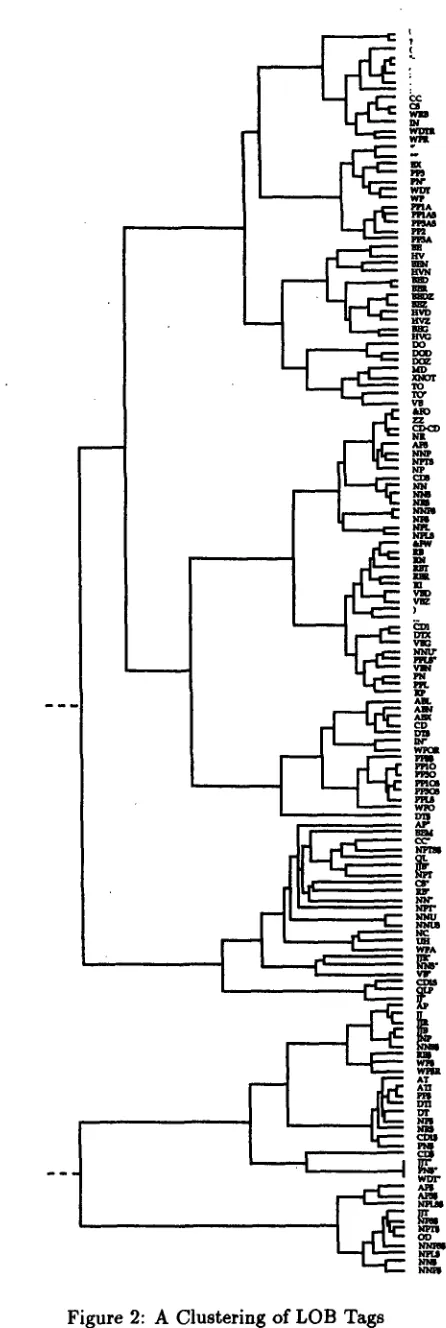
textual information can be used with clustering tech- niques to classify words. These techniques could be applied to the tagging scheme with little modification. The classifications could then be examined to see which types of tag are difficult to group. Tags which are dif- ficult to cluster m a y be useful in identifying problem areas early. As an example, Figure 2 shows a clustering dendogram for the L O B Corpus tagset.
One possible problem might be: given the set of Words in (SI ... Sn) and the interlingua tags (al... an) how are the other tagging scheme's tags (bl...bn) de-
rived? Obviously, the tagging scheme itself can be used to m a p directly the words ($I... Sn) onto the tags (bl...bn) without knowledge of the interlingua tags
(al...an). Also, mappings could be m a d e solely be-
tween the interlingua tags (al ... an) and the other tags (bl ... bn). This could be done by having an expert tag a section of the 'core text' with both the interlingua and the other tagging scheme. Probabilisitic rules could be derived indicating how the tags match up. These rules would be strengthened if the context of the surrounding tags was incorporated.
W h e n the two pieces of information axe combined it is hoped that a more accurate mapping can be achieved. This can be done by mapping directly from the word plus tag to the new tag. For instance;
Si + ai ~ bi.
However, rules could grow very large even when reg- ularities are used to reduce their number.
Alternatively, a mapping could be made for Si ~-* bil according to the standard annotation rules for the non- interlingua tagging scheme; and a mapping could be done for a i ~ bi2 according to the procedure outlined
above. These mappings produce two potential tags in- dependently. One algorithm might always accept bil when bil = hi2. When b~l ~ bi2 a decision needs to be made as to which, if any, of the tags should be cho- sen. Brill [14] developed a clever and highly accurate tagging scheme which could have implications for this problem. He tagged every occurrence of a word with its most probable tag if there was more than one choice. A
second pass of the corpus would update the tags accord- ing to a set of automatically acquired rules. A similar idea could be utilised to choose between the tags. Per- haps the most probable tag would always be selected on the first pass but we would allow that decision to be altered on a second pass according to rules derived from earlier sections of the corpus that had been tagged and checked by the expert linguist. This, then, is another example of incremental learning.
C o m b i n i n g S y m b o l i c a n d S t a t i s t i c a l A p p r o a c h e s t o L a n g u a g e
Our research is particularly relevant to this work- shop, as it is clear we will have to combine rule- based symbol-mapping knowledge with statistical dis- ambiguation models. W e envisage that the bulk of a
g,
u m m
MD VB
m g, 1ol m
i v ~ ) gtDt
I== ~
!
Figure 2: A Clustering of LOB Tags
mapping can be done using simple one-to-one symbol replacement rules; but some rules will map one source symbol onto a set of more than one target symbol. A statistical part-of-speech tagger along the lines of th,~ CLAWS tagger used on LOB [42], [3], [25] ca,, th,'.,, l., used to select between the reduced camlhhtt,, set ush,g ~, statistical context model; probably a lst-order Mark, w or Bi-Pos model is most appropriate as this is tt,' sim- plest 'standard' statistical language model and is widely used and understood, see for example [2], [48], [7], [37], [9], [49].
We can arrive at such a model of source-to-tart:it mapping by 'working backwards': first run a CLAWS- style Markovian target-tagset tagger over the text, ig- noring the source tags; proofread the output to note where this makes mistakes (assigns incorrect target tags); and then devise source-to-target tag mapping rules only for these cases. We are aware from our own initial attempts at deivising tag-mappings that this re- quires a high level of specialist linguistic knowledge, of both source and target tagset; this "symbolic patching of the statistical model" approach minimises the 'lin- guistic expertise' we need to capture (and first develop!) to devise symbolic mapping rules. We have learnt of corpus-tagset mapping work by a number of other re- searchers (including [13], [30], [20] [39] [41], [52]), I, ut generally such research in the past has been merely a means to an end (to create a re-tagged Corpus), so the full mapping algorithms have not been formalis~,d or published; but if all we need is a limited nub~'r of mapping-rules to "patch" the Markov model the,t we may be able to glean sufficient details from informal notes etc. It may appear that we are promoting bad Software Engineering principles in advocating symbolic
"patches" to fix the flaws in the statistical model as and when we spot them - patching up a program as the bugs
seep out, However, we prefer to view this as a princi- pled, well-founded approach to combining symbolic and statistical models, minimising the 'overlap' by ensufi,g that each has a separate useful contribution to mak(, I.o the overall mapping task.
We envisage combining a CLAWS-style tagger mod- ule for each of the target tagsets into a single Multi- tagger program. This accepts as input a stream of words annotated with tag(s) from one (or more) of tlw source tagsets; to output is a stream of words plus t~tgs from ALL target tagsets. This model allows for inclu- sion of mapping rules both direct from source to targ,q. tagset, and via an interlingua (a backup default to try if there are no direct mapping rules).
F u t u r e W o r k
[image:6.596.53.276.40.704.2]I m p l e m e n t a t i o n o f A l g o r i t h m s F o r M a p p i n g B e t w e e n G r a m m a r S c h e m e s Initially mapping algorithms will be designed and im- plemented between the Lancaster-IBM Treebank gram- mar scheme, and each of the UPenn Treebank and the Lancaster-Leeds Treebank. Each grammar scheme will bc considered in turn:
1. Analysis of the notational and substantive differences b~.tween the Lancaster-IBM grammar scheme and the ~cHrrent' grammar scheme.
2. Mammlly parse a subset of the SEC according to the 'current' grammar scheme. This subset should be sufficient to allow a prototype mapping algorithm to I~q~ imluced.
:~. Apply mapping algorithm to the parsed SEC; incre- mentally improve in light of common errors and lin- guistic intuition.
Dcpending on how much time is available, mapping algorithms for more detailed grammar schemes will be investigated: parsed POW Corpus, parsed Nijmegen (',orpus, GPSG, and the BNC grammar scheme (when published). A side-effect of this phase will be the pro- duction of a Multi-Treebank; the SEC automatically a:mml.ated with each grammar scheme.
The all-in-one Multi-tagger architecture outlined ~d,ove can be carried over to a Multi-parser. Instead of a CLAWS-style Markovian tagger, for each target parsing scheme a grammar and parser can be extracted directly from the corresponding training Treebank. A Context-Free Grammar can be elicited directly by ex- tracting each non-terminal and its immediate-daughter- scqu~'nce, to become the left-hand-side and right-hand- side respectively of a context-free grammar rule [6]; fre- quencies of constituents in the training treebank can be used to make this a Probabilistic Context Free Gram- mar [49], useable in a treebank-trained probabilistic parser such as those in [2], [29], [9], [50]. Rather than producing a single, fully correct parse-tree for each input sentence, these probabilistic Treebank-trained p~rser generally output an ordered list of possible parse- trees, with a probability or weight attached to each. As with the procedure for developing a partial tag- mapping, we need only devise source-to-target parse- tree-constituent mappings in cases where the target- parser's 'best' parsetree is not fully correct.
A s s e s s m e n t o f t h e M u l t i - T r e e b a n k a s a
B e n c h m a r k f o r G r a m m a r s
'this requires analysis of the substantive differences bee-
tw,'en different parses of the S E C sentences; detailed
analysis of how many and which constructs differ in tlw dilfcrent language umdels. It may be possible to divide. I,he sentences in the SEC into two subsets: a ~'ommon core of "uncontentious" sentences which all or
most lheories analyse in much the same way; and a
"troublesome" subset of sentences which linguists can concentrate their debate on.
One possible criticism of a lot of work in Corpus Linguistics, including the AMALGAM proposed work- plan, is that we restrict ourselves to variants of exist- ing tagging and parsing schemes which are specifically crafted for Corpus annotation, but which are quite dif- ferent from grammar models being advocated and de- veloped by non-Corpus-based theoretical linguists, such as GPSG or HPSG (see e.g. [27]). Unfortunately, we know of no English corpus parsed according to such a feature-based unification-oriented formalism, so one cannot readily be included in the AMALGAM project; however, we would like to hear from theoretical linguists who we could collaborate with in extending the multi- parser to a unificational grammar formalism. It is not clear that our multi-corpus will be a 'fair' benchmark for testing grammars and parsers from such widely- differing theories; it will be interesting to see whether the partition between "uncontentious" and "trouble- some" sentences is also applicable in assessment of uni- ficational grammars.
Another constraint of the AMALGAM project is that we are not considering Corpus-based semantic tagging
schemes (e.g. [4O], [22], [21]), only syntactic tagging
schemes. Again, it will be interesting to see whether the syntactically "troublesome" sentences are also se- mantically complex or anomalous; but this is a question for another, follow-up, project.
C o m p a r i s o n o f t h e M u l t i - T r e e b a n k w i t h o t h e r p a r s e d c o r p o r a
W e will compare the S E C data with other parsed texts (LOB, UPenn, P O W , Nijmegen, etc), to assess differ- ences in the range and frequency distributions of gram- matical constructs. The S E C consists of transcripts of scripted (and probably rehearsed) radio broadcasts.
Some natural language researchers may feel that the
Spoken English dataset is thus inappropriate for their work, since the grammars and parsers they are devel- oping are designed for a different type of language, for example, unrehearsed informal spoken dialogue as found in the London-Lund Corpus and British Na- tional Corpus spoken section, or more formal published (written) text as found in the Brown and Lancaster- Oslo/Bergen Corpora. It m a y be appropriate to aug- ment the S E C dataset with additional material from alternative sources. O n the other hand, it m a y be that the main differences are in vocabulary rather than syn- tax, and that the coverage of the SEC, though not com- plete or perfect, is adequate for most applications. W c will try to find empirical evidence for or against the ac- ceptability of 'scripted' Spoken English to the N L com- m u n ity.
A s s e s s m e n t o f M u l t b T r e e b a n k a s a B e n c h m a r k f o r P a r s e r s
This will involve attempting to parse the SEC text with other parsers, available from a variety of sources. To avoid the need for intensive manual proofreading or checking of results, a (semi-)antomatic assessment pro- cedure will be developed.
A n t i c i p a t e d R e s u l t s
The tangible 'deliverables' of use to the Speech and Language research community include:
. Final implementations of algorithms for mapping be- tween pairs of tagsets
. Final implementations of algorithms for mapping be- tween pairs of Treebanks
• Handbooks of common errors and corrections for post-editing
• The Multi-Tagged Corpus . The MultiTreebank • Reports on the above
The mapping software, Multi-tagged Corpus and MultiTreebank (along with postediting handbooks and documentation) will be delivered to ICAME and Ox- ford Text Archive for public distribution; they will also be available for incorporation into the SEC Speech Database. Reports on the findings of the three stages of investigations will be made widely available to all in- terested parties through SALT and ELSNET (UK and European Networks of Excellence) and other channels including conference presentations and journal papers.
Applications
The implemented mapping algorithms will be made widely available to the UK and international speech and language research community. They will allow re- search groups who are using corpus-based training data to make use of other corpora straightforwardly, without substantial modifications. Any current and future users of corpora will have a much expanded resource.
The Multi-Tagged Corpus and the Multi-Treebank will be distributed, along with the main Spoken English Corpus, through ICAME. They will also be available for incorporation into the SEC Speech Database currently being created by Gerry Knowles and Peter Roach, fur- ther enhancing the SEC as a general research resource. Both the Multi-Tr'eebank and the Multi-Tagged cor- pus will potentially be used by speech and language technology groups for many research and teaching pur- poses, including: training data for speech-recognisers, optical text recognisers, word processor text-critiquing systems, machine translation systems, natural language interfaces, and NLP applications generally; and for pro- viding examples for English Language Teaching (ELT) grammar textbooks and training material. In addi- tion, the Multi-Treebank may be used as a testbed and
benchmark for parsers (explored in the workpla.). It would also be a rich resource for grammar-learning ,,x- periments - a research topic of growing interest (see ,,.g.
[8], [11], [16], [33]).
We envisage supplying the computational linguistics research community with a valuable research rcso,,rc,', and the ACL Workshop will be all invaluable ol?port, nity for us to survey potential customer require.w.ts and preferences!
R e f e r e n c e s
[1] Eric Steven Atwell. 1982. LOB Corpus 7'ag.qz,lg Project: Manual Post-edit Handbook. Departments of Computer Studies and Linguistics, Lancaster Uni- versity.
[2] Eric Atwell. 1983. Constituent Likelihood Gram- mar. In Journal of the International Compuler Archive of Modern English (1CAME Journal), No. 7, pages 34-66. Norwegian Computing Centre for I.he Humanities, Bergen University
[3] Eric Steven Atwell, Geoffrey Leech and Roger Car- side 1984. Analysis of the LOB Corpus: progress arid prospects in Jan Aarts and Willem Meijs (ed), ('or- pus Linguistics: Proceedings of the ICAME ~th Inter- national Conference on the Use of Computer Corpora in English Language Research pp40-52, Amsterdam: Rodopi.
[4] Eric Steven Atwell. 1987. A parsing expert system which learns from corpus analysis. In Willem Meijs, editor, Corpus Linguistics and Beyond: Proceediu.q~ of the ICAME 7th International Conference, pages 227-235. Amsterdam, Rodopi.
[5] Eric Steven Atwell and Nikos Drakos. 1987. l~attcrn Recognition Applied to the Acquisition of a Gram- matical Classification System from Unrestricted E,- glish Text. In Bente Maegaard, editor, Proeeediuqs of the Third Conference of European Chapter of the A.~- sociation for Computational Linguistics, New Jersey, Association for Computational Linguistics.
[6] Eric Steven Atwell. 1988. Transforming a p~zrscd corpus into a corpus parser. In Merja Kyto, Ossi Ihalainen, and Matti Risanen, editors, Corpus Lin- guistics, Hard and Soft: Proceedings of the ICA ME 8th International Conference, pages 61-70. Amster- dam, ttodopi.
[7] Eric Steven Atwell. 1988. Grammatical analysis of english by statistical pattern recognition. In .]osef Kittler, editor, Pattern Recognition: Proceedings of the 4th International Conference Cambridge, pages 626-635. Berlin, Springer-Verlag.
[9] Eric Steven Atwell. 1993. Corpus-based statistical modelling of English grammar. In Clive Souter and Eric Atwell, editors, Corpus-Based Computational Li~,fluistics, pages 195-214. Amsterdam, Rodopi. [10] Eric Steven Atwell. 1993. Linguistic Constraints
for Large-Vocabulary Speech Recognition In Eric Stcw:n Atwell (ed), h'nowledge at Work in, Univer- ,~ilies: Proceedings of the second annual conference of the Higher Education Funding Councils' Knowl- cdgc Based Systems Initiative, pp26-32. Leeds, Leeds I~ n iversity Press.
[11] Eric Steven Atwell, Simon Arnfield, George l)~.metriou, Stephen Itanlon, John Hughes, Uwe Jost, I¢ot> Pocock, Clive Souter, and Joerg Ueberla. 1993. Multi-level disambiguation grammar inferred from I,:uglish corpus, treebank and dictionary. In Proceed- ing.~ of the IEE Two One-Day Colloquia on Gram- mutical Infi:rence : Theory, Applications and Alter- oati~,cs, (Ref 1993/092). London, Institution of Elec- i rical Engim~crs (lEE).
[12] Ih~nk Barkema. 1994. The TOSCA Analysis En- ~,~ro~,mcnt for ICE. Technical Report, Department of I,auguage and Speech, Katholieke Universiteit Ni- .imegen, The Netherlands.
[13] Nancy Belmore. 1991. Tagging Brown with the I,OB tagging suite. In Journal of the International Uompnter Archive of Modern English (ICAME Jonr- ,al). No. 15, pages 63-86. Norwegian Computing Centre for the Humanities, Bergen University. [14] Eric Brill. 1991. A Simple Rule-Based Part of
Speech Tagger. Technical Report: Department of C.omputer Science, University of Pennsylvania. [15] Eric Brill and Mitchel Marcus. 1992. Tagging an
Unfamiliar Text with Minimal Human Supervision. In Robert Goldman, editor, Working notes of the A A AI ~hli Symposium on Probabilistic Approaches to Natural Language, AAAI Press.
[1{~] Eric Brill, David Magerman, Mitchell Marcus, :~ml Beatrice Santorini. 1992. Deducing Linguistic Structure from the Statistics of Large Corpora. In Carl Weir and Ralph Grishman, editors, Proceedings of AAAI-gP Workshop Program: Statistically.Based NLP Techniques San Jose, California.
[I 7] Gavin Burnage. 1990. CELEX - A Guide for Users. N ij n wgen: Centre for Lexical Information (CELEX). [18] Lou Burnard. 1991. What is the TEI? In D. Green- stein, editor, Modelling Historical Data. Goettingen: St. Katharinen.
[19] K. Church. 1992. Parts of Speech Tagging. Fifth Amm:d CUNY Conference on Human Science Pro- ~:~.ssiwlg.
[211] Aviv Cohen. 1994. personal communication. [71] (h'~rgc C. Demetriou and Eric Steven Atwell.
199,1. Machinc-Lc~irs~abic, Non-Compositional Se- maolic.~ fiJr Domain Independent Speech or Text
Recognition to appear in Proceedings of 2nd Hellenic- European Conference on Mathematics and Informat- ies (HERMIS), Athens University of Economics and Business.
[22] Elizabeth Eyes and Geoffrey Leech. 1993. Progress in UCREL research: Improving corpus annotation practices. In Jan Aarts, Pieter de Haan, and Nelleke Oostdijk, editors, English Language Corpora: de- sign, analysis and exploitation; Proceedings of the 13th ICAME conference, pages 123-144. Amsterdam: Rodopi.
[23] Robin Fawcett and Michael Perkins. 1980. Child Language Transcripts 6-12. (With a preface, in J vol- umes). Department of Behavioural and Communica- tion Studies, Polytechnic of Wales.
[24] W.N. Francis and H. Ku~era. 1979. Manual of Information to Accompany a Standard Corpus of Present-Day Edited American English, for use with Digital Computers (Corrected and Revised edition). Department of Linguistics, Brown University, Provi- dence, Rhode Island.
[25] Roger Garside, Geoffrey Leech, and Geoffrey Sampson (editors). 1987. The Computational Analy- sis of English : A Corpus-Based Approach. Longman, London and New York.
[26] Roger Garside, Geoffrey Leech and T a m ~ V~iradi. 1990. Manual of Information for the Lancaster Parsed Corpus. Technical Report, Department of Linguistics and Modern English, University of Lan- caster, UK.
[27] Gerald Ga~dar and Chris Mellish. 1989. Natural Language Processing in POP-11 : An Introduction to Computational Linguistics. Addison Wesley. [28] Sidney Greenbaum. 1993. The Tagset for the In-
ternational Corpus of English. In Clive Souter and Eric Atwell (eds.) Corpus-based Computational Lin- guistics Amsterdam: Rodopi.
[29] Robin Haigh, Geoffrey Sampson and Eric Atwell. 1988. Project APRIL - a progress report on the Leeds annealing parser project. In Proceedings of the ~6th Annual Meeting of the Association for Computa- tional Linguistics (ACL), pages 104-112. New Jersey, Association for Computational Linguistics (ACL). [30] Robin Haigh. 1993. personal communication. [31] Hans van Halteren and Nelleke Oostdijk. 1993.
Towards a syntactic database: the TOSCA anal- ysis system. In Jan Aarts, Pieter de Haan, and Nelleke Oostdijk, editors, English Language Corpora: design, analysis and exploitation; Proceedings of the 13th ICAME conference, pages 145-162. Amsterdam: Rodopi.
[32] John Hughes. 1989. A Learning Interface to the Realistic Annealing Parser. Technical Report: School of Computer Studies, The University of Leeds.
[33] John ltughes and Erie Steven Atwell. 1993. uto- matically acquiring and evaluating a classification of words In Proceedings of the IEE Two One-Day Col. loquia on Grammatical Inference : Theory, Applica- tions and Alternatives, (Ref 1993/092). London, In- stitution of Electrical Engineers (IEE).
[34] John Hughes. 1994. Automatically Acquiring a Classification of Words. PhD Thesis: School of Com- puter Studies, The University of Leeds.
[35] John Hughes and Eric Steven Atwell. 1994. A Methodical Approach to Word Class Formation Us- ing Automatic Evaluation. In Lindsay Evett and Tony Rose, editors, Proceedings of AISB workshop on Computational Linguistics for Speech and Hand- writing Recognition. Leeds University.
[36] John Hughes and Erie Steven Atwell. 1994. The Automated Evaluation of Inferred Word Classifica- tions. In Tony Cohn (ed), Proceedings of the 1I th European Conference on Artificial Intelligence, Am- sterdam.
[37] F. Jelinek. 1990. Self-organised language modelling for speech recognition. In Alex Waibel and Kai-Fu Lee, editors, Readings in Speech Recognition, pages 450-506. Morgan Kaufmann.
[38] Stig Johansson, Eric Atwell, Roger Garside and Geoffrey Leech. 1986. The Tagged LOB Corpus- Users' Manual. The Norwegian Centre for the Hu- manities, Bergen.
[39] Stig Johansson. 1994. personal communication. [40] Uwe Jost and Eric Steven Atwell. 1993. Deriving a
probabilistic grammar of semantic markers from un- restricted English text In Proceedings of the lEE Two One-Day Colloquia on Grammatical Inference : The- ory, Applications and Alternatives, (Ref 1993/0921. London, Institution of Electrical Engineers (lEE). [41] Judith Klavans. 1994. personal communication. [42] Geoffrey Leech, Roger Garside and Eric Atwell.
1983. The automatic grammatical tagging of the LOB Corpus. In Journal of the International Com- puter Archive of Modern English (1CAME Journal), No. 7, pages 13-33. Norwegian Computing Centre for the Humanities, Bergen University.
[43] Geoffrey Leech and Roger Garside. 1991. Running a grammar factory: The production of syntactically analysed corpora or "treebanks". In Stig Johansson and Anna-Brits Stenstr6m, editors, English Com- puter Corpora: Selected Papers and Research Guide. Berlin: Mouten de Gruyter.
[44] Geoffrey Leech. 1993. 100 Million Words of En- glish: The British National Corpus (BNC) Project. English Today.
[45] Miteh P. Marcus and Beatrice Santorini. 1992. Building Very Large Natural Language Corpora: The Penn Treebank. In N. Ostler, editor, Proceedings of
the 1992 Pisa Symposium on European Textual (:ol.- pora.
06] Nelleke Oostdijk. 1989. TOSCA Corpus MaT~ual. University of Nijmegen.
[47] Nelleke Oostdijk. 1991. Corpus linguistic~ and the automatic analysis of English. Amst, erdam: I{,o,lopi. [48] Marian Owen. 1987. Evaluating automatic gram- marital tagging of text. In Newsletter of the Interna- tional Computer Archive of Modern English (ICAME NEWS), No. 11, pages 18-26. Norwegian Computing Centre for the Humanities, Bergen University. [49] Rob Pocock and Eric Atwell. 1993. Extracting sta-
tistical grammars from the Lancaster-IBM Spoken English Corpus Treebank. Technical Report 93.29, School of Computer Studies, Leeds University. [50] Rob Pocock and Eric Atwell. 1993. Probabilis-
tic grammatical models for treebank-trained lattice disambiguation. Technical Report 93.30, School of Computer Studies, Leeds University.
[51] Paul Procter. 1978. Longman Dictionary of Con- temporary English. London: Longman.
[52] Geoffrey Sampson. 1994. "personal comnm,fi('a- tion".
[53] Beatrice Santorini. 1990. Part-of-speech ta!l.qing guidelines for the Penn treebank project. Teclmi('al Report MS-CIS-90-47, Department of Computer and • Information Science, University of Pennsylvania. [54] John Sinclair. 1987. 'Looking Up: An Account of
the COBUILD Project in Lexical Computing. Collins, Glasgow.
[55] Clive Souter. 1989. A short handbook to the Pol.q- technic of Wales Corpus. Bergen: Norwegian (',om- puting Centre for the Humanities, Bergen Uniw;rsity. [56] Clive Sourer. 1990. Systemic functional grammars and corpora. In J. Aarts and W. Meijs, editors, The- ory and Practice in Corpus Linguistics, pages 179- 211. Amsterdam: Rodopi.
[57] Clive Sourer and Eric Steven Atwell. 1992. A richly annotated corpus for probabilistic parsing. In Carl Weir and Ralph Grishman, editors, Proceedings of A A A I workshop on Statistically-Based NLP Tech- niques, San Jose, CA, pages 28-38.
[58] Clive Souter. 1993. Harmonising a lexical datal)a~se with a corpus-based grammar. In Souter and Atwell, editors, Corpus-based Computational Lin- guistics, pages 181-193. Amsterdam: Rodopi. [59] Clive Souter. 1993. Towards a standard format fi)r
[(10] Clive Souter and Eric Steven Atwell. 1994. Us- ing Parsed Corpora: A review of current practice In N~lleke Oostdijk and Pieter de Haan (eds), Corpus- based Research Into Language, pp143-158. Amster- d a m , l'~odopi.
[(;1] C. Sperberg-McQueen and L. Burnard. 1990. Guidelines for the encoding and interchange of machine-readable tezts, TEI P1, Technical report, [l n iversities of Chicago and Oxford.
[62] Jan Svartvik (ed). 1990. The London-Lund Corpus of Spoken English: Description and Research. Lund University Press, Lund, Sweden.
[(i:~] L.J. Taylor and G. Knowles. 1988. Manual of In- formation to Accompany the SEC Corpus. Technical Report, Unit for Computer Research on the English l,anguage,University of Lancaster, UK.
[(il] Ni Yihin 1993. The ICE Tagset - A Complete List of Tags used by the Tag-Selector for the Reference ,~f Tag.Selectors and Researchers. Technical Report, I)epartment of English, University College London, UK.