T E C H N I C A L N O T E
Open Access
Microbial diversity in fecal samples depends on
DNA extraction method: easyMag DNA extraction
compared to QIAamp DNA stool mini kit extraction
Hengameh Mirsepasi
1*, Søren Persson
1, Carsten Struve
1, Lee O B Andersen
1, Andreas M Petersen
1,2and Karen A Krogfelt
1Abstract
Background:There are challenges, when extracting bacterial DNA from specimens for molecular diagnostics, since fecal samples also contain DNA from human cells and many different substances derived from food, cell residues and medication that can inhibit downstream PCR. The purpose of the study was to evaluate two different DNA extraction methods in order to choose the most efficient method for studying intestinal bacterial diversity using Denaturing Gradient Gel Electrophoresis (DGGE).
Findings:In this study, a semi-automatic DNA extraction system (easyMag®, BioMérieux, Marcy I’Etoile, France) and a manual one (QIAamp DNA Stool Mini Kit, Qiagen, Hilden, Germany) were tested on stool samples collected from 3 patients with Inflammatory Bowel disease (IBD) and 5 healthy individuals.
DNA extracts obtained by the QIAamp DNA Stool Mini Kit yield a higher amount of DNA compared to DNA extracts obtained by easyMag® from the same fecal samples. Furthermore, DNA extracts obtained using easyMag® seemed to contain inhibitory compounds, since in order to perform a successful PCR-analysis, the sample should be diluted at least 10 times. DGGE performed on PCR from DNA extracted by QIAamp DNA Stool Mini Kit DNA was very successful.
Conclusion:QIAamp DNA Stool Mini Kit DNA extracts are optimal for DGGE runs and this extraction method yields a higher amount of DNA compared to easyMag®.
Keywords:Fecal DNA extraction, DNA measurement, Inflammatory bowel disease, Denaturing gradient gel electrophoresis, easyMag®, QIAamp DNA stool mini kit, NanoDrop®, Qubit® system
Background
The human intestinal microbiota is very complex and var-ies among individuals. This variation is believed to play a significant role in human health and disease [1,2]. The conventional method used for several decades to identify gastrointestinal bacterial populations has been culturing on selective media followed by biochemical characterization and serotyping, a clear disadvantage when identifying slow-growing or fastidious organisms. Only a small percentage of intestinal microorganisms have been identified by these conventional culture techniques, while recent molecular
techniques have provided new knowledge about the com-plexity of the intestinal micro-flora [3,4]. The first step in molecular diagnostics is the extraction of intact template DNA, which may be generated by boiling bacterial colonies from cultured samples or by DNA extraction directly from the sample. The extraction of fecal DNA is a challenge, since feces not only contains bacterial and human cells but also many different substances derived from for example food, medicine, secondary cell metabolites etc. that can inhibit downstream PCR [5-9]. Various extraction methods have been developed and evaluated [10-13]. These methods are mainly based on chemical and mechanical lysis in the presence of buffers and chelating agents protecting the liberated DNA from degradation, followed by charge-dependent binding to an immobilized matrix that permits * Correspondence:[email protected]
1
Department of Microbiology & Infection Control, Statens Serum Institut, Copenhagen DK-2300 S, Denmark
Full list of author information is available at the end of the article
washing and elution of pure DNA. When using
De-naturing Gradient Gel Electrophoresis (DGGE) of 16S
rDNA it has been demonstrated that the diversity of the microbiota in patients with Inflammatory Bowel Disease (IBD) is less complex than in healthy subjects [14]; nevertheless, the influence of DNA extraction methods is unknown.
In this study, the semi-automated NucliSENS® easy-Mag system was tested and compared to the manual QIAamp DNA Stool Mini Kit. easyMag® is based on off-board bacterial lysis followed by automated DNA extrac-tion using magnetic beads with bound silica particles. The QIAamp DNA Stool Mini Kit is a manual proced-ure extracting DNA from chemically and mechanically lysed bacteria on spin columns with bound silica [13,15]. The DNA amount was measured by two different methods. Finally, PCR-DGGE was applied on the DNA extracts from both extraction procedures in order to evaluate the efficiency of the two extraction methods for determining the bacterial diversity in fecal samples from IBD patients and from healthy controls.
Findings
Materials and methods Human fecal samples
Fecal samples were obtained from each of three IBD patients and five healthy individuals. Subjects were between 22 and 47 years of age. Each stool sample was
split into equal portions (100 mg) and stored at −80°C
until processing.
DNA extraction by the QIAamp DNA stool MiniKit
DNA extraction was performed according to the instruc-tions of the manufacturer (QIAGEN, Hilden, Germany) with the following modifications: 100 mg fecal sample was mixed with 1.4 mL ASL buffer in a 2 mL tube and vortexed until the sample was thoroughly homogenized. Samples were subsequently mixed with 0.2 g sterile zirconia/silica beads (diameter, 0.1 mm; Biospec Product, ROTH, Karlsruhe, Germany). Hereafter, the samples were processed on a TissueLyser (Qiagen Retsch GmbH, Hannover, Germany) for 6 minutes at 30 Hz [16,17]. Lysis was completed at a temperature of 95°C for 5 minutes. Finally, DNA was extracted according to the in-struction of the QIAamp DNA stool MiniKit and eluted in 100μL elution buffer provided in the kit.
DNA extraction by NucliSENS® easyMag
DNA extraction was performed according to the manufac-turer’s instructions (NucliSENS®.bioMèrieux, France) with some modifications [18,19]. Briefly, 100 mg fecal sample was mixed with 400μL Lysis Buffer 1 and vortexed using Mylab (Vortex-Mixer SLV-6, Seoulin Bioscience Co., Ltd, Korea) for 10 minutes until the fecal sample was
thoroughly homogenized. The samples were subsequently centrifuged for 5 minutes at 13,000 rpm. Hereafter, 140μL magnetic silica was added to each tube and thoroughly mixed with the sample. The remaining steps of the DNA extraction process were performed by the robot according to protocol A and eluted in 110 μL elution buffer (pro-vided by easyMag®) [20].
DNA quantification
NanoDrop® (NanoDrop products, Wilmington, DE, USA),
and Qubit® (Qubit™ fluorometer, Invitrogen, CA 92008,
USA) were used in order to identify the most suitable method for measuring purified DNA from the fecal sam-ples. Nanodrop® measures anything that absorbs light at 260 nm, which could be single-stranded or double-stranded DNA, RNA, proteins or contaminants [21]. The Qubit fluorometer is based on dyes that emit fluorescence when binding to DNA [6,21,22].
PCR amplification for denaturing gradient gel electrophoresis
The V2-V3 region of the16SrDNA gene was amplified by
universal primer set HDA 1 position 338–357: (5′ACT
CCT ACG GGA GGC AGC AGT′3) and HDA 2 position
539–561: (5′GTA TTA CCG CGG CTG CTG GCA C–′
3) [8]. The forward primer, HDA 1, was at the 5′end
la-beled with GC clamp (5′CGC CCG GGG CGC GCC
CCG GGC GGG GCG GGG GCA CGGGGG G′3). All
primers were purchased from MWG-eurofins, Ebersberg, Germany). PCRs were performed in a total volume of
50μL containing 20μL of 5 PRIME Mastermix
(Master-Mix-100Rxns, 5PRIME GmbH, Hamburg), 0.8μM primer
HDA 1-GC, 0.8μM primer HDA 2, 10μL of DNA
tem-plate (DNA concentrations shown in Table 1) and, finally,
4 μL RNase free water (Qiagen, Hilden, Germany, also
used to dilute the DNA extracts in this study). The PCR was performed using the following conditions: preheating at 94°C for 4 minutes proceeded by 30 cycles of denatur-ing at 94°C for 30 sec, annealdenatur-ing at 56°C for 30 sec, elong-ation at 68°C for 45 sec, and finally a single step of 68°C for 7 minutes; the PCR products were run on a 0.8% agar-ose gel.
Denaturing gradient gel electrophoresis
without denaturing chemicals was cast, and an appro-priate comb was subsequently inserted and left for 30 minutes for polymerization. Gels were run at 60°C for 16 hours at a constant voltage of 70 V in 0.5 × TAE buffer. After electrophoresis, gels were stained with GelRED (Bio-tium, Denmark) for 45 minutes and analyzed using an ultraviolet trans-illuminator (BIO RAD, Universal HOOD II, Germany).
Results
The automated easyMag® protocol recommends the use of 140μL silica [19] to extract fecal DNA. In this study, both
140 and 35 μL silica were tested and the amount of
extracted fecal DNA was compared to the amount of ex-tracted fecal DNA using the QIAamp DNA Stool Mini Kit (Qiagen). Both the Qubit® system and NanoDrop® instru-ment were used to measure the amount of extracted DNA. As shown in Table 1, faecal DNA extraction using
easy-Mag® with 140 and 35 μL silica yielded an average of
30.9μg/mL (Standard Deviation (SD) 12.5) and 18.5μg/mL (SD 18.4) DNA, respectively using NanoDrop®, while faecal samples purified using QIAamp DNA Stool Mini Kit (Qiagen) yielded an average of 32.9μg/mL (SD 24.1) DNA (Table 1). When DNA extracts were measured with the Qubit® system, the average concentration of DNA was mea-sured to be 0.8 μg/mL (SD 0.5), 1.8 μg/mL (SD 2.0) and 6.3μg/mL (SD 9.4), for easyMag® with 140, 35μL silica and Qiagen respectively (Table 1).
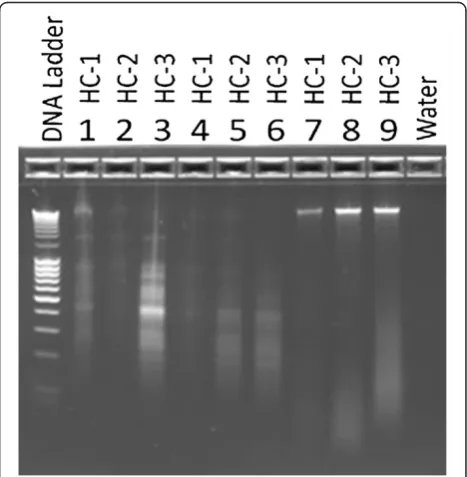
DNA extracts from stool specimens HC-1, HC-2, and HC-3 from the healthy individuals were visualized using electrophoresis on a 2% agarose gel. Figure 1, lanes 1–3 and 4–6 representing DNA extracted by easyMag® with 35
and 140 μL silica, respectively, show smears and/or
[image:3.595.56.546.99.267.2]multiple bands, suggesting DNA degradation or frag-mentation. The densities of the bands correlate with the quantities of the DNA measured by the Qubit® system, suggesting that higher quality of DNA with less degrad-ation was obtained from samples extracted by Qiagen, which also appears as distinct bands of high molecular weight in lanes 7–9 in Figure 1.
Table 1 Quantification of extracted DNA from fecal samples
Sample nr. NanoDrop® (μg/mL) Qubit® (μg/mL)
Qiagen EasyMag 35μL silica EasyMag 140μL silica Qiagen EasyMag 35μL silica EasyMag 140μL silica
HC-1 17.5 41.9 13.7 2.9 6.5 0.5
HC-2 40.1 9.6 41.4 6.9 0.7 1.2
HC-3 42.5 52.4 50.8 4.5 1.2 0.7
HC-8 18.5 10.3 36.1 3.4 1.3 0.6
HC-10 73.8 17.4 33.4 28.8 2.5 1.9
IBD-1* 9.5 6.7 32.2 0.6 0.8 1.0
IBD-2* 5.6 3.4 18.4 0.2 1.2 0.3
IBD-3* 55.5 5.9 21.2 2.7 0.4 0.5
Average 32.9 18.5 30.9 6.3 1.8 0.8
Standard deviation 24.1 18.4 12.5 9.4 2.0 0.5
*Inflammatory Bowel Disease (IBD), Healthy controls (HC).
The table shows faecal DNA concentration of extracts quantified using NanoDrop® and Qubit®. DNA extraction by EasyMag® with 35μL and 140μl silica yields in average 18.5 (SD 18.4) and 30.9μg (SD 12.5) DNA, respectively and DNA extraction by Qiagen yields in average 32.9μg (SD 24.1) DNA, using NanoDrop® instrument. Same faecal DNA extracts measured using Qubit® instrument for DNA by EasyMag® with 35μL and 140μL silica, yields a concentration of 1.8 (SD 2.0) and 0.8μg (SD 0.5) DNA, respectively, while DNA extraction by Qiagen yields a concentration of 6.3μg/ml (SD 9.4) DNA.
[image:3.595.305.539.436.675.2]Thereafter, 16S rDNA PCR products were visualized using electrophoresis on 2% agarose gel and analysed by
DGGE (Figures 2 and 3). Lanes exhibiting 16S rDNA
PCR products obtained from easyMag® DNA were blank, while PCR products obtained from DNA extracted by Qiagen were clearly visible. This part of the experiment was repeated twice.
In order to investigate whether impurities and/or in-hibitory compounds had any effect on the visualisation of the DNA, DNA extractions from HC-1, HC-2, HC-3, IBD1, IBD2 and IBD3 were diluted 5, 10, 15, and 20 times. PCR was performed and the PCR-products were
analysed by DGGE. As Figure 4 shows,16S rDNA PCR
products obtained using easyMag® revealed more bands and showed bands with higher densities in the lanes where the DNA was diluted 10 and 15 times. Addition-ally, almost identical bands appear for each faecal sample in DGGE gel lane in both DNA extracts; diluted easy-Mag® DNA extracts and Qiagen DNA extracts (Figures 4 and 5). However, the lanes in DGGE gels representing DNA extracted by Qiagen show brightest bands in com-parison to DNA extracted by easyMag®. These results were confirmed on diluted DNA extracted by easyMag® of three IBD patients, using DGGE (Figure 5).
Discussion
In this study the goal was to investigate the DNA extrac-tion quality of two systems, a semi-automatic and a manual DNA extraction system for the purpose of downstream PCR-DGGE analysis. In order to compare these two methods a quantitation of small amounts of DNA is neces-sary. Based on the results of gel electrophoresis of DNA extracts (Figure 1), there is a greater consistency between the Qubit® system measurement and the density of bands
occurring in the gel electrophoresis. Probably NanoDrop® measures other compounds than DNA such as RNA and protein residues with a similar absorption, making this measuring method inconsistent. Differences between DNA amount were tested using One-way Analysis of variance test, which shows significant differences in DNA concen-tration with no reservation for which measuring method was used (P <0.0001***).
Results of the DNA measurements (Qubit®) and the density of bands in gel electrophoresis showed a relatively low amount of DNA extracted by easyMag® compared to DNA extracted by Qiagen. It was noted that using less sil-ica than suggested by the easyMag® manufacturer resulted in a higher DNA yield. An explanation could be that when using the semi-automatic easyMag® with 140μL silica rela-tively more non-DNA compounds such as protein will be extracted from the sample compared to 35μL silica. These non-DNA compounds probably interfere with the DNA extraction. Diluting the DNA extracts and thereby the non-DNA inhibiting compounds 10 and 15 times resulted in more bands as revealed on DGGE gels. One of the goals of this study was to investigate whether easyMag® can be used to extract small amounts of fecal DNA. IBD patients frequently have a reduced diversity of bacterial DNA in comparison to healthy controls [24-26]. Our results dem-onstrate that easyMag® can extract DNA from fecal sam-ples and the method is suitable for extracting DNA from fecal samples of IBD patients. However, the DGGE gel
lanes representing 16SrDNA PCR products of the DNA
extracted by Qiagen revealed clearly more visible bands in
comparison with DGGE gel lanes representing16SrDNA
[image:4.595.58.539.518.696.2]PCR products derived from DNA extracted by easyMag®. The reason why Qiagen extracted DNA is of better quality may be found in the method used to extract fecal DNA.
Figure 3DGGE gel pictures show,16SrDNA PCR products on faecal DNA extracts obtained using easyMag® with140μL silica and Qiagen methods.Lanes 1, 3, 5, 7, 9, 11, 13, and 15 are16SrDNA PCR products using DNA extracted by easyMag®. Lanes 2, 4, 6, 8, 10, 12, 14, and 16 are16SrDNA PCR products using DNA extracted by Qiagen.
Figure 4DGGE gel pictures show16SrDNA PCR products of 3 healthy individuals' diluted faecal DNA extracts: 5, 10, 15 and 20 times, respectively.Lanes 1-4, 9-12, 17-20 show16SrDNA PCR products of diluted DNA extracted using Qiagen. Lanes 5-8, 13-16, 21-24 show16S
[image:5.595.57.540.408.691.2]The Qiagen DNA extraction method was combined with TissueLyser, which enhances lysis of gram-positive micro-organisms (5) and a dedicated step to eradicate non-DNA molecules (InhibitEX) that might interfere with the DNA extraction and downstream PCR (16). Cellular debris that is not removed can also result in a decreased yield and quality of DNA or RNA preparation (16).
The Semi-automatic easyMag® handles 24 fecal extrac-tions simultaneously at approximately the same cost as the QIAamp DNA Stool Mini Kit in less time (40 mi-nutes vs. 5 hours including pretreatment with TissueLy-ser, respectively) and obviously with much less hands-on time; therefore it is an attractive solution for laboratories handling many samples [13,15].
Conclusions
In contrast to NanoDrop, quantification of DNA by the Qubit® system correlated with the density of the bands that appeared in electrophoresis gels for both whole genomic DNA and the PCR products. QIAamp Stool Mini Kit DNA extracts yielded higher amount of DNA and showed brighter bands on DGGE gels in comparison to DNA ex-tracts obtained using easyMag®. However the semi-automatic easyMag® method is usable for molecular diagnostics, when DNA extracts are diluted 10 or 15 times.
Our study shows the necessity of testing different proto-cols for DNA extraction for samples of different origin in
order to obtain optimal results and avoid false interpreta-tions on the bacterial composiinterpreta-tions and bacterial diversity.
Availability and requirements
This study is based on laboratory work. No software or specific computer programs were used for the study.
Abbreviations
Qiagen:QIAamp DNA stool mini kit; DGGE: Denaturing gradient gel
electrophoresis; IBD: Inflammatory bowel disease; PCR: Polymerase chain reaction.
Competing interests
The authors declare no competing financial interests.
Authors’contributions
KAK, AMP, HM, SP, CS participated in the design of the study. HM, AMP, SP and KAK drafted the manuscript. HM, LOBA were responsible for molecular genetic studies. All authors have read and approved the final manuscript.
Acknowledgement
We thank Henrik Vedel Nielsen and Christen Rune Stensvold for helpful discussions and for giving us access to the easyMag instrument at their laboratory, the Mycology & Parasitology special diagnostics department at Statens Serum Institut. We also thank the laboratory staff at the Mycology & Parasitology special diagnostics department at Statens Serum Institut for their technical assistance.
Author details
1
Department of Microbiology & Infection Control, Statens Serum Institut, Copenhagen DK-2300 S, Denmark.2Department of Gastroenterology, Hvidovre University Hospital, Kettegård Allé 30, Hvidovre DK-2650, Denmark.
[image:6.595.58.538.89.339.2]Received: 5 August 2013 Accepted: 13 January 2014 Published: 21 January 2014
Figure 5DGGE gel pictures show16SrDNA PCR products of 3 IBD patients' diluted faecal DNA extracts: 5, 10, 15 and 20 times, respectively.Lanes 1-4, 9-12, 17-20 show 16S rDNA PCR products of diluted DNA extracted using Qiagen. Lanes 5-8, 13-16,
References
1. Guarner F, Malagelada JR:Gut flora in health and disease.Lancet2003,
361:512–519.
2. Wallace TC, Guarner F, Madsen K, Cabana MD, Gibson G, Hentges E, Sanders ME:
Human gut microbiota and its relationship to health and disease.Nutr Rev
2011,69:392–403.
3. Eckburg PB, Bik EM, Bernstein CN, Purdom E, Dethlefsen L, Sargent M, Gill SR, Nelson KE, Relman DA:Diversity of the human intestinal microbial flora. Science2005,308:1635–1638.
4. Favier CF, Vaughan EE, De Vos WM, Akkermans AD:Molecular monitoring of succession of bacterial communities in human neonates.Appl Environ Microbiol2002,68:219–226.
5. Abu Al-Soud W, Radstrom P:Capacity of nine thermostable DNA polymerases to mediate DNA amplification in the presence of PCR-inhibiting samples.Appl Environ Microbiol1998,64:3748–3753. 6. Kreader CA:Relief of amplification inhibition in PCR with bovine serum
albumin or T4 gene 32 protein.Appl Environ Microbiol1996,62:1102–1106. 7. Monteiro L, Bonnemaison D, Vekris A, Petry KG, Bonnet J, Vidal R, Cabrita J,
Megraud F:Complex polysaccharides as PCR inhibitors in feces: Helicobacter pylori model.J Clin Microbiol1997,35:995–998.
8. Walter J, Tannock GW, Tilsala-Timisjarvi A, Rodtong S, Loach DM, Munro K, Alatossava T:Detection and identification of gastrointestinal Lactobacillus species by using denaturing gradient gel electrophoresis and
species-specific PCR primers.Appl Environ Microbiol2000,66:297–303. 9. Wilson IG:Inhibition and facilitation of nucleic acid amplification.
Appl Environ Microbiol1997,63:3741–3751.
10. Argyros FC, Ghosh M, Huang L, Masubuchi N, Cave DR, Grubel P:Evaluation of a PCR primer based on the isocitrate dehydrogenase gene for detection of Helicobacter pylori in feces.J Clin Microbiol2000,38:3755–3758.
11. Whitehouse CA, Hottel HE:Comparison of five commercial DNA extraction kits for the recovery of Francisella tularensis DNA from spiked soil samples.Mol Cell Probes2007,21:92–96.
12. Yu Z, Morrison M:Improved extraction of PCR-quality community DNA from digesta and fecal samples.Biotechniques2004,36:808–812. 13. Persson S, De Boer RF, Kooistra-Smid AM, Olsen KE:Five commercial DNA
extraction systems tested and compared on a stool sample collection. Diagn Microbiol Infect Dis2011,69:240–244.
14. Sha S, Xu B, Wang X, Zhang Y, Wang H, Kong X, Zhu H, Wu K:The biodiversity and composition of the dominant fecal microbiota in patients with inflammatory bowel disease.Diagn Microbiol Infect Dis2012,
75:245–251.
15. Schuurman T, De BR, Patty R, Kooistra-Smid M, Van ZA:Comparative evalu-ation of in-house manual, and commercial semi-automated and auto-mated DNA extraction platforms in the sample preparation of human stool specimens for a Salmonella enterica 5′-nuclease assay.J Microbiol Methods2007,71:238–245.
16. Nakaune R, Nakano M:Efficient methods for sample processing and cDNA synthesis by RT-PCR for the detection of grapevine viruses and viroids.J Virol Methods2006,134:244–249.
17. Smith B, Li N, Andersen AS, Slotved HC, Krogfelt KA:Optimising bacterial DNA extraction from faecal samples: comparison of three methods.Open Microbiol J2011,5:14–7.doi:10.2174/1874285801105010014.Epub;%2011 Apr 22.:14–17.
18. Andersen LO, Roser D, Nejsum P, Nielsen HV, Stensvold CR:Is
supplementary bead beating for DNA extraction from nematode eggs using the NucliSENS(R) easyMag(R) protocol necessary?J Clin Microbiol
2013,51:1345–1347.
19. Budding AE, Grasman ME, Lin F, Bogaards JA, Soeltan-Kaersenhout DJ, Vandenbroucke-Grauls CM, Van Bodegraven AA, Savelkoul PH:IS-pro: high-throughput molecular fingerprinting of the intestinal microbiota. FASEB J2010,24:4556–4564.
20. Van Deursen P:HBV DNA extraction from serum using the NucliSENS easyMAG platform [abstract].Europe: 17th European Congress of clinical Microbiology and Infectious Disease (ECCMID); 2007.
21. O’Neill M:ConferenceSeries 307 edition.InComparison of the TLDA with the Nanodrop and the reference Qubit system.Edited by McPartlin KASRNM J. 1Drop Technology Ltd., Tallaght Business Park, Whitestown, Dublin 24, Ireland: IOP Publishing; 2012:1–6.
22. Lu Y, Morimoto K:Is habitual alcohol drinking associated with reduced electrophoretic DNA migration in peripheral blood leukocytes from ALDH2-deficient male Japanese?Mutagenesis2009,24:303–308.
23. Muyzer G, De Waal EC, Uitterlinden AG:Profiling of complex microbial populations by denaturing gradient gel electrophoresis analysis of polymerase chain reaction-amplified genes coding for 16S rRNA. Appl Environ Microbiol1993,59:695–700.
24. Fava F, Danese S:Intestinal microbiota in inflammatory bowel disease: friend of foe?World J Gastroenterol2011,17:557–566.
25. Friswell M, Campbell B, Rhodes J:The role of bacteria in the pathogenesis of inflammatory bowel disease.Gut Liver2010,4:295–306.
26. Manichanh C, Rigottier-Gois L, Bonnaud E, Gloux K, Pelletier E, Frangeul L, Nalin R, Jarrin C, Chardon P, Marteau P, Roca J, Dore J:Reduced diversity of faecal microbiota in Crohn’s disease revealed by a metagenomic approach.Gut2006,55:205–211.
doi:10.1186/1756-0500-7-50
Cite this article as:Mirsepasiet al.:Microbial diversity in fecal samples depends on DNA extraction method: easyMag DNA extraction compared to QIAamp DNA stool mini kit extraction.BMC Research Notes20147:50.
Submit your next manuscript to BioMed Central and take full advantage of:
• Convenient online submission
• Thorough peer review
• No space constraints or color figure charges
• Immediate publication on acceptance
• Inclusion in PubMed, CAS, Scopus and Google Scholar
• Research which is freely available for redistribution