Validity of the ICFT R-matrix method: Be-like Al
9+
a case study
L. Fern´andez-Menchero
1?, G. Del Zanna
2and N. R. Badnell
11Department of Physics, University of Strathclyde. Glasgow G4 0NG, United Kingdom
2Department of Applied Mathematics and Theoretical Physics, University of Cambridge, Cambridge CB3 0WA, United Kingdom
Accepted tomorrow. Received 16 April 2015; in original form yesterday
ABSTRACT
We have carried-out 98-level configuration-interaction/close-coupling (CI/CC) inter-mediate coupling frame transformation (ICFT) and Breit–Pauli R-matrix calculations for the electron-impact excitation of Be-like Al9+. The close agreement that we find between the two sets of effective collision strengths demonstrates the continued robustness of the ICFT method. On the other hand, a comparison of this data with previous 238-level CI/CC ICFT effective collision strengths shows that the results for excitation up to n =4 levels are sys-tematically and increasingly underestimated over a wide range of temperatures by R-matrix calculations whose close-coupling expansion extends only to n=4 (98-levels).
Thus, we find to be false a recent conjecture that the ICFT approach may not be com-pletely robust. The conjecture was based upon a comparison of 98-level CI/CC Dirac R-matrix effective collision strengths for Al 9+with those from the 238-level CI/CC ICFT R-matrix calculations. The disagreement found recently is due to a lack of convergence of the close-coupling expansion in the 98-level CI/CC Dirac work. The earlier 238-level CI/CC ICFT work has a superior target to the 98-level CI/CC Dirac one and provides more accurate atomic data.
Similar considerations need to be made for other Be-like ions and for other sequences.
Key words: Atomic data – Techniques: spectroscopic
1 INTRODUCTION
Electron-impact excitation is the dominant process for populating the radiating states of ions whose emission lines form the basis for the spectroscopic diagnostic modelling of non-equilibrium astro-physical and laboratory plasmas. As such, a great deal of effort over many years has gone in to calculating a large amount of colli-sion data, which is incorporated into databases and modelling suites such as CHIANTI1 and OPEN-ADAS2. The pre-eminent method-ology used is the R-matrix one. However, there are many variations on this theme.
The intermediate coupling frame transformation (ICFT) R-matrix method is an approximation to the Breit–Pauli R-R-matrix method (BPRM) which neglects the spin–orbit interaction between the colliding electron and the ion. Thus, it is physically well mo-tivated. There is a good deal of literature which verifies the ac-curacy of the ICFT approach: the original comparisons of the re-sults of ICFT and Breit–Pauli R-matrix calculations by Griffin et al. (1998, 1999) on Mg-like ions and Badnell & Griffin (1999) on Ni4+; more recent ones by Liang & Badnell (2010) comparing ICFT
R-? E-mail: [email protected] (LFM);
[email protected] (NRB); [email protected] (GDZ)
1 http://www.chiantidatabase.org 2 http://open.adas.ac.uk
matrix and Dirac Atomic R-matrix Code (DARC) calculations for Ne-like Fe16+and Kr26+, Liang et al. (2009) on ICFT with Breit– Pauli and DARC for Na-like Fe15+; and most recently Badnell &
Ballance (2014) compared the results of ICFT, BPRM and DARC calculations for Fe2+. The differences observed between ICFT and
other R-matrix results are all well within the uncertainties to be expected due to the use of different configuration interaction and close-coupling expansions and resonance resolution. Indeed, the Badnell & Ballance (2014) work on Fe2+ used identical atomic structures and close-coupling expansions for the ICFT and Breit– Pauli R-matrix calculations and found excellent agreement, better than 5%. Their DARC calculations out of necessity used a some-what different atomic structure, and the low-level structure of Fe2+ is challenging, but still gave agreement to within∼20% at 104K.
Extensive calculations have been carried-out applying the ICFT R-matrix method to whole isoelectronic sequences (for el-ements, typically, up to Zn), the most recent ones being Mg-like (Fern´andez-Menchero et al. 2014b), Be-like (Fern´andez-Menchero et al. 2014a) and B-like (Liang et al. 2012) — this last paper con-tains references to earlier sequences.
Thus it is both surprising and of great concern to find a work which counters this trend: Aggarwal & Keenan (2015a) made a comparison of the results of a 98-level DARC calculation on Be-like Al 9+ (Aggarwal & Keenan 2014c) with a 238-level ICFT
from the 238-level ICFT R-matrix calculation were significantly larger than the DARC ones in many instances and they suggested that the results of Fern´andez-Menchero et al. (2014a) were less re-liable, querying the ICFT method, resonance resolution and its high energy/temperature behaviour.
In addition, Aggarwal & Keenan (2015a) alighted on the re-cent paper by Storey et al. (2014) which reported a problem in the outer-region ICFT calculation of O2+, when compared to a full
Breit–Pauli calculation, and suggested that this could be the main cause of the discrepancies for Al9+. However, Storey et al. (2014)
noted that such an issue only arises when resonance effective quan-tum numbers become small. The problem is peculiar to low-charge ions such as O2+and unusually small R-matrix box sizes. Storey
et al. (2014) focused on providing a solution to their problem at hand. We note that the problem does not arise in the first place if the R-matrix box size is increased (beyond its default in their case) to encompass a spectroscopic n=3 orbital, say. This is why the issue had not arisen before: all previous calculations (including Fern´andez-Menchero et al. (2014a)) used larger, often much larger, box sizes. The problem noted by Storey et al. (2014) is not relevant in general. Aggarwal & Keenan (2015a) noted a similar trend for other ions of the Be-like sequence Cl13+, K15+, Ge28+
(Aggarwal & Keenan 2014a) and Ti18+(Aggarwal & Keenan 2012).
Where does that leave us with regard to the discrepancies noted by Aggarwal & Keenan (2015a)? The concern of Aggar-wal & Keenan (2015a) was the disagreement between R-matrix calculations of (apparent) comparable complexity. However, the works of Aggarwal & Keenan (2014c) and Fern´andez-Menchero et al. (2014a) are not of comparable complexity. We show here that the much larger close-coupling expansion used by (Fern´andez-Menchero et al. 2014a) (238 vs 98 levels) gives rise to a system-atic enhancement of effective collision strengths over a wide range of temperatures, which increases as one excites higher-and-higher levels.
In addition, we analyze the uncertainty in the effective colli-sion strengths due to the incompleteness of the configuration inter-action expansion, the validity of the ICFT vs Breit–Pauli method, viz. the neglect of the spin–orbit interaction of the colliding elec-tron, and the effect of resonance resolution and position on low temperature effective collision strengths.
The paper is organized as follows. In section 2 we describe the methodology we used for the different calculations we have per-formed. In section 3 we discuss the atomic structure of Al9+and
present results for energies, line strengths and infinite energy plane wave Born collision strengths. In section 4 we compare and con-trast effective collision strengths. In section 5 we present our main conclusions. Atomic units are used unless otherwise specified.
2 METHODOLOGY
In the following sections we compare the results of the 238-level configuration-interaction/close-coupling (CI/CC) ICFT R-matrix calculation by Fern´andez-Menchero et al. (2014a) for Al9+with
the results of new ICFT and Breit–Pauli 98-level CI/CC R-matrix calculations — the latter being the same sized CI & CC expansions that were used by Aggarwal & Keenan (2012, 2014a,c). Where pos-sible (meaningful), our new 98-level CC calculations follow the same prescription as Fern´andez-Menchero et al. (2014a) e.g. with respect to angular momentum and energy specification.
[image:2.595.386.460.133.257.2]The target description uses theprogram (Bad-nell 2011). Fern´andez-Menchero et al. (2014a) included all of the
Table 1. Scaling parameters (λnl) used in the 98-level CI structure calcula-tion.
Orbital λnl 1s 1.57175 2s 1.29675 2p 1.17081 3s 1.29004 3p 1.15958 3d 1.29791 4s 1.29797 4p 1.15413 4d 1.30212 4f 1.50916
configurations 1s2{2s2,2s2p,2p2}and 1s2{2s,2p}nl with n=3−7 and l=s,p,d,f,g for n=3−5 and l=s,p,d for n=6,7, which makes a total of 238 levels. In the present work, we restrict our-selves to n=4 (with l=s,p,d,f) which gives a total of 98 levels. The Thomas–Fermi potential scaling parameters,λnl, for the atomic structure calculation with the CI basis set of 98 levels are given in Table 1, those for the CI calculation with 238 levels are given in Fern´andez-Menchero et al. (2014a). Theλnlparameters for the 98-level CI calculation were obtained in the same way as the ones for the 238-level calculation (Fern´andez-Menchero et al. 2014a): by minimizing the equally-weighted sum of all LS -coupling term energies.
For the collision calculations we use the inner-region R-matrix programs of Hummer et al. (1993); Berrington et al. (1995) and the outer-regionprogram of Berrington et al. (1987); Badnell (1999) plus the ICFT one of Griffin et al. (1998). We will com-pare the results of ICFT and Breit–Pauli R-matrix methods to treat relativistic effects in the scattering problem. Both can use the ex-act same Breit–Pauli atomic structure. This is important as it en-ables us to isolate differences due solely to the differing treatment of relativistic effects in the scattering. We note that Berrington et al. (2005) have shown that the Breit–Pauli R-matrix method gives es-sentially the same results as the Dirac one for Z.30.
The ICFT R-matrix method first carries-out an LS -coupling close-coupling calculation for the CI target described above and it includes the mass-velocity and Darwin one-body relativistic oper-ators. The LS -coupling reactance K-matrices are first recoupled to
jK-coupling and then transformed to intermediate coupling using the term coupling coefficients (Hummer et al. 1993) for the Breit– Pauli target. This imposes the exact same atomic structure on the ICFT K-matrices as a Breit–Pauli one which uses the same CI ex-pansion and radial orbitals. In particular, the fine-structure levels within a term are non-degenerate in the final scattering calculation. This method is the one which was used by Fern´andez-Menchero et al. (2014a).
The second method which we use is the Breit–Pauli (BP) one. In this method the close-coupling expansion is made in intermedi-ate coupling as well, in addition to the target CI, i.e. the one-body effective (nuclear plus Blume & Watson) spin–orbit operator is in-cluded in the (N+1)-electron Hamiltonian. The Breit–Pauli for-malism increases considerably the size of the Hamiltonian matrix, which makes it impractical to use this method for 238 CC levels.
is the diagonalization of much smaller (N+1)-electron Hamiltonian matrices and a much smaller set of coupled scattering equations to be solved in the outer-region by.
[image:3.595.305.543.73.273.2]3 STRUCTURE
Table 2 compares our energies for the first 98 levels of Al9+
calcu-lated with the 98- and 238-level CI targets. These energies are com-pared also with the observed ones tabulated in the NIST3database, which were taken from work of Martin & Zalubas (1979). There are ten levels in Table 2 which do not follow the same order in both structure calculations: from level index 82 to 84 and from 88 to 94. We use the order of the 98-level CI calculation to index levels for comparison purposes. Energies calculated with both CI expan-sions have differences smaller than 0.5% with the observed ones for most of the levels, and differences of around 2% for the low lying singlet states. In general, the differences are similar to those found by Aggarwal & Keenan (2014c). In the original paper from Martin & Zalubas (1979) there are several gaps in the level energies, and some of them are labeled as “inaccurate”, so we refer the reader to the original work to avoid hasty conclusions.
It is difficult to relate differences in energies directly to dif-ferences in collision data. However, differences in oscillator or line strengths (S ) and infinite energy plane-wave Born collision strengths (ΩPWB
∞ ), essentially non-dipole electric multipole line
strengths, can be so related. Burgess & Tully (1992) show how infi-nite energy/temperature and ordinary/effective collision strengths (Ω∞/Υ∞) from any scattering calculation, including an R-matrix
one, are directly related to these quantities, viz.
Υ∞ = Ω∞ = ΩPWB∞ (1)
for non-dipole allowed transitions, while for electric dipole ones
Ω∞ = lim
E→∞
4S 3 ln
E
∆E+e
, (2)
and
Υ∞ = lim
T→∞
4S 3 ln
kT ∆E +e
!
, (3)
where∆E is the excitation energy for the transition.
In practice, we find that changes in the line strength, S , or ΩPWB
∞ between two different atomic structures change not only the
infinite energy values but also the (background) ordinary collision strength correspondingly over a wide range of collision energies, and hence the effective collision strength over a wide range of tem-peratures, unless dominated by resonances. A 20% change, say, in
S orΩPWB
∞ provides a very realistic measure of the resulting change
in effective collision strengths. Thus, care must be taken when at-tempting to deduce anything about scattering methods from diff er-ences in the collision data without reference to differences in the underlying atomic structure.
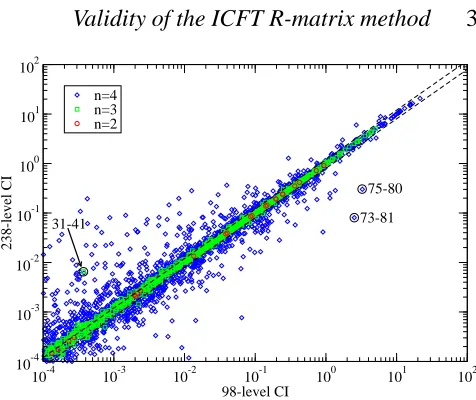
To illustrate, we show in Fig. 1 a comparison of the reduced quantityy∞, given by
y∞ = ΩPWB∞ or
4S
3 , (4)
for the two atomic structure calculations which we consider (which we label 98-level CI and 238-level CI). We show points for a total of 4035 transitions resulting from the common 98 levels. These split
3 http://physics.nist.gov
10-4 10-3 10-2 10-1 100 101 102
98-level CI 10-4
10-3 10-2 10-1 100 101 102
238-level CI
n=4 n=3 n=2
75-80 73-81 31-41
Figure 1. A comparison ofy∞(see eq. 4) for the 98- vs 238-level CI atomic
structures for transitions amongst the 98 lowest common levels of Al9+.
◦: transitions with upper level with n=2;: transitions with upper level with n=3;: transitions with upper level with n=4; dashed lines: 20% fractional difference.
into 1466 dipole transitions and 2569 Born-allowed transitions, while there are an additional 718 forbidden transitions that are not represented. We highlight by colour and symbol transitions to upper levels with n=2,3,4. We see that transitions up to n=2 are very well converged. Only one transition differs by more than 10%; it is the very weak (∼10−8) Born transition 6−9: 2p2 3P
0−2p2 1D2(off the scale). There is good convergence for transitions up to n=3, with 233 out of 801 transitions which differ by more than 20% but mostly for the weaker transitions. However, there is much more spread for transitions up to n=4, 1834 of 3202 transitions differ by more than 20%. This plot illustrates that the n=4 levels of the 98-level CI structure are not so well converged with respect to the CI expansion. We expect that their representation by the 238-level CI expansion to be much better converged.
We circle several transitions for comment. The transition 31− 41: 2p3p3P
1−2p3d3Po2 is a dipole one, its line strength changes by a factor of 18 between the 98- and 238-level structures. Note also the transitions 75−80: 2p4d1Do
2−2p4f 1F
3 and 73 −81: 2p4d3Fo
2−2p4f 3F
3. Both transitions are dipole allowed and quite strong and yet differ by about a factor of 20 and 30 between the two structures. These levels lie towards the upper end of the 98-level CI expansion. These differences highlight the need for as accurate an atomic description as possible to obtain the best target for accurate collision data and the need to exercise extreme caution when mak-ing comparisons of collision data based on different atomic struc-tures.
4 COLLISIONS
In this section, we carry-out a series of comparisons of effective collision strengths for Al9+at the temperature of peak abundance
[image:3.595.50.204.469.533.2]Table 2. Al9+target levels. Key: i: level index; Conf.: configuration; Level: level IC designation (largest weight); ENIST: observed energy from the NIST database (Martin & Zalubas 1979); E98: calculated energy with 98-level CI expansion; E238: calculated energy with 238-level CI expansion (see text); %: percentage difference between theoretical and NIST data. All energies are in cm−1.
i Conf. Level ENIST E98( %) E238( %) i Conf. Level ENIST E98( %) E238( %) 1 2s2 1S0 0. 0.( 0) 0.( 0) 50 2s 4p 3Po1 − 2504724.( −) 2500556.( −) 2 2s 2p 3Po
0 155148. 155722.( 0.4) 155539.( 0.3) 51 2s 4p 3Po
2 − 2505125.( −) 2500975.( −) 3 2s 2p 3Po1 156798. 157487.( 0.4) 157404.( 0.4) 52 2s 4p 1Po1 − 2508073.( −) 2503514.( −) 4 2s 2p 3Po2 160429. 161146.( 0.4) 161278.( 0.5) 53 2s 4d 3D1 − 2520502.( −) 2516248.( −) 5 2s 2p 1Po
1 300490. 309273.( 2.9) 307209.( 2.2) 54 2s 4d 3D
2 − 2520573.( −) 2516321.( −) 6 2p2 3P
0 404574. 408026.( 0.9) 407826.( 0.8) 55 2s 4d 3D3 − 2520682.( −) 2516434.( −) 7 2p2 3P
1 406517. 409969.( 0.8) 409888.( 0.8) 56 2s 4d 1D2 2527560. 2530218.(0.1) 2525880.(−0.1) 8 2p2 3P
2 409690. 413420.( 0.9) 413526.( 0.9) 57 2s 4f 3Fo2 2528570. 2530774.(0.1) 2526258.(−0.1) 9 2p2 1D
2 449732. 458157.( 1.9) 457831.( 1.8) 58 2s 4f 3Fo3 2528570. 2530815.(0.1) 2526299.(−0.1) 10 2p2 1S
0 553783. 567794.( 2.5) 567267.( 2.4) 59 2s 4f 3Fo4 2528570. 2530871.(0.1) 2526355.(−0.1) 11 2s 3s 3S
1 1855760. 1856089.( 0.0) 1852844.(−0.2) 60 2s 4f 1Fo3 − 2533730.( −) 2528991.( −) 12 2s 3s 1S
0 1884420. 1886214.( 0.1) 1882216.(−0.1) 61 2p 4s 3Po0 − 2661563.( −) 2655681.( −) 13 2s 3p 1Po
1 1923850. 1925826.( 0.1) 1922358.(−0.1) 62 2p 4s 3Po
1 − 2662724.( −) 2656820.( −) 14 2s 3p 3Po
0 − 1928630.( −) 1925009.( −) 63 2p 4s 3Po
2 − 2666840.( −) 2661460.( −) 15 2s 3p 3Po
1 − 1929220.( −) 1925611.( −) 64 2p 4s 1Po
1 − 2673641.( −) 2666939.( −) 16 2s 3p 3Po
2 − 1930059.( −) 1926462.( −) 65 2p 4p 1P
1 − 2681281.( −) 2675347.( −) 17 2s 3d 3D
1 1965860. 1967770.( 0.1) 1964163.(−0.1) 66 2p 4p 3D1 − 2684513.( −) 2678722.( −) 18 2s 3d 3D
2 1966080. 1967980.( 0.1) 1964378.(−0.1) 67 2p 4p 3D2 − 2684938.( −) 2679129.( −) 19 2s 3d 3D
3 1966300. 1968296.( 0.1) 1964701.(−0.1) 68 2p 4p 3D3 − 2688348.( −) 2682876.( −) 20 2s 3d 1D2 1992340. 1997586.( 0.3) 1993399.( 0.1) 69 2p 4p 3S1 − 2691166.( −) 2684805.( −) 21 2p 3s 3Po0 2057140. 2055664.(−0.1) 2050249.(−0.3) 70 2p 4p 3P0 − 2691420.( −) 2685788.( −) 22 2p 3s 3Po
1 2057140. 2057249.( 0.0) 2051958.(−0.3) 71 2p 4p 3P1 − 2694295.( −) 2688609.( −) 23 2p 3s 3Po2 2057140. 2060910.( 0.2) 2055983.(−0.1) 72 2p 4p 3P2 − 2694733.( −) 2689496.( −) 24 2p 3s 1Po1 2091870. 2090063.(−0.1) 2084057.(−0.4) 73 2p 4d 3Fo2 − 2697404.( −) 2691501.( −) 25 2p 3p 1P1 2094820. 2097317.( 0.1) 2093229.(−0.1) 74 2p 4d 3Fo3 − 2699888.( −) 2694096.( −) 26 2p 3p 3D1 2102330. 2105510.( 0.2) 2101249.(−0.1) 75 2p 4d 1Do2 − 2700756.( −) 2695172.( −) 27 2p 3p 3D2 2103900. 2107151.( 0.2) 2102917.(−0.0) 76 2p 4p 1D2 2696850. 2702087.(0.2) 2696558.(−0.0) 28 2p 3p 3D
3 2107390. 2110622.( 0.2) 2106614.(−0.0) 77 2p 4d 3Fo4 − 2702915.( −) 2697461.( −) 29 2p 3p 3S
1 2119690. 2123472.( 0.2) 2118706.(−0.0) 78 2p 4d 3Do1 − 2705726.( −) 2700008.( −) 30 2p 3p 3P
0 − 2132252.( −) 2126478.( −) 79 2p 4d 3Do2 − 2706671.( −) 2701074.( −) 31 2p 3p 3P
1 2128680. 2133785.( 0.2) 2128247.(−0.0) 80 2p 4f 1F3 − 2707963.( −) 2701789.( −) 32 2p 3p 3P
2 2130410. 2135720.( 0.2) 2130292.(−0.0) 81 2p 4f 3F3 − 2708388.( −) 2702400.( −) 33 2p 3d 3Fo
2 − 2139901.( −) 2135677.( −) 82 2p 4d 3Do
3 − 2708430.( −) 2703108.( −) 34 2p 3d 3Fo
3 − 2142598.( −) 2138636.( −) 83 2p 4f 3F
2 − 2708468.( −) 2702641.( −) 35 2p 3d 1Do
2 2141580. 2144437.( 0.1) 2140459.(−0.1) 84 2p 4f 3F
4 − 2708819.( −) 2702505.( −) 36 2p 3d 3Fo
4 − 2145366.( −) 2141681.( −) 85 2p 4d 3Po
2 − 2710818.( −) 2705109.( −) 37 2p 3p 1D
2 2148410. 2157057.( 0.4) 2150745.( 0.1) 86 2p 4d 3Po1 − 2711544.( −) 2705747.( −) 38 2p 3d 3Do
1 2160650. 2165232.( 0.2) 2159945.(−0.0) 87 2p 4d 3Po
0 − 2711943.( −) 2706094.( −) 39 2p 3d 3Do
2 2161960. 2165961.( 0.2) 2160762.(−0.1) 88 2p 4f 3P
3 − 2712961.( −) 2706897.( −) 40 2p 3d 3Do
3 2163340. 2167469.( 0.2) 2162400.(−0.0) 89 2p 4f 3P4 − 2713531.( −) 2707350.( −) 41 2p 3d 3Po
2 2170190. 2174402.( 0.2) 2169739.(−0.0) 90 2p 4f 3P
5 − 2715225.( −) 2708632.( −) 42 2p 3d 3Po
1 2171680. 2175473.( 0.2) 2170906.(−0.0) 91 2p 4f 3D
3 − 2716473.( −) 2710743.( −) 43 2p 3d 3Po
0 − 2176019.( −) 2171512.( −) 92 2p 4f 1D4 − 2717105.( −) 2710218.( −) 44 2p 3p 1S
0 − 2193603.( −) 2186094.( −) 93 2p 4f 3D2 − 2717141.( −) 2711361.( −) 45 2p 3d 1Fo
3 2192860. 2203326.( 0.5) 2195894.( 0.1) 94 2p 4p 1S0 − 2717922.( −) 2706869.( −) 46 2p 3d 1Po
1 − 2208387.( −) 2201414.( −) 95 2p 4f 3D1 − 2718397.( −) 2712736.( −) 47 2s 4s 3S
1 − 2477026.( −) 2472580.( −) 96 2p 4f 1D2 − 2719895.( −) 2713991.( −) 48 2s 4s 1S
0 − 2488107.( −) 2483578.( −) 97 2p 4d 1Fo3 − 2722212.( −) 2715080.( −) 49 2s 4p 3Po0 − 2504555.( −) 2500383.( −) 98 2p 4d 1Po1 − 2723448.( −) 2716711.( −)
4.1 Peak abundance temperature
In Fig. 2 we compare our 98-level CC ICFT and Breit–Pauli R-matrix Maxwellian effective collision strengths,Υ, for all inelastic transitions in Al9+at the temperature of peak abundance, 106K, in an electron collisional plasma. We recall that both calculations use the exact same (98-level CI) structure. We note excellent agreement between the two scattering methods, as illustrated by the points ly-ing on the diagonal, only 82 points out of 4753 have a difference
larger than 10%. This is to be contrasted with the spread of points shown in Fig. 1 which results from our two different atomic struc-tures.
Only two points differ from the diagonal more than 50%, at around Υ = 10−1, they correspond to the transitions 67−75: 2p4p3D
10-4 10-3 10-2 10-1 100 101 102 ICFT
10-4 10-3 10-2 10-1 100 101 102
BP
[image:5.595.44.279.100.272.2]n=4 n=3 n=2
Figure 2. A comparison of effective collision strengths from 98-level CI/CC ICFT versus Breit–Pauli R-matrix calculations for all inelastic transitions amongst the 98 levels of Al9+at T
e=106K.◦: transitions with upper level
n=2;: transitions with upper level n=3;: transitions with upper level n=4; dashed lines: 20% fractional difference.
10-4 10-3 10-2 10-1 100 101 102
98-level CI/CC 10-4
10-3 10-2 10-1 100 101 102
238-level CI/CC
n=4 n=3 n=2
73-81 75-80 31-41
Figure 3. A comparison of effective collision strengths from 98- vs 238-level CI/CC ICFT R-matrix calculations for all inelastic transitions amongst the 98 lowest common levels of Al9+at T
e =106K.◦: transitions with upper level n=2;: transitions with upper level n=3;: transitions with upper level n=4; dashed lines: 20% fractional difference.
the difference, providing additional mixing via the (N+1)-electron Hamiltonian diagonalization.
Next, in Fig. 3 we compare our 98- versus 238-level CI/CC ICFT effective collision strengths as a whole. In contrast to Fig. 2, we see a much wider spread of points, i.e. the agreement between different scattering methods is much (much) better than that ob-tained using different configuration interaction basis sets. Like the comparison of line strengths andΩPWB
∞ shown in Fig. 1, we note
the excellent and very good agreement between the two sets of re-sults for transitions up to n = 2 and n = 3, respectively, while there is a much wider spread in the comparison for transitions up to n =4. However, unlike the atomic structure comparison, there is a systematic shift above the diagonal. The 238-level CC results are systematically larger than the 98-level ones. Thus, we conclude that this is not due to the differences in atomic structure, which were evenly distributed above and below the diagonal, rather that this is a measure of the lack of convergence of the close-coupling expansion
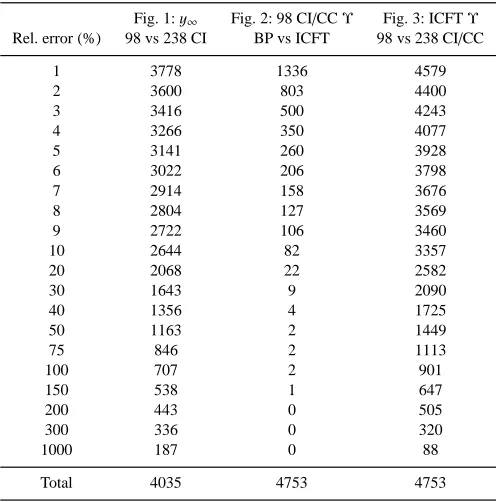
[image:5.595.305.553.141.392.2]Table 3. Number of transitions in Figs 1 – 3 which differ by more than a certain relative errorδ=|Υ98−Υ238|/Υ238(orΥ→y∞), as a percentage.
Fig. 1:y∞ Fig. 2: 98 CI/CCΥ Fig. 3: ICFTΥ
Rel. error (%) 98 vs 238 CI BP vs ICFT 98 vs 238 CI/CC
1 3778 1336 4579
2 3600 803 4400
3 3416 500 4243
4 3266 350 4077
5 3141 260 3928
6 3022 206 3798
7 2914 158 3676
8 2804 127 3569
9 2722 106 3460
10 2644 82 3357
20 2068 22 2582
30 1643 9 2090
40 1356 4 1725
50 1163 2 1449
75 846 2 1113
100 707 2 901
150 538 1 647
200 443 0 505
300 336 0 320
1000 187 0 88
Total 4035 4753 4753
in the 98-level CC calculation for the transitions involving n=4 levels. This mirrors the lack of convergence of the 98-level config-uration interaction expansion for n=4 levels. We note that there are still more than one hundred levels which lie above the n=4 levels in the 238-level CI/CC case.
Specifically, one half of the transitions in Fig.3 differ by more than 30%. The number of transitions differing by more than 20% (lines indicated in the plot) correspond to 1 for n=2 (out of 45), 256 for n=3 (out of 990) and 2331 for n=4 (out of 3718). Note also that the 3 transitions which were circled in Fig. 1 are again circled in Fig. 3. The strong transitions 75−80 and 73−81 do illustrate how outliers in the atomic structure comparison (factor 20 and 30 difference) show-up as outliers in the collision comparison (factor 10 and 20 difference). For the weaker transition 31−41 the resonances in the collision calculation “dampen” the difference in atomic structure, it being “just” a factor of 1.6 now. In Table 3 we give the exact number of transitions which have a difference
δ = |Υ98−Υ238|/Υ238 larger than a given percentage for they∞
for the 98- vs 238-level CI atomic structures as well as theΥat T=106K for the 98-level CC ICFT vs Breit–Pauli and the 98- vs 238-level CC ICFT comparisons.
We can confirm further that the systematic increase of the effective collision strengths to n = 4 in the 238-level CC cal-culation over those of the 98-level CC calcal-culation is due to the lack of convergence of the close-coupling expansion in the latter. Like the convergence of the CI expansion, the convergence of the close-coupling expansion is essentially independent of the coupling scheme, i.e. the specific R-matrix method used, be it LS, ICFT, Breit–Pauli or DARC. We illustrate this in Fig. 4 where we make a similar comparison of 54- vs 130-term CC LS -coupling R-matrix effective collision strengths. We see the same systematic increase for transitions to n = 4 as in the comparison of ICFT R-matrix effective collision strengths.
[image:5.595.43.280.350.519.2]10-4 10-3 10-2 10-1 100 101 102 54-term CI/CC
10-4 10-3 10-2 10-1 100 101 102
130-term CI/CC
[image:6.595.43.279.75.272.2]n=4 n=3 n=2
Figure 4. A comparison of effective collision strengths from 54- vs 130-term CI/CC LS -coupling R-matrix calculations for all inelastic transitions amongst the 54 lowest common terms of Al9+at T
e=106K.◦: transitions with upper term n=2;: transitions with upper term n=3;: transitions with upper term n=4; dashed lines: 20% fractional difference.
they allow us to make comparisons as a function of the strength of a transition — larger differences are acceptable for weaker transi-tions. On the other hand, because of the wide range of strengths, it is necessary for such plots to be logarithmic. If we plot the ra-tio of results from two different calculations we can make a linear comparison. We do this in Fig. 5 for the same comparison as we made in Fig. 3, and with respect to the lower level of the transition (5(a)) or the upper one (5(b)). Fig. 5(a) shows that the transitions with the largest scatter are those from 2s 3l (lower level index 11– 20) and 2s 4l (lower level index 47–60) up to n=4, and where we have highlighted by symbol/colour all upper levels with the same n-value. It bears a very strong resemblance to the same comparison (figure 2) made byAggarwal & Keenan (2015a) to compare the 98-level CI/CC DARC effective collision strengths with the 238-level CI/CC ICFT ones, except that they did not differentiate (highlight) the different n-values of the upper levels. In contrast, 5(b) clari-fies that the differences in the effective collision strengths become increasingly larger as the upper levels excited move closer to the last one included in the 98-level CC calculation. This in turn means that the effective collision strengths to the uppermost levels of the 238-level CC calculation of Fern´andez-Menchero et al. (2014a) are increasingly unconverged with respect to the close-coupling expan-sion. However, based on the present convergence study to n=2 and n=3 we can expect that their results for transitions up to n=4 to be well converged, but those to n=5 less so since only a partial set of n=6,7 levels (to l =2) were included in their close-coupling expansion.
While all of the plots shown so far are visually appealing, es-pecially Fig. 5, none of them give any indication of the number of transitions whose quantities differ by any given amount — we cannot tell the density of points close to the diagonal (Figs 1–4) or sitting at unity (Fig. 5). We must be wary of such plots misleading us as to the level of agreement, as opposed to disagreement. Only a table like Table 3 gives such an answer.
Thus, these comparisons demonstrate that the observation by Aggarwal & Keenan (2015a), that the 238-level CC effective colli-sions strengths of Fern´andez-Menchero et al. (2014a) are system-atically and increasingly larger with higher excitations than the 98-level CC results of Aggarwal & Keenan (2014c) over a wide range
0 20 40 60 80 100
Lower level (i) -30
-25 -20 -15 -10 -5 0 5 10
R =
ϒ98
/
ϒ238
n=4 n=3 n=2 98-lev > 238-lev
238-lev > 98-lev
(a)
0 20 40 60 80 100
Upper level (i) -30
-25 -20 -15 -10 -5 0 5 10
R =
ϒ98
/
ϒ238
n=4 n=3 n=2 98-lev > 238-lev
238-lev > 98-lev
[image:6.595.305.546.97.469.2](b)
Figure 5. The ratio of effective collision strengths from 98- vs 238-level CI/CC ICFT R-matrix calculations vs (a) lower level and (b) upper level index, for all inelastic transitions amongst the 98 lowest common levels of Al9+at T
e = 106K. Positive values indicateΥ98 > Υ238 and negative valuesΥ238>Υ98.◦: transitions with upper level n=2;: transitions with upper level n=3;: transitions with upper level n=4.
of temperatures is correct, but it is due to the lack of convergence of the CC expansion of the 98-level CC results of Aggarwal & Keenan (2014c), particularly with respect to the n=4 levels.
10-4 10-3 10-2 10-1 100 101 102 ICFT
10-4 10-3 10-2 10-1 100 101 102
DARC
[image:7.595.305.543.71.274.2]n=4 n=3 n=2
Figure 6. A comparison of effective collision strengths from 98-level CI/CC ICFT versus Dirac R-matrix (Aggarwal & Keenan 2014c) calculations for all inelastic transitions amongst the 98 levels of Al9+at T
e =106K.◦: transitions with upper level n=2;: transitions with upper level n=3;: transitions with upper level n=4; dashed lines: 20% fractional difference.
4.2 Low temperature
The effective collision strengths that we have presented so far have been relevant to the temperature of peak abundance (of Al9+) in
an electron collisional plasma, such as found in the solar atmo-sphere and magnetic fusion devices. In photoionized plasmas the same charge state exists at much lower temperatures. The role of resonances becomes more important at low temperatures both with respect to their magnitude, resolution and, in particular, their po-sition. Fern´andez-Menchero et al. (2014a) carried-out an exhaus-tive analysis of the convergence of the effective collision strengths with respect to the energy step used to map-out the resonances. They calculated the effective collision strengthsΥby convolution of the ordinary collision strengthsΩwith a Maxwellian electron energy distribution. Then they reduced the energy step by a factor one half and re-calculatedΥ. After repeatedly reducing the energy step down to a factor one eighth from the original one, the worst case transition from the ground state, the 1−78, only changed by 10% relative to the previous value ofΥ, at the lowest temperature calculated of 2×10⁴K, and by 1% at 106K.
We note that Aggarwal & Keenan (2015a) incorrectly re-ported the energy step used in the resonance region by Fern´andez-Menchero et al. (2014a). As they stated, Fern´andez-Fern´andez-Menchero et al. (2014a) used an energy step in the resonance region that scales as
∼z in the ion charge, not z2, along the sequence. In particular the
step length used was 6.94×10⁻⁶z2Ry for Al9+, 4.89×10⁻⁶z2Ry for Cl13+, 4.09×10⁻⁶z2Ry for K15+, 3.30×10⁻⁶z2Ry for Ti18+
, and 2.02×10⁻⁶z2Ry for Ge28+. These steps are comparable to the
ones used by Aggarwal & Keenan (2012, 2014a,c), being slightly finer for Al9+, and slightly coarser for Ge28+
. Fern´andez-Menchero et al. (2014a) used this fine mesh only over 2J = 1−23, which corresponds to their exchange calculation. They used their coarse energy mesh across the resonance region as well for 2J=25−89. Such J-values can only give rise to high-n resonances, which by definition are narrow. A simple calculation with re-veals that the strongest resonances have widths<10−5Ryd. Thus, the results provided by Fern´andez-Menchero et al. (2014a) are con-verged with respect to the collision energy step and all significant resonances are well resolved. Differences in low temperature eff ec-tive collision strengths between Aggarwal & Keenan (2014c) and
10-4 10-3 10-2 10-1 100 101 102
98-level CI/CC 10-4
10-3 10-2 10-1 100 101 102
238-level CI/CC
n=4 n=3 n=2
Figure 7. A comparison of effective collision strengths from 98- vs 238-level CI/CC ICFT R-matrix calculations for all inelastic transitions amongst the 98 lowest common levels of Al9+at T
e=2×10⁴K.◦: transitions with upper level n=2;: transitions with upper level n=3;: transitions with upper level n=4; dashed lines: 20% fractional difference.
Fern´andez-Menchero et al. (2014a) can not be ascribed to the reso-lution of the resonances.
The largest source of error in the low temperature effective collision strengths arises from the inaccuracy in the positioning of resonances which lie just above threshold when the temperature (in energy units) starts to become comparable in magnitude with the uncertainty in position of these resonances. To a first approxima-tion, this uncertainty in position is given by the difference between the calculated and observed values for the energy level to which the resonance is attached. In general, the specific level is not know, without detailed resonance analysis. Energy level accuracy can be improved theoretically via the use of pseudostates or purely ‘ex-perimentally’ through the use of observed energies or by a com-bination of theory and observation using term energy corrections. Each has its limitations: the use of pseudostates can lead to pseu-doresonances at higher energies while not all levels may be known observationally. Storey et al. (2014) discuss the various considera-tions that need to be made in order to calculate accurate data at very low temperatures for planetary nebulae, for example.
Fig. 7 shows a comparison of 98- and 238-level CC ICFT ef-fective collision strengths for transitions between the lowest com-mon 98 levels of Al9+ at a photoionized plasma temperature of
[image:7.595.44.279.100.272.2]The inaccuracy in the position of the resonances makes ef-fective collision strengths from both Fern´andez-Menchero et al. (2014a) and Aggarwal & Keenan (2012, 2014a,c) increasingly un-reliable at low temperatures. For example, if we shift all resonances down in energy by 0.002 Ryd (comparable with the accuracy of some energy levels) then the effective collision strength for the 1−4 : 2s2 1S
0−2s2p3Po2 transition changes by a factor of 2 at 2×10⁴K, although this is reduced to a 20% effect by 2×10⁵K. Nevertheless, such results can be used for estimation purposes.
4.3 High temperature
We calculate effective collision strengths over a wide range of tem-peratures, as defined by the OPEN-ADAS adf04 file format viz. 2×10² −2×10⁶ (z+1)2 K, to cover all possible applications to electron-collisional plasmas. Higher temperature effective col-lision strengths require ordinary colcol-lision strengths to higher en-ergies, which in turn require the contribution from higher partial waves, and this needs to be handled efficiently and accurately by R-matrix calculations.
Aggarwal & Keenan (2015a) highlighted several transitions (1−64, 1−70 and 1−80) for which they observed large differences between the 238-level CI/CC ICFT results of Fern´andez-Menchero et al. (2014a) and the 98-level CI/CC DARC ones of Aggarwal & Keenan (2014c), particularly at high temperatures. They suggested that the use of the Burgess & Tully (1992) formulae at high energy was perhaps a major source of error, i.e. that the ICFT calcula-tions did not go high enough in energy for the collision strengths to have reached their asymptotic form. Aggarwal & Keenan (2015a) also commented-on the neglect of electron exchange by Fern´andez-Menchero et al. (2014a) at high-J.
The ‘top-up’ procedure used for angular momentum is described in Fern´andez-Menchero et al. (2014a). In addition, Fern´andez-Menchero et al. (2014a) included electron exchange for angular momenta up to 2J = 23, and then used a non-exchange calculation for the rest of the angular momenta calculated: 2J = 25−89. (Aggarwal & Keenan (2014c) included exchange for all of the angular momenta calculated, up to 2J=91.) The method used by Fern´andez-Menchero et al. (2014a) is not a source of significant inaccuracy. By 2J =25 the smallest exchange multipole is larger than 10. Neglect of higher exchange multipoles causes a small un-derestimate at the highest temperatures for a few very weak highly forbidden transitions, i.e. ones that not only have no target mix-ing with allowed transitions (i.e. zero limit points) but also are not strongly enhanced by coupling. By extending the inclusion of ex-change to 2J=51 we find no transition differing by more than 5% up to 2×10⁷K, rising to 10% at 2×10⁸K, for Al9+.
With regards to energy, Fern´andez-Menchero et al. (2014a) extended the outer region R-matrix calculation up to three times the ionization potential, 88 Ry in the case of Al9+. They then
carried-out a linear interpolation of the reduced collision strength,y, as a function of the reduced scattering energy, x∈[0,1], for dipole and Born allowed transitions (while forbidden transitions were extrap-olated) as follows.
For a given excitation, let E denote the final scattered energy (with∆E the excitation energy still) and define
ε = E
∆E. (5)
Then, at threshold (E = 0)ε = 0. Following Burgess & Tully (1992), we divide all transitions into one of three cases to represent
0 0.2 0.4 0.6 0.8 1 Reduced energy 0
1×10⁻² 2×10⁻² 3×10⁻² 4×10⁻²
Reduced collision strength
(a) 1−52 : 2s2 1S0−2s4p1Po1
0 0.2 0.4 0.6 0.8 1 Reduced energy 0
1×10⁻⁴ 2×10⁻⁴ 3×10⁻⁴ 4×10⁻⁴
Reduced collision strength
(b) 1−64 : 2s2 1S0−2p4s1Po1;
0 0.2 0.4 0.6 0.8 1 Reduced energy 0
1×10⁻⁵ 2×10⁻⁵ 3×10⁻⁵ 4×10⁻⁵
Collision strength
(c) 1−70 : 2s2 1S0−2p4p3P0
0 0.2 0.4 0.6 0.8 1 Reduced energy 0
1×10⁻⁴ 2×10⁻⁴
Reduced collision strength
[image:8.595.312.537.102.300.2](d) 1−80 : 2s2 1S0−2p4f1F3
Figure 8. Reduced collision strengths versus energy from 238-level CI/CC ICFT R-matrix calculations for selected transitions of Al9+.◦: denotes the
last finite calculated and infinite energy points; dashed line: indicates ex-trapolation for a forbidden transition. (C=2.)
(x, y), based-on their infinite energy valuesy∞, or lack thereof, as
described in sec. 3.
• Dipole transitions
x = 1 − ln C
ln (ε+C)
y = Ω
ln (ε +e) (6)
• Born transitions
x = ε
ε+C
y = Ω (7)
• Forbidden transitions
x = ε
ε+C
y = (ε +1)α Ω (8)
where C is an arbitrary visual scaling parameter. In the last case, formally,α=2 in the infinite energy limit. At high but finite en-ergies, a more accurate approach is to determineαfrom two rea-sonably well-separated high-energy points so as to take account of enhancement or depletion of these weak high-energy collision strengths by continuum coupling. This is carried-out automatically, but restricted to the rangeα=1−3, i.e. within reasonable physical bounds.
Fig. 8 shows the reduced collision strength in a Burgess– Tully (x, y) plot from the 238-level CI/CC ICFT calculation for Al 9+ by Fern´andez-Menchero et al. (2014a). Fig. 8(a) is for a
strong dipole transition 1−52 : 2s2 1S
0−2s4p1Po1, Fig. 8(b) the dipole transition 1−64 : 2s2 1S
0−2p4s1Po1 which takes place through configuration mixing, Fig. 8(c) the Born-allowed transi-tion 1−70 : 2s2 1S
0−2p4p3P0which also takes place only through configuration mixing, and Fig. 8(d) is for the forbidden transition 1−80 : 2s2 1S
tran-sitions have reached the assumed asymptotic form. What then is the source of the differences in high temperature effective collision strengths noted by Aggarwal & Keenan (2015a)? The answer lies in the atomic structure.
In Table 4 we compare effective collision strengths from the 98- and 238-level CI/CC ICFT calculations with the 98-level CI/CC DARC ones (Aggarwal & Keenan 2014c). We note first that results for the strong dipole transition 1−21 are independent of atomic structure (98- vs 238-level CIy∞=4S/3) and close-coupling
ex-pansion (98- vs 238-level CCΥ). However, if we consider the weak dipole transition 1−64 we see that the limit value (y∞) is a
fac-tor 6.2 larger for the 98- vs 238-level CI (Breit–Pauli) case and this leads to a factor of 2.08 in the corresponding ICFT effective collision strengths at 2×10⁷K. Indeed, the difference in effective collision strengths would likely be larger were it not for the fact that the 238-level CI/CC is (much) larger at (much) lower tempera-tures due to additional resonances and coupling. The DARC struc-ture limit point reported by Aggarwal & Keenan (2015a) is similar to the 98-level CI Breit–Pauli one. Correspondingly, the 98-level CI/CC DARC and ICFT effective collision strengths agree to within ∼20% over the entire temperature range shown in Table 4.
For the case of the (weak) Born-allowed transition 1−70 we see a similar trend in the comparisons, viz. differences in structure (y∞) leading to corresponding differences in high temperature
ef-fective collision strengths, strong resonance enhancement at lower temperature for the 238- vs 98-level CI/CC results and agreement to within 30% between the DARC and ICFT 98-level CI/CC re-sults. (Aggarwal & Keenan (2015a) do not report Born limits for this transition, but clearly the sensitivity to atomic structure we see reflected in the two Breit–Pauli Born limits accounts for the remain-ing difference.) Finally, for the weak forbidden 1−80 transition we note a very similar set of comparisons as for the 1−70 tran-sition, indeed, the DARC and ICFT 98-level CI/CC results agree more closely (20%). The 238-level CI/CC ICFT result is increas-ingly enhanced by resonances over the 98-level CI/CC one at low temperatures, by a factor 15 at 2×10⁴K. We note that including higher-J exchange multipoles does not change the effective colli-sion strength to 3 s.f. even at the highest temperature considered. There are several equally forbidden transitions (1−61,68,69, not shown) for which the pattern of dis/agreement is very similar to that for the 1−80, in all cases.
In summary, the results of the 98-level CI/CC DARC calcula-tion of Aggarwal & Keenan (2014c) are in much closer agreement (indeed, no significant differences) with the present 98-level CI/CC ICFT results than the 238-level CI/CC ones across a wide range of temperatures for all of the transitions highlighted by Aggarwal & Keenan (2015a). However, the results of the calculations ob-tained using the 238-level CI target have a better converged atomic structure and, correspondingly, give more accurate effective colli-sion strengths, especially at high temperatures, while the much bet-ter convergence of the 238-level close-coupling expansion provides more accurate results across a wide range of temperatures.
5 CONCLUSIONS
Reliable and accurate electron-impact excitation data are key to the successful spectroscopic diagnostic modelling of non-LTE plas-mas. We have compared and contrasted differences in such data for the benchmark Be-like Al9+ion which we have calculated
us-ing the R-matrix method. Such differences arise through: 1) diff er-ing approximations of relativistic effects, 2) uncertainties in atomic
structure and 3) errors due to the lack of convergence of the close-coupling expansion. Error 3) is quantifiable and can be reduced sys-tematically and reliably — we illustrated this by comparing new 98-level and previous 238-level CC ICFT R-matrix calculations. We find that effective collision strengths to n = 4 levels are sig-nificantly enhanced over a wide range of temperatures by coupling to n>4 levels. Uncertainty 2) is quantifiable but is more difficult to reduce and constrain as an error — we compared 98-level and 238-level configuration interaction expansion calculations of line strengths and infinite energy plane-wave Born collision strengths to illustrate this point. Again, transitions to n =4 levels are most susceptible to lack of convergence but now of the configuration in-teraction expansion. Differences 1) between ICFT and Breit-Pauli
R-matrix treatments of relativistic effects are small, and negligible
relative to 2) and 3), as is to be expected for an element which lies below Zn. We illustrated this by a comparison of new 98-level CI/CC ICFT and Breit–Pauli R-matrix effective collision strengths which use the exact same atomic structure. We also find good ac-cord between our 98-level CI/CC results and previous ones from a 98-level CI/CC Dirac–Coulomb R-matrix calculation, particularly for transitions from the ground-level.
However, based-upon the study of effects 1), 2) and 3), we conclude that the original 238-level CI/CC ICFT R-matrix results are the most complete to-date with respect to convergence of both the configuration interaction and close-coupling expansions and a reliable treatment of relativistic effects. Or to put it more simply, the earlier 238-level CI/CC ICFT work (Fern´andez-Menchero et al. 2014a) has a superior target to the 98-level CI/CC DARC one (Ag-garwal & Keenan 2014c) and provides more accurate atomic data.
Thus, we find to be false the recent conjecture by Aggarwal & Keenan (2015a) that the ICFT approach may not be completely robust. Their conjecture was based upon a comparison of 98-level CI/CC Dirac R-matrix effective collision strengths (Aggarwal & Keenan 2014c) with those from 238-level CI/CC ICFT R-matrix calculations (Fern´andez-Menchero et al. 2014a). Rather, Aggarwal & Keenan (2015a) have failed to appreciate the size of the effect which the lack of convergence, in both the close-coupling and con-figuration interaction expansions, has on transitions to the higher-lying states (n =4 in the case of a 98-level CI/CC expansion for Al9+). This can only be quantified by extending the expansions.
There is nothing special about Al9+with regards to the
conver-gence of the close-coupling expansion. Except perhaps at the low-est charge states, as they discussed, the effective collision strengths for all ions in the Be-like sequence, from B+to Kr32+calculated
by Fern´andez-Menchero et al. (2014a)4using the 238 level CI/CC expansion are the most complete and reliable to-date. The use of a 98 level CI/CC expansion for Al9+(Aggarwal & Keenan 2014c),
Cl13+, K15+, Ge28+
(Aggarwal & Keenan 2014a) and Ti18+ (Aggar-wal & Keenan 2012) means that these effective collision strengths for transitions up to n=4 are increasingly an underestimate over
4 Fig. 5 of the paper of Fern´andez-Menchero et al.(2014a) compared their effective collision strengths for the transition 2s2 1S
Table 4. Comparison of effective collision strengths,Υ, at selected finite temperatures, and the reduced quantityy∞at infinite temperature. See Table 2 for
the transition indices i,j.
DARC ICFT
i– j 98-level CI/CC 98-level CI/CC 238-level CI/CC
T (K) 2×10⁴ 106 2×10⁷ 2×10⁴ 106 2×10⁷ ∞ 2×10⁴ 106 2×10⁷ ∞ 1–52 1.09 (−2) 1.01 (−2) 3.01 (−2) 1.14 (−2) 1.02 (−2) 3.20 (−2) 2.40 (−2) 1.53 (−2) 9.68 (−3) 3.22 (−2) 2.64 (−2) 1–64 5.49 (−4) 1.78 (−4) 1.70 (−4) 5.80 (−4) 1.80 (−4) 1.96 (−4) 1.01 (−4) 3.12 (−3) 2.94 (−4) 9.40 (−5) 1.63 (−5) 1–70 2.68 (−5) 1.26 (−5) 5.29 (−6) 3.48 (−5) 1.11 (−5) 4.24 (−6) 2.68 (−6) 6.99 (−5) 3.10 (−5) 2.18 (−5) 2.18 (−5) 1–80 4.52 (−5) 2.51 (−5) 8.45 (−6) 4.63 (−5) 2.47 (−5) 7.05 (−6) − 7.04 (−4) 8.66 (−5) 1.09 (−5) −
Notes. DARC: Aggarwal & Keenan (2014c); 98-level ICFT: present work; 238-level ICFT: Fern´andez-Menchero et al.(2014a). A (B) denotes A×10B.
a wide range of temperatures, including the temperature of peak abundance.
There is nothing special about Be-like ions. The 136-level CC DARC calculations of Aggarwal & Keenan (2014b) for Fe13+are
shown to be a systematic underestimate compared to the 197-level CC ICFT calculations of Liang et al. (2010) (in addition, Liang et al. used a much larger CI expansion 2985 vs 136 levels) — see Del Zanna et al (MNRAS to be submitted) for another detailed anal-ysis similar to the present paper’s. The convergence of the close-coupling expansion increasingly affects the accuracy of collision data to the highest-lying states in all R-matrix calculations. Like-wise, the accuracy of the atomic structure becomes more uncertain for the most highly-excited states of the configuration interaction expansion.
In general, care must be exercised when comparing collision data calculated using different atomic structures and / or close-coupling expansions lest one draws false conclusions. Finally, given Figs 1 and 3 and Table 3, we suggest that it is fanciful to assign a single accuracy rating of 20%, say, to an entire collision data set.
ACKNOWLEDGMENTS
The present work was funded by STFC (UK) through the Univer-sity of Strathclyde UK APAP network grant ST/J000892/1 and the University of Cambridge DAMTP astrophysics grant.
NOTE IN ADDED PROOF
Subsequent to the submission of the original manuscript, an-other paper by Aggarwal & Keenan (2015b) has appeared, this time on Be-like C2+, making much the same claims that have
just been refuted, quite generally, above. Aggarwal & Keenan (2015b) have extended their CI/CC expansion up to n =5 this time, but this 166-level expansion still falls short of the 238-level expansion up to nl = 7d of Fern´andez-Menchero et al. (2014a). This may reduce the systematic differences (understi-mates) of their results up to n=4 somewhat compared to those of Fern´andez-Menchero et al. (2014a) but the low-charge state means that the errors and uncertainties due to the difference between the two atomic structures will be much larger than for Al9+. Arguably, a Breit–Pauli R-matrix with pseudo-states
cal-culation is required for C2+to give a definitive representation
of the CI/CC expansion for all level-resolved transitions.
REFERENCES
Aggarwal K. M., Keenan F. P., 2012, Phys. Scr., 86, 055301 Aggarwal K. M., Keenan F. P., 2014a, Phys. Scr., 89, 125401 Aggarwal K. M., Keenan F. P., 2014b, Mon. Not. R. Astr. Soc.,
445, 2015
Aggarwal K. M., Keenan F. P., 2014c, Mon. Not. R. Astr. Soc., 438, 1223
Aggarwal K. M., Keenan F. P., 2015a, Mon. Not. R. Astr. Soc., 447, 3849
Aggarwal K. M., Keenan F. P., 2015b, Mon. Not. R. Astr. Soc., 0, submitted
Badnell N. R., 1999, Journal of Physics B: Atomic, Molecular and Optical Physics, 32, 5583
Badnell N. R., 2011, Comput. Phys. Commun., 182, 1528 Badnell N. R., Ballance C. P., 2014, The Astrophysical Journal,
785, 99
Badnell N. R., Griffin D. C., 1999, J. Phys. B, 32, 2267
Berrington K. A., Ballance C. P., Griffin D. C., Badnell N. R., 2005, Journal of Physics B: Atomic, Molecular and Optical Physics, 38, 1667
Berrington K. A., Burke P. G., Butler K., Seaton M. J., Storey P. J., Taylor K. T., Yan Y., 1987, Journal of Physics B: Atomic and Molecular Physics, 20, 6379
Berrington K. A., Eissner W. B., Norrington P. H., 1995, Comput. Phys. Commun., 92, 290
Bryans P., Badnell N. R., Gorczyca T. W., Laming J. M., Mit-thumsiri W., Savin D. W., 2006, Astrophys. J. Suppl. Ser., 167, 343
Burgess A., Tully J. A., 1992, Astron. Astrophys., 254, 436 Fern´andez-Menchero L., Del Zanna G., Badnell N. R., 2014a,
As-tron. Astrophys., 566, A104
Fern´andez-Menchero L., Del Zanna G., Badnell N. R., 2014b, As-tron. Astrophys., 572, A115
Griffin D. C., Badnell N. R., Pindzola M. S., 1998, J. Phys. B, 31, 3713
Griffin D. C., Badnell N. R., Pindzola M. S., Shaw J. A., 1999, J. Phys. B, 32, 2139
Hummer D. G., Berrington K. A., Eissner W., Pradhan A. K., Saraph H. E., Tully J. A., 1993, Astron. Astrophys., 279, 298 Kallman T., Bautista M., 2001, The Astrophysical Journal
Sup-plement Series, 133, 221
Keenan F. P., 1988, Physica Scripta, 37, 57
Liang G. Y., Badnell N. R., 2010, Astron. Astrophys., 518, A64 Liang G. Y., Badnell N. R., L´opez-Urrutia J. R. C., Baumann
Liang G. Y., Badnell N. R., Zhao G., 2012, Astron. Astrophys., 547, A87
Liang G. Y., Whiteford A. D., Badnell N. R., 2009, Astron. As-trophys., 500, 1263
Martin W. C., Zalubas R., 1979, J. Phys. Chem. Ref. Data, 8, 817 Storey P. J., Sochi T., Badnell N. R., 2014, Monthly Notices of the