JISC Final Report: APPENDICES
Project Document Cover Sheet
Project Information
Project Acronym
DiSCmap
Project Title
Digitisation of Special Collections: mapping, assessment, prioritisation
Start Date
01 September 2008
End Date
05 June 2009
Lead Institution
Centre for Digital Library Research (CDLR), University of Strathclyde
Project Director
Mr. Dennis Nicholson
Project
Manager
&
contact details
Dr. Milena Dobreva
Centre for Digital Library Research, University of Strathclyde
12.12 Livingstone Tower, 26 Richmond Street, Glasgow, G1 1XH
email:
[email protected]
:: tel: 0141 548 4753
Partner Institutions
Centre for Research in Library and Information Management (CERLIM),
Manchester Metropolitan University
Project Web URL
http://discmap.cdlr.strath.ac.uk
Programme Name (and
number)
JISC Digitisation Programme
Programme Manager
Paola Marchionni
Document Name
Document Title
Final report
Reporting Period
September 2008 – April 2009
Author(s)
&
project
role
Milena Dobreva, Project manager
Date
25.04.2009
Filename
URL
Access
Project and JISC internal
General dissemination
Document History
Version
Date
Comments
V1
25.03.
First draft
V2
21.04
Second draft
Digitisation of Special Collections: mapping, assessment, prioritisation
Final Report: APPENDICES
Duncan Birrell, Dr. Milena Dobreva, Gordon Dunsire, Jillian Griffiths,
Professor Richard Hartley and Kathleen Menzies
May 2009
Table of contents
Appendix I - Online survey of intermediaries ... 5
Appendix I - Online survey of intermediaries ... 5
Appendix II - Direct user survey ... 13
Appendix IIa- Direct user survey – online questionnaire ... 14
Appendix IIb- Direct user survey – Intermediary schedule. ... 31
Appendix IIc- Direct user survey – end user focus group schedule (also used as a basis for two interviews)... 35
Appendix III - HESA Subject codes used and expanded list of codes ... 39
Appendix IV – Intermediary survey and analysis... 43
Breakdown of responses by region and age... 43
The typology of digitisation criteria to emerge from the mass survey of Intermediaries ... 45
Reasons for nomination of Collections for Digitisation given by pilot survey group ... 46
User orientated criteria supplied by intermediaries ... 47
Feedback from the University of Stirling test group... 49
Appendix V – Departmental Case Studies ... 50
An uncurated “Hidden” Special Collection ... 50
An Archival Collection re-located within a new environment: Lindsay Anderson Collection at the University of Stirling ... 51
The Context of Change ... 51
The decant project for Special Collections ... 51
The Interim Service Project for the Lindsay Anderson Collection... 52
An expanded role for Special Collections ... 53
Appendix VI - End User Study... 54
Institutions, schools and departments represented ... 54
Responses given to survey of End Users ... 57
Appendix VII - A comparison of collections nominated to DiSCmap with those recorded in SCONE, an established collection-level descriptions service ... 62
1. SCONE ... 62
2. Checking DiSCmap nominations against SCONE ... 62
3. Overlap between DiSCmap and SCONE... 63
4. Visualising the SCONE landscape for DiSCmap ... 63
5.1 Collection titles ... 64
5.1.1. Granularity... 66
5.1.2. Availability of metadata... 67
5.2. Coverage ... 67
Appendix VIII. Frameworks of digitisation priorities ... 68
Access... 71
Administrative Issues ... 71
Demand... 71
Technical considerations ... 71
Financial considerations ... 72
Preservation ... 72
Utility... 72
Value ... 72
Source material ... 72
Appendix IX. Sources of information regarding digital and analogue Special Collections ... 79
1. Digital resources... 79
2. Physical (and Digital) resources ... 79
Appendix X - Examples of short lists ... 81
1. Collections nominated by various groups of users ... 81
2. Collections related to a specific policy framework (HEFCE) ... 82
3. Collections on specific thematic clusters ... 83
4. Collections with highest number of reasons for digitisation... 88
Appendix XI – Mapping of data on collections coming from the various sources... 90
List of tables
Table 1. Total number of HEIs surveyed in January 2009, by region. ... 44
Table 2. Affiliation of respondents to the end user survey ... 55
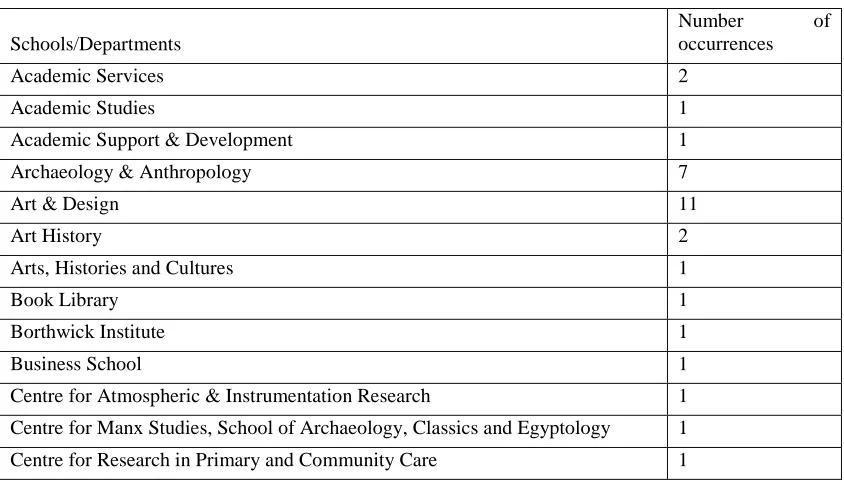
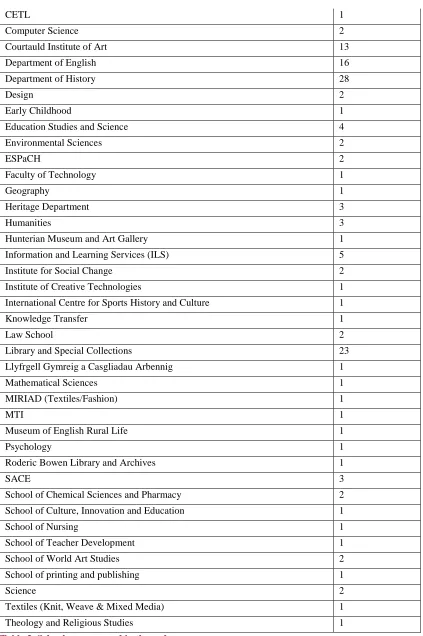
Table 3. Schools represented in the end user survey responses... 56
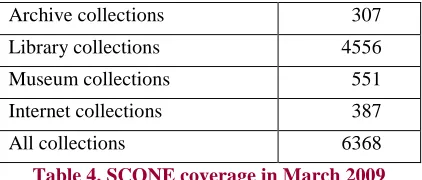
Table 4. SCONE coverage in March 2009 ... 62
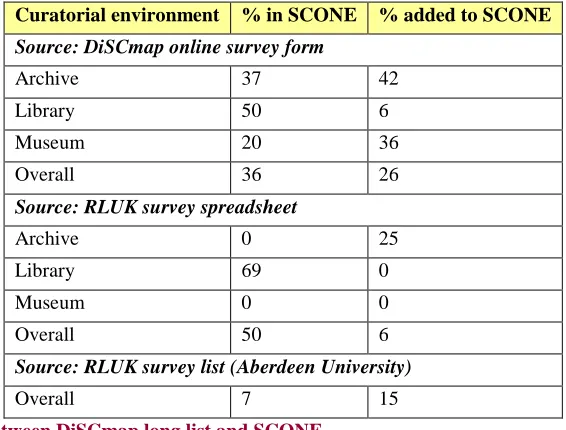
Table 5. Overlap between DiSCmap long list and SCONE... 63
Table 6. Variations in collections’ titles ... 65
Table 7. Examples of sub-collections nominated as collections... 66
Table 8. Multiple occurrences of carrier types ... 66
Table 9. List of complementary collections not nominated by their host institutions ... 67
Table 10. Short list 1: collections nominated by different groups of users... 82
Table 11. List of collection under the subject domain Mathematics, Chemistry and Physics ... 83
Table 12. Short list 3: thematic clusters based on collection titles ... 88
Table 13. Collections per digitisation reason... 88
Table 14. Details on the data received from different sources... 90
List of figures
Figure 1. Breakdown of actual and potential respondents to DiSCmap survey by region... 43Figure 2. Response by classification of University as percentage of their UK Total ... 44
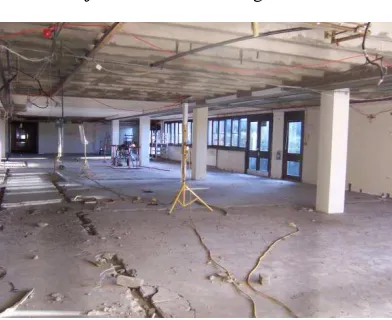
Figure 3. The Special Collections building in construction... 51
Figure 4. Images from the Lindsay Anderson Collection, University of Stirling ... 52
Figure 5. Screenshot 1: The “classic” presentation of the DiSCmap landscape in SCONE. ... 64
Figure 6. Screenshot 2: The DiSCmap landscape presented on Google Maps. ... 65
Figure 7. Granularity issues in physical and digitised collections ... 66
Figure 8. Coverage of subject domains in the collections from the long list ... 82
Figure 9. Popularity of digitisation reasons in the long list ... 88
Appendix I - Online survey of intermediaries
The following Appendix explains in summary the nature of the various fields used in the DiSCmap Online Survey of Intermediaries. A separate explanatory “Guidance” document was also produced and sent to all potential respondents, as well as being made available as a webpage alongside the questionnaire on the project website. The text below is partly based, but elaborates, on the content of the Guidance document.
Institution name
Department/school name
Department/school homepage
These first 3 fields are fairly self-explanatory, asking simply for the name of the respondent's institution, their department or school name and the URL of that department's homepage. There were two reasons why we did not create a drop-down list of institutions (for example, a standardised version the HERO list of UK HEIs) from which respondents could have selected the appropriate name. First; a drop-down list of 196 institutions would have been unwieldy on a standard computer monitor. Second; trying to normalise names would have created an unnecessary administrative burden for the project staff.
We introduced standardisation by asking respondents to supply the full, official name of their institution, without abbreviation.
Contact
Details of the person to contact for further information.
Name
Job title
Telephone
We could not assume that the person responding to the questionnaire was the person whom we had contacted via email. In many cases our “DiSCmap project Request” was forwarded to various other members of the institution or department contacted – for example, when our primary contact was unavailable, too busy to take part, or knew of another member of staff equally, or more qualified, to assist. Therefore, we asked respondents to supply us with their name, job title and basic contact details (destroyed after the project duration), allowing us – if necessary – to contact the correct individual with any additional questions.
The most important pieces of the questionnaire were the “Collection” and “Digitisation” sections, described below. The information gathered here directly contributed to the final project deliverables; primarily, the gathering of intermediary-led/user-focussed prioritisation criteria and a list of nominated Special Collections.
collection
Collection description
Collection management
•
Library/Special collections
•
Museum
•
Archive
•
Faculty/Department/School
Catalogue URL
We wished respondents to provide Collection names according to their “official” titles – i.e. the full title by which a Collection is referred to administratively in catalogues or records held by the library/archive or other department. We sought standardisation by asking that AACRII rules of capitalisation be adhered to (i.e. only the first word and proper nouns were to be capitalised). Abbreviations were not to be used.
“Description” was by necessity a free text field, asking for a brief summary of some or all of the scope and provenance of the Collection being nominated as well as its current condition. By condition we meant non-physical attributes, such as the extent to which the Collection was catalogued, curated and visible to researchers. This was the first field which might allow us to compare and contrast content and context with regard to which Collections were being nominated for digitisation by intermediaries and why. If respondents so wished they might tell us about any “notable” items within the Collection (i.e. items of real rarity or with special significance for the associated subject area or more generally, in socio-cultural terms).
Details on physical condition were to be entered in the “Notes” field (a free text box) at the bottom of the form. We could not assume that the department of the individual responding to our questionnaire corresponded to the environment in which the nominated Collection was curated. Similarly, the Collection might for some reason be located in a different space to the conceptual administrative space in which it was managed. For example, the Lindsay Anderson Collection at Stirling is currently held at Departmental level but remains an Archival Collection in every other sense. Therefore, respondents were to tell us whether nominated Collections were managed as Library/Special Collections, Museum Collections, Archives or within a Faculty, Department or School.
Where an online catalogue record of the Collection existed, we asked respondents to provide the URL; where more than one online catalogue record existed we preferred them to tell us of the one more co-extensive with the Collection (i.e. a specific shelf-list), irrespective of the functionality of the catalogue.
Agriculture & Related Subjects
Archaeology
Architecture, Engineering & Technology Biological Sciences
Business & Administrative Studies Cinema & Photography
Combined
Creative Arts, Design & Music Education
History of Art
Item age
•
-1799
•
1800-1899
•
1900-1949
•
1950-1999
•
2000-
The “Subject” and “Item age” fields were, to some extent, problematic. It was difficult to decide how granular we wished to be in our provision of subject headings, and indeed, which set of subjects we should offer as pre-set drop-down menu options. Clearly we did not need to reflect the fine and subtle distinctions of subject classification because it was not the aim of DiSCmap to consider nominated collections in that amount of depth. In any case, Special Collections tend to be relevant to a subject - or group of subjects – in broader rather than narrower terms, with connections to various aspects of a subject domain. In our professional judgement, it was unlikely that a Special Collection would be catalogued as a collection on “Plutocracy” rather than “Politics”. If it were, it would still be a sub-class of the parent “Politics” collection, justifying our approach while at the same time making it simpler to process the data.
While we did not wish to be pre-emptive, second-guessing the subject areas to which collections nominated corresponded, providing even the 142 “Principal” top-level subjects (as detailed in the HESA JACS Subject coding scheme) or those of similar schemes would have been unnecessary and prohibitive, both for the project team, and respondents expected to select from a huge drop down list. It was decided that we would use a small sub-set of 22 Subjects, using a modification of the HESA scheme. We selected headings corresponding to the most “common” faculties and taught courses within UK HE, and which accommodated within them the broadest range of materials. For example, “Architecture, Engineering and Technology” was used rather than “Architecture”, “Engineering” and “Technology”.
The 22 Subjects which we offered as options were presented alphabetically and are as follows:
Agriculture & Related Subjects
Archaeology
Architecture, Engineering & Technology
Biological Sciences
Business Studies
Cinema & Photography
Combined
Creative Arts, Design & Music
Education
General Humanities
History of Art
History of Science
Languages & Literature
Law
Librarianship, Computing & Information Science
Mathematics & Physical Sciences
Medicine, Dentistry & Allied subjects
Philosophy
Social, Economic & Political Studies
Theology & religious studies
Veterinary Sciences
These codes are a combination of high-level HESA codes with some additions. For the list of HESA codes see Appendix III.: It was decided to extend the range from within the existing top level hierarchy of HESA subject codes. The list of 19 top level Subject codes were adapted and expanded to form a list of 22 Subject Headings from which respondents could select to assist collection description. It was agreed that some of the subject headings related to Medicine, Science and Engineering would be conflated in order to allow for the expansion of subject coverage within the Humanities – the domain traditionally making high use of Special Collections. Medicine & Dentistry and Subjects Allied to Medicine - two distinct subject codes for HESA - were presented in DiSCmap as one, as were Computer Science and Librarianship & Information Science, Physical Science and Mathematical Science, Architecture Building & Planning and Engineering & Technology.
In the opposite direction, whilst the category of General Humanities remained, the range of subjects available from within this hierarchy was extended to include separate options for Archaeology, History (Economic & Social), History of Art, History of Science, Philosophy and Theology. Additionally the HESA subject code Cinematics was itself re-titled “Cinema & Photography” for improved clarity and extracted from within its top level classification of “Creative Arts & Design” to reflect an awareness of the growing significance of film and photographic archives for media research. Such modification was felt necessary both to increase the usability of the online form and to accommodate the wide range of collections which DiSCmap anticipated would be nominated related to Humanities subject areas.
Regarding dates; there were similar issues. DiSCmap was not expected to find or analyse in depth the dates of items within Collections nominated for digitisation, and to ask for this information would only have given us data surplus to requirement. For simplicity we devised a set of 5 broad date ranges in order that we could provide JISC with a general picture of the time periods to which nominated Collections belonged. Date ranges referred to date of production of the item, rather than any other of the dates associated with Special Collections (such as dates referred to by the item; acquisition date etc.).
The question of date (as with the Subject Headings) might be seen to signpost some of the further work which might usefully be undertaken by JISC, building on that of the DiSCmap team.
Languages (other than English)
We asked respondents to tell us if nominated Collections contained items in languages other than English in order to provide JISC with an illustrative snapshot – given that we could not predict which languages might be relevant, it was simpler that this information be provided to us via a free text box; there was less need to enforce standardisation or normalisation given that most individual languages were likely to be described uniformly by respondents – in English, “Hungarian” is always “Hungarian”, and “Welsh” always “Welsh”. Respondents were only to list languages which were applicable to significant parts of the Collection.
The role of language in digitisation prioritisation would also be a rich seam for further and deeper analysis.
Collection size
No. of serials (parts)
No. of manuscripts
No. of maps
No. of images
Size of archive (shelf-meters)
No. of audio recordings
No. of film/video recordings
No. of other items/objects
The final part of the “Collection” section asked for basic information on extent. Rather than using any domain-specific terminology (for example, that found in EAD) we simplified this so that it would be generalisable across all respondent groups and provide us with enough basic information to make an informed assessment and comparison. Approximations were acceptable.
Digitisation section
Digitised?
•
Part
•
No
•
Selected
Distributed?
•
Yes
•
No
•
Not known
We wished to know whether pieces of the Collection had already been digitised or at least whether the collection had been selected for digitisation as part of a definite or planned future project; clearly this has a bearing on whether or not the rest of the Collection should be prioritised for digitisation (although in what way depends on the specific priorities being taken into consideration). So too does knowing whether or not the Collection was distributed; bringing distributed parts of a Collection together is often part of the case made for digitisation and can represent increased value for money and value to the scholarly community.
Digitisation criteria
•
Collaboration
•Facilitate access
•
Preservation
•
Other
In light of this, we wished to know why the respondent was nominating a Collection for digitisation. Offering some of the common criteria usually advanced as reasons for digitisation allowed us to avoid gathering many non-standardised repetitions of the “obvious”, as well as simplifying the survey for respondents. The choices were derived from a literature review, including the current JISC digitisation strategy and a free text box allowed selections to be elaborated upon, or extended.
Case or additional criteria for digitisation
Teaching impact now
•
Not known
•
None
•
Low
•
High
•
Very high
Research impact now
•
Not known
•
None
•
Low
•
High
•
Very high
Teaching impact if digitised
•
Not known
•
None
•
Low
•
High
Research impact if digitised
•
Not known
•
None
•
Low
•
High
•
Very high
Impact statement
The “Case or additional criteria for digitisation” section of the questionnaire was not intended to be scientific – it asked for the opinion of one person (the respondent) on something qualitative and essentially immeasurable. It was one of the most important parts of the questionnaire, providing us with a basis to compare and contrast Collections in terms of the judgements made about their current impact and their potential impact (if digitised) by active professionals in intimate contact with, and possessing knowledge not only of the Collections themselves but the subject areas and the users to which they relate. These impact statements could, in broad terms allow respondents to indicate to us the perceived value of these Collections to their core user groups: i.e. teaching staff and researchers. This will be invaluable in informing JISC about which Collections must move up any given hierarchy with scholarly need as its foundation.
Initially we – and the DiSCmap Advisory Board – had some misgivings, wondering if respondents might – sensing the dangling carrot of potential funding, or through excessive regard for the fate of a Collection close to them – select “High” or “Very High” for each of the impact questions, regardless of actualities. However, our decision to trust in the intermediaries' professionalism, honesty and lack of bias bore fruit as this skewing of data did not in fact occur; selections were made across the board.
We provided a free-text box to counter-act the limitations involved in offering only pre-set “scales” on impact, giving intermediaries valuable space to tell us about specific reasons why the digitisation of their nomination would be of “high” or “low” impact for teachers and researchers within their own or other institutions; for example, we were able to gather information on which taught courses within respondents' institutions these Collections – if digitised – would benefit, something which would be very time-consuming to try and discern otherwise.
Copyright
•
None
•
Held by institution
•Held by another party
•
Not known
Current conservation?
•
No
Additional information
Notes
Because any digitisation activities must comply to Copyright and other IPR rules and regulations it was common sense that we ask respondents to tell us whether it was their or another institution who held the Copyright of the Collections they were proposing be digitised. If another party was in possession, respondents could tell us about them in the “Additional information” field.
Appendix II - Direct user survey
Work here has followed a lifecycle model which started with identification of assessment criteria followed by identification of participants which has been informed by discussions with JISC and the Advisory board at the meeting 5th December 2008. Collection of responses has been undertaken through direct and indirect methods. As such, definition of initial criteria was developed through analysis of the literature and related studies informal discussions with Intermediaries at the RLUK conference and results from the Intermediary survey described in Appendix I.
Five Intermediary participants were interviewed from a range of institutions across the UK HE community. It was initially hoped that engagement with Intermediaries would occur through a variety of methods but it was found that the most successful was via interview. Social networking was explored but at this stage is not used with sufficient consistency to form the main data collection approach. A Facebook Group has been set up (24 members to date), with links to the Discussion Forum at Strathclyde, and it is hoped that this will continue to develop. It remains to be seen if Intermediaries use this to discuss issues regarding digitisation of Special Collections, and to which directed questions can be debated and resources discussed. Results of these interviews identified: 1) digitisation criteria important to Intermediaries, 2) criteria thought to be important to end users and 3) views on the impact on teaching and research of the digitisation of Special Collections. The interview schedule used can be seen in Appendix IIb.
Initially Direct-users of digitised materials were going to respond to a preliminary list of potential priority collections (as identified by the Intermediaries) and asked to refine the final selection of collections according to the needs of their own research area and agenda. However, it became apparent early on in the project that this approach may restrict Direct users and as such the decision was made to allow users to identify the Special Collections they use for their research, studies or teaching and to identify if they wish these collections to be digitised (if not already).
Consultation with Direct-users has been undertaken by online questionnaire and focus group and interview. The online survey was informed by: 1) the results of the Intermediary survey described in Section 4.2.1 of the DiSCmap project report) the findings of the interviews with Intermediaries and 3) critical evaluation of related studies. This enabled the development of a list of criteria for digitisation of Special Collections from which end users could select, and add their own. Further to this, advice was taken from the members of the Advisory Board meeting of December 2008 on additional areas of investigation to include. A pilot questionnaire was tested with colleagues in CERLIM and CDLR and, following final adjustments, the survey released for one month from end of January until end of February 2009. This survey can be seen in Appendix IIa.
Utilising the database of mass contacts compiled for the Intermediaries’ survey which contained an identified Intermediary from each higher education library was emailed with a request to distribute an invitation to staff and students of their institution to participate in the online survey. In total 196 universities were contacted. In addition, related professional bodies were also invited to participate and postings were made on the DiSCmap Facebook group, other related groups on Facebook (12 in total) and on the Project website and Discussion forum. Results of this online survey are presented in the following series of charts, tables and graphs, with additional detailed analysis being provided in Appendix VI.
It was agreed with the Advisory Board in December 2008 that the subjects to be included for the workshop/focus groups would be the Biological Life Sciences, History and Sociology. Two focus groups were to be held in Manchester (History and Sociology) and one in Glasgow (Biological Life Sciences). To this end participants from universities located within a reasonable travelling distance were invited to attend and in total 221 Historians were invited to participate; 159 Sociologists and 214 Biological Life Scientists. However, efforts to recruit participants to these focus groups were largely unsuccessful, with only one focus group taking place for Historians (plus one interview for a participant who was unable to attend the focus group but wished to participate). One participant accepted the invitation for Biological Life Sciences and was subsequently interviewed. No academics accepted the invitation for Sociology. The Focus Group/Interview schedule used can be seen in Appendix IIb and IIc. Comments from the focus group and interview are interspersed with the survey findings below.
Appendix IIa- Direct user survey – online questionnaire
Welcome: DiSCmap - Digitisation in Special Collections: Mapping, Assessment, Prioritisation
Thank you for taking part in this online survey. The results will be used to inform the DISCmap Project which aims to map, assess and prioritise Special Collections. We define Special Collections as those collections identified as such by the staff of libraries, museums and archives, arranged and curated as such, and (at least to some extent) already visible to researchers and the public.
We welcome any further thoughts or opinions as to the definition of Special collections through our forum
http://forums.cdlr.strath.ac.uk/index.php
How is DISCmap relevant to you?
This research will help to ensure that the digitisation of institutional Special Collections is carried out using a clear, practical and useful set of criteria, meeting the actual needs and demands of researchers, lecturers, students and other end users.
Data use and Disclaimer
All participants are guaranteed anonymity and all personal data gathered in the process of research from participants will be destroyed after the completion of the DISCmap project. We will not attempt to use the answers we are provided as though they were fixed or factually based ‐ no opinions will be used in ways which participants might be held accountable for.
This survey asks a total of 20 questions and should take approximately 15 minutes to complete.
Please note that once you have clicked on the CONTINUE button at the bottom of each page you can not return to review or amend that page.
This first section asks for some brief details about you. This information will be kept confidential and data will be used anonymously.
1. Please select the description which most closely matches your role, or roles, within your institution.
(select all that apply)
Academic Lecturer Academic Researcher
Academic Research Associate Academic Research Fellow Academic Senior Research Fellow Academic Reader
Academic Professor Undergraduate Student Post Graduate Student Research Student
Special Collections Manager Archivist
Librarian
Other (please specify):
2. Please tell us the name of your institution:
Please tell us the name of your Department/School:
3. If you would be willing to participate in a focus group please provide us with your name and email
regarding this project.
YOUR reasons for digitisation of a Special Collection
4. What would be YOUR OWN reasons or criteria for a Special Collection to be digitised?
(select all that apply)
Because the collection is rare or valuable
Because it would enable me to use it more frequently Because it would improve my access to the collection
Because it would allow me to work collaboratively with other people
Because it would help with the preservation and conservation of the collection Because it would have a positive impact on my teaching of a subject
Because it would have a positive impact on my research or studies Because there is little in my subject area which is currently digitised
Because there is little in the chronological timeline I am interested in which is currently digitised Because there is little in the format I am need in which is currently digitised
Because it would bring distributed parts of a collection together allowing me to access it more easily and improving intellectual coherence
a. If you feel that there is little in your subject area which is currently digitised please state what this subject is:
b. If you feel that there is little in the chronological timeline you are interested in which is currently digitised please state what this timeline is:
c. If you feel that there is little in the format which is currently digitised please state what this format is:
d. Any other criteria/issue/point you wish to raise:
Special Collections and your RESEARCH or your STUDIES
Use of Special Collections and your RESEARCH or your STUDIES
5. Do you use Special Collections for your research or studies? If you answer Yes to this please answer question 6. If you answer No, Don't know, or Not applicable please go to question 7.
Yes No
Don't know Not applicable
6. Which Special Collections do you need to use for your research or studies?
To what extent (to your
knowledge) are they digitised?
Do you want
or need them
to be
digitised?
Name of the Collection Into which subject area does this Collection fall?
NOT digitised
PART digitised
Digitised Don't know
a. 1
b. 2
c. 3
d. 4
e. 5
7. What is the level of impact of the non-digitised Special Collections you use on your research or studies?
None Low High Very high Not applicable
a. If none or low, what are the current factors preventing non-digitised Special Collection materials impacting on your research
or studies?
(select all that apply)
b. If high or very high, how do non-digitised Special Collection materials impact on your research or studies?
(select all that apply)
Increase subject knowledge Further interdisciplinary research Further collaborative research
Enable research or rare and unique materials Aid formation of research networks
Other (please specify):
8. Please speculate as to level of the potential impact of digitised Special Collections on your research or
studies
Very high Not applicable
If high or very high, how would digitised Special Collection materials impact on your research or
studies?
(select all that apply)
Increase subject knowledge Further interdisciplinary research Further collaborative research
Enable research or rare and unique materials Aid formation of research networks
Other (please specify):
9. Do you feel that there is a lack of digitised Special Collections available to assist you in your research
or studies?
Yes No
Don't know Not applicable
If yes, does the lack of digitised collections hinder your research or studies? Yes
No
Don't know
If no, please explain why not:
Special Collections and your TEACHING
Use of Special Collections and your TEACHING
10. Do you use Special Collections for your teaching? If you answer Yes to this please answer
Yes No
Don't know
11. Which Special Collections do you need to use for your teaching?
To what extent (to your knowledge) are they
digitised?
Do you want or need them to be digitised?
Name of the Collection
Into which subject
area does this Collection fall?
NOT digitised PART digitised
Digitised
Don't know
Yes
No Don't know a.
1
b. 2
c. 3
d. 4
e. 5
12. What is the impact of the non-digitised Special Collections
you use on your teaching?
Low High Very high Not applicable
a. If none or low, what are the current factors preventing the impact of non-digitised Special
Collection materials on your teaching? (select all that apply)
Time Access Cost Travel Material types Other (please specify):
b. If high or very high, how do non-digitised Special Collection materials impact on your teaching?
(select all that apply)
Preparation of teaching materials
13. Please speculate as to the potential impact of digitised Special Collections on your teaching?
None Low High Very high Not applicable
If high or very high, how would digitised Special Collection materials impact on your teaching? (select all that apply)
Preparation of teaching materials Cite as references for students Other (please specify):
14. Do you feel that there is a lack of digitised Special Collections available to assist you in your
Yes No
Don't know Not applicable
a. If Yes, does the lack of digitised collections hinder your teaching? Please explain how:
b. If No please explain why not:
15. Would digitisation of a Special Collection affect your use of that Collection?
Yes No
Don't know
a. If yes, please explain how:
b. If no, please explain why not:
16. Do you find it difficult to find digitised Special Collections?
Yes No
Don't know
a. If yes, please explain why:
17. How do you usually find out about a digitised Special Collection?
(select all that apply)
Library Librarian
Searching the university catalogue Searching using a search engine Searching using COPAC Searching using Intute Searching using INFORM25 Searching using the Archives Hub Searching using other academic resource Word of mouth from colleagues
References in articles/newsletters etc Other (please specify):
18. Do you think any of the Special Collections you use have relationships or links with other separate Collections? If you answer Yes to this please answer question 19. If you answer No or Don't know please go to question 20.
Yes No
Don't know
19. What are these Collections?
Linked to Collections overseas?
Collection names: UK
USA
Europe Other (please specify)
If yes, please explain which these are and what is the link:
b. 2
c. 3
d. 4
e. 5
20. In order for us to understand the digitisation priorities of academic students, researchers and lecturers it would be helpful if you could tell us your own individual priorities as:
Your priorities in terms of, for example, career/contribution to knowledge/excellence in teaching/publication and dissemination of work/success in studies, etc
a. As a researcher
b. As a lecturer
Final Page
Who are the DISCmap team?
DISCmap is funded by the Joint Information Systems Committee (JISC) and Research Information Network (RIN) and is being carried out by staff at the Centre for Digital Library Research (CDLR) at the University of Strathclyde, and the Centre for Research in Library and Information Management (CERLIM) at Manchester Metropolitan University (MMU).
Online Presence
We would be grateful if you would bookmark the DISCmap project website,
http://discmap.cdlr.strath.ac.uk/index.htm where project documents, progress updates and details of forthcoming events will be made available. DISCmap also makes use of an online forum and we invite you to join (http://forums.cdlr.strath.ac.uk/index.php). Joining instructions are on the project website.
Contacts
If you have any questions about this study please contact: Jill Griffiths: [email protected]
Centre for Research in Library and Information Management (CERLIM), Manchester Metropolitan University.
http://www.cerlim.ac.uk
Appendix IIb- Direct user survey – Intermediary schedule.
Interview schedule DISCMAP – 5 areas we wish to ask about, plus one free text question for any
additional thoughts
Interview with:
__________________________________________________________________________________________
Role: ________________________________________________________________________________
Prompts/suggestions √ Prompts/suggestions √
Archivist Librarian
Collections Manager
Institution: ________________________________________________________________________________
Any other observations: _____________________________________________________________________
1.1) What are YOUR CRITERIA for prioritising collections for digitisation?
__________________________________________________________________________________________ __________________________________________________________________________________________
Prompts/suggestions √ Prompts/suggestions √
Importance (unique) Number of volumes
Importance (rare) Number of pages
Potential users Preservation needs
Consultation required
(internal/external)
Access (any restrictions)
Copyright (needing
clearance)
Added value from
digitisation
Fundraising possibilities User driven requests
Response to funding calls High level of potential
1.2) Do relationships or links exist between a nominated collection with other collections? Does this affect
your prioritisation?
__________________________________________________________________________________________
2.1) Do you have a PRESERVATION strategy or do you build on known examples of good practice?
__________________________________________________________________________________________
2.2) Are there strategies to work with other institutions in the preservation of collections?
__________________________________________________________________________________________
2.3) Do you have any view on the preservation medium needed for Special Collections?
__________________________________________________________________________________________
2.4) Is digital or microfilm preferred?
__________________________________________________________________________________________
3) Do you have a view on how END USERS may prioritise digitisation of collections?
__________________________________________________________________________________________
Prompts/suggestions √ Prompts/suggestions √
Own research needs Own teaching needs
Access (restrictions) Importance (unique)
Importance (rare) Full collections
Specific items
THE FOLLOWING ARE NEW CRITERIA
Because the collection is
rare or valuable
Because it would enable
them to use it more
frequently
Because it would improve
their access to the
collection
Because it would allow
them to work
people
Because it would help with
the preservation and
conservation of the
collection
Because it would have a
positive impact on their
teaching of a subject
Because it would have a
positive impact on their
research or studies
Because there is little in
their subject area which
is currently digitised
Please state what this
subject may be
______________________
Because there is little in
the chronological timeline
they are interested in
which is currently
digitised
Please state what this
chronological timeline may
be ____________________
Because there is little in
the format they need which
is currently digitised
Please state what this
format may be
_________________
4) What are your views on levels of current USAGE of collections and what do you think the IMPACT
would be if these collections were digitised?
4.1) IMPACT in terms of USE of collections:
4.1.1) What are the current levels of use of non-digitised collections?
__________________________________________________________________________________________
4.1.2) Impact in terms of increase in use - Do you think that the level of use and demand of collections
would increase after digitisation?
__________________________________________________________________________________________
4.1.3) Is the digitised material you’ve got used? And if not being used, why not?
__________________________________________________________________________________________
4.1.4) Do you have any evidence of usage on collections (statistics/ requests for analogue and digital
collections)? And if yes, may we see these or have an anecdotal report of them?
4.2) IMPACT ON TEACHING
__________________________________________________________________________________________
4.2.1) Is it possible to see differences in the behaviour of LECTURERS once a collection has been
digitised? ________________________________________________________________________________
4.3) IMPACT ON RESEARCH
__________________________________________________________________________________________
4.3.1) Is it possible to see differences in the behaviour of RESEARCHERS once a collection has been
digitised?
__________________________________________________________________________________________
5) Which subject disciplines/user communities are most likely to engage with discussions on the
digitisation of collections? And what might be the best way to encourage them to participate?
__________________________________________________________________________________________
6) Do you use social networking tools/sites/groups to keep in contact with other colleagues and/or users?
__________________________________________________________________________________________
Prompts/suggestions √ Prompts/suggestions √
Email lists Social networking sties
Facebook MySpace
LinkedIn Blogs
Wiki
7) Any other issues they would like to raise?
Appendix IIc- Direct user survey – end user focus group schedule (also
used as a basis for two interviews).
DiSCmap Focus Group script
Note to facilitators: Instructions for facilitators are in standard text. Areas for discussion - to be read out - are in bold text. Smaller text to be used as prompts/probes where necessary.
Suggested timings are provided by each section.
Where appropriate, the most important questions in each area are highlighted in yellow.
11.00 Start
The purpose of the focus group is to gather the views and opinions of prioritisation of the digitisation of Special Collections in UK higher education.
Read out the statement on confidentiality:
Opinions expressed will be treated in confidence among project staff for the purpose of the DiSCmap Project. All responses will remain anonymous.
Check that there are no objections to the use of the audio recorder.
Start off by reiterating the purpose of the meeting, e.g.:
I am very grateful to you all for sparing time for this focus group session. The session should last for around 1 ½ hours, please help yourself to refreshments at any time.
Before we start, does anyone have any questions?
In the short space of time we have for this focus group, we would like to explore the following areas, which were also covered in recent survey undertaken for the project:
1. Your own criteria for prioritisation of digitisation of a collection 2. Special collections and your research
3. Special collections an your teaching
4. Your views on digitisation at a broader level
To get the conversation going go around the table getting people to introduce themselves:
Please could you say who you are, where you work, and very briefly describe your area of research or teaching.
What would be YOUR OWN reasons or criteria for a Special Collection to be digitised?
(select all that apply)
Because the collection is rare or valuable
Because it would enable me to use it more frequently Because it would improve my access to the collection
Because it would allow me to work collaboratively with other people
Because it would help with the preservation and conservation of the collection Because it would have a positive impact on my teaching of a subject
Because it would have a positive impact on my research or studies Because there is little in my subject area which is currently digitised
Because there is little in the chronological timeline I am interested in which is currently digitised Because there is little in the format I am need in which is currently digitised
Because it would bring distributed parts of a collection together allowing me to access it more easily and improving intellectual coherence
Other (please specify):
If you feel that there is little in your subject area which is currently digitised please state what this subject is:
If you feel that there is little in the chronological timeline you are interested in which is currently digitised please state what this timeline is:
If you feel that there is little in the format which is currently digitised please state what this format is:
11.35: 2. Special collections and your RESEARCH:
Do you use Special Collections for your research or studies? Yes
Yes: 61.8% 55 No: 21.3% 19
Don't know: 9.0% 8 Not applicable: 7.9% 7
Please speculate as to level of the potential impact of digitised Special Collections on your research or studies
None: 3.4% 3 Low: 11.2% 10
High: 49.4% 44
Very high: 31.5% 28
Not applicable: 4.5% 4
Preparation of teaching materials: n/a 35 Cite as references for students: n/a 31
Other (please specify): n/a 13
11.55: 3. Special collections and your TEACHING:
Do you use Special Collections for your teaching?
Yes: 26.5% 22
No: 62.7% 52 Don't know: 10.8% 9
Please speculate as to level of the potential impact of digitised Special Collections on your teaching
None: 8.4% 7
Low: 18.1% 15
High: 30.1% 25
Very high: 14.5% 12
Not applicable: 28.9% 24
How would digitised Special Collection materials impact on your teaching?
Preparation of teaching materials: n/a 35 Cite as references for students: n/a 31
Other (please specify): n/a 13
12.15: 4. Your views on digitisation at a broader level
Would digitisation of a Special Collection affect your use of that Collection?
Yes: 88.2% 67 No: 5.3% 4
Don't know: 6.6% 5
How do you find digitised Special Collections?
Library: n/a 32 Librarian: n/a 20
Searching using other academic resource: n/a 20 Word of mouth from colleagues: n/a 39 References in articles/newsletters etc: n/a 29 Other (please specify): n/a 11
Advert/info from independent provider
Archive to Archive at National Archives website Athens data archive
google Google HE colleagues
through AIM25, M25 etc
It is very difficult to get any info other than by word of mouth. Knowledge of collecting history etc.
posters specialist literature, scholarly articles and conference papers
Could tell us your own individual priorities as:
Researcher - Your priorities in terms of, for example, career/contribution to knowledge/excellence in teaching/publication and dissemination of work/success in studies
Lecturer - Your priorities in terms of, for example, career/contribution to knowledge/excellence in teaching/publication and dissemination of work/success in studies
Student - Your priorities in terms of, for example, career/contribution to knowledge/excellence in teaching/publication and dissemination of work/success in studies
Finally thank the group for their time.
Appendix III - HESA Subject codes used and expanded list of codes
1The List of 22 Subject Codes revised from available HESA Subject Codes was used in the surveys with the intermediaries and the end users. All Subject headings appeared alphabetically on the web form.
(1) Medicine, Dentistry & Allied subjects (2) Biological Sciences
(3) Veterinary Sciences
(4) Agriculture & Related Subjects (5) Mathematics & Physical Sciences (6) Architecture, Engineering & Technology (7) Social, Economic & Political Studies (8) Business Studies
(9) Law
(10) Librarianship, Computing & Information Science (11) Languages & Literature
(12) General Humanities
(13) History, economic & social history (14) Archaeology
(15) History of Art (16) History of Science (17) Philosophy
(18) Theology & religious studies (19) Creative Arts, Design & Music (20) Cinema & Photography (21) Education
[image:39.595.65.531.569.751.2](22) Combined
Table 1 presents the detailed list of HESA subject codes.
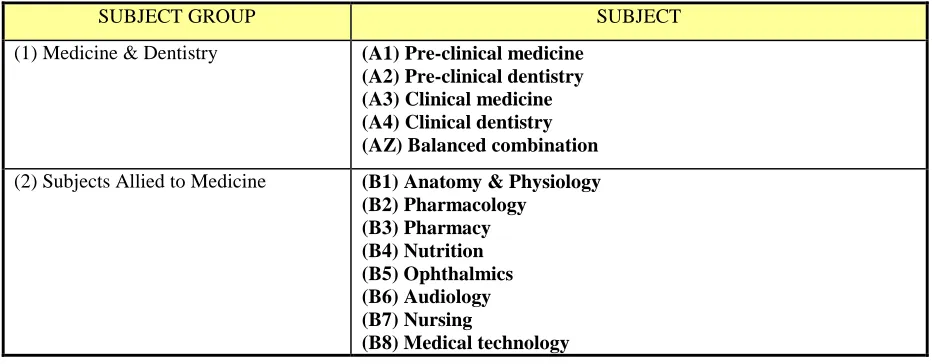
SUBJECT GROUP SUBJECT
(1) Medicine & Dentistry (A1) Pre-clinical medicine (A2) Pre-clinical dentistry (A3) Clinical medicine (A4) Clinical dentistry (AZ) Balanced combination
(2) Subjects Allied to Medicine (B1) Anatomy & Physiology (B2) Pharmacology
(B3) Pharmacy (B4) Nutrition (B5) Ophthalmics (B6) Audiology (B7) Nursing
(B8) Medical technology
(B9) Other medical subjects (BZ) Balanced combination
(3) Biological Sciences (C1) Biology (C2) Botany (C3) Zoology (C4) Genetics (C5) Microbiology
(C6) Molecular biology & biophysics (C7) Biochemistry
(C8) Psychology (not solely as social science) (C9) Other biological sciences
(CZ) Balanced combination
(4) Veterinary Sciences (D1) Veterinary sciences
(5) Agriculture & Related Subjects (D2) Agriculture (D3) Forestry (D4) Food science
(D8) Agricultural sciences (D9) Other agricultural subjects (DZ) Balanced combination
(6) Physical Science (F1) Chemistry (F2) Materials science (F3) Physics
(F4) Archaeology as a physical science (F5) Astronomy
(F6) Geology (F7) Oceanography
(F8) Geography studies as a science
(F9) Environmental science & other physical sciences (FZ) Balanced combination
(7) Mathematical Science (G1) Mathematics (G4) Statistics
(G9) Other mathematical sciences (GZ) Balanced combination
(8) Computer Science (G5) Computing science
(9) Engineering & Technology (H1) General engineering (H2) Civil engineering (H3) Mechanical engineering (H4) Aeronautical engineering (H5) Electrical engineering (H6) Electronic engineering (H7) Production engineering (H8) Chemical engineering (H9) Other engineering (HZ) Balanced combinations (J1) Minerals technology (J2) Metallurgy
(J3) Ceramics & glasses (J4) Polymers & textiles
(J5) Other materials technology (J6) Maritime technology (J8) Biotechnology (J9) Other technologies
(K3) Environmental technologies (K4) Town & country planning (K9) Other architectural studies (KZ) Balanced combination
(B) Social, Economic & Political Studies
(L1) Economics (L3) Sociology
(L4) Social policy & administration (L5) Social work
(L6) Anthropology
(L7) Psychology (without significant element of biological science)
(L8) Geography (unless solely as a physical science) (LZ) Balanced combination
(M1) Politics
(M9) Other social studies
(C) Business & Administrative Studies (N1) Business & management studies (N2) Operational research
(N3) Financial management (N4) Accountancy
(N5) Marketing & market research (N6) Industrial relations
(N7) Catering & institutional management (N8) Land & property management
(N9) Transport, other business & administrative studies (NZ) Balanced combination
(D) Law (M3) Law
(E) Librarianship & Information Science
(P1) Librarianship (P2) Information science (P3) Communication studies (P4) Media studies
(P5) Publishing (P6) Journalism
(PZ) Balanced combination
(F) Languages (Q1) Linguistics
(Q2) Comparative literature (Q3) English
(Q4) American studies
(Q5) Celtic languages, literature & culture (Q6) Latin language & literature
(Q7) Ancient Greek language & literature (Q8) Classics
(Q9) Other ancient languages & related studies (QZ) Balanced combination
(R1) French language, literature & culture (R2) German language, literature & culture (R3) Italian language, literature & culture (R4) Spanish language, literature & culture (R5) Portuguese language, literature & culture (R6) Latin American languages, literature & culture (R7) Scandinavian languages, literature & culture (R8) Russian languages, literature & culture
(T1) Slavonic & East European languages, literature & culture (T2) Other European languages, literature & culture
(T6) Modern Middle Eastern languages, literature & culture (T7) African languages, literature & culture
(T8) Other language studies
(T9) Other or unspecified modern languages
(G) Humanities (V1) History
(V3) Economic & social history (V4) History of art
(V5) History & philosophy of science (V6) Archaeology
(V7) Philosophy
(V8) Theology & religious studies (V9) Other humanities
(VZ) Balanced combination
(H) Creative Arts & Design (W1) Fine art (W2) Design studies (W3) Music
(W4) Drama (W5) Cinematics (W6) Crafts
(W8) Beauty & hairdressing (W9) Art & design other (WZ) Balanced combinations
(I) Education (X1) Teacher training
(X2) Physical education
(X3) Academic studies in education (X4) Techniques in teaching children (X5) Techniques in teaching adults
(X6) Education for those with special needs (X7) Technology in education
(X8) Management & organisation of education (X9) Other topics in education
(XZ) Balanced combination
(J) Combined (Y1) Combined or general science
(Y2) Combined or general social science (Y3) Combined or general arts
(Y4) Other combined or general courses/modular courses (Y5) Combined general & leisure courses not elsewhere specified (Y6) Research methods
Appendix IV – Intermediary survey and analysis
Breakdown of responses by region and age
Given that the methodology employed for the creation of the Intermediary Survey considered both the location and age/type of any given HEI, it is interesting to examine how region and type were reflected in the response rate.
Responses by region
16 2 1 3 1 2 7 6 6 5 2 6 5 5 3 8 4 14 7 6 15 43 3 9 0 10 20 30 40 50 60 Number of institutions (blue: responded, green: unresponded) Sco tland
N Ir elan
d
N E ast
N W est
Yor kshi
re & Hum
ber
E M idla
nds
W M idla
nds Eas
tern S E
ast S W
[image:43.595.77.523.238.536.2]est Lond on Wal es REGIONS
Figure 1. Breakdown of actual and potential respondents to DiSCmap survey by region
Just under half of the regions gave a 50% or above response rate. The highest regional response rate came from Scotland, with 88% of those contacted participating. This figure includes 2 RLUK member institutions (the Universities of Aberdeen and Glasgow) who responded to DiSCmap without being approached directly by the project team.
In total, the survey had a 46% response rate. However, after eventual confirmation from the RLUK survey team, February saw the inclusion of HEIs and RIs associated with RLUK member institute the University of London, its School of Advanced Study and its associated Research Institutes, which increased the overall survey group from 153 to 173 HEIs, thereby reducing the rate of response accordingly to approximately 40%.
The figures indicated below the waterline in blue are the number of HEIs which responded per region, whilst figures above refer to the quantity of HEIs that could potentially come into the scope of any future mapping or assessment.
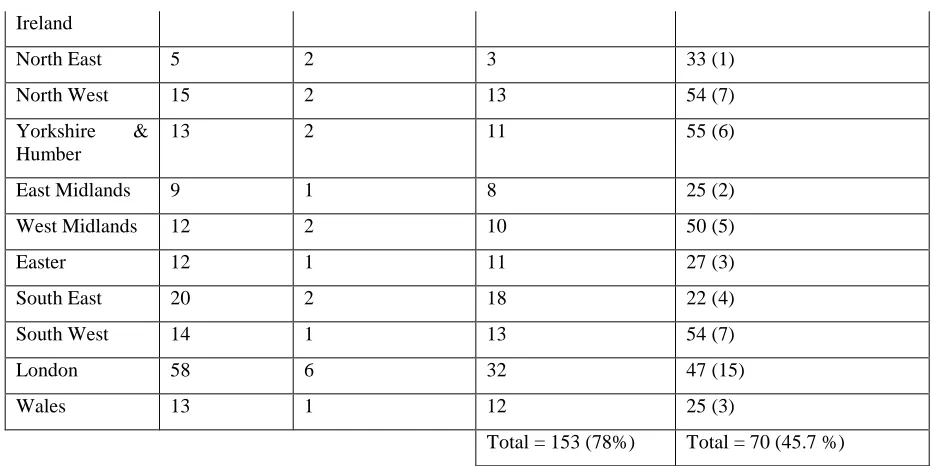
Region Number of HEIs
Number of HEIs in RLUK
Total contacted by DiSCmap
Percentage/Number Responding
Scotland 21 3 18 88 (16)
[image:43.595.66.535.708.770.2]Ireland
North East 5 2 3 33 (1)
North West 15 2 13 54 (7)
Yorkshire & Humber
13 2 11 55 (6)
East Midlands 9 1 8 25 (2)
West Midlands 12 2 10 50 (5)
Easter 12 1 11 27 (3)
South East 20 2 18 22 (4)
South West 14 1 13 54 (7)
London 58 6 32 47 (15)
Wales 13 1 12 25 (3)
[image:44.595.64.531.78.311.2]Total = 153 (78%) Total = 70 (45.7 %) Table 1. Total number of HEIs surveyed in January 2009, by region.
Respondents by type of institution
Of the “Pre-1960s” Universities which responded to the mass survey, 16 were located in England 6 in Scotland and 3 in Wales. This gave a total of 25, approx. 36 % of participating HEIs. An equivalent rate of response of 36% was received from the “Post 1992” institutions, 19 from England, 6 from Scotland (non from N. Ireland or Wales) again with a total of 25 HEIs. A total of 20 “Post Robbins” Universities, 15 from England, 4 from Scotland and 1 from N. Ireland (again none from Wales) responded giving them 28% coverage.
Although numbering fewer HEIs within the overall response to DiSCmap, if we examine the rate of response by institutional type as a percentage of their UK total, (illustrated below in Figure 2) it becomes clear that “Post Robbins” universities form the most pro-active group in advancing their priorities for digitization - 20 out of 36 having responded to the survey.
25
20
25
58
16
52
0 10 20 30 40 50 60 70 80 90 Pre-1960
(30%) Post-Robbins
(55%) Post-1992
(32%)
T
y
p
e
o
f
in
s
ti
tu
ti
o
n
Number of HEI respondents (blue: responded, green: unrespondent)
[image:44.595.134.460.463.727.2]The typology of digitisation criteria to emerge from the mass survey of
Intermediaries
The following list of 24 separate criteria is an inclusive one discerned from extensive analysis of the DiSCmap survey response. (Note: because some of these are broadly similar, they were latterly conflated when preparing the final framework). No attempt has been made to establish a ranking in order of priorities or in the order in which intermediaries or end users advanced them – nor was the user-related criteria solely advanced by end users in the survey.
Below are provided some elaboration on how/why these criteria were discerned. 1. User orientated criteria
2. Collection level criteria
3. Physical / Environmental factors 4. Institutional concerns
5. Wider cultural issues User orientated criteria
– to improve/facilitate access – to meet evidence of user demand
– to enhance teaching of undergraduate and taught masters course – to enhance teaching of networked courses for distance learners – to support ongoing research
– support research in multiple disciplines (interdisciplinarity) – a means of furthering collaborative research projects – potential to create a new subject area for research – create / support research and teaching using new media – potential impact for users beyond the boundaries of HE Collection level criteria
– collections pertaining to significant individual/s – regional importance
– iconic collections of national importance – collections with international scope/ impact
– uniqueness and/or rarity of the collection and its materials
– comprehensiveness of the collection (i.e. its range, mixture, representativeness, critical mass of materials)
– linkage to other related/distributed collections and digitisation projects – materials suitable for digitisation (e.g. papers - less time/effort involved) – no or few IPR restrictions
Physical / Environmental factors
– considerations of space/storage
– a means of preservation (to prevent deterioration of original) Institutional concerns
– to increase/attract/promote greater usage – college/university has strong open access policy