Theses Thesis/Dissertation Collections
4-10-2009
Exploring the Relationships between Executive
Functions and The Big Five Personality Traits using
the Behavior Rating Inventory of Executive
Functioning-Adult Form
Kira FormicolaFollow this and additional works at:http://scholarworks.rit.edu/theses
This Thesis is brought to you for free and open access by the Thesis/Dissertation Collections at RIT Scholar Works. It has been accepted for inclusion in Theses by an authorized administrator of RIT Scholar Works. For more information, please [email protected].
Recommended Citation
Running Head: EXECUTIVE FUNCTION AND PERSONALITY
Exploring the Relationships between Executive Functions and The Big Five Personality Traits using the Behavior Rating Inventory of Executive Functioning-Adult Form
Abstract
CHAPTER ONE Overview
Exploring the Relationships between Executive Functions and The Big Five Personality Traits using the Behavior Rating Inventory of Executive Functioning-Adult Form
Researchers have taken a particular interest in how personality and executive function correlate and influence each other. Demetrious and Kazi (2001) infer that personality shapes how individuals make use of and control their cognitive abilities. Correlations between these factors have been found using various measures of executive function, including questionnaires, self-report inventories, and performance measures such as sorting tasks.
Executive functions refer to processes used during goal-oriented problem solving (Neisser, 1967). These functions are responsible for regulating, directing, delegating, and controlling behavior (Giao, Isquith and Guy, 2001). An individual's ability to initiate behavior, inhibit competing actions or stimuli, set goals, problem solve, shift problem solving strategies, exhibit emotional control, sustain working memory, and monitor and evaluate behavior impacts how that individual interacts with the environment (Giao, Isquith and Guy, 2001).
Extraversion, Conscientiousness, Neuroticism, Agreeableness, and Openness to Experience.
Emotional regulation has been one of the predominant executive functions investigated in regards to the correlations between executive function and personality (Jensen-Campbell, 2007). Jensen-Campbell (2007) found a relationship between the regulation of anger, aggression, and the personality traits of Agreeableness and
Conscientiousness using both a self-report measure of anger and a performance measure of aggression. Kokkonen and Pulkinen, (2001) also measured emotional-regulation using self-report measures and found a significant relationship between emotional regulation and the traits of Extraversion and Neuroticism.
Various self-report and performance measures have been used to assess executive function to demonstrate the relationships between executive functions and personality. Performance based, traditional measures of executive function often meet criticism because they do not represent real world challenges of dysexecutive function (Burgess et. al, 2006). Some purport that self report measures and behavior rating scales of executive function are more effective assessments of the real life challenges that occur due to dysexecutive function (Chaytor and Schmitter-Edgecombe, 2003).
emotional regulation. None of these measures aimed to measure executive function globally, as they only focused on specific executive functions.
One measure of executive function that has not been investigated with these correlations is the Behavior Rating Inventory of Executive Functioning- Adult Version (BRIEF-A). The BRIEF-A is a 75-item standardized self-report measure designed to evaluate an individual's executive control functions (Gioia et al., 2001).This inventory is not limited to just one or two aspects of executive function, but is a global measure of executive function made up of nine scales.
The current study explores the BRIEF-A's ability as a self-report, global measure of executive function, to demonstrate similar correlations using archival data. To examine the degree of correlation, students from a Western N.Y. Technology Institute filled out both the BRIEF-A, as well as a background information sheet used to obtain
demographic information and to measure Costa and McCrae's (1992) The Big Five. The current researcher predicted that the BRIEF-A, a self-report, global measure of executive function, would show similar relationships between the executive functions of emotional regulation, behavioral inhibition, shift, and the Big Five Traits Extraversion, Neuroticism, Openness to Experience, Agreeableness, and Conscientiousness. More specifically, the current researcher predicts that Extraversion will be negatively associated with behavioral inhibition (Wolfe and Kasmer, 1998, Jackson, 2002) and be positively associated with emotional regulation (Kokkonen and Pulkkinen, 2001). On the other hand, Neuroticism is expected to predict lower emotional regulation (O'Brien and Delongis, 1996), and higher behavioral inhibition (Wolfe and Kasmer, 1998). Openness to Experience,
CHAPTER TWO Review of the Literature
Executive Function is a term used to describe a set of mental processes that connect past experiences with present action. Executive function is used during activities such as planning, organizing, strategizing, and paying attention to and remembering details. Examiners have a better understanding of how an individual engages in everyday life by assessing executive function. What if those assessments of executive function could also help practitioners understand an individual's personality? It would provide professionals an additional window into comprehending the complexities of the human mind. In addition, it may expand on possibilities for intervention.
Executive Function
Executive function is a complex construct. Neisser, (1967) one of the first researchers of executive function, defines it as processes used during goal-oriented problem solving. Executive function falls under the umbrella of cognition, but differs from basic cognitive functions. This difference is based on executive functions' self directive nature to regulate and control behavior and emotions (Gioa, Isquith, and Guy, 2001).
Butterfield and Albertson's (1995) theory of executive function helps illustrate these differences. They developed a theory proposing executive function plays a central role in cognition. Their model involved three major components: cognition,
metacognition, and executive function. Butterfield and Albertson propose that the basic cognitive level serves functions such as knowledge and strategies that exist in long-term memory. The metacognitive level is aware of this basic level of cognitive processes. This self-knowledge is similar to forming mental models of one's own cognitive processes. Butterfield and Albertson (1995) hypothesize that these models are created by individuals based on their day-to-day experiences with problem solving activities. Executive function is thought to coordinate these two levels by monitoring and controlling the use of
knowledge and strategies in concordance with the metacognitive level (Butterfield and Albertson, 1995).
Barkley (2001) conceptualizes executive function as any act toward oneself that modifies behavior to alter future outcomes. Stuss and Benson (1984) purport that abilities such as anticipation, goal selection, planning, monitoring, and use of feedback are
components of executive function and goal oriented behavior. They also highlight complex cognitive abilities including judgment, self-awareness, and decision-making as factors that contribute to regulating behavior.
A common theme among these definitions is that executive function is
responsible for self-direction, and supervising purposeful, goal-directed, problem-solving behavior. Giao, Isquith, and Guy (2001) illustrate this concept using the metaphor of an orchestra conductor, where the "instruments" are basic domain-specific cognitive functions such as language and memory. The "conductor" directs these functions by making intentional decisions concerning the final output of the music and recruiting the necessary components in reaching the intended goal. This metaphor further illustrates the self regulatory role executive function plays in organizing and directing all cognitive activity, emotional response, and overt behavior. Additional functions that fall under this construct include the ability to initiate behavior, inhibit competing actions or stimuli, select relevant task goals, plan and organize a means to solve complex problems, shift problem-solving strategies flexibly when necessary, regulate emotions, maintain information actively in one's mind, and monitor and evaluate behavior (Giao, Isquith, and Guy, 2001).
Specific Executive Functions
the inhibitory aspect of executive function because it involves filtering out stimuli in order to sustain attention. Attention is a self-directed effort to delegate concentration.
Mirksy's (1996) model of attention illustrates how attention is related to executive function. It is comprised of five stages. According to Mirsky (1996), the first stage of the model is to execute, which resembles the executive function of sustained attention and allocating attentional resources and filtering out irrelevant ones. The next stage is shift, or an individual's ability to move attentional focus efficiently across stimuli. Next is sustain, which is the ability to maintain performance over extended periods of time. The fourth stage is encode, which is the capacity to hold information in mind for a brief period while utilizing or manipulating it. The last stage of Mirky's model is stability, which is
attentional effort maintained over time. This model reflects how attention is governed by executive function because it involves controlling, sustaining, shifting, manipulating, and allocating attentional recourses.
In addition to attention, the ability to shift cognitive set is another salient component of executive function. Shifting involves the ability to move freely from one situation, activity, or aspect of a problem to another as the situation demands. This includes the ability to transition, to be flexible in problem solving, to alter attention, and the ability to change mindsets (Gioia, Isquith, and Guy, 2001).
sustaining information relevant to a current task in one's mind for further processing. Working memory aids in modifying one's behavior in order to reach a goal.
Language is also governed by executive function, for instance, the internalization of language, rate and fluency of speech, voice volume, intonation, vocabulary, receptive functions, and controlling and inhibiting output of language (Giao, Isquith, and Guy, 2001). In addition, the executive system helps to ensure that speech used in social interaction is appropriate and relevant by modifying, regulating, and controlling the output oflanguage (Giao, Isquith, and Guy, 2001). Executive "dysfunction" in language occurs when language production is hindered, for instance, in the organization of speech. An example is disorganized output and random topic changes. Uninhibited speech marked by inappropriate verbosity or irrelevant questions is anirnpaired executive
function (Giao, Isquith, and Guy, 2001). This type of speech reveals a lack of control and inhibition to filter language production.
Bronowski (1977) breaks the internalization of speech into two processes which he refers to as reconstitution. The first process is analysis, which involves breaking down the stimuli into parts and redistributing the message so that content is personally
meaningful. The next process is synthesis, where the parts can then be manipulated and reconstituted into entirely new messages. Analysis may be represented in our conversion of internal thoughts into speech and writing. Synthesis may be represented into fluency, or putting together parts of sentences to express entire thoughts, feelings, or images.
Executive function is also responsible for self-regulation. Self-regulation is an adaptive human trait that allows people to override and alter their responses to stressful situations, and adapt to social standards. It also allows people to exert self-control over their thoughts, feelings, impulses and appetites, and task performance (Baumeister, Gailliot, DeWall, and Oaten, 2006). Behavioral regulation also involves the ability to inhibit behavior, think before acting, maintain attention and effort, planning, organizing, flexibility in problem solving, and initiating tasks (Giao, Isquith, and Guy, 2001).
Mithaug's (1993) theory of self-regulation provides additional perspective on this construct. His theory consists of four stages: identifying a difference between a desired goal state and the actual current state, choosing strategies to reduce that discrepancy, allocating resources to complete the task, and lastly maximizing goal attainment by optimizing all of the above harmoniously. Mithaug's theory involves the ability to reduce this discrepancy by allocating resources rather than becoming overwhelmed and
Frontal Lobes
Research suggests that executive function in the human brain is mediated by the frontal lobes and the cerebral cortex (Busch, McBride, Curtiss, and Vanderploeg, 2005). Busch et. al investigated the subcomponents of executive abilities obtained from a sample of individuals with a history of traumatic brain injury. They investigated abilities such as self generative behavior and cognitive flexibility/set shifting, working memory, and failure to inhibit reporting inaccurate information. They found that self-initiated behavior is related to the frontal cortex.
Stuss and Benson (1984) further illustrate the role of frontal lobes in executive function by highlighting specific abilities that suffer from frontal lobe damage.
Individuals with frontal lobe damage have exhibited disorganized behaviors and
strategies for everyday tasks while other more fundamental cognitive functions, such as language and learning remain in tact. This suggests the presence of an overarching system that coordinates these cognitive resources.
Stuss and Benson (1984) also describe changes in abilities to restrain behavior and regulate mood as a result of frontal lobe damage Those suffering frontal lobe damage also have difficulty shifting their mental sets from the self to others, leading to a sense of grandiosity, obstinacy, childishness, and egocentricity. They tend to experience a
deterioration of memory and intellectual abilities, inability to produce imaginative or original thinking, and difficulty sustaining attention, all of which are related to executive function.
impairment may lack the ability to put items in an organized sequence or engage in sequential motor tasks. This ability is related to the organization and planning aspect of executive function. Damage may also result in an abnormal repetition of a specific behavior seen in tasks such as movement, verbalizations, sorting tests, drawings, writing, and tracking tests, all of which are maintained by the inhibitory and shifting
manifestations of executive function.
Prefrontal damage impacts the ability to form and change a pattern of thinking and behavior ( cognitive set), which is influenced by attention and planning. Fixation of a mental set may result in perseverative or random behavior. Working memory has also demonstrated to be related to the frontal lobes (Stuss and Benson, 1984). When damage occurs, there are impairments in the ability to maintain information in the mind in the face of interference within immediate awareness. Additional abilities such as recency (the ability to sequence), the ability to monitor behavior, and personal behavior can also be affected by frontal lobe damage (Stuss and Benson, 1984).
Models of Executive Function
future. Barkley's model explores nonverbal working memory, verbal working memory, self-regulation, reconstitution, and the role they play in executive function.
Nonverbal working memory (covert self-directed sensing) works to "re-sense" what an individual is overtly sensing from their environment to the self (Barkely, 2001). It is the ability to maintain information to guide later motor response (Mash and Barkely, 2003). Nonverbal working memory is both retrospective and prospective. It works to predict a hypothetical future by drawing from experiences in the past, which ultimately serves to generate mental representations. Self-regulation becomes consequence to inhibition working with nonverbal working memory.
Verbal working memory (covert self-directed speech) originates in the internalization of speech, where the central aspects of speech are activated without engaging the motor execution of speech (Barkely, 2001). This resembles Bronowsky's (1977) theory about the internalization of speech mentioned previously. According to Barkley, internal speech is more instructive. Language becomes a means of reflection, self-directed description, and a means to control one's own behavior (Mash and Barkley, 2003).
Inhibiting a primary response involves inhibiting the initial emotional response it may elicit. The behavioral reaction to that emotion can be delayed, which allows time to engage self-directed behavior that will modify the response to the event and emotional reaction that may accompany it. The underlying components of emotion are also regulated, such as motivation and arousal (Mash and Barkely, 2003).
Reconstitution (covert self-directed play) occurs when an individual uses private imagery and language to mentally represent objects and actions, and allows an individual to disassemble the world and recombine it cognitively. This helps the individual extract information about an event before responding to it (Mash and Barkley, 2003). There are two parts that comprise this process: analysis and synthesis (Barkely, 2001). Analysis is allowed by utilizing internal imagery and speech, and synthesis is used to recombine the speech and imagery to create new ideas about the world.
Zelzoa's Macro Model provides a more ecological perspective of executive function. Zelzoa, Reznick, and Frye's (1997) macro-construct of executive function is based on the temporal phases of problem solving required to advance from recognition of a problem to the solution to that problem. These four phases are: representation, planning, execution and evaluation.
problem as having a variety of solutions rather than as being fixed (Zelzoa, Reznick, and Frye, 1997).
Planning involves means-end analysis and selection from various alternatives. Planning deals with knowing the desired outcome and the necessary steps needed to achieve this outcome. Planning requires an individual to be future oriented in their problem solving abilities (Zelzoa, Reznick, and Frye, 1997).
Execution involves keeping the plan mind in order to guide one's thoughts and actions. Zelzoa et. al (1997) refer to this process of maintaining a plan as intending. The process of actually executing the plan is called "rule use."
Evaluation involves assessing one's own actions to determine whether or not a solution has been reached. Evaluation requires retrospection. An individual may reflect on the steps taken to achieve a goal, and then assess if these behaviors and actions were successful in reaching the desired outcome. (Zelzoa, Reznick, and Frye, 1997).
Before investigating specific research that explore the correlations between executive function and personality, the following section of this review provides a brief overview of personality and the Big Five personality traits.
Personality
Trait psychology and trait structure is a key aspect of personality psychology. Trait structure is the pattern of covariation among individual traits, usually expressed as dimensions of personality identified in factor analyses (Costa and McCrae, 1996). Competing systems of trait structure have contributed to the development of personality psychology. Researchers agree that most personality traits can be understood in the dimensions of The Five Factor Model (FFM) and The Big Five model, which are two well-known models of personality (Costa and McCrae, 1992). Factor Analysis of
personality descriptions obtained from self-reports and observer ratings contribute to the FFM. One or more of these factors recur in various semblances in almost all personality trait measures (Costa and McCrae, 1996).
Research demonstrates the connections between language and personality. To date, research provides that personality attributes can be represented at an abstract level with considerable comprehensiveness (Saucier and Goldberg, 1996). Thurstone (1934) found 60 adjectives using factor analysis to describe personality. He concluded that five independent factors account for all 60 adjectives. Cattell (1943) continued with factor analysis to develop complex bipolar sets of adjectives and phrases. Further analysis of his findings by more modern researchers narrowed his sets down to five main factors, also known as the Big Five.
Researchers have identified differences between The Big Five Model and The Five Factor Model. The Big Five Model, derived from lexical data, is a model of personality attributes. It is therefore more descriptive than explanatory (Saucier and Goldberg, 1996). The Five Factor Model includes a dispositionalist explanatory
on findings from cluster analysis of the 16 PF by Costa and McCrae (1976) and in part by the additional dimensions of Agreeableness and Conscientiousness from the Big Five Model. The Five Factor Model claims to provide a comprehensive system for organizing most personality traits (McCrae and Costa, 1996). The Big Five Model is comprised of
the five personality traits of Extraversion (E), Neuroticism (N), Agreeableness (A), Conscientiousness (C), and Openness to Experience (0).
The Big Five Personality Traits
Extraversion is marked by positive emotions, warmth, and assertiveness (McCrae and Costa, 1987). Extroverts tend to have a pronounced engagement with the external world. They enjoy the company of others, are energetic, and often experience positive affect. They tend to be talkative, enthusiastic, assertive, and action oriented. Those who score low on this scale, also known as Introverts, tend to be less energetic and less involved in the social world. They may be seen as more quiet and deliberate. As opposed to those scoring high in Extroversion, they require less stimulation from the social world (Goldberg, 1993).
Conscientiousness reflects the degree to which an individual can control and regulate impulses, particularly in handling responsibilities and work ethic. Those scoring high on this scale are careful, reliable, hardworking, well organized, and purposeful (McCrae and Costa, 1987). These individuals also tend to be more organized, persistent, and reliable. Those scoring low may be unreliable, careless, and less ambitious
(Goldberg, 1993).
and trusting (McCrae and Costa, 1987). Those scoring high in this dimension have a tendency towards being considerate, friendly, generous, helpful, and willing to
compromise. They also tend to be optimistic, trustworthy and honest. Those who are low
on this scale are not often able to compromise because their interests usually come first. They can be skeptic, hostile, and uncooperative (Goldberg, 1993).
Neuroticism may also be characterized as emotional stability. Those high on this scale are characterized as experiencing negative affect, anxiety, depression or sadness, hostility, and self-consciousness. They are also considered impulsive and less able to regulate their emotions (McCrae and Costa, 1987). Additional tendencies include
emotional reactivity and moodiness. Those high on this scale tend to experience emotions more intensely than others. They tend to perceive situations as threatening and challenges
as hopeless. These emotions tend to persist for longer periods of time than those lower on the scale. Those on the low end of the spectrum are less emotionally reactive, less upset, calm, emotionally stable, and free from persistent negative feelings (McCrae and Costa,
1987).
The dimension of Openness to Experience helps to distinguish creative, flexible
individuals, from more down to earth, conventional people. Those scoring high on this scale tend to be curious, imaginative, creative, original, artistic, psychologically minded, and flexible. They may experience aesthetic sensitivity, broad interests, preference for
spectrum may be more plain and practical, conservative, and resistant to change (Goldberg, 1993).
Proponents of this model do not reduce personality as merely being understood by five traits, but instead seek to provide a framework by which to organize the multitude of individual differences that characterize humankind (Goldberg, 1993). The dimensions do not represent a particular theoretical perspective, but instead were derived from analysis of the natural language people use to describe themselves and others. The Big Five represents personality at the broadest level of abstraction with each dimension summarizing numerous specific characteristics (Pervin and John, 1999). Research on the Correlations between Executive Function and The Big Five
Extraversion Neuroticism and Emotional Regulation/Coping
A large portion of the research on personality and executive function investigates the role of Extraversion and Neuroticism on coping, an aspect of executive function related to behavioral and emotional regulation. For example, O'Brien and Delongis
(1996) conducted a study to explore the relationship between Extraversion, Neuroticism, and coping. They surveyed 270 undergraduate students with a series of self-report
questionnaires that assess coping, personality, and social desirability. Personality was measured by the NEO Five-Factor Inventory, which consisted of 60 items and was rated on a seven-point scale. The inventory assessed the five personality factors of
Agreeableness, Extraversion, Neuroticism, Conscientiousness, and Openness to
problem-focused coping or more emotion-problem-focused coping (accepting responsibility and escape
avoidance methods of coping).
0 'Brien and Delongis' ( 1996) findings suggest that those who rated high on the Neuroticism trait tend to experience more personal distress in the face of problems, and
they engage in forms of coping that create and maintain stress. They also displayed a greater dependence on escape-avoidance coping and a lower inclination to use planful problem solving than those lower on Neuroticism. These findings imply that those who score high on this trait may employ maladaptive ways of coping by either fleeing the situation, or by angrily venting their emotions (O'Brien and Delongis, 1996). This
suggests that those higher on the Neuroticism trait may lack in the ability to self-regulate.
The researchers also found that Extraversion was significantly related to support
seeking as a coping strategy, and negatively related to accepting responsibility. This is
consistent with the characteristics of Extraversion, such as being socially outgoing, which
would lend to seeking social support (O'Brien and Delongis, 1996).
Kokkonen and Pulkkinen (2001) also investigated Extraversion and Neuroticism as antecedents of emotional regulation and dysregulation. They conducted a longitudinal
study to investigate the relationships between Extraversion and Neuroticism, cognitive and social emotion regulation, and dysregulation in adults. Their original sample consisted of 173 Finnish second-grade girls and 196 boys from 12 classes randomly drawn from urban and suburban schools (Pulkkinen, 1982).
Personality Questionnaire. At age 33 subjects completed the Big Five Personality Inventory. At age 36, emotional regulation and dysregulation were measured using a series of questionnaires and interviews. Participants completed and mailed in the Life Situation Questionnaire. This questionnaire assessed the use of social support as a
method of emotional regulation. Participants were also given The Meta-Regulation Scale. Examiners were looking at the ability to self-regulate emotions through Repair. Repair
was defined as the ability to transform a negative emotion into a positive emotion. Participants were asked to imagine something positive to improve their mood. The
Ambivalence Over Expressiveness Questionnaire was an additional measure of emotional dysregulation used in the study. This scale assessed the ability to express emotion as well
as the level of regret experienced for expressing emotion.
Kokkonen and Pulkkinen found that scoring high on the Neuroticism scale early on in life (prior Neuroticism) led to higher emotional ambivalence and emotional
dysregulation later on in life. Prior Extraversion was linked with lower emotional dysregulation and a tendency to rely on emotional social support to regulate emotions. These findings further support that Extraversion is generally associated with emotional
regulation and the use of adaptive strategies, and that Neuroticism is often related to maladaptive strategies.
Extraversion, Neuroticism and Inhibition
Correlations between executive function and personality are also found between Extraversion and inhibition in a study by Wolfe and Kasmer (1988). Their study
completed two questionnaires. Personality and impulsivity were measured using the
Eysenck Personality Inventory. Cooperation and competitiveness were measured using verbatim descriptions of the imaginary cooperative and competitive activities. They
found that Extraverted students were less inhibited than those who were more Introverted.
Jackson (2002) investigated Neuroticism, Extraversion, and both trait's effect on behavioral inhibition. This study consisted of 120 suspended students participating in a transitional program at an alternative center for out-of-school suspended children with disciplinary problems. They were administered the Junior Eysenck Personality
Questionnaire to assess level of Neuroticism and Extraversion. They also completed the Externalizing Youth Self Report to assess behavioral inhibition and anti-social behaviors.
Jackson (2002) suggests Extraversion and Neuroticism traits in combination are
related to the acquisition of behavioral inhibitions. Those students scoring lower on both traits had lower scores on the Externalizing scale of the Youth Self Report. This suggests that those who are more reserved, and less energetic and involved in the social world also
tend to regulate their behavioral inhibitions. Eysenck (1976) suggests that the ease with which one acquires these inhibitions varies on that individual's temperament, or level of
Extraversion/Introversion. Eysenck (1976) considers behavioral inhibition to be a
conditioned reflex acquired through respondent learning, and believes this to be related to susceptibility to this learning determined by temperament. For instance, those who are higher on Extraversion scale tend to be more resistant to the conditioned learning
Neuroimaging as evidence of correlations between Neuroticism and Extraversion and Executive Functioning
Neuroimaging research provides further evidence that Neuroticism and Extraversion/Introversion have specific functional and structural neural correlates (Wright, Williams et al., 2006). Wright et al. observed that the thickness of specific prefrontal cortex regions correlates with the measure of Extraversion and Neuroticism. Personality was measured by having subjects complete the NEO Five-Factor Inventory. Cortical Thickness was measured through two high-resolution structural scans for each participant. Their findings suggest that specific aspects of regional prefrontal anatomy are associated with specific personality traits. These same areas of the brain have been
associated with aspects of executive functioning (Stuss and Benson, 1984). This research lends credence to relationships between executive functioning and personality because they are orchestrated from the same regions of the brain.
Those subjects who reported themselves as highly Extraverted were found to have
a thinner cortical gray matter ribbon in regions of the right inferior prefrontal cortex and fusiform gyrus compared with those describing themselves as Introverted. Individuals
who described themselves as more neurotic tend to have a thinner cortex mantle in anterior regions of the left occipital frontal cortex. Two characteristics of Extraversion (positive affect and a tendency to seek out and participate in social situations) are
Openness to Experience, Agreeableness, and Conscientiousness and Emotional
Regulation/Coping, and Behavioral Inhibition
Agreeableness, Conscientiousness, and Openness to Experience have also been
investigated as to their relation to emotional regulation. O'Brien and Delongis (1996)
explored these dimensions using the same procedures and measures mentioned
previously. They found that those higher on the Conscientiousness scale engaged in more
positive reassessment of negative situations than those lower on the scale. Their cognitive
style lends to reflectiveness, flexibility of thought, creativity, and originality. This
contributes to an ability to take a broader, more creative view of stressful situations, to
appraise stressful situations as challenging, growth-enhancing opportunities, and to
derive meaning from adverse situations. It was also found that those participants respond
more empathetically to family and friends during times of conflict and stress, which suggests that they are more open and sensitive to their own feelings, and to the feelings of others. They are capable of reframing stressful situations and of being empathic to others during hard times.
O'Brien and Delongis (1996) found that those higher on Agreeableness reported engaging in more support seeking strategies and less confrontation than those lower on
Agreeableness. They inferred that this is consistent with evidence that those scoring higher on the trait may avoid confrontation in order to maintain an amicable emotional equilibrium and relation with others. They may place a higher value on having
harmonious relations with others versus engaging in interpersonal confrontation. O'Brien and Delongis (1996) found that those who scored high on the
strategies when coping with stressful situations. Their tendency to engage in planful problem solving is consistent with their profile of being purposeful, industrious, and organized. They seem to be more accepting of responsibility than those low on the
Conscientiousness scale (O'Brien and Delongis, 1996).
Further research has investigated the dimensions of Conscientiousness, Agreeableness, and their link to the prefrontal cortex and emotional and behavioral
regulation. Jensen-Campbell, Knack, Waldrip, and Campbell (2007) found this link by measuring the ability of 126 participants to regulate emotions when given negative feedback concerning written work, and the ability to regulate behavior when given the
opportunity to aggress.
The study was conducted in two sessions. To measure personality, participants
completed the Big Five Inventory and Trait Markers. To measure emotion, participants rated themselves both at the beginning and end of the study on emotions such as angry,
scared, nervous, jittery, good mood, or happy. The first assessment indicated baseline emotion, while the second assessment was used as a measure of emotion.
Electroencephalography (EEG) was also recorded from mid-frontal, lateral-frontal,
parietal, midline frontal, and midline parietal.
During the first session, participants were asked to fill out the self-report
While undergoing the EEG, participants reviewed their feedback. After reading the feedback, participants were given the option of assigning their rater a bitter drink or a sweet drink. Their level of aggression was measured by the drink choice for their rater.
Jensen-Campbell et. al (2007) found correlations between Conscientiousness and both self-reported anger and frontal cortical asymmetry associated with anger responses. Being high on the Conscientiousness scale mediates the association between anger and aggression. When participants scored high on this scale they did not consistently aggress against their rater by assigning them a bad drink, despite their anger. It seems that those higher on Conscientiousness were better equipped to control their behavior even when frustrated.
Those rated higher on the Agreeableness trait seemed to be more sensitive to negative feedback and therefore expressed more anger, more so than those lower in
Agreeableness. Agreeableness was associated with angry reactions only if they were also low on the Conscientiousness scale (Jensen-Campbell et. al, 2007).
Measures of Executive Functions
Various methods for measuring executive function have been explored within this
review. Jensen and Campbell (2007) investigated emotional control and found a
relationship between anger, aggression, Agreeableness, and Conscientiousness using both
a self-report measure of anger, and a performance measure of aggression.
Kokkonen and Pulkinen (2001) measured emotional-regulation and produced significant results by showing the relationship between personality and executive
found using self-report measures of executive function in the form of questionnaires and interviews. O'Brien and Delongis (1996) assessed the correlation between the Big Five and coping. They were successful in showing a significant relationship between the five personality factors and coping using questionnaires.
Jackson (2002) used the Youth Self Report to demonstrate behavioral inhibition by looking at the Externalized Behavior Scale. Jackson (2002) was successful in
demonstrating a significant relationship between Extraversion and behavioral inhibition, by showing that those lower on the Extraversion scale are more inhibited than who score higher on the scale. These studies all demonstrate correlations between executive function and personality. Each study varies in methods of assessment of executive function.
Traditional performance measures of executive function have often been
criticized because they poorly represent the challenges individuals may encounter in the real world that summon their executive function (Burgess et. al, 2006). On the other hand, ecologically valid tests, such as behavior questionnaires predict executive function in daily living by addressing issues of generalizibility and representativeness (Chaytor and Schmitter-Edgecombe, 2003). These issues relate to how well performance corresponds to life outside the laboratory, and how well that predicts problems faced outside of the testing conditions (Burgess et. al, 2006).
which has prompted copious research in this area. Burgess et. al (2006) have claimed that
traditional measures that are most commonly used are too far removed from practical
application. Burgess et. all (2006) infer that those traditional measures are too driven by a
concentration on "construct-driven" experimentation in neuropsychology, and that there
is a need for a more "function-led" approach.
Performance measures that have been studied for ecological validity include the
Hayling Test (Odhuba, van den Broek, and Johns, 2005), the Brixton Test's Rule
Attainments Circle Task, the Wisconsin Card Sorting Task, The Cognitive Estimates
Test, and Trail Making (Burgess et. al, 1997). Their validity in demonstrating real world
application varies from low to high validity. Some self report measures of executive
function that have been studied to show real world application include the Dysexecutive
Questionnaire, the Community Integration Questionnaire, and the Iowa Collateral Head
Injury Interview (Odhuba, van den Broek, and Johns, 2005), all of which have correlated
with real world applications.
The current study explores the BRIEF-A's ability as a self-report, global measure
of executive function to demonstrate similar correlations between executive function and the Big Five personality traits. Previous research has studied self report, informant report, and performance measures of executive function. Also, many of the executive function measures were limited to one or two aspects of executive function. The BRIEF-A on the
other hand is a self report measure that assesses the executive functions: Inhibit, Shift, Emotional Control, Self-Monitor, Initiate, Working Memory, Plan/Organize, Task Monitor, and Organization of Materials. Based on previous research that has
demonstrated these correlations using various measures of executive function, it is proposed the BRIEF-A will also be successful in also showing these relationships. The purpose of this study is to examine the relationship between personality and executive
function as assessed by a self-report, global measure of executive function such as the BRIEF-A.
Based on previous studies, findings are expected to reveal similar relationships
between emotional regulation, behavioral inhibition, and the Big Five Traits:
Extraversion, Neuroticism, Openness to Experience, Agreeableness, and
Conscientiousness. More specifically, the current researcher predicts Extraversion will
correlate with lower behavioral inhibition (Wolfe and Kasmer, 1998) and higher
emotional regulation (Kokkonen and Pulkkinen, 2001). Neuroticism is expected to
correlate with lower emotional regulation, and higher behavioral inhibition. Openness to
Experience, Agreeableness, and Conscientiousness are predicted to correlate with higher
in shifting and problem solving (O'Brien and Delongis, 1996, and Jensen-Campbell,
CHAPTER THREE Methods
Archival data used in this study was collected in 2006 for a validity study of the
Behavior Rating Inventory of Executive Functioning-Adult Version (BRIEF-A) for deaf
and hard of hearing adults.
Participants
The data used for this study represents a sample of 126 hearing, college age
participants who were used as a control group from a previous study. For the purpose of
this study the researcher used data collected from the hearing participants.
Of the 126 participants, 63% were male and 30% female, ages 18-46 years old
(mean age 31). This sample is representative of the gender distribution on campus. Based
on a recent poll of the gender ratio on campus in 2003-2004, the ratio of men to women is
67%-32%. Ethnicity in the sample consisted of the following: 67% white, 6% black, 6%
Hispanic or Latino, 11 % Asian or Pacific, and 4% did not identify as any of the above
(See Table I).
Instruments
BRIEF-A
The Behavior Rating Inventory of Executive Function- Adult Version (BRIEF-A)
created by Robert M. Roth, PhD, Peter K. Isquith, PhD, Gerard A. Gioia, PhD is a
75-item questionnaire completed by adults ages 18-90 or informants who know them well
(such as children, spouses, and parents) to obtain their perception of their executive
functioning over the past month (Gioia et al., 2002). Individuals respond to items by
the BRIEF-A include the Inhibit, Shift, Emotional Control, Self-Monitor, Initiate,
Working Memory, Plan/Organize, Task Monitor and Organization of Materials Scales.
The BRIEF-A rating scale is a 75-item standardized self-report measure designed
to evaluate an individual's executive control functions Reliability for the BRIEF-A is
moderate to high, ranging from .73 to .90. Test-retest correlations are .93 for both the
Behavioral Regulation Index and the Metacognition Index, and .94 for the GEC. Inter
rater agreement between the self-report and information report versions of the BRIEF-A
is moderate, ranging from a .44 to a .68.
Validity of this measure if supported by various sources, such as the content of
the items, the convergence and divergence of BRIEF-A scores with other measures, the
internal structure of the BREIF-A, and profiles of the BRIEF-A clinical scale and index
scores within and between various diagnostic groups that might be expected to have
difficulties with aspects of executive functions.
Background Information Questionnaire
The Background Information Questionnaire was developed by the researchers who collected the data used in the previous study. The demographic section requested
information regarding the participant's age, sex, college enrollment, nationality, ethnicity, disability diagnosis, and hearing status. The personality perception section was an
adaptation of McCrae and Cost's (1996) Big Five personality traits of Openness to
Experience, Conscientiousness, Extraversion, Agreeableness, and Neuroticism. Participants rated themselves on a scale from "1" through "7" on the following
instance, "Umeliable," "Reserved," "Rude," and "Calm." "Willingness to try new things"
assesses for Openness to Experience, "Reliability" assesses for Conscientiousness,
"Outgoing" assesses for Extraversion, "Helpful" assesses for Agreeableness, and
"Worrying" assesses for Neuroticism.
Procedure
CHAPTER FOUR
Results
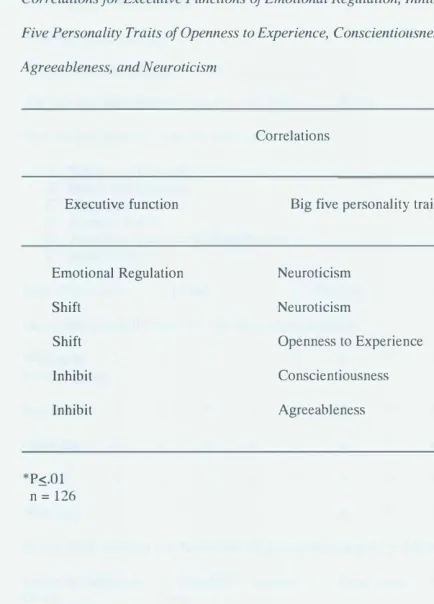
Bivariate Pearson Correlations were used to determine 2-tailed significance on a number of BRIEF-A scales and Big Five traits and are displayed in Table Two. As predicted, positive correlations were found such that participants who reported higher Neuroticism also reported being less able to control their emotions (r = -.28, p =.001). In addition, those participants who rated themselves high on Openness to Experience also reported themselves as having a greater ability to use creativity in shifting and problem solving ( r =.29, p =.001).
Although not predicted, positive correlations were also found such that
participants who reported higher Neuroticism also endorsed more difficulty in their
ability to shift in problem solving (r =-.28, p =.001). In addition, those participants who
rated themselves as being higher on the Conscientiousness trait also reported having a
greater ability to inhibit behavior (r =.26, p =.003). Lastly, those participants who
reported higher Agreeableness were better able to inhibit behavior (r =.23, p =.009).
Non-significant relationships were found between emotional control and Extraversion (r= .00, p=.934), Agreeableness (r=.00, p=.973), Conscientiousness (r = -.09, p =.313), and Openness to Experience (r=-.01, p=.262). Non-significant
were found between shifting in problem solving and Conscientiousness (r =.05, p =.579),
CHAPTER FIVE
Discussion
The primary purpose of this study was to examine the relationship between
executive function and personality (the Big Five) using the Behavior Rating Inventory of
Executive Function-Adult Form (BRIEF-A). This inventory is a self-report, global
measure of executive function. Findings were that Neuroticisrn negatively correlated with
emotional regulation and ability to shift during problem solving. Findings also were that
Openness to Experience positively correlated with creativity and flexibility in shifting
and problem solving. In addition, it was found that Agreeableness and Conscientiousness
correlated with increased behavioral inhibition. In contrast with the current researcher's
hypothesis, findings showed no significant relationships for Extraversion and
Neuroticism with behavioral inhibition. In addition, findings were not significant for
association for Extraversion, Openness to Experience, Agreeableness, and
Conscientiousness with emotional regulation.
The first finding that Neuroticism significantly correlates with lower emotional
regulation is consistent with O'Brien and Delongis (1996) who also found that
Neuroticism correlates with lower emotional regulation. Individuals high on the
Neuroticism scale are characterized as experiencing negative affect, anxiety, depression,
sadness, and impulsivity, which will often times lend to emotional reactivity and
moodiness (McCrae and Costa, 1987). These tendencies may contribute to lower abilities
to regulate emotions and vice versa.
Kasmer (1988) assessed both personality and executive function using the standardized version of the Eysenck Personality Questionnaire (EPQ). The EPQ differs from the demographic questionnaire used to assess personality, as it is made up of 101 items
measuring Extraversion, Neuroticism, and Psychotisism. Also, the BRIEF-A rating scale used in the current study is a standardized self-report measure designed specifically to evaluate an individual's executive control functions (Gioia et al., 2002).
The finding that Extraversion and Neuroticism does not significantly correlate with behavioral inhibition does not reflect previous research by Jackson (2002), who found that correlation to be significant. Jackson (2002) used such inventories as the
Junior Eysenck Personality Questionnaire to assess level of Neuroticism and
Extraversion. The Youth Self Report (YSR) was also used to assess behavioral inhibition
and anti-social behaviors with the Externalizing Scale. Youths rate themselves for each item using the same three-point response scale as the CBCL/6-18 and Teacher Report Form. In the current study, The Big Five Personality Traits were measured using a demographic questionnaire, while behavioral inhibition was measured using the Inhibit
Scale on the BRIEF-A. However, the current study was not limited to exploring the executive function of behavioral inhibition. An additional difference is that Jackson's
(2002) population consisted of younger, high school age individuals, while the current study looked at adults.
The finding that Openness to Experience, Agreeableness, Conscientiousness, and
Extraversion did not correlate with increased emotional control abilities is not consistent
with O'Brien and Delongis' (1996) findings. This may be due to the fact that O'Brien and
inventory is made up of 60 Items that assess the Big Five Personality Traits. In addition,
O'Brien and Delongis (1996) were only investigating coping (emotional control) in their
study using measures specifically designed to assess for coping: The Ways of Coping
Scale (WOC) and the Empathic Responding Scale (ERS).
O'Brien and Delongis (1996) used the WOS to assess for emotion-focused and
relation-focused coping strategies. This scale assesses problem and emotion-focused
functions of coping and cognitive and behavioral coping strategies. Participants were
asked to describe coping methods for stressful experiences. Relationship-focused coping
was assessed with a 10-item, non-standardized Empathic Responding scale created by the
researchers. This scale looks at two facets of empathic responding: cognitive/affective
strategies (perspective taking and vicarious experiencing of another's concerns and
feelings) and behavioral strategies (listening, providing comfort or support).
In contrast, the BRIEF-A is a standardized measure that investigates coping and
emotional control using items dealing with angry outbursts, emotional outbursts, and
reaction to facing small challenges or problems. The items directly assess ones'
perception of emotional control, whereas the WOS requires respondents to report on
coping strategies and styles.
The finding that Conscientiousness was not significantly correlated with
emotional control is also inconsistent with previous research that suggests there is a
relationship. Jensen-Campbell et. al (2007) also found Conscientiousness to predict
emotional control of anger and aggression, which may also be attributed to using
different measures. Jensen-Campbell's (2007) study assessed for personality using the
44-item inventory consisting of short phrases based on trait adjectives associated with each
of the Big Five personality factors on a Likert type scale. Goldberg's trait markers
required participants to rate the degree to which they agreed or disagreed with 100 trait
words on a 5-point Likert type scale. Aggression was measured based on the drink choice
(bitter or sweet) that participants assigned their raters. Jensen-Campbell et. al (2007)
focused the assessment of emotional regulation on modulating anger and aggression.
In contrast, the BRIEF-A measures emotional control based on an individual's
response to items such as: "angry outburts," "emotional outbursts for no reason,"
"overreacts emotionally," "overreacts to small problems," "reacts more emotionally than
friends," "overreacts to small problems," "changes mood frequently," in addition to
other items dealing with the regulation of emotions. The BRIEF-A is not as narrowly
focused on anger and aggression, but on the range of emotions that may be challenging to
control.
The finding that Extraversion was not significantly correlated with increased
emotional regulation is not consistent with Kokkonen and Pulkkinen's (2001) findings.
They found a significant positive correlation between Extraversion and emotional
regulation. These findings may be attributed to the use of different measures such as The
Eysenck Personality Questionnaire. The Big-Five Personality Inventory, which consists
of 181 statements, was also used to assess for personality. Emotional regulation and
dysregulation were measured using the Meta-Regulation Scale (MRS), the Ambivalence
Over Expressiveness Questionnaire (AOEQ), and a Life Situation Questionnaire (LSQ).
Emotional regulation (repair) was a sum score of two items "I am imagining
mood going." Participants had to rate how they related to these items, which was
measured using the MRS, a modified seven-item inventory created by Mayer and Stevens (1994). The emotional regulation strategy of using emotional social support was a sum
score of eight items derived from the LSQ, an inventory created by the researchers. Items
assessed for an individual's number of close friends, time spent associating with friends
or acquaintances. Emotional ambivalence, indicative of emotional dysregulation, was a
sum score of seven items derived from the AEQ. This questionnaire was developed by
King and Emmons (1990). Ambivalence covers both inhibition and rumination of
emotion. While the inventories used by Kokkonen and Pulkinen focus on emotional
repair, support, and feelings surrounding expressing or not expressing emotion, the
BRIEF-A focuses more on an individual's control over emotions.
Other significant findings, although not hypothesized, were that
Conscientiousness and Agreeableness significantly correlated with the Inhibit scale. This correlation may be attributed the shared similarities in both Conscientiousness and
Inhibition. Conscientiousness reflects the degree to which an individual can control and regulate impulses, particularly in handling responsibilities and work ethic. Those
individuals who rate themselves as being high on this scale also tend to be more organized, persistent, and reliable (Goldberg, 1993). These traits relate to inhibition, because inhibition requires the traits associated with Conscientiousness such as being able to control and regulate impulses. The Agreeableness scale reflects an individual's
who are highly Agreeable will likely be more able to inhibit their actions to facilitate
social harmony and cooperation.
Lastly, a significant, negative correlation between the personality trait
Neuroticism and the executive function Shift was found. As discussed previously,
individuals high on this scale are characterized as experiencing negative affect, anxiety,
depression or sadness, hostility, and self-consciousness. Those who rate themselves high
on this trait tend to perceive situations as threatening and challenges as hopeless (McCrae
and Costa, 1987). When individuals perceive situations as challenging and hopeless, it is
difficult for them to creatively problem solve, and shift between situations and possible
solutions.
To conclude, many of the differences found between previous research and the
current study may be attributed to the fact that the BRIEF-A is intended to specifically
measure executive function, whereas some of the inventories used to measure executive
function were developed to assess personality. Also, the BRIEF-A measures executive
function globally. The BRIEF-A consists of eight scales of executive function, while
many of the inventories used were intended for the specific executive function being
researched. For instance, many of the inventories only looked at coping, or behavioral
inhibition (O'Brien and Delongis, 1996, Jackson, 2002). Therefore the BRIEF-A may be
better equipped to demonstrate such executive functions as shift and inhibit, which may
have contributed to the significant findings that were not predicted by the literature
reviewed for this study. Items that reveal shifting ability inquire about the participant's
believed ability to change from one activity to the next, accepting alternative solutions to
reflect inhibition tap into the participant's believed abilities in sitting still, maintaining
focus, and being appropriate.
Limitations
The present study did have several key limitations that should be considered. First
of all, the sample used is limited to college students in western New York. An additional
limitation to this study is the exclusive use of self-report measures. Other informants or
the use of observations may have produced different results. Lastly, the sample used was
predominantly Caucasian, and was limited to adults. Future research should focus on
different populations such as children, and those individuals who did not attend college.
Also, future research should extend their investigations to different ethnic groups.
Implications
With the present limitations considered, it is also important to consider the
important implications of this study. The findings of this study support that executive
function correlates with personality. One major implication of these findings is that the
BRIEF-A is a useful tool to demonstrate correlations between executive function and
personality. This may be attributed to the fact that the BRIEF-A is a global measure of
executive function that targets eight domains of executive function. In addition, the
BRIEF-A is a self report measure designed to assess behavioral aspects of executive
dysfunction (Gioa, et al., 2000). The benefit of this self-report measure over other more
traditional measures of executive function is that it focuses more on real-life behavior and
ecological validity.
The findings of this study also imply that if one were to target executive function
Mischel, Shoda, and Smith (2004) personality is a persistent set of thoughts, feelings, and
actions that occur in response to situational demands. It might be the case that these
thoughts and feelings are not determined for any one individual. For instance, if an
individual harbors the trait of Neuroticism, they are likely to respond to certain situations
with feelings of helplessness and worry, and inability to approach problems with an open
mind to alternative solutions (Costa and McCrae, 1987). Since the current study has
demonstrated that the executive functions of emotional control and shift share a
correlation with this trait, it may be useful to target these functions with intervention,
References
Barkley, R. A. (2001). The Executive functions and self-regulation: an evolutionary
neuropsychological perspective [Data file]. Worcester: Neuropsychology Review
Baumeister, R. F., Gailliot, M., Dewall, C. N., & Oaten, M. (2006, December). Self
regulation and personality: How interventions increase regulatory success, and
how depletion moderates the effects of traits on behavior. Journal of personality,
74(6), 1773-1802. Retrieved from Psyclnfo database.
Bronowski, J. (1977). Human and animal languages: A sense of the future. Cambridge,
MA: MIT Press.
Burgess, P. W., Alderman, N., Evans, J., Emslie, H., & Wilson, B. A. (1997). The
ecological validity of tests of executive function. Behavioral assessment of the
dysexecutive syndrome. Retrieved from Psychlnfo database.
Burgess, P. W., Forbes, N., Costello, C., Coates, A., Dawson, L., Anderson, D.R., et al.
(2006). The case for the development and use of "ecologically valid" measures of
executive fucntion in experiemental and clinical neuropsychology.
Neuropsychol.Soc., 12, 194-209. Retrieved from Psychlnfo database.
Busch, R. M., McBride, A., Curtiss, G., & Vanderploeg, R. D. (2005). The components
of executive functioning in traumatic injury. Journal of clincial and experimental
neuropsychology, 27(B), 1022-1032. Retrieved August 8, 2007, from
Butterfield, E. C., & Albertson, L. R. (1995). On making cognitive theory more general
and developmentally pertinent. In F. Weinert & W. Schneider (Eds.), Research on
memory development (pp. 73-99). Hillsdale, NJ: Lawrence Erlbaum Associates.
(Original work published 1993)
Cattell, R. B. (1943). The description of personality: Basic iratis resloved into clusters.
Journal of abnormal and social psychology , 38, 476-506. Retrieved from
Psyclnfo database.
Chaytor, N., & Schmitter-Edgecombe, M. (2003). The ecological validity of
neuropsychological tests: a review of the literature on everyday cognitive skills.
Neuropsychol. Rev., 13, 181-197. Retrieved from PsychArticles database.
Costa, & McCrae. (1976). Age differences in personality structure: A cluster analytic
approach. Journal of Gerontology, 31, 564-570.
Costa, P. T., & McCrae, R.R. (1992). Four ways five factors are basic. Personality
Individual Differences, 13(6), 633-665. Retrieved from Psychinfo database.
Costa, P. T., Jr., & McCrae, R.R. (1992). Multiple uses for longitudinal personality data.
European Journal of Personality, 6, 85-102. Retrieved August 24, 2007, from
PsychArticles database.
Costa, P. T., Jr., & McCrae, R.R. (1996). Mood and personality in adulthood. In
Handbook of Emotion, Adult Development, and Aging (pp. 369-383). Retrieved
August 24, 2007, from Psychinfo database.
Demetriou, A., & Kazi, S. (2001). Unity and modularity in the mind and the self.
Eisenberg, N., & Damon, W. (Eds.). (1998). Personality development across the life
course. In Handbook of child psychology (Vol. 3, pp. 311-388). New York:
Wiley.
Eysenck, H.J., & Eysenck, S. B. (1976).psychotism as a dimension of personality. New
York: Crane.
Gioia, G. A., Isquith, P. K., & Guy, S. C. (2001). Assesment of executive functions in
children with neurologic impairment. In R. Simeonsson & S. Rosenthal (Eds.),
Psychological and developmental assessment ( chapter 15). NY: The Guilford
Press.
Gioia, G. A., Isquith, P. K., Guy, S. C., & Kenworth, L. (1996). The behavior rating
inventory of executive function. Lutz, FL: Psychological assessment resources.
Goldberg, L. R. (1993, January). The structure of phenotypic personality traits. American
Psychologist, 48(1), 26-34. Retrieved August 21, 2007, from PsychArticles
database.
Jackson, N. M. (2002). Inhibition of anti social behaivor and Eysencks theory of
Conscience. Education and treatment of children, 25(4), 522-531. Retrieved from
PsychArticles database.
Jensen-Campbell, L. A., Knack, J.M., Waldrip, A. M., & Campbell, S. D. (2007). Do
Big Five personality traits associated with self-control influence the regulation of
anger and aggression? Journal of research in personality, 41, 403-424. Retrieved
Kokkonen, M., & Pulkkinen, L. (2001). Extraversion and neuroticism as antecedents of
emotion regulation and dysregulation in adulthood. European journal of
personality, 15, 407-424. Retrieved from Psyclnfo database.
Mash, E. J., & Barkley, R. A. (2003). Behavior Disorders. In Child Psychopathology
(Second Edition ed., pp. 82-87). New York: The Guilford Press.
McCrae, R.R., & Costa, P. T. (1987, January). Validation of the five factor model and
personality across instruments and observers. Journal of Personality and Social
Psychology, 52(1), 81-90. Retrieved from Psyclnfo database.
Mirsky, A. F. (1996). Disorders of attention: A neuropshycological perspective. In G. R. Lyon & N. A. Krasnegor, Attention, Memory, and Executive Function (pp. 71-96).
Mischel, Shoda, & Smith. (2004). Introduction to Personality (7th ed.). John Wiley and
Sons.
Mithaug, D. (1993). Self-regulation theory: How optimal adjustment maximizes gain ..
Westport, CT: Praeger.
Neisser, U. (1967). Cognitive Psychology. Englewood Cliffs, NJ: Prentice Hall.
O'Brien, T. B., & Delongis, A. (1996). The interactional contex of problem-emotion-,
and relationship-focused coping: The role of the big five personality factors [Data
file]. Retrieved from Science Direct database.
Odhuba, R. A., van den Broek, M. D., & Johns, L. C. (2005). Ecological validity of
measures of executive functioning. British Journal of Clinical Psychology, 44,
269-78. Retrieved from Psyclnfo database.
Pervin, L., & John, 0. (1999). Handbook of personality: Theory and research (2nd ed.).
Psychological Assessment Recources, (PAR), Inc. (n.d.). Retrieved July 12, 2007, from
http://www3.parinc.com/.
Pulkkinen, L. (1982). Self-control and continuity from childhood to late adolescence.
Life-span development and behavior, 70, 63-105. Retrieved from Psyclnfo
database.
Saucier, G., & Goldberg, L. R. (1996). The language of personality: Lexical Perspectives
on the Five-Factor Model. In J. S. Wiggins (Ed.), The Five Factor Model of
Personality (pp. 21-50). New York, NY: The Guilford Press.
Stuss, D. T., & Benson, D. F. (1984). Neuropsychological studies of the frontal lobes.
Psychological Bulletin, 95(1). Retrieved July 15, 2007, from PsychArticles
database.
Thurstone, L. L. (1934, January). The Vectors of Mind. The Psychological Review, 41(1),
1-32. Retrieved August 24, 2007, from PyschArticles database.
Wolfe, R. N., & Kasmer, J. A. (1988). Type versus trait: Extraversion, impulsivity,
socialbility, and preferences for cooperative and competative activities. Journal of
personality and social psychology, 54(5), 864-871. Retrieved from PsychArticles
database.
Wright, C. I., Williams, D., Feczko, E., Barrett, L., Dicerson, B., Schwartz, C., et al.
(2006, December). Neuroanatomical correlates of Extraversion and Neuroticism.
Cerebral Cortex, 16(12), 1809-1819. Retrieved from Psyclnfo database.
Zelazo, P. D., Carter, A., Reznick, J. S., & Frye, D. (1997). Early development of
executive function: A problem-solving framework [Data file]. Retrieved from
Table I
Demographic Characteristics of the Student Population
General Characteristics Percentage (n)
Gender
Male 63 (86)
Female 28 (39)
Ethnicity
White 67.7 (90)
Black 5.9 (8)
Hispanic or Latino 5.9 (8)
Asian or Pacific 11.1 (15)
None of the Above 3.7 (5 )
Age
18 11.1 (15)
19 18.5 (25)
20 16.3 (22)
21 17.0 (23)
22 13.3 (18)
23 7.4 (10)
24-46 9.4 (13)
College Enrollment
College of Liberal Arts 22.2 (30)
College of Business 5.2 (7)
College of Imaging Arts and Science .7 (1)
College of Computing Information Science 23.7 (32)
College of Science 2.2 (3)
College of Applied Science and Technology 12.6 (17)
College of Engineering 8.1 (11)
Employees .7 (1)
NTID Graduate School .7 (1)
Table II
Pearson Product-Moment
Correlations for Executive Functions of Emotional Regulation, Inhibit, Shift, and the Big
Five Personality Traits of Openness to Experience, Conscientiousness, Extraversion,
Agreeableness, and Neuroticism
Correlations
Executive function Big five personality trait !
Emotional Regulation Neuroticism -.28*
Shift Neuroticism -.29*
Shift Openness to Experience .29*
Inhibit Conscientiousness .26*
Inhibit Agreeableness .23*
Appendix
BACKGROUND INFORMATION
Please answer the following:
Your age: ____ _
What college are you enrolled in?
---Are you and international student? A. Yes
How do you typically describe yourself?
A. White- not Hispanic B. Black- not Hispanic C. Hispanic or Latino D. Asian or Pacific
E. American Indian or Alaskan Native F. None of the Above
Your sex: Male Female
B. No
I am ( check one): [ ] Deaf [ ] Hearing [ ] Hard of Hearing
Please rate yourself from 1 to 7 on these characteristics:
Willing to try new things
Reliable Outgoing Helpful Worrying 1 1 1 1 1 2 2 2 2 2 3 3 3 3 3 4 4 4 4 4 5 5 5 5 5 6 6 6 6 6 7 7 7 7 7
Don't like change
Unreliable
Reserved
Rude
Calm
Please circle whether you have been diagnosed with any of the following
Leaming Disability ADHD/ADD Anxiety Depression Bipolar
Other None