Research Paper:
The Reliability and Validity of Behavior
Rating Inventory of Executive Functions Tool Teacher’s
Form Among Iranian Primary School Students
Malahat Amani1* , Roghaye Asadi Gandomani1, Abbas Nesayan1
1. Department of Psychology, Faculty of Humanities, University of Bojnord, Iran.
* Corresponding Author: Malahat Amani, PhD
Address: Department of Psychology, Faculty of Humanities, University of Bojnord, Iran. Tel: +98 (914) 3580277
E-mail: [email protected]; [email protected]
Objectives: Behavior rating scales have been developed to increase ecological validity in the measurement of executive functions. As the teachers have a lot of contact with the students in the school environment, behavioral rating scale teacher’s form can provide useful information. The purpose of this study was to investigate the reliability and validity of the behavioral rating inventory of executive functions teacher’s form among primary school students of Iran.
Methods: The statistical population consisted of primary school students of Jajarm city who were studying in the academic year 2016-2017. Students (n=360) were selected through sampling two-stage clusters. The behavioral rating inventory of executive functions (BRIEF) teacher’s form for students was completed by their teachers, and the Wechsler’s coding subscale was completed by the students.
Results: The results showed that the internal consistency of this inventory was 0.98 and for all subscales ranged 0.75 to 0.92. Also, subscales related to each other significantly. Regarding convergent validity, Wechsler’s coding subscale had a significant correlation with the subscales of executive functions. Also, results showed that two-factor model with eight subscales were confirmed by confirmatory factor analysis.
Discussion: Given the satisfactory reliability and validity of BRIEF tool in the school environment and results of this study indicated the relationship of executive functions with academic problems; this tool could be used to examine students’ executive functions.
A B S T R A C T
Article info:
Received: 12 Aug. 2017
Accepted:07 Dec. 2017
Keywords:
Executive functions, Standardization, Behavior, Questionnaire
Citation: Amani M, Asady Gandomani R, Nesayan A. The Reliability and Validity of Behavior Rating Inventory of Execu-tive Functions Tool Teacher’s Form Among Iranian Primary School Students. Iranian Rehabilitation Journal. 2018; 16(1):25-34. https://doi.org/10.29252/nrip.irj.16.1.25
:
: https://doi.org/10.29252/nrip.irj.16.1.25
Use your device to scan and read the article online
1. Introduction
he term executive functions include a wide range of cognitive processes and
behavioral competencies that consist of
verbal reasoning, problem-solving, planning, sequenc-ing, ability to maintain attention, resistance to distract-ing factors, use of feedback, cognitive flexibility,
of executive functions since these cognitive processes do not include emotional excitation and nearly are based on logic or machine. On the other hand, executive functions
which are more emotional and attitudinal (such as
expe-riences of reward and punishment, regulation of social
behavior, and decision making), and personal and
emo-tional interpretations, are considered as “hot component”
[2]. Studies have shown that disturbance in both the cold
and hot components of executive functions may have
catastrophic effects on everyday life activities such as
the ability to work, social relationships, education, and independent function [3].
Previous studies about executive functions were fo-cused on neuropsychology based tests and were criti-cized as raw and non-specific [2]. The most troublesome
problem in evaluating executive functions is that the task measuring executive functions is commonly trap
-ping into other cognitive processes such as intelligence
and language, not specified executive functions [4]. An-other primary concern about neuropsychological tests is the lack of ecological validity, which is defined as the relationships between test results and real-world
perfor-mance [2]. Although neuropsychological tests provide
essential information about how a person works, there are less practical applications in the contextual school, and tasks that evaluate executive functions in clinical
settings provide less information on how a student works
in the classroom [5]. The classes, of course, filled with routines and distracting issues that require the student to apply multiple executive functions for success. Students performed test outside the classroom, less information is provided on how executive functions affect class
behav-iors and academic achievement.
The behavioral rating scales were developed to reduce the cited problems for assessing executive functions [6].
The behavioral rating scales are tools that list more spe-cific behavioral features, and the person familiar with student evaluates frequencies of presented behaviors. School psychologists widely use these behavioral
as-sessment scales, although these tools have some limita -tions. These tools have been criticized for undesirable
variability that is attributed to the rater variance, the con
-text variance, the time variance, and tool variance [7]. Other criticism of the behavioral rating scale includes the lack of useful information to select interventions that
do not result in scientific conclusions because they are
based on personal perception of behavior rather than ac
-tual behavior measurement [8].
Despite the limitations, the behavioral rating scales have the main utility as an evaluation tool. Rating scales
based on direct raters’ assessments are inexpensive, eas
-ier to implement, and easy scoring [7]. Respondents are
parents or teachers who have a regular contact with a
student in their natural environment. Another benefit in
using rating scales is that there is a normative data that
helps to compare the student with his or her peers to
de-termine the appropriate behavior with growth [5].
There are specific tools for measuring executive func-tions such as Behavioral Rating Inventory of Execu-tive Functions (BRIEF) [9], Comprehensive Executive Function Inventory (CEFI) [8], and Barkley Deficits in Executive Function Scale (BDEFS). This study focused on BRIEF tool to rate executive functions as they are
used commonly in school [10,11]. BDEFS is not consid-ered for this study because it does not have a teacher rat-ing scale and also CEFI has less research sup-port about
reliability and validity [12].
The authors’ BRIEF tool has considered various
dimen-sions within the framework of executive functions that in
-clude inhibit, shift, working memory, emotional control,
planning, and organizing of material, initiate, and moni-tor. In Parent and Teacher’s Forms of BRIEF and with
eight subscales exploratory factor analysis has revealed solution two factors in both clinical and normal samples
[9]. Gioia et al. [10] have analyzed the BRIEF among children and adolescents of aged 5 to 18 years in the clini-cal sample, and have obtained the three-factors
metacog-nition, emotional regulation, and behavioral regulation.
The metacognition factor consists initiate, work-ing memory, plannwork-ing/organization, an organization of material, monitor subscales. Emotional regulation
fac-tor includes shift and emotional control subscales, and
behavioral regulation factor include self-monitor and inhibits subscales. Slick et al. [13] have found that the
two-factor model had the best fit for children and
ado-lescents with untamable epilepsy rather than of the one
or three-factor model for the parent’s form. In a sample of brain-damaged children, a two-factor structure with
eight subscales was approved in the parent’s form [14].
The present study has used the two-factor model with
eight subscales to examine validity and reliability teach -er’s form of BRIEF.
The developers’ BRIEF tool have found that collecting structured observations from parents and teachers has potential benefits [9]. Therefore, along helping parents,
teachers, and clients, clinicians in various fields it is in-terested in contributing in interventions related to
execu-tive functions in particular neurodevelopment disorders.
func-tions in the non-laboratory clinical environment using a
valid and reliable tool. Given the cited issues, it is es
-sential that there will be valid and reliable tools to assess
the students’ executive functions in an educational envi-ronment. In general, due to the importance of the practi-cal application of the BRIEF in examining the executive functions of primary students, the reliability and validity of BRIEF have not been investigated in Iran. Therefore, the aim of this study was to examine the psychometric properties of the Persian version of the BRIEF tool for primary school students in Iranian population.
2. Methods
The study was a descriptive-correlation type. The statis-tical population consisted of all primary school students of Jajarm city who were studying in the academic year 2016-2017. Two primary schools (a girls ‘school and a boys’ school) were selected by sampling two-stage
clus-ters and was selected a grade in each school. The sam -ple size was 360 students and their 12 teachers (6 women and 6 men) completed BRIEF for them. The numbers of students in each grade were based on gender presented
in Table 1.
Instrument
The Behavioral Rating Inventory of Executive Functions (BRIEF)
Gioia et al. [9] have designed BRIEF for children aged 5 to 18 years. It has 86 questions and parent and teacher’s forms. Questions were answered based on the three-point scale Likert (never, sometimes, and often). BRIEF has eight subscales, in which inhibit, shift and emotional control together constitute the behavioral regulation index; initiate, plan/organization, working memory, organization of material and monitor constitute
metacognition index. The sum of these two indexes is global executive composite. The higher scores are an in -dicator of higher perceived score. The designers’ BRIEF have standardized it among 1419 normal children and 852 of the clinical groups, and have confirmed two
fac-tors model that is metacognition and behavioral regula
-tion in the factor analysis.
The internal consistency for parent’s form was in the range of 0.80 to 0.98. The correlation of retest reliabil-ity for the parent’s form in the normal sample was 0.81 (ranged 0.76 to 0.85), with a mean of two weeks interval, the test-retest correlation for behavioral regulation was 0.84, metacognition 0.88 and the total 0.86. The correla-tion of retest for the parent’s form in the clinical sample
was 0.79 (ranged 0.72 to 0.84) and for the behavioral index was 0.80, metacognition index 0.83 and the total 0.81. The retest reliability of teacher’s test form in three weeks internal was in the normal sample of 0.87 (ranged 0.83 to 0.92), and for the behavioral regulation, index was 0.92, metacognition 0.91 and total 0.91 [15].
Mahone et al. [16] reported the validity of BRIEF tool in children aged 6 to 16 years and found that both at-tention deficit hyperactivity disorder and Tourette
syn-drome groups were rated as more impaired than the con -trol group on the subscales of BRIEF.
Lamer [12] studied the correlation of BRIEF and Con-ners 3 executive functioning scale among children and adolescents and found a correlation of 0.5 for total scores and the subscale in the range of 0.14 to 0.68. He obtained an internal consistency of between 0.80 to 0.98 for the
form of parent and teacher in normal children and chil
-dren with clinical problems, and interrater agreement for
the forms of teacher and parent was in the range of 0.15 to 0.50, and the correlation among forms was 0.32.
Wechslerʼs Coding Subscale
In this subscale, one must copy symbols as part of a code set, and the numbers and symbols must be paired.
This subscale measures the psychomovement speed, the
ability to follow the order, visual short-term memory,
speed and accuracy, the ability to learn unfamiliar tasks,
and flexibility. The scores of this subscale are reduced significantly in learning disabilities, brain damage, de-pression, anxiety, and obsession. In coding subscale, normal children were significantly different than
chil-dren with clinical problems [17]. Reliability for this subscale has been reported 0.80 [18]. In this study, the internal consistency of coding subscale was 0.96.
Procedure
At The first, English version of BRIEF was translated into Persian and accuracy translation was checked by
several translators and then reverse translation was car -ried out to ensure the conformity of the Persian version with the English version. The Persian version was match-ing with the English version. The sample was selected using a two-stage cluster sampling. In the first stage, two schools (a girls ‘school and a boys’ school) were chosen
randomly from among elementary schools, and in the
second stage, a class of each grade was selected.
completing each, the questionnaire was paid 20,000 Ri-als to teachers. Wechsler’s coding subscale was given to the students, as this subscale was performed in 120 seconds, students were encouraged to answer quickly, and financial support was not provided. The completed questionnaires were analyzed through correlation and Cronbach’s alpha test in SPSS 23 software and the con-firmatory factor analysis through AMOS 23 software.
3. Results
Mean and standard deviation of variables is presented
in Table 2. The relationships among sub-scales of BRIEF
are significant. Also, the exception of working memo-ry and organization of material, and other subscales of BRIEF have a significant correlation with coding.
Table 2 shows that all factors of BRIEF have
satisfac-tory of internal consistency reliability measured through Cronbachʼs Alpha test. The lowest reliability is in the initiate factor, and the highest reliability is in the plan/ organization factor.
The confirmatory factor analysis was used to examine the validity of the BRIEF tool. At first, the validity of
subscales was considered separately to assure items re -lated to subscales significantly. In this analysis, each of the subscales was considered as a single-factor model
in which its items were observed variables. After that,
the validity of the two-factor model of the BRIEF tool was examined including metacognition factor with five
subscales as observed variable and behavioral regulation factor with three subscales as an observed variable. The
two-factor model of BRIEF is shown in Figure 1. The
results of confirmatory factor analysis are presented in
the Tables 2and 3.
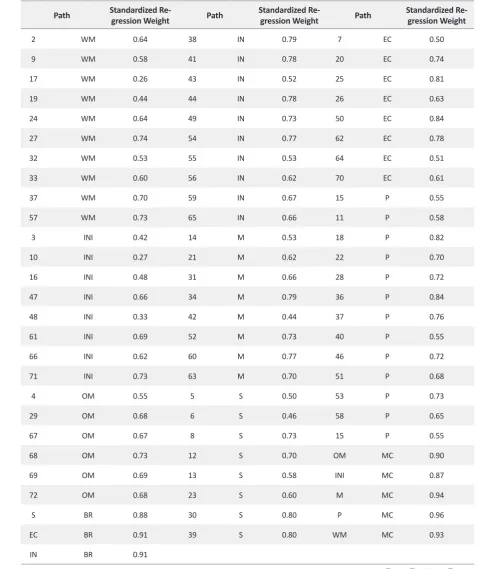
Table 3 shows standardized direct effects. In this
man-ner that paths of working memory factor to related items
are ranged 0.26 to 0.74; paths inhibit factor to its items are ranged 0.52 to 0.79; paths of initiate to its items are ranged 0.27 to 0.73; paths of monitor to its items are ranged 0.44 to 0.79; paths of organization of material to its items are ranged 0.55 to 0.73; paths of shift to its items are ranged 0.46 to 0.80; paths of emotional control to its items are ranged 0.50 to 0.84; paths of plan/orga-nization to its items are ranged 0.55 to 0.84. In general all items significantly related to its factors. Also, Table
3 shows that in the two-factor model the subscales of
inhibit, emotional control and shift related to the behav
-ioral regulation index; subscales of the initiate, working
memory, plan/organization, an organization of material
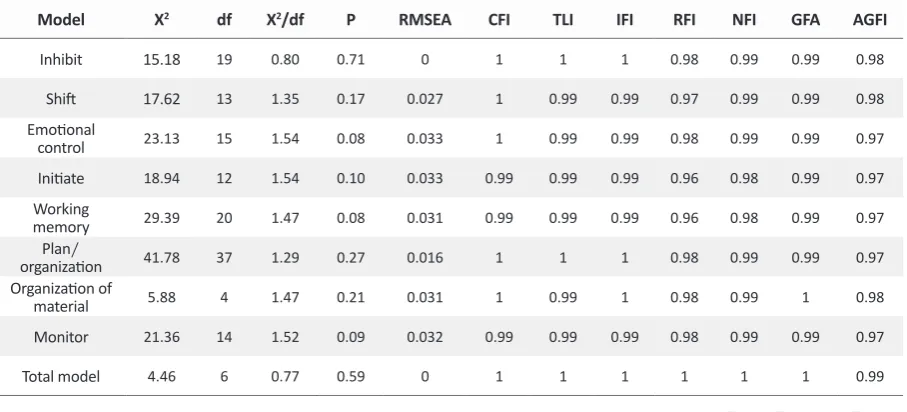
and monitor pertaining to metacognition index. Table 4
shows that the indexes of best fit model in all subscales are acceptable. Also, in the solution two-factor model, the total model is confirmed through confirmatory factor
analysis. The results show that indexes of the goodness
of fit are acceptable for this model.
4. Discussion
Processes as executive functions are considered
in-cluding the ability to regulate behavior and monitoring
and evaluation of thoughts, emotions, and behavior. Ex-ecutive functions are measured through a questionnaire
based on the performance and multiple related routine aspects were reported [19]. The present study aimed to examine the reliability and validity of BRIEF among pri-mary school students. The results showed that internal consistency of BRIEF subscales was in the range of 0.75 to 0.98 among primary school students.
Table 1. Demographic characteristics of the participants
Grade Girl Boy Total
Frequency Percent Frequency Percent Frequency Percent
1 25 6.94 26 7.22 51 14.16
2 31 8.61 30 8.34 61 16.95
3 33 9.17 32 8.89 65 18.06
4 30 8.34 29 8.05 59 16.39
5 34 9.44 33 9.17 67 18.61
6 28 7.78 29 8.05 57 15.83
The lowest reliability of 0.75 was related to initiate, al-though it is an acceptable range but cautions must be tak-en before using this sub-scale in a clinical settings. This finding is in agreement with the study of Lamer [12],
which showed that the internal consistency was ranged 80 to 0 98 for the forms of parent and teacher in normal
children and children with clinical problems. The high
internal consistency implies that all relevant items to a
subscale measure the same subscale and not the other.
Also, the present study showed that all subscales of the BRIEF tool have high significant correlation together
with indicating these subscales measure a conventional
structure. These findings are consistent with the study of Ebrahimi et al. [20].
In this study, confirmatory factor analysis was per-formed to examine the structural validity of subscales
which indicated all models of subscales had acceptable
indexes of the goodness of fit. Also, in the present study,
Table 2. Statistical descriptive and correlation among variables
Variables M SD α 1 2 3 4 5 6 7 8 9 10 11
Inhibit 15.51 5.08 0.90 1
Shift 12.43 3.63 0.85 0.81** 1
Emotional control 11.81 3.76 0.88 0.86**0.84** 1
Initial 11.65 3.39 0.75 0.81**0.79** 0.82** 1
Working memory 15.37 4.21 0.84 0.87**0.86** 0.87** 0.81** 1
Plan 19.35 5.82 0.92 0.90**0.87** 0.88** 0.80** 0.89** 1
Organization 8.75 2.65 0.82 0.83**0.83** 0.88** 0.85** 0.85** 0.86** 1
Monitor 12.29 3.79 0.87 0.89**0.85** 0.86** 0.79** 0.85** 0.91** 0.85** 1
BRI 38.09 11.25 0.95 0.95**0.93** 0.95** 0.85** 0.91** 0.93** 0.89* 0.92** 1
MI 67.31 18.75 0.97 0.92**0.90** 0.92** 0.89** 0.93** 0.96** 0.93** 0.94** 0.97* 1
GEC 105.52 29.68 0.98 0.94**0.92** 0.94** 0.89** 0.94** 0.96** 0.92** 0.94** 0.97** 0.99** 1
Coding 47.89 14.44 0.96 -0.12* -0.14* -0.13** -0.13** -0.10 -0.17** -0.10 -0.16** -0.16** -0.15** -0.15**
* P<0.05; ** P<0.01; α: Cronbach’s Alpha; BRI: Behavioral Regulation Index; MI: Metacognition Index; GEC: Global Executive Composite
Inhibit
Shift
Emotional
control
Initial
Working
memory
Plan/
organization
Organization
of material
Monitor
Behavioral regulation
Metaganition
0.88
0.91
0.91
0.87
0.93
0.96
0.90
0.94
the two-factor model of BRIEF with adequate indexes for
the goodness of fit was confirmed through confirmatory factor analysis. This model consists metacognition and behavioral regulation factors. The behavioral regulation
Table 3. Standardized regression weight of paths
Standardized Re-gression Weight Path Standardized Re-gression Weight Path Standardized Re-gression Weight Path 0.50 EC 7 0.79 IN 38 0.64 WM 2 0.74 EC 20 0.78 IN 41 0.58 WM 9 0.81 EC 25 0.52 IN 43 0.26 WM 17 0.63 EC 26 0.78 IN 44 0.44 WM 19 0.84 EC 50 0.73 IN 49 0.64 WM 24 0.78 EC 62 0.77 IN 54 0.74 WM 27 0.51 EC 64 0.53 IN 55 0.53 WM 32 0.61 EC 70 0.62 IN 56 0.60 WM 33 0.55 P 15 0.67 IN 59 0.70 WM 37 0.58 P 11 0.66 IN 65 0.73 WM 57 0.82 P 18 0.53 M 14 0.42 INI 3 0.70 P 22 0.62 M 21 0.27 INI 10 0.72 P 28 0.66 M 31 0.48 INI 16 0.84 P 36 0.79 M 34 0.66 INI 47 0.76 P 37 0.44 M 42 0.33 INI 48 0.55 P 40 0.73 M 52 0.69 INI 61 0.72 P 46 0.77 M 60 0.62 INI 66 0.68 P 51 0.70 M 63 0.73 INI 71 0.73 P 53 0.50 S 5 0.55 OM 4 0.65 P 58 0.46 S 6 0.68 OM 29 0.55 P 15 0.73 S 8 0.67 OM 67 0.90 MC OM 0.70 S 12 0.73 OM 68 0.87 MC INI 0.58 S 13 0.69 OM 69 0.94 MC M 0.60 S 23 0.68 OM 72 0.96 MC P 0.80 S 30 0.88 BR S 0.93 MC WM 0.80 S 39 0.91 BR EC 0.91 BR IN
factor reflects the ability for cognitive, emotional and be-havioral modification, and to impose appropriate
inhibi-tor controls. The metacognition facinhibi-tor measure working
memory, the ability to start, plan and organize problem-solving as well as behaviors of self-monitor [10].
This result indicates that two-factor structure BRIEF was confirmed in the present study. This finding is consis-tent with the study of Gioia et al. [9] that revealed solu -tion of two-factor of a BRIEF tool for parent and
teach-er’s forms in both children with clinical problems and
normal samples by the exploratory analysis factor. Simi-larly, Donders et al. [14] confirmed the two-factor model of BRIEF in a sample with brain-damaged children.
Studies on convergent validity have used other- report behavioral scales. We used the Wechslerʼs coding
sub-scale to examine the convergent validity that showed
a significant correlation between BRIEF and Coding, which indicates that BRIEF tool measures
characteris-tics that are similar to coding. The coding subscale is used to measure the speed of processing information, attention processes, memory function and perceptual or -ganization and performance speed [21], although coding correlates with all the subscales of executive functions,
but with working memory sub-scale and organization of material did not relate significantly.
Given that all symbols are written alongside the num
-bers at the top of the screen, and child can look at and
copy symbols continuously, him/her only uses short-term memory and does not require complicated
process-ing such as workprocess-ing memory. Also, because of the sim
-plicity of the coding, it does not engage the processes
of organizing thoughts and behavior. As in coding one quickly need to start and to find the related symbol to numbers it is related to the initiate. Since one is neces-sary to pay attention only to the specific symbol among
similar symbols and to choose it, it is correlated with inhibition. Coding related to emotional control because
one must copy symbols correctly and quickly, therefore he/she must control the negative emotions to focus. It is
related to shifting, since each time the number changes its symbol also changes. At the end, in coding subscale
one have to monitor his/her answers and to correct wrong
answers, therefore related to monitoring.
This study has some limitations. First, in the present study the normal group was not compared with the clini-cal problem group. Second, because of the polarity of
teachers at secondary and high school levels and their
low familiarity with students, the sample of the study was limited to the primary school students. Third, the present study was conducted in Jajarm city and should be cautious in generalizing the results to the other cit-ies. Considering the limitations of this study, it is recom-mended to examine the reliability and validity of BRIEF tool in Iranian clinical samples. It is also recommended that in the future studies the parent and teacher’s forms of BRIEF should be used in the adolescent group. To investigate convergent validity, other behavioral assess-ment questionnaires of executive functions should be used, and it is suggested that this study should be carried out in other geographic regions of Iran. Given proper re-liability and validity of BRIEF tool in the present study,
it is recommended to use in intervention and diagnosis in an educational environment.
Table 4. Significant indexes in the models
AGFI GFA NFI RFI IFI TLI CFI RMSEA P
Χ2/df
5. Conclusion
This study indicates that BRIEF tool is a reliable and
valid inventory to rate executive functions in children
and adolescents. As students are observed by teachers
ev-ery day in an educational environment, teachers possess
wealth information about students’ behaviors that help to understand executive functions of students. Therefore, BRIEF of teacher’s form can become the main part of assessing students in school and clinical settings and can
be helpful for interventions based educational planning in children with executive functions problems.
Acknowledgements
We thank to the managers of educational organizations in Jajarm city for their cooperation in doing this study, and especially we thank to the teachers and students of
primary schools who directly had participated in the
present study. The current article is based on a research project with the contract number 96/3672428, and the sponsor was the University of Bojnord.
Conflict of Interest
The authors declare no conflict of interest.
References
[1] Burgess PW, Veitch E, de Lacy Costello A, Shallice T. The cognitive and neuroanatomical correlates of multitask-ing. Neuropsychologia. 2000; 38(6):848–63. Available from: http://dx.doi.org/10.1016/s0028-3932(99)00134-7
[2] Chan RC, Shum D, Toulopoulou T, Chen EY. Assessment of executive functions: Review of instruments and identification of critical issues. Archives of Clinical Neuropsychology. 2008; 23(2):201–16. Available from: http://dx.doi.org/10.1016/j. acn.2007.08.010
[3] Green MF, Kern RS, Braff DL, Mintz J. Neurocognitive Deficits and Functional Outcome in Schizophrenia: Are We Measuring the “Right Stuff”? Schizophrenia Bulletin. 2000; 26(1):119–36. Available from: http://dx.doi.org/10.1093/ox-fordjournals.schbul.a033430
[4] Lagattuta KH, Sayfan L, Monsour M. A new measure for as-sessing executive function across a wide age range: children and adults find happy-sad more difficult than day-night. Developmental Science. 2010; 14(3):481–9. Available from: http://dx.doi.org/10.1111/j.1467-7687.2010.00994.x
[5] Miyake A, Friedman NP. The nature and organization of individual differences in executive functions. Current Direc-tions in Psychological Science. 2012; 21(1):8–14. Available from: http://dx.doi.org/10.1177/0963721411429458
[6] Naglieri JA, Goldstein S. Comprehensive executive func-tion inventory. North Tonawanda, NY: Multi-Health Sys-tems Inc.; 2013.
[7] Harrison PL, Thomas A, National Association of School Psychologists. Best practices in school psychology. Bethes-da, Maryland: National Association of School Psycholo-gists; 2014.
[8] McConaughy S, Ritter D. Best practices in multimethod as-sessment of emotional and behavioral disorders. In: Thomas A, Grimes J, editors. Best Practices in School Psychology, V. Bethesda, Maryland: National Association of School Psychol-ogists; 2008.
[9] Gioia GA, Isquith PK, Guy SC, Kenworthy L. Test review, behavior rating inventory of executive function. Child Neu-ropsychology. 2000; 6(3):235–8. Available from: http:// dx.doi.org/10.1076/chin.6.3.235.3152
[10] Gioia GA, Isquith PK, Retzlaff PD, Espy KA. Confirmatory Factor Analysis of the Behavior Rating Inventory of Execu-tive Function (BRIEF) in a Clinical Sample. Child Neuropsy-chology. 2002; 8(4):249–57. Available from: http://dx.doi. org/10.1076/chin.8.4.249.13513
[11] Sullivan JR, Riccio CA. Diagnostic group differences in parent and teacher ratings on the BRIEF and Conners’ Scales. Journal of Attention Disorders. 2007; 11(3):398-406. Available from: https://doi.org/10.1177/1087054707299399
[12] Lamar LR. The relationship and consistency in ratings between the conners 3 executive functioning scale and the behavior rating inventory of executive functioning [MSc. thesis]. Bowling Green, Kentucky: Western Kentucky Uni-versity; 2016.
[13] Slick DJ, Lautzenhiser A, Sherman EMS, Eyrl K. Frequency of Scale Elevations and Factor Structure of the Behavior Rat-ing Inventory of Executive Function (BRIEF) in Children and Adolescents With Intractable Epilepsy. Child Neuropsy-chology. 2006; 12(3):181–9. Available from: http://dx.doi. org/10.1080/09297040600611320
[14] Donders J, DenBraber D, Vos L. Construct and criterion validity of the Behaviour Rating Inventory of Executive Function (BRIEF) in children referred for neuropsychologi-cal assessment after paediatric traumatic brain injury. Jour-nal of Neuropsychology. 2010; 4(2):197–209. Available from: http://dx.doi.org/10.1348/174866409x478970
[15] Isquith P. BRIEF predictions of ADHD: clinical utility of the Behavior Rating Inventory of Executive Function for detecting ADHD subtypes in children. Archives of Clinical Neuropsychology. 2000; 15(8):780–1. Available from: http:// dx.doi.org/10.1016/s0887-6177(00)80238-3
[16] Mahone EM, Cirino PT, Cutting LE, Cerrone PM, Hagelt-horn KM, Hiemenz JR, et al. Validity of the behavior rating inventory of executive function in children with ADHD and/or Tourette syndrome. Archives of Clinical Neuropsy-chology. 2002; 17(7):643–62. Available from: http://dx.doi. org/10.1093/arclin/17.7.643
[18] Wechsler D, Naglieri JA. Wechsler nonverbal scale of abil-ity (WNV). London: Pearson; 2006.
[19] Roth RM, Lance CE, Isquith PK, Fischer AS, Giancola PR. Confirmatory Factor Analysis of the Behavior Rating Inven-tory of Executive Function-Adult Version in Healthy Adults and Application to Attention-Deficit/Hyperactivity Disor-der. Archives of Clinical Neuropsychology. 2013; 28(5):425– 34. Available from: http://dx.doi.org/10.1093/arclin/act031 [20] Ebrahimi AA, Kassani A, Menati R, Abedi A, Yarmo-hammadian A, Faramarzi S. The assessment of validity and reliability of behavior rating inventory of executive func-tions in iranian pre-school children. International Journal of School Health. 2015;2(4). Available from: http://dx.doi. org/10.17795/intjsh29022