A FRAMEWORK FOR AGROFORESTRY DESIGN
by
R.J. CARNE
A thesis submitted in partial fulfilment of the requirements for the degree of
Master of Forestry of the Australian National University
February 1988
Statement of Originality
ABSTRACT
The successful e s t a b l i s h m e n t and f u n c t i o n i n g o f a g r o f o r e s t r y systems w i l l depend to a l a r g e e x t e n t on design procedures which r e f l e c t a c l e a r u nder standi ng o f the basic concepts o f design and an a p p r e c i a t i o n o f the c o m p l e x i t i e s o f a g r o f o r e s t r y land use. Both aspects are addressed i n t h i s t h e s i s in o rder t o p r o vi d e a framework f o r a g r o f o r e s t r y desi gn. The 1a t t e r i s e s t a b l i s h e d w i t h r e f e r e n c e to (a) concepts der iv ed from landscape design (b) an a n a l y s i s o f a g r o f o r e s t r y land use, and (c) a r ev ie w o f e x i s t i n g design approaches a p p l i c a b l e t o a g r o f o r e s t r y , and i n c l u d e s f i r s t , a n e x p l a n a t i o n o f design i n the c o n t e x t o f a g r o f o r e s t r y , and second, an o u t l i n e o f a t hr ee- phase design procedure a p p l i c a b l e at the
f a r m - s c a l e . This procedure r ecogni zes the need f o r a thorough
c o n s i d e r a t i o n o f socioeconomic c o n d i t i o n s , and the importance o f p r o v i d i n g a s y n th e s is o f b i o p h y s i c a l and socioeconomic f a c t o r s in order t o r e s o l v e the design c o n t e x t .
The proposed pr ocedur e, and the e x p l a n a t i o n o f associated concepts, r ep re s en ts an i n i t i a l statement on a g r o f o r e s t r y desi gn . This c l a r i f i e s a p r e v i o u s l y i l l - d e f i n e d , but p o t e n t i a l l y i mp o r t a n t design f i e l d , and e s t a b l i s h e s a framework f o r f u r t h e r developments.
ACKNOWLEDGEMENTS
I am i n d e b t e d t o Dr K. Shepherd f o r s u p p o r t i n g t h i s work. His encour age me nt , and keen i n t e r e s t in t h e s u b j e c t of ' a g r o f o r e s t r y d e s i g n ' has been much a p p r e c i a t e d . I would a l s o l i k e t o acknowledge Bi l l Mol l i s on f o r s t i m u l a t i n g my i n i t i a l i n t e r e s t in d e s i g n , and t h e s t a f f and s t u d e n t s in t h e Landscape A r c h i t e c t u r e De p t . , C. C. A. E . , f o r br oadeni ng my u n d e r s t a n d i n g of t h e f i e l d . Many t h a n k s t o Assoc. P r o f . E. Woolmington f o r t h e numerous s t i m u l a t i n g and u s e f u l d i s c u s s i o n s , and t o Dr P. T r a n t e r f o r h i s h e l p f u l advi ce on many o c c a s i o n s .
TABLE OF CONTENTS
Page
A b s t r a c t ( i )
Acknowledgements ( i i )
Table o f C o n t e n t s ( i i i )
L i s t o f F i g u r e s (v)
L i s t o f T a b l e s ( v i )
L i s t o f P I a t e s ( v i )
C hap ter One - I n t r o d u c t i o n 1
1.1 The N a t u r e o f Landscape Design: Some P r e l i m i n a r y
Comments 1
1. 2 S t a t e m e n t o f Aims and O b j e c t i v e s 2
1. 3 O u t l i n e o f T h e s i s 3
C hap ter Two - C on ce pt ua l Background 4
2.1 I n t r o d u c t i o n 4
2 . 2 Landscape Design in t h e Co nt e xt of Landscape P la nni ng 4
2 . 3 Design S c a l e s 8
2 . 4 The Design P r o c e s s 9
2 . 5 A g r o f o r e s t r y De sign: I n t r o d u c t o r y Remarks 13
2 . 6 C o n c l u s i o n 18
Chap ter Thr ee - A g r o f o r e s t r y : Concept and P r a c t i c e 20
3.1 I n t r o d u c t i o n 20
3 .2 P r e l i m i n a r y Comments 20
3. 3 D e f i n i t i o n o f A g r o f o r e s t r y 30 3 . 4 I m p l i c a t i o n s o f t h e A g r o f o r e s t r y Concept 40 3 . 5 C l a s s i f i c a t i o n o f A g r o f o r e s t r y Systems 43 3 .6 A g r o f o r e s t r y in A u s t r a l i a 45
3 .7 C o n cl u s i on 49
Chapter Four - The Design of Agroforestry Systems: A Review 52
4.1 Introduction 52
4.2 Four Approaches to Agroforestry Design 52
4.2.1 Forest Farming 52
4.2.2 Permaculture 56
4.2.3 The Whole Farm Planning Concept 65
4.2.4 Diagnosis and Design Methodology 72
4.3 Conclusion 75
Chapter Five - A Framework for Agroforestry Design 77
5.1 Introduction 77
5.2 Agroforestry Concept and Practice:
General Implications for Design 78
5.3 The Design Context 82
5.3.1 Socioeconomic Conditions 83
5.3.2 Biophysical Conditions 84
5.3.3 Design Goals 86
5.3.4 Research-Analysis-Synthesis: The Role of
Land Evaluation 91
5.4 Visual, Functional and Ecological Appropriateness 105
5.4.1 Visual Aspects 105
5.4.2 Functional Aspects 111
5.4.3 Ecological Aspects 112
5.5 Specification of Form 112
5.5.1 Spatial Arrangement 113
5.5.2 Shape 115
5.6 Outline of Proposed Agroforestry Design Procedure 118
5.6.2 Phase 2: Detailed Land Unit Plan 126 5.6.3 Phase 3: Working S p e c if ic a ti o n s 132
5.7 Conclusion 132
Chapter Six - Discussion and Conclusion 136
6.1 Discussion 136
6.2 Conclusion 138
Bi b1ioqraphy 139
Appendix One - Temporal and Spatial Arrangement of Elements in Some Common A gr o fo re s try Systems 156 Appendix Two - C l a s s i f i c a t i o n of Ag ro fo re str y Systems 158
Appendix Three - Survey Form : Forest Farming 160
Appendix Four - Diagnosis and Design Methodology: Factors to
Consider in the Four-Stage Design Procedure 164 Appendix Five - Form of Survey: Biophysical Conditions (ICRAF's
Environmental Data Base) 169
Appendix Six - Check L i s t of Land Q u a l i t i e s f o r Agro fores try 173 L i s t of Figures
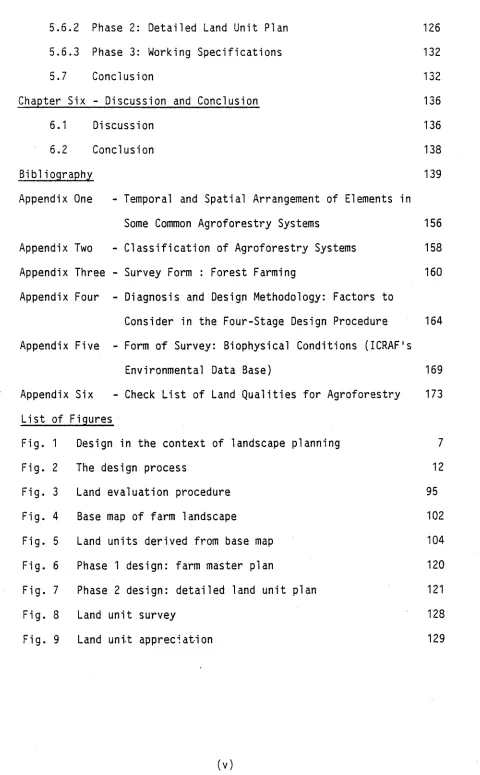
Fig. 1 Design in the context of landscape planning 7
Fig. 2 The design process 12
Fig. 3 Land evaluation procedure 95
Fig. 4 Base map of farm landscape 102
Fig. 5 Land un it s derived from base map 104
Fig. 6 Phase 1 design: farm master plan 120
Fig. 7 Phase 2 design: d e ta i l e d land u n i t plan 121
Fig. 8 Land u n i t survey 128
Fig. 9 Land u n i t app re ciat ion 129
[image:7.552.29.509.40.815.2]List of Tables
Table 1 Environmental problems which agroforestry has a
potential to allevi ate 27
Table 2 Summary of questions and factors to consider in
'Diagnosis and Design' 74
Table 3 Summary of land qualities and characteristics
relevant to agroforestry 106
Table 4 Summary of i n i t i a l biophysical survey 123
List of plates
Plate 1 Gully erosion near Bredbo, N.S.W. 23
Plate 2 Cleared h i 11s 1 opes in the Bega Valley, N.S.W. 23
Plate 3 Salinity problems near Hamilton, Western Victoria 24
Plate 4 Roadside verges in Central Victoria 24
Plate 5 River corridor (A.C.T.) 25
Plate 6 Eucalyptus camaldulensis in the Murray River
corridor near Mil dura, Victoria 25
Plate 7
and 8 Farm landscape near Braidwood, N.S.W. 28
Plate 9 Farm woodlot (Pinus r a d i a t a ) near Canberra 35
Plate 10 Farm woodlot (Eucalyptus spp.) near Marulan, N.S.W. 35
Plate 11 Shelterbelt system on farmland in Victoria 36
Plate 12 Three-row windbreak (near Bega, N.S.W.) 36
Plate 13 Single-row windbreak (near Braidwood, N.S.W.) 37
Plate 14 Newly-planted three-row windbreak (near Braidwood,
N.S.W.) 37
Plate 15 Tagasaste (Chamaecytisus palmensis) in three-row
Plate 17
and 18 A g r i s i l v i c u l t u r e near Tanja, Bega Val ley , N.S.W. Plate 19 F r u i t and nut trees sheltered by windbreak (near
Tanja, N.S.W.)
CHAPTER ONE I n t r o d u c t i o n
1.1 The N a t u r e o f Landscape Design: Some P r e l i m i n a r y Comments.
The l a ndscape i s f u n d a m e n t a l l y a ' c o m p o s i t e o f n a t u r a l and man-made f e a t u r e s t h a t c h a r a c t e r i z e t h e s u r f a c e o f t h e land ... ' (Marsh and D o z i e r , 1 9 8 1 : 6 1 2 ) , and, i n t h e g en er al sense, de si g n ' i m p l i e s purpose: the a d a p t a t i o n o f means t o an i n t e n d e d o b j e c t i v e . I t i m p l i e s change from t h a t which has been t o t h a t which w i l l be under new c i r c u m s t a n c e s ' ( C o l v i n , 1974:8) Thus, d e s i g n i n t h e c o n t e x t o f landscape can be c o n s i d e r e d t o be concerned w i t h man- induced landscape changes, i n t e n t i o n a l l y d i r e c t e d t o wards f u l f i l l i n g some p a r t i c u l a r o b j e c t i v e or s e t o f o b j e c t i v e s . More s p e c i f i c a l l y , l a ndscap e d e si g n i n v o l v e s t h e f o r m u l a t i o n and p r e s e n t a t i o n o f p r o p o s a l s f o r t h e a l t e r a t i o n and m o d i f i c a t i o n o f n a t u r a l a n d / o r man made landscape f e a t u r e s .
From t h e v i e w p o i n t o f l andscape e c o l o g y , a landscape a l s o comprises a c l u s t e r o f i n t e r a c t i n g ecosystems (see Forman and Godron, 1981; 1986; Forman 1 9 8 2) . T h e r e f o r e , l andscape desi gn must, t o some e x t e n t , a l s o be i n v o l v e d w i t h t h e a l t e r a t i o n o f ecosystems? However, as L y l e ( 1 978 :6) p o i n t s o u t , 'as ec osy st ems, most o f our man-shaped l andscapes are f a i l u r e s ; a t b e s t t h e y are cr ude f a c s i m i l e s o f t h e r u d i m e n t a r y systems t h a t n a t u r e uses i n t h e e a r l y phases o f s uc ce ss i o n ... More o f t e n than n o t , t h e y are u n s t a b l e , dependent on l a r g e i m p o r t s o f m a t e r i a l s and energy, d e s t r u c t i v e t o o t h e r s p e c i e s , and damaging t o o t h e r systems both nearby
and f a r away'. R e c o g n i t i o n of this f a c t has led to a t t e m p t s to p r o v i d e an
e c o l o g i c a l ba s i s f o r l a n d s c a p e d e s i g n (eg. Lyle, 1978; 1985a; B r a d s h a w and
H a n d l e y , 1982; R u f f and T r e g a y , 1982; G o l d s t e i n , Gross and M a r s t o n , 1985).
Such d e v e l o p m e n t s are still in the f o r m a t i v e sta g e s , n o n e t h e l e s s , t h e y
r e p r e s e n t an a w a r e n e s s t h a t l a n d s c a p e d e s i g n f a c i l i t a t e s not j u s t c h a n g e s
in e a s i l y o b s e r v a b l e l a n d s c a p e f e a t u r e s , but also, in the m o r e s u b t l e
p r o p e r t i e s of e c o s y s t e m s . T h u s , f r o m an ' e cologica l v i e w p o i n t 1 , t h e
p r o c e s s of l a n d s c a p e d e s i g n t a k e s on an a d d e d s i g n i f i c a n c e . C l e a r l y ,
d e s i g n p r o c e d u r e s n e e d to be set out in detail and e x a m i n e d c r i t i c a l l y
b e f o r e being a p p l i e d in the l a n d s c a p e .
L a n d s c a p e d e s i g n p r o c e d u r e s hav e b e e n s p e c i f i e d in a v a r i e t y of f o r m s
(see Lyle, 1985a; 1 9 8 5 b ) , and w h i l e V a n i c e k (1974) s u g g e s t s t h a t s u r v e y
and a n a l y s i s s h o u l d p r e c e d e t h e d e s i g n p r o c e s s , it is m o r e usual to i n
c l u d e th e s e p r e l i m i n a r i e s , a l o n g w i t h ' s ynthesis ' and p o s t - d e s i g n ' e v a l u a
tion', as part of t h e d e s i g n p r o c e s s i tself. Thus, in its s i m p l e s t fo r m ,
the l a n d s c a p e d e s i g n p r o c e s s is o f t e n e x p r e s s e d as R E S E A R C H - A N A L Y S I S
-S Y N T H E -S I -S - D E S I G N - E V A L U A T I O N . H o w e v e r , as L y l e (1985a: 127) n o t e s ,
this s e q u e n c e of s t e p s 'tells l i t t l e m o r e tha n tha t we need to k n o w
s o m e t h i n g ab o u t t h e s u b j e c t m a t t e r b e f o r e a t t e m p t i n g to r e s h a p e it.'
T h e r e f o r e , the r e is a n eed to e l a b o r a t e on this ba s i c 'design s e q u e n c e ' in
or d e r to m o r e f u l l y u n d e r s t a n d the n a t u r e of l a n d s c a p e d e s i g n . A c l e a r
s t a t e m e n t on the l a t t e r is p a r t i c u l a r l y i m p o r t a n t in the c o n t e x t of this
thesis, sin c e it is c o n s i d e r e d to p r o v i d e a ba s i s on w h i c h a f r a m e w o r k
for ' a g r o f o r e s t r y d e s i g n ' can be d e v e l o p e d .
1.2 S t a t e m e n t of A i m s of O b j e c t i v e s
T h e aim of t h i s t h e s i s is to p r o v i d e a s y s t e m a t i c p r o c e d u r e f o r t h e
d e s i g n of a g r o f o r e s t r y s y s t e m s . Thi s p r o c e d u r e is an a t t e m p t to e s t a b l i s h
a framework from which more detailed design procedures applicable to specific agroforestry systems and landscapes can be developed. Pursuant to this aim are two major objectives. These are, first, the specification of the landscape design process as a rational sequence of steps in order to provide a basis upon which an agroforestry design procedure can be developed, and second, the incorporation of a systematic approach to land evaluation as a means of accomplishing the research, analysis and synthe sis stages of design.
1.3 Qutline of Thesis
In the following chapter the landscape design process is examined in detail, a systematic design procedure outlined, some introductory remarks made in regard to the nature of agroforestry design, and relevant 'design- scales' identified. Then, in Chapter 3, the concept and practice of agroforestry is analysed in order to draw out those characteristics which would require consideration in a design procedure. Following this, Chapter 4 reviews some existing design approaches applicable to agroforestry, and provides an appraisal of each in the light of the preceding chapters.
CHAPTER 2
Conceptual Background 2.1 Introduction
This chapter is concerned to provide a conceptual background to agroforestry design, as yet, an ill-defined and little developed field of study despite its undeniable importance to the successful establishment and functioning of agroforestry systems.
The precedence for a systematic approach to agroforestry design can be found in the established field of landscape design. Thus, it is useful to examine the latter in some detail, first, by considering design in the context of landscape planning, and second, by identifying landscape scales at which design operates (Sec. 2.2 and 2.3 respectively). The nature of the design process is then examined and specified as a sequence of steps (Sec. 2.4). Finally, some preliminary remarks are made regarding the fundamentals of agroforestry design (Sec. 2.5).
2.2 Landscape Design in the Context of Landscape Planning
Khosla, Prakash and Revi (1986: 402) consider that landscape planning is a design activity 'concerned with the design of spaces, from small individual gardens, through neighbourhoods, sites and metropolitan areas, to large-scale change at the continental and planetary level'. However, it is more common to view planning as more than simply a 'design activity' (eg. Hackett, 1971), since its scope of concern tends to encompass that of design. Nonetheless, planning and design may be seen as closely related activities. Both lead to changes in the landscape and have a common aim, that is, 'to improve the original situation and to find the optimum rela tionships between man and his environment ...' (Van der Poel, 1976: 369). Thus, in a general sense, the terms 'planning' and 'design' can be used
interchangeably to describe the process of formulating proposals for
landscape changes. However, in the context of this thesis i t is necessary
to be more specific about what constitutes design. The f i r s t step is to
d i f f e r e n t i a t e the respective roles of planning and design in the 'formula
tion of landscape changes'. While i t is d i f f i c u l t to make a clearcut
division between the two i t is possible to draw some dis tin ct ions.
The term 'design' is often used to refer to the specification of
small-scale construction d e ta il s, whereas 'planning' is applied to the
process of formulating landscape changes at larger scales (Lyle, 1985a).
For example, Kassler (1964) suggests that the evaluation of large portions
of land to assess s u i t a b i l i t y for uses is planning, while the selection of
elements (materials and plants) and th e ir combination 'as solutions to
limited and well-defined problems' (Kassler, 1964: 10) is design. How
ever, the scale at which design becomes planning is i l l - d e f i n e d . Moreover,
authors such as MacHarg (1969) and Steinitz (1978) use the term 'design'
in the large-scale regional context, while Lynch (1971) uses 'planning' to
describe a c t i v i t i e s at the small-scale sit e level. Clearly, attempting to
d i ff e r e n t i a t e planning and design on the basis of the scale of a c t i v i t i e s
is far from satisfactory.
Laurie (1975) c l a r i f i e s the issue somewhat by suggesting that design
should be regarded as a part of the landscape planning process. The
l a t t e r is considered to be the process by which portions of land are
allocated to meet the demands and predicted needs of society. The
'q u a li ta tiv e and functional' arrangement of those land portions are then
regarded as being the province of design. In other words, design and
planning are distinguished on the basis of the nature, rather than the
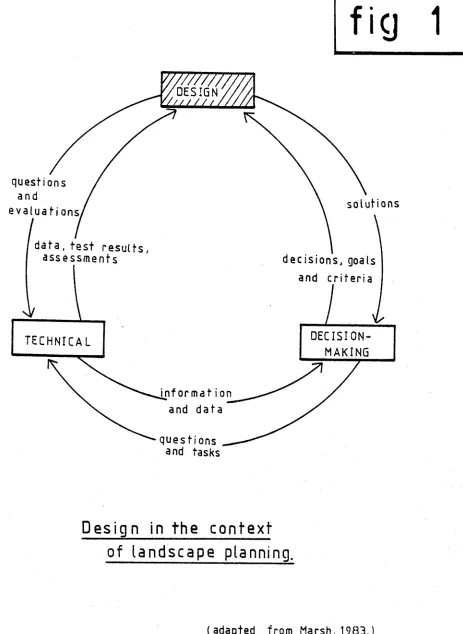
S i m i l a r l y , Marsh (1983) views design as a component w i th i n landscape planning. The other major components are suggested to be ' d e c i s io n - making' and ' t e c h n i c a l ' . The former is predominantly a p o l i t i c a l process (formal or i n fo rm a l) in v o lv i n g such a c t i v i t i e s as d e f i n i t i o n of goals, fo rm ul a ti on o f rele va n t p o l i c i e s , legal and a d m in is tr a ti v e arrangements, and the examination and s e le c ti on of design proposals, whereas the l a t t e r is p r i m a r i l y concerned with environmental inve nto rie s and impact assessment. Design, described as 'the process of devising the physical s o l u ti o n to a planning de ci s io n' (Marsh, 1983: 22), is c lo s e ly linked to both the decision-making and technical components (Fig. 1). These three components comprise the 'landscape planning process' which is aimed at providing a r a t i o n a l basis f o r d i r e c t i n g land use changes (Marsh, 1983).
I t should be noted t h a t there is considerable overlap between the a c t i v i t i e s associated with each component. For example, a more-or-less standard sequence of steps f o r landscape design may be spe cified as ( i ) research ( i i ) analysis ( i i i ) synthesis ( i v ) design and (v) evaluation (Lyle, 1985b). Steps ( i ) and ( i i ) may involve considerable input from the technical component, whereas step (v) is l i k e l y to be u l t i m a t e l y the concern of the decision-making component. Therefore design should not be viewed as a completely d i s c r e te a c t i v i t y w i t h i n the planning process. Rather, i t operates in a p a r a l l e l and complementary fashion to other planning a c t i v i t i e s .
Thus, landscape design can be viewed as a component of landscape planning. I t has close i n t e r a c t i o n s with the decision-making and technical components of planning, and is p r i m a r i l y concerned to provide physical s o l u ti on s to the problems posed by those components. Design a c t i v i t i e s can be considered to operate in both the urban and ru ra l
fig 1
DESIGN
questi ons and
eval ua t j ons sol ut i ons
dat a, t e s t r e s u l t s ,
assessment s deci si ons, goals
and c r i t e r i a
DECISION- MAKING TECHNICAL
j n f or mat i on and dat a
q u e s t i ons and tasks
Desi gn in the cont ext
of l andscape planning.
[image:16.552.62.525.14.648.2]text across a range of landscape scales.
2.3 Design Scales
As pointed out in the preceding section design a c t i v i t i e s are not
limited to any pa rt icula r landscape scale. However, in practice certain
scales frequently provide the focus for design. In descending order of
size these are, the plan u n it, the project area, the s it e , and the con
struction area (Lyle, 1985a). The major characteristics of each are
b r i e f l y outlined in the following:
( i ) Plan u n i t ; has existing definable boundaries (physiographic or
p o l i t i c a l ) , and is small enough to permit accurate detailed
consideration of landscape attrib utes .
( i i ) Project area; part of the plan unit under the fis cal control of
a single e n t i t y , and small enough to f a c i l i t a t e the precise
determination of land-uses.
( i i i ) S i t e ; the scale at which the physical environment is specified
in complete d e t a i l . I t is usually small enough to be seen
e n t ir e l y from a single viewpoint.
(iv) Construction area; that portion of the site where physical
reshaping actually occurs. Techniques pertaining to planting
and the use of materials are specified at this scale. Also,
detail of the arrangement of plants and materials which may have
been precluded by the scale of the site plan are shown.
Larger scales of concern include the region, subcontinent and whole
earth (Lyle, 1985a). Design at the regional scale is rare, and the sub
continent and the whole earth as operational design scales can only be
regarded as f u t u r i s t i c p o s s i b i l i t i e s .
2.4 The Design Process
The foregoing has placed design in the context o f landscape planning and a number of design scales have been i d e n t i f i e d . However, l i t t l e has been said about the design process i t s e l f . The l a t t e r needs to be c l e a r l y explained in order to provide a conceptual base f o r ag ro fo re s tr y design. In the f o l l o w i n g an attempt is made to o u t l i n e the fundamentals of the landscape design process.
Lyle (1985a) suggests t h a t design is a process in which form is given to physical phenomena. Form re la te s to the s p a t i a l arrangement and shape of the phenomena in question. In landscape design the l a t t e r is the land scape i t s e l f , comprising 'the surface of the earth and a l l i t s phenomena, i ncl ud ing landforms, vegetation and man-influenced a t t r i b u t e s . . . (Vink, 1983:2). Thus, the landscape design process can be considered to be ba s i c a l l y concerned with the s p e c i f i c a t i o n of the form of landscape. This invo lves , as Van der Poel (1976: 369) puts i t , 'c r e a t i n g plans f o r the outward appearance of landscape'. Such plans w i l l show the s p a ti a l arran gement and shape of the component parts of the landscape.
In design terminology landscape components are often i d e n t i f i e d as 'elements' (e.g. Hackett, 1971; McCluskey, 1985). The term re fe rs to v i s i b l e , s u r f i c i a l aspects of landscape r e a d i l y d i s ti n g u i s h a b l e at the p a r t i c u l a r scale of concern. Landscape elements may be natural or man made, b i o t i c or a b i o t i c . The term does not have the more precise meaning
accorded to i t in geomorphology (see Speight, 1984) and landscape ecology (see Forman and Godron, 1981; Forman, 1982) although i t is used in a somewhat s i m i l a r sense. S u ff i c e to say t h a t elements are the fundamental units of concern in the design process.
elements. At the plan unit scale (see Sec. 2.3) the l a t t e r may include,
for example, a fore st, timber mill and access road. In this instance
spatial arrangement is l i k e l y to be primarily concerned with r e l a t iv e
location. At the 'project area1 scale, landscape elements may include a
pasture and shelterb elt, in which case i t is not only rel at iv e location
(the shelterbelt in relation to pasture and prevailing winds) that is
important but also the shape (cross-sectional p r o f il e ) of the shelterbelt
(see Brown and Hall, 1968).
Alexander (1964) points out that the design process is also an
attempt to achieve 'f it n e s s ' between form and context. In regard to
landscape design the biophysical attributes of landscape and i t s
associated socioeconomic conditions can be considered to provide the
context for design. That context w i l l , to a large extent, define the
design problem. Form may then be considered*as a solution to that
problem. The degree of 'f i t n e s s ' between form and context is dependent on
the design proposals' visual and ecological empathy with the landscape and
it s relevance to socioeconomic conditions. Context is also set by speci
fied design goals which are framed with reference to biophysical and
socioeconomic conditions. The form of elements needs to f a c i l i t a t e the
attainment of these goals, in other words, form needs to be functional.
Thus, the landscape design process may be described as the
specification of the form of landscape elements^ which are visu ally,
2. In practice, specialized fie l d s w i l l be involved in the detailed
specification of pa rt icula r elements, for example architecture with
building and c i v i l engineering with roads and bridges, nonetheless, the form of such elements within the context of the landscape is a legitimate concern of landscape design.
ecologically and functionally appropriate within the context of particular
landscapes, socioeconomic conditions, and design goals. The process is
shown as a sequence of steps in Fig. 2. The 'specification of the form of
landscape elements' is noted as the 'design proposal', which is usually
shown by plan and section drawings. These are evaluated with respect to
visual, ecological and functional aspects which may be presented as a set
of specific evaluatory c r i t e r i a developed in the light of the stated
design goals (Fig. 2). If evaluation shows the design proposal to be
unsatisfactory i t is necessary to return to an earl i er stage of the pro
cess, otherwise, i t is possible to proceed to the implementation stage.
The design process can be considered to end with the production of working
specifications at the beginning of this last stage, which also
incorporates the establishment of plant materials, structures, paths et c. ,
and where applicable, the formulation of management plans. However, these
aspects are not normally considered as part of the design process.
The design proposal may be seen as a response to specific design
problems which become clear as the design context is c l a r i f i e d. The
3
l at t er is defined with reference to design goals, and by the synthesis of
information derived from the research and analysis of biophysical and
socioeconomic conditions (Fig. 2). The formulation of r e a l i s t i c design
goals requires cognizance of the existing situation (biophysical and
socioeconomic), and subsequent modification as more precise information
becomes available (Fig. 2).
ficj 2
EVAIUATORY CRITERIA
SYNTHESI S RESEARCH
ANALYSIS
OESIGN PROBLEMS
EVALUATI ON
IMPLEMENTATION STATEMENT OF
DESIGN GOALS
SOCIOECONOMIC CONDI TI ONS BI OPHYSICAL
A T T R I B U T E S OF L A N D S C A P E
THE DESIGN CONTEXT
VISUAL, ECOLOGICAL ANO FUNCTIONAL ASPECTS
z DESIGN PROPOSAL: / S P E C I F I C A T I O N OF,.
The design process.
The outline of the design process builds on the basic research- analysis-synthesis-design-evaluation sequence as noted in Sec. 2.2, and essentially represents the rational problem - solving paradigm which has been adapted from the systems approach (see Lyle, 1985a). While the sequence of steps is referred to as a 'design process', it is clear that in the early and late stages other planning components are involved (see Sec. 2.2). It is taken as understood that the design process cannot be completely isolated from other activities which might be more properly considered as 'technical' or 'decision-making'.
Rational design procedures can be criticised as unrealistic, since in practice design rarely proceeds through the linear step-by-step sequence as suggested by Fig. 2 (Lyle, 1985a; 1985b). More importantly, as Lyle (1985b: 9) points out, 'taken too literally and followed too rigorously, a formal design process can close out creativity, the driving force of design, and this can lead to disaster, or more commonly, to mediocrity'. Nonetheless, the kind of approach shown in Fig. 2 has gained wide currency as a response to the increasing demand for design processes to be logically defensible (Lyle, 1985a).
The procedure outlined here is not intended as a definitive statement on the correct approach to design, rather it is presented as an example of the way design is commonly approached. The procedure is not a formal process but a framework in which the various steps mark stages in a rough progression towards the design proposal. It does not imply that frequent iteration is not required.
2.5 Agroforestry Design : Introductory Remarks
t r e e s , a g r i c u l t u r a l c r o p s , a n d d o m e s t i c a n i m a l s in a n y o r all
c o m b i n a t i o n s ' ( G o l d a n d H a n o v e r , 1 9 8 7 : 1 1 0 ) . S u c h s y s t e m s c a n be c o n s i
d e r e d a n i n t e g r a t i o n o f f o r e s t r y a n d a g r i c u l t u r e , a n d i n v o l v e t h e i n t r o
d u c t i o n o f c r o p s a n d / o r l i v e s t o c k t o f o r e s t l a n d s , o r m o r e c o m m o n l y , t h e
i n t r o d u c t i o n o f t r e e s to a g r i c u l t u r a l s y s t e m s . In e i t h e r c a s e c o n s i d e r
a b l e c h a n g e s in t h e r u r a l l a n d s c a p e m a y e n s u e . C l e a r l y , a r a t i o n a l b a s i s
f o r d i r e c t i n g s u c h c h a n g e s is r e q u i r e d .
T h u s , t h e f o r m u l a t i o n o f p r o p o s a l s i n v o l v i n g l a n d s c a p e c h a n g e f o r
a g r o f o r e s t r y is t h e p r o v i n c e o f r u r a l l a n d s c a p e p l a n n i n g . T h i s d o e s n o t
n e c e s s a r i l y i m p l y t h a t s u c h p l a n n i n g w o u l d i n v o l v e a f o r m a l p r o c e s s
d i r e c t e d b y g o v e r n m e n t o r p r i v a t e a g e n c i e s . H o w e v e r , it d o e s s u g g e s t t h a t ,
e v e n i f p l a n n i n g is c a r r i e d o u t b y t h e i n d i v i d u a l l a n d o w n e r , d e c i s i o n
m a k i n g , t e c h n i c a l , a n d d e s i g n a c t i v i t i e s a r e r e q u i r e d ( s e e S e c . 2 . 2 ) .
T o g e t h e r , t h e s e t h r e e c o m p o n e n t s w i l l d i r e c t t h e c o u r s e t o w a r d s t h e
c r e a t i o n o f an a g r o f o r e s t r y s y s t e m . T h e s u c c e s s o r f a i l u r e o f t h e l a t t e r
w i l l b e l a r g e l y d e p e n d e n t o n a t h o r o u g h c o n s i d e r a t i o n o f e a c h p l a n n i n g
c o m p o n e n t .
O a t e s ( 1 9 8 4 ) a n d R e i d a n d W i l s o n ( 1 9 8 5 ) h a v e s t r e s s e d t h e n e e d f o r
p l a n n i n g in a g r o f o r e s t r y . H o w e v e r , p l a n n i n g p r o c e d u r e s a r e o u t l i n e d in a
v e r y s i m p l e a n d r u d i m e n t a r y f a s h i o n . M o r e o v e r , l i t t l e is s a i d a b o u t t h e
a c t u a l p r o c e s s o f a g r o f o r e s t r y d e s i g n . O l d e m a n s ( 1 9 7 9 : 29) s a l u t o r y c o m
m e n t on t h e l a t t e r is w o r t h n o t i n g : 'Up t i l l n o w , o n e o f t e n g e t s t h e
i m p r e s s i o n t h a t t h e d e s i g n o f b i o - e c o l o g i c a l p r o d u c t i o n s y s t e m s h a s b e e n
c o n s i d e r e d as s o m e t h i n g e a s y a n d e l e m e n t a r y . O n e h a s o n l y t o p l a n t a n d it
g r o w s . In r e a l i t y , s u c h s y s t e m s a r e m o r e c o m p l i c a t e d t h a n m o s t o f o u r
i n d u s t r i a l c o m p l e x e s ' . In v i e w o f t h i s , it is c l e a r t h a t a g r o f o r e s t r y
terminology means the abi l i t y to accommodate 'a great deal of information
from a variety of sources on many different subjects from diverse discip
lines' (Lyle, 1385b: 8). The broad scope of the possible inputs is indi
cated by Gold and Hanover (1987: 110): 1 Agroforestry might be considered
as the meeting point for a confluence of disciplines, both applied and
basic in nature. Within i t s broadest scope i t draws on the accumulated
knowledge of many separate disciplines including forestry, agronomy,
animal husbandry and horticulture for i t s major inputs, with necessary
additional inputs coming from soil science, microbiology, ecology, plant
breeding, chemistry, economics, sociology, agriculture engineering, and
ot hers' . For the most part, these disciplines are ' technical' in nature,
thus, their potential input is likely to be more dependent on design being
set within an overall planning framework (see Fig. 1), rather than on the
design procedure p e r s e. This aside, the design process i t s e l f can have
characteristics which either discourage or encourage a 'capacity for
complexity'. Characteristics in the l a t t e r category and already specified
in tne design procedure shown in Fig. 2 include, f i r s t , a design context
which is resolved with reference to both socioeconomic and biophysical
conditions, and second, a requirement that the specification of form
involve ecological and visual, as well as, functional considerations.
Since i 11-conceived design approaches clearly have the potential to
produce detrimental landscape changes, which, in many instances, may not
be easily r ect i f i ed, there is a need for procedures to be established,
specified in some de t a i l , and examined c r i t i c a l l y in order to establish
' defensibi1i t y ' . The l a t t e r refers to the existence of a clear and cor
rect logical framework, and like the abovementioned 'capacity for com
pl exi t y1 c r i t e r i a , is now commonly applied to landscape design in general
context of project planning, where the need for 'accountability' has
resulted in formally specified procedures such as the 'logical framework
approach' (Australian Development Assistance Bureau, 1986).
The position taken in this thesis is that agroforestry design can be
modelled on the landscape design process as outlined in Sec. 2.4. Thus,
as a f i r s t approximation, agroforestry design, like landscape design, can
be considered to involve 'the specification of the form of landscape
elements which are visually, ecologically and functionally appropriate
within the context of particular landscapes, socioeconomic conditions and
design goals' . This would seem an appropriate view of design in the light
of Nairs' (1979: 275)’ assertion that agroforestry land use should be
'ecologically desirable, pract ically f easible, and socially acceptable to
the farmers'. Thus, the design process as shown in Fig. 2 can be consi
dered as an appropriate starting point from which to develop an agrofores
try design procedure characterised by 'logical defensibi1ity' and the
'capacity for complexity'.
The procedure, as developed in the following chapters, addresses land
use changes at the level of the 'farm u n i t ' . This is roughly parallel to
the 'project area' design scale (see Sec. 2.3). At this scale landscape
elements will include shel t er bel t s, production plantations, pasture,
crops, livestock, access tracks, buildings, fences and dams, and the
central design problem is the spatial arrangement of these elements in
relation to each other and the landscape. Larger and smaller design
scales can be considered to be 'the catchment' (largely synonomous with
the 'plan uni t ' ; see Sec. 2.3) and ' s i t e ' respectively. The central
design problem at these scales are briefly noted in the following:
( i ) The Catchment Scale; catchments are regarded as natural planning
units characterised by dynamic interrelationships between water, land
and people (Irwin and Williams, 1986). The protective role of trees,
the importance of management decisions on individual farms, and the
need fo r comprehensive resource inventories as a basis for rational
management have been recognized (Clarke, Irwin, Marshall and
Wakefield, 1986; Breckwoldt, 1986a; Short, 1986). Agroforestry de
sign at this scale needs to consider these aspects. In p a rtic u la r,
the re co n cilia tio n of overall design strategies with the needs of
individual management units (e.g. farms) is a central problem. For
example, streamside protection planting, which may well be part of
agroforestry design at the farm scale, may be limited in e ffe c tiv e
ness at the catchment scale i f plantings do not extend upstream and
downstream from the eroded site (Carne, 1986). Clearly, the resolu
tion of problems at this scale require an awareness of land-use
practices on individual farms or management units, and at the farm
scale, a recognition of the implications of land-use for the cat
chment as a whole. In practice, the preparation of agroforestry
'master plans' at the 1arger-than-farm scale (e.g. Rocheleau and
Hoek, 1984) is required against which farm design can be checked to
ascertain possible c o n f lic t .
( i i ) The Site Scale; at the s ite level the central design problem
is the spatial and temporal arrangement of plants. In practice
design specifications would be expressed in a 's ilv i c u l t u r a l regime'
(see Shepherd, 1986). At th is level of agroforestry design i t may be
possible to derive design principals from studies of natural forest
ecosystems. Attempts to derive workable concepts have begun (e.g.
1984) but the translation to practical design guidelines is d i f f i
c u l t .
2.6 Conclusion
In broad terms, agroforestry land use can be described as an
integration of fore stry and agriculture. Clearly, i t s ' adoption w i l l
result in considerable change in the rural landscape, and therefore, i t is
a legitimate concern of landscape planning. The l a t t e r can provide a
rational basis for directing such change, and involves decision-making,
technical, and design a c t i v i t i e s . Design is essentially concerned with
the specification of the form (shape and spatial arrangement) of landscape
elements.
The 'specification of form1, shown as a 'design proposal', is
f a c i l i t a t e d through the design process. The l a t t e r can be described as a
sequence of steps, which while indicating a certain l i n e a r i t y should not
be interpreted as meaning that it e ra tio n does not occur. Indeed, frequent
it er a tio n is more a rule than exception in design. Nonetheless, the value
of linear step-by-step descriptions is that they provide a logical
framework within which design problems can be systematically approached.
Such descriptions essentially represent a rational problem-solving
approach to design, which, in the context of t h is thesis, is considered
appropriate for agroforestry.
In view of the above, a systematic landscape design procedure has
been outlined and proposed as an appropriate model from which an agro
forestry design procedure can be developed. The procedure has been shown
in general form and described as 'the specification of the form of land
scape elements which are v is u a ll y, ecologically and fun ction ally approp
ria te within the context of particul ar landscapes, socioeconomic
tions and design goals'. Also, it has been suggested that agroforestry design procedures, in common with landscape design approaches in general, should have the 'capacity for complexity' and be 'logically defensible'.
Design activities operate across a range of landscape scales, the largest of which is typically the 'plan unit', and the smallest the 'construction area'. The focus of attention in this thesis is the 'farm- unit', which in most instances will be intermediate to these extremes, being more-or-less synonomous with the 'project area' design scale. At this scale, the precise determination of land uses is possible, and the form of associated landscape elements such as windbreaks, pastures, and production plantations can be specified in detail. The central design problem at this scale is the spatial arrangement of elements in relation to each other and the landscape. More detailed specifications, such as the arrangement of individual plants, is the subject of design at the 'site' or 'construction area' scales. These small-scale design problems will not be further considered in this thesis. Similarly, design at the large-scale, such as a major catchment incorporating several farm-units (synonomous with the 'plan unit'), will not receive further attention.
CHAPTER THREE
A g r o f o r e s t r y : Concept and P r a c t i c e 3.1 I n t r o d u c t i o n
This c h apt er attempts t o e l u c i d a t e the concept and p r a c t i c e o f agro f o r e s t r y and thus p r o v i d e the necessary background a g ai n s t which the n o t i o n o f ' a g r o f o r e s t r y d e s i g n' can be developed. F o l l o w i n g some p r e l i m i nary comments concerni ng a g r o f o r e s t r y as a land use and f i e l d o f s t ud y , the term ' a g r o f o r e s t r y ' i s d e f i n e d (Sec. 3 . 3 ) . A t t e n t i o n i s then drawn to some o f the more i m p o r t a n t i m p l i c a t i o n s a sso c ia te d w i t h the a g r o f o r e s t r y concept (Sec. 3 . 4 ) , and the c l a s s i f i c a t i o n o f a g r o f o r e s t r y systems i s discussed (Sec. 3 . 5 ) . F i n a l l y , some t y p i c a l A u s t r a l i a n a g r o f o r e s t r y p r a c t i c e s are b r i e f l y o u t l i n e d (Sec. 3 . 6 ) .
3.2 P r e l i m i n a r y Comments
The term ' a g r o f o r e s t r y ' , d e s p i t e some c o nf usi on over i t s exact meaning and d i f f i c u l t i e s i n t r a n s l a t i o n to o t h e r languages (Combe and Budowski, 1979; S t e w a r t , 1981), i s now w i d e l y used t o d es c ri be the growing o f t r e e s w i t h a g r i c u l t u r a l crops an d/ or l i v e s t o c k on the same piece o f l an d . To some e x t e n t , t h i s r e p r e s e n t s an i n t e g r a t i o n o f f o r e s t r y and a g r i c u l t u r e , both o f which are n o r m a l l y r ecogni zed as d i s t i n c t l an d - use a c t i v i t i e s . However, as Adeyoju (1980: 157) p o i n t s o u t , ' f o r e s t r y and a g r i c u l t u r e were, f o r c e n t u r i e s in si mpl e s o c i e t i e s , a common vo ca ti on wherein the f a rm e r, h u n t e r , and woodsman were n e a r l y always the same', and R a i n tr e e (1984) , w h i l e r e c o g n i z i n g t h a t a g r o f o r e s t r y i s a r e l a t i v e l y new f i e l d o f organi zed s c i e n t i f i c a c t i v i t y d es c ri be s i t as an ' a n c i e n t land use p r a c t i c e ' . The i n t e r p l a n t i n g o f t r e e s w i t h crops and the g ra zi ng o f domesticated animals i n f o r e s t s are, f o r example, p r a c t i c e s having a long
Agricultural Bureaux, 1982).
Clearly, integrated land-use involving forestry and agriculture is not a new concept. However, its newness as a scientific field of study bridging, as Raintree (1984: 253) puts it, the 'artificial but time- honoured disciplinary no man's land between agriculture and forestry', is underscored by the fact that the International Council for Research in Agroforestry (ICRAF) was formed as recently as 1977.
Agroforestry, as a distinct and legitimate field of study, is c onsi dered by Jorgensen (1986) as a branch of 'community forestry' aimed at providing environmental and social benefits for rural populations. In the urban context, the provision of 'environmental and social benefits' is suggested to be the aim of 'urban forestry'. In the case of the latter the main products are amelioration of urban living areas with regard to climate, hydrology, air quality, noise control and aesthetics, and the provision of land for recreational and educational use. In regard to agroforestry, Jorgensen (1986) lists the main products as increased land productivity due to soil conservation, wood for energy, and animal fodder for food production.
desires of the rural community-at-large. Thus, i t would be d i f f i c u l t to
apply the concepts of 'community forestry' to agroforestry in these situa
tions .
Nonetheless, the importance of agroforestry as a rural land-use lies
in its potential to u t i l i z e and s t ab il iz e ' f r a g i l e ' or 'degraded' ecosys
tems, which in the tropical world occupy about 65% of the land and support
35% of the population of the developing countries (King, 1979a). The
c r i t i c a l state of such ecosystems is indicated by severe land degradation
which manifests in problems of soil erosion, s a l i n i t y , soil micronutrient
deficiencies and reductions in the carbon to nitrogen r a t io , and
sedimentation in reservoirs and watercourses (Bowonder, 1987). These
problems are closely associated with alarming rates of deforestation (see
Myers, 1985; UNEP, 1987) as a result of fuelwood demand, shifting cu lt iv a
tion, overgrazing, large-scale wood extraction for paper and pulp, conver
sion of forest land to agricultural uses, and poor efforts at forest
regeneration (Bowonder, 1987). In the developed countries there is in
creasing evidence of land degradation. For example, in the U.S.A. 1/3 of
croplands is now undergoing a marked decline in long-term productivity as
a consequence of soil erosion (Myers, 1985). In Australia, Woods (1983)
suggests that 51% of agricultural and pastoral land is seriously degraded,
and Grose (1982) has noted the concomitant widespread extent of tree
decline (Plates 1 to 3). Indeed, i t has been estimated that some 87
million hectares of forests and woodlands have been cleared since European
settlement (Wells, Wood and Laut, 1984). This amounts to approximately
36% of the original cover. Those stands which have survived the onslaught
of the early settlers (see Bolton, 1981) and contemporary non-conservative
agricultural practices are now ty pi ca lly restricted to roadside verges and
riparian corridors (Plates 4 and 6). These, along with the odd patch of
PLATE 1 : Gully erosion; a typical form of rural land degradation (near Bredbo, N.S.W.).
15*
PLATE 3 : Farmland near Hamilton, Western Victoria; the low-lying area (centre of photo) has severe salinity problems as a result of overclearing and the concomitant high water-table.
PLATE 4 : Roadside verges; woodland remnants in the rural landscape of central Victoria.
PLATE 5 : A well-vegetated riparian strip stands in stark contrast to a background of cleared hillslopes
(Murrumbidgee River, A.C.T.).
forest l e f t intact on private fanning or grazing land, and the forest
remnants associated with stock route reserves, are recognized as invalu
able components of the rural landscape (e.g. Breckwoldt, 1986). Nonethe
less, various studies indicate a continuing decline in these surviving
remnants (e.g. Devonshire and Greig, 1980; McMurray, 1984).
In view of the above, i t is clear that the need for rural reforesta
tion can be found in both the developed and developing countries. Moreo
ver, there is a general need for alternative, sustainable land use prac
tices to halt the current widespread extent of environmental degradation.
Agroforestry can be seen as one such alternative which would promote the
reestablishment of a tree-cover for both protection and production.
Obviously, agroforestry is not a panacea for all environmental problems,
but, as Young (1985: 11) points out, 'there are clear grounds for suppo
sing that the introduction of trees in land use systems can be of particu
lar benefit in areas which have suffered some form of environmental degra
da tio n' . In p a rtic u l a r, soil erosion and f e r t i l i t y decline can be
mitigated by certain agroforestry practices (Young, 1987). These, along
with other environmental problems which agroforestry has the potential to
alleviate are shown in Table 1.
Even in landscapes which show l i t t l e or no degradation, a change to
agroforestry is l i k e l y to resu lt in a better use of land. In Australia,
for example, there are farm landscapes which have been reasonably well-
maintained, but due mainly to inherent low soil f e r t i l i t y have r e l a t i v e l y
low land capability rankings for forestry and agriculture (Plates 7 and
8). For such areas, ' agroforestry c ap ab il ity ' is of course unknown,
nonetheless, they are l i k e l y to be suitable for some form of agroforestry.
Moreover, with the appropriate choice of agroforestry practice (see Table
TABLE 1. Environmental problems which agroforestry has a potential to alleviate
Environmental Problem Potential Agroforestry Practices and Functions
Soil erosion by water Agroforestry practices for erosion control; barrier hedges, trees on soil conservation works, alley cropping, multistorey tree gardens, plantation crop combinations.
Soil erosion by wind. Windbreaks and shelterbelts.
Low natural soil fertility or fertility decline (physical, chemical and biological
degradation).
Agroforestry practices for maintenance and improvement of soil fertility; alley cropping, multistorey tree
gardens, plantation crop combinations, biomass transfer (transport of tree foliage from forests to cropland), planted tree fallows, trees on cropland, trees on pastures. Forest clearance and
degradation.
On-farm production of fuelwood.
Pasture degradation. Fodder production from trees; pasture improvement through trees.
Drought hazard. Agroforestry practices for micro climatic modification and moisture conservation; role of deep-rocting trees.
Degradation of river flow. Agroforestry as an element in watershed management.
Pest attack. Trees for pest inhibition.
[image:36.552.42.514.37.803.2]PLATE 7 : (and 8): Farm landscape near Braidwood, N.S.W: windbreak plantings (middle-ground), the retention of some trees on pasture, and a grassed dam wall and fencing to control stock (below), are indicative of relatively well-managed land. Nonetheless, grazing is limited (Class VI; moderate grazing), and capability for forestry is Class IV (site index 80). Landscapes such as this, less than optimal for agriculture or forestry alone, are likely to benefit greatly from some form of agroforestry.
PLATE 8:
1), and the judicious selection of tree and/or shrub species, soil
f e r t i l i t y could be enhanced and maintained in the long term.
Thus, agroforestry has the potential to bring about improvements in
biophysical conditions of both seriously degraded and r e l a t i v e l y well-
conserved environment. Concomitant improvements in social conditions could
be expected, and may occur as a result of a raised level of human w e ll
being through increases in the quality and quantity of food, or more
simply, as a consequence of improvements in environmental amenity (shade,
shelter, aesthetic values e t c . ) . Therefore, agroforestry could be consi
dered a form of 'social f o r e s t r y ' , which while clearly providing a social
benefit may or may not involve the active community participation charac
t e r i s t i c of 'community for e stry ' (Basu, 1984).
Indeed, a 'social forestry context' for agroforestry is made clear in
ICRAF's charter. Ultimate objectives are stated as: 'to improve the
n u t r i t i o n a l , economic and social well-being of the peoples of developing
countries by the promotion of agroforestry systems designed to result in
better land use without detriment to the environment' (ICRAF, 1983: 3).
While this relates s p e c i f i c a l l y to the developing world, there are many
parts of the so-called 'developed world' where such objectives would be
e n t ir e l y appropriate. For example, in the Australian context, Oates
(1984: 166) suggests that agroforestry is 'the management of land for
increased net social benefit, by the simultaneous production of farm and
forest products.'
To conclude these preliminary comments i t is worthwhile noting the
following remark by Raintree (1986: 3): ‘ Many people today have great
expectations fo r agroforestry, some of which would seem to be j u s t i f i e d on
technological grounds. However, i f current e f f o rts to understand, develop
even a reasonable proportion of current expectations, it s deployment, as a
newly organized branch of applied science, must take place with a clearer
than usual view of the human context of supposed land-use improvements'.
Clearly, the integration of forestry and agriculture is more than just a
question of biophysical p o s s i b i l i t i e s . If the potential of agroforestry
to redress environmental degradation and provide a viable alternative land
use is to be realized, thorough consideration must be given to the social
and economic circumstances of rural populations. This is particularly
important in land use system where managed trees and shrubs represent a
new inovation. As Lundgren and Raintree (1983:39) point out, in these
situations social and cultural attitudes may hinder the adoption of
agroforestry practices, and moreover, the 'period between planting a tree
and achieving appreciable benefits from i t involves risks that farmers
with limited resources may not be prepared to take*.
3.3 Definition of Agroforesty
A large variety of rural land-use practices exhibit, to greater or
lesser degrees, an integration of forestry and agriculture. Inevitably,
regional terminologies have been devised to describe such practices.
Examples include, from New Zealand, 'integrated farm forestry' (Tustin and
Knowles, 1975), from southern Africa, '' three dimensional forestry
(Douglas, 1967; 1968), from central Morocco, ' sylvo-pastoral systems
(Montoya 01i v e r , 1986) and from Nigeria, ' agri•-silvicultural systems
(01awoye, 1975). In southeast Asia, the terms 'swidden' and ' taungya
describe tree/crop systems (Awang, 1985; Vergara, 1985). The term 'tree
gardening' with i t s two main variants 'pekarangan' and ' talun-kebun' has
also been applied in this region (Wiersum, 1982; Christanty and Iskandar,
1985). Other authors, refer to the same systems as 'tropical homegardens'
(Fernandes and Nair, 1986) or ' multi-storied gardens' (Freeman and Fricke,
1984). In the West Indies, somewhat similar forms of land-use (see Innis,
1961) are referred to as 'kitchen gardens' (Brierley, 1976).
All the abovementioned systems have in common the integration of
woody perennials with herbaceous plants and/or livestock. However, great
diversity occurs in the plant species ut i l i zed, the scale of land-use,
products, and temporal and spatial arrangement of plantings. Much of the
confusion as to 'what agroforestry i s' is no doubt due to the di f fi cul t y
of elucidating the term by proferring examples of what are at f i r s t glance
disparate land-use practices. Clearly, if the term ' agroforestry1 is to
be applied to such diverse practices the definition needs to be comprehen
sive, without being so broad as to be useless from a sci ent i fi c point of
view.
King (1979b) suggests that agroforestry should be considered a gene
r i c term embracing the following components:
(i) Agri silviculture; the use of land for the concurrent production
of agricultural crops (including tree crops) and forest crops.
( i i ) Sylvopastoral systems; forests managed for the production of
wood and the rearing of domesticated animals.
( i i i ) Agrosylvopastoral systems; a combination of (i) and (i i )
(iv) Multipurpose forest tree production systems; forest tree
species managed for production of wood and leaves and/or f r ui t
suitable for food and/or fodder.
A number of practices can be recognized as characteri stic of each of
these components (see Nair, 1985). These include, for example, in agri
si l vi cul t ure, hedgerow intercropping, multistorey crop combinations, mul
tipurpose trees on farmlands, shelterbelts and windbreaks, and shade trees
trees over pasture and 'living fences' are cha racteristic, while agrosil-
vopastoral systems typically exhibit tree-crop-livestock combinations
around homesteads and woody hedgerows for browse, mulch, green manure and
soil conservation.
Numerous attempts have been made to provide a concise definition to
cover these components and practices (e.g. Editorial, 1982), and, as the
Commonwealth Agricultural Bureau (1982:1) notes, 'There are probably as
many definitions of agroforestry as there are users of the term'. However,
the following definition proposed by Lundgren and Raintree (1983) has been
adopted by ICRAF (see Fernandes and Nair, 1986) and is accepted for the
purposes of this thesis:
' Agroforestry is a collective name for land-use systems and technologies where woody perennials are deliberately used on the same land management unit as agricultural crops and/or animals, in either a spatial arrangement or a tempo ral sequence, there being both ecological and economical
interactions between the different components'.
As Fernandes and Nair (1986) point out, this implies f i r s t , agroforestry
normally involves two or more species of plants (or plant and animal), at
least one of which is a woody perennial, second, an agroforestry system
always has two or more outputs, third, the cycle of an agroforestry
system is always more than one year, and fourth,even the most simple
agroforestry system is more complex, ecologically (structurally and func
tionally) and economically, than a monocropping system.
As suggested in the above, 'woody perennials' (trees, shrubs, palms,
bamboos, etc.) are a ch ara cteristic element of agroforestry systems. These
are almost always 'multipurpose'^ (Young, 1986), that is , they 'provide
4. See Turnbull (1986) for examples of 'multipurpose' Australian Trees and shrubs.
more than one significant contribution to the production and/or service
functions (e.g. shelter, shade and land sustainability) of the land use
systems they occupy' (Huxley, 1985a: 13). Annual agricultural crops are
5
sometimes included with pasture plants under the collective term 'herbs'
(Young, 1986). These comprise the second major element in agroforestry,
the third being animals, which in most instances will be domesticated.
The f i r s t element, that is, woody perennials, are found in all
agroforestry systems, and the second, herbaceous plants, are found in
most, with the possible exceptions of certain agrisi lvicultural systems in
which the agricultural crop is produced by trees and/or shrubs (see Nair,
1985), in multipurpose forest tree production systems (see King, 1979b),
or in forest apiculture and mangrove aquaculture, both legitimate, though
somewhat d i f f i c u l t to cl assify agroforestry forms (see Nair, 1985). The
third element, namely 'animals', is present in some agroforestry systems
usually designated as ' si 1vopastoral' and ' agrosi1vopastoral' (see Nair,
1985).
The above definition notifies that elements may be arranged in either
a spatial arrangement or temporal sequence. The former includes zonal or
mixed arrangements, while the l a t t e r may be concomitant, sequential,
coincident, interpolated, or overlapping (see Nair, 1985). Examples of
the various combinations of spatial and temporal arrangements which
characterise particular agroforestry systems are shown in Appendix 1.