INTRODUCTION
Ecology aims to describe and study distribution and patterns of biodiversity to empirically infer the complex bio-physico-chemical processes that have created this biodiversity through time and space. Conservation science and management then use eco -logical descriptions and patterns to elaborate biodi-versity conservation plans. Ecologists increasingly turn to applied conservation science given the in-creasing societal (and funding) requirements for
‘use-ful’ research to achieve population well being and re-source sustainability. In fact, conservation is reward-ing for ecologists as citizens worried about how the natural world is degrading. But also intellectually speaking since conservation brings new challenges and fresh paradigms when looking at classic ecologi-cal problems and data sets. However, in some in-stances, conservation has brought specific angles to ecological problems to the point that it may be neces-sary to clarify recent concepts (Caro 2010). Confusing recommendations may have negative and costly
con-© Inter-Research 2012 · www.int-res.com *Email: [email protected]
NOTE
Distinction between effective pattern-based
and selection-based biodiversity surrogates
is essential: caveats for managers
Serge Andréfouët
1,*, Mélanie A. Hamel
1, 2, Mayeul Dalleau
1, 31Institut de Recherche pour le Développement, Centre de Nouméa, BP A5, 98848, Nouméa, New Caledonia 2Present address : Australian Research Council Centre of Excellence for Coral Reef Studies, James Cook University,
Townsville, Queensland 4811, Australia
3Present address : Kélonia, 46 rue du Général de Gaulle, 97436 Saint Leu, La Réunion — France
ABSTRACT: Ecological concepts and data may justify the selection of biodiversity conservation plans among different options, but can also lead to poor conservation guidelines if not properly used. The use and meaning of the ‘surrogate’ concept in ecology and conservation planning contexts is a typical example. Surrogates are entities such as species, environmental variables or habitats, which are used to represent a target entity such as genes, species, ecosystems or related metrics. ‘Pattern-based surrogacy’ identifies effective surrogates using statistical congruence, while ‘selection-based surrogacy’ identifies effective surrogates through a notional conservation plan or prioritization analysis where sites are added to a set of protected areas, often using a complementarity criterion between sites. With this clear framework in mind, an investigation of the coral reef literature revealed that most published studies on surrogates of reef biodiversity refer in fact to pattern-based surrogates. Fundamentally, there is nothing wrong with both approaches. However, efficient pattern-based surrogates are often recommended for conser -vation planning, implying that they could be efficient selection-based surrogates. In fact, efficient pattern-based surrogates are not necessarily efficient selection-based surrogates and vice versa.
The reason is the complementarity rules used by selection algorithms. We call for more clarity from authors on the context in which effective surrogates have to be used, and more caution from managers when surrogates are to be used in conservation plans.
KEY WORDS: Surrogacy · Surrogate effectiveness · Remote sensing · Conservation planning · Habitat map · Coral reefs
sequences on the decision-making process because managers could channel substantial efforts and funds in the wrong directions (Carwardine et al. 2008).
The goal of this Note is to (re-)emphasize the spe-cific use and meaning of the words ‘surrogacy’ and ‘surrogates’ according to their common uses in eco -logy and conservation planning. In its broader eco-logical meaning, surrogates can be defined as enti-ties (species, environment data, habitats) which are used to represent other biodiversity entities (genes, species, ecosystems or biodiversity metrics). The practical justification of using surrogates generally comes from the substantial funds, expertise and time needed to acquire new data (Grantham et al. 2008, 2009). Instead, existent data or data that are cheaper or easier to acquire (i.e. surrogates) are used. In the conservation planning literature, reference to a con-servation plan is implicit. For Caro (2010) for in -stance, surrogates are entities which are used to rep-resent other species or aspects of the environment to attain a conservation objective. The use of surrogate data sets instead of more precise ideal biological data sets is increasing (e.g. Mellin et al. 2011). However, under the general aforementioned ‘surrogate’/ ‘sur-rogacy’ vocabulary, there are several distinct notions. Since they may lead to paradoxical and apparently contradictory guidelines in terms of data acquisition and conservation strategies, managers need to be aware of the differences.
PATTERN-BASED AND SELECTION-BASED SURROGATES IN ECOLOGY AND
CONSERVATION
In all terrestrial, marine and freshwater realms, many ecological studies have investigated the links between biodiversity patterns (e.g. exhaustive spe-cies diversity) and ancillary variables (typically envi-ronmental and habitat variables, but also other accessible species and higher-order taxa). The goal is to infer the processes explaining the observed bio -diversity, but also to find good direct predictors of biodiversity patterns (Gaston 2000, Ricklefs 2004, Tittensor et al. 2010). In ecology, if that link is statis-tically strong, the ancillary variable can be used as a proxy of the studied biological system, especially if this proxy is easier, faster or cheaper to study than the initial target. In this case, simple congruence measurements between the 2 variables (such as Spear man and Kendall correlation coefficients or Mantel tests) are sufficient to estimate the effective-ness of the proxy. Knowledge of biodiversity from
et al. 2005), and related metrics (such as the species accumulation index, SAI; Rodrigues & Brooks 2007). The SAI is based on the differences of the areas under the accumulation curves. It quantifies the effectiveness of the scenario, and thus the effective-ness of the used surrogate. In general, a surrogate will be more efficient than another if conservation scenario outputs show that a conservation target is reached at a lower cost than with other datasets. Therefore, the measure of surrogacy potential in a conservation context is not based solely on a statisti-cal measure of good fit, but it depends on the cost-effectiveness of a scenario, which is itself highly dependent on prioritization methods. In most cases, these prioritization methods are selection or opti-mization algorithms (Moilanen et al. 2009). Such sur-rogates are known as ‘selection-based sursur-rogates’ (Grantham et al. 2010).
It is also important to add that, often, ‘pattern-based’ and ‘selection-‘pattern-based’ surrogates are the same entities (for instance a habitat descriptor). It is the evidence of effectiveness, and how it is measured, that makes them pattern-based or selection-based, and not the nature of the entity.
CONTRASTED EFFECTIVENESS OF PATTERN-BASED AND SELECTION-BASED SURROGATE LEADS TO APPARENT PARADOX
What is often seen as a paradox is that an efficient pattern-based surrogate in ecology is not necessarily an efficient selection-based surrogate in
conserva-tion. The opposite is also verified. For instance, if a surrogate has a strong statistical spatial link with the distribution of a suite of endangered rare species, depending on the scenario used to save these spe-cies, the use of the surrogate instead of the actual list of species can be either efficient or misleading. Examples are found in the literature. For coral reefs, Beger et al. (2007), who investigated cross-taxa sur-rogacy, gave a good example that contradicts the idea that a good pattern-based surrogate is a good selection-based surrogate. They showed that even though there is a spatial correlation between a vari-able X(fish, corals or molluscs) diversity and a vari-able Y(fish, corals, molluscs) diversity, the design of a marine protected area based on Xwould lead to a poor representation of Ydiversity. On the other hand, Dalleau et al. (2010) showed that using marine ben-thic habitats to design a marine protected area would likely benefit species diversity of various taxa despite no apparent spatial correlation. This demonstrates the point that efficient selection-based surrogates are compatible with low spatial congruence and weak efficiency as pattern-based surrogates. This paradox is of course only apparent.
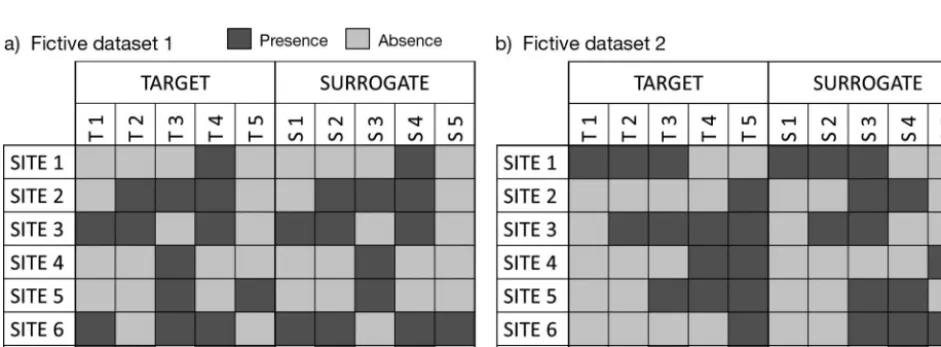
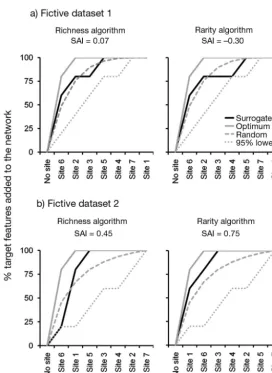
Of this pseudo-paradox, 2 illustrations are given here using a simple simulation and a case study. (1) For 2 simulated data sets (Fig. 1), we show the possible occurrence of strong and weak pattern-based effectiveness, associated with respectively weak and strong selection-based effectiveness (Fig. 2 and Table 1). (2) We extracted a subset of the data set presented by Dalleau et al. (2010), who tested coral reef habitat maps as surrogates of
spe-Fig. 1. Fictive datasets used to illustrate effective (a) pattern-based surrogates which are not effective selection-based surro-gates and (b) selection-based surrosurro-gates which are not effective pattern-based surrosurro-gates (cf. Fig. 2 and Table 1). The matrix indicates the distribution (presence/absence) of 5 surrogate features (S1, S2, S3, S4, S5) and 5 target features (T1, T2, T3, T4,
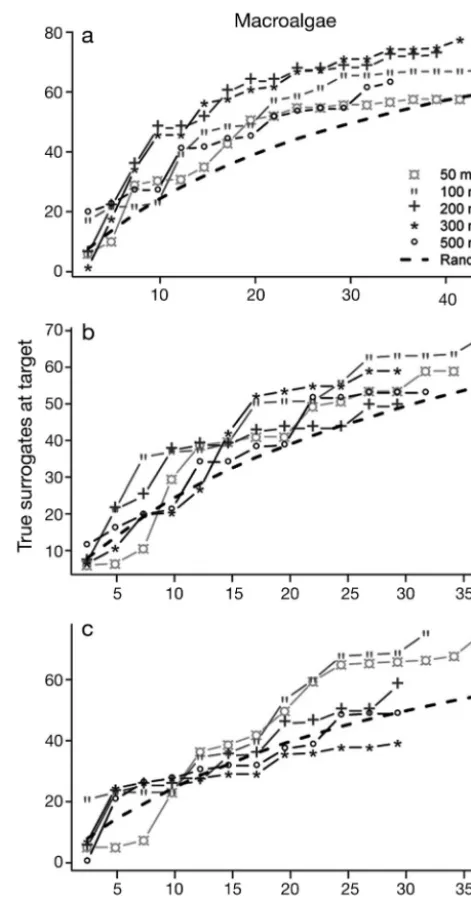
[image:3.612.63.534.503.676.2]cies inventories in Wallis Island (South Pacific). Dalleau et al. (2010) re ported a poor correlation (non-significant) between macroalgal diversity and habitat diversity at all spatial scales and for all levels of habi-tat characterization (Fig. 3). Yet, habihabi-tats were always effective surrogates in repre-senting the same algal diversity in a con-servation plan (Fig. 4). These 2 examples highlight the common occurrence of the paradox.
[image:4.612.57.330.82.456.2]In the recent coral reef literature (re -viewed below) and elsewhere, the word ‘surrogate’ is often used with a ‘pattern-based’ meaning. There are many claims that good surrogates (sensu pattern-based) are identified, but conclusions on effective-ness of pattern-based surrogacy cannot be systemati cally generalized to selection-based surrogacy. This caveat is important for managers and funding agencies. If they aim for a conservation objective using deci-sion support methods such as systematic conservation planning, they should fund studies that are articulated around a con-servation plan, and not ecological studies that statistically quantify links be tween variables. This plan can be quite specific, as the local conservation objectives can also be quite specific as well. Therefore, using the published pattern-based conclu-sions from one site (or region), to identify a conservation area network for another site (or region), is not a recommended practice. As mentioned by Grantham et al. (2010, p. 8), ‘insights into surrogates could be gained from reviewing aspects of the ecol-ogy and biogeography of species that both support the use of surrogates’, or in other words, it is useful to identify beforehand the specific aspects of species (e.g. their rarity) that make surrogates effective or ineffective. This also suggests that demon-strated efficient pattern-based surrogates could be used to develop selection-based surrogacy strategies. But, as highlighted here, effectiveness of both cannot be guar-anteed. Methods for assessing the effec-tiveness of pattern-based and selection-based surrogates are different, which makes both types of surrogates not neces-sarily transposable. According to Williams et al. (2006), who discussed this in depth, Fig. 2. Selection-based surrogacy effectiveness measured for fictive
datasets 1 and 2. Two iterative reserve design algorithms were tested, maximizing either richness and complementarity or rarity and complementarity of surrogates within the selected set of reserves. This means that sites that maximized the surrogate richness (respec-tively rarity), were added one by one to the set of reserves. To satisfy the complementarity criterion, sites containing surrogates not yet included in the set of reserves were prioritized. The first site included in the set of reserves was the site with the richest (respectively rarest) set of surrogates. During the iterative process, the representa-tion of the target within the selected set of reserves was monitored. The rate of target inclusion was subsequently compared with the rate of target inclusion obtained when selecting sites randomly: 1000 ran-dom simulations yielded a mean and confidence interval (mean + 1.96 SE). A reference optimal scenario was also built using the same algorithms, selecting sites directly regarding the target data. Plots of target representation against the number of sites added are called accumulation curves. Species accumulation indices (SAI, Rodrigues & Brooks 2007) were calculated to assess more accurately the position of the ‘surrogate’ curve regarding the ‘optimum’ curve and the ‘ran-dom’ curve. (a) Evidence that a strong pattern-based surrogate (cf. Fig. 1a and Table 1) can be a weak selection-based surrogate. (b) Evidence that a strong selection-based (cf. Fig. 1b and Table 1)
the important criteria to achieve effectiveness of a set of reserves when using surrogates is not the strength of the relationship between biodiversity patterns of the target and its surrogate (pattern-based surrogate) but biotic complementarity among areas. Comple-Dataset 1 Dataset 2
Mantel test
Test statistic 0.82 0.20 Spearman test
Rho 0.71 0
Pearson test
[image:5.612.303.539.80.531.2]Correlation coefficient 0.67 0 Table 1. Pattern-based surrogacy effectiveness measured for fictive datasets 1 and 2 (Fig. 1). Pattern-based surrogate effectiveness is measured with non-parametric tests based on rank correlation: Mantel test (correlation between target and surrogate composition), Spearman test (relationship between target and surrogate richness) and Pearson test (linear relationship between target and surrogate richness). The different metrics show that the surrogates in datasets 1 and 2 are, respectively, good and poor pattern-based
surrogates
Fig. 3. From Dalleau et al. (2010), a real-case study in Wallis Island (South Pacific) demonstrating that good selection-based surrogates can be poor pattern-selection-based surrogates. Targets are macroalgae species, and surrogates are habi-tats. In this example, we used a habitat geomorphological map (map C in Dalleau et al. 2010) and a scale of analysis of 250 m to compute habitat richness around the stations. Circle size indicates species richness at each census station, while colour indicates habitat richness in the considered neighbourhood. Good congruence would result in small green circles, medium-sized congruence in yellow and orange, and poor congruence in large red circles. A poor correlation was measured between target and surrogate richness, with low Kendall correlation τ = 0.11 (p = 0.19). This poor correlation was the best achieved for the macro -algae taxa, for all types of habitat maps and scales (Dalleau
[image:5.612.62.283.187.545.2]et al. 2010)
mentarity was redefined as ‘a measure of the extent to which an area or set of areas, contributes unrepre-sented features to an existing area or set of areas’ (Margules & Pressey 2000, p. 249). Complementarity analysis is thus a function of an iterative process that selects management units in a stepwise fashion such that each new unit contributes best to the overall cri-teria (e.g. maximum representation of species; Caro 2010). Fig. 1a clearly suggests that patterns of com-plementarity need to be considered before using pat-tern-based surrogates for selection-based surrogates.
THEMATIC EXAMPLES OF PATTERN-BASED AND SELECTION-BASED SURROGATES FROM
THE CORAL REEF LITERATURE
Coral reefs are globally at risk, threatened by cli-mate change and anthropogenic disturbances, and conservation actions are exponentially increasing. This is paralleled by a similar increase in coral reef conservation literature, including a growing use of the concept of surrogacy applied to coral reefs. As such it is a good ecosystem case study to illustrate some misuses of the concepts and definitions pre-sented above. Thus, we did not conduct a compre-hensive review of the use of biodiversity surrogates (see instead Ferrier 2002, Favreau et al. 2006, Ro dri -gues & Brooks 2007) but highlighted representative current references to the surrogacy concept.
In early 2011, we performed a search on surrogacy papers from the ISI Web of Science literature data-base using a combination of the following key words: coral, reef, surrogate, surrogacy. For each study, we analysed the conservation target, the potential surro-gate feature, the vocabulary used when referring to the surrogate and the aim or context of the study. Here, the terms ‘conservation target’ and ‘target fea-ture’ refer to the attribute of biodiversity on which conservation actions or protection measures focus.
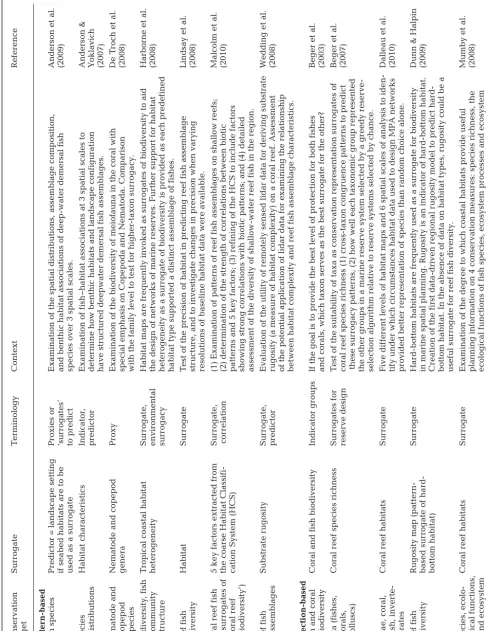
We recorded 6 papers using the generic term ‘sur-rogate’ that actually referred to pattern-based surro-gates (Table 2). These papers represented studies that used surrogates to (1) describe biodiversity pat-terns; (2) estimate biodiversity metrics (e.g. species or habitat richness, diversity); (3) develop models to predict the spatial distribution of conservation tar-gets (Moilanen et al. 2009, McArthur et al. 2010). These studies suggested, as perspectives, that the resulting data and maps could be used for rapid bio-diversity assessments and for integration in con -servation planning schemes. Most of the studies assessed the potential of habitats and environmental
variables to predict reef fish diversity, except De Troch et al. (2008), who demonstrated that higher taxa in copepods and nematodes can be used as pat-tern-based surrogates for species-level identifica-tions or fast assessments. One interesting example is from Dunn & Halpin (2009). They suggested using ‘rugosity’ as a pattern-based surrogate of hard-bot-tom habitats, which are known to support high levels of biodiversity. They then proposed to use bottom habitat predictions from the rugosity as input of siting algorithms to protect fish richness, and more generally marine biodiversity. Lindsay et al. (2008) investigated the potential of habitats as pattern-based surrogates to predict fish assemblages in a marine protected area. Harborne et al. (2008) assessed the pattern-based surrogacy potential of habitat heterogeneity as a surrogate of biodiversity to support its use as a selectionbased surrogate. An -derson & Yoklavich (2007) and An-derson et al. (2009) proposed to use their efficient pattern-based surro-gates (seabed habitats) for management purposes. Wedding et al. (2008) stated that since there was a strong link between the pattern-based surrogate (substrate rugosity) and the considered ultimate con-servation target (reef fish assemblages), the surro-gate could be used to assist in prioritizing areas for conservation and management but gave no further details on how this could be applied. It is obvious in the coral reef literature that there is a propensity to consider pattern-based surrogates for further conser-vation planning. However, the message remains unclear concerning the exact methods to apply.
Few selection-based surrogacy studies (Table 1) appear in the coral reef literature. They focused on (1) testing selected taxa as surrogates of total reef biodiversity (Beger et al. 2007), (2) testing of selected taxa as surrogates of other selected taxa (Beger et al. 2003, 2007), and (3) testing coral reef habitats as sur-rogates of taxa, ecological functions and ecosystem services (Mumby et al. 2008, Dalleau et al. 2010). Generally, these studies have avoided mixing the selection-based and pattern-based concepts, and even clearly pointed out the paradox (Beger et al. 2007, Dalleau et al. 2010).
Conser vation Sur rogate T e rminology Context Refer ence tar get Patter n-based Fish species P
redictor = landscape setting
Pr
oxies or
Examination of the spatial distributions, assemblage composition,
Anderso
n et al.
if seabed habitats ar
e to be
‘sur
rogates’
and benthic habitat associations of deep-water demersal fish
(2009)
used as a sur
rogate
to pr
edict
species over 3 spatial scales.
Species
Habitat characteristics
Indicator
,
Examination of fish−habitat associations at 3 spatial scales to
Anderson &
distributions
pr
edictor
deter
mine how benthic habitats and landscape configuration
Y
oklavich
have str
u
ctur
ed deepwater demersal fish assemblages.
(2007)
Nematode and
Nematode and copepod
Pr
oxy
Examination of the biodiversity of meiofauna in the coral with
De T
roch et al.
copepod
genera
special emphasis on Copepoda and Nematoda. Comparison
(2008)
species
w
ith the family level to test for higher
-taxon sur rogacy . Biodiversity , fish T
ropical coastal habitat
Sur
rogate,
Habitat maps ar
e fr
equently invoked as sur
rogates of biodiversity to aid
Harbor
ne et al.
community
heter
ogeneity
envir
onmental
the design of networks of marine r
e
ser
ves. Fur
ther suppor
t for habitat
(2008) str u ctur e sur rogacy heter
ogeneity as a sur
rogate of biodiversity is pr
ovided as each pr
edefined
habitat type suppor
ted a distinct assemblage of fishes.
Reef fish Habitat Sur rogate T e
st of the pr
ecision of habitat in pr
edicting r
eef fish assemblage
Lindsay et al.
diversity
str
uctur
e, and to investigate changes in pr
ecision when var
ying
(2008)
re
solutions of baseline habitat data wer
e available.
Coral r
eef fish
5 key factors extracted fr
om
Sur
rogate,
(1) Examination of patter
ns of r
eef fish assemblages on shallow r
eefs;
M
alcolm et al.
(‘sur
rogates of
the coarse Habitat
Classifi-cor
re
lation
(2) deter
mination of the str
ength of cor
re
lations between biotic
(2010)
coral r
eef
cation System (HCS)
patter
ns and 5 key factors; (3) r
efining of the HCS to include factors
biodiversity’)
showing str
ong cor
re
lations with biotic patter
ns; and (4) detailed
assessment of the diversity of shallow-water r
eef fish in the r
egion. Reef fish Substrate r ugosity Sur rogate,
Evaluation of the utility of r
e
motely sensed lidar data for deriving substrate
W edding e t al. assemblages pr edictor
rugosity (a measur
e of habitat complexity) on a coral r
eef. Assessment
(2008)
of the potential application of lidar data for examining the r
e
lationship
between habitat complexity and r
eef fish assemblage characteristics.
Selection-based Fish and coral
Coral and fish biodiversity
Indicator gr
oups
If the goal is to pr
ovide the best level of pr
otection for both fishe
s
Beger et al.
biodiversity
and corals, which taxon ser
ves as the best sur
rogate for the other?
(2003)
T
axa (fishes,
Coral r
eef species richness
Sur
rogates for
T
e
st of the suitability of taxa as conser
vation r
epr
esentation sur
rogat
es of
Beger et al.
corals, re ser ve design c oral r
eef species richness (1) cr
oss-taxon congr
uence patter
ns to pr
edict
(2007)
molluscs)
these sur
rogacy patter
ns, (2) how well each taxonomic gr
oup r
epr
esented
the other gr
oups in a marine r
e
ser
ve system selected by a gr
eedy r
e
ser
ve-selection algorithm r
e
lative to r
e
ser
ve systems selected by chance.
Algae, coral, Coral r eef habitats Sur rogate Five dif fer
ent levels of habitat maps and 6 spatial scales of analysis to iden-
Dall
eau et al.
fish, inver
te-tify under which cir
cumstances habitat data used to design MP
A networks
(2010)
brates
pr
ovided better r
epr
esentation of species than random choice alone.
Reef fish
Rugosity map (patter
n-Sur
rogate
Har
d-bottom habitats ar
e fr
equently used as a sur
rogate for biodiversity
Dunn & Halpin
diversity
based sur
rogate of har
d-in mard-ine spatial plannd-ing. Rugosity is an d-indicator of har
d-bottom habitat.
(2009)
bottom habitat)
Cr
eation of
the first data-driven r
egional r
ugosity model to pr
edict har
d-bottom habitat. In the absence of data on habitat types, r
ugosity could be a
useful sur
rogate for r
eef fish diversity
. Species, ecolo-Coral r eef habitats Sur rogate
Examination of the degr
ee to which coastal habitats pr
ovide useful
Mumby et al.
gical functions,
planning infor
mation on 4 conser
vation measur
es: species richness, the
(2008)
and ecosystem
ecological functions of fish species, ecosystem pr
ocesses and ecosystem
ser v ices ser vices. T
able 2. Synthesis of studies on patter
n-based and selection-based sur
rogates for coral r
[image:7.612.62.548.90.721.2]CONCLUSION
In their review on the effectiveness of surrogates in conservation planning, Rodrigues & Brooks (2007) clearly made the distinction between the different types of surrogacy approaches by examining studies using reserve selection, and excluding those testing correlations between surrogates and target features. The 2 different ways of using the terms ‘surrogate’ or ‘surrogacy’ pointed out by Rodrigues & Brooks (2007) are recurrent as shown by our coral reef review, and this has led to confusion, contrasting and apparently opposite results, and possible misunderstandings of the concepts and methods applied.
Pattern-based surrogates are mostly descriptive tools, whereas selection-based surrogates are strictly conservation tools. Managers have to keep in mind that a good pattern-based surrogate is not necessar-ily a good selection-based surrogate and vice versa. Conceptually, there is inherently nothing wrong in using one approach or the other for a given problem. However, we recommend that authors clarify upfront which approach they use and provide a clear frame-work to avoid misleading conservation advice. We also believe that systematic presentation would facil-itate future inter-study comparisons, meta-analysis and the establishment of clear guidelines.
Acknowledgements. This paper benefited from the com-ments made by 3 anonymous reviewers. C. Payri provided the macroalgae data used in Figs. 3 & 4.
LITERATURE CITED
Anderson TJ, Yoklavich MM (2007) Multiscale habitat asso-ciations of deepwater demersal fishes off central Califor-nia. Fish Bull 105: 168−179
Anderson TJ, Syms C, Roberts DA, Howard DF (2009) Multi-scale fish-habitat associations and the use of habitat sur-rogates to predict the organisation and abundance of deep-water fish assemblages. J Exp Mar Biol Ecol 379: 34−42
Balmford A, Gaston KJ (1999) Why biodiversity surveys are good value. Nature 398: 204−205
Beger M, Jones GP, Munday PL (2003) Conservation of coral reef biodiversity: a comparison of reserve selection pro-cedures for corals and fishes. Biol Conserv 111: 53−62 Beger M, McKenna SA, Possingham HP (2007) Effectiveness
of surrogate taxa in the design of coral reef reserve sys-tems in the Indo-Pacific. Conserv Biol 21: 1584−1593 Caro TM (2010) Conservation by proxies: indicator, um
-brella, keystone, flagship, and other surrogate species. Island Press, Washington, DC, USA
Carwardine J, Wilson KA, Watts M, Etter A, Klein CJ, Poss-ingham HP (2008) Avoiding costly conservation mis-takes: the importance of defining actions and costs in spatial priority setting. PLoS ONE 3: e2586
Dalleau M, Andréfouët S, Wabnitz CCC, Payri C and others (2010) Use of habitats as surrogates of biodiversity for efficient coral reef conservation planning in Pacific Ocean Islands. Conserv Biol 24: 541−552
De Troch M, Raes M, Muthumbi A, Gheerardyn H, Van-reusel A (2008) Spatial diversity of nematode and cope-pod genera of the coral degradation zone along the Kenyan coast, including a test for the use of higher-taxon surrogacy. Afr J Mar Sci 30: 25−33
Dunn DC, Halpin PN (2009) Rugosity-based regional model-ing of hard-bottom habitat. Mar Ecol Prog Ser 377: 1−11 Favreau JM, Drew CA, Hess GR, Rubino MJ, Koch FH, Eschelbach KA (2006) Recommendations for assessing the effectiveness of surrogate species approaches. Bio-divers Conserv 15: 3949−3969
Ferrier S (2002) Mapping spatial pattern in biodiversity for regional conservation planning: Where to from here? Syst Biol 51: 331−363
Gaston KJ (2000) Global patterns in biodiversity. Nature 405: 220−227
Grantham HS, Moilanen A, Wilson KA, Pressey RL, Rebelo TG, Possingham HP (2008) Diminishing return on invest-ment for biodiversity data in conservation planning. Conserv Lett 1: 190−198
Grantham HS, Wilson KA, Moilanen A, Rebelo T, Possing-ham HP (2009) Delaying conservation actions for improved knowledge: How long should we wait? Ecol Lett 12: 293−301
Grantham HS, Pressey RL, Wells JA, Beattie AJ (2010) Effec-tiveness of biodiversity surrogates for conservation plan-ning: Different measures of effectiveness generate a kaleidoscope of variation. PLoS ONE 5: e11430
Harborne AR, Mumby PJ, Kappel CV, Dahlgren CP, Micheli F, Holmes KE, Brumbaugh DR (2008) Tropical coastal habitats as surrogates of fish community structure, graz-ing, and fisheries value. Ecol Appl 18: 1689−1701 Lindsay MJ, Patterson HM, Swearer SE (2008) Habitat as a
surrogate measure of reef fish diversity in the zoning of the Lord Howe Island Marine Park, Australia. Mar Ecol Prog Ser 353: 265−273
Malcolm HA, Smith SDA (2010) Objective selection of surro-gate families to describe reef fish assemblages in a sub-tropical marine park. Biodivers Conserv 19:3611–3618 Margules CR, Pressey RL (2000) Systematic conservation
planning. Nature 405: 243−253
McArthur MA, Brooke BP, Przeslawski R, Ryan DA and oth-ers (2010) On the use of abiotic surrogates to describe marine benthic biodiversity. Estuar Coast Shelf Sci 88: 21−32
Mellin C, Delean S, Caley MJ, Edgar GJ and others (2011) Effectiveness of biological surrogates for predicting pat-terns of marine biodiversity: a global meta-analysis. PLoS ONE 6: e20141
Moilanen A, Wilson KA, Possingham H (2009) Spatial con-servation prioritization. Quantitative methods and com-putational tools. Oxford University Press, Oxford Mumby PJ, Broad K, Brumbaugh DR, Dahlgren CP and
oth-ers (2008) Coral reef habitats as surrogates of species, ecological functions, and ecosystem services. Conserv Biol 22: 941−951
Ricklefs RE (2004) A comprehensive framework for global patterns in biodiversity. Ecol Lett 7: 1−15
Rodrigues ASL, Brooks TM (2007) Shortcuts for biodiversity conservation planning: the effectiveness of surrogates. Annu Rev Ecol Evol Syst 38: 713−737
➤
➤
➤
➤
➤
➤
➤
➤
➤
➤
➤
➤
➤
➤
➤
➤
➤
➤
➤
➤
➤
➤
➤
➤
➤
➤
➤
➤
➤
➤
➤
Sarkar S, Justus J, Fuller T, Kelley C, Garson J, Mayfield M (2005) Effectiveness of environmental surrogates for the selection of conservation area networks. Conserv Biol 19: 815−825
Tittensor DP, Mora C, Jetz W, Lotze HK, Ricard D, Vanden Berghe E, Worm B (2010) Global patterns and predic-tors of marine biodiversity across taxa. Nature 466: 1098−1101
Wedding LM, Friedlander AM, McGranaghan M, Yost RS, Monaco ME (2008) Using bathymetric lidar to define nearshore benthic habitat complexity: implications for management of reef fish assemblages in Hawaii. Remote Sens Environ 112: 4159−4165
Williams P, Faith D, Manne L, Sechrest W, Preston C (2006) Complementarity analysis: mapping the performance of surrogates for biodiversity. Biol Conserv 128: 253−264
Editorial responsibility: Hans Heinrich Janssen, Oldendorf/Luhe, Germany
Submitted: July 25, 2011; Accepted: February 8, 2012 Proofs received from author(s): April 18, 2012