An Empirical Evaluation of
doc2vec
with
Practical Insights into Document Embedding Generation
Jey Han Lau1,2 and Timothy Baldwin2 1IBM Research
2 Dept of Computing and Information Systems,
The University of Melbourne [email protected],[email protected]
Abstract
Recently, Le and Mikolov (2014)
pro-posed doc2vec as an extension to
word2vec (Mikolov et al., 2013a) to learn document-level embeddings. De-spite promising results in the original pa-per, others have struggled to reproduce those results. This paper presents a
rig-orous empirical evaluation of doc2vec
over two tasks. We compare doc2vec
to two baselines and two state-of-the-art document embedding methodologies. We
found that doc2vec performs robustly
when using models trained on large ex-ternal corpora, and can be further im-proved by using pre-trained word embed-dings. We also provide recommendations on hyper-parameter settings for general-purpose applications, and release source code to induce document embeddings
us-ing our traineddoc2vecmodels.
1 Introduction
Neural embeddings were first proposed by Bengio et al. (2003), in the form of a feed-forward neu-ral network language model. Modern methods use a simpler and more efficient neural architecture to
learn word vectors (word2vec: Mikolov et al.
(2013b);GloVe: Pennington et al. (2014)), based
on objective functions that are designed specifi-cally to produce high-quality vectors.
Neural embeddings learnt by these methods have been applied in a myriad of NLP applica-tions, including initialising neural network mod-els for objective visual recognition (Frome et al., 2013) or machine translation (Zhang et al., 2014; Li et al., 2014), as well as directly mod-elling word-to-word relationships (Mikolov et al.,
2013a; Zhao et al., 2015; Salehi et al., 2015; Vy-lomova et al., to appear),
Paragraph vectors, or doc2vec, were
pro-posed by Le and Mikolov (2014) as a simple
extension to word2vec to extend the learning
of embeddings from words to word sequences.1
doc2vec is agnostic to the granularity of the
word sequence — it can equally be a wordn-gram,
sentence, paragraph or document. In this paper, we use the term “document embedding” to refer to the embedding of a word sequence, irrespective of its granularity.
doc2vec was proposed in two forms: dbow
anddmpv. dbowis a simpler model and ignores
word order, whiledmpvis a more complex model
with more parameters (see Section 2 for details). Although Le and Mikolov (2014) found that as a
standalone methoddmpvis a better model, others
have reported contradictory results.2 doc2vec
has also been reported to produce sub-par per-formance compared to vector averaging methods
based on informal experiments.3 Additionally,
while Le and Mikolov (2014) report state-of-the-art results over a sentiment analysis task using
doc2vec, others (including the second author of the original paper in follow-up work) have
strug-gled to replicate this result.4
Given this background of uncertainty regarding
the true effectiveness ofdoc2vecand confusion
about performance differences betweendbowand
dmpv, we aim to shed light on a number of
em-1The term doc2vec was popularised by Gensim
( ˇReh˚uˇrek and Sojka, 2010), a widely-used implementation of paragraph vectors:https://radimrehurek.com/gensim/
2The authors of Gensim found dbow outperforms
dmpv: https://github.com/piskvorky/gensim/blob/ develop/docs/notebooks/doc2vec-IMDB.ipynb
3https://groups.google.com/forum/#!topic/
gensim/bEskaT45fXQ
4For a detailed discussion on replicating the results of Le
and Mikolov (2014), see: https://groups.google.com/ forum/#!topic/word2vec-toolkit/Q49FIrNOQRo
pirical questions: (1) how effective is doc2vec
in different task settings?; (2) which is better out
ofdmpvanddbow?; (3) is it possible to improve
doc2vec through careful hyper-parameter opti-misation or with pre-trained word embeddings?;
and (4) candoc2vecbe used as an off-the-shelf
model likeword2vec? To this end, we present
a formal and rigorous evaluation of doc2vec
over two extrinsic tasks. Our findings reveal that
dbow, despite being the simpler model, is
supe-rior to dmpv. When trained over large external
corpora, with pre-trained word embeddings and
hyper-parameter tuning, we find that doc2vec
performs very strongly compared to both a
sim-ple word embedding averaging andn-gram
base-line, as well as two state-of-the-art document
em-bedding approaches, and thatdoc2vecperforms
particularly strongly over longer documents. We additionally release source code for replicating our experiments, and for inducing document embed-dings using our trained models.
2 Related Work
word2vec was proposed as an efficient neural approach to learning high-quality embeddings for words (Mikolov et al., 2013a). Negative sampling was subsequently introduced as an alternative to the more complex hierarchical softmax step at the output layer, with the authors finding that not only is it more efficient, but actually produces better word vectors on average (Mikolov et al., 2013b).
The objective function ofword2vecis to
max-imise the log probability of context word (wO)
given its input word (wI), i.e.logP(wO|wI). With
negative sampling, the objective is to maximise the
dot product of the wI andwO while minimising
the dot product ofwIand randomly sampled
“neg-ative” words. Formally,logP(wO|wI)is given as
follows:
logσ(v0
wO|vwI)+ k
X
i=1
wi ∼Pn(w)
h
logσ(−vw0i|vwI)
i
(1)
whereσis the sigmoid function,kis the number of
negative samples,Pn(w)is the noise distribution,
vwis the vector of wordw, andvw0 is the negative
sample vector of wordw.
There are two approaches within word2vec:
skip-gram(“sg”) andcbow. Inskip-gram,
the input is a word (i.e.vwIis a vector ofoneword)
and the output is a context word. For each input word, the number of left or right context words to predict is defined by the window size
hyper-parameter. cbow is different toskip-gram in
one aspect: the input consists of multiple words that are combined via vector addition to predict
the context word (i.e.vwI is a summed vector of
severalwords).
doc2vec is an extension to word2vec for learning document embeddings (Le and Mikolov,
2014). There are two approaches within
doc2vec:dbowanddmpv.
dbowworks in the same way asskip-gram,
except that the input is replaced by a special token
representing the document (i.e.vwI is a vector
rep-resenting the document). In this architecture, the order of words in the document is ignored; hence
the namedistributed bag of words.
dmpvworks in a similar way tocbow. For the
input, dmpv introduces an additional document
token in addition to multiple target words.
Un-likecbow, however, these vectors are not summed
but concatenated (i.e.vwI is a concatenated vector
containing the document token and several target words). The objective is again to predict a context word given the concatenated document and word vectors..
More recently, Kiros et al. (2015) proposed
skip-thought as a means of learning
docu-ment embeddings. skip-thought vectors are
inspired by abstracting the distributional hypothe-sis from the word level to the sentence level. Using an encoder-decoder neural network architecture, the encoder learns a dense vector presentation of a sentence, and the decoder takes this encoding and decodes it by predicting words of its next (or pre-vious) sentence. Both the encoder and decoder use a gated recurrent neural network language model. Evaluating over a range of tasks, the authors found thatskip-thought vectors perform very well against state-of-the-art task-optimised methods.
Wieting et al. (2016) proposed a more direct way of learning document embeddings, based on a large-scale training set of paraphrase pairs from
the Paraphrase Database (PPDB: Ganitkevitch et
is maximised. The authors explore several meth-ods of combining word embeddings, and found that simple averaging produces the best perfor-mance.
3 Evaluation Tasks
We evaluate doc2vec in two task settings,
specifically chosen to highlight the impact of doc-ument length on model performance.
For all tasks, we split the dataset into 2 par-titions: development and test. The development set is used to optimise the hyper-parameters of
doc2vec, and results are reported on the test set. We use all documents in the development and test set (and potentially more background documents,
where explicitly mentioned) to train doc2vec.
Our rationale for this is that thedoc2vectraining
is completely unsupervised, i.e. the model takes only raw text and uses no supervised or annotated information, and thus there is no need to hold out the test data, as it is unlabelled. We ultimately re-lax this assumption in the next section (Section 4),
when we traindoc2vecusing large external
cor-pora.
After training doc2vec, document
embed-dings are generated by the model. For the
word2vec baseline, we compute a document embedding by taking the component-wise mean of its component word embeddings. We experiment
with both variants ofdoc2vec(dbowanddmpv)
andword2vec(skip-gramandcbow) for all tasks.
In addition toword2vec, we experiment with
another baseline model that converts a document into a distribution over words via maximum like-lihood estimation, and compute pairwise docu-ment similarity using the Jensen Shannon
diver-gence.5 For word types we exploren-grams of
or-dern={1,2,3,4}and find that a combination of
unigrams, bigrams and trigrams achieves the best
results.6 Henceforth, this second baseline will be
referred to asngram.
3.1 Forum Question Duplication
We first evaluatedoc2vec over the task of
du-plicate question detection in a web forum setting, using the dataset of Hoogeveen et al. (2015). The
5We multiply the divergence value by−1.0to invert the
value, so that a higher value indicates greater similarity.
6That is, the probability distribution is computed over the
union of unigrams, bigrams and trigrams in the paired docu-ments.
dataset has 12 subforums extracted from StackEx-change, and provides training and test splits in two experimental settings: retrieval and classification. We use the classification setting, where the goal is to classify whether a given question pair is a du-plicate.
The dataset is separated into the 12 subforums, with a pre-compiled training–test split per subfo-rum; the total number of instances (question pairs) ranges from 50M to 1B pairs for the training titions, and 30M to 300M pairs for the test par-titions, depending on the subforum. The propor-tion of true duplicate pairs is very small in each subforum, but the setup is intended to respect the distribution of true duplicate pairs in a real-world setting.
We sub-sample the test partition to create a smaller test partition that has 10M document
pairs.7 On average across all twelve subforums,
there are 22 true positive pairs per 10M ques-tion pairs. We also create a smaller development partition from the training partition by randomly selecting 300 positive and 3000 negative pairs.
We optimise the hyper-parameters of doc2vec
and word2vecusing the development partition
on the tex subforum, and apply the same
hyper-parameter settings for all subforums when evalu-ating over the test pairs. We use both the ques-tion title and body as document content: on aver-age the test document length is approximately 130 words. We use the default tokenised and lower-cased words given by the dataset. All test, devel-opment and un-sampled documents are pooled to-gether during model training, and each subforum is trained separately.
We compute cosine similarity between
docu-ments using the vectors produced by doc2vec
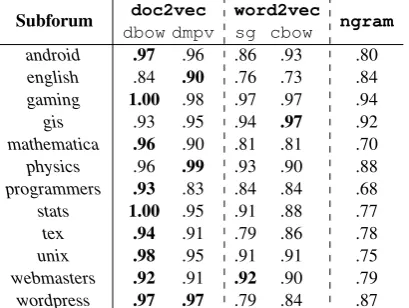
and word2vec to score a document pair. We then sort the document pairs in descending order of similarity score, and evaluate using the area un-der the curve (AUC) of the receiver operating char-acteristic (ROC) curve . The ROC curve tracks the true positive rate against the false positive rate at each point of the ranking, and as such works well for heavily-skewed datasets. An AUC score of 1.0 implies that all true positive pairs are ranked be-fore true negative pairs, while an AUC score of .5 indicates a random ranking. We present the full results for each subforum in Table 1.
7Uniform random sampling is used so as to respect the
Subforum dbow dmpv sg cbowdoc2vec word2vec ngram
android .97 .96 .86 .93 .80
english .84 .90 .76 .73 .84
gaming 1.00 .98 .97 .97 .94
gis .93 .95 .94 .97 .92
mathematica .96 .90 .81 .81 .70
physics .96 .99 .93 .90 .88
programmers .93 .83 .84 .84 .68
stats 1.00 .95 .91 .88 .77
tex .94 .91 .79 .86 .78
unix .98 .95 .91 .91 .75
webmasters .92 .91 .92 .90 .79
[image:4.595.81.286.63.217.2]wordpress .97 .97 .79 .84 .87
Table 1: ROC AUC scores for each subforum. Boldface indicates the best score in each row.
Domain DLS dbow dmpv sg cbowdoc2vec word2vec ngram
headlines .83 .77 .78 .74 .69 .61
ans-forums .74 .66 .65 .62 .52 .50
ans-students .77 .65 .60 .69 .64 .65
belief .74 .76 .75 .72 .59 .67
images .86 .78 .75 .73 .69 .62
Table 2: Pearson’sr of the STS task across 5
do-mains. DLSis the overall best system in the
com-petition. Boldface indicates the best results
be-tweendoc2vecandword2vecin each row.
Comparing doc2vec and word2vec to
ngram, both embedding methods perform sub-stantially better in most domains, with two
excep-tions (english andgis), wherengramhas
compa-rable performance.
doc2vec outperforms word2vec
embed-dings in all subforums except for gis. Despite
the skewed distribution, simple cosine similarity
based ondoc2vecembeddings is able to detect
these duplicate document pairs with a high degree
of accuracy.dbowperforms better than or as well
as dmpv in 9 out of the 12 subforums, showing
that the simplerdbowis superior todmpv.
One interesting exception is the english
sub-forum, where dmpv is substantially better, and
ngram — which uses only surface word forms — also performs very well. We hypothesise that the order and the surface form of words possibly has a stronger role in this subforum, as questions are often about grammar problems and as such the position and semantics of words is less predictable
(e.g.Where does “for the same” come from?)
Hyper-Parameter Description
Vector Size Dimension of word vectors Window Size Left/right context window size
Min Count Minimum frequency threshold for word types
Sub-sampling Threshold to downsample high frequency words
Negative Sample No. of negative word samples Epoch Number of training epochs
Table 3: A description of doc2vec
hyper-paramters.
3.2 Semantic Textual Similarity
The Semantic Textual Similarity (STS) task is a shared task held as part of *SEM and SemEval over a number of iterations (Agirre et al., 2013; Agirre et al., 2014; Agirre et al., 2015). In STS, the goal is to automatically predict the similarity
of a pair of sentences in the range[0,5], where 0
indicates no similarity whatsoever and 5 indicates semantic equivalence.
The top systems utilise word alignment, and fur-ther optimise their scores using supervised learn-ing (Agirre et al., 2015). Word embeddlearn-ings are employed, although sentence embeddings are of-ten taken as the average of word embeddings (e.g. Sultan et al. (2015)).
We evaluatedoc2vecandword2vec
embed-dings over the English STS sub-task of SemEval-2015 (Agirre et al., SemEval-2015). The dataset has 5 do-mains, and each domain has 375–750 annotated pairs. Sentences are much shorter than our previ-ous task, at an average of only 13 words in each test sentence.
As the dataset is also much smaller, we com-bine sentences from all 5 domains and also sen-tences from previous years (2012–2014) to form
the training data. We use the headlines
do-main from 2014 as development, and test on all 2015 domains. For pre-processing, we tokenise and lowercase the words using Stanford CoreNLP (Manning et al., 2014).
As a benchmark, we include results from the overall top-performing system in the competition,
referred to as “DLS” (Sultan et al., 2015). Note,
however, that this system is supervised and highly customised to the task, whereas our methods are completely unsupervised. Results are presented in Table 2.
Unsurprisingly, we do not exceed the overall performance of the supervised benchmark system
[image:4.595.77.286.283.358.2]Method Task Training Vector WindowSize Size Size Count SamplingMin Sub- Negative EpochSample
dbow Q-DupSTS 4.3M.5M 300300 1515 15 1010−−55 55 40020
[image:5.595.84.516.65.148.2]dmpv Q-DupSTS 4.3M.5M 300300 55 15 1010−−66 55 1000600
Table 4: Optimaldoc2vechyper-parameter values used for each tasks. “Training size” is the total word
count in the training data. For Q-Dup training size is an average word count across all subforums.
the domain of belief. ngram performs
substan-tially worse than all methods (with an exception in ans-students where it outperforms dmpv and
cbow).
Comparing doc2vec and word2vec,
doc2vec performs better. However, the per-formance gap is lower compared to the previous two tasks, suggesting that the benefit of using
doc2vec is diminished for shorter documents.
Comparing dbow and dmpv, the difference is
marginal, although dbow as a whole is slightly
stronger, consistent with the observation of previous task.
3.3 Optimal Hyper-parameter Settings
Across the two tasks, we found that the optimal hyper-parameter settings (as described in Table 3)
are fairly consistent for dbow anddmpv, as
de-tailed in Table 4 (task abbreviations: Q-Dup =
Forum Question Duplication (Section 3.1); and
STS=Semantic Textual Similarity (Section 3.2)).
Note that we did not tune the initial and
mini-mum learning rates (α and αmin, respectively),
and use the the following values for all
experi-ments:α=.025andαmin =.0001. The learning
rate decreases linearly per epoch from the initial rate to the minimum rate.
In general, dbow favours longer windows for
context words than dmpv. Possibly the most
important hyper-parameter is the sub-sampling threshold for high frequency words: in our experi-ments we find that task performance dips
consider-ably when a sub-optimal value is used.dmpvalso
requires more training epochs than dbow. As a
rule of thumb, fordmpvto reach convergence, the
number of epochs is one order of magnitude larger
thandbow. Given thatdmpvhas more parameters
in the model, this is perhaps not a surprising find-ing.
4 Training with Large External Corpora
In Section 3, all tasks were trained using small
in-domain document collections. doc2vec is
de-signed to scale to large data, and we explore the
effectiveness ofdoc2vecby training it on large
external corpora in this section.
We experiment with two external corpora: (1)
WIKI, the full collection of English Wikipedia;8
and (2)AP-NEWS, a collection of Associated Press
English news articles from 2009 to 2015. We to-kenise and lowercase the documents using Stan-ford CoreNLP (Manning et al., 2014), and treat each natural paragraph of an article as a document fordoc2vec. After pre-processing, we have ap-proximately 35M documents and 2B tokens for
WIKI, and 25M and .9B tokens forAP-NEWS.
See-ing that dbowtrains faster and is a better model
than dmpv from Section 3, we experiment with
onlydbowhere.9
To test ifdoc2veccan be used as an
off-the-shelf model, we take a pre-trained model and in-fer an embedding for a new document without
up-dating the hidden layer word weights.10 We have
three hyper-parameters for test inference: initial
learning rate (α), minimum learning rate (αmin),
and number of inference epochs. We optimise these parameters using the development partitions
in each task; in general a small initial α (= .01)
with lowαmin (= .0001) and large epoch number
(= 500–1000) works well.
For word2vec, we trainskip-gram on the
8Using the dump dated 2015-12-01, cleaned
us-ing WikiExtractor: https://github.com/attardi/ wikiextractor
9We use these hyper-parameter values for WIKI (AP
-NEWS): vector size =300 (300), window size =15 (15), min count=20 (10), sub-sampling threshold=10−5(10−5), negative sample=5, epoch=20 (30). After removing low frequency words, the vocabulary size is approximately 670K forWIKIand 300K forAP-NEWS.
10That is, test data is held out and not including as part of
Task Metric Domain PPDBpp skip-thoughtBOOK-CORPUS WIKIdbowAP-NEWS WIKI APskip-gram-NEWS GL-NEWS ngram
Q-Dup AUC
android .92 .57 .96 .94 .77 .76 .72 .80
english .82 .56 .80 .81 .62 .63 .61 .84
gaming .96 .70 .95 .93 .88 .85 .83 .94
gis .89 .58 .85 .86 .79 .83 .79 .92
mathematica .80 .57 .84 .80 .65 .58 .59 .70
physics .97 .61 .92 .94 .81 .77 .74 .88
programmers .88 .69 .93 .88 .75 .72 .64 .68
stats .87 .60 .92 .98 .70 .72 .66 .77
tex .88 .65 .89 .82 .75 .64 .73 .78
unix .86 .74 .95 .94 .78 .72 .66 .75
webmasters .89 .53 .89 .91 .77 .73 .71 .79
wordpress .83 .66 .99 .98 .61 .58 .58 .87
STS r
headlines .77 .44 .73 .75 .73 .74 .66 .61
ans-forums .67 .35 .59 .60 .46 .44 .42 .50
ans-students .78 .33 .65 .69 .67 .69 .65 .65
belief .78 .24 .58 .62 .51 .51 .52 .67
[image:6.595.81.515.63.261.2]images .83 .18 .80 .78 .72 .73 .69 .62
Table 5: Results over all two tasks using models trained with external corpora.
same corpora.11 We also include the word vectors
trained on the larger Google News by Mikolov et
al. (2013b), which has 100B words.12 The Google
Newsskip-gramvectors will henceforth be
re-ferred to asGL-NEWS.
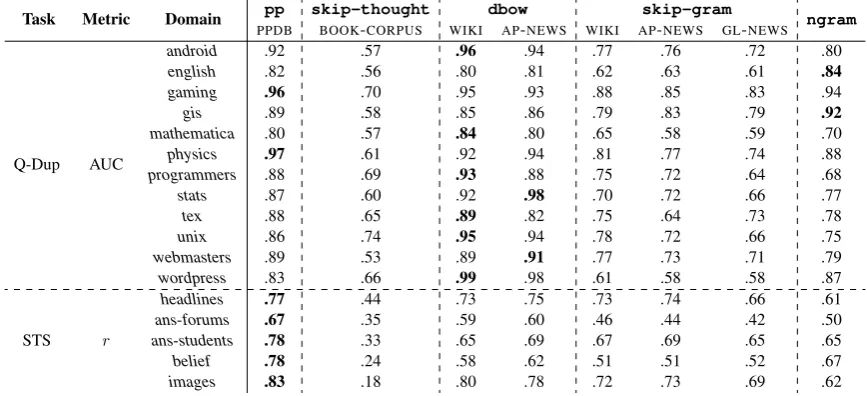
dbow,skip-gramandngramresults for all two tasks are presented in Table 5. Between the
baselines ngram and skip-gram, ngram
ap-pears to do better over Q-Dup, whileskip-gram
works better over STS.
As before,doc2vecoutperformsword2vec
andngramacross almost all tasks. For tasks with longer documents (Q-Dup), the performance gap
betweendoc2vecandword2vecis more
pro-nounced, while for STS, which has shorter docu-ments, the gap is smaller. In some STS domains
(e.g. ans-students) word2vec performs just as
well asdoc2vec. Interestingly, we see thatGL
-NEWS word2vec embeddings perform worse
than ourWIKIandAP-NEWS word2vec
embed-dings, even though the Google News corpus is or-ders of magnitude larger.
Comparing doc2vec results with in-domain
results (1 and 2), the performance is in general lower. As a whole, the performance difference
be-tween the dbow models trained using WIKI and
AP-NEWSis not very large, indicating the
robust-ness of these large external corpora for general-purpose applications. To facilitate applications
us-11Hyper-parameter values for WIKI (AP-NEWS): vector
size=300 (300), window size=5 (5), min count=20 (10), sub-sampling threshold=10−5(10−5), negative sample= 5, epoch=100 (150)
12https://code.google.com/archive/p/word2vec/
ing off-the-shelfdoc2vecmodels, we have
pub-licly released code and trained models to induce
document embeddings using the WIKI and AP
-NEWSdbowmodels.13
4.1 Comparison with Other Document Embedding Methodologies
We next calibrate the results for doc2vec
againstskip-thought(Kiros et al., 2015) and
paragram-phrase (pp: Wieting et al. (2016)), two
recently-proposed competitor document
embed-ding methods. Forskip-thought, we use the
pre-trained model made available by the authors,
based on the BOOK-CORPUS dataset (Zhu et al.,
2015); forpp, once again we use the pre-trained
model from the authors, based on PPDB
(Gan-itkevitch et al., 2013). We compare these two
models against dbow trained on each of WIKI
and AP-NEWS. The results are presented in
Ta-ble 5, along with results for the baseline method ofskip-gramandngram.
skip-thought performs poorly: its per-formance is worse than the simpler method of
word2vecvector averaging andngram. dbow
outperformsppover most Q-Dup subforums,
al-though the situation is reversed for STS. Given
thatppis based on word vector averaging, these
observations support the conclusion that vector averaging methods works best for shorter
docu-ments, whiledbowhandles longer documents
bet-ter.
It is worth noting thatdoc2vechas the
hand compared toppin that it can be trained on in-domain documents. If we compare in-domain
doc2vec results (1 and 2) topp (Table 5), the performance gain on Q-Dup is even more pro-nounced.
5 Improvingdoc2vecwith Pre-trained
Word Embeddings
Although not explicitly mentioned in the original
paper (Le and Mikolov, 2014), dbow does not
learn embeddings for words in the default
configu-ration. In its implementation (e.g. Gensim),dbow
has an option to turn on word embedding
learn-ing, by running a step ofskip-gram to update
word embeddings before runningdbow. With the
option turned off, word embeddings are randomly initialised and kept at these randomised values.
Even thoughdbowcan in theory work with
ran-domised word embeddings, we found that perfor-mance degrades severely under this setting. An in-tuitive explanation can be traced back to its objec-tive function, which is to maximise the dot prod-uct between the document embedding and its con-stituent word embeddings: if word embeddings are randomly distributed, it becomes more difficult to optimise the document embedding to be close to its more critical content words.
To illustrate this, consider the two-dimensional t-SNE plot (Van der Maaten and Hinton, 2008) ofdoc2vecdocument and word embeddings in Figure 1(a). In this case, the word learning op-tion is turned on, and related words form clusters, allowing the document embedding to selectively position itself closer to a particular word cluster (e.g. content words) and distance itself from other clusters (e.g. function words). If word embeddings are randomly distributed on the plane, it would be harder to optimise the document embedding.
Seeing that word vectors are essentially learnt via skip-gram in dbow, we explore the
pos-sibility of using externally trained skip-gram
word embeddings to initialise the word
embed-dings in dbow. We repeat the experiments
de-scribed in Section 3, training thedbowmodel
us-ing the smaller in-domain document collections in each task, but this time initialise the word
vectors using pre-trainedword2vecembeddings
fromWIKI andAP-NEWS. The motivation is that
with better initialisation, the model could converge faster and improve the quality of embeddings.
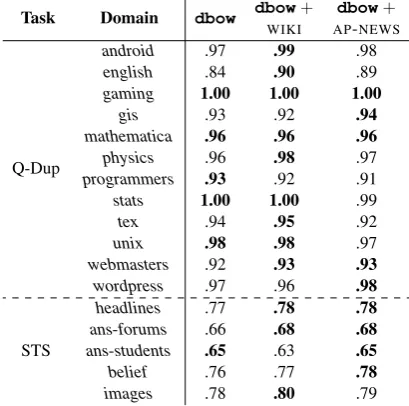
Results using pre-trained WIKI and AP-NEWS
Task Domain dbow dbowWIKI+ APdbow-NEWS+
Q-Dup
android .97 .99 .98
english .84 .90 .89
gaming 1.00 1.00 1.00
gis .93 .92 .94
mathematica .96 .96 .96
physics .96 .98 .97
programmers .93 .92 .91
stats 1.00 1.00 .99
tex .94 .95 .92
unix .98 .98 .97
webmasters .92 .93 .93
wordpress .97 .96 .98
STS
headlines .77 .78 .78
ans-forums .66 .68 .68
ans-students .65 .63 .65
belief .76 .77 .78
[image:7.595.313.518.64.267.2]images .78 .80 .79
Table 6: Comparison ofdbowperformance using
pre-trainedWIKIandAP-NEWS skip-gram
em-beddings.
skip-gram embeddings are presented in Ta-ble 6. Encouragingly, we see that using pre-trained word embeddings helps the training of
dbowon the smaller in-domain document
collec-tion. Across all tasks, we see an increase in perfor-mance. More importantly, using pre-trained word
embeddings never harms the performance.
Al-though not detailed in the table, we also find that the number of epochs to achieve optimal perfor-mance (based on development data) is fewer than before.
We also experimented with using pre-trained
cbowword embeddings fordbow, and found
sim-ilar observations. This suggests that the
initialisa-tion of word embeddings ofdbowis not sensitive
to a particular word embedding implementation.
6 Discussion
To date, we have focused on quantitative
eval-uation of doc2vec and word2vec. The
qualitative difference between doc2vec and
word2vecdocument embeddings, however, re-mains unclear. To shed light on what is be-ing learned, we select a random document from
STS — tech capital bangalore costliest indian
city to live in: survey — and plot the
docu-ment and word embeddings induced bydbowand
skip-gramusing t-SNE in Figure 1.14
14We plotted a larger set of sentences as part of this
2.0 1.5 1.0 0.5 0.0 0.5 1.0 1.5 2.0 2.5 4
2 0 2
4 tech
capital bangalore
costliest indian
city
to
live
in :
survey doc2vec_sent_emb
tech capital bangalore costliest indian city to live in : survey
(a)doc2vec(dbow)
3 2 1 0 1 2 3 4
4 3 2 1 0 1 2 3 4
tech capital
bangalore
costliest
indian city
to
live in
:
survey word2vec_sent_emb
tech capital bangalore costliest indian city to live in : survey
[image:8.595.83.531.64.247.2](b)word2vec(skip-gram)
Figure 1: Two-dimentional t-SNE projection ofdoc2vecandword2vecembeddings.
For word2vec, the document embedding is a centroid of the word embeddings, given the
sim-ple word averaging method. With doc2vec, on
the other hand, the document embedding is clearly
biased towards the content words such as tech,
costliestandbangalore, and away from the
func-tion words. doc2vec learns this from its
ob-jective function with negative sampling: high fre-quency function words are likely to be selected as negative samples, and so the document embedding will tend to align itself with lower frequency con-tent words.
7 Conclusion
We used two tasks to empirically evaluate the quality of document embeddings learnt by
doc2vec, as compared to two baseline
meth-ods —word2vecword vector averaging and an
n-gram model — and two competitor document
embedding methodologies. Overall, we found that doc2vec performs well, and that dbow is
a better model than dmpv. We empirically
ar-rived at recommendations on optimal doc2vec
hyper-parameter settings for general-purpose
ap-plications, and found thatdoc2vecperforms
ro-bustly even when trained using large external cor-pora, and benefits from pre-trained word
embed-dings. To facilitate the use of doc2vecand
en-able replication of these results, we release our code and pre-trained models.
References
Eneko Agirre, Daniel Cer, Mona Diab, Aitor Gonzalez-Agirre, and Weiwei Guo. 2013. *sem 2013 shared
task: Semantic textual similarity. InProceedings of the Second Joint Conference on Lexical and Compu-tational Semantics (*SEM 2013), pages 32–43, At-lanta, USA.
Eneko Agirre, Carmen Banea, Claire Cardie, Daniel Cer, Mona Diab, Aitor Gonzalez-Agirre, Weiwei Guo, Rada Mihalcea, German Rigau, and Janyce Wiebe. 2014. Semeval-2014 task 10: Multilingual
semantic textual similarity. In Proceedings of the
8th International Workshop on Semantic Evaluation (SemEval 2014), pages 81–91, Dublin, Ireland.
Eneko Agirre, Carmen Banea, Claire Cardie, Daniel Cer, Mona Diab, Aitor Gonzalez-Agirre, Weiwei Guo, Inigo Lopez-Gazpio, Montse Maritxalar, Rada Mihalcea, German Rigau, Larraitz Uria, and Janyce Wiebe. 2015. SemEval-2015 task 2: Semantic tex-tual similarity, English, Spanish and pilot on inter-pretability. InProceedings of the 9th International Workshop on Semantic Evaluation (SemEval 2015), pages 252–263, Denver, USA.
Yoshua Bengio, R´ejean Ducharme, Pascal Vincent, and Christian Janvin. 2003. A neural probabilistic
lan-guage model. The Journal of Machine Learning
Re-search, 3:1137–1155.
Andrea Frome, Greg S Corrado, Jon Shlens, Samy Bengio, Jeff Dean, Marc Aurelio Ranzato, and Tomas Mikolov. 2013. DeViSE: A deep
visual-semantic embedding model. In Advances in
Neu-ral Information Processing Systems 26 (NIPS-13), pages 2121–2129.
Juri Ganitkevitch, Benjamin Van Durme, and Chris Callison-Burch. 2013. PPDB: The paraphrase
database. InProceedings of the 2013 Conference of
Doris Hoogeveen, Karin Verspoor, and Timothy Bald-win. 2015. CQADupStack: A benchmark data set for community question-answering research. In Proceedings of the Twentieth Australasian Docu-ment Computing Symposium (ADCS 2015), pages 3:1–3:8, Sydney, Australia.
Ryan Kiros, Yukun Zhu, Ruslan Salakhutdinov, Richard S. Zemel, Antionio Torralba, Raquel Ur-tasun, and Sanja Fidler. 2015. Skip-thought
vec-tors. InAdvances in Neural Information Processing
Systems 28 (NIPS-15), pages 3294–3302, Montreal, Canada.
Q. Le and T. Mikolov. 2014. Distributed
representa-tions of sentences and documents. InProceedings
of the 31st International Conference on Machine Learning (ICML 2014), pages 1188–1196, Beijing, China.
Peng Li, Yang Liu, Maosong Sun, Tatsuya Izuha, and Dakun Zhang. 2014. A neural reordering
model for phrase-based translation. InProceedings
of the 25th International Conference on Compu-tational Linguistics (COLING 2014), pages 1897– 1907, Dublin, Ireland.
Christopher D. Manning, Mihai Surdeanu, John Bauer, Jenny Finkel, Steven J. Bethard, and David Mc-Closky. 2014. The Stanford CoreNLP natural lan-guage processing toolkit. InAssociation for Compu-tational Linguistics (ACL) System Demonstrations, pages 55–60, Baltimore, USA.
Tomas Mikolov, Kai Chen, Greg Corrado, and Jeffrey Dean. 2013a. Efficient estimation of word represen-tations in vector space. InProceedings of Workshop at the International Conference on Learning Repre-sentations, 2013, Scottsdale, USA.
Tomas Mikolov, Ilya Sutskever, Kai Chen, Greg S Cor-rado, and Jeff Dean. 2013b. Distributed representa-tions of words and phrases and their
compositional-ity. InAdvances in Neural Information Processing
Systems, pages 3111–3119.
Jeffrey Pennington, Richard Socher, and Christopher
Manning. 2014. Glove: Global vectors for
word representation. In Proceedings of the 2014
Conference on Empirical Methods in Natural Lan-guage Processing (EMNLP 2014), pages 1532– 1543, Doha, Qatar.
Radim ˇReh˚uˇrek and Petr Sojka. 2010. Software Framework for Topic Modelling with Large
Cor-pora. InProceedings of the LREC 2010 Workshop
on New Challenges for NLP Frameworks, pages 45– 50, Valletta, Malta.
Bahar Salehi, Paul Cook, and Timothy Baldwin. 2015. A word embedding approach to predicting the com-positionality of multiword expressions. In Proceed-ings of the 2015 Conference of the North American Chapter of the Association for Computational Lin-guistics — Human Language Technologies (NAACL HLT 2015), pages 977–983, Denver, USA.
Md Arafat Sultan, Steven Bethard, and Tamara
Sum-ner. 2015. DLS@CU: Sentence similarity from
word alignment and semantic vector composition. InProceedings of the 9th International Workshop on Semantic Evaluation (SemEval 2015), pages 148– 153, Denver, Colorado.
Laurens Van der Maaten and Geoffrey Hinton. 2008.
Visualizing data using t-SNE. Journal of Machine
Learning Research, 9(2579–2605):85.
Ekaterina Vylomova, Laura Rimell, Trevor Cohn, and Timothy Baldwin. to appear. Take and took, gag-gle and goose, book and read: Evaluating the util-ity of vector differences for lexical relation learning. Berlin, Germany.
John Wieting, Mohit Bansal, Kevin Gimpel, and Karen Livescu. 2016. Towards universal paraphrastic
sen-tence embeddings. In Proceedings of the
Inter-national Conference on Learning Representations 2016, San Juan, Puerto Rico.
Jiajun Zhang, Shujie Liu, Mu Li, Ming Zhou, and Chengqing Zong. 2014. Bilingually-constrained
phrase embeddings for machine translation. In
Pro-ceedings of the 52nd Annual Meeting of the Asso-ciation for Computational Linguistics (ACL 2014), pages 111–121, Baltimore, USA.
Jiang Zhao, Man Lan, Zheng-Yu Niu, and Yue Lu. 2015. Integrating word embeddings and traditional nlp features to measure textual entailment and se-mantic relatedness of sentence pairs. InProceedings of the International Joint Conference on Neural Net-works (IJCNN2015), pages 1–7, Killarney, Ireland. Yukun Zhu, Ryan Kiros, Richard Zemel, Ruslan
Salakhutdinov, Raquel Urtasun, Antonio Torralba, and Sanja Fidler. 2015. Aligning books and movies: Towards story-like visual explanations by watching