R e v i e w
open access to scientific and medical research
Open Access Full Text Article
Counterfeit drugs and medical devices
in developing countries
Beverley D Glass
School of Pharmacy and Molecular Sciences, James Cook University, Townsville, QLD, Australia
Correspondence: Beverley D Glass School of Pharmacy and Molecular Sciences, James Cook University, 1 James Cook Drive, Townsville, QLD 4811, Australia
Tel +61 7 4781 6423 Fax +61 7 4781 5356 email [email protected]
Abstract: The World Health Organization has reported that counterfeit medicines potentially make up more than 50% of the global drug market, with a significant proportion of these fake products being encountered in developing countries. This occurrence is attributed to a lack of effective regulation and a weak enforcement capacity existing in these countries, with an increase in this trade resulting from the growing size and sophistication of drug counterfeiters. In addition, due to both cost and lack of availability of medicines, consumers in developing countries are more likely to seek out these inexpensive options. The World Health Organization is mindful of the impact of counterfeit drugs on consumer confidence in health care systems, health professionals, the supply chain, and genuine suppliers of medicines and medical devices. Antibiotics, antituber-culosis drugs, and antimalarial and antiretroviral drugs are frequently targeted, with reports of 60% of the anti-infective drugs in Asia and Africa containing active pharmaceutical ingredients outside their pharmacopoeial limits. This has obvious public health implications of increasing drug resistance and negating all the efforts that have already gone into the provision of medicines to treat these life threatening conditions in the developing world. This review, while focusing on counterfeit medicines and medical devices in developing countries, will present information on their impact and how these issues can be addressed by regulation and control of the supply chain using technology appropriate to the developing world. The complexity of the problem will also be highlighted in terms of the definition of counterfeit and substandard medicines, including gray pharmaceuticals. Although this issue presents as a global public health problem, outcomes in developing countries where counterfeit drugs to treat malaria, tuberculosis, and human immuno-deficiency virus/acquired immunoimmuno-deficiency syndrome not only result in drug resistance, but a number of deaths from the untreated disease, is in stark contrast with the developed world, where lifestyle drugs such as sildenafil (Viagra®) are most commonly counterfeited.
Keywords: counterfeit, medicines, devices, developing countries, drug resistance, public health
Introduction
Product counterfeiting is increasing worldwide, both in terms of the volume, level of sophistication, and in the number the countries affected, both in the developed and developing world. Despite the diversity of products counterfeited, counterfeit-ers are often referred to as a homogeneous group. Staake et al1 have however
clas-sified counterfeiters into five groups: 1) disaggregators; 2) imitators; 3) fraudsters; 4) desperados; and 5) smugglers, to better address the issue of counterfeiting in the market. These groups were classified according to the visual and functional quality of the counterfeit products, in addition to product complexity. The disaggregator group encompasses counterfeit products with an average visual quality, medium functional
Number of times this article has been viewed
This article was published in the following Dove Press journal: Research and Reports in Tropical Medicine
quality, and low to medium product complexity, while the imitators represent those products with the highest visual and functional quality and product complexity. The term imitator is appropriately used in this case, as these counterfeits closely resemble the genuine products. Although the smuggler group, which includes products with average to high visual and func-tional quality and medium complexity, resembles the imitator group, the major difference is the circumvention of taxes by this group. The fraudster group includes those products of high visual but low functional quality, which because of their medium complexity are likely to pass as genuine. Because of the deception involved, and the potential financial loss to the buyer, the term fraudster was deemed appropriate. For pharmaceutical products, which represent 9% of the sample in this study, all counterfeiters were classified as desperados. This group represents products where the visual quality is medium to high, while the functional quality and product complexity is low. They are said to pose a severe threat to consumers and as such, this places the counterfeiters into conflict with enforcement agencies such as regulators, with the term desperados relating to the unscrupulous nature of this group. Counterfeiters have unfortunately also evolved over time with the transformation of a counterfeit producer to an illicit manufacturer occurring, which is particularly relevant to counterfeited pharmaceutical products.
The term counterfeit drug has been defined differently in different countries limiting both the exchange of information between countries and a real understanding of the extent of the problem globally. To address this problem, the World Health Organization (WHO) has proposed that a counter-feit medicine (branded or generic products) be defined as one which is deliberately and fraudulently mislabeled with respect to identity and/or source.2 This however should not
be confused with the term substandard medicines, which may be described as genuine drug products which do not meet the required quality specifications. “Gray pharmaceuticals” is a term recently used for the marketing of competitive brands by illicit profiteers who do not have regulatory approval.
Counterfeit products are those: 1) without active pharma-ceutical ingredients (APIs), including the wrong ingredients, which may or may not be toxic. In this case, the API is often replaced by inexpensive substitutes such as flour, curcuma, or cassava in oral formulations and water in injections. Even more of a problem is that these products may contain toxic or pathogenic chemical impurities, which have potentially lethal consequences, with an example being methanol detected in a counterfeited amoxicillin injection;2 2) with incorrect
quanti-ties of these APIs, where these products usually contain less
than the stated amount. Examples here are less expensive or outdated drugs, which may be repackaged, such as diazepam syrup which was sold as cotrimoxazole syrup in Nigeria and erythromycin sold as the antimalarial, artesunate, in south-east Asia. Another example is praziquantel, used against schistosomiasis, where the forgery was detected because each tablet should have contained 600 mg of API and the tablets only weighed 480 mg in total. In addition, the leaf-let was written in poor English, without any manufacturer identification;3 3) with fake or counterfeit packaging, where
the packaging may be copied, or in some cases modified, to escape prosecution for infringing intellectual property.2
The United States Food and Drug Administration have reported on the existence of counterfeit and substandard med-icines in both developed and developing countries, with 25% (range between 10%–30%) of the counterfeit and substandard medicines being consumed in developing countries, includ-ing Latin America, southeast Asia, or sub-Saharan Africa.4
Evidence from 17 countries5 has revealed that there is a
relationship between price and the poor quality of medicines. The purchasers of these products are also likely to suspect that they are of low quality, if in addition to low price, the product is generic and available from a pharmacy or outlet, with a poor appearance. It must however be stated that even if all these factors are present, it cannot be assumed that the products are counterfeit. These findings do present informa-tion on the economics of poor quality drugs and the extent to which consumers can draw accurate conclusions relating quality to both price and the appearance of the pharmacy. Unfortunately the poor consumer in the developing world, who will inevitably have a low income and limited literacy, will still choose to purchase on the assumption that it is bet-ter than no treatment at all. These findings concur with those of Furnham and Valgeirsson6 who reported on the effect of
life values and materialism on buying counterfeit products. Their study was conducted on a sample of educated British people who were willing to buy counterfeit pens and clothing for a good price. They were however not prepared to do so in the case of medicines. Stumpf and Chaudhry7 also explored
counterfeit medicines is low in the developed world, there has been an increase by 400% in the number of these drugs identified from 2005 to 2010 in Europe.8 The fact that this
trade is said to be 25 times more lucrative than that of heroin places a perspective on and highlights the magnitude of this problem.8
Counterfeit medicines, unfortunately, are not a new con-cept, with trading in these counterfeit medicines, sometimes referred to as fake medicines, beginning several millennia ago.8 In fact, it is ironic today that antibiotics are the most
counterfeited medicines, occupying a 28% share of this market, when fake cinchona bark was reported as a crisis as early as the 1600s and fake quinine in the 1800s.9 These
counterfeit antibiotics include mainly the “old” antibiotics such as beta-lactams and quinolones, which have been com-monly used for years. Amoxicillin is reported to be the most counterfeited API in the world, and the cause of treatment failure in Papua New Guinea.10 Counterfeit anti-infective
drugs were first reported over 25 years ago.11 Until recently,
the published research in this area has been limited, with much of the information, especially in developing countries, found in the gray literature. In fact, most of the current litera-ture is related to analytical approaches to detect counterfeit medicines, which due to cost and expertise required, have limited application in developing countries.
Dosage forms for oral administration, eg, tablets, syrup, and capsules are those most commonly counterfeited (77%), as opposed to injectable formulations (17%).10 This obviously
relates to the level of sophistication of the equipment required to produce injectable formulations.10
A comprehensive review on understanding and fighting the counterfeit medicine market by Dégardin et al12
high-lights the situation worldwide and proposes solutions to limit this phenomenon. Almuzaini et al13 have however also
presented a systematic review of the literature to explore the evidence available, not only for counterfeit medicines but also for all poor quality medicines, whether counterfeit or substandard.
Counterfeiting of drugs – why?
WHO estimated as far back as 1991 that half of the world’s population at that stage did not have regular access to essen-tial drugs, with this number reducing to 33% in sub-Saharan Africa.14 Although counterfeit drugs are an important issue
in Africa, there are also a number of other constraints to the regular supply of essential drugs, including geographic location, logistics, ensuring the integrity of the supply chain, and financing the supply of essential drugs. It must also
be noted that some of these constraints also play a role in compounding or impacting the issue of counterfeit drugs in Africa.14 There are a number of factors which make medicines
a viable and attractive option for counterfeiters, particularly in the developing world. These factors and their importance in developing countries as well as the risk rated as mild, moder-ate, or high, are listed in Table 1. Drug products lacking in quality, safety, and efficacy, and that are not under regulatory control, may result in prolonged therapy, promote resistance, and cause adverse effects, which are then not reported on or monitored. This has potential to significantly impact on global public health.
Impact of counterfeit medicines
and devices
Developing countries
The International Medical Products Anti-Counterfeiting Taskforce (IMPACT) was established in February 2006, to coordinate efforts to address the issue of counterfeit drugs,15
as this subject has taken on a new dimension within the international health community. Mitigating a macroeconomic pandemic has attracted the attention of prominent members of the public health community who have commented on the potential outcomes of treating, eg, human immunodeficiency virus/acquired immunodeficiency syndrome (HIV/AIDS) patients with counterfeit drugs.16 IMPACT, led by WHO,
[image:3.612.320.557.478.692.2]had plans to focus on the following key areas: legislative and regulatory infrastructure, regulatory implementation,
Table 1 Factors affecting the counterfeiting of drugs
Factor Explanation Importance
in developing country
Risk
Government will and commitment
Drugs should not be treated as other commodities due to effect on public health
*
Drug regulatory body
Legislation does not exist wHO member states: a) 20% – well developed b) 50% – varied development c) 30% – no or nonfunctional
regulation
**
Demand exceeds supply
Health care system lack of supply of medicines due to: a) Poverty
b) illiteracy c) Rural locations
Creates a market for criminally minded people
***
High prices Price differentials Supply chain, poverty
**
Notes: *Denotes risk rated as mild; **denotes risk rated as moderate; ***denotes risk rated as high. Data from wHO.2
enforcement, technology, and communication. Table 2 pres-ents a summary of the impact of counterfeit medicines for people in developing countries.
Antibiotic drugs
Acquired bacterial resistance is common in developing countries, with this resistance increasing to first line broad spectrum agents. This is of particular concern as these agents are inexpensive and given the budgetary constraints within developing countries, are often the only affordable drugs. It is also worrying how rapidly resistance has emerged to the newer agents, such as the fluoroquinolones. This has been attributed to the misuse of antibiotics by physicians, unskilled practitioners, and the public.18 In developing countries,
counterfeit medicines are only one aspect of poor quality antibiotics, with other issues including a lack of adherence
and monitoring, degraded antibiotics often due to inadequate storage in both pharmacies and in the supply chain, expired antibiotics distributed from developed countries, and bio-inequivalent antibiotics. Between 1981 and 1995, resistance to ampicillin, tetracycline, sulfonamides, chloramphenicol, fluoroquinolones, isoniazid, streptomycin, and rifampicin was shown to be increasingly prevalent across the following devel-oping and tropical countries: Bangladesh, Brazil, Rwanda, Thailand, India, Kenya, and Morocco.18 As an indication of
the problem of counterfeiting in relation to antibiotics, it has been reported that counterfeit drugs account for 5% of antibiotics sold worldwide, with this percentage a lot higher in developing countries.9 Counterfeiting of antibiotics in
developed countries is a rarity, eg, in the French health care network there has been no reported counterfeiting of antibiot-ics. This has been attributed to effective control of marketing, the supply chain, and strict enforcement by customs.9 These
counterfeit drugs in developing countries only compete favor-ably in these markets because of the lack of availability of analytical laboratories and because a substantial proportion of the drugs in these countries are generic, often resulting in the counterfeit drugs going undetected.
Because countries of sub-Saharan Africa are highly affected by infectious disease, and because of economics, corruption, and lack of regulation and control they are an obvious target for counterfeiters. The unfavorable outcome of this is that they account for 50% of the deaths due to infectious diseases, even though these countries only have 12% of the world population.18 There is also a discrepancy
in the availability of health care between rural and urban or metropolitan regions. Although this has been described for India and China, this is true for most countries, often even those in the developed world. Metropolitan areas are less con-cerned with counterfeit drugs, and there are in fact similarities between these urban zones in developing countries and those countries in the developed world.18
Antibiotics are reported to be counterfeited according to chemical class such as beta-lactams and the type of formula-tion (77% for oral intake) and are often presented in a coun-terfeited package. Antibiotic counterfeiting has implications for the individual and the collective population, with obvious industrial and economic consequences. In studies conducted in Burma, Cameroon, Vietnam, Cote d’Ivoire, and Nigeria, between 8% and 35% of the anti-infectives were found to be counterfeit, in most cases with the API content being out of the pharmacopoeial limits, with no API present, and in the case of the antimalarials, chloroquine being substituted for quinine.18
Table 2 impact of counterfeit medicines for developing countries
1. increased mortality and morbidity: due to ingredients substituted for the APi, which are lethal. in the past it has been assumed that these ingredients were inert, eg, starch or lactose. Paracetamol adulterated with diethylene glycol, a renal toxin and a cheaper substitute for propylene glycerol or glycerol, caused the death of a number of children in various developing countries, including Bangladesh.17
2. Drug resistance: due to subtherapeutic amounts of APi in the drug product. in developing countries this is particularly relevant to the supply of antibiotics, and antimalarial and antiretroviral drugs, resulting in the emergence of drug resistant pathogens. Combination therapy for TB, Hiv/AiDS, and malaria limited by poor quality artemisinin derivatives and similarly, poor quality TB drugs does not only result in treatment failure, but increases the incidence of drug resistance. 3.Reducedconfidenceinthehealthsystem:duetotheconsequencesof
these counterfeit medicines, often among patients who were skeptical of these essentially “western” systems at the outset. This also results in an increased workload for health professionals and health outlets suchasclinicsandpharmaciestoattempttorestorethisconfidence. 4. economic consequences: for patients and their families, the country, and the providers of genuine medicines, due to a workforce which is often too ill to work or care for their families.
5. Adverse effects: due to incorrect ingredients, where the effects may vary from being unexpected (eg, when cotrimoxazole contains diazepam) to causing allergic reactions (eg, artesunate tablets containing chloramphenicol). in addition, it cannot be assumed that counterfeit products containing APis will be subtherapeutic, as in some cases, they contain more than the stated amount and for those drugs with narrow therapeutic indices, this increases the potential for adverse effects.
6.Wastage:financiallyduetotheeffortsofgovernmentsbothinthe developing countries, who have attempted to make these medicines available to patients, and to those in the developed world, who often sponsor the provision of these drugs to control and/or eradicate diseases such as TB, malaria, and Hiv/AiDS.
Note: Data from Newton et al8 and wertheimer and Norris.16
Antimalarial drugs
The prevalence of malaria in tropical countries results in antimalarials being the most widely taken drug and therefore often described as “blockbuster” drugs for counterfeiters. Two thirds of the available antimalarials are reported to be counterfeited, eg, for mefloquine and artesunate found in Cambodia in 1998, up to 71% and 60%, respectively, were reported to be fake.19 In addition, chloroquine was reported to
be substituted for artesunate and mefloquine tablets contained sulphadoxine-pyrimethamine. Since 1998, between 38% and 53% of the artesunate blister packages were reported to contain no API, with some counterfeits containing only minimal amounts of artesunate. In Cambodia, an effort has been made to address the quality of antimalarials in both the public and the private health sectors, where 79% of the 451 drug samples collected in 2006 were not registered with the Cambodian Department of Drugs and Food.19 This
resulted in the National Malaria Control Program taking action and attempting to alert both the population and the health departments about these counterfeit antimalarials.19
Although the National Malaria Control Program has pro-moted the use of good quality antimalarials through both the private and public sectors, there was a concern that over 82% of the population acquired these products from the private rather than public sector. In addition, for those people living in remote areas, the problem is exacerbated because they are less informed and there is increased tendency for people in these locations to buy cheaper drugs from local outlets.19
Newton et al11 have continued to highlight that counterfeit
medicines have the most profound effect on disadvantaged people in poor countries, usually in the developing world. Although they addressed anti-infectives in general, particular attention was paid to antimalarials as they are the most widely taken drugs in tropical countries.11 These authors recommend
that to combat the counterfeiters, good quality anti-infectives should be available at an affordable price. However, to achieve this, there is a need for adequate information on the quality of the drug supply in the “real life” situation. Although clinical trials to determine the appropriate antimalarials for use in particular countries20 have been undertaken, unfortunately
this is of little use if the supply of quality antimalarial drugs is not maintained and monitored.
Newton et al21 reported that the efficacy of artesunate as
a key treatment for multidrug resistant malaria in mainland southeast Asia was being compromised by the widespread occurrence of counterfeit artesunate tablets. The inaction of international organizations, such as WHO, was reported to be due to a lack of resources and regulation, but more importantly,
also due to a lack of knowledge of the impact of the fake arte-sunate.22 This is due to the many deaths of people in rural
locations not being attributed to fake antimalarials.22
In southeast Asia from 2002 to 2003, up to 53% of the artesunate in blister packages was reported to be fake, with counterfeit types classified by packaging and fake holograms encountered in the People’s Republic of China.23
This highlighted the increasing level of sophistication of the counterfeiters. Because it is one of the most threatened foci of malaria, the Greater Mekong subregion has also been the subject of an investigation into the emergence of artemisinin resistance, with the existence of counterfeit or substandard medicines being attributed to worsening the situation.23 It has
been reported that countries in the Greater Mekong subregion face a greater challenge when compared to African countries in combating the threat of counterfeit antimalarials.23 Even
though there are superior legislative procedures in countries such as Thailand, a study in 80 outlets revealed that 15.4% of the artesunate, 11.1% of the chloroquine, and 29.4% of the quinine were substandard.23
In 2012, Nayyar et al24 reviewed the chemical analyses
and packaging of antimalarial drugs to identify poor qual-ity antimalarials in southeast Asia and sub-Saharan Africa. Although the global burden of malaria has reduced in the past decade, there is concern that these poor quality antimalarials are likely to put into jeopardy the progress that has been made in these regions in eliminating malaria. Results achieved were similar for the two regions, especially in relation to failed packaging analysis. For southeast Asia (sub-Saharan Africa), 46% (35%) failed the chemical analyses, 36% (35%) failed packaging analysis, and overall, 36% (20%) were classified as falsified. Despite a multifaceted approach needed to address the issue, empowering of regulatory agencies to protect drug supply is seen as key to addressing the problem.24
Green et al26 put forward the combined use of refractometry
and colorimetry as an appropriate method for field use to assess antimalarial drug quality. Colorimetry makes use of color changes from specific chemical reactions, does not require toxic organic solvents, and makes use of a portable battery powered photometer. A refractometer, which is inexpensive and portable, also provides a rugged measure of the refractive index of a drug solution, a common physical property which can be used to identify counterfeits. Results from method bias, sensitivity, specificity, and accuracy relative to high performance liquid chromatography indi-cated that these techniques provide a simple, accurate, and affordable means to determine drug quality in resource poor settings and are thus appropriate for use in develop-ing countries. Newton et al11 also highlight the importance
of dissolution studies to provide information on in vivo bioavailability. Poor drug dissolution may not be due to the incorrect amount of API, but be due to the incorrect excipients and/or poor manufacturing procedures. Disso-lution, which reflects drug absorption, bioavailability, and ultimately efficacy, is thus critical to ensuring the quality of antimalarial drugs.11
Antiretroviral and antituberculosis drugs
The impact of counterfeit drugs has the potential to escalate toward a macroeconomic pandemic if the emergence of drug resistance and mutation of viruses, especially in the treatment of HIV/AIDS occurs, resulting in populations which are too ill to work in addition to overwhelming the health resources of their respective countries.16 Although there are not sufficientdata to confirm whether resistance to antiretrovirals (ARVs) is due to counterfeit drugs or natural resistance, increasing resistance has been reported in the United Kingdom, Spain, and Brazil. In India, a high prevalence of HIV-1 and HIV-2 coinfections has resulted in it being necessary for more expensive ARV therapies to be used.16 Trade in counterfeit
drugs is responsible for increasing drug resistance among the infectious diseases, including tuberculosis and HIV/AIDS. A study in Botswana, reported in 2005, found that 315 of the drugs used in tuberculosis treatment were substandard, either containing toxic ingredients or no API.16 It is ironic
that the many millions of dollars contributed by governments of developing countries from their limited resources and that are donated from developed countries to treat HIV/AIDS and tuberculosis are attracting criminals who are playing a role in setting this pandemic in motion. It has also been reported by Ahmad27 that antidepressants are being sold as
ARVs in the Democratic Republic of Congo. Fluvoxamine,
an antidepressant and cyclobenzaprine hydrochloride, and a muscle relaxant, has been labeled as Triomune®, which is a
combination of stavudine, lamivudine, and nevirapine, and Duovir®, a combination of zidovudine and lamivudine, two
commonly prescribed ARV brands. The prevalence of HIV/ AIDS in the Democratic Republic of Congo, which has been made worse by the long civil war, ranges from 5% to 15%, with many people relying on counterfeit medicines, because of price and the shortage of good quality ARVs.27 Fears et al28
have also reported on the re-emergence of tuberculosis in the European Union (EU) and its failure to respond to the global tuberculosis threat. They also advocated for a humanitarian role for the EU to support tuberculosis control in developing countries.28
Medical devices
Medical devices (MDs) and in vitro diagnostics (IVDs) are a wide range of products and include those simply used as a tongue depressor to very complex equipment, with IVDs used to examine human specimens in vitro. Although the primary action of these devices is not pharmacological, they are how-ever not exempt from counterfeiting with WHO reporting29 in
2010 that over 8% of these devices in circulation were coun-terfeit. The market in these devices is set to increase by 50% in 2014, which highlights their increasing role in health care. However despite this, there are significant differences between developed countries such as Australia, Canada, the EU, and the United States and resource limited developing countries, not only in their quality but in the ability of countries to access these products. Again there is a tension between the defini-tions for counterfeit and substandard devices. Counterfeit devices have been defined in line with counterfeit products to be those which are deliberately mislabeled, whereas those substandard IVDs do not meet specifications and/or contain labeling errors. Mori et al30 undertook a detailed review of the
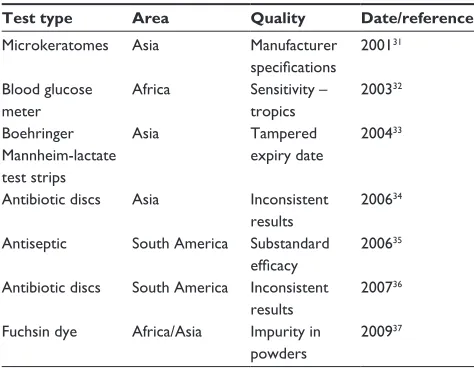
literature and reported on low quality MDs/IVDs in resource limited countries. Table 3 presents a summary of their findings, giving examples of MDs/IVDs all performing poorly in rela-tion to a reference product. It is important to note that climatic conditions do have some effect on the performance of these products, with poor performance often found during use in tropical conditions. A further limitation was the inability to distinguish whether performance of the MD/IVD was related to quality or poor practices.
practices in terms of poor laboratory practices and lack of training, including the ability to interpret results will also play a role in concealing inaccurate diagnoses due to poor quality IVDs.38
Addressing the issue of counterfeit
medicines
Regulation
Adulterated medicines were reported to exist as early as the fourth century BC, with warnings to people about the harmful nature of these medicines. Changes over the years have seen increases in the expertise of the counterfeiters and the extent of the problem. Seear39 has highlighted that counterfeiting is
only one cause of poor drug quality and that reliable research into the extent of counterfeiting is lacking with no randomized studies of drug quality undertaken in either China or India. Despite all the technological advances, this problem still exists and has prompted WHO to put out a set of guidelines to inform the development of national strategies to combat counterfeit medicines, in addition to suggested approaches to detecting and monitoring these drugs, including staff training.40 Much of
these efforts have been limited at the international level by the confusion around the definition of counterfeit medicines. This has been attributed to the inability to distinguish between intel-lectual property rights, trademark protection, and authenticity and correct representation of drug content and quality.41 The
requirement is that this global threat requires solutions which are global, regional, and national and there is some frustration that despite the establishment of IMPACT in 2006,15 little has
been achieved.
The Medicrime Convention was drafted by the Council of Europe in 2010 to include for the first time an international standard criminalizing the manufacture and distribution of counterfeit medicines.15 This approach is limited as this
standard can impede the introduction of new generic drugs into these markets, criminalize manufacturers for legitimate mistakes, and most importantly, it is distrusted by developing countries, especially India and Brazil. These views have been summarized by Bate and Attaran42 who indicate that these
European officials lack the credibility to effect a global drug treaty, which should have been the responsibility of WHO, through the global initiative, IMPACT.
Frustrations raised by developing countries, especially India and Brazil, have included: the lack of accountability of IMPACT to WHO, the role of WHO as a public health organization and not an enforcement agency for intellectual property law, the fact that member states did not endorse WHO to be a secretariat of IMPACT, and the need for WHO support of developing countries.43 There was also
concern about the lack of transparency in terms of the involvement of IMPACT with big pharma and its role in enforcing intellectual property rights rather than serving the purpose of public health. This inability to maintain balance between intellectual property and drug quality has resulted in IMPACT moving its secretariat from Geneva to Italy,43 and thus in 2012, members welcomed the
estab-lishment of the new member state mechanism (MSM),44 a
governance structure to address the issue of poor quality medicines.
The 65th World Health Assembly in 2012 put forward new tools to combat what they defined as substandard/spurious/ falsified/counterfeit medicines.45 Recommendations were to
focus on the public health implications of these medicines whilst providing support for the establishment of the New Member States Mechanism 45 within the framework of WHO
to facilitate information exchange and foster international collaboration to combat these medicines. In addition, member states undertook to develop direction tools, build capacity, establish global monitoring systems, and more importantly, to assess risk in the allocation of resources taking into account their national context. Interestingly, a workshop was also held on the regulation of medical devices for the first time, with the outcome of suggested collaborations between regulatory authorities in developed countries with those countries with less developed systems.45
[image:7.612.70.307.76.260.2]At a regional level, harmonization of medicine registra-tion and regulatory activities are being addressed, eg, by the African Medicines Regulatory Harmonization Initiative. This
Table 3 examples of quality issues related to medical devices and in vitro diagnostics
Test type Area Quality Date/reference
Microkeratomes Asia Manufacturer
specifications 200131
Blood glucose meter
Africa Sensitivity – tropics
200332
Boehringer Mannheimlactate test strips
Asia Tampered
expiry date
200433
Antibiotic discs Asia inconsistent results
200634
Antiseptic South America Substandard efficacy
200635
Antibiotic discs South America inconsistent results
200736
Fuchsin dye Africa/Asia impurity in powders
200937
initiative aims to use scarce resources to improve standards, including addressing the issue of poor quality and counterfeit drugs.46
The United States Pharmacopeial Convention has also undertaken to train medicine regulatory officers at a train-ing center established in Ghana, so that African nations can address the issue of regulation of drugs in the region.47
Although the United States Pharmacopeial has contributed funding for this initiative, it is expected that the member countries, currently including Ghana, Ethiopia, Kenya, Senegal, Sierra Leone, and Nigeria will begin to contribute financially. These programs will include training in dossier evaluation, good manufacturing practice, and laboratory techniques. The plan to build a quality control laboratory, which will charge for services, has attracted the interest of local pharmaceutical industries, who due to their own lack of infrastructure see this as an opportunity to undertake the testing of their products. This training center is seen as providing an important opportunity for countries to share information on counterfeit medicines.47
At a national level, despite the growth in technology including screening devices in the field and the use of text messages by consumers, regulation continues to present a challenge in developing countries. A study was undertaken in Tanzania to identify whether reforms of pharmaceutical policy were undertaken to in fact improve efficiency or whether they just presented an opportunity for vested inter-ests.48 Findings from the study highlighted the influence of
politics on decision making at many levels of the reform process, with regulation remaining a challenge. There is a call on governments to limit the political influence on policy, in the interests of appropriate public health outcomes for the populations of developing countries.48
Despite all these efforts, ineffectual governance and diver-gent interests are reported by Mackey and Liang49 to be the
reason for the limited surveillance of counterfeit medicines and the continuing global public health threat. Despite the fact that as early as 1988, the World Health Assembly of WHO called for global action on counterfeit medicines in the interest of medicine safety, arguments over terminology have detracted attention from the crisis and the threat to public health. These authors therefore have suggested the formation of an enhanced global health governance trilateral mechanism between the WHO, the United Nations Office of Drugs and Crime (UNODC), and Interpol to optimize both the strengths and resources of these organizations. This proposal has been made because of the lack of enforcement capabilities of the WHO, and their conflict between representing public health
needs and that of intellectual property. UNODC and Interpol have been suggested as partners in the trilateral mechanism due to the need for effective engagement against the criminal networks involved in counterfeiting. Since UNODC50
previ-ously engaged in global health by participating in HIV/AIDS prevention and specializes in establishing policy to combat transnational crime, this should provide WHO with the free-dom to redirect its efforts toward the protection of patient safety to achieve an improved public health outcome.
Quality
Controlling the quality and limiting drug counterfeiting requires different strategies in developing countries as compared to the developed world.51 Anticounterfeit
mea-sures using the short messaging service verification system was effective in developing countries including Ghana, Nigeria, and Kenya, with an announcement in early 2012 that more than one million people had used this system to verify the authenticity of their medicines.51 Since labeling
allows manufacturers to monitor different batches of prod-uct, radiofrequency identification (RFID) using electronic devices to track and identify items ensures that the supply chain not only becomes more secure, but also efficient. The limitation of the short messaging service technology is that unlike the RFID, it cannot be traced and therefore is exposed to the potential of cloning by the counterfeiters. Serialization presents the advantage of uniquely identifying every item with a serial number stored in the RFID tag or in a bar code, with verification of these codes to be undertaken at the point of purchase. This system has been successfully implemented in North America and the recommendation is for use in developing countries.51 It has been concluded that
ensuring maximum traceability and authenticity through the use of this technology has contributed to the low level of drug counterfeiting in developed countries.
The expansion in the number of pharmaceutical manu-facturers in China and India and in the developed world has increased. This expansion includes in Kenya, Uganda, and Nigeria to accommodate the growing demand for pharmaceuticals and is good in that it has driven down the price of these products. However, this benefit is only of value if these products are in fact therapeutically equivalent to the original products and their quality is comparable. Bate et al52 have determined the quality of 1,912 drug samples
Table 4 Analytical techniques used to detect counterfeit medicines
Technique Description Drugs Limitations cost Technology
Nearinfrared spectroscopy54
NiR is rapid and simple Physical and chemical testing
Trimethoprim/ sulfmethoxazole Drotaverine Metronidazole
NiR systems routine in laboratories but portable NiR for onsite
** inclusion of chemometric analysis * Nearinfrared spectroscopy55 chemometric analysis
NiR spectra acquired and compared to reference spectra
Spectra of drug in packaging Paracetamol tablets
NiR systems spectrometer * Reference spectra inclusion of chemometric analysis * Nearinfrared spectroscopy56 Multivariate classificationmodels
NiR spectra acquired and compared to reference spectra
Artesunate tablets NiR system US$45,000 – a lower cost siliconbased instrument US$5,000 **
Portable NiR battery powered
Training minimal after calibrations – basic computer skills **
Capillary electrophoresis57
Analyze compounds with good selectivity; simple, rapid, and reliable
Quinine Furosemide Trimethoprim/ sulfmethoxazole
Cost of reagents and thus analysis low and low cost maintenance
**
Compared low cost Ce equipment to conventional setup **
Liquid
chromatography58,59
Analyze with good specificity,accuracy, precision Antibiotics Ampicillin Amoxicillin Doxycycline Antimalarials Quinine Chloroquine Mefloquine
Reagents costly and high cost equipment Advantage:
One method for a number of drugs * Highly trained personnel, specialized equipment/maintenance * Fast chemical identificationsystem60
Color reactions based on functional groups/thin layer chromatography
Macrolide antibiotics Simple, rapid, cost effective for use onsite ***
Lacks sensitivity of LC to identify the drug
equipment simple, limited expertise required ***
Gas chromatography/ mass spectrometry61
Residual solvents higher than genuine products – also often toxic
Sildenafiland Tadalafiltablets
High cost equipment but rapid, simple to undertake * Specialized equipment, limited training required/maintenance ** Raman microscopy and 2D correlation spectroscopy62
Chemically analyze the box colorants and visual inspection
Packaging Tadalafiltablets
Raman microscope, high cost equipment * Specialized equipment, trained personnel required/maintenance *
Calorimetry63 Reflectancevisible
spectrum of solid material
PackagingSildenafil tablets Colorimeter Low cost Limitations: Reference library Low precision for convex tablets
***
Simple equipment, easy to operate, limited maintenance ***
Notes: Cost is designated as: ***affordable; **medium affordability; and *not affordable. equipment and expertise (technology) is designated by the level of applicability to developing countries as: ***applicable; **medium applicability; and *not applicable.
Abbreviations: Ce, capillary electrophoresis; LC, liquid chromatography; NiR, nearinfrared spectroscopy.
findings indicated that the failure rate of drugs produced by African companies was 8.3% and that these failures were relatively higher amongst antimalarials than antibiotics. This study highlights the problem in Africa, and is attributed to poor manufacturing locally and the fact that low quality drugs are able to infiltrate into the supply chain. In addition,
this research has drawn attention to the issue of substandard drug products, especially because of the potentially lethal nature of the infections that these products are being used to treat. The relevance of this work in relation to substandard medicines is confirmed by Kaltenboeck et al53 who have
of chronic myeloid leukemia. In assessing whether the litera-ture provides evidence of the safety and efficacy of generic imatinib, their findings indicate that there are significant gaps in interpretability and quality. This highlights a need for information, where the bioequivalence of the generic products is compared to that of the original medicines, and the greater need for pharmacovigilance to assess both the impact of these medicines and their effect on patient safety. Table 4 presents a summary of various analytical techniques that have been developed to discriminate between counter-feit and genuine products. Although these techniques have evolved over the past 10 years and are being applied very successfully in the developed countries, there are limitations in terms of cost and the sophistication of the technology in relation to both instrumentation and lack of an appropriately trained workforce in developing countries.
Supply chain
The complexity of the supply chain for pharmaceuticals has been identified as contributing to the market for counterfeit medicines.65 There is a requirement that the supply chain be
fit for purpose to ensure the safe supply of medicines. This supply chain begins with the raw materials and ends with the finished product, delivered to the patients, ensuring that there has been no tampering, diversion, falsification, substitution, or adulteration.64 Pharmacists, because of the various
posi-tions that they hold in the supply chain and their expertise in drugs and drug products, are said to have a role to play in securing the supply chain. This has been highlighted by the call for updating training programs for pharmacists in India, with extension of their role to creating awareness among all health professionals.65 An innovative solution to decrease
the complexity of the supply chain has been put forward by Cozella et al66 who proposed that drug packaging security be
achieved by the application of white light speckle theory to an ultraviolet (UV) source linking packaging to a barcode. Both direct and indirect technology may be used to optimize the security of packaging. Direct technology offers the consumer the opportunity to visually inspect the packaging and includes such techniques as holograms and color shift inks. Barcodes and RFID allow electronic control of the products within the sale system. RFID could be used in developing countries, even accounting for poor electricity supply by integration with cell phones. Indirect technology however is reliant on expertise, dedicated instrumentation, and is characterized by its invisibility and includes the use of UV inks, color, and UV microtext print taggant and laser surface authentication. Physical unclonable function (PUF) involves the inclusion of
chemical particles randomly into packaging, with white light speckle as a PUF being put forward as an alternative to a laser speckle method. This is advantageous as PUF only requires incoherent light illumination, with a surface with speckle-like reflectivity applied by spraying with retroreflective paint.66
Conclusion
Drugs make an essential contribution to the quality of life, human dignity, and self-esteem of populations worldwide and are significant to people being employed and the subsequent economic and social upliftment of entire populations, espe-cially in the developing world. Although counterfeit drugs present a global problem, there is however a vast difference between the nature of the drugs counterfeited in develop-ing countries and those in developed countries. Primarily expensive lifestyle drugs such as sildenafil and tadalafil are counterfeited in the developed world, while those drugs frequently counterfeited in developing countries are to treat life threatening diseases such as malaria, tuberculosis, HIV/ AIDS, and other serious infectious conditions. Kelesidis et al67 in their review of the scientific evidence on
counter-feit or substandard antimicrobial drugs have highlighted the consequences for patients and society of these low quality antimicrobials. Although challenges worldwide include the increasing sophistication of the counterfeiters, the lack of an international “fake” drug treaty, the lack of laws to pursue the counterfeiters of drugs (with these laws in place for other intellectual property infringements), and the expansion of counterfeiting to all therapeutic fields including expensive cancer medicines, there is an increased level of complexity to resolving this issue in the developing world. Essential drugs are important to public health programs, aimed at reducing mortality and morbidity in the developing world, where poor quality and counterfeit drugs represent only one of the issues associated with the lack of accessibility to drugs for these populations. A lack of access, which is attributed to economic reasons, is yet another factor which divides the developed and developing world and has resulted in an increase in counterfeit products in developing countries over the past 10 years, providing a very fertile market of desperate, uninformed, and unsophisticated people.
As early as 1997, Shakoor et al68 reported on the need
countries, if a product fails a pharmacopoeial test, it can-not be assumed that it is counterfeit, with a lack of good manufacturing practice, adequate quality assurance and drug degradation, or decomposition due to inappropriate packaging and storage all potential contributors to the substandard quality of these products. This was again addressed by Ravinetto et al69 after almost 15 years,
who reported that although there have been a number of initiatives globally attempting to address counterfeit medicines, the issue of substandard medicines has been neglected and in the developing world these medicines are not only widespread, but are as dangerous as counter-feits. Tremblay64 concurs with these findings identifying
that the complexity related to counterfeiting is due to the consumer not being informed, the Internet exacerbating the problem, the criminal element associated with coun-terfeiting, and the fact that substandard medicines may be a bigger problem. While much effort has been focused on the development of sophisticated analytical methods to detect counterfeit drugs, these methods are only really applicable in the developed world. It is hoped that mea-sures will also be put in place to address this real public health problem and to prevent the appearance of poor quality products, whether medicines or devices, to protect the interests of patients worldwide, especially those most vulnerable in the developing countries.
Disclosure
The author reports no conflict of interest in this work.
References
1. Staake T, Thiesse F, Fleisch E. Business strategies in the counterfeit market. J Bus Res. 2012;65:658–665.
2. World Health Organization. General Information on Counterfeit Medi-cines [webpage on the Internet]. Available from: http://www.who.int/ medicines/services/counterfeit/overview/en/. Accessed September 30, 2013.
3. Sulaiman SM, Traor´e M, Engels D, Hagan P, Cioli D. Counterfeit praziquantel. Lancet. 2001;358:666–667.
4. World Health Organization. Substandard and Counterfeit Medi-cines [webpage on the Internet]. Available from: http://www. who.int/mediacentre/factsheets/2003/fs275/en/. Accessed September 30, 2013.
5. Bate R, Ginger ZJ, Mathur A. Does price reveal poor-quality drugs? Evidence from 17 countries. J Health Econ. 2011;30:1150–1163. 6. Furnham A, Valgeirsson H. The effect of life values and materialism on
buying counterfeit products. J Socio Econ. 2007;36:677–685. 7. Stumpf SA, Chaudhry P. Country matters: Executives weigh in on the
causes and counter measures of counterfeit trade. Business Horizons. 2010;53:305–314.
8. Newton PN, Green MD, Fernández M. Impact of poor quality medicines in the developing world. Trends Pharmacol Sci. 2010;31:99–101. 9. Delpierre A, Gayot A, Carpentier A. Update on counterfeit antibiotics
worldwide; Public health risks. Med Mal Infect. 2012;42:247–255.
10. Nair A, Strauch S, Lauwo J, Jähnke RW, Dressman J. Are counterfeit or substandard anti-infective products the cause of treatment failure in Papua New Guinea? J Pharm Sci. 2011;100:5059–5068.
11. Newton PN, Green MD, Fernández FM, Day NP, White NJ. Counterfeit anti-infective drugs. Lancet Infect Dis. 2006;6:602–613.
12. Dégardin K, Roggo Y, Margot P. Understanding and fighting the medicine counterfeit market. J Pharm Biomed Anal. 2014;87:167–175. 13. Almuzaini T, Choonara I, Sammons H. Substandard and counterfeit
medicines: a systematic review of the literature. BMJ Open. 2013;3: e002923.
14. Foster S. Supply and use of essential drugs in Sub-saharan Africa: some issues and possible solutions. Soc Sci Med. 1991;32:1201–1281. 15. World Health Organization. Counterfeit medicines. In: WHO Expert
Com-mittee on Specifications for Pharmaceutical Preparations. Geneva: World
Health Organization; 2009:17–20. Available from: http://whqlibdoc.who. int/trs/WHO_TRS_953_eng.pdf. Accessed October 2, 2013.
16. Wertheimer AI, Norris J. Safeguarding against substandard /counterfeit drugs: mitigating a macroeconomic pandemic. Res Social Adm Pharm. 2009;5:4–16.
17. Hanif M, Mobarak MR, Ronan A, Rahman D, Donovan JJ Jr, Bennish ML. Fatal renal failure caused by diethylene glycol in paracetamol elixir: the Bangladesh epidemic. BMJ. 1995;311:88–91.
18. Okeke IN, Lamikanra A, Edelman R. Socioeconomic and behavioural factors leading to acquired bacterial resistance to antibiotics in develop-ing countries. Emerg Infect Dis. 1999;5:18–27.
19. Lon CT, Tsuyuoka R, Phanouvong S, et al. Counterfeit and substandard antimalarial drugs in Cambodia. Trans R Soc Trop Med Hyg. 2006;100: 1019–1024.
20. Myint HY, Tipmanee P, Nosten F, et al. A systematic overview of published antimalarial drug trials. Trans R Soc Trop Med. 2004;98: 73–81.
21. Newton PN, Dondorp A, Green M, Mayxay M, White NJ. Counterfeit artesunate antimalarials in southeast Asia. Lancet. 2003;362:169. 22. Newton PN, White NJ, Rozendaal JA, Green MD. Murder by fake
drugs – time for international action. BMJ. 2002:324:800–801. 23. Cui L, Yan G, Sattabongkot J, et al. Malaria in the Greater Mekong
Subregion: heterogeneity and complexity. Acta Trop. 2012;121: 227–239.
24. Nayyar GML, Breman JG, Newton PN, Herrington J. Poor-quality antimalarial drugs in southeast Asia and sub-Saharan Africa. Lancet
Infect Dis. 2012;12:488–496.
25. Ricci C, Nyadong L, Yang F. Assessment of hand-held Raman instrumentation for in-situ screening for potentially counterfeit artesu-nate antimalarial tablets by FT-Raman spectroscopy and direct ioniza-tion mass spectrometry. Anal Chim Acta. 2008;623:178–186. 26. Green MD, Nettey H, Villalva Rojas O, et al. Use of refractometry and
colorimetry as field methods to rapidly assess antimalarial drug quality.
J Pharm Biomed Anal. 2007;43:105–110.
27. Ahmad K. Antidepressants are sold as antiretrovirals in DR Congo.
Lancet. 2004;363:713.
28. Fears R, Kaufmann S, ter Meulen V, Zumla A; EASAC Working Group. Drug resistant tuberculosis in the European Union: opportunities and challenges for control. Tuberculosis (Edinb). 2012;90:182–187. 29. Over 8% of medical devices in circulation are counterfeit: WHO
[webpage on the Internet]. Available from: http://www.news-medical. net/news/20100128/Over-825-of-medical-devices-in-circulation-are-counterfeit-WHO.aspx. Accessed October 4, 2013.
30. Mori M, Ravinetto R, Jacobs J. Quality of medical devices and in vitro diagnostics in resource-limited settings. Trop Med Int
Health. 2011;16:1439–1449.
31. Liu KY, Lam DS. Direct measurement of micro-keratomes gap width by electron microscopy. J Cataract Refract Surg. 2001;27:924–927. 32. Bimenya GS, Nzarubara GR, Kiconco J, Sabuni S, Byarugaba W. The
accuracy of self monitoring blood glucose meter systems in Kampala Uganda. Afr Health Sci. 2003;3:23–32.
Research and Reports in Tropical Medicine
Publish your work in this journal
Submit your manuscript here: http://www.dovepress.com/researchandreportsintropicalmedicinejournal
Research and Reports in Tropical Medicine is an international, peer-reviewed, open access journal publishing original research, case reports, editorials, reviews and commentaries on all areas of tropical medicine, including: Diseases and medicine in tropical regions; Entomology; Epidemiology; Health economics issues; Infectious disease; Laboratory
science and new technology in tropical medicine; Parasitology; Public health medicine/health care policy in tropical regions; and Microbiology. The manuscript management system is completely online and includes a very quick and fair peer-review system. Visit http://www.dovepress. com/testimonials.php to read real quotes from published authors.
Dove
press
34. Arya SC, Agarwal N, Agarwal S. Comparison of two amoxicillin/ clavulanic acid-resistant profiles employing two types of assay disks: A pilot study in 50 isolates from a tertiary care hospital in India. Current
Therapeutic Research. 2006;67:151–156.
35. Volkow P, Sandoval S, Campos AM, et al. Increase in catheter insertion-site infection associated to the introduction of a substandard competitive antiseptic. Am J Infect Control. 2006;34:335–337. 36. Souza Antunes AL, Secchi C, Reiter KC, et al. Evaluation of oxacillin
and cefoxitin disks for detection of resistance in coagulase negative staphylococci. Mem Inst Oswalso Cruz. 2007;102:719–723. 37. Gordon C, Van Deun A, Lumb R. Evaluating performance of basic
fuchsin for Ziehl-Neelsen stain. Int J Tuberc Lung Dis. 2009;13: 130–135.
38. Petti CA, Polage CR, QuinnTC, Ronald AR, Sande MA. Laboratory medicine in Africa: a barrier to effective health. Clin Infect Dis. 2006;42:377–382.
39. Seear M. Pharmaceutical quality: an urgent and unresolved issue.
Lancet Infect Dis. 2012;12:428–429.
40. World Health Organization. Counterfeit drugs. Guidelines for the development of measures to combat counterfeit medicines. Geneva: World Health Organization; 1999. Available from: http://www.who.int/ medicines/publications/counterfeitguidelines/en/#. Accessed October 5, 2013.
41. Counterfeit drugs: a growing global threat. Lancet. 2012;379:685. 42. Bate R, Attaran A. A counterfeit drug treaty: great idea, wrong
implementation. Lancet. 2010;376:1446–1448.
43. Shashikant S. QSE Working Group divided, IMPACT secretariat moves to Italy [webpage on the Internet]. Available from: http://www.twnside. org.sg/title2/intellectual_property/info.service/2011/ipr.info.110302. htm. Accessed November 24, 2013.
44. Hermann RM. World Health Assembly: members gavel new mechanisms to fight poor-quality medicines [webpage on the Internet]. Available from: http://www.ip-watch.org/2012/05/26/world-health-assembly-members-gavel-new-mechanism-to-fight-poor-quality-medicines/. Accessed November 24, 2013.
45. International Regulatory Harmonization. International conference of drug regulatory attitudes. WHO Drug Information. 2012;26:339–352. 46. Global Forum on Law, Justice and Development. Counterfeit medicines:
impact and potential solutions. Available from: http://globalforumljd. org/docs/events/100212_CounterfeitMedicines.pdf. Accessed November 24, 2013.
47. Appiah B. US Pharmacopoeia fighting counterfeit medicines in Africa.
CMAJ. 2013;185:E666.
48. Mori AT, Kaale EA, Risha P. Reforms: a quest for efficiency or an opportunity for vested interests? A case study of pharmaceutical policy reforms in Tanzania. BMC Public Health. 2013;13:651.
49. Mackey TK, Liang BA. Improving global health governance to combat counterfeit medicines: a proposal for UNODC-WHO-Interpol trilateral mechanism. BMC Med. 2013;11:233.
50. United Nations Office on Drugs and Crime. How UNODC deals with
HIV/AIDS. Vienna: UNODC HIV/AIDS Unit; 2006. Available from:
http://www.unodc.org/documents/afghanistan//Health_HIV-AIDS/ HIV_UNODC_2pager.pdf. Accessed February 27, 2014.
51. Agbaraji EC, Ochulor DO, Ezeh GN. Food and drug counterfeiting in the developing nations: The implications and way-out. Academic
Research International. 2012;3:24–31.
52. Bate R, Mooney L, Milligan J. The danger of substandard drugs in emerging markets: an assessment of basic product quality. Pharmacologia. 2012;3:46–51.
53. Kaltenboeck A, Long G, Hayes-Larson E, Lopes Gde L. Assessing the impact of substandard copy medicines in developing countries: the experience with imatinib copies. Expert Rev Clin Pharmacol. 2013;6: 691–701.
54. Said MM, Gibbons S, Moffat AC, Zloh M. Near-infrared spectroscopy (NIRS) and chemometric analysis of Malaysian and UK paracetamol tablets: a spectral database study. Int J Pharm. 2011;415:102–109. 55. Rodionova OY, Pomerantsev AL. NIR-based approach to
counterfeit-drug detection. Trends Analyt Chem. 2010;29:795–803.
56. Dowell FE, Maghirang EB, Fernandez FM, Newton PN, Green MD. Detecting counterfeit antimalarial tablets by near-infrared spectroscopy.
J Pharm Biomed Anal. 2008;48:1011–1014.
57. Marini RD, Rozet E, Montes ML, et al. Reliable low-cost electrophoresis device for drug quality control and counterfeit medicines. J Pharm Biomed Anal. 2010;53:1278–1287.
58. Gaudiano MC, Di Maggio A, Antoniella E, et al. An LC method for the simultaneous screening of some common counterfeit and substandard antibiotics: Validation and uncertainty estimation. J Pharm Biomed
Anal. 2008;48:303–309.
59. Guadiano MC, Antoniella E, Bertocchi P, Valvo L. Development and validation of a reverse-phase LC method for analysing potentially counterfeit antimalarial medicines. J Pharm Biomed Anal. 2006;42: 132–135.
60. Hu CQ, Zou WB, Hu WS, et al. Establishment of a Fast Chemical identification system for screening of counterfeit drugs of macrolide antibiotics. J Pharm Biomed Anal. 2006;40:68–74.
61. Deconinck E, Canfyn M, Sacré PY, Courselle P, De Beer JO. Evaluation of residual solvent content of counterfeit tablets and capsules. J Pharm
Biomed Anal. 2013;81–82:80–88.
62. Kwok K, Taylor LS. Analysis of the packaging enclosing a counterfeit pharmaceutical tablet using Raman microscopy and two-dimensional correlation spectroscopy. Vib Spectrosc. 2012;61:176–182.
63. Rodomonte AL, Guadiano MC, Antoniella E, et al. Counterfeit drugs detection by measurement of tablets and secondary packaging colour.
J Pharm Biomed Anal. 2010;53:215–220.
64. Tremblay M. Medicines counterfeiting is a complex problem: A review of key challenges across the supply chain. Curr Drug Saf. 2013;8:43–55.
65. Rajapandian G, Narayanan N, Maheswaran A, Chanchal P. Dangerous world of counterfeit drugs–Pharmacist’s role and its prevention.
Int J Pharm Sci Rev Res. 2013;4:1709–1713.
66. Cozella L, Simonetti C, Spagnolo GS. Drug packaging security by means of white-light speckle. Opt Lasers Eng. 2012;50:1359–1371. 67. Kelesidis T, Kelesidis I, Rafailidis PI, Falagas ME. Counterfeit or
substandard antimicrobial drugs: a review of the scientific evidence.
J Antimicrob Chemother. 2007;60:214–236.
68. Shakoor O, Taylor RB, Behrens RH. Assessment of the incidence of substandard drugs in developing countries. Trop Med Int Health. 1997;2:839–845.
69. Ravinetto RM, Boelaert M, Jacobs J, Pouget C, Luyckx C. Poor-quality medical products: time to address substandards, not only counterfeits.