www.nature.com/scientificreports
Exploring the diversity-stability
paradigm using sponge microbial
communities
Bettina Glasl
1,2,3, Caitlin E. Smith
2,3, David G. Bourne
1,2,3& Nicole S. Webster
1,3,4A key concept in theoretical ecology is the positive correlation between biodiversity and ecosystem
stability. When applying this diversity-stability concept to host-associated microbiomes, the following questions emerge: (1) Does microbial diversity influence the stability of microbiomes upon environmental fluctuations? (2) Do hosts that harbor high versus low microbial diversity differ in their stress response? To test the diversity-stability concept in host-associated microbiomes, we exposed six
marine sponge species with varying levels of microbial diversity to non-lethal salinity disturbances and
followed their microbial composition over time using 16S rRNA gene amplicon sequencing. No signs of
sponge stress were evident following salinity amendment and microbiomes exhibited compositional
resistance irrespective of their microbial diversity. Compositional stability of the sponge microbiome manifests itself at distinct host taxonomic and host microbial diversity groups, with (1) stable host genotype-specific microbiomes at oligotype-level; (2) stable host species-specific microbiomes at genus-level; and (3) stable and specific microbiomes at phylum-level for hosts with high versus low
microbial diversity. The resistance of sponge microbiomes together with the overall stability of sponge holobionts upon salinity fluctuations suggest that the stability-diversity concept does not appear to
hold for sponge microbiomes and provides further evidence for the widely recognized environmental
tolerance of sponges.
Marine invertebrates establish relationships with a wide diversity of microorganisms that undertake fundamental roles in host nutrition, waste-product removal, host immunity, pathogen defense and host development1–3. The
ecological unit comprised of the animal host and its associated microbes is often referred to as a holobiont4,5,
where the associated microbes are not a random aggregation of environmental microorganisms but rather a selected consortium, critical to the well-being of the host1,6. Disturbances or changes in the environment can
destabilize the microbiome, often with adverse consequences for host health7–9.
The application of concepts developed for the field of community ecology can be useful to better understand environmental drivers of microbial community dynamics10,11. Similar to ecological communities12, microbial
communities can respond to disturbance events in different ways13. For example, a microbiome can be entirely
resistant to a stressor and hence no change in the community composition occurs14–16. Alternatively, resilient
microbial communities may shift immediately following the disturbance event but return to their original com-position once the stressor(s) has been removed7. However, if the shift is too dramatic or the original composition
cannot be restored, the holobiont homeostasis can collapse which is often associated with disease and/or host mortality7,15,17,18. The type of response a microbiome will exhibit upon disturbance is difficult to predict and likely
depends on the nature of host-microbe association (facultative versus obligate), plus the strength and/or duration of the disturbance19. Another potential factor may be the diversity (defined as richness and evenness) of a
micro-biome. Increased biodiversity, for example, has been postulated to increase the stability of an ecosystem20. For
hosts associated with highly diverse microbiomes, these associations may provide greater functional repertoires and functional redundancies compared to animals that host less diverse microbiomes.
The association between sponges and their microorganisms represents one of the most evolutionarily ancient examples of symbiosis in multicellular life2,21. The diversity of microorganisms within sponges varies considerably
amongst species22,23 and between sponges that host high (high microbial abundance; HMA) or low (low microbial
1Australian Institute of Marine Science, Townsville, Qld, Australia. 2College of Science and Engineering, James Cook
University, Townsville, Qld, Australia. 3AIMS@JCU, Townsville, Qld, Australia. 4Australian Centre for Ecogenomics,
University of Queensland, Brisbane, Qld, Australia. Correspondence and requests for materials should be addressed to B.G. (email: [email protected])
Received: 26 February 2018 Accepted: 15 May 2018 Published: xx xx xxxx
www.nature.com/scientificreports/
abundance; LMA) microbial abundance24,25. In general, microbial composition also differs between HMA and
LMA species, with LMA sponges being dominated by Proteobacteria and Cyanobacteria26–28 and HMA sponges
being dominated by the phyla Chloroflexi, Acidobacteria, Actinobacteria and PAUC34f25. HMA and LMA sponge
species are also thought to differ in their functional gene content29, pumping rates30, and their cycling of carbon
and nitrogen compounds31. Although notable similarities in microbiome stability over seasonal scales has been
detected across the HMA-LMA dichotomy28, how microbial diversity and abundance affects sponge microbiome
stability upon acute environmental fluctuations has not yet been defined.
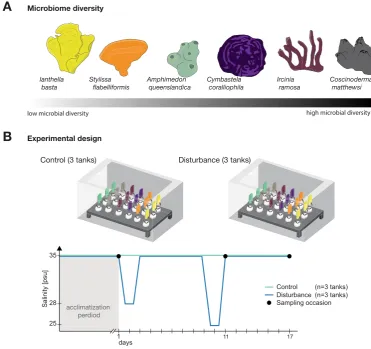
This study investigates how the diversity of the sponge microbiome influences community stability upon acute salinity fluctuations (ranging from 36 psu to 25 psu) under controlled experimental conditions (Fig. 1). The sim-ulated fluctuation mimics natural salinity levels experienced by reef organisms after major flooding events32,33,
and therefore provides further insights into the environmental tolerance (ability to live within a certain range of abiotic factors) of sponge holobionts to short-term salinity stress. Stability was investigated for six marine sponge species (Amphimedon queenslandica, Ianthella basta and Stylissa flabelliformis as representatives of low microbial diversity species; and Coscinoderma matthewsi, Cymbastela coralliophila and Ircinia ramosa as representatives of high microbial diversity species) using high taxonomic resolution based on Amplicon Sequence Variants (ASV)34,
facilitating detection of fine-scale variations in microbiome composition.
Figure 1. Diversity of sponge microbiomes and experimental setup to test microbiome stability. (A) Sponge
[image:2.595.153.525.45.394.2]www.nature.com/scientificreports/
Results
Host health and photopigment composition.
Sponges were not visibly stressed following salinity amendment as determined using the previously described stress proxies of mucus production, tissue regression and tissue necrosis15. Photopigment concentrations (Chlorophyll a, b, c, d, total chlorophyll and totalcarote-noids) were evaluated for each species as an additional proxy of host health (Supplementary Material, Figure S1). Photopigment concentrations varied significantly between host species (ANOVA, F(5/630)= 8.145, p = 1.84−7). S. flabelliformis had the highest total carotenoid concentration (150.57 µg g−1± 48.51) followed by I. basta (41.41 µg g−1± 9.48). Chlorophyll a concentration was highest in the two photosynthetic species I. ramosa and C. coralliophila, ranging from 100.63 µg g−1± 37.60 to 97.20 µg g−1± 33.79 respectively. Neither time nor treatment had an effect on the photopigment composition within each host species (PERMANOVA, p > 0.05, Table S1).
Microbiome diversity and richness.
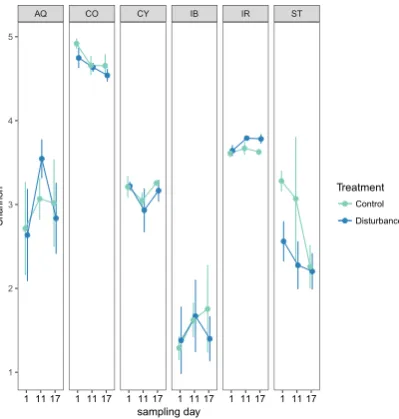
In total, 7 077 372 Illumina sequence reads were obtained (ranging from 5 976 to 57 917 in the different samples), of which 3 185 811 reads remained after quality filtering. Overall, 6 896 ASV were identified based on single nucleotide variations in the sequence reads. The highest richness was observed in A. queenslandica (297 ASVs ± 94), while I. basta was associated with the lowest microbial rich-ness (66 ASVs ± 62) (Table S2). Alpha diversities based on Shannon Index varied significantly between sponge species (ANOVA, F(5/72)= 85.356, p = 2 × 10⁻¹⁶, Table S3; Fig. 2). C. matthewsi was associated with the highest alpha diversity (4.69 ± 0.18), followed by I. ramosa (3.69 ± 0.10), C. coralliophila (3.14 ± 0.23), A. queenslandica (2.97 ± 0.71) and S. flabelliformis (2.61 ± 0.68). I. basta associated microbiomes had the lowest microbial diver-sity (1.52 ± 0.54). Sponges from the different treatment groups (control versus disturbance) had similar diversity values, indicating acute salinity disturbance had no influence on microbiome richness or evenness within each sponge species (Fig. 2).Compositional stability of sponge microbiomes after salinity fluctuations.
The stability of the sponge microbiome upon two consecutive pulses of reduced salinity was compared across HMA and LMA spe-cies. Each sponge species was associated with a distinct microbial community (ANOSIM, p = 0.001, R = 0.9793) and microbiomes of both treatment groups (control versus disturbance) were highly similar within each sponge species (ANOSIM p = 0.027, R =−0.0070; Fig. 3). Multivariate dispersion (heterogeneity of a community based on distances of samples to their group centroid) of microbial assemblages varied significantly between sponge species (ANOVA, F(11/96)= 42.383, p = 2.2 × 10⁻¹⁶; Fig. 4), however, treatment had no effect on the dispersion of the sponge microbiome (TukeyHSD p > 0.05, Table S4). Microbial community composition in each sponge spe-cies also remained stable over time within each treatment group (adonis2, host and treatment group as blocking factor, 10 000 permutations, p = 0.9989, Table S5). However, host genotype had a significant effect on microbial composition for all sponge species, with a higher similarity between samples originating from the same geno-type than between samples originating from different conspecific genogeno-types (ANOSIM, p = 0.001, R = 0.9427). Furthermore, the microbiome composition varied significantly between sponge individuals (genotypes) of the same species (adonis2, host species as blocking factor, 10 000 permutations, p < 0.001, Table S6).Fine-scale variations in sponge microbiomes.
Sponge microbiomes were dominated by sequences clas-sified to the phyla Proteobacteria, Chloroflexi, Cyanobacteria, Bacteroidetes and PAUC34f (Fig. 5A). The ten most abundant ASVs for each sponge species are represented in Fig. 5A and the ASV composition for selected taxa is shown for each host genotype in Fig. 5B. A. queenslandica was dominated by seven genera belonging [image:3.595.158.358.44.254.2]www.nature.com/scientificreports/
to the phyla Proteobacteria and Bacteroidetes (Fig. 5A). Nitrosococcus (phylum Proteobacteria) was the most abundant genus and was represented by four ASVs (Fig. 5B). Each A. queenslandica host genotype was associ-ated with a specific Nitrosococcus community (ANOSIM, p = 0.001., R = 0.7128), which displayed high tempo-ral stability irrespective of treatment. C. matthewsi was dominated by six genera belonging to Proteobacteria, PAUC34f, Chloroflexi and Acidobacteria phyla (Fig. 5A). The three most abundant PAUC34f ASVs retrieved from the C. matthewsi microbiome were equally abundant in all host genotypes, except genotype CO_D which was dominated by a single PAUC34f ASV (Fig. 5C). C. coralliophila was dominated by seven genera belong-ing to the phyla Proteobacteria, Cyanobacteria and Chloroflexi with the cyanobacterial ASVs revealbelong-ing high host genotype specificity and high temporal stability irrespective of treatment (Fig. 5A,D). I. basta was dom-inated by one Alphaproteobacteria-affiliated sequence across all genotypes while the other dominant class, Gammaproteobacteria, consisted of two equally abundant ASVs and a third low abundant ASV which was not
Figure 3. Non-metric multidimensional scaling plot displaying similarities in the microbiomes of the six
sponge species under both treatment conditions (control and disturbance). Microbiomes show high host-species specificity and high temporal stability even after exposure to a non-lethal salinity stress. Abbreviation of the host species as indicated: Amphimedon queenslandica (AQ), Coscinoderma matthewsi (CO), Cymbastela coralliophila (CY), Ianthella basta (IB), Ircinia ramosa (IR) and Stylissa flabelliformis (ST).
[image:4.595.156.455.48.274.2] [image:4.595.157.454.362.542.2]www.nature.com/scientificreports/
present across all host genotypes (Fig. 5A,E). I. ramosa was dominated by seven bacterial genera belonging to six phyla, with the most abundant members belonging to Rhodothermaceae (phylum Bacteroidetes) (Fig. 5A). Rhodothermaceae ASVs varied significantly between the I. ramosa host genotypes but were stable within each genotype (Fig. 5F). The S. flabelliformis microbiome was dominated by the phyla Proteobacteria and Nitrospirae (Fig. 5A), with the two dominant Nitrospira ASVs displaying similar relative abundance patterns across all geno-types except ST_E (Fig. 5G).
Discussion
Disturbance of the global climate system as a result of increased green-house gas emissions is predicted to result in stronger storm activity and larger flooding events35. For near-shore coral reefs, large floods can result in acute
salinity fluctuations that impact the health of marine invertebrates such as corals and sponges32,36. For example, a
flood plume associated with tropical cyclone “Tash” in 2011 caused a dramatic salinity drop (reaching extremes
Figure 5. (A) Alluvial diagram depicting taxonomic affiliation of the ten most abundant Amplicon Sequence
Variants (ASV) associated with each sponge species (AQ = Amphimedon queenslandica, CO = Coscinoderma matthewsi, CY = Cymbastela coralliophila, IB = Ianthella basta, IR = Ircinia ramosa and ST = Stylissa
[image:5.595.158.553.47.489.2]www.nature.com/scientificreports/
of 6.5 psu) on coral reefs in Keppel Bay (GBR, Australia) which resulted in large-scale coral mortality36. Similar
salinity extremes and mortalities were observed after cyclone “Joy” crossed the Queensland (Australia) coast in 1991, where salinity during the flood peak reached 7–10 psu at the surface and 15–28 psu at 3 m depth32.
However, despite experiencing an average annual salinity of ~35.7 psu in the field37, sponge species assessed in
this study were highly tolerant of short-term acute salinity fluctuations (minimum of 25 psu), showing no visual signs of health deterioration, no changes in the concentration or composition of photopigments and no shifts in the sponge-associated microbial communities. The only previous assessment of salinity tolerance in sponges showed that Cymbastela concentrica tolerated long-term exposure to salinities ranging from 30.6 psu to 34.5 psu38.
These results contribute to an increasing body of evidence showing high environmental tolerance in sponges39,40.
The diversity-stability hypothesis posits that high diversity systems are more stable than low diversity systems upon environmental fluctuation20. Applying this diversity-stability paradigm to sponge microbiomes subjected to
acute salinity disturbance revealed no shift in the compositional stability (e.g. compositional resistance, resilience and sensitivity differences) of the microbiome for both high (HMA) and low (LMA) diversity species. Temporal stability in HMA- and LMA-sponge microbiomes has been described along natural seasonal fluctuations28 and
sponge microbiomes have also been shown to be resistant to sub-lethal increases in nitrogen, temperature, sed-iment, light and pollution14,15,41–44. Furthermore, sponge microbiomes can remain stable during stress-induced
tissue regression of the host45. However, once a compositional and functional shift of the sponge-associated
microbiome occurs, host mortality can rapidly follow17,18,46, highlighting the crucial link between microbial
sta-bility and host health. In addition to altering the abundance and/or prevalence of microorganisms, environmental disturbances can also induce changes to the community dispersion/heterogeneity47. The recently coined Anna
Karenina principle postulates that disturbances often lead to more stochastic community structures47, which can
be measured by the increase in multivariate dispersion of a microbiome. In our study the dispersion of microbial communities also remained consistent across both high and low diversity species, irrespective of experimental treatment. Stability in the composition and dispersion of sponge-microbial associations under short-term salinity stress emphasizes the high fidelity of sponge-microbial partnerships. Furthermore, equal compositional resist-ance across high and low microbial diversity species during environmental fluctuations shows that the stability of sponge microbiomes remains unaffected by its diversity. While the diversity-stability concept does not appear to hold for sponge microbiomes, it remains to be seen whether the environmental tolerance of other reef species such as corals is linked to microbiome diversity. Furthermore, the effect of microbial diversity on functional sta-bility of sponge microbiomes remains to be determined.
Oligotyping sequence clustering techniques identify nucleotide variations (up to one nucleotide) between sequences and hence increase the ability to detect fine-scale variations, which can be informative about ecological niches, temporal dynamics and population structures48–50. In this study, oligotyping revealed that host genotype
significantly controls fine-scale bacterial composition (ASV level), whereas sponge species structures the asso-ciated bacterial genera, and the HMA-LMA dichotomy appears to influence the microbiome composition at the phylum level (Fig. 5). For example, low microbial diversity species (A. queenslandica, I. basta and S. flabelliformis) were predominantly associated with bacteria belonging to the phylum Proteobacteria. In contrast, high micro-bial diversity species (C. matthewsi, C. coralliophila and I. ramosa) were associated with a complex community dominated by Proteobacteria, PAUC34f, Chloroflexi, Bacteroidetes, Actinobacteria and Acidobacteria. Similar observations have been reported for other LMA and HMA sponge species25 and results are also consistent with
previous reports of high species-specificity in sponge microbiomes28,51–53. Here we further report that sponge
microbiomes also exhibit strong genotype-specificity, detected using fine-scale compositional variation at the ASV level. This is consistent with other host-microbe systems including the human gut54–56 and the Drosophila
microbiome57,58. Considering the significant microbiome differences amongst host genotypes, we argue that
future research on sponge microbiomes should take genotype-specific microbiome variations into account. The significant influence of host genotype on the fine-scale composition of a sponge microbiome further suggests that host intrinsic factors (e.g. host genetics) rather than environmental factors are particularly important in shaping the sponge microbiome.
Marine ecosystems, such as coral reefs, are increasingly impacted by local and global stressors59 and effective
monitoring and management are critical to their protection. Microbial diagnostics have recently been proposed as a rapid and sensitive way to monitor environmental fluctuations in coral reef ecosystems60. As ecologically
important filter feeders with well-established microbial partnerships39,61,62, sponges represent a relevant target
for microbial based monitoring approaches. However, the high stability of sponge microbiomes towards a vari-ety of natural fluctuations28,63 and stressors42–44, in conjunction with fine-scale compositional variation between
host genotypes, suggests that sponge-associated microbes are not suitable indicators for assessing perturba-tions to reef ecosystem health. Here we have also shown that the primary driver of the remarkable stability in sponge-associated microbial communities is environmental resistance rather than resilience.
Methods
Experimental setup.
Great Barrier Reef (GBR) sponge species (n = 6) associated with previously docu-mented low and high diversity microbial communities53,64 were selected for the study and included: Amphimedonwww.nature.com/scientificreports/
each sponge was fragmented into three equally sized clones and placed into indoor flow-through tanks for two weeks to allow tissue healing. Sponge clones were subsequently transferred to experimental tanks and left to acclimatize for seven days. Each experimental tank harbored six sponge species, each represented by three clones of the same individual (in total 6 × 3 sponge clones per tank; see Fig. 1).
The experimental setup comprised three control tanks and three pulse salinity disturbance tanks. All tanks were kept at stable temperature (27.5 °C ± 0.04 °C), light (80 mol photons m−2 s−1) and flow (8 m s−1) conditions throughout the experiment. While control tanks were kept at stable ambient salinity (34.77 psu ± 1.05 psu), dis-turbance tanks were exposed to two consecutive pulse salinity drops on the second (day 2) and tenth day (day 10) to 28 psu and 25 psu, respectively (Fig. 1). Each pulse lasted for a total of nine hours with the intensity and dura-tion of the simulated salinity fluctuadura-tions based on previously documented salinity fluctuadura-tions on the GBR32,33,65.
Samples were collected before the disturbance (day 1), directly after the second low-salinity pulse event (day 11) and one week after the pulse event to assess recovery (day 17). On each sampling occasion one clone of each individual sponge was removed from the tanks with sterile tweezers, photographed, rinsed with 0.2 µm filtered seawater to remove loosely attached microbes from the surface and cut into small fragments. Randomly selected subsamples containing pinacoderm and mesohyl were placed into two 2 ml cryogenic vials (Corning
®
), snap frozen in liquid nitrogen and stored at −80 °C until further processing.Pigment analysis.
The concentration of sponge photopigments was analyzed following the method described by Pineda, et al.15. Briefly, sponge samples were defrosted, wet weight of each sample was recorded(approximately 0.2 g) and samples were transferred into clean PowerBead tubes (MoBio Power Plant Kit) contain-ing four stainless steel beads per vial. To each tube 1 ml of 95% EtOH was added, and tissue was bead beaten for 3 × 40 s at 5 m s−1 and centrifuged for 30 s at 10 000 rcf. The supernatant was added in triplicate into 96-well plates and absorbance was measured at 470 nm, 632 nm, 649 nm, 665 nm, 696 nm and 750 nm on a Bio-Tek
®
Power Wave Microplate Scanning Spectrophotometer. Blank-corrected absorbance readings were used to calculate Chlorophyll a, b, c, d, total Chlorophyll and total Carotenoids (Supplementary Material). Pigment concentration was normalized to sponge wet weight.DNA extraction and sequencing.
DNA was extracted from all sponge samples using the MoBio Power Soil Kit following the manufacturer’s instructions, including one bead beating step of 40 s at 4 m s−1. DNA extracts were stored at −80 °C until shipment on dry ice to Ramaciotti Centre (University of New south Wales, Australia) for sequencing. The V1-V3 region of the 16S rRNA gene was amplified using primers 27 F (Lane 1991) and 519 R (Lane et al. 1993) and libraries were prepared with the Illumina TruSeq preparation protocol, followed by Illumina MiSeq2 × 300 bp sequencing.Sequence analysis.
Demultiplexed paired end reads were analyzed using QIIME2 (Version 2017.9.0; https:// qiime2.org). Based on quality plots, forward and reverse reads were truncated at their 3′ end at the 296 and 257 sequencing positions, respectively. Samples were individually checked for chimeras and chimeric sequences were removed from the dataset using DADA266. Sequences were grouped into features based on 100% sequencesimi-larity, subsequently referred to as ASV (amplicon sequence variants), using DADA266. Multiple de novo sequence
alignments of the representative sequences was performed using MAFFT67. Nonconserved and highly gapped
columns from the alignment were removed using default settings of the mask option in QIIME2. Unrooted and rooted trees were generated using FastTree for analysis of phylogenetic diversity. For taxonomic assignment, a Naïve-Bayes classifier was trained on the SILVA v123 99% Operational Taxonomic Units, where reference sequences only included the V1-V2 regions (27 F/519 R primer pair) of the 16S rRNA genes. The trained classifier was applied to the representative sequences to assign taxonomy. Chloroplast and Mitochondria derived sequence reads and singletons were removed from the dataset and the feature table was rarefied to an even sequencing depth of 5976 sequencing reads, representing 21.41% of the total sequences post quality control.
Statistical analyses were performed in R68. Multivariate statistical approaches including Analysis of Similarity
(ANOSIM, ‘vegan package’69), Permutation Multivariate Analysis of Variance (PERMANOVA, ‘vegan package’69),
Multivariate Homogeneity of Group Dispersion/variance (‘vegan package’69) and Non-metric Multidimensional
Scaling (NMDS, ‘phyloseq package’70) were based on Bray Curtis dissimilarities. Graphs were created in R using
ggplot271 and phyloseq packages70. The alluvial diagram was generated in RAWGraph72.
Data Availability.
Demultiplexed sequences and metadata are available from the Sequence Read Archives (SRA) under accession number SRP131926.References
1. McFall-Ngai, M. et al. Animals in a bacterial world, a new imperative for the life sciences. Proc. Natl. Acad. Sci USA 110, 3229–3236 (2013).
2. Webster, N. S. & Thomas, T. The sponge hologenome. mBio 7, e00135–16 (2016).
3. Bourne, D. G., Morrow, K. M. & Webster, N. S. Coral Holobionts: Insights into the coral microbiome: Underpinning the health and resilience of reef ecosystems. Annu. Rev. Microbiol. 70, 317–340 (2016).
4. Rosenberg, E. & Zilber-Rosenberg, I. Symbiosis and development: the hologenome concept. Birth Defects Res C Embryo Today 93, 56–66 (2011).
5. Rohwer, F., Seguritan, V., Azam, F. & Knowlton, N. Diversity and distribution of coral-associated bacteria. Mar. Ecol. Prog. Ser. 243, 1–10 (2002).
6. Bordenstein, S. R. & Theis, K. R. Host biology in light of the microbiome: ten principles of holobionts and hologenomes. PLoS Biol.
13, e1002226 (2015).
7. Glasl, B., Herndl, G. J. & Frade, P. R. The microbiome of coral surface mucus has a key role in mediating holobiont health and survival upon disturbance. ISME J 10, 2280–2292 (2016).
www.nature.com/scientificreports/
9. Zaneveld, J. R. et al. Overfishing and nutrient pollution interact with temperature to disrupt coral reefs down to microbial scales.
Nat. Commun. 7, 11833 (2016).
10. Christian, N., Whitaker, B. K. & Clay, K. Microbiomes: unifying animal and plant systems through the lens of community ecology theory. Front. Microbiol. 6, 869 (2015).
11. Costello, E. K., Stagaman, K., Dethlefsen, L., Bohannan, B. J. M. & Relman, D. A. The Application of Ecological Theory Toward an Understanding of the Human Microbiome. Science 336, 1255–1263 (2012).
12. Allison, S. D. & Martiny, J. B. H. Resistance, resilience, and redundancy in microbial communities. Proc. Natl. Acad. Sci USA 105, 11512–11519 (2008).
13. Shade, A. et al. Fundamentals of microbial community resistance and resilience. Front. Microbiol. 3 (2012).
14. Luter, H. M., Gibb, K. & Webster, N. S. Eutrophication has no short-term effect on the Cymbastela stipitata holobiont. Front. Microbiol. 5, 216 (2014).
15. Pineda, M. C. et al. Effects of light attenuation on the sponge holobiont- implications for dredging management. Sci. Rep. 6, 39038 (2016).
16. Ziegler, M., Seneca, F. O., Yum, L. K., Palumbi, S. R. & Voolstra, C. R. Bacterial community dynamics are linked to patterns of coral heat tolerance. Nat. Commun. 8, 14213 (2017).
17. Fan, L., Liu, M., Simister, R., Webster, N. S. & Thomas, T. Marine microbial symbiosis heats up: the phylogenetic and functional response of a sponge holobiont to thermal stress. ISME J 7, 991–1002 (2013).
18. Blanquer, A., Uriz, M. J., Cebrian, E. & Galand, P. E. Snapshot of a bacterial microbiome shift during the early symptoms of a massive sponge die-off in the western Mediterranean. Front. Microbiol. 7, 752 (2016).
19. Dini-Andreote, F., Stegen, J. C. & Elsas, J. D. v. & Salles, J. F. Disentangling mechanisms that mediate the balance between stochastic and deterministic processes in microbial succession. PNAS 112, 1326–1332 (2015).
20. McCann, K. S. The diversity-stability debate. Nature 405, 228–233 (2000).
21. Hentschel, U., Piel, J., Degnan, S. M. & Taylor, M. W. Genomic insights into the marine sponge microbiome. Nat. Rev. Microbiol. 10, 641–654 (2012).
22. Webster, N. S. et al. Deep sequencing reveals exceptional diversity and modes of transmission for bacterial sponge symbionts.
Environ. Microbiol. 12, 2070–2082 (2010).
23. Reveillaud, J. et al. Host-specificity among abundant and rare taxa in the sponge microbiome. ISME J 8, 1198–1209 (2014). 24. Hentschel, U. et al. In Molecular Marine Biology of Sponges (ed Müller WEG) 60-88 (Springer Verlag, 2003).
25. Moitinho-Silva, L. et al. Predicting the HMA-LMA Status in Marine Sponges by Machine Learning. Front. Microbiol. 8, 752 (2017). 26. Hentschel, U., Usher, K. M. & Taylor, M. W. Marine sponges as microbial fermenters. FEMS Microbiol. Ecol. 55, 167–177 (2006). 27. Giles, E. C. et al. Bacterial community profiles in low microbial abundance sponges. FEMS Microbiol. Ecol. 83, 232–241 (2013). 28. Erwin, P. M., Coma, R., Lopez-Sendino, P., Serrano, E. & Ribes, M. Stable symbionts across the HMA-LMA dichotomy: low seasonal
and interannual variation in sponge-associated bacteria from taxonomically diverse hosts. FEMS Microbiol. Ecol. 91 (2015). 29. Bayer, K., Kamke, J. & Hentschel, U. Quantification of bacterial and archaeal symbionts in high and low microbial abundance
sponges using real-time PCR. FEMS Microbiol. Ecol. 89, 679–690 (2014).
30. Weisz, J. B., Lindquist, N. & Martens, C. S. Do associated microbial abundances impact marine demosponge pumping rates and tissue densities? Oecologia 155, 367–376 (2008).
31. Ribes, M. et al. Functional convergence of microbes associated with temperate marine sponges. Environ. Microbiol. 14 (2012). 32. VanWoesik, R., DeVantier, L. M. & Glazebrook, J. S. Effects of cyclone ‘Joy’ on nearshore coral communities of the Great Barrier
Reef. Mar. Ecol. Prog. Ser. 128, 261–270 (1995).
33. Devlin, M. & Schaffelke, B. Spatial extent of riverine flood plumes and exposure of marine ecosystems in the Tully coastal region, Great Barrier Reef. Marine and Freshwater Research 60, 1109–1122 (2009).
34. Callahan, B. J., McMurdie, P. J. & Holmes, S. P. Exact sequence variation should replace operational taxonomic units in marker-gene data analysis. ISME J 11, 2639–2643 (2017).
35. Arnell, N. W. & Gosling, S. N. The impacts of climate change on river flood risk at the global scale. Clim. Change 134, 387–401 (2016).
36. Jones, A. M. & Berkelmans, R. Flood Impacts in Keppel Bay, Southern Great Barrier Reef in the Aftermath of Cyclonic Rainfall. PLoS One 9 (2014).
37. Wolanski, E. Physical Oceanographic Processes of the Great Barrier Reef. (CRC Press, 1994).
38. Roberts, D. E., Davis, A. R. & Cummins, S. P. Experimental manipulation of shade, silt, nutrients and salinity on the temperate reef sponge Cymbastela concentrica. Mar. Ecol. Prog. Ser. 307, 143–154 (2006).
39. Bell, J. J., Davy, S. K., Jones, T., Taylor, M. W. & Webster, N. S. Could some coral reefs become sponge reefs as our climate changes?
Global Change Biol. 19, 2613–2624 (2013).
40. Bennett, H. M. et al. Interactive effects of temperature and pCO2 on sponges: from the cradle to the grave. Glob Chang Biol. 23, 2031–2046 (2017).
41. Thoms, C., Horn, M., Wagner, M., Hentschel, U. & Proksch, P. Monitoring microbial diversity and natural product profiles of the sponge Aplysina cavernicola following transplantation. Mar. Biol. 142, 685–692 (2003).
42. Gantt, S. E., Lopez-Legentil, S. & Erwin, P. M. Stable microbial communities in the sponge Crambe crambe from inside and outside a polluted Mediterranean harbor. FEMS Microbiol. Lett. 364, 685–692 (2017).
43. Pineda, M. C. et al. Effects of sediment smothering on the sponge holobiont with implications for dredging management. Sci. Rep.
7, 5156 (2017).
44. Simister, R., Taylor, M. W., Tsai, P. & Webster, N. Sponge-microbe associations survive high nutrients and temperatures. PLoS One
7, e52220 (2012).
45. Luter, H. M., Whalan, S. & Webster, N. S. The marine sponge Ianthella basta can recover from stress-induced tissue regression.
Hydrobiologia 687, 227–235 (2012).
46. Webster, N. S., Cobb, R. E. & Negri, A. P. Temperature thresholds for bacterial symbiosis with a sponge. ISME J 2, 830–842 (2008). 47. Zaneveld, J. R., McMinds, R. & Thurber, R. V. Stress and stability: applying the Anna Karenina principle to animal microbiomes. Nat.
Microbiol. 2, 17121 (2017).
48. Eren, A. M., Borisy, G. G., Huse, S. M. & Welch, J. L. M. Oligotyping analysis of the human oral microbiome. Proc. Natl. Acad. Sci USA 111, 2875–2884 (2014).
49. Eren, A. M. et al. Minimum entropy decomposition: Unsupervised oligotyping for sensitive partitioning of high-throughput marker gene sequences. ISME J 9, 968–979 (2015).
50. Mackey, K. R. M. et al. Seasonal succession and spatial patterns of Synechococcus microdiversity in a salt marsh estuary revealed through 16S rRNA gene oligotyping. Front. Microbiol. 8, 1496 (2017).
51. Schmitt, S. et al. Assessing the complex sponge microbiota: core, variable and species-specific bacterial communities in marine sponges. ISME J 6, 564–576 (2012).
52. Taylor, M. W., Schupp, P. J., Dahllof, I., Kjelleberg, S. & Steinberg, P. D. Host specificity in marine sponge-associated bacteria, and potential implications for marine microbial diversity. Environ. Microbiol. 6, 121–130 (2004).
53. Thomas, T. et al. Diversity, structure and convergent evolution of the global sponge microbiome. Nat. Commun. 7, 11870 (2016). 54. Spor, A., Koren, O. & Ley, R. Unravelling the effects of the environment and host genotype on the gut microbiome. Nat. Rev.
www.nature.com/scientificreports/
55. Blekhman, R. et al. Host genetic variation impacts microbiome composition across human body sites. Genome Biol. 16 (2015). 56. Dabrowska, K. & Witkiewicz, W. Correlations of host genetics and gut microbiome composition. Front. Microbiol. 7, 1357 (2016). 57. Chaston, J. M., Dobson, A. J., Newell, P. D. & Douglas, A. E. Host genetic control of the microbiota mediates the Drosophila
nutritional phenotype. Appl. Environ. Microbiol. 82, 671–679 (2016).
58. Early, A. M., Shanmugarajah, N., Buchon, N. & Clark, A. G. Drosophila genotype influences commensal bacterial levels. PLoS One
12, e0170332 (2017).
59. Hughes, T. P. et al. Coral reefs in the Anthropocene. Nature 546, 82–90 (2017).
60. Glasl, B., Webster, N. S. & Bourne, D. G. Microbial indicators as a diagnostic tool for assessing water quality and climate stress in coral reef ecosystems. Mar. Biol. 164-91 (2017).
61. Bell, J. J. The functional roles of marine sponges. Estuar. Coast Shelf Sci. 79, 341–353 (2008).
62. Lesser, M. P. Benthic-pelagic coupling on coral reefs: Feeding and growth of Caribbean sponges. J. Exp. Mar. Biol. and Ecol. 328, 277–288 (2006).
63. Erwin, P. M., Pita, L., López-Legentil, S. & Turon, X. Stability of sponge-associated bacteria over large seasonal shifts in temperature and irradiance. Appl. Environ. Microbiol. 78, 7358–7368 (2012).
64. Webster, N. S. et al. Same, same but different: symbiotic bacterial associations in GBR sponges. Front. Microbiol. 3, 444 (2012). 65. Kline, D. I. et al. Six month in situ high-resolution carbonate chemistry and temperature study on a coral reef flat reveals
asynchronous pH and temperature anomalies. PLoS One 10 (2015).
66. Callahan, B. J. et al. DADA2: High-resolution sample inference from Illumina amplicon data. Nature Methods 13, 581 (2016). 67. Katoh, K., Misawa, K., Kuma, K. & Miyata, T. MAFFT: a novel method for rapid multiple sequence alignment based on fast Fourier
transform. Nucleic Acids Res. 30, 3059–3066 (2002).
68. R Development Core Team. R: A language and environment for statistical computing. R Foundation for Statistical Computing (2008). 69. Oksanen, J. et al. vegan: Community Ecology Package. R package version 2, 0–9 (2013).
70. McMurdie, P. J. & Holmes, S. phyloseq: an R package for reproducible interactive analysis and graphics of microbiome census data.
PLoS One 8, e61217 (2013).
71. Wickham, H. ggplot2: elegant graphics for data analysis. (Springer New York, 2009).
72. Mauri, M., Elli, T., Caviglia, G., Uboldi, G. & Azzi, M. RAWGraphs: A Visualisation Platform to Create Open Outputs. 28, 1–28 (2017).
Acknowledgements
We thank Victoria Lydick and Andrew Ball for their help during the experiment. We also acknowledge the technical support provided by the National SeaSimulator, and we want to express our gratitude to Craig Humphrey and Andrea Severati. We thank Heidi Luter for inspiring scientific discussions on the sponge microbiome and by providing a helping hand in the field. The study was funded by the Advance Queensland PhD Scholarship and the GBRMPA Management Award awarded to B.G.
Author Contributions
B.G., D.G.B. and N.S.W. designed the experiment. B.G. and C.E.S. undertook the experiment. B.G. and C.E.S. undertook laboratory analyses. B.G. analysed the data and wrote the manuscript. All authors reviewed the manuscript.
Additional Information
Supplementary information accompanies this paper at https://doi.org/10.1038/s41598-018-26641-9.
Competing Interests: The authors declare no competing interests.
Publisher's note: Springer Nature remains neutral with regard to jurisdictional claims in published maps and
institutional affiliations.
Open Access This article is licensed under a Creative Commons Attribution 4.0 International
License, which permits use, sharing, adaptation, distribution and reproduction in any medium or format, as long as you give appropriate credit to the original author(s) and the source, provide a link to the Cre-ative Commons license, and indicate if changes were made. The images or other third party material in this article are included in the article’s Creative Commons license, unless indicated otherwise in a credit line to the material. If material is not included in the article’s Creative Commons license and your intended use is not per-mitted by statutory regulation or exceeds the perper-mitted use, you will need to obtain permission directly from the copyright holder. To view a copy of this license, visit http://creativecommons.org/licenses/by/4.0/.