UNIVERSITI TEKNIKAL MALAYSIA MELAKA
DETERMINATION OF THE SUITABLE POWER DELIVERY
METHOD TOWARDS COMPATIBLE LINE LOADABILITY
IN MICROGRID USING POWERWORLD SOFTWARE.
This report submitted in accordance with requirement of the Universiti Teknikal Malaysia Melaka (UTeM) for the Bachelor Degree of Engineering Technology
Industrial Power with Hons.
by
NUR ADILAH BINTI ZAKARIAH B071310790
941214026172
UNIVERSITI TEKNIKAL MALAYSIA MELAKA
BORANG PENGESAHAN STATUS LAPORAN PROJEK SARJANA MUDA
TAJUK: Determination Of The Suitable Power Delivery Method Towards Compatible Line Loadability In Microgrid Using PowerWorld Software.
SESI PENGAJIAN: 2016/17 Semester 2
Saya NUR ADILAH BINTI ZAKARIAH
mengaku membenarkan Laporan PSM ini disimpan di Perpustakaan Universiti Teknikal Malaysia Melaka (UTeM) dengan syarat-syarat kegunaan seperti berikut:
1. Laporan PSM adalah hak milik Universiti Teknikal Malaysia Melaka dan penulis. 2. Perpustakaan Universiti Teknikal Malaysia Melaka dibenarkan membuat salinan
untuk tujuan pengajian sahaja dengan izin penulis.
3. Perpustakaan dibenarkan membuat salinan laporan PSM ini sebagai bahan pertukaran antara institusi pengajian tinggi.
4. **Sila tandakan ( )
SULIT
TERHAD
TIDAK TERHAD
(Mengandungi maklumat yang berdarjah keselamatan atau kepentingan Malaysia sebagaimana yang termaktub dalam AKTA RAHSIA RASMI 1972)
(Mengandungi maklumat TERHAD yang telah ditentukan oleh organisasi/badan di mana penyelidikan dijalankan)
Alamat Tetap:
309 Taman Rhu, 08600 Tikam Batu, Sungai Petani, Kedah Darul Aman.
Tarikh: 13 December 2016
Disahkan oleh:
Cop Rasmi:
Tarikh: _______________________
DECLARATION
I hereby, declared this report entitled “Determination Of The Suitable Power Delivery Method Towards Compatible Line Loadability In Microgrid Using Powerworld Software” is
the results of my own research except as cited in references.
Signature : ……….
Author’s Name : NUR ADILAH BINTI ZAKARIAH
APPROVAL
This report is submitted to the Faculty of Engineering Technology of UTeM as a partial fulfillment of the requirements for the degree of Bachelor of Electrical Engineering Technology (Industrial Power) with Honours. The member of the supervisory is as follow:
i
ABSTRAK
ii
ABSTRACT
iii
DEDICATION
I dedicate my dissertation work to my beloved family especially for my lovely parents with deepest gratitude because without their encouragement I was not able to complete this final
iv
ACKNOWLEDGEMENT
v
TABLE OF CONTENT
Abstrak i
Abstract ii
Dedication iii
Acknowledgement iv
Table of Content v
List of Tables vii
List of Figures viii
List Abbreviations, Symbols and Nomenclatures x
CHAPTER 1: INTRODUCTION 1
1.1 Project Overview 1
1.2 Problem Statement 2
1.3 Project Objectives 3
1.4 Project Scope 3
CHAPTER 2: LITERATURE REVIEW 4
2.1 Microgrid Definition 4
2.1.1 Development of Microgrid 5
2.1.2 Size of Microgrid 7
2.1.3 Common Type of Distributed Generation 8
2.1.4 Operating Mode 9
2.1.5 Importance of Microgrid 11
2.2 Power Quality in Microgrid 12
2.3 Method of power dispatch in Microgrid 17
2.3.1 Power Flow 17
2.3.2 Economic Dispatch 19
2.3.3 Optimal Power Flow 21
2.4 Power Management 24
2.4.1 One Distributed Generation in certain value of load 24
2.4.2 Line Distance 25
vi
2.4.3.1 Natural Gas Energy 27
2.4.3.2 Biomass Energy 30
CHAPTER 3 : METHODOLOGY
3.1 Method of Power Dispatch 32
3.2 Analysing the method with different condition of Power Management 32
3.2.1 One DG in certain value of load 33
3.2.2 Line distance 33
3.2.3 Type of Distributed Generation used 33
3.3 Evaluation of method towards compatible line lodability 34
CHAPTER 4 : RESULT AND DISCUSSION
4.1 Single Line Diagram of Microgrid system 35
4.2 Input data 35
4.2.1 Power Load 36
4.2.2 Line distance 36
4.2.3 Generator Cost 37
4.3 Output data 37
4.3.1 Power Flow 37
4.3.2 Economic Dispatch 38
4.4.3 Optimal Power Flow 39
4.4 Comparison of total output data between method 41
CHAPTER 5 : CONCLUSION AND FUTURE WORK 43
REFERENCES 44
vii
LIST OF TABLES
2.1 The experience of TNB involvement in rural electrification 2.2 Line flow and losses by using Newton Raphson
2.3 Final Result for stability analysis in Power Flow Method 2.4 Parameter of various source DG
2.5 Spot price in a day produce by DG 2.6 Distribution and power electronic losses
2.7 The characteristics of the cable lines(conductor section 3 x 95 mm2 ) 2.8 The position and nominal apparent power of the load
2.9 Cost and capacity factor of different DERs 2.10 US Renewables consumptions
4.1 Power Load and Power Factor of the load
4.2 Length of line in resistance, R and reactance, X value 4.3 Generator cost model
4.4 Power Output of Generator
4.5 Line Losses and Power Factor in line
4.6 Incremental Cost and Hourly Cost of Generator 4.7 Power Output of Generator
4.8 Line Losses and Power Factor in line
4.9 Incremental Cost and Hourly Cost of Generator 4.10 Power Output of Generator
4.11 Line Losses and Power Factor in line
viii
LIST OF FIGURES
2.1 Typical of Microgrid with some RES .
2.2 Microgrid Project Type of top 10 countries in APAC 2.3 The capacity of Microgrid from 2013 until 2020 at APAC 2.4 PCC circuit breaker connected in Microgrid
2.5 Point Common Coupling (PCC)
2.6 Multiple DG Microgrid example (centralized control framework) 2.7 Single line diagram of Microgrid
2.8 Output power of DG2 with (output compensate) and without ESS 2.9 Issues of stability in Microgrid
2.10 Microgrid Stability improvement 2.11 Power unbalance during islanding
2.12 System is balance after DSATCOM operation
2.13 Experimental result. (a) Dynamic response of FC; (b) Dynamic response of battery 2.14 3 bus system
2.15 Cost Curve in Different Scenarios of DG for 24 Hours of a Day
2.16 Test Microgrid (NPGs associated with a storage system are indicated by double rectangle
2.17 Various of demand in Microgrid for a day 2.18 Steam Generation Unit
2.19 Gas Turbines Unit 2.20 Combined Cycle Unit
2.21 U.S natural gas from 2009 until 2016 2.22 Natural gas generation capacity
2.23 Total supply/demand of natural gas 2.24 Natural gas spot price
2.25 Biomass generator
3.1 Microgrid system with different condition of Power Management
4.1 Microgrid system
x
LIST OF ABBREVIATIONS, SYMBOLS AND
NOMENCLATURE
DG - Distributed Generator RES - Renewable Energy Source MT - Micro Turbine
DE - Diesel Engine PV - Photovoltaic WT - Wind Turbine FC - Fuel Cell
CHP - Combined Heat Power PM - Power Management PCC - Point Common Coupling
HCPV - High Concentration Photovoltaic VSC - Voltage Source Converter PF - Power Flow
ED - Economic Dispatch OPF - Optimal Power Flow EES - Electrical Energy Storage DSM - Demand Side Management SSM - Supply Side Management APAC - Asia-Pasific
FIT - Feed-in-Tariff
TNB - Tenaga Nasional Berhad SESB - Sabah Electricity Sdn. Bhd. SEB - Sarawak Energy Berhad DSTATCOM - Distributed Static Compensator MPQC - Microgrid Power Quality Conditioner GA - Genetic Algorithm
1
CHAPTER 1
INTRODUCTION
1.0 Project Overview
A Micro-grid is defined as a group of Distributed Generation (DG), energy storage devices and loads, serviced by a distribution system [1]-[3]. The capacities or sizes of
Microgrid vary from few kilowatts up to Megawatts [1]-[4]. For the conventional DG usually used fuel and diesel as microsource. Nowadays, most DG used Renewable Energy which is photovoltaic (PV) high concentration photovoltaic (HCPV), wind turbine (WT), and hydro plants. For energy storage, batteries, super capacitors, and flywheels was used [1]-[4]. These types of sources and energy storage devices produce voltage in ac or dc with various
amplitudes and frequencies. In order to convert source, power converter is needed for example VSC (voltage Source Converter) [3][15]. The Micro-grid have three operating mode. First is the grid-connected mode (non autonomous) that operate in parallel to the grid. Second is the islanded mode (autonomous) that operate without utility grid and providing uninterruptible power supply service. Third is ride- through between two modes [1]-[8]. The development of Micro-grid is based on the encouraging government policy and it was an attractive plans [4][5]. Malaysia is one of the country that develop a Microgrid system to deliver power at local demand especially for rural area [4][5][11]. Rural area at Peninsular Malaysia, ( Perak) Sabah and Sarawak have their own Microgrid to supply power to local demand with the maximum capacity usually not more than 50 MW [11]. In recent years, with the development of Microgrid the power stability becomes a major issue and have to be solve properly [11]-[15]. In order to deliver a suitable power to consumer the method of power dispatch have to be identified.
2 flows in a system under a load conditions.[16][17] Power is deliver by considering losses in line and maximizing the power generation output. The cost of operation and generation was neglected.[16]-[20]
For the Economic Dispatch is to determine the cost of power generating of DG and it will minimize that overall cost of fuel, PV and WT needed to serve the system load [18][19]. This method was also applies to economic scheduling of plants output without considering transmission losses in line. Then the output of each of the plant is have to achieve the total cost of generating in minimum [18][20].
For the optimal power flow is method actually combine the power flow and economic dispatch method [21]. The OPF problem aims to achieve an optimal solution of a specific power system objective such as fuel, PV and WT generation cost while maximizing the power transfer to consumer [21]-[23]. OPF also will minimize the total of active power losses and minimize the operating cost when has losses in line [21][23].
There are many such thing that have to be considered in order to evaluate the suitable method of power dispatch in Micro-grid. A condition of Power Management (PM) is required for sound operation of a Micro grid [24]. The PM used in this project is condition of power when one DG is used in certain value of load [25]. For the second PM is the distance between the DG with load because long, medium or short distance of transmission line will affect the power quality to consumer [10][26]. For the last PM is type of different DG used in
Microgrid system. The different type of DG draw a different power output level for example is fuel type that draw a high power output as compared to PV and WT [27][28]. By
considering the PM in Microgrid, the suitable method for power dispatch can easily be selected towards compatible line loadability.
1.1 Problem Statement
3 mode cause a changes on power dispatch quality to consumer [11]-[15]. This is because, during islanding modes, the DG will continue to supply power to local demand and leads to issues of power quality.
1.2 Project Objectives
1. Identify the method of power dispatch used in Microgrid.
2. Analyse the method of power dispatch by using the different Power Management on Microgrid through PowerWorld software.
3. Evaluate the suitable method of power dispatch towards compatible line loadability on Microgrid.
1.3 Project Scopes
4
CHAPTER 2
LITERATURE REVIEW
2.1 Microgrid Definition
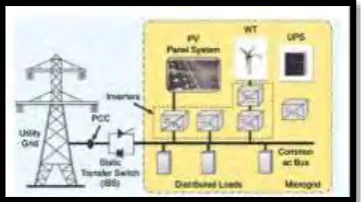
[image:18.595.188.369.516.617.2]Refer to Mohammed Yekini Suberu, Nouruddeen Bashir, Ogundola Matthew Adefemi and Umar Usman on 2013, authors state that with the development of DG nowadays based on renewable energy sources (RES) was increase the development of Microgrid in certain area. Microgrid can be define as combination, group or cluster of electricity generation, system electrical energy storage (EES) and load. The meaning of DG is a generation of electricity that supply a power close to power consumer via some distribution network. With the development of Microgrid, it give a lot of benefit especially for rural area. In a modern power sector, to supply the reliable power to consumer, demand side management (DSM) and supply side management (SSM) play an important role to supply an efficient power in low level of losses. In order to supply a reliable power to consumer, the implementation of DG have to be develop in distribution area. Figure 2.1 shows a typical of Microgrid with some RES .
Figure 2.1: Typical of Microgrid with some RES .
5 electricity with reliable power to consumer. The implementation of DG as Microgrid system will help to reduce losses and increase the system efficiency to deliver power as compared to main grid.
Besides that, based on Ritwik Majumder, Member IEEE 2013 state that Microgrid have three types area which is remote microgrid, facility grid and utility grid. A remote microgrid use decentralized control method as operation system and it never have connection between utility. For the power that use is maximum and limited for the customers. It power quality demand is high quality as compared to a facility Microgrid. The next type of
Microgrid is Facility Microgrid. It connection is normally connected to host utility and usually a single business-entity Microgrid. For the last type of Microgrid is utility Microgrid. The utility Microgrid have the connection to the utility at one point ( it could be also multiple connection points for grid connected reliability) of point common coupling (PCC). The PCC act as circuit breaker to connect and disconnect from the main grid. The area of utility grid is large (compared with facility Microgrid) and contains a lot of different types DG and load.
2.1.1 Development of Microgrid
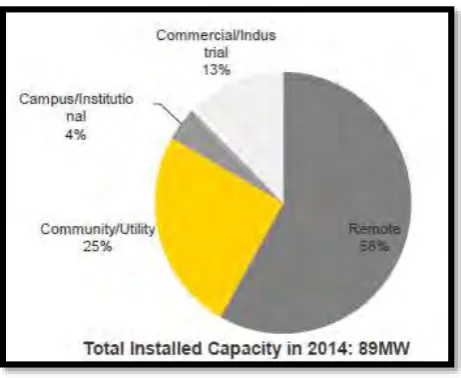
Based on the Korea Smart Grid Association in 2015 they state that the development of Microgrid of 10 countries in Asia-Pacific (APAC) is expected to grow by four times in 2023 by remote Microgrid. Figure 2.2 below shows a project of Microgrid of 10 countries in APAC.
6
Figure 2.2 : Microgrid Project Type of top 10 countries in APAC
India, Philippines, and Malaysia are selected as target among 10 countries of this project considering its potential for remote Microgrid because high demand of remote island and have a great potential. India have a largest Microgrid market in APAC which is 22.9 MW followed by Philippines and Malaysia which is 12.6 MW and 11.6 MW respectively. For Malaysia renewable energy is targeted to be installed in capacity among 3GW by 2020, Feed-in-Tariff (FIT) . Three state-owned utilities, TNB, SESB and SEB, provide electricity to Peninsular Malaysia (Major projects: Kemar -850kW, Perhentian -300kW), Sabah (Major projects: Banggi-200kW, Kinabatangan-1.5MW) , Sarawak (Major projects: Mudung Abun-20kW, Long Lawen-15kW) and majority of Microgrid projects are located in Sabah and Sarawak because Microgrid have big potential towards rural area. The rural and remote areas in developing countries are the major victims to get the electricity. Selection criteria to develop remote Microgrid is economic analysis, distance from grid, load growth and capacity of RES.
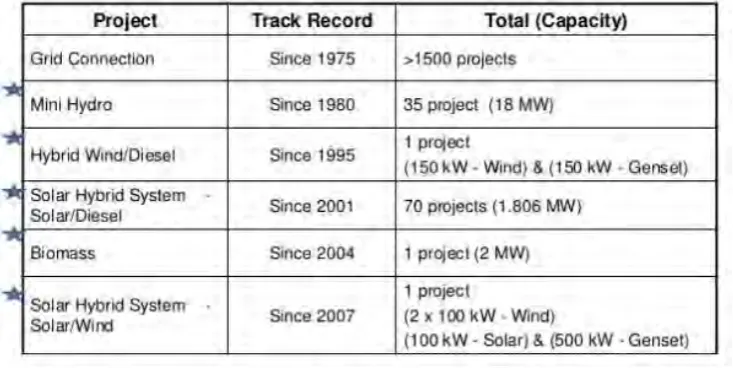
7 Table 2.1 : The experience of TNB involvement in rural electrification (adapted from
http://www.slideshare.net/e4sv/kuching-112-tnb-micro-grid-renewable-for-rural-electrification-mohd-azhar-abdul-rahman)
For example project in Kemar Grik, Perak is equipped with solar generating capacity of 850 kW in 2012. In 2004 until 2008, solar hybrid was build at station at Kg. Pak Kaleh, in P. Pemanggil, Kg. Teluk Berhala in P. aur, Pulau Perhentian, Kg. Sinulihan in Kiulu, Pulau Banggi in Kudat Sabah at Pulau Perehentian.
2.1.2 Size of Microgrid
8 Figures 2.3 : The capacity of Microgrid from 2013 until 2020 at APAC
2.1.3 Common type of Distributed Generation
For the common type of DG by Hartono RS, Budiyanto and Rudy Setiabudy in 2013, both author state that Microgrid is small-scale independent source that are placed near consumers, which is also compatibility to different condition of
environment. Generally, DG type can be divided into two categories conventional type for example micro-turbine (MT), diesel engine (DE) and renewable type for example wind turbine (WT), photovoltaic (PV) microhydro turbine. Energy storage devices which can be battery, supercapacitor, superconducting energy storage and flywheel. DG can not only supply electric energy, but also can supply combined heat and power (CHP). Microgrid is a small power grid, which is composed by various DGs, energy storage, loads, monitoring system and protection system. Microgrid behaves as a dispatchable load to large power system, and it behaves as a
independence power source to consumers.
9 In Microgrid system, there are many combination of DG or in other name is DER. It was various DER technology such as dipatchable thermal generation,
common renewable energy which is solar generation and but not least is DES. This is due to paper by Hossein Lotfi and Amin Khodaei on paper 2016.
2.1.4 Operating mode
Due to paper by C.E Jones and C. FItzer (undated) , both author explain that Microgrid can operate in connected to the main grid or islanded from utility grid. Grid operating mode means that Microgrid system supply the load with help by utility grid. But for the islanded operating mode, Microgrid will be separated from the utility grid if any fault develop on main grid. Therefore, the islanding mode is needed because it produce non interrupt supply. The Microgrid also can operate between two modes.
Another paper by Frank van Over, D Pudjianto and G Strbac in 2005, three of them state that Microgrid have two operating mode which is grid connected mode and islanding mode. In grid connected mode, microgrid operate with utility grid and islanding operating mode is when Microgrid operate independently without utility grid.
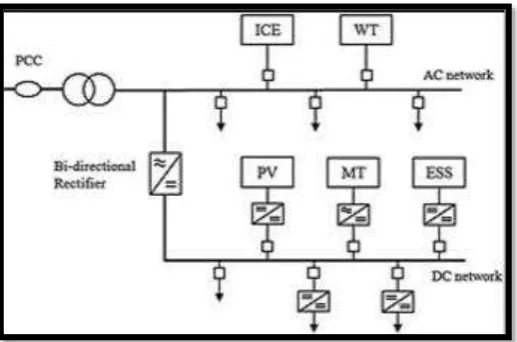
10 Figure 2.4 : PCC circuit breaker connected in Microgrid (adapted from
https://www.researchgate.net/figure/264224520_fig7_Figure-1-Hybrid-AC-DC-microgrid-AC-alternating-current-DC-direct-current-ICE)
Based A. Solanki, A. Nasiri, V. Bhavaraju, T. Abdullah and D. Yu, Member,
IEEE 2013, all the author states that Microgrid is a group of DGs that used
renewables energy and local loads connected to the utility grid. Microgrid can operate in parallel to the grid or as an island. The most attractive feature of a microgrid is the ability to separate and isolate itself from the utility’s distribution system in
unintentionally during problem for example during faults, voltage collapses, black-outs. It may also intentionally disconnect during grid maintenance and also when the quality of power from the grid falls below certain standards. So the PCC circuit breaker will open and Microgrid start to operate itself without utility grid.
Based on the paper by Aida Khavatian, Masoud Barati and Gino J Lim, they state that Microgrid is a one team of loads and DER that act as controller with respect to national grid. They also state Microgrid system has an ability operating in parallel with national grid in islanded mode to increase the system reliability of the grid.