Single-event upsets in the Cluster and Double Star
Digital Wave Processor instruments
K. H. Yearby1, M. Balikhin1, and S. N. Walker1
1
Department of Automatic Control and Systems Engineering, University of Sheffield, Sheffield, UK
Abstract
Radiation-induced upsets are an important issue for electronic circuits operating in space. Upsets due to solar protons, trapped protons, and galactic cosmic rays are frequently observed. Modeling the expected frequency of upsets is a necessary part of the design process for space hardware. The Cluster and Double Star spacecraft were respectively European and Chinese missions dedicated to the study of the wave and particle environment in the Earth’s magnetosphere. All four Cluster spacecraft and one Double Star spacecraft included a Digital Wave Processor (DWP) instrument. The primary purpose of this instrument was as the central controller of the Wave Experiment Consortium. This paper investigates the occurrence of radiation-induced single-event upsets in these DWP instruments. The memory devices used in the DWP were not specifically radiation-hardened parts and so are relatively sensitive to single-event effects. We present the experience gained during thefirst 11 years of operation of the Cluster mission and the nearly 4 year lifetime of the Double Star TC-1 spacecraft and compare with models of theradiation environment.
1. Introduction
The Cluster and Double Star spacecraft are respectively European and Chinese missions dedicated to the study of the wave and particle environment in the Earth’s magnetosphere. The Cluster mission comprises four identical spacecraft in elliptical, polar orbits. The spacecraft were launched in two pairs on 12 July and 9 August 2000 and following a period of commissioning, scientific operations started in February 2001, with a planned mission duration of just 2 years. The initial orbit parameters were perigee 19,000 km, apogee 119,000 km (4 × 19.6Re), and 57 h period. The mission has been extended several times, and evolution of the orbit due to gravitational effects resulted in the perigee height falling to a minimum of just over 200 km in June 2011; it is now rising again. Double Star TC-1 was launched on 29 December 2003 into an equatorial elliptical orbit with perigee 570 km, apogee 78,970 km (13.3Re), and an inclination of 28.5°. TC-1 reentered the Earth’s atmosphere on 14 October 2007.
The Digital Wave Processor (DWP) is one offive instruments forming the Wave Experiment Consortium (WEC) of the Cluster spacecraft [Credland and Lehn, 1993]. The scientific objectives and technical orga-nization of the WEC are described by Pedersen et al. [1997] and the general design of the DWP by Woolliscroft et al. [1997]. Further details of the DWP design are given byDunford et al. [1991]. All spacecraft, including all DWP instruments, are still operating at the time of writing. A modified version of the instrument that wasflown on the Double Star TC-1 spacecraft is described inCornilleau-Wehrlin et al. [2005].
Single-event upsets in electronic semiconductor devices occur when a heavy ion passes through the device and deposits sufficient ionization to change the state of a logic circuit (bitflip). The ability of a particle to cause an upset is measured by a quantity called the linear energy transfer (LET) which depends mainly on the mass and charge of the particle. Protons do not have sufficient LET to directly upset any but the most sen-sitive devices, but they can interact with the nuclei of the substrate yielding recoil products which then deposit ionization.
The Cluster DWP instruments each contains 12 × 8 K × 8 bit static random access memories (SRAMs), type HM1-65664A, manufactured by Temic. The software structure is such that upsets are easily detected in the 165,800 bits (21% of the total) that contains executable code and critical system parameters. The remaining memory is used for data buffers. The average upset rate is of the order of 0.25 per day per instrument, but this may increase considerably during solar storms and during passages through the inner radiation belt.
Space Weather
RESEARCH ARTICLE
10.1002/2013SW000985
Key Points:
•Single-event upsets caused by cosmic rays and trapped protons are observed
•The upset rate is proportional to but higher than that predicted by modeling
•The higher upset rate is attributed to the increased sensitivity of the devices
Correspondence to:
K. H. Yearby,
k.h.yearby@sheffield.ac.uk
Citation:
Yearby, K. H., M. Balikhin, and S. N. Walker (2014), Single-event upsets in the Cluster and Double Star Digital Wave Processor instruments,Space Weather,12, 24–28, doi:10.1002/ 2013SW000985.
Received 11 SEP 2013 Accepted 2 DEC 2013
Initially, only the critical parameters were protected by checksums, as it was expected that any corruption of the code would cause an exception, triggering the watchdog timer and rebooting the processor. However, in practice it was found that many upsets in the code were not immediately apparent and that some would cause obscure malfunctions rather than a reboot. A checksum patch was devised to detect upsets in the code, but this is lost on each reboot until it is reset by command which is usually done twice per orbit. The result is that the ability to detect and respond to upsets is reduced if more than one occurs in each half orbit. This is not a problem for upsets due to cosmic rays as there is a low probability of more than one occurring during each period. It is also satisfactory for trapped protons as the brief duration of each pass through the inner radiation belt means there is unlikely to be more than one upset. However, during solar storms, upset rates are likely to be under reported as the probability of detecting multiple events within one interval is reduced. Therefore, the present work concentrates on upsets due to cosmic rays and trapped protons.
The Double Star instrument contains 8 × 8 K × 8 bit SRAMs, type Matra MHS HM1-65664, of which 180,592 bits are directly monitored for upsets. The patch to detect upsets in the code was included in the standard software and no longer needs to be reset after each upset. Although constructed more recently than the Cluster in-struments, the Double Star DWP used parts from existing stock and the memory device is an earlier version of the devices used for Cluster.
Radiation effects observed in the DWP during thefirst 2 years of the Cluster mission have previously been reported byYearby and Alleyne[2003]. The susceptibility of the instrument to single-event upsets (SEU) and
“latchup”was noted, although the impact of these events on science operations was minimal. The average upset rate reported in that paper was 0.1 per day. However, during the major solar storms in 2001 as many as nine upsets were observed in 1 day, but as noted above this is likely to be an underestimate of the true rate.
The present work is concerned with single-event upsets, but it should be noted in passing that after 11 years of operations on Cluster there is still no sign of any total dose damage. Prior to complete loss of function, total dose damage could result in an increase in power consumption or erasure of bits in the read only memories (UV EPROM). Neither effect has been observed, and all DWP instruments continue to perform as designed.
“Latchup”is a loss of function that can only be restored by removing power to the device and is still observed at a similar rate as reported previously (around twice per year per spacecraft). This is now handled by onboard monitoring by the spacecraft data handling system.
2. Data Analysis and Modeling
The time of each upset is determined by analysis of the instrument housekeeping telemetry. Multiple-bits upset at the same time are counted as one event. Spacecraft orbit information is used to determine the geometric and geomagnetic coordinates of the spacecraft at each upset. The upset rate as a function ofLvalue and year is then calculated.
[image:2.612.172.577.106.162.2]Predicted upset rates were obtained using the Cosmic Ray Effects on Micro-Electronics (CREME96) suite of pro-grams [Tylka et al., 1997]. This includes the AP8 model for trapped protons. Rates applicable to the Double Star mission were obtained as follows.Doucin et al. [1996] reported laboratory measurements of upset rates in the 65664 device using both heavy ions and protons. The data, shown in Figure 6 of that paper, were used to esti-mate the Weibull parameters given here in Table 1. These parameters describe how the upset cross section of the device varies as a function of LET (for heavy ions) or energy (for protons) byfitting the data points to a Weibull distribution. Using these parameters in conjunction with CREME96, we determine the predicted upset rates due to galactic cosmic rays and trapped protons.
Table 1. Weibull Parameters for SEU Rate Modeling, Device 65664C, Estimated FromDoucin et al. [1996, Figure 6]a
Name Heavy Ions Protons
L0 Onset 5.8 MeV cm
2
/mg 0.0 MeV
W Width 21.7 MeV cm2/mg 103.4 MeV
S Exponent 1.0 2.233
σL Limiting cross section 7.63 × 10
7
cm2/bit 6.0 × 10 14cm2/bit a
Outside of the inner magnetosphere, up-sets rates due to galactic cosmic rays are not dependent on the orbit but vary over the solar cycle inversely with solar activity as the density of the solar wind attenuates particles arriving from outside the solar system. Therefore, at solar maximum (as at the beginning of the Cluster mission) up-set rates due to cosmic rays are at a mini-mum, although solar energetic particle events are more probable. The cosmic rays upset rates were obtained by running the CREME particleflux module multiple times specifying the year in question in each case.
Obtaining predicted upset rates for trapped protons proved more difficult as the satellite orbit has evolved substantially over the duration of the mission, and the CREME module for trapped particlefluxes does not support orbit evolution. Instead, the upset rates predicted for three orbits representative of the beginning, middle, and end of the mission were averaged.
No predicted rates specifically for the Cluster mission have been calculated because we have no laboratory measurements of the upset rates for the memory devices used in these instruments. However, the rates predicted for Double Star should apply with a constant factor adjustment to allow for different device sensitivity.
3. Results
Figure 1 shows the upset rate as a function ofLvalue up toL= 10, in steps of 0.5 L (Cluster) or 1 L (Double Star). AboveL= 2.5 there is no significant variation in the upset rate. In the inner radiation belt, the upset rate reaches about 100 times that at higherL, and we assume that this is due mainly to trapped protons. The small dip for Cluster atL= 3.25 is not statistically significant and may be due to magnetospheric shielding of ga-lactic cosmic rays. The average rate of upsets forL>2.5 and outside the magnetosphere is 0.15 per day (Cluster) and 0.07 per day (Double Star), over the full duration of each mission.
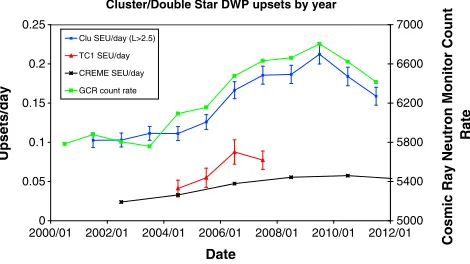
In Figure 2 the upset rate for allL>2.5 (thus excluding trapped protons) is plotted averaged over each year, together with the count rate of the cosmic ray neutron monitor at Oulu, Finland, and the upset rate estimated by CREME96. The error bars represent the expected standard deviation based on Poisson counting statistics. The Cluster upset rate is about 3 times that for Double Star, which in turn is slightly higher than that predicted
by CREME96.
The agreement between the variation of the Cluster upset rate and the cosmic ray neutron monitor is very good over the whole solar cycle. However, note that the cosmic ray scale is offset. The varia-tion in upset rate is 50%, while the vari-ation in cosmic ray rate is only 15%. This may be because some of the upsets are caused by lower energy cosmic ray par-ticles than the average spectrum mea-sured by the neutron monitor. These lower energy particles are more effected by heliospheric modulation.
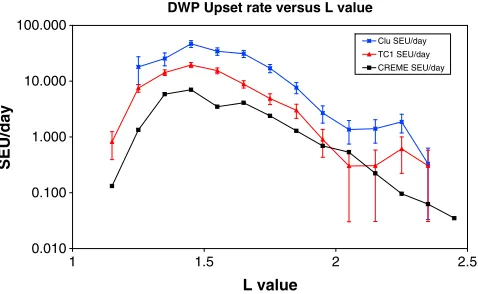
In Figure 3 we look in more detail at theL value range betweenL= 1.1 andL= 2.4. DWP Upset rate versus L value
0.01 0.1 1 10 100
1 2 3 4 5 6 7 8 9 10
L value
SEU/day
[image:3.612.175.411.96.250.2]Clu SEU/day TC1 SEU/day
Figure 1.Cluster and Double Star SEU rate versusLvalue, up toL= 10 and over the full duration of each mission (up to 2011 for Cluster).
Cluster/Double Star DWP upsets by year
0 0.05 0.1 0.15 0.2 0.25
2000/01 2002/01 2004/01 2006/01 2008/01 2010/01 2012/01
Date
Upsets/day
5000 5400 5800 6200 6600 7000
Cosmic Ray Neutron Monitor Count
Rate
Clu SEU/day (L>2.5)
TC1 SEU/day
CREME SEU/day
[image:3.612.175.410.557.689.2]GCR count rate
The three curves are the Cluster SEU rate per day (averaged over all spacecraft), the Double Star rate per day, and the predicted SEU rate for trapped protons using CREME96 with the AP8MIN model. Again, Cluster upset rates are about 3 times those for Double Star, and this holds over the full range ofLvalues. Double Star upset rates are about 3 times the CREME96 predicted rate, with two exceptions. AtL= 2.05 there is a dip in the measured rate where the model predicts an enhancement, while at L= 2.25 there is an increase in the mea-sured rate not predicted by the model. The Cluster upset rates show these same variations.
4. Discussion
The upset rates observed for Cluster are about a factor of 3 higher than for Double Star under the same conditions, both for galactic cosmic rays and trapped protons. Outside of the inner magnetosphere, the rate of upsets due to cosmic rays is not expected to be orbit dependent, so the higher rate for Cluster is probably due to the Cluster devices having a higher sensitivity to upsets. A change by a factor of 3 in the SEU sensitivity of a device following a manufacturing process change is not unexpected and underlines the impor-tance of performing SEU testing on parts that are as representative as possible offlight parts [Petersen, 1997]. The Double Star instrument did have enhanced shielding (a minimum of 4 mm of aluminum versus 2 mm for Cluster) to reduce the total radiation dose, but this has only a minor influence on single-event effects. CREME96 predicts a decrease of 7% in cosmic ray SEU rate due to the increased shielding.
Observed rates for Double Star were on average a factor of 1.5 greater than the CREME96 prediction for cosmic rays, and 3 times higher for trapped protons. Again, this could be due in part to theflight devices having a higher sensitivity to upsets than those used in laboratory tests. Some upsets may be caused by solar proton events which are not included in the modeling.
There are also limitations in the accuracy of the models.Petersen[1997] reviewed reports on trapped-proton SEU rates which indicated that the AP8 models tended on average to under predict the observed rates by a factor of ~0.7, with occasional disagreements between observations and predictions of more than an order of magnitude. It has already been noted that the CREME96 model could not support the evolution of the Double Star orbit.Ginet et al. [2010] (corrected byGinet et al. [2012]) provide composite models of the trapped proton environment. Their model 1 is probably more applicable to our observations and predicts upset rates between 0.5 and 1.8 times the AP8 model. The average Double Star results are close to the upper end of that range.
The increased rate of upsets observed for both Cluster and Double Star in the slot region, aroundL= 2.25 have no clear explanation, and may possibly be just statisticalfluctuations. The absolute number of events is small, just four on Double Star and 11 on Cluster. However, given that the increase is seen in the same place on both missions, we considered the possibility that these upsets might be caused by a second proton belt.
Gussenhoven et al. [1994] report CRRES observations showing a second proton belt at that location in 1991. In their Figure 7 an enhancedflux of protons of energy>35 MeV centered aroundL= 2.3 is shown. These energies are lower than in the main proton belt but sufficient to cause upsets in the 65664 devices. However, we have not been able tofind any data supporting the presence of a second proton belt during the time of our observations.
Solar proton events (SPE) might either directly cause the observed upsets, if the event occurred when the spacecraft was in the slot region, or cause a transitory second proton belt in the slot region that may persist for several months. We have compared the time of each upset in the rangeL= 2.1 to 2.4 with times of SPE and
DWP Upset rate versus L value
0.010 0.100 1.000 10.000 100.000
2.5 2
1.5 1
L value
SEU/day
[image:4.612.175.414.96.243.2]Clu SEU/day TC1 SEU/day CREME SEU/day
find no correspondence that would support either mechanism. None of the slot region upsets occurred during a SPE, and the Double Star upsets (which were all in 2006) were more than 4 months after the most recent SPE. The Cluster upsets occurred more than 2 years after the last moderate SPE, at a time when solar activity was quiet.
5. Conclusions
The memory devices in the Cluster and Double Star DWP instruments are susceptible to single-event upsets. These occur at a rate significantly higher than that predicted by modeling. For the Double Star instrument, upsets due to cosmic rays occur at around 1.5 times the predicted rate, while the upset rate due to trapped protons is about 3 times higher. Cluster upset rates are around 4 times higher (cosmic rays) and 9 times higher (protons) than predicted. This higher upset rate is attributed mainly to the higher upset sensitivity of theflight parts compared with those used for modeling. This underlines the importance of performing SEU testing on parts that are as representative as possible offlight parts.
The variations in the upset rate, due to solar cycle variations in cosmic ray occurrence and spatial variations in trapped protonfluxes, on the whole agree well with modeling. A small increase in upset rate, relative to that predicted by the model, is seen in the slot region. Although a transitory second proton belt has been ob-served in this region by other missions at times of high solar activity, conditions were fairly quiet when the slot region upsets were observed, so this is unlikely to be an explanation.
Upsets occur at an absolute rate which is still low and with proper management, there has been little loss of science observations. This management includes the use of software checksums to detect upsets in the memory holding executable code and critical parameters. However, for future missions, if budgetary and re-source constraints allow, we would recommend using SEU-hardened devices or hardware error correction.
References
Cornilleau-Wehrlin, N., et al. (2005), The STAFF-DWP wave instrument on the DSP equatorial spacecraft: Description andfirst results,Ann. Geophys.,23, 2785–2801.
Credland, J., and G. Lehn (1993),The Cluster Spacecraft, ESA SP-1159, pp. 235–250, ESA Publications Division, ESTEC, Noordwijk, Netherlands.
Doucin, B., T. Carriere, C. Poivey, P. Garnier, J. Beaucour, and Y. Patin (1996), Model of single event upsets induced by space protons in electronic devices,Radecs 95 - Third European Conference On Radiation And Its Effects On Components And Systems, 402–408, I.E.E.E. Press, doi:10.1109/ RADECS.1995.509810.
Dunford, C. M., J. A. Thompson, and K. H. Yearby (1991), A transputer-based instrument for the ESA/NASA Cluster mission,Concurr. Pract. Exper., 3(4), 293–302.
Ginet, G. P., S. L. Huston, C. J. Roth, T. P. O’Brien, and T. B. Guild (2010), The trapped proton environment in medium Earth orbit (MEO),IEEE Trans. Nucl. Sci.,57, 3135–3142, doi:10.1109/TNS.2010.2085086.
Ginet, G. P., S. L. Huston, C. J. Roth, T. P. O’Brien, and T. B. Guild (2012), Correction to“The Trapped Proton Environment in Medium Earth Orbit (MEO)”,IEEE Trans. Nucl. Sci.,59, 685, doi:10.1109/TNS.2012.2200611.
Gussenhoven, M. S., E. G. Mullen, and D. H. Brautigam (1994), Near-earth radiation model deficiencies as seen on CRRES,Adv. Space Res.,14, 927–941.
Pedersen, A., et al. (1997), The Wave Experiment Consortium (WEC),Space Sci. Rev.,79, 93–105, doi:10.1023/A:1004927225495. Petersen, E. L. (1997), Predictions and observations of SEU rates in space,IEEE Trans. Nucl. Sci.,44, 2174–2187, doi:10.1109/23.659033. Tylka, A. J., J. H. Adams Jr., P. R. Boberg, B. Brownstein, W. F. Dietrich, E. O. Flueckiger, E. L. Petersen, M. A. Shea, D. F. Smart, and E. C. Smith
(1997), CREME96: A revision of the cosmic ray effects on micro-electronics code,IEEE Trans. Nucl. Sci.,44, 2150–2160, doi:10.1109/ 23.659030.
Woolliscroft, L. J. C., et al. (1997), The Digital Wave Processing experiment on Cluster,Space Sci. Rev.,79, 209–231, doi:10.1023/A:1004914211866. Yearby, K. H., and H. S. C. Alleyne (2003), Use of non-radiation hardened micro-circuits in space—Experience from the Cluster Digital Wave
Processor,Adv. Space Res.,32, 417–422, doi:10.1016/S0273-1177(03)00272-2.
Acknowledgments