This is a repository copy of
Parking Policy
.
White Rose Research Online URL for this paper:
http://eprints.whiterose.ac.uk/81820/
Book Section:
Marsden, GR (2014) Parking Policy. In: Ison, S and Mulley, C, (eds.) Parking Issues and
Policies. Transport and Sustainability, 5 . Emerald Group Publishing Limited , 11 - 32. ISBN
978-1-78350-919-5
https://doi.org/10.1108/S2044-994120140000005016
[email protected] Reuse
Unless indicated otherwise, fulltext items are protected by copyright with all rights reserved. The copyright exception in section 29 of the Copyright, Designs and Patents Act 1988 allows the making of a single copy solely for the purpose of non-commercial research or private study within the limits of fair dealing. The publisher or other rights-holder may allow further reproduction and re-use of this version - refer to the White Rose Research Online record for this item. Where records identify the publisher as the copyright holder, users can verify any specific terms of use on the publisher’s website.
Takedown
If you consider content in White Rose Research Online to be in breach of UK law, please notify us by
Parking Policy
Prof. Greg Marsden, Institute for Transport Studies, University of Leeds
Abstract
Purpose
This Chapter provides an overview of parking policy. The Chapter takes as its start point that parking is first and foremost a land-use issue. It looks at the conflicts and synergies between parking policy for the purposes of traffic management and parking policy to support various key land-uses and policy objectives.
Methodology/approach
This Chapter discusses the main practice oriented viewpoints on what is meant by parking policy and what it aims to achieve. It then provides a state-of-art review of the evidence base on residential, retail and workplace parking as the three key parking destinations before drawing together these findings.
Findings
The reviews reveal that there has been an over emphasis on the importance of the impact of parking pricing to trip frequency, destination and walk times in the literature. Much greater emphasis should be put in to establishing the extent to which parking restraint supports the economy, the environment and social equity. Only then will we be able to develop a consistent policy framing within which good parking management policy can play out and make a long-term difference to travel patterns and the quality of life in our cities.
Practical implications
If parking policy is to work well as part of an overall package of demand restraint, it needs to be applied in conjunction with and understanding of land-use planning. In transport terms this means connecting parking policy to non-car accessibility. If the overarching land-use and transport accessibility policies are right then there is a greater possibility for other parking management policies to be effectively applied and integrated in broader transport strategies.
Originality/value of paper
The paper suggests that without a clear understanding of the broader objectives that parking policy supports it will not be possible to design effective parking management approaches.
Key words: land-use; residential; retail; integration
Introduction
goals of land-use and transport policy are not always clear and the role that parking plays in supporting these goals is contested. Coupled with this is the complexity of developing a coherent parking policy that covers retail, work, leisure and residential parking when these land-uses are not neatly divided and where governance arrangements can be highly fragmented.
Parking is a land-use. An estimated 12m2is required to park a car in a non-disabled bay. For the 29.1 million cars currently in the UK this equates to an area of 349km2 – around one quarter of Greater London and more than the whole island of Malta. It is worth noting that, in the UK, “the average car spends about 80% of the time parked at home, is parked elsewhere for about 16% of the time, and is thus only actually in use (i.e. moving) for the remaining 3–4% of the time” (RAC, 2012, pvi). All parking policy is a decision about how much land to give over to parking and the terms and conditions of use of that space. Parking takes up land and in doing so it prevents an alternative use. All land has a value and, as Donald Shoup so clearly establishes, there is no such thing as free parking (Shoup, 2005). This Chapter focuses on why we would wish to allocate land to parking and what is and could be done to allocate the costs of parking to users or owners of parking space.
It is tempting to treat “parking” as a single issue, certainly in the popular press. However, parking acts are all associated with a single activity (e.g. parking at work) or a bundle of activities (e.g. parking in town to shop and eat out). These activities are different in nature and so there is a need to develop parking policies which take account of the characteristics of those activities (IHT, 2006). Whilst many single use sites do exist (e.g. the out of town retail car park), there are often mixed use developments and conflicts can exist between the demands for parking spaces that are available (e.g. a major workplace located within a residential area). Habib et al. (2012) reflect that the transport modeling community has been slow to adapt to the complexity of parking policy and to move beyond thinking of parking policy as an influence largely on route, mode and parking duration but also to include where and when trips should occur, i.e. the nature of the activities and the potentially competing means by which they could be conducted.
The previous two paragraphs provide background on what parking is, but what is parking policy for? The answer to this is highly context specific. The Institution of Highways and Transportation note that the application of parking pricing and supply restrictions is “the most widely accepted and readily accepted method” of limiting car use (IHT, 2005, p20). Bonsall and Young (2010) also note the role of parking in influencing transport choice, although they are more skeptical as to the extent to which local government has the levers to make this work. Parking policy is used as part of the toolkit of measures to limit congestion and air pollution in cities as well as to ensure the safe and smooth running of traffic on streets. McCahill and Garrick (2010) suggest that, applied in a consistent manner over the long term, it can be effective as a means of reducing overall demand for travel by car.
relates to issues including land value, culture and tradition, economic strength and, increasingly, the availability of supporting technologies.
This Chapter aims to provide an overview of the multiple functions of parking policy at a level of detail that highlights the main issues and outstanding questions. It relies on the published evidence base wherever possible and therefore seeks to provide insight into an often heated discussion and suggests areas for further work, some of which are covered later in the book. The Chapter builds on a previous review (Marsden, 2006) updated through a review of literature published on parking since 2006. By necessity, it is not possible to cover all work on parking. There has, for example, been a rising interest in parking policy amongst emerging and developing economies with poor regulation and inadequate supply becoming increasingly critical issues as car ownership levels rise (Vytautous et al., 2013; Al-Fouzan, 2012; Barter, 2012) but this will not be a focus here. Any reference to parking standards (e.g. space sizes) derives from the UK and would need reinterpreting for other contexts. The Chapter focuses on car parking policy, largely because there is comparatively little written on bicycle parking policy (see Buehler, 2012 for an exception), rather than because it is seen as unimportant. Whilst the Chapter focuses on the place of parking in a policy context it is not a practitioner’s guidebook (for a still excellent overview of the issues to think through see IHT, 2005).
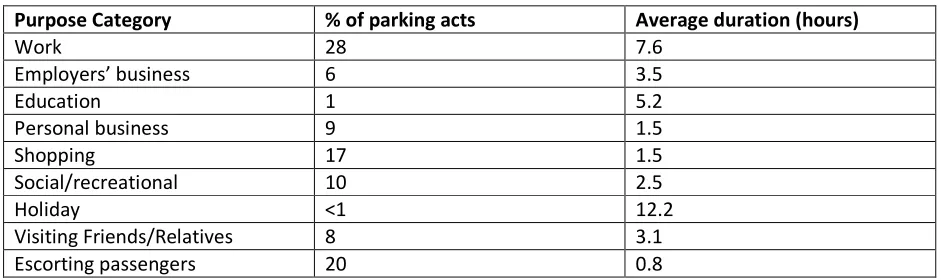
[image:4.595.63.534.593.733.2]This Chapter begins by examining residential parking policy as this is where vehicles spend most of their time parked. Table 1, using UK data from the 2002 to 2008 National Travel Surveys, shows shopping and commuting to be the most important clear journey purposes which generate parking. The Chapter therefore then examines retail parking and workplace parking. A great deal of interest in parking comes from the focus on workplace and commuter parking given its connection to the associated congestion and environmental impacts of the commute. Commute parking is shown to be largest proportion of all parking acts by purpose (28%) and the longest average duration (excluding residential parking) of 7.5 hours. The land-take associated with this must therefore also be significant, often in areas with high demand from other potential uses. Each of these three sections consider the objectives of the policy, options available and the evidence base that exists to support policy development. The Chapter then moves on to consider integrated transport policy, its role in supporting this and the governance challenges that exist. Future challenges and opportunities are identified and discussed before the Chapter concludes with what I consider to be the main outstanding questions to be addressed.
Table 1: Percentage of parking acts and average estimated duration (RAC, 2012, p35)
Purpose Category % of parking acts Average duration (hours)
Work 28 7.6
Employers’ business 6 3.5
Education 1 5.2
Personal business 9 1.5
Shopping 17 1.5
Social/recreational 10 2.5
Holiday <1 12.2
Visiting Friends/Relatives 8 3.1
All purposes 100 3.5
2. Residential Parking Policy
Residential parking policy refers to both planning policy relating to the provision of parking at the point of construction of new homes and tools which are used to manage parking in existing residential areas. Both are important since only 0.6% of the housing stock in a developed country, such as the UK, will typically be ‘new build’ in a given year. There are large parts of many cities which were developed in the period before mass car ownership, where parking standards were not considered at the time of construction and where managing the existing situation is critical.
The two extreme positions with regards to the role of residential parking policy are to see it as a means to accommodate current and future desired vehicles in a residential environment or as a tool to influence levels of vehicle ownership. In the absence of other supporting policies that also discourage car use, the latter approach may struggle to gain political traction and to be effective.
2.1 Options
When considering new build there are five main options available:
1. Provide parking to anticipated future needs (minimum standards1). In this situation, the goal of the parking policy is to avoid on-street parking spill over with all cars located on the property. By necessity, as developers cannot know which houses will need to accommodate two or three vehicles then a situation of oversupply is created for some houses where owners would be happy with less parking. This has been demonstrated to lower the density of development and raise the average house price cost, being regressive for those seeking lower car ownership (Shoup, 1995; Jia and Wachs, 1999; Litman, 2004).
2. Limit parking to maintain densities and discourage ownership (maximum standards2). This policy provides a maximum level of parking which can be provided. The UK for example had established a maximum of 1.5 spaces per property, thus seeking to increase density of development. This was somewhat difficult to deliver as it was not clear if this was over a development or a city. Critics of the approach point to the difficulties raised where the actual demand for parking exceeds the supply and where parking overspill onto the surrounding residential streets occurs. The UK has abandoned this guidance now although local authorities will still look to match lower parking provision to areas with good public transport accessibility. 3. Decoupling car parking space from ownership is common place, particularly in medium and high
rise apartment developments where the amount of underground parking is far lower than the number of units. This essentially makes visible the cost of owning a parking space from within the house purchase or rental decision bundle. The ability to choose not to own a space, or to
1
A defined amount of parking which must be provided as a minimum for a new development (for example a minimum of one space per 25 square metres of floor area)
take one only as circumstances require, should act as a deterrent to vehicle ownership at the margins.
4. An extension of decoupling the parking space from ownership can be seen in the car free developments that have begun to materialise (see chapter 10 by Melia later in this book for more in-depth review). These developments have parking available on the periphery, decoupled from home ownership. The notion is that there is a market for people who prefer to live in an area not so dominated by the car. Whilst developer uptake for these types of scheme has been slow there are numerous examples of success.
5. The final main option is to ration and/or charge for permits to park. This can be for spaces within an off-street development although more commonly this is used as a tool to manage the demand for on-street spaces. Typically households are allocated a baseline number of spaces and may face additional charges for fees over and above this number (see van Ommeren, Wentink and Dekkers (2011) for an exploration of willingness to pay for permits). The cost of permits has, in some cities, been linked to the environmental performance of vehicles. Visitor permits are typically provided as part of the process.
2.2 Evidence
There is little evidence of the impacts of residential parking policy on car ownership levels and travel behaviour relative to the importance of the residential parking as a total of all parking acts. In a recent study in New York City, the provision of free on-street parking was estimated to increase “private car ownership by nearly 9%; that is, the availability of free street parking explains 1 out of 11 cars owned by households with off-street parking.” (Zhan, 2013). In addition to encouraging car ownership, the provision of convenient parking also, unsurprisingly, stimulates more trips by car (Weinberger, Seaman and Johnson, 2009). Weinberger (2012) also explores how parking provision interacts with public transport accessibility concluding that there is “a clear relationship between guaranteed parking at home and a greater propensity to use the automobile for journey to work trips even between origin and destinations pairs that are reasonably well and very well served by transit.” (p93). It is hypothesised that this will be even more pronounced for non-work trips where the destination set is more dispersed. Engel-Yan and Passmore (2013) conducted a study in Toronto of the impact of car sharing on requirements for dedicated parking spaces. This study is important since it considers the implications for parking standards for buildings where such schemes are in operation. Their analysis suggests that “the presence of dedicated carshare vehicles is associated with reduced vehicle ownership and parking demand at the building level.”(p82).
residential parking policy as a restraint on ownership if greater levels of supply are relatively freely available elsewhere. Balcombe and York also reported a tendency to hold on to older vehicles where residents had to frequently park some distance from home, which may stifle the uptake of cleaner technologies. As more than 30% of people normally parked more than 50 metres from home at some of the sites surveyed this also poses challenges to electric vehicle adoption unless public charge points are available in sufficient numbers. This becomes a significant issue for the urban realm.
2.3 Discussion
Residential parking policy is one important part of the decisions of a city about its stance on vehicle ownership and use. It is a complex decision-set as cities have developed during different periods of car ownership and have areas with very different characteristics. A conscious strategy for managing the current and future supply of residential parking is essential.
Ample parking supply is correlated with increased vehicle use holding all other things equal. Limiting ownership by not providing enough spaces encourages fewer journeys by car. However, it can also create unwanted spillover effects to the surrounding area and requires managing. Work on car free developments suggest there could be an unmet demand for these types of development although the total of such stock relative to the whole housing stock is likely to remain small.
Undoubtedly, in recent years, there has been an oversupply of residential off-street parking in many places, particularly at the periphery of cities. This generates additional costs for all home owners whether or not they wish to possess a car. Planning policy has yet to catch up with developments such as car sharing clubs which offer the potential to reduce the space given over to parking.
I believe that, wherever possible, space for parking vehicles should be decoupled from the purchase cost of the residential unit. This makes the costs transparent without rationing to a degree which creates overspill. Where on-street parking is the only solution and where demand is close to supply then rationing through the use of permits which are linked to the number of vehicles which are owned seems progressive. There are also arguments in favour of those choosing to own more vehicles (than the average for the street) compensating those with fewer vehicles for the loss of amenity that their ‘over parking’ creates.
3. Retail Parking Policy
the evidence base published around retail choice and parking provision. A major gap or oversight in the literature is the presence of bigger picture changes such as the growth in internet shopping which is changing the competitive position of retail outlets irrespective of the presence or absence of parking in the vicinity.
3.1 Options
The options for managing retail parking are relatively straight forward although they may be applied in different ways and different combinations within a city.
1. Parking can be provided free or, more accurately, as part of the bundle of costs associated with an activity. Out of town centres for example typically do not directly charge the users for parking but will recoup the costs of constructing and maintaining the large areas of parking through shop rental fees which indirectly filter through to the consumer. Free parking is not restricted to out of town centres but is typically applied elsewhere with a time limitation (such as 30 minutes with no return to the area within two hours). Such schemes can be used to manage the demand for spaces whilst also encouraging regular turnover of spaces. They are unlikely to be appropriate in city centres with very high levels of demand where such schemes encourage cruising activities looking for space and contributing to congestion (Shoup, 2006).
2. Paid for parking can work on or off-street where different tariffs are used to reflect the cost of the land (higher nearer busy centres) and the convenience and quality of the parking provision. Parking pricing is also often used to signal what type of users are welcome – with a distinction made between ‘short-stay’ and ‘long-stay’ parking. Here the aim is to use tariffs which discourage people parking all day for commute purposes for example, where there is a high demand from shoppers for shorter visits. High tariffs are applied for stays over a couple of hours in short stay car parks thus discouraging, rather than banning, longer stay parkers. One of the key aspects of short-term parking for retail is to encourage the turnover of spaces and this therefore requires active management of the use of spaces (via enforcement officers).
Park and Ride is applied in some cities with a strong emphasis on supporting visitor journeys and shopping trips. Elsewhere there is more of a focus on the commute. For insights into the choice of park and ride in cities see Dijk and Montalvo (2011) and for information on impacts see Chapter 9 later in this book.
3.2 Evidence
elasticities of demand for parking on and off-street. They suggest that on-street parking should have a premium which reflects their benefits to drivers from reduced walk times. Location specific studies have been reported from various places such as Dublin (Kelly and Clinch, 2009) and Vilnius (Klementschitz and Stark 2008). The focus of these studies remains on the relationship between price, convenience and parking location within a centre.
As yet, comparatively little effort has been put into the study of the extent to which parking prices affect which retail centre people will visit – a matter of huge importance to the vocal retail stakeholder groups and of high political importance. Mullen and Marsden (2014) interviewed 31 stakeholders as part of a study examining whether, and if so how, cities compete with each other. The study looked at a small sample of major English cities outside London and, for each, a smaller local town or city that sits within the same functional economic area. The work revealed that major cities typically have a strong retail offer (as do some smaller historic centres) and these cities can act as price setters for parking. The main brake on price setting is the extent to which they may lose custom to out of town centres. Nonetheless, the experience of being in the city centre was critical to their distinctiveness. The smaller towns were typically struggling to maintain a healthy retail sector. Prices were generally quite low and were set with three different constraints. The authorities were aware of the difficulty of competing with out of town centres which drove prices down. The town centres were also subject to competition at the margins from neighbourhood level shopping and shopping in the major regional centre. Finally, they saw other similar towns to them in the vicinity as competitors and they were able to very accurately describe their position in a parking cost league table. Studies of retail parking policy which do not pay sufficient account of the alternatives and the impacts of prices and availability on shopping destination choice, frequency and duration are missing key variables that matter to policy makers.
3.3 Discussion
The debate about draconian town centre parking policies is seeking to address the wrong issue. Maximising the strength of retail centres means making them places that people want to go to, however they choose to get there. The evidence from London points to the need for a much broader understanding of the spend by users of all types and for strategies to promote access by car and non-car users alike.
The debate about town centre parking policies is also missing the point for another reason. Whilst I suggest earlier that the cost of parking at out of town centres is bundled with the cost of shopping and is not ‘free’, it is still a crucial differentiator between town centre and out of town retail which, the evidence suggests, encourages more out of town shopping. Unbundling (as also suggested for residential units) parking price from shopping fees at least provides a clear cue to drivers as to what each element costs. Beyond that, it is not useful to get too drawn in to the politics of out of town versus town centre. Out of town centres are often large pedestrianised areas with high quality (if bland) covered and heated (or cooled) shopping environments. Shoppers are attracted by a diversity of shopping offer and a good environment to shop in. This is where town centres need to compete and to do so needs a coherent parking policy. Weaker centres may need low fees or time restrictions whereas stronger centres not only can, but must levy higher fees in order to manage congestion and make public spaces attractive places to be – and that goes for all users not just car drivers.
4. Workplace Parking Policy
Workplace parking is important for different actors in different ways. A key objective for employers is to maximize their accessibility to employees. The wider the labour pool, the lower the pressure on wages and the greater the potential to match skilled people to jobs (Laird, 2006). Accessibility needs to be considered by public transport, bike, walk and car, with studies on social exclusion noting that proximity is not always a good indicator that it is easy to access sites by non-car modes (Lucas, 2004). Parking for work also generates the most concentrated pattern of parking over the course of the day with, in the UK, around 30% of all parking acts during the week occurring before 0930 (RAC, 2012). This clearly makes the management of commuter parking a challenge and an important contributor to urban congestion and pollution. Commuter parking acts are however only 28% of all parking acts in the UK (Ibid.)
4.1. Options
Parking is a cost to employers and it may be physically difficult or environmentally undesirable to accommodate the potential demand for parking. Equally, the provision of parking may be seen to be a perk or an ‘entitlement’ of the job. The demand for workplace parking has been managed in a variety of ways:
2. On-site paid and managed parking is more typically offered by employers where there is a capacity constraint or where the employment is located in a central area and constraints on parking have been required by the local authority.
3. Off-site parking can be provided through rental agreements with private parking suppliers.
There are clearly various variations on these broad classifications. In particular, recent years have seen a number of advances in the sophistication of on-site parking management. These include parking cash-out schemes where employees are offered incentives to use their car less frequently or to surrender their permits and innovations in permit management (Shoup, 1997; Enoch, 2002), where employees can purchase different levels of access to parking spaces (e.g. right to search or a guaranteed place) or where fees are determined according to other criteria such as the environmental performance of vehicle or enrolment in liftsharing schemes (Rye and Ison, 2005).
Interest has also begun to grow in workplace parking levies, which are schemes designed to capture a tax of some sort on the provision of parking at sites of employment, typically above some minimum threshold of employer size. These charges may or may not be passed on to the employees which clearly impacts on their likely effectiveness as a tool to influence mode choice. Nonetheless, they overcome part of the problem of the provision of parking as a tax free perk. Van Ommeren and Wentink (2012) found, using Dutch data, that free parking at work “induces welfare losses of about 10% of employer parking resource costs.” (p965). Chapters 13 to 15 provide an overview of impacts of the first workplace parking levy schemes to be implemented.
4.2 Evidence
It is not possible here to provide a comprehensive overview of all of the evidence on workplace parking. Excellent reviews of the evidence of the impacts of employer parking policies can be found in TCRP (2005) and Shoup (2005). Further examples are provided in Chapters 11 onwards of this book. Nonetheless, some important common messages emerge. One of the main behavioural responses of commuters to parking restrictions is a change in parking location (as duration is typically outside of their control). This is in contrast to those parking for retail where walk time is valued more highly than search time and in-car access time (Axhausen and Polak, 1991; Shiftan, 2002). This means that commuters look to find cheaper or free parking in the vicinity, with some studies reporting walk times of up to 30 minutes (Rye, Cowan and Ison, 2004). Klementschitz and Stark (2008) found that more than 50% of commuter parkers could avoid parking fees at work and highlighted the importance of the introduction of effective controlled on-street parking in the areas around workplaces with strong parking management).
transit benefits as determinants of cycling to work in the Washington D.C. area. He finds that “bicycle parking and cyclist showers are related to higher levels of bicycle commuting—even when controlling for other explanatory variables. The odds for cycling to work are greater for employees with access to both cyclist showers and bike parking at work compared to those with just bike parking, but no showers at work. Free car parking at work is associated with 70% smaller odds for bike commuting. Employer provided transit commuter benefits appear to be unrelated to bike commuting.” (p525). Buehler’s is one of few pieces of work directly examining the role of cycle parking provision on mode-choice.
4.3 Discussion
There is a section of the working population that will drive to work when given a ‘free permit’ to do so but who are prepared to surrender that permit and choose other modes when suitably incentivized to do so. Unbundling parking costs from employment packages and charging (or taxing the perk) accordingly provides a more transparent signal. In particular, removing the ‘all or nothing’ decision about holding a permit and incentivizing less frequent usage appears effective.
It has been argued that good parking provision is critical in encouraging employers to relocate into an area (Gerrard et al., 2001). However, a recent study exploring the role of travel demand restraint policies in economic development has found that employers locating to areas with good accessibility do not expect local authorities to agree to high levels of free parking. Whilst authorities were all able to discuss the potential for employers to locate elsewhere for better parking, none were able to provide examples of when this had happened (Marsden and Mullen, 2014). It appears that other factors such as the availability of skilled employees and proximity to markets are more important in the business location decision (McQuaid et al., 2004). Once again however, the evidence base on the more individual level impacts of policies dominates the level of evidence about parking provision and locational choice for businesses of various sorts.
5. Integrating Parking Policy
Having looked at residential, retail and workplace parking separately it is necessary to consider these policies together and, perhaps more importantly, their role in a broader more integrated transport strategy. Managing parking is fundamental to the effective functioning of cities. This is however somewhat different to using parking policy as a key tool to reduce the overall demand for travel. The former requires effective combinations of spaces, regulation, information and enforcement. The latter requires a vision for the city and the balance between the different modes that will be used to connect the city. This is more than a semantic difference, as applying demand restraint policies in parking without reinforcing these policies through roadspace reallocation, improving alternatives and better land-use planning will be both unpopular and ineffective. Studies on integrated transport policy (May et al., 2000) show that parking pricing and supply adjustments are just one of a series of measures that need to be applied to deliver improvements to congestion, environmental performance and safety.
commitment, local network conditions and organizational capacities are all important in the choice of approach to parking policy (Dijk and Montalvo, 2011). Second, the governance of parking means that the reality of parking management is often far from any economically calculable optimum. The issue of free workplace parking is described above, but even with charged workplace parking there are issues of a complex mix of public and privately owned off-street spaces and on-street provision which can serve to undermine parking policy (Hamer, Young and Currie, 2012).
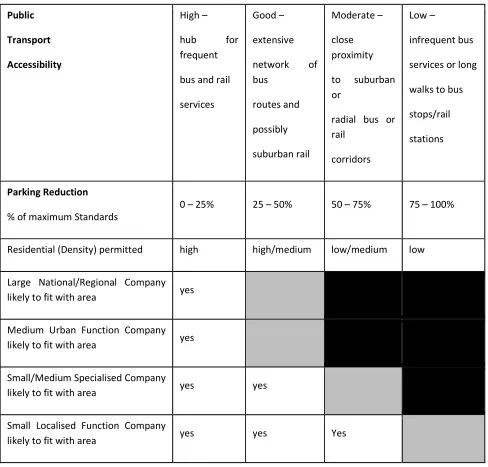
This chapter began with a reflection on the importance of parking as a land-use. If parking policy is to work well as part of an overall package of demand restraint, it needs to be applied in conjunction with thinking about land-use planning. In transport terms this means connecting parking policy to non-car accessibility. In areas where non-car accessibility is high then the amount of parking provided should be lower and land-uses which involve significant flows of people should be encouraged. By contrast, where non-car accessibility is low but car access is high this is better suited to land-uses which are vehicle dependent (such as warehousing) and are unlikely to be successful sites for demand restraint. These principles underlay the thinking behind the Dutch ABC policy, although this was ultimately seen as too prescriptive to be effective (Schwanen et al., 2004). An alternative application along similar lines from Surrey County Council (2003) in the south east of England is shown below in Figure 1. Here, only particular types of development are considered permissible in particular places. So, you would permit large national/regional companies to locate in Area type 1 with good public transport services and facilities but not Area type 4. Similarly, Area 1 would not be a good place for low density housing. Where public transport accessibility is good there is also an expectation that maximum parking standards will be reduced and the land-use and transport access policies work in unison. The figure also shows some grey areas where development may be acceptable. These are always matters of judgement but at least it forms the basis of a need to negotiate over the type of development and any remedial measures that may be required to allow the development to proceed.
The characteristics of parking package areas
Area 1 Area 2 Area 3 Area 4
Description Regional or
major town
centres
Larger town
centres and
periphery of
Area 1 centres
Smaller town
centres, urban
fringes or inner
suburbs
Outer
residential areas
and isolated
Public
Transport
Accessibility
High –
hub for
frequent
bus and rail
services
Good –
extensive
network of bus
routes and
possibly
suburban rail
Moderate –
close proximity
to suburban or
radial bus or rail
corridors
Low –
infrequent bus
services or long
walks to bus
stops/rail
stations
Parking Reduction
% of maximum Standards
0 – 25% 25 – 50% 50 – 75% 75 – 100%
Residential (Density) permitted high high/medium low/medium low
Large National/Regional Company
likely to fit with area yes
Medium Urban Function Company
likely to fit with area yes
Small/Medium Specialised Company
likely to fit with area yes yes
Small Localised Function Company
[image:14.595.63.551.102.569.2]likely to fit with area yes yes Yes
Figure 1: Adapted from Surrey County Council Framework for Parking and Land-Use Development (2003)
short stay paid parking very close to retail with longer stay facilities for workers slightly further away for town centres (reflecting the relative willingness to walk of the two different user categories). This makes parking a complex task to manage but it is workable provided clear thought is given as to the purpose of the land-uses that are being served and the options that are available.
6. Conclusion
If the overarching land-use and transport accessibility policies are right then there is a greater possibility for other parking management policies to be effectively applied and integrated in broader transport strategies. The statement and analysis above works most easily in a world where land-uses are strictly zoned. The reality is somewhat different, requiring sometimes complex implementation to balance the needs of residents, shoppers and commuters. An optimal parking policy is surely a theoretical construct rather than a practical prospect. Similarly, there is no prospect of a free market for parking and the price of not having some form of regulatory oversight of the parking market would be substantial environmental, congestion and safety externalities (Barter, 2010). That said, intervention has to correct the market whilst effectively working towards the objectives of the city. Vociferous local interests with a short-term outlook can quite easily influence policy for the worse.
Where the costs of parking are unbundled from house ownership or work or shopping, it has a real influence on choices made over vehicle ownership, frequency of parking acts and destination choice. It provides a better level playing field for public transport, cycling or shared mobility services. Current policies appear to lead to an overprovision with a net welfare loss. Minimum parking standards artificially inflate the amount which the private sector would otherwise provide. However, maximum parking standards need to be considered carefully and properly integrated with land-use and wider transport policy to ensure they do not create unwanted spillover effects.
Looking ahead, parking research and parking policy need to adapt quickly to the possibilities that new technologies and changing mobility opportunities provide. Ottosson et al. (2013) has shown the potential to vary parking prices by time of day within a geographic area and Caicedo (2012) to have pay by the minute parking. In addition, the growing range of mobility services such as car sharing mean that incorporating car share into residential parking standards is now an important issue (Engel-Yan and Passmore, 2013 and Shaheen et al., 2010). Should the move towards electrification gather pace then parking policy will be about managing access to energy supply with a far more complex set of issues relating to charge levels, pace of charging and overall grid demands (Ma, Ahmed and Osama, 2012).
should be put in to establishing the extent to which parking restraint supports the economy, the environment and social equity. Only then will we be able to develop a consistent policy framing within which good parking management policy can play out and make a long-term difference to travel patterns and the quality of life in our cities.
References
Al-Fouzan, S. A. (2012) Using car parking requirements to promote sustainable transport development in the Kingdom of Saudi Arabia,Cities,29(3), 201-211.
Axhausen, K.W and Polak, J.W. (1991) ‘Choice of parking: Stated preference approach’ Transportation
18(1) 59-81.
Balcombe, R. J. and York, I. O. (1993) ‘The future of residential parking’, Project Report 22, Transport Research Laboratory, Crowthorne, Berkshire, UK.
Barter, P.A. (2010) Off-Street Parking Policy without Parking Requirements: A Need for Market Fostering and Regulation,Transport Reviews,30(5), 571-588.
Barter, P.A. (2012) Off-street parking policy surprises in Asian cities,Cities,29(1), 23-31.
Bonsall, P. and Young, W. (2010) Is there a case for replacing parking charges by road user charges?,
Transport Policy,17(5), 323-334.
Buehler, R. (2012) Determinants of bicycle commuting in the Washington, DC region: The role of bicycle parking, cyclist showers, and free car parking at work, Transportation Research Part D: Transport and Environment,17(7), 525-531.
Caicedo, F. (2012) Charging parking by the minute: What to expect from this parking pricing policy?
Transport Policy,19(1), 63-68.
Dijk, M. and Montalvo, C. (2011) Policy frames of Park and Ride in Europe, Journal of Transport Geography,19(6), 1106-1119
Engel-Yan, J. and Passmore, D. (2013) Carsharing and Car Ownership at the Building Scale: Examining the Potential for Flexible Parking Requirements,Journal of the American Planning Association,79(1), 82-91.
Enoch, M. (2002) ‘UK parking cash out experience, and lessons from California’,Traffic Engineering and Control,48(5), 184-187.
Gerrard, B., Still, B. and Jopson, A. (2001) ‘The Impact of Road Pricing and Workplace Parking Levies on the Urban Economy: results from a survey of business attitudes’, Environment and Planning A: environment and planning,33, pp. 1985-2002.
Hamer, P., Young, W. and Currie, G. (2012) Do long stay parkers pay the Melbourne congestion levy?
Transport Policy,21, 71-84.
Hensher, D. A. and King, J. (2001) ‘Parking demand and responsiveness to supply, pricing and location in the Sydney central business district’Transportation Research A,35(3), 177-96.
IHT (2005) ‘Parking Strategies and Management’, Institution of Highways and Transportation, HQ Media Services Ltd, Essex, ISBN: 0 902933 36 1.
Jia, W. and Wachs, M. (1999) ‘Parking Requirements and Housing Affordability: A Case Study of San Francisco’. Paper presented at the 78th Annual Meeting of the Transportation Research Board, Washington D.C., January 1999.
Kelly, A.J. and Clinch, P.J. (2009) Temporal variance of revealed preference on-street parking price elasticity,Transport Policy,16(4), 193-199.
Klementschitz, R. and Stark, J. (2008) Shopping centres and car use: Car park regimentations as a potential lever, in, Eds. Cygas, D and Froehner, K, Proceedings of 7th International Conference on Environmental Engineering, Vilnius, May 22-23
Kobus, M.B.W, Gutiérrez-i-Puigarnau, E., Rietveld, P. and Van Ommeren, J.N. (2013) The on-street parking premium and car drivers' choice between street and garage parking, Regional Science and Urban Economics,43(2), 395-403.
Laird, J. (2006) Commuting costs and their impact on wage rates. Working Paper. Institute of Transport Studies, University of Leeds, Leeds, UK,http://eprints.whiterose.ac.uk/2056/, Last accessed 27/09/13.
Litman, T. (2004) ‘Parking Requirement Impacts on Housing Affordability’,www.vtpi.org.
Lucas, K. (2004) Running on Empty: Transport, social exclusion and environmental justice, Policy Press, Bristol, ISBN 1 86134 570 4.
Ma, T; Ahmed, M. and Osama, M. (2012) Optimal Charging of Plug-in Electric Vehicles for a Car Park Infrastructure, Annual Meeting of the IEEE-Industry-Applications-Society (IAS), Las Vegas, Oct 7-11, 2012.
Marsden, G. (2006) The evidence base for parking policies: a review,Transport Policy,13, 447-457.
May, A.D., Shepherd, S.P. and Timms, P.M. (2000) Optimal transport strategies for European cities,
Transportation,27, 285-315.
Mullen, C. And Marsden, G. (2014) Transport, Economic Competitiveness and Competition: A City Perspective, accepted subject to corrections,Journal of Transport Geography.
McQuaid, R.W., Greig, M., Smyth, A. and Cooper, J. (2004) ‘The importance of transport in business’ location decisions’, Report to Department for Transport, Napier University.
Mingardo, G. and van Meerkerk, J (2012) Is parking supply related to turnover of shopping areas? The case of the Netherlands,Journal of Retailing and Consumer Services,19(2) 195–201.
Ottosson, D. B., Chen, C.; Wang, T., Lin, H. (2013) The sensitivity of on-street parking demand in response to price changes: A case study in Seattle, WA,Transport Policy,25, 222-232.
RAC Foundation. (2012) ‘Spaced Out: Perspectives on Parking Policy’, RAC Foundation, Pall Mall, London.
Roby, H (2010) 'Workplace travel plans: past, present and future', Journal of Transport Geography,
1(18), 23-30.
Rodriguez, D. A., Aytur, S., Forsyth, A.; Oakes, M.J. and Clifton, K.J. (2008) Relation of modifiable neighborhood attributes to walking,Preventitive Medicine,47(3), 260-264.
Rye, T., Cowan, T. and Ison, S. (2004)Expansion of a Controlled Parking Zone (CPZ) and Its Influence on Modal Split: The Case Study of Edinburgh, Scotland and Its Relevance to Elsewhere, Paper presented at the 83rdAnnual Meeting of the Transportation Research Board, Washington D.C., January 2004.
Rye, T. and Ison, S. (2005) ‘Overcoming barriers to the implementation of car parking charges at UK workplaces’,Transport Policy,12(1), pp 57-64.
Rye, T., Hunton, K., Ison, S. and Kozak, N. (2008) The role of market research and consultation in developing parking policy,Transport Policy,15(6), 387-394.
Shaheen, S. A., Cohen, A. P. and Elliot, M. (2010) Carsharing Parking Policy Review of North American Practices and San Francisco, California, Bay Area Case Study,Transportation Research Record,2187, 146-156.
Schwanen, T., Dijst, M. and Dieleman, F.M. (2004) Policies for Urban Form and their Impact on Travel: The Netherlands Experience,Urban Studies,41(3), 579-603.
Shiftan, Y. (2002) ‘The Effects of Parking Pricing and Supply on Travel Patterns to a Major Business District’, in. Stern, E., Salomon, I. and Bovy, P. H. L. (ed)Travel Behaviour: Spatial Patterns, Congestion and Modelling, Edward Elgar Publishing, Cheltenham, UK.
Shoup, D. C. (1995) ‘An opportunity to reduce minimum parking requirements’, Journal of the American Planning Association,61(1), 14-28.
Shoup, D. C. (1997) ‘Evaluating the Effects of Cashing Out Employer-Paid Parking: Eight Case Studies’,
Transport Policy,4(4), 201-16.
Shoup, D.C. (2006) Cruising for Parking,Transport Policy,13(6), 479–486.
Surrey County Council (2003) A Parking Strategy for Surrey, Supplementary Planning Guidance.
Sustrans (2006) Shoppers and how they travel. Liveable Neighbourhoods Information Sheet LNO2. Sustrans, Bristol. www.sustrans.org.uk.
TCRP (2005) ‘Parking Prices and Fees: Traveler Response to Transportation System Changes’. Transit Cooperative Research Program Report 95, Chapter 13, Transportation Research Board, Washington D.C.
Tyler, S., Semper, G., Guest, P and Fieldhouse B. (2012) The relevance of parking in the success of urban centres, A review for London Councils, Available at http://www.londoncouncils.gov.uk/, last accessed 24/09/13.
van Ommeren, J., Wentink, D. and Dekkers, J. (2011) The real price of parking policy, Journal of Urban Economics,70(1), 25-31.
van Ommeren, J. and Wentink, D. (2012) The (Hidden) Cost of Employer Parking Policies,International Economic Review,53(3), 965-977.
V P G M P J V B V E
passenger car parking spaces using multi-criteria methods,Journal of Civil Engineering and Management,
19(1), 49-58.
Weinberger, R., Seaman, M. and Johnson, C. (2009) Residential Off-Street Parking Impacts on Car Ownership, Vehicle Miles Traveled, and Related Carbon Emissions New York City Case Study,
Transportation Research Record,2118, 24-30.
Weinberger, R. (2012) Death by a thousand curb-cuts: Evidence on the effect of minimum parking requirements on the choice to drive,Transport Policy,20, 93-102.