This is a repository copy of 'It's coming at things from a very different standpoint': evaluating the 'Supporting Self-Care in General Practice Programme' in NHS East of England.
White Rose Research Online URL for this paper: http://eprints.whiterose.ac.uk/132229/
Version: Accepted Version
Article:
Robertson, S. orcid.org/0000-0002-5683-363X, Witty, K., Braybrook, D. et al. (3 more authors) (2013) 'It's coming at things from a very different standpoint': evaluating the 'Supporting Self-Care in General Practice Programme' in NHS East of England. Primary Health Care Research & Development, 14 (2). pp. 113-125. ISSN 1463-4236
https://doi.org/10.1017/S1463423612000151
Reuse
Items deposited in White Rose Research Online are protected by copyright, with all rights reserved unless indicated otherwise. They may be downloaded and/or printed for private study, or other acts as permitted by national copyright laws. The publisher or other rights holders may allow further reproduction and re-use of the full text version. This is indicated by the licence information on the White Rose Research Online record for the item.
Takedown
Joint working to develop R&D capacity
in three rural Primary Care Trusts
Steve Robertson PhD, RGN, RHV
R&D facilitator (Primary Care) Health R&D Northwest
Institute for Health Research
Lancaster University
Lancaster LA1 4YT
Tel: 01524 593376
Email: [email protected]
Claire Hornby BSc, CBiol, MIBiol
R&D Co-ordinator for Cumbria Primary Care Research Network
Rod Jones MB, ChB, MSc, FRCGP
Joint working to develop R&D capacity in three rural Primary Care Trusts
Introduction:
Historically, there has been a low research base and culture within many primary care
organisations (NHS Executive 1997). This stands in contrast to a recognition that
good quality research, and its application, in primary care is much needed (De
Maeseneer et al 2003) and often neglected as a responsibility of PCTs (DoH 2004).
The starting point in solving this apparent contradiction must therefore lie in
developing quality research capacity so that, as a minimum, NHS staff understand the
research process and principles to enable the implementation of evidence based
practice. This paper considers how collaboration between a small primary care
research network, (Cumbria Primary Care Research Network, CumbReN) and a
Research and Development Support Unit (Health R&D North West, HRDNoW) has
begun this process of research capacity development across three rural Primary Care
Historical development
As separate organisations both CumbReN and HRDNoW have been in existence for a
number of years. CumbReN was first formed in 1988. Its aim has always been to
provide an efficient and effective support network for all interested healthcare
researchers in what are now the three North Cumbria PCT’s; Carlisle & District PCT,
Eden Valley PCT and West Cumbria PCT (figure 1). HRDNoW, established in 1998,
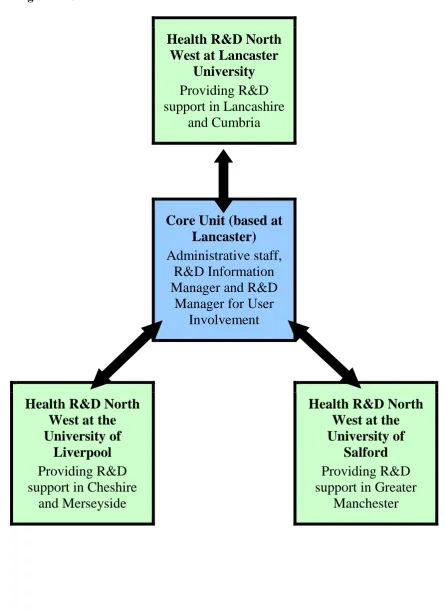
is a collaboration of three universities; Lancaster University (which hosts the core
unit), the University of Liverpool, and the University of Salford (figure 2). It was
established to provide research support to the NHS in what was the North West
Regional Health Authority. At this time, research support for North Cumbria was the
responsibility of the Northern & Yorkshire Regional Health Authority. With the
disestablishment of the regions in 2001, HRDNoW’s remit was extended and, for the
first time, incorporated the North Cumbria PCTs. These changes provided the
opportunity for CumbReN and HRDNoW to work collaboratively in developing
research capacity within North Cumbria.
North Cumbria has a characteristically rural nature - a large geographical area (figure
1) with low population density and attendant health issues (Cox 1997). This creates
both barriers and opportunities when considering R&D capacity & capability. The
importance of collaborations between practitioners and academic institutions in
developing an NHS research culture has been highlighted by Pitkethly & Sullivan
(2003) and by Thomas et al (2001). Yet, obtaining research support from academic
institutions can be financially costly. Add to this the fact that no university has its
main base in Cumbria (although three universities do have campus sites there) and
issues of accessing such support and developing such necessary collaborations are
compounded within this rural setting. Previous work undertaken by CumbReN had
highlighted the need for high quality research education and training and, importantly,
that this needed to be delivered locally. However, CumbReN only receives
infrastructure support and does not have any dedicated funding to deliver such
training. Early discussions between CumbReN and HRDNoW therefore focused on
how and what research training could be developed and delivered locally to health
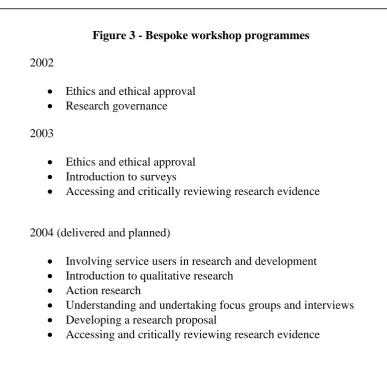
professional staff given that such provision falls within the brief of HRDNoW. A
rolling programme of bespoke workshops has developed since 2002 (figure 3) being
convened by HRDNoW who act as a conduit, drawing in academic staff from
appropriate disciplines to deliver these sessions. The programme now develops
Moving forward
Whilst the development of the workshop programme has been significant in itself, it
has also cemented the collaboration between CumbReN and HRDNoW and has
thereby led to a range of other positive outcomes. First, it has raised the profile of
CumbReN as the first line provider of research support for primary health care
professionals. Second, potential researchers now have more ready and free access to
what has become a known provider of R&D expertise across a wide range of research
topics, including statistical support from medical statisticians. Third, if this expertise
is not directly available within HRDNoW, they will broker relationships with
appropriate academics/departments on behalf of NHS staff.
Department of Health information on implementing Research Management and
Governance (RM&G) in Primary care (DoH 2002), states that existing expertise and
resources, including research networks, should be utilised to develop research
governance arrangements. Also, the same DoH information suggests that RDSUs can
have a significant role in RM&G support. In North Cumbria, CumbReN provides
RM&G support to the PCTs but, through its close relationship with HRDNoW, it does
managers across the Lancashire & Cumbria Strategic Health Authority who are
involved in implementing RM&G within their organisations. These meetings have
enabled the support that CumbReN provides to the PCTs to be informed by best
practice from other often larger and more research experienced organisations. There is
also currently an emerging desire within Lancashire and Cumbria to develop shared
RM&G documentation and arrangements, for example with cross organisational audit
and monitoring of research. It is hoped that this will streamline what is often
perceived as a complex and bureaucratic research process and thereby encourage
more research within the two neighbouring counties.
In addition, the close relationship, established initially through the workshop
programme, has also led to the involvement of HRDNoW at a strategic level within
both CumbReN and the PCTs. A member of HRDNoW sits on the CumbReN
education sub-committee and advises not only on future workshop developments but
also provides practical input into the Annual North Cumbria Health Care R&D
Conference organised by CumbReN. This input includes suggesting and approaching
appropriate keynote speakers, reviewing abstract submissions, and chairing sessions
on the day. A recent development within the PCTs is that they now have a shared
corporate management team, including having a single chief executive. Under this
PCTs. HRDNoW have been invited to sit on this committee, and their expertise can
therefore be utilised to provide organisational development advice to help guide the
strategic direction of R&D within North Cumbria.
Conclusion
Since beginning collaborative working in 2002, a synergy has developed between
CumbReN and HRDNoW that has helped build research capacity at an individual and
organisational level within the North Cumbria PCTs. The following are specific
outcomes of this process:
1) An increase in the provision of high quality research workshops tailored to
workforce requirements.
2) A raised profile for both CumbReN and HRDNoW as providers of research
support.
3) Easier access to appropriate academic expertise.
4) Assistance for the PCTs to receive greater support with implementing RM&G
arrangements, including the streamlining and standardisation of these
5) The opportunity for the PCTs to utilise organisational development expertise
to help guide R&D strategic direction across North Cumbria when needed.
Whilst much has been achieved, there is further work to be done and the changing
nature of the NHS will undoubtedly bring new challenges. However, a relationship
has been established between a small research network and an RDSU that will
strengthen the ability of the organisations jointly served in North Cumbria to meet
such challenges.
References
Cox J. (1997) Rural general practice: a personal view of current key issues. Health
Bulletin 55(5): 309-315
De Maeseneer J.M. van Driel M.L. Green L.A. van Weel C. (2003) The need for
research in primary care. The Lancet 362: 1314-1319
Department of Health (2002) Development of research management and governance
Department of Health (2004) Joint ministerial review of the role of primary care trusts
in relation to learning and research in the new NHS. DoH, London
NHS Executive (1997) R&D in primary care. National Working Group Report.
Professor David Mant
Pitkethly M. Sullivan F. (2003) Four years of TayRen, a primary care research and
development network. Primary Health Care 4(4): 279-283
Thomas P. Griffiths F. Kai J. O’Dwyer A. (2001) Networks for research in primary
Figure 2 - Structure of HRDNoW
Health R&D North
West at Lancaster
University
Providing R&D
support in Lancashire
and Cumbria
Core Unit (based at
Lancaster)
Administrative staff,
R&D Information
Manager and R&D
Manager for User
Involvement
Health R&D North
West at the
University of
Liverpool
Providing R&D
support in Cheshire
and Merseyside
Health R&D North
West at the
University of
Salford
Providing R&D
support in Greater
Figure 3 - Bespoke workshop programmes
2002
Ethics and ethical approval Research governance
2003
Ethics and ethical approval Introduction to surveys
Accessing and critically reviewing research evidence
2004 (delivered and planned)
Involving service users in research and development Introduction to qualitative research
Action research
Understanding and undertaking focus groups and interviews Developing a research proposal