1755
An Investigative Report On Encryption Based
Security Mechanisms For E-Wallets
Shibin David, Jaspher W kathrine
Abstract: The inception of mobile wallets or e-wallets has laid recess on the retail outlets to embrace e-wallet payment system. In contrast to e-banking, e-wallets have made allowance for the customers to pay cash directly through their mobile device which can be spent online and in-store as well. The application of the unified theory of acceptance and use of technology (UTAUT) represents features such as usefulness and easy access which attracts the users in terms of security and trust. Despite the leads that e-wallet possesses over the banking applications, there prevails certain shortcomings in terms of security such as fragile encryption mechanism, poor session maintenance, threats over offloading, tampering the proof of the receipt over a transaction, personification of the original identity, etc. Majority of the ongoing researches elevates the security of the e-wallet channel by including location-based security, strengthening the app security, appending block chain technology and more. However, a concrete novel secure mobile wallet framework lags the mandate to overcome all the aforementioned threats. In this paper, a systematic survey that covers the security and privacy aspects of e-wallet is studied. Also, an in-depth review of various encryption schemes and its outcomes, various offloading mechanisms, threats over e-wallet applications and its remedial measures are discussed in an aspiration to reach the expected solution.
Index Terms: mobile cloud computing, data offloading, data outsourcing, data security, privacy, cloud storage, encryption schemes.
————————————————————
1
I
NTRODUCTIONMobile wallet otherwise termed as e-wallet, has become one of the most widely used platforms to make payment under the regulations of the finance for a mobile device which may add standards to the regular payment routine with the increase in the growth of mobile network connectivity [1]. Due to its ease of access and usefulness, it has reached the corners of the world and used by laymen even though it is sophisticated. In recent days, the evolution of mobile wallets is enormous which includes applications like Paytm, Paymate, PayUmoney, MobiKwik, etc. which brings ease of use amongst the users to access, utilize and make payment. E-wallets have replaced the physical E-wallets by reducing the usage of currency notes, coins, etc. among various age groups of people [2]. This has become evident through surveys that cashless transaction are ease of use and time saving where in security remains a concern [3]. Mobile wallet applications are dependent on inadequate resources such as the limited battery lifetime, bandwidth, storage capacity and performance of the processor within the mobile [4]. These limitations can be substantially reduced by performing computation offloading to the resourceful servers. But, large-scale computations are not permissible in this environment [4]. Henceforth, outsourced verification was suggested by Liao et al., where the computation was outsourced to an untrusted server [5]. It clearly indicates that when the payment is done through wireless networks, there are high range of threats such as denial of service, rogue access points, etc., and security attacks are possible [6]. Encryption is the process of transforming an intelligible message to an unintelligible message [1]. This encryption plays an important role in e-wallet to enhance its
authenticity. Privacy could be defined in two perspectives such as the authority over one’s personal data and the intended access over the unauthorized users [7]. On the other hand, performance becomes an important factor to be considered regardless of the customer’s anonymity and offline processing. The e-wallet application has been internally categorized into three types such as server-side wallet, client-side wallet and cookie-based wallet cache to store the e-coins [8]. In all the afore-mentioned wallets, unique encryption scheme is applied to prove the authenticity and improve the privacy of the transaction in the network. The factors involved in the process of encryption schemes are categories of keys used, access control, security mechanism involved and number of bytes of input data to be processed. Cryptographic keys are used to achieve confidentiality in the encryption mechanism. Being involved in the process of encryption, keys are classified into two categories such as symmetric and asymmetric keys [3][4]. Symmetric encryption uses single symmetric key for both encryption and decryption. Asymmetric encryption uses two different keys (public and private) which are related to perform encryption and decryption [10]. These cryptographic keys may be used for long-term use (static) or even for a single session (ephemeral) in a transaction [9].
Initially, authentication is given to the mobile users to secure the message or information to be transmitted over the network. Further, the transmitted message has to be sent to the resourceful servers for computation through offloading [4]. In the grid environment, the process migration may takes place from one system to another whereas the computation offloading moves the process to the servers outside the computing environment. Computation offloading involves mobile agents, virtualized environment, mobile client authentication and remote authentication. If all these processes should take place in a convincing environment, the threats standing against the mobile wallet payment providers and applications should be keenly observed and analysed [10] [11]. Even though the e-wallet appears to be a highly secure component, it faces certain threats such as phishing attack, malware attack, and hacking, human error, risk of losing the ————————————————
Shibin David is currently working as an Assistant Professor at Karunya Institute of Technology and Sciences, Coimbatore, India. His research interests are cryptography and network security, mobile computing, wireless security. E-mail:[email protected]
1756 device, impersonation and man-in-the-middle attack [10]. The
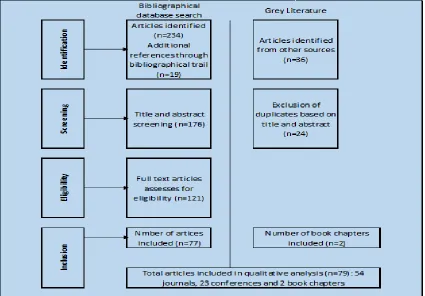
detailed flow of the protective covering mechanism has to be studied carefully in order to bring out a feasible and secure solution to the existing threats prevailing amidst the arena of mobile wallets. The remainder of this paper is structured as follows. Fig.1 describes about the search strategy for selecting the articles for this survey. Section 2 reports the definition for keywords some past related surveys. Section 3 outlines the
implementation and application scope of various platforms for mobile wallets to improve the security and privacy. A comparative analysis on the evaluation criteria, salient features, merits and limitations of the existing schemes, tools used, are discussed in Section 4. Finally, in Section 5, the inferences of the research work and the concluding remarks are presented.
Fig. 1. Flowchart of search strategy
2 Related works and Literature Survey
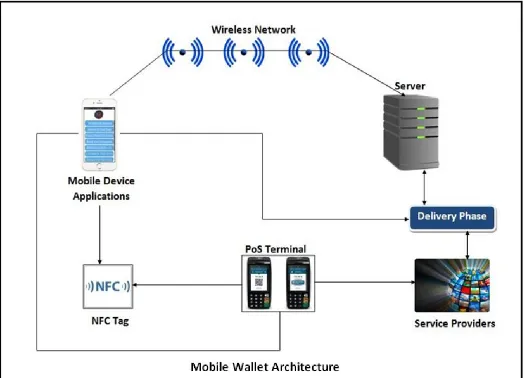
The principal difference between online banking, mobile banking and e-wallet is narrated in this section. Banking technology is expected to keep up with the increase in the demands of the customers in day to day life. Online banking can be defined as the transaction that is done over the internet, normally through a bank’s web page under a private manager and portal and with a desktop computer or laptop computer. Mobile banking paves a way to perform many of the transaction similar to the online banking using a smartphone or tablet instead of desktop computer. E-Wallet is a virtual/digital wallet where we can keep your money to use it when we need without swiping you debit/credit cards. Starting from grocery items to flight tickets, everything can be brought using e-wallets. An e-wallet refers to an electronic device or online service that allows an individual to make
electronic payments which is depicted in Fig.2. This can
1757
Fig 2.
Architecture of mobile wallet
An e-wallet has both a software and information component. The software provides security and encryption for the personal information and also for the actual transaction being done by the individual. Typically, e-wallets are stored on the client side and are easily self-maintained and fully compatible with most Touch-commerce websites [14]. A server-side digital wallet, also known as an e-wallet or thin wallet, is one that an organization creates and maintains on its servers. Server-side e-wallets are getting popular amongst majority of retailers due to the security, efficiency, and added utility it provides to the end-user, which increases their satisfaction of their overall purchase within lesser amount of time. The information component is actually a database to store user-input in- formation. This information consists of your shipping address, billing address, payment methods, individual’s credentials, and personal information. (Also including credit card numbers, expiry dates, adhaar details,
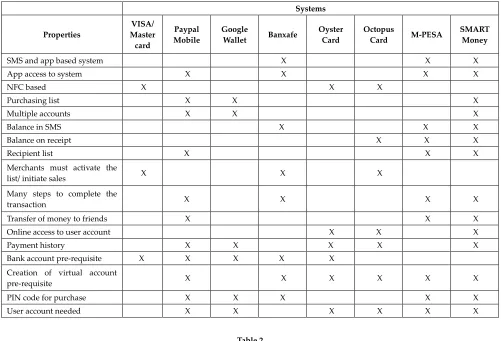
and security numbers). Table. 1 will narrate the comparative
study of properties of the wallets along with the existing e-wallet system.
3
Security mechanisms behind e-wallets
1758 Table 1
Comparison of properties of various mobile payment applications
Table 2
Comparison between the encryption schemes and its security parameters
3.1. Encryption techniques used in mobile wallets
Encryption seems to be one of the finest solutions to secure data till date. Authentication of the user and clear encryption can provide good security for the data. Data or information transmitted form the mobile device should be protected from attacks. As there are plenty of loopholes to access the data around, the role of attackers becomes tranquil to access all the private data. In a traditional web wallet referred in [15], the information needs to be submitted online and it underwent phishing attack which evaded the privacy of the data. But in the recent days, the evolution of Near Field communication (NFC) alongside the mobile devices, poured interest in developing NFC security despite of the device being an attack platform [16] and software based relay attack. Even though NFC
communication is appreciated in mobile wallets, it stays as a short range communication platform [17]. The ultimate goal behind every security mechanism is to provide the legitimate access to mobile device and the impending transactions to be carried out by the applications. This section will describe about the various encryption schemes and its merits towards the appliance on mobile wallet applications. Sahai and Waters et al. developed Fuzzy Identity based encryption [18] where identity is viewed as a set of attributes. The limitations with this scheme is that the users with secret key can perform encryption using a public key and decryption using a secret key and identity with a certain distance. Error tolerance needs attention in the FIBE scheme since the comparison between more than identities can never be the same. Cheng, Rong, Tan, Zeng et al
Systems
Properties
VISA/ Master card
Paypal Mobile
Wallet Banxafe
Oyster Card
Octopus
Card M-PESA
SMART Money
SMS and app based system X X X
App access to system X X X X
NFC based X X X
Purchasing list X X X
Multiple accounts X X X
Balance in SMS X X X
Balance on receipt X X X
Recipient list X X X
Merchants must activate the
list/ initiate sales X X X
Many steps to complete the
transaction X X X X
Transfer of money to friends X X X
Online access to user account X X X
Payment history X X X X X
Bank account pre-requisite X X X X X
Creation of virtual account
pre-requisite X X X X X X
PIN code for purchase X X X X X
User account needed X X X X X X
Encryption Schemes/
Security Parameters Access Control Scalability Flexibility Efficiency
IDE Low Low Low Low
HE Low Low Low Low
ABE Low High Low Low
KP-ABE Low Low High Low
CP-ABE High Low High Low
1759 proposed scheme to securely access the data using Identity
based encryption and biometric authentication [19]. This scheme required a centralized server and a secure channel between the sender and receiver for transmitting the secret key information. Cipher-text policy attribute based encryption [20] proposed by Bethencourt, Sahai and Waters et al. has been serving as a method to analyse the complexity behind access control on encrypted data. In the above said method, attributes are used to describe the user’s credentials and the user who encrypts the message creates a special policy for the receiver who decrypt the message. The encrypted data in the CPABE will be kept confidential despite of the untrusted server and proved secure against the collusion attack. Chase et al. suggested a Multi authority based encryption scheme allows multiple polynomial quantity of independent authorities to overlook and issue secret keys. Encryption takes place with the help of a set of attributes defined by the authority and a random number whereas decryption takes place if atleast ‘x’ number of attributes revealed by the decrypting entity [21]. Multi authority based encryption (ABE) is proposed in [22] where it allows any party to become the competent authority and imbibes no coordination requirement other than the initial creation of reference parameters. Encryption takes place by means of any Boolean formula over the declared attributes set by any chosen set of authorities where it does not need any central authority. This is also referred as Decentralizing attribute based encryption. Xiang et al. proposed a secure outsourcing attribute encryption scheme with Checkability provision [23]. This scheme allows offloading of access policy and operations depending on the attributes in the key-issuing process to a key generation service provider or decryption by a decryption service provider. In [24], Xhafa, Feng, Zhang et al has made a scheme which invokes privacy aware attribute based sharing and works only within the limitations of a trusted domain. Tysowski and Hasan et al. proposed attribute based encryption scheme for mobile applications. The responsibility of the owner is relieved here and instead the key generation mechanism is shared between the mobile data owner and a trusted authority [25]. Another category of encryption is role-based encryption which integrates the techniques from cryptography to RBAC. This scheme allows the users with certain roles assigned may only decrypt and view the original data [26]. Tiwari and Saklani et al. suggested a biometric based encryption and decryption scheme where master key generation will be done using either fully/partial hash portion of the finger prints of both sender and receiver [27].
3.1.1. Advanced cryptographic encryption techniques Some of the advanced cryptographic techniques to encrypt the message are as follows.
Searchable encryption which includes symmetric searchable encryption and asymmetric searchable encryption [1][5].
Homomorphic encryption [5][11]. Identity based encryption [13].
Attribute based encryption which includes key-policy attribute based encryption, cipher-text policy based encryption and multi-authority attribute based encryption [18-21].
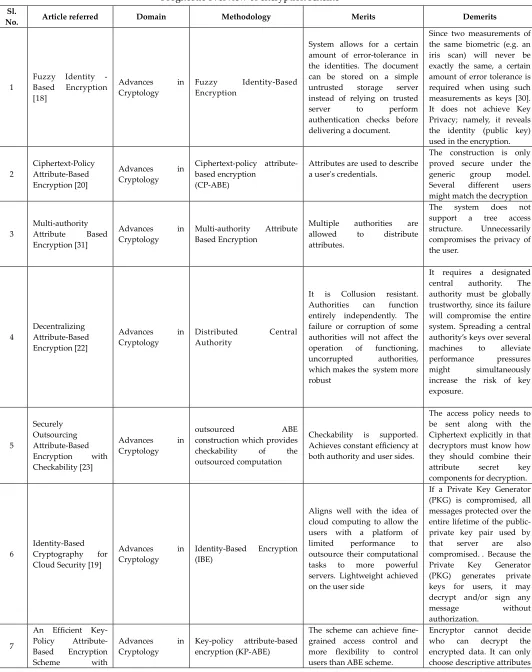
Table. 2 has shown a comparison between the encryption schemes and its security parameters to investigate the security mechanisms such as access control, scalability, flexibility and efficiency of various encryption schemes available in the security standards. Similarly, Table.3 has a deep overview of various encryption schemes and its variants which are reflected in the encryption standards are discussed.
3.2. Mobile wallets – Offloading perspective and layering of block chain technology
1760 Table 3
Prognostic overview of encryption scheme Sl.
No. Article referred Domain Methodology Merits Demerits
1
Fuzzy Identity
-Based Encryption
[18]
Advances in
Cryptology
Fuzzy Identity-Based
Encryption
System allows for a certain amount of error-tolerance in the identities. The document can be stored on a simple
untrusted storage server
instead of relying on trusted
server to perform
authentication checks before delivering a document.
Since two measurements of the same biometric (e.g. an iris scan) will never be exactly the same, a certain amount of error tolerance is required when using such measurements as keys [30]. It does not achieve Key Privacy; namely, it reveals the identity (public key) used in the encryption.
2
Ciphertext-Policy Attribute-Based Encryption [20]
Advances in
Cryptology
Ciphertext-policy attribute-based encryption
(CP-ABE)
Attributes are used to describe a user's credentials.
The construction is only proved secure under the
generic group model.
Several different users might match the decryption
3
Multi-authority
Attribute Based
Encryption [31]
Advances in
Cryptology
Multi-authority Attribute Based Encryption
Multiple authorities are
allowed to distribute
attributes.
The system does not
support a tree access
structure. Unnecessarily compromises the privacy of the user.
4
Decentralizing Attribute-Based Encryption [22]
Advances in
Cryptology
Distributed Central
Authority
It is Collusion resistant. Authorities can function entirely independently. The failure or corruption of some authorities will not affect the operation of functioning,
uncorrupted authorities,
which makes the system more robust
It requires a designated
central authority. The
authority must be globally trustworthy, since its failure will compromise the entire system. Spreading a central authority’s keys over several
machines to alleviate
performance pressures
might simultaneously
increase the risk of key exposure.
5
Securely Outsourcing Attribute-Based
Encryption with
Checkability [23]
Advances in
Cryptology
outsourced ABE
construction which provides
checkability of the
outsourced computation
Checkability is supported. Achieves constant efficiency at both authority and user sides.
The access policy needs to be sent along with the Ciphertext explicitly in that decryptors must know how they should combine their
attribute secret key
components for decryption.
6
Identity-Based
Cryptography for
Cloud Security [19]
Advances in
Cryptology
Identity-Based Encryption (IBE)
Aligns well with the idea of cloud computing to allow the users with a platform of
limited performance to
outsource their computational
tasks to more powerful
servers. Lightweight achieved on the user side
If a Private Key Generator (PKG) is compromised, all messages protected over the entire lifetime of the public-private key pair used by
that server are also
compromised. . Because the
Private Key Generator
(PKG) generates private keys for users, it may decrypt and/or sign any
message without
authorization.
7
An Efficient
Key-Policy
Attribute-Based Encryption
Scheme with
Advances in
Cryptology
Key-policy attribute-based encryption (KP-ABE)
The scheme can achieve fine-grained access control and more flexibility to control users than ABE scheme.
Encryptor cannot decide
who can decrypt the
1761 Constant Ciphertext
Length [32]
for the data, it is unsuitable in some application because a data owner has to trust the key issuer.
8
Hierarchical attribute-based
encryption and
scalable user
revocation for
sharing data in
cloud servers [33]
Computers & Security
Hierarchical attribute-based encryption scheme (HABE) &proxy re-encryption (PRE)
and lazy re-encryption
(LRE)
It assures high performance and full delegation. It can share data for users in the
cloud in an enterprise
environment .
In practice, it is unsuitable to implement. Since all attributes in one conjunctive clause in this scheme may be administered by the same domain authority, the same
attribute may be
administered by multiple domain authorities.
9
Privacy-Aware Attribute-Based PHR Sharing with User Accountability in Cloud Computing
Supercomputing
Multi-authority Ciphertext-policy ABE scheme with user accountability [24]
The access policy is hidden and hence user access privacy is protected. Unauthorized users can be traced.
Overhead involved in
managing the distributed authorities.
10
Achieving Secure
Role-Based Access
Control on
Encrypted Data in Cloud Storage
Information
Forensics and
Security
role-based encryption (RBE) scheme that integrates the cryptographic techniques
with RBAC(Role Based
Access Control) [26]
It allows an organization to store data securely in a public cloud, while maintaining the sensitive information related to the organization’s structure in a private cloud.
Data owner is solely
responsible for providing access to shared data, also
requires constant
availability of data owner. Affects mobility of data
owner and adds
computation burden on
mobile device.
11
Hybrid
Attribute-Based Encryption
and Re-Encryption for Scalable Mobile
Applications in
Clouds
Cloud Computing Hybrid Attribute-Based
Encryption (H-ABE) [25]
Optimized for mobile users, Reduces communication and
computation cost,
computationally very difficult to crack.
No provision of backup manager.
12
An expressive and
provably secure
Ciphertext-Policy Attribute-Based Encryption
Information Sciences
Ciphertext-Policy Attribute-Based Encryption, based on a Linear Integer Secret Sharing Scheme (LISS) [34]
Advantages of secret sharing over integers opposed to secret sharing over finite groups or fields in LSSS. In LISS, the secret sharing cost is less.
The access policy needs to be sent along with the cipher text explicitly in that decryptors must know how they should combine their
attribute secret key
components for decryption.
13
Ciphertext-policy hierarchical attribute-based
encryption with
short cipher texts
Cloud computing encryption
Ciphertext-policy
hierarchical ABE (CP-HABE) [35]
The attributes are organized in a matrix where the users having higher level. Attributes can delegate their access rights to the users at a lower level. These features enable a CP-HABE system to host a large number of users from different organizations by delegating keys, e.g., enabling efficient
data sharing among
hierarchically organized large groups.
Lacks a description of the structures of access control.
14
Re-Encryption-Based Key
Management Towards Secure and
Scalable Mobile
Applications in
Clouds
Proxy based Re-Encryption
Dynamic data re-encryption [36]
Store data securely, works efficiently in case of user revocation.
Constant user revocation results in updating of keys
thus denied access to
authorized users during ongoing process.
15
Functional
Encryption for Inner Product: Achieving Constant-Size
Public Key
Cryptography
Negated spatial encryption [37]
System is (semantically)
secure under chosen key attack. Fine-grained access control to the data along with
1762
Ciphertexts with
Adaptive Security or
Support for
Negation
a Low communication round complexity mechanism.
is a-priori bounded.
16
Bounded Ciphertext
Policy Attribute
Based Encryption
Public Key
Cryptography
Ciphertext-policy attribute based encryption scheme having a security proof based on a number theoretic assumption and supporting advanced access structures [20]
Construction can support
access structures which can be represented by a bounded size access tree with threshold gates as its nodes.
The depth of the access trees d under which messages can be encrypted is defined in the setup phase. Thus, the user who wants to encrypt a message is restricted to use only an access tree which has the depth d’ ≤ d.
17
Ciphertext-Policy Attribute-Based
Encryption: An
Expressive,
Efficient, and
Provably Secure
Realization [34]
Public Key
Cryptography
Efficient, expressive, and provably secure
ciphertext-policy attribute-based
encryption system
The first cipher text-policy attribute-based encryption systems that are efficient,
expressive, and provably
secure under concrete
assumptions.
Expensive decryption.
Ciphertext and public
parameters size have been increased in the DBDH Assumption[20].
18
Attribute-based encryption for
fine-grained access
control of encrypted data
Public Key
Cryptography
Key-Policy Attribute-Based Encryption (KP-ABE) [38]
This KP-ABE system naturally offers a targeted broadcast system.
The parameters of cipher text and private key sizes
add encryption and
decryption complexity blow up (in the worst case) by an n 3.42 factor limiting its usefulness in practice.
19
Provably Secure
Ciphertext Policy ABE
Cloud Computing
and Security CP-ABE scheme [39]
It provides Selective Data
Sharing Group Key
Management
The size of the Ciphertext and secret key increases linearly with the total number of attributes in the system.
20
Secure and Efficient
Data Sharing in
Cloud Using Hybrid Patient Controlled Biometric
Encryption Scheme [40]
Cloud Computing and Security
Hybrid Patient Controlled
Biometric Encryption
Scheme (HPCBES)
Ensures the security,
authentication and efficient data sharing in the cloud environment.
Double encryption process enhances the security
Cost for equipment is higher.
Vulnerable to noise and distortion brought on by dirt and twists
21
Multivariate Authentication and Encryption Scheme for Data Privacy in
IoT Healthcare
Monitoring [41]
Cloud Computing and Security
authentication based
security model for internet of things
Capable to protect against the security breach attacks on the healthcare databases.
Large keys and the
uncertainty about their security.
22
Feasibility of
Deploying Biometric
Encryption in
Mobile Cloud
Computing
Biometric encryption
Biometric encryption (BE) [42]
More reliable because it has features of difficult to forget, lose, share and forge.
Challenges for practical
implementation (e.g.
appropriate request
scheduling, efficient match algorithm, secure storage of templates and secret keys).
23
Identity Based
Encryption and
Biometric Authentication Scheme for Secure Data Access in
Cloud Computing
[19]
Advances in
Cryptology
secure data access scheme based on identity-based encryption and biometric authentication
Feasible and secure for data access in cloud computing
Requires a centralized
server. IBE's centralized approach implies that some keys must be created and held in escrow and are therefore at greater risk of disclosure.
Requires a secure channel
between a sender or
recipient and the IBE server for transmitting the private key.
24 Multiple Biometric
Security in Cloud
Advances in
Cryptology
Multiple Biometric Security [43]
Limited authentication
capability in order to avoid
1763
Computing unauthorized access. each subject registered with
a multi-biometric system.
25
Role of Biometric
Cryptography in
Cloud Computing
[44]
Advances in
Cryptology Biometric Cryptography
Availability of data by overcoming many existing problem like denial of services
Legal issues and Privacy concerns
26
Ensuring attribute privacy protection and fast decryption for outsourced data security in mobile cloud computing
Network Security match-then-decrypt [45]
Supports efficient attribute matching.
Involves many bilinear pairings in decryption phase and suffers a security weakness
27
An efficient and
secure
privacy-preserving
Approach For
outsourced data of resource constrained mobile devices in
cloud computing
[46]
Advances in
Cryptology
Efficient and Secure Privacy-Preserving approach based on probabilistic public key
encryption and ranked
multi- keyword search
Data privacy ensures and computation, Communication overheads in reduction.
Large keys and the
uncertainty about their security.
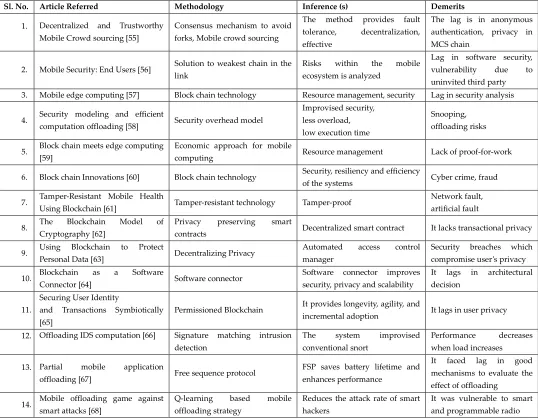
Table 4
Parasitic overview of offloading and block chain based security mechanisms
Sl. No. Article Referred Methodology Inference (s) Demerits
1. Decentralized and Trustworthy
Mobile Crowd sourcing [55]
Consensus mechanism to avoid forks, Mobile crowd sourcing
The method provides fault tolerance, decentralization, effective
The lag is in anonymous authentication, privacy in MCS chain
2. Mobile Security: End Users [56] Solution to weakest chain in the link
Risks within the mobile
ecosystem is analyzed
Lag in software security,
vulnerability due to
uninvited third party
3. Mobile edge computing [57] Block chain technology Resource management, security Lag in security analysis
4. Security modeling and efficient
computation offloading [58] Security overhead model
Improvised security, less overload, low execution time
Snooping, offloading risks
5. Block chain meets edge computing [59]
Economic approach for mobile
computing Resource management Lack of proof-for-work
6. Block chain Innovations [60] Block chain technology Security, resiliency and efficiency
of the systems Cyber crime, fraud
7. Tamper-Resistant Mobile Health
Using Blockchain [61] Tamper-resistant technology Tamper-proof
Network fault, artificial fault
8. The Blockchain Model of
Cryptography [62]
Privacy preserving smart
contracts Decentralized smart contract It lacks transactional privacy
9. Using Blockchain to Protect
Personal Data [63] Decentralizing Privacy
Automated access control
manager
Security breaches which compromise user’s privacy
10. Blockchain as a Software
Connector [64] Software connector
Software connector improves security, privacy and scalability
It lags in architectural decision
11.
Securing User Identity
and Transactions Symbiotically [65]
Permissioned Blockchain It provides longevity, agility, and
incremental adoption It lags in user privacy
12. Offloading IDS computation [66] Signature matching intrusion detection
The system improvised
conventional snort
Performance decreases
when load increases
13. Partial mobile application
offloading [67] Free sequence protocol
FSP saves battery lifetime and enhances performance
It faced lag in good
mechanisms to evaluate the effect of offloading
14. Mobile offloading game against smart attacks [68]
Q-learning based mobile
offloading strategy
Reduces the attack rate of smart hackers
1764
15. ECOS: mobile application
offloading [69]
Enterprise centric offloading framework
Achieved privacy and trust
worthiness, decoupled
offloading and accommodated offload at a scale
Lag in security constraints, fairness
16.
Reinforcement Learning Based
Mobile Offloading [70] Offloading based on Q-network
technique
It improves detection speed, utility and accuracy.
Needs improvement in
malware analysis
17.
Mobile cloud offloading for malware detections with learning [71]
Offloading based on Q-learning method
It improves the utility under dynamic network bandwidths
Requires fast processing of large data
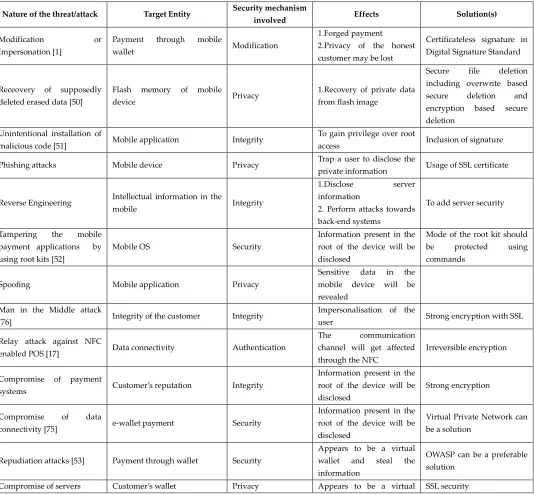
Table 5
Effects of the security threats and attacks and its impending solutions
Nature of the threat/attack Target Entity Security mechanism
involved Effects Solution(s)
Modification or
Impersonation [1]
Payment through mobile
wallet Modification
1.Forged payment
2.Privacy of the honest customer may be lost
Certificateless signature in Digital Signature Standard
Receovery of supposedly deleted erased data [50]
Flash memory of mobile
device Privacy
1.Recovery of private data from flash image
Secure file deletion
including overwrite based
secure deletion and
encryption based secure deletion
Unintentional installation of
malicious code [51] Mobile application Integrity
To gain privilege over root
access Inclusion of signature
Phishing attacks Mobile device Privacy Trap a user to disclose the
private information Usage of SSL certificate
Reverse Engineering Intellectual information in the
mobile Integrity
1.Disclose server
information
2. Perform attacks towards back-end systems
To add server security
Tampering the mobile
payment applications by using root kits [52]
Mobile OS Security
Information present in the root of the device will be disclosed
Mode of the root kit should
be protected using
commands
Spoofing Mobile application Privacy
Sensitive data in the mobile device will be revealed
Man in the Middle attack
[76] Integrity of the customer Integrity
Impersonalisation of the
user Strong encryption with SSL
Relay attack against NFC
enabled POS [17] Data connectivity Authentication
The communication
channel will get affected through the NFC
Irreversible encryption
Compromise of payment
systems Customer’s reputation Integrity
Information present in the root of the device will be disclosed
Strong encryption
Compromise of data
connectivity [75] e-wallet payment Security
Information present in the root of the device will be disclosed
Virtual Private Network can be a solution
Repudiation attacks [53] Payment through wallet Security
Appears to be a virtual
wallet and steal the
information
OWASP can be a preferable solution
1765
wallet and steal the
information
Denial of payment
settlement services Customer and POS Accountability
Reputation of the customer will get endangered
Customer centric awareness on neglecting the denial of payment
Payment fraud [73] Customer Confidentiality The money in the wallet is
targeted
Session maintenance
protocol can be
implemented Advanced persistent threats
(APTs) [54] Mobile device Security
Device will face a lag in the response
Usage of Network Access Control mechanism
DDoS attack Payment gateway Confidentiality Resource from the server
will not be reached
Securing the IP gateway, Anteater system
4. Mobile wallet security attacks and threats
and its remedial measures
Mobile wallet, despite of its user friendliness faces a lot many security challenges. This section deals about the possible threats and intrusion towards the mobile system [54][77]. There are plenty of existing threats and identified solutions which can help us to review the nature of the threat and its vulnerability. Threats may appear in the mobile wallet in many forms including mobile wallet application, mobile device, mobile wallet users, acquirers, merchants, payment service providers, card issuers, payment network providers, etc.
4.1. Threat model of mobile wallets
The possible area of attacks/threats in a mobile wallet is discussed in this section. Threat deals with the boundary limitations and its intrusion in the model discussed here [49]. Table. 5 suggest the remedial measures for the threats and attacks in mobile wallet applications.
Social Engineering: Social Engineering deals with the information available in the public domain where attackers can send fraudulent payments just like the intended user. The same data may be sold in the market for a price and gain an identity of the original user [12][44].
Installation of malware and nature of operating system: Many a times, attackers handle the technique of installing malware and re-direct the user to insecure wifi access, fake access points and malicious uniform resource locators (urls) and use this information for payment through mobile wallets. Operating System’s access also plays a key role in protecting the application from the invaders. Attackers point out the sensitive data available within our device and may spoof the application.
Phishing attack: Phishing is a simple means to trap the user to reveal original information incorporated within a mobile device and then carry out attacks.
Interception: The access to the root may be obtained at times by downloading the malware which seems to be
reliable. The installation of such malware may download attacks influence into the mobile device.
Uploading malware on POS terminal: The way in which the attacker can obtain remote access when the point of sale (POS) malware is installed on the terminal. It obtains the information about the mobile wallet data that transact through the card readers.
Man-in-the-middle attack: Attackers attempt to invade the poor network connections like lack of firewalls and attack against the point of sale’s terminal.
Relay Attack: Relay attack is a known attack with the installation of relay software that can relay commands between the secure element and card emulator installed within the device. Apart from these, there are numerous threats and attacks involved in the mobile wallet technology including the compromise of software running on contactless terminals, payment gateways, POS servers, token services, token service provider services, payment settlement services, payment authorization process, data connectivity and repudiation, etc.
4.2. Preventive security measures for a mobile wallet
It is always recommended to be alert and acquire preventive measures in the field of security. The various preventive measures that can be adopted rather than facing the critical threats and attacks in mobile era are discussed here.
Awareness about the new updated security systems
Usage of unauthorized public hotspots should be avoided
Always update the application in the mobile device in order to keep the device updated and secured Usage of strong passwords and remote lock Inculcation of security with the validation of
biometric data
1766 White-box cryptography is recommended
Keep the point of sale (POS) software up-to-date Deploy strong firewalls and restrict unauthorized
access to POS
Patching may be done between the hardware and software component of POI terminal
Ensure high security standards for payment processing systems
Deploy the agents for detecting malware, data leakage and fraud detection in the wallets
Require certificate less signature to verify the payment process
Enforce fewer privileges and deploy anti-DoS (Denial of service) measures for critical servers.
5. Future prospects of mobile wallets
In the long run, mobile wallets may reach their peak by the huge involvement of users, due to its user friendliness and ease of access [75]. When the sensitive information present in the mobile wallet is concerned, lots of new policy adoptions are expected to arrive in place to hold the security mechanisms such as authentication, authorization, integrity, confidentiality and privacy [78][79]. Some of the latest technologies which need to be reviewed and put in market will add an extra mile to the mobile wallets.
5.1. Unified payment interface in e-wallets
Unified payment interface (UPI) [74] is an attractive feature that enables direct transfer from user’s bank account to make payments using the e-wallet. Millions of users are currently using the e-wallet in the recent days, but they have its own limitations. One such featured limitation is interoperability. The transfer of money between the sender and recipient was from the same bank account initially. Henceforth, it was an obstacle that the transfer of money cannot be made between wallet to bank and vice versa. In future, solutions to resolve interoperability through UPI along with strong security in all the e-wallets can be designed.
5.2. Block chain based e-wallets
There is a high demand in the market for the OS based mobile wallets including ApplePay, AndroidPay which has gone all through the world. Despite of this, brand-oriented wallets such as Starbucks, WalmartPay are experiencing significant growth amidst the users. Alongside, the digital wallets can be used as a platform to interact on the block chain [72-74]. Alike in digital wallet, e-wallets should also be provided with a way to store, trade and handle the assets such as crypto currencies as they do for normal exchange of payment. The concern of the customer towards the privacy and security on mobile wallets should subside fully with the intervention of block chain technology which can make transactions easier at any time, in any currency and with any business agencies.
5.3. Scope for development
During the transaction through the mobile wallet, the session during the time lapse to receive the OTP in the wallets should be secure in order to guarantee the payment channel and payment mode secure.
The legal compliance upon the mobile wallets should be made common and be used by all the organisations since this could be a problem for the newbie’s who enter into the market of mobile wallet.
Some of the major risk factors such as leakage of data, undetected malware, etc may be due to contactless payment option. Due to this financial breach, the market may lose many of the trusted customers who opt for mobile wallets.
The perception of the user should be changed in such a way that there should be some trust in the mobile wallet which could be an alternative for the payment through credit cards.
Trust, fear, safety measures are the most prominent concern of a customer to choose a mobile wallet. Many of recent surveys have plotted that the trust in mobile wallet by the customers, increase in the fear of losing their devices and safety towards making payment through the e-wallets has to be re-considered.
6 Conclusions
E-wallet applications were very much comfortable for the user to make transaction easily and in simple. In this paper, a study on the various encryption schemes available to provide security, ways to offload the computation to the resourceful servers, need for latest technology have been discussed in detail. The widespread concept of e-wallet has been owned by too many corporate sectors with their own flavours which had given handful of benefits. But, there were enough number of security concerns to be aware of by every individual in this world. The study of the various security threats breaches have been discussed and narrowed down with the futuristic scope to be implemented and arrive at better wallets is done. With the consideration of the challenges to be improvised, a brand new flavour of e-wallet application can be designed.
References
[1] Z. Qin, J. Sun, A. Wahaballa, W. Zheng, H. Xiong, and Z. Qin, ‚A secure and privacy-preserving mobile wallet with outsourced verification in cloud computing,‛ Comput. Stand. Interfaces, vol. 54, no. P1, pp. 55–60, Nov. 2017.
1767 2011, 2011, pp. 158–165.
[3] R. Batra and N. Kalra, ‚ARE DIGITAL WALLETS THE NEW CURRENCY?,‛ 2016.
[4] D. Shibin and G. J. W. Kathrine, ‚A comprehensive overview on secure offloading in mobile cloud computing,‛ in 2017 4th International Conference on Electronics and Communication Systems (ICECS), 2017, pp. 121–124.
[5] Y. Liao, Y. He, F. Li, and S. Zhou, ‚Analysis of a mobile payment protocol with outsourced verification in cloud server and the improvement,‛ Comput. Stand. Interfaces, vol. 56, pp. 101–106, Feb. 2018.
[6] D. Shibin and J. W. Kathrine, ‚A Secure and Hybrid Approach for Key Escrow Problem and to Enhance Authentic Mobile Wallets,‛ Springer, Singapore, 2019, pp. 81–89.
[7] M. S. Ackerman and D. T. Davis, ‚Privacy and Security Issues in E-Commerce.‛
[8] X. Dai and J. Grundy, ‚Three Kinds of E-wallets for a NetPay Micro-Payment System,‛ Springer, Berlin, Heidelberg, 2004, pp. 66–77.
[9] E. Barker, M. Smid, D. Branstad, and S. Chokhani, ‚NIST Special Publication 800-130 A Framework for Designing Cryptographic Key Management Systems.‛
[10] R. Upadhyaya and A. Jain, ‚Cyber ethics and cyber crime: A deep dwelved study into legality, ransomware, underground web and bitcoin wallet,‛ in 2016 International Conference on Computing, Communication and Automation (ICCCA), 2016, pp. 143–148.
[11] T. Caldwell, ‚Locking down the e-wallet,‛ Comput. Fraud Secur., vol. 2012, no. 4, pp. 5–8, Apr. 2012. [12] M. Olsen, J. Hedman, and R. Vatrapu, ‚e-wallet
Prototypes,‛ Springer, Berlin, Heidelberg, 2011, pp. 223–236.
[13] M. Olsen, J. Hedman, and R. Vatrapu, ‚Designing digital payment artifacts,‛ in Proceedings of the 14th Annual International Conference on Electronic Commerce - ICEC ’12, 2012, pp. 161–168.
[14] K. Marinova, ‚MOBILE WALLET-FUNCTIONS, COMPONENTS AND ARCHITECTURE,‛ 2017. [15] M. Wu, M. Wu, R. C. Miller, and G. Little, ‚Web
wallet: Preventing phishing attacks by revealing user intentions,‛ Proc. Symp. USABLE Priv. Secur. (SOUPS, vol. 149, pp. 102--113, 2006.
[16] M. Roland, J. Langer, and J. Scharinger, ‚Applying relay attacks to Google Wallet,‛ in 2013 5th International Workshop on Near Field Communication (NFC), 2013, pp. 1–6.
[17] L. Francis, G. Hancke, K. Mayes, and K. Markantonakis, ‚Practical NFC Peer-to-Peer Relay Attack Using Mobile Phones,‛ Springer, Berlin,
Heidelberg, 2010, pp. 35–49.
[18] A. Sahai and B. Waters, ‚Fuzzy Identity-Based Encryption,‛ Springer, Berlin, Heidelberg, 2005, pp. 457–473.
[19] H. Cheng, C. Rong, Z.-H. Tan, and Q. Zeng, Identity based Encryption and Biometric Authentication Scheme for Secure Data Access in Cloud Computing, vol. 21, no. 2. Technology Exchange, 1991.
[20] J. Bethencourt, A. Sahai, and B. Waters, ‚Ciphertext-Policy Attribute-Based Encryption,‛ in 2007 IEEE Symposium on Security and Privacy (SP ’07), 2007, pp. 321–334.
[21] K. Fan, H. Xu, L. Gao, H. Li, and Y. Yang, ‚Efficient and privacy preserving access control scheme for fog-enabled IoT,‛ Futur. Gener. Comput. Syst., vol. 99, pp. 134–142, Oct. 2019.
[22] A. Lewko and B. Waters, ‚Decentralizing Attribute-Based Encryption,‛ Springer, Berlin, Heidelberg, 2011, pp. 568–588.
[23] J. Li, X. Huang, J. Li, X. Chen, and Y. Xiang, ‚Securely Outsourcing Attribute-Based Encryption with Checkability,‛ IEEE Trans. Parallel Distrib. Syst., vol. 25, no. 8, pp. 2201–2210, Aug. 2014. [24] F. Xhafa, J. Feng, Y. Zhang, X. Chen, and J. Li,
‚Privacy-aware attribute-based PHR sharing with user accountability in cloud computing,‛ J. Supercomput., vol. 71, no. 5, pp. 1607–1619, May 2015.
[25] P. K. Tysowski and M. A. Hasan, ‚Hybrid Attribute- and Re-Encryption-Based Key Management for Secure and Scalable Mobile Applications in Clouds,‛ IEEE Trans. Cloud Comput., vol. 1, no. 2, pp. 172–186, 2013.
[26] L. Zhou, V. Varadharajan, and M. Hitchens, ‚Achieving Secure Role-Based Access Control on Encrypted Data in Cloud Storage,‛ IEEE Trans. Inf. Forensics Secur., vol. 8, no. 12, pp. 1947–1960, Dec. 2013.
[27] L. Sun, H. Wang, and E. Bertino, ‚Role-based access control to outsourced data in cloud computing,‛ Proc. Twenty-Fourth Australas. Database Conf. - Vol. 137, pp. 119–128, 2013.
[28] D. Kotz, R. Gray, S. Nog, D. Rus, S. Chawla, and G. Cybenko, ‚AGENT TCL: targeting the needs of mobile computers,‛ IEEE Internet Comput., vol. 1, no. 4, pp. 58–67, 1997.
[29] R. P. Goldberg, ‚Survey of virtual machine research,‛ Computer (Long. Beach. Calif)., vol. 7, no. 6, pp. 34–45, Jun. 1974.
[30] Girish and Phaneendra HD, ‚Identity-Based Cryptography and Comparison with traditional Public key Encryption: A Survey.‛
1768 Encryption,‛ in Theory of Cryptography, Berlin,
Heidelberg: Springer Berlin Heidelberg, 2007, pp. 515–534.
[32] C.-J. Wang and J.-F. Luo, ‚A Key-policy Attribute-based Encryption Scheme with Constant Size Ciphertext,‛ in 2012 Eighth International Conference on Computational Intelligence and Security, 2012, pp. 447–451.
[33] G. Wang, Q. Liu, J. Wu, and M. Guo, ‚Hierarchical attribute-based encryption and scalable user revocation for sharing data in cloud servers,‛ Comput. Secur., vol. 30, no. 5, pp. 320–331, Jul. 2011. [34] B. Waters, ‚Ciphertext-Policy Attribute-Based
Encryption: An Expressive, Efficient, and Provably Secure Realization,‛ Springer, Berlin, Heidelberg, 2011, pp. 53–70.
[35] H. Deng et al., ‚Ciphertext-policy hierarchical attribute-based encryption with short ciphertexts,‛ Inf. Sci. (Ny)., vol. 275, pp. 370–384, Aug. 2014. [36] E. Novak, ‚Security and Privacy for Ubiquitous
Mobile Devices,‛ Diss. Theses, Masters Proj., Oct. 2016.
[37] N. Attrapadung and B. Libert, ‚Functional Encryption for Inner Product: Achieving Constant-Size Ciphertexts with Adaptive Security or Support for Negation,‛ Springer, Berlin, Heidelberg, 2010, pp. 384–402.
[38] V. Goyal, O. Pandey, A. Sahai, and B. Waters, ‚Attribute-based encryption for fine-grained access control of encrypted data,‛ in Proceedings of the 13th ACM conference on Computer and communications security - CCS ’06, 2006, p. 89. [39] L. Cheung and C. Newport, ‚Provably secure
ciphertext policy ABE,‛ in Proceedings of the 14th ACM conference on Computer and communications security - CCS ’07, 2007, p. 456.
[40] A. Bastia, M. Parhi, B. K. Pattanayak, and M. R. Patra, ‚Service Composition Using Efficient Multi-agents in Cloud Computing Environment,‛ Springer, New Delhi, 2015, pp. 357–370.
[41] J. H. Llego, D. H. P. Singh, E. N. P. Singh, and E. Mamta, Multivariate Authentication and Encryption Scheme for Data Privacy in IoT Healthcare Monitoring, vol. 2, no. 8. 2016.
[42] K. Zhao, H. Jin, D. Zou, G. Chen, and W. Dai, ‚Feasibility of Deploying Biometric Encryption in Mobile Cloud Computing,‛ in 2013 8th ChinaGrid Annual Conference, 2013, pp. 28–33.
[43] H. A. Dinesha and V. K. Agrawal, ‚Multi-level authentication technique for accessing cloud services,‛ in 2012 International Conference on Computing, Communication and Applications, 2012, pp. 1–4.
[44] S. El-Etriby, E. Meslhy, H. A. Abd, E. M. Mohamed,
and H. S. Abdul-Kader, ‚Modern Encryption Techniques for Cloud Computing Randomness and Performance Testing,‛ Int. Conf. Commun. Inf. Technol. , pp. 800–805, 2014.
[45] Y. Zhang, X. Chen, J. Li, D. S. Wong, H. Li, and I. You, ‚Ensuring attribute privacy protection and fast decryption for outsourced data security in mobile cloud computing,‛ Inf. Sci. (Ny)., vol. 379, pp. 42– 61, Feb. 2017.
[46] S. K. Pasupuleti, S. Ramalingam, and R. Buyya, ‚An efficient and secure privacy-preserving approach for outsourced data of resource constrained mobile devices in cloud computing,‛ J. Netw. Comput. Appl., vol. 64, pp. 12–22, Apr. 2016.
[47] K. Kumar, J. Liu, Y.-H. Lu, and B. Bhargava, ‚A Survey of Computation Offloading for Mobile Systems,‛ Mob. Networks Appl., vol. 18, no. 1, pp. 129–140, Feb. 2013.
[48] P. Mach and Z. Becvar, ‚Mobile Edge Computing: A Survey on Architecture and Computation Offloading,‛ IEEE Commun. Surv. Tutorials, vol. 19, no. 3, pp. 1628–1656, 2017.
[49] M. Bosamia, ‚Mobile Wallet Payments Recent Potential Threats and Vulnerabilities with its possible security Measures,‛ 2017.
[50] L. Yang, T. Wei, F. Zhang, and J. Ma, ‚SADUS: Secure data deletion in user space for mobile devices,‛ Comput. Secur., vol. 77, pp. 612–626, Aug. 2018.
[51] S. Wessel, M. Huber, F. Stumpf, and C. Eckert, ‚Improving mobile device security with operating system-level virtualization,‛ Comput. Secur., vol. 52, pp. 207–220, Jul. 2015.
[52] P. G. Schierz, O. Schilke, and B. W. Wirtz, ‚Understanding consumer acceptance of mobile payment services: An empirical analysis,‛ Electron. Commer. Res. Appl., vol. 9, no. 3, pp. 209–216, May 2010.
[53] J. L. Hernandez-Ardieta, A. I. Gonzalez-Tablas, J. M. de Fuentes, and B. Ramos, ‚A taxonomy and survey of attacks on digital signatures,‛ Comput. Secur., vol. 34, pp. 67–112, May 2013.
[54] C. Cinar, M. Alkan, M. Dorterler, and I. Alper Dogru, ‚A Study on Advanced Persistent Threat,‛ in 2018 3rd International Conference on Computer Science and Engineering (UBMK), 2018, pp. 116– 121.
[55] Feng, Wei, and Zheng Yan. ‚MCS-Chain: Decentralized and Trustworthy Mobile Crowdsourcing Based on Blockchain.‛ Future Generation Computer Systems 95 (2019): 649-666. [56] Lau, L. ‚Mobile Security: End Users Are the
1769 Directions. Elsevier Inc., 2016. 57-66.
[57] Roman, Rodrigo, Javier Lopez, and Masahiro Mambo. ‚Mobile Edge Computing, Fog et Al.: A Survey and Analysis of Security Threats and Challenges.‛ Future Generation Computer Systems 78 (2018): 680-698.
[58] Huang, Binbin et al. ‚Security Modeling and Efficient Computation Offloading for Service Workflow in Mobile Edge Computing.‛ Future Generation Computer Systems 97 (2019): 755-774. [59] Xiong, Zehui et al. ‚When Mobile Blockchain Meets
Edge Computing.‛ IEEE Communications Magazine 56.8 (2018): 33–39.
[60] Ahram, Tareq et al. ‚Blockchain Technology Innovations.‛ 2017 IEEE Technology and Engineering Management Society Conference, TEMSCON 2017. Institute of Electrical and Electronics Engineers Inc., 2017. 137-141.
[61] Ichikawa, Daisuke, Makiko Kashiyama, and Taro Ueno. ‚Tamper-Resistant Mobile Health Using Blockchain Technology.‛ JMIR mHealth and uHealth 5.7 (2017): e111.
[62] Kosba, Ahmed et al. ‚Hawk: The Blockchain Model of Cryptography and Privacy-Preserving Smart Contracts.‛ Proceedings - 2016 IEEE Symposium on Security and Privacy, SP 2016. Institute of Electrical and Electronics Engineers Inc., 2016. 839–858. [63] Zyskind, Guy, Oz Nathan, and Alex Sandy
Pentland. ‚Decentralizing Privacy: Using Blockchain to Protect Personal Data.‛ Proceedings - 2015 IEEE Security and Privacy Workshops, SPW 2015. Institute of Electrical and Electronics Engineers Inc., 2015. 180-184.
[64] Xu, Xiwei et al. ‚The Blockchain as a Software Connector.‛ Proceedings - 2016 13th Working IEEE/IFIP Conference on Software Architecture, WICSA 2016. Institute of Electrical and Electronics Engineers Inc., 2016. 182-191.
[65] Kravitz, David W., and Jason Cooper. ‚Securing User Identity and Transactions Symbiotically: IoT Meets Blockchain.‛ GIoTS 2017 - Global Internet of Things Summit, Proceedings. Institute of Electrical and Electronics Engineers Inc., 2017.
[66] Jacob, Nigel, and Carla Brodley. ‚Offloading IDS Computation to the GPU.‛ Proceedings - Annual Computer Security Applications Conference, ACSAC. N.p., 2006. 371–380.
[67] Saab, Salwa Adriana et al. ‚Partial Mobile Application Offloading to the Cloud for Energy-Efficiency with Security Measures.‛ Sustainable Computing: Informatics and Systems 8 (2015): 38– 46.
[68] Xiao, Liang et al. ‚Mobile Offloading Game against Smart Attacks.‛ Proceedings - IEEE INFOCOM. Vol.
2016-September. Institute of Electrical and Electronics Engineers Inc., 2016. 403–408.
[69] Gember, Aaron, Christopher Dragga, and Aditya Akella. ‚ECOS: Leveraging Software-Defined Networks to Support Mobile Application Offloading.‛ Proceedings of the eighth ACM/IEEE…i(2012): 199–210.
[70] Wan, Xiaoyue et al. ‚Reinforcement Learning Based Mobile Offloading for Cloud-Based Malware Detection.‛ 2017 IEEE Global Communications Conference, GLOBECOM 2017 - Proceedings. Vol. 2018-January. Institute of Electrical and Electronics Engineers Inc., 2018. 1–6.
[71] Li, Yanda et al. ‚Mobile Cloud Offloading for Malware Detections with Learning.‛ Proceedings - IEEE INFOCOM. Vol. 2015-August. Institute of Electrical and Electronics Engineers Inc., 2015. 197– 201.
[72] Shin, Dong Hee. ‚Towards an Understanding of the Consumer Acceptance of Mobile Wallet.‛ Computers in Human Behavior 25.6 (2009): 1343–1354.
[73] Zhao, H, and S Muftic. ‚The Concept of Secure Mobile Wallet.‛ World Congress on Internet Security, WorldCIS-2011 (2011): 54–58.
[74] Caldwell, Tracey. ‚Locking down the E-Wallet.‛ Computer Fraud and Security 2012.4 (2012): 5–8.
[75] Roland, Michael, Josef Langer, and Josef Scharinger. ‚Practical Attack Scenarios on Secure Element-Enabled Mobile Devices.‛ Proceedings - 4th International Workshop on Near Field Communication, NFC 2012. N.p., 2012. 19–24. [76] Upadhayaya, Abhay. ‚Electronic Commerce and
E-Wallet.‛ International Journal of Recent Research and Review 1 (2012): 37–41.
[77] Seetharaman, A et al. ‚Factors Influencing Behavioural Intention to Use the Mobile Wallet in Singapore.‛ Applied Economics and Business Research 7.2 (2017): 116–136.
[78] Aydin, Gokhan. ‚Adoption of Mobile Payment Systems: A Study on Mobile Wallets.‛ Pressacademia 5.1 (2016): 73–73.