This is a repository copy of Molecular dynamics simulations of organic crystal dissolution: The lifetime and stability of the polymorphic forms of para-amino benzoic acid in aqueous environment.
White Rose Research Online URL for this paper: http://eprints.whiterose.ac.uk/84723/
Version: Accepted Version
Article:
Toroz, D, Hammond, RB, Roberts, KJ et al. (2 more authors) (2014) Molecular dynamics simulations of organic crystal dissolution: The lifetime and stability of the polymorphic forms of para-amino benzoic acid in aqueous environment. Journal of Crystal Growth, 401. 38 - 43. ISSN 0022-0248
https://doi.org/10.1016/j.jcrysgro.2014.01.064
(c) 2014, Elsevier. Licensed under the Creative Commons Attribution Non-Commercial No Derivatives 4.0 International http://creativecommons.org/licenses/by-nc-nd/4.0/
[email protected] https://eprints.whiterose.ac.uk/ Reuse
Unless indicated otherwise, fulltext items are protected by copyright with all rights reserved. The copyright exception in section 29 of the Copyright, Designs and Patents Act 1988 allows the making of a single copy solely for the purpose of non-commercial research or private study within the limits of fair dealing. The publisher or other rights-holder may allow further reproduction and re-use of this version - refer to the White Rose Research Online record for this item. Where records identify the publisher as the copyright holder, users can verify any specific terms of use on the publisher’s website.
Takedown
If you consider content in White Rose Research Online to be in breach of UK law, please notify us by
Molecular dynamics simulations of organic crystal dissolution: The lifetime
and stability of the polymorphic forms of para-amino benzoic acid in aqueous
environment.
D. Toroz1, R.B. Hammond1, K.J. Roberts1, S. Harris2 and T. Ridley2
1
Institute of Particle Science and Engineering; School of Process, Environmental and
Materials Engineering; University of Leeds, Leeds, LS2 9JT, UK
2
School of Physics and Astronomy, University of Leeds, Leeds, LS2 9JT, UK
University of Leeds
Abstract
Para-amino benzoic acid (PABA) manifests crystalline solid-state properties that are typical of a class of chemical compounds with important industrial applications. Hence, it is particularly worthwhile to investigate the lifetime and stability of representative molecular-clusters of two polymorphic forms of PABA in aqueous solution using molecular dynamics simulations. Simulations of five nano-seconds duration in the isothermal-isobaric ensemble (constant particle number, pressure and temperature (NPT) ensemble) were performed for the two polymorphic forms at three different temperatures 0 °C, 50 °C and 100 °C. The simulations revealed that at 0 °C the representative molecular-clusters of the two polymorphic forms remain ordered while at 50 °C the molecular packing within the clusters becomes partially disordered for both polymorphic forms and at 100 °C the clusters lose long-range order rapidly and come to resemble liquid drops. Care should be taken when assessing the relative stability of polymorphic forms, as a function of temperature, from such computational experiments which explore the dissolution of nano-scale crystals. The
-form at 50°C and 100°C was, respectively, partially and completely lost after 5ns which merits further investigation given -form is the high-temperature stable polymorph. Importantly, the initial shape of clusters, as well as the number of solute molecules they contained, affected the extent to which order was lost and how rapidly the loss occurred. Given that classical nucleation theory predicts a finite probability that clusters significantly larger than the critical size, in terms of number of molecules, may dissolve, building clusters containing a greater number of molecules could improve the simulated stability of the alpha polymorph at 50°C and 100°C. Furthermore, the simulations revealed that the selection of a suitable electrostatic potential is very important for the description of the dissolution process of the nano-sized crystals.
1. Introduction
The dissolution of crystals is a fundamental physical-process which has a remarkable impact on various applications in a broad range of scientific areas1-4. The dissolution of organic crystals is of particular interest to the pharmaceutical sector as it is a controlling factor in the development of formulations for health-care products.5-8. The mechanism by which molecules detach from the solid, crystalline phase in the presence of solution is not yet fully revealed by the available experimental techniques. Molecular dynamics approaches have
*Manuscript
been used extensively as a powerful tool to reveal important information about the process of the dissolution at the microscopic level thus complementing experimental findings.9-10
Molecular dynamics simulations have been extremely useful for exploring biological function (protein-folding thermodynamics and kinetics, self-assembly in complex fluids and biological systems, lipid bilayer pressure profiles) for pharmaceutical applications in relation to proteins, lipids and nucleic acids11-15. One representative study of crystal dissolution has been reported by Gao and Olsen16. They simulated the drug-crystal dissolution of Acetaminophen (Aspirin) Form I in water. Their findings demonstrate that the dissolution process is influenced strongly by both the electrostatic and van der Waals solute-solute and solute-solvent inter-molecular interactions with non-negligible contributions from the latter. Hayakawa and co-authors reported the dissolution process of a cellulose triacetate-II nano-sized crystal in DMSO17. The crystal packing of cellulose triacetate-II is characterised by three, main intermolecular CH···O interactions where the H---O bond is in line with the C-H bond forming an angle of 180 degrees. The strongest interaction is between three hydrogens of the glucopyranose ring and a carbonyl oxygen. The other two interactions are found between two acetyl carbonyl oxygens and two acetyl methyl hydrogens. Hayakawa reported that the three types of interaction occurring in the crystal structure were fully compensated in solution through solute interactions with DMSO solvent molecules and that the atoms involved in the main interactions were surrounded by the DMSO solvent. The energetic stability, in vacuum, of molecular clusters representing organic, molecular crystals, as a function of cluster size, has already been investigated extensively for L-glutamic acid18, and D-mannitol19 and in the case of benzophenone20 particularly, cluster stability with respect to molecular, conformational flexibility has been addressed.
Two polymorphs of PABA have been identified which constitute an enantiotropic pair. The -form is the more thermodynamically stable above the transition temperature, independently reported to be 13.8 °C21and 16 °C22, whilst the -form is stable below this
temperature. T
rhombus (slightly off a square shape).23 The unit cell dimensions are a = 18.5712, b =
3.8431, c = P 1/N and Z = 824. This structure of the polymorph is the structure used for this study and packing diagrams are shown in Figure 1b.
T crystallises as rhombic prisms with cell dimensions reported as a = 6.2782 Å, b = 8.5831 Å, c = 12.3649 Å ; Z = 4 and space group P21/N25. The molecular packing is characterised by a closed, hydrogen bonded cycle of two identical
OH N NH O that link four PABA molecules and is shown in Figure 1c. Of particular interest is the stability of carboxylic-acid dimers which are -form alone. The strength of the carboxylic-acid dimer interaction is of interest not only for single, isolated dimers but also in cases where the dimers are assembled into larger clusters, as the packing of these dimers is manifested in the solid-state structure
function of the supersaturation, in a solvent environment based on observing a small probability for clusters to dissolve. A more accurate estimation of the critical cluster size, requiring many more simulations, was not undertaken however as this was not the main objective.
The stability of molecular clusters in solution was used to evaluate the performance and transferability of the potential employed in the simulations. In the case that sufficiently large molecular clusters of a particular shape, i.e. very much greater than the critical size, are employed, then for the specified temperature and supersaturation, the clusters are likely to remain stable in terms of retaining their original long-range order. It is recognised, however, that there is still a chance that such clusters can vanish by the process that starts h respect to the Gibbs free energy. From the molecular dynamics simulations the possible outcomes fall in to three different categories: (i) the clusters retain their order and cluster size, (ii) the clusters become liquid like but retain size, (iii) the clusters break-up and dissolve.
2. Computational details
The crystal structures of the AMBNAC AMBNAC forms of PABA were retrieved from the Cambridge Crystallographic Data Centre. The asymmetric unit of the -form comprises two molecules and the unit cell contains eight molecules. The asymmetric
and the unit cell contains four molecules. A series of -form crystal lattices was constructed using the Material Studio package26. The crystal lattices were built and examined in two sets of computational experiments in which the size of the clusters was increased in order to estimate an upper bound to the critical-cluster size. The first critical-clusters examined consisted of 192 -form and were constructed as a 2 x 6 x 2 array of unit cells (along the crystallographic a, b and c unit cell axes respectively) containing 24 unit cells in total. S -form contained 256 molecules and was constructed as 4 x 4 x 4 array containing 64 unit cells. In the second set of simulations, the clusters examined consisted of a 504 molecule cluster -form, in a 3 x 7 x 3 array containing 63 unit cells, and a 480 molecule cluster -form in a 6 x 5 x 4 array containing 120 unit cells. Finally, as the crystal shape observed to be a needle-like another cluster was examined which consisted of 512
-form as a 2 x 16 x 2 array containing 64 unit cells. The shape of these molecular clusters, which represented nano-crystals of the respective polymorphs, was a
-form and recta -form.
or size of clusters and no molecules were observed to detach from the clusters. The Particle Mesh Ewald (PME) method was used to investigate the effect of long-range electrostatic interactions. The systems were equilibrated at the three temperatures at constant volume and temperature for 100 ps followed by a second phase equilibration at the three temperatures at constant pressure and temperature for 100 ps. Finally production simulations (5ns) were performed at constant pressure and temperature within the isobaric-isothermal (NPT) ensemble with a 2fs time step.
3. Results and discussion
The small molecular clusters employed in the first numerical experiment rapidly lost their long range order for all temperatures which implies that the clusters were much smaller than the critical cluster size required to maintain structural integrity. The same behaviour was observed for all the sets of atomic point charges employed (i.e. whether based on a semi-empirical or DFT level of theory). Therefore the use of larger clusters was indicated to further examine whether the failure of the molecular clusters to remain stable is size dependent or there is an issue of the atomic charges used to describe the electrostatic potential.
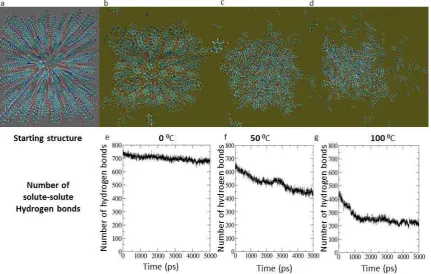
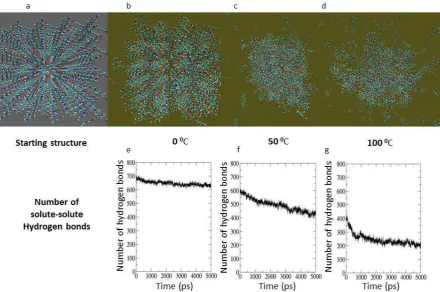
The simulation results obtained for the larger size clusters (3 x 7 x 3 array for the -form and 6 x 5 x 4 array -form) using partial charges derived from the semi-empirical AM1 method manifested clusters which also lost their long range order rapidly. This might imply that the clusters are smaller than the critical size. However, this inference is not supported by the results of simulations that employed DFT derived RESP charges which were significantly different. A possible implication is that the charges derived from the semi-empirical approach do not describe accurately the electrostatic interactions between molecules in the clusters. In particular, during these simulations the clusters appear to have transformed to configurations resembling liquid drops. On the other hand, when the DFT derived RESP charges were applied, -form cluster at 0°C was stable in water with only a small number of molecules becoming detached around the edges as is shown in Figure 2. This suggests that the lifetime and stability of the clusters depends not only on the size of the clusters chosen but on the partial charges selected as well. At 50°C the cluster
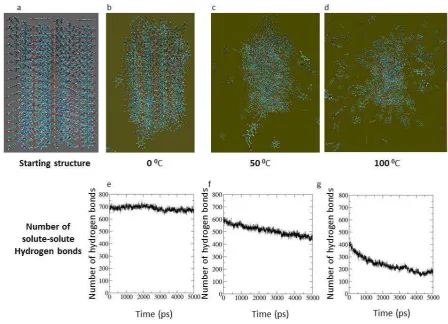
The next step was to examine a cluster that has an external morphology similar to that observed in experiments. Figure 3 shows the simulation results performed for the 2 x 16 x 2 cluster -form. The results obtained were significantly different compared to the 3 x 7 x 3 array for the -form: the -form cluster at 0°C remained ordered as with the more equant shaped cluster, with some detachment of PABA molecules at the edges. On the other hand, at 50°C the needle-shaped cluster retained long range order for a longer period (for about 4ns) although after 5ns the cluster has lost much of the original order. As for the 3 x 7 x 3 cluster, at 100°C the needle-shaped cluster transformed to a liquid drop rapidly although the cluster retained order for longer period. The relatively rapid reduction in long range order -form nano-crystal at 100°C, which one would envisaged should retain its order, suggests that, perhaps, a larger cluster should be used because of the implied greater solubility at the increased temperature. The results of monitoring the long-range order through time via counting the number of hydrogen bonding solute-solute interactions were similar to those found for the 3 x 7 x 3 cluster. In summary, it was found that the needle shaped cluster retained long range order at 50°C and at 100°C for longer than the 3 x 7 x 3 cluster.
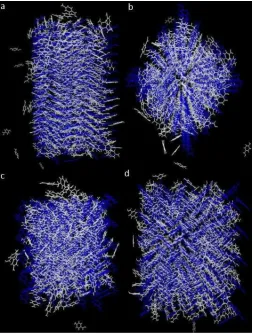
In particular, it is interesting to observe the molecules that detach first from the molecular cluster into the solvent. Figure 5 represents the superposition of the initial cluster generated for the -form and the 2 x 16 x 2 cluster after 5 ns simulation. It can be seen that the first molecules of PABA to detach from the cluster are mainly from the edges and corners. This observation is in general agreement with the simulations performed for Acetaminophen crystal by Gao and Olsen16. Additionally, it is interesting to note that the results from the simulations are supported by the simple Kossel model32.
4. Summary
The lifetime and stability of the two polymorphic forms of PABA at the nano-crystalline scale were investigated by means of molecular dynamics simulations. Simulations were performed at three different temperatures above and below the expected transition temperature to evaluate the performance of the selected force-field and to predict the critical-cluster size as a function of temperature and supersaturation ratio. The results demonstrate that the shape of the initial cluster of molecules selected i.e. being based on the experimentally observed morphology of the crystal, is important in terms of getting accurate predictions to which molecules will remain integral to the cluster and which will diffuse into the solution. The long range order of the clusters of the -form at 50°C and 100°C were, respectively, partially and completely lost after 5ns which is not expected as -form is the high-temperature stable polymorph. Building clusters containing a greater number of molecules could improve the simulated stability of the alpha polymorph at these temperatures or alternatively we should consider changing aspects of the interatomic potential employed so as to improve the stability of -form clusters in computational experiments. Additionally, the accurate description of the electrostatic potential is crucial for successfully modelling the dissolution process of nano-sized crystals via MD simulations. Overall, it has been demonstrated that molecular dynamics simulations can provide a better understanding of both the polymorph selection process and the dissolution process for organic crystals.
We are grateful to the EPSRC for the support of nucleation research at Leeds through the award of a Critical mass grant (EP/I014446/1) in collaboration with the University of Manchester. The computational work made use of the facilities of a HPC cluster provided and funded by the N8 consortium and EPSRC (Grant No.EP/K000225/1) and is co-ordinated by the Universities of Leeds and Manchester.
References
1. S. Piana, M. Reyhani, J.D. Gale, Nature 438 2005 70 2. S. Piana, J.D. Gale, J. Am. Chem. Soc., 127 2005 1975 3. I. G. Batyrev, et al. Phys. Rev. Lett., 100 2008 105503 4. S. Nangia, B. J. Garrison, J. Am Chem. Soc. 131 2009 9538
5. Y. Gao, R. A. Carr, J. K. Spence, W. W., Wang, T. M. Turner, J. M. Lipari, J. M., Miller, Mol. Pharmaceutics 7 2010 1516
6. D. C. Sperry, S. J. Thomas, E. Lobo, Mol. Pharmaceutics, 7 2010 1450 7. M. V. Dali, J. T. Carstensen, Pharm. Res., 13 1996 155
8. P. V. Pedersen, K. F. Brown, J. Pharm., 65 1976 1437 9. TX. Xiang, BD. Anderson, J. Chem. Phys., 110 1999 1807
10. R. Bahadur, LM. Russell, S. Alavi, J. Chem. Phys., 124 206 154713 11. K. Lindorff-Larsen, S. Piana, R. O. Dror, D. E. Shaw, Science 2011 517 12. M. L. Klein, W. Shinoda, Science 321 2008 798
13. H. Heller, M. Schaefer, K. Schulten, J. Phys. Chem. 97 1993 8343 14. J. Gullingsrud, K. Schulten, Biophys. J. 86 2004 3496
15. S. D. Golden, K. W. Olsen, Methods Enzymol. 437 2008 459 16. Y. Gao, K. W. Olsen, Mol. Pharmaceutics 10 2013 905
17. D. Hayakawa, K. Ueda, C. Yamane, H. Miyamoto, F. Horii, Carbohydrate Research 346 2011 2940
18. R. B. Hammond, K. Pencheva, K. J. Roberts, J. Phys Chem B, 109 2005 19550 19. R. B. Hammond, K. Pencheva, K. J. Roberts, Faraday Discussion 136 2007 87 20. R. B. Hammond, K. Pencheva, K. J. Roberts, CrystEngComm 14 2012 1069 21. S. Gracin, A. C. Rasmunson, J Cryst. Growth Des. 4 2004 1013
22. M. Sv rd, F.L. Nordström, E-M. Hoffman, B. Aziz, A.C. Rasmunson, Crystengcomm 15 2013 5020
23. Y. G. Ko, P.X. Ma, CrystEngComm, 2012, 14, 7891 7894
24. S. Athimoolam, S. Natarajan, Acta Crystallographica Section C-Crystal Structure Communications 63 2007 O514
25. S. Gracin, A. Fischer, Acta Crystallographica Section E-Structure Reports Online 612005,
O1242
26."Materials Studio," Accelrys. © 2001-2007 Accelrys Software Inc
27. J. Wang, W. Wang, P. A. Kollman, D.A. Case, Journal of Molecular Graphics and Modelling 25 2006 247260
28. J. Wang, R.M. Wolf, J. W. Caldwell, P. A. Kollman, D.A. Case, J. Comput. Chem. 25 2004 1157
29. E. Vanquelef, S. Simon, G. Marquant, E. Garcia, G. Klimerak, J. C. Delepine, P. Cieplak & F.-Y. Dupradeau, Nucl. Acids Res. (Web server issue) 39 2001 W511.
31. B. Hess, C. Kutzner, D. van der Spoel, E. Lindahl J. Chem. Theory Comput. 4 2008 435 32. V.V. Voronkov, Grotwh of crystals, 1976, pp 1-17
List of Figures
Figure 1. (a) Molecular structure of PABA. (b) Unit cell of anhydrous PABA -form (c) Unit cell of anhydrous PABA - T PABA -form (e) The
PABA -form (top and side view) (f) The 6 x 5 x 4 anhydrous
PABA -form
a b c
[image:8.595.76.508.459.733.2]Figure 2. Results of the MD simulations of a 3 x 7 x 3 nano-crystal of PABA: Starting structure (Crystal lattice constructed in Materials Studio not the equilibrated structure) (a). Snapshot taken and the number of hydrogen bond of solute-solute after 5ns simulation respectively for 0C (b) and (e), 50°C (c) and (f) and 100°C (d) and (g).