This is a repository copy of Developing adaptive capacity through reflexivity: lessons from collaborative research with a UK water utility.
White Rose Research Online URL for this paper: http://eprints.whiterose.ac.uk/82536/
Version: Submitted Version
Article:
Westling, E.L., Sharp, L., Rychlewski, M. et al. (1 more author) (2014) Developing adaptive capacity through reflexivity: lessons from collaborative research with a UK water utility. Critical Policy Studies. Published online: 30th Oct 2014. ISSN 1946-0171
https://doi.org/10.1080/19460171.2014.957334
[email protected] https://eprints.whiterose.ac.uk/
Reuse
Unless indicated otherwise, fulltext items are protected by copyright with all rights reserved. The copyright exception in section 29 of the Copyright, Designs and Patents Act 1988 allows the making of a single copy solely for the purpose of non-commercial research or private study within the limits of fair dealing. The publisher or other rights-holder may allow further reproduction and re-use of this version - refer to the White Rose Research Online record for this item. Where records identify the publisher as the copyright holder, users can verify any specific terms of use on the publisher’s website.
Takedown
If you consider content in White Rose Research Online to be in breach of UK law, please notify us by
1 Developing adaptive capacity through reflexivity: Lessons from collaborative research with a UK water utility
Emma Westlinga*, Liz Sharpa, Marta Rychlewskib, Chiara Carrozzac
a*
Corresponding author: Department of Town and Regional Planning, the University of Sheffield, Western Bank, Sheffield, S10 2TN,U.K
b
Bradford Centre for Sustainable Environments, University of Bradford, Bradford, West Yorkshire, BD7 1DP, U.K
c
The Centre for Social Studies, University of Coimbra, Associate Laboratory Colegio de S. Jeronimo, Apartado 3087 Coimbra, Portugal.
Abstract
This paper develops debates about reflexivity and its role in adaptive management and collaborative research through recounting the case of an action research project aiming to support water utilities in adapting to climate change. The project sought to produce ‘usable’ knowledge about adaptation through interpretive social scientists working closely with water utility practitioners operating within a positivist knowledge context. Developing the work of Stirling, Voß and Kemp, the paper identifies four challenges arising from this collaboration. We have named these the challenges of difference, integrity, fit and valid knowledge. Each challenge was addressed through reflexive processes of first opening-up debate, and then closing down discussion by identifying routes for action. The paper argues that these same challenges may pose difficulties and hence require careful consideration in other collaborative projects that cross not only the interpretive-positivist but also the research-practice divide. We conclude that if collaborations are to be maintained, making things less comfortable and more reflexive must be cautious, based on strong relations of trust and willingness to, at times, compromise on what one believes is ‘usable’ knowledge.
2 Introduction and context
The interpretive social sciences have a very particular role to play in relation to climate change […] It is to make us more aware, less comfortable, and hence more reflective
about how we intervene, in word or deed, in the changing order of things (Jasanoff, 2010, p. 249).
This paper provides evidence about the role of reflexivity in collaborative knowledge production when interpretive researchers work with practitioners in a positivist field of practice. It tells the story of how the partners negotiated their way through a project that
sought to produce ‘usable’ knowledge through processes of making us more aware and less comfortable as implied by Jasanoff above. It develops two linked contextual fields of
knowledge. The first concerns the nature of ‘adaptive [water] management’, the area of change that was being pursued through the research described. The second relates to the challenges of collaborative research projects that bridge the schisms between research and
practice on the one hand, and the positivist and interpretive epistemological paradigms on the other (Connelly and Anderson 2007).
The past three decades have seen the emergence of ‘adaptive management’, a mode of
governance that is advocated for systems that are complex, uncertain and unpredictable (e.g. Holling 1978, Folke et al. 2005). Whereas traditional methods of governing uncertainty
sought to predict and control, adaptive management recognises that knowledge is incomplete and hence emphasises the need for flexibility and adaptive capacity so that emergent
problems and opportunities can be quickly identified and responses generated (e.g. Folke 2006). Adaptive management requires that scientific and societal stakeholders interact to identify problems and opportunities; an iterative process of collective experimentation and
3 collaboration to steer institutions towards the ‘best’ resilient state (e.g. Folke 2006) as it is
seen as including an implicit assumption that a common vision about the ‘best’ state exists
(Berkhout et al. 2004). It is also argued that adaptive management assumes that joint problem-solving is possible, hence denying potential tensions, such as value conflicts
between stakeholders (Stirling 2006, Smith and Stirling 2010, Voß and Bornemann 2011). Although contributions from the adaptive management literature, including the later developments of adaptive co-management (Huitema et al. 2009) and adaptive governance
(Olsson et al. 2007), provide alternatives to predictive methods to deal with uncertainties by fostering collective learning, such approaches still exhibit positivist assumptions about
actors’ objectivity. Hence, the value-laden processes of adaptation related decision-making
continue to be hidden from view. By encouraging a collective awareness about different values and beliefs, reflexivity has been identified as one route through which these
difficulties can be overcome (Stirling 2006, Lövbrand 2011, Voß and Bornemann 2011, Mackenzie et al. 2012, Phillips et al. 2013).
Adaptive management’s aspiration to transform how complex problems are managed
has a long-standing corollary in ideas about how the science of complex problems should be developed (Lemos and Morehouse 2005). Starting from a critique of traditional science as too
narrowly focused to be useful (Brewer 1999, Klein, 2004), ‘post-normal science’ (Funtowicz and Ravetz, 1991, p. 138), ‘collective experiments’ (Latour 1989), ‘Mode 2 science’
(Gibbons et al. 1994, p. 2) and ‘transdisciplinary research’ (Klein 2004) are among the terms used to describe a collaborative form of enquiry in which natural and social scientists work alongside societal stakeholders to frame problems and to generate responses. Similarly,
‘action research’ (Lewin 1946) has long denoted social research that is focused on
participating in processes of institutional transformation, while ‘social learning’ (Ison et
4 enquiry1. Like adaptive management, the key point about all of these processes is that they allow research to be shaped by those who are likely to use and implement its findings, hence,
according to their proponents, enhancing the potential for the knowledge produced to be useful (Nutley et al. 2007, p.303). According to Nowotny and colleagues, such joint working
between scientific and societal stakeholders shifts science from ‘a culture of scientific
autonomy to a culture of accountability’ (2001, p. 119). In the discussions below we will use the terms ‘collaborative knowledge production’ and ‘collaborative research’ to refer to such
processes that include interpretive and positivist scientists while also bridging research and practice. In this context, our understandings are largely drawn from the literature on action
research (Dickens and Watkins 1999), transdisciplinary research (Klein 2004) and co-production (Lövbrand 2011).
Ideas about collaborative knowledge production have also been subject to critique. A
number of commentators have raised questions about whether paradigmatically different approaches can work together (Pohl 2005, Evans and Marvin 2006, Connelly and Anderson
2007, Sharp et al. 2011). The argument is that diverse viewpoints cannot necessarily be integrated to form a single new form of knowledge. Therefore each collaborative project needs context specific negotiation and ‘transdiciplinarity requires deconstruction, which
accepts that an object can pertain to different levels of reality, with attendant contradictions,
paradoxes, and conflicts’ (Klein 2004, p.524). Hence, reflexivity has been argued to be
crucial in getting to grips with potential tensions within collaborative teams (Phillips et al. 2013). For some of these commentators there is also a more specific point about collaboration across different paradigms. Writing in relation to interdisciplinarity Pohl (2005), Evans and
1 The analytical idiom of co-production was developed by Sheila Jasanoff and examines how ways in which we
know and represent the world relate to how we live in it. In this sense, natural and social order is constantly co-produced (Jasanoff 2004, .p 2). The concept has also emerged as a normative framework for improved
5 Marvin (2006), Connelly and Anderson (2007) and Sharp et al., 2011 all suggest that it is hard to merge positivist and interpretive knowledge production processes. Nevertheless, Pohl
(2005) and Sharp et al., (2011) suggest that there is a value in ‘inter-relating inter-disciplinarity’ (Pohl 2005) in which contrasting disciplines work towards a mutually
intelligible body of knowledge (Gandy 2008, p. 566). It remains unclear exactly how ‘inter
-relating interdisciplinarity’ transfers to the collaborative research arena that includes
scientists and practitioners. Just as there are challenges interacting within interdisciplinary
research across paradigms, so it might be expected that challenges will arise when
interpretive social science operates within a largely positivist practice arena such as water
management.
There are many similarities between the concept of adaptive management and ideas about collaborative research that lead us to address the topics together. First, both are driven
by concerns about the variety of perspectives that are needed to address complex problems. Second, the concepts share a normative ideal about a new mode of scientific knowledge
production involving not only greater integration between scientific disciplines, but also more collaborative working between scientists and societal stakeholders. As noted above, the perceived value of such collaboration is that more usable knowledge is produced. A third
point of similarity arises because they have both been subject to a similar critique concerning an arguably idealised objective of collaboration between diverse groups. A final, but
important area of similarity between the approaches is the suggestion that reflexivity might provide a route to address these issues about collaboration.
At present there is a limited amount of empirical evidence on whether and how
reflexivity can help within collaborative knowledge production addressing complex systems such as societal adaptive capacity (one example is MacKenzie et al, 2012). Our aim in this
6 potential role of reflexivity in relation to both collaborative research and adaptive
management. A particular contribution is the consideration of whether and how interpretive
academics and positivist practitioners can work towards a mutually intelligible body of knowledge. Our approach is also unusual in focusing on adaptation within an organisation;
this contrasts with other discussions on adaptation that usually focus on collaborations between organisations in large-scale socio-ecological processes (e.g. Olsson et al. 2004, Tompkins and Adger 2004).
We achieve this aim through recounting the role that reflexivity played in a highly collaborative action research project aimed at supporting the development of adaptive
capacity within a UK water utility. In the next section we discuss reflexivity in collaborative research further and set out the theoretical foundation for the analysis of the collaborative project, focusing particularly on the role interpretive research can play within a generally
positivist practice context. The subsequent empirical sections explain and analyse how the collaborative research sought to develop adaptive capacity through a number of different
processes of reflexivity. The paper concludes with some of the challenges faced; our assertion is that these same challenges may pose difficulties and hence need careful consideration in many other projects.
Reflexivity in Collaborative Research and Governance
Reflexivity is variously referred to as an unavoidable human capacity, as a critical or
self-critical act, or as a circular, recursive process to reflect upon human communication (Lynch 2000). It is the latter meaning that is most commonly developed within a research context,
for example, by Finlay in his description of reflexivity as a process of ‘examining how the
researcher and intersubjective elements impinge on, and even transform, research’ (p. 210).
7 which the researchers explicitly reflect on their role in knowledge production to strengthen its content and the transparency and legitimacy of the research process.
Reflexivity is the key means through which action research seeks to provoke collective awareness and disarrange beliefs and values among participants. Allowing for
reflexivity provides a space for opening up questions, debate, and assumptions and for discussing differences (Lövbrand 2011, Phillips et al. 2013). Reflexivity therefore aims to
‘develop a collective capacity to reflect upon the salient narratives and their roles in shaping
society’ (Felt and Wynne 2007, p. 75). The concept of reflexivity has also gained increased
attention in environmental governance (e.g. Stirling, 2006, Voß and Kemp 2006, Beck 2006,
Grin 2006, Hendriks and Grin 2007, Smith and Stirling 2010, Voß and Bornemann 2011). Here reflexivity is a means to envision a diversity of possibilities to support the development of alternatives to current action modes and strategies (Beck 2006). Hence reflexivity is a
point of departure underpinned by a plurality of options emphasising that there is no ‘single
-truth’ and no universal solution to a problem (Grin 2006, p. 69). Stirling (2006) refers to such
reflexive processes as a mode of ‘opening up’ debate in terms of revealing how different
information, disciplines, value-conflicts and differences in interests and power impact upon the interpretation of evidence and decision-making processes. By opening up, reflexivity has
the potential to include the excluded (for example, marginalised viewpoints, issues not previously considered, and uncertainties previously ignored) and to identify new options to
assist the development of more informed decisions. Stirling contrasts ‘opening up’ with the
‘closing down’ mode that reduces complexity by avoiding conflict-prone contradictive views
to provide focused authoritative and prescriptive advice (Stirling 2006). Voß and Kemp
(2005) have developed these ideas further; they call the contradiction between opening up
and closing down the ‘efficacy paradox’ (2005, p. 2), and argue that both processes are
8 concept that approaches the balance between the two contradictory extremes.
Drawing on the efficacy paradox (Voß and Kemp 2005, p. 2), this paper examines the
role of reflexivity in collaborative research and adaptive management through identifying contradictions in terms of tensions that arose in our action research project. In line with the
literature (Grin et al. 2004, Voß and Kemp 2005, Stirling 2006, Hendriks and Grin 2007), reflexive governance is understood to be present in practice through the creation of moments where actors can scrutinise current strategies, values and beliefs to identify alternative ways
of addressing them and form routes for action. We refer to these particular points of time in
which a discourse is shaped by reflection as ‘reflexive arrangements’ (Hendriks and Grin
2007, p. 334). We apply a reflexive lens in analysing the way in which researchers and practitioners negotiated their way through the process of opening up and closing down in
order to produce something ‘usable’. Discussions consider where in the research process
reflexivity occurred, what form it took, and the tensions encountered. Hence, our aim in this
paper is not to introduce a normative ‘product’ for a more reflexive stance to adaptation or
collaboration as has been achieved by other authors (e.g. Tompkins and Adger 2004, Pahl-Wostl 2009, Voß and Bornemann 2011). Rather, we describe and reflect on the process in which such a product was developed. By so doing we seek to (1) contribute to the
understanding of reflexivity theory and specifically how the contradictions of opening up and closing down play out in the practice of collaborative knowledge production and adaptive
management (2) support researchers and practitioners facilitating reflexivity in their research projects/organisations (3) provide insight to interpretive social scientists working on
collaborative projects in practice environments in which the approach to knowledge is
9 The PREPARED project: case study background
‘PREPARED Enabling Change’ (henceforth PREPARED) was awarded funding as part of
the European Commission Seventh Framework Programme 'Environment' in May 2009. In
total, 35 partners representing city or regional utilities and research institutes participated in the project that ran for four years from February 2010. The proposal defined the overall aim as supporting urban utilities in Europe and worldwide through developing an advanced
strategy to meet the upcoming challenges for water supply and sanitation posed by climate change. By linking academic research with development programmes in partner utilities, the
project expected to provide significant synergistic opportunities for the utilities to improve their preparedness for the ongoing changes related to the provision of water supply and
sanitation (PREPARED 2009).
In this paper, we draw on the work emerging from PREPARED that was underpinned by an action research approach (e.g. Reason and Bradbury 2008) and considered the
organisational and social processes through which adaptation occurs in water management. The primary aim of the research was to deliver tools, knowledge and learning materials for
utilities to build capacity to manage their water supply and sanitation systems using an adaptive approach. Our partner water utility was willing to participate because PREPARED
linked to the utility’s existing innovative practice in relation to Asset Management, and the
research offered a route to publicise and develop this area of the utility. An action research approach was deemed appropriate due to the normative nature of the PREPARED project in
seeking to generate knowledge with strong implications for practice. It was also seen as suitable due to its highly participatory methods combining action, reflection, theory and practice to produce practical knowledge (Reason and Bradbury 2008, p. 1).
10 three social scientists and two research engineers. The practitioners included a ‘core team’ of three engineers from different functions across the utility who supported the development of
PREPARED, but also a wider set of some forty engineers and environmental science
practitioners who participated in interviews and workshops. Specifically, the paper considers
‘reflexive arrangements’ including three workshops as well as interactions with the core team
in meetings, telephone calls and emails. In addition we draw on semi-structured interviews with the core team about their experiences of the project. Finally, an external social scientist
was invited to observe the first workshop to provide an ‘outsider’ perspective, and further interactions with this researcher continued through the project influencing the thinking of the
social scientists and further developing their reflections.
In the preparation of this paper a two-day workshop was arranged for the authors (social scientists) to collectively reflect on the knowledge production process of the
PREPARED project. Although the research team also included research engineers, this paper
focuses on the interpretive social scientists’ perspectives about the action research project and
how the knowledge production processes shaped and influenced the way the social scientists created meaning for their work with the practitioners in the water utility. In addition, the paper provides insights into the practitioners’ perceptions about the collaborative research
process and their experiences of working with the social scientists.
Developing adaptive capacity in a Water Utility
Our analysis of the role of reflexivity in collaborative knowledge production and adaptive
management as experienced through the PREPARED project draws on the transformation of the original proposal’s ‘audit tool’ to an ‘Adaptation Planning Process’ (APP). Drawing on
11 following sections recount the transformation of a ‘tool’ to a ‘process’ which was
collaboratively developed during the project. While reflexivity had no explicit role in the
process of ‘becoming adaptive’ from the beginning, it gained more formal importance
throughout the process of working out what a strategic planning process could be. Although
parts of the final APP strongly aligned with an engineering logic of responding to identified risks and uncertainties, reflexivity formed a crucial thread throughout the process in enabling the values, interests and assumptions that underpin how these responses are identified to
become explicit. Figure 1 illustrates the project’s chronology highlighting the key reflexive
[image:12.595.83.503.333.483.2]arrangements.
Figure 1. Chronology of the PREPARED project.
From Audit Tool to Adaptation Planning Process
For the PREPARED proposal the project’s first task was the development of a ‘framework’
to characterise an adaptive city or utility, and the second was its translation into the audit tool.
As defined in the proposal the audit tool was referred to as a ‘spreadsheet based tool’ (PREPARED 2009, p. 75). The purpose of the audit tool was to provide the end user with a
12 characteristics as defined by the framework. However, in the kick-off meeting for the project, it was recognised that achieving an unambiguous definition of an adaptive organisation
would be challenging. Instead it was more likely that the framework would identify competing ideas about what it means to be adaptive. Hence, the meeting participants
questioned whether a generic spreadsheet based tool was the most appropriate way to assess a
water utility’s adaptive capacity to climate change. Rather it was highlighted that the way in
which an organisation is able to adapt is context specific and that the priorities, values, risks
and uncertainties of the particular water utility have to be considered.
In order to move away from a generic tool to assess the water utility towards a more
reflexive process an extensive and highly interactive period followed between the research team and the practitioners. This took place through the planning and implementation of a series of three workshops, aiming to provide space for the water utility to define a shared
understanding of values, goals, constraints and uncertainties and agreed routes through which these were addressed and translated into action. The three workshops all focused on the Asset
Strategy & Planning team within our partner utility D r Cymru Welsh Water (DCWW). The focus on this team was always seen as an exemplar or ‘case’ through which the use of the workshops could be developed before they were applied elsewhere in the organisation. The
team selected was one in which the organisation was already breaking the boundaries of normal practice for the industry.
The first workshop aimed to discuss four competing adaptive governance ideals
referred to as ‘frames’ that were identified through the initial research phase of the
PREPARED project. The identification of the frames drew on some forty in depth interviews
with water utility employees and representatives from their partner organisations including government departments, economic and environmental regulators, engineering consultancies
13 ideally be managed in the region including a concept of what it meant for the water utility to be adaptive. In total four frames referred to as Market, Environment, Technocracy and People
of Wales were identified through the research and used in the workshop. The main purpose of the workshop was to validate the frames, to examine how they formed internal and external
pressures for the water utility team and to identify what the water utility practitioners collectively perceived as a desirable balance between these frames in their future practice. The Frames Workshop involved thirteen participants in total. The participants were primarily
a mixture of engineers and middle managers from the Asset Strategy & Planning team within DCWW, but also included participants from external stakeholders and employees from
Wastewater Operations within the water utility.
Although the definition of a frame was communicated it was clear that the concept meant different things to different people within the workshop. Frames were interpreted by
the practitioners as referring to ‘different futures’ rather than representing different
approaches to adaptation that were already present within the utility. Two of the four frames
were implicitly understood as ‘progressive’ (Environment and People of Wales) and the other
two as ‘unprogressive’ (Market and Technocracy) in the context of this utility, and
consequently practitioners felt uncomfortable if they perceived that their views were being
associated with an unprogressive frame. Another observation was that different perspectives or disagreements between the team were minimised by other team members in an attempt to
show that everyone shared one set of core values. The outcome of the workshop was a consensus among the participants that their area and activities of water management should be carried out in the future in a way that involved more active engagement with the public
14 After the first workshop, the initial understanding of the audit tool as a spreadsheet transformed into a series of workshops including the Frames Workshop, Scenario Workshop
and Roadmapping Workshop. The reason for the audit tool becoming a much larger process was due to the water utility practitioners expressing the willingness to organise more
workshops to build on the results of the initial workshop. The research engineers also gave
weight to this idea as they had previously developed a ‘scenarios approach’ to help
infrastructure providers achieve systematic discussions about the future. In their view their
scenarios approach could be re-framed to fit the utility giving the workshops a more explicit link to climate change and also helping the participants to think more systematically about the
future.
If the first workshop (Frames Workshop) explored what the water utility team wanted
to ‘do to the world’ (i.e. what values they wanted their practices to perpetuate), the second
workshop (Scenario Workshop) was focused on considering how the team should, in the context of those values, respond to the uncertainties in their world. The workshop sought to
generate ‘robust’ responses to an uncertain world, expressed through two plausible future
scenarios related to climate change and socio-economic capacity. Both scenarios were concerned with high climate change but one posited low socio-economic capacity and the
other high socio-economic capacity. The workshop involved nine participants including one external stakeholder and employees from the water utility’s Asset Strategy, Environment and
Wastewater Operations teams. The outcome of the workshop included six potential actions that could be undertaken to support adaptive capacity, arranged in rank order according to their robustness in the light of different future scenarios. The legitimacy of the research
project and the practitioners’ perception of its usefulness grew substantially through the
Scenario Workshop. In a post-workshop meeting one practitioner commented that they really
15 scenarios. However, the legitimacy of the outcomes of the specific workshop was questioned because participants felt that the scenarios used within the workshop were not place specific
enough to be of relevance. As a consequence, as part of discussions after the workshop, the scenarios were reconsidered to allow for more context-relevant examples to be used in the
future.
In the final Roadmapping Workshop, a route forward including action plans to deliver a higher level of adaptive capacity was developed. The workshop was again focused on the
Asset Strategy & Planning team within D r Cymru Welsh Water, but fourteen participants were drawn in combining this team and colleagues from related parts of the organisation
(Environment, Regulations, Legal, Innovation, Wastewater Operations, Water Efficiency and Business Information Systems), on the basis that the team’s effective operation depended on its interactions with others as well as the direct activities of its core practitioners. Because it
generated an action plan showing how the robust responses would be achieved, the
Roadmapping Workshop was perceived as further increasing the value and usefulness of the
workshop series for the utility.
During the preparation for the third workshop, one of the practitioners suggested
changing the term audit tool to ‘adaptation planning tool’. It was noted that auditing was
usually used to mean checking on something that should have already been done whereas
‘adaptation planning’ could be seen as a new and progressive activity, and hence accorded
more closely with what was being done in the workshop series. Similarly, as part of the immediate post workshop meeting it was suggested by another water utility practitioner to
change the term ‘adaptation planning tool’ to the ‘Adaptation Planning Process’ (APP). In
this case a tool was seen as something that was applied to something, whereas a process was something in which people participated. From this workshop onwards the APP replaced the
16 plans about how their activities and assets can be more adaptive to a range of different
possible futures, whilst also matching their organisational values’ (Rychlewski et al. 2013, p.
4).
As part of the extensive process of collaboratively transforming the audit tool to the
APP, reflexivity occurred at three different levels. Firstly, the research team promoted reflexivity within the water utility as an approach to adaptation; secondly, reflexive
discussions were undertaken by the project team (researchers and practitioners) to develop
the APP, and thirdly a final layer of reflexivity emerged from the social scientists when the experiences of the knowledge production process was discussed and reflected upon. These
processes of reflexivity enabled us to collectively develop new understandings of adaptation. Rather than viewing adaptive capacity as a set of general water utility characteristics, this new approach viewed adaptive capacity as an emergent quality arising from collective
thought and reflection about shared goals and actions. Reflexivity is fundamental to action research (e.g. Robertson 2000) and we argue that being adaptive as an organisation also
means being more reflexive and hence more aware and less comfortable. Such adaptation would be sensitive to the need to first open up in order to sufficiently close down. This means that an organisation becomes adaptive when an anticipated disturbance stimulates the
iterative re-evaluation of current strategies, and when values, beliefs and aspirations are made explicit and debated which eventually facilitates agreed routes to take action.
Organising for reflexivity
Drawing on the three levels of reflexivity identified above (research team reflexivity, project team reflexivity, social scientists’ reflexivity), this section further analyses where and how
17 producing usable knowledge and incorporating reflexivity in adaptation planning in the water
utility. We draw on Stirling (2006) and Voß and Kemp’s (2005) efficacy paradox in
illustrating key reflexive arrangements that included both opening up and closing down processes in the Adaptation Planning Process. The tensions between opening up and closing
down illustrate what Voß and Kemp (2005) describe as the challenge of achieving reflexive governance in fostering the balance between the two contradictory extremes. We observed tension in forms of four challenges arising from our collaborative research process, each of
which we explain below. However, first we discuss reflexivity in the Adaptation Planning Process.
Reflexivity in the Adaptation Planning Process
The concept of adaptation in the project proposal shared the normative ideals of the adaptation management literature in which it is assumed that an adaptive capacity
underpinned by a set of characteristics can be identified. Hence responses to achieve that capacity can be defined, prioritised and acted upon. Further, the research undertaken in the
PREPARED project was expected to deliver outcomes and processes that water utilities could
draw on ‘to be able to acquire the capacity for them to manage their water supply and
sanitation systems using an adaptive approach’ (PREPARED 2009, p. 17). Rather than
seeking to support adaptive capacity through a set of universal criteria, we have worked collaboratively with the practitioners and developed a process through which conversations
about adaptation to climate change can take place. We have argued that in contrast to the mainstream interpretation of adaptation, such conversations should include and make space for an element of reflexivity to stimulate debate about values, perceptions and assumptions
18 adaptation as embracing reflexivity. Such reflexivity encourages shifts from the known and comfortable to the unknown and uncomfortable and the opening up of questions. This
involves a move away from assumptions of one correct problem framing, one true evaluation of consequences or a singular best way of acting towards embracing different perspectives,
expectations and strategies in understanding societal change (Voß and Bornemann 2011, Beck 2006). At the same time each of the workshops stimulated the closing down of the debate to reduce complexity and enable the creation of action plans. The ways in which the
reflexive arrangements of the PREPARED process described in the previous section opened up and closed down dialogue and how reflexivity occurred in the development of the
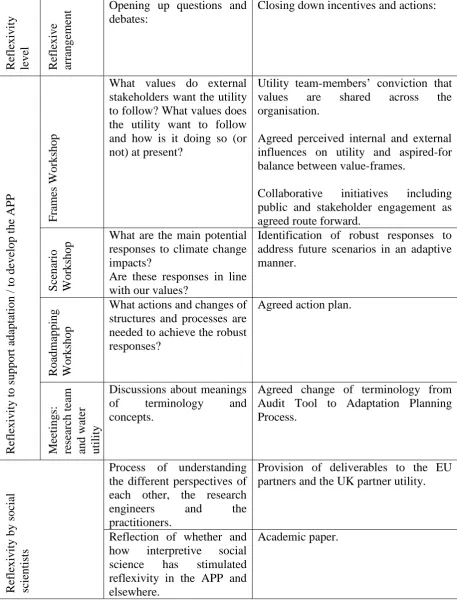
19 Table 1. Summary of key reflexive arrangements of the PREPARED project illustrating processes of ‘opening up’ and ‘closing down’.
R efle xivi ty leve l R efle xive arr ang ement
Opening up questions and debates:
Closing down incentives and actions:
R efle xivi ty t o support ada ptation / to deve lop t he
APP Fra
mes W
or
kshop
What values do external stakeholders want the utility to follow? What values does the utility want to follow and how is it doing so (or not) at present?
Utility team-members’ conviction that values are shared across the organisation.
Agreed perceived internal and external influences on utility and aspired-for balance between value-frames.
Collaborative initiatives including public and stakeholder engagement as agreed route forward.
S ce na rio W or kshop
What are the main potential responses to climate change impacts?
Are these responses in line with our values?
Identification of robust responses to address future scenarios in an adaptive manner. R oa dmapping W or kshop
What actions and changes of structures and processes are needed to achieve the robust responses?
Agreed action plan.
Mee ti ngs: re se arc h te am and wa ter uti li ty
Discussions about meanings of terminology and concepts.
Agreed change of terminology from Audit Tool to Adaptation Planning Process. R efle xivi ty by soc ial sc ientis ts
Process of understanding the different perspectives of each other, the research engineers and the practitioners.
Provision of deliverables to the EU partners and the UK partner utility.
Reflection of whether and how interpretive social science has stimulated reflexivity in the APP and elsewhere.
20 The collaborative process of working with the water utility in terms of the development of the APP provoked several opening up situations where reflexivity took place and brought politics
into play. Both the participants and researchers were faced with moments of discomfort that were followed by mutual re-evaluation of values, beliefs and meanings (i.e. language). At the
same time each of the reflexive arrangements included a closing down process to enable constructive agreement and development of actions for routes forward. However, balancing these processes of opening up and closing down was challenging, particularly in the context
of the different backgrounds and understandings about knowledge brought by ourselves and the practitioners.
Four challenges of collaborative research
The four most prominent challenges encountered in the collaboration arose as part of the particular processes of opening up and closing down experienced in the PREPARED project.
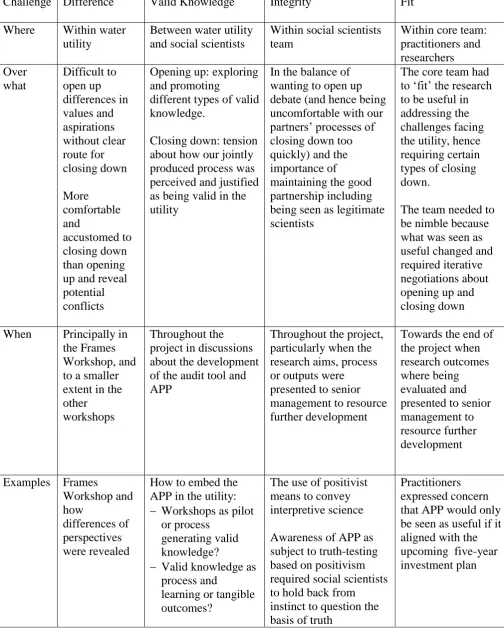
However, we would argue that similar challenges will face other researchers and practitioners working in collaborative teams across science and practice. Table 2 summarises the four
21 Table 2. Summary of key challenges of collaborative research
Challenge Difference Valid Knowledge Integrity Fit
Where Within water utility
Between water utility and social scientists
Within social scientists team
Within core team: practitioners and researchers Over what Difficult to open up differences in values and aspirations without clear route for closing down More comfortable and accustomed to closing down than opening up and reveal potential conflicts
Opening up: exploring and promoting
different types of valid knowledge.
Closing down: tension about how our jointly produced process was perceived and justified as being valid in the utility
In the balance of wanting to open up debate (and hence being uncomfortable with our
partners’ processes of
closing down too quickly) and the importance of
maintaining the good partnership including being seen as legitimate scientists
The core team had
to ‘fit’ the research
to be useful in addressing the challenges facing the utility, hence requiring certain types of closing down.
The team needed to be nimble because what was seen as useful changed and required iterative negotiations about opening up and closing down
When Principally in the Frames Workshop, and to a smaller extent in the other
workshops
Throughout the project in discussions about the development of the audit tool and APP
Throughout the project, particularly when the research aims, process or outputs were presented to senior management to resource further development
Towards the end of the project when research outcomes where being evaluated and presented to senior management to resource further development
Examples Frames
Workshop and how
differences of perspectives were revealed
How to embed the APP in the utility: Workshops as pilot
or process generating valid knowledge?
Valid knowledge as process and
learning or tangible outcomes?
The use of positivist means to convey interpretive science Awareness of APP as subject to truth-testing based on positivism required social scientists to hold back from instinct to question the basis of truth
22 The Challenge of Difference
The first challenge illustrates the tensions that arose between the practitioners in terms of us unsettling assumed shared current and future values of the water utility. This challenge was
particularly encountered in the first workshop in the Adaptation Planning Process, the Frames Workshop, where individual and organisational values related to adaptation were explicitly discussed. Whereas the practitioners could grasp the idea that water organisations held
different values and had different ideas about adaptation that imposed pressures on the water utility, the fact that values might be equally diverse within the organisation was a less
comfortable suggestion. The participants were more comfortable with closing down questions and sought to avoid tensions that openly revealed conflicting values and assumptions within
their utility, which they were used to perceiving as a singular entity. The issue of being uncomfortable was also reflected upon in the interviews with the practitioners directly involved in the PREPARED project. One practitioner for example said that as a utility ‘[...]
we just don’t understand where this [discussion of different values] is leading to [...].Yet, as
soon as that [the APP] turned out to be a structured, logical, engineering based solution, or
almost, then we were all comfortable with it again.’ (P12
). The importance of the utility being viewed as a united organisation also became clear when the need for the Frames Workshop was questioned by a number of the practitioners. The utility’s organisational values had been
previously identified and published by the utility’s central management; it was anticipated
that these values were already shared amongst all of the employees, and hence that
discussions of values was unnecessary. However, one practitioner in particular confirmed that identifying conflicting values was adding a new element to how they usually planned their activities in stating that ‘[...] the bit that was novel and exciting was [...] the Frames
2
23 [Workshop] and starting to think about a different way of highlighting some of the issues to
people’ (P1).
The Challenge of Valid Knowledge
The second challenge relates to what was perceived to constitute valid knowledge among the participants in terms of producing valuable outcomes from PREPARED. This tension was particularly highlighted in discussions about whether and how to embed the APP within the
wider water utility. Both during and at the end of the three workshops ‘pilot’ the practitioners expressed interest in developing the workshop process as a whole, but not in delivering the
actions identified in the completed workshops. One consequence was that the existing pilot workshop series itself became less authentic for participants because there was no clear route
through which the outcomes of the workshops would be implemented. At the end of the project, the water utility asked for another series of workshops so that the APP, now it had
been developed, could be fully ‘piloted’. Something of an impasse developed: the utility
would not listen to the outcomes of an APP until it had been fully piloted, but the researchers
saw little value in another ‘inauthentic’ APP pilot where management had not already
promised to consider the outcomes.
A second demonstration of the challenge of valid knowledge is that only the tangible ‘Action
Plan’ was seen as an outcome of the workshop process, (and as noted above, even this was
not seen as validated). As social scientists we perceived other forms of knowledge production as valid that were not seen as sufficiently tangible to be labelled as outcomes by the
practitioners. For example, we know that new conversations between different team members were stimulated during the workshop process, and even the practitioner leading the Asset
Strategy & Planning team in the utility explained that the workshops affected the team’s
24 the importance of [internal] communication’ (P4). For the social scientists this comment constitutes valid knowledge of an outcome achieved, but for the practitioners it is a subjective
opinion, and not sufficiently proven to constitute evidence for the utilities’ senior
management about the effectiveness of the APP. As proposed by Jasanoff (2010) the example
illustrates the tension between the view of knowledge production as impersonal and universal and the subjective, normative and contextual engagement in terms of activities which the practitioners take part in their everyday role as water engineers. Our research process gained
legitimacy for being objective and universal, not necessarily from highlighting the subjective and political aspects of the practices we researched. However, here we avoided opening up
the discussion about the nature of valid knowledge: the most important outcome for us was that the reflexive process of the APP was perceived as usable and taken forward. In this context we expected that explanations about the value of interpretivism would have seemed
obscure and academic, as well as contrary to the practitioners’ existing positivist knowledge
frames, and hence would potentially have undermined rather than supported our goal.
Overall, the challenge of valid knowledge concerned the difficult line that we trod between on the one hand claiming expertise and validity as scientists, and on the other hand,
recognising the limitations and partiality of all expertise.
The Challenge of Integrity
The third challenge relates to the tensions we as social scientists experienced in the process of
producing ‘valid’ knowledge to meet the expectations of our partner utility, our engineering
colleagues and the EC whilst maintaining our own research integrity. Due to the
practitioners’ positivist understandings the social scientists were expected to behave like
25 the type of science that we perceived was expected from us. The research engineers held an important role as translators or mediators between the social scientists and the water utility
practitioners in these processes. To some extent they worked as a filter through which the social scientists were proposing ideas and direction for the project. Although our engineering
researcher colleagues understood something of our interpretive approach, they nevertheless encouraged us to argue for our research through positivist means. A description of the research using conventional scientific language made the research more accessible to them
and hence (we and they inferred) to the practitioners.
Alongside producing ‘usable’ knowledge, we tried to keep our integrity to legitimate
our work to ourselves and to the wider social science community. Hence, the process of working with the practitioners within the PREPARED project underpinned by an action research approach seeking to produce practical outcomes has generated a complex mixture of
feelings. These feelings both challenged and developed our interpretive science. We have all
been strongly committed to making our science ‘usable’, which in PREPARED has become
translated into embedding a reflexive process of adapting to climate change within our case study water utility. However, this commitment was sometimes challenging as we have had to work very hard at relationships and processes, in particular related to debates about valid and
usable knowledge. In this sense, the need to open up our epistemological claims and have them challenged caused us some discomfort. On the other hand, the discomfort also enabled
the process of reflection (and the writing of this paper) which provides strength as it
highlights the structural constraints of working within a positivist field of practice and, more positively, illustrates how reflexivity and interpretive science can be framed and developed in
a way that can be 'usable' within such a knowledge environment. The partnership also
highlights the strength of action research in developing our interpretive science. In particular,
26
different participants’ interests and values in terms of knowledge production. In this sense,
action research is not primarily drawn upon to gain a better understanding of adaptation in the
water industry, but rather to enable insights and awareness of the project participants’
practices, including the process of knowledge production (Robertson 2000), and hence to
make an important material contribution to achieving our shared goals.
The Challenge of Fit
The final challenge concerns the extent to which the research objectives, processes and
outcomes aligned with the organisational priorities of the water utility during the initiation, development and completion of the project. Hence, this challenge illustrates practical
tensions in the implementation of the research.
The water utility particularly valued research processes and outcomes which could form a case in order to secure funding in the upcoming price review cycle through which the
water utility bid for the investment of their activities for the next five years. In this sense, the research outcomes had to prove their economic viability. In the interviews one practitioner
suggested that isolated strategy was not highly valued in the company: ‘unless [...] they [the
utility] can see what they’re getting for their money [they are not interested] they don’t want
strategic thinkers who maybe go to conferences or plan things or develop ideas.’ (P1).
Another practitioner stressed the challenge of fit in saying that ‘there’s a challenge in getting
that requirement [what the utility wants] across and trying to understand if what you can offer
actually meets what we need’ (P2). Although the water utility’s needs and values are similar
to those of the European Commission in terms of producing tangible measurable research outcomes, the interest in the research is rather to generate outcomes that fit within the current
structure of the organisation and its financial constraints rather than to promote radical
27
practitioner and you changed the process to fit with what we asked. I think that’s really good,
so you get a product that actually can be used’ (P2). Similar observations have been made by
Lövbrand (2011) in her evaluation of another European Union project on adaptation and mitigation strategies for climate change with the ultimate aim of producing useful research
for policy. In Lövbrand’s project, involving researchers and policy makers, what was seen as useful for the policy makers was knowledge underpinned by more traditional sciences (in this case economics) that aligned with their existing goals rather than reflexive approaches that
might transform those goals. In the PREPARED project, the water utility practitioners also primarily valued positivist science underpinned by an evidence-based approach that aligned
with their engineering tradition. In contrast we researchers promoted research as something that also challenges existing thoughts and assumptions. In this respect reflexivity enables consideration of the links between what is being said and what is acted upon. For us,
providing a process for such conversations to take place is the core value of the research in this project, but at the same time knowledge that actively disturbs the perception of fit.
The challenge of fit did not always involve the research fitting in with the needs of the utility, however. At times the practitioners taking part of the workshops applied a strong visionary character in being willing to challenge and change practice and legislation to better
align them with what they perceived they need to do in terms of making water systems more adaptive. In the evaluation meeting of the PREPARED project one practitioner also
confirmed that the workshops provided an important ‘reality-check in stressing that there are
bigger more important things that we need to address’ (P4), which are not often prioritised in
their day-to-day activities. The Adaptation Planning Process (APP) meant that the bigger
issues were thought about and brought back to the agenda. The way in which the workshops were organised and enabled questions to be asked, was also highlighted as a key strength as
28
‘I think if we did them internally ourselves, it would be very difficult to get the same information out. Just the way that you approach things, our workshops tend to be very much, I do not say ‘staid,’ but it is the same people. It is the same people round the table. The same questions get asked, and we never seem to move on. Whereas, you are coming from a completely different view, so you get us thinking in a bit of a wider sense. So, yes, that was useful’ (P3).
In addition the practitioners suggested that the workshops enabled more structured ways of internal and external groups interacting, which allowed for visionary thinking and a holistic
understanding of challenges facing them and from where they originated. The Action Plans generated at the end of the APP were seen as adding value as a clear steer for where to go next in terms of how to address current and future challenges and hence become more
adaptive. Also at a more general level the APP workshops suggested new ways of working which if implemented would mean incorporating changes into higher levels of policy,
procedures and cultures. Although the practitioners valued new ways of working at times, these experiences related to the challenge of fit also highlight how action research needs to demonstrate flexibility in fitting in to the particular opportunities and incentives that are
motivating those in the organisation at present.
Conclusions and Implications
This paper highlights the structural constraints of carrying out collaborative research within a positivist field of practice and how our aspirations and ambitions to effect change in the way water is managed need to be seen in a longer term, system-wide perspective. We have
discussed how stimulating reflexivity as part of an action research approach within a positivist policy milieu involves a complex balancing act. On the one hand, we have been
29 as researchers. In this respect, producing knowledge in the context of application has meant finding a space beyond the arena of the practitioners to discuss and make sense of our
research experience.
Voß and Kemp (2005) framed this as a balance between ‘opening up’ and ‘closing
down’, and in demonstrating the strength and usefulness of this metaphor our experiences
seek to add to this aspect of Voß and Kemp’s theoretical discussion of reflexive governance.
We used the ‘opening up and closing down’ metaphor explicitly in the above discussion of
the four challenges of collaborative research which we experienced as part of the
PREPARED project in seeking to produce ‘usable’ knowledge. In terms of the challenge of
difference we suggested that, while practitioners are inevitably cautious about processes of opening up insofar as it is going to upset the current balance of activities, such caution can be minimised if there is confidence in the subsequent closing down. The three other challenges
(of valid knowledge, of integrity and of fit) each describe tensions between opening up and closing down. Specifically, the research arose because of the perceived ‘fit’ between the
research project proposal and the needs of the utility, and as the research progressed issues of fit both offered opportunities for opening up and led to restrictions and closing down.
Moreover, the challenge to produce valid knowledge according to positivist principles
embraced by the water practitioners sometimes appeared in tension with the challenge of maintaining our integrity as social scientists. Addressing these challenges involved some
compartmentalisation (closing down). We instrumentally pursued reflexive governance by the utility within the arena of our practitioner interactions, while maintaining a separate social science space in which we question and develop our understandings of our own motives and
processes. However, throughout the process we were all faced with discomfort in terms of fostering the balance between the contradictions of opening up and closing down. For us, as
30 what extent the opening up of debate led to closing down in ways that did not compromise our science. On the other hand, the practitioners faced discomfort in opening up debates
without already being aware of associated processes which enabled closing down. This concern with closing down is understandably relevant to practitioners whose jobs are
ultimately concerned with taking action. It is interesting to note that we all, at certain times, felt uncomfortable with closing down when we feared that the process that we had produced collaboratively was going to be closed down and implemented in ways which we did not
perceive as useful.
Far from thinking that reflexivity represents a guarantee of insight and revelation per
se (see Lynch 2000 for a discussion), we feel that the methodology of continually inquiring about the meaning and purpose of our practice, while at the same time attempting to stimulate this attitude in the context of the water industry, has produced findings that are of relevance
for the practice of action research and the field of interpretive social science. If a primary purpose of action research is to produce practical knowledge that is usable (Reason and
Bradbury 2008, p. 2), our case suggests that the notion of what is usable and constitutes valid knowledge are not given, even among partners sharing similar ideas and perspectives, but rather a matter of debate and of negotiation among the actors involved.
What lessons do these experiences offer for other researchers seeking to stimulate reflexive governance and for interpretive social scientists working in interdisciplinary
projects across science and practice? We suggest four key pointers or pieces of advice. First, our experience underlines the importance of developing and maintaining strong personal relationships between practitioners and researchers such that difficult factors can be
highlighted and addressed. Hence, the time and effort that need to be spent on relationships should not be underestimated. Second, in order to support reflexive governance it felt
31 own role in the research and to some extent make these processes known to our project
partners. Third, in order to manage expectations and avoid disappointment, it was important
for the researchers to explicitly and iteratively communicate diverse and sometimes
conflicting perceptions of usable and valid knowledge. Fourth, and perhaps most importantly,
the research process highlighted how as social scientists we should not be too afraid of processes of closing down and ‘compartmentalising’ debate. Effectively, through small processes of closing down, we were able to support the utility, our engineering researcher
colleagues, and ourselves in appropriate and bite-sized progress in a reflexive direction. In the PREPARED project, reflexivity has been our lens through which to explore and
stimulate change in the process of collaborative knowledge production and social order in the context of climate change. The Adaptation Planning Process illustrates an attempt to
stimulate reflexive governance in practice that opens up the political aspect of problem
framing and closes down by development of active steps towards problem solving. The incorporation of collective reflexivity has also been argued to be vital in order to move away
from adaptation as apolitical. Stimulating and reframing adaptation through reflexivity as a political concept within the water utility has opened up new perspectives, but has also
required us to constantly rearrange ourselves to fit the needs of our partners. If collaborations
are to be maintained, the process of making things 'less comfortable' must be cautious, based on strong relations of trust and a willingness to, at certain times, compromise on what one
33 References
Beck, U., 2006. Reflexive governance: politics in the global risk society. In: J.-P. Voß, D. Bauknecht, and R. Kemp, eds. Reflexive governance for sustainable development. Cheltenham: Edward Elgar Publishing Limited, 31-56.
Berkhout, F., Smith, A., and Stirling, A., 2004. Socio-technological regimes and transition contexts. In: B. Elzen, F.W. Geels, and K. Green, eds. System innovation and the transition to sustainability – theory, evidence and policy. Cheltenham: Edward Elgar Publishing Limited, 48-75.
Brewer, G.D., 1999. The challenges of interdisciplinarity. Policy Sciences, 32, 327–37.
Connelly, S., and Anderson, C.W., 2007. Studying water - reflections on the problems and possibilities for interdisciplinary working. Interdisciplinary Studies Reviews, 32 (3), 213-220.
Dickens, L., and Watkins, K., 1999. Action Research: rethinking Lewin, Management Learning, 30 (2), 127-140.
Evans, R., and Marvin, S., 2006. Researching the sustainable city: three modes of Interdisciplinarity. Environment and Planning A, 38, 1009-1028.
Felt, U., and Wynne, B., 2007. Taking European Knowledge Society Seriously. Report of the Expert Group on Science and Governance to the Science, Economy and Society Directorate. Brussels: Directorate-General for Research.
Finlay, L., 2002. Negotiating the swamp: the opportunity and challenge of reflexivity in research practice. Qualitative Research, 2, 209-230.
34 Folke, C., 2006. Resilience: the emergence of a perspective for social–ecological systems
analyses. Global Environmental Change, 16, 253-267.
Funtowicz, S.O. and Ravetz, J.R., 1991. A New Scientific Methodology for Global
Environmental Issues, in R. Costanza (Ed), Ecological Economics: The Science and Management of Sustainability, New York: Columbia University Press, 137–152.
Gandy, M., 2008. Above the treetops: nature history and the limits to philosophical naturalism. Geoforum, 39, 561–9.
Gibbons, M., et al., 1994. The new production of knowledge: The dynamics of science and
research in contemporary societies, London: Sage.
Grin, J., Felix, F., and Bos, B., 2004. Practices for reflexive design: lessons from a Dutch
programme on sustainable agriculture. International Journal of Foresight and Innovation Policy, 1 (1/2), 126–149
Grin, J., 2006. Reflexive modernisation as a governance issue, or: designing and shaping re-structuration. In: J.-P. Voß, D. Bauknecht, and R. Kemp, eds. Reflexive governance for sustainable development. Cheltenham: Edward Elgar Publishing Limited, 57-81.
Hendriks, C.M., and Grin, J., 2007. Contextualizing reflexive governance: the politics of Dutch transitions to sustainability. Journal of Environmental Policy and Planning, 9 (3-4), 333-350.
Holling C.S., ed, 1978. Adaptive Environmental Assessment and Management. John Wiley and Sons, NewYork.
Huitema, D. et al., 2009. Adaptive Water Governance: Assessing the Institutional
35 Ison, R., Blackmore, C., and Iaquinto, B.L., 2013. Towards systemic and adaptive
governance: Exploring the revealing and concealing aspects of contemporary social-learning metaphors. Ecological Economics 87, 34–42.
Jasanoff, S., 2004. The idiom of co-production, in S. Jasanoff (Ed), States of Knowledge: The Co-Production of Science and Social Order, New York: Routledge, 1-12.
Jasanoff, S., 2010. A new climate for society. Theory, Culture & Society, 27 (2–3), 233–253.
Klein, J.T., 2004. Prospects for transdisciplinarity. Futures, 36, 515–52.
Latour, B., 1998. From the World of Science to the World of Research? Science, 280 (5361), 208-209.
Lemos, M.C,. and Morehouse, B.J., 2005. The co-production of science and policy in integrated climate assessment. Global Environmental Change, 15, 57–68.
Lewin, K.,1946. Action Research and Minority Problems. Journal of Social Issues 2(4): 34–46.
Lövbrand, E., 2011. Co-producing European climate science and policy: a cautionary note on the making of useful knowledge. Science and Public Policy, 38 (3), 225–236.
Lynch, M., 2000. Against reflexivity as an academic virtue and source of privileged knowledge. Theory Culture Society, 17 (3), 26-54.
Mackenzie, J., et al., 2012. The value and limitations of Participatory Action Research methodology. Journal of Hydrology, 474, 11–21.
Nutley, S M, Walter, I, and Davies, H, 2007. Using Evidence: How research can inform public services. Bristol: Policy Press.
36 Olsson, P., Folke, C., and Berkes, F., 2004. Adaptive Comanagement for Building Resilience
in Social–Ecological Systems. Environmental Management, 34, (1), 75–90.
Olsson, P. et al., 2007. Enhancing the fit through adaptive co-management: creating and maintaining bridging functions for matching scales in the Kristianstads Vattenrike biosphere reserve, Sweden. Ecology and Society, 12 (1), 28.
Pahl-Wostl C., 2009. A conceptual framework for analysing adaptive capacity and multi-level learning processes in resource governance regimes. Global Environmental Change, 19, 354-365.
Phillips, L. et al., eds., 2013. Knowledge and power in collaborative research – a reflexive approach. New York: Routledge.
Pohl C., 2005. Transdisciplinary collaboration in environmental research. Futures 37, 1159– 78.
PREPARED, 2009. PREPARED – enabling change. Grant agreement for: collaborative project (large scale integrating project).
Reason, P., and Bradbury, H., 2008. Introduction: Inquiry and Participation in Search of a World Worthy of Human Aspiration In: P. Reason, and H. Bradbury, eds. The SAGE handbook of action research: participative inquiry and practice. London: Sage, 1-10.
Robertson, J., 2000. The three Rs of action research methodology: reciprocity, reflexivity and reflection-on-reality. Educational Action Research, 8 (2), 307-326.
Rychlewski, M., et al., 2013. Adaptation planning process: report on roadmapping workshop 22nd February 2013. PREPARED project report.
37 Smith, A., and Stirling., A., 2010. The Politics of Social-ecological Resilience and
Sustainable Sociotechnical Transitions. Ecology and Society, 15 (1), 11.
Stirling, A., 2006. Analysis, participation and power: justification and closure in participatory multi-criteria analysis. Land Use Policy, 23, 95–107
Tompkins, E. L. and. Adger, W.N., 2004. Does adaptive management of natural resources enhance resilience to climate change? Ecology and Society 9 (2), 10.
Voß, J.-P., and Bornemann, B., 2011. The politics of reflexive governance: challenges for designing adaptive management and transition management. Ecology and Society, 16: 2 (9).
Voß, J.-P., and Kemp, R., 2005. Reflexive Governance for Sustainable Development – Incorporating feedback in social problem solving. 6th International Conference of the European Society for Ecological Economics (ESEE), 14–17 June 2005, Special session on transition management, Lisbon, Portugal, 1-31.
38 Figure Captions
Figure 1. Chronology of the PREPARED project’s Work Area 6
Table Captions
Table 1. Summary of key reflexive arrangements of the PREPARED project
illustrating processes of' ‘opening up’ and ‘closing down’
Table 2. Summary of key challenges of collaborative research in relation to the