White Rose Research Online URL for this paper:
http://eprints.whiterose.ac.uk/94456/
Version: Accepted Version
Article:
Turner, H., Tatham, M., Lant, M. et al. (2 more authors) (2014) Clinicians' concerns about
delivering cognitive-behavioural therapy for eating disorders. BEHAVIOUR RESEARCH
AND THERAPY, 57. pp. 38-42. ISSN 0005-7967
https://doi.org/10.1016/j.brat.2014.04.003
Article available under the terms of the CC-BY-NC-ND licence
(https://creativecommons.org/licenses/by-nc-nd/4.0/)
[email protected] https://eprints.whiterose.ac.uk/ Reuse
Unless indicated otherwise, fulltext items are protected by copyright with all rights reserved. The copyright exception in section 29 of the Copyright, Designs and Patents Act 1988 allows the making of a single copy solely for the purpose of non-commercial research or private study within the limits of fair dealing. The publisher or other rights-holder may allow further reproduction and re-use of this version - refer to the White Rose Research Online record for this item. Where records identify the publisher as the copyright holder, users can verify any specific terms of use on the publisher’s website.
Takedown
If you consider content in White Rose Research Online to be in breach of UK law, please notify us by
Clinicians’ concerns about delivering cognitive-behavioural therapy
for eating disorders
Hannah Turner (1)
Madeleine Tatham (2)
Marie Lant (3)
Victoria A. Mountford (4,5)
Glenn Waller (6)
1. Southern Health Eating Disorders Service, Southern Health NHS Foundation Trust,
Southampton, UK
2. Norfolk Community Eating Disorders Service, Norwich, UK
3. Barnsley Specialist Adult Learning Disability Health Service, South West Yorkshire
Partnership NHS Foundation Trust
4. South London and Maudsley Eating Disorder Service, South London and Maudsley
NHS Foundation Trust, London, UK
5. Institute of Psychiatry, King’s College London, London, UK
6. Clinical Psychology Unit, Department of Psychology, University of Sheffield, UK
Corresponding author
Glenn Waller, Clinical Psychology Unit, Department of Psychology, University of
Sheffield, Western Bank, Sheffield S10 2NT, UK. Email: [email protected];
Clinicians’ concerns about delivering cognitive-behavioural therapy
for eating disorders
Abstract
Despite research supporting the effectiveness of evidence-based interventions in the
treatment of eating disorders, those interventions are under-utilized in routine clinical
practice, possibly due to clinicians’ concerns about delivering the relevant techniques. This
study examined what elements of therapy clinicians worry about when delivering
cognitive-behavioural therapy (CBT) for the eating disorders, and what clinician variables are
associated with such concerns. The participants were 113 clinicians who used individual
CBT with eating disorder patients. They completed a novel measure of concerns about
delivering elements of CBT, as well as demographic characteristics and a standardised
measure of intolerance of uncertainty. Clinicians worried most about body image work and
ending treatment, but least about delivering psychoeducation. Their concerns fell into four
distinct factors. Older, more experienced clinicians worried less about delivering the CBT
techniques, but those with greater levels of prospective and inhibitory anxiety worried more
about specific factors in the CBT techniques. Clinicians’ capacity to tolerate uncertainty
might impair their delivery of evidence-based CBT, and merits consideration as a target in
training and supervision of CBT clinicians.
Clinicians’ concerns about delivering cognitive-behavioural therapy
for eating disorders
Cognitive-behavioural therapy (CBT) can be effective in the treatment of adult
women with eating disorders across the diagnostic spectrum (e.g., Bulik, Berkman,
Brownley, Sedway, & Lohr, 2007; Fairburn & Harrison, 2003; National Institute for Clinical
Excellence, 2004). Over the past 25 years, CBT approaches have been refined, resulting in
the widespread availability of manualised approaches (Fairburn, 2008; Gowers & Green,
2010; Waller, Corstorphine, Cordery, Hinrichsen, Lawson, Mountford, & Russell, 2007).
While much of the evidence of efficacy of those approaches derives from tightly-controlled
research trials (e.g., Fairburn, Cooper, Doll, O'Connor, Bohn, Hawker, Wales, & Palmer,
2009; Fairburn, Cooper, Doll, O’Connor, Palmer, & Dalle Grave, 2013; Poulsen, Lunn,
Daniel, Folke, Mathieson, Katznelson, & Fairburn, 2014; Zipfel, Wild, Gro , Friederich,
Teufel, Schelberg, Giel, de Zwaan, Dinkel, Herpertz, Burgmer, Löwe, Tagay, von
Wietersheim, Zeeck, Schade-Brittinger, Schauenburg, & Herzog, 2014), recent studies have
demonstrated its effectiveness in routine clinical settings (e.g., Byrne, Fursland, Allen, &
Watson, 2011; Waller, Gray, Hinrichsen, Mountford, Lawson, & Patient, 2014). However,
such effectiveness depends on the use of the core techniques developed in efficacy studies,
and particularly the use of manual-based methods (e.g., Addis & Waltz, 2002; Cukrowicz,
Timmons, Sawyer, Caron, Gummelt, & Joiner, 2011). The use of manuals to direct CBT for
the eating disorders is associated with greater use of core techniques, such as cognitive
restructuring, goal setting, problem solving techniques, relapse prevention, self-monitoring,
nutritional counseling, stress management, and homework assignments (Simmons, Milnes,
& Anderson, 2008). However, relatively few clinicians use manuals and evidence-based
techniques with the eating disorders (Tobin, Banker, Weisberg & Bowers, 2007; von
Ranson, Wallace & Stevenson 2013; Wallace & von Ranson, 2011; Waller, Stringer &
Meyer, 2012).
In order to address this research-practice gap, it is vital to understand why clinicians
suggests that a common reason is that clinicians are not aware of the evidence base, but
also identifies reasons that are more centred in the clinician’s own nature. For example,
Shafran, Clark, Fairburn, Arntz, Barlow, Ehlers, Freeston, Garety, Hollon, Ost, Salkovskis,
Williams and Wilson (2009) suggest that commonly-held clinician beliefs might impede the
use of evidence-based treatment (e.g., ‘the therapist is more important than the treatment
protocol in determining outcome’; ‘it is more valuable to mix and match parts of different
interventions’). Other factors include levels of therapist training, clinical competence and
supervision, all of which are pertinent to efforts to bridge the research-practice gap (Fairburn
& Cooper, 2011, Fairburn & Wilson, 2013).
Another characteristic that has been considered is the emotional component of
therapist ‘drift’ (Waller, 2009). In particular, there is evidence that clinicians who are more
anxious are less likely to deliver the more effective elements of CBT for the eating disorders
(Brown, Mountford & Waller, under consideration; Waller, Stringer & Meyer, 2012). It can be
hypothesised that clinicians’ failure to encourage the patient to engage in clinical change
represents a safety behaviour, where their concerns about distressing the patient make them
less likely to push for the key elements of change. This pattern is likely to make the patient
feel safer in the short term, but to make them less likely to recover in the long term. What is
not clear is which elements of evidence-based CBT for the eating disorders are of greatest
concern to the therapist, and what clinician characteristics might be related to their worry
about implementation of different elements of CBT. For example, it might be the case that
clinician experience, age and trait anxiety are all associated with level of worry about
different elements of CBT for the eating disorders.
The aim of this study is to identify what elements of therapy clinicians worry about
when delivering CBT for the eating disorders, whether those elements form natural
groupings, and what clinician characteristics are associated with their concern about
different parts of CBT. It is hypothesised that older, more experienced clinicians will be less
worried about delivering the different elements of CBT. However, it is also hypothesised that
worry about the different elements of CBT for the eating disorders.
Method
Ethical clearance
The research was approved by the research ethics committee of the Department of
Psychology, University of Sheffield, UK.
Participants
The participants were 113 clinicians (99 female, 14 male), all of whom reported using
individual CBT with at least part of their eating disorder clientele. A further 12 clinicians were
excluded because they reported not using CBT with any eating disorder patients. Their
mean age was 41.1 years (SD = 11.8, range = 23-75), and they reported a mean of 11.8 years of experience working with the eating disorders (SD = 11.0, range = 0-40). They came from a wide range of professions, including clinical psychology, psychiatry, nursing, social
work and occupational therapy. The mean proportion of patients who they treated using CBT
was 69.7% (SD = 27.3). The participants were recruited from teaching sessions on CBT for the eating disorders (N = 89) and from eating disorder services within the UK (N = 24). Those attending the teaching sessions had opted to do so as part of their continuing
professional development. Given the nature of the data collection approach, it was not
possible to determine how many people were approached overall. The number approached
for the teaching sessions was 145 (with 89 CBT practitioners and a further 18 non-CBT
clinicians completing the survey – a response rate of 73.8%). However, the data from other
clinicians was collected using a snowball strategy, so there was no evidence of how many
were approached, and no overall participation rate could be calculated. Each participant
completed a paper questionnaire (prior to the teaching session, in relevant cases).
Measures and Procedure
Each participant gave demographic details and then completed two measures. First,
they rated how much they worried about the delivery of each of 14 elements of CBT for the
reported to be used routinely in clinical practice (Waller et al., 2012). However, it is
acknowledged that some of the elements lack an evidence base (e.g., mindfulness) and
others have been demonstrated to have little or no value (e.g., pre-therapy motivational
enhancement work) in work with the eating disorders (e.g., Waller, 2012; Waller et al., 2012).
The 14 items were rated on a 1-5 scale (‘not at all worried’, ‘a little worried’, ‘fairly worried’,
‘pretty worried’, ‘highly worried’), such that higher scores indicated greater worry about
delivering CBT elements.
The second measure completed was the short form of the Intolerance of Uncertainty
Scale (Carleton, Nordon & Amundson, 2007). This is a well-validated self-report measure of
responses to uncertainty and ambiguity. It has 12 items, rated on a five-point Likert scale (1
= ‘not at all characteristic of me’; 5 = ‘entirely characteristic of me’). It has strong
psychometric properties (Carleton et al., 2007), and reflects two factors. The first of these is
‘prospective anxiety’ (the inability to tolerate unpredictable events), and the second is
‘inhibitory anxiety’ (the inability to act due to uncertainty). Higher scores indicate greater
levels of intolerance of uncertainty. The mean scores of this sample were prospective
anxiety = 15.7 (SD = 4.84) and inhibitory anxiety = 10.1 (SD = 3.27), which are very similar to non-clinical norms (Carleton, Mulvogue, Thibodeau, McCabe, Antony & Asmundson,
2012). The internal consistencies (Cronbach’s alpha) of the prospective anxiety and inhibitory anxiety scales were 0.885 and 0.847 respectively, which is comparable to the
levels reported in the development of the measure (0.85 for each scale; Carleton et al.,
2007).
Data analysis
Where items were missed on a measure, there was no replacement of data. The
relevant N is shown in Table 1. Non-parametric analyses were used where available, due to the non-normal distribution of some scores. The dimensional relationship between worry
about delivering elements of CBT and clinician characteristics (demographic details;
analysis with varimax rotation, and the emerging scales were tested for internal consistency
using Cronbach’s alpha.
Results
Table 1 outlines clinicians’ levels of worry (range = 1-5) when delivering different
elements of CBT. The most concerning elements of delivering CBT when working with
people with eating disorders were undertaking body image work and ending treatment,
where scores varied from ‘a little’ to ‘fairly worried’. In contrast, the least worrying elements
of delivering CBT were giving information (e.g., on food, eating and weight, on life threat,
and on other effects), where scores varied between a ‘not at all’ to ‘a little worried’.
_________________________
Insert Table 1 about here
_________________________
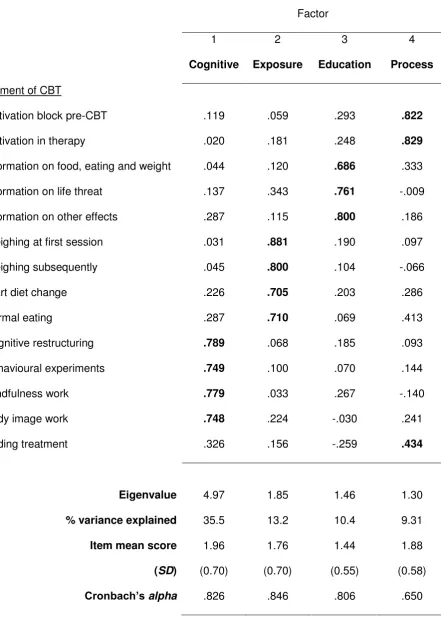
Factor analysis was used to determine whether there were underlying constructs that
subsume the individual worry items. Using both an eigenvalue of > 1 and scree analysis as
criteria, four factors emerged. The factor loadings are shown in Table 2. All items were
retained, on the grounds that each loaded uniquely on one scale at above the 0.4 level, and
none had loadings that were within 0.1 of that on another scale. These factors fell into four
scales: cognitive approaches (including behavioural experiments, which have cognitive
change as the goal); exposure-based methods (around being weighed and changes in
eating); education (provision of information); and process-related methods (motivation and
endings). Table 2 also shows the item mean scores and the internal consistency ratings
(Cronbach’s alpha), which were moderate to strong. The weaker alpha on the ‘process’
scale might be explained by the small number of items that loaded on it.
_________________________
Insert Table 2 about here
Table 3 shows the association between these four scales and the clinicians’ own
characteristics. Older, more experienced clinicians were less likely to experience worry
about most of the factors, but current exposure to CBT cases was not linked to such worry.
Considering intolerance of uncertainty, neither form was associated with worries about the
education element of CBT. Prospective anxiety was correlated with worry about the
cognitive- and exposure-based elements of CBT for the eating disorders. In contrast, both
prospective and inhibitory anxiety were related to worries about process-related elements of
therapy.
_________________________
Insert Table 3 about here
_________________________
Discussion
Evidence-based treatments such as CBT can yield positive outcomes for the eating
disorders when delivered in routine clinical practice (Byrne et al., 2011; Waller et al., 2014).
However, they are commonly not delivered adequately in such settings (von Ranson et al,
2013; Wallace & von Ranson, 2012; Waller et al., 2012). This study extended existing
research into the potential reasons why evidence-based CBT for the eating disorders is not
implemented appropriately, considering the reasons for clinicians’ concerns about delivering
different elements of the therapy.
The elements of CBT that therapists worried most about were undertaking body
image work and ending treatment, while psychoeducation was the least worrying element of
delivering CBT. Clinician’s concerns fell into four distinct factors – process-, education-,
cognitive- and exposure-related. Older, more experienced clinicians were less worried about
delivering most elements of CBT, though this was not related to current CBT caseloads.
There was no general link between trait anxiety and concerns about techniques, as there
prospective anxiety (as reflected in intolerance of uncertainty) were more likely to worry
about cognitive- and exposure-related elements of change. In contrast, both inhibitory and
prospective anxiety were associated with greater concerns about process-related elements
of treatment (motivation and endings).
These findings help us to understand why clinicians might avoid delivering some of
the core aspects of CBT for the eating disorders (e.g., Waller et al., 2012). Age and
experience are clearly associated with lower concerns about using CBT techniques.
However, clinicians’ trait anxiety characteristics are also relevant. Clinicians’ fears about the
results of action (prospective anxiety) were linked to greater concerns about using the more
impact-laden cognitive and behavioural methods (e.g., cognitive restructuring, behavioural
experiments, weighing and dietary change). Their inhibitory anxiety levels (fear of initiating
change) were linked only to process-related concerns. Thus, clinician characteristics are
likely to have an impact on the effective delivery of evidence-based CBT for the eating
disorders. A particular issue is that the clinicians were most concerned about addressing the
end of therapy and body image. While the former might mean that therapy is extended
unnecessarily, a failure to address body image effectively in therapy is an established risk
factor for relapse (Keel, Dorer, Franko, Jackson & Herzog, 2005). Therefore, the clinician’s
own characteristics (lack of experience, prospective anxiety) might have a substantial impact
on patient outcome.
It is important to note that the sample in this study included a high proportion of
clinicians who were attending training. Although attendance at the training was voluntary, it
is possible that their seeking training reflected an existing concern about the delivery of
therapy. Therefore, it is possible that these clinicians had higher scores than might be the
case elsewhere. Future research should consider whether the recruitment method involves
such biases. A further limitation lies in the conclusions that can be reached regarding the
process-related elements of therapy, given the lower internal consistency of that scale in this
study. Further work and studies with other disorders might include further items (e.g.,
internal consistency and utility of the measure.
Further exploration is needed regarding the reasons why evidence-based CBT
techniques might cause concerns to specific clinicians, and how clinicians’ own cognitions,
emotions and other characteristics might interfere with the use of such methods (e.g.,
Farrell, Deacon, Kemp, Dixon, & Sy, 2013; Harned, Dimeff, Woodcock, & Contreras, 2013).
For example, it might be the case that clinicians see exposure-based work (e.g., helping the
patient to change eating patterns) as likely to distress the patient. Addressing this concern
requires accepting that the clinician is partly correct, in that the patient probably will
experience this change negatively in the short term. However, there is also evidence that
those patients who make this change in their diet experience positive outcomes in the longer
term (Waller, Evans & Pugh, 2013). Similarly, clinicians are correct to anticipate that
effective body image work will make the patient anxious in the short term. However, to avoid
critical techniques such as exposure with response prevention (e.g., Wilson, 2004) because
of that short-term anxiety means that the body image disturbance is unlikely to change
longer-term. In short, if clinician’s own trait anxiety drives concerns about the use of effective
techniques, then the risk is that the clinician will engage in the safety behaviour of not
pressing the patient to change. Such avoidance has the short-term perceived benefit of not
distressing the patient, but also means that the patient has little imperative or ability to
change or recover in the long term.
It might be argued that clinicians’ concerns reflect a desire to maintain the
therapeutic alliance by not prioritising behavioural change that might reduce the strength of
that relationship. However, it is important to note that the eating-disordered patients of CBT
clinicians rate the working alliance relative positively (Waller, Evans & Stringer, 2012), and
that the alliance might be driven by behavioural change rather than vice versa (Brown,
Mountford & Waller, 2013), as found in CBT for other disorders (e.g., Tang & DeRubeis,
1999).
These findings have implications for the training, supervision and development of
Cooper (2011) have indicated, it is clearly important for trainers and supervisors to support
clinicians in the development of core knowledge and technical skills (e.g., how to do good
behavioural experiments; what techniques to use to facilitate cognitive restructuring).
However, it is also necessary to attend to how clinicians feel about delivering these aspects of therapy. As such, supervision could usefully provide a safe space for discussion of the
process of therapy in combination with the development of technical competence, so that
those aspects of treatment that might be more anxiety-provoking can be regularly discussed.
Training and supervision will require understanding of the basis of the clinicians’ concerns,
as well as the planning of changes in practice (e.g., exposure-based methods and
behavioural experiments for clinicians) to assist in evaluating and overcoming such concerns
(e.g., Farrell, Deacon, Dixon, & Lickel, 2013). Thus, training and supervision would play key
roles in the implementation and monitoring of evidence-based methods.
It will be important for future research to establish the concerns that clinicians have
about the implementation of evidence-based therapy techniques in other disorders (e.g.,
Harned et al., 2013). Such work will determine whether these findings relating to CBT for the
eating disorders apply to other disorders and therapies where there is evidence of therapist
drift (e.g., Becker, Zayfert, & Anderson, 2004; DiGiorgio, Glass, & Arnkoff., 2010; Stobie,
Taylor, Quigley, Ewing, & Salkovskis, 2007). The role of supervision in the effective delivery
of therapy also merits investigation, given that there is some evidence that supervisors
overestimate clinicians’ competence and adherence to treatment model, relative to
independent judges (Dennhag, Gibbons, Barber, Gallop, & Crits-Christoph, 2012). A more
objectively driven pattern of feedback to supervisees (e.g., an eating disorders specific
version of the Cognitive Therapy Rating Scale; Young & Beck, 1980) might help to increase
References
Addis, M. E., & Waltz, J. (2002). Implicit and untested assumptions about the role of
psychotherapy treatment manuals in evidence-based mental health practice. Clinical Psychology: Science and Practice, 9, 421–424.
Becker, C. B., Zayfert, C., & Anderson, E. (2004). A survey of psychologists' attitudes
towards and utilization of exposure therapy for PTSD. Behaviour Research and Therapy, 42, 277-292.
Brown, A., Mountford, V., & Waller, G. (under consideration). Clinician beliefs about what
therapeutic techniques drive weight gain over the early part of outpatient cognitive
behavioral therapy for anorexia nervosa. The Cognitive Behaviour Therapist.
Brown, A., Mountford, V., & Waller, G. (2013). Therapeutic alliance and weight gain during
cognitive-behaviour therapy for anorexia nervosa. Behaviour Research and Therapy, 51, 216-220.
Bulik, C. M., Berkman, N. D., Brownley, K. A., Sedway, J. A., & Lohr, K. N. (2007). Anorexia
nervosa treatment: A systematic review of randomized control trials. International Journal of Eating Disorders, 40, 310-320.
Byrne, S. M., Fursland, A., Allen, K. L., & Watson, H. (2011). The effectiveness of enhanced
cognitive behaviour therapy for eating disorders. Behaviour Research and Therapy, 49, 219-226.
Carleton, R. N., Mulvogue, M. K., Thibodeau, M. A., McCabe, R. E., Antony, M. M., &
Asmundson, G. J. G. (2012). Increasingly certain about uncertainty: Intolerance of
uncertainty across anxiety and depression. Journal of Anxiety Disorders, 26, 468-479. Carleton, R. N., Norton, M. A., & Asmundson, G. J. G. (2007). Fearing the unknown: A short
version of the intolerance of uncertainty scale. Journal of Anxiety Disorders, 21, 105-117.
Cukrowicz, K. C., Timmons, K. A., Sawyer, K., Caron, K. M., Gummelt, H. D., Joiner Jr, T. E.
(2011). Improved treatment outcome associated with the shift to empirically supported
Psychology: Research and Practice, 42,145-152.
Dennhag, I., Gibbons, M. B., Barber, J. P., Gallop, R., & Crits-Christoph, P. (2012). Do
supervisors and independent judges agree on evaluations of therapist adherence and
competence in the treatment of cocaine dependence? Psychotherapy Research, 22, 720-730.
DiGiorgio, K., Glass, C. R., & Arnkoff, D. B. (2010). Therapists’ use of DBT: A survey study
of clinical practice. Cognitive and Behavioral Practice, 17, 213-221.
Fairburn, C. G. (2008). Cognitive behaviour therapy and eating disorders. New York, NY: Guilford.
Fairburn, C. G., & Cooper, Z. (2011). Therapist competence, therapy quality, and therapist
training. Behaviour Research and Therapy, 49, 373–378.
Fairburn, C., Cooper, Z., Doll, H. A., O'Connor, M. E., Bohn, K., Hawker, D. M. Wales, J. A.,
& Palmer, R.L. (2009). Transdiagnostic cognitive-behavioral therapy for patients with
eating disorders: A two-site trial with 60-week follow-up. American Journal of
Psychiatry, 166,311-319.
Fairburn, C. G., Cooper, Z., Doll, H. A., O’Connor, M. E., Palmer, R., & Dalle Grave, R.
(2013), Enhanced cognitive behaviour therapy for adults with anorexia nervosa: A
UK-Italy study. Behaviour Research and Therapy, 51, R2-R8.
Fairburn, C. G., & Harrison, P. J. (2003). Eating disorders. Lancet, 361, 407-416.
Fairburn, C. G., & Wilson, G. T. (2013). The dissemination and implementation of
psychological treatments: Problems and solutions. International Journal of Eating Disorders, 46, 516-521.
Farrell, N. R., Deacon, B. J., Dixon, L. J., & Lickel, J. J. (2013) Theory-based training
strategies for modifying practitioner concerns about exposure therapy. Journal of Anxiety Disorders, 27, 781-787
Farrell, N. R., Deacon, B. J., Kemp, J. J., Dixon, L. J., & Sy J. T. (2013) Do negative beliefs
about exposure therapy cause its suboptimal delivery? An experimental investigation.
Gowers, S. G. & Green, L. (2009). Eating disorders: Cognitive behaviour therapy with children and younger people. London, UK: Routledge.
Harned, M. S., Dimeff, L. A., Woodcock, E. A., & Contreras, I. (2013). Predicting adoption of
exposure therapy in a randomized controlled dissemination trial. Journal of Anxiety Disorders, 27, P. 754-762.
Keel, P. K., Dorer, D. J., Franko, D. L., Jackson, S. C., & Herzog, D. B. (2005).
Postremission predictors of relapse in women with eating disorders. American Journal of Psychiatry, 162, 2263-2268.
Meehl, P. E. (1986). Causes and effects of my disturbing little book. Journal of Personality Assessment, 50, 370-375.
National Institute for Clinical Excellence. (2004). Eating disorders: Core interventions in the treatment and management of anorexia nervosa, bulimia nervosa and related eating disorders. London, UK: British Psychological Society.
Poulsen, S., Lunn, S., Daniel, S.I.F., Folke, S., Mathieson, B.B., Katznelson, H., & Fairburn,
C.G. (2014). A randomized controlled trial of psychoanalytic psychotherapy or
cognitive behavior therapy for bulimia nervosa. American Journal of Psychiatry, 171, 109-116.
Shafran, R., Clark, D. M., Fairburn, C. G., Arntz, A., Barlow, D. H., Ehlers, A., Freeston, M.,
Garety, P. A., Hollon, S. D., Ost, L. G., Salkovskis, P. M., Williams, J . M. G., & Wilson,
G. T. (2009). Mind the gap: Improving the dissemination of CBT. Behaviour Research and Therapy, 47, 902-909.
Simmons, A. M., Milnes, S. M., & Anderson, D. A. (2008). Factors influencing the utilization
of empirically supported treatments for eating disorders. Eating Disorders, 16, 342-354.
Stobie, B., Taylor, T., Quigley, A., Ewing, S., & Salkovskis, P. M. (2007). “Contents may
vary”: A pilot study of treatment histories of OCD patients. Behavioural and Cognitive
Psychotherapy, 35, 273–282
cognitive-behavioural therapy for depression. Journal of Consulting and Clinical Psychology, 67, 894-904.
Tobin, D. L., Banker, J. D., Weisberg, L., & Bowers, W. (2007). I know what you did last
summer (and it was not CBT): A factor analytic model of international
psychotherapeutic practice in the eating disorders. International Journal of Eating Disorders, 40, 754-757.
von Ranson, K. M., Wallace, L. M., & Stevenson, A. (2013). Psychotherapies provided for
eating disorders by community clinicians: Infrequent use of evidence-based treatment.
Psychotherapy Research, 23, 333-343.
Wallace, L. M., & von Ranson, K. M. (2011). Treatment manuals: Use in the treatment of
bulimia nervosa. Behaviour Research and Therapy, 49, 815-820.
Wallace, L. M., & von Ranson, K. M. (2012). Perceptions and use of empirically-supported
psychotherapies among eating disorder professionals. Behaviour Research and Therapy, 50, 215-223.
Waller, G. (2009). Evidence-based treatment and therapist drift. Behaviour Research and Therapy, 47, 119-127.
Waller, G. (2012). The myths of motivation: Time for a fresh look at some received wisdom
in the eating disorders? International Journal of Eating Disorders, 45, 1-16.
Waller, G., Cordery, H., Corstorphine, E., Hinrichsen, H., Lawson, R., Mountford, V., &
Russell, K. (2007). Cognitive behavioral therapy for eating disorders: A comprehensive treatment guide. Cambridge, UK: Cambridge University Press.
Waller, G., Gray, E., Hinrichsen, H., Mountford, V., Lawson, R., & Patient, E. (2014).
Individualized cognitive behavioral therapy for bulimia nervosa and atypical bulimic
cases: Generalisability of effectiveness to clinical settings. International Journal of Eating Disorders, 47, 13-17.
Waller, G., Evans, J., & Pugh, M. (2013). Food for thought: A pilot study of the pros and cons
of changing eating patterns within cognitive-behavioural therapy for the eating
Waller, G., Evans, J., & Stringer, H. (2012). The therapeutic alliance in the early part of
cognitive-behavioral therapy for the eating disorders. International Journal of Eating Disorders, 45, 63-69.
Waller, G., Stringer, H, & Meyer, C. (2012). What cognitive-behavioral techniques do
therapists report using when delivering cognitive-behavioral therapy for the eating
disorders? Journal of Consulting and Clinical Psychology, 80, 171-175.
Wilson, G. T. (2004). Acceptance and change in the treatment of eating disorders: The
evolution of manual-based cognitive-behavioural therapy. In. S. C. Hayes, V. M.,
Follette & M. M. Linehan (eds.). Mindfulness and acceptance: Expanding the cognitive-behavioural tradition (pp.243-260). New York, NY: Guilford.
Young, J. E., & Beck, A. T. (1980). Cognitive Therapy Rating Scale. University of Pennsylvania, Philadelphia: unpublished manuscript
Zipfel, S., Wild, B., Gro , G., Friederich, H-C., Teufel, M., Schelberg, D. & Giel, K. E., de
Zwaan, M., Dinkel, A., Herpertz, S., Burgmer, M., Löwe, B., Tagay, S., von
Wietersheim, J., Zeeck, A., Schade-Brittinger, C., Schauenburg, H., & Herzog, W.
(2014). Focal psychodynamic therapy, cognitive behaviour therapy, and optimized
treatment as usual in outpatients with anorexia nervosa (ANTOP study): randomized
Table 1
Clinicians’ levels of worry (1 = not at all worried; 5 = highly worried) about different individual
elements of CBT for eating disorders, and association with clinician characteristics
N M (SD)
Element of CBT
Motivation block pre-CBT 109 1.67 (0.73)
Motivation in therapy 112 1.70 (0.71)
Information on food, eating, and weight 112 1.42 (0.62)
Information on life threat 113 1.56 (0.74)
Information on other physical effects 112 1.32 (0.54
Weighing at first session 104 1.74 (0.82)
Weighing subsequently 101 1.68 (0.88)
Start diet change 112 1.86 (0.84)
Normal eating 111 1.76 (0.81)
Cognitive restructuring 110 1.74 (0.80)
Behavioural experiments 111 1.98 (0.83)
Mindfulness work 94 1.86 (0.89)
Body image work 108 2.19 (0.88)
Table 2
Factor structure (principal components analysis; varimax rotation) of clinician worries about
elements of CBT for the eating disorders, with statistics for the resulting scales
Factor
1 2 3 4
Cognitive Exposure Education Process
Element of CBT
Motivation block pre-CBT .119 .059 .293 .822
Motivation in therapy .020 .181 .248 .829
Information on food, eating and weight .044 .120 .686 .333
Information on life threat .137 .343 .761 -.009
Information on other effects .287 .115 .800 .186
Weighing at first session .031 .881 .190 .097
Weighing subsequently .045 .800 .104 -.066
Start diet change .226 .705 .203 .286
Normal eating .287 .710 .069 .413
Cognitive restructuring .789 .068 .185 .093
Behavioural experiments .749 .100 .070 .144
Mindfulness work .779 .033 .267 -.140
Body image work .748 .224 -.030 .241
Ending treatment .326 .156 -.259 .434
Eigenvalue 4.97 1.85 1.46 1.30
% variance explained 35.5 13.2 10.4 9.31
Item mean score 1.96 1.76 1.44 1.88
(SD) (0.70) (0.70) (0.55) (0.58)
Table 3
Association of domains of clinician worry with clinician characteristics (Spearman’s rho)
* P < .05; ** P < .01
Demographic characteristics Intolerance of Uncertainty Scale
Factor N
Age Years of
experience
Proportion of
CBT cases
Prospective Inhibitory
Process 105 -.29** -.28** -.01 .21* .24*
Education 111 -.31** -.41** -.12 .13 .04
Exposure 99 -.38** -.36** -.11 .20* .14