Analog Modeling of
Worm-Like Chain Molecules Using
Macroscopic Beads-on-a-String
The Harvard community has made this
article openly available. Please share how
this access benefits you. Your story matters
Citation Tricard, Simon, Efraim Feinstein, Robert F. Shepherd, Meital Reches, Phillip W. Snyder, Dileni C. Bandarage, Mara Prentiss, and George M. Whitesides. 2012. Analog Modeling of Worm-Like Chain Molecules Using Macroscopic Beads-on-a-String. Physical Chemistry Chemical Physics 14, no. 25: 9041-9046.
Published Version doi:10.1039/c2cp40593h
Citable link http://nrs.harvard.edu/urn-3:HUL.InstRepos:11920044
Analog Modeling of Worm-Like Chain Molecules Using Macroscopic Beads-on-a-String
Simon Tricard,a,* Efraim Feinstein,b Robert F. Shepherd,a Meital Reches,a Phillip W. Snyder,a Dileni C. Bandarage,a Mara Prentiss,b and George M. Whitesidesa,c,*
a
Department of Chemistry and Chemical Biology, Harvard University, 12 Oxford Street,
Cambridge, MA 02138, USA
b
Department of Physics, Harvard University, 17 Oxford Street, Cambridge, MA 02138, USA
c
Kavli Institute for Bionano Science & Technology,Harvard University, 29 Oxford Street,
Cambridge, MA 02138, USA
* Authors to whom correspondence should be addressed: [email protected],
Abstract
This paper describes an empirical model of polymer dynamics, based on the agitation of
millimeter-sized polymeric beads. Although the interactions between the particles in the
macroscopic model, and those between the monomers of molecular-scale polymers, are
Introduction
Current computational simulations can not accurately quantify the very large number of
interactions and conformations required to describe molecular phenomena (for example, polymer
dynamics, solvation, crystal nucleation and growth, molecular recognition, etc.). Descriptions of
the kinetics of dynamic phenomena are mostly unapproachable without drastic simplifications.
Assumptions and approximations – some major – are required to make aspects of static and
equilibrium problems tractable for theoretical modeling or simulation. Although we applaud the
value of digital, computational models,1-4 we also believe that analog, physical methods have a role to play in understanding molecular (and supramolecular) phenomena, and we are exploring
such models as a complement to theory and in silico simulation.
The models we are testing do not provide quantitative details of molecular properties;
rather, they are intended to improve and test our intuition concerning the effect of mechanical
agitation on the evolution of the conformation of multiparticle systems. As a first step to explore
their dynamics, we have constructed an analog, physical model using several simplifications: (i) a
relatively small numbers of macroscopic particles, (ii) a two-dimensional (2D) configuration, and
(iii) agitation using mechanical stimulation (e.g., shaking). Our physical model gives an
alternative to the analytical description and computational simulation of the dynamics of polymer
behavior.
Interpretation of the behavior of multiparticle molecular systems often rests on important
and not easily verified assumptions (e.g., the ergodic hypothesis);5 in addition, information essential to a complete interpretation of the behavior of individual constituents is not available,
and is subsumed into observable collective properties. The development of simplified systems in
of the agitation that drives the evolution of the system with time can be controlled, is broadly
relevant to study complex molecular behaviors.
We propose macroscopic agitation (which we abbreviate “MacAg”) as a strategy for
physical simulation of the behavior of microscopic systems. In this paper, we demonstrate that a
MacAg simulation of a short-chain polymer reproduces Worm-Like Chain (WLC) behavior.6 We do not claim that this model mimics molecular interactions, because the origins of the interactions
at the macroscopic and microscopic scales are fundamentally different. Instead, we have used
MacAg to simulate a specific, focused question concerning the dynamics of short-chain
molecules: that is, the temporal evolution of the end-to-end distances of short chains of beads
threaded on a flexible string as they were agitated by shaking on a 2D surface. The data
describing the end-to-end distances are compatible with predictions of the WLC theory: in
particular, we observed good agreement between this theory and the relationship between
oligomer length and persistence length for the macroscopic beads-on-a-string model.
We controlled the persistence length of the physical system by modifying the parameters
of the chain (e.g., the composition and the shape of the beads, and the diameter of the thread) and
the parameters of the agitation (e.g., the nature, the amplitude and the frequency of the shaking
motion). We observed a correlation between the persistence length of the beaded string and the
frequency of agitation. This dependence suggests that this type of mechanical agitation – which
in this system is manifestly different from the agitation experienced by molecules in solution –
can be considered, in some sense, to be analogous to temperature.
Experimental models of “beads-on-a-string” simulate aspects of the physics of granular
materials. Examples include the influence of topological constraints such as knots, the effect of
confinement of the chain on a circular vibrating bed, and phase transitions, including glass
conformation under agitation. Experiments involving macroscopic particles make it
straightforward to control a number of the physical parameters that define these systems: for
example, the nature and strength of the interactions (e.g., electrostatic or magnetic) between the
particles, the energy transferred to the system (e.g., the amplitude and frequency of agitation),
and anisotropy in the motion used to induce energy introduced into the system (e.g., by orbital or
linear agitation). Here we provide a preliminary description of the capability of MacAg to follow
one aspect of the behavior of microscopic polymers: compatibility with the WLC model. In this
analog simulation, the only interactions between the particles of the chain are the physical contact
and momentum transfer by collision, and by friction with the surface of the container driven by
agitation of the experimental apparatus.
In addition, we employed Monte-Carlo simulations to rationalize the dynamics of the
macroscopic experimental model. We found that a digitally simulated system, which behaves
according to the limited set of rules that we propose as the driving forces in the MacAg
simulations, also behaves in accordance with the WLC model.
Background
We initiated our work using MacAg in studies of the crystallization of Coulombic
crystals.1-3 Beads that were electrostatically charged (by contact electrification) with opposite charge crystallized into regular and partially ordered arrays when agitated on a flat surface.2, 3 These systems also showed complex phenomena that resembled phase separation. When these
beads were connected on a string, they became a model for polymeric or oligomeric molecules.4 Examination of the conformations of these polymer models demonstrated (for appropriate
designs of the sequences of beads) hairpin loops; this type of intrachain molecular recognition
the self-assembly was provided by an agitation system that transferred momentum to the particles
through friction between the support surface and the particles, and by collisions of the particles
with the wall of the container of the experimental apparatus. In these cases, the movement of the
particles and their interactions were strongly influenced by electrostatic charging, and by the
electrostatic interactions between charged particles.
The present study was based on experiments without electrically charging of the
components; we focused on the simplest behavior of the polymer chain under mechanical
agitation, with no influence from electrostatic interactions. Under the conditions of the
experiments we described, the bead-on-a-string system was surprisingly well described by the
WLC theory.
Worm-Like Chain Model
The WLC – also called the Porod-Kratky Chain model11 – describes a polymer or an oligomer as a string of contour length L with a persistence length Lp. The contour length L is
defined as the length of the chain at its maximal extension. The parameter Lp is described as “the
scale over which the tangent-tangent correlation function decays along the chain”, and quantifies
the stiffness of the chain.6, 12 If Lp is large compared to L, the chain is rigid; if Lp is small compared to L, the chain is flexible. According to the WLC model,6 eq. 1 described the mean-square end-to-end distance <R2> as a function of L and Lp.
(
)
−− p −L Lp
p e
L L L
=
R2 2L 1 1 / (1)
The WLC theory is a purely conformational description of a flexible long chain: it
includes no specific interactions (attractive or repulsive), no size effects, and no time dependence.
continuously flexible object; Lp is the single parameter necessary to describe the stiffness of the
chain. The calculation of <R2> comes from integration along the 1D curvilinear coordinate. Eq. 1
will thus always be an accurate description, whether we consider the chain in a two-dimensional
(2D) or three-dimensional (3D) space.6 The WLC model is typically used to describe stiff polymers, as it does not take into account the self-avoidance constraint present in real systems.
The WLC model is nonetheless the most used system to describe the dynamics of polymers,
especially biopolymers like DNA and small unfolded proteins.13-15
The dependence of the persistence length of DNA on temperature is not obvious – in part
because it is strongly influenced by interactions among ions, the charged backbone of DNA, and
the solvent – and this dependence is still an active area of study.16 More generally, the persistence length of a polymer is related to the temperature, T, according to eq. 2, where g is the bending
constant of the polymer given in Å.kcal.mol-1, and R is the gas constant.17, 18 A consequence of eq. 2 is that if the temperature has no effect on the bending rigidity of the system, Lp will decrease
with increasing temperature.
RT g =
Lp (2)
Experimental Design
Our simple physical model can reproduce elements of polymer dynamics described by the
WLC model. The macroscopic nature of the beads makes it possible to visualize in detail the
motion of the chain with a specificity and clarity that is not possible with molecular species. This
capability will help to understand the implications of theory for conformational behavior. The
mean-square end-to-end distance is a key parameter in polymer statistical physics, and is the one
end-to-end distances can be measured experimentally by a variety of methods, either collectively in
solution by Fluorescence Resonance Energy Transfer, or individually on single molecules using
optical or magnetic tweezers, Atomic Force Microscope traps and single-molecule Fluorescence
Resonance Energy Transfer.14, 15, 19-23 The macroscopic experimental model makes it very easy to follow the end-to-end distance visually and thus to characterize the statistics of the chain.
The model, however, differs manifestly in its behavior from that of molecules because of:
(i) the nature of the dominant forces at the macroscopic and microscopic scales, and the response
of the chains to them; (ii) the experimental difficulty in the macroscopic model to generate purely
random motion of the chains through mechanical agitation because the direction of transfer of
momentum is the same on all points of the chain. The simplicity of the macroscopic system, and
the obvious similarities and differences between the statistical description of the macroscopic
chain and polymers in solution still makes this model a useful tool to study complex behaviors in
macromolecules, such as the dynamics of homopolymers in solution.
Physical Experiments
The apparatus for agitation has been previously described (see Fig. S1 and materials and
methods in supplementary information).4 Agitation occurred on a flat surface covered with paper and connected to an orbital shaker with variable frequency control. The roughness of paper
assured that the beads rolled and did not slide. A pendulum attached under the platform, and
excited by a linear motor, randomized the movement. We placed chains of beads of different
natures and lengths on the surface (Fig. 1a). We threaded Nylon beads (6-mm in diameter; we use
Figure 1. a) Schematic representations of “beads-on-a-string” chains comprising either four
spherical beads or three cylindrical beads. The beads at the termini are dyed in blue for visual
contrast in image analysis. Each sphere or cylinder is separated from one another by three 3-mm
balls (grey) and two crimp tubes that assure the spacing and flexibility of the chain (black). b) R
represents the end-to-end distance measured from the images. c) A graphical representation of the
model used for Monte-Carlo simulation with four large mobile beads (green); each bead is
separated from one another by three small mobile beads (green) and two fixed beads that
constrain the movement of the mobile beads on the string (purple). d) Representative digital
images captured under agitation of spheres-on-a-string of different lengths L (4, 7, 11, 14, 17, and
21 spheres per string corresponding to L = 5.8, 11.6, 19.4, 25.2, 31.0 and 38.8 cm). e)
Representative images captured under agitation of cylinders-on-a-string of different lengths L (3,
5, 8, 10, 12, and 15 cylinders per string corresponding to L = 5.4, 10.7, 18.4, 23.9, 29.2, and 37.5
These large beads were separated by three small acrylic spheres (3-mm in diameter), which we
inserted between two metal crimp tubes to maintain the flexibility of the chain.4 We used either sphere-shaped beads or cylinder-shaped beads to modify the rigidity of the chain. Increasing the
diameter of the thread (from 75-µm to 150-µm in diameter) lowered the flexibility of the chain.
We agitated the beads-on-a-string at different frequencies, f, from 120 to 160 rounds per
minute (rpm).24 We dyed one bead at each terminus of the string to make it easier to determine the end-to-end distance, which was measured from the middle of the two terminal beads (Fig.
1b). We agitated the chains for durations ranging from 100 to 200 min, while capturing a single
digital image at regular intervals (every 30 s). We coded an image analysis program in Matlab to
determine the end-to-end distance on each frame. We calculated the mean-square end-to-end
distance <R2> over a large number of snapshots (between 200 and 400) for different lengths of
chains (Fig. 1d and 1e) and compared it to the analytical WLC model.
Monte-Carlo Simulation
We performed Monte-Carlo computer simulations using a model with digital parameters
equivalent to those of our physical beads-on-a-string model. The string was a fixed length 1D
object and, as in the mechanical model, we simulated three types of beads: large beads, small
beads, and small fixed beads (Fig. 1c). We centered fixed beads at defined positions along the
string and fixed the string straight inside each bead from its entry point to its exit point. At the
entry and exit points, the string was allowed to bend at any angle between -90 degrees and 90
degrees. Bends greater than this range would cause the beads to overlap. Non-fixed beads could
shift in one dimension into adjacent voids along the string. Beads were not allowed to overlap in
We controlled the chain flexibility by controlling the ratio of the total length of the string
to the length of the string inside the beads, which corresponded to the sum of the diameters of the
beads. For example, a chain of flexibility 1.0 was unable to bend, whereas chains of flexibility
1.01, with 1% exposed string length, and a chain of flexibility 1.20, with 20% of its length
exposed, might both bend without the beads overlapping in space. We measured the fluctuation
in mean-square end-to-end distance <R2> of chains with the same number of beads as the analog
physical system and compared the results to the analytical WLC model. Lengths are given in
arbitrary units (a.u.); one a.u. corresponds to the distance between two nearest beads in a totally
extended conformation.
Results and Discussion
Behavior of Macroscopic Beads-on-a-String under Agitation.
We considered three different chains of beads: two chains of spherical beads (6 mm in
diameter) threaded on different threads (75 or 150 µm in diameter), and one chain of cylindrical
beads threaded on a 75-µm-diameter thread. Under agitation over a period of 100 to 200 min, the
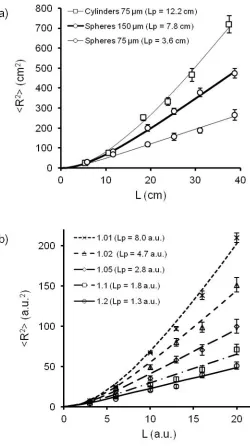
chains bent and translated across the surface. Fig. 2a shows the dependence of <R2> on the
contour length, L, calculated from the experimental data. We fit the data with the WLC model
formula given in eq. 1 and found excellent agreement, (r2 > 0.99). This correlation showed an
increase in Lp while increasing the diameter of the thread (Lp = 3.6 cm for a 75 µm-diameter
thread and Lp = 7.8 cm for a 150 µm-diameter thread). Altering the geometry of the polymeric
beads had a drastic effect on the persistence length of the chain. For the same diameter of thread,
Lp was 7.8 cm for spherical beads, and 12.2 cm for cylindrical beads. We are thus able to tune the
persistence length of the system by adjusting either the diameter of the thread or the shape of the
Figure 2. a) Mean-square end-to-end distance as a function of the length of the chain for spheres
on a 75 µm-diameter thread, for spheres on a 150 µm-diameter thread, for cylinders on a 75 µm-
diameter thread, and their corresponding Lp calculated using the Worm-Like Chain model. The
frequency of agitation was 140 rpm. b) Mean-square end-to-end distance as a function of the
length of the chain obtained by Monte-Carlo simulation for flexibilities equal to 1.01, 1.02, 1.05,
1.1, 1.2, and their corresponding Lp calculated using the Worm-Like Chain model. See the text
Eq. 2 predicts that the persistence length of a WLC is proportional to the bending rigidity
of the polymer. The experimental results showed an increase in Lp with the diameter of the
thread; the trends described by eq. 2 are thus reproduced in the MacAg model. The WLC
description was still valid when we replaced the spherical beads by cylindrical beads: Lp
increased, reflecting an increase of the rigidity of the chain. The cylinders-on-a-string is still
described by the WLC model because, even though it is constructed with cylinders, the chain is
still 1D, inextensible and continuously flexible; the presence of cylinders did not prevent
continuous bending. The supplementary information gives the distributions of R (Fig. S2).
For the WLC model, whether by simulations or analytical studies, theoretical descriptions
of the distributions of R are complex and still the subject of active discussion.25, 26 The detailed analysis of these distributions is outside the scope of the present article. Modifying the physical
properties of our simple beads-on-a-string model leads to changes in the dynamics of the system
that are qualitatively compatible with the WLC analytical model. We thus infer that our
macroscopic experimental system models at least some important aspects of WLC behavior, and
can thus be useful in exploring conceptual aspects of the dynamics of homopolymers in solution.
Monte-Carlo Simulations
We performed Monte-Carlo simulations as described in the experimental design section.
Fig. 2b shows the evolution of <R2> as a function of L for different flexibilities of the simulated
chain. We fixed the flexibility from 1.01 to 1.20, where larger numbers correspond to more
flexible chains. We fitted the experimental points with the WLC model according to eq. 1, and
found good correlations (r2 > 0.98). The persistence length decreased from Lp = 8.0 a.u. to Lp =
1.3 a.u. for flexibilities going from 1.01 to 1.2 (corresponding to decreasing the stiffness of the
We chose parameters of the simulation to match the magnitudes of the L/Lp ratios as the ones
obtained for the experiments, and ranging from approximately 0.5 to 10. The L/Lp ratios reflect
the flexibility of the chain: L/Lp >>1 corresponds to a flexible chain, and L/Lp << 1 corresponds
to a rigid chain.
The distributions of R in experiment and simulation (given in the supplementary
information) are qualitatively similar for comparable L/Lp ratios. The simulations thus provide
useful insight into the parameters that are important in controlling the mechanisms of
macroscopic chain dynamics. Indeed, numerous external parameters are important for this
macroscopic system (e.g. friction, kinetic energy, and momentum transfer through collisions) that
can be irrelevant or absent for a molecular system. Although none of these parameters is present
in the Monte-Carlo simulation, we obtained the same behavior as in the macroscopic experiment.
Obtaining similar dynamics for both the simulations and the macroscopic experiments confirms
the universal application of the WLC model for 1D inextensible and continuously flexible objects
– stiff enough to comply with the self-avoidance conditions. Both our MC model and MacAg
model fulfill the necessary conditions for WLC behavior.
The macroscopic forces (e.g., gravity, friction, collision, tension) that determine the
behavior of the macroscopic system are fundamentally different from the forces that regulate
molecular dynamics (e.g., electronic repulsion, electrostatic and dipolar interactions, solvent
interactions). Nonetheless, the WLC model apparently applies both to our macroscopic system
and to stiff molecular polymers. We thus propose to use the beads-on-a-string MacAg sytem to
model WLC molecules, and to include this analog system, and variants on it, in more complex
designs comprising supplementary components that mimic solvents, intra-chain interactions, etc.
The 2D design of the MacAg model is not a limiting characteristic in describing the dynamics of
introduction, the MacAg model gives identical results in 2D and in 3D, as long as we consider a
1D inextensible and continuously flexible object.
Effect of the Frequency of Agitation
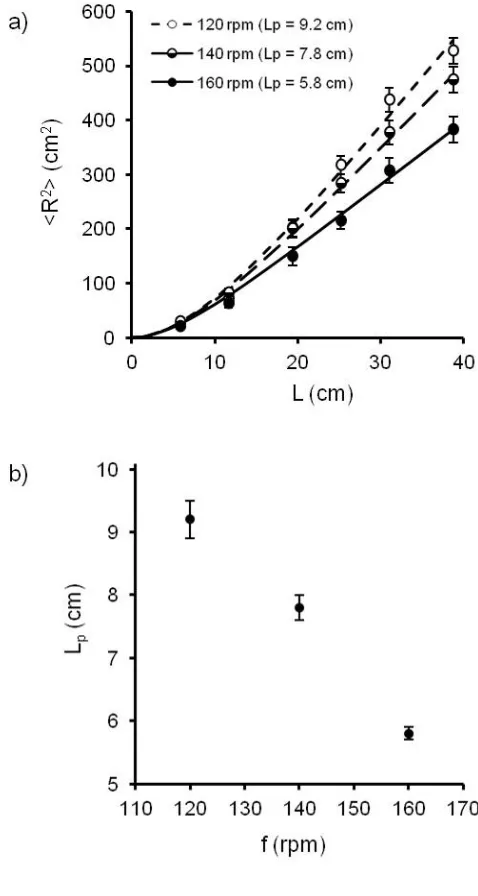
The macroscopic model is sensitive to the frequency of agitation f. Fig. 3a shows the
change of <R2> as a function of L for chains with a 150 µm-diameter thread, for three different f
(120, 140 and 160 rpm). As described above, we fit the data using eq. 1 and observed a decrease
of the persistence length from 9.2 to 5.8 cm when f increased from 120 to 160 rpm (Fig. 3b). Eq.
2 indicates that Lp for a WLC molecule is inversely proportional to the temperature, while the
rigidity of the chain, g, does not depend on temperature. Lp of a WLC molecule decreases with
increasing T and we observed a decrease of Lp of the macroscopic chains with increasing f.
Temperature at the molecular scale is proportional to the average kinetic energy of the
particles.5 In the MacAg model, the movement of the chain is induced by the agitation of the apparatus; as f increased, the elements of the chain rolled more rapidly on the surface. The
concept of “granular temperature” in granular systems has previously been defined as the
fluctuation of the kinetic energy of the grains, and is related to the frequency of agitation.27 Our macroscopic system is a simple interconnected granular system, in which the beads
have been linked together. Even though a detailed kinetic study is not within the scope of this
paper, we did observe a significant decrease of Lp as we increased f. Since we see no obvious
reason for an increase of the rigidity of the chain when increasing f, we assume that the evolution
of Lp is related to the change in f. The decrease of Lp of the macroscopic beads-on-a-string with
the frequency of agitation can thus be compared to the dependence of Lp in polymers with
temperature. Further investigations are under way to deepen this understanding of the relationship
Figure 3. a) Mean-square end-to-end distance as a function of the length of the chain for spheres
threaded on a 150 µm-diameter thread with changing frequencies of agitation and their
corresponding Lp calculated using the Worm-Like Chain model. Error bars are 95% confidence
interval. b) Evolution of the fitted persistence length Lp as a function of the frequency of agitation
Conclusion
The macroscopic experimental system of beads-on-a-string, which we present in this
paper, behaves with the same statistical description as the WLC theory – a commonly used model
for stiff polymers such as DNA or short-chain unfolded proteins. The universality of the WLC
description for both the 2D macroscopic MacAg model and some 3D molecular polymers is the
consequence of the prerequisites of the model: 1D, inextensible, and continuously flexible.
Nevertheless, the nature of the interactions that regulate the motion of the chains is
different at the macroscopic and molecular scales, and the motion of the macroscopic beads does
not follow Brownian motion. The MacAg system is thus not suitable to describe the microscopic
properties of molecular motion, but it does have remarkable phenomenological similarities with
statistical descriptions of molecular behavior. Its conceptual simplicity and its ease of visual
characterization (due to the use of macroscopic beads), makes it an interesting complement to
analytical models and simulations. These characteristics also makes MacAg systems conceptually
simple pedagogical models, and are a way to gain and test intuition.
The phenomenological similarities of our macroscopic model with WLC behavior provide
new opportunities for comparing the response of the MacAg system to more complex
phenomena. Simulations of phenomena such as polymer-solvent mixtures, phase transitions (e.g.
coil-globule), and self-assembly are currently under investigation.
Acknowledgments
We thank Dr. Xinyu Liu for insightful discussions and assistance in data analysis. This
work was supported by the US Department of Energy, Division of Materials Sciences &
References
1. B. A. Grzybowski, A. Winkleman, J. A. Wiles, Y. Brumer and G. M. Whitesides, Nat. Mater., 2003, 2, 241-245.
2. G. K. Kaufman, M. Reches, S. W. Thomas, J. Feng, B. F. Shaw and G. M. Whitesides,
Appl. Phys. Lett., 2009, 94, 044102.
3. G. K. Kaufman, S. W. Thomas, M. Reches, B. F. Shaw, J. Feng and G. M. Whitesides,
Soft Matter, 2009, 5, 1188-1191.
4. M. Reches, P. W. Snyder and G. M. Whitesides, Proc. Nat. Acad. Sci., 2009, 106, 17644-17649.
5. M. Plischke and B. Bergersen, Equilibrium Statistical Physics, World Scientific, 2006, p. 31 and 355.
6. P. J. Flory, Statistical Mechanics of Chain Molecules, Interscience Publishers, New-York, NY, 1969, p. 401-403.
7. B. Bammes and J. S. Olafsen, Chaos, 2004, 14, S9-S9.
8. E. Ben-Naim, Z. A. Daya, P. Vorobieff and R. E. Ecke, Phys. Rev. Lett., 2001, 86, 1414-1417.
9. K. Safford, Y. Kantor, M. Kardar and A. Kudrolli, Phys. Rev. E, 2009, 79, 061304. 10. L. N. Zou, X. Cheng, M. L. Rivers, H. M. Jaeger and S. R. Nagel, Science, 2009, 326,
408-410.
11. O. Kratky and G. Porod, Rec. Trav. Chim. Pays-Bas, 1949, 68, 1106-1122.
12. R. Phillips, J. Kondev and J. Theriot, Physical Biology of the Cell, Garland Science, New-York, NY, 2009, p. 363-366.
13. J. F. Marko and E. D. Siggia, Macromolecules, 1995, 28, 8759-8770.
14. M. S. Z. Kellermayer, S. B. Smith, H. L. Granzier and C. Bustamante, Science, 1997, 276, 1112-1116.
15. J. Moukhtar, C. Faivre-Moskalenko, P. Milani, B. Audit, C. Valliant, E. Fontaine, F. Mongelard, G. Lavorel, P. St-Jean, P. Bouvet, F. Argoul and A. Arneodo, J. Phys. Chem. B, 2010, 114, 5125-5143.
16. S. Geggier, A. Kotlyar and A. Vologodskii, Nucleic Acids Res., 2010, 39, 1419-1426. 17. J. A. Schellma, Biopolymers, 1974, 13, 217-226.
18. K. A. Dill and S. Bromberg, Molecular Driving Forces, Garland Science, New-York, NY, 2011, p. 664.
19. C. Bouchiat, M. D. Wang, J. F. Allemand, T. Strick, S. M. Block and V. Croquette,
Biophys. J., 1999, 76, 409-413.
20. T. E. Fisher, P. E. Marszalek and J. M. Fernandez, Nat. Struct. Biol., 2000, 7, 719-724. 21. E. Haas, M. Wilchek, E. Katchalskikatzir and I. Z. Steinberg, Proc. Nat. Acad. Sci., 1975,
72, 1807-1811.
22. M. D. Wang, H. Yin, R. Landick, J. Gelles and S. M. Block, Biophys. J., 1997, 72, 1335-1346.
23. S. Weiss, Science, 1999, 283, 1676-1683.
24. The details of the experimental setup are given in the materials and methods section in the supplementary information. The longest chain we studied was around 40 cm long (21 beads). Longer chains reached the physical limit of our apparatus, and collapsed on the side of the dish during the time of agitation.
26. S. Mehraeen, B. Sudhanshu, E. F. Koslover and A. J. Spakowitz, Phys. Rev. E, 2008, 77, 061803.