This is a repository copy of
Dynamics of a quantum reference frame undergoing selective
measurements and coherent interactions
.
White Rose Research Online URL for this paper:
http://eprints.whiterose.ac.uk/139413/
Version: Published Version
Article:
Ahmadi, M, Jennings, D orcid.org/0000-0003-1201-3725 and Rudolph, T (2010) Dynamics
of a quantum reference frame undergoing selective measurements and coherent
interactions. Physical Review A, 82 (3). 032320. ISSN 1050-2947
https://doi.org/10.1103/PhysRevA.82.032320
© 2010 The American Physical Society. Reproduced in accordance with the publisher's
self-archiving policy.
[email protected] https://eprints.whiterose.ac.uk/
Reuse
Items deposited in White Rose Research Online are protected by copyright, with all rights reserved unless indicated otherwise. They may be downloaded and/or printed for private study, or other acts as permitted by national copyright laws. The publisher or other rights holders may allow further reproduction and re-use of the full text version. This is indicated by the licence information on the White Rose Research Online record for the item.
Takedown
If you consider content in White Rose Research Online to be in breach of UK law, please notify us by
Dynamics of a quantum reference frame undergoing selective measurements
and coherent interactions
Mehdi Ahmadi, David Jennings, and Terry Rudolph
Institute for Mathematical Sciences, Imperial College London, London SW7 2PG, United Kingdom and Optics Section, Blackett Laboratory, Imperial College London, London SW7 2BW, United Kingdom
(Received 13 May 2010; published 22 September 2010)
We consider the dynamics of a quantum directional reference frame undergoing repeated interactions. We first describe how a precise sequence of measurement outcomes affects the reference frame, looking at both the case that the measurement record is averaged over and the case wherein it is retained. We find, in particular, that there is interesting dynamics in the latter situation, which cannot be revealed by considering the average case. We then consider in detail how a sequence of rotationally invariant unitary interactions affects the reference frame, a situation, which leads to quite different dynamics than the case of repeated measurements. We then consider strategies for correcting reference frame drift if we are given a set of particles with polarization opposite to the direction of drift. In particular, we find that, by implementing a suitably chosen unitary interaction after every two measurements, we can eliminate the rotational drift of the reference frame.
DOI:10.1103/PhysRevA.82.032320 PACS number(s): 03.67.Lx, 73.43.Nq
I. INTRODUCTION
It is common to assume the control fields used to manipulate quantum systems are of infinite strength and, therefore, classical. It is possible, however, to relax this assumption, and to treat them within the quantum formalism [1]—that is, as systems of bounded size and strength, and to then investigate the limitations that this finiteness does or does not impose. From the perspective of quantum computing, this could be desirable because the inevitable miniaturization of quantum information processing devices—such as ion trap chips—may make using small strength control fields a necessity (current proposals would require hundreds of watts of laser power for a full-scale quantum computation). From the perspective of quantum communication, the issue of finite-sized reference frames raises interesting questions regarding the fact that the shared references commonly used by the separated parties can drift, and realigning them requires further resource expenditure. Finally, there are interesting foundational reasons for considering finite-sized references [2–5]. An example is the work on finite-precision measurements, black-hole entropy, and symmetry deformations [6,7]. Another example, more pertinent to the work to be presented here, is the work on quantum clocks—for instance, the Page-Wootters model of a clock, which has developed into the conditional probability interpretation of time in quantum gravity [8].
In this paper, we continue a line of investigation [9,10] into a simple model of degradation of a quantum reference frame consisting of a large spin system as it repeatedly interacts with a series of incoming source particles. In Ref. [11], this program of investigation was initiated by considering a source of unpolarized spin-1/2 particles, each of which has its component of spin measured against a reference spin directional frame, by implementing the optimal measurement [10] for determining the relative direction between the frame and the system. An example of such a procedure might be the measurement of qubits in a BB84 key-distribution protocol by a finite-strength magnetic field. The conclusion there was that, in such circumstances, the reference would be useful for a time (number of uses) that scales quadratically in the size
(i.e., spin) of the reference. This conclusion was shown to be quite generally true for rotationally invariant source particles in Ref. [12]. In Ref. [13], the investigation was simplified and was extended to the case where the source of particles has some net polarization—such as in a B92-type key distribution, for example. An interesting result of Ref. [13] was that, in this instance, the drift of the reference frame was more important to its degradation than the diffusion caused by the entanglement with the particles, and now the reference would only be useful for a time linear in its size.
Both Refs. [13] and [11] considered the case ofmeasuring the source particles against the reference frame. The results of Ref. [12] also apply, however, to the case where we use the reference as a mechanism for doing coherent (unitary) interactions between the reference and an unpolarized stream of source particles. In this paper, we consider the case of degradation when we do coherent interactions between the reference system and a polarized source of particles. We also consider how well one might correct for the reference frame drift in a simple model wherein we are given, in addition to the polarized set of source particles, a smaller number of particles, which are known to have a polarization in a direction opposite to those of the source. We begin, however, by revisiting the case of using the reference to implement measurements on a polarized source of particles, exploring in more detail the dynamics in the case that the measurement results are not averaged over.
II. EVOLUTION OF THE REFERENCE FRAME UNDER MEASUREMENT INTERACTIONS
We briefly introduce the formalism for our investigations by recapping the case of a directional quantum reference frame (QRF) used for measurement; for the most part, we are following the formulation of Ref. [13].
MEHDI AHMADI, DAVID JENNINGS, AND TERRY RUDOLPH PHYSICAL REVIEW A82, 032320 (2010)
the projections
Pn=
I2
2 ±nˆ·S. (1)
Now, the question arises: What do we mean by a classical reference frame and in which aspects it is different from a quantum mechanical reference frame? A QRF is different from its classical counterpart in two ways. First, due to the inherent uncertainty in its direction, the measurement results are only an approximation of what would be obtained using the classical reference frame. Second, each time the quantum reference frame is used, it suffers a backaction, which causes the future measurements to be less accurate.
We model the QRF as a spin-lparticle, the spin components described in the normal manner by an operatorL, and consider it being used to make measurements of the direction of a series of spin-1/2 particles, each described by an operatorS. A measurement of the relative orientation between the QRF and one particle is given by a measurement ofJ2=(L+S)2 (the optimal measurement [11] for determining the relative orientation), that is, projection onto thej =l±1
2 irreducible representations (irreps) as described by projectors,
±= 1 2
I2d±
4L·S+I2d
d
, (2)
with
++−=I2d, (3) where d =2l+1. To verify this works as an approximate measurement of the particle’s spin, we then calculate the partial trace over the reference, initially in a state ρ, which yields positive operator-valued measure (POVM) operations corresponding to the two outcomes given by
±ρ =TrR[±(ρ⊗I2)]= 1 2
I2±
4L ·S+I2
d
. (4)
Note that the induced measurement on the source only depends on the expectation values of angular momentum of the reference frame, and we can write
+ρ =l+1
d I2+nˆρ·S,
(5)
−ρ = l
dI2−nˆρ·S,
where
ˆ
nρ= L l+1
2
. (6)
As is clear, this induced measurement is an approximation of what we have in Eq. (1) such that aslapproaches infinity this approximation becomes more and more accurate.
After the reference frame has been used to measure a source particle, it experiences a backaction that can be described as a quantum channel, or a completely positive trace-preserving map [14], which depends on the polarization direction of the source particlesS. Note that, for the moment, we presume the specific measurement result obtained is ignored. To derive this map, we consider
E[ρ]=Trs[+(ρ⊗ξ)++−(ρ⊗ξ)−], (7)
in whichρis the state of the reference frame andξis the state of the source particle. Using the expressions for±, we may express this channel as
E[ρ]=
1 2+
1 2d2
ρ+ 8
d2Trs[L·S(ρ⊗ξ)L·S] + 2
d2[ρ(L· S)+ρ(L· S)]. (8) This expression is coordinate independent and as such we can choose to introduce a background frame in which the source particles have their spin aligned along theZaxis. In this case, the state of the sources is given by ξ =1
2(I +zσz) so that Sz =z/2 andSx = Sy =0, and
E[ρ]=
1 2 +
1 2d2
ρ+ 2 d2
i=x,y,z
LiρLi
+ z
d2(Lzρ+ρLz+L+ρL−−L−ρL+). (9) This can be written in the more illuminating form:
E[ρ]=
1 2 +
1−z2
2d2
ρ+ 2
d2(Lz+z/2)ρ(Lz+z/2) +1+z
d2 L+ρL−+ 1−z
d2 L−ρL+. (10) As shown in Ref. [13], the reference frame to leading order suffers a drift in its orientation due to nonzero polarization in the measured particles. This drift tends to align the reference frame with that of the stream of polarized source particles and constitutes an equilibrium condition in the absence of depolarization effects.
To analyze the relative orientation between the QRF and the source particles, we consider an orthonormal frame ( ˆx′,yˆ′,zˆ′), obtained from the Cartesian frame ( ˆx,y,ˆ zˆ) via a rotation, which transforms (Lx,Ly,Lz)→(L′x(θ),L
′ y(θ),L
′
z(θ)) such thatL′x(θ) = L′y(θ) =0 andL′z(θ) =rl for some frac-tional r. Here, r quantifies the polarization of the quantum reference frame, which is aligned along the direction ˆz′. Since, by symmetry, the QRF will remain in the X-Z plane, the transformation is a rotation about the Y axis and takes the formL′x(θ)=Lx cosθ−Lz sinθ,L′y(θ)=Ly andL′z(θ)=
Lz cosθ+Lx sinθ. In Ref. [13], it was shown that, in the limit of largel, the map (10) can be approximated toO(1/ l) as
E[ρ]≈ρ+irz
2l sin θ[Ly,ρ], (11)
whereθ is the angle between the polarization of the sources (Z axis) and the polarization of the reference frame. Conse-quently, the measurement process produces an average rotation of the reference frame through an angle (θ)= −rz
2l sin θ toward the polarization direction of the sources.
A. Beyond the average map
Equation (10) provides the evolution of the reference frame due to a measurement process in which we discard the actual measurement outcome and represents the average evolution of the reference frame. However, we obtain a more accurate evolution if we take into account the specific sequence of measurement outcomes.
The average mapE[ρ] can be written as
E[ρ]=p+E+[ρ]+p−E−[ρ], (12) where a±outcome occurs with probabilityp±and the QRF evolves according to
E±[ρ]=Trs[±(ρ⊗ξ)±]/p±, (13) or more explicitly,
p±E±[ρ]=
1 4 ±
1 2d +
1−z2 4d2
ρ± z
2d(ρLz+Lzρ) + 1
d2
Lz+
z
2
ρLz+
z
2
+1+z
2d2 L+ρL−+ 1−z
2d2 L−ρL+.
As in the first part of Sec.II, these maps may be approximated toO(1/ l) as
E±[ρ]≈ ρ
2p±
± z
4lp±
(ρLz+Lzρ)+i
zr
4lp±
sinθ[Ly,ρ],
where the probability of a plus or minus outcome isp±(θ)= 1
2± 1
2zr cosθforl≫1.
Recall that we have defined the angle of inclination of the QRF in terms of vanishing expectation values, in particular, the relation Tr[L′x(θ±)E±[ρ]]=0 defined the angleθ±that the transformed stateE±[ρ] made with theZ axis, while on the other hand, Tr [L′x(θ)ρ]=0 defined the initial angleθ. Since
±=θ±−θ, we find that±is determined from the relation sin±
sin(±+θ) +zr
2l cos± ± z
2rl2
2L2z−cot (±+θ){Lz,Lx} =0. (14)
The unusual terms are the quadratic expectation values in the square brackets, which indicate that the dynamics depends on reference frame observables beyond simply the polarization. After many measurements, the dependence on these observables will tend to cancel on average, however, for a small number of measurements, their influence is of importance.
The polarizations of the source particle and the QRF together define a distinguished frame, which is described by the triple(L′x(θ),L′y(θ),L′z(θ)). In this natural frame, we find that
tan±
= −
zr
2l sin θ± z
rl2[cosθL ′
x(θ)L′z(θ) −sin θL′x(θ)2] 1+zr
2l cosθ± z
rl2[cosθL′z(θ)2 −sin θL′x(θ)L′z(θ)]
,
where we have used that the transformed angular momen-tum operators obey the usual su(2) commutation relations [L′i(θ),L′j(θ)]=iǫij kL′k(θ) [15,16]. We now consider two interesting classes of states, for which more explicit analytic solutions for±exist.
1. Partially coherent states
Since a distinguished frame exists for which the QRF is initially in a state for which L′x(θ) = L′y(θ) =0 and
L′z(θ) =rl, we can restrict to a class of states with the property that the initial stateρobeys
Tr [ρL′i(θ)L′j(θ)]= l,rl|LiLj|l,rl (15) for any choice ofiandj. These states possess a high degree of symmetry about their axis of polarization and include, as a special case, coherent states. In this set of states, we obtain± in a form that only depends on its initial angle of inclination
θ,
± = −arctan z
sinθ{r2±[l(1−r2)+1]} 2rl(1±zr cosθ)
. (16)
Forr= ±1, we have perfectly coherent states and find that
± vanishes in thel→ ∞limit, as expected, and the QRF becomes a fixed classical reference frame. Indeed, for this perfectly coherent state, we find that−=0 for allθ, which occurs since the rank of the corresponding projector is 2l+2 and the initial state lies entirely in its support.
However, for −1< r <1, we see that as l→ ∞ the rotation angles ± are nonzero, in contrast to the average map. We find that
lim
l→∞± = ±arctan z
(r2−1) sinθ 2r(1±zrcosθ)
, (17)
which reflects that the QRF does not have perfect polarization along its axis.
Indeed, from Eq. (5) it can be seen that forL ·S=rlSz′(θ) in the limit l→ ∞, the source particles do not undergo a perfect projective measurement but instead are subject to a fuzzy measurement with POVM operators ±ρ =(1/2)(I±
2rnˆ·S).
For the QRF, the large transverse fluctuations inL′x(θ)2 are affected by the projectionl±1/2and lead to a nonvanishing asymptotic rotation of the QRF.
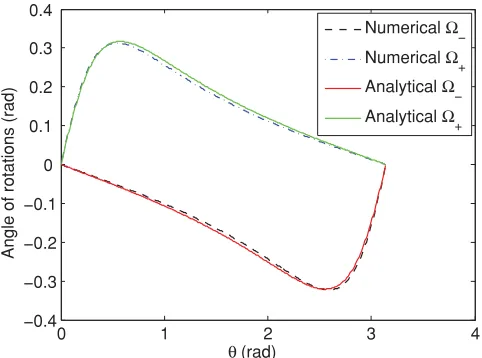
In Fig.1, we compare our analytical expression (16) with numerical results for a set of mixed initial states of the form
ρ=p exp[−iβLy]|l,k1l,k1|exp[iβLy]
+(1−p) exp[−iβLy]|l,k2l,k2|exp[iβLy], (18) and find excellent agreement. Indeed, this analytic expression provides a reasonably robust approximation, allowing for a few percent mixing of a random state to the pure partially coherent states. In such cases, the analytic expressions tend to slightly overestimate the angles of rotation.
A convenient subset of these partially coherent states is given by ρ=exp[−β(r)L′z(θ)]/Z, where Z=
Tr{exp[−β(r)L′z(θ)]}. These states correspond to a QRF partially polarized at an angle θ to the source particles and withr= −1
l∂β lnZ. These states are special in that they are the highest entropy states subject to these two conditions onθ
andr.
2. Quadratic Bloch states
In general, for an N-dimensional irrep of su(N), the generators{Li}, together with the identity operator, span the space of quantum states and so any state admits a Bloch state formρ =aI +
MEHDI AHMADI, DAVID JENNINGS, AND TERRY RUDOLPH PHYSICAL REVIEW A82, 032320 (2010)
0 1 2 3 4
−0.4 −0.3 −0.2 −0.1 0 0.1 0.2 0.3 0.4
θ (rad)
Angle of rotations (rad)
NumericalΩ
−
NumericalΩ
+
AnalyticalΩ
−
AnalyticalΩ
+
FIG. 1. (Color online) A comparison between a numerical simulation of the rotation produced by the mapE± on a family of
mixed states of the form (18) with the expression± obtained in Eq. (16). The state that we have considered in this figure is ρ= p exp[−iβLy]|l,90l,90| exp[iβLy]+(1−p) exp[−iβLy]|l,60 l,60|exp[iβLy] withp=0.2 andl=100.
However, for a spin-l irrep of su(2), these Hermitian operators no longer span the set of quantum states. Instead, we must use symmetric polynomials in the generators of the su(2) algebra to span the full set of states. Furthermore, for any spin-lirrep there exists a minimal-order polynomial expansion (e.g., forl=1/2 the minimal order is 1). Consequently, any truncated expansion to a lower order will only span a subset of the full space of states.
A potentially interesting set of states for the spin-l irrep of su(2), are quadratic Bloch states obtained from a quadratic combination of su(2) generators
ρ= 1
2l+1
I +R·L+1
2
a,b
Tab{La,Lb}
. (19)
The vectorRand the tensorTabmust obey certain conditions in order that ρ be a positive trace-1 operator, in particular,
Tabis a real symmetric traceless second-rank tensor. Only for
l=1/2 andl=1 does this expansion cover the whole set of states.
For such quadratic states, we may calculate an explicit form for ± using certain trace identities. The quadratic terms L′i(θ)L′j(θ) receive nonzero contributions from the
Tab components only. They are determined explicitly using the identity,
Tr [{Li,Lj}{Lk,Lm}]=αlδijδkm+βl(δikδj m+δimδj k), (20) where the coefficientsαlandβlare given by
αl=
l(l+1)(2l+1)[1+2l(l+1)]
15 ,
(21)
βl=
l(l+1)(4l2−1)(2l+3)
15 .
Repeated use of this trace identity gives us that the angles of rotation for this family of states are given by
tan±=−
15zr2 sin θ±z(l+1)(d2−4)T1(θ) 30rl±z(l+1)(d2−4)T
2(θ)
, (22)
withd =2l+1 and
T1(θ)=Txx cosθ sin 2θ−Tzz sin θ cos 2θ+Txz cos 3θ,
T2(θ)=Txx sin θ sin 2θ+Tzz cosθ cos 2θ+Txzsin 3θ
being the contributions from the quadratic-order terms in the state.
As already mentioned, these quadratic Bloch states are generally a subset of all quantum states. Forl=1/2,1, this expansion covers the full set of states, however, the analytic expressions for the rotation angles are a poor approximation since we are neglectingO(1/ l2) terms. As we increasel, the set of states described by Eq. (19) becomes a smaller and smaller fraction of all states. In addition, the net polarization
r of these states is generally small, and this means that the analytic expressions obtained are still very approximate. It is expected that by including higher-order terms that contribute to the net polarizationr, but do not contribute to the quadratic expectation values, the expression (22) would have greater accuracy. We leave this issue for a future investigation.
III. EVOLUTION OF THE REFERENCE FRAME UNDER A UNITARY INTERACTION
Single spin-qubit rotations are typically performed using an external classical field that can be considered as some large-amplitude coherent state within the quantum description. In practice, the finiteness of the external control field—equivalent to our reference system—means that the qubit and the field become entangled, resulting in a slightly imperfect rotation of the qubit. This was investigated for the case of a two-level atom interacting with a single-cavity mode initially in a coherent state in Ref. [18]. Our model is very similar—our reference spin is essentially starting in a large-amplitude spin-coherent state. We are interested, however, in the case that it is reused multiple times for applying single-qubit rotations to different qubits. As there is no other reference system, it is clear the interaction Hamiltonian should be rotationally invariant [4], that is, it should depend only on the relative orientations of the qubit and the frame. The most natural choice is to consider a coupling Hamiltonian of the formL·S, which, in the limit of largel, would yield a standard single-qubit unitary rotation on the spin.
We consider therefore that the QRF and each incoming spin are coupled for a timetsuch that the evolution takes the form
eiL·St. As already discussed, the sequential measurement of total angular momentum causes the reference frame to rotate in theX-Zplane, in other words, the expectation value of the
y component of the QRF is always zero during the whole process, however, we will see that the unitary interaction produces a rotation around an axis that depends on the precise duration of the interaction.
[image:5.608.52.293.71.250.2]A. Backreaction on the quantum reference frame
First, we write the unitaryeitL·Sin a simpler form. For this purpose, we use the equations,
J2=
l+1
2 l+
3 2
++
l−1
2 l+
1 2
−,
(23)
I2d =++−,
and obtain thatL·S=1
2[l+−(l+1)−]. It is clear from this expression that, in the l→ ∞ classical limit, coherent interactions with a highly polarized QRF induce rotation about the spatial axis defined by the observable Z=+−−, while for finite l, we have that U =++e−iγ− where
γ =t(l+1/2).
The effect that the QRF suffers due to a single unitary interactionU(γ) is then given by the CP map
Fγ[ρ]=Trs[U(γ)(ρ⊗ξ)U(γ)†]
=Trs[(+(ρ⊗ξ)+]+TrS[(−(ρ⊗ξ)−] +e−iγTrs[−(ρ⊗ξ)+]
+eiγTrs[+(ρ⊗ξ)−].
Once again we assume a source particle polarized along the
Zaxis and in the stateξ = 1
2(I+zσz) and obtain that [19] Fγ[ρ]= 1
2d2[d 2+
1+(d2−1) cos γ]ρ
+ 4 d2 sin
2 γ 2
α
LαρLα
+iz 4 d2 sin
2 γ
2(LyρLx−LxρLy)
+2z d2 sin
2 γ
2(Lzρ+ρLz)+i
z
d sin γ[Lz,ρ],
(24) from which we only keep up to O(1/ l) terms to obtain the following expression for the effect of the unitary interaction on the reference frame:
Fγ[ρ]≈ρ+izr
l sin θ sin
2 γ
2[Ly,ρ]+
iz
2l sinγ[Lz,ρ].
(25) This induces a linear transformation of the initial polarization vector (Lx,Ly,Lz) sending it to (LxF,LyF,LzF)
where LiF≡Tr[Fγ[ρ]Li], and the new components are given by
LxF = Lx +
z
2l sinγLy − rz
l sinθ sin
2 γ 2Lz,
LyF= Ly −
z
2l sin γLx, (26) LzF= Lz −
rz
l sinθ sin
2 γ 2Lx.
To order O(1/ l), this is a rotational map around the axis (0,1r cscθ cot γ2,1) through an angle F(γ ,θ)=
z l sin
γ 2
r2 sin2 θ sin2 γ 2 +cos2
γ
2, and in particular, it is clear that liml→∞F(γ ,θ)=0. This rotational dynamics is
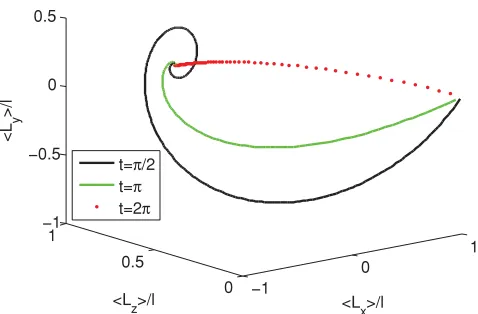
illustrated in Fig.2, where we perform repeated coherent inter-actions between the QRF and a stream of source particles.
−1
0
1
0 0.5
1 −1 −0.5 0 0.5
<Lx>/l <Lz>/l
<L
y
>/l
t=π/2 t=π
t=2π
FIG. 2. (Color online)Lx/ l,Ly/ l, andLz/ l. The rotation
induced on the reference frame due to the unitary interaction with the source particle forl=16. The source particles are polarized along thezaxis withz=1 and the QRF initially points along thexaxis
θ=π/2. In this figure,N=500 source particles have been used.
IV. CORRECTING THE DRIFT OF A QUANTUM REFERENCE FRAME
In this section, we consider certain approaches that allow us to correct the drift of the reference frame due to the projective measurement{±}.
If, in addition to the source of particles S, which are aligned in the Z direction, we also have access to another set of particles ¯S, which are aligned in the−Zdirection, then our intuition is that we may recover the quadratic scaling of Ref. [11] by alternating the measurements on systems from
Swith measurements on systems from ¯S. Since the sequence of measured particles has zero net polarization, no directional drift of the QRF occurs.
However, this approach requires the use of an equal number of corrective ¯Sparticles as measured particles—but is this the optimal strategy to eliminate drift? Two different strategies present themselves, but before discussing them, we first establish an operational criterion for the usefulness of the QRF.
A. Operational criterion
We wish to define an operational criterion by which to judge how well the finite-sized QRF does in the task of mimicking a projective measurement on the source particles.
To judge the quality of the measurement, we follow Ref. [11] and consider the probability of successfully finding the correct resultl+1
2 when the test particle is pointing along +nˆ(the initial direction of the reference frame) or finding the correct resultl−1
2when the test particle is pointing along−nˆ:
Psucc= 12Tr [+(ρ⊗ |nˆnˆ|)+−(ρ⊗ | −nˆ−nˆ|)] = 1
2(1+nˆ·nˆρ). (27)
[image:6.608.316.555.83.240.2]MEHDI AHMADI, DAVID JENNINGS, AND TERRY RUDOLPH PHYSICAL REVIEW A82, 032320 (2010)
0 100 200 300 400 500
0.2 0.3 0.4 0.5 0.6 0.7 0.8 0.9 1
Number of measurements or unitary interactions
Probability of success
t=π/2
t=π
t=2π
Sequential measurements
FIG. 3. (Color online) Psucc as a function of the number of
interactions for the case in which source particles are polarized along thezaxis (z=1) and the QRF is initially in the coherent statel=16 pointing along thexaxis (i.e.,θ=π/2).
becomes only linear with l if the source of particles being measured has some net polarization. In Fig. 3, we show the degradation of the reference frame under a sequence of either measurement interactions (solid line) or unitary interactions for various values forγ.
B. Correction via unitary interactions
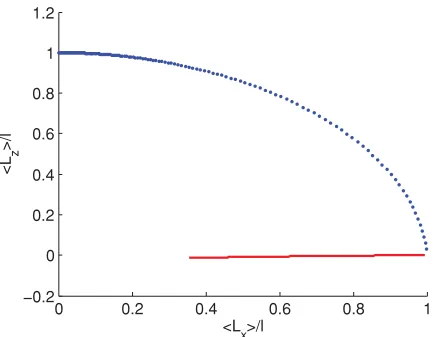
The first corrective mechanism we consider is to make two measurements of particles from S and then to implement a unitaryU =e−i2πL·Sbetween the QRF and a particle from ¯S. In Fig.4, we plot theZcomponent of angular momentum of the QRF vs itsxcomponent. The blue line is the degradation with no correction, as considered in Ref. [13]. The red line is for the case in which we have applied the unitary mentioned earlier after every twomeasurements—we observe that this method helps us to essentially completely correct the rotation of QRF (the drift toward the polarization ofS).
0 0.2 0.4 0.6 0.8 1
−0.2 0 0.2 0.4 0.6 0.8 1 1.2
<Lx>/l
<L
z
>/l
FIG. 4. (Color online)Lz/ lvsLx/ lforl=16. The source
particles are polarized along thezaxis, and the QRF is initially in the coherent state pointing along thexaxis. The blue dotted line corre-sponds to the case of sequential measurements, and the red solid line is for the case of unitary interactionei2πL·Safter two measurements.
0 500 1000 1500 2000 2500
0.4 0.5 0.6 0.7 0.8 0.9 1
Number of measurements
Probability of success
FIG. 5. (Color online) A comparison of probability of success for obtaining a correct measurement result in three different cases forl=16. The dashed line corresponds to the case of sequential measurements, the dashed-dotted line is for the case in which we correct the measurement result via applying unitary interactions after two measurements, and the solid line belongs to the case of correction via applying unitary interactions after each plus outcome.
To understand why this works, we see from Eq. (25) that the unitary interaction can generate a rotation about theY axis of
rz
l sin θ sin 2 γ /
2. For the particular choice ofγ =π, we have that the unitary interaction produces a rotation exactly twice as large as the measurement interaction, while maintaining the reference frame in theX-Zplane. By using a source particle from ¯S, we can ensure that this rotation acts in the opposite direction to the drift to equilibrium, and it is easily checked that
Fπ[E2[ρ]]=ρ+O(1/ l2). (28)
An important point to emphasize is that the application of the unitary interaction not only can correct the polarization drift to O(1/ l2), but also does so without requiring knowledge of the relative angle θ between the QRF and the source particles.
For very largel, we have greater freedom regarding when in the course of a sequence ofNmeasurements the corrective unitaries are performed. If 1≪N ≪l, then we have that
p±(θ) is roughly constant over the course ofNmeasurements. The actual measurement sequence is highly probable to be a typical measurement sequence withp+N plus outcomes and
p−Nminus outcomes. However, sinceN≪l, the QRF has ro-tated through a total anglep+N ++p−N −=N , which may be corrected with N/2 unitary interactions distributed arbitrarily between theNmeasurements.
In Fig.5,Psuccis plotted against the number of measure-ments for the two cases mentioned previously. We can clearly see that the longevity of the QRF is now improved. In this figure, the horizontal axis is for the number of measurements, and the particles used to improve the probability of success are not included, so with the use of particles from ¯S, we may extend the lifetime of the QRF toO(1/ l2).
[image:7.608.323.543.69.239.2] [image:7.608.63.278.72.239.2] [image:7.608.63.283.521.690.2]C. Keeping track of measurement results
None of the work on QRF degradation has considered the option of keeping track of the measurement results. This has been primarily for the sake of maintaining a simple pedagogy. We can now consider the possibility of actively feeding back individual measurement results to correct the frame’s drift.
With probabilityp+, the QRF is transformed asρ→E+[ρ] and similarly with probabilityp−the QRF is transformed as
ρ→E−[ρ]. A measurement history for the reference frame may be described vias=(s1,s2, . . . ,sN), withsi= ±. This sequence of outcomes in term corresponds to an evolution of the QRF given byEs[ρ] :=EsN[· · ·Es2[Es1[ρ]]].
The probabilities for largel are given byp±(θ)= 12(1±
zr cosθ) wherezis the polarization of the source particles and l is the polarization of the of the reference frame, as described earlier. Since we are consideringO(1/ l) effects, we will assume thatris approximately constant forN ≪l.
Note that in the context of the preceding measurement his-tory, the probabilities for each outcomesiare not independent, sincep±has angular dependence and so depends on previous rotations induced bysi−1,si−2, . . ..
We may again use the unitary interaction, however, unlike the case of the average map E, no simple correction exists for an individual plus or minus outcome for two reasons. First, the angle of rotation generated by the unitary interaction decreases monotonically with l and so fluctuations, such as the ones discussed earlier, may be much too large to correct.
Second, the unitary rotation goes sinusoidally with the relative angleθ between the source particles and the QRF, while the rotations due to the individual outcomes are, in general, complicated functions ofθ. Knowledge ofθ would be needed to tune the unitary interaction correctly. However, it should be that any auxiliary background reference frame that we may introduce should not feature in the experimental considerations and should serve only as a useful intermediate construct. Information is physical, and so any meaningful coordinate system must be associated with an actual physical system.
Of course, one could take the view that a large background system already exists, and relative to this, we have already determined the angles of inclinations of both the source particles and the quantum reference frame and, hence, know the value forθ. However, in this case, the goal of considering unitary corrections would then be to preserve the known state of the QRF in between measurements, as distinct from providing a reliable reference frame with which one determines the unknown relative angle with an ensemble of source particles through repeated measurements.
With knowledge of the relative angleθ, we may tune the unitary interaction appropriately, using either a source particle from S or ¯S, and correct sufficiently small rotations of the QRF. However, in the event of large measurement rotations, the best we can do between individual measurements would be to perform the largest allowable rotation in the required direction—numerics indicate that for the two projective outcomes ± we can always correct one outcome entirely and the other forπ/2< θ < π.
V. DISCUSSION AND OUTLOOK
In this paper, we have analyzed in some detail the induced dynamics of a quantum reference frame as it is used to measure the spins of a sequence of source particles and also used to implement unitary interactions on the source particles.
We found that the average behavior of the QRF is to gradually rotate into alignment with the source particles at anO(1/ l) rate. If we pay attention to the induced dynamics subsequent to a particular measurement outcome, we find that the dynamics is not so simple and large fluctuations can exist, which depend on observables quadratic inL. We considered the restriction to a simple class of initial states for which the dynamics depends purely on the inclination of the QRF relative to the source particles. For such states, we found that fluctuations may persist even in the infinite limit, and which give nontrivial dynamics. Of course in this limit, there is, on average, no net rotation of the QRF.
We found that by performing a unitary interaction between the QRF and source particles every third step, we could eliminate theO(1/ l) directional of the reference frame under the average map. While we have shown how the rotational drift of the QRF is correctable via unitary interactions, the degradation of the polarization is more problematic. However, since this degradation arises due to the formation of correlations between the QRF and the source particles, it should be possible [20] to partially correct this degradation via interactions that are sensitive to the correlation patterns present.
Future work might include the issue of parameter estimation on the state of the source particles. While ordinary projective measurements possess a degeneracy between the polarization of the source particles and the relative angle between the QRF and the particles, the presence of dynamics breaks this degeneracy and potentially allows a richer measurement inference.
In the ideal projective measurement case, the measurement probabilities are given by p±=(1/2)(1±zcosθ), and so doing a sequence of measurements only gives us the value of
zcosθ. However, in the presence of dynamics, the reference frame responds differently to the polarizationzof the source and to the relative angle θ with the source. For example, by allowing the QRF to gradually come into alignment with the source particles, the measurement pattern is eventually determined solely byz, while the early-time outcomes encode the dependence onθ. Such a separation of parameters is a result of the nontrivial dynamics of the finite quantum reference frame.
It is also possible to do parameter estimation plus correction in parallel. Initially, we know nothing ofθand so can take it to lie uniformly between 0 andπ. However, for example, getting a string of many plus outcomes implies that the relative angle
θis quite small. Each successive measure outcome we obtain allows us to update our estimate forθand in each case we can use our best estimate to perform a unitary correction, ideally converging in on a stable distribution and the correct value for the relative angle.
MEHDI AHMADI, DAVID JENNINGS, AND TERRY RUDOLPH PHYSICAL REVIEW A82, 032320 (2010)
has been measured with the QRF encodes the relative angle between the QRF and the unmeasured particles in its new state. It may be possible to transfer thisθdependence in a manner that improves the corrective procedures.
Finally, it would be of interest to extend the analysis we have conducted here to study how measurement and unitary interactions behave between a large QRF and higher spin particles.
[1] S. Bartlett, T. Rudolph, and R. Spekkens,Rev. Mod. Phys.79, 555 (2007).
[2] F. Costa, N. Harrigan, T. Rudolph, and C. Brukner,New J. Phys.
11, 123007 (2009).
[3] S. Bartlett, T. Rudolph, R. Spekkens, and P. Turner,New J. Phys.
11, 063013 (2009).
[4] D. Poulin,Int. J. Theor. Phys.45, 1189 (2006).
[5] G. A. White, J. A. Vaccaro, and H. M. Wiseman, Quantum Communication, Measurement and Computing: Ninth Interna-tional Conference on QCMC, AIP Conf. Proc. No. 1110 (AIP, New York, 2009), p. 79.
[6] R. Gambini, R. A. Porto, and J. Pullin, Phys. Rev. Lett. 93, 240401 (2004); New J. Phys.6, 45 (2004).
[7] F. Girelli and D. Poulin,Phys. Rev. D77, 104012 (2008).
[8] D. N. Page and W. K. Wootters,Phys. Rev. D27, 2885 (1983).
[9] S. Bartlett, T. Rudolph, B. C. Sanders, and P. Turner, J. Mod. Opt.54, 367 (2007).
[10] S. D. Bartlett, T. Rudolph, and R. W. Spekkens,Phys. Rev. A
70, 032321 (2004).
[11] S. Bartlett, T. Rudolph, R. Spekkens, and P. S. Turner,New J. Phys.8, 58 (2006).
[12] J.-C. Boileau, L. Sheridan, M. Laforest, S. Bartlett, J. Math. Phys.49, 032105 (2008).
[13] D. Poulin and J. Yard,New J. Phys.9, 156 (2007).
[14] M. A. Nielsen and I. L. Chuang,Quantum Computation and Quantum Information(Cambridge University Press, Cambridge, UK, 2000).
[15] M. E. Rose,Elementary Theory of Angular Momentum(Wiley, New York, 1957).
[16] A. R. Edmonds, Angular Momentum in Quantum Mechanics
(Princeton University Press, Princeton, 1957). [17] W. G. Ritter,J. Math. Phys.46, 082103 (2005).
[18] S. J. van Enk, H. J. Kimble, Quantum Inf. Comput.2, 1 (2002). [19] O. Landon-Cardinal and R. MacKenzie, Poster Presentation at the Twelfth Workshop on Quantum Information Processing (QIP), January 2009 (unpublished).
[20] D. Jennings and T. Rudolph, Phys. Rev. E 81, 061130 (2010).