Testing Fermion Universality at a Conformal Fixed Point
AnnaHasenfratz1,,ClaudioRebbi2, andOliverWitzel3
1Department of Physics, University of Colorado, Boulder, CO 80309, USA
2Department of Physics and Center for Computational Science, Boston University, Boston, MA 02215, USA
3Higgs Centre for Theoretical Physics, University of Edinburgh, Edinburgh, EH9 3FD, UK
Abstract.Universality of various fermion formulations is well established in QCD-like theories defined around the perturbativeg2=0 fixed point. These arguments do not apply for conformal systems that exhibit an infrared fixed point at non-vanishingg2coupling. We investigate the step scaling function for systems with 10 or 12 fundamental flavors using domain wall fermions and compare it to perturbative predictions. We test univer-sality by contrasting our findings to results published in the literature based on staggered fermions.
1 Introduction
The concept of universality is a cornerstone of quantum field theory investigations on the lattice. Universality means that systems with identical field content and identical symmetries in the same space-time dimension have the same universal critical properties. Since the continuum limit is reached when the system is tuned to criticality, universality implies that the continuum limit depends only on the relevant operators of the system. We point out that a unique continuum limit can be defined in the basin of attraction of every ultraviolet fixed point (UVFP) of a system.
The symmetries relevant for universality include local gauge invariance, and global ones like flavor symmetry of fermions. While local gauge symmetries are usually preserved by the lattice action, the flavor symmetries are frequently not. Staggered fermions break the SU(Nf)×SU(Nf) symmetry to SU(Nf/4)×SU(Nf/4), while Wilson fermions break flavor symmetry completely. Thus universality arguments do not apply to fermions unless the flavor symmetry gets restored at criticality.
QCD-like gauge-fermion systems are asymptotically free and the continuum limit is defined around the perturbativeg2 =0 Gaussian fixed point (GFP) where the restoration of continuum flavor symmetry can be proven perturbatively. In case of staggered fermions the taste breaking terms enter asO(g2). Proving the continuum flavor symmetries are recovered as the bare gauge couplingg2 is tuned to zero is non-trivial, because one has to show that all taste-breaking operators are irrelevant at the GFP [1]. (For a concise summary see e.g. Ref. [2].) If one increases the number of flavors, a new fixed point, in addition to the GFP, emerges where the gauge coupling becomes irrelevant. Even though this fixed point is commonly referred to as conformal infrared fixed point (IRFP), it is actu-ally an UVFP in the mass, which is the only relevant operator. The continuum limit in the basin of attraction of this conformal FP is reached by tuning the fermion mass to zero. The gauge coupling
does not require tuning; in the infrared it takes the value of the IRFP, independent of its bare value at the cut-off. The proof showing staggered fermions are in the same universality class as continuum fermions [1] relies however ong2→0. Thus if the taste breaking terms of staggered fermions do not vanish at the conformal IRFP, staggered formulations of a conformal system might not be in the same universality class as continuum fermions.1
A situation similar to the taste breaking of staggered fermions can be modeled in the 3-dimensional
O(n) scalar model. For illustration we summarize the results of Ref. [3] in the next section before highlighting recent developments for SU(3) gauge theories in four dimensions.
In Sect.3we present our new results on the step scaling functions for SU(3) gauge theories with 10 or 12 fundamental flavors obtained with domain wall fermions (DWF). Our findings suggest that at a conformal IRFP staggered fermions are not in the same universality class as domain wall fermions. Finally, we conclude in Sec.4.
2 Indications of universality violation
2.1 φ4scalar models in three dimensions
Ising
Cubic
Gaussian Heisenberg g
g 2
1
Figure 1.Sketch of the RG flows on the critical surface of the scalar model with symmetry breaking term as in Eq. (1). The infrared limit is characterized by a new "cubic" fixed point [3].
The O(n) symmetric scalar models in three dimensions have very similar structure to the 4-dimensional conformal gauge-fermion systems. Theφ4coupling is relevant at the perturbative GFP but irrelevant at the non-perturbative conformal Wilson-Fischer fixed point (WFFP), whereas the mass is a relevant operator at both fixed points. The GFP has mean-field exponents for alln, but the WFFP is different for differentn. Adding to the action interaction terms breaking the symmetryO(n)→O(n), multicritical phenomena can emerge (see e.g. Refs. [3,4]). Using the-expansion up to fifth order a model with potential
V =1 2m2
n
α=1
φ2n +g1
n
α=1
φ2n
2
+g2
n
α=1
φ4a
, (1)
is investigated in Ref. [3]. In addition to the perturbative GFP, the system has anO(n) Heisenberg WFFP forg2 =0 and aZ2symmetric Ising FP forg1 = 0. The renormalization group structure of
does not require tuning; in the infrared it takes the value of the IRFP, independent of its bare value at the cut-off. The proof showing staggered fermions are in the same universality class as continuum fermions [1] relies however ong2→0. Thus if the taste breaking terms of staggered fermions do not vanish at the conformal IRFP, staggered formulations of a conformal system might not be in the same universality class as continuum fermions.1
A situation similar to the taste breaking of staggered fermions can be modeled in the 3-dimensional
O(n) scalar model. For illustration we summarize the results of Ref. [3] in the next section before highlighting recent developments for SU(3) gauge theories in four dimensions.
In Sect.3we present our new results on the step scaling functions for SU(3) gauge theories with 10 or 12 fundamental flavors obtained with domain wall fermions (DWF). Our findings suggest that at a conformal IRFP staggered fermions are not in the same universality class as domain wall fermions. Finally, we conclude in Sec.4.
2 Indications of universality violation
2.1 φ4scalar models in three dimensions
Ising
Cubic
Gaussian Heisenberg g
g 2
1
Figure 1.Sketch of the RG flows on the critical surface of the scalar model with symmetry breaking term as in Eq. (1). The infrared limit is characterized by a new "cubic" fixed point [3].
The O(n) symmetric scalar models in three dimensions have very similar structure to the 4-dimensional conformal gauge-fermion systems. Theφ4coupling is relevant at the perturbative GFP but irrelevant at the non-perturbative conformal Wilson-Fischer fixed point (WFFP), whereas the mass is a relevant operator at both fixed points. The GFP has mean-field exponents for alln, but the WFFP is different for differentn. Adding to the action interaction terms breaking the symmetryO(n)→O(n), multicritical phenomena can emerge (see e.g. Refs. [3,4]). Using the-expansion up to fifth order a model with potential
V=1 2m2
n
α=1
φ2n +g1
n
α=1
φ2n
2
+g2
n
α=1
φ4a
, (1)
is investigated in Ref. [3]. In addition to the perturbative GFP, the system has anO(n) Heisenberg WFFP forg2 =0 and aZ2 symmetric Ising FP forg1 =0. The renormalization group structure of
1This issue is not related to rooting. Whether a rooted staggered action is equivalent to a local action at an IRFP withg2>0 is another interesting question, but not considered here.
this system when both couplings are non-zero is similar to the sketch in Fig.1. The infrared limit is governed by neither by theO(n) nor theZ2 symmetric fixed point but by a new, “cubic” fixed point. Perhaps the situation is similar for staggered fermions in 4-dimensional conformal models.
2.2 SU(3) gauge theory in four dimensions
Recently the gradient flow step scaling function has been used to investigate theβfunction in 4-dimensional SU(3) gauge theories [5,6]. The gradient flow step scaling function for a scale changes
is related to the discreteβ-function
βs(g2c;L)=
g2c(sL;a)−g2c(L;a)
log(s2) . (2)
The ratioc= √8t/Lties the lattice volume to the energy scale where the parametertis the flow time,
Lthe extent of the lattice with volumeL4, andg2
c(L;a) the gradient flow coupling at lattice spacing
a.2 The continuum extrapolated discreteβ-functionβs(g2
c)=lim(a/L)→0βs(g2c,L) depends only on the renormalized couplingg2c, therefore it is expected to be independent of irrelevant operators introduced by the lattice regularization. The gradient flow step scaling function is only 1-loop universal when the simulations are done with periodic or antiperiodic boundary conditions. We do not expect the non-perturbative lattice results to follow perturbative curves outside the small-g2crange. In the plots we nevertheless show the perturbative 2-loop and 4-loopMS predictions. These solely serve to guide the eye and help to compare results obtained with different lattice actions. In the remainder of this section we briefly point out two cases possibly indicating violations of universality which motivated our investigations:
1. SU(3) gauge model with 2 flavors in the sextet representation: Using Wilson fermions and the Schrödinger functional scheme Refs. [7,8] found the step scaling function to be consistently smaller than the 2-loop value, possibly developing an IRFP. More recently Ref. [9] investigated thec=0.35 gradient flow step scaling function with Wilson fermions and found that it approx-imately follows the 4-loopMS prediction in the 0 < g2c <5.5 range, increasing forg2c 3.5, decreasing thereafter and approaching zero aroundg2c ≈6.0. The Lattice Higgs Collaboration studied the gradient flow step scaling function in the same scheme using (rooted) staggered fermions. Their results predict thatβs(g2c) increases monotonically in the range 0 < g2 <6.5, staying within≈20% of the 2-loop value [10]. Establishing a zero in the step scaling function is difficult, however the qualitative differences between staggered and Wilson results are striking and are too large in theg2c≥4.0 range to be attributed to under-estimated statistical errors. 2. SU(3) gauge theory withNf 8fundamental flavors: 2-loop perturbation theory predicts
the boundary of the conformal window to be at Nf 8. The step scaling function of the
Nf =12 flavor system has been investigated extensively with staggered fermions. Figure 5 of Ref. [11], reproduced on the right panel of Fig.5, shows results from three different calculations that agree within errors and predict the step scaling function to lie between the 2- and 4-loop perturbative values with a suggested IRFP aroundg2c ≈7.4(3).3 This result is in some tension with a recent domain wall fermion calculation of a 10-flavor system that predicts the gradient flow step scaling function well below the 4-loopMS curve and suggests an IRFP aroundg2c =
2Following the usual conventions,t,L, andaare dimensionful quantities.
3At Lattice 2017 the LatHC collaboration presented a poster with updated results indicating that the step scaling function in theg2c≈7.0−7.6 range is close to 0.1, i.e. it has minimal dependence on the gauge coupling in a wideg2crange. In this
7.0 [12,13]. In generalNf =10 is expected to show features that are related to the conformal window, like a real or approximate IRFP, at stronger coupling thanNf =12. The qualitative features of the step scaling functions with staggered and DW fermions appear to be in conflict with each other.
3 Step scaling function from domain wall simulations
0 0.2 0.4 0.6 0.8 1
0 1 2 3 4 5 6 7 8
β2
(
g
2)
g2
Nf =10
preliminary
c=0.35 clover c=0.35 plaq 2-loop perturb 4-loop MS
0 0.2 0.4 0.6 0.8 1
0 1 2 3 4 5 6 7 8
β2
(
g
2)
g2
Nf=10
preliminary
c=0.4 clover c=0.4 plaq 2-loop perturb 4-loop MS
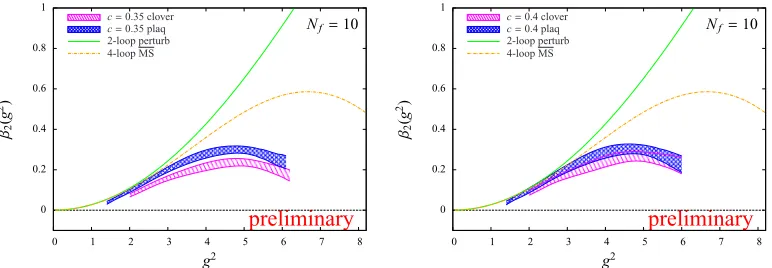
Figure 2. Comparison of the 10-flavor (a/L)2 →0 extrapolated step scaling functions using the plaquette and
clover discretizations in our MDW fermion simulations. Left panel corresponds toc=0.35, right toc=0.4.
Motivated by the possible lack of universality of staggered fermions at a conformal fixed point we have started a program to investigate the step scaling function of SU(3) gauge theory withNf =10 and 12 fundamental flavors. We use Möbius domain wall fermions with 3-levels of stout smearing and Symanzik gauge action [14–17]. The boundary conditions are periodic for the gauge fields and antiperiodic for the fermions in all four directions and the bare fermion mass is set to zero. Our simulations are carried out using theGridcode [18,19].
We simulate symmetric L4 volumes with L/a = 6, 8, 10, 12, 16, 20 and 24, although in our analysis we use onlyL/a≥8. On all seven volumes we have generated ensembles at 12 – 14 values of the gauge coupling in the range 4.15 ≤ β≤ 7.0 forNf = 10 and 4.20 ≤ β≤ 7.0 forNf = 12. For each ensemble we have typically collected 5000 Molecular Dynamics Time Units (MDTU). We identified a first order bulk transition for bothNf =10 and 12 aroundβ=4.0−4.05. The DW residual mass increases exponentially as this transition is approached, thus limiting the range of couplings we can simulate.
For most ensembles we chose the 5th dimension of domain wall fermions to beLs = 12, but increase it up toLs = 24 on the larger (L/a = 16,20,24) volumes at stronger gauge coupling in order to keep the residual mass sufficiently small. If the residual mass is too large compared to the energy scale given by the inverse lattice sizeL−1, the configurations should be considered finite-mass deformed and not volume squeezed. At finite fermion mass the gauge coupling runs faster and the step scaling function predicted by the finite-volume gradient flow scheme would be larger than in the chiral limit. In this sense our results here can be considered as upper bounds onβs(g2c).
7.0 [12,13]. In generalNf =10 is expected to show features that are related to the conformal window, like a real or approximate IRFP, at stronger coupling thanNf =12. The qualitative features of the step scaling functions with staggered and DW fermions appear to be in conflict with each other.
3 Step scaling function from domain wall simulations
0 0.2 0.4 0.6 0.8 1
0 1 2 3 4 5 6 7 8
β2
(
g
2)
g2
Nf=10
preliminary
c=0.35 clover c=0.35 plaq 2-loop perturb 4-loop MS 0 0.2 0.4 0.6 0.8 1
0 1 2 3 4 5 6 7 8
β2
(
g
2)
g2
Nf=10
preliminary
c=0.4 clover c=0.4 plaq 2-loop perturb 4-loop MS
Figure 2. Comparison of the 10-flavor (a/L)2 →0 extrapolated step scaling functions using the plaquette and
clover discretizations in our MDW fermion simulations. Left panel corresponds toc=0.35, right toc=0.4.
Motivated by the possible lack of universality of staggered fermions at a conformal fixed point we have started a program to investigate the step scaling function of SU(3) gauge theory withNf =10 and 12 fundamental flavors. We use Möbius domain wall fermions with 3-levels of stout smearing and Symanzik gauge action [14–17]. The boundary conditions are periodic for the gauge fields and antiperiodic for the fermions in all four directions and the bare fermion mass is set to zero. Our simulations are carried out using theGridcode [18,19].
We simulate symmetric L4 volumes with L/a = 6, 8, 10, 12, 16, 20 and 24, although in our
analysis we use onlyL/a≥8. On all seven volumes we have generated ensembles at 12 – 14 values of the gauge coupling in the range 4.15 ≤ β ≤7.0 forNf = 10 and 4.20 ≤ β ≤7.0 forNf = 12. For each ensemble we have typically collected 5000 Molecular Dynamics Time Units (MDTU). We identified a first order bulk transition for bothNf =10 and 12 aroundβ=4.0−4.05. The DW residual mass increases exponentially as this transition is approached, thus limiting the range of couplings we can simulate.
For most ensembles we chose the 5th dimension of domain wall fermions to be Ls = 12, but increase it up to Ls = 24 on the larger (L/a = 16,20,24) volumes at stronger gauge coupling in order to keep the residual mass sufficiently small. If the residual mass is too large compared to the energy scale given by the inverse lattice sizeL−1, the configurations should be considered finite-mass
deformed and not volume squeezed. At finite fermion mass the gauge coupling runs faster and the step scaling function predicted by the finite-volume gradient flow scheme would be larger than in the chiral limit. In this sense our results here can be considered as upper bounds onβs(g2c).
The volumes in our simulations are small compared to staggered fermion calculations. We expect that lattice artifacts with DW fermions are smaller than with staggered, as many QCD simulations indicate. The DW calculation of the step scaling function of Refs. [12,13] also indicates thatβs(L;g2c)
shows linear (a/L)2 dependence already atL/a =8. We have started simulations withL/a =32 to strengthen the (a/L)2→0 extrapolation, but they are not included here. We measure the gradient flow renormalized coupling using Wilson flow and consider both the clover and plaquette discretization of the energy density. We choosec= √8t/Llarge enough so the two are consistent. We also applyt-shift optimization to removeO(a2) cut-offeffects [20] and plan to repeat the gradient flow measurements
with Symanzik flow as a further consistency check.
3.1 Step scaling function withNf =10fundamental flavors
0 0.005 0.01 0.015 0.02 0.025 0.03
(a/L)2 -0.2 0 0.2 0.4 0.6 0.8 1 1.2 1.4 1.6 -2 (g 2,L/a)
clover,=0=0.0 clover,=0=-0.075 plaquette, =0=0.0 plaquette, =0=0.04
gc2=3.0
preliminary
0 0.005 0.01 0.015 0.02 0.025 0.03
(a/L)2 -0.2 0 0.2 0.4 0.6 0.8 1 1.2 1.4 1.6 -2 (g 2,L/a)
clover,=0=0.0 clover,=0=-0.075 plaquette, =0=0.0 plaquette, =0=0.04
gc2=4.0
preliminary
0 0.005 0.01 0.015 0.02 0.025 0.03
(a/L)2 -0.2 0 0.2 0.4 0.6 0.8 1 1.2 1.4 1.6 -2 (g 2,L/a) clover,= 0=0.0
clover,=0=-0.075 plaquette, =0=0.0 plaquette, =0=0.04
gc2=5.0
preliminary
0 0.005 0.01 0.015 0.02 0.025 0.03
(a/L)2 -0.2 0 0.2 0.4 0.6 0.8 1 1.2 1.4 1.6 -2 (g 2,L/a) clover,= 0=0.0
clover,=0=-0.075 plaquette,=0=0.0 plaquette,=0=0.04
gc2=6.0
preliminary
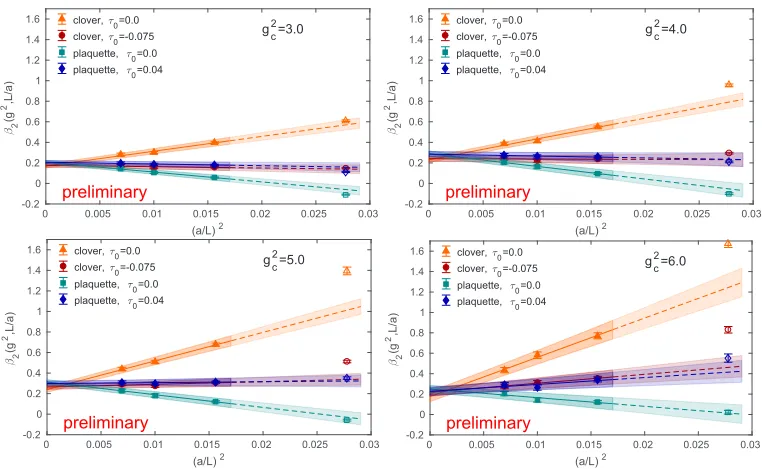
Figure 3.Continuum limit extrapolations inNf =10 atg2c =3.0, 4.0, 5.0 and 6.0 in thec=0.4 gradient flow
scheme. Each panel shows the extrapolation in (a/L)2 using the plaquette and clover discretizations both with
and without near-optimalt-shift values (0.04 for plaquette, -0.075 for clover). The lines with errorband are linear
fits to the data obtained from volumesL/a≥8 (filled symbols). We do not include the right-most data points
(open symbols) corresponding toL/a=6→12 matching but to guide eye extend our fit results to the right using
dashed lines and a lighter shaded error band. Especially for the plaquette even those data points are close to the
linear fit lines, strengthening our confidence in the continuum extrapolation based on volumesL/a=8 to 24.
0 0.2 0.4 0.6 0.8 1
0 1 2 3 4 5 6 7 8
β2
(
g
2)
g2
Nf=10
preliminary
c=0.4 plaq c=0.35 plaq c=0.3 plaq 2-loop perturb 4-loop MS
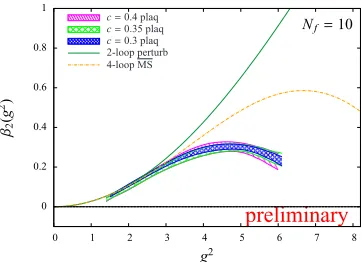
Figure 4. Preliminary results for theNf = 10 step scaling function using MDW fermions. The continuum limit extrapolated predictions corresponding toc = 0.3, 0.35 and 0.4 are consistent when using the plaquette discretization for the energy density and imply that the coupling is running slower than the 4-loopMSprediction. We are not yet able to verify the existence of the IRFP predicted in Ref. [12,13] but so far ourβ-function agrees reasonably well with theirs.
The four panels of Fig.3show the (a/L)2 extrapolations atc = 0.4 forg2
c = 3.0, 4.0, 5.0, and 6.0. In all cases we consider both the plaquette and clover discretizations with and without near-optimalt-shift. The (a/L)2extrapolations, depicted by solid lines with error bands in Fig.3are based on volumes withL/a ≥ 8. Extending these fit lines to the right, we observe that for the plaquette discretization even the smallestL/a = 6 → 12 volumes are fairly close to these linear fits. The four different extrapolations predict within errors consistent continuum limit values forβ2(g2c). Since we use Wilson flow with Symanzik gauge action, the combination with plaquette discretization is expected to have smallerO(a2) corrections [21]. Fig.4shows that the step scaling function obtained with the plaquette discretization is largely independent ofcwhen comparing c = 0.3, 0.35, 0.4, a property that is not expected theoretically but seems to hold also in other models. The continuum extrapolated step scaling function is similar to the prediction of Refs. [12,13]. It follows the 2- and 4-loop perturbative curves up tog2c 3.0 but turns away at larger couplings. Our results, shown in Fig.4, explore the range forg2c<6.0 but neither confirm nor discredit the emergence of an IRFP.
3.2 Step scaling function withNf =12fundamental flavors
0 0.2 0.4 0.6 0.8 1
0 1 2 3 4 5 6 7 8
β2
(
g
2)
g2
Nf=10
preliminary
c=0.4 plaq c=0.35 plaq c=0.3 plaq 2-loop perturb 4-loop MS
Figure 4. Preliminary results for theNf = 10 step scaling function using MDW fermions. The continuum limit extrapolated predictions corresponding toc = 0.3, 0.35 and 0.4 are consistent when using the plaquette discretization for the energy density and imply that the coupling is running slower than the 4-loopMS prediction. We are not yet able to verify the existence of the IRFP predicted in Ref. [12,13] but so far ourβ-function agrees reasonably well with theirs.
The four panels of Fig.3show the (a/L)2 extrapolations atc = 0.4 forg2
c = 3.0, 4.0, 5.0, and 6.0. In all cases we consider both the plaquette and clover discretizations with and without near-optimalt-shift. The (a/L)2extrapolations, depicted by solid lines with error bands in Fig.3are based on volumes withL/a ≥ 8. Extending these fit lines to the right, we observe that for the plaquette discretization even the smallest L/a = 6 → 12 volumes are fairly close to these linear fits. The four different extrapolations predict within errors consistent continuum limit values forβ2(g2c). Since we use Wilson flow with Symanzik gauge action, the combination with plaquette discretization is expected to have smallerO(a2) corrections [21]. Fig.4shows that the step scaling function obtained with the plaquette discretization is largely independent ofcwhen comparing c = 0.3, 0.35, 0.4, a property that is not expected theoretically but seems to hold also in other models. The continuum extrapolated step scaling function is similar to the prediction of Refs. [12,13]. It follows the 2- and 4-loop perturbative curves up tog2c 3.0 but turns away at larger couplings. Our results, shown in Fig.4, explore the range forg2c<6.0 but neither confirm nor discredit the emergence of an IRFP.
3.2 Step scaling function withNf =12fundamental flavors
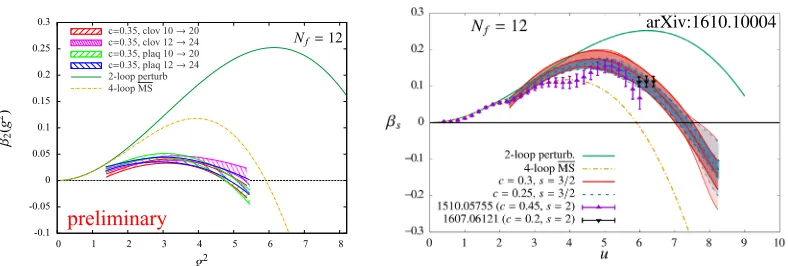
Given the tension between the step scaling function obtained for 12 flavors with staggered fermions and the outcome of theNf =10 domain wall simulations presented above, we have started to inves-tigate the 12-flavor system with DW fermions to better understand and hopefully resolve the conflict. The step scaling function with 12 flavors is small, making its non-perturbative determination more challenging. While 5000 MDTU per configuration was sufficient to estimateβ2(g2c) with 10 flavors, the same statistics is not sufficient withNf = 12. In addition we observe larger scaling violations for the clover discretization when matching 8→16 volumes compared to ourNf =10 simulations. AddingL=32 volumes will allow us to drop theL=8 ensemble set or allow us to verify that all four volume pairs are consistent with linear (a/L)2dependence. Comparing Wilson flow with Symanzik flow could also serve as a consistency check. At this point we present only preliminary results. Fig-ure5shows the finite volume step scalingβ2(L;g2) as defined in Eq. (2) for the 10→20 and 12→24 volume pairs in thec=0.35 gradient flow scheme with both plaquette and clover discretizations. The
-0.1 -0.05 0 0.05 0.1 0.15 0.2 0.25 0.3
0 1 2 3 4 5 6 7 8
β2
(
g
2)
g2
Nf=12
preliminary
c=0.35, clov 10→20
c=0.35, clov 12→24
c=0.35, plaq 10→20
c=0.35, plaq 12→24
2-loop perturb 4-loop MS
arXiv:1610.10004
Figure 5. Left panel: Preliminary results for theNf =12 step scaling function from our MDW fermion sim-ulations. Using near-optimalt-shift (0.04 for the plaquette, -0.065 for the clover operator) the finite volumeβ
function of Eq. (2) is shown forL/a=10→20 and 12→24. The dependence onLis weak, hence the effect of the extrapolation toL/a→ ∞is likely small. LargerL/a=32 volumes are in progress and will allow a standard infinite volume continuum extrapolation. Right panel, reproduced from Ref. [11]: Comparison of the gradient flow step scaling functions from Refs. [11] (c=0.25 andc=0.3, blue and red bands), [22] (c=0.45, magenta symbols) and [23] (c=0.2, black symbols). All three references use staggered fermions but given the different
renormalization schemes and analysis details the results are in surprisingly good agreement.
t-shift value was chosen to roughly minimize the volume dependence ofβ2(L;g2), 0.04 for the pla-quette discretization and -0.065 for the clover one. Once the (a/L)2extrapolation is taken, the value of thet-shift becomes irrelevant. In addition we use the samet-shift at everyg2c, proving further that its exact value is not important. Comparing the fourβ2(L;g2) bands in Fig.5shows that the continuum limit extrapolated step scaling function will lie below the 4-loopMSprediction and also suggests an IRFP aroundg2c=6.0. Results withc=0.4 are similar.
The step scaling function implied by our preliminary results are in tension with the staggered fermion results that predictβs(g2c) increasing up tog2c ≈5 before turning back and approaching zero aroundg2c = 7.4 as shown on the right panel of Fig.5. However the DW step scaling function as presented in Fig.5resolves the tension with theNf =10 results shown in Fig.4. Both the maximum and the implied zero ofβs(g2c) occurs at stronger couplings withNf =12 thanNf =10.
4 Conclusion
Universality between continuum and staggered fermions at the Gaussiang2=0 fixed point is subtle, but can be proven perturbatively. This proof does not apply at ag2 0 non-trivial conformal IRFP and a simple 3-dimensional examples illustrates that universality can be broken near a conformal fixed point. Several existing lattice calculations point to tensions between staggered and other fermion formulations in 4-dimensional conformal or near-conformal systems.
taken with caution. While these studies provide important information on conformal systems, their quantitative predictions might not be reliable.
Acknowledgments
We are very grateful to Peter Boyle, Guido Cossu, Anontin Portelli, and Azusa Yamaguchi who de-velop theGridsoftware library providing the basis of this work and who assisted us in installing and runningGridon different architectures and computing centers. Computations for this work were car-ried out in part on facilities of the USQCD Collaboration, which are funded by the Office of Science of the U.S. Department of Energy and the RMACC Summit supercomputer, which is supported by the National Science Foundation (awards ACI-1532235 and ACI-1532236), the University of Colorado Boulder, and Colorado State University. We thank Fermilab, Jefferson Lab, the University of Col-orado Boulder, the NSF, and the U.S. DOE for providing the facilities essential for the completion of this work. A.H. acknowledges support by DOE grant SC0010005 and C.R. by DOE grant DE-SC0015845. This project has received funding from the European Union’s Horizon 2020 research and innovation programme under the Marie Skłodowska-Curie grant agreement No 659322.
References
[1] M.F.L. Golterman, J. Smit, Nucl. Phys.B245, 61 (1984) [2] S.R. Sharpe, PoSLAT2006, 022 (2006),hep-lat/0610094
[3] H. Kleinert, V. Schulte-Frohlinde, Phys. Lett.B342, 284 (1995),cond-mat/9503038 [4] P. Calabrese, A. Pelissetto, E. Vicari, Phys. Rev.B67, 054505 (2003),cond-mat/0209580 [5] M. Lüscher, JHEP1008, 071 (2010),1006.4518
[6] Z. Fodor, K. Holland, J. Kuti, D. Nogradi, C.H. Wong, JHEP1211, 007 (2012),1208.1051 [7] Y. Shamir, B. Svetitsky, T. DeGrand, Phys. Rev.D78, 031502 (2008),0803.1707
[8] T. DeGrand, Y. Shamir, B. Svetitsky, Phys.Rev.D88, 054505 (2013),1307.2425 [9] A. Hasenfratz, Y. Liu, C.Y.H. Huang (2015),1507.08260
[10] Z. Fodor, K. Holland, J. Kuti, S. Mondal, D. Nogradi, C.H. Wong, JHEP09, 039 (2015), 1506.06599
[11] A. Hasenfratz, D. Schaich (2016),1610.10004 [12] T.W. Chiu (2016),1603.08854
[13] T.W. Chiu, PoSLATTICE2016, 228 (2017)
[14] R.C. Brower, H. Neff, K. Orginos (2012),1206.5214
[15] C. Morningstar, M.J. Peardon, Phys. Rev.D69, 054501 (2004),hep-lat/0311018
[16] T. Kaneko, S. Aoki, G. Cossu, H. Fukaya, S. Hashimoto, J. Noaki (JLQCD), PoS LAT-TICE2013, 125 (2014),1311.6941
[17] J. Noaki, G. Cossu, K.I. Ishikawa, Y. Iwasaki, T. Yoshie, PoSLATTICE2015, 312 (2016), 1511.06474
[18] P. Boyle, A. Yamaguchi, G. Cossu, A. Portelli, PoSLATTICE2015, 023 (2015),1512.03487 [19] P. Boyle, G. Cossu, A. Portelli, A. Yamaguchi,https://github.com/paboyle/Grid [20] A. Hasenfratz, PoSLATTICE2014, 257 (2015),1501.07848
[21] A. Ramos, S. Sint, Eur. Phys. J.C76, 15 (2016),1508.05552 [22] C.J.D. Lin, K. Ogawa, A. Ramos, JHEP12, 103 (2015),1510.05755