This is a repository copy of Alumina-grafted SBA-15 as a high performance support for
Pd-catalysed cinnamyl alcohol selective oxidation.
White Rose Research Online URL for this paper:
http://eprints.whiterose.ac.uk/78925/
Version: WRRO with coversheet
Article:
Parlett, CMA, Durndell, LJ, Machado, A et al. (5 more authors) (2014) Alumina-grafted
SBA-15 as a high performance support for Pd-catalysed cinnamyl alcohol selective
oxidation. Catalysis Today, 229. 46 - 55. ISSN 0920-5861
https://doi.org/10.1016/j.cattod.2013.11.056
[email protected] https://eprints.whiterose.ac.uk/ Reuse
Unless indicated otherwise, fulltext items are protected by copyright with all rights reserved. The copyright exception in section 29 of the Copyright, Designs and Patents Act 1988 allows the making of a single copy solely for the purpose of non-commercial research or private study within the limits of fair dealing. The publisher or other rights-holder may allow further reproduction and re-use of this version - refer to the White Rose Research Online record for this item. Where records identify the publisher as the copyright holder, users can verify any specific terms of use on the publisher’s website.
Takedown
If you consider content in White Rose Research Online to be in breach of UK law, please notify us by
promoting access to White Rose research papers
White Rose Research Online
[email protected]
Universities of Leeds, Sheffield and York
http://eprints.whiterose.ac.uk/
This is an author produced version of a paper published in
Catalysis Today.
White Rose Research Online URL for this paper:
http://eprints.whiterose.ac.uk/78925/
Paper:
Parlett, CMA, Durndell, LJ, Machado, A, Lee, AF, Bruce, DW, Cibin, G, Hondow,
NS and Wilson, K (2014) Alumina-grafted SBA-15 as a high performance support
for Pd-catalysed cinnamyl alcohol selective oxidation. Catalysis Today, 229. 46 -
55.
1
Alumina-grafted SBA-15 as a high performance support for Pd catalysed
cinnamyl alcohol selective oxidation
Christopher M.A. Parlett,
a*Lee J. Durndell,
aAndreia Machado,
aGianantonio Cibin,
cDuncan W.
Bruce,
bNicole S. Hondow,
dKaren Wilson
aand Adam F. Lee
a,e*a
Department of Chemistry, University of Warwick, Coventry CV4 7AL, UK
b
Department of Chemistry, University of York, York YO10 5DD, UK
c
Diamond Light Source, Harwell Science and Innovation Campus, Didcot, OX11 0DE, UK
d
Institute for Materials Research, School of Process, Environmental and Materials Engineering, University of
Leeds, Leeds, LS2 9JT, UK
e
School of Chemistry, Monash University, Victoria 3800, Australia.
Corresponding Author: [email protected], +44 (0)2476 151839; [email protected]
Abstract
Ultrathin alumina monolayers grafted onto an ordered mesoporous SBA-15 silica framework afford a
composite catalyst support with unique structural properties and surface chemistry. Palladium nanoparticles
deposited onto Al-SBA-15 via wet-impregnation exhibit the high dispersion and surface oxidation
characteristic of pure aluminas, in conjunction with the high active site densities characteristic of high area
mesoporous silicas. This combination confers significant rate-enhancements in the aerobic selective oxidation
(selox) of cinnamyl alcohol over Pd/Al-SBA-15 compared to mesoporous alumina or silica supports.
Operando, liquid phase XAS highlights the interplay between dissolved oxygen and the oxidation state of
palladium nanoparticles dispersed over Al-SBA-15 towards on-stream reduction: ambient pressures of
flowing oxygen are sufficient to hinder palladium oxide reduction to metal, enabling a high selox activity to
be maintained, whereas rapid PdO reduction and concomitant catalyst deactivation occurs under static oxygen.
Selectivity to the desired cinnamaldehyde product mirrors these trends in activity, with flowing oxygen
minimising C-O cleavage of the cinnamyl alcohol reactant to trans- -methylstyrene, and of cinnamaldehyde
decarbonylation to styrene.
Highlights:
An ultrathin alumina coating has been grafted onto a SBA-15 mesoporous silica architecture.
Pd impregnated Al-SBA-15 materials are superior catalysts for the aerobic selox of allylic alcohols to
aldehydes compared to pure silica or alumina supports.
Operando XAS confirms cinnamyl alcohol selox occurs over a PdO active species, which is prone to
on-stream reduction and associated catalyst deactivation under static oxygen.
2
1.
Introduction
Cinnamaldehyde is an allylic aldehyde widely employed as a chemical intermediate in organic synthesis and
as a desirable product in its own right for application as an insecticide and food and perfume additive [1].
Related aromatic and aliphatic allylic aldehydes are also commercially important fine chemical and
agrochemical products [2-4], hence their green synthesis through low energy and atom economical routes has
been the focus of extensive academic and commercial research. The direct aerobic selective oxidation (selox)
of allylic alcohols is a potential route to such unsaturated aldehydes that avoids recourse to stoichiometric
oxidants and can be undertaken in either the liquid or vapour phase under mild conditions [5, 6]. Such
chemistry is believed to proceed via oxidative dehydrogenation of the alcohol to the corresponding allylic
aldehyde which may undergo subsequent oxidation to the acid. Aldehyde selectivity is also influenced by
competitive hydrogenation of the C=C bond or C-O cleavage in the parent alcohol, and decarbonylation of the
desired aldehyde product.
A number of heterogeneous catalysts capable of facilitating alcohol selox using air or dioxygen as the
oxidant have been developed, with nanoparticulate palladium and/or gold the active components of choice
[7-11]. In recent years, an array of ex-situ and in-situ analytical techniques and parallel kinetic profiling has
identified electron deficient Pd2+, present as PdO at the surface of nanoparticles, as the active species
participating in palladium catalysed allylic alcohol selox. Pd2+ species are proposed to play a critical role in
aerobic alcohol oxidations over AuPd core-shell nanoparticles [12] and intercalated Pd/NiZn layered double
hydroxides [13], while Pd2+ complexes are ubiquitous in homogeneously catalysed selox chemistry [14, 15].
Time-resolved, liquid and vapour phase XAS measurements [16-19] on carbon and oxide supported
nanoparticles respectively, and complementary in-situ XPS measurements over O/Pd(111) single crystals [20,
21] have highlighted PdO reduction to metallic palladium as a potential deactivation pathway, and hence the
importance of generating highly dispersed nanoparticles which favour an oxide phase [20, 22-24].
Temperature-programmed desorption and XPS of crotyl alcohol en-1-ol) and crotonaldehyde
(but-2-en-1-al) over Pd(111) and palladium-rich Au/Pd surface alloys suggest deactivation arises from
crotonaldehyde decarbonylation and subsequent site-blocking by strongly adsorbed propylidyne and CO [20,
21]. Computational modelling predicts Pd(111) can also drive propanoic acid decarbonylation [25]. Vapour
phase studies of crotyl alcohol oxidation show that such in-situ palladium reduction is reversible under
oxidising environments [17, 19], enabling selox to be maintained, however the ability of dissolved oxygen to
preserve palladium as PdO during liquid phase selox is unknown.
Improved palladium selox catalysts require enhanced surface PdO concentration. A number of approaches
have been explored to disperse palladium nanoparticles throughout nanoporous supports, e.g. Pd coordination
to pyridyls [26] or amines [27, 28] covalently tethered to silicas. However the grafting densities achievable via
such organic surface functionalisation are low (typically 0.1 ligands.nm-2), and palladium only weakly bound
and prone to leaching in-situ. Direct impregnation of inorganic oxides with palladium precursors (and
subsequent thermochemical processing) or pre-formed colloidal nanoparticles remains the simplest, scalable
3
adhesion of pre-prepared colloids and/or modify their catalytic reactivity [29]. Tailoring the support
architecture offers an alternative means to influencing palladium dispersion. Ordered mesoporous silicas,
prepared via surfactant templating routes [30, 31], possess high surface areas and interconnected mesopores
that permit the synthesis of highly oxidised 1-2 nm Pd particles [22, 23]. We recently discovered that
mesoporous alumina is superior to silica for stabilising sub-nanometre palladium clusters and even
atomically-dispersed Pd2+ centres [24, 32], presumably reflecting a stronger metal-support interaction (a function of the
acid/base character of metal oxides [33-35]). Unfortunately, pure alumina supports are plagued by low
hydrothermal stability, and typically significantly lower surface areas and mesopore ordering than their silica
counterparts. The growth of conformal alumina coatings over a mesostructured silica framework opens the
way to new catalyst supports combining the structural stability (and diverse topologies) accessible through
silica materials chemistry, with the surface chemistry of alumina. Alumina coated MCM-41 [36] and SBA-15
[37] have been reported via hydrolysis of alkoxyaluminium species. Such dual-oxide supports have shown
enhanced immobilisation of heteropoly acids [38] and attendant activity in o-xylene alkylation [39], and
strong metal support interactions in bimetallic PtSn catalysts promoting propane dehydrogenation [40].
Alumina grafting also affords a direct means to introduce surface acidity into silica [41] and thus control
activity and selectivity in cobalt catalysed Fischer-Tropsch synthesis [42].
Here we report the first use of alumina-functionalised mesoporous silica as a support for catalytic
oxidation. Palladium impregnated Al-SBA-15 exhibits significantly higher nanoparticle dispersions and
surface PdO concentrations than either pure mesoporous alumina or SBA-15 supports, and correspondingly
higher activities in the liquid phase aerobic selox of cinnamyl alcohol to cinnamaldehyde. Complementary
operando XAS measurements reveal a strong correlation between activity and in-situ palladium oxidation
state, with dissolved oxygen maintaining an active PdO species and thereby retarding on-stream catalyst
deactivation.
2.
Experimental
2.1 Catalyst synthesis
The parent SBA-15 silica framework was synthesised following the method of Zhao et al [30]. Pluronic P123
(10 g) was dissolved in water (75.5 cm3) and HCl (2 M, 291.5 cm3) and stirred at 35 °C. Tetramethoxysilane
(15.5 cm3) was then added, and the mixture left for 20 h under agitation. The resulting gel was aged for 24 h at
100 °C without agitation. The remaining solid was filtered, washed with water (1000 cm3) and dried at room
temperature before calcining at 500 °C for 6 h under flowing air (ramp rate 1 °C min-1). The protocol of
Landau and co-workers was used to deposit a uniform alumina coating onto SBA-15 (Al-SBA-15(n) where n
corresponds to the number of grafting cycles) [36]. Aluminium-tri-sec-butoxide (14.5 g) was dissolved in
anhydrous toluene (100 cm3) at 85 °C with stirring. Triethylamine (2.1 cm3) was added to the solution
followed by dried SBA-15 (1 g). After 6 h stirring at 85 °C the solution was filtered under vacuum (~0.1 bar)
to recover the solid, which was washed three times in toluene (100 cm3). The alumina precursor was
4
by filtration under vacuum (~0.1 bar), washed with ethanol (300 cm3), and dried under vacuum (0.25 bar) at
50 °C on a rotary evaporator. The solid was further dried at 120 °C in air, before a three-step calcination
sequence. The powdered material was initially heated to 250 °C for 1 h, then 400 °C for 1 h and finally 500 °C
for 4 h (common ramp rate 1 °C min-1). Consecutive alumina grafting cycles were carried out using an
identical protocol each time, with adjustments to the quantities to maintain the initial Al:Si ratios.
A nominal 1 wt% Pd/Al-SBA-15(4) catalyst was prepared using tetraamine palladium(II) nitrate solution
(10 wt% Pd salt) by incipient wetness impregnation. A slurry of the palladium precursor and Al-SBA-15(4)
support was stirred for 18 h at room temperature before heating to 50 °C. After ~5 h, agitation was ceased and
the solids aged at 50 °C for a further 24 h to yield a dry powder. Dried samples were calcined at 500 C (ramp
rate 1 C min-1) in static air for 2 h, then reduced under flowing H2 (10 cm3.min-1) at 400 C (ramp rate 10 C
min-1) for 2 h. The resulting materials were stored in air, and not re-activated prior to use. Full synthesis,
characterisation and reactivity of Pd/SBA-15 and Pd/meso-Al2O3 controls are described in references 22- 24.
2.2 Catalyst characterisation
Accurate Pd loadings was determined by MEDAC Analytical and Chemical Consultancy Service Ltd.
Samples were digested in HF prior to ICP analysis on a Varian Vista MPX inductively coupled plasma-optical
emission spectrometer (ICP-OES).
Nitrogen porosimetry was undertaken on a Quantachrome Nova 2000e porosimeter, with analysis carried
out using NovaWin v11 software. Samples were degassed at 120 °C for 2 h prior to recording N2
adsorption/desorption isotherms. BET surface areas were calculated over the relative pressure range 0.02-0.2,
with microporosity assessed by the t-plot method over the relative pressure range of 0.2-0.5; a linear
relationship was observed for both. Pore diameters and volumes were calculated applying the BJH method to
the desorption isotherm for relative pressures >0.35.
Powder X-ray diffraction (XRD) patterns were recorded on a Panalytical X’pertPro diffractometer fitted
with an X’celerator detector using Cu K (1.54 ) sources calibrated against a crystalline Si standard. Low
angle patterns were recorded for 2 = 0.3-8° with a step size of 0.01°. Wide angle patterns were recorded for
2 = 25-75° with a step size of 0.02.
Pd dispersions were estimated by CO chemisorption on a Quantachrome ChemBET 3000 assuming a 1:2
CO:Pd stoichiometry. Samples were outgassed at 150 °C under flowing He (20 cm3.min-1) for 1 h, then
reduced at 100 °C under flowing hydrogen (20 cm3.min-1) for 1 h before room temperature analysis. This
reduction protocol is far milder than that employed during the catalyst synthesis, and hence does not induce
particle sintering.
High resolution (scanning) transmission electron microscopy (S)TEM images were recorded on a FEI
Tecnai F20 FEG TEM operating at 200 kV equipped with a Gatan Orius SC600A CCD camera. Samples were
prepared by dispersion in methanol and drop-casting onto a copper grid coated with a holey carbon support
5
(HAADF) imaging, which is particularly sensitive to heavy atoms [43], was used to image Pd-impregnated
supports. Scanning electron microscopy (SEM) images were recorded on a Carl Zeiss Evo-40 SEM operating
at 25 kV. Samples were supported on aluminium stubs each backed with carbon tape.
X-ray photoelectron spectra were acquired on a Kratos AXIS HSi spectrometer equipped with a charge
neutraliser and monochromated Al K excitation source (1486.7 eV). Binding energy (BE) referencing was
employed using the adventitious carbon peak at 284.6 eV. Survey scans were recorded for surface elemental
analysis (pass energy 160 eV), with high resolution spectra recorded at 40 eV pass energy. Spectral fitting was
performed using CasaXPS Version 2.3.5. A common Gaussian/Lorentzian (90:10) mix with asymmetry based
on a Donaich-Sunjic mix of 0.005 was determined from fitting a PdO standard, and used for all Pd chemical
environments, with a common full-width half maximum (FWHM) adopted for all components. Two Pd 3d5/2
species were observed at 335.4 eV and 336.8 eV, assigned as Pd metal and PdO respectively, both with
spin-orbit doublet separations of 5.3 eV. It is important to recall that the inelastic mean free path of Pd 3d5/2
photoelectrons excited by Al K radiation is ~1.3 nm, i.e. comparable to the diameter of our nanoparticles,
hence significant contributions may be expected from palladium metal residing within nanoparticle cores.
Spectral fitting of Si, Al and O species was undertaken adopting a common Gaussian/Lorentzian (70:30)
lineshape and FWHM. A maximum of two Si and two Al components were observed, assigned to the pure
oxide and interfacial alumina-silicate species, at 103.4 eV and 102.3 eV for Si, and 73.8 eV and 74.7 eV for
Al, with spin-orbit doublet separations of 0.61 eV (Si) and 0.41 eV (Al). O 1s XP spectra were fit to three
components associated with the silica framework, alumina coating and alumina-silicate interface at 532.9 eV,
530.9 eV and 531.8 eV respectively. All binding energies and double separations are consistent with those
reported in the NIST surface database [44].
2.3 Cinnamyl alcohol selox
Catalyst screening was performed using a Radleys Starfish carousel batch reactor on a 10 cm3 scale at 90 °C
under either static oxygen (1 bar), or with oxygen bubbled through the reaction solution (3 cm3.min-1 at 1 bar)
via 0.5 mm i.d. PTFE tubing while magnetic stirring was maintained at 1000 rpm. 50 mg of catalyst was
added to a reaction mixture of 8.4 mmol cinnamyl alcohol (1.123 g, Aldrich), 0.1 cm3 mesitylene (Aldrich) as
an internal standard, and 10 cm3 HPLC grade toluene solvent. Control reactions in the absence of any solid
phase, or presence of bare supports, were conducted in parallel, and all gave negligible conversions. Reactions
were periodically sampled, with 0.25 cm3 aliquots withdrawn, filtered, and diluted with 1.75 cm3 toluene for
triplicate analysis on a Varian 3900GC with CP-8400 autosampler (CP-Sil5 CB column, 15 m x 0.25 mm x
0.25 m). Initial rates were calculated from the early linear region of the alcohol conversion profiles (typically
20-30 min reaction), with selectivity and mass balances calculated using calibrated response factors for
reactants and products. Conversion and selectivity values are reported within ±3 % error, with mass balances
6
2.4 Operando selox XAS measurements
Fluorescence Pd K-edge (24.35 KeV) X-ray absorption spectra were collected at Diamond Light Source on
beamline B18 employing a Si [311] monochromator, Pt coated mirrors and a Vortex multichannel
fluorescence detector. Operando XAS spectra were continuously acquired over a 4 h time period, spectra
acquisition length of ~ 0.15 h, using a bespoke PTFE operando cell fitted with 25 µm Kapton windows. A
reaction slurry of 250 mg catalyst, 84 mmol cinnamyl alcohol (11.23 g), 50 cm3 solvent and 0.5 cm3
mesitylene was continuously circulated though the cell via PTFE transfer tubing from a stirred glass reaction
reservoir held at 90 °C under either static or flowing O2 though the reaction solution (15 cm3.min-1 at 1 bar)
with magnetic stirrer at 1000 rpm. These reaction conditions represent a doubling of the alcohol:catalyst ratio
with respect to the laboratory selox conditions above in order to observe the impact of oxygen upon
deactivation processes over a reasonable timescale. Spectra were processed using the IFEFFIT version 1.2.11d
open source software suite, employing Athena version 0.9.1 for normalisation, background subtraction and
linear combination fitting of XANES, and Artemis version 0.9.1 for EXAFS fitting. Reference spectra of PdO
and a Pd foil standard were also recorded.
3.
Results and Discussion
3.1 Material characterisation
Successful synthesis of the parent SBA-15 mesoporous silica support, which possesses a characteristic p6mm
space group [30], and its retention following alumina grafting was first confirmed by low angle XRD and
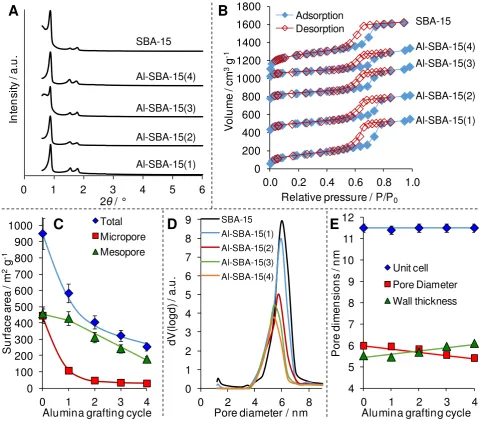
nitrogen adsorption isotherms shown in Figure 1. XRD patterns were essentially unchanged after the grafting
procedure (Figure 1A), with common reflections and peak intensities evidencing ordered mesostructures that
were stable against pore expansion/contraction and collapse during the additional chemical and thermal
processing associated with alumina coating. Porosimetry showed type 4 isotherms with H1 hysteresis for
SBA-15 and all Al-SBA-15 samples (Figure 1B), highlighting the presence of mesopores. The corresponding
surface areas decreased with alumina grafting cycle (Figure 1C), due to initial micropore filling and
subsequent loss of mesopore area coincident with shrinking mesopore diameter (WBJH). The latter is clear from
the downshift in the unimodal BJH pore size distributions (Figure 1D), with mesopores narrowing by 0.6 nm
between the parent SBA-15 and Al-SBA-15(4). The constant unit cell parameter a (calculated from a =
2d(100)/3 for hexagonal close-packed mesopores, with the plane spacing d obtained from Bragg's Law)
determined by XRD and narrowing mesopore diameters upon grafting, provide strong evidence for uniform
alumina deposition within the mesopore matrix, apparent from the increase in wall thickness (a - WBJH) with
grafting cycle in Figure 1E.
7
Figure 1. Structural properties of SBA-15 and Al-SBA-15 composites: (A) low angle XRD patterns; (B) N2
adsorption isotherms; (C) surface areas (total from BET, micropore from T-plot, and mesopore from
BET-micropore- external surface area); (D) BJH mesopore distribution; and (E) mesopore dimensions.
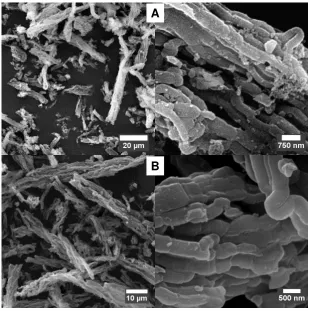
SEM images of the corresponding SBA-15 template and Al-SBA-15(4) material show a single, common
straw-like crystallite morphology with matching dimensions (Figure 2), precisely as anticipated if alumina
had grafted into the parent SBA-15 framework, and not a second, discrete morphology that would indicate the
formation of a separate, pure alumina phase.
0 1 2 3 4 5 6
In te n si ty / a .u .
2 / °
SBA-15 Al-SBA-15(1) Al-SBA-15(2) Al-SBA-15(3) Al-SBA-15(4) 0 200 400 600 800 1000 1200 1400 1600 1800
0.0 0.2 0.4 0.6 0.8 1.0
V ol u m e / cm 3g -1
Relative pressure / P/P0
Adsorption Desorption SBA-15 Al-SBA-15(1) Al-SBA-15(2) Al-SBA-15(3) Al-SBA-15(4) 0 100 200 300 400 500 600 700 800 900 1000
0 1 2 3 4
S u rf ace a re a / m 2g -1
Alumina grafting cycle Total Micropore Mesopore 4 5 6 7 8 9 10 11 12
0 1 2 3 4
P or e di m en si on s / n m
Alumina grafting cycle Pore Spacing Pore Diameter Wall thickness 0 1 2 3 4 5 6 7 8 9
0 2 4 6 8
dV (lo gd ) / a .u .
Pore diameter / nm SBA-15 Al-SBA-15(1) Al-SBA-15(2) Al-SBA-15(3) Al-SBA-15(4)
A
B
C
D
E
[image:9.595.56.540.76.499.2]8
Figure 2. Representative SEM images of (A) Al-SBA-15(4); and (B) the parent SBA-15.
The high surface sensitivity and chemical specificity of XPS renders it the ideal technique with which to
follow the formation of alumina adlayers as a function of grafting number. As noted in the Experimental, the
Al 2p, Si 2p and O 1s spectra for the Al-SBA-15 materials exhibit multiple chemical states associated with the
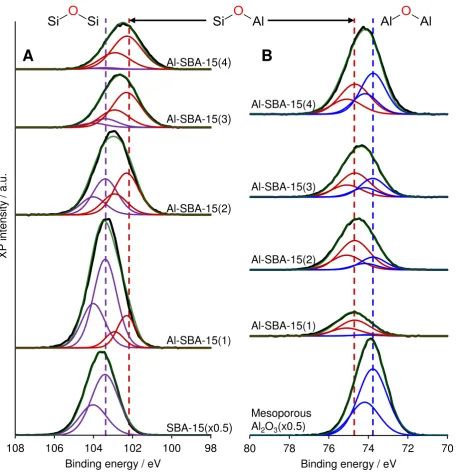
underlying silica template, alumina-silica interface, and alumina multilayers, as highlighted in Figure 3.
Aluminium and silicon atoms at the interface can be readily differentiated, since they exhibit unique BEs
reflecting their different Pauling electronegativities and associated induced dipoles mediated via the bridging
oxygen. Considering the Al 2p XP spectra (Figure 3B), aluminium atoms within Al-SBA-15(1), i.e. deposited
during the first grafting cycle, exhibit BE characteristic of Al3+ but occur at 74.7 eV, approximately 1.1 eV
higher energy than observed for the pure mesoporous alumina (meso-Al2O3) reference. The absence of any
bulk alumina features for Al-SBA-15(1) discounts the possibility that aluminium introduced during the
grafting procedure is hydrolysed to an alumina phase spatially-isolated from the SBA-15 framework. The
intensity of this interfacial alumina feature grows with each successive grafting cycle, and is accompanied by
the emergence of bulk alumina features, consistent with the formation of alumina multilayers not in direct
contact with the silica support. The converse behaviour is observed in the Si 2p XP spectra (Figure 3A),
wherein the pure parent SBA-15 component at 103.4 eV is progressively attenuated with each grafting cycle,
concomitant with the growth of a new silicon environment at 102.3 eV attributed to electronically perturbed
silicon atoms at the interface with the evolving alumina overlayer. The stoichiometry of the alumina coating
was estimated from the ratio of the 'bulk-like' Al 2p3/2 state at 73.3 eV to the associated O 1s state at 530.9 eV,
9
corrected for their relative instrumental response factors, and was between Al2O2.9 to Al2O3.2 demonstrating
the successful deposition of a stoichiometric alumina adlayer. The thickness of the alumina overlayer can be
estimated from the variation in the overall Si 2p XP intensity with excitation source energy. The inelastic
mean free path for Si 2p3/2 photoelectrons excited by Mg K radiation is 2 nm versus 2.33 nm for excitation by
Al K [45]. Applying these values to the Al-SBA-15(4) sample according to Equation S1 (derived from [46])
yields an alumina thickness of 0.62 nm, which equates to ~2.7 alumina monolayers assuming a thickness of
0.23 nm [47], slightly greater than the pore shrinkage determined by porosimetry.
Figure 3. Background-subtracted, fitted (A) Si 2p and (B) Al 2p XP spectra of Al-SBA-15 as a function of
alumina grafting cycles. Comparative spectra for SBA-15 and mesoporous alumina references are also shown.
Al-SBA-15(4)
Al-SBA-15(3)
Al-SBA-15(2)
Al-SBA-15(1)
SBA-15(x0.5)
Al-SBA-15(4)
Al-SBA-15(3)
Al-SBA-15(2)
Al-SBA-15(1)
Mesoporous
Al2O3(x0.5)
98 100
102 104
106 108
X
P
intensi
ty
/
a.u
.
Binding energy / eV
A
B
70 72
74 76
78 80
[image:11.595.60.517.209.683.2]10
Having established that the Al-SBA-15(4) material comprised a 2-3 monolayer, stoichiometric alumina
coating permeating throughout the SBA-15 template, palladium nanoparticles were subsequently introduced
via incipient wetness impregnation to achieve a loading of 0.77 wt%. Low angle XRD, porosimetry and XPS
(Figure S1) showed that the ordered mesostructure and alumina surface composition of the alumina-coated
SBA-15 support were preserved in the resulting Pd/Al-SBA-15(4) sample. This contrasts with palladium
incorporation by an identical protocol into a mesoporous alumina support, wherein alumina crystallisation and
a consequent loss of mesopore ordering and pore dimensions was observed (Figure S2), highlighting the
greater stability of the Al-SBA-15 support.
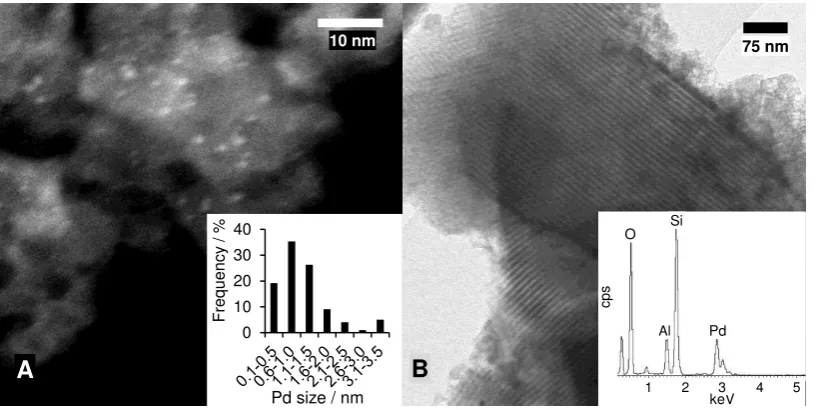
Palladium nanoparticles and their size distribution and dispersion were evaluated by HAADF-STEM and
CO chemisorption (Figure 4 and Table 1). HAADF-STEM shows uniformly distributed nanoparticles with a
narrow size range and mean particle diameter of 1.1 (±0.5) nm, while bright field TEM shows that the ordered
mesopore architecture of the Al-SBA-15(4) support is preserved, with elemental analysis (in STEM
configuration) confirming the presence of both Pd and Al throughout the pore network. Palladium metal
dispersions were used to estimate average particle diameters, assuming a spherical morphology, for
comparison against similar Pd loadings on mesoporous alumina and SBA-15 supports [22, 24]. Table 1 shows
that far higher dispersions and smaller nanoparticles were achieved over the Al-SBA-15(4) support than pure
SBA-15 or meso-Al2O3 materials, as reported for Pt on Al-SBA-15 [40]. The palladium oxidation state within
Pd/Al-SBA-15(4) was probed by XPS, with both metal and oxide observed (Figure S3). The surface PdO
content quantified in Table 1 was significantly higher than that observed for comparable metal loadings over
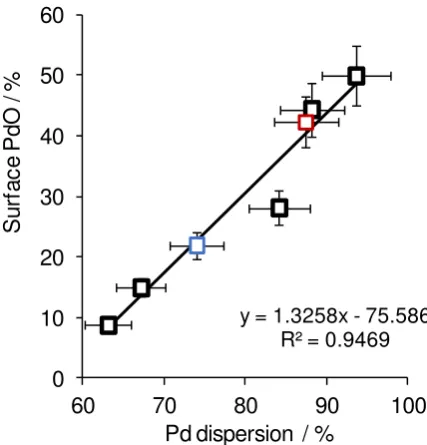
mesoporous silica or alumina, consistent with the higher palladium dispersion. We have previously noted that
these properties are closely correlated over alumina supports [24], and Figure 5 confirms that in this respect,
palladium nanoparticles on Al-SBA-15(4) behave akin to those on pure meso-Al2O3.
Figure 4. (A) Representative HAADF-STEM image of Pd/Al-SBA-15(4) with Pd particle size distribution
derived from 100 particles shown inset; and (B) Bright field TEM image with corresponding EDX spectrum
shown inset (unlabelled peaks correspond to C and Cu from the sample grid).
A
10 nm 75 nm
B
0 10 20 30 40
Frequen
cy
/
%
Pd size / nm
O
Pd
1 Al
Si
2 4 5
keV
cps
[image:12.595.56.472.507.712.2]11
Table 1. Physicochemical properties of Pd/Al-SBA-15(4) versus Pd/meso-Al2O3 and Pd/SBA-15
Support Pd loading
/ wt%(a)
Pd dispersion
/ %(b)
Pd particle size
/ nm(b)
Surface PdO content
/ %(c)
Al-SBA-15(4) 0.77 88 (±1) 1.0 (±0.1) 44.3 (±4.2)
meso-Al2O3(d) 0.74 74 (±1) 1.5 (±0.1) 21.9 (±2.2)
SBA-15(e) 0.89 52 (±1) 2.3 (±0.1) 6.0 (±0.1)
(a)
ICP analysis; (b)Pulse chemisorption assuming stoichiometry of 1:2 CO:Pd; (c) PdO% from fitted Pd 3d XP
spectra; (d)From reference 24; (e)From reference 22.
Figure 5. Linear correlation between palladium dispersion (from CO titration) and surface PdO content (from
XPS fitting) for Pd/Al-SBA-15(4) and mesoporous Al2O3 (taken from reference 21). Red and blues data points
represent 0.77 wt% Pd/Al-SBA-15 and 0.74 wt% Pd/meso-Al2O3 respectively.
3.2 Cinnamyl alcohol selox
The catalytic activity of Pd/Al-SBA-15 towards the aerobic selox of cinnamyl alcohol was determined in
order to benchmark its performance against Pd/SBA-15 or Pd/meso-Al2O3 [22-24], and thus assess support
effects. Identical reaction conditions, including stirring speed, reaction vessel dimensions, O2 flow rate and
temperature, were selected to match our previous studies and facilitate direct comparison of catalysts in the
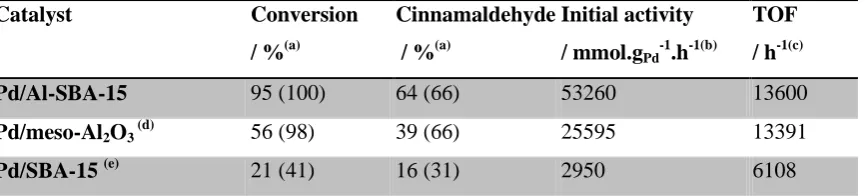
absence of bulk mass transport limitations. The mass-normalised initial rate of cinnamyl alcohol selox for
Pd/Al-SBA-15(4) was exceptional, being twice that observed over the pure meso-Al2O3 support, and almost
20 times that obtained for Pd/SBA-15 (Table 2, Figure S4). Although Pd/Al-SBA-15(4) affords a higher rate
of cinnamyl selox than obtained for the Pd/meso-Al2O3 catalyst, their corresponding Turnover Frequencies
(TOFs) per surface PdO sites are almost identical (~13,500 h-1), suggesting a common active species and
palladium-support interaction; the principal impact of the more highly ordered Al-SBA-15 support is simply y = 1.3258x - 75.586
R² = 0.9469 0
10 20 30 40 50 60
60 70 80 90 100
Su
rf
ac
e
Pd
O
/
%
[image:13.595.61.275.250.473.2]12
to increase the density of such PdO sites. A similar explanation has been advanced for the superior
electrocatalytic performance of Pt supported on ordered mesoporous CMK-3 versus a disordered
wormhole-like mesoporous carbon for ethanol oxidation and oxygen reduction [48]. If cinnamyl selox activity was solely
a function of the concentration of PdO present at the surface of oxidised palladium nanoparticles, then one
might expect a common TOF for all three catalysts, independent of support type. In fact, the TOF for the
Pd/SBA-15 catalyst was only 6,108 h-1. Since the morphology of Al-SBA-15 is identical to that of its SBA-15
parent, such different TOFs are not easily explained by differing mass-transport properties, but rather suggest
a palladium-silica interaction distinct from that obtained with the alumina-grated surface. We propose that the
enhanced activity and TOFs for alumina versus silica supported palladium reflects a superior ability to
disperse and preserve smaller, and hence more heavily oxidised, PdO nanoparticles during cinnamyl selox. A
gradation of 'PdO' active centres may thus exist over oxide supports, which though all formally Pd2+, may
differ in their dimensionality and thus reducibility [18]. The unsaturated allylic aldehyde, cinnamaldehyde,
was the dominant product for all three catalysts (formed with ~70 % selectivity), with 3-phenylpropan-1-ol
and trans- -methylstyrene the major by-products (both ~ 14 % after 3 h reaction), with styrene and
ethylbenzene minor by-products (<5 %) via cinnamaldehyde decarbonylation and subsequent hydrogenation
[image:14.595.57.490.414.512.2](Figure S5).
Table 2. Cinnamyl alcohol selox over Pd/Al-SBA-15(4) versus Pd/meso-Al2O3 and Pd/SBA-15
Catalyst Conversion
/ %(a)
Cinnamaldehyde
/ %(a)
Initial activity
/ mmol.gPd-1.h-1(b)
TOF
/ h-1(c)
Pd/Al-SBA-15 95 (100) 64 (66) 53260 13600
Pd/meso-Al2O3 (d) 56 (98) 39 (66) 25595 13391
Pd/SBA-15 (e) 21 (41) 16 (31) 2950 6108
(a)
Conversion and cinnamaldehyde selectivity after 30 min (and 3 h in parentheses) flowing O2; (b)calculated
over the initial 20-30 min for conversions <50 %; (c)normalised to PdO active site density (XPS); (d)From
reference 20; (e)From reference 18.
3.3 Operando XAS studies of cinnamyl alcohol selox
Additional laboratory studies of cinnamyl alcohol selox over Pd/SBA-15 revealed rapid on-stream
deactivation in under 10 min when a static oxygen pressure was maintained above the reaction solution,
instead of oxygen flowing through the solution (Figure S6-7). We therefore undertook time-resolved,
operando Pd K-edge XAS measurements on the 0.77 wt% Pd/Al-SBA-15 catalyst to assess the interplay
between static versus flowing oxygen and the corresponding oxidation state of palladium nanoparticles.
Previous work on the vapour phase oxidation of crotyl alcohol, an analogue of cinnamyl alcohol, has shown
the importance of high oxygen concentrations in maintaining steady state catalytic selox over palladium
Pd/Al-SBA-13
15 in toluene, and after 1 h cinnamyl alcohol selox under static or flowing oxygen are presented in Figure 6.
XANES of the as-prepared catalyst exhibits a significant white-line consistent with the presence of substantial
PdO (~74 % PdO from fitting to standards). After 1 h selox under flowing oxygen (i.e. a higher concentration
of dissolved oxygen) there is little visible change in the operando XANES spectra, and indeed fitting suggests
around 66 % of palladium remains as PdO. In contrast, after 1 h reaction under static oxygen, significant
changes are apparent in the XANES consistent with reduction to palladium metal, with only 41 % PdO
retained. Flowing oxygen thus helps preserve palladium in the +2 oxidation state under full selox reaction
conditions.
Figure 6. (A) Operando XANES of the as-prepared Pd/Al-SBA-15 in toluene (superior data quality reflects
the average of 10 spectra), and after 1 h cinnamyl alcohol selox reaction under static or flowing O2 (single
spectrum); (B) linear combination fitted XANES spectrum of Pd/Al-SBA-15 under flowing O2.
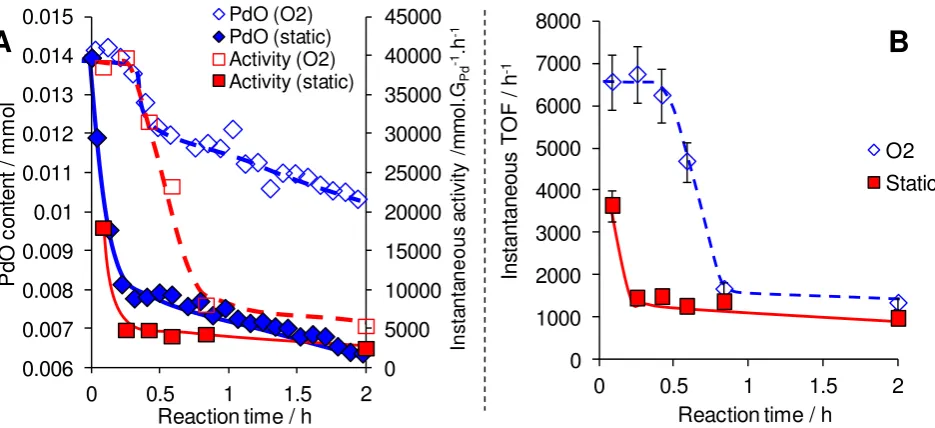
The time-dependent evolution of palladium oxidation state and concomitant impact upon instantaneous
selox activity during the first 2 h of reaction are closely correlated (Figure 7A). Under static conditions, the
concentration of PdO, determined in solution during cinnamyl alcohol oxidation, falls rapidly during the first
20 min reaction before reaching a plateau, mirrored by a sharp drop in catalyst reactivity which reaches a low,
stable selox rate. When this reaction is repeated with an oxygen flow introduced before alcohol addition, the
initial high [PdO] is maintained for the first 20 min reaction, coincident with a constant, high selox rate.
Longer reaction times result in a monotonic decrease in both palladium oxide concentration and activity,
although neither parameter falls to the low values observed under static oxygen. 0.0
0.3 0.6 0.9 1.2 1.5
24200 24400 24600 24800 25000
N
orm
al
ised
ad
sorpt
ion
/
a.u.
Energy / eV 24300 24350 24400 24450
N
orm
. adsorpt
ion
/ a.
u.
Energy / eV Raw
data Fit
PdO
Pd
A
B
Fresh
Flowing O2
[image:15.595.68.486.240.522.2]14
Figure 7. (A) Impact of flowing versus static oxygen on palladium oxidation state and catalytic activity of
Pd/Al-SBA-15 during liquid phase cinnamyl alcohol selox. (B) Evolution of corresponding TOFs (normalised
per PdO surface sites) as a function of reaction time (250 mg catalyst and 84 mmol alcohol substrate). Note,
lower TOFs relative to laboratory batch conditions reflect heating losses from circulating solution during
transfer between cell and reservoir.
If catalyst deactivation quantitatively tracked palladium reduction, then the corresponding instantaneous
TOFs (per PdO site) should remain constant throughout reaction under static and flowing oxygen. Figure 7B
reveals that a constant TOF is only observed for the first 30 min under flowing oxygen, before a steep
decrease to the same low steady state value obtained under static conditions, indicating the genesis of a new,
common, poorly active species, which vida supra, is assigned to Pd0. Palladium metal is known to favour
aldehyde decarbonylation [49], resulting in catalyst self-poisoning by strong-bound hydrocarbons and CO [20,
21]. Carbonaceous residues may irreversibly block subsequent alcohol adsorption, while CO can serve as both
a reversibly adsorbed site-blocker and reductant [50, 51]. Our operando measurements confirm that on-stream
deactivation occurs via a transition from highly active and selective cinnamyl alcohol oxidation over PdO, to
the slow and unselective conversion of cinnamyl alcohol over metallic Pd with attendant self-poisoning by
undesired by-products of decarbonylation. Although the low flow of oxygen (at atmospheric pressure)
employed in this study was insufficient to fully suppress in-situ catalyst reduction, it is clear that the local
concentration of (dissolved) oxygen is critical in regulating the rate of Pd/Al-SBA-15 deactivation. This is
consistent with the oxidative dehydrogenation reaction mechanism generally accepted for allylic alcohol selox
[52]. Figure 7 shows that maintaining palladium catalysts in a high oxidation state during operando liquid
phase selox is essential for optimising their activity, in agreement with our observations of gas phase crotyl
alcohol selox [17, 19]. Throughout our research on the selective oxidation of allylic alcohols, whether in the
liquid or gas phase, and under oxygen-rich or deficient conditions, a direct correlation between selox activity
B
0 1000 2000 3000 4000 5000 6000 7000 80000 0.5 1 1.5 2
In st an ta ne ou s T O F / h -1
Reaction time / h
O2 Static 0 5000 10000 15000 20000 25000 30000 35000 40000 45000 0.006 0.007 0.008 0.009 0.01 0.011 0.012 0.013 0.014 0.015
0 0.5 1 1.5 2
In st an ta ne ou s act ivi ty /m m ol .GPd -1.h -1 Pd O c on te nt / m m ol
Reaction time / h
PdO (O2) PdO (static) Activity (O2) Activity (static)
[image:16.595.68.536.92.306.2]15
and palladium oxide concentration determined in-situ has been observed [16, 18, 21], hence there is no
convincing evidence for catalyst deactivation during allylic alcohol selox due to palladium ‘over-oxidation’.
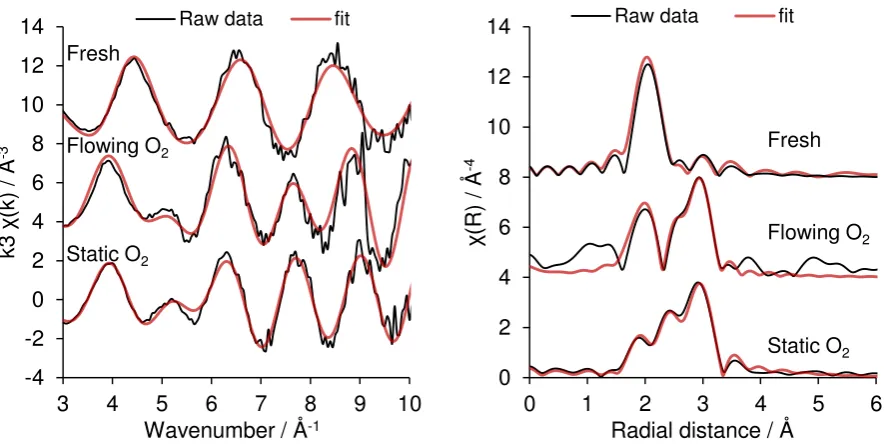
The preceding XANES analysis is supported by EXAFS fitting of the as-prepared 0.77 wt%
Pd/Al-SBA-15 catalyst in toluene, and after 2 h cinnamyl alcohol selox under static or flowing oxygen (Figure 8). An
excellent fit to the as-prepared Pd/Al-SBA-15 catalyst was obtained for a mix of PdO and Pd (Table S1), with
Pd-O nearest neighbours at 2.02 Å the dominant scatters. We propose the as-prepared catalyst comprised a
metallic palladium core encapsulated by a multilayer palladium oxide shell, akin to Pd/SBA-15 [22]. The
extremely low Pd-Pd 1st shell coordination number at 2.7 Å (and absence of longer range shells expected for
Pd metal), and presence of Pd-Pd scatterers at 2.68 Å and 3.04 Å consistent with 'bulk-like' PdO, indicate a
relatively thick oxide shell and small metal core compared to the silica analogue, in keeping with the higher
selox activity of Pd/Al-SBA-15.
EXAFS spectra of Pd/Al-SBA-15 in solution following 2 h reaction under either static or flowing oxygen
could only be successfully fitted by including a third phase, palladium carbide (Figure 8 and Table S1); fits to
a two-phase mixture of oxide, metal or carbide were poor (Figure S8 and Table S2). Palladium carbide is
known to form via surface-mediated reactions with gaseous hydrocarbons at ambient temperature [53, 54] or
CO decomposition, resulting in a characteristic Pd-C scattering feature ~2.16 Å and concomitant palladium
lattice expansion [55]. Good fits were obtained only though including additional shells, Pd-C at 2.16 Å and an
expanded Pd-Pd shell at ~2.84 Å [54]. Carbide formation from metallic palladium can usually be discerned
through subtle shifts in the first and second XANES features due to the interaction between the excited 1s
photoelectron with empty 5p and 4f orbitals [55, 56], however the complex mixture of oxide/metal/carbide
present under reaction conditions prohibited such observations. The first shell Pd-Pd coordination number of
the metallic phase observed operando under either oxygen environment of ~1.8 is essentially identical to that
of the fresh catalyst in toluene, suggesting a common metallic core. This leads us to hypothesise that the
carbide represents an amorphous surface phase, formed as a result of in-situ PdO reduction (apparent from the
fall in first shell Pd-O coordination number from 3.2 under toluene, to 1.8 and 1.4 under flowing and static
oxygen respectively) and subsequent carbon laydown over metallic surface sites. The concomitant rise in
selectivity to trans- -methylstyrene from ~5 % after 10 min reaction to ~15 % after 2 h (and to a lesser degree
styrene), associated with a partial switchover from oxidative dehydrogenation to C-O cleavage pathways,
16
Figure 8. k3-weighted EXAFS data and corresponding Fourier Transforms and fits for as-prepared 0.77 wt%
Pd/Al-SBA-15 in toluene and after 1 h cinnamyl alcohol selox reaction under static O2 or flowing O2.
It is interesting to consider whether dissolved oxygen could re-oxidise palladium nanoparticles reduced
in-situ, and thus regenerate catalytic selox activity. We have only ever observed palladium re-oxidation and
associated reactivation during vapour phase selox experiments [17-18] at (i) significantly higher temperatures
(140 °C) than those used in the present liquid phase study (90 °C), and (ii) local oxygen concentrations far
exceeding those employed during our solution phase experiments (mol fractionvapour = 0.025 versus mol
fractiontoluene = 0.0009 [57]), or following a deliberate post-reaction 500 C calcination treatment [22] wherein
the calcined catalyst exhibits a comparable PdO content to that of fresh catalysts. The forcing conditions
required to re-oxidise palladium nanoparticles suggest that the deactivated metal/carbide surfaces may be
poisoned by strongly adsorbed hydrocarbons, and hence are resistant to mild re-oxidation treatments - this
hypothesis is supported by comparing C 1s XP spectra of fresh and spent 0.42 wt% Pd/SBA-16 catalysts
(Figure S9). Pd(0) reoxidation back to PdO thus likely requires thermal activation; this poses a problem for
solution phase regeneration, with Henry’s Law dictating a decrease in oxygen solubility with increasing
solution temperature. We therefore predict that palladium re-oxidation at 90 C would only be feasible under
pO2 >20 bar for which the mol fraction of dissolved oxygen rises to 0.025 [57].
4.
Conclusions
Deposition of ultrathin alumina films on mesoporous SBA-15 silica provides an effective route to the
synthesis of a highly ordered, high area catalyst support exhibiting alumina-like surface properties. The
resulting composite Al-SBA-15 support facilitates enhanced dispersion of palladium nanoparticles, and thus a
greater proportion of surface PdO than either mesoporous silica or alumina for comparable palladium
loadings. Consequently, Pd/Al-SBA-15 exhibits superior activity in the liquid phase aerobic selective -4
-2 0 2 4 6 8 10 12 14
3 4 5 6 7 8 9 10
k3
(
k)
/
Å
-3
Wavenumber / Å-1
Raw data fit
0 2 4 6 8 10 12 14
0 1 2 3 4 5 6
(
R
)
/ Å
-4
Radial distance / Å
Raw data fit
Fresh
Flowing O2
Static O2
Fresh
Flowing O2
17
oxidation of cinnamyl alcohol to cinnamaldehyde than Pd/SBA-15 or Pd/meso-Al2O3. Turnover Frequency
analysis indicates that ultrathin and bulk alumina surfaces generate higher levels of a common (PdO) active
species than can be achieved over silica, indicating significant metal-support interactions. Operando XAS
measurements reveal strong correlations between the palladium oxidation state and selox activity which
identify rapid on-stream PdO reduction as the major deactivation pathway, which can be ameliorated by an
increase in the local oxygen partial pressure. PdO reduction opens up undesired C-O cleavage and
decarbonylation pathways (with attendant loss of cinnamaldehyde selectivity), with the resulting hydrocarbon
and CO by-products liberated driving surface palladium carbide formation. Knowledge of the redox chemistry
of palladium nanoparticles under reaction conditions, and advantages of employing a nanostructured
Al-SBA-15 support in generating and maintaining high surface PdO concentrations is critical to the design of
next-generation palladium-derived catalysts for energy efficient alcohol selox and process optimisation.
Acknowledgements
We thank the EPSRC (EP/E046754/1; EP/G007594/2) for financial support, a Leadership Fellowship (A.F.L.)
and studentships (L.J.D. and A.F.M.) and Diamond Light Source for beamtime (SP7668-1). K.W.
acknowledges the Royal Society for the award of an Industry Fellowship. Electron microscopy access was
provided through the Leeds EPSRC Nanoscience and Nanotechnology Research Equipment Facility (LENNF)
(EP/F056311/1).
References
[1] S.S. Cheng, J.Y. Liu, K.H. Tsai, W.J. Chen, S.T. Chang, Chemical composition and mosquito larvicidal activity of essential oils from leaves of different Cinnamomum osmophloeum provenances, Journal of Agricultural and Food Chemistry 52 (2004) 4395-4400.
[2] G.O. Onawunmi, Evaluation of the antimicrobial activity of citral, Letters in Applied Microbiology 9 (1989) 105-108.
[3] T. Hattori, Y. Suzuki, O. Uesugi, S. Oi, S. Miyano, Cationic palladium(II) complex-catalyzed [2+2] cycloaddition and tandem cycloaddition-allylic rearrangement of ketene with aldehydes: an improved synthesis of sorbic acid, Chemical Communications (2000) 73-74.
[4] C. Mercier, P. Chabardes, Organometallic chemistry in industrial vitamin A and vitamin E synthesis, Catalysis of Organic Reactions 62 (1994) 213.
[5] J.H. Clark, Green Chemistry: challenges and opportunities, Green Chemistry 1 (1999) 1-8.
[6] R.A. Sheldon, Fundamentals of green chemistry: efficiency in reaction design, Chemical Society Reviews 41 (2012) 1437-1451.
[7] A. Corma, H. Garcia, Supported gold nanoparticles as catalysts for organic reactions, Chemical Society Reviews 37 (2008) 2096-2126.
[8] X.Y. Liu, R.J. Madix, C.M. Friend, Unraveling molecular transformations on surfaces: a critical comparison of oxidation reactions on coinage metals, Chemical Society Reviews 37 (2008) 2243-2261.
[9] T. Takei, T. Akita, I. Nakamura, T. Fujitani, M. Okumura, K. Okazaki, J. Huang, T. Ishida, M. Haruta, Chapter One - Heterogeneous Catalysis by Gold, in: C.G. Bruce, C.J. Friederike, (Eds.), Advances in Catalysis, Academic Press, 2012, pp. 1-126.
18 [11] S.E. Davis, M.S. Ide, R.J. Davis, Selective oxidation of alcohols and aldehydes over supported metal
nanoparticles, Green Chemistry 15 (2013) 17-45.
[12] T. Balcha, J.R. Strobl, C. Fowler, P. Dash, R.W.J. Scott, Selective Aerobic Oxidation of Crotyl Alcohol Using AuPd Core-Shell Nanoparticles, Acs Catalysis 1 (2011) 425-436.
[13] T. Hara, M. Ishikawa, J. Sawada, N. Ichikuni, S. Shimazu, Creation of highly stable monomeric Pd(II) species in an anion-exchangeable hydroxy double salt interlayer: Application to aerobic alcohol oxidation under an air atmosphere, Green Chemistry 11 (2009) 2034-2040.
[14] R.A. Sheldon, I. Arends, A. Dijksman, New developments in catalytic alcohol oxidations for fine chemicals synthesis, Catalysis Today 57 (2000) 157-166.
[15] S.S. Stahl, Palladium oxidase catalysis: Selective oxidation of organic chemicals by direct dioxygen-coupled turnover, Angewandte Chemie-International Edition 43 (2004) 3400-3420.
[16] A.F. Lee, K. Wilson, Structure-reactivity correlations in the selective aerobic oxidation of cinnamyl alcohol: in situ XAFS, Green Chemistry 6 (2004) 37-42.
[17] A.F. Lee, C.V. Ellis, J.N. Naughton, M.A. Newton, C.M.A. Parlett, K. Wilson, Reaction-Driven Surface Restructuring and Selectivity Control in Allylic Alcohol Catalytic Aerobic Oxidation over Pd, Journal of the American Chemical Society 133 (2011) 5724-5727.
[18] C.V. Gaskell, C.M.A. Parlett, M.A. Newton, K. Wilson, A.F. Lee, Redox-Controlled Crotyl Alcohol Selective Oxidation: In Situ Oxidation and Reduction Dynamics of Catalytic Pd Nanoparticles via Synchronous XANES/MS, Acs Catalysis 2 (2012) 2242-2246.
[19] C.M.A. Parlett, C.V. Gaskell, J.N. Naughton, M.A. Newton, K. Wilson, A.F. Lee, Operando synchronous DRIFTS/MS/XAS as a powerful tool for guiding the design of Pd catalysts for the selective oxidation of alcohols, Catalysis Today 205 (2013) 76-85.
[20] A.F. Lee, Z. Chang, P. Ellis, S.F.J. Hackett, K. Wilson, Selective oxidation of crotyl alcohol over pd(111), Journal of Physical Chemistry C 111 (2007) 18844-18847.
[21] A.F. Lee, J.N. Naughton, Z. Liu, K. Wilson, High-Pressure XPS of Crotyl Alcohol Selective Oxidation over Metallic and Oxidized Pd(111), Acs Catalysis 2 (2012) 2235-2241.
[22] C.M.A. Parlett, D.W. Bruce, N.S. Hondow, M.A. Newton, A.F. Lee, K. Wilson, Mesoporous Silicas as Versatile Supports to Tune the Palladium-Catalyzed Selective Aerobic Oxidation of Allylic Alcohols, ChemCatChem 5 (2013) 939-950.
[23] C.M.A. Parlett, D.W. Bruce, N.S. Hondow, A.F. Lee, K. Wilson, Support-Enhanced Selective Aerobic Alcohol Oxidation over Pd/Mesoporous Silicas, ACS Catalysis 1 (2011) 636-640.
[24] C.M.A. Parlett, K. Wilson, D.W. Bruce, N.S. Hondow, A.F. Lee, Selective oxidation of allylic alcohols over highly ordered Pd/meso-Al2O3 catalysts, Catalysis Communications Submitted (2013).
[25] J. Lu, S. Behtash, M. Faheem, A. Heyden, Microkinetic modeling of the decarboxylation and decarbonylation of propanoic acid over Pd(111) model surfaces based on parameters obtained from first principles, Journal of Catalysis 305 (2013) 56-66.
[26] B. Karimi, A. Zamani, S. Abedia, J.H. Clark, Aerobic oxidation of alcohols using various types of immobilized palladium catalyst: the synergistic role of functionalized ligands, morphology of support, and solvent in generating and stabilizing nanoparticles, Green Chemistry 11 (2009) 109-119.
[27] Y.T. Chen, Z. Guo, T. Chen, Y.H. Yang, Surface-functionalized TUD-1 mesoporous molecular sieve supported palladium for solvent-free aerobic oxidation of benzyl alcohol, Journal of Catalysis 275 (2010) 11-24.
[28] Z.C. Ma, H.Q. Yang, Y. Qin, Y.J. Hao, G.A. Li, Palladium nanoparticles confined in the nanocages of SBA-16: Enhanced recyclability for the aerobic oxidation of alcohols in water, Journal of Molecular Catalysis a-Chemical 331 (2010) 78-85.
[29] C.-J. Jia, F. Schuth, Colloidal metal nanoparticles as a component of designed catalyst, Physical Chemistry Chemical Physics 13 (2011) 2457-2487.
19 [31] F. Kleitz, S.H. Choi, R. Ryoo, Cubic Ia3d large mesoporous silica: synthesis and replication to platinum
nanowires, carbon nanorods and carbon nanotubes, Chemical Communications (2003) 2136-2137. [32] S.F.J. Hackett, R.M. Brydson, M.H. Gass, I. Harvey, A.D. Newman, K. Wilson, A.F. Lee, High-Activity,
Single-Site Mesoporous Pd/Al2O3 Catalysts for Selective Aerobic Oxidation of Allylic Alcohols, Angewandte Chemie International Edition 46 (2007) 8593-8596.
[33] A.Y. Stakheev, L.M. Kustov, Effects of the support on the morphology and electronic properties of supported metal clusters: modern concepts and progress in 1990s, Applied Catalysis a-General 188 (1999) 3-35.
[34] S.J. Tauster, Strong metal-support interactions, Accounts of Chemical Research 20 (1987) 389-394. [35] K. Hayek, R. Kramer, Z. Paal, Metal-support boundary sites in catalysis, Applied Catalysis a-General
162 (1997) 1-15.
[36] M.V. Landau, E. Dafa, M.L. Kaliya, T. Sen, M. Herskowitz, Mesoporous alumina catalytic material prepared by grafting wide-pore MCM-41 with an alumina multilayer, Microporous and Mesoporous Materials 49 (2001) 65-81.
[37] M. Baca, E. de la Rochefoucauld, E. Ambroise, J.M. Krafft, R. Hajjar, P.P. Man, X. Carrier, J. Blanchard, Characterization of mesoporous alumina prepared by surface alumination of SBA-15, Microporous and Mesoporous Materials 110 (2008) 232-241.
[38] P. Madhusudhan Rao, A. Wolfson, S. Kababya, S. Vega, M.V. Landau, Immobilization of molecular H3PW12O40 heteropolyacid catalyst in alumina-grafted silica-gel and mesostructured SBA-15 silica matrices, Journal of Catalysis 232 (2005) 210-225.
[39] X. Sheng, Y. Zhou, Y. Zhang, Y. Duan, Z. Zhang, Y. Yang, Immobilization of 12-Tungstophosphoric acid in alumina-grafted mesoporous LaSBA-15 and its catalytic activity for alkylation of o-xylene with styrene, Microporous and Mesoporous Materials 161 (2012) 25-32.
[40] Y. Duan, Y. Zhou, Y. Zhang, X. Sheng, S. Zhou, Z. Zhang, Effect of aluminum modification on catalytic properties of PtSn-based catalysts supported on SBA-15 for propane dehydrogenation, Journal of Natural Gas Chemistry 21 (2012) 207-214.
[41] E.J.M. Hensen, D.G. Poduval, P. Magusin, A.E. Coumans, J.A.R. Veen, Formation of acid sites in amorphous silica-alumina, Journal of Catalysis 269 (2010) 201-218.
[42] Q.-Q. Hao, Y.-H. Zhao, H.-H. Yang, Z.-T. Liu, Z.-W. Liu, Alumina Grafted to SBA-15 in Supercritical CO2 as a Support of Cobalt for Fischer Tropsch Synthesis, Energy & Fuels 26 (2012) 6567-6575.
[43] S.J. Pennycook, L.A. Boatner, CHEMICALLY SENSITIVE STRUCTURE-IMAGING WITH A SCANNING-TRANSMISSION ELECTRON-MICROSCOPE, Nature 336 (1988) 565-567.
[44] NIST XRay Photoelectron spectroscopy database, NIST Standard Reference Database 20, Version 3.5. (2003) [online] Available at: < http://srdata.nist.gov/xps/> [Accessed January 2012].
[45] P.J. Cumpson, M.P. Seah, Elastic Scattering Corrections in AES and XPS. II. Estimating Attenuation Lengths and Conditions Required for their Valid Use in Overlayer/Substrate Experiments, Surface and Interface Analysis 25 (1997) 430-446.
[46] A.F. Lee, C.V. Ellis, K. Wilson, N.S. Hondow, In situ studies of titania-supported Au shell-Pd core nanoparticles for the selective aerobic oxidation of crotyl alcohol, Catalysis Today 157 (2010) 243-249.
[47] V. Maurice, I. Bennour, S. Zanna, L.H. Klein, P. Marcus, Modifications and Growth Mechanisms of Ultrathin Aluminum Oxide Films on NiAl in Water, The Journal of Physical Chemistry C 114 (2010) 7132-7140.
[48] S.Q. Song, Y.R. Liang, Z.H. Li, Y. Wang, R.W. Fu, D.C. Wu, P. Tsiakaras, Effect of pore morphology of mesoporous carbons on the electrocatalytic activity of Pt nanoparticles for fuel cell reactions, Applied Catalysis B-Environmental 98 (2010) 132-137.
20 [50] T. Maillet, C. Solleau, J. Barbier Jr, D. Duprez, Oxidation of carbon monoxide, propene, propane and methane over a Pd/Al2O3 catalyst. Effect of the chemical state of Pd, Applied Catalysis B: Environmental 14 (1997) 85-95.
[51] T. Lear, N.G. Hamilton, D. Lennon, The application of temperature-programmed desorption, adsorption isotherms and temperature-programmed oxidation to investigate the interaction of CO with alumina-supported palladium catalysts, Catalysis Today 126 (2007) 219-227.
[52] M. Besson, P. Gallezot, Selective oxidation of alcohols and aldehydes on metal catalysts, Catalysis Today 57 (2000) 127-141.
[53] M.W. Tew, M. Janousch, T. Huthwelker, J.A. van Bokhoven, The roles of carbide and hydride in oxide-supported palladium nanoparticles for alkyne hydrogenation, Journal of Catalysis 283 (2011) 45-54.
[54] M. Bauer, R. Schoch, L. Shao, B. Zhang, A. Knop-Gericke, M. Willinger, R. Schlögl, D. Teschner, Structure Activity Studies on Highly Active Palladium Hydrogenation Catalysts by X-ray Absorption Spectroscopy, The Journal of Physical Chemistry C 116 (2012) 22375-22385.
[55] M.A. Newton, M.D. Michiel, A. Kubacka, M. Fernández-García, Combining Time-Resolved Hard X-ray Diffraction and Diffuse Reflectance Infrared Spectroscopy To Illuminate CO Dissociation and Transient Carbon Storage by Supported Pd Nanoparticles during CO/NO Cycling, Journal of the American Chemical Society 132 (2010) 4540-4541.
[56] J.A. McCaulley, In-situ x-ray absorption spectroscopy studies of hydride and carbide formation in supported palladium catalysts, The Journal of Physical Chemistry 97 (1993) 10372-10379.