Amphiphilic Molecules and Liquid Crystals
The Harvard community has made this
article openly available.
Please share
how
this access benefits you. Your story matters
Citation
Pershan, Peter S. 1979. Amphiphilic molecules and liquid crystals.
Journal de Physique 40(C3): 423-432.
Published Version
doi:10.1051/jphyscol:1979385
Citable link
http://nrs.harvard.edu/urn-3:HUL.InstRepos:10361923
Terms of Use
This article was downloaded from Harvard University’s DASH
repository, and is made available under the terms and conditions
applicable to Other Posted Material, as set forth at
http://
JOURNAL DE PHYSIQUE Colloque C3, supplLment au no 4, Tome 40, Avril 1979, page C3-423
AMPH/PH/L
/C
S YS TEMS.
AMPHIPHILIC MOLECULES AND LIQUID CRYSTALS
P. S. PERSHAN
Division of Applied Sciences, Harvard University, Cambridge, Mass. 02138, U.S.A.
Abstract. - A brief description of the essential features of amphiphillic molecules will be pre-
sented. This will be followed by a discussion of specific physical phenomena and their relation to a number of contemporary research areas. Foremost amongst these is the possible application of amphiphillic monolayers to the physics of two-dimensional systems. Specific experimental and theoretical examples will largely be drawn from studies of synthetic phosphatidylcholine (e.g., lecithin) type lipids. Recent experimental results from our laboratory will be mentioned.
1 . Introduction. - The intention in preparing this
article is to provide a brief survey of some of the salient features of amphiphillic materials and then illustrate how the physical properties of macroscopic systems formed from amphiphillics relate to pheno- mena of fundamental importance to a variety of other subjects. Hopefully, this superficial discussion of diverse phenomena from disparate disciplines will enable the reader that is already an expert in one discipline to better appreciate how his work bears on the current activities in other disciplines. The reader should also be aware that this paper was originally prepared for oral presentation and, in the manner of oral presentations, there are fewer literature citations than would have been the case had this article been prepared as a written review article. Nevertheless those citations that are listed should provide the reader with entry points into the literature of different fields. One of the classical textbooks on amphiphillic materials is Adamsons' [l], however, Tanford has recently prepared an excellent and concise review [2] of hydrophobic effects and his own book [3] is certainly relevant.
2. Amphiphillic molecules. - The saturated fatty acid CH,(CH,),COOH can be considered as the prototype of all amphiphillic molecules in that it consists of two parts which separately have very different solubilities in water, or other solvents. In this case the polar part, HCOOH or formic acid, is infinitely soluble in water while the alkane or hydro- carbon part CH,(CH,),-,CH, is much less soluble
in water than in most non-aqueous solvents. For simple alkanes, with less than 10
-
20 carbon atoms, the solubility in water decreases by roughly one order of magnitude with each increase in the carbon number by two. Conventional terminology attri- butes this decrease with increasing size of the hydro- carbon to a hydrophobic interaction. Unfortuna- tely this is somewhat of a misnomer since the effect does not derive from a repulsion between water and the hydrocarbon [2, 31. Rather it is well known that when a hydrocarbon is in contact with water the network of hydrogen bonds between water molecules reconstructs itself to avoid the region occupied by the hydrocarbon. This constraint on the local structure of water decreases the entropy of the water near the hydrocarbon and results in a larger free energy for the total system, i.e., the water plus the solvated hydrocarbon. The hydrophobic effect thus arises more from the self-attraction of water for itself, which tends to squeeze the hydrocarbon out, rather than a repulsion between water and hydrocarbon. A corollary of this is that for hydrophobic groups more complicated than the simple saturated normal alkanes mentioned above, i.e., those containing branched chains or those with large enough carbon numbers that the chain can fold over upon itself, the solubility decreases in proportion to the surface area rather than the carbon number.Amphiphillic molecules are often termed surfac- tants or surface active molecules. Figure 1 illustrates that if one dissolves a low concentration of amphi- phillics in a water solution, by virtue of the hydro-
C3-424 P. S. PERSHAN
k p A p
q FLOAT
SURFACE
p
-- --
I
.J
r
PUREWATER
I
FLEXIBLE BARRIER
FIG. l . - Schematic illustration of monolayer surface pressure. The float isolates the part of the surface containing surfactant from the rest. The flexible barrier isolates the volume containing surfactant from the rest of the liquid. The barrier is constructed such that the float can move without changing the relative volumes on either side. Also it does not exert a lateral force on the float.
phobic effect a certain fraction of the molecules will partition between the surface and the bulk with their tails pointed away from the water. Gibbs discussed this effect over a century ago [4]. The watersurfactant surface has lower energy or surface tension than for pure water. Thus in the experimental geometry schematically shown the float on the surface will move to the right in order to lower the total surface energy of the combined system. The flexible barrier allows this to occur without changing the depth on either side. The float can be kept stationary by application of a force proportional to the length" of the line of contact between the float and the sur- face. Thus one speaks of a surface pressure n with the dimensions of force per unit length that might be interpreted as the two dimensional analogue of the normal three dimensional pressure. Gibbs showed that in equilibrium with the solution n is a function of the ambient three-dimensional pressure, the tem- perature and the chemical potential of the amphi- phillic molecules in solution, i.e., n(T, P, p), with the inequality ( d ~ c l d p ) ~ , ~
> 0. Since one also can
write p = p,+
kg
T
InX
where X is the activity of the amphiphillic in the bulk (for low concentrations X is proportional to the concentration) the surface pressure should be a monotonically increasing func- tion of concentration. The unitary potential of the amphiphillic, p,, reflects the amphiphillic character of the molecule. For larger hydrocarbons p, is larger and more positive, for polar parts with stronger tendencies to dissolve in water p, is more negative. The relative strengths of these two effects determines what is known as the HLB or hydrophillic-lipophillicbalance for a given molecule.
Experimentally does increase monotonically with increasing concentration only so long as X is less than some number known as the critical micelle concentration or CMC [i.e., X = X(CMC)]. For this concentration p = p,
+
kB
T ln X(CMC) the che- mical potential of the monomer in solution becomes equal to the chemical potential for some phase jn which the molecules aggregate. The aggregated phaseacts as a sort of buffer and p becomes fixed implying that 71 is also fixed. In the case of the fatty acid, and
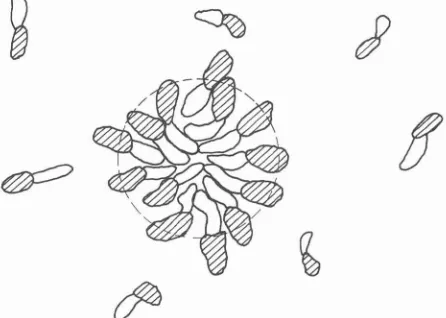
also for many other amphiphillics this aggregated phase consists of a solution of micelles as illustrated in figure 2.
FIG. 2. - A cross-section view of the molecular packing at some instant in time for amphiphillic molecules in a micelle containing approximately 50 monomers. The cross-hatched areas indicate the polar or hydrophillic part of the molecule. Micelles are in dynamic equilibrium with the monomer solution and the structure is not
static.
Typical micelles are aggregates of from 20- 100 monomers in dynamic equilibrium with the monomer solution. They organize themselves such that the polar part forms a sort of barrier that sepa- rates the hydrocarbon part from the water. The hydrophobic effect, is essentially shielded so that although the chemical potential for the molecules in the micelle becomes a complicated function of inter- molecular, intramolecular, and solvent interactions the physical state of the water surrounding the micelle is not directly affected by the hydrocarbon. Very interesting questions arise as to the precise size and shape of the micelle and the physical phenomena that determine them. We will not discuss these here except to point out that in order to pack the hydro- carbon part of these amphiphillics into the micelle structures the chains must be somewhat flexible. Alternatively if the hydrocarbon parts are too bulky when compared with the size of the polar part micellar packing will not be possible.
[image:3.602.67.295.57.165.2] [image:3.602.313.536.127.286.2]AMPHIPHILLIC MOLECULES AND LIQUID CRYSTALS C3-425
MIDDLE SOAP (HEXAGONAL)
t
TTc GEL
I
/
% WATER --+
NEAT SOAP ( L A M E L L A )
m
SOAPWATER
a
-
SOAPWATER
FIG. 3. - Illustration of a typical phase diagram for a simple soap. See Skoulius [5] for further details.
are either cylindrical (middle phase) or lamella (neat phase). Skoulius discusses variations on these simple forms but we will not go into those details here. The interesting feature of this phase diagram is that in the middle phase, in the neat phase, and in general for T > Tc a variety of experiments demonstrate that the hydrocarbon parts of the molecules are relatively flexible or fluid like. In contrast for T < Tc
the hydrocarbon parts are relatively rigid or solid like. Consequently one expects, and experiments demonstrate that for T < Tc micelles will not form because the rigid molecules will not easily pack into the micelle structure. Since micelles in solution tend to scatter light relatively strongly micellar solutions have a somewhat milky appearance. On lowering the temperature below Tc there is a sudden clearing of the solution as the micelles become unstable and form larger aggregates that percipitate out of the so1utio.n. The temperature at which this occurs is often referred to as the Kraft point.
In addition to the simple fatty acids and their alkali salts (the soaps) there are a much larger variety of amphiphillic molecules than we want to review here. For example, a common amphiphillic used in shampoos has a sulfate for the polar part
Aerosols, such as the common foaming shaving creams, often contain powerful wetting agents such as the dialkyl ester of sulfosuccinic acid
in which there are more than one hydrocarbon chain. Derivatives of ethylene oxide
are of yet a different type. The list could obviously be extended, however in the rest of this article we will concern ourselves with one special amphiphillic of biological significance, namely the di-acylphospho- glyceride or phospholipid
where R,, and R, refer to hydrocarbon chains and X refers to one or another smaller chemical group. If R, and R, are both of the form CH3(CH,), this is referred to by the prefex di-palmitoyl. If X is of the form -CH,-CH,-N(CH3): the molecule is called dipalmitoyl phosphatidyl choline or DPPC. Shorter hydrocarbon chain lengths, obtain other lipids. For example if both chains have the form CH3(CH,),, one has dimyrystoyl-phosphatidyl choline or DMPC.
Variations with different polar parts, different chain lengths, two unequal chains, chains with double bonds etc. are all possible and all are referred to as phospholipids. Although all amphiphillics exhibit interesting physical properties the lipids are of particular interest to us here because : 1) they play a major role in the architecture of biological mem- branes, 2) their amphiphillic character is essential to this role, and 3) macroscopically oriented single domain lamella or smectic liquid crystals are readily formed from these molecules.
[image:4.602.99.261.57.334.2]P. S. PERSHAN
PROTEINS " b" Ll PI D BlLAYER
FIG. 4. - A schematic view of thejluid mosaic model of biological
membranes [6]. Proteins sit in and on the lipid bilayer as shown. In addition there are extensive extra membraneous structures that are not shown but which are essential to membrane function.
For example the protein controlled flux of protons though mitochondrial membranes is one key ingre- dient in the conversion of ADP to ATP.
Proteins make membranes work but the proteins exist in and on an amphiphillic lipid bilayer and depend on the physical properties of that bilayer to function. Hinkle and McCarty's article How Cells
Make ATP in Scientific American gives a very read- able picture of some of the complex chemical and physical processes taking place in and on mem- branes [7].
The recent physical studies on lipids have been briefly reviewed by Nagle and Scott in Physics Today [8]. A slightly older review, from a somewhat different point of view is the article by Dennis Chap- man [9]. Figure 5 illustrates essential features of the phase diagram for DPPC-water mixtures. There are both similarities and differences to the phase diagram for simple soaps shown in figure 3. First and foremost amongst the similarities is the existence of a first order phase transition separating regions in which the hydrocarbons are rigid or solid-like from the regions where they are flexible or fluid-like. In figure 3 this was indicated by the T, line. In the case of lipids the transition is referred to as the gel transition and the temperature at which it occurs is indicated by
T,.
For both lipids and soaps, as well as for all other amphiphillics the temperature of the gel transition decreases with increasing water content. A significant difference between lipids and soaps is the high water region. At temperatures above T,, or above the gel transition, and at high water content the soaps form micellar solutions. Micelles do not form for DPPC although they are observed for similar lipids with hydrocarbon chain lengths containing fewer than ten (CH,) groups. Presumably two hydrocarbon chains, each containing fourteen CH, groups are too bulky for micellar packing. Thus if T > T,, for weightfractions greater than 40
%
(water to total sample weight) DPPC water mixtures separate into oneLAMELLA (MULTILAMELLA 8or PHASE AGGREGATES + WATER)
" C )
10 20 3 0 40 % WATER
-
FIG. 5. - Simplified version of the phase diagram for DPPC, i.e., dipalmitoyl phosphatidylcholine-water mixtures. On cooling the onset of the gel transition is indicated by the line T,. Many details of the phase diagram below T,, although known, are omitted for simplicity. The calibration of the horizontal axis is percentage of
water to total sample weight.
phase that is essentially pure water (i.e., less than
--
10-l' molar in DPPC) and a lamella or smectic A phase as shown in figure 5.It is interesting to note that for the soap (Fig. 3)
the lamella phase is separated from the micellar phase by a hexagonal phase. The hexagonal phase does not form under similar conditions for DPPC, presumably for the same reason that DPPC does not form micelles, because the relative size and shape of the hydrocarbon to polar part make the packing unfavorable. We will return later to discuss the role of water in stabilizing the lamellar phase of DPPC and the reasons for the phase boundary at 40
%
weight water.Since real biological membranes contain a number of different lipids, each of which have gel transitions at different temperatures when pure, it is not sur- prising that in biological membranes the gel transition is spread out over 20
--
30 OC. Melchior and Steim [l01 have reviewed the evidence for thermotropic phase transitions in biological membranes. Some of the most interesting experiments result from a bacteriumA. laidlawii that can be obtained in a mutated form
[image:5.602.323.523.51.292.2] [image:5.602.82.269.56.200.2]AMPHIPHILLIC MOLECULES AND LIQUID CRYSTALS C3-427
branes will have higher gel transition temperatures. In this way bacteria can be obtained in which gel transition temperatures vary by as much as 70 OC.
Studies such as the temperature dependence of enzyme activity, respiration rate, growth rate, etc. all show marked changes that correlate with the gel transition. Without overstating the case it is safe to say that there is evidence that the physical state of the lipids play a role in biological processes. Although the practical importance of this for regulatory life processes, or for realization of diverse properties within a single membrane, is not yet agreed upon one can justify research into the physical properties of lipids with the assurance that these properties do play some role. The remainder of this article will deal with physical properties of lipid systems.
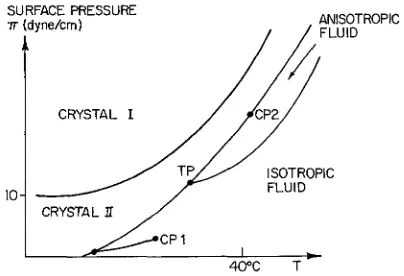
4. Physical studies of lipid systems. - One of the earliest techniques employed in the study of lipid systems is based on the tendency of amphiphillics to form surface monolayers of the type illustrated schematically in figure 1 [ll]. An important diffe- rence between lipids such as DPPC with very strong hydrophobic parts and the soaps discussed earlier is the fact that DPPC does not form micelles and the solubility for the monomer is less than 10-l0 molar under usual circumstances. Thus if a monolayer of DPPC is formed at a water air interface there is hope that the system can be regarded as being truly two-dimensional with a fixed number of molecules. According to Gibbs [4], and numerous experimental studies [g], at low densities (molecules/cm2) the surface acts as a nearly perfect two-dimensional gas, e.g., nA cc NT. At higher density, i.e., larger values of NIA, there is also evidence for a phase transition in which the two-dimensional gas condenses into a two-dimensional liquid. The interesting question is whether one can also realize two-dimensional crys- talline or liquid crystalline phases by suitable choice of molecular species, surface pressure n, density NIA, or temperature. Dervichian's early work [Ill, as well as more recent studies all suggest this i$ possible and a recent publication [l21 presents the case sup- porting this suggestion in great detail. Figure 6 is a schematic version of the phase diagram proposed for monolayer films of DPPC at a water air interface. According to Alrecht et al. the n-Tplane for DPPC is separated into four regions or phases; a two- dimensional isotropic fluid, an anisotropic two- dimensional fluid or two-dimensional liquid crystal, and two separate crystalline regions. As for three- dimensional isotropic fluids the region of the two- dimensional isotropic fluid contains a line marking the liquid-gas coexistence condition. This line ter- minates at a critical point Cpl. They also indicate a second critical point CP2 along the coexistence line separating the anisotropic fluid from one of the crystalline regions. Presumably at higher surface pressures n the transition from crystal I1 to aniso-
SURFACE PRESSURE -rr (dyne/crn)
CRYSTAL I
FIG. 6 . - Schematic version of the two-dimensional phase diagram for insoluble monolayers of DPPC at a water air interface. This form was proposed by Albrecht et al. [12]. The surface pressure of 10 dynes/cm and temperature of 40 OC occur where indicated.
tropic fluid is second order while for lower pressures it is first order. A triple point
TP
marks the coexis- tence point of the crystal, the isotropic fluid and the anisotropic fluid. If they are right, such that this variety of two-dimensional phases can be observed with amphiphillic monolayers in general, and for lipids in particular, amphiphillics will certainly play an important role in the current research activities on phase transitions in two dimensions. Below we will return to discuss some of the difficulties encoun- tered when studying monolayers at high surface pressures and explain why we raise the question (( If they are right ! in relation to figure 6. Before that, however, we will discuss some aspects of phase transitions in two dimensions.Although the concept of a two-dimensional crystal appears straight-forward there are basic theoretical results which introduce subtle complications. For example one speaks of long range order in a three- dimensional crystal by defining a set of three unit vectors { Zi } ; i = 1, 2, 3. It then follows that aside from small fluctuations the vector connecting any two lattice points can be expressed as a linear combi- nation
-
of the { Zi ) with integral coefficients, e.g.,R, = n1
a,
+
n , Z ,+
n,Z, ; { ni } = integers. It is [image:6.602.320.522.53.191.2]C3-428 P. S. PERSHAN
Studies of monoatomic or monomolecular layers deposited on crystalline substrates constitute what is probably the principle experimental effort into two- dimensional crystalline order. Berker et al.'s theo- retical paper on this subject cites most of these recent experimental articles and also describes some of the phase diagrams [17]. In lieu of going into that literature in any sort of detail we will restrict ourselves to a few remarks on the recent theory by Halperin and Nelson on the nature of melting in two dimen- sions [18]. According to them the two-dimensional crystal at finite temperature will always have a finite concentration of lattice vacancies that can be thought of as pairs of opposite dislocations. In the crystalline state these dislocations are bound to each other with a finite energy. Halperin and Nelson demonstrate that at some finite temperature these dislocations become unbounded of each other and move freely throughout the two-dimensional crystal. They interpret this as the melting of the two- dimensional crystal. Since it is well known that free mobile dislocations render a system incapable of sustaining static shear stresses the elastic properties of the melted phase will be very much like that of a two-dimensional fluid. The transition might pro- fitably be thought of as the elastic analogue of the transition from a normal to a superfluid [19]. In any event the phase that occurs on melting is not a simple two-dimensional isotropic fluid for which the orien- tational correlation functions between bond direc- tions decay as an exponential function of distance. Rather this phase is analogous to a two-dimensional nematic liquid crystal in which bond directions play the same role that molecular axes play in conven- tional nematics. In contrast to thpe dimensional
nernatics, director fluctuations, e.g., \ ( k B T / K ~ ~ ) d2q, J
are not integrable and there is no true long range orientational order in two dimensions. In this phase the orientational correlation functions decay alge- braically with distance and there will be a second phase transition at a higher temperature than the
crystal melt in which the correlations switch from
algebraic decay to the exponential decay expected for a simple two-dimensional fluid. In view of the similarity between this progression of phases and the phase diagram proposed by Albrecht et al. [l21 for DPPC monolayers (Fig. 6) it is very important that one critically evaluate both the DPPC experi- mental results and the appropriateness of the Hal- perin-Nelson model for DPPC.
To consider the experimental results first, Gersh- feld and Tajima [20] pointed out a basic difficulty with all monolayer studies. In their experiment, illustrated schematically in figure 7a, a three-dimen- sional sample of DMPC (either solid or liquid crys- talline) is put in contact with a clean air-water inter- face. DMPC differs from DPPC by having two less CH, groups in each of the hydrocarbon chains.
INSOLUBLE SURFACE PHASE
/
3 DIMENSIONAL SOLID OR LIQUID CRYSTAL PHASE
D
.rr 1,
METASTABLE 2 D - LIQUID E
I L 2 0 2 2 1 2 4 26 28 30
T(OC,
FIG. 7. - a) Schematic illustration of'the Gershfeld-Tajima [20] experiment. The amphiphillic forms an insoluble monolayer in equilibrium with the 3-dimensional phase. b) The phase diagram obtained by Gershfeld and Tajima for DMPC. In the text we discuss the disparity in the surface pressures shown here and in
figure 6.
Although the gel transition for DMPC is lower than for DPPC the two molecules have essentially the same phase diagram. In a process reminescent of evaporation, molecules from the three-dimensional phase spread out on the surface until the chemical potential for the surface molecules become equal to the chemical potential of the molecules in the three- dimensional phase. As we mentioned earlier, in thermal equilibrium at a given P and T, the surface pressure .n is uniquely given by the chemical poten- tial p. The line AB in figure 7b is the X-T line when the surface film is in equilibrium with the three- dimensional phase in which the hydrocarbons are stiff or solid like. For T
>
T, the film is in equili-brium with a three-dimensional phase in which the chains are fluid like. If the three-dimensional phase is removed one can expand the area of the film and measure the n-A isotherms at constant number of surface molecules. For the expanded film these would all be to the right of the ABCD line. The line CE represents the two-dimensional liquid-gas coexis- tence line. It terminates in the critical point E. If, after removal of the three-dimensional phase, one attempts to compress the film rather than expanding it one enters the cross-hatched region to the left of ABCD. Elementary thermodynamics is sufficient to demonstrate that in this region the chemical potential p(P, T, A ) is larger than the chemical
[image:7.602.323.513.52.275.2]AMPHIF'HILLIC MOLECULES AND LIQUID CRYSTALS C3-429
this situation the monolayer is metastable and great care must be exercised when interpreting n-A measu- rements to insure that an apparent phase transition is really a transition between two different two- dimensional phases and not a transition in which a metastable two-dimensional phase (( condenses B into
a mixture of some three-dimensional phase and a monolayer phase of lower free energy. This is parti- cularly serious for DPPC since in some ranges of' temperature the surface pressures observed by Gersh- feld and Tajima to separate the metastable and stable regions of the phase diagram are two to three orders of magnitude lower than the surface pressures at which phase transitions are suggested in figure 6. To be absolutely clear, we are not arguing the phase diagram obtained by Albrecht et al. [l21 is wrong. Rather we are suggesting that all experimental studies of, what one hopes are, two-dimensional systems must be carefully evaluated to determine that they truly are two-dimensional.
Returning to the theoretical studies appropriate to DPPC, although the principle features of the Halperin, Nelson work are probably relevant these authors were not trying to develop a model for amphi- phillic monolayer systems. Thus the monomer units in their two-dimensional model had neither internal structure nor other degrees of freedom aside from the positions of their centers of mass. On the other hand, we know that the flexibility of the chains and the chain melting transitions are important to three- dimensional phase diagrams and they must also be important for some features of the two-dimensional phase diagram. The article by Nagle and Scott in Physics Today reviews some of the recent results [g].
For example, Nagel developed a mathematical model that relates the flexibility of the hydrocarbon to both the temperature and mean surface area per hydrocarbon chain. For this model he calculates the surface pressure n that corresponds to this temperature and surface area and predicts the monolayer n-A isotherms. He also predicts a first order transition from a phase of flexible to straight chains at low n:
and a second order transition at higher n. The cri- tical point in the phase diagram proposed by Albrecht et al. (see Fig. 6) along the boundary between the crystalline and anisotropic fluid phases corresponds to this. It is interesting to note that the temperature of this critical point appears to be very close to the temperature T, of the gel transition observed in the three-dimensional smectic phases (see Fig. 5) at high water. This lead Nagel to argue that the molecular details in the bilayers making up the three-dimensional phases are essentially the same as the molecular details of the molecules in the monolayer at the temperature and surface pressure corresponding to the critical point.
If the concern expressed by Gershfeld and Tajima about the metastability of monolayers at high sur- face pressure does not prove to be a fundamental
obstacle it would be very interesting to study the effect of chain length on the high surface density part of the two-dimensional phase diagram.
For example, as discussed in the Nagel-Scott review article, the first few carbon-carbon bonds, nearest to the polar part of the amphiphillic, are constrained by the position and orientation of the polar part at the interface. By virtue of cis-trans isomerization and other thermal effects the orien- tation of bonds further down the chain become more and more random. Marcelja [21], Bothorel et al. [22] and others have developed theoretical models that reproduce some of the experimental results for this effect [23, 241. All agree that (CH,) groups more than approximately 10 C-C bonds away from the polar part are essentially randomly oriented. This must surely have an effect on the short range repulsive forces between surface molecules. Furthermore, for DPPC and many other amphiphillics as well, the polar part of the molecule is not cylindrically sym- metric. Coupling between polar group and the hydro- carbon chains can thus cause anisotropy in the chain configuration that should be sensitive to the size of the chain. All this is rather speculative but, if surface pressure can induce two-dimensional phase transi- tions without complicating three-dimensional effects, amphiphillic monolayers should be very interesting. The principle contribution to come from our own laboratory has been the development of improved techniques for obtaining macroscopic, single domain, aligned, multilamella, smectic-A samples. The initial experiment to obtain aligned samples of DPPC monohydrate was done by Powers and Clark [25].
However, more recently we were able to control the amount of water and also to incorporate other ingre- dients into the aligned lipid bilayers [26]. These included cholesterol, various antibiotics, chloro- phyll-a [26] and p-carotene [27]. This is particularly important since the individual lipid bilayer is widely used as a model biological membrane. If one can also demonstrate that the individual bilayers making up the multilamellar smectic are also good models than the ability to incorporate typical membrane ingredients into the smectic will facilitate spectro- graphic studies that might be impossible on these ingredients when included in either unoriented multi- lamellae or single bilayers.
.
C3-430 P. S. PERSHAN
tions [29]. More recently we have been able to induce light scattering effects with much lower strains and observe phenomena that is essentially identical to the undulation instability effects well known in thermotropic smectics at small strains [30].
Although it is not easy to demonstrate that the multilamellar samples constitute acceptable models for biological membranes one can argue indirectly from available data that for more than approximately 20-25
%
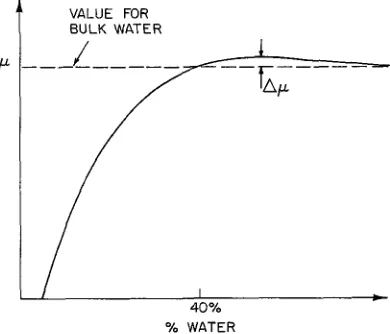
weight water to total sample weight and for temperatures above T, (see Fig. 5), the bilayers are not significantly perturbed by the multilamella struc- ture. Thus if the isolated bilayer is an acceptable model, which it is, than the multilamellar should also be acceptable.Consider the chemical potential for water in the planar spaces separating adjacent bilayers. We know that at low water content lipids are strongly hygro- scopic. Thus for low water content the chemical potential for the water contained in the lipid must also be very low. Furthermore we also know&at as more water is added to the lipid it becomes less and less hygroscopic and eventually reaches an equilibrium state, which for DPPC is 40
%
water (see Fig. 5), when the chemical potential for water in the lipid is equal to that of bulk water. This is shown schematically in figure 8. Obviously, if theVALUE FOR
1
BULK WATER [image:9.605.82.277.378.545.2]% WATER
FIG. 8. - Qualitative representation of p, chemical potential for the water within the lamella phase of DPPC, as a function of water concentration. The two phase limit, shown at 40 % in figure 5 occurs when the chemical potential becomes equal to that of bulk water. The quantity Ap is one measure of the attractive forces
between adjacent lipid bilayers in the lamella phase.
number of water molecules per lipid were infinite the chemical potential for water would be unaffected by the lipid and p would have the value for bulk water. Also obvious is that p must have this same value at 40
%
by weight since this is the proven equilibrium between the bulk lamella phase and pure water. The quantity Ap indicated in the figure is the result of some sort of attractive force between layers since for p greater than the value for bulk water but to theleft of the maximum the system would prefer to loose water, allowing the layers to approach each other. In fact, it is well known that if one adds an ionic or charged lipid to an electrically neutral lipid like DPPC the effect is to add a repulsive component to the force between bilayers. The equilibrium water content increases above 40
%.
For pure DPPC at high water content (i.e., 30-40%)
there is some attractive force between bilayers and we must ask how large.Using different techniques to fix the chemical potential Elworthy [31] and Rand et al. [32] measured the water concentration as a function of chemical potential. They found that at approximately 30
%
weight water, which is well below the 40%
value for equilibrium between bulk and free water, the attractive force per unit area between bilayers was of the order of 10 atmospheres. Although this may appear large at first glance, it is in fact very small when one considers the pressures required to modify the bulk properties of matter. For example, 10 atmo- spheres will reduce the melting temperature of ice less than 0.1 OC and change the volume of paraffine by approximately 0.1%.
For all practical purposes, at temperatures above the gel transition, the interac- tion between bilayers in multilamellar samples of DPPC containing more than 30%
weight water is negligible when measured against the type of forces that are required to influence molecular properties. The same conclusion can be drawn from the concentration dependence of the gel transition tem- perature (see Fig. 5). Above about 20%
water the temperature is independent of water content. Simi- larly, the latent heat associated with the gel transition in DPPC rises monotonically with increasing water content below about 25%
water and then saturates at about 16 kTlmolecule of lipid for higher water content. This is roughly three orders of magnitude larger than the difference between the chemical potential for water in the lipid at 25%
weight and the value for bulk water. Again, this supports the idea that for these water concentrations the system is roughly equivalent to the ideal system of inde- pendent layers.AMPHIPHILLIC MOLECULES A N D LIQUID CRYSTALS C3-43 1
are simply less sensitive. This may be true however, properties of the gel transition depend on both the high and low temperature phases and we do not have good measurements of the physical effects of water within the low temperature phase. In fact we know that below the gel transition the lipid-water is in equilibrium with bulk water at 25
%
by weight in contrast to 40%
above the gel [34]. Thus the high and low temperature phases have some very different features and it is still possible that in the high tempe- rature phases the interlayer interactions are negligible at 13%
water while for the low temperature phase they are nonnegligible at all water contents.Another experiment related to the interlayer water was developed in our laboratory by Winston Chan [35]. Brochard and de Gennes [36] demonstrated theore- tically that a sinusoidal variation in the concentration of water, parallel to the bilayers, will decay exponen- tially with a time constant z = (Dg2)-l, where D is a phenomenological diffusion constant and 2 n/q is the spatial period or wavelength of the sinusoidal variation. Chan induced such a sinusoidal variation using the heat absorbed from two laser beams forming an interference pattern at the sample. By varying the angle between the two beams it was possible to vary q and prove zqZ was a constant, from which D was determined. A theoretical model was developed relating D to a phenomenological parameter that was identified as the efective thickness of free water. According to Chan this parameter is approximately zero at about 10
%
water and grows, nearly linearly, with increased water concentration becoming about 10A
somewhere between 25%
and 35%
water. Although it is not clear that the water concentration sufficient to make the Brillouin result above T, independent of water, which corresponds Chan's parameter being between 1 and 3A,
is sufficient that the layers can be regarded as non-interacting it is reasonable that 25%
water, corresponding to more than 10A
of free water, should be sufficient.5. Summary.
-
The principle theme that we have tried to develop is that amphiphillic monolayers are potentially useful for study of phase transitions, and the long-range order within two-dimensional systems. The most serious problem is the intrinsic metasta- bility, or possible instability, when monolayers are subjected to high surface pressures. This is an essential difficulty with all two-dimensional systems and although it is not necessarily inevitable it must be considered in all experimental systems. The specific experiments discussed in relation to this point all employed phospholipids, however, similar phenomena is expected for nearly all amphiphillics and others, rather than lipids, may be better choices from this point of view.A second theme, is that it is possible to form macro- scopically oriented, multilamellar or smectic phases from amphiphillic-water mixtures (or for that matter
from mixtures of amphiphillics and hydrophobic solvents) that present a number of interesting pos- sible research directions. First, in line with the mono- layer or two-dimensional phases, one should determine whether or not the smectics can be regarded as simple stacks of non-interacting two-dimensional systems. In the case of amphiphillic-water mixtures this may be true for the amphiphillic bilayers at high water content and some of the evidence sup- porting this was reviewed for DPPC. However, one should not overlook the possibility that even if DPPC is not suitable from this point of view, the bilayers of charged amphiphilles are more strongly repellent and will adsorb more interlayer water than neutral DPPC. Thus one might hope the bilayers in smectics of charged lipids will interact less.
Even if one can demonstrate that the bilayers are non-interacting above the gel transition it is far from clear that they will also be non-interacting below the transition. However, X-ray experiments on lipids below T, do reveal Bragg like spots that suggest two-dimensional order within the bilayers [34]. If the bilayers are non-interacting the smectic systems would be interesting models for two-dimensional phase transitions. On the other hand, if there are interlayer interactions below the gel the systems are probably in one or another smectic B phase and these have their own special interest. In particular the transition from a system of non-interacting two- dimensional fluid bilayers to the three-dimensional smectic B could be studied as a function of water content.
Some of these ideas are rather naive and one should not try to push them too far without thinking about the other factors that determine the molecular organization. For example, simple soaps are charged amphiphillics and as one can see from the phase diagram in figure 3 addition of water to the lamella phase leads to an instability that results in the cylin- drical phase. Earlier we suggested that this is related to the rather small polar group with a single hydro- carbon chain. Thus, one should not ignore intra- molecular structure in deciding on the best system to study.
Another interesting possibility is that the polar parts of an amphiphillic will exhibit two-dimensional order and that these layers will be decoupled from adjacent polar layers by the hydrocarbon layers. We did not discuss this explicitly but Pomerantz et al. did present evidence for two-dimensional magnetic order in thin samples of Mn stearate [37].
C3-432 P. S. PERSHAN
dients that X-ray or neutron diffraction studies will students and scientific associates who, working in yield structural information. our laboratory, provided the results that were quoted. The financial support for that work was provided in Acknowledgments.
-
I would like to express my part by the Joint Services Electronics Program appreciation to the Scientific Organizing Committee (U.S. Army, Navy and Air Force) under Contract of the 7th International Conference on Liquid Number N00014-75-C-0648 and by the National Crystals for the invitation to present the lecture that Science Foundation under Grants numbered DMR- this article is based on. 1 am also indebted to the 76-01 111 and DRM-76-22452.References
[l] ADAMSON, A. W., Physical Chemistry ofsurfaces (Wiley, N.Y.) 1976, 3rd Edition.
[2] TANFORD, C., (( The Hydrophobic Effect and the Organization
of Living Matter l), Science 200 (1978) 1012.
[3] TANFORD, C., The Hydrophobic Effect, Formation of Micelles
and Biological Membranes (Wiley, New York) 1973. [4] GIBBS, J. W., Trans. Conn. Acad. 3 (1876) 108, ibid3(1878) 343. [5] SKOULIUS, A., Advan. Celloid and Interface Science 1 (1967)
79.
[6] SINGER, S. J., NICOLSON, G. L., Science 175 (1972) 720. [7] HINKLE, P. C., MCCARTY, R. E., Sci. Am. 238 (1978) 104. [8] NAGLE, J. F., SCOTT, H. L., Phys. Today (1978) 38. [9] CHAPMAN, D., Quart. Rev. Biophys. 8 (1975) 2.
[l01 MELCHIOR, D. L., STEIM, J. M., Ann. Rev. of ~ i 4 h y s . and Sioeng. 5 (1976) 205.
[ l l ] DERVICHIAN, D. G., JOLY, M,, J. Physique Radium 10 (1939) 375 ;
DERVICHIAN, D., J. Chem. Phys. 7 (1939) 931.
[l21 ALBRECHT, O., GRULER, H., SACKMANN, E., J. Physique 39
(1978) 301.
[l31 LANDAU, L. D. and LIFCHITZ, E. M., Statistical Physics (Pergamon, London) 1959, Chapt. 13.
[l41 MERMIN, N. D., Phys. Rev. 176 (1968) 250.
[l51 See DE GENNES, P. G., The Physics of Liquid Crystals (Cla- rendon, Oxford) 1975, p. 302.
[l61 ALS-NIELSEN, J., BIRGENEAU, R. J., KAPLAN, M,, LIPSTER, J. D., SAFINYA, C. F., Phys. Rev. Lett. 39 (1977) 1668. [l71 BERKER, A. N., OSTLUND, S., PUTNAM, F. A., Phys. Rev. B 17
(1978) 3650.
[l81 HALPERIN, B. I., NELSON, D., Phys. Rev. Lett. 41 (1978) 121. [l91 PERSHAN, P. S., PROST, J., J. Appl. Phys. 46 (1975) 2343. [20] GERSHFELD, N. L., TAJIMA, K., J . Colloid. and Interface
Science 59 (1977) 597.
[21] MARCELJA, S., Biophys. Biochem. Acta 367 (1976) 165. [22] BOTHOREL, P,, BELLE, J., C. R. Hebd. Skan. Acad. Sci. 282
(1976) 437 ;
BOTHOREL, P,, BELLE, J., LEMAIRE, B., Chem. Phys. Liplcis 12
(1974) 96.
[23] SEELIG, J., NIWERBERGER, W., Biochemistry 13 (1974) 1585 ;
SEELIG, A. and SEELIG, J., Biochemistry 13 (1974) 4839. [24] MELY, B., CHARVOLIN, J., KELLER, P., Chem. Phys. Lipids 15
(1975) 161.
[25] POWERS, L., CLARK, N. A., Proc. Nat. Acad. Sci. (USA) 72
(1972) 840.
[26] POWERS, L., PERSHAN, P. S., Biophys. J. 20 (1977) 137. [27] CHAN, W., PERSHAN, P. S., Phys. Rev. Lett. 39 (1977) 1368 ;
Biophys. J . (to be published).
[28] ROSENBLATT, C. S., PINDAK, R., CLARK, N. A., MEYER, R. B.,
J. Physique 38 (1977) 1105.
1291 SANPORD, ASHER, A., PERSHAN, P. S. (submitted to J. Physique) 1978.
[30] See Ref. [15], page 296.
[31] ELWORTHY, P, H., J. Chem. Soc. (1961) 5385 ; (1962) 4897. [32] LE NEVEU, D. M,, RAND, R. P., PARSEGIAN, V. A., GINGELL, D.,
Biophys. J . 18 (1977) 209.
[33] LE PESANT, J.-P., POWERS, L., PERSHAN, P. S., Proc. Nat.
Acad. Sci. (USA) 75 (1978) 1792.
[34J JANIAK, M. J., SMALL, D. M., SHIPLEY, G. G., Biochemistry
15 (1976) 4575.
[35] -AN, W., PERSHAN, P. S., Phys. Rev. Lett. 39 (1978) 1368 ;
Biophysical J. (to be published).
[36] BROCHARD, F., DE GENNES, P. G., Pramana, Suppl. No. 1 (1975) 1.
![FIG. 3. - Illustration of a typical phase diagram for a simple soap. See Skoulius [5] for further details](https://thumb-us.123doks.com/thumbv2/123dok_us/7955240.197821/4.602.99.261.57.334/fig-illustration-typical-phase-diagram-simple-skoulius-details.webp)
![FIG. 4. In addition there are extensive extra membraneous structures - A schematic view of thejluid mosaic model of biological membranes [6]](https://thumb-us.123doks.com/thumbv2/123dok_us/7955240.197821/5.602.323.523.51.292/addition-extensive-membraneous-structures-schematic-thejluid-biological-membranes.webp)