This is a repository copy of
Robust watermarking for scalable image coding-based content
adaptation
.
White Rose Research Online URL for this paper:
http://eprints.whiterose.ac.uk/76014/
Conference or Workshop Item:
Bhowmik, D. and Abhayaratne, C. (2012) Robust watermarking for scalable image
coding-based content adaptation. In: Image Processing (IPR 2012), IET Conference on ,
3-4 July 2012 , London, UK.
https://doi.org/10.1049/cp.2012.0436
[email protected] https://eprints.whiterose.ac.uk/
Reuse
Unless indicated otherwise, fulltext items are protected by copyright with all rights reserved. The copyright exception in section 29 of the Copyright, Designs and Patents Act 1988 allows the making of a single copy solely for the purpose of non-commercial research or private study within the limits of fair dealing. The publisher or other rights-holder may allow further reproduction and re-use of this version - refer to the White Rose Research Online record for this item. Where records identify the publisher as the copyright holder, users can verify any specific terms of use on the publisher’s website.
Takedown
If you consider content in White Rose Research Online to be in breach of UK law, please notify us by
Robust watermarking for scalable image coding-based content
adaptation
Deepayan Bhowmik and Charith Abhayaratne
Department of Electronic and Electrical Engineering, The University of Sheffield, Sheffield, United Kingdom, S1 3JD
{d.bhowmik, c.abhayaratne}@sheffield.ac.uk
Keywords: Content adaptation, watermarking
robust-ness, JPEG 2000, bit plane discarding, wavelet.
Abstract
In scalable image coding-based content adaptation, such as, JPEG 2000, the quality scaling is performed by a quantiza-tion process that follows a bit plane discarding model. In this paper we propose a robust blind image watermarking algorithm by incorporating the bit plane discarding model. The new wavelet based binary tree guided rules-based wa-termarking algorithm is capable to retain the watermark-ing information for a given number of bit plane bewatermark-ing dis-carded. The experimental simulations confirm the scheme’s robustness against JPEG 2000 quality scalability.
1
Introduction
In the state of the art multimedia distribution and consump-tion scenario, scalable content adaptaconsump-tion coding schemes, such as, JPEG 2000 for image and H.264/SVC for video, offer the solution for seamless multimedia delivery to var-ious end user display devices through the heterogeneous networks. More recently the watermarking robustness to such content adaptation for images,i.e., JPEG 2000 com-pression, is discussed in the literature [1–8]. To improve the robustness, different approaches have been made,e.g., choosing the coefficients in selected subband [4, 7], using thresholds [1], embedding watermark within wavelet lifting step [6] or using a texture detection algorithm [5]. However, in the algorithmic development most of the algorithms do not consider the effect of JPEG2000 quantization process. To achieve a higher watermarking robustness, in this paper, we propose a new wavelet based blind watermarking algo-rithm which incorporates JPEG 2000 quantization process, using a bit discarding model. Such an algorithm can easily be combined within the JPEG 2000 pipeline to produce a secured scalable image bit stream.
2
Quality scalable image watermarking
2.1 Scalable coding-based content adaptation
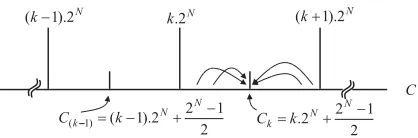
[image:2.595.317.526.219.288.2]JPEG 2000 uses the Discrete Wavelet Transform (DWT) as its core technology and offers scalable decoding with qual-ity and resolution scalabilqual-ity. The scalable coders encode the image by performing the DWT followed by embedded
Figure 1: Quantization compression scheme considering N level bit-plane discarding.
quantizing and entropy coding. The coefficient quantiza-tion, in its simplest form, can be formulated as follows:
Cq =
C Q
, (1)
whereCqis the quantized coefficient,Cis the original
co-efficient andQis the quantization factor. Embedded quan-tizers often useQ= 2N, whereNis a non negative integer.
Such a quantization parameter within downward rounding (i.e.,using floor), can also be interpreted as bit plane dis-carding as commonly known within the image coding com-munity.
At the decoder side, a reverse process of the encoding is fol-lowed to reconstruct the image. The dequantization process is formulated as follows:
ˆ
C=Q.Cq+
Q−1
2
, (2)
whereCˆ is the de-quantized coefficient. In such a quanti-zation scheme, the original coefficient values in the range
k.Q ≤ C < (k+ 1).Q, where k ∈ ±1,±2±3... and
Q= 2N for bit plane wise coding, are mapped toCˆ=C k,
which is the center value of the concerned region as shown in Fig. 1 and in Eq. (3).
Ck =k.2N+
2N −1
2
. (3)
2.2 The proposed algorithm
Binary Watermark Symbol tree Association Embedded Zero (EZ) 000xxxx 0
Embedded Zero (EZ) 001xxxx 0
Cumulative Zero (CZ) 010xxxx 0
Weak One (WO) 011xxxx 1
Weak Zero (WZ) 100xxxx 0
Cumulative One (CO) 101xxxx 1
Embedded One (EO) 110xxxx 1
[image:3.595.313.526.65.366.2]Embedded One (EO) 111xxxx 1
Table 1: Tree-based watermarking rules table
2.2.1 Quantized binary tree formation:
The individual coefficients are recursively quantized to form a binary tree. The coefficients to be watermarked, can be selected based on their magnitude, sign, texture infor-mation, randomly or any other selection criteria. Firstly the selected coefficient (C) is indexed (bi) as 0or 1using an
initial quantization parameterλ:
bi=
|C|
λ/2i
%2, i∈0,1,2,3..., (4) where%denotes the modulo operation. The coefficientC
is then further quantized more precisely within a smaller cluster using a smaller quantization parameterλ/2and cor-responding index is calculated as: b1 =
|C|
λ/2
%2. The index tree formation is continued recursively by scalingλ
value by2, untilλ/2i ≥1. During this tree formation
pro-cess theSignof the coefficients is preserved separately. To incorporate the bit plane discarding model within the pro-posed algorithm we restrict initialλto the integer power of 2. Therefore, the quantization cluster in tree formation can now alternatively be described as a bit plane cluster. Now, based on the calculated index value at various quantization step a binary tree (b(C)) of each coefficient is formed as follows:
b(C) = (b0)(b1)....(bi−1)(bi), (5)
where(b0),(b1)...(bi)are binary bits withb0as most
sig-nificant bit (MSB) andbi as least significant bit (LSB) of
the binary tree along with the tree depth ofd=i+ 1. For example ifC=142 and initialλ= 32, the binary treeb(C)
will beb(C) = 001110.
2.2.2 Embedding:
The binary tree is used to embed the binary watermark in-formation using symbol based embedding rules, by choos-ing the 3 most significant bits which represent 8 different states corresponding to 6 different symbols (EZ = Embed-ded Zero, CZ = Cumulative Zero, WZ = Weak Zero, EO = Embedded One, CO = Cumulative One and WO = Weak One) to identify the original coefficient’s association with a
0or1as shown in Table 1. Based on the input watermark stream, if required, new association is made by altering the chosen3most significant bits in the tree to reach the near-est symbol. Assuming the current state of the binary tree is
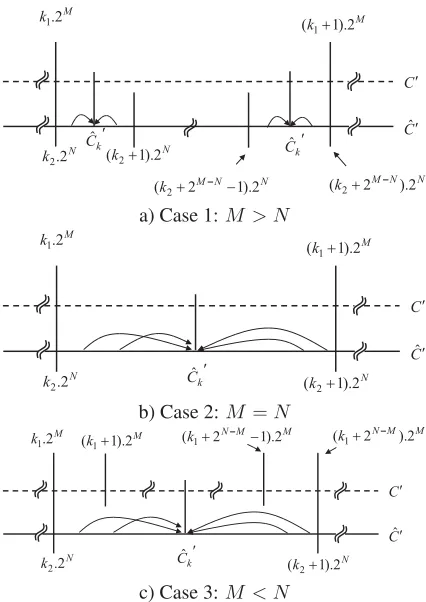
a) Case 1:M > N
b) Case 2: M =N
[image:3.595.70.278.65.188.2]c) Case 3:M < N
Figure 2: Effect of bit plane discarding in watermark ex-traction;λ= 2M andN is the number of bit plane being
discarded.
EZ, to embed watermark bit0no change in state is required while to embed watermark bit1, a new value of the binary tree must be assigned associated with eitherW O,COor
EO. However to minimize the distortion, the nearest state change must occur. Finally the watermarked image is ob-tained by dequantizing the modified binary tree followed by the inverse transform.
2.2.3 Extraction and Authentication:
A universal blind extractor is proposed for the watermark extraction and authentication process. The wavelet coeffi-cients are generated after the forward transform on the test image followed by the tree formation process as in embed-ding. Based on the recovered tree structure, symbols are regenerated to decide on a 0 or 1 watermark extraction. The extracted watermark is then authenticated by compar-ing with the original watermark by measurcompar-ing the Hammcompar-ing distance (Bit Error Rate).
2.3 The effect of bit plane discarding
be-fore and after the bit plane discarding, respectively, we shall examine the effect ofN bit plane discarding on ev-ery bits within the binary tree during the watermark extrac-tion. Considering initialλ = 2M, whereM corresponds
to the depth of the tree, the bit (bi) in the binary tree at the
extractor can be calculated using Eq. (4):
bi=
|C′|
2M
%2 =k1%2, (6)
wherek1is the cluster index as shown in Fig. 2. Using the
bit plane discarding model in Section 2.1, the watermarked coefficientsC′are now quantized and mapped to the center
valueC′
k within a bit plane cluster with an index value of k2as shown in Fig. 2. At this point we consider following
three cases to investigate the effect of this quantization and dequantization process:
2.3.1 Case 1 (M > N):
In this case the binary tree cluster (λ= 2M) is bigger than
the bit plane discarding cluster. Hence for any bit plane discarding whereM > N, C′
k value remains within the
binary tree cluster,i.e.,k.2M ≤ (k+ 1).2M as shown in
Fig. 2.a) and
bi =
|C′|
2M
%2 = |C
′|
2M
%2 =b′
i, (7)
wherebiandb′irepresents the bit in binary tree, before and
after the bit plane discarding, respectively.
2.3.2 Case 2 (M =N):
This case considers the same cluster size in the binary tree and the bit plane discarding, and thereforeC′
k remains in
the same cluster of the binary tree during the watermark extraction, as shown in Fig. 2.b) and hence,bi=b′i. 2.3.3 Case 3 (M < N):
In this scenario, the number of bit planes being discarded are greater than the depth of the binary tree. Due to the bit plane discarding, any watermarked coefficient (C′) in the
cluster (k2.2N ≤C′ <(k2+1).2N) is mapped to the center
valueCk′. In terms of the binary tree clustering this range
can be defined as (k1.2M ≤ C′ < (k1+ 2(N−M)).2M)
where(N−M)is a positive integer. Hence, during the wa-termark extraction, the index of the binary tree cluster can be changed and effectivelybi =b′iis not guaranteed. So far
we have explained the effect of bit plane discarding on in-dividual bits of the binary tree. As the algorithm generates the watermark association symbols using the most signifi-cant three bits of the binary tree (Table 1), we can define the necessary condition for the coefficients to retain the water-mark as follows:
d≥N+ 3, (8)
wheredis the depth of the binary tree andNis the number of bit plane assumed to be discarded.
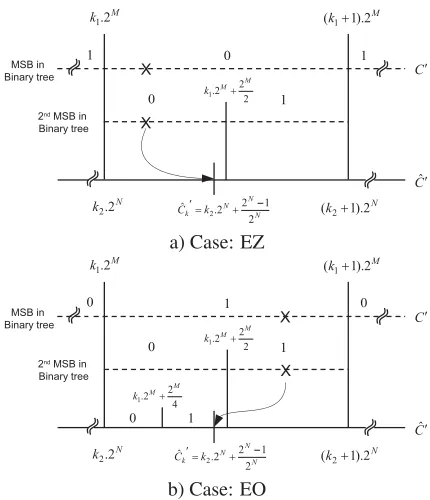
a) Case: EZ
[image:4.595.312.527.64.314.2]b) Case: EO
Figure 3: Effect of bit plane discarding in watermark ex-traction for special case of EZ and EO;λ = 2M andN is
the number of bit plane being discarded.
Now considering a scenario, where the embedding modifi-cation is done in such a way that all modified coefficients are associated with eitherEZ and EO and in that case, only most significant two bits are required to be preserved and Eq. (8) becomes:
d≥N+ 2. (9)
However, in this case, the second most significant bit (MSB) in the binary tree does not need to not be preserved if, MSB is preserved along with the support decision from the third MSB,i.e.,EZ and EO are allowed to be extracted as CZ and CO, respectively. Now we will examine the ef-fect of bit plane discarding in such cases whend=N+ 1.
Case EZ:
In this case, the coefficients (C′) are associated to
embed-ded zero (EZ→00x), i.e., k1.2M ≤ C′ <
k1+2
M
2
where k1%2 = 0, as shown in Fig. 3.a). After N bit
plane discarding,C′ is modified to the center valueCˆ k =
k2.2N+2
N−1
2
. ForM =N (i.e.,d=N + 1),k2
be-comesk1and therefore:
ˆ
Ck=
k2.2N +
2N−1
2
<
k1.2M +
2M
2
,
⇒ Cˆk<
k1.2M+
2M
2
,
∀ k1.2M <Cˆk<
k1.2M +2
M
2
. (10)
[image:4.595.316.535.660.743.2]association with EZ remains same and watermark informa-tion can be successfully recovered.
Case EO:
Referring Fig. 3.b), for embedded one (EO→11x), the condition for the coefficient association becomes
k1+2
M
2
≤ C′ < (k
1 + 1).2M where k1%2 = 1.
As in the previous case, afterN bit plane discarding, C′
is modified to the center value of the corresponding cluster
ˆ
Ck =
k2.2N+2
N−1
2
. ConsideringM =N, similar to Eq. (10) we can write:
k1.2M <Cˆk<
k1.2M +
2M
2
. (11)
Therefore first two MSB of the binary tree now changed as 11x→10x. At this point, we aim to extract the third MSB (b′), which can be retrieved as:
b′=
⎧ ⎨ ⎩
0 : if k1.2M ≤Cˆk <
k1.2M +2
M
4
,
1 : if
k1.2M+2
M
4
≤Cˆk<
k1.2M+2
M
2
.
(12) Now consideringM = N ⇒ 2N2−1 > 24M, Eq. (11) be-comes
k1.2M +
2M
4
<Cˆk<
k1.2M+
2M
2
. (13)
Combining Eq. (12) and Eq. (13), extracted third MSB be-comesˆb= 1and hence 11x→101. Therefore, after (N+ 1) bit plane discarding, the coefficient association with EO be-comes CO and the watermark information can still be suc-cessfully extracted.
Combining the above mentioned cases, we can modify Eq. (9) and conclude that, for EZ or EO, the relationship between the embedding depthdand maximum number of bit plane discarding (N) is as follows:
d≥N+ 1. (14)
3
Experimental results and discussion
The experimental simulations are grouped into three sets: 1) Verification against the bit plane discarding model, 2) Robustness against JPEG 2000 and 3) Comparison with the existing algorithm. In the experimental sets, a3level 9/7 wavelet decomposition is performed using a test data set of 20 images (consists of Kodak test image set and other popular test images). The low frequency subband has been selected to embed binary logo based watermarks. The ini-tial quantization value,λ, is set to32, resulting in the tree depth ofd=6. The embedding distortion is measured here using a new metric, combining the distortion and the data capacity together:
Φ =
X−1 m=0
Y−1
n=0(I(m, n)−I′(m, n))2
L , (15)
whereΦrepresents embedding distortion rate,IandI′ are
the original and watermarked image, respectively with di-mensionX×Y andLis the number of watermark bits em-bedded. The robustness is measured by Hamming distance
and a lower Hamming distance represents a better robust-ness.
1) Verification against bit plane discarding:
The proposed watermarking scheme incorporates bit plane discarding model and the experimental verifications for the same are shown in Fig. 4. The y-axis shows the robust-ness in terms of Hamming distance against the number of bit planes discarded (p) on the x-axis. Different depth (d) values with minimum and maximum embedding distortion rateΦ are chosen to verify our arguments in Eq. (8) and Eq. (14), where the maximumΦrepresents all coefficient’s association withEZ/EO . For example, at d = 6, for
Φmin, correct watermark extraction is possible up top= 3
and forΦmax, correct watermark is extracted up top = 5
as shown in the said figures.
[image:5.595.311.529.382.631.2]2) Robustness against JPEG 2000:
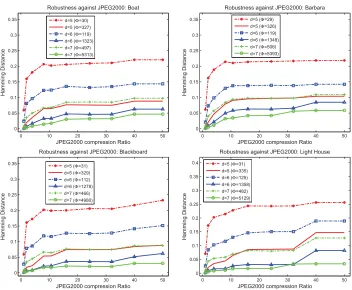
Fig. 5 shows the robustness performance of the proposed watermarking scheme against JPEG 2000 scalable com-pression. These results compare the robustness for various
Φat a givend. It is evident from the plots that higher depth offers greater robustness to scalable coding-based content adaptation attacks,e.g.,JPEG 2000. The results show that more than35%improvements is achieved when comparing the robustness between two consecutived.
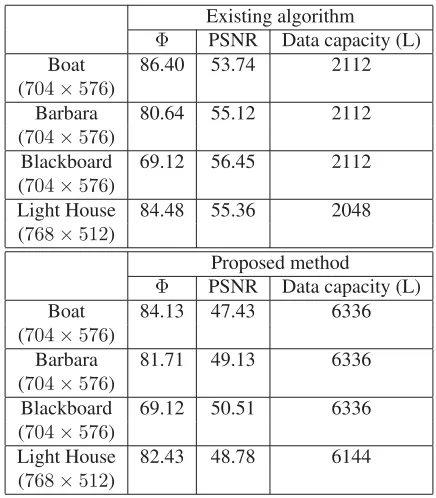
Existing algorithm
Φ PSNR Data capacity (L) Boat 86.40 53.74 2112 (704×576)
Barbara 80.64 55.12 2112 (704×576)
Blackboard 69.12 56.45 2112 (704×576)
Light House 84.48 55.36 2048 (768×512)
Proposed method
Φ PSNR Data capacity (L) Boat 84.13 47.43 6336 (704×576)
Barbara 81.71 49.13 6336 (704×576)
Blackboard 69.12 50.51 6336 (704×576)
Light House 82.43 48.78 6144 (768×512)
Table 2: Embedding distortion performance comparison between existing and proposed watermarking method.
3) Comparison with the existing algorithm:
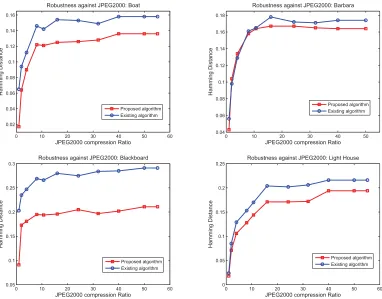
The performance of the proposed algorithm is compared with an existing JPEG 2000 based blind watermarking method [4]. For a fair comparison, considering the embed-ding distortion and the data capacity together, we set same
0 1 2 3 4 5 6 7 0 0.1 0.2 0.3 0.4 0.5 p H a mmi ng D is tance
Robustness against bit plane discarding: Boat
d=5 (Φ=30) d=5 (Φ=327) d=6 (Φ=119) d=6 (Φ=1323) d=7 (Φ=497) d=7 (Φ=5313)
0 1 2 3 4 5 6 7 0 0.1 0.2 0.3 0.4 0.5 p H a mmi ng D is tance
Robustness against bit plane discarding: Barbara
d=5 (Φ=29) d=5 (Φ=326) d=6 (Φ=119) d=6 (Φ=1348) d=7 (Φ=506) d=7 (Φ=5393)
0 1 2 3 4 5 6 7 0 0.1 0.2 0.3 0.4 0.5 p H a mmi ng D is tance
Robustness against bit plane discarding: Blackboard
d=5 (Φ=31) d=5 (Φ=329) d=6 (Φ=112) d=6 (Φ=1278) d=7 (Φ=466) d=7 (Φ=4980)
0 1 2 3 4 5 6 7 0 0.1 0.2 0.3 0.4 0.5 p H a mmi ng D is tance
Robustness against bit plane discarding: Light House
[image:6.595.122.474.64.355.2]d=5 (Φ=31) d=5 (Φ=335) d=6 (Φ=125) d=6 (Φ=1358) d=7 (Φ=482) d=7 (Φ=5129)
Figure 4: Robustness against discarding of p bit planes for variousdat minimum and maximumΦ.
0 10 20 30 40 50 0 0.05 0.1 0.15 0.2 0.25 0.3 0.35
JPEG2000 compression Ratio
H a mmi ng D is tance
Robustness against JPEG2000: Boat
d=5 (Φ=30) d=5 (Φ=327) d=6 (Φ=119) d=6 (Φ=1323) d=7 (Φ=497) d=7 (Φ=5313)
0 10 20 30 40 50 0 0.05 0.1 0.15 0.2 0.25 0.3 0.35
JPEG2000 compression Ratio
H a mmi ng D is tance
Robustness against JPEG2000: Barbara
d=5 (Φ=29) d=5 (Φ=326) d=6 (Φ=119) d=6 (Φ=1348) d=7 (Φ=506) d=7 (Φ=5393)
0 10 20 30 40 50 0 0.05 0.1 0.15 0.2 0.25 0.3 0.35
JPEG2000 compression Ratio
H a mmi ng D is tance
Robustness against JPEG2000: Blackboard
d=5 (Φ=31) d=5 (Φ=329) d=6 (Φ=112) d=6 (Φ=1278) d=7 (Φ=466) d=7 (Φ=4980)
0 10 20 30 40 50 0 0.05 0.1 0.15 0.2 0.25 0.3 0.35 0.4
JPEG2000 compression Ratio
H a mmi ng D is tance
Robustness against JPEG2000: Light House
d=5 (Φ=31) d=5 (Φ=335) d=6 (Φ=125) d=6 (Φ=1358) d=7 (Φ=482) d=7 (Φ=5129)
Figure 5: Robustness against JPEG 2000 compression for variousdat minimum and maximumΦ.
compression is shown in Fig. 6. In embedding distortion, the existing method shows better PSNR, but the data capac-ity of the proposed method is reported 3 times higher. In
[image:6.595.122.474.392.682.2]out-0 10 20 30 40 50 60 0.02
0.04 0.06 0.08 0.1 0.12 0.14 0.16
JPEG2000 compression Ratio
Hamming Distance
Robustness against JPEG2000: Boat
Proposed algorithm Existing algorithm
0 10 20 30 40 50
0.04 0.06 0.08 0.1 0.12 0.14 0.16 0.18
JPEG2000 compression Ratio
Hamming Distance
Robustness against JPEG2000: Barbara
Proposed algorithm Existing algorithm
0 10 20 30 40 50 60 0.05
0.1 0.15 0.2 0.25 0.3
JPEG2000 compression Ratio
Hamming Distance
Robustness against JPEG2000: Blackboard
Proposed algorithm Existing algorithm
0 10 20 30 40 50 60 0
0.05 0.1 0.15 0.2 0.25
JPEG2000 compression Ratio
Hamming Distance
Robustness against JPEG2000: Light House
[image:7.595.103.485.67.366.2]Proposed algorithm Existing algorithm
Figure 6: Robustness performance comparison between existing and proposed method against JPEG 2000 compression with sameΦ.
performed the existing one in terms of robustness by an av-erage improvement of 25% to 35% at higher compression ratios.
4
Conclusions
In this paper, we proposed a new robust blind watermark-ing algorithm suitable for scalable image codwatermark-ing-based content adaptation. The algorithm incorporates the JPEG 2000 quantization process which uses a bit plane discard-ing model. The proposed algorithm is experimentally ver-ified against the bit plane discarding model and the JPEG 2000 quality compression. In comparing the robustness, the new algorithm outperformed the existing JPEG 2000 based blind watermarking scheme.
Acknowledgements
The work was funded by BP-EPSRC Dorothy Hodgkin Post Graduate Award.
References
[1] T.-S. Chen, J. Chen, and J.-G. Chen. A simple and efficient watermarking technique based on JPEG2000 codec. In Proc. Int’l Symp. on Multimedia Software Eng., pages 80–87, 2003.
[2] F. Dufaux, S. J. Wee, J. G. Apostolopoulos, and T. Ebrahimi. JPSEC for secure imaging in JPEG2000.
InProc. SPIE Appl. of Digital Image Processing XXVII, volume 5558, pages 319–330, 2004.
[3] R. Grosbois, P. Gerbelot, and T. Ebrahimi. Authenti-cation and access control in the JPEG2000 compressed domain. InProc. SPIE Appl. of Digital Image Process-ing XXIV, volume 4472, pages 95–104, 2001.
[4] P. Meerwald. Quantization watermarking in the JPEG2000 coding pipeline. In Proc. Int’l Working Conf. on Comms. and Multimedia Security, pages 69– 79, 2001.
[5] A. Piper, R. Safavi-Naini, and A. Mertins. Resolution and quality scalable spread spectrum image watermark-ing. InProc. 7th workshop on Multimedia and Security, pages 79–90, 2005.
[6] Y.-S. Seo, M.-S. Kim, H.-J. Park, H.-Y. Jung, H.-Y. Chung, Y. Huh, and J.-D. Lee. A secure watermarking for JPEG2000. InProc. IEEE ICIP, volume 2, pages 530–533, 2001.
[7] P.-C. Su, H.-J. M. Wang, and C.-C. J. Kuo. An in-tegrated approach to image watermarking and JPEG-2000 compression. The Journal of VLSI Signal Pro-cessing, 27(1):35–53, Feb. 2001.