EUROPEAN INTEGRATION
by
Heather Field, B.Sc. Hons., Dip. I.C.I.E.
A sub-thesis submitted in partial fulfilment of the requirements for the degree of Master of Arts (International Relations) in the Department of International Relations, Research School of Pacific Studies, Australian National University
ACKNOWLEDGEMENTS AND DISCLAIMER
The f o l l o w i n g s u b - t h e s i s i s e n t i r e l y my own work. A l l sources used are acknowledged in the accompanying n o te s . E r r o r s o f f a c t , p e r c e p tio n and i n t e r p r e t a t i o n are e n t i r e l y my own.
The ad vice and s u p e r v i s io n p ro v id e d by Alan B u r n e t t , o f th e Dep a rtm ent o f I n t e r n a t i o n a l R e la t io n s , and th e loan o f p u b l i c a t i o n s by P ro fe s s o r J .D .B . M i l l e r , are g r a t e f u l l y acknowledged.
CONTENTS
Chapter Page
I. Introd uctio n... -... 1
I I . Outline of the Historical Background to the Development of the European Community... 3
I I I . Theories of Integration and the European Community... 13
IV. The EC's Decision-making Process and I n s t i t u t i o n s ... 31
V. The Common Agricultural P o l i cy ... 50
VI. Budgetary and Other Costs of the CAP... 67
VII. Other Major Common EC P o l i c i e s ... 79
LIST OF TABLES
Table Page
I V . 1 The D is trib u tio n of Votes in the EC Council from 1986..35
I V . 2 The D is trib u tio n of Council Votes P rior to 1986... 36
I V . 3 The D is trib u tio n of MEPs and the EC Population...44
V . l Nominal Rates of EC Protection fo r Selected Products...62
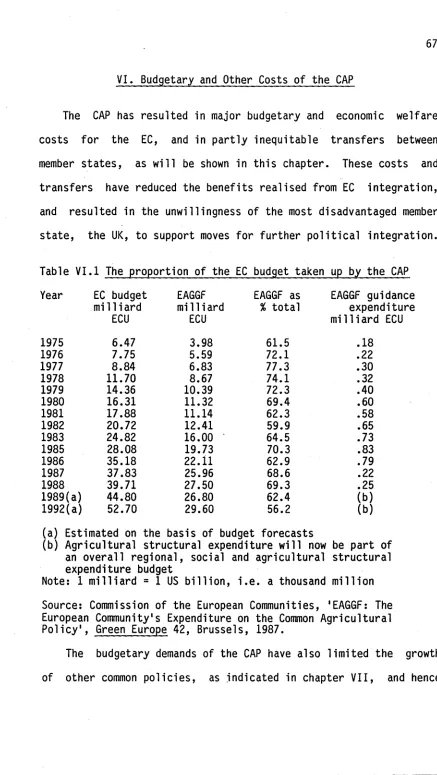
VI. 1 The Proportion of the EC Budget Taken Up by the C A P ....67
V I . 2 Expenditure on Major Non-Agricultural Policy Areas...68
V I . 3 EAGGF Support Expenditure on Major Products, 1986... 69
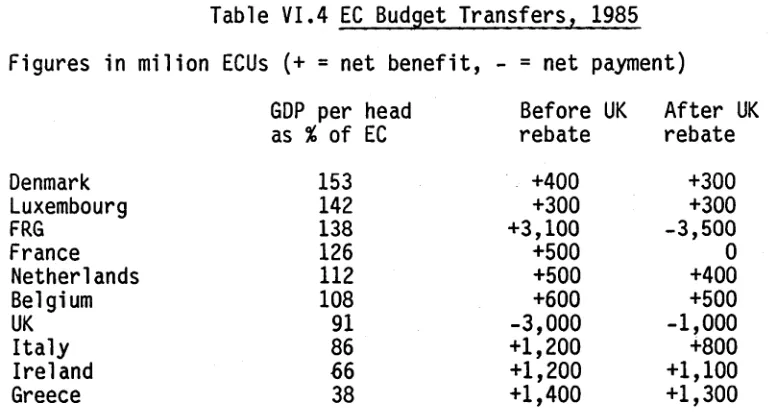
V I . 4 EC Budget Transfers, 1985... 70
I. Introduction
This sub-thesis deals with the concentration of the European Community (EC) on the Common Agricultural Policy or CAP as its main policy to date, and the consequences of this for the process of integration. This process of integration is considered to be both economic and political, with both the economic welfare and the influence in international affairs of the integrated whole, the European Community, being greater than the sum of these from the individual parts, in this case the member states.
The sub-thesis is not concerned with consequences of the CAP which do not have perceived consequences for integration at pres ent. These include the negative effects of the CAP on the country side, on the quality and potability of water supplies, and in encouraging a growth in fraud and organised crime, and its positive effects in providing some income assistance for low income groups and regions.
The analysis is divided into a number of chapters. This introduction is followed by a brief exposition on the history of the EC and the background to its formation. Chapter III discusses theories of integration in international politics as they have been applied to the EC, customs union theory and its application to the EC, and other theories relevant to the derivation of a rationale for the formation of and adhesion to customs unions and wider political entities.
supranational entity, and to determine how they have resulted in the adoption and continuation of the CAP as the EC's main policy. The development, nature and effects of the CAP are considered in chapter V, and those of the EC's other main policies in chapter VII.
The budgetary and economic welfare costs of concentration on the CAP are discussed in chapter VI, in order to demonstrate both the extent to which the CAP has consumed the greater part of Comm unity funds and the extent to which this has starved other EC policies of funds and retarded their development. Chapter VIII considers the impact of the CAP on the Community's international relations, preventing it from playing a greater leadership or hegemonial role in some areas and having close relationships in others.
I I . Outline of the Historical Background to the Development of the European Community
What is perhaps surprising about the history of the European Community is not t h a t p o l i t i c a l and economic inte gr ati on should have commenced in western Europe in the second half of the 20th Century, but t h a t i t should have taken so long for t h i s to occur. Some two mill eni a ago the Roman Empire extended to Anglesey in the west and Hadrian's Wall and Cologne in the north, though t h i s was 1 an empire of a Mediterranean basin rather than European ch arac ter . The language of the empire, Latin, continued to act as a common language for r e l i g i o u s , legal and many other purposes in Europe until post-Reformation times in the sixteenth century, when i t was replaced to some extent by o f f i c i a l and increasingly standardised
2
vernaculars. Even today Latin is used for much medical and botanical terminology in the western world.
The Carolingian Empire of Charlemagne unified France, Rhineland Germany and the Low Countries, and is considered by one commentator
3
Religious, ling ui stic, ideological, ethnic and cultural d if fe r ences have been divisive factors between the various European states, though also in some cases a source of cross-border links. The economic interdependence of the states which came to form the EC was a major pre-disposing factor for economic integration. This interdependence developed rapidly with the spread of the industrial revolution, in spite of the efforts of most governments to r e s t r i c t i t . It was an interdependence not just in trade relations but in ideas and technology, people and investment, in what may be descr ibed as the early c a p ita lis t system, which spread from Britain to
4 the Continent in the 19th Century .
The level of interdependence declined somewhat between 1914 and the end of 1945. The aftermath of WWII made an unprecedented level of interdependence a pre-requisite for recovery, leading to formal co-operation and integration arrangements.
5
The m a jo rity of the nation states which now form the EC came
in to being themselves through the in te g r a tio n of e a r l i e r sovereign 6
t e r r i t o r i e s . Conversely, several of the Member States were once 7 part of larg er p o l i t i c a l e n t i t i e s , or governed by each other.
The areas of the nation states themselves have also been subject to
r e d e f in it io n , with tra n s fe rs of f o r example Schleswig Holstein
between Denmark and Germany, and Alsace Lorraine between Germany
and France. Even today there are s e p a ra tis t pressures in the nation
states, from no n-vio le n t s e p a ra tis t movements in Scotland and B r i t
tany to r e l a t i v e l y v io le n t ones in Corsica, Northern Ire land and
the Basque region of Spain.
The dominance of the European states in world a f f a i r s , and
t h e i r r i v a l r y on the world scene, led to a com petitive ra th e r than
co-operative system of world domination by them. The growth of
nationalism in Europe permitted the m o b ilis a tio n and e x p lo ita tio n
of mass support f o r the c o lo n ia l ventures of each of the nation
states, fo s te rin g a com petitive s it u a t io n with regard to c o lo n ia l
expansion, which was one of the fa c to rs behind the progression to
at least the f i r s t of the two major wars in the f i r s t h a lf of the
20th century.
The single most important shock to the system which engendered
European in te g ra tio n was the p a r t i t i o n of the former German reich
in to the Federal German Republic (FRG) or West Germany and the
German Democratic Republic (GDR) or East Germany at the end of
World War I I . Only the FRG now lay w ith in the west European states
aggression and inhumanity during the course of World War I I had led
to widespread m is tru s t and re vu lsio n f o r a l l things German in much
of the western world. The FRG was forced to seek close allia n ce s to
enable i t to provide f o r i t s defence, to obtain a market f o r i t s
goods, and be part of a s tru c tu re w ith in which i t could re b u ild i t s
in d u s try and p ro s p e rity . NATO met the f i r s t need, and the EC was
entered in to as a means of meeting the la s t two. There was a view
th a t th a t the nation states had f a i l e d , and th a t 'th e inadequacy of
European legitim acy based on the supremacy of the nation state had
8
f a i l e d ' .
However, the beginnings of European in te g r a tio n can only be
a ttr ib u t e d to a very lim ite d extent to post-war pan-Europeanism. A
number of separate s p e c ific i n i t i a t i v e s were s i g n if ic a n t as e a rly
moves towards European co-operation and u n ity , l a t e r culminating in
the formation of the European Community. An e a rly s ta r t in g point in
terms of the expression of views was Winston C h u r c h ill's 1946 9 speech in Zurich c a llin g f o r a 'United S tates' of Europe. The
f i r s t major i n i t i a t i v e was the in tr o d u c tio n in 1947 of the Marshall
Plan f o r U.S. aid f o r Europe, with seventeen nations jo in in g to
form the OEEC (Organisation f o r European Economic Co-operation). 10 However, by 1950 the impetus of the OEEC had la r g e ly petered out.
The formation of the WEU (Western European Union) in 1948 was a
fu r th e r move to greater co-operation, but the Union was lim ite d in
being mainly a c o n s u lta tiv e assembly to discuss c u ltu r a l and human
11
rig h ts issues. The signing of the NATO (North A t la n t ic Treaty
U.S-European co-ope ratio n and w ith only m ilit a r y and defence aims. A
proposal fo r an EDC (European Defence Community) was put forward by
France in 1950, but in 1954 the French Chamber of Deputies i t s e l f
fa ile d to r a t i f y the plan.
In 1950 Robert Schuman, the French Foreign M in is te r, put
forward a proposal fo r an ECSC (European Coal and Steel Community)
in which the coal and stee l in d u s trie s of France and the FRG would
be pooled, membership o f the pool being open to a ll countrie s in
Europe, w ith the pool i t s e l f being administered by a supranational
European a u th o rity , on the basis of a b lu e p rin t drawn up by Jean
Monnet, the a r c h ite c t of the plan. The Treaty of Paris was signed
in 1951 by the s ix founding EC co u n trie s (France, the FRG, I t a ly ,
the Netherlands, Belgium and Luxembourg), b rin g in g the f i r s t
12
European Community in to being.
The importance of the ECSC is th a t i t was the foundation stone
in the b u ild in g of the European Community. I t was a means of
in te g ra tin g and sup ervising the e ssse n tia ls of war-making ca p a city, 13 making war between the member states a physical im p o s s ib ility .
Monnet h im se lf had w r itte n , in support of the plan fo r the ECSC,
th a t i f fe a r o f German in d u s tr ia l predominance could only be e lim
inated in France, the gre a te st hindrance to European in te g ra tio n 14
would be swept away. He viewed the ECSC as not ju s t the best
means o f s o lv in g an economic problem, but as the f i r s t move towards 15
a European fe d e ra tio n . As Barraclough s ta te s , the ECSC was a
means of re s o lv in g Franco-German dissension, in c lu d in g French des
the in d is s o lu b le lin k in g o f resources in the ECSC made discord and 16
divergences over the Saar and i t s in d u s trie s im possible.
The success o f the ECSC led to the p o s s ib ilit y of fu rth e r
in te g ra tio n being viewed fa v o u ra b ly . At the Messsina Conference of
1955 the p o s s ib ilit y o f general economic in te g ra tio n among the
'S ix ' was discussed. The Spaak Committee, under the leadership of
Paul-Henri Spaak, the Belgian Foreign M in is te r, drew up a b lu e p rin t
fo r fu r th e r European in te g ra tio n in the economic and atomic energy 17
spheres, sub m itting i t s re p o rt in A p ril 1956. The Treaty of Rome
was signed in 1957 and entered in to fo rce on 1 January 1958,
b rin g in g in to existence the EEC (European Economic Community) and
Euratom (the European Atomic Community) (the agencies of Euratom
were merged w ith those o f the EEC in 1967).
By 1962 the basic re g u la tio n s governing the common a g ric u ltu ra l
p o lic y and in d u s tr ia l com petition p o lic y were agreed. The UK's
f i r s t a p p lic a tio n fo r membership of the European Communities was
submitted in 1961, but under pressure from General de Gaulle 18
(President o f France) they were broken o f f in 1963.
A second a p p lic a tio n fo r membership o f the European Communities
made by the UK in 1967, and consequent a p p lic a tio n s from Ire la n d ,
Denmark and Norway, met w ith f a ilu r e due to French re se rva tio n s.
However, 1969 saw the re tire m e n t from o ffic e o f de Gaulle. The
Hague summit la te r th a t year re s u lte d in plans fo r economic and
monetary union and the commencement of EPC (European P o litic a l Co
o p e ra tio n ), as w ell as the acceptance of n e g o tia tio n s fo r EC 19
Ireland and Denmark acceded to the EC on 1 January 1973. Norway did not jo in as a national referendum had narrowly reje cted EC membership.
The second and t h ir d enlargements of the EC, in a more southwards d i r e c ti o n , came with the accession of Greece in 1981 and Spain and Portugal in 1986. Further enlargements appear ruled out for the near f ut ur e, in view of the internal pressures in the EC against a t r a n s l a t i o n of the association agreement with Turkey into
20
membership , and the r ej e ct i o n of a 1987 application by Morocco on the grounds of the l a t t e r not being a European s t a t e . While Norway is s t i l l an obvious candidate for EC membership, the t r a d i t i o n a l independence of Switzerland and Sweden operate as a s i g n i f i c a n t b a r r i e r to membership of any wider p o l i t i c a l grouping, as does the p o l i t i c a l independence which the USSR is understood to require of Finland and much more arguably Austria, although i t did not prevent them from becoming members of EFTA. There has been one exception to the gradual geographical growth of the Community: in 1984 Greenland, a Danish p ro t e c to r a te , was permitted by the Ten to leave the EC and become an associated overseas t e r r i t o r y .
However, the geographical expansion of the Community in p o l i t i c a l terms has been exceeded gr eat ly by the expansion in economic terms. The EC has been part of a free trade area with the EFTA countries from 1972. I t has association and trade agreements with most of the countries which border on the Mediterranean
21
have special links covers much of Africa, the P a c if i c islands and
22
the Caribbean.
In December 1985 the Community agreed to adopt the Single European Act. This represented a move towards g r e a t e r in tegration in both the p o l i t i c a l and the economic spheres. As discussed l a t e r in t h i s su b- th es is, the SEA r e s t r i c t e d the use of the veto by
c
individual member s t a t e s in the Council of Ministers, and increased 23
the powers of the European Parliament. The Act committed the EC, at l e a s t in p r i n c i p le , to the establishment of a s in g le Community market in goods and services by 1992, a 'Europe without f r o n t i e r s ' , which i f adhered to will greatly increase the level of economic
i nt e g ra ti on of the EC member s t a t e s .
Notes to chapter I
1 Paul Johnson 'Europe: the Sleeping P r i n c e s s ' , p. 16, European Affairs 1/87, pp. 11-18
2 A. Watson 'European International Society and i t s Expansion', p. 15, in H. Bull and A. Watson (Eds.)The
Expansion of International Society, Clarendon Press, Oxford, 1984, pp. 13-32.
3 Johnson, p. 15
4 S. Pollard European Economic Integration 1815-1970' , Thames and Hudson, London, 1974
5 F.H. Hi ns ley Power and the Pursuit of Peace, Cambridge University Press, 1967, p. 280
7 For example, Portugal was once part of the Spanish Duchy of Leon, parts of I t a l y once formed part of the Austro- Hungarian empire, the Netherlands and Belgium (the 'Low Countries') were once t e r r i t o r i e s of the Spanish empire, while in the years immediately prior to 1830 Belgium was governed by the Netherlands, and the I r i s h Republic separated from Britain e a r l i e r t h i s century.
8 S. Henig Power and Decision in Europe, Europotentials Press, London, 1980, p. 2
9 Commission of the European Communities 'Three Decades of the Community', EC News 5(2), 1987, p. 2
10 Walter Laqueur Europe Since H i t l e r , Weidenfeld and Nicolson, London, 1970, p. 96
11 I b i d . , p. 98
12 Commission of the European Communities European Unific ation and the Origins and Growth of the European Community, Periodical 2/87, Klaus-Dieter Borchardt, Luxembourg, February 1987
13 C.D.E. Collins 'History and I n s t i t u t i o n s of the EEC', p. 14, in A.M. el-Agraa (Ed.) The Economics of the European Community, Philip Alan Publishers, Oxford, 1980, pp. 11-4Ö
14 C.A. Ehrhardt 'Europe Between National Sovereignty and Integ r a t i o n ' , p. 107, Aussen P o l i t i k 38(2), 1987, pp. 103-119 15 Jean Monnet Memoirs, Collins, London, 1978, p. 328
16 G. Barraclough, ‘The EEC in the World Economy', p. 59, in Seers and Vaitsos (Eds.), Integration and Unequal Development: the Experience of the EEC, Macmillan Press, London, pp. 57-71 17 Ehrhardt, op. c i t . , p. 110
18 Commission of the European Communities, op. c i t . , p. 16 19 I b i d . , p. 16
20 Due for instance to fears of f u r t h e r movements of Turkish 'guest workers' into the FRG, as indicated by Dietrich Schlegel, 'Turkish-European Pragmatism', Aussen P o l i t i k 37(3), 3rd
21 H.K. Fi eld , 'Aspects of the Effects of the Second Enlarge ment of the European Community upon the Mediterranean Sta tes '
Exports of Agricultural Products, Textiles and Migrant Work e r s ' , pp. 209-233 of A. Stepniak and M.R. Will, Structural Changes in the European Community, University of the Saar-1 and, Saar-1986
22 A l i s t of the 66 is given in chapter VIII
III. Theories of Integration and the European Community
This chapter examines the treatment of integration in internal relations theory and economic theory, concentrating on approaches which have been considered relevant to the EC. It does so in order to allow an assessment to be made later in the sub-thesis of how concentration on the Common Agricultural Policy has had negative consequences for the pace of EC integration and for the reaping of possible po li tic a l and economic benefits from the integration process.
In considering the val idi ty and importance of different integ ration theories, i t is important to remember that the aim in s e t t ing up the European Community was not that of po l i t ic a l integrat ion, at least in the short or medium term. In the European Economic Community Treaty, also known as the Treaty of Rome, the goal s t r i v en for is a customs union with some common pol ici es in a number of
1
sectors (agriculture, transport, energy, external trade). Even now, some thirty years later, the aim is one of closer economic co-operation with the establishment of a full common market (not only for goods, but labour, capital, services e t c . ) by 1992. There is l i t t l e evidence that the Community is any closer to establishing po li tic a l unity as a goal than i t was in 1957. However, the Commun ity of Twelve is a much more significant entity than that of just the Six, and a major step outside the purely economic f i e l d has been taken with the development of EPC (European Po litical
Co-2
i n i t i a t i o n and operation of the foreign policies of the member s t a t e s .
One possible reason for the lack of development of p o l i t i c a l in teg rat io n is t h a t the Community has not developed along the lines
3
of the Security Community envisaged by Deutsch in the sense of assuming any res po nsi bi 1i t y for the defence of i t s members. This is because NATO (the North Atlantic Treaty Organisation) had already assumed t h i s r e s p o n s i b i l i t y , and because the scheme to set up a European Defence Community f a i l e d . The value of the Community as a guarantor against war has been diminished or l o s t , both because of the existence of NATO, and because the very success of the
4
Community has meant t h a t , as Henig s t a t e s , war is no longer an instrument of policy for solving differences between the s t a t e s of
i 5
Western Europe. Scheingold argues that EC in tegration is good by d e f i n i t i o n since i t has led to permanent r e c o n c i l i a t io n between nations whose bloody c o n f l i c t s had led to major wars engulfing s i g n i f i c a n t portions of the world.
The e x p l i c i t aim of the European Treaties and the EEC was clos er economic in te g r a t i o n , and most progress has been in the area of economic in teg rat io n r ath er than p o l i t i c a l in te g r at i o n . As i t is considered to have more relevance for the development of the EC, economic i n te g r at i o n theory is examined here pr ior to th at of
5
p o l i t i c a l i n te g r a t i o n . Robson describes the principal forms of i . Henig considers t h a t these s t a t e s already c o n s t i t u t e an informal se cu r i t y community, with the existence of the formal European
economic int egration as being free trade areas, customs unions, common markets and economic unions. The EC is not a free trade area, but a customs union with elements of a common market and some initial steps towards an economic union. In the EC and customs unions in general, a common external tariff is applied to outside trade, with (as in a free trade area) there being tariff-free movement of products in the area.
A customs union experiences gains and losses from trade creation and trade diversion. Trade creation occurs where the domestic production of goods identical with those from partner countries is eliminated, and these goods are now imported from the partner country (i.e. production effects), and where this increased consumption of partner country substitutes for domestic goods that formerly satisfied the need at a higher cost (i.e. consumption
7 effects and the gain in consumers' surplus).
T rade), and i n d u s t r i a l r a w m a t e r i a l s o ther than coal and steel have in m o s t c a s e s n e v e r been h i g h l y p r o t e c t e d .
The l a rger the c u s t o m s union, the grea t e r will be the scope for t r a d e c r e a t i o n . Thi s i n d i c a t e s t h a t the b e n e f i t s fro m EC m e m b e r s h i p c o u l d i n c r e a s e s i g n i f i c a n t l y w i t h the p r o g r e s s i v e e n l a r g e m e n t of the C o m m u n i t y .
In a t r a d e d i v e r t i n g c u s t o m s union it is still p o s s i b l e for at least one ind i v i d u a l c o u n t r y to gain, just as in a trade c r e a t i n g union, w h i l e the u nion is p o t e n t i a l l y benefical to all m e m b e r s at least one indi v i d u a l c o u n t r y m a y lose. Such i n e q u i t a b l e ou t c o m e s m a y be r e m e d i e d by a d j u s t m e n t s in the t a r i f f itself, or (as to some e x t e n t in the EC) by m e a n s of b u d g e t a r y tra n s f e r s .
A f u r t h e r r e l e v a n t point is that a c u s t o m s union m a y also have 'dynamic' e f f e c t s such as e c o n o m i e s of scale f r o m the r e d u c t i o n in the f r a g m e n t a t i o n of the m arket. However, the e c o n o m i c b e n e f i t s of the l a tter m a y be r e d u c e d w h e r e t h e y lead to a high e r d e g r e e of
8 m o n o p o l y and m o n o p o l i s t i c b e h a v i o u r .
f o r a g r ic u ltu r a l trade w ith in the Community has prevented trade
creation b e nefits from being f u l l y re a lis e d w ith in the sector.
However, against th is must be set trade cre ation be n e fits from free
trade in many in d u s tr ia l sectors w ith in the Community and EFTA, and
on r e l a t i v e l y open terms both with countries associated with the
EC, and the re s t of the world in general.
P o l i t i c a l in te g ra tio n theories seek to explain how the process
of in te g ra tio n may take place, and to some extent measure i t .
Unlike the economic theories of in te g ra tio n discussed above, they
do not in most cases attempt to consider the gains and losses from
peaceful in te g r a tio n , but ra ther the process i t s e l f and the causat-9
ive fa c to rs behind i t . Scheingold's 1973 a r t i c l e was w r itte n with
the express purpose of drawing a tte n tio n to the missing fa c to r in
the work undertaken on p o l i t i c a l the orie s of in te g r a tio n , i . e . what
d iffe re n c e does in te g ra tio n make, what are i t s costs and 10
be n e fits . He noted th a t the work of the economists involved in
the area co n s titu te d the major exception to his g e n e ra lis a tio n .
The three main approaches to European in te g r a tio n in p o l i t i c a l
theory are federalism , fun ctio n a lism and neofunctionalism , while
other theories which have been applied have included communications
theory, concordance systems, the orie s of interdependence, and that
11
of the formation of s e c u rity communities.
12
As Lodge states , federalism means d i f f e r e n t things to
d i f f e r e n t people, as fo r some i t means a d iv is io n of sovereignties
between central and local governments under a supreme c o n s titu tio n ,
13
government c o n s titu te s a federal system. Lodge h e rs e lf describes
i t as the i n s t i t u t i o n a l i s a t i o n of lin k s between European states. 14
Borchardt sees the f e d e r a lis t approach as th a t which aims to
dissolve the t r a d i t i o n a l d iv is io n s between member states. 15
Haas comments th a t the f e d e r a l i s t approach involves two
groups, one id e o lo g ica l and the other involved (more p r a c t ic a lly )
in d r a ftin g of arrangements. The major component of the theory of
the id e o lo g ic a l group is the imputed need of peoples and nations,
and th a t these needs w i l l (or must or ought to) r e s u lt in a federal
regime.
Federalism as a doctrine a ttra c te d considerable support among 16
resistance groups in World War I I . In 1946 the EUF (European
Union of F e d e ra lis ts ) was founded to pursue the f e d e r a lis t aim, and
the EDC or European Defence Community was the next p r a c tic a l a t t
empt and f a i l u r e at federalism .
Functionalism involves the idea th a t in te g ra tio n can be
id e n t i f i e d with the successful performance of fu n ctio n a l tasks.
Issues such as defence and fo re ig n p o lic y are considered unsuitable
fo r in te r n a tio n a l co-operation, while everyday welfare issues and 17
s im ila r 'lo w ' areas of p o l i t i c s are. The main exponent of 18
fu n c tio n a lis m , David Mitrany , stated th a t 'p o lic y making in
f u n c t io n a lly based in te rn a tio n a l i n s t i t u t i o n s is a process
sheltered from p o l i t i c a l b a ttle s , where values and concrete
o b jectives harmonise, where issues are resolved according to
'te c h n ic a l' as opposed to ' p o l i t i c a l ' c r i t e r i a ' . Although the Eur
a g r ic u ltu re has remained the main common p o lic y area, p o lic y making
has been the subject of many p o l i t i c a l b a ttle s , and f u n c t io n a lis t
theories bear l i t t l e r e la tio n s h ip w ith the actual development of
the Community.
In the fun ctio n a l model p o l i t i c a l l y s i g n if ic a n t e l i t e s are by
passed, and hence do not fig u r e in i t . The f u n c t i o n a l i s t formula
postulates a n o n - p o litic a l sector not subject to the play of fund
amentally c o n f lic t in g in te r e s ts , with incremental decision making
and ' r a t i o n a l ' or technical c r i t e r i a to develop p o lic y choices. As
tasks are performed and p a rtic ip a n ts in te re s ts met, support f o r the
process and in s t i t u t i o n a l s tru c tu re grows. Co-operative a ttitu d e s
succe ssfully developed in one sector stim u la te demand fo r f u r th e r 19
co-operation in other fu n c tio n a l sectors.
A major c r i t i c i s m of fu n ctio n a lism is of i t s premise th a t some
issues can be separated from others as as non-controversial and
te c h n ic a l. The h is to ry of disputes in the Community over such
mattters as lo r r y axle weights, food colo uring s, sheep shipments
20
and a g r ic u ltu r a l prices support Lodge's view th a t the d i s t in c t io n
between 'high p o l i t i c s ' (e.g. fo re ig n a f f a i r s , defence and s e c u rity
and 'low p o l i t i c s ' (e.g. a g r ic u ltu r e , education and health) is a
fa ls e one. 22
M itra n y's view of the European Community m anifestation of
in te g ra tio n was that supranational systems (or federal systems, as
he termed the European Communities) tend to heighten c o n f l i c t and
endanger world peace, and th a t the EEC was in c re a s in g ly a 'close d'
a parochial brand of regional patriotism.
Haas, one of the major exponents of neofunctionalism, which developed from functionalism as a theory of integration, decribed the process of political integration as being the result of specific decisions made by governments acting in conjunction with
23 politically relevant organised groups , and:
'the process whereby political actors in several distinct national settings are persuaded to shift their loyalties, expectations and political activities towards a new centre, whose institutions possess or demand jurisdiction over the pre-existing national states'.
Lindberg, another neofunctionalist theorist, describes integration as involving the establishment of a new collective decision making elite, of a 'legitimate system for the resolution of conflict, for
24 the making of authoritative decisions for the group as a whole'
As can be seen from these descriptions, a key element of neo functionalism is that it is political elites rather than
populat-25
ions as a whole that are persuaded to support integration. Neo functionalist theory takes self-interest for granted, and rejects the functional approach to governmental involvement in
internat-26
ional co-operation. In the view of neofunctionalists 'integration is clearly an elite process in a situation of permissive consensus
27 where the public as a whole is passively aquiescent.
28 Hence, to quote Lodge :
The process by which integration is considered to be achieved in neofunctionalist theory is that of spillover, with success in integration in one sector spilling over to lead to integration in
29
another. Taylor describes spillover as the process whereby successful integration in an area of lesser substance would lead to a series of further integrative measures in linked areas, so that the process would become increasingly involved with issues of greater political importance. The spillover process, in the neofunctionalist view, would be assisted by the development of en-grenage or increasing links between bureaucrats and others in the policy process. These 'others' included political and labour groups, central banks and technical advisers, in addition to civil
30 servants and national government offices.
Over time qualifications to neofunctionalism have led to quest ioning of its validity, and it s abandonment as the major theory of
31
western European integration. In 1977 Crichton noted that the theory of neofunctionalism did not f a c i l i t a t e an understanding of the European Community. It had not predicted the way in which events would develop, or been able to explain adequately the
mech-32
anism through which change occurs. Pryce and Wessels in 1987 described the neofunctionalists' main conclusions as having been
(unfairly in their view) 'consigned to the dustbin'. 33
l i k e l y to have been s t a t i s f i e d , with (c o n tra ry to n e o fu n c tio n a lis t
theory) t h is i n i t i a l s a tis fa c tio n not n e cessarily leading to dem
ands f o r broader or more in te n s iv e decision making. Functional
s p illo v e r could not be viewed in and of i t s e l f as a dynamic force 34
f o r in te g r a tio n .
The f a i l u r e of the Community to develop along the lin e s sugg
ested by the n e o fu n c tio n a lis ts can, with h in d s ig h t, be a ttrib u te d
to a few major causes. Perhaps the most important one is th a t the
Council of M in is te rs , and through the Council the member states,
have maintained and perhaps even increased t h e i r powers in the EC 35 decision making system, as w i l l be shown in chapter IV. As Averyt
suggests, influence and in te r e s t group pressures w i l l be brought to
bear where power resides and where the locus of decision making is .
Hence the main e f f o r t s of in t e r e s t groups and e l i t e s have been to
influence national le g is la t io n s .
A f u r th e r reason f o r the f a i l u r e of ' s p i l l o v e r ' to develop at
the Community level is th a t national c i v i l servants have been
re lu c ta n t to give up t h e i r key p o s itio n s and 'gatekeeping' ro le 36
with regard to in te r e s t group pressures. However, f o r i t s part
the Commission has t r ie d to remain alo of from in t e r e s t group press-
37 38
ures , and refused to a ccredit national in t e r e s t groups
However, the concentration of the EC on a g r ic u ltu r e has been
very important in preventing the wider growth of in t e r e s t groups
and o v e r s p ill from t h i s . While Averyt i d e n t i f i e s 300 Eurogroups or 39
in te r e s t groups at the European level in operation , Kirchner 40
in d ic a to rs could j u s t i f y such a conclusion. Measuring mail flows
but not telephone t r a f f i c , and newspaper coverage but not
t e le v is io n time, f o r example, was to leave out hig h ly relevant
major explanatory varia bles and ignore the extent to which s h if t s
could have been due to fa c to rs such as technological change.
However, another v a ria b le examined by the communications theor
i s t s , the extent to which member states traded with each other
ra th e r than the outside world, is a reasonable measure of economic
interdependence to some degree and an important measure used in
interdependency the ory. Also, the data produced by Deutsch's anal
y s is gave a sense of changes in a ttitu d e s and aggregate behaviour 47
which accompanied in te g r a tio n .
Communications theory was perhaps over-ambitious in attempting
to assess the capacity f o r and progress of p o l i t i c a l in te g ra tio n
from a small number of varia bles of dubious importance. However,
the premise of the theory th a t in te g ra tio n could be advanced by
improving the communications network is borne out by p r a c tic a l
r e a l i t y . This is because changes such as the con tructio n of the
Channel tun ne l, the removal of f r o n t i e r con tro ls and other r e s t r
ic t io n s on fre e movement of goods, labour and c a p ita l (as planned
f o r 1992), and even the sharing of common t e le v is io n programmes (be
they US' products such as Dallas and Dynasty), a l l f a c i l i t a t e
in te g ra tio n at the personal, economic and c u ltu r a l levels respect
iv e ly . Also, changes in trade re la tio n s h ip s continue to be a major
v a ria b le in the study of economic and p o l i t i c a l in te g ra tio n , as
Haas himself reappraised neofu n ctio n alist theory and stressed it s neglect of the world s etting of in teg ratio n and of the
import-48
ance of the wider issue of interdependence. From the mid-1970s the attention of theorists of European in teg ratio n turned to theor ies of interdependence, in tern a tio n a l p o l i t i c a l economy and in t e r
-49
national regimes. The interdependence theories concerned both those of general economic interdependence, and others dealing more s p e c ific a lly with the lin kin g e f f e c t of m ultinational corporations
50
such as that of Stuart Holland. One fa c to r behind the acceptance of interdependence theories was the growth of transnational organ isations such as the United Nations, the OEEC and OECD, the IMF (In te rn a tio n a l Monetary Fund), NATO, and the In ternatio nal Energy Agency, and t h e ir influence, during the e a rly post-war era. As
51
Wallace notes, some of these organisations were set up to discuss issues which were also within the competence of the EC T reaties.
One of the most recent th e o re tic a l characterisations of Europ ean integration is as ' intergovernmental is m '. I t overcomes Stanley Hoffman's c ritic is m s of neofunctionalism, th a t i t did not allow for the fa c t th a t governments were central actors in any process of 52 in ternatio nal co-operation, or fo r the strength of nationalism. However, on the other hand, intergovernmentalism 'denies the uniqueness of the Communities as a framework fo r in ternatio nal
co-53
operation' . I t re je c ts the p l u r a l i s t i c image in favour of a more conventional picture of governments optimising t h e i r national
pos-54 55
la tte r to avoid controls over sovereignty, and the defense of
national interests with use of the Council of Ministers veto where
necessary, and they give a detailed account of how th is a ll works
in practice.
The development of the regular summit meetings of the European
Council and the decline in the power of the Commission have cle a rly
contributed to the v a lid ity of the intergovernmental approach com
pared to others. This approach solves one of the problems of neo-56
fu n c tio n a lis t theory indicated by George , that i t neglected the
'p o litic s of support', because intergovernmentalism allows for
analysis of policy making at the national level, and hence fo r the
roles of national p o litic a l parties and coalitions of these, an
area e a rlie r neglected in favour of the study of in te re st groups at
the Community le ve l.
Hence intergovernmentalism allows the consideration of national
p o litic a l factors which have major factors at the Community level,
such as the reasons fo r the willingness of FRG governments to
continue to make large net transfers to the EC budget in support of
the CAP. These reasons include the electoral system of proportional
representation, which resu lt in the m ajority party in power
requiring the support of one of the main m inority parties in order
to be able to govern. Formerly the party in power was the Social
Democratic Party (SPD) which required the support of the Free
Democratic Party (FDP), a party p a rtly representative of farmers'
in te re sts. The FDP appointed the Minister of A griculture, then 57
(CDU) which is in power, and i t requires the support of the
C h ris tia n Social Union (CSU) in order to be able to form a
government. The CSU, l i k e the FDP, is s tro n g ly representative of
farm in te r e s ts , and has been allowed to appoint the M in iste r of
A g ric u ltu re , Ignaz K iechle. Through the CAP tra n s fe rs can be made
to farm groups which would not be possible on a domestic basis, but
the FRG has to make large net budgetary outlays to the EC in order
to be able to do so.
Bulmer and Wessels take t h e i r analysis beyond
intergovernment-alism and introduce 'c o -o p e ra tiv e fe d e ra lis m 1 as t h e i r
character-58
is a tio n of the European Community. This concept r e f le c t s the
pooling and mixing of na tiona l sovereignty with Community powers,
with the two leve ls of a u th o r ity , EC and n a tio n a l, losing any clear
separation between them. In c o n tra s t to a federal system where each
level operates on i t s own in some p o lic y areas, both levels share
re s p o n s ib i1i t y f o r problem solving because ne ith e r has adequate
legal a u th o rity and p o lic y instruments to ta c k le the challenge they
face.
The revised the o rie s of regional in te g ra tio n represented by
intergovernmentalism and co-ope rative federalism re quire a re def
i n i t i o n of in te g r a tio n , compared w ith the e a r l i e r n e o -fu n c tio n a lis t
d e f i n i t i o n of Haas, to allow f o r the ro le of national governments.
59
Schmitter puts forward a d e f i n i t i o n which seems to f i l l th is
requirement:
o rd in a ry people) cease to i d e n t i f y themselves and t h e i r fu tu re welfare e n t i r e l y with t h e i r own na tional governments and p o l i c i e s ' .
Notes to chapter I I I
1 H. Vredeling 'The Common Market of P o l i t i c a l P a r t ie s ', pp. 105- 109 of James Barber and Bruce Reed (Eds.) European Community: Vision and R e a lit y , Croom Helm, London, 1973, p. 105
2 Cooperation in the sphere of fo re ig n p o lic y comes under A r t i c l e 30 of T i t l e I I I of the Single European Act, Commission of the European Communities Single European A c t, B u lle tin of the European Communities, supplement 2/86, Brussels, 1986, p. 18
3 Karl W. Deutsch et a l . P o l i t i c a l Community and the North
A t l a n t ic Area, Princeton U n iv e rs ity Press, Princeton, NJ, 1979
4 Stanley Henig Power and Decision in Europe, Europotentials Press, London, 1980, p. 11
5 S tua rt A. Scheingold 'Domestic and In te rn a tio n a l Consequences of Regional In t e g r a t io n ', pp. 133-151 of R.A. Falk and H. Mendlovitz Regional P o lit ic s and World Order, W.H. Freeman and Co., San Francisco, 1973
6 Peter Robson The Economics of In te rn a tio n a l In t e g r a t io n , George Allen & Unwin, London, 1980, p. 2
7 I b i d . , p. 12
8 I b i d . , p. 42
9 Scheingold, op. c i t .
10 I b i d . , p. 133
11 J u l i e t Lodge 'In t e g r a tio n Theory', pp. 6-23 o f J u l i e t Lodge ( e d ) ., The European Community: b ib lio g ra p h ic a l excursions, Frances P in te r (Publishers) L td ., London, 1983, p. 7
12 I b i d . , p. 9
13 I b i d . , p. 9
14 Klaus-Dieter Borchardt European U n if ic a t io n : the o r ig in s and growth of the European Community, Commission of the European Communities European Documentation P erio dical 2/1987,
15 Ernst B. Haas 'The Study of Regional Integration: Reflections on the Joy and Anguish of P r e t h e o r i z i n g ', pp. 103-132 of Falk and Mendlovitz, op. c i t . , p. 115
16 Stephen George P o l i t i c s and Policy in the European Commmunity, Clarendon Press, Oxford, 1985, p . l 7
17 Carole Webb 'In troduction: Variations on a Theoretical Theme', pp. 1-29 of Helen Wallace, William Wallace and Carole Webb Policy Making in the European Communities, John Wiley and Sons, London 1979, pp. 1-2
18 David Mitrany A Working Peace System, Chicago Quadrangle, 1966, c it ed on p. 9 of Webb, op. c i t .
19 Webb, op. c i t . , p. 10 20 Lodge, op. c i t . , p. 13
21 D. Mitrany 'The Prospects of Integration: Federal or Function a l ? ' reprin ted on pp. 43-74 of Joseph S. Nye, J r . (Ed.) I n t e r national Regionalism: Readings, L i t t l e , Brown and Co.,
Boston, 1968, c it ed on p. 149 of Scheingold, op. c i t .
22 Ernst B. Haas The Uniting of Europe, Stanford University Press, Stanford, Ca lifor nia, 1958, p. 285
23 Ibid.
24 L. Lindberg The P o l i t i c a l Dynamics of European I n t e g r a t i o n , Stanford University Press, Stanford, 1963, p. 15, c it e d on p. 15 of Lodge, op. c i t .
25 Haas, 1958, op. c i t . , cited on p. 17 of Lodge, op. c i t . 26 Webb., op. c i t . , p. 12
27 Lodge, op. c i t . , p. 14 28 Lodge, op. c i t . , p. 15
29 Paul Taylor The Limits of European I n t e g r a t i o n , Croom Helm, London, 1983, p. 9
30 Haas, 1958, op. c i t . , p. 292 and p. 313
31 Pamela Crichton Prospects of P o l i t i c a l Union in the European Community, Occasional Paper No. 1, Centre for Foreign Poli cies
32 Roy Pryce and Wolfgang Wessels ‘The Search for an Ever Closer Union: A Framework for Ana ly sis ', pp. 1-34 of Roy Pryce (ed.) , The Dynamics of European Union, Croom Helm, London, 1987, p. 2 33 Leon H. Lindberg and Stuart A. Scheingold, 'The Future of the
European Community: Equilibrium and Beyond', pp. 436-454 of Falk and Mendlovitz, op. c i t . , p. 443
34 I b i d . , p. 449
35 William Averyt 'Eurogroups, C lie nt ela and the European Commun i t y ' , pp. 949-972 of International Organisation, Vol. 29,
1975, p. 955
36 Werner Feld 'National Economic I n t e r e s t Groups and Policy
Formation in the EEC', pp. 392-411 of P o l i t i c a l Science Quarterly 81, 1966, p. 408
37 I b i d . , p. 403
38 Averyt, op. c i t . , p. 966 39 Averyt, op. c i t . , p. 951
40 Emil J. Kirchner ' I n t e r e s t Group Behaviour at the Community Level, pp. 95-117 of Leon Hurwitz (ed.) Contemporary
Perspectives on European In teg ra tio n , Aldwych Press, London, 1980, p. 100
41 I b i d . , p. 113
42 Haas, cited by Lodge, op. c i t . , p. 15 43 Haas, 1958, op. c i t . , p. 284
44 Haas, 1973, op. c i t . , p. 116
45 Karl W. Deutsch and others France, Germany and the
Western Alliance: A Study of E l i t e At titudes on European Integration and World P o l i t i c s , Charles Sc r i b n er 's Sons, NY, 1967, cited on p. 117 of Haas, 1958, op. c i t .
46 Haas, 1958, op. c i t . , p. 117 47 Scheingold, op. c i t . , p. 134 48 George, op. c i t . p. 31
49 Lodge, op. c i t . , pp. 7 and 16
51 Helen Wallace 'National Bulls in the Community China Shop: the Role of National Governments in Community Policy-Making', pp. 34-67 of Wallace, Wallace and Webb, op. c i t ., p. 50
52 Stanley Hoffman, 'Obstinate or Obsolete: the f a t e of the na t ion s t a t e and the case of Western Europe, Daedalus Vol. 95, 1966, pp. 862-915, c ited on p. 17 of Webb, op. c i t . , and
p. 31 of George, op. c i t . , and 'The European Process at Atlant ic Cross-Purposes, Journal of Common Market Stu di es, Vol. 3 (1964-65), pp. 85-101, cit ed on p. 31 of George.
53 Webb, op. c i t . , p. 18 54 I b i d . , p. 20
55 Simon Bulmer and Wolfgang Wessels The European Counci 1: Decision-Making in European P o l i t i c s , The Macmillan Press Ltd., London, 1987, p. 10
56 George, op. c i t . , p. 33
57 Werner J. Feld 'Two-Tier Policy Making in the EC: The Common Agricultural P o l i c y 1, pp. 123-148 of Leon Hurwitz (ed.) Contemporary Perspectives on European I n t e g r a t i o n , Aldwych Press, London, 1980, p. 137
58 Bulmer and Wessels, op. c i t . , p. 10
IV. The EC's Decision Making Process and I n s t i t u t i o n s
This chapter looks at the EC decision making process, in terms of the i n s t i t u t i o n s and processes involved and how these operate and i n t e r a c t . I t is intended to provide some explanation of two major issues. These are the f a i l u r e of the Community to achieve a high degree of p o l i t i c a l in teg rat io n but to continue to operate, in terms of the making of key decisions, through the cooperation of the member s t a t e s , and how the decision making apparatus has led to a continued concentration on the Common Agricultural Policy (CAP).
The three major decision making bodies of the Community are the Council, the Commission, and the Parliament. The European Court also has a s i g n i f i c a n t degree of decision making power, but the Court of Auditors, the f i f t h i n s t i t u t i o n of the Community, considerably l es s. Other i n f l u e n t i a l bodies include COREPER (the Committee of Permanent Representatives), the Economic and Social Committee, and the various management committees of the a g r i c u l t u r al commodity secto rs.
The decision making process at Community level d i f f e r s from th at in the individual member s t a t e s mainly in t h a t the parliament is a r e l a t i v e l y weak body and i t is the Council of Ministers which is the most powerful organ, being the most important decision
1
making body or ' p o l i t i c a l l y a u t h o r i t a t i v e i n s t i t u t i o n ' of the EC. I t may be viewed to some extent as a two-level body. Since the 1969 Hague summit conference, which put the meetings of the EC heads of
2
government have themselves maintained a high degree of control over the Community and decisions such as enlargement and reform. The Council also consists of the Council of Ministers, which is actual
ly several bodies according to the isssues which are being dealt with. The General Council of Ministers consists of the foreign ministers of the EC members states. The technical Councils are of ministers dealing with their own specific policy areas, with the agriculture and the finance ministers being perhaps the most imp ortant. The introduction of the European Council with regular summit meetings has necessarily to some extent reduced the General
3
Council's co-ordination function. In making major changes in bud getary funding and to regional and agricultural support at the December 1987 and February 1988 European Council meetings, the EC heads of government were acting over the heads of their ministers in the relevant technical areas, and this is how particularly d iffi c u lt issues are now resolved.
4
Henig sees the major function of the Council as being to take the decisions which determine the overall direction of the Commun ity. This is correct in that only the Council, as the representat ive body of the member states, can take key decisions on issues such as enlargement, increases in budget funding, and policy r e f orm. Henig views the other important role of the Council as being informal exchanges of view, defining the guidelines of integration, the central feed or link from national administrative and political
5 6
orientation, scope enlargement, policy co-ordination, issuing dec larations on foreign relations, decision making (de j u r e ), problem solving as a 'court of appeal', and policy monitoring.
Until the development of regular European Council meetings at summit level, the agriculture ministers of the Community were able to exercise substantial power in steering the Community through its main policy, the Common Agricultural Policy (CAP). With the FRG's agriculture minister normally being chosen by a minority party highly representative of farm interests, as shown in chapter III, and French expectations that the CAP would allow France to gain from German funding of agricultural support, as discussed in chap ter V, i t was perhaps inevitable that agriculture would remain the EC's main common political concern and most costly policy. The agriculture ministers of the Netherlands, Belgium and Italy had their own reasons for not seeking to block or prevent this develop ment. The Netherlands was able to obtain net gains as a major supplier of livestock products, in Belgium the CAP provided benefits for the politically important Flemish farm lobby, and Italy was able to obtain assistance for Mediterranean products.
The major reasons for the continued dominance of Community politics and the Community budget by agriculture, as shown in chapters V and VI, include the domination of the Community's decision making process by the Council of agriculture ministers until relatively recently, the allocation of Council votes between member states, and the degree to which unanimity is required when a decision is taken.
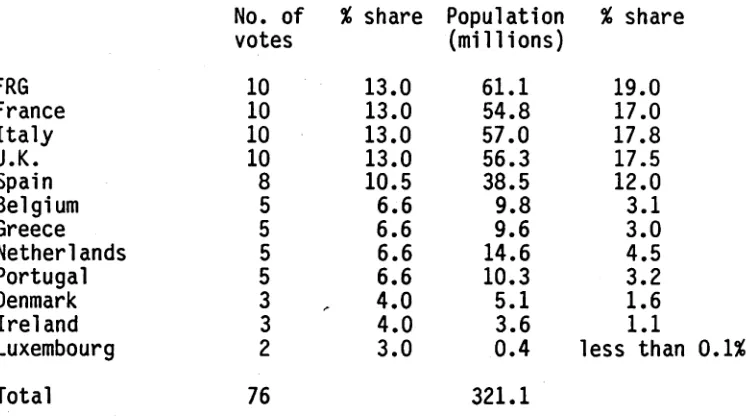
In the Commmunity of 12 the four largest states have 10 votes each in the Council voting process, Spain has 8 votes, Belgium, Greece, the Netherlands and Portugal 5 votes each, Denmark and
7
Ireland 3 votes each and Luxembourg 2 votes. As shown in Table IV.1, the distribution of votes over-represents the smaller states of the EC in terms of population. If other measures such as GNP or surface area are brought into the comparison, the weight given to the small countries' votes is even more disproportionate.
Twenty-three of the total of 76 votes are able to form a blocking minority under the distribution of votes operating since the 1986 enlargement of the Community. This means that the Mediterranean states, or a grouping which excludes all the large states, can easily form a blocking minority and prevent the accep tance of Commission proposals.
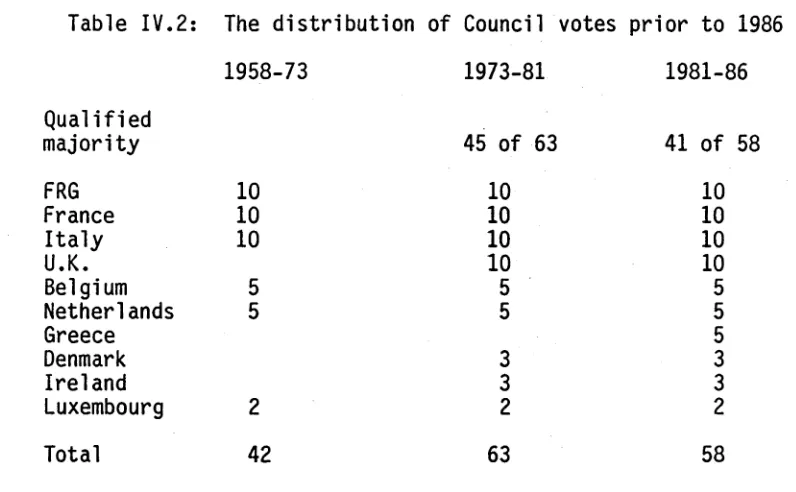
was the only small s t a t e , with Belgium and the Netherlands being medium sized powers. The f i r s t enlargement of the Community changed t h i s s i t u a t i o n , bringing in Ireland and Denmark as well as the UK. The second enlargement and the entry of Greece strengthened the trend towards grea ter power being concentrated in the small st a te s through t h e i r a b i l i t y to form a blocking minority or to a s s i s t one of the large powers to form one.
Table IV.1 The Distribution of Votes in the EC Council from 1986 (54 out of 76, i . e . 71 per cent, are needed to approve a Commission proposal)
No. of % share Population % share
votes (mi 1 lions)
FRG 10 13.0 61.1 19.0
France 10 13.0 54.8 17.0
I t a l y 10 13.0 57.0 17.8
U.K. 10 13.0 56.3 17.5
Spain 8 10.5 38.5 12.0
Belgium 5 6.6 9.8 3.1
Greece 5 6.6 9.6 3.0
Netherlands 5 6.6 14.6 4.5
Portugal 5 6.6 10.3 3.2
Denmark 3 4.0 5.1 1.6
Ireland 3 4.0 3.6 1.1
Luxembourg 2 3.0 0.4 less than
Total 76 321.1
Note: percentages may not add to 100 due to rounding
Source: Commission of the European Communities The I n s t i t u t i o n s of the European Community, European File 11/86, Brussels, June/July 1986, p. 5, and EUR 12: diagrams of the enlarged Community,
European Fi le 5-6/86, Brussels, March 1986, p. 6
[image:39.558.118.491.348.558.2]and produced a s u b s t a n t i a l l y smaller percentage of i t s GDP.
Table IV.2: The d i s t r i b u t i o n of Council votes pr io r to 1986
1958-73 1973-81 1981-86
Qualified
majority 45 of 63 41 of 58
FRG 10 10 10
France 10 10 10
I t a l y 10 10 10
U.K. 10 10
Belgium 5 5 5
Netherlands Greece
5 5 5
5
Denmark 3 3
Ireland 3 3
Luxembourg 2 2 2
Total 42 63 58
Source: Commission of the European Communities 'Working Together: the i n s t i t u t i o n s of the European Community', Brussels, November 1981, p. 4, and Stanley Henig 'Power and Decision in Europe', Euro p o t e n t i a l s Press, London, 1980, p. 25
[image:40.558.96.494.151.397.2]necessary, fo r example in the acceptance o f unaltered Commission
proposals. The e xte n t to which unanim ity has been required fo r the
decisions of the C ouncil, and changes in t h is , have to some extent
re fle c te d the d i f f i c u l t i e s and obstacles in the Community's path
towards supranational ism. The ne g o tia to rs o f the Treaty o f Rome had
agreed th a t p ro g re s s iv e ly during the tr a n s itio n p e riod , and gener
a lly when th is period had ended, decisions which implemented the
broad lin e o f p o lic y already established under the Treaty might be 9
taken by a q u a lifie d m a jo rity vote. The tr a n s itio n period was to
c o n s is t o f three stages, w ith a v a rie ty o f decisions being subject
to unanim ity p r io r to the t h ir d stage, but being taken by a
qual-10
if ie d m a jo rity vote once the t h ir d stage had commenced.
A number o f safeguards were agreed upon, namely th a t the
Council could o n ly act by means o f a q u a lifie d m a jo rity when i t was
a ctin g on a proposal put forward by the Commission; th a t the
q u a lifie d m a jo rity had ( fo r the Six) to include the votes of at
le a s t fo u r members; and t h ir d ly , the Council could not amend a
11
Commission proposal except by unanimous a c tio n .
In 1961 the French refused to regard the f i r s t stage o f the
tr a n s itio n period as completed unless fa r-re a c h in g decisions were
taken to give f u l l e ffe c t to the a g ric u ltu ra l p o lic y . The FRG was
forced to make s u b s ta n tia l concessions in the a g ric u ltu ra l
12
sphere, the d e ta ils of which are discussed in chapter V. In
January 1962 the French declared themselves s a tis fie d and agreed to
pass on to the second stage o f tr a n s itio n .
progressed to m a jo rity voting on a wider range of issues in the 13
Council of M in isters from 1 January 1966. This development was prevented by the c r is is of de G aulle's 'empty c h a ir' p o lic y , when the French withdrew from EC in s titu tio n s from 30 June 1965 to the end of the year and boycotted the Community's intergovernmental
14 in s titu tio n s .
15
As Henig notes, the s itu a tio n which led to the 1966 Luxem bourg agreement was more complicated than th a t of one member state blocking the development of s u p ra n a tio n a lity . The dispute involved a g ric u ltu ra l p o lic y , in d u s tria l p o lic y , and moves towards supra national i t y , as well as the issue of m a jo rity voting in the Coun c i l . While the FRG wanted the completion of the common customs union to proceed in step with the introduction of common cereal prices on July 1 1967, the French f e l t th a t such a date was
prem-16 ature fo r the f in a l 10 per cent reduction in t a r i f f s .
The c r is is was p re c ip ita te d by the Commission's presentation of proposals fo r the financing of the CAP fo r the period 1965-70,
17 which included:
i . an acceleration of the re a lis a tio n of the common market fo r a g ric u ltu ra l and in d u s tria l products;
i i . providing the Community with it s own funds from 1 July 1967, in place of the budgetary contributions made by the member states; i i i . strengthening the budgetary powers of both the European Parliament and the Commission.
delegation considers th at where very important i n t e r e s t s are at stake the discussion must be continued u n t il unanimous agreement is
18
r e a ch e d .1 The consequence was t h a t the move to implement major-19 voting in the Council had been postponed i n d e f i n i t e l y . George suggests t h a t t h i s was perhaps de Gaulle's ob jective throughout the episode, given t h a t majority voting represented a much greater t h r ea t to national control than the proposed increase in the budg etary powers of the European Parliament.
Since then member s t a te s have been able to use the veto, or r ath er the t h r e a t of i t , where they were able to claim t h a t v ital national i n t e r e s t s were at stake, hence blocking l e g i s l a t i o n they did not agree with or securing 's id e payments' to themselves in return for agreement. The veto, or r a t h e r the t h r e a t of i t s use, has on a number of occasions led to reform measures for ag ric ult ur e being foregone. However, invocation of the Luxembourg compromise has not always succeeded. In 1982 the B r i t i s h Government opposed the price increases for ag ri c u lt u r al products from 1982-83 which the other Member States has agreed upon. When v i t a l national i n t e re st was invoked, namely budgetary c os t, the ch ai r (supported by
20 the Commission) overruled the attempted veto.
One intended outcome of the adoption of the Single European Act in 1985 is the greater use of majority voting in the Council. As
21