
Figures and figure supplements
Structural mapping of oligomeric intermediates in an amyloid assembly pathway
Theodoros K Karamanos
et al
Figure 1.Dependence of the fibril elongation rate on the concentration of soluble protein. Seeded elongation assays for (a) hb2m at pH 2.0 monitored
by ThT fluorescence. 20mM of preformed seeds of hb2m (formed at pH 2.0) and varying amounts of soluble protein were added, as indicated in the
key. Note that the protein does not aggregate under these conditions in the absence of seeds on this timescale (Xue et al., 2008). The dashed line shows the initial rate of each reaction. (b) The initial rate of fibril elongation (shown in units of ThT fluorescence (a.u.)/h) versus the concentration of hb2m added. The dashed line represents a prediction using a monomer addition model (seeTable 4). (c) Seeded elongation assays forDN6 using 20
mM preformed seeds formed fromDN6 at pH 6.2 as a function of the concentration of solubleDN6 added. Open blue symbols denote the ThT fluorescence signal of 500mMDN6 in the absence of seeds. The dashed line shows the initial rate of each reaction. (d) The initial rate of fibril elongation (shown in units of ThT fluorescence (a.u)/h) versus the concentration of solubleDN6 added. The dashed line shows the dependence of the elongation rate (in units of ThT fluorescence (a.u)/h) on the concentration of monomer assuming a monomer addition model (seeTable 4). The elongation rate for monomer addition shows a hyperbolic behavior as a function of monomer concentration, with a linear dependence at lower monomer concentrations, followed by a saturation phase at higher monomer concentrations. The simulation in (b) (dashed line) uses a slower
microscopic elongation rate (ke) (Table 4) than that used in panel (d) and therefore saturation is not achieved by 410mM protein in (b), but is in (d). Five
replicates are shown for each protein concentration. Error bars show the standard deviation between all replicates.
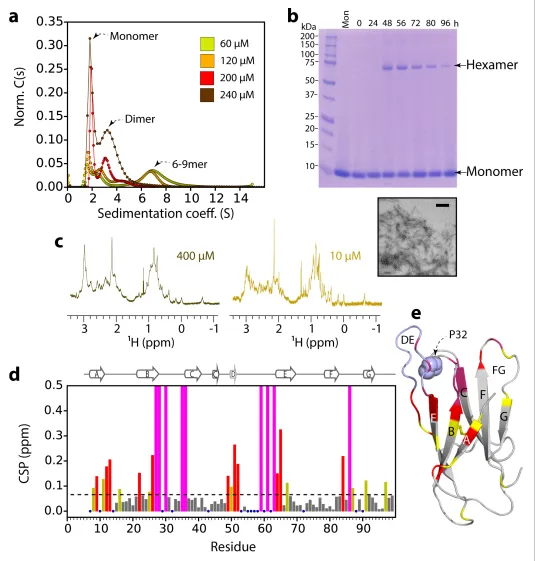
Figure 2.DN6 oligomer formation. (a) Sedimentation velocity AUC ofDN6 at different concentrations, as indicated by the key. Note that the higher order species decrease in intensity at high protein concentrations (>200mM) consistent with the formation of large aggregates that sediment rapidly before detection (see alsoFigure 2—figure supplement 1d). (b) SDS–PAGE of cross-linkedDN6 (80mM) at different time-points during de novo fibril assembly in the absence of fibril seeds (see Materials and methods). Note that dimers are not observed, presumably as they are not resilient to the vigorous agitation conditions used to accelerate fibril formation in these unseeded reactions, or are not efficiently cross-linked by EDC under the conditions used (see Materials and methods). A negative stain electron micrograph ofDN6 after 100 hr of incubation is shown below. Scale bar – 500
Figure 2 continued on next page
Figure 2 continued
nm. (c) The methyl region of the1H NMR spectrum ofDN6 at 400mM (left) or 10mMDN6 (right). (d) Per residue combined1H-15N chemical shift
differences between the1H-15N HSQC spectrum ofDN6 at 10mM and 400mM. Blue dots represent residues for which assignments are missing in both spectra. The dashed line represents one standard deviation (s) of chemical shifts across the entire dataset. Residues that show chemical shift
differences > 1sare shown in yellow,>2sare colored red, and residues for which the chemical shift difference is not significant (<1s) are colored gray. Residues that are broadened beyond detection in the spectrum obtained at 400mM are colored in magenta (see alsoFigure 2—figure supplement 2a). Residues are numbered according to the sequence of the WT protein. Arg 97 is hydrogen bonded to residues in the N-terminus and presumably is indirectly affected by the interaction. (e) The structure ofDN6 (2XKU;Eichner et al., 2011) colored in the same scheme as (d). Pro32 is shown in blue space-fill. The buffer used in all experiments was 10 mM sodium phosphate pH 6.2 containing 83.3 mM NaCl (to maintain a constant ionic strength of 100 mM for all experiments), 25
˚
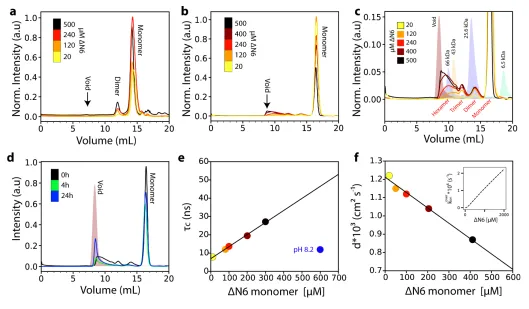
C.Figure 2—figure supplement 1.Analysis ofDN6 oligomerization. (a) Analytical SEC traces of uncross-linkedDN6 at different concentrations as indicated in the key. (b) Analytical SEC traces of cross-linkedDN6. (c) Zoom-in of the SEC traces shown in (b). The elution profile of protein standards is shaded in the background. (d) Analytical SEC traces of 500mMDN6 0 hr (black), 4 hr (green) or 24 hr (blue) after cross-linking was performed. (e) Protein correlation times (tc) measured using a1H-TRACT experiment (see Materials and methods) as a function ofDN6 concentration at pH 6.2, colored as in
(b). The black line represents a linear fit to the data. The correlation time of 600mMDN6 at pH 8.2 is shown in blue. (f) The exponential decay rate (d) of the1H NMR signal in a diffusion measurement using stimulated echoes as a function ofDN6 concentration. The black line represents a linear fit to the
data. The linear scaling oftcand d is predicted from the linear dependence of the overall assembly rate koverononDN6 concentration using the
calculated Kds and a monomer-dimer-hexamer model (inset) (see Materials and methods). Data points are colored as in (b). Error bars in (e) and (f) are
calculated from the noise level of the spectra and are smaller than the marker points.
DOI: https://doi.org/10.7554/eLife.46574.004
Figure 2—figure supplement 2 continued
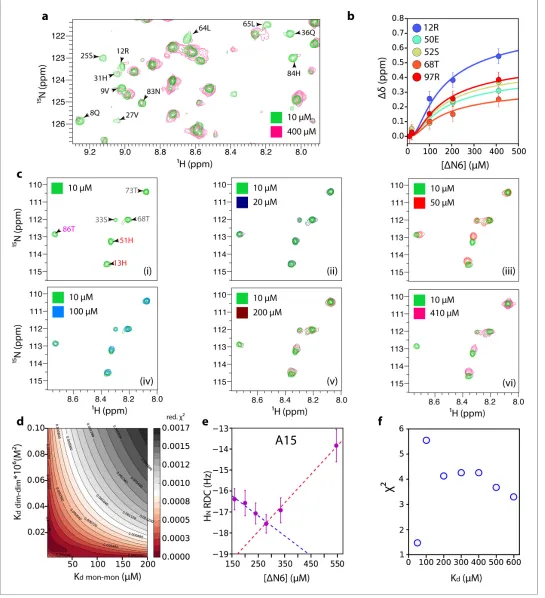
dimer formation). The solid lines represent fits to a monomer-dimer-hexamer model using a dimer Kdof 50mM and a hexamer Kdof 1010 9M2(see Materials and methods). Error bars represent the standard deviation of the resonances that do not show significant chemical shift changes between 10 and 410mMDN6. Data were acquired at 25
˚
C in 10 mM sodium phosphate pH 6.2 containing 83.3 mM NaCl (total ionic strength of 100 mM). (c)1H-15NHSQC spectra of 10mM (panel i), 20mM (panel ii), 50mM (panel iii), 100mM (panel iv), 200mM (panel v) or 410mM (panel vi)DN6. Residues are labeled in panel (i) according to the color scheme ofFigure 2d. (d) Reducedc(Benilova et al., 2012) surface produced by fits to the monomer-dimer-hexamer model using the 10 residues (11, 12, 23, 26, 50, 51, 52, 67, 68, 97) that showed the largest chemical shift changes. (e) HNRDCs as a function of theDN6
concentration (a single example for A15 is shown for clarity). (f) Reducedc(Benilova et al., 2012) values for the fitting of RDC data over the 41 residues measured to the structure ofDN6 as a function of the Kdvalue used to extrapolate the RDCs to 100% dimer (see Materials and methods). Error bars
were calculated from the noise level of the experiment.
DOI: https://doi.org/10.7554/eLife.46574.005
Figure 3.Identification of interacting surfaces inDN6 dimers. Intermolecular PRE data for the self-association ofDN6.15N-DN6 (60mM) was mixed with
an equal concentration of (a)14N-(S33C)DN6-MTSL; (b)14N-(L54C)DN6-MTSL; (c)14N-(S61C)DN6-MTSL; or (d)14N-(S20C)DN6-MTSL in 10 mM sodium phosphate buffer, pH 6.2 containing 83.3 mM NaCl (a total ionic strength of 100 mM). The resultingG2rates are color-coded according to the
amplitude of the PRE effect (see scale bar: gray-insignificant (<20 s 1), yellow->20 s 1, red->50 s 1, pH 6.2, 25
˚
C). Blue dots in the plots are residues for which resonances are not assigned (na) at pH 6.2. Red crosses indicate high HN-G2rates for which an accurate value could not be determined. Controlexperiments showed that the small PREs arising from14N-(S20C)DN6-MTSL arise from non-specific interactions with MTSL itself. Solid black lines depict fits to the PRE data for the dimer structure shown inFigure 4a. Note the poor fits for some residues which are sensitive to hexamer formation (14% of DN6 molecules) under the conditions used. Residues are numbered according to the WT sequence and the position ofb-strands (2XKU;Eichner et al., 2011) is marked above each plot. (e) The structure ofDN6 (2XKU;Eichner et al., 2011) with the BC loop shown in magenta, the DE loop in green and the FG loop in yellow. The MTSL attachment sites are highlighted as spheres.
Figure 3—figure supplement 1.Lack of a hexamer population precludes aggregation ofDN6 at pH 8.2. (a) Aggregation assays for 60mMDN6 monitored by ThT fluorescence at pH 6.2 (red) or pH 8.2 (blue), 37
˚
C with agitation (600 rpm). Five replicates are shown. Negative stain transmission electron micrographs of samples at 100 hr are shown alongside in the same color code. (b) Sedimentation velocity AUC traces for 120mMDN6 at pH 6.2 (red) or pH 8.2 (blue). (c,d) Intermolecular PRE values forDN6 at pH 8.2. 60mM15N-DN6 was mixed with (c) 60mM of14N-(S61C)DN6-MTSL or (d) 60 mM of14N-(S20C)DM6-MTSL in 10 mM sodium phosphate buffer, pH 8.2 containing 86.6 mM NaCl (total ionic strength 100 mM).G2rates are
color-coded according to their amplitude (blue-not assigned, gray-insignificant (<20 s 1), yellow->20 s-1, red->50 s 1at pH 8.2, 25
˚
C). Residues are numbered according to the WT sequence. The position ofb-strands (from 2XKU;Eichner et al., 2011) is marked above each plot.DOI: https://doi.org/10.7554/eLife.46574.007
Figure 3—figure supplement 2.Mapping the interface ofDN6 self-association at pH 8.2 using CPMG experiments.15N Relaxation dispersion CPMG
data for residues (a) V49, (b) E74 and (c) Y78 at 1200mM (blue) or 600mMDN6 (red). Solid lines represent fits to a fast exchange model (see
Materials and methods). (d) Plots of Rex(defined as R2,eff50Hz- R2,eff680Hz) per residue at different concentrations ofDN6 at pH 8.2 as indicated in the key.
The dashed line represents one standard deviation of the mean. (e) Correlation plot of HNRDCs measured at pH 6.2 versus those back-calculated from
the structure ofDN6 (2XKU;Eichner et al., 2011;Eisenberg et al., 1984) at pH 7.5. (f) The structure ofDN6 monomers (2XKU;Eichner et al., 2011) colored according the amplitude of the Rexvalues at 1200mM shown in (d). The results show that the interface between interacting monomers at pH 8.2
involves interaction betweenb-sheets mediated by residues in the B, D and Eb-strands and adjacent residues in the DE loop. This interface is very different to the loop-loop interactions that create the dimer interface at pH 6.2 (seeFigure 3e).
Figure 4.Structural models ofDN6 dimers. Structural models of (a) the lowest energyDN6 homodimer (dimer A) and (b) theDN6-mb2m heterodimer
that inhibitsDN6 fibril assembly (Karamanos et al., 2014). Interface residues (identified as those residues that have any pair of atoms closer than 5 A˚)
Figure 4 continued on next page
Figure 4 continued
are shown in a ball and stick representation on one subunit and are colored in space fill in gold in (a) or red in (b) on the surface of the second subunit. DN6 is shown in the same pose (blue) in (a) and (b). The BC, DE and FG loops are shown in magenta, green and yellow, respectively, and the position of attachment of MTSL for the PRE experiments (residues 20, 33, 54 and 61) is highlighted in spheres. PDB files are publicly available from the University of Leeds depository (https://doi.org/10.5518/329). See alsoVideo 1.
Figure 4—figure supplement 1.AlternativeDN6 dimer structures. Intermolecular PRE data for the self-association of15N-DN6 (60mM) mixed with 60
mM of (a)14N-(S33C)DN6-MTSL, (b)14N-(L54C)DN6-MTSL, (c)14N-(S61C)DN6-MTSL, or (d)14N-(S20C)DN6-MTSL) with the PRE effect color-coded
according to its amplitude (blue dot- residues not assigned, gray-insignificant (<20 s 1), yellow->20 s 1, red->50 s 1, pH 6.2, 25
˚
C). Red crosses indicate high HN-G2rates for which an accurate value could not be determined. Solid black lines represent back-calculated PREs from the high energy dimer Figure 4—figure supplement 1 continued on next pageFigure 4—figure supplement 1 continued
structure shown in (e) and (f). The small PREs arising from14N-(S20C)DN6-MTSL result from non-specific interactions with MTSL itself. (e and f) The
structural model of dimer B shown in different orientations. In each diagram, one subunit is shown in cartoon representation (BC loop (magenta), DE loop (green) and FG loop (yellow)) and the second is shown as a surface. Interface residues are highlighted as balls and sticks on the first subunit and shown in gold space-fill on the second subunit. The MTSL attachment sites are highlighted as spheres and the positions of attachment (20, 33, 54 or 61) are labeled. The interface in dimer B involves a more extensive inter-subunit interface in the apical loops than observed in dimer A (Figure 4a). The resulting interface for dimer B does not describe the PRE data (solid black line) as well as the lower energy model of dimer A shown inFigure 4a
(Materials and methods andTable 1).
Figure 5.Structural model ofDN6 hexamers. (a–c) Sphere representations of the hexamer model formed from dimer A rotated by 90
˚
in each view. Subunits belonging to the same dimer are colored in different tones of the same color. (d) The monomer-monomer (intra-dimer) interface is highlighted in green on the surface of the dimer formed from subunits 1a and 1b (within dimer A), with the other dimers shown as cartoons. (e) The inter-dimerFigure 5 continued on next page
Figure 5 continued
interface is colored red on the surface of the dimer formed from subunits 1a and 1b, with the dimers shown as cartoons. (f) As in (e), but showing the dimer formed from subunits 1a and 1b, superposed with the mb2m subunit in the inhibitoryDN6-mb2m dimer (Karamanos et al., 2014) (green
cartoon). TheDN6-DN6 andDN6-mb2m dimers were aligned on theDN6 subunit 1b. Schematics of the assemblies are shown at the bottom colored as
in (d–f). Note that the BC, DE and FG loops are highlighted as thicker chains in blue, green and cyan, respectively, in d-f. PDB files are publicly available from the University of Leeds depository (https://doi.org/10.5518/329). See alsoVideo 2.
Figure 5—figure supplement 1.Intermolecular PREs at highDN6 concentration. Intermolecular PRE data for the self-association of (a) 240mM15N-D N6 mixed with 80mM14N-(L54C)DN6-MTSL, (b) 200mM15N-DN6 mixed with 200mM14N-(L54C)DN6-MTSL, or (c) 80mM 15N-DN6 mixed with 240mM 14N-(S33C)DN6-MTSL. PRE data are color-coded according to their amplitude (blue dots-not assigned, gray-insignificant (<20 s 1), yellow->20 s 1,
red->50 s 1, pH 6.2, 25
˚
C). Red crosses indicate high HN-G2rates for which an accurate value could not be determined. (d) Raw PRE data for residue 85Vwhen 60mM14N-(L54C)DN6-MTSL was mixed with 60mM15N-DN6 (left) or when 200mM14N-(L54C)DN6-MTSL was mixed with 200mM15N-DN6 (right).
Solid lines represent single exponential fits for the paramagnetic (black) or the diamagnetic samples (red).
DOI: https://doi.org/10.7554/eLife.46574.014
Figure 5—figure supplement 2.Additional interfaces do not form in theDN6 hexamer.15N relaxation dispersion CPMG data for residues (a) 37, (b) 67, and (c) 83 at 180mMDN6 (26%DN6 molecules are monomers, 48% are in dimers, 26% are in hexamers) (red) or 480mMDN6 (13%DN6 molecules are monomers, 32% are in dimers, 55% are in hexamers) (black). Solid lines represent fits to the fast exchange model, yielding values of kexbindof
1790±290 s 1at 180mMDN6 and k
exbindof 1170±196 s 1at 480mMDN6 (see Materials and methods). (d) Plots of Rexper residue defined as R2,eff50Hz
- R2,eff680Hz. The dashed line represents one standard deviation of the mean calculated for all data points. Residues are numbered according to the WT
sequence. Significant CPMG profiles are observed for residues in the N-terminus, A strand, BC, DE and FG loops, in excellent agreement with the intermolecular PRE data shown at 120mM and 320mMDN6 inFigure 3andFigure 5—figure supplement 1. Residues which are severely broadened at 480mM, thereby precluding accurate determination of their Rexvalues, are shown as black crosses. Crucially, when the protein concentration was
increased the residues which show significant CPMG profiles are unchanged suggesting that the dimers and hexamers share a similar interface. (e) The structure ofDN6 (2XKU;Eichner et al., 2011) colored according to the Rexamplitude as indicated in the scale bar.TransPro32 is shown in space-fill
(pale blue).
Figure 5—figure supplement 3.Initial docking of dimer structures to create hexamer models. Plots of RMSD (to the lowest energy structure) versus total energy for hexamers generated by docking of (a) the lowest energy dimer structure (dimer A) or (b) the higher energy dimer (dimer B). The 50 lowest energy hexamer structures are marked as red circles. The hexamers that were selected for the next round of structure calculation for each dimer starting model are marked with green arrows. The structural model of dimer A and dimer B are shown alongside colored as inFigure 4—figure supplement 1.
DOI: https://doi.org/10.7554/eLife.46574.016
Figure 5—figure supplement 4.Intermolecular PREs back-calculated from the hexamer structural model generated from dimer A. Intermolecular PRE data for the self-association ofDN6.15N-DN6 (60mM) was mixed with 60mM of (a)14N-(S33C)DN6-MTSL, (b)14N-(L54C)DN6-MTSL, (c)14
N-(S61C)DN6-MTSL, or (d)14N-(S20C)DN6-MTSL. The data are color-coded according to their amplitude (blue dots-not assigned, gray-insignificant (<20 s 1),
yellow->20 s 1, red->50 s 1, pH 6.2, 25
˚
C). Red crosses indicate high HN-G2rates for which an accurate value could not be determined. Solid black linesrepresent back-calculated PREs from the lowest energy hexamer structure (arising from dimer A) shown inFigure 5. The RMS distances (A˚) between the intermolecular distances that were used as restraints and those back-calculated from the hexamer structural model are shown (inset) for each dataset (see Materials and methods).
Figure 5—figure supplement 5.Conformational and biochemical properties ofDN6 hexamers. (a) ESI-IMS-MS analysis. Collision cross section (CCS) distributions for each observed charge state of hexamericDN6. The charge state for each CCS distribution is indicated. Note that the CCS of the lowest (most native;Vahidi et al., 2013) charge state (15+) is consistent with the hexamer model generated from dimer A (labeled A (green)), but not the models generated from dimer B (labeled (B(i)), (B(ii)) and (B(iii)) for the three conformers labeled inFigure 5—figure supplement 3b). (b) Hydrophobicity of the hexamer interface. The surface of dimer one in the hexamer is colored according to the Eisenberg hydrophobicity scale (Arg = 2.53, Ile = 1.38) (Eisenberg et al., 1984) with the other dimers shown as cartoons. A key is show alongside. The view on the left-hand side shows the surface that is packed against dimers 2 and 3 in the hexamer (interior), with the view on the right-hand side showing the exterior surface of the assembly. (c, d) Fluorescence emission spectra of ANS (200mM) incubated with (c)DN6 monomers (green), (d) dimers (open symbols) or hexamers (red) (eluting at 17 mL, 15 mL and 11 mL, respectively obtained with/without cross-linking, as indicated, using SEC;Figure 5—figure supplement 6). The fluorescence emission spectrum of ANS in buffer alone is shown in blue. ANS bound to the partially folded Im7 variant L53A I54A (Spence et al., 2004) (1mM) is shown for comparison (black). This was used as a model for a compact native-like folding intermediate (Spence et al., 2004) (see text).
DOI: https://doi.org/10.7554/eLife.46574.018
Figure 5—figure supplement 6 continued
generation of reactive oxygen species (ROS), and LDH release assays. For assays of MTT reduction, ATP levels and ROS production, the data are normalized to PBS (100%) and NaN3-treated controls (0%). LDH release is normalized to detergent lysed cells (100%) and PBS buffer treated controls
(0%). The error bars represent mean S.E, * p 0.05. No evidence for cytotoxicity was observed for any protein species under the conditions employed.
DOI: https://doi.org/10.7554/eLife.46574.019
Figure 6 continued
and 51 report on intermolecular interactions that describe dimer and/or hexamer formation (schematic, top left), while residues 89 and 92 do not lie in an interface and report instead in the dynamics of the G strand in the different assemblies formed. The position of all five residues used in the cluster analysis of G strand dynamics is shown in spheres on the structure ofDN6 (blue cartoon, top right). Pro32 is shown as a magenta sphere. Solid lines represent global fits to the Bloch-McConnell equations (Materials and methods) for each cluster of residues. The extracted parameters of the global fit for the two processes (kexbindand kexG) are indicated above the plots.
DOI: https://doi.org/10.7554/eLife.46574.023
Figure 6—figure supplement 1.Hexamer formation increases the dynamics of the G strand. (a) Location of the G strand in relation to the dimer and hexamer interfaces. Dimer one in the hexamer is shown in a cartoon representation while dimers 2 and 3 are shown as semi-transparent surfaces. The positions of the amide protons for residues 87, 89, 91, 92 are shown as gray spheres and the residues that take part in both the dimer and hexamer interfaces are shown as red spheres on the structure of dimer 1. A schematic of the assembly is shown alongside.15N relaxation dispersion CPMG data
for residues (b) 87, (c) 89, (d) 91 and (e) 92 at 950 MHz (red) and 750 MHz (magenta) of 180mMDN6, pH 6.2. Solid lines represent the global fits to all residues in the cluster to the slow exchange model which yields a kexGof 205±150 s 1. CPMG data for the same residues (f) 87, (g) 89, (h) 91 and (i) 92
at 750 MHz (blue) and 600 MHz (gray) using 480mMDN6. Solid lines represent global fits to the fast exchange model which yields a kexGof 1170±196
s 1.
Figure 7.The monomer-dimer-hexamer model describes the thermodynamics and kinetics of fibril elongation. (a) Global fits (blue solid lines) to the fibril elongation kinetics monitored by ThT fluorescence assuming a hexamer addition model at different concentrations of solubleDN6 (dots) (Materials and methods andTable 4). The concentrations ofDN6 are colored according to the key. The average of five replicates is shown. (b) Protein correlation times (tc) measured using NMR (red) and back-calculated values (green) using the populations of monomers, dimers and hexamers
predicted from the monomer-dimer-hexamer model and the correlation times of the dimers and hexamer structural models shown inFigures 4and
5. (c) The fibril yield (after 100 hr) of each elongation reaction. SDS-PAGE analysis of the whole reaction (shown in (a)) before centrifugation (W) or of the supernatant (S/N) after centrifugation at the different concentrations ofDN6, as indicated. (d) Bar-charts showing the % of insoluble material (gray) measured using densitometry of the gel shown in (c). The % hexamer population in the absence of seeds (black) predicted by the monomer-dimer-hexamer model at eachDN6 concentration correlates with the % insoluble material (gray). Note that the fibril yield is low since fibrils cannot form when the monomer concentration falls significantly below the Kdfor dimer formation (50mM).
DOI: https://doi.org/10.7554/eLife.46574.025
Figure 7—figure supplement 1.Alternative kinetic models do not describe the kinetics of seeded fibril growth. Global fits (blue solid lines) which assume that (a) a monomer, (b) a monomer excited state, or (c) a dimer, add to the fibril ends do not describe the observed fibril growth kinetics monitored using ThT fluorescence at different concentrations of solubleDN6 (dotted lines and key). A more complex monomer-dimer-tetramer-hexamer model (d) does not improve the quality of the fit compared with that shown inFigure 7a.
Figure 8.Fibril formation in atomic detail. Schematic representation of the mechanism of amyloid formation forDN6. During folding of hb2m, a highly
dynamic intermediate with a flexible A strand is populated prior to formation of the native-like intermediate termed IT, which has a native-like fold but
contains a non-nativetransX-Pro32 bond. The latter species is mimicked byDN6 and formed in vivo by proteolytic degradation of the WT protein (Bellotti et al., 1998). Only IT/DN6 is primed for aggregation, while the intermediate with the flexible A strand is not able to assembly directly into
amyloid (Karamanos et al., 2016). As reported here,DN6 forms elongated head-to-head dimers (upper image, center) which assemble into hexamers. Alternative dimers involving interactions between the ABEDb-sheets in adjacent molecules formed at pH 8.2 (lower image, center) do not associate further into fibrils. Murineb2m (mb2m) also interacts withDN6 at pH 6.2 to form head-to-head heterodimers. The subunit orientation is different in this
heterodimer (Karamanos et al., 2014), occluding the hexamer interface and inhibiting assembly (central image).DN6 hexamers can elongate fibrillar seeds and show enhanced dynamics in the G strand which could represent the first step towards the major structural reorganization required to form the parallel in-register amyloid fold. How this final step occurs, however, remains to be solved.
DOI: https://doi.org/10.7554/eLife.46574.028
Figure 8—figure supplement 1 continued
be used to determine estimates of Kdwhich in turn can be used to determine conditions under which different species are populated. More detailed
NMR studies lead to structural models of these species, while stabilization of the intermediates by chemical cross-linking aids the assessment of their cytotoxicity. The structural and kinetic information collected leads to the generation of kinetic models whose ability to describe the progress of aggregation monitored by ThT fluorescence is tested using numerical methods. Agreement is suggestive of the validity of the kinetic mechanism of assembly and the identity and structural properties of oligomeric intermediates formed.
DOI: https://doi.org/10.7554/eLife.46574.029
Figure 8—figure supplement 2.Examples of some previously characterized oligomers of WT hb2m andDN6. (a, b) Cu2+-stabilized H13F hb2m
hexamer (Calabrese et al., 2008;Eakin et al., 2004;Calabrese and Miranker, 2007;Antwi et al., 2008). (c) Domain swappedDN6 dimer (Domanska et al., 2011).







![Fisheries and aquaculture in Europe [Newsletter] August 2007 No 35](data:image/gif;base64,R0lGODlhAQABAIAAAP///wAAACH5BAEAAAAALAAAAAABAAEAAAICRAEAOw==)