This is a repository copy of Evaluating a continuous sonic interaction : comparing a
performable acoustic and digital everyday sound.
White Rose Research Online URL for this paper:
http://eprints.whiterose.ac.uk/151269/
Version: Published Version
Proceedings Paper:
Keenan, Fiona orcid.org/0000-0003-2046-9036 and Pauletto, Sandra
orcid.org/0000-0002-9404-851X (2019) Evaluating a continuous sonic interaction :
comparing a performable acoustic and digital everyday sound. In: Barbancho, Isabel,
Tardón, Lorenzo J., Peinado, Alberto and Barbancho, Ana M., (eds.) SMC
2019:Proceedings of the 16th Sound & Music Computing Conference. Sound & Music
Computing Conference, 28-31 May 2019 Proceedings of the Sound and Music Computing
Conferences. . , pp. 127-134.
Reuse
This article is distributed under the terms of the Creative Commons Attribution (CC BY) licence. This licence
allows you to distribute, remix, tweak, and build upon the work, even commercially, as long as you credit the
authors for the original work. More information and the full terms of the licence here:
https://creativecommons.org/licenses/
Takedown
If you consider content in White Rose Research Online to be in breach of UK law, please notify us by
EVALUATING A CONTINUOUS SONIC INTERACTION: COMPARING A
PERFORMABLE ACOUSTIC AND DIGITAL EVERYDAY SOUND
Fiona Keenan Department of Theatre, Film and
Television University of York, UK
Sandra Pauletto Department of Media Technology
and Interaction Design
KTH Royal Institute of Technology, Sweden
ABSTRACT
Thispaperreportsontheprocedureandresultsofan experimenttoevaluateacontinuoussonicinteractionwith aneverydaywind-likesoundcreatedbybothacoustic anddigitalmeans. Theinteractionisfacilitatedby amechanicaltheatresoundeffect, anacousticwind machine,whichisperformedbyparticipants.Thiswork ispartofwiderresearchintothepotentialoftheatre soundeffectdesignsasameanstostudymultisensory feedbackandcontinuoussonicinteractions.Anacoustic windmachineisamechanicaldevicethataffordsasimple rotationalgesturetoaperformer;turningitscrankhandle atvaryingspeedsproducesawind-likesound.Aprototype digital model of a working acoustic wind machine isprogrammed, andtheacousticinterfacedrivesthe digitalmodelinperformance,preservingthesametactile andkinaestheticfeedbackacrossthecontinuoussonic interactions.Participants’performancesareelicitedwith soundstimuliproducedfromsimplegesturalperformances ofthewind-likesounds.Theresultsofthisstudyshowthat theacousticwindmachineisratedassignificantlyeasier toplaythanitsdigitalcounterpart.Acousticalanalysisof thecorpusofparticipants’performancessuggeststhatthe mechanismofthewindmachineinterfacemayplayarole inguidingtheirrotationalgestures.
1.BACKGROUND
Thisevaluationwasconductedaspartofaninvestigation intothesonicinteractivityofhistoricaltheatresound effects, devices created for soundmaking through performanceactions,mechanismsandmaterialsinthe latenineteenthandearlytwentiethcentury.Itisproposed thatasinteractivemechanismsdesignedexplicitlyforthe performanceofeverydaysoundeventssuchasrain,wind andthunder,theatresoundeffectsoffertheopportunity to explore how verysimple hand actionsmight be coupledtotheperformanceofcomplexdigitalsounds inaperceptuallymeaningfulway. Anexaminationof historicalsourcesontheatresoundeffectshasshown thatthesehistoricalinterfaceswerecreatedusingan
Copyright:!c201FionaKeenanetal.Thisisanopen-accessarticledistributed underthetermsoftheCreativeCommonsAttribution3.0UnportedLicense,which
permitsunrestricteduse,distribution,andreproductioninanymedium,provided theoriginalauthorandsourcearecredited.
approach much like Franinovi´c’s proposedenactive sound design [1]. This is a Sonic Interaction Design (SID) strategy that engages with the potential of ergoaudition (listening to self-produced sound) [2] to facilitate learning in a sonic interaction. Sound is produced directly and continuously through a user’s movement, guides their sensorimotor activity and allows them to build on previously accumulated tacit knowledge of action and sound [3, 4]. With no established system of sound notation in use in theatres in the late nineteenth and early twentieth century, sound effects were explicitly designed to facilitate the development of bodily skill in sound performance through a simple process of exploration and rehearsal while listening to self-produced sound.
As simple acoustic interfaces that produce theeffectof a familiar everyday sound [5] in performance, theatre sound effect designs also afford an exploration of the perceptual experience of a continuous sonic interaction, and potentially expressive sound performance, without the need for participants to have a particular level of prior musical experience. This research therefore adapts evaluation methods from previous research into the design of Digital Musical Instruments (DMIs) focused on musical expression [6–8], and applies them to a broader cohort of participants. The evaluation method presented here also positions theatre sound effect designs as a potentially useful means of controlling and comparing specific modes of multisensory feedback in the evaluation of a continuous sonic interaction [9, 10]. To examine how the enactive qualities of specific historical theatre sound effects might be uncovered and then captured in the design of a continuous sonic interaction with a digital sound, this research focused on exploring the experience of a continuous sonic interaction with one acoustic theatre sound effect, and comparing this experience with that afforded by a digital model of its sonic feedback in performance. This work extends the methodology used in prior research in the field of SID, which examined the enactive qualities of Luigi Russolo’sintonarumorifamily of early twentieth century acoustic noise instruments in order to recreate them as digital models [11].
1.1 Interface Design and Synthesis Method
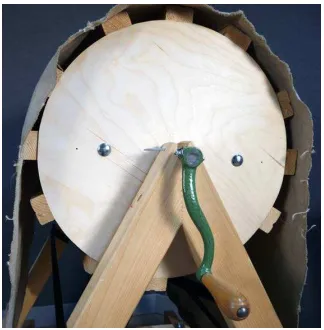
wind machine consists of a wooden slatted cylinder, which is mounted on a central axle and A-frame and covered by a cloth. A crank handle coupled to the axle allows a performer to rotate the cylinder. As the handle is turned, the wooden slats of the cylinder rub and scrape the encompassing cloth, which produces a wind-like sound. (Figure 1). This acoustically modelled everyday sound [5] can have perceivably repetitive and machine-like qualities at slow and regular speeds of rotation, but when activated with a gesture of continuously varying speed the sound becomes more convincing as a wind effect. The cylinder of the wind machine has flywheel qualities, storing rotational energy and resisting changes in rotational speed during a performance with its crank handle. This adds a complex sensation of shifting weight and effort to the very simple rotational gesture.
Following an exploration of its process of sound production, a prototype digital model of this working wind machine was programmed in Max/MSP1. This digital prototype was created using a procedural approach to sound modelling [12]. Rather than designing a performable wind-like sound from a physical model of real-world aeroacoustics [13,14], or a signal-based method using noise and a band-pass filter [12], this prototype aimed to directly model the mechanical wind effect, i.e. the theatre wind machine’s wooden slats and cloth that interact to produce sound. For this reason, the model was based on the rubbing and scraping interaction between each wooden slat and the encompassing cloth of the wind machine during a rotational gesture performed with the crank handle (Figure 2). In this way, the mechanical design of the acoustic wind machine and the physics inherent in its sound production could be explored through the modelling process, a method long in use in musical acoustics [15]. The perceptual experience and potential distinctions between real-world wind sounds and the cloth-based effect of the acoustic wind machine could also be examined, and the primacy of the performer’s gesture in the realism of the wind effect could be transferred more explicitly to the digital prototype.
Twelve instances of the Sound Design Toolkit (SDT) physical model of friction [16] were implemented in Max/MSP to represent each of the twelve slats of the acoustic wind machine and their interaction with the cloth. Some additional dispersion of the resulting friction sound through each side of the cloth was also implemented using a digital waveguide [17]. The acoustic wind machine’s mechanism was fitted with a rotary encoder, some laser-cut gearing and an Arduino2. to capture data from its rotational motion. This allowed the acoustic wind machine’s crank handle to drive the digital model of its sound in performance. The rotary encoder’s data was mapped to each of the twelve digital slat models, which were activated according to the position of the wooden slats on the acoustic wind machine. The rotational data also slightly modulated the delay time to the cloth model to add some of the characteristic whistling of the
1http://cycling74.com/ 2https://www.arduino.cc/
acoustic wind machine at high rotational speeds to its digital counterpart.
Using the acoustic wind machine as a performance interface for the digital model in Max/MSP maintained a consistent tactile and kinaesthetic feedback during a performance of both the acoustic and digital wind-like sounds. It also allowed the acoustic and digital wind-like sounds to be simultaneously activated by the same performance gesture, facilitating an acoustic analysis and comparison of the acoustic and digital sounds that helped develop and calibrate the digital model in Max/MSP. This objective analysis confirmed that the digital model was quite similar to the acoustic wind machine, particularly at slow and regular speeds of rotation. The stages of this work, and the full technical details of the digital model, have been previously described elsewhere [18, 19].
Figure 1. The working acoustic wind machine.
2. EXPERIMENT DESIGN
With the acoustic wind machine producing its own wind-like sound and simultaneously driving its digital counterpart during performance, it was possible to design an experimental procedure to evaluate only one modality of the interaction - the sonic feedback itself. The evaluation was focused on exploring whether the continuous sonic interaction with the digital wind-like sound was perceivably ‘similar enough’ to that of its acoustic counterpart. If so, this would confirm that the digital model had captured many of the sonic qualities of the acoustic wind machine, and could be used as a substitute in a future evaluation. If not, the evaluation would help to determine how the digital model of the wind-like sound should be developed further. Comparing the two sonic interactions would also help to discover more about the perceptual experience of performing an everyday sound [5] , and establish a baseline of results against which future evaluations could be compared.
Figure 2. A comparison of approaches to digitally synthesizing a wind sound using A) a physical model of real-world wind [13, 14], B) a signal-based approach [12], and C) this research. The green outline denotes performance data mapping.
results while also collecting some qualitative data in the form of participants’ free descriptions of their experiences of performing the acoustic and digital wind-like sounds. To clearly investigate whether participants might perceive a particular rotational gesture of the crank handle in the acoustic or digital wind-like sound, the experimental design focused on operationalizingthe experience of a continuous sonic interaction with both the acoustic and digital wind-like sounds. This follows prior research in the field of Digital Musical Instrument (DMI) Design, where musical performers were given defined audio cues to imitate, and time to reflect on their performance experiences, when evaluating a new DMI [6]. This would help to examine whether participants could understand a rotational gesture from the wind-like sounds they heard, and then translate this to a performance gesture of their own.
Previous work to acoustically evaluate and compare both wind-like sounds found that the prototype digital model’s response was closer to that of its acoustic counterpart at slower and more regular speeds [19]. As such, this evaluation focused on simple and steady performance gestures. The sounds produced by these gestures were used as stimuli to elicit participants’ performances. Participants were also asked to reflect on how they felt their performances compared to the stimuli.
2.1 Stimuli
Two simple rotational gestures were chosen to serve as stimuli for participants’ performances; a slow, single rotation, and two rotations performed at a moderate and steady speed. These gestures were recorded for both the
acoustic and digital wind-like sounds. Another recording of a natural wind sound consisting of several short gusts of varying speed was chosen from the BBC Sound Effects Library [20] for use in the practice step.
2.2 Apparatus
The evaluation took place in an acoustically treated room at the Department of Theatre, Film and Television at the University of York. A laptop running the python-based Open Sesame experiment platform [21] presented questions and collected data from participants. A second laptop was used to run the prototype digital model in Max/MSP, and an additional computer was set up to deliver the sound stimuli and record participants’ performances using Pro Tools. Both the Max/MSP patch and the Pro Tools session were obscured from participants to ensure they did not receive any additional visual feedback during their performances.
The sound stimuli and live audio of participants’ performances was delivered to them via Pro Tools through a closed-back pair of Sennheiser HD280 Pro headphones. Participants’ performances in response to the sound stimuli were recorded into the same Pro Tools session. The acoustic wind machine was obscured, apart from its crank handle, behind a cardboard screen to ensure that it provided no visual feedback to participants during performance (Figure 3).
Figure 3. The experimental setup with crank handle highlighted.
2.3 Participants
The evaluation was undertaken with 48 participants. Of these, 32 identified themselves as female and 16 as male. 38 participants designated themselves as 18-24, 8 as 25-34, and 2 as 45-54 years old. 13 participants said they did not have experience of playing a musical instrument, 15 played a musical instrument at beginner level, 12 at intermediate level and 8 at advanced level. All participants reported normal hearing and were paid for their participation.
2.4 Procedure
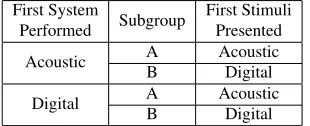
[image:4.595.326.490.392.524.2]digital wind-like sounds in response to all of the stimuli. To avoid order effects, the order of presentation of the acoustic and digital wind-like sounds was randomised. The order of presentation of the sound stimuli was also randomised. This created four groups of twelve participants. Each group had its own order of system performed and stimuli presented (Table 1).
First System
Performed Subgroup
First Stimuli Presented
Acoustic A Acoustic B Digital
Digital A Acoustic B Digital
Table 1. The different orders of system and stimuli for this evaluation.
Participants were presented with the crank handle and advised that they would be able to perform a wind sound by rotating it. They were told that there would be two wind sounds to perform with during this evaluation, and that they would get to perform with both of these sounds, one after the other. No terms such as ‘acoustic’ or ‘digital’ were used to ensure that participants’ responses would not be influenced. Participants were then asked to listen to a wind sound from the group of stimuli played through their headphones, and then try to imitate what they had heard directly afterwards by turning the crank handle. There was a practice step, and then a test step, for both the acoustic and digital wind-like sounds. During each practice step, participants imitated the natural wind sound [20] and answered all of the questions that would be presented during the test step.
Participants were presented with a range of test questions to evaluate their experiences. They were first asked to rate how similar they perceived their own performances to be to the stimuli on a scale of 1(not similar at all) to 7(as similar as they can possibly be). Participants were then asked to rate how far they agreed with the statement “This wind sound is easy to play” on a scale of 1(strongly disagree) to 7(strongly agree).
Next, a list of possible descriptors for the wind-like sound that had been performed was presented, and participants were asked to describe the wind sound they had just played by selecting from these. There was also a space to add a descriptor of their own to this list. Finally, participants were given the opportunity to provide some free description of their experiences of playing each of the wind-like sounds.
3. RESULTS AND ANALYSIS
3.1 Perceived Similarity of Performances to Stimuli
Participants’ ratings of perceived similarity between the sound stimuli and the wind-like sounds they had performed to imitate them were scored with values from 1 to 7. A Kruskal-Wallis test was then performed on the similarity ratings given by the participants across each of the groups
[image:5.595.113.268.184.247.2]according to the order of performance system and the order of presentation of stimuli. This test confirmed that there was no statistically significant difference between the ratings given according to the experimental condition, confirming that no order effects had influenced the ratings (Table 2).
Test: Kruskal-Wallis Significance Effect Size Acoustic similarity
H(3) = 6.36
p>0.05
not significant
-0.12 (small) power = 0.8 Digital similarity
H(3) = 3.04
p>0.05
not significant
0.0 (no effect) power = 0.8
Table 2. Results of the statistical testing to confirm no order effects influenced the similarity ratings for the acoustic or digital wind-like sounds.
A summary of the similarity ratings showed that, while there was a range of scores for each of the interactions, the acoustic wind machine performances had a higher mean rating for similarity to the stimuli presented than the prototype digital wind machine performances (Table 3).
Sound Played Mean SD Median Acoustic 4.88 1.66 5.5
[image:5.595.331.484.346.380.2]Digital 2.77 1.51 2.5
Table 3. Summary of ratings for the acoustic and digital wind-like sounds’ similarity to the stimuli.
[image:5.595.320.498.528.571.2]A Wilcoxon signed rank test was then performed on these similarity ratings, which confirmed that there was a statistically significant difference between the ratings given to the acoustic wind machine performances and the performances with its digital counterpart (Table 4). Participants therefore rated the similarity of the wind machine performances to the stimuli significantly differently depending on whether they were performing an acoustic or digital wind-like sound.
Test: Wilcoxon
Signed-Rank Significance Effect Size
Z = -5.40 p<0.01 -0.78 (large)
power = 0.8
Table 4. Results of the statistical testing of participants’ similarity ratings.
3.2 Perceived Easiness of Play
the ratings given according to each experimental condition, confirming that no order effects had influenced the results (Table 5).
Test: Kruskal-Wallis Significance Effect Size Acoustic similarity
H(3) = 5.36
p>0.05
not significant
0.03 (small) power = 0.8 Digital similarity
H(3) = 1.33
p>0.05
not significant
[image:6.595.113.265.292.324.2]0.0 (no effect) power = 0.8
Table 5. Results of the statistical testing to confirm no order effects influenced the easiness ratings for the acoustic or digital wind-like sounds.
A summary of the easiness ratings showed that the acoustic wind machine had a higher mean rating for ease of play than the prototype digital wind machine (Table 6).
Sound Played Mean SD Median Acoustic 4.98 1.19 5
Digital 3.04 1.41 3
Table 6. Summary of ratings for the acoustic and digital wind-like sounds’ ease of play.
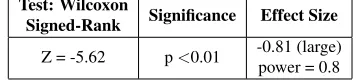
A Wilcoxon signed rank test was then performed on the easiness ratings to statistically compare the results for each wind-like sound. This test confirmed a statistically significant difference between how easy the acoustic and digital wind-like sounds were perceived to play (Table 7). Participants therefore rated the acoustic wind machine as significantly easier to perform with than its digital counterpart.
Test: Wilcoxon
Signed-Rank Significance Effect Size
Z = -5.62 p<0.01 -0.81 (large)
power = 0.8
Table 7. Results of the statistical testing of participants’ easiness ratings.
3.3 Descriptions of Sounds
Participants were then invited to describe the acoustic and digital wind-like sounds by choosing as many descriptors as they liked from a list. These descriptors were associated with a range of categories, including weather (breeze, gale), force (gentle, strong), onomatopoeic descriptions of wind (shrieking, howling), and a historical action-oriented onomatopoeic descriptor (swishing[1]).
Participants’ responses to this question were collated to produce a bar graph in R comparing the frequency of the descriptors given to each wind machine (Figure 4). Participants chose not to add their own descriptors to the list, but instead chose from the descriptors provided.
This showed that the most popular descriptor for both the acoustic and digital wind-like sounds was the
Figure 4. Summary of the descriptors participants assigned to their performances of the acoustic (blue) and digital (red) wind-like sounds.
action-orientedswishing, followed by the force descriptor
strong and the weather-associatedgusty. The acoustic wind machine scored more highly across these three descriptors than its digital counterpart. The digital wind-like sound was described with a fuller spread of adjectives, and was described more often as shrieking
and gale when compared with its acoustic counterpart. This may reflect the fact that participants perceived the digital wind-like sound as having a narrower bandwidth of frequencies than the acoustic wind-like sound in performance.
3.4 Free Descriptions
The free descriptions participants gave of their experiences of performing with the acoustic and digital wind-like sounds were collated and coded. It was evident that participants had acquired some vocabulary from the list of descriptive words previously presented to them, as words likegentle, strong orgustywere included within their free descriptions. Some interesting issues and trends emerged. Participants readily connected the speed of rotation of the handle with what they variously described as the speed, motion, rhythm or pace of the resulting wind-like sound, whether it was acoustic or digital in origin. Some participants reported that the crank handle felt heavier to turn when performing the acoustic wind-like sound. One participant highlighted that they perceived a disconnection between the crank handle movement and the digital wind-like sound. Despite being informed that they would be playing wind sounds with the crank handle, one participant identified the digital wind-like sound as a rain sound in their comments.
3.5 Acoustic Analysis of Performed Sounds
[image:6.595.99.277.463.503.2]wind-like sounds in response to both the acoustic and digital stimuli. These recordings were exported from Pro Tools as audio clips and coded for analysis according to the performance gesture (a single slow rotation or two steady rotations) and the sound being performed (acoustic or digital). The coded audio clips were then analysed in Matlab using the MIR Toolbox [22] to produce numerical measures of the spectrum (brightness, inharmonicity, spectral centroid, spread and skewness) and amplitude envelope (event density - a measure of the frequency of onsets). The resulting numerical values for each feature were then collated together for statistical analysis in R.
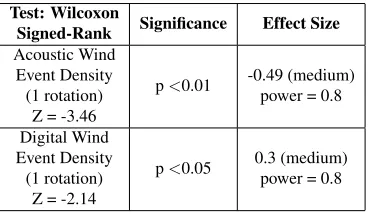
To establish whether the source of the stimulus presented to participants (acoustic or digital) might have influenced their performances, gestures performed with the same system were paired in order to facilitate their statistical comparison. For example, two rotations performed with the acoustic wind machine in response to an acoustic stimulus were compared to two rotations performed with the acoustic wind machine in response to a digital stimulus. A Wilcoxon signed rank test was then performed to compare each acoustic feature of the paired gestures. This testing established that no statistically significant difference existed across the spectral measurements of the performances. For the measures of event density, no statistically significant difference was found between the paired gestures of two steady rotations. However, statistically significant differences were found for measures of event density for a single rotation performed with both the acoustic wind machine and the prototype digital wind machine (Table 8).
This suggests that the gesture of two rotations performed with the acoustic and digital wind-like sound was quite consistent regardless of whether participants had first listened to a stimulus that matched the sound that they were performing. For a single rotation, performances seem to have been more directly influenced by whether the stimulus presented matched the sound of the wind machine being played.
Test: Wilcoxon
Signed-Rank Significance Effect Size Acoustic Wind
Event Density (1 rotation)
Z = -3.46
p<0.01 -0.49 (medium)
power = 0.8
Digital Wind Event Density
(1 rotation) Z = -2.14
p<0.05 0.3 (medium)
[image:7.595.98.283.512.619.2]power = 0.8
Table 8. Results of the statistical testing to compare the acoustical analysis of participants’ performances.
4. DISCUSSION
This evaluation aimed to establish whether there was perceived similarity between the experience of performing
with the acoustic wind machine and that of performing with its digital counterpart. The results established that, while the continuous sonic feedback was the only mode of feedback that changed between these two performance conditions, participants found the acoustic wind machine significantly easier to play and perceived it as sonically similar to the stimuli used to elicit their performances. By contrast, the digital wind-like sound was rated as significantly less easy to play, and participants found their performances with it to be significantly less similar to the stimuli they were trying to imitate. Statistical testing showed that the ratings for similarity and ease of play were significantly different depending on the kind of wind-like sound being rated, and so the results did not allow the null hypothesis to be rejected. These results suggest that the digital model of the acoustic wind machine needs to be developed further. In particular, the easiness ratings for the digital wind-like sounds may reflect the need to improve the model’s response to variations in performance gesture. Participants may have experienced this as an action-sound latency issue, something which previous research has show to be disruptive to musical performance [23].
When asked to choose from a list of descriptors for the acoustic and digital wind-like sounds, participants preferred the action-based descriptor swishing for both sounds, and were more confident in categorising the acoustic wind machine (as gusty, strong andswishing). Some interesting information emerged from participants’ free description of their performances, in particular that the change in sonic feedback from an acoustic to digital sound might have influenced how the physical properties of the acoustic wind machine were experienced. This concurs with previous research showing that auditory cues can influence the perception of haptics and movement [24–26]. This aspect of the change in sonic feedback from an acoustic to digital wind-like sound could be explored further in a future evaluation.
Acoustical analysis of the corpus of wind sounds produced from recordings of participants’ performances established that there was no statistically significant difference in the acoustical measurements of sounds performed in response to a stimulus that matched the wind-like sound being played when compared with performances responding to an unmatched stimulus. The exception to this finding was the measurement of event density, or number of onsets in the sound’s amplitude envelope per second, which was found to be significantly different for a single rotation performed with the acoustic wind machine between the acoustic and digital wind stimuli. The same pattern was visible for a single rotation with the digital wind-like sound.
wind-like sound, it is unlikely that the digital stimuli were so simple to imitate. It is proposed that this continuity of gestural response evidenced in the performances of two steady rotations may be the result of the mechanical qualities of the acoustic wind machine itself, rather than the responses of participants. With a single rotation, the acoustic wind machine’s cylinder may not have time to accumulate rotational energy and push forward from the movement of the performer’s hand on the crank handle. However, with a gesture of two rotations, the moving cylinder must be imposing more of its flywheel qualities, and hence some regularity, on the performer’s rotational movement. Given the medium effect size observed here, further testing with a larger number of participants would be able to confirm these results. An experiment examining a broader range of gestures, and in particular a robust method of recording data from the rotary encoder would help to illustrate the influence of the cylinder’s rotational inertia on the performer’s movement in the continuous sonic interaction.
5. CONCLUSION
The evaluation of the acoustic wind machine and its digital counterpart in performance has confirmed that the sonic response of the digital model is not yet perceptually close enough to the acoustic wind-like sound to be used as a substitute for it in a future experiment. Further work is therefore needed to calibrate the response of the digital model. However, the acoustic wind machine was itself rated highly for ease of performance and similarity to the stimuli it imitated, confirming its enactive qualities. The potential of the mechanical wooden interface playing a role in facilitating a meaningful link between a performer’s action and the complex wind-like sound is interesting, as the flywheel properties of the cylinder and axle design may have a critical role in enhancing the enactive potential of this particular theatre sound effect design. Isolating the sonic feedback as part of this evaluation has also shown that despite the continuity of tactile and kinaesthetic feedback across the interactions, participants perceived their acoustic and digital performances significantly differently.
Using historical theatre sound effect designs as the focus of an evaluation like this allows participants’ perceptual experiences of incrementally different modes of feedback, in a continuous sonic interaction, to be explored in detail. How far the digital model needs to be developed in order to capture more of the enactive experience of the acoustic wind machine in performance should be investigated. In this way, the potential of digital systems to afford rich, intuitive encounters with performable everyday sounds can be explored further.
Acknowledgments
This research was supported by the Arts and Humanities Research Council (AHRC) through the White Rose College of the Arts and Humanities Doctoral Training Partnership (WRoCAH).
6. REFERENCES
[1] F. Keenan and S. Pauletto, “Listening back: Exploring the sonic interactions at the heart of historical sound effects performance,” The New Soundtrack, vol. 7, no. 1, pp. 15–30, 2017.
[2] M. Chion, “Epilogue. audition and ergo-audition: Then and now,” inSee this Sound: Audiovisuology: a Reader, D. Daniels and S. Naumann, Eds. Buchhandlung Walther K¨onig, 2015, pp. 670–684.
[3] K. Franinovi´c, “Amplified movements: An enactive approach to sound in interaction design,” New Realities: Being Syncretic, pp. 114–117, 2009.
[4] ——, “Amplifying actions - towards enactive sound design,” PhD Thesis, 2013.
[5] W. W. Gaver, “What in the world do we hear?: An ecological approach to auditory event perception,”
Ecological psychology, vol. 5, no. 1, pp. 1–29, 1993.
[6] C. Poepel,On interface expressivity: a player-based study. National University of Singapore, 2005.
[7] E. R. Miranda and M. M. Wanderley, New digital musical instruments: control and interaction beyond the keyboard. AR Editions, Inc., 2006, vol. 21.
[8] A. R. Jensenius and M. J. Lyons, A NIME Reader: Fifteen years of new interfaces for musical expression. Springer, 2017.
[9] B. L. Giordano, Y. Visell, H.-Y. Yao, V. Hayward, J. R. Cooperstock, and S. McAdams, “Identification of walked-upon materials in auditory, kinesthetic, haptic, and audio-haptic conditions,”The Journal of the Acoustical Society of America, vol. 131, no. 5, pp. 4002–4012, 2012.
[10] E. Frid, J. Moll, R. Bresin, and E.-L. S. Pysander, “Haptic feedback combined with movement sonification using a friction sound improves task performance in a virtual throwing task,”Journal on Multimodal User Interfaces, pp. 1–12, 2018.
[11] S. Serafin and A. De G¨otzen, “An enactive approach to the preservation of musical instruments reconstructing russolo’s intonarumori,” Journal of New Music Research, vol. 38, no. 3, pp. 231–239, 2009.
[12] A. Farnell,Designing sound. MIT Press Cambridge, 2010.
[13] R. Selfridge, J. D. Reiss, E. J. Avital, and X. Tang,
Physically derived synthesis model of an Aeolian tone. Audio Engineering Society, 2016.
[15] J. Woodhouse, “Physical modeling of bowed strings,”
Computer Music Journal, vol. 16, no. 4, pp. 43–56, 1992.
[16] S. Baldan, S. Delle Monache, and D. Rocchesso, “The sound design toolkit,”SoftwareX, vol. 6, pp. 255–260, 2017.
[17] J. O. Smith, Physical audio signal processing: For virtual musical instruments and audio effects. W3K Publishing, 2010. [Online]. Available: https: //ccrma.stanford.edu/⇠jos/pasp/
[18] F. Keenan and S. Pauletto, “An acoustic wind machine and its digital counterpart: Initial audio analysis and comparison,” inInteractive Audio Systems Symposium (IASS), University of York, York, UK, 2016. [Online]. Available: http://www.york.ac.uk/ sadie-project/IASS2016.html
[19] ——, “Design and evaluation of a digital theatre wind machine,” in Proceedings of The 17th International Conference on New Interfaces for Musical Expression (NIME 17), Copenhagen, Denmark, 2017.
[20] BBC, “Weather 1,” CD, 1988.
[21] S. Mathˆot, D. Schreij, and J. Theeuwes, “Opensesame: An open-source, graphical experiment builder for the social sciences,”Behavior research methods, vol. 44, no. 2, pp. 314–324, 2012.
[22] O. Lartillot and P. Toiviainen, “A matlab toolbox for musical feature extraction from audio,” in
International Conference on Digital Audio Effects (DAFX), Bordeaux, France, 2007, pp. 237–244.
[23] R. H. Jack, A. Mehrabi, T. Stockman, and A. McPherson, “Action-sound latency and the perceived quality of digital musical instruments: Comparing professional percussionists and amateur musicians,” Music Perception: An Interdisciplinary Journal, vol. 36, no. 1, pp. 109–128, 2018.
[24] D. E. DiFranco, G. L. Beauregard, and M. A. Srinivasan, “Effect of auditory cues on the haptic perception of stiffness in virtual environments,” in
American Society of Mechanical Engineers, Dynamic Systems and Control Division (Publication) DSC, vol. 61, 1997, pp. 17–22.
[25] F. Avanzini and P. Crosato, “Haptic-auditory rendering and perception of contact stiffness,” inInternational Workshop on Haptic and Audio Interaction Design. Springer, 2006, pp. 24–35.
![Figure 2.A comparison of approaches to digitallysynthesizing a wind sound using A) a physical modelof real-world wind [13, 14], B) a signal-based approach[12], and C) this research.The green outline denotesperformance data mapping.](https://thumb-us.123doks.com/thumbv2/123dok_us/1864212.143336/4.595.326.490.392.524/comparison-approaches-digitallysynthesizing-physical-approach-research-outline-denotesperformance.webp)