schemes for cognitive radio sensor networks
.
White Rose Research Online URL for this paper:
http://eprints.whiterose.ac.uk/130680/
Version: Accepted Version
Article:
Bukhari, SHR, Rehmani, MH and Siraj, S orcid.org/0000-0002-7962-9930 (2018)
Remaining idle time aware intelligent channel bonding schemes for cognitive radio sensor
networks. Wireless Networks. ISSN 1022-0038
https://doi.org/10.1007/s11276-018-1745-9
(c) Springer Science+Business Media, LLC, part of Springer Nature 2018. This is a
post-peer-review, pre-copyedit version of an article published in Wireless Networks. The
final authenticated version is available online at:
https://doi.org/10.1007/s11276-018-1745-9.
[email protected] https://eprints.whiterose.ac.uk/
Reuse
Items deposited in White Rose Research Online are protected by copyright, with all rights reserved unless indicated otherwise. They may be downloaded and/or printed for private study, or other acts as permitted by national copyright laws. The publisher or other rights holders may allow further reproduction and re-use of the full text version. This is indicated by the licence information on the White Rose Research Online record for the item.
Takedown
If you consider content in White Rose Research Online to be in breach of UK law, please notify us by
Remaining Idle Time Aware Intelligent Channel
Bonding Schemes for Cognitive Radio Sensor
Networks
Syed Hashim Raza Bukhari
⋆⋄, Mubashir Husain Rehmani
θ, and Sajid Siraj
⋆×⋆
COMSATS Institute of Information Technology, Wah Cantt, Pakistan,
⋄COMSATS Institute of Information
Technology, Attock, Pakistan,
θWaterford Institute of Technology (WIT) Ireland,
×University of Leeds, United
Kingdom
[email protected], [email protected] and [email protected]
Abstract—Channel Bonding (CB) is a technique used to provide larger bandwidth to users. It has been applied to various networks such as wireless local area networks (WLANs), Wireless Sensor Networks (WSNs), Cognitive Radio Networks (CRNs), and Cognitive Radio Sensor Networks (CRSNs). The implementation of CB in CRSNs needs special attention as Primary Radio (PR) nodes traffic must be protected from any
harmful interference by Cognitive Radio (CR) sensor nodes.On
the other hand, CR sensor nodes need to communicate without interruption to meet their data rate requirements and conserve energy. If CR nodes perform frequent channel switching due to PR traffic then it will be difficult to meet their quality of service (QoS) and data rate requirements. So, CR nodes need to
select those channels which are stable.By stable, we mean those
channels which having less PR activity or long remaining idle time and cause less harmful interference to PR nodes. In this paper, we propose two approaches Remaining Idle Time aware intelligent Channel Bonding (RITCB) and Remaining Idle Time aware Intelligent Channel Bonding with Interference Prevention (RITCB-IP) for cognitive radio sensor networks which select
stablechannels for CB which have longest remaining idle time.
We compare our approaches with four schemessuch as Primary
radio user activity aware channel bonding scheme (PRACB), Sample width algorithm (SWA), Cognitive radio network over white spaces (KNOWS) and AGILE. Simulation results show that our proposed approaches RITCB and RITCB-IP decrease harmful interference (HIR) and increases the life time of cognitive radio sensor nodes.
Index Terms—Channel bonding; cognitive radio; dynamic spectrum access; wireless sensor networks; channel switching; primary user activity; remaining idle time.
I. INTRODUCTION
Wireless Sensor Networks (WSNs) play an important role in automation of our daily life processes and industries. Potential applications of WSNs includes military target tracking and surveillance [1], temperature monitoring, humidity monitoring, agriculture [2], food health monitoring [3], vehicle moveme-ment detection, forest fire detection, and health applications [4]. All these applications have made WSNs so attractive that they can be found almost everywhere.Emerging smart cities are majorly building their infrastructure on these WSNs as
their vital components [5]. As wireless sensor nodes utilize
in-dustrial, scientific, and medical (ISM) band for communication so the problem arises when overlaid deployment of multiple
WSNs is required in the same geographical area [6]. For instance, in forests, multiple sensor networks are deployed to sense the specific parameteres. Like sensor network ‘A’ is for smoke detection to generate a fire alarm, sensor network ‘B’ is for humudity level detection and sensor network ‘C’ is for animals movement detection. These different sensor networks utilize the same ISM band for their communication and are deployed in same geographical area. So, their overlaid de-ployment will create inteference among the co-existent sensor networks and also create spectrum scarcity and/or utilization problems [4]. To solve this issue of overlaid deployment and spectrum scarcity, cognitive radio capability can be added to WSNs. When wireless sensor nodes are equipped with cognitive radio capability, they are called as Cognitive Radio Sensor Networks (CRSNs). With cognitive radio support, sensor nodes can utilize the unlicensed as well as licensed band opportunistically, which improves the spectrum utilization and sensor nodes become able to meet their quality of service (QoS) and data rate requirements [7]. This capability also helps to mitigate the spectrum scarcity problem in WSNs [8]. CRSNs also help to minimize the ISM band interference and jamming [9]. CRSNs have been promising in various real world scenarios such as indoor sensing applications, multimedia applications, multi class heterogeneous sensing applications and real time surveillance applications [10]. The dynamic spectrum access (DSA) has powered up these CRSNs through which they can provide required performance in the diversity of applications by changing the operating parameters dynamically and adapting according to the channels condition. In CRSNs, there are two types of users which utilize the spectrum. The users which have a license to access the channel are called primary users (PR) and the unlicensed opportunistic users are called as cognitive users (CR).
The PR nodes are the priority nodes and whenever CRSN node1 have some data to transmit, it has to go through a three step process known as cognitive cycle [17]. It first performs channel sensing to know about the present channel condition. Based on the channel sensing results, the CRSN
1We use the term CR nodes and CRSN nodes for the same types of nodes
References Considered Network Publication Year Description
[11] 2010 Residual idle time distribution scheme to estimate the transmission duration in remaining idle time [12] 2010 A proactive scheme for unlicensed users to perform channel switching before licensed user appear on the network
[13] 2009 The need to perform intelligent channel decision for improved utilization
[image:3.612.46.566.53.110.2][14] CRNs 2009 Improved spectrum sharing based on traffic pattern prediction in cognitive radio networks [15] 2008 Forecasting the traffic pattern to reduce the frequency hopping rate and interference effects in CRNs [16] 2008 The intelligent utilization of channel histories to predict the forthcoming PR activities
TABLE I: Summary of Remaining Idle Time based schemes for CRNs in Literature
node take the decision to tune to or select the suitable channel for communication. The CRSN nodes can now access both licensed and unlicensed bands opportunistically provided that they will not create harmful interference to the PR nodes. If any PR node appear on the same channel during CRSN communication, the CRSN node has to immediatelyleavethe channel for PR communication. The addition of CR capability to wireless sensor nodes for effective spectrum utilization has also invoked certain challenges as well. These challenges must be addressed for prevailing future of CRSNs.
As multimedia content has become the integral part of all applications and CRSNs tend to provide seamless commu-nication for those applications uning unlicensed opportunistic access [10], therefore, large bandwidth is required to meet data rate requirements of CRSNs. CB tends to empower CRSNs by providing large bandwidth to opportunistic users. CB proposes to take benefit of multiple contiguous channels which are free from PR activity. CB combines the multiple contiguous channels to be used by high bandwidth applications. The devices are now equipped with multiple interfaces which sense the spectrum holes in parallel for multiple networks and utilize
them whenever found [18]. Although CB is a very promising
approach inWLANs, WSNs, CRNs and for CRSNs, CB can provide the required performance only when it accurately
makes decision on the basis of PR activity. Primary Radio
(PR) activity is an approximation of spectrum utilization by PR nodes.
The channel selection is based on channel sensing process.
The CRSN nodes sense the channels and if they are found free, they can utilize those channel for CB. During communication, the CRSN nodes do periodic channel sensing and if any PR node appears on any channel of bond, the CR node has to
stop its communication, break the bond and leave the channel.
It means that the PR node will have to face interference before being detected by the CRSN node. Similarly, the CRSN transmissions face a great disruption due to frequent making
and breaking of bonds and it becomes highly difficult for
CRSN nodes to meet the certain network requirements.Here, the importance of RIT gets highlighted. If the CRSN nodes select those channels which have highest probability of longest RIT, they can meet their QoS requirements and reduce harmful
interference to PR nodes. Hence, the channels with longest
remaining idle time are suitable for CRSN nodes. In this way, the harmful interference can be reduced and CRSN nodes may also become able to meet certain QoS requirements [11].
In this paper, we propose two schemes RITCB and RITCB-IP for CRSNs which select those channels for CRSN nodes which have longest remaining idle time.
A. Contribution in this Article:
Our contributions in this article are as follows:
• We propose a channel bonding algorithm which selects
channels based on longest remaining idle time (RITCB) for the purpose of channel bonding.
• We then propose a modified scheme called as RITCB-IP
to prevent harmful interference with PR nodes.
• We analyze our proposed channel bonding algorithm
un-der different PR activities and compare our two proposed schemes RITCB and RITCB-IP with PRACB, SWA, KNOWS and AGILE.
B. Article Structure:
In the next section, i.e., section II, we discuss the related work. In section III, we discuss our proposed remaining idle time aware channel bonding algorithm for CRSNs. The per-formance analysis of our proposed scheme has been discussed
insection IVand paper concludes insection V.
II. RELATEDWORK
First, we briefly discuss the use of CB in WLANs, WSNs, and CRNs. Then we discuss the challenges of CB while implementing in CRSNs.
A. RIT based CB in WLANs and WSNs
CB combines the multiple contiguous channels to provide the users a larger bandwidth [19]. WLANs are now being deployed for providing continuous seamless support round the clock to the users. Almost all the wireless devices are powered by WLAN support from their vendors. Due to this facility, the users can get internet support almost every where either in the home, office, hospital or market etc. As, WLANs are mostly used for providing internet access to the users, hence the performance can be enhanced by performing CB. The new standard for WLAN IEEE 802.11n supports CB to provide large bandwidth to the users. Hence, all the users in WLAN environment are sharing the sources equally so, the size of bond will vary according to the number of users present at a time. If there are more users present and require network resources, the bond size will decrease to facilitate more users and if less users are present, the bond size can be increased. The several ways to improve bandwidth in wireless networks have been discussed in [20] in which authors have highlighted the effectiveness of using CB approach.
Ch 0 Ch 1 Ch 2 Ch 3 Ch 4 Ch 5 Ch 6 Ch 7 Ch 8 Ch 9 Ch 10 Ch 11 Ch 12 Ch 13 Ch 14
TON 0.83 0.77 0.42 0.31 0.53 0.27 0.36 0.2 0.26 0.24 0.13 0.15 0.18 0.48 0.3 TOF F 2.5 1.11 10.0 1.67 3.33 10.0 4.0 9.09 3.45 2.08 5.26 3.7 1.0 1.61 2.63
λX 1.20 1.29 2.38 3.22 1.88 3.70 2.77 5 3.84 4.16 7.69 6.66 5.55 2.08 3.33
λY 0.4 0.90 0.1 0.59 0.30 0.1 0.25 0.11 0.28 0.48 0.19 0.27 1 0.62 0.38
[image:4.612.114.498.166.245.2]µi 0.24 0.40 0.04 0.15 0.13 0.02 0.08 0.02 0.07 0.10 0.02 0.03 0.15 0.22 0.10
TABLE II: Wireless Channel Parameters used in simulation (Low PR Activity)
Ch 0 Ch 1 Ch 2 Ch 3 Ch 4 Ch 5 Ch 6 Ch 7 Ch 8 Ch 9 Ch 10 Ch 11 Ch 12 Ch 13 Ch 14
TON 3.33 1.11 10.0 5.0 2.5 1.67 2.86 5.56 5.88 4.35 1.85 1.3 1.0 1.23 2.38 TOF F 0.83 0.77 0.42 0.31 0.53 0.27 0.36 0.2 0.26 0.24 0.13 0.15 0.18 0.48 0.3
λX 0.30 0.90 0.1 0.2 0.4 0.59 0.34 0.17 0.17 0.22 0.54 0.76 1 0.81 0.42
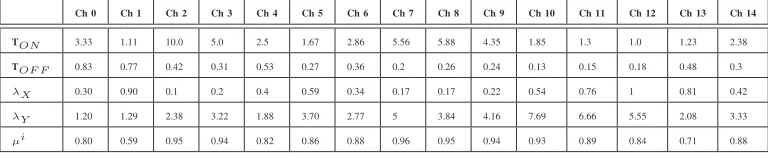
λY 1.20 1.29 2.38 3.22 1.88 3.70 2.77 5 3.84 4.16 7.69 6.66 5.55 2.08 3.33
µi 0.80 0.59 0.95 0.94 0.82 0.86 0.88 0.96 0.95 0.94 0.93 0.89 0.84 0.71 0.88
TABLE III: Wireless Channel Parameters used in simulation (High PR Activity)
short communication range, the life time of wireless sensor nodes can be increased. The current standard for WSNs is IEEE 802.15.4 does not support CB by default. As, WSNs normally utilize industrial, scientific and medical (ISM) band for communication, so, effective spectrum utilization is nec-essary to avoid any interference.
B. RIT based CB in CRNs
CRNs are opportunistic nodes which utilize ISM as well as licensed band for their communication. As in a CR based network, CR nodes co-exist with the licensed nodes so it is required that CR nodes must not create interference for the licensed users. It is possible that a CR node is transmitting its data and meanwhile a PR nodes tries to access the same frequency band for transmission. In this situation, the CR node must leave the band by stopping its communication to prevent from PR-CR interference. The information of PR activity is necessary for interference prevention. In this regard, PR activity model is required to estimate the presence or absence of PR node.
The CR technique helps to improve the utilization of scarce spectrum. The CR nodes in a network utilize the spectrum op-portunities (white spaces) while avoiding harmful interference. The intellient decision provides CR node a better chance to exploit the opportunities. The authors in [13] have mentioned that intelligent channel utilization is dependent upon total number of CR nodes in a network. If the CR traffic is low in network then probability based channel selection can provide required performance but for high CR traffic, sensing based channel selection provides better results to select the required channels. [14] highlights the importance of channel prediction techniques for CR based networks. Multiple methods have been introduced to estimate the suitability of channels for CR nodes. Using these methods, CR nodes can switch to those channels which provide longer idle slots through network coordination [12]. Furthermore [15] discusses that prediction based schemes for PR users activity can enhance the CR node performance as it reduces the number of channels switching.
The CR nodes can intelligently utilize the past channel histo-ries to predict the forthcoming PR activities and can effectively reduce the harmful interference [16]. When CR capabilities are addded to WSN node, the power consumption also becomes an important parameter. An effective way of increasing the life of CR based wireless sensor node is to perform channel sensing only when a CR node has some data to send [11], [21], thus the battery resources can be saved remarkably.
CB in CR based networks provides larger bandwidth to CR nodes while keeping the interference below the threshold level. The emerging CR based standard IEEE 802.22 supports CB to provide larger bandwidth to CR nodes [22].
The CB in CRSNs is a new idea and we have proposed it in [23]. The work shows that CB in CRSNs using efficient channel selection can reduce harmful interference. Now, in this paper, we propose two channel bonding algorithms based on RIT. Our work is different from all the aforementioned literature of CR networks in a sense that we consider CRSN while the works presented in the literature are specifically designed for CRNs (see Table. I) and these works cannot be directly applied to CRSNs.
III. REMAININGIDLETIMEAWARECHANNELBONDING
SCHEME
A. System Model:
PR activity gives the information about presence or absence of PR users over the channel. We modeled the PR activity as continuous-time, alternating ON/OFF Markov Renewal Process (MRP) [24]–[26]. This PR activity model has been widely used in the literature [16], [24], [25], [27]–[29]. The ON/OFF PR activity model approximates the spectrum utiliza-tion pattern of voice networks [30] and also very famous for public safety bands [16], [31]. The presence of PR node in a wireless channel can be modelled as the ON state which represents that channel is currently busy and occupied by
PR node. The OFF state represents that channel is idle and
unoccupied by any PR node. The time duration for which the channel i is in ON and OFF states are denoted as Ti
Ch 0 Ch 1 Ch 2 Ch 3 Ch 4 Ch 5 Ch 6 Ch 7 Ch 8 Ch 9 Ch 10 Ch 11 Ch 12 Ch 13 Ch 14
TON 3.33 1.11 10.0 5.0 2.5 1.67 2.86 5.56 5.88 4.35 1.85 1.3 1.0 1.23 2.38 TOF F 2.5 1.11 10.0 1.67 3.33 10.0 4.0 9.09 3.45 2.08 5.26 3.7 1.0 1.61 2.63
λX 0.30 0.90 0.1 0.2 0.4 0.59 0.34 0.17 0.17 0.22 0.54 0.76 1 0.81 0.42
λY 0.4 0.90 0.1 0.59 0.30 0.1 0.25 0.11 0.28 0.48 0.19 0.27 1 0.62 0.38
[image:5.612.113.499.51.133.2]µi 0.57 0.5 0.5 0.74 0.42 0.14 0.41 0.37 0.63 0.67 0.26 0.26 0.5 0.43 0.47
TABLE IV: Wireless Channel Parameters used in simulation (Long PR Activity)
Ch 0 Ch 1 Ch 2 Ch 3 Ch 4 Ch 5 Ch 6 Ch 7 Ch 8 Ch 9 Ch 10 Ch 11 Ch 12 Ch 13 Ch 14
TON 0.83 0.77 0.42 0.31 0.53 0.27 0.36 0.2 0.26 0.24 0.13 0.15 0.18 0.48 0.3 TOF F 0.27 0.36 0.2 0.26 0.24 0.83 0.77 0.42 0.31 0.53 0.4 0.29 0.15 0.53 0.2
λX 1.20 1.29 2.38 3.22 1.88 3.70 2.77 5 3.84 4.16 7.69 6.66 5.55 2.08 3.33
λY 3.70 2.77 5 3.84 4.16 1.20 1.29 2.38 3.22 1.88 2.5 3.44 6.66 1.88 5
[image:5.612.317.564.518.719.2]µi 0.75 0.68 0.67 0.54 0.68 0.24 0.31 0.32 0.45 0.31 0.24 0.34 0.54 0.47 0.6
TABLE V: Wireless Channel Parameters used in simulation (Intermittent PR Activity)
and Ti
OF F respectively. The duration which a channel takes
to complete one consecutive ON and OFF period is called renewal period. Let, this renewal period for a channel i at time t is denoted by Zi(t) =TONi +T
i
OF F [25], [32], [33].
Both ON and OFF periods are assumed to be independent and identically distributed (i.i.d). Since each PR user arrival is independent so according to [33], each PR user arrival follows the Poisson arrival process and λX and λY are the
rate parameters for exponential distribution, the length of ON periods which are exponentially distributed with probability
density functionp.d.f. can be given as:
fX(t) =λX×e−λXt (1)
Similarly, the length of OFF periods exponentially dis-tributed with p.d.f can be stated as:
fY(t) =λY ×e−λYt (2)
The total utilization of channel iby a PR user is called as utilization factor of ith
channel and can be written as:
ui= E[T
i ON]
E[Ti
ON] +E[T i OF F]
= λY
λX+λY
(3)
E[TONi ]andE[T i
OF F]is the mean of exponential
distribu-tion [32]. µX andµY are the mean of rate parameters where
µX = λ1X andµY = λ1Y. In this way, any kind of PR activity
can be added by describing the pattern as discussed in [34]. We have used four types of PR activities i.e. Low, High, Long and Intermittent. The wireless parameters for these four types of PR activities has been shown as Tables. II, III, IV and V.
The CRSN nodes perform spectrum sensing through de-tecting energy threshold on the channel. Energy threshold is the most common way of sensing due to its low complexity, computational overhead and power requirements [35]. LetFis the total number ofchannels which can be sensedandF =fi
wherei= 1,2, ..., m.‘m’ is the maximum number of channels
in a network. Nowfi =k(i) +n(i) wherek(i)is the signal
to be detected and n(i) is the additive white gaussian noise (AWGN) over the channel. Then the set of occupied channels
Focan be formulated as:
Fo=fi:φ(fi)≥θ (4)
Where ‘θ’ is the threshold to take decision of a sensing function and φ(fi) is the sensing function. Similarly the set
of vacant channelsFv can also be formulated as:
Fv=fi:φ(fi)≤θ (5)
Eq. 4 and 5 provide the state of channel being occupied or vacant at any instant. We can also use probability theory to estimate the state of channel using the rate parameters.when we start our simulation, we assume that all channels are idle and calculate the probabilities for the channels to be in ON or OFF state depending upon the rate parameters.
Let,Pi
ON(t)be the probability of ith channel in ON state
at time “t” andPi
OF F(t)be the probability ofith channel in
OFF state at time “t” then these probabilities can be given as:
PONi (t) =
λiY
λi X+λ
i Y
− λ
i Y
λi X+λ
i Y
.e−(λiX+λiY)t
(6)
POF Fi (t) =
λiX
λi X+λ
i Y
+ λ
i Y
λi X+λ
i Y
.e−(λiX+λiY)t
(7)
such that,
PONi (t) +POF Fi (t) = 1 (8)
Eq. 6 and Eq. 7 can also be written as [32]:
PONi (t) =u i
−ui.e−(λi
X+λiY)t (9)
and
POF Fi (t) = (1−u i) +
ui.e−(λi
X+λiY)t (10)
Algorithm 1 Remaining Idle Time Aware Channel Bonding Algorithm for CRSNs (RITCB)
1:CH: Total number of channels 2:CBsize: Size for channel bonding 3:SCH: Selected channels 4:CCH: Contiguous channels
5:RITi: Remaining idle time ofithchannel
6:SRIT: Smallest remaining idle time
7:RIT CH3: The array of three contiguous channels with RIT 8:RIT CH2: The array of two contiguous channels with RIT 9:Start
10: Perform spectrum sensing to find total number of channelsCH
11: InputCH,CBsize
12: Select all the possible channel combinations ofCBsizefromCH
13: selected channels←add the value of possible combinations 14:SCH←arrange the selected channels in descending order 15: goto algorithm 2←to find set of contiguous channels 16: fori= 0, i < CCH, i+ +
17: CON T[CCH] ← Arrange the contiguous channel pairs in descending order
18: Perform detailed channel sensing on contiguous channels to find PR activity onCON T[CCH]
19: CON T[CCH3]←Insert the sets of three contiguous pairs from
CON T[CCH]
20: CON T[CCH2]←Insert the sets of two contiguous pairs from
CON T[CCH] 21: end for
22: forj= 0, j < CON T[CCH3], j+ + 23: For AlljComputeRIT
24: SRIT[CCH3]←min[RIT(CON T[CCH3])] 25: end for
26: RIT CH3 ←Select the channels fromSRIT[CCH3] with longest
RIT
27: fork= 0, k < CON T[CCH2], k+ + 28: For AllkComputeRIT
29: SRIT[CCH2]←min[RIT(CON T[CCH2])] 30: end for
31: RIT CH2 ←Select the channels fromSRIT[CCH2] with longest
RIT
32: ifRIT CH3> RIT CH2then
33: Make a bond using three contiguousRIT CH3 34: Transmit data
35: Break the bond and release the channels 36: else ifRIT CH3 ==RIT CH2then
37: Make a bond using three contiguousRIT CH3 38: Transmit data
39: Break the bond and release the channels 40: elseRIT CH3< RIT CH2then
41: Make a bond using two contiguousRIT CH2 42: Transmit data
43: Break the bond and release the channels 44:Stop
state and the rate parameters to estimate the remaining idle timeRIT as:
RITi= P
i OF F(t)
λi X
(11)
which comes to
RITi= λ
i X+λ
i Y.e
−(λi X+λiY)t
λi X(λ
i X+λ
i Y)
(12)
and
RITi=µiX.(
λi X+λ
i Y.e
−(λi X+λiY)t
λi X+λiY
) (13)
wherePi
OF F(t)is probability of nodeiin off state at timet,
λi
Xis the rate parameter andµ
i
Xis the mean of rate parameter.
By using Eq. 13, we can find the RIT for channel i.
Algorithm 2 Algorithm to find Contiguous Channels for RITCB
1:Start 2: InputSCH
3: For eachSCHpair, get the channel ID’s
4: ifall three channels inSCHare consecutivethen 5: CCH←all selected channels are contiguous 6: shortlist the ID’s of three contiguous channels 7: else ifany two channels inSCHare consecutivethen 8: CCH←two selected channels are contiguous 9: shortlist the ID’s of two contiguous channels 10:Stop
11: goto Algortithm 1
B. Importance of Remaining Idle Time Aware Channel Selec-tion Decision
We assume that we have a multimedia CRSN node and when it has some data to send, it needs to perform CB. There are multiple channels and CRSN needs to select the suitable channel for communication. Now, it is required that CRSN node must not create interference for the PR node. The channel selection will be done using the three step process known as cognitive cycle[36], [37]. In determining the vacant channel, the CRSN node can either follow an instantaneous channel selection method or remaining idle time information can be used.
Lets analyze that if CRSN node uses instantaneous channel selection method, will it be an effective way or not? Instan-taneous channel selection is a method which searches for a vacant channel at any instant of time when a CRSN node wants to acquire a channel. It has been demonstrated in Fig. 1 that if a node only uses current state information to select a channel, it is highly possible that it will cause interference with PR node. The node will have to face frequent channel switching and ultimately will fail to deliver the required performance. However, if a node uses prediction and current channel state to perform channel selection, it is expected that it will create less interference with PR nodes and have to perform less channel switching. The channel which is vacant at given time gets selected and assigned to CRSN node. This method does not uses any prior information of traffic over that channel so it is un-aware of probability that when PR node can re-appear on the same channel. As illustrated in Fig. 1(a), when CRSN node performs channel sensing using instantaneous method at time t=1, the channel 1 is busy where as channel 2 seems suitable as it is free at that instant of time so channel 1 gets selected. However, just after that instant, channel 1 becomes free and channel 2 gets occupied by PR node and CRSN node will have to stop its communication, leave that channel and will again need to perform channel sensing. Similarly, in Fig. 1(b), channel 1 gets selected as it is vacant at that instant of time but it is not suitable for CRSN communication.
(a) (b)
(c) (d)
[image:7.612.90.534.82.641.2](e)
long duration of time but was not selected. It is due to the reason that instantaneous channel selection does not considers the PR activity model and performs channel selection based on current channel sensing result only.
Algorithm 3 Remaining Idle Time Aware Channel Bonding Algorithm for CRSNs (RITCB-IP)
1:CH: Total number of channels 2:CBsize: Size for channel bonding 3:SCH: Selected channels 4:CCH: Contiguous channels
5:RITi: Remaining idle time ofithchannel
6:SRIT: Smallest remaining idle time
7:RIT CH−IP3: The array of three contiguous channels with RIT 8:RIT CH−IP2: The array of two contiguous channels with RIT 9:Start
10: Perform spectrum sensing to find total number of channelsCH
11: InputCH,CBsize
12: Select all the possible channel combinations ofCBsizefromCH
13: selected channels←add the value of possible combinations 14:SCH←arrange the selected channels in descending order 15: goto algorithm 4←to find set of contiguous channels 16: fori= 0, i < CCH, i+ +
17: CON T[CCH] ← Arrange the contiguous channel pairs in descending order
18: Perform detailed channel sensing on contiguous channels to find PR activity onCON T[CCH]
19: CON T[CCH3]←Insert the sets of three contiguous pairs from
CON T[CCH]
20: CON T[CCH2]←Insert the sets of two contiguous pairs from
CON T[CCH] 21: end for
22: forj= 0, j < CON T[CCH3], j+ + 23: For AlljComputeRIT
24: SRIT[CCH3]←min[RIT(CON T[CCH3])] 25: end for
26: RIT CH−IP3 ← Select the channels from SRIT[CCH3] with longestRIT
27: fork= 0, k < CON T[CCH2], k+ + 28: For AllkComputeRIT
29: SRIT[CCH2]←min[RIT(CON T[CCH2])] 30: end for
31: RIT CH−IP2 ← Select the channels from SRIT[CCH2] with longestRIT
32: ifRIT CH−IP3> RIT CH−IP2then
33: Make a bond using three contiguousRIT CH−IP3
34: ifPR node active on selected bond ofRIT CH−IP3 then
35: break the bond, drop the packet and release the channels for PR node
36: else if PR node is not active on selected bond of
RIT CH−IP3then
37: Transmit data
38: Break the bond and release the channels 39: else ifRIT CH−IP3 ==RIT CH−IP2then 40: Make a bond using three contiguousRIT CH−IP3
41: ifPR node active on selected bond ofRIT CH−IP3 then
42: break the bond, drop the packet and release the channels for PR node
43: else if PR node is not active on selected bond of
RIT CH−IP3then
44: Transmit data
45: Break the bond and release the channels 46: elseRIT CH−IP3< RIT CH−IP2then 47: Make a bond using two contiguousRIT CH−IP2
48: ifPR node active on selected bond ofRIT CH−IP3 then
49: break the bond, drop the packet and release the channels for PR node
50: else if PR node is not active on selected bond of
RIT CH−IP3then
51: Transmit data
52: Break the bond and release the channels 53:Stop
Algorithm 4 Algorithm to find Contiguous Channels for RITCB-IP
1:Start 2: InputSCH
3: For eachSCHpair, get the channel ID’s
4: ifall three channels inSCHare consecutivethen 5: CCH←all selected channels are contiguous 6: shortlist the ID’s of three contiguous channels 7: else ifany two channels inSCHare consecutivethen 8: CCH←two selected channels are contiguous 9: shortlist the ID’s of two contiguous channels 10:Stop
11: goto Algortithm 3
C. Working of Remaining Idle Time Aware Intelligent Channel Bonding Schemes RITCB and RITCB-IP
In this section, we discuss the working of our proposed algorithms. Our proposed remaining idle time aware channel bonding schemes RITCB and RITCB-IP perform channel selection based on PR activity over the channels. As shown in algorithm. 1, first RITCB takes number of channels and CB size as input. According to the given parameters, the algorithm selects the channels and arranges them. The algorithm 2 finds out that the selected channels have three contiguous channels or two contiguous channels or they are not con-tiguous.All the pairs of three contiguous and two contiguous channels are arranged according to size in descending order in
CON T[CCH]. TheCON T[CCH]is further classified into
three ans two contiguous channels pairs as CON T[CCH3]
and CON T[CCH2]respectively. Upon finding the contigu-ous channels, it performs detailed channel sensing, detects the PR activity over the channels and then estimates that the channels will be available for how much duration of time. The selection of channels is done on the basis of remaining idle time of PR node. The longer the PR node will remain idle over the channel the more suitable is the channel for CR node.
After the selection of channels, the RIT of all contiguous sets having three channels is calculated. When RIT values have been achieved then, the minimum RIT value of each contiguous set is calculated and stored in SRIT. It reduces the possibility of creating harmful interference with PR nodes. When SRIT of all contiguous sets is achieved then the maxi-mum RIT of from SRIT is selected and stored in RTICH3. The same criteria is followed for contiguous sets of two channels and the maximum RIT is stored in RITCH2. Now, we compare the values of RITCH3 and RITCH2 to select the size of bond. Our target is to select the larger bond size having maximum RIT so bond of two channels is selected only if RITCH2 > RITCH3. The contiguous pair having the longest remaining idle time is the output of our proposed algorithm. In this way, our proposed scheme selects the suitable channels for CRSN nodes and these channels can be combined to perform channel bonding.
1 2 3 4
5 10 15
Average RIT (sec)
Number of channels
Average RIT Achieved for 3 Contiguous Channels (RITCB)
[image:9.612.310.564.50.228.2]LOW PR Activity HIGH PR Activity LONG PR Activity INTERMITTENT PR Activity
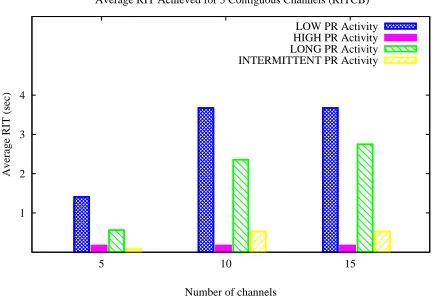
Fig. 2: Average RIT based Time for all PR activities
when there is high PR activity on the network. It is due to the reason that channels are mostly busy and it is impossible to get 3 contiguous channels with longest RIT with high PR activity.
We can also estimate the average remaining idle time of selected contiguous pair. It is elaborated in Fig. 2 that as number of channels in the network increase, the possibility of finding longer RIT increases. When low PR activity is present in the network, we get longer RIT as compared to high PR activity which confirms the effectiveness of our proposed scheme. Long PR activity also provide considerable amount of RIT as there are long OFF periods which can be utilized for CB purpose.
The RITCB-IP works differently in case of HIR avoidance as shown in algorithm 3. When the contiguous channels based on RIT get selected, RITCB-IP checks that if PR node is active on any channel of the bonded pair. In case of PR presence, the RITCB-IP stops the CRSN node communication by dropping the packet and releasing the channels for PR node. In this way, RITCB-IP effectively prevents harmful interference with PR nodes.
IV. PERFORMANCEEVALUATION
In this section, we discuss performance evaluation of our proposed algorithms and compare them with PRACB, SWA, KNOWS and AGILE.
A. Simulation Results
We have done performance analysis of our proposed schemes RITCB and RITCB-IP by comparing them with PRACB [23], SWA [38], KNOWS [39] and AGILE [40]. We have decided to compare our approaches with SWA, KNOWS, and AGILE, as these schemes are focusing on channel bonding. We did not compare our approaches with RIT based single channel selection schemes proposed for CRNs (c.f. Table. I) because these single channel schemes are generally not well suited for channel bonding (c.f. [23]). In PRACB [23], the channels get selected randomly and only those channels are used for CB which are free from PR activity at that time. The channels which have active PR nodes are dropped for CR utilization. SWA [38] applies the concept of CB by varying the channel width without considering any PR
Parameters Values
Simulator Name NS-2
Patch used for simulating CRSN CRCN patch Operating frequency band 2.4 GHz
Number of nodes 02
Number of channels 3 - 15 Size of simulation area 1000*1000 Radio propagation model Two-ray ground model
Network interface type Wireless PHY
Routing protocol AODV
MAC type Mac/Maccon
PR activity ON / OFF with exponential distribution PR activity regimes Low, High, Long and Intermittent Sensor initial energy (Ein) 1J
Transceiver energy consumption (Etr) 50nj [42]
Simulation time 10000 sec No. of packets sent 10000
Packet size 44 bytes
Size of bonded channels 3 bonded channels / 2 bonded channels
TABLE VI: Simulation Parameters
activity hence it causes interference with PR nodes. KNOWS [39] utilizes the white spaces in TV band for channel width adaptation. AGILE [40] tunes the node central frequency and bandwidth to the under utilized WLAN spectrum to use it for unlicensed operations.Earlier, we have incorporated the CRSN
capabilities in NS-2 [41]. We have now thoroughly tested the
proposed scheme by simulating it in NS-2. The CRSN nodes first find the contiguous channels and then check the PR activ-ity over the selected channels. In addition, they select channels on the basis of remaining idle time as discussed in previous section. The simulation parameters have been mentioned in Table. VI.There are two CRSN nodes which establish single hop communication in presence of four types of PR activities. In this work, we show that how intelligent channel selection gives the suitable channels for channel bonding which will be idle for longest possible duration in a single hop scenario. The implementation of RITCB and RITCB-IP in multi hop scenario can be considered as future work.
1) Impact of intelligent channel selection on PR activity model: As we have discussed earlier, PR activity model plays vital role in the performance of CRSN nodes. The availability of channels depends upon the type of PR activity present in the network. The selection of available channels is a critical problem which impacts the throughput of CRSN nodes. The intelligent channel selection provides an opportunity to CRSN nodes that they can select those channels which are available for longer duration of time as compared to other channels. This intelligent channel selection improves the channel utilization and other parameters as discussed later in this section.
B. Comparison Analysis
Now we discuss the comparison analysis of our proposed schemes RITCB and RITCB-IP by comparing with other four schemes based on following performance parameters.
[image:9.612.61.283.62.211.2]0 10 20 30 40 50 60 70 80 90 100
3 7 11 15
Delivery Ratio (%)
Number of channels
Comparison of Channel Bonding schemes for 3 channels with LOW PR activity
RITCB-IP RITCB PRACB SWA KNOWS AGILE
(a)
0 10 20 30 40 50 60 70 80 90 100
3 7 11 15
Delivery Ratio (%)
Number of channels
Comparison of Channel Bonding schemes for 3 channels with HIGH PR activity
RITCB-IP RITCB PRACB SWA KNOWS AGILE
(b)
0 10 20 30 40 50 60 70 80 90 100
3 7 11 15
Delivery Ratio (%)
Number of channels
Comparison of Channel Bonding schemes for 3 channels with LONG PR activity
RITCB-IP RITCB PRACB SWA KNOWS AGILE
(c)
0 10 20 30 40 50 60 70 80 90 100
3 7 11 15
Delivery Ratio (%)
Number of channels
Comparison of Channel Bonding schemes for 3 channels with INTERMITTENT PR activity
RITCB-IP RITCB PRACB SWA KNOWS AGILE
[image:10.612.100.506.57.359.2](d)
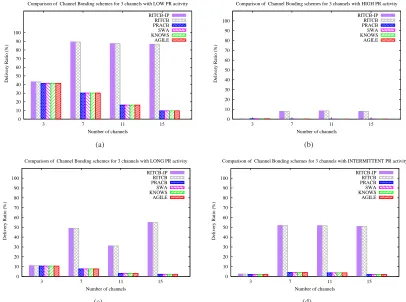
Fig. 3: Overview of Delivery Ratio for RIT based contiguous channels with: (a) Low PR Activity. (b) High PR Activity. (c) Long PR Activity. (d) Intermittent PR Activity.
Sr. No. Scheme Complexity
1. RITCB-IP O(n)
2. RITCB O(n)
3. PRACB O(n2)
4. SWA O(n)
5. KNOWS O(n)
6. AGILE O(n)
TABLE VII: Complexity Analysis
time or required memory. As mentioned in Table. VII, our proposed schemes RITCB-IP and RITCB have the complexity
as O(n)which shows the linearity of our schemes as compared
to PRACB which has the complexity as O(n2). The other
schemes such as SWA, KNOWS and AGILE also has linear
complexities i.e. O(n)but our proposed schemes outperform in
other parameters such as delivery ratio, harmful interference, node life and channel switching.
2) Delivery Ratio: Delivery Ratio can be defined as the successful number of packets received from total sent packets. Suppose a CRSN node is utilizing a channel to send its data to a sink node then how many packets it successfully transmits out of all packets sent is called as delivery ratio.
In our simulation scenario, the CRSN node selects RIT based pair of contiguous channels to make a bond and transmits the data using RITCB and RITCB-IP. We count the total number of packets transmitted and number of packets successfully received at receiver. The results in Fig. 3 show that RITCB and RITCB-IP provide significant better delivery ratio than PRACB, SWA, KNOWS and AGILE. The RITCB
and RTICB-IP give same delivery ratio as they select the channel following the same criteria i.e. RIT based contiguous channels selection.
The major improvement in delivery ratio can be seen in case of high PR activity i.e. Fig. 3(b) where our proposed schemes are giving visible delivery ratio when other schemes are almost zero. It is due to the intelligent channel selection of contiguous channels based on remaining idle time.
The significant performance in terms of delivery ratio can also be seen in other PR activities such as low, long and intermittent (Fig. 3(a), 3(c), and 3(d) respectively).
Hence, it can be concluded that intelligent channel selec-tion through RIT based contiguous channels can significantly improve the overall delivery ratio for all types of PR activities. 3) Harmful Interference:Harmful interference occurs when PR and CR nodes try to utilize channel at the same time. Sup-pose, a CRSN node is utilizing a channel and meanwhile a PR node appears on the same channel. The PR and CR nodes will sense interference and CR node will stop its communication. This problem is due to instantaneous channel selection by CR nodes. If CR nodes select channels on the basis of remaining idle time, then they can stop their communication before the appearance of PR nodes hence minimizing PR-CR harmful interference.
[image:10.612.108.240.394.466.2]0 10 20 30 40 50 60 70 80 90 100
3 7 11 15
HIR (%)
Number of channels
Comparison of Channel Bonding schemes for 3 channels with LOW PR activity
RITCB-IP HIR = 0% PRACB HIR = 0%
RITCB-IP HIR = 0% PRACB HIR = 0%
RITCB-IP HIR = 0% PRACB HIR = 0%
RITCB-IP HIR = 0% PRACB HIR = 0%
RITCB-IP RITCB PRACB SWA KNOWS AGILE (a) 0 10 20 30 40 50 60 70 80 90 100
3 7 11 15
HIR (%)
Number of channels
Comparison of Channel Bonding schemes for 3 channels with HIGH PR activity
RITCB-IP HIR = 0% PRACB HIR = 0%
RITCB-IP HIR = 0% PRACB HIR = 0%
RITCB-IP HIR = 0% PRACB HIR = 0%
RITCB-IP HIR = 0% PRACB HIR = 0%
RITCB-IP RITCB PRACB SWA KNOWS AGILE (b) 0 10 20 30 40 50 60 70 80 90 100
3 7 11 15
HIR (%)
Number of channels
Comparison of Channel Bonding schemes for 3 channels with LONG PR activity
RITCB-IP HIR = 0% PRACB HIR = 0%
RITCB-IP HIR = 0% PRACB HIR = 0%
RITCB-IP HIR = 0% PRACB HIR = 0%
RITCB-IP HIR = 0% PRACB HIR = 0%
RITCB-IP RITCB PRACB SWA KNOWS AGILE (c) 0 10 20 30 40 50 60 70 80 90 100
3 7 11 15
HIR (%)
Number of channels
Comparison of Channel Bonding schemes for 3 channels with INTERMITTENT PR activity
RITCB-IP HIR = 0% PRACB HIR = 0%
RITCB-IP HIR = 0% PRACB HIR = 0%
RITCB-IP HIR = 0% PRACB HIR = 0%
RITCB-IP HIR = 0% PRACB HIR = 0%
[image:11.612.103.505.57.361.2]RITCB-IP RITCB PRACB SWA KNOWS AGILE (d)
Fig. 4: Overview of Harmful Interference Ratio for RIT based contiguous channels with: (a) Low PR Activity. (b) High PR Activity. (c) Long PR Activity. (d) Intermittent PR Activity.
to select that channel and when PR node appears over that channel it stops its communication (as shown in Fig. 4). However, The RITCB-IP does not causes interference with PR nodes as it performs channel sensing for every packet and sends when the channel is idle from PR activity. The HIR is increased when there is high PR activity over the network (as shown in Fig. 4(b)) as the channels are mostly occupied by PR nodes and CRSN nodes get very less chance to transmit their data.
Hence, harmful interference can be reduced by using intelli-gent channel selection scheme along with performing channel sensing in a periodic manner.
4) Node Life Time: The CRSN node life depends upon many factors. The number of total packets transmitted, suc-cessfully received packets and the packets which caused harmful interference with PR nodes affect the energy of CRSN node. Lets suppose that initial CRSN node energy is 1J [43] and transceiver energy consumption is 50nj/bit [42] then the total energy consumed by CRSN node can be calculated by considering total number of packets successfully transmitted and the number of packets which caused harmful interference. As our proposed schemes RITCB and RITCB-IP select those channels for CB which have longest remaining idle time so we get higher delivery ratio but RITCB causes harmful interference due to which it consumes more energy than RITCB-IP as shown in Fig. 5.
When there is low PR activity present in the network, it can be observed in Fig. 5(a) that RITCB-IP consumes less energy than RITCB but as number of channels is increased,
it seems that PRACB performs better RITCB-IP as it gives lower energy consumption. It is due to reason that as number of channels is increased, PRACB select fewer contiguous channels and its delivery ratio decreases (as depicted in Fig. 3(a)) which consequently consumes less energy. However, RITCB provides better delivery ratio even with increased number of channels.
Similarly, when high PR activity is present, there is very less chance of obtaining idle contiguous channels due to which RITCB-IP consumes very less energy in packets transmission (as shown in Fig. 5(b)) where as RITCB causes harmful inter-ference and consumes more energy. PRACB also consumes very less energy as it does not obtain contiguous pairs as number of channels is increased.
Hence, it can be concluded that our objective is to optimize the CRSN node life by increasing total number of successful packet transmissions and reducing harmful interference. In this manner, RITCB-IP outperforms all other schemes as it reduces harmful interference to zero and provides better successful packet transmission.Our proposed scheme RITCB-IP consumes less energy and its specific design for wireless sensor nodes made it suitable for CRSNs.
0 100 200 300 400 500
3 7 11 15
Transmission Energy Consumption (mJ)
Number of channels
Comparison of Energy Consumption with LOW PR activity
RITCB-IP RITCB PRACB SWA KNOWS AGILE (a) 0 100 200 300 400 500
3 7 11 15
Transmission Energy Consumption (mJ)
Number of channels
Comparison of Energy Consumption with HIGH PR activity
RITCB-IP RITCB PRACB SWA KNOWS AGILE (b) 0 100 200 300 400 500
3 7 11 15
Transmission Energy Consumption (mJ)
Number of channels
Comparison of Energy Consumption with LONG PR activity
RITCB-IP RITCB PRACB SWA KNOWS AGILE (c) 0 100 200 300 400 500
3 7 11 15
Transmission Energy Consumption (mJ)
Number of channels
Comparison of Energy Consumption with INTERMITTENT PR activity
[image:12.612.101.500.65.368.2]RITCB-IP RITCB PRACB SWA KNOWS AGILE (d)
Fig. 5: The comparison of CRSN node life time with: (a) Low PR Activity. (b) High PR Activity. (c) Long PR Activity. (d) Intermittent PR Activity.
0 1000 2000 3000 4000 5000 6000 7000 8000 9000 10000
3 7 11 15
No. of Channel Switching
Number of channels
Comparison of CB schemes for 3 channels with LOW PR activity
RITCB-IP CS = 0 PRACB CS = 0
RITCB-IP CS = 0 PRACB CS = 0
RITCB-IP CS = 0 PRACB CS = 0
RITCB-IP CS = 0 PRACB CS = 0
RITCB-IP RITCB PRACB SWA KNOWS AGILE (a) 0 1000 2000 3000 4000 5000 6000 7000 8000 9000 10000
3 7 11 15
No. of Channel Switching
Number of channels
Comparison of CB schemes for 3 channels with HIGH PR activity
RITCB-IP CS = 0 PRACB CS = 0
RITCB-IP CS = 0 PRACB CS = 0
RITCB-IP CS = 0 PRACB CS = 0
RITCB-IP CS = 0 PRACB CS = 0
RITCB-IP RITCB PRACB SWA KNOWS AGILE (b) 0 1000 2000 3000 4000 5000 6000 7000 8000 9000 10000
3 7 11 15
No. of Channel Switching
Number of channels
Comparison of CB schemes for 3 channels with LONG PR activity
RITCB-IP CS = 0 PRACB CS = 0
RITCB-IP CS = 0 PRACB CS = 0
RITCB-IP CS = 0 PRACB CS = 0
RITCB-IP CS = 0 PRACB CS = 0
RITCB-IP RITCB PRACB SWA KNOWS AGILE (c) 0 1000 2000 3000 4000 5000 6000 7000 8000 9000 10000
3 7 11 15
No. of Channel Switching
Number of channels
Comparison of CB schemes for 3 channels with INTERMITTENT PR activity
RITCB-IP CS = 0 PRACB CS = 0
RITCB-IP CS = 0 PRACB CS = 0
RITCB-CS HIR = 0 PRACB CS = 0
RITCB-IP CS = 0 PRACB CS = 0
RITCB-IP RITCB PRACB SWA KNOWS AGILE (d)
[image:12.612.102.501.416.719.2]becomes more complex in case of CB, where CRSN node has to find multiple contiguous channels for communication. When PR node appears on any of that channel, the CRSN node has to break the bond, leave the channels and find other suitable channels.
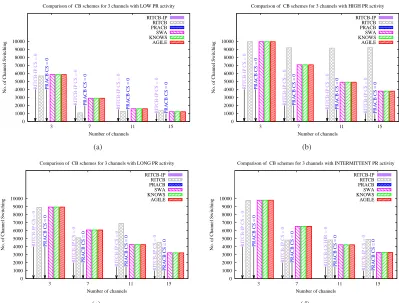
There are two general types of channel switching: proactive channel switching and reactive channel switching. By using proactive channel switching, a CRSN node has the expectation of appearing a PR node over the selected channel so it can leave the selected channel before PR becomes active. Whereas, in reactive channel switching, the CRSN node leaves the channel upon appearance of PR node over the selected channel.
As shown in Fig. 6, a CRSN node is sending 10000 packets using CB in presence of PR traffic. RITCB is selecting the channels based on expected value of remaining idle time for each channel but when PR node appear at any instant, it has to perform channel switching. We can also estimate the value of channel switching from harmful interference ratio (Fig. 4). This is the reason due to which channel switching will very high in high PR activity as shown in Fig. 6(b). The RITCB-IP and PRACB do not transmit their packet when the selected channel has active PR node. The other schemes such as SWA, KNOWS and AGILE do not incorporate the concept of channel switching hence they will be causing harmful interference to PR nodes and reduced delivery ratio. In this paper, proposing a channel switching scheme is not our objective. However, the capability of channel switching can be added to RITCB and RITCB-IP which will further improve their performance. The enhancement of channel switching capability can be considered as future work.
Hence, channel switching can help to reduce harmful in-terference and improve delivery ratio but frequent channel switching affects the sensor node energy.
V. CONCLUSION ANDFUTUREWORK
In this paper, we have proposed intelligent schemes for channel bonding RITCB and RITCB-IP which select channels based on remaining idle time. RITCB and RITCB-IP have shown significant performance gains in delivery ratio while RITCB-IP outperform RITCB, SWA, KNOWS and AGILE in HIR, transmission energy consumption and required number of channel switching. It improves the overall performance of network as it decreases node energy consumption and increases CRSN node life time. The concept of remaining idle time has its significance in cognitive networks where CR nodes attempt to access the channel opportunistically. The concept has greater impact when CRSN nodes are involved as the life time of battery oriented nodes must be optimized. This paper is a significant contribution to perform efficient channel selection for CRSN nodes.
REFERENCES
[1] J. Yick, B. Mukherjee, and D. Ghosal, “Wireless sensor network survey,” Computer networks, vol. 52, no. 12, pp. 2292–2330, 2008.
[2] N. Wang, N. Zhang, and M. Wang, “Wireless sensors in agriculture and
food industry recent development and future perspective,” Computers
and Electronics in Agriculture, vol. 50, no. 1, pp. 1–14, 2006.
[3] L. Qi, M. Xu, Z. Fu, T. Mira, and X. Zhang, “C 2 slds: a wsn-based perishable food shelf-life prediction and lsfo strategy decision support
system in cold chain logistics,”Food Control, vol. 38, pp. 19–29, 2014.
[4] I. F. Akyildiz, W. Su, Y. Sankarasubramaniam, and E. Cayirci, “Wireless
sensor networks: a survey,”Computer Networks, vol. 38, no. 4, pp. 393–
422, 2002.
[5] S. H. R. Bukhari, S. Siraj, and M. H. Rehmani, “Wireless sensor networks in smart cities: Applications of channel bonding to meet data
communication requirements,”Book Chapter for the Book,
Transporta-tion and Power Grid in Smart Cities: CommunicaTransporta-tion Networks and Services, in Print, John Wiley, UK, 2018.
[6] A. Ahmad, S. Ahmad, M. H. Rehmani, and N. U. Hassan, “A survey
on radio resource allocation in cognitive radio sensor networks,”IEEE
Communications Surveys & Tutorials, vol. 17, no. 2, pp. 888–917, 2015. [7] F. Akhtar, M. H. Rehmani, and M. Reisslein, “White space: Defini-tional perspectives and their role in exploiting spectrum opportunities,” Telecommunications Policy, vol. 40, no. 4, pp. 319–331, 2016. [8] B. Gulbahar and O. B. Akan, “Information theoretical optimization gains
in energy adaptive data gathering and relaying in cognitive radio sensor
networks,” IEEE Transactions on Wireless Communications, vol. 11,
no. 5, pp. 1788–1796, 2012.
[9] M. C. Oto and O. B. Akan, “Energy-efficient packet size optimization
for cognitive radio sensor networks,” IEEE Transactions on Wireless
Communications, vol. 11, no. 4, pp. 1544–1553, 2012.
[10] O. B. Akan, O. B. Karli, and O. Ergul, “Cognitive radio sensor
networks,”IEEE Network, vol. 23, no. 4, pp. 34–40, 2009.
[11] M. Sharma and A. Sahoo, “Opportunistic channel access scheme for cognitive radio system based on residual white space distribution,” in 21st Annual IEEE International Symposium on Personal, Indoor and Mobile Radio Communications. IEEE, 2010, pp. 1842–1847. [12] Y. Song and J. Xie, “Common hopping based proactive spectrum handoff
in cognitive radio ad hoc networks,” in Global Telecommunications
Conference (GLOBECOM). IEEE, 2010, pp. 1–5.
[13] C.-W. Wang, L.-C. Wang, and F. Adachi, “Modeling and analysis of multi-user spectrum selection schemes in cognitive radio networks,” in IEEE 20th International Symposium on Personal, Indoor and Mobile Radio Communications. IEEE, 2009, pp. 828–832.
[14] X. Li and S. A. R. Zekavat,Traffic pattern prediction based spectrum
sharing for cognitive radios. INTECH Open Access Publisher, 2009. [15] X. Li and S. A. Zekavat, “Traffic pattern prediction and performance
investigation for cognitive radio systems,” inIEEE Wireless
Communi-cations and Networking Conference. IEEE, 2008, pp. 894–899. [16] L. Yang, L. Cao, and H. Zheng, “Proactive channel access in dynamic
spectrum networks,”Physical Communications Journal, vol. 1, pp. 103–
111, 2008.
[17] Y. C. Liang, Y. Zeng, E. C. Y. Peh, and A. T. Hoang,
“Sensing-throughput tradeoff for cognitive radio networks,” IEEE Transactions
on Wireless Communications, vol. 7, no. 4, pp. 326–1337, 2008. [18] Z. Lin, M. Ghosh, and A. Demir, “A comparison of mac aggregation
vs. phy bonding for wlans in tv white spaces,” in 24th International
Symposium on Personal, Indoor and Mobile Radio Communications: MAC and Cross-Layer Design Track, 2013, pp. 1829 – 1834. [19] S. H. R. Bukhari, M. H. Rehmani, and S. Siraj, “A survey of channel
bonding for wireless networks and guidelines of channel bonding
for futuristic cognitive radio sensor networks,” IEEE Communications
Surveys & Tutorials, vol. 18, no. 2, pp. 924–948, Second Quarter 2016. [20] A. L. Ramaboli, O. E. Falowo, and A. H. Chan, “Bandwidth aggregation in heterogeneous wireless networks: A survey of current approaches and
issues,”Journal of Network and Computer Applications, vol. 35, no. 6,
pp. 1674 – 1690, 2012.
[21] M. Sharma and A. Sahoo, “Residual white space distribution-based
opportunistic channel access for cognitive radio enabled devices,”ACM
SIGCOMM Computer Communication Review, vol. 40, no. 4, pp. 427– 428, 2010.
[22] C. Cordeiro, K. Challapali, D. Birru, and S. Shankar, “Ieee 802.22 an introduction to the first wireless standard based on cognitive radios,” Journal of Communications, vol. 1, no. 1, pp. 38–47, 2006.
[23] S. H. R. Bukhari, S. Siraj, and M. H. Rehmani, “PRACB: A novel
channel bonding algorithm for cognitive radio sensor networks,”IEEE
Access, vol. 4, pp. 6950–6963, 2016.
[24] G. Yuan, R. Grammenos, Y. Yang, and W. Wang, “Performance analysis
of selective opportunistic spectrum access with traffic prediction,”IEEE
Transactions on Vehicular Technology, vol. 59, no. 4, pp. 1949–1959, 2010.
[25] A. Min and K. Shin, “Exploiting multi channel diversity in spectrum
[26] Y. Saleem and M. H. Rehmani, “Primary radio user activity models for
cognitive radio networks: A survey,”Journal of Network and Computer
Applications, vol. 43, pp. 1–16, 2014.
[27] H. Kim and K. Shin, “Fast discovery of spectrum opportunities in
cognitive radio networks,” inIEEE DySPAN, 2008.
[28] O. Mehanna, A. Sultan, and H. Gamal, “Cognitive mac protocols for general primary network models,” Cornell University, Tech. Rep., 2009. [29] A. Zahmati, X. Fernando, and A. Grami, “Steady-state markov chain
analysis for heterogeneous cognitive radio networks,” inSarnoff, 2010.
[30] A. Adas, “Traffic models in broadband networks,”IEEE
Communica-tions Magazine, vol. 35, no. 7, pp. 82–89, 1997.
[31] B. Vujicic, N. Cackov, S. Vujicic, and L. Trajkovic, “Modeling and
char-acterization of traffic in public safety wireless networks,” inSPECTS,
2005.
[32] H. Kim and K. Shin, “Efficient discovery of spectrum opportunities with
mac layer sensing in cognitive radio networks,”IEEE Transactions on
Mobile Computing, vol. 7, pp. 533–545, 2008.
[33] K. Sriram and W. Whitt, “Characterizing superposition arrival processes
in packet multiplexers for voice and data,”IEEE Journal on Selected
Areas in Communications, vol. 4, no. 6, pp. 833–846, 1986.
[34] M. H. Rehmani, A. C. Viana, H. Khalife, and S. Fdida, “SURF: A distributed channel selection strategy for data dissemination in multi-hop
cognitive radio networks,”Computer Communications, vol. 36, no. 10,
pp. 1172–1185, 2013.
[35] T. Yucek and H. Arslan, “A survey of spectrum sensing algorithms
for cognitive radio applications,” IEEE Communications Surveys &
Tutorials, vol. 11, no. 1, pp. 116–130, 2009.
[36] S. Haykin, “Cognitive radio: brain-empowered wireless
communica-tions,”IEEE journal on selected areas in communications, vol. 23, no. 2,
pp. 201–220, 2005.
[37] J. Mitola and G. Q. Maguire, “Cognitive radio: making software radios
more personal,”IEEE personal communications, vol. 6, no. 4, pp. 13–18,
1999.
[38] R. Chandra, R. Mahajan, J. Moscibroda, R. Raghavendra, and P. Bahl, “A
case for adapting channel width in wireless networks,”ACM SIGCOMM
Computer Communication Review, vol. 38, no. 4, pp. 135–146, 2008. [39] Y. Yuan, P. Bahl, R. Chandra, and P. Chou, “Knows: Cognitive radio
networks over white spaces,” in International Sumposium on New
Frontiers in Dynamic Spectrum Access Networks, 2007, pp. 416 – 427. [40] S. Keranidis, K. Chounos, T. Korakis, I. Koutsopoulos, and L. Tassiulas, “Demo: Enabling agile spectrum adaptation in commercial 802.11
wlan deployments,” in Proceedings of the 20th annual international
conference on Mobile computing and networking, 2014, pp. 295 – 298. [41] S. H. R. Bukhari, S. Siraj, and M. H. Rehmani, “NS-2 based simulation
framework for cognitive radio sensor networks,” Springer Wireless
Networks, In Print, 2018.
[42] G. A. Shah and O. B. Akan, “Cognitive adaptive medium access control
in cognitive radio sensor networks,”IEEE Transactions on Vehicular
Technology, vol. 64, no. 2, pp. 757–767, 2015.
[43] X. Li, D. Wang, J. McNair, and J. Chen, “Residual energy aware channel
assignment in cognitive radio sensor networks,” in IEEE Wireless