Radio Sensor Networks
.
White Rose Research Online URL for this paper:
http://eprints.whiterose.ac.uk/106004/
Version: Accepted Version
Article:
Bukhari, SHR, Siraj, S orcid.org/0000-0002-7962-9930 and Rehmani, MH (2016) PRACB:
A Novel Channel Bonding Algorithm for Cognitive Radio Sensor Networks. IEEE Access,
4. ISSN 2169-3536
https://doi.org/10.1109/ACCESS.2016.2618418
© 2016 IEEE. Translations and content mining are permitted for academic research only.
Personal use is also permitted, but republication/redistribution requires IEEE permission.
[email protected] https://eprints.whiterose.ac.uk/
Reuse
Unless indicated otherwise, fulltext items are protected by copyright with all rights reserved. The copyright exception in section 29 of the Copyright, Designs and Patents Act 1988 allows the making of a single copy solely for the purpose of non-commercial research or private study within the limits of fair dealing. The publisher or other rights-holder may allow further reproduction and re-use of this version - refer to the White Rose Research Online record for this item. Where records identify the publisher as the copyright holder, users can verify any specific terms of use on the publisher’s website.
Takedown
If you consider content in White Rose Research Online to be in breach of UK law, please notify us by
PRACB: A Novel Channel Bonding Algorithm for
Cognitive Radio Sensor Networks
Syed Hashim Raza Bukhari
⋆⋄, Sajid Siraj
⋆×, and Mubashir Husain Rehmani
⋆⋆
COMSATS Institute of Information Technology, Wah Cantt, Pakistan,
⋄COMSATS Institute of Information
Technology, Attock, Pakistan,
×Leeds University Business School, Leeds, United Kingdom
[email protected], [email protected] and [email protected]
Abstract—Wireless sensor networks (WSNs) can utilize the unlicensed industrial, scientific and medical (ISM) band to communicate the sensed data. The ISM band has been already saturated due to overlaid deployment of WSNs. To solve this problem, WSNs have been powered up by cognitive radio (CR) capability. By using CR technique, WSNs can utilize the spectrum holes opportunistically. Channel bonding (CB) is a technique through which multiple contiguous channels can be combined to form a single wide band channel. By using channel bonding (CB) technique, CR based WSN nodes attempt to find and combine contiguous channels to avail larger bandwidth. In this paper, we show that probability of finding contiguous channels decreases with the increase in number of channels. Moreover, we propose two algorithms of primary radio (PR) activity based channel bonding schemes and compare with sample width algorithm (SWA). The simulation results show that our algorithm significantly avoids PR-CR harmful interference and CB in cognitive radio sensor networks (CRSNs) provides greater bandwidth to CR nodes.
Index Terms—Channel bonding; cognitive radio; dynamic spectrum access; wireless sensor networks.
I. INTRODUCTION
WSNs have been deployed everywhere around us and integrated with our daily life operations. WSNs have been implemented in automation of processes ranging from house hold applications to industry [1] [2]. Some common applica-tions of WSNs include home automation [3], services in urban areas [4], mobile target tracking [5], medical applications [6], battle field surveillance, forest fire detection, and industrial automation [7]. All these applications utilize ISM band for communication as it is freely available in all parts of world. The ISM band is over crowded due to vast deployment of these networks such as, indoor sensing applications, multimedia applications and multiclass heterogeneous sensing applicaitons [8]. The situation becomes more complex where there comes overlaid deployment of WSNs over same geographical area [9]. It increases the chances to introduce collisions while trying to acquire same frequency band at the same time or to add delay in accessing a specific band.
A. Cognitive Radios in WSN
By adding cognitive radio capabilities to WSNs, one can take advantage of dynamic spectrum allocation based on cognitive cycle [8], [10]. The sensor nodes are hence called Cognitive Radio (CR) nodes and network based on CR nodes
is called Secondary network or CRSN. CR nodes (unlicensed users) can access both licensed and unlicensed band whenever they are available and the nodes have capability to utilize them. The licensed users have priority to access the spectrum and hence called Primary Radio (PR) nodes. The cognitive cycle is responsible for sensing spectrum holes, providing access to CR nodes and release them whenever PR node become active [11]. In this way, the problem of overlaid deployment of multiple WSNs have been solved and amount of collisions can be significantly reduced. Cognitive radio technology in WSNs has also make it independent of different spectrum regulations in different parts of world as CR nodes can access and utilize any spectrum band by keeping the threshold of interference lower than specified level [12].
B. Channel Bonding
Wireless Multimedia Sensor Networks (WMSNs) have be-come famous to providing multimedia services to various type of applications such as environmental monitoring, location tracking and health care etc. These applications require high bandwidth as sensor nodes sense and transmit multimedia data [29]. Also this data needs to be sent in real-time so high throughput is highly desirable. Channel Bonding (CB) has been a promising approach to satisfy the need of bandwidth hungry WMSN nodes [30]. Using this technique, multiple free narrow-band contiguous channels can be combined to make a large wide-band channel. CB technique has been used in cellular networks to increase the spectral resources [15]. The devices are now equipped with multiple network interfaces which sense the spectrum holes in parallel for multiple networks and utilize them whenever found [31].
Reference Year Network Description
[13] 2013 Cellular The concept of transmission enhancement features for LTE-Advanced in cellular networks
[14] 2014 Cellular A survey of resource management schemes for LTE-Advanced cellular networks
[15] 2014 Cellular A review of CA/CB schemes in next generation cellular networks
[16] 2006 Cellular A scheme for cellular channel bonding for high data transmission
[17] 2009 Cellular A concept of OSA with CB in cellular networks
[18] 2011 WSN The impact of CB technique on 802.11n network management
[19] 2008 WSN A method of improving throughput through varying channel width
[20] 2008 WSN The study of channel assignment problem for dynamic width channels
[21] 2008 WSN Adapting channel width for high data rates
[22] 2009 WSN An efficient joint channel assignment technique for enhancing network capacity
[23] 2009 CRN Directions for high speed cognitive radio networks
[24] 2012 CRN The issues of dynamic spectrum access in CRNs
[25] 2012 CRN The discussion of Opportunistic spectrum access in 802.22 networks
[26] 2013 CRN The issues of guard band with CB in CRNs
[27] 2007 CRN The performance comparison of CB and multi-channel CSMA
[28] 2008 CRN The discussion of narrow band friendly wide bands in CRNs
TABLE I
APPLICATION OFCBSCHEMES IN LITERATURE
has become possible. Also, multiple overlaid sensor networks can continue transmitting their sensed data without creating harmful interference to their neighbor channels and on the same time multimedia sensors can utilize high bandwidth whenever required [8]. While getting advantages of CB in CRSNs, it is to take care that CR nodes should not interrupt the services guaranteed to PR nodes. For this purpose, CR nodes may be required to break the bond and stop their transmissions to leave the channel empty for PR nodes [25].
C. Contribution of this article
Our brief contributions in this article are as follows:
• We first characterize the behavior of channel bonding in
presence of PR activities.
• From extensive simulations, we have showed that naive
channel bonding can cause harmful interference to PR nodes.
• As per our best knowledge, CB application in CRSNs
has not been proposed to the date. There does not exists any protocol which supports CB in CRSNs. Hence, this paper proposes algorithms for CB strategy in CRSNs.
• We have performed detailed analysis of our proposed
scheme and propose future goals for high bandwidth applications in CRSNs.
D. Article structure
The rest of our paper is organized as, Section 2 is discussing the related work. Section 3 proposes the channel bonding algorithms for CRSNs, its assumptions and technical details. Section 4 performs the detailed analysis of our proposed algorithm and the topic concludes in section 5 along with future recommendations.
II. RELATEDWORK
In this section, we will provide the CB schemes which have been implemented in various types of networks, their discussion and analysis.
A wide implementation of CB schemes has been mentioned in [32], where as a brief discussion of these implementations has been summarized as Table. I.
A. Channel Bonding in Cellular Networks
PR Activity λX λY ON OFF Long Term Activity λX≤1 λY ≤1 Long ON Long OFF High Activity λX≤1 λY >1 Long ON Short OFF Low Activity λX>1 λY ≤1 Short ON Long OFF Intermittent Activity λX>1 λY >1 Short ON Short OFF
TABLE II
A SUMMARY OFPRIMARYRADIOACTIVITYPARAMETERS
draft standard has allowed CB to be utilized for wireless RANs [35]. Similarly, CB technique has also been used by WLANs [36], WSNs [37] and CRNs [38] to improve their bandwidth conditions.
B. Channel Bonding in WSNs
WSNs can also get benefit from CB scheme by combining contiguous free channels. By using CB scheme, the channel width can be increased but at the cost of reduced transmis-sion range. As WSNs are battery powered nodes, so power consumption is an important metric which determines the network life time. When channel width is increased using CB scheme, the transmission range can be maintained unchanged but at the cost of more power consumption. This is the reason which suggests the compromise of transmission range and to conserve power [18]. Increasing transmission range also increases the probability of interference with other users. This interference can be avoided using variable width frequency allocations [19]. As there is no concept of PR traffic in WSNs so all the nodes have same priority and share the same set of channels. Using variable width frequency allocations, CB can be applied when channels are free and WSN node get a burst to transmit. Dynamic channel assignment for WLAN depending upon the traffic mass has been presented in [20] and the same can be applied to WSNs by considering the effect on power consumption. When low throughput is required, a narrower channel can be used while in case of high throughput requirement, CB can be used for dynamic channel assignment [21]. Although CB can mitigate the bandwidth hunger of WSN nodes but the demand cannot be fully served due to the absence of cognitive radio capabilities. All the nodes in a network sharing same set of channels can utilize CB only with consultation of channel assignment protocol such as CSMA. This situation leads to frequency wastage due to non-utilization of spectrum holes present in other frequency channels.
C. Channel Bonding in CR based Networks
To cope the problem with static resource allocation in overcrowded radio spectrum, CR based networks have been considered as a reasonable solution [23]. By using the process of dynamic spectrum allocation (DSA), CRNs access the spectrum holes present in licensed as well as in unlicensed bands [24]. Once these holes have been identified, a bond can be established to meet the high bandwidth requirement. As, CRNs consider PR activity, so it is worth noting that suitability of a channel for channel bonding depends upon the type of PR activity over that channel [25]. Those channels
having low PR activity are suitable for CB as there are few chances for harmful interference to happen. To reduce the chances of adjacent channels interference, the concept of guard band is used. The size of guard bands can be optimized using the scheme proposed in [26] using which the spectrum allocation protocol can dynamically adjust the size of guard band depending upon the traffic state on channel. CB is no doubt an effective solution to increase bandwidth and minimize delay [27] but still its true advantage cannot be gained due to limitations of CRNs. The static nature of CR based networks refrain the nodes to achieve the maximum benefits of CB using DSA. Some of the important challenges for CR based networks are to minimize interference, avoid contention and to maximize the use of limited bandwidth assigned to the given network [28] [39].
D. Channel Bonding in CRSNs
CRSNs are WSNs having cognitive capabilities can cope easily with mobility issue as these sensor nodes can be static as well as mobile. The involvement of wireless multimedia sensor nodes (WMS) is a new addition in WSN family. When these WMS have some data to transmit, they require high bandwidth for which CB is the suitable candidate. While applying CB in CRSNs, power consumption and PR traffic both are needed to be considered. As per our best knowledge, there does not exists any protocol which can provide CB capability in CRSNs. In this paper we propose an algorithm PRACB which is capable of providing CB scheme while considering PR traffic. Extensive simulations have been performed to show that our proposed protocol successfully increases bandwidth and provide a high speed link to CR nodes.
E. Summary
To summarize the discussion, there is no scheme available in literature to provide CB for CRSNs. We are the first one to propose an intelligent CB scheme for CRSN which attempts to provide maximum bandwidth while avoiding harmful inter-ference to PR nodes.
III. CHANNELBONDINGALGORITHM FORCRSNS
In this section, we will discuss the PR activity models and description of our proposed algorithms.
A. Modeling of PR Activity
Algorithm 1PR user activity aware CB algorithm for CRSNs (PRACB) for 2 Contiguous channels
and unoccupied by any PR node. The time duration for which
the channel i is in ON and OFF states are denoted asTi
ON
and Ti
OF F respectively. The duration which a channel takes
to complete one consecutive ON and OFF period is called
renewal period. Let this renewal period for a channel i at
time t is denoted by Zi(t) =Ti
ON+T i
OF F [41], [48], [49].
Both ON and OFF periods are assumed to be independent and identically distributed (i.i.d). Since each PR user arrival is independent so according to [49], each PR user arrival follows the Poisson arrival process and the length of ON and OFF periods are exponentially distributed with p.d.f.
fX(t) =λX×e−λXt
for ON state andfY(t) =λY ×e−λYt
for OFF state. The time duration for which a channeliis being
utilized by PR user is called utilization factor of ith
channel and can be written as:
ui= E[T
i ON] E[Ti
ON] +E[T i OF F]
= λY
λX+λY (1)
whereE[Ti
ON] = λ1X andE[T
i
OF F] = λ1Y,λX andλY are
the rate parameters for exponential distribution. E[Ti
ON]and E[Ti
OF F]is the mean of exponential distribution [48]. In this
way any kind of PR activity can be added by describing the pattern as discussed in [50]. We have used four types of PR activities i.e. Low, High, Long and Intermittent. The wireless parameters for these four types of PR activities has been shown in Tables. III, IV, V and VI.
B. PRACB: Description and Assumptions
Now we describe the working of our proposed PRACB algorithms. The algorithms have been designed to bond the white spaces in the frequency band. The algorithms first detect the total number of available channels. The requirement of contiguous channels can be defined or changed by application dynamically i.e. 2 in case of Algo. 1 and 3 in case of Algo. 2. According to the provided parameters, PRACB algorithms make a list of available contiguous channels which fulfill the requirement of CR node. However, Algo. 2 also looks for 2
Algorithm 2PR user activity aware CB algorithm for CRSNs (PRACB) for 3 Contiguous channels
contiguous channels after finding 3 contiguous channels. After finding the contiguous channels, algorithms perform spectrum sensing. Spectrum sensing detects the presence or absence of PR activity over the selected bonds. If there is no PR activity found over the bond, the bond can be utilized by the CR node. However, if PR activity is present over the selected bond, the packet will be dropped and PRACB algorithms will look again for contiguous channels as requested by CR node.
Lets assume a battle field scenario where infantry has been deployed in the field for surveillance and other military operations. The infantry and armor units will operate as CR nodes and will utilize the spectrum opportunistically. Various multimedia sensors have been attached with infantry to mon-itor the field scenario and the data (audio + video) will be transmitted to armor units. In response these armor units can provide guidance to infantry and overall operational progress can be logged as well. When infantry units get some data to transmit, they identify the contiguous available channels which can fulfill their requirements. Upon finding the contiguous channels, they make a bond out of it and pass this information to MAC layer. The MAC layer performs spectrum sensing and detects the PR activity over the bonded channels. Now there are five possibilities at this stage. Either there can be any of four PR activities over the bond or channel can be idle. In case of presence of PR activity, the bond will be broken and if channel is idle, the information of selected bond will be passed to receiver node through control channel. The receiver tunes its transceiver to selected bandwidth and receives the data.
IV. PERFORMANCEEVALUATION
10 20 30 40 50 60 70 80 90 100
2 3 4 5 6 7 8 9 10 11 12 13 14 15
% of finding successful bonding channels
Number of channels
Channel Bonding for 2 channels without PR activity CB size = 2
(a)
0 10 20 30 40 50 60 70 80 90 100
3 4 5 6 7 8 9 10 11 12 13 14 15
% of finding successful bonding channels
Number of channels
Channel Bonding for 3 channels without PR activity CB size = 3
[image:6.612.73.528.60.223.2](b)
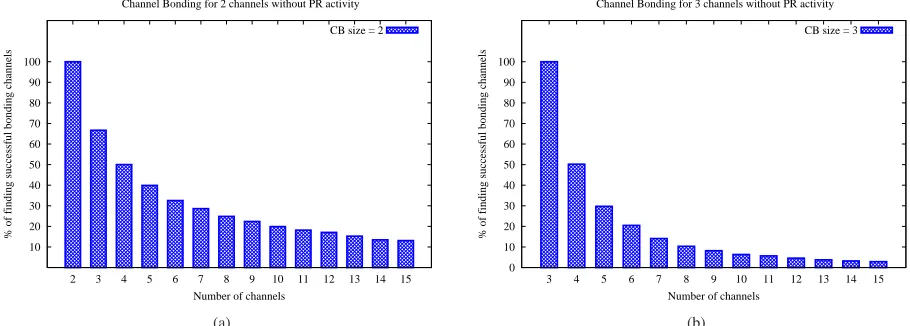
Fig. 1. (a) Obtaining 2 contiguous channels for channel bonding. (b) Obtaining 3 contiguous channels for channel bonding.
A. Modification in NS-2
We have chosen CRCN patch [51] in NS-2 to simulate our CRSN scenario. To simulate PRACB in NS-2, there are certain modifications required. CRCN patch in NS-2 does not consider PR activity hence it is required that first PR activity should be introduced so that CR nodes should be able to utilize only those channels which are free from PR nodes. By introducing PR activity, the harmful interference with PR nodes can be significantly reduced. After introducing PR activity, we added multiple channels support so that a CR node should be capable of realizing advantages of DSA and utilizing multiple channels for the purpose of channel bonding. As CRCN patch is designed for cognitive radio nodes so to implement it in CRSN scenario we added energy consumption module so that sensor nodes should be capable of monitoring and conserving their power.
B. Simulation Results
We have performed extensive simulations in NS-2 and for comparison purpose, we have performed simulations for two kinds of schemes. We have compared our proposed scheme with sample width algorithm (SWA) [21]. The concept of SWA for CB is similar with scheme discussed in [18] so we have selected SWA as a base case. SWA does not consider any PR activity and performs channel bonding by changing channel width whenever required.
We have used aodv protocol at network layer and maccon protocol at link layer. We have increased the total number of channels from 2 to 15 and run our simulation for 10000 seconds. By these parameters, we have calculated harmful interference ratio (HIR) with PR nodes, the results revealed that PRACB out marked the other scheme and minimum HIR occurred with PR nodes when using PRACB.
Let “T” is total number of times channel is occupied by PR nodes, “D” is total number of packets dropped due to PR activity and “N” is total number of times channel decision occur. Then the harmful interference (HIR) can be calculated as:
HIR=T−D
N (2)
The delivery ratio (DR) is an important performance metric which estimates that how many transmitted packets reach the destination node. Let, “R” is the total number of packets received on selected bonded channel and “S” be the total number of packets sent then The delivery ratio (DR) can be calculated as:
DR= R
S (3)
C. Channel Bonding for 2 Contiguous Channels
In Fig. 1(a), we have set the value of bond size as 2. There are total 15 available channels and out of these 15 channels, we select 2 channels randomly for each case. When there are 2 channels, there is 100% occurrence of finding contiguous channels as there is no third channel and all two channels are contiguous. We have formulated our design in such a way that it does not selects a channel twice. When channels are increased gradually, the percentage of finding contiguous channels decreases as there exist non-contiguous channels in the same set. When there are 15 channels, the percentage of finding contiguous channels decreases to 13%. It means as we increase the number of channels, the chances of obtaining contiguous channels decrease.
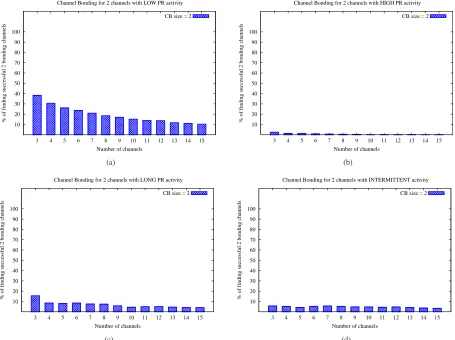
When PR activity has been added to PRACB algorithm, the number of contiguous channels decrease. This is due to the reason that PRACB selects only those channels which are free from PR activity. As shown in Fig. 2(a), the percentage of finding contiguous channels is high with less number of channels whereas we increase the number of channels, the probability decreases. The behavior of high PR activity can be seen in Fig. 2(b), where we get very less probability of contiguous channels for bonding. The effect of long and intermittent PR activity can be seen in Fig. 2(c) and 2(d) respectively.
10 20 30 40 50 60 70 80 90 100
3 4 5 6 7 8 9 10 11 12 13 14 15
% of finding successful 2 bonding channels
Number of channels
Channel Bonding for 2 channels with LOW PR activity CB size = 2
(a)
10 20 30 40 50 60 70 80 90 100
3 4 5 6 7 8 9 10 11 12 13 14 15
% of finding successful 2 bonding channels
Number of channels
Channel Bonding for 2 channels with HIGH PR activity CB size = 2
(b)
10 20 30 40 50 60 70 80 90 100
3 4 5 6 7 8 9 10 11 12 13 14 15
% of finding successful 2 bonding channels
Number of channels
Channel Bonding for 2 channels with LONG PR activity CB size = 2
(c)
10 20 30 40 50 60 70 80 90 100
3 4 5 6 7 8 9 10 11 12 13 14 15
% of finding successful 2 bonding channels
Number of channels
Channel Bonding for 2 channels with INTERMITTENT activity CB size = 2
[image:7.612.75.530.59.399.2](d)
Fig. 2. Obtaining 2 contiguous channels for channel bonding with: (a) Low PR Activity. (b) High PR Activity. (c) Long PR Activity. (d) Intermittent PR Activity.
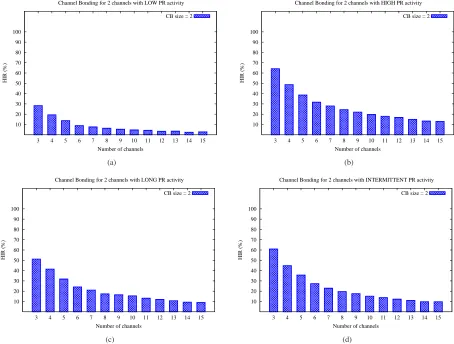
increases when high PR activity (Fig. 3(b)) is present over the network. The effect of HIR can also be observed with long and intermittent PR activities in Fig. 3(c) and 3(d) respectively.
D. Channel Bonding for 3 Contiguous Channels
When we increase the bond size as 3, we get all contiguous channels when there are total 3 channels in the available channel set as shown in Fig. 1(b). This is due to the fact that PR activity is not present over the network and all three channels which are contiguous as well get selected for bonding. However, when channels are increases in available channel set, the occurrence of contiguous channels decreases. It means that a big set of contiguous channels is difficult to find from multiple available channels.
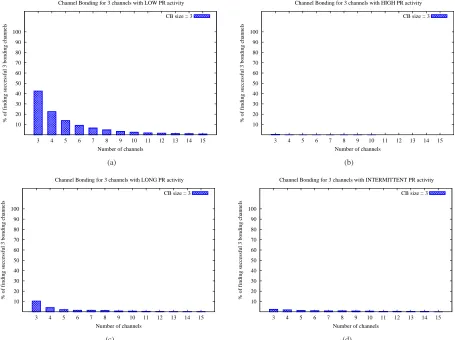
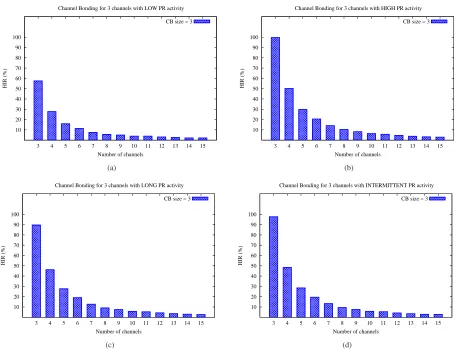
When CB size has been selected as 3 in presence of PR activity, the percentage of finding 3 contiguous channels for bonding decreases. It is due to the fact that low PR activity (Fig. 4(a)) have its impact over the network and only those channels are selected for bond which are free from PR activity. When the total number of channels is increased, the percentage of contiguous channels further decreases due to the reason that it is difficult to find contiguous channels from larger set of channels. As high PR activity (Fig. 4(b)) is introduced, the percentage of finding 3 contiguous channels diminishes due to all the channels occupied by PR node. Hence high PR activity is not suitable for channel bonding. The long PR activity (as
shown in Fig. 4(c)) has mild behavior for channel bonding whereas, the intermittent PR activity has uneven behavior on PRACB algorithm as shown in Fig. 4(d).
The HIR caused when CB size is 3 can be seen in Fig. 5(a) when there is low PR activity present in the network. This HIR has been avoided by performing channel sensing and then selecting only those channels which are free from PR activity. The percentage of HIR increases when there is high PR activity in the network. It can be seen in Fig. 5(b) that almost all channels are occupied when there are total three channels in the network, as number of channels increases the percentage of causing HIR decreases and PRACB algorithm gets opportunity to bond the free channels. The effect of long and intermittent PR activity can also be seen on PRACB algorithm in Fig. 5(c) and 5(d) respectively.
E. Combined Behavior of CB Schemes
10 20 30 40 50 60 70 80 90 100
3 4 5 6 7 8 9 10 11 12 13 14 15
HIR (%)
Number of channels
Channel Bonding for 2 channels with LOW PR activity CB size = 2
(a)
10 20 30 40 50 60 70 80 90 100
3 4 5 6 7 8 9 10 11 12 13 14 15
HIR (%)
Number of channels
Channel Bonding for 2 channels with HIGH PR activity CB size = 2
(b)
10 20 30 40 50 60 70 80 90 100
3 4 5 6 7 8 9 10 11 12 13 14 15
HIR (%)
Number of channels
Channel Bonding for 2 channels with LONG PR activity CB size = 2
(c)
10 20 30 40 50 60 70 80 90 100
3 4 5 6 7 8 9 10 11 12 13 14 15
HIR (%)
Number of channels
Channel Bonding for 2 channels with INTERMITTENT PR activity CB size = 2
[image:8.612.74.528.59.403.2](d)
Fig. 3. Harmful interference avoided for 2 Contiguous channels with: (a) Low PR Activity. (b) High PR Activity. (c) Long PR Activity. (d) Intermittent PR Activity.
selecting bond size as 3, the system gets higher number of 2 contiguous channels as compared to selecting bond size as 2 (Fig. 1(a)). It is due to the reason that when system selects a big set of channels from available channel set, the chances of getting smaller contiguous chunks increases. It is worth mentioning here that Fig. 6 shows results in the absence of PR activity. Next we perform the analysis of this approach in the presence of PR activities.
When we introduce low PR activity in the network (Fig. 7(a)), the number of all contiguous channels decreases due to PR activity. There are no non-contiguous channels when there are total three channels present. When number of total channels is increased, the number of non-contiguous channels increases and contiguous channels decreases. The number of 3 contiguous and 2 contiguous channels have a specific behavior. When there are total three channels, all these are contiguous so all contiguous channels are equal to 3 contiguous channels. When total number of channels is increased, number of 3 contiguous channels decreases and we get more number of 2 contiguous channels as described earlier. The number of 2 contiguous channels also decrease with increase in total chan-nels as all contiguous chanchan-nels are decreasing. The interrupted channels is the case when there is PR activity present on the channels and PRACB does not selects the channels. When total number of channels increase the interrupted channels decrease as there are less chance of presence of PR activity when
contiguous channels are selected from larger set of channels. When high PR activity is present in the network, the number of interrupted channels is so large that it is highly unlikely to find the PR activity free contiguous channels. Hence, when there are total three channels in the network, almost all the channels are interrupted. As the total number of channels is increased, the number of interrupted channels decrease gradually but number of non-contiguous channels increase as shown in Fig. 7(b). Hence, high PR activity is not suitable to perform channel bonding. The effect of long and intermittent PR activity can be observed in Fig. 7(c) and 7(d).
F. Comparison Analysis
We have performed comparison of PRACB and SWA for two performance metrics, i.e. Harmful Interference Ratio (HIR) and Delivery Ratio (DR). We have applied all four PR activities and observed the behavior of both schemes.
Harmful Interference Ratio
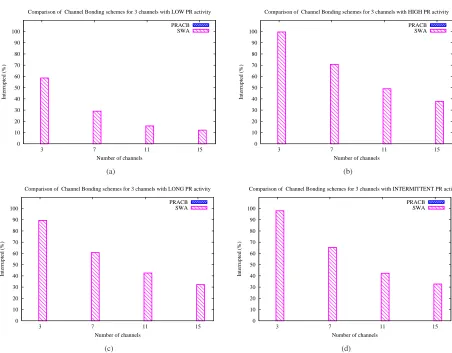
In case of low PR activity (as shown in Fig. 8(a)), SWA selects interrupted channels hence cause HIR. On the other hand, PRACB selects only those contiguous channels which are free from PR activity hence no HIR has been caused and transmission has been occurred successfully.
10 20 30 40 50 60 70 80 90 100
3 4 5 6 7 8 9 10 11 12 13 14 15
% of finding successful 3 bonding channels
Number of channels
Channel Bonding for 3 channels with LOW PR activity CB size = 3
(a)
10 20 30 40 50 60 70 80 90 100
3 4 5 6 7 8 9 10 11 12 13 14 15
% of finding successful 3 bonding channels
Number of channels
Channel Bonding for 3 channels with HIGH PR activity CB size = 3
(b)
10 20 30 40 50 60 70 80 90 100
3 4 5 6 7 8 9 10 11 12 13 14 15
% of finding successful 3 bonding channels
Number of channels
Channel Bonding for 3 channels with LONG PR activity CB size = 3
(c)
10 20 30 40 50 60 70 80 90 100
3 4 5 6 7 8 9 10 11 12 13 14 15
% of finding successful 3 bonding channels
Number of channels
Channel Bonding for 3 channels with INTERMITTENT PR activity CB size = 3
[image:9.612.74.529.59.399.2](d)
Fig. 4. Obtaining 3 contiguous channels for channel bonding with: (a) Low PR Activity. (b) High PR Activity. (c) Long PR Activity. (d) Intermittent PR Activity.
not consider PR activity before channel selection i.e. SWA cause huge HIR where as PRACB efficiently senses the PR activity and avoids HIR as shown in Fig. 8(b). The comparison of both schemes with long and intermittent PR activities has been shown in Fig. 8(c) and 8(d). All these results show that our proposed scheme PRACB has outperformed SWA by effectively avoiding HIR and performing interference free bonding.
Delivery Ratio
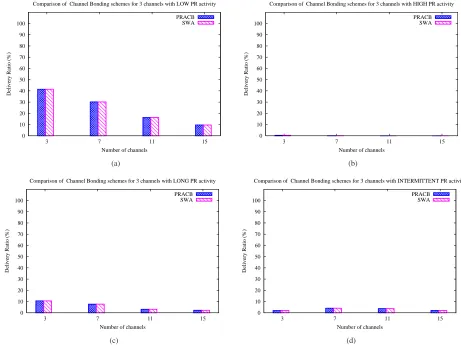
The delivery ratio (DR) also determines the performance of any network. The DR can be observed as how many packets sent from transmitter have been received at the receiver. Here one thing is worth mentioning that receiver is aware of channel selection performed by transmitter through control channel. The receiver tunes its transceiver to the same bonded channel hence receives packets. When there is low PR activity on the network (as shown in [fig:Comparison-of-DR-low]), PRACB selects only those channels which are vacant hence the DR is almost 40% when there are total three channels in the network. It is noticeable that SWA also provides almost same DR but it keeps on transmitting packets without considering PR activity hence, creating almost 60% HIR and gets successful in transmitting the packets for only 40% time when channels were idle. All the interrupted packets are re-transmitted which causes extra traffic in the network.
The delivery ratio diminishes when high PR activity is introduced in the network as depicted in Fig. 9(b). It is due to the reason that almost all the channels are occupied by PR nodes hence PRACB does not selects those channels and keeps the transmitter silent. The SWA performs worse in this case as it causes maximum HIR which in turn causes re-transmission of interrupted packets. The effect of long and intermittent PR activities on DR can be observed in Fig. 9(c) and 9(d) respectively.
V. CONCLUSION ANDFUTUREWORK
In this paper, we have proposed a scheme of channel bonding which utilizes the white spaces hence, satisfies the requirement of CR nodes in CRSN. Extensive simulations show that proposed scheme outperforms by providing PR-CR interference free communication. Our scheme also helps in maintaining the highest possible delivery ratio between two communicating nodes through channel bonding while minimizing the re-transmissions in the network. As plan of our future work, we will use the proposed CB algorithm in conjunction with any routing protocol.
REFERENCES
10 20 30 40 50 60 70 80 90 100
3 4 5 6 7 8 9 10 11 12 13 14 15
HIR (%)
Number of channels
Channel Bonding for 3 channels with LOW PR activity CB size = 3
(a)
10 20 30 40 50 60 70 80 90 100
3 4 5 6 7 8 9 10 11 12 13 14 15
HIR (%)
Number of channels
Channel Bonding for 3 channels with HIGH PR activity CB size = 3
(b)
10 20 30 40 50 60 70 80 90 100
3 4 5 6 7 8 9 10 11 12 13 14 15
HIR (%)
Number of channels
Channel Bonding for 3 channels with LONG PR activity CB size = 3
(c)
10 20 30 40 50 60 70 80 90 100
3 4 5 6 7 8 9 10 11 12 13 14 15
HIR (%)
Number of channels
Channel Bonding for 3 channels with INTERMITTENT PR activity CB size = 3
[image:10.612.74.529.81.430.2](d)
Fig. 5. Harmful interference avoided for 3 Contiguous channels with: (a) Low PR Activity. (b) High PR Activity. (c) Long PR Activity. (d) Intermittent PR Activity.
0 10 20 30 40 50 60 70 80 90 100
All Contiguous All Non-Contiguous 3 Contiguous 2 Contiguous All Contiguous All Non-Contiguous 3 Contiguous 2 Contiguous All Contiguous All Non-Contiguous 3 Contiguous 2 Contiguous All Contiguous All Non-Contiguous 3 Contiguous 2 Contiguous All Contiguous All Non-Contiguous 3 Contiguous 2 Contiguous
% of finding successful bonding channels
3 6 9 12 15 Channel Bonding of 3 channels for all contiguous channels without PR activity
CB size = 3
[image:10.612.179.421.503.670.2]0 10 20 30 40 50 60 70 80 90 100
All Contiguous All Non-Contiguous Interrupted 3 Contiguous 2 Contiguous All Contiguous All Non-Contiguous Interrupted 3 Contiguous 2 Contiguous All Contiguous All Non-Contiguous Interrupted 3 Contiguous 2 Contiguous All Contiguous All Non-Contiguous Interrupted 3 Contiguous 2 Contiguous
% of finding successful bonding channels
3 7 11 15 Channel Bonding of 3 channels for all contiguous channels with LOW PR activity
CB size = 3
(a)
0 10 20 30 40 50 60 70 80 90 100
All Contiguous All Non-Contiguous Interrupted 3 Contiguous 2 Contiguous All Contiguous All Non-Contiguous Interrupted 3 Contiguous 2 Contiguous All Contiguous All Non-Contiguous Interrupted 3 Contiguous 2 Contiguous All Contiguous All Non-Contiguous Interrupted 3 Contiguous 2 Contiguous
% of finding successful bonding channels
3 7 11 15 Channel Bonding of 3 channels for all contiguous channels with HIGH PR activity
CB size = 3
(b)
0 10 20 30 40 50 60 70 80 90 100
All Contiguous All Non-Contiguous Interrupted 3 Contiguous 2 Contiguous All Contiguous All Non-Contiguous Interrupted 3 Contiguous 2 Contiguous All Contiguous All Non-Contiguous Interrupted 3 Contiguous 2 Contiguous All Contiguous All Non-Contiguous Interrupted 3 Contiguous 2 Contiguous
% of finding successful bonding channels
3 7 11 15 Channel Bonding of 3 channels for all contiguous channels with LONG PR activity
CB size = 3
(c)
0 10 20 30 40 50 60 70 80 90 100
All Contiguous All Non-Contiguous Interrupted 3 Contiguous 2 Contiguous All Contiguous All Non-Contiguous Interrupted 3 Contiguous 2 Contiguous All Contiguous All Non-Contiguous Interrupted 3 Contiguous 2 Contiguous All Contiguous All Non-Contiguous Interrupted 3 Contiguous 2 Contiguous
% of finding successful bonding channels
3 7 11 15
Channel Bonding of 3 channels for all contiguous channels with INTERMITTENT PR activity CB size = 3
[image:11.612.77.532.52.401.2](d)
Fig. 7. Overview of all contiguous channels for channel bonding with: (a) Low PR Activity. (b) High PR Activity. (c) Long PR Activity. (d) Intermittent PR Activity.
[2] I. F. Akyildiz, W. Lee, M. C. Vuran, and S. Mohanty, “A survey on spec-trum management in cognitive radio networks,”IEEE Communication Magazine, pp. 40–48, 2008.
[3] A. M. Kavi K. Khedo, Rajiv Perseedoss, “A wireless sensor network air pollution monitoring system,”International Journal of Wireless & Mobile Networks, vol. Vol. 2, No. 2, pp. 31–45, 2010.
[4] B. Rashid and M. H. Rehmani, “Applications of wireless sensor net-works for urban areas: a survey,” Journal of Network and Computer Applications, vol. 60, pp. 192–219, 2016.
[5] M. Z. A. Bhuiyan, G. Wang, and A. V. Vasilakos, “Local area prediction-based mobile target tracking in wireless sensor networks,”IEEE Trans-actions on Computers, vol. 64, no. 7, pp. 1968–1982, 2015.
[6] J. Yick, B. Mukherjee, and D. Ghosal, “Wireless sensor network survey,”
Computer networks, vol. 52, no. 12, pp. 2292–2330, 2008.
[7] I. F. Akyildiz, W. Su, Y. Sankarasubramaniam, and E. Cayirci, “Wireless sensor networks: a survey,”Computer Networks, vol. Vol. 38, No. 4, pp. 393–422, 2002.
[8] O. B. Akan, O. B. Karli, and O. Ergul, “Cognitive radio sensor networks,”IEEE Network, vol. Vol. 23, No. 4, pp. 34–40, 2009. [9] A. Ahmad, S. Ahmad, M. H. Rehmani, and N. U. Hassan, “A survey
on radio resource allocation in cognitive radio sensor networks,”IEEE Communications Surveys & Tutorials, vol. Vol. 17, No. 2, pp. 888–917, 2015.
[10] Y. Saleem and M. H. Rehmani,Cognitive Radio Sensor Networks. IGI-Global, 2015.
[11] I. F. Akyildiz, B. F. Lo, and R. Balakrishnan, “Cooperative spectrum sensing in cognitive radio networks: A survey,”Physical communication, vol. 4, no. 1, pp. 40–62, 2011.
[12] S. Pollin,Cognitive Wireless Communication Networks. Springer, 2007, ch. Coexistence and Dynamic Sharing in Cognitive Radio Networks, pp. pp. 79–113.
[13] Y. Rui, P. Cheng, M. Li, Q. T. Zhang, and M. Guizani, “Carrier aggregation for lte-advanced: uplink multiple access and transmission enhancement features,” IEEE Wireless Communications, vol. Vol. 20, No. 4, pp. 101–108, 2013.
[14] H. Lee, S. Vahid, and K. Moessner, “A survey of radio resource manage-ment for spectrum aggregation in lte-advanced,”IEEE Communications Surveys & Tutorials, vol. Vol. 16, No. 2, pp. 745–760, 2014. [15] Z. Khan, H. Ahmadi, E. Hossain, M. Coupechoux, L. A. DaSilva, and
J. J. Lehtomaki, “Carrier aggregation/channel bonding in next generation cellular networks: Methods and challenges,”IEEE Network, vol. Vol. 28, No. 6, pp. 34–40, 2014.
[16] D. J. Schmidt, “Cellular channel bonding for improved data transmis-sion,” United States Patent Patent US 7 020 472 B2, 2006.
[17] Y. Lu, H. He, J. Wang, and S. Li, “Opportunistic spectrum access with channel bonding,” inFourth International Conference on Communica-tions and Networking in China, 2009, pp. 1 – 5.
[18] L. Deek, E. Garcia-Villegas, E. Belding, S.-J. Lee, and K. Almeroth, “The impact of channel bonding on 802.11n network management,” in Proceedings of the Seventh Conference on emerging Networking Experiments and Technologies, 2011, pp. 1 – 11.
[19] R. Gummadi, R. Patra, H. Balakrishnan, and E. Brewer, “Interference avoidance and control,” inHot Topics in Networks HotNets, 2008, pp. 13 – 18.
[20] T. Moscibroda, R. Chandra, Y. Wu, S. Sengupta, P. Bahl, and Y. Yuan, “Load-aware spectrum distribution in wireless lans,” in International Conference on Network Protocols, 2008, pp. 137 – 146.
[21] R. Chandra, R. Mahajan, J. Moscibroda, R. Raghavendra, and P. Bahl, “A case for adapting channel width in wireless networks,”ACM SIGCOMM Computer Communication Review, vol. Vol. 38, No. 4, pp. 135–146, 2008.
[22] H. S. Chiu, K. L. Yeung, and K.-S. Lui, “J-car : An efficient joint channel assignment and routing protocol for ieee 802.11-based multi-channel multi-interface mobile ad hoc networks,”IEEE Transaction on Wireless Communications, vol. Vol. 8, No. 4, pp. 1706–1715, 2009. [23] P. Steenkiste, D. Sicker, G. Minden, and D. Raychaudri, “Future
direc-tions in cognitive radio network research,” National Science Foundation Workshop Report, Tech. Rep. Vol. 4, No. 1, 2009.
0 10 20 30 40 50 60 70 80 90 100
3 7 11 15
Interrupted (%)
Number of channels
Comparison of Channel Bonding schemes for 3 channels with LOW PR activity PRACB
SWA
(a)
0 10 20 30 40 50 60 70 80 90 100
3 7 11 15
Interrupted (%)
Number of channels
Comparison of Channel Bonding schemes for 3 channels with HIGH PR activity PRACB
SWA
(b)
0 10 20 30 40 50 60 70 80 90 100
3 7 11 15
Interrupted (%)
Number of channels
Comparison of Channel Bonding schemes for 3 channels with LONG PR activity PRACB
SWA
(c)
0 10 20 30 40 50 60 70 80 90 100
3 7 11 15
Interrupted (%)
Number of channels
Comparison of Channel Bonding schemes for 3 channels with INTERMITTENT PR activity PRACB
SWA
[image:12.612.75.527.50.403.2](d)
Fig. 8. Comparison of Channel Bonding schemes for HIR with: (a) Low PR Activity. (b) High PR Activity. (c) Long PR Activity. (d) Intermittent PR Activity.
[25] S. Joshi, P. Pawelczak, D. Cabric, and J. Villasenor, “When channel bonding is beneficial for opportunistic spectrum access networks,”IEEE Transactions on Wireless Communications, vol. Vol. 11, No. 11, pp. 3942–3956, 2012.
[26] H. B. Salameh, M. Krunz, and D. Manzi, “Spectrum bonding and aggregation with guard-band awareness in cognitive radio networks,”
IEEE Transactions on Mobile Computing, vol. Vol. 13, No. 3, pp. 569 – 581, 2013.
[27] L. Xu, K. Yamamoto, and S. Yoshida, “Performance comparison be-tween channel-bonding and multi-channel csma,” inWireless Commu-nication and Networking Conference, 2007, pp. 406 – 410.
[28] H. Rahul, N. Kushman, D. Katabi, C. Sodini, and F. Edalat, “Learning to share: Narrowband-friendly wideband networks,”Computer Commu-nication Review, vol. Vol. 38, No. 4, pp. 147–158, 2008.
[29] I. F. Akyildiz, T. Melodia, and K. R. Chowdury, “Wireless multimedia sensor networks: A survey,”IEEE Wireless Communications, vol. 14, no. 6, pp. 32–39, 2007.
[30] M. H. Rehmani, S. Lohier, and A. Rachedi, “Channel bonding in cogni-tive radio wireless sensor networks,” inIEEE International Conference on Selected Topics in Mobile and Wireless Networking (iCOST), 2012, pp. pp. 72 – 76.
[31] Z. Lin, M. Ghosh, and A. Demir, “A comparison of mac aggregation vs. phy bonding for wlans in tv white spaces,” in24th International Symposium on Personal, Indoor and Mobile Radio Communications: MAC and Cross-Layer Design Track, 2013, pp. 1829 – 1834. [32] S. H. R. Bukhari, M. H. Rehmani, and S. Siraj, “A survey of channel
bonding for wireless networks and guidelines of channel bonding for futuristic cognitive radio sensor networks,”IEEE Communications Surveys & Tutorials, vol. 18, no. 2, pp. 924–948, 2016.
[33] V. Valenta, R. Marsalek, G. Baudoin, M. Villegas, and F. Robert, “Survey on spectrum utilization in europe: Measurements, analyses and observations,” in5th International Conference on Cognitive Radio Oriented Wireless Networks and Communications, 2010, pp. pp. 1 – 5. [34] S. Anand, S. Sengupta, K. Hong, K. P. S. Subbalakshmi, R. M. Chandramouli, and H. Cam, “Exploiting channel fragmentation and
ag-gregation/bonding to create security vulnerabilities,”IEEE Transactions on Vehicular Technology, vol. Vol. 63, No. 8, pp. 3867–3874, 2014. [35] V. Gardellin, S. K. Das, and L. Lenzini, “Self-coexistence in cellular
cognitive radio networks based on the ieee 802.22 standard,” IEEE Wireless Communications, vol. 20, no. 2, pp. 52–59, 2013.
[36] L. Deek, E. Garcia-Villegas, E. Belding, S.-J. Lee, and K. Almeroth, “Intelligent channel bonding in 802.11n wlans,”IEEE Transactions on Mobile Computing, vol. Vol. 13, No. 6, pp. 1242–1255, 2014. [37] S.-H. Kim and Y.-B. Ko, “Wireless bonding for maximizing throughput
in multi-radio mesh networks,” inInternational Conference on Pervasive Computing and Communications Workshops (PerComW’07), 2007, pp. 570 – 576.
[38] L. Jiao, V. Pla, and F. Y. Li, “Analysis on channel bonding/aggregation for multi-channel cognitive radio networks,” in European Wireless Conference, 2010, pp. pp. 468–474.
[39] O. D. Incel, “A survey on multi-channel communication in wireless sensor networks,”Computer Networks, vol. Vol. 55, No. 13, pp. 3081 – 3099, 2011.
[40] G. Yuan, R. Grammenos, Y. Yang, and W. Wang, “Performance analysis of selective opportunistic spectrum access with traffic prediction,”IEEE Transactions on Vehicular Technology, vol. 59, pp. 1949–1959, 2010. [41] A. Min and K. Shin, “Exploiting multi channel diversity in spectrum
agile networks,” inINFOCOM, 2008.
[42] H. Kim and K. Shin, “Fast discovery of spectrum opportunities in cognitive radio networks,” inIEEE DySPAN, 2008.
[43] O. Mehanna, A. Sultan, and H. Gamal, “Cognitive mac protocols for general primary network models,” Cornell University, Tech. Rep., 2009. [44] A. Zahmati, X. Fernando, and A. Grami, “Steady-state markov chain analysis for heterogeneous cognitive radio networks,” inSarnoff, 2010. [45] L. Yang, L. Cao, and H. Zheng, “Proactive channel access in dynamic spectrum networks,”Physical Communications Journal, vol. 1, pp. 103– 111, 2008.
0 10 20 30 40 50 60 70 80 90 100
3 7 11 15
Delivery Ratio (%)
Number of channels
Comparison of Channel Bonding schemes for 3 channels with LOW PR activity PRACB
SWA
(a)
0 10 20 30 40 50 60 70 80 90 100
3 7 11 15
Delivery Ratio (%)
Number of channels
Comparison of Channel Bonding schemes for 3 channels with HIGH PR activity PRACB
SWA
(b)
0 10 20 30 40 50 60 70 80 90 100
3 7 11 15
Delivery Ratio (%)
Number of channels
Comparison of Channel Bonding schemes for 3 channels with LONG PR activity PRACB
SWA
(c)
0 10 20 30 40 50 60 70 80 90 100
3 7 11 15
Delivery Ratio (%)
Number of channels
Comparison of Channel Bonding schemes for 3 channels with INTERMITTENT PR activity PRACB
SWA
(d)
Fig. 9. Comparison of Channel Bonding schemes for DR with: (a) Low PR Activity. (b) High PR Activity. (c) Long PR Activity. (d) Intermittent PR Activity.
[47] B. Vujicic, N. Cackov, S. Vujicic, and L. Trajkovic, “Modeling and char-acterization of traffic in public safety wireless networks,” inSPECTS, 2005.
[image:13.612.70.531.58.404.2][48] H. Kim and K. Shin, “Efficient discovery of spectrum opportunities with mac layer sensing in cognitive radio networks,”IEEE Transactions on Mobile Computing, vol. 7, pp. 533–545, 2008.
[49] K. Sriram and W. Whitt, “Characterizing superposition arrival processes in packet multiplexers for voice and data,”IEEE Journal on Selected Areas in Communications, vol. Vol. 4, No. 6, pp. 833–846, 1986. [50] M. H. Rehmani, A. C. Viana, H. Khalife, and S. Fdida, “SURF: A
distributed channel selection strategy for data dissemination in multi-hop cognitive radio networks,”Computer Communications, vol. Vol. 36, No. 10, pp. 1172–1185, 2013.
[51] “Cognitive radio cognitive network simulator,” 2013. [Online]. Avail-able: http://faculty.uml.edu/TriciaChigan/Research/CRCNSimulator.htm
APPENDIX
Ch 0 Ch 1 Ch 2 Ch 3 Ch 4 Ch 5 Ch 6 Ch 7 Ch 8 Ch 9 Ch 10 Ch 11 Ch 12 Ch 13 Ch 14 TON 0.83 0.77 0.42 0.31 0.53 0.27 0.36 0.2 0.26 0.24 0.13 0.15 0.18 0.48 0.3
TOF F 2.5 1.11 10.0 1.67 3.33 10.0 4.0 9.09 3.45 2.08 5.26 3.7 1.0 1.61 2.63
λX 1.20 1.29 2.38 3.22 1.88 3.70 2.77 5 3.84 4.16 7.69 6.66 5.55 2.08 3.33
λY 0.4 0.90 0.1 0.59 0.30 0.1 0.25 0.11 0.28 0.48 0.19 0.27 1 0.62 0.38
µi 0.24 0.40 0.04 0.15 0.13 0.02 0.08 0.02 0.07 0.10 0.02 0.03 0.15 0.22 0.10
TABLE III
WIRELESSCHANNELPARAMETERS USED IN SIMULATION(LOWPR ACTIVITY)
Ch 0 Ch 1 Ch 2 Ch 3 Ch 4 Ch 5 Ch 6 Ch 7 Ch 8 Ch 9 Ch 10 Ch 11 Ch 12 Ch 13 Ch 14 TON 3.33 1.11 10.0 5.0 2.5 1.67 2.86 5.56 5.88 4.35 1.85 1.3 1.0 1.23 2.38
TOF F 0.83 0.77 0.42 0.31 0.53 0.27 0.36 0.2 0.26 0.24 0.13 0.15 0.18 0.48 0.3
λX 0.30 0.90 0.1 0.2 0.4 0.59 0.34 0.17 0.17 0.22 0.54 0.76 1 0.81 0.42
λY 1.20 1.29 2.38 3.22 1.88 3.70 2.77 5 3.84 4.16 7.69 6.66 5.55 2.08 3.33
µi 0.80 0.59 0.95 0.94 0.82 0.86 0.88 0.96 0.95 0.94 0.93 0.89 0.84 0.71 0.88
TABLE IV
WIRELESSCHANNELPARAMETERS USED IN SIMULATION(HIGHPR ACTIVITY)
Ch 0 Ch 1 Ch 2 Ch 3 Ch 4 Ch 5 Ch 6 Ch 7 Ch 8 Ch 9 Ch 10 Ch 11 Ch 12 Ch 13 Ch 14 TON 3.33 1.11 10.0 5.0 2.5 1.67 2.86 5.56 5.88 4.35 1.85 1.3 1.0 1.23 2.38
TOF F 2.5 1.11 10.0 1.67 3.33 10.0 4.0 9.09 3.45 2.08 5.26 3.7 1.0 1.61 2.63
λX 0.30 0.90 0.1 0.2 0.4 0.59 0.34 0.17 0.17 0.22 0.54 0.76 1 0.81 0.42
λY 0.4 0.90 0.1 0.59 0.30 0.1 0.25 0.11 0.28 0.48 0.19 0.27 1 0.62 0.38
µi 0.57 0.5 0.5 0.74 0.42 0.14 0.41 0.37 0.63 0.67 0.26 0.26 0.5 0.43 0.47
TABLE V
WIRELESSCHANNELPARAMETERS USED IN SIMULATION(LONGPR ACTIVITY)
Ch 0 Ch 1 Ch 2 Ch 3 Ch 4 Ch 5 Ch 6 Ch 7 Ch 8 Ch 9 Ch 10 Ch 11 Ch 12 Ch 13 Ch 14 TON 0.83 0.77 0.42 0.31 0.53 0.27 0.36 0.2 0.26 0.24 0.13 0.15 0.18 0.48 0.3
TOF F 0.27 0.36 0.2 0.26 0.24 0.83 0.77 0.42 0.31 0.53 0.4 0.29 0.15 0.53 0.2
λX 1.20 1.29 2.38 3.22 1.88 3.70 2.77 5 3.84 4.16 7.69 6.66 5.55 2.08 3.33
λY 3.70 2.77 5 3.84 4.16 1.20 1.29 2.38 3.22 1.88 2.5 3.44 6.66 1.88 5
µi 0.75 0.68 0.67 0.54 0.68 0.24 0.31 0.32 0.45 0.31 0.24 0.34 0.54 0.47 0.6
TABLE VI
[image:13.612.45.568.409.729.2]