Int. J. Electrochem. Sci., 8 (2013) 5191 - 5202
International Journal of
ELECTROCHEMICAL
SCIENCE
www.electrochemsci.orgA Study of Low Temperature and Low Stress Electroless
Copper Plating Bath
Li-Sha Li, Xi-Rong Li, Wen-Xia Zhao, Qian Ma, Xu-Bin Lu, Zeng-Lin Wang*
Key Laboratory of Applied Surface and Colloid Chemistry (Shaanxi Normal University), Ministry of Education, School of Chemistry and Chemical Engineering, Xi’an, 710062, People’s Rep. China
*
E-mail: [email protected]
Received: 28 January 2013 / Accepted: 7 March 2013 / Published: 1 April 2013
To meet the requirement of PCB copper interconnection, a low temperature and low stress electroless copper plating bath containing Cu(II)-Rochell salt as complex was investigated. The effects of additives, such as 2,6-diaminopyridine as accelerator, 2,2'-dipyridyl as stabilizer, NiSO4∙6H2O as
stress-relief agent and sodium dodecyl sulfate as surfactant, on the deposition rate, deposited copper microstructure and surface morphology were investigated by deposition rate measurement and surface SEM observation. Though the deposition rate of electroless copper solution was accelerated by 2,6-diaminopyridine addition and was inhibited by 2,2'-dipyridyl addition, it reached 3.45 μm·h-1 at 33 °C with the composite addition of the four additives, and the deposited copper film also became smooth and uniform. The effects of additives on the polarization behaviors of the electroless copper plating bath were investigated by the linear sweep voltammetry method and mixed potential theory. The internal stresses of copper films were measured by XRD analysis method using the (220) and (311) peaks. The internal stresses of deposited copper film on the (220) and (311) crystal planes were decreased from -164.49 and -122.34 MPa to -16.50 and -31.00 MPa with an addition of 15.0 mg·L-1 NiSO4·6H2O, and the adhesion strength between the substrate and electroless copper film was also
increased from 0.84 to 1.12 kN·m-1
. Finally, a low temperature and low stress electroless copper plating bath was obtained.
Keywords: electroless copper film; low stress; additives; adhesion strength; deposition rate
1. INTRODUCTION
required to have finer and thinner PCB substrates for the high integrated electronic devices [2]. With the further finer and thinner of the copper interconnection, a high surface roughness of the substrate leads to a dramatic attenuation for the high-frequency signal [3]. In order to assure the adhesive strength at the same time reduce the attenuation for the high-frequency signal, a low stress electroless copper plating bath became very essential.
Intrinsic stress of deposited copper film was influenced by the composition and the operation conditions of the electroless copper solution. Hsu and Chen reported that additive saccharin relieved the stress of electroless Ni-Cu-P deposit on Al foil [4, 5]. Kobayashi et al. demonstrated that the adhesion between epoxy resin and electroless copper was enhanced by an addition of sodium sulfide or triazine dithiole [6]. Seo and Bamberg reported that the strain of copper film could be weakened with an addition of nickel [7, 8]. However, there has no literature to report about low temperature and low stress electroless copper solution.
In order to obtain stable electroless copper solution, 2,2'-dipyridyl was usual used as the stabilizer to prevent spontaneous decomposition of the bath. However, the deposition rate of electroless copper solution decreased significantly with an addition of 2,2'-dipyridyl. Then the synergistic effects of accelerator 2,6-diaminopyridine with 2,2'-dipyridyl on the deposition rate and the stability of electroless copper solution were investigated. And the effects of surfactant SDS and NiSO4·6H2O on the surface morphology and stress of deposited Cu film were studied.
2. EXPERMENTAL PART
The ABS substrates with a thickness of 1.0 mm and an area of 40×25 mm were used in all experiments. First, the ABS substrates were pretreated by the degreasing and swelling processes [9]. Then the etching process, neutralizing process, sensitization process and activation process were carried according to our previous researches [10]. Distilled water was used to wash the substrates after every step.
The composition of electroless copper plating solution was CuSO4·5H2O (10.0 g·L-1) as a
copper ion source, NaKC4H4O6·4H2O (28.25 g·L-1) as a complexing agent, HCHO (5 mL·L-1) as a
reducing agent, 2,6-diaminopyridine as the accelerator, 2,2'-dipyridyl as the stabilizer, NiSO4∙6H2O as
the stress-relief agent and SDS as the surface activator. The pH of the plating bath was adjusted to 12.5 using NaOH solution, and the bath temperature was maintained at 33 °C.
The linear sweep voltammetry (LSV) was used to depict the effects of additives on the oxidation of HCHO and reduction of copper ions. The measurement method was carried according to literature [10]. The X-ray diffractometer (XRD) was used to measure and analyze the internal stress of the electroless copper films [11, 12]. A Cu target with a wave length of 0.1506 nm was used as the X-ray radiator. The particular (h k l) planes of deposited copper films were scanned at 4 °·min-1 and the degree increment were 0.1 °. The working voltage and current were 40 kV and 40 mA, respectively. The 2θψ-sin2ψ method was applied for the internal stress evaluation [13] and the diffracted peaks (220)
The adhesion strength between film and substrate was measured using a 90 º peel test at a peel rate of 25 mm·min-1 [14]. The microstructure and surface morphology of samples were characterized by scanning electron microscope (SEM).
3. RESULTS AND DISCUSSION
3.1Synergistic effect of additives on the deposition rate and surface morphology of deposited copper films
The electroless copper bath is usual easy to be decomposed without a stabilizer addition, but the addition of the stabilizer would lead to a significant decrease of the deposition rate. In order to improve the stability of electroless copper solution at the same time maintain a high deposition rate at low bath temperature, a accelerator should not only accelerate electroless copper deposition, but also have a better synergistic effect with stabilizer to inhibit a significant decrease of the deposition rate. And so, the synergy effects of some accelerators such as 8-hydroxy-7-iodo-5-quinoline sulfonic acid, 2-mercaptobenzothiazole, 2,6-diaminopyridine, triethanolamine, and bis-3-sulfopropyl-disulfide and inhibitors such as 2,2'-dipyridyl, K4[Fe(CN)4] on the deposition rate were first investigated [10, 15-19].
And the better synergy effect only between 2,6-diaminopyridine and 2,2'-dipyridyl on the deposition rate of electroless copper solution was obtained.
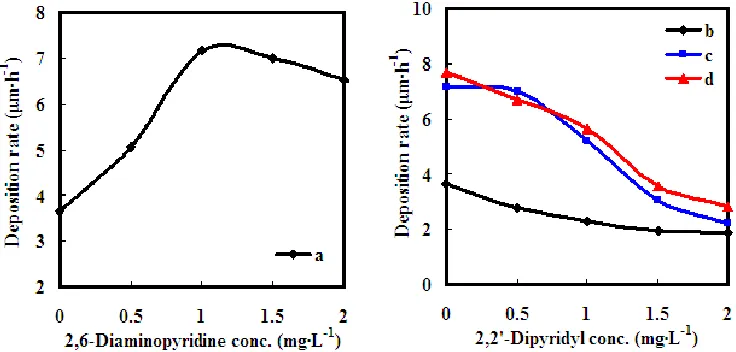
As shown in Fig.1, the deposition reaction in the electrolyte was inhibited by an addition of 2,2'-dipyridyl, but was accelerated by an addition of 2,6-diaminopyridine.
[image:3.596.115.483.461.637.2]
Figure 1. Effects of additives on the deposition rate of the electroless copper plating solution. (a) 2,6-diaminopyridine; (b) 2,2'-dipyridyl; (c) 2,2'-dipyridyl with 1.0 mg·L-1 2,6-diaminopyridine; (d) 2,2'-dipyridyl with 1.0 mg·L-1 2,6-diaminopyridine and 15.0 mg·L-1 NiSO4·6H2O.
with alone addition 1.5 mg·L-1 2,2'-dipyridyl (Fig.1b). However, when 2,6-diaminopyridine concentration was 1.0 mg·L-1, the deposition rate of electroless copper solution decreased from 7.16 to 3.03 μm·h-1 with an addition of 1.5 mg·L-1 2,2'-dipyridyl (Fig.1c), which indicated a better synergistic effect between 2,6-diaminopyridine and 2,2'-dipyridyl on inhibiting the significant decrease of the deposition rate caused by alone addition 2,2'-dipyridyl. Not only the deposition rate of electroless copper solution was increased to some extent, but also the stability of the electroless copper solution and the surface morphology of the deposited copper films were improved with the two additives addition.
To decrease deposited copper film stress, NiSO4·6H2O as stress-relieving agent was added to
the electroless copper solution. And it was found that the deposition rate of electroless copper solution increased slightly with an alone addition of NiSO4·6H2O or combing with 2,6-diaminopyridine and
2,2'-dipyridyl (Fig.1d).
Figure 2. SEM images of deposited copper films in the baths with different additives: (a) additive-free; (b) 1.0 mg·L-1
2,6-diaminopyridine; (c) 1.5 mg·L-1 2,2'-dipyridyl; (d) 15.0 mg·L-1 NiSO4·6H2O; (e) 4.0 mg·L-1 SDS; (f) 1.0 mg·L-1 2,6-diaminopyridine and 1.5 mg·L-1
2,2'-dipyridyl; (g) 1.0 mg·L-1
2,6-diaminopyridine, 1.5 mg·L-1 2,2'-dipyridyl and 15.0 mg·L-1 NiSO4·6H2O; (h) 1.0 mg·L-1 2,6-diaminopyridine, 1.5 mg·L-1 2,2'-dipyridyl, 15.0 mg·L-1
[image:4.596.123.478.302.658.2]
Hydrogen gas trapped in the deposit is a major cause of blister formation, which evolves inevitably during electroless Cu deposition. SDS as surfactant was used to decrease the surface tension of the electroless copper solution and eliminate hydrogen bubbles formed on the surface of electroless Cu film by the reducing agent dehydrogenation reaction [20]. Furthermore, the deposition rate of electroless copper solution did not change apparently no matter if the SDS was added alone or combining with other additives.
Fig.2 represented the surface morphology of the deposited copper films obtained at different composition of additives. The surface morphology of the deposited copper film in the basic bath exhibited rough (see Fig.2a). With an alone addition of the additives, the surface morphology of the deposited copper films were same as that in the basic bath (see Fig.2b-2e), which indicated that the surface morphology of the copper films could not be improved by an alone addition of the additives. However, when 1.0 mg·L-1 2,6-diaminopyridine and 1.5 mg·L-1 2,2'-dipyridyl were added to the electroless copper solution, the surface morphology of deposited copper film was ameliorated to some extent (see Fig.2f). Further, when 1.0 mg·L-1 2,6-diaminopyridine, 1.5 mg·L-1 2,2'-dipyridyl and 15.0 mg·L-1 NiSO4∙6H2O were added to the electroless copper solution, the surface morphology became
smooth and uniform (see Fig.2g). The results indicated that the surface morphology of the copper had not been improved with an addition of any additive alone, but the combination of the above three additives with their optimized concentrations was very conducive to refine the crystalline size and improve the surface morphology of the deposited copper film. When SDS was added to the electroless copper solution combing with the three additives, the topography of the deposited copper film was very smooth and uniform (see Fig.2h). And, the color of the Cu film was changed from dark red to copper-bright color.
3.2 Effects of additives on the oxidation of HCHO and reduction of copper ions.
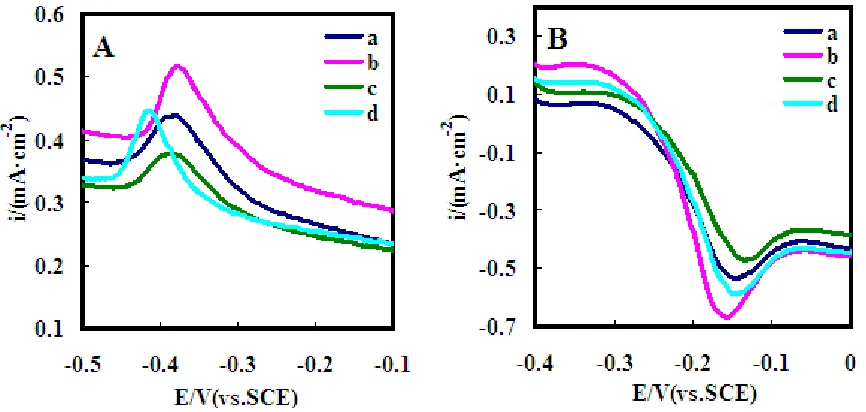
According to the mixed potential theory, the overall reaction of the electroless process was separated into the reduction of copper ions and the oxidation of the reducing agent, and the deposition rate was determined by the two half-reactions on the same electrode. And so, the LSV measurement is useful to understand the effects of additives on the half-reactions in the electrolyte [21, 22]. Fig.3 and Fig.4 showed the LSV for HCHO oxidation and copper ions reduction on the copper electrode in an electrolyte. It was found that the HCHO oxidation peaks occurred at more negative potentials than the copper ions reduction peaks, so the overall reaction of the electroless copper plating process was controlled by current densities of the oxidation and reduction.
Fig.3A(c) and Fig.3B(c)). With an addition of 15.0 mg·L-1 NiSO4·6H2O, the HCHO oxidation peak
shifted from -0.380 to -0.414 V (see Fig.3A(d)), which indicated that reduction capacity of HCHO in the electrolyte could be enhanced by the presence of nickel ions [19, 22]. However, the oxidation peak current and the reduction peak current changed a little with an addition of NiSO4·6H2O, which was in
agreement with the deposition rate measurement.
Figure 3. The effects of additives on the (A) HCHO oxidation polarization, and (B) copper ions reduction polarization behaviors of electroless copper plating solution. (a) additive-free; (b) 1.0 mg·L-1
2,6-diaminopyridine; (c) 1.5 mg·L-1 2,2'-dipyridyl; (d) 15.0 mg·L-1 NiSO4·6H2O.
Figure 4. The effects of additives on the (A) HCHO oxidation polarization, and (B) copper ions reduction polarization behaviors of electroless copper plating solution: (a) 1.0 mg·L-1 2,6-diaminopyridine and 1.5 mg·L-1
2,2'-dipyridyl; (b) 1.0 mg·L-1 2,6-diaminopyridine, 1.5 mg·L-1 2,2'-dipyridyl and 15.0 mg·L-1 NiSO4·6H2O.
[image:6.596.86.519.175.381.2] [image:6.596.89.508.454.656.2]
increased to 0.43 and 0.52 mA·cm-2 (see Fig.4A(a) and Fig.4B(a)), which was higher than that with an alone addition of 2,2'-dipyridyl (0.38 and 0.47 mA·cm-2), and was in agreement with the deposition rate measurement. Further, when 15.0 mg·L-1 NiSO4·6H2O was added to the above mentioned
solution, though the oxidation peak potential was migrated from -0.386 V to -0.400 V, the oxidation peak current and the reduction peak current increased a little (see Fig.4A(b) and Fig.4B(b)), which was consistent with the deposition rate change with the additives.
3.3 Internal stress and adhesion strength measurements of deposited copper film
Internal stresses of the copper films were analyzed using XRD by a 2θψ-sin2ψ method which
was based on the measurement of the shift of a diffraction peak position recorded for different tilt angles ψ, and the angles ψ ranged from 0 ° to 40 ° [13]. The diffraction angle 2θψ on a particular (h k l)
plane was measured as a function of ψ, and the internal stress σ could be calculated from the slope of the 2θψ-sin2ψ curve through the formula as follow:
(1)
Here, θ was the diffraction angle of stress-free Cu film, and E (119×103 MPa) and ν (0.34) were
the Young modulus and Poisson ratio of the Cu film, respectively [23]. Diffraction peaks of different (h k l) planes were decreased with angle ψ due to absorption by the copper films [11]. The higher the diffraction angle 2θ, the more accurate the measurement was [24, 25]. And so, the Cu (220) and Cu (311) crystal planes were chosen to evaluate the internal stresses, whereas the Cu (222) peak was too weak to be used to evaluate stress measurements.
[image:7.596.77.516.481.720.2]
Then when 2,6-diaminopyridine, 2,2'-dipyridyl and SDS concentration were 1.0 mg·L-1, 1.5 mg·L-1, and 4.0 mg·L-1
, the effect of NiSO4·6H2O concentration (0, 5.0, 10.0, 15.0 and 20.0 mg·L-1)
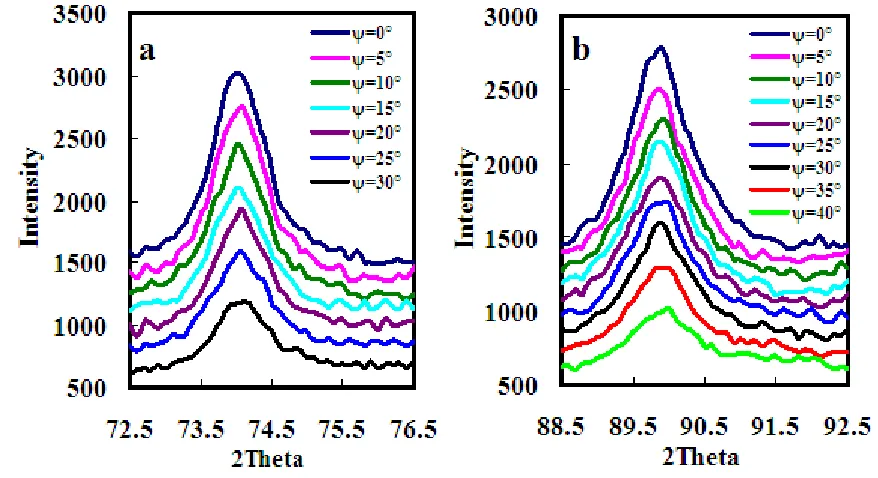
on internal stress of the Cu film was investigated. Fig.5 showed the copper film diffraction peaks of (220) and (311) planes with different angles ψ without NiSO4·6H2O in the electrolyte. Fig.6 showed
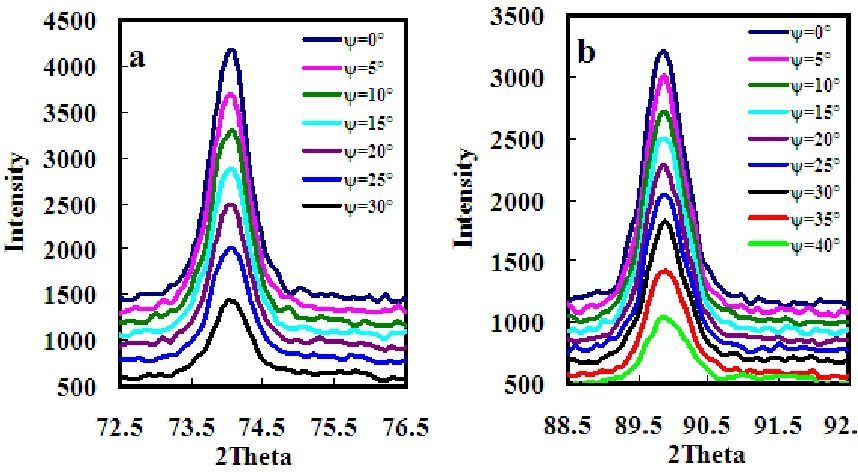
the (220) and (311) diffraction peaks with different angles ψ when NiSO4·6H2O concentration was
15.0 mg·L-1 in the electrolyte.
[image:8.596.82.511.201.437.2]
Figure 6. XRD patterns of the electroless copper film with the angles ψ on the (a) (220) plane, and (b) (311) plane when NiSO4·6H2O concentration in the electrolyte was 15.0 mg·L-1.
From Fig.5 and Fig.6, it was found that the diffraction angles of (220) and (311) planes were shifted with an increase of ψ angle, and the diffraction intensities of (220) and (311) planes decreased with an increase of ψ angle. On the other hand, it was found that the diffraction intensities strengthened significantly with the addition of NiSO4·6H2O, which indicated that NiSO4·6H2O enhanced the
crystallinity of deposited copper film. Taking 2θψ-sin2ψ as ordinate and abscissa axis, the linear
relationship between 2θψ and sin2ψ on the (220) and (311) planes with the NiSO4·6H2O concentrations
were shown in Fig.7 and Fig.8. Then the slopes of 2θψ-sin2ψ straight line with the NiSO4·6H2O
concentrations were obtained by the least square approximation, and the results were listed in Table 1. After putting the slope values of 2θψ-sin2ψ into equation (1), the internal stress values of deposited Cu
films versus the NiSO4·6H2O concentration in the electrolyte were obtained, and the results were listed
Figure 7. The 2θψ-sin2ψ curves of the deposited copper film on the (220) plane with NiSO4·6H2O
[image:9.596.184.414.73.278.2]conc.: (a) 0; (b) 5.0; (c) 10.0; (d) 15.0; (e) 20.0 mg·L-1.
Figure 8. The 2θψ-sin2ψ lines of the deposited copper film on the (311) plane with NiSO4·6H2O conc.:
(a) 0 ; (b) 5.0; (c) 10.0; (d) 15.0; (e) 20.0 mg·L-1.
Table 1. The slopes of the 2θψ-sin2ψ lines for deposited copper films on the (220) and (311) planes
with the NiSO4·6H2O concentration.
NiSO4·6H2O conc. ( mg·L-1 )
0.0 5.0 10.0 15.0 20.0
the slope on the (220) plane
0.16 0.10 0.10 0.02 0.03
the slope on the (311) plane
[image:9.596.181.416.338.541.2] [image:9.596.149.452.655.765.2]
From the Table 2, it was found that the internal stress value of the deposited copper films for the (220) plane was -164.49 MPa without NiSO4·6H2O in the electrolyte, and it was decreased with an
addition and the increasing concentration of NiSO4·6H2O. When NiSO4·6H2O concentration in the
electrolyte was 15.0 mg·L-1, the internal stress value reached the minimum value -16.50 MPa. For the (311) plane, the change trend of the internal stress value with an addition and increasing concentration of NiSO4·6H2O was same as for the (220) plane, and the internal stress of the copper films decreased
from -122.3 to -31.0 MPa with NiSO4·6H2O concentration from 0 to 15.0 mg·L-1. The result indicated
that the internal stress of electroless copper film could be relieved with an addition of NiSO4·6H2O in
the electrolyte.
Table 2. The internal stresses of deposited copper films on the (220) and (311) planes with the NiSO4·6H2O concentrations.
NiSO4·6H2O conc. ( mg·L-1
)
0.0 5.0 10.0 15.0 20.0
the stress on the (220) plane (MPa)
-164.49 -106.09 -105.34 -16.50 -34.29
the stress on the (311) plane (MPa)
-122.34 -105.61 -97.19 -31.00 -51.56
The initial islands of the growing Cu film were compressed upon deposition in the copper deposition process and these individual islands coalesced into larger islands with the elapse of deposition time [26-28]. And the intrinsic stress was created by the coalescence of neighboring islands which was caused by the flow of atoms between the grain boundaries of the film and the substrate surface within nodules [29, 30]. As shown in Fig.2, the copper particles formed from the bath with the addition of NiSO4·6H2O were finer than that from the bath without nickel, and did not coalesce
without the prominent nodule structure in the progress of the electroless copper plating, which indicated that the addition of NiSO4·6H2O increased the number of the nodules and restrained
coalescence of the islands within nodules by disrupting the transport of the Cu atoms during electroless deposition [31, 32]. Consequently, the energy of stress was released significantly by the addition of NiSO4·6H2O with the formation of nodule boundaries and a lower stress was obtained. However, the
internal stress increased slightly when NiSO4·6H2O concentration was 20.0 mg·L-1, which was
attributed to that the neighboring Ni atoms might also coalesce during deposition.
Table 3. The adhesion strengths between ABS substrates and the deposited copper films with the NiSO4·6H2O concentration.
NiSO4·6H2O conc. ( mg·L-1 )
0 5.0 10.0 15.0 20.0
the adhesion strength ( kN·m-1 )
Though the adhesion between the copper film and the substrate was partially attributed to mechanical anchoring effect, it could be influenced by the internal stress of the Cu film [6]. In order to verify the change trend of the internal stress value with the concentration of NiSO4·6H2O in the
electrolyte, the adhesion strengths between ABS substrates and electroless copper film deposited in the electrolyte with different NiSO4·6H2O concentrations were measured, and the results were shown in
Table 3. It was found that the adhesion strength between the substrate and electroless copper film without NiSO4·6H2O was 0.84 kN·m-1. It was increased with the addition and the increasing of the
NiSO4·6H2O concentration, and reached the maximum value 1.12 kN·m-1 when NiSO4·6H2O
concentration in the electrolyte was 15.0 mg·L-1. The results were in agreement with the internal stress measurement of deposited copper film and indicated that low stress electroless copper plating bath was obtained by the composite addition of NiSO4·6H2O and other additives, and the stress measurement
using XRD by a 2θψ-sin2ψ method was very effective.
4. CONCLUSION
A low temperature and low stress electroless copper plating bath containing Cu(II)-Rochell salt as complex was investigated. The deposition rate of electroless copper solution was accelerated by 2,6-diaminopyridine and was inhibited by 2,2'-dipyridyl. When 1.0 mg·L-1 2,6-diaminopyridine, 1.5 mg·L
-1
2,2'-dipyridyl, 15.0 mg·L-1 NiSO4·6H2O and4.0 mg·L-1 SDS were added to the bath, the deposition
rate reached 3.45 μm·h-1
, and the deposited copper film became smooth and uniform. The effects of additives on the polarization behaviors of the electroless copper plating bath were investigated by the linear sweep voltammetry method and mixed potential theory. The internal stresses of the copper films were measured by XRD analysis method using the (220) and (311) peaks. The internal stresses of deposited copper film on the (220) and (311) crystal planes were decreased from -164.49 and -122.34 MPa to -16.50 and -31.00 MPa with an addition of 15.0 mg·L-1 NiSO4·6H2O, and the adhesion strength
between the substrate and electroless copper film was also increased from 0.84 to 1.12 kN·m-1. In conclusion, a low temperature and low stress electroless copper plating bath was obtained.
ACKNOWLEDGMENTS
The authors would like to thank Research Fund for the National Natural Science Foundation of China (No.21273144), Doctoral Program of Higher Education of China (No.20110202110004) and Changjiang Scholars and Innovative Research Team in University of China (IRT1070) for supporting this research.
References
1. R. Huemoeller, S. Rusli, S. Chiang, T. Y. Chen, D. Baron, L. Brandt and B. Roelfs, Adv. Microelectron., 34 (2007) 22
2. G. Dehm, T. J. Balk, H. Edongué and E. Arzt, Microelectron. Eng., 70 (2003) 412-424 3. P. Hutapea, J. L. Grenestedt, Microelectron. Int., 24(1) (2007) 15-22
5. C. J. Chen, K. L. Lin, Thin Solid Films, 370 (2000) 106-113
6. T. Kobayashi, I. Mochizuki, H. Takahashi and H. Honma, J. Surf. Finish. Soc. Jpn., 50(1) (1999) 101-102
7. J. W. Seo, H. S. Nam, S. Lee and Y. S. Won, Korean J. Chem. Eng., 29(4) (2012) 529-533 8. S. Bamberg, L. K. Perry, B. Muir, A. Abuzir, F. Brüning and R. Brüning, Thin Solid Films, 520
(2012) 6935-6941
9. Z. X. Li, N. Li, L. Yin, Y. He and Z. L. Wang, J. Electrochem. Soc., 12(12) (2009) D92-D95 10.X. Wang, N. Li, Z. F. Yang and Z. L. Wang, J. Electrochem. Soc., 157(9) (2010) D500-D502 11.R. Brüning, B. Muir, E. McCalla, É. Lempereur, F. Brüning and J. Etzkorn, Thin Solid Films, 519
(2011) 4377-4383
12.M. Gelfi, E. Bontempi, R. Roberti and L. E. Depero, Acta Mater., 52 (2004) 583-589
13.M. Yu, J. Z. Zhang, D. X. Li, Q. L. Meng and W. Z. Li, Surf. Coat. Tech., 201 (2006) 1243-1249 14.Z. L. Wang, O. Yaegashi, H. Sakaue, T. Takahagi and S. Shingubara, J. Appl. Phys., 7 (2003)
4697-4701
15.L. N. Schoenber, J. Electrochem. Soc., 119 (11) (1972) 1491-1493 16.F. Hanna, Z. A. Hamid, A. A. Aal,Mater. Lett., 58 (2003) 104-109
17.C. J. Dubois, A. E. Elia, J. C. Figueroa, US patent 2012/0234682 A1, (2012) 18.C. H. Lee, S. C. Lee, J. J. Kim, Electrochim. Acta, 50 (2005) 3563-3568 19.J. Li, H. Hayden and P. A. Kohl, Electrochim. Acta, 49 (2004) 1789-1795
20.N. Nwosu, A. Davidson, C. Hindle and M. Barker, Ind. Eng. Chem. Res., 51 (2012) 5635-5644 21.J. Li, P. A. Kohl, J. Electrochem. Soc., 149(12) (2002) C631-C636
22.X. P. Gan , K. C. Zhou, W. B. Hu and D. Zhang, Surf. Coat. Tech., 206 (2012) 3405-3409 23.P. Dixit, Y. F. Sun, J. M. Miao, J. H. L. Pang, R. Chatterjee and R. R. Tummala, J. Electrochem.
Soc., 155(12) (2008) H981-H986
24.X. J. Zheng, J. Y. Li and Y. C. Zhou, Acta Mater., 52 (2004) 3313-3322 25.C. H. Ma, J. H. Huang and H. Chen, Thin Solid Films, 418 (2002) 73-78
26.N. Fukumuro, M. Yamazaki, K. Ito, H. Ishihara, S. Kakunai, S. Yae and H. Matsuda, J. Electrochem. Soc., 10(6) (2007) E14-E15
27.R. C. Cammarata, T. M. Trimble, J. Mater. Res., 15(11) (2000) 2468-2474
28.B. W. Sheldon, K. H. A. Lau and A. Rajamani, J. Appl. Phys., 90(10) (2001) 5097-5103 29.A. L. D. Vecchio, F. Spaepen, J. Appl. Phys., 101(6) (2007) 063518 (1-9)
30.Z. Chen, X. D. Xu, C. C. Wong and S. Mhaisalkar, Surf. Coat. Tech., 167 (2003) 170-176
31.D. Chocyk, T. Zientarski, A. Proszynski, T. Pienkos, L. Gladyszewski and G. Gladyszewski, Cryst. Res. Technol., 40(4/5) (2005) 509-516