European. .
Background
Communlt
,
I~~
;
:
t
~
No
te
Press
an
,.a
~
Jt\
,
--
.
~
\
~
f(f
London Office
I
n .
f
23 Chesham Street SW10
r
m at Ion
Telephone 01-235 490419th October, 1972.
The Enlarged Community and Development Aid
In July 1971 the Commission put forward a memorandum giving its views on a Community policy for development aid to the third world.
The memorandum was discussed on September 26, 1972, by the Foreign Ministers of the Six, together with the ~finisters
responsible for overseas development. This was the first Ministers' meeting of its kind since the formation of the Community in 1958.
The Commission proposed the following guide
lines:-1. Aid given to the developing countries must be
reconciled with internal economic policies.
(This is illustrated by the inability of the Community up to the present to join the \vorld Sugar Agreemed:).
The Community and its members should as far as possible adapt their industrial, agricultural, social and other
policies so that development aid to the Third World can be increased without undue economic distrubance at home.
2. The Commission does not propose that national
policies should be superseded, hut rather harmonized and coordinated, both in relation to one another and -to Community policy. A common approach need not and
should not imply uniformity.
3. Without forgetting the responsibility it has to the
developing countries as a whole, the Community must extend and improve its preferential cooperation
agreements with the Mediterranean countries and with various African countries south of the Sahara •
ISEC/B31/72
..
/
..
*
I
2
4.
The continuity of the Association with the AfricanCountries and Madagascar, reaffirmed by the Cpmmunity during the enlargment negotiations, calls for the maintenance of its three-fold structure - free trade, technical and financial ~ooperation, and
institutions. The Commonwealth African countries have been invited to join the Association, but the admission of new members must not be allowed to prejudice its basic structure. Practical solutions must be found to the problems involved.
5. It is in the interest of the Community that the
existing links with various Mediterranean Countries be made more homogeneous, and also more effective.
This will mean the progressive completion of the commercial clauses of the agreements in question. Additional
financ ial and technical measures should be added wi thin· the existing framework of cooperation. These measures should take account of social problems.
6.
In addition to its existing regional preferences theCommunity should continue to cooperate in trade-and-aid measures on a world scale. Discussion have already opened with the countries of other regions, such as Latin America. These should be intensified.
7.
In addition to the special relations it has withMed!terranean ani African countries the Community· should be ready to extend its trade-and-aid links to other parts of the developing world. For this purpose it will be necessary to act selectively. The action taken nationally by the member countries should be coordinated.
An initial programme of action.
On February 2, the Commission adopted an initial programme as
follows:-Measures to aid exports from developing countries.
(a) The Community should join the new International
Coffee Agreement and contribute to the Diversification Fund of the International Coffee Organisation.
(b) The Community should help bring about an international
cocoa agreement (without ruling out the possibility of an international agreement in which all the
consumer count.ries do not immediately participate.)
(c) The Community should help thedeyeloplns countries which are producers of sugar by maintaining a
def'icit in sugar production ift the enlarged COllllllUnity. (d) Developing countries should be actively helped to
increase their exports to the COlmDUDity. This help should include vocational training f'or those engaged in production and export activities, encouraging the developing countries to set up co_ereial of'f'ices on a cooperative basis, and explaining Community rules to commercial Counsellors. The COllllllUllity should help the improvement and standardization of' product quality by giving technical assistance. (e) The progessive elimination of'
tropical produce. excise duties on
(f') The protection of local descriptions of' food products. II Other Measures.
(a) The stepping up of public aid appropriations at least to the target :figure of' O.7~ GNP, and the
incorporation of public development aid in medium term policy_
(b) Reduction of the indebtedness of' developing countries by improvements in the terms on which aid is granted. (c) The progressive derestriction of aid.
(d) Better coordination at Community level of' aid and technical assistance measures, through a more effective exchange o:f in:formation on requests f'or aid received :from the developing countries and plans for action that may follow.
(e) Encouragement of' improved regional cooperation among the developing countries themselves, by a systematic cultivation of' relationships with the regional group. concerned and the provision of specific technical assistance.
The Ministers' Meeting.
\Yhen the Ministers of' the Six held their meeting on September 26, they has been able to study in detail the Commissions' proposals, outlined above.
They stressed the inadequacy of' the development aid so :far provided by the industrial countries as a whole,
including the countries o£ the Community. They
regretted that the attitudes of' the Six in international organisations still lacked su££icient coordination
-attitudes, which appeared simetimes to call in question the Community's seriousness o£ purpose.
Some delegations considered that the aid problem should be approached £rom a world -angle. but without
neglecting the regional responsibilities o£ the Community in Africa and the Med1't'erraneaJ'l.
Other considered that the regional experience
with the Associated African States and Madagascar should be used as a starting point in seeking e~ measures of
cooperation which would be more widely opened to other developing countries.
There was a general and encouraging recognition that these two approaches lead broadly to the same conclusion•• Awaiting the outcome of the Summit.
Special emphasis was placed on three points by Jean Francois Deniau, Commission member with special responsibility for development
aid:-1. The "world approach" and the "regional approach" can legitimately be regarded as complementary and opposition between them is sterile.
2. Community aid should be strengthened without
eliminating national aid, and the two types of' aid should be harmonised.
3. The different aspects o£ development aid should be treated not as separate items, but as part of a general picture. Account should be taken of the impact of
development and not only on the external policy, but
also on the internal policy (agricultural policy, industrial policy, social policy etc.),of the member countries. M.
Deniau suggested that a high-level working party be set up to take acc?unt of all the aspects involved.
The Council thereupon decided that an ad hoc working party should be set up, its membership and terms of
reference to be discussed as soon as possible
The work of this ad hoc group is to be based on the documents already put forward by the Commission, .on the observations contributed by member governments, and on the work oC the Council.
. /
5
The group is to make its first report to the Council before May 1,
1973.
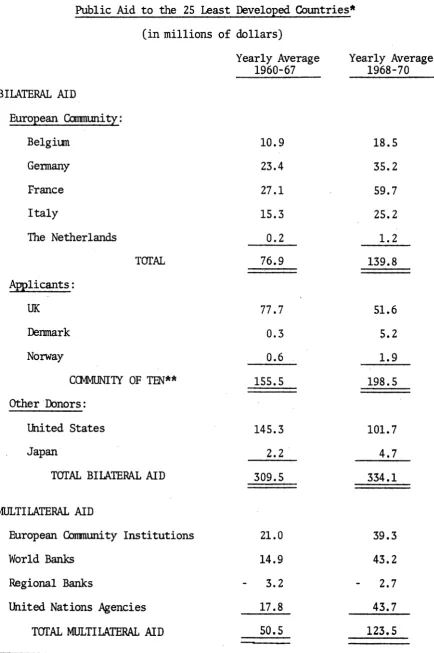
The Commission is to take an active part.--6--4-TABLE II
Public Aid to the 25 Least Developed Countries*
(in millions of dollars)
Yearly Average
Yearly Average
1960-67
1968-70
BILATERAL AID
European Community:
Belgiun
10.9
18.5
Gennany
23.4
35.2
France
27.1
59.7
Italy
15.3
25.2
The Netherlands
0.2
1.2
TOTAL
76.9
139.8
Applicants:
UK 77.7
51.6
Denmark
0.3
5.2Norway
0.6
1.9
COv1MUNITI OF TEN**
155.5
198.5
Other·Donors:
United States
145.3
101.
7Japan
2.2 .4.7
TarAL BILATERAL AID
309.5
334.1
MULTILATERAL AID
European Oo.mmunity Institutions
21.0
39.3
World
Banks14.9
43.2
Regional Banks
3.2
2.7
United Nations Agencies
17 .843.7
TarAL MULTILATERAL AID
50.5
123.5
it neSl.gnated