promoting access to White Rose research papers
Universities of Leeds, Sheffield and York
http://eprints.whiterose.ac.uk/
This is an author produced version of a paper published in Journal of Health Economics.
White Rose Research Online URL for this paper: http://eprints.whiterose.ac.uk/3789/
Published paper
Brouwer, W.B.F., Culyer, A.J., van Exel, N.J.A. and Rutten, F.F.H. (2008) Welfarism vs. extra-welfarism, Journal of Health Economics, Volume 27 (2), 325 – 338.
Welfarism vs. extra-welfarism
Werner B. F. Brouwer a Anthony J. Culyer b N. Job A. van Exel a Frans F.H. Rutten a a
Department of Health Policy & Management, Erasmus University Rotterdam, The Netherlands
b
Institute for Work & Health, Canada and University of York, UK
Corresponding author: Werner Brouwer
Department of Health Policy & Management Erasmus University Rotterdam
Postbus 1738
3000 DR Rotterdam The Netherlands
Abstract
‘Extra-welfarism’ has received some attention in health economics, yet there is little consensus on what distinguishes it from more conventional ‘welfarist economics’. In this paper, we seek to identify the characteristics of each in order to make a systematic comparison of the ways in which they evaluate alternative social states. The focus, though this is not intended to be exclusive, is on health. Specifically, we highlight four areas in which the two schools differ: (i) the outcomes considered relevant in an evaluation; (ii) the sources of valuation of the relevant outcomes; (iii) the basis of weighting of relevant outcomes and (iv) interpersonal comparisons. We conclude that these differences are substantive.
Keywords: welfare, welfarism, extra-welfarism, health economics, Paretianism, utility, consumer sovereignty, distribution, equity.
Welfarism vs. extra-welfarism
Werner B. F. Brouwer a, Anthony J. Culyer b, N. Job A. van Exel a, Frans F.H. Rutten a a
Department of Health Policy & Management, Erasmus University Rotterdam, The Netherlands
b
Institute for Work & Health, Canada and University of York, UK
1. Introduction
Drawing lines around related ideas that neatly and completely separate them is never entirely
possible. There is fuzz and haze at the edges. Despite this truth, it seems worthwhile at least to
attempt to make clearer what seem to be significant differences of approach that have arisen in
the normative analysis of health and health care. The approaches are those that have become
labelled ‘welfarism’ and ‘extra-welfarism’. Extra-welfarism has received some attention in health
economics (see for example Culyer, 1990; Hurley, 1998; Hurley, 2000; Brouwer and
Koopmanschap, 2000; Birch and Donaldson, 2003) but there appears to be no consensus on its
definition; nor is there any consensus on a general term to describe a deviation, such as
extra-welfarism appears to be, from standard welfare economics. Even the label attached to it is
disputed. In addition to ‘extra-welfarism’, ‘non-welfarism’ is sometimes encountered (e.g. Kaplow
and Shavell, 2001; Dolan and Olsen, 2002) so proponents of traditional welfare economics can
criticise what we shall still call ‘extra-welfarism’ as not only lacking an identity but, since the ‘non’
of non-welfarism seems to put it altogether beyond the bounds of welfare theory, as lacking any
sort of foundation in economic theory at all (Birch and Donaldson, 2003).1 One might indeed ask
further: how is it possible to add anything ‘extra’ to welfarism? If welfare is an ultimate goal and it
is comprised of individual utilities, and if anything important for individual welfare can be
assigned a utility number, then to add anything ‘extra’ is at best to risk double-counting. So, for
example, let it be asserted that ‘process’ is important for social welfare as well as ‘outcome’, then
1
let standard welfarists ‘simply’ assign utilities to processes (of course we know that doing so may
by no means be simple) and carry on as usual. Plainly extra-welfarism is an attempt to escape, at
least in part, from standard welfarist theory. But to what? To be of interest, extra-welfarism must
offer something that welfarism does not permit, despite its all-encompassing appearance.
In order to understand what might be ‘extra’ about extra-welfarism, we shall first explore what
welfarism entails; any ‘extra’ in extra-welfarism will then lie beyond the limits of welfarism and we
shall at least be clearer about what we are adding to (or subtracting from) welfarism.
Unfortunately, a consensus on the content even of welfarism does not emerge self-evidently from
the literature; it seems clear that different conceptions of both extra-welfarism and welfarism
prevail. Some confine welfarism to a limited set of properties (e.g. Culyer, 1991), while others
follow Bergson in setting no limits on what may count in a social welfare function – processes,
institutions, equity, quality of relationships, social norms and so on ad infinitum, as long as these
items can be captured in terms of individual utility.
Not surprisingly, the content of extra-welfarism is even less obvious from a perusal of the
literature. Hurley (1998) for example claims that extra-welfarism replaces ‘utility’ with ‘health’
even though an explicit extra-welfarist like one of us (Culyer, 1990) cautions against discarding
any outcomes, whether utility or health, and against discarding the relevance of a functional
relationship between health and utility. Others may see extra-welfarism as a method of analysis in
which explicit (and, in general, non-unitary) equity weights are attached to entities like individuals’
utility or health (e.g. Dolan, 1999a). It can be seen archetypically in cost-utility analysis where,
instead of using effective demand and willingness to pay (as in cost-benefit analysis), something
like ‘need’ is used (e.g. Culyer, 1995b, 1998). The latter concept is unrelated to the consumer’s
distribution but also from the Pareto principle as used within the traditional welfare economic
school (Brouwer and Koopmanschap, 2000).
This lack of clarity plainly hinders understanding of the differences between the two schools of
thought. In this paper, we try to provide a clear dogmatic statement of what welfarism entails
and, hence, an indication of wherein the ‘extra’ in extra-welfarism lies. We focus on theory rather
than on applied work and highlight two interrelated topics that we conjecture to lie at the root of
the distinction between welfarism and extra-welfarism:
(i) The source and nature of valuation. In welfarism, individual utility (or ‘welfare’) characterizes all
outcomes and ‘social welfare’ is normally understood to be a function only of individual utilities.
It is this restriction that has been labelled ‘welfarism’ (e.g. Sen, 1977; Boadway and Bruce, 1984).
Normative frameworks that do not make this restriction may therefore be labelled as
“extra-welfarist”. Within such frameworks, individual utilities might be replaced by something else (for
example, by Sen’s ‘capabilities’).
(ii) The Pareto-principle and the initial distribution of wealth and income. The Pareto principle2 states that
social welfare unambiguously increases only if the welfare of any member of society increases and
that of no one falls. In applications of welfarism the initial distribution of income and wealth is
normally taken as a given and changes in either cannot be evaluated beyond requiring that any
such changes themselves satisfy the Pareto criterion (as they may, for example, in a society
containing some altruists). The potential Pareto criterion, requiring the gains related to some
change to outweigh the losses caused by it, with both expressed in monetary terms, is a less
2
restrictive criterion. Yet this criterion may be viewed as normally representing a serious
compromising of the Pareto principle, making explicit interpersonal comparisons of
uncompensated gains or losses by assigning an equal unitary shadow weight to each dollar gain or
loss, independently of identity while ignoring all other types of uncompensated change or initial
differences between individuals. In extra-welfarism, however, uncompensated changes - even
those that would not satisfy the potential Pareto criterion - may be judged to be social
improvements (or deteriorations) by invoking additional ethical criteria, and deliberate attempts
are often made to compensate for the undesired consequences of the distribution of purchasing
power by focusing on what is sometimes termed the distribution of ‘need’, and by weighting
everyone’s need explicitly and according to a set of ethical principles that lie outside the ambit of
traditional welfare economic framework.
The difference in perspective between welfarism and extra-welfarism becomes especially relevant
when assessing (changes in) social as distinct from individual welfare, as it is especially on the
comparison of persons that much social policy in practice focuses: the distribution of such
characteristics as health, skills, wealth, handicap, information, social isolation, parenting
competencies, that may be more directly germane to societal welfare than mere preference
satisfaction and willingness to pay, and where the differences between people frequently raise
issues of equity. It is precisely here that students of social policy often feel that welfarism is
impotent and that either something ‘extra’ is needed or that economics has become irrelevant.
Such concerns are far from new. Ever since Arrow’s classic work on the impossibility of
constructing a non-dictatorial social welfare function, economists’ thinking on how to identify
increases in social welfare has nonetheless continued to have been dominated by the Pareto
improvement, which normally has little cutting power beyond the realm of voluntary trading in
well-regulated markets. It was primarily Sen (e.g. 1987) who began to release economists from
may therefore be seen as one signally important starting point for extra-welfarism. There are, as
we shall see, others as well.
The structure of the rest of the paper is as follows. Section 2 outlines more completely what
welfarism entails. Section 3 does the same for extra-welfarism. We have, however, allowed some
leakage from each section into the other since neither compartment is entirely waterproof.
Section 4 highlights the differences in tabular form and presents our conclusions.
2. Welfarism and welfare economics
Welfarism is not a synonym for welfare economics, though it is an important element in it. The
central objective of the study of welfare economics is to provide a coherent ethical framework for
making meaningful statements about whether some states of the world are socially preferable to
others (Boadway and Bruce, 1984). Thus, ‘In order to make statements about the consequences for economic
welfare of an event we must go beyond the study of positive economics, which is concerned with the effects of an event
on objectively measurable economic variables, such as price and quantity. That is, the welfare economist wishes to
determine the desirability of a particular policy – not in terms of his or her own values, but in terms of some
explicitly stated ethical criteria’ (Boadway and Bruce, 1984, p.1).
Welfare economists have developed a dominant framework for assessing particular states of the
world as better than or ethically preferable to others. This framework is built on explicit
normative principles but it is clearly not the only principled normative way of thinking about the
relative desirability of different states of the world (for example Rawls (1971) provided an
influential alternative). The neo-classical framework is built on four key tenets (e.g. Hurley, 2000):
(i) the utility principle (i.e. individuals rationally maximize their welfare by ordering
(ii) individual sovereignty (i.e. individuals are themselves the best – some might say ‘the
only’ - judges of what contributes most to their utility and how much that
contribution is);
(iii) consequentialism (i.e. utility is derived only from the outcomes of behaviour and
processes rather than the processes themselves or intentions that led to the
outcomes); and
(iv) welfarism (i.e. ‘the proposition that the ‘goodness’ of any situation … be judged solely on the basis
of the utility levels attained by individuals in that situation’ (Hurley, 1998, p.377) or, as Sen
puts it (1986, p.111): ‘judging the goodness of states of affairs only by utility information’.
The predominant welfare economics stream that is built on these four tenets is what, following
Sen (e.g. 1977), we shall call ‘welfarist economics’ from here on. Welfarist economics may be
further divided into two broad traditions: classical and neo-classical. Roughly speaking, in the
classical tradition (the ‘old’ welfarist economics) utilities were cardinally measured, could be
added across individuals and the social optimum was reached when this sum was at a maximum
(assuming a given population). The neo-classical tradition also has two broad subdivisions. In
one, the Paretian tradition of the ‘new’ welfarist economics, utility was usually ordinally
measured, interpersonal comparisons were held to be ‘impossible’ or ‘meaningless’ or
‘unscientific’, and an overall social judgement was reached by using the Pareto principle: any
increase of utility for one individual that involved no utility loss for another was an improvement
and an optimum was where no reallocation of resources could be made without reducing at least
one person’s utility (there might be many such ‘optima’, choice between which is impossible
using only the Pareto criterion). In the other tradition, interpersonal comparisons are made by
using a Bergson-Samuelson social welfare function (Bergson, 1948; Samuelson, 1947). This
enabled analysts to select preferred distributions of welfare on a welfare frontier, provided some
Pareto criterion was silent). In all variants of welfarist economics, however, not only is non-utility
information irrelevant to the making of social orderings, so are the identities of the creators and
receivers of utility.
Welfarism, narrowly interpreted, is therefore only the fourth of the four main tenets of the
dominant welfarist economics framework – the one that confines the ‘evaluative space’ (Sen,
1993) to individual utility only. Taken together, ‘... these four tenets require that any policy be judged solely
in terms of resulting utilities achieved by individuals, as assessed by the individuals themselves’ (Hurley, 1998, p.
377).
The concept of utility
‘Utility’ has a long and varied ancestry and we need to be clear about the meanings we intend to
attach to it. The notion of ‘utility’ is commonly treated in a fairly cavalier fashion, for example, by
being considered synonymous with ‘welfare’, ‘satisfaction’, ‘happiness’ or ‘preference’, as though
each of these were the same thing and carried the same ethical weight, and as though ‘utility’
must necessarily have a normative use – as distinct, for example, from a merely predictive or
descriptive use as an index of choice. As Van Praag (1993) notes, the attitude of economics
towards the concept of utility has always been (and continues to be) ambiguous, since the
concept has been central in the development of both normative and positive theory, but its exact
meaning and measurability has always been a matter for discussion. Two prominent ways of
interpreting utility are, to use Cohen’s (1993) terms; preference satisfaction, that is, a way of treating
how people make preference orderings of states of the world with their preference being more
satisfied as higher ranking states are reached; and hedonic welfare, that is a desirable or agreeable
state of consciousness – enjoyment or happiness or even pleasure. The second interpretation has
a long tradition (e.g. the greatest happiness for the greatest number) though even Bentham had
pleasure on the one hand, and the idea of utility, on the other” (quoted in Roemer, 1996, p.13). Yet, the
measurement of ‘happiness’ has enjoyed something of a resurgence in recent empirical research
(e.g. Easterlin, 1995; Oswald, 1997; Kahneman et al., 1997; Frey and Stutzer, 2002). In this genre,
an index of ‘happiness’ seems to be used as a (partial) index of welfare and is understood to have
a deeper meaning than mere superficial pleasure. Ferrer-i-Carbonell and Frijters, for instance,
take the answer to (different types of) happiness questions to describe ‘general satisfaction’ which
in turn is seen as “a positive monotonic transformation of an underlying metaphysical concept called welfare”
(Ferrer-i-Carbonell and Frijters, 2004).
We shall, however, take it that utility numbers are a representation of an individual’s preference
ordering over bundles of goods or states of the world and, in welfarist economics, an individual
moving to a preferred state of the world is an equivalent statement to an individual having a
higher level of utility. We shall not assume welfarism to require that these preferences have any
particular grounding – for example, that preferences need to be only self-regarding, or a
reflection of the pleasure to be had from anticipated consumption. Thus, we do not caricature
welfarism as assuming hedonism or selfishness. However, welfarists do not usually enquire as to
how these preferences may have come about nor do they judge them on grounds of decency,
ethics, aesthetics or any other ground.
It is important to be clear in this respect since the same carelessness in the use of the concept of
utility has also led some economists into solipsistic treatments of social welfare – for example,
that all choice, social as well as individual, can be reduced to preferences by the simple device of
allowing people to have preferences about preferences. Such reasoning adds new dimensions to
Any confusion about the meaning of utility will diminish the value of utility theory and
over-restrict the application of what is, at root, a simple idea, viz. that utility measurement is a
systematic method of assigning numbers to entities according to an explicit choice-related rule
(Alchian 1953). Likewise, one can assign numbers to verbal descriptions of health states so as to
enable states to be identified in which there was ‘more’ or ‘less’ ‘health’. These numbers provide a
rationale for choice, but do not necessarily have a direct bearing on anyone’s ‘satisfaction’ or
‘happiness’, nor are they necessarily based on the preferences of those affected by the choices
they might inform. This divorce from preferences is particularly apposite when the numbers are
used to make interpersonal comparisons (Brouwer and Koopmanschap, 2000). However, the
choices made using such numbers are nonetheless intended to represent a change of some kind,
such as improving the output of the health care sector. The use of such indices therefore still
qualifies as being within the broad church of welfare economics indicated by Boadway and Bruce
(1984).
In an attempt to not add to the confusion and carelessness in this area, we will use the term
welfare from this point onward to indicate the utility of people in a narrow, that is welfarist,
sense. When we refer to a broader measure or evaluation of welfare, which may include more
than only individual utility, we will use the term well-being, which allows something extra-welfarist
to be considered. It seems also better (at least from an extra-welfarist perspective) not to call such
numbers ‘utilities’, though, extra-welfarists may claim, this is precisely what is done in ‘cost-utility
analysis’, where the denominator of incremental cost-utility ratios is a measure of health, like the
EQ-5D.
The sources of utility in welfarist economics
Culyer (1991, p.67) narrowed the scope of welfarist economics by arguing that the source of utility
economics as a whole, is what Sen ... calls ‘welfarist’. This is very much in accord with liberal political opinion and
asserts that social welfare … is a function of only individual welfare (or utility) and judgements about the superiority
of one state of the world … over another are made irrespective of the non-utility aspects of each state. Moreover, the
individual welfares (or utilities) are a function only of goods and services consumed” by the individual himself.
Some welfarist economists do not restrict the sources of utility to goods and services, though
these are undoubtedly one major source. Thus, Hochman and Rodgers’ (1969) pioneering
analysis of Paretian income distribution extended welfarist economics’ scope in one direction, to
incorporate utility interdependence as a kind of externality. Becker used utility theory extensively,
though rarely normatively, in his influential analyses of fertility, habit, marriage, family size, crime
and punishment (see e.g. Becker, 1968; Becker, 1993). Culyer also used this approach in an
explicitly normative way in justifying subsidized health care and charitable behaviour (e.g. Culyer
1971a, 1971b) though there are major analytical problems lying at its root (Sugden 1982, 1985).
A similar inclusivity might be claimed for welfarist economics with regard to the tenet of
consequentialism. Sometimes this tenet has been criticised for admitting processes and
procedures, or even freedoms. Some welfarists have sought to broaden analysis in such a way as
to allow that individual utility can be derived from processes, procedures and freedoms because
they may have the direct characteristics of pleasantness or unpleasantness, or because processes
themselves may be consequences (for example, of prior decisions reflecting preferences), or may
also have consequences – consequences that might be appraised in either welfarist or
non-welfarist ways but that are still consequentialist. A growing body of literature, both in the general
economic literature as well as in the health economic literature, uses procedural or process utility
(Hahn, 1982; Benz and Stutzer, 2003; Frey et al., 2004; Birch et al., 2004; Brouwer et al., 2005;
Tsuchiya et al., 2005). Narrowly defined consequentialism is thus not intrinsic to welfarist
utility consequences rooted in the preferences of individuals. Indeed, if there is a single tenet of
the four that characterises welfarist economics, and only welfarist economics, it would seem to be
the tenet of welfarism.
From individual to social welfare
Classical utilitarianism, in which the maximisation of total welfare, or total utility, was also the
sole objective, was less nervous of making interpersonal comparisons than the ‘new’ welfarist
economics has been: ‘Utilitarianism is a species of welfarist consequentialism – that particular form of it which
requires simply adding up individual welfares or utilities…...’ (Sen and Williams, 1982, p.4). Sen (1986)
indicates that no approach to welfare economics has received as much support over the years as
classical utilitarianism. Indeed, given the four tenets of welfarist economics, classical utilitarianism
seems a natural way of stipulating a social welfare function. According each an equal weight has
superficial democratic appeal, though that begs questions concerning, for example, the
appropriateness of using ‘democracy’ as a criterion for equity. There are other ways of combining
individual utilities to make a social ordering, such as attaching weights to them. It is not
uncommon in the welfarist school to work with equity weights in a social welfare function (e.g.
Roemer, 1996). It is not clear, however, what such weights represent. Even if these weights apply
to the distribution of utility only, which seems necessary in a welfarist framework, it is unclear
that the weights themselves qualify as utility information (see e.g. Dolan, 1998; Johannesson,
1999; Dolan, 1999a for related discussions). This will depend on their source. They might reflect
utilities (while not double-counting what is already captured in the individual utilities), since it is
possible to speak of distributions that are themselves more or less ‘preferred’. Still, it is difficult
to envisage how moving to a preferred distribution would or should then not be reflected in at
least one person’s higher individual utility – whose utility is otherwise being improved by moving
to a preferred state? Unless individualistic preferences existed over distributions, which are not
to inform decisions about weights to be used in a social welfare function (including a decision
that they should be unity). In that case, some source of independent values needs to imported
from ‘outside’ to determine the weights to be attached to individual utilities. That, in itself is, of
course, already something ‘extra’.
The initial income distribution is conventionally not challengeable in welfarist economics,
especially in applied research. Instead, the initial distribution is used as a kind of anchorpoint
from which to judge changes in social welfare. It is not claimed to be devoid of ethical
significance. It is simply that Paretianism alone offers no reason for preferring or not preferring it
relative to any other possible, Pareto optimal distribution. Thus, in applied cost-benefit analysis,
interpersonal comparisons of monetary uncompensated gains or losses are made that assign an
equal unitary shadow weight to each dollar gain or loss, independently of whose it is. Moreover,
applied cost-benefit analysis ignores any other types of uncompensated change or initial
differences between individuals. As in conventional markets, net utility is monetarily expressed
through willingness and ability to pay in terms of Harberger triangles (Harberger, 1971). This is,
of course, potential Pareto improving with the (non-Paretian) assumption that individual welfares
can, after all, be compared in monetary terms and that the appropriate weight for each is unity.
In conclusion, the central characteristic of welfarist economics is that it confines the evaluative
space to individual utilities only. This can severely limit the evaluation, especially when any
comparability of utilities between individuals is considered impossible. As we will explain below,
extra-welfarism opens up the evaluative space to be able include more than only individual utility.
3. Extra-welfarism
We think that the extra-welfarist approach differs from the welfarist in four general ways: (i) it
than the affected individuals, (iii) it permits the weighting of outcomes (whether utility or other)
according to principles that need not be preference-based and (iv) it permits interpersonal
comparisons of well-being in a variety of dimensions, thus enabling moving beyond Paretian
economics. In this section we highlight these points. First, however, we indicate, without
claiming the intellectual history to be complete, that extra-welfarism has had a number of roots in
the literature over the years (Culyer, 2007). The section ends by emphasizing that extra-welfarism
is not confined to health care only nor should it be seen as a type of analysis that is restricted to
health alone.
Seeds from which extra-welfarism has grown
An early seed was sown in public finance in the shape of ‘merit goods’ (Musgrave, 1959): goods
that need not be public goods but that are deemed so ‘meritorious’ that they ought to be
subsidized by the state – though what qualified such goods as ‘meritorious’ was never quite clear,
nor was it fully clear how these goods differed from goods whose consumption generated
externalities (Culyer, 1971c).
A second seed was sown by Tobin (1970). He argued that the desire for equality is specific rather
than general (‘specific egalitarianism’) and that some basic goods and services (like health care)
are, as a matter of fact, commonly thought to be more properly allocated in egalitarian ways than
others. Similar ideas are met in other disciplines like philosophy, such as the notion of ‘basic
goods’ used by Rawls (1971) though he explicitly excluded both health and health care from the
list of ‘primary goods’. Walzer (1983) uses ‘spheres of justice’ to indicate that the distribution of
different goods may relate to different types of justice.
A third, especially influential, seed was sown by Sen (1980) in arguing that a focus on mere
account of the quality of utility and of people’s capabilities rather than exclusively of the emotional
reaction (i.e. utility) of individuals to the possession of goods or capabilities. Sen thus directly
attacked the tenet of welfarism on the grounds of it being too narrow and too focused on mental
reactions to goods and states rather than on what goods and states enabled people to do and be.
He also warned against the strict application of the Pareto principle. The sublime Paretian
indifference to alternative distributions of income and wealth has produced some of Sen’s most
caustic comments: an economy can be Pareto-optimal, yet still “perfectly disgusting” by any
standards (Sen, 1970, p.22) and “A state can be Pareto-optimal with some people in extreme misery and
others rolling in luxury, so long as the miserable cannot be made better off without cutting into the luxury of the
rich. Pareto can, like ‘Caesar’s spirit’, ‘come hot from hell’ ” (Sen, 1987, p.32).
A fourth seed might be regarded as the explicit rejection of strict welfarist economics by
governments. Some governments are very explicit about the proper role of willingness and ability
to pay in allocating health care. In the UK, for example, the 1944 white paper on health ‘A
National Health Service’ stated that “The government (...) wants to ensure that in the future every man, woman
and child can rely on getting (...) the best medical and other facilities available; that their getting them shall not
depend on whether they can pay for them or any other factor irrelevant to real need” (as quoted in Van
Doorslaer et al., 1993). In the face of such explicit statements from politically authoritative
sources it seems curmudgeonly to insist on not going further than Pareto will allow. Moreover,
the emphasis in the health care sector is clearly on improving health, which contrasts with the
evaluative space under welfarist economics.
A fifth significant seed was the ‘decision-making’ approach to cost-benefit analysis suggested by
Sugden and Williams (1978) through which they contrasted the welfarist approach with its
embodiment of ‘individual sovereignty’ with one in which ‘decision-makers’ were the source of
aided by the analyst may also explain some practical choices in the analysis, such as the
perspective – which, in contrast to the welfare economics framework, does not always entail the
adoption of a societal perspective regarding either costs or, particularly in the case of health
economics evaluations, in terms of effects, where the focus is, purposely, mainly on health
(Brouwer et al., 2006). Note that in this context, the rejection of individual sovereignty does not
need to pertain to the assessment of individual utility, as it does within the welfarist stream, but
can relate to some other desideratum, like health, that is in the evaluative space of an
extra-welfarist evaluation.
The term ‘extra-welfarism’ has been particularly used by health economists (for example, Hurley,
1998, 2000; Williams, 1993). Culyer’s use of this term was based on the idea that ‘capabilities’
might be broadened to embrace a wider range of human characteristics associated with what is
commonly thought of as ‘well-being’ and that judgements might appropriately be made on behalf
of, rather than by, affected individuals. This seems especially relevant for judgements concerning
the production and distribution of public and so-called ‘merit’ goods. Extra-welfarism therefore
has been described as introducing ‘…an important class of ‘extra’ welfare sources … the non-goods
characteristics of individuals (like whether they are happy, out of pain, free to choose, physically mobile, honest).
Extra-welfarism thus transcends traditional welfare: it does not exclude individual welfares from the judgements
about the social state, but it does supplement them with other aspects of individuals (including even the quality of
the relationships between individuals, groups and social classes)’ (Culyer, 1991, p.67).
Extra-welfarism thus rejects the exclusive focus on individual utility and thereby broadens the
evaluative space to include other desiderata. There is a clear parallel with the capabilities approach
advocated by Sen: ‘the capability approach is concerned primarily with the identification of value-objects, and
sees the evaluative space in terms of functionings and capabilities to function’ (Sen, 1993, p.32). This rejection
between welfarist economics and extra-welfarism. This distinction will now be highlighted
further.
Other outcomes than utility
Extra-welfarism thus transcends welfarist economics. It does not focus solely on individual
utilities, but neither does it completely eschew them. It complements utility information with
other ‘non-utility information’, of which the quality of utility, equity weights, characteristics and
capabilities are some examples. Information about or based on ‘preferences’ is not the only kind
of information permitted to be weighed in the quasi-utilitarian balance. These additional
considerations do not merely amount to a weighting of conventional Harberger triangles. Sen
(1980, p.212) stated that the ‘relevance of non-utility information to moral judgments is the central issue
involved in disputing welfarism.’ Brouwer and Koopmanschap (2000) in a similar context stated that:
‘... within extra-welfarism one does not necessarily have to translate all these aspects into utility-weights in order to
take them into consideration in the analysis’. Hurley (1998) more comprehensively claimed that
extra-welfarism rejects ‘the exclusive focus on utility-based notions of welfare.’ Such a shift of focus allows the
consideration of something extra. Sen, for instance, stated that ‘because of the nature of the evaluative
space, the capability approach differs from utilitarian evaluation (more generally ‘welfarist’ evaluation) in making
room for a variety of human acts and states in themselves (not just because they may produce utility, nor just to
the extent that they yield utility)’ (Sen, 1993, p.33).
Kaplow and Shavell (2001) represented extra-welfarism (which they call ‘non-welfarism’) as
inserting an additional non-utility argument into the social welfare function. Thus ‘non-welfarist’
policymaking relates to arguments in the social welfare function that enhance the well-being of
society other than via individual utilities. This seems to us to be an unnecessarily restrictive view
of extra-welfarism. There may, indeed, be additional arguments in the function but there may also
attached to arguments and types of value that are not preference-based. Social choices might
clearly, then, account in several ways for the effects of policy on utilities or other relevant
outcomes and the decision is therefore not seen as being necessarily driven by the utility
considerations (however ‘weighted’) alone.
This is just what many health economists appear to have done in treating ‘health’ (rather than the
utility actually derived from health) as both a maximand and a distribuendum of a health care
system. Indeed, health has become seen as the central (if not exclusive) focus of evaluations,
given that health care policy makers, as clients of economic analysts, are interested mainly in this
aspect of human life. Health is pursued and valued by policy makers for its own sake (and
possibly because of its impact on productivity) rather than because it yields utility or merely to
the extent that it yields utility. Although good health certainly also contributes to welfare and, for
that matter, to equal opportunity for welfare (e.g. Arneson, 1989), it is valuable in itself as an
important characteristic of human beings. Indeed, especially in the context of health it has been
claimed that ‘utility is an unsuitable guide to policy, if only because a person may adjust his expectations to his
condition. The fact that a person has learned to live with adversity, and to smile courageously in the face of it,
should not nullify his claim to compensation.’ (Cohen, 1993, p.17).
A more fruitful way of characterizing the evaluative space of extra-welfarism, therefore, is not in
terms of any weighted sum of individual utilities, but as an assembly of other characteristics of
individuals, like health, some of which might be, but need not be, measured – as in ‘cost-utility
analysis’ - by utility-like scalings but which are neither determined a priori nor combined by
following a priori rules. It is therefore possible for an optimal state under welfarism to be classed
as suboptimal if there is judged to be a maldistribution of any one such characteristic (like health).
The use of QALYs also demonstrates that it is not necessary to completely reject preference
extra-welfarist framework there still can be a role for preference measurement in, for example, ranking
health gains. Health may be an argument in the production function of well-being, but it is
multidimensional and some aspects of health may be accorded more importance than others.
Extra-welfarism does not preclude the use of preferences in ranking capabilities or characteristics
or in deciding such matters as whether, for example, treating deafness yields more important
improvements than treating blindness. Sen (1993, p.33) indicated that ‘various substantive ways of
evaluating functionings and capabilities can all belong to the general capability approach’. Preference
measurement is one such way, but not the only one.
Determining the content of the evaluative space calls for a deliberative process of some kind to
determine what (and who) to include and what to exclude. Under extra-welfarism policy makers
become one important potential source of value judgements, which links clearly to the
decision-making approach advocated in Sugden and Williams (1978). This need for selection and
discrimination, as Sen (1993) stipulates, is neither an embarrassment nor a unique difficulty of
approaches that use an evaluative space other than that of welfarist economics, since the latter is
itself entails a priori selection and discrimination. In health care, the evaluative space has,
naturally enough, focused on health, often measured as QALYs, not because QALYs capture
utility but because they measure health, using an acceptable and systematic rule to rank health
states. The interpretation of QALYs as a measure of health is also reflected in their subsequent
use, for example, in directly comparing individuals’ health, which is an uncommon way of
treating conventional utilities (Brouwer and Koopmanschap, 2000).
Sources of valuation
It seems a short hop from these considerations to the conclusion that amongst the decisions to
be taken is one about whose values are to be used to underpin utility and other preference- or
individuals is the primary source of valuation, in extra-welfarist economics any number of
stakeholders might be regarded as appropriate sources of different values for different entities
and how they ought to be traded off against one another and compared interpersonally. This
choice might vary according to the level of aggregation of decision-making and the size and
character of the jurisdiction in which the decisions are being made. Moreover, in acting as agents
for their clients, the public, we do not have to assume that decision makers are acting as they
think the principals whom they represent would act, but rather as they think they ought to act.
Extra-welfarism may thus be inherently paternalistic. If it is wished to weight utilities, to define
the outcome parameters of interest and to allow changes not sanctioned by the Pareto criterion,
an authority (decision-makers, wise women, the general public, an elected or appointed
committee, a citizens’ jury, or some other organ) is plainly required. Indeed, as Sen (1993, p.33)
indicates, the definition of the evaluative space ‘has a good deal of cutting power on its own, both because
of what it includes as potentially valuable and because of what it excludes.’ Economists are not, of course,
equipped to make value judgements regarding the evaluative space. They can, however, help those
who are charged to make such judgments, who need to understand the options and their
consequences; and economists may also be able to derive values from experimental groups or
samples of relevant populations through modern methods for eliciting preferences. Choices
about which groups to sample are not normally for the analyst to make but for the ultimate
decision-maker whom the analyst advises. There is debate about the appropriateness of various
possible sources of value (e.g. Dolan, 1999b) but the practice embodies the (one might say
extra-welfarist) idea that even someone who under no conceivable circumstance would actually
consume the good in question may be a relevant source of preferences or other elicitation. In
short, preferences may still occupy a key role in extra-welfarist calculation, though not necessarily
Weightings
Suppose it is intended to weight a benefit such as health according to a characteristic of the
people receiving it. The characteristic in question may be related to their health state or to other
characteristics such as age or productivity. Williams (e.g. 1997) has argued cogently for the ‘fair
innings’: society ought to attach more weight to QALYs gained by the young (or, rather, those
who have not yet had their fair innings) than the elderly (or, rather, those who already had their
fair innings). In contrast, the WHO’s age weights (e.g. Murray 1996) reflect the productive
contribution of persons at different ages to society, something which is normally reflected in the
calculation of indirect costs (see e.g. Sculpher, 2001). Others (e.g. Nord, 1995; Stolk et al., 2004)
have suggested that QALY gains for persons with poor levels of initial health or those who stand
to loose a large proportion of remaining health should receive more weight compared to gains in
persons with a higher initial health level or standing to lose a smaller proportion of remaining
health. Rather than applying such relative weights on a presumption of generalized diminishing
marginal utility of health, it is applied for reasons of equity. Although a consensus amongst
extra-welfarists on why and how QALYs ought to be weighted does not exist, it is apparent that such
weights are recognized as not being treated purely as utility information (e.g. Dolan, 1999a); they
do not, as a rule, even relate to the utility, as distinct from the health, of individuals. They are
‘extra’ to welfarism. This contrasts to the tenet of welfarism which ‘acknowledges the relevance of no
information but welfare in the context of equality’, as Cohen (1993, p.11-12) puts it. In extra-welfarism,
therefore, a concern about distribution may reflect something else – such as a concern for
fairness that is not rooted in individual utility but may have different philosophical origins and
may pertain to non-utility characteristics of people, like their health. The ‘something else’ permits,
for example, the possibility of saying that a society might be a better society if it were to embody
some feature not because it was preferred but because it was right for it to be embodied. The
weights may thus reflect perceptions of need, desert, just compensation, or other criteria beyond
meta-entity (e.g. an agent of society like a committee to determine which drugs are to be added to a
formulary) with its own ethical rules for weighting individual utilities or combining them in
deliberative ways.
A common way of assigning weights under extra-welfarism is on the basis of equalising some
characteristic of human beings such as health. Sen (1980) uses the term ‘basic capability equality’.
This particular form of equity, which could be viewed as an extension of Rawls’s focus on
primary goods, is exactly what is striven for in the field of health care with its characteristic focus
on improving health and reducing health inequalities.
Beyond Pareto
In welfarist economics, interpersonal comparisons in the evaluative space of utility are normally
deemed impossible or meaningless3. However, explicit interpersonal comparisons seem to lie at
the heart of many extra-welfarist approaches to public decision-making. Although one may not
know for sure whether an unhealthy person has less utility than a healthy one, we do know that
the unhealthy person has less (current or prospective) health. Having explicit quantitative
measures, even if imperfect, plainly both makes interpersonal comparisons more practical and
affords opportunities to test and monitor the effectiveness of policies designed to improve health
or reduce health inequalities.
The use of health-related quality of life measures (such as the QALY) allows individuals to be
compared within a health domain and permits the economist to address directly questions raised
by decision-makers who have selected ‘health maximization’ as one of a number of important
policy objectives. Thus QALYs may be interpreted as a principal outcome of (effective) health
3
care - measures of changes in capability4 (and characteristics) that reflect (if appropriately
designed) the principal dimensions of quality of life deemed to be of significance by the ‘decision
maker’ involved or by the ‘public’ served by the decision making authority in question. They,
however, need not be utilities in any conventional sense of ‘utility’ even though sometimes the
rules used to assign numbers and the properties held to be desirable (such as transitivity) may be
similar. Other systematic ways of assigning numbers to health states, ones that are not designed
to yield conventional utilities, like a simple visual analogue scale asking people to indicate where
different health states should be ranked between death and perfect health, may be judged equally
useful for a decision maker aiming to improve health.
QALYs also facilitate joint research with practitioners of other disciplines (such as epidemiology)
and professions (such as medicine) that have not typically adopted quasi-utilitarian frameworks
for their own evaluation of health care technologies. In this way, policy paralysis resulting from
refusing to compare individual welfares and reliance on the Pareto criterion is avoided. People
can be compared in terms of their (weighted) endowment of some capability. In health care, this
capability usually relates, as an empirical matter of fact, to health as measured in terms of
QALYs. However, the QALY is not a necessary outcome of extra-welfarism and may well come
to be eschewed in preference for some other means of health measurement and valuation.
Other considerations also separate extra-welfarism and traditional Paretian economics. Hurley
(1998) has contrasted effective demand (as determined in part by the prevailing wealth
distribution) with ‘effective need’. Need is then related to the prospects for gaining health and the
effectiveness of health services is determined by the availability of a cost-effective technology (e.g
Maynard, 1999). Sen (1980, p.217) maintained long ago that “even the concept of needs does not get
adequate coverage through the information on … utility.” This clear separation of need from ability to pay
4
is another contrast with applied welfarist economics and is very common in health economics.
Moreover, in health economics the distribution of income may be especially important given the
correlation between income levels and the incidence and prevalence of disease (the so-called
social gradient of health) and sometimes, the use of health care services. The use of need as
central aspect in distribution of resources is a clear deviation from welfarist economics.
Health alone?
Unsurprisingly, extra-welfarism has sometimes come to be seen in health economics as a school
of thought that postulates health rather than utility maximization (e.g. Hurley, 2000; Mooney,
2005). This, however, seems to us to mistake a single example of a valid application of
extra-welfarism for the totality of the scope of its application. First, health does not have to be the only
object of concern in extra-welfarism despite the fact that collaboration with psychologists,
epidemiologists and others in designing and applying a valid construct of health has been a major
preoccupation of extra-welfarists involved in developing techniques of economic appraisal for
health care. Second, health maximisation is manifestly meaningless as a general maximandum for
the public sector, and one might easily imagine extra-welfarists applying their framework of
analysis in other fields of social policy: education, housing, criminal justice, poverty reduction, fair
employment, and so on. Third, health production – like the production of other characteristics
that are not welfarist utilities - ultimately involves opportunity costs that embrace both utility and
non-utility sources of well-being throughout the whole gamut of society and so forgone health
alone cannot constitute the sole opportunity cost of public sector resources, even if it counts as
the principal opportunity cost within a health care sector (see e.g. Olsen and Richardson, 1999).
Fourth, extra-welfarism does not intrinsically exclude preference-based measures of anything, and
many extra-welfarists strongly advocate the use of preference-based measures of health. Such
measures of health may use systematic ways of assigning numbers to entities that can be
capability, or of acceptability, or of moral rectitude, or (to give a non-normative example) of
predicted choice. It is perfectly permissible, for example, for extra-welfarists to seek to ground
the principal value-judgements embodied in, for example, QALYs in the preferences of
representative members of the population to be served, or some subset of it, though we do not
consider the resultant numbers to be utilities as conventionally understood in welfarist
economics.
4. Closing remarks
In this section, we attempt to briefly bring the foregoing accounts of the welfarist approach (in its
various guises) and extra-welfarist approach (in the most general guise we can ascribe to it) face
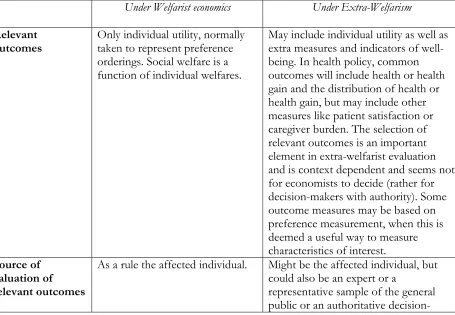
to face in order to facilitate comparisons. For convenience we display the comparisons in tabular
[image:27.595.78.533.449.764.2]form.
Table 1: Summary of four main and related differences between the welfarist and extra-welfarist approaches
Under Welfarist economics Under Extra-Welfarism
Relevant
outcomes Only individual utility, normally taken to represent preference orderings. Social welfare is a function of individual welfares.
May include individual utility as well as extra measures and indicators of well-being. In health policy, common outcomes will include health or health gain and the distribution of health or health gain, but may include other measures like patient satisfaction or caregiver burden. The selection of relevant outcomes is an important element in extra-welfarist evaluation and is context dependent and seems not for economists to decide (rather for decision-makers with authority). Some outcome measures may be based on preference measurement, when this is deemed a useful way to measure characteristics of interest. Source of
valuation of relevant outcomes
As a rule the affected individual. Might be the affected individual, but could also be an expert or a
maker.
Weighting of
relevant outcomes Sometimes permitted in a Social Welfare Function, where the weights normally pertain to the distribution of individual utilities. Unclear whether such weights still classify as utility information.
Allowed and often considered important as means of incorporating equity and other considerations.
Weights may be based upon a variety of ethical considerations including wealth, need and desert and can relate to the variety of relevant outcomes considered important (e.g. capabilities).
Interpersonal comparability of relevant outcomes
Although some theoretical
approaches allow it (e.g. in a social welfare function), especially in applied work normally considered impossible in the relevant
evaluative space, i.e. individual utilities.
Explicitly allowed in the relevant outcomes, though normally not in terms of individual utility, but rather in terms of capabilities and characteristics like health, handicap, ability to cope, schooling, ability to exercise discretion.
As one may infer from table 1, the main difference between the two schools of thought relates to
the delineation of the relevant evaluative space. Under welfarist economics this is, by definition,
individual utility, whereas extra-welfarism broadens the evaluative space to include other relevant
outcomes in addition to utility, for instance capabilities or characteristics such as health. These
are considered as important desiderata in themselves, not just because they produce utility nor to
the extent they produce utility (Sen, 1993). So extra-welfarism is different from welfarist
economics first and foremost by rejecting the tenet of welfarism and allowing other elements
than individual utility to be considered in the analysis. The other differences between the two
schools to a large extent follow from this first difference. For example, extra-welfarism allows
other sources of valuation of the relevant outcomes while still allowing that individual utility will
often be better elicited from the individuals in question rather than some others. Extra-welfarism
allows interpersonal comparisons, but it does not try to compare individual utilities but rather
their characteristics and capabilities, like their health. The ‘extra’ that extra-welfarism has to offer
must therefore be found in the broadening of the evaluative space and the consequences that has
In broad terms, it seems to us that the welfarist approach is a special subset of extra-welfarism in
which the evaluative space is limited to individual utility only, so extra-welfarism is a more general
framework of analysis. The extra-welfarist approach is adaptable to a variety of situations and can
be designed to be responsive to this variety. Its application is not restricted to health care. The
context in which it is applied will, we conjecture, often determine the relevant evaluative space
and this determination is an important exercise in itself, requiring authoritative decisions. In this
sense, extra-welfarism can be seen as pragmatic (Brouwer and Koopmanschap, 2000) focusing on
relevant outcomes contingent on the policy problem at hand. In this regard, extra-welfarism is
clearly still a species of welfare economics according to the definition by Boadway and Bruce
(1984) but it is not welfarist.
Acknowledgements
References
Alchian AA, 1953, The Meaning of Utility Measurement, American Economic Review 43, (1): 26–50.
Anand P, 2005, QALYs and capabilities: a comment on Cookson, Health Economics 14, (12): 1283-1286
Arneson R, 1989, Equality and equality of opportunity for welfare, Philosophical Studies, 56: 77– 93
Becker GS, l968, Crime and Punishment: An Economic Approach, Journal of Political Economy 76 (2): 169-217
Becker GS, 1993, A treatise on the family, Harvard University Press, Cambridge
Benz M, A Stutzer (2003). Do Workers Enjoy Procedural Utility? Applied Economics Quarterly 49(2): 149-172.
Bergson A.(1938) A Reformulation of Certain Aspects of Welfare Economics, Quarterly Journal of Economics, 52, 310-334.
Birch S, C Donaldson, 2003, Valuing the benefits and costs of health care programmes: where's the 'extra' in extra-welfarism? Soc Sci Med 56(5):1121-1133
Birch S, Melnikow J, Kuppermann M, 2003, Conservative versus aggressive follow up of mildly abnormal Pap smears: testing for process utility. Health Econ. 12(10):879-84.
Boadway R, N Bruce, 1984, Welfare economics. Oxford: Basil Backwell
Bleichrodt H, 1997, Health utility indices and equity considerations, Journal of Health Economics 16, 65-91
Brouwer WBF, MA Koopmanschap, 2000, On the Economic Foundations of CEA. Ladies and gentlemen, take your positions! Journal of Health Economics 19: 439-459
Brouwer WBF, NJA van Exel, B van den Berg, GAM van den Bos, MA Koopmanschap, 2005, Process utility from providing informal care: The benefit of caring. Health Policy 74(1): 85-99
Brouwer WBF, NJA van Exel, RMPM Baltussen, FFH Rutten, 2006, A dollar is a dollar is a dollar – or is it? Value in Health 9(5): 341-347
Cohen GA, 1993, Equality of what? On welfare, goods and capabilities. In: MC Nussbaum, AK Sen (eds) The Quality of Life (Clarendon Press, Oxford)
Cookson R, 2005, QALYs and the capability approach, Health Economics, 14, (8): 817-829
Culyer AJ, 1971a, The nature of the commodity 'health care' and its efficient allocation, Oxford Economic Papers, 23, 189-211
Culyer AJ, 1971c , Merit goods and the welfare economics of coercion, Public Finance, 26, 546-72.
Culyer AJ, 1990, Commodities, characteristics of commodities, characteristics of people, utilities and the quality of life, in: S Baldwin, C Godfrey and C Propper (eds), The quality of life:
perspectives and policies. (London, Routledge)
Culyer AJ, 1991, The normative economics of health care finance and provision, in: A. McGuire, P Fenn and K Mayhew (eds), Providing Health Care: The economics of Alternative systems of finance and delivery (Oxford University Press, Oxford)
Culyer AJ, 1995a, Equality of what in health policy? Conflicts between the contenders”, Discussion paper 142 (University of York, Centre for Health Economics)
Culyer AJ, 1995b, Need: the idea won't do - but we still need it, Social Science and Medicine, 40, 727-730.
Culyer AJ, 1998, Need - is a consensus possible?, Journal of Medical Ethics, 24, 1998, 77-80.
Culyer AJ, 2001, Equity - some theory and its policy implications, Journal of Medical Ethics, 27, 2001, 275-283.
Culyer AJ, 2007, Rationing health care - Alan Williams’ decision-maker, the authority, and Pareto.
Forthcoming in Be Reasonable: Following the Williams Way, Proceedings of a Conference to Celebrate the Work of Alan Williams, London: Office of Health Economics, in press.
Daniels N, 1985, Just Health Care (Cambridge University Press, Cambridge)
Dolan P, 1998, The measurement of individual utility and social welfare, Journal of Health Economics 17, 39-52
Dolan P, 1999a, Drawing a veil over the measurement of social welfare – a reply to Johannesson, Journal of Health Economics 18, 387-390
Dolan P, 1999b, Whose preferences count? Medical Decision Making, 19(4), 482-486
Dolan P, Olsen JA, 2002, Distributing Health Care: Economic and Ethical Issues. (Oxford University Press, Oxford).
Easterlin R. 1995 Will Raising the Incomes of All Increase the Happiness of All?, Journal of Economic Behaviour and Organization 27, 35-48.
Ferrer-i-Carbonell, A, Frijters, P. How important is methodology for the estimates of the determinants of happiness? The Economic Journal 114(July): 641-659.
Frey B, Stutzer A. What Can Economists Learn from Happiness Research? Journal of Economic Literature 2002; 40: 402-435
Grewal I, Lewis J, Flynn T, Brown J, Bond J, Coast J, 2006, Developing attributes for a generic quality of life measure for older people: preferences or capabilities? Social Science and Medicine 2006;62(8):1891-1901
Hahn F, 1982, On some difficulties of the utilitarian economist. In: Sen A.K. and B Williams. Utilitarianism and beyond. (Cambridge University Press, Cambridge)
Harberger AC, 1971, Three basic postulates for applied welfare economics, Journal of Economic Literature, 9 (3), 785-797.
Hochman, H and Rodgers, J, 1969, Pareto optimal redistribution. American Economic Review 59, 642-557.
Hurley J, 1998, Welfarism, Extra-Welfarism and Evaluative Economic Analysis in the Health Care Sector, in: ML Barer, TE Getzen and GL Stoddard (eds), Health, Health Care and Health Economics: Perspectives on Distribution (John Wiley & Sons Ltd, Chichester)
Hurley J, 2000, An overview of the normative economics of the health care sector. In: AJ Culyer and J Newhouse (eds). Handbook of Health Economics, Elsevier Science, Amsterdam
Johannesson M, 1999, On aggregating QALYs: a comment on Dolan, Journal of Health Economics 18: 381-386
Kahneman D, PP Wakker, RK Sarin (1997), Back to Bentham? Explorations of Experienced Utility, The Quarterly Journal of Economics 112, 375-405.
Kaplow L, S Shavell, 2001, Any non-welfarist method of policy assessment violates the Pareto principle. Journal of Political Economy 2001; 109: 281-286
Maynard A, 1999, Rationing health care: an exploration. Health Policy 49(1-2): 5-11
Mooney G, 2005, Communitarian claims and community capabilities: furthering priority setting? Soc Sci Med 60(2):247-255
Murray CJL (1996). Rethinking DALYs. In:Murray CJL, Lopez AD, eds. The Global Burden of Disease. Global Burden of Disease and Injury Series. (pp.1-98) Harvard University Press, Cambridge.
Musgrave, RA (1959) The Economics of Public Finance, McGraw Hill, New York.
Nord E, 1995, The person trade-off approach to valuing health care programs. Medical Decision Making 15, 201-208
Olsen JA, J Richardson, 1999, Production gains from health care: what should be included in cost-effectiveness analyses? Soc Sci Med 49(1), 17-26
Oswald A, 1997, Happiness and Economic Performance, Economic Journal 107, 1815-1831.
Rawls J, 1971, A theory of justice (Harvard University Press, Cambridge, MA)
Robbinson J (1962) Economic Philosophy (Aldine, Chicago).
Roemer JE (1996) Theories of Distributive Justice. Harvard University Press, Cambridge Mass.
Samuelson PA (1938) Welfare and International Trade , American Economic Review, 28, 261-266.
Sculpher M, 2001, The role and estimation of productivity costs in economic evaluation. In: Drummond MF, McGuire A (eds) Economic evaluation in health care: merging theory with practice. (Oxford, Oxford University Press)
Sen AK, 1970, Collective choice and social welfare. San Fransisco: Holden-Day
Sen AK, 1977, Social choice theory: a re-examination. Econometrica 45: 53-89
Sen AK, 1980, Equality of what? In: S. McMurrin (ed). The Tanner Lectures on human values Cambridge, Cambridge University Press
Sen AK, B Williams. Introduction, 1982, In: Sen A.K. and B Williams. Utilitarianism and beyond. (Cambridge University Press, Cambridge)
Sen AK, 1986, Social choice theory. In: KJ Arrow and MD Intriligator. Handbook of mathematical economics, vol III, Elsevier Science, Amsterdam
Sen AK, 1987, On ethics and economics. Oxford: Blackwell Publishers
Sen AK, 1993, Capability and well-being. In: MC Nussbaum, AK Sen (eds) The Quality of Life (Clarendon Press, Oxford)
Stolk EA, G van Donselaar, WBF Brouwer, JJ van Busschbach, 2004, Reconciliation of economic concerns and health policy: illustration of an equity adjustment procedure using proportional shortfall. PharmacoEconomics 22(17), 1097-1107
Sugden R, 1982, On the economics of philanthropy, Economic Journal, 92, 341-350
Sugden R, 1985, Consistent conjectures and voluntary contributions to public goods: why the conventional theory does not work. Journal of Public Economics, 27, 117-124
Sugden R, Williams A, 1978, The Principles of Practical Cost-Benefit Analysis. Oxford University Press, Oxford.
Tobin, J (1970) On limiting the domain of inequality. Journal of Law and Economics, 13, 263-277.
Tsuchiya A, LS Miguel, R Edlin, A Wailoo, P Dolan (2005). Procedural Justice in Public Healthcare Resource Allocation. Applied Health Economics and Health Policy 4(2): 119-128.
van Doorslaer E., Wagstaff, A., Rutten, F. Eds. , 1993. Equity in the finance and delivery of health care: an international perspective, Oxford University Press, Oxford.
Van Praag BMS, 1993, The relativity of the welfare concept. In: MC Nussbaum, AK Sen (eds) The Quality of Life (Clarendon Press, Oxford)
Walzer M, 1983, Spheres of Justice (Martin Robertson)
Williams A, 1993, Priorities and research strategy in health economics for the 1990’s. Health Economics 2; 4: 295-302