STRUCTURED PROGRAMMING LANGUAGE WITH
FEW ARBITRARY SYNTACTIC RESTRICTIONS
-THE INTERPRETIVE PHASE
A dissertation presented by
P.B. Gibbons
in partial fulfilment of the requirements
for the degree of
Master of Science in Computer Science
at
Massey University
There are a number of people I wish to thank for the parts they have played, either directly or indirectly, in the production of this thesis.
Firstly, I would like to sincerely thank my supervisors, Professor G. Tate and Mr. R.W. Doran for all the guidance and encouragement they have given me during the preparation of this work. I would particularly like to thank Bob Doran for providing the original syntax of MUSSEL.
I am also extremely grateful to Miss Nola Gordon for the many long hours spent with her discussing and designing the implementation of MUSSEL; to Mr. P.J. Herbert for his co-operation in printing the structure diagrams; to the Massey University Computer Unit for absorbing much of the cost of the project; to the Mathematics Department for the use of its electric typewriter; and last, but by no means least, to the IBM 1620 II Computer at Massey, with profound apologies for the considerable amount of abuse i t has quietly suffered during the development of the Interpreter.
I would also like to take this opportunity to thank my parents for their unfailing generosity and tolerance during my years of study at Massey, particularly while this thesis was being written.
Finally, I would like to say a very special 'thank you' to Noela for her constant patience, understanding, and untold assistance during the preparation of this work. For these qualities, alone, I shall always be grateful.
Massey University August 1972
ii
Chapter 0 INTRODUCTION - THE CASE FOR A NEW LANGUAGE
.
.
1Chapter 1 A DESCRIPTION OF THE LANGUAGE
.
.
.
.
.
.
.
. .
51.1. Admissible characters 5
1.2. Constants 5
1.3. Operators 6
1.4. Names 7
1.5. Variables 8
1.6. Arrays and subscripted variables 8
1.7. Assignment instructions 9
1.8. Program structuring 10
1.9. Conditional groups 10
1.10. Loops 13
1.11. Procedures 16
L 12= Recursion 17
1.13. Dynamic arrays 18
1.14. Input/Output 18
1.14.1. Input 19
1. 14. 2. Output 20
1.15. An example 26
1.15.1. The structure diagram 27
1.15. 2. The program 28
Chapter 2 AN OVERVIEW OF THE IMPLEMENTATION
.
. . . .
.
29-3.1. 3.2. 3.3. 3. 4. 3. 5. 3. 6. 3.7. 3.8.
The Interpreter Stack The Symbol Table
The basic structure of the Interpreter Expression evaluation
Assignment instructions
Main arrays & subscripted variables Number representation & arithmetic Logical operations
3.9. String storage & manipulation 3.10. The Line Number operator
32 34 36 39 44 46 52 53 54 63 3.11. General choice-groups, conditional
groups, and if-groups 63
3.12. Repeat-group instructions 66
3.12.1. Simple REPEAT without control 67 3.12.2. REPEAT-while instruction 68 3.12.3. REPEAT-until instruction 70 3.12.4. REPEAT-times instruction 71 3.12.5. REPEAT-for instr. grp. (with test) 75 3.12.6. " 11 11 11 (without test) 78 3.12.7. REPEAT-set instruction group 80
3.13. CASE-group instruction 83
3.14. Functions and procedures 88
3.14.1. Overview of their implementation 88
3.14.2. The link data 90
3.14.3. Fn. & proc. calls & declarations 91 3.14.4. The use of local variables in
expressions & assignments 3.14.5. Dynamic arrays
3.15. Input/Output 3 .15 .1. Input 3.15.2. Output
99 100 105 105 110 3.15.2.1. Unformatted output 111 3.15.2.2. PIC controlled 0/P 115
-3.17. The Translator-Interpreter interface 122
Chapter 4 POSSIBLE DEVELOPMENTS OF THE SYSTEM • • • . . 124
APPENDICES AND REFERENCES • • • • • • • • . • • . • • • 128
APPENDIX A APPENDIX B APPENDIX C APPENDIX D APPENDIX E
APPENDIX F
REFERENCES
The Syntax of MUSSEL in BNF
A Summary of the Intermediate Language The Interpreter Structure Diagrams The Interpreter SPS Program
Error Analysis of First Year Student FORTRAN Programs at Massey University 2 Sample MUSSEL Programs (with
corresponding object code)
-INTRODUCTION
THE CASE FOR A NEW LANGUAGE
The first and most important question that must be answered is, "Why in fact do we need a new programming
language?". In order to answer this, we must really go back and try to answer the question, "What is programming?".
In designing MUSSEL, we have been very much influenced by the ideas of E.W. Dijkstra [35] and N. Wirth [7], [8], and (34]. Wirth, in particular, provides some strong criti-cism of present day programming courses, and in doing so, formulates some well-reasoned and constructive answers to the question, "What is programming?", or rather, "What should a programming course be?". His views, in fact, are representative of a growing dissatisfaction among many Computer Scientists with the conventional methods being taught to students as an aid to writing programs.
The process of writing a program to solve a particular problem on the computer may be divided into 2 fundamental steps. The first of these is the construction of a well-defined and efficient algorithm to solve the problem. The second is the translation of this algorithm to a
well-structured, effective, and reliable program for the computer.
THE PROBLEM
(Step 1)
THE ALGORITHM
1
-(Step 2) THE
Wirth's main criticism is that too many present day courses concentrate on step 2 of this process, and therefore tend to ignore the fundamentals of step 1. In other words, while language details are being taught and examined at great length, the actual heart of the matter, the construc-tion of algorithms, is largely left to the intuiconstruc-tion of the student. Experience has shown that languages are not merely
tools to communicate with the computer, but are the framework in whose terms the programmer thinks and designs. And as many
of the languages used are extremely awkward to express al-gorithms in, i t is not therefore surprising that the end product of such courses is more the knowledge of the details and idiosyncrasies of the languages used, rather than an appreciation of the disciplined reasoning needed to develop
algorithms. In fact, as Wirth puts i t , the course could al-most be described as a 'computer disappreciation' course! This is particularly true of a language such as FORTRAN.
More emphasis, then, should be placed on step 1 of the programming process i.e. on teaching the student dis-ciplined methods of constructing algorithms. Wirth believes that this discipline can be achieved only by emphasising the essential principles of program structuring from the very beginning. He believes that programming should be
con-sidered as an activity consisting of a succession of steps, each one breaking up a given task into a number of subtasks, starting with the original problem, and ending when all sub-tasks can be expressed by elementary statements of the
underlying programming language. This process of successive refinement of tasks was originally proposed by Dijkstra, and has now come to be called "structured programming".
pictorially by a 'tree', the nodes of which are boxes essent-ially containing statements of subalgorithms. (More strictly, such a diagram represents a List, rather than a tree, since the algorithms represented may be resursive.)
Having assumed, then, that the use of structure dia-grams was a good method of formulating algorithms, we were then faced with the problem of choosing a suitable language which was compatible with these ideas, and which would
there-fore make step 2 as natural as possible for the student. FORTRAN, besides being unstructured, has a number of 'bad' features (see Chapter 1, and also Appendix E), and is there-fore not particularly satisfactory. ALGOL, on the other hand, is indeed structured. Some of the concepts of the language, however, are probably a little sophisticated for instruction in a first year course. And among other things, we had no PL/ I compiler.
There were, then, 2 options open to us. The first would be to modify an existing language so as to cover up or remove some of its 'bad' features. While this would at least have the advantage of teaching the student a language which is in wide use, i t would not be entirely satisfactory, as i t is unlikely that all of the bad features could be
easily removed, if at all.
should have no difficulty in adapting to other, more widely used languages in later, more advanced courses.
The language we have designed has been called MUSSEL (Massey University Structured Student Language). The lang-uage has 2 main features:
1. It is structured.
2. The syntax has been made as natural as possible for the student.
In fact, both the structure and syntax of MUSSEL re-semble very closely the form of the structure diagram. In this way, we believe that the student will be able to trans-late his structure diagram quite easily to program form.
A DESCRIPTION OF THE LANGUAGE
1.1. Admissible Characters
MUSSEL uses a basic character set consisting of the 26 upper case letters of the alphabet, A through Z, the digits 0 through 9, and the special characters+ -
* /
! : . , b ( and$.1.2. Constants
There are 3 types of constants in MUSSEL.
(i) Numbers
These may be real or integer, the latter being written without a decimal point or exponent.
examples: 5 -3000 278.3496 +1.0 -6.SE-7 ElO .00463E44
All numbers are represented internally by
MUSSEL as a 7 digit mantissa (with the implied decimal point to the right) accompanied by a 2 digit exponent. Under this representation, integers are treated essen-tially as a subset of the reals and are distinguished internally by a zero exponent. The range of integers therefore is from -9999999 to +9999999, while reals may range from± E99 to± 9999999E99.
-(ii) Booleans
These may be written as TRUE or FALSE, or in the abbreviated forms Tor F. Internally they are repre-sented by the digits 1 and O respectively.
(iii) Strings
A string in MUSSEL consists of zero or more
characters from the basic character set, excluding the record mark. Constants are enclosed between exclam-ation (!) marks. Similar to the convention adopted in PL/I, each exclamation mark itself in a string is rep-resented by 2 such marks.
examples: !THIS IS A STRING! !! (null string)
!!!! (single exclamation mark) !! !QUOTE!!! (represents !QUOTE!)
1.3. Operators
The 4 types of operators used in MUSSEL expressions are as follows:
(i) Arithmetic
These include+ - */./.(integer divide), and **(exponentiation).
(ii) Logical
(iii) Relational
Written as in FORTRAN IV, these include .LT., .LE., .EQ., .NE., .GE., and .GT., being equivalent to the relational operators <~=~~> as used in ALGOL.
(iv) String
Strings may be concatenated by the use of the operator .CAT. Other common string manipulations may be performed by the use of library functions.
The above operators have the following precedence:
Operator
• OR. .AND. .NOT.
. LT. • LE. • EQ. • NE • • GE. • GT. .CAT.
+
-+.
I .
I
.
NEG**
(NEG indicates unary minus)
1. 4. Names
Priority
1 2 3 4 5 6 7 8
of a letter followed by a string of letters and/or digits.
examples: I SUM Ul24R902 VERYVERYVERYLONGNAME
1. 5. Variables
All main variables used in a MUSSEL program must be reserved at the head of the program.
example: RESERVE X, SUM, t,,1..EAN, VARIANCE
The form of this instruction indicates clearly to
students the process of setting aside storage space for vari-ables. Another nice feature for the student is the absence, unlike FORTRAN, PL/I, ALGOL and COBOL, of explicit type dec-larations. Each variable's type is set implicitly through an assignment instruction and hence does not remain static
throughout a program. The implementation of this is not a great drawback as MUSSEL, being an interpretive system, can easily check the types of variables during the execution phase.
1.6. Arrays and Subscripted Variables
Arrays in MUSSEL may be 1 or 2 dimensional only, which although restrictive is considered adequate for student re-quirements. Although the system does not provide for dynamic arrays (see procedures), main arrays, like outer block arrays in ALGOL, must have constant bounds.
example: RESERVE A(l:60,2:10) ,B(-1:1), (C,D,E(-4:4,0:5))
examples: A(I), B(J,K), C(A(4) ,2*SIN(4*PI*B(-4,0)))
1.7. Assignment Instructions
It is unfortunate that most languages, including FORTRAN and PL/I, use the equal (=) sign to specify the assignment operation.
example: I=I+l
The criticism here, of course, is that the meaning of this sign contrasts with its meaning in algebra. FORTRAN has the further disadvantage of not catering for multiple
assignments.
To emphasise the assymmetry of the assignment rela-tionship, ALGOL in fact replaces the equal sign by':=', but even here the new operator resembles closely the equal
sign. A further criticism of ALGOL is that the multiple assignment, although evaluated quite unambiguously accord-ing to the rules in the ALGOL report, is in a form which may cause trouble to students.
For these reasons MUSSEL has an assignment instruc-tion of the form
SET ... loc . . . TO exp
Analogous to the MOVE verb format in COBOL, this form expresses multiple assignments in a natural way and empha-sizes quite clearly the operation of replacing the contents of a location (or locations) by the value of an expression.
examples: SET I TO I+l SET A,B,C TO 0
1.8. Program Structuring
Apart from procedures, which are discussed below, pro-gram structuring in MUSSEL is achieved through the use of instruction groups. These are equivalent to compound state-ments in ALGOL and similar to DO groups in PL/I i.e. they are optionally labelled sets of instructions grouped between the instruction parentheses DO and END, each group being treated syntactically as a single instruction. The absence
(without procedures) of a more complex structure, such as the block in ALGOL, simplifies the structuring of MUSSEL a great deal. All main variables are reserved at the head of a pro-gram and are, together with labels, global to the whole of that program. In this way a student is able to structure and display his program clearly (indenting 5 columns per group) without having to master the more involved variable scope
problem present in ALGOL.
1.9. Conditional Groups
A variety of conditional instruction groups is provi-ded in MUSSEL. The IF-group, of the form
(i) IF condexp THEN simple instruction
or (ii) IF condexp
THEN instruction
corresponds to similar IF-THEN statements in ALGOL and PL/I. FORTRAN IV's logical IF statement corresponds to form (i) only.
examples: IF X.GT.Y .OR. A.LT.B THEN SET F TO 1
IF N .GE. M THEN DO
END
SET MEAN TO SUM/M EXIT
MUSSEL'S conditional group, of the form
DO IF condexp
THEN instruction ELSE instruction END
corresponds to similar IF-THEN-ELSE statements in ALGOL,PL/I and COBOL, while the rather unnatural arithmetic IF state-ment is its counterpart in FORTRAN.
example: DO IF I .EQ. 0 THEN DO
SET
s
TO N+K SET p TO P+S ENDELSE DO
SET
s
TO N-K SET p TO P-S ENDEND
example: DO CHOICE OF
IF TEMP .LT. 0 THEN SET STATE TO !FREEZING!!! IF TEMP .LT. 10 THEN SET STATE TO !COLD!
IF TEMP .LT. 15 THEN SET STATE TO !COOL! IF TEMP .LT. 25 THEN SET STATE TO !MILD! IF TEMP .LT. 30 THEN SET STATE TO !WARM! IF TEMP .LT. 50 THEN SET STATE TO !HOT! ELSE SET STATE TO ! BOILING! ! !
END
The 'ELSE . . . ' in the above form is optional.
Another feature is the CASE group which has its counter-part in Burrough's ALGOL. This is MUSSEL's equivalent of the computed GO TO in FORTRAN, PL/I and COBOL, and the switch in ALGOL. Its use may be seen in the following simple de-coding example:
DO CASE N OF
SET STUDENT TO ! FRESHER! SET STUDENT TO ! 2ND YEAR! SET STUDENT TO !3RD YEAR! SET STUDENT TO !4TH YEAR! END
An advantage in MUSSEL however is that by the insertion of bounds, the index need not necessarily range from 1.
example: DO CASE OPCODE IN (22,26) OF SET OP TO ! SUBTRACT! SET OP TO !MULTIPLY! SET OP TO !COMPARE!
1.10. Loops
The REPEAT-group of the form
DO REPEAT (control)
.•• instruction ••. END
provides for extensive looping facilities in MUSSEL. The variety of controls available corresponds essentially to the PERFORM verb options available in COBOL.
examples: (i) DO REPEAT FOR I FROM FIRST TO LAST BY STEP
END
(ii) DO REPEAT FOR STRING SET TO !IT'S!,!AN!,!EXAMPLE!
END
The forms displayed above essentially correspond to those available in ALGOL (with its 'for' statement) and PL/I
(with its 'DO variable= iteration list' statement), with the additional freedom of allowing set list elements in form
(ii) to be of any type. (Note - FORTRAN's DO statement
corresponds to form (i) above with the restriction that all controlling variables be positive at run time). As is
allowed in these 3 languages, the STEP in form (i) may be
examples: (iii) DO REPEAT FOR I FROM 12*K**2
END
(iv) DO REPEAT FOR I FROM 1 TO 100
END
(v) DO REPEAT FOR I FROM N./.4 BY 2*C(U,V)
END
As in PL/I, the controlling expressions in the above forms are all called by a value rather than by name if the loop is regarded as a procedure i.e. the expressions are evaluated and the results stacked on entry to the loop at run time and are thus unaffected by any changes within the loop. This both simplifies the implementation and avoids some nasty features of ALGOL.
MUSSEL also provides for iteration without indexing a variable.
examples: (vi) DO REPEAT READ X
IF X .EQ. 9999 THEN EXIT SET SUM TO SUM+X
END
(vii) DO REPEAT UNTIL P .EQ. Q
.
.
.
END
(viii) DO REPEAT WHILE X .NE. 0
.
.
.
The last form only is available in PL/I.
Another feature of MUSSEL, unavailable in ALGOL, PL/I, or FORTRAN, but available using the PERFORM verb in COBOL, is the 'REPEAT valexp TIMES' loop.
example: DO REPEAT N TIMES READ X
SET SUM TO SUM+X
SET SUMSQUARES TO SUMSQUARES+X*X END
Where REPEAT-groups are nested, the word EXIT specifies an exit from the innermost loop. If an exit from another loop is required, then the appropriate label must be speci-fied also.
example:
OUTLOOP: DO REPEAT FOR I FROM 1 TO M
DO REPEAT FOR J FROM 1 TON IF B(I,J) .EQ. 0
THEN DO
SET STATE TO ! ERROR! EXIT FROM OUTLOOP END
SET A (I, J) TO A(I,J)/B(I,J) END
END OUTLOOP
or through the use of procedures and functions.
1.11. Procedures
As there are no explicit type declarations in MUSSEL, procedures and functions have similar declaration forms. These must be placed at the head of a program, immediately following the main variable reservations, and are of the following general form:
example:
DEFINE procedure name (ON formal parameter list) AS DO
END
(RESERVE local variable list) ... instruction ...
DEFINE SWAP ON A,B AS DO
RESERVE HOLD SET HOLD TO A SET A TO B SET B TO HOLD END
A function value assignment in MUSSEL is accomplished by use of the VALUE IS instruction.
example: VALUE IS X**N/FACTORIAL(N)
The form of this instruction indicates to students the special nature of this assignment.
examples: EXECUTE SWAP(A,B)
EXECUTE TRANSPOSE(A,N) EXECUTE P
A function call on the other hand is indicated by the appearance of the function name (and actual parameters, if any) in an expression, as in most other languages.
examples: SET NIBBLE TO SUBSTRING(WORD,1,4) SET Y TO F(A**2,B*C)
Parameters in MUSSEL may be expressions or procedure names and are called by reference, as in PL/I. In partic-ular, whole arrays may be altered by passing across array names as parameters to procedures. This has the additional advantage that space in a procedure need only be reserved for the array word address, rather than the array elements themselves.
As in ALGOL, the scope of variables reserved within a procedure does not extend beyond that procedure. However, variables reserved in the main program are global to all procedures, and any procedure may call any other, including itself. There is just one restriction - procedure declar-ations may not be nested. The purpose of this is to pre-serve the simple structure of the language. The block structure is essentially 2-level, as opposed to the multi-level structure of ALGOL which may be difficult for the novice programmer to comprehend.
1.12. Recursion
program iteratively, rather than recursively, would be quite awkward, if not impossible in practice. Yet a student learn-ing FORTRAN for example, which does not allow a subroutine to be called recursively, is forced to think and program iteratively, and is thereby not encouraged to look for recur-sion. This may become a bad habit - when introduced to the concept at a later date, he may find i t hard to understand.
For these reasons, recursion is considered an essential facility in MUSSEL. By programming in the language, a stu-dent may be introduced to the recursive way of thinking at an early stage and will thereby be in a position to weigh the respective merits of iterative and recursive programming.
1.13. Dynamic Arrays
These are reserved locally to a procedure. Bound expressions must be arithmetic, consisting of main varia-bles and/or parameters to the procedure. As is the case with subscript expressions, the convention is that
non-integral bound values are rounded to the nearest integer.
examples: RESERVE A(l:N), (B,C(BOT:TOP)) ,D(O:I*J/K,L:E(U,V))
These rules are similar to those applying to bound expressions in ALGOL. In FORTRAN IV however, where dynamic arrays are permitted in subprograms, subscripts and bounds must be (restricted) integer expressions ranging up from 1.
1.14. Input/ Output
student programs at Massey University revealed that in fact nearly 30 percent of all programming errors were linked with the formatting of I/O.
A similar, more comprehensive examination of student programs has also been carried out under the DITRAN system at the University of Wisconsin. Here a total of 5,158 programs were analysed. From this analysis i t was found that while I/O and FORMAT statements made up 17 percent of the total number of statements, they accounted for 10 percent of the total compilation time errors, and 64 percent of the total execution time errors.
Yet this is an area, we believe, which should not con-cern the student unduly at an early stage in his programming career - initially there are more fundamental concepts for him to grasp. For this reason MUSSEL has endeavoured not only to simplify I/O as much as possible for the novice, but also to allow him at a later stage to format his output in a clear and natural manner.
The following sections describe some of the features of the I/O system adopted by MUSSEL. Additional details may be obtained from section 3.15.
1.14.1. Input
MUSSEL has a simple unformatted stream input with data being separated on cards by a blank or a comma. String con-stants have the additional delimiter'!'. Arrays are read in row-wise by the specification of the array name.
1.14.2. Output
For the novice programmer, MUSSEL provides a standard formatted output. (See section 3.15.2.). Here again arrays are output row-wise by specifying the array name in the PRINT list.
example: PRINT X,Y,Z
At a later stage, however, the student may optionally include a PICTURE specification with his output data, simi-lar to the forms used in COBOL and PL/ I. Although this may appear to be a primitive form of specification, we believe i t will aid the student in visualising exactly how his 0/P will appear on the printed page.
Characters used in the MUSSEL picture specification are as follows:
* The position indicated will contain an alpha-numeric character. With a number, however, leading zeros will be automatically suppres-sed unless otherwise specified.
B A blank is inserted in the position indica-ted.
Those used specifically with numeric data are as follows:
A decimal point will be printed in the posi-tion indicated.
9 A zero will not be suppressed in this position.
S If this character is placed at the head of a picture, the sign (+or-) will be floated up to and printed at the head of the num-ber concerned. Otherwise the sign of the number will be printed in the position indi-cated.
Similar to S, except that the sign is print-ed only if the number is less than zero. Otherwise a blank is printed.
E The character 'E' is printed in the position indicated. This is used in the E - format specification of a number. It should be noted here that PIC specifications for expo-nents are subject to the same rules as those applying to mantissas. In particular, this means that leading exponent zeros are auto-matically suppressed unless otherwise
speci-fied.
In addition the following rules apply:
(i) Replication of the characters I
*
I I BI'and '9' may be specified by a bracketted integer following the character concerned.
example: *(4) .*(2) means****.**
(ii) The association of a picture with a vari-able remains optional, the output being in standard format if a picture is omitted.
variable name concerned in a PRINT list, and is of the form (PIC= 'picture').
example:
PRINT A,B(PIC=***.**) ,C(PIC=S***.**ES99)
(iv) Whole arrays may be output by specifying the array name and a single picture only. Each element is then printed out according to the picture with a standard 4 spaces between elements.
example: RES A(O:M,0:N)
PRINT A(PIC=****.***)
(v) Character strings are left justified (or left adjusted) under a PICTURE specification i.e. if necessary a string is extended with blanks on the right or truncated on the
right to the specified field width.
examples:
Internal String
HEADING HEADING HEADING
PIC=
* (
7)* (
10)* (
4)Output
HEADING HEADINGbbb HEAD
examples:
Boolean Value PIC= Output
TRUE none TRUEb
FALSE none FALSE
TRUE * T
FALSE * F
TRUE **** TRUE
FALSE **** FALS
TRUE *(10) TRUEbbbbbb
FALSE * ( 10) FALSEbbbbb
(vii) With pictures specifying numeric data no more than one of each of the characters . and Eis allowed per picture.
examples:
Internal Representation PIC= Output
Mantissa Exponent
0001234 00 **** 1234
******** bbbbl234 S*****.*ES99 bb+l23.4E+Ol
**999999 bb001234 -0012345 -03 ****.***S
bbl2.345-*** *
.
bl2. 3**** • *E-*·* 1234.5E-b2
It can be seen that the PIC specification used in
(i) As MUSSEL is intended primarily as a student language, i t is felt that a cheque protection character (e.g. * in COBOL) would not be used often enough to justify its inclusion in the picture specification. This leaves the asterisk as a reasonable character to use to specify an alphameric position in a picture. If, however, i t should be required as a cheque protection character, then this could quite easily be grammed into the output by use of string pro-cessing subroutines. In a similar way the$ character, although not considered necessary as a special character, could quite easily be
appended to output if necessary.
(ii) MUSSEL uses the picture specification to edit output only. The character 'V', specifying an implied decimal point, is therefore not required.
(iii) We believe i t is more natural to have leading zeros in a number automatically suppressed unless otherwise specified.
(iv) We believe i t is important that a picture cor-respond as closely as possible to the intended printed 0/P. For this reason insertion of the sign of a number is not automatically implied in MUSSEL. A student using the language must specifically ask for the sign to be appended by the use of Sor - and if this is not done, then the sign will be omitted.
Printer Controls
The following are used in MUSSEL:
NEWPAGE skip to newpage NEWLINE skip to newline NEWLINE(N) skip N lines
SPACE shift one space to right SPACE(N) shift N spaces to right TAB(N) shift to (N+l)th column
example:
PRINT NEWPAGE,TAB(30) ,!HEADING!,NEWLINE,TAB(30) ,!*******!, NEWLINE(2) ,TAB(28) ,!X= !,X(PIC=***.**)
The output with X containing 339.56 is as follows:
( 30 spaces) .•. HEADING
*******
1.15. An Example
The following example1 illustrates just how easily a MUSSEL program follows from a structure diagram.
Problem
A program is required to process a stream of telegrams. This stream is available as a sequence of words. Each tele-gram is delimited by the word !ZZZZ!. The stream of tele-grams itself is terminated by the occurrence of the empty telegram i.e. the null word!!. Each telegram is to be
processed to determine the number of chargeable words and to check for occurrences of overlength words. The words !ZZZZ! and !STOP! are not chargeable and words of more than 12
letters are considered overlength. The result of the processing is to be a neat listing of the telegrams, each accompanied by the word count and a message indicating the occurrence of an overlength word.
1A simplified version of that used by Henderson and Snowdon in "An Experiment in Structured Programming."
TELEGRAM
~~-~~I~
~
IPrint Heading
WORDCOUNT
+ 0
OVERLENGTH
+ FALSE
Print WORDCOUNT
Read WORD
Print !CHECK!
Exit Repeat Repeat Choice No operation Print WORD Print !**END OF JOB**!
WORDCOUNT + WORDCOUNT+1
If
LENGTH(WORD)>12
OVERLENGTH + TRUE
1.15.2. The Program
*NAME BROWN,CHARLES K.
*
*PROGRAM TO PROCESS STREAM OF TELEGRAMS
*
DO
RESERVE WORDCOUNT,OVERLENGTH, WORD
PRINT NEWPAGE,TAB(30) ,!TELEGRAM ANALYSIS!,
NEWLINE,TAB(30) ,!*****************! ,NEWLINE(3) OUTA:DO REPEAT
SET WORDCOUNT TO 0
SET OVERLENGTH TO FALSE DO REPEAT
READ WORD DO CHOICE OF
IF WORD .EQ. !! THEN EXIT FROM OUTA IF WORD .EQ. !ZZZZ!
THEN DO
PRINT NEWLINE,!WORDCOUNT
=
.
I,
WORDCOUNT(PIC=***) IF OVERLENGTH
THEN PRINT SPACE(5) ,!**CHECK**! EXIT
END
END
IF WORD .NE. !STOP! THEN DO
END END
SET WORDCOUNT TO WORDCOUNT+l IF LENGTH(WORD) .GT. 12
THEN SET OVERLENGTH TO TRUE
PRINT WORD ,SPACE END
END OUTA
AN OVERVIEW OF THE IMPLEMENTATION
MUSSEL is being implemented on the IBM 1620 II computer at Massey University. This is an interim measure only, the system being designed to be as machine independent as poss-ible to facilitate adaption to other computer systems. Clear-ly this ideal has its limitations. For instance, given the opportunity, one would obviously take advantage of a wider character set than that which is available on the 1620. Also, the 1620 is essentially a variable word length machine, and in this sense differs from the majority of computers in use today.
The system is an interpretive one i.e. during the compilation phase (Phase I) the source code is translated into an intermediate language which is then interpreted
(Phase II). There are 2 main reasons for this type of imp-lementation. The first is the need, with student jobs, to minimize compile time, ignoring execution time (which is
usually trivial, in any case). The second is the need to maximize diagnostics, particularly during the execution
phase. The use of an interpreter should enable us to achieve both these goals.
During the translation phase, when the source program is converted into the reverse polish intermediate language, 2 program listings are given. The first corresponds exactly to the submitted program, while the second is an amended form, with the line number appended, correct indenting, and error
-messages inserted where necessary. The recogniser itself is syntax-directed, top-down, and uses a graph with links to the associated language productions. Because MUSSEL is designed as a student language, i t is essential that the error diagnostics be satisfactory. Using a top-down parser i t is difficult to keep track of exactly where an error has occurred. It is therefore conceivable that in this case a switch will have to be made to bottom-up parsing, thereby pinpointing the error more precisely. In fact, at a later stage i t is hoped to implement a small amount of error correction with, for example, misspelt key words.
Thi s translation phase of MUSSEL will be more fully described in Miss N.M. Gordon's M.Sc. thesis, entitled:
"The Desi gn and Implementation of a Structured Programming Language with Few Arbitrary Syntactic Restrictions - the Compilation Phase".
The Intermedi ate Language itself (see Appendix B) is similar to that used by Randell & Russell [1], being essent-ially a form of 'Reverse Polish' notation consisting of a set of object program operations which are obeyed by the Interpreter. The Intermediate Language here, of course, is much simpler, due to the simpler form of MUSSEL compared with ALGOL. For instance, the absence of explicit type
dec-larations in MUSSEL means that a variable's type is not determined until the execution phase. TA (Take Address) and TR (Take Result) operators can therefore replace the operators TIA (Take Integer Address), TRA (Take Real Address), TBA
(Take Boolean Address), TIR (Take Integer Result), TRR (Take Real Result), and TBR (Take Boolean Result), used by Randell
& Russell [1].
During this phase, MUSINT has access not only to the names
of variables and procedures, which have been stored on disk
by the Translator, but also to the line number of the piece
of original source code at which i t is currently working.
This line number updating is incorporated into the
Inter-mediate Language. In this way, the Interpreter will be able,
during execution, to keep a close check on such things as
variable types and definition, subscript values, illegal
operations, and improper procedure call sequences, and on
the detection of an error will, in most cases, be in a
position to give meaningful error messages, quoting not
only the types of errors themselves, but also the names of
the variables concerned and the appropriate line numbers.
More of the potential diagnostic capabilities of
INTERPRETING THE INTERMEDIATE L~_NGUAGE
3.1. The Interpreter Stack
Each Stack unit (10 digits) consists of a type part (1 digit) followed by a value part (9 digits). Stack manip-ulation, consequently, is controlled by the 2 main Stack pointers STP (Stack Type Pointer) and SVP (Stack Value
Pointer). The contents of STP, c(STP) (see structure diagram section, appendix, for notational explanation) in general
point to the current top Stack type digit at any time, whereas c(SVP) points to the low-order digit of the corresponding top Stack value. The incrementing or decrementing of these
pointers is achieved through the use of the MUSINT subroutine POPTOP.
c(STP) X
X
X X X
X X
X X
X X X
X X X
X X X
MUSINT
STACK
X X X X
X X X X
X X X X
X X X X X X X X X
- 32
-c(SVP)
The value part of a Stack unit may take on various
forms depending on its particular type. The following is a
complete summary of the Stack units used by the Interpreter:
Null string
Number
Boolean value
Address
String descriptor
Array (AW)
Return address
word (RAW)
Undefined Stack unit
Repeat-times control word
~ Value
1
2 X X X X
-
X X X X-
Xt t
mantissa exponent
3 x
-
x (01-TRUE00-FALSE)
-6 X X X X X t core address
-
-7 X X X X X X X X X
t t
length address
-4 X X X X X X X X X
t t t
dim. 1st array SMF
elt addr. addr.
-
-9 X X X X X X X X X
t t
previous return I.L.
RAW addr. address
0
8
X
x x x x x xX
x tNo. of loop
The form of each of the above Stack units will be explained more fully in the appropriate section below.
The above summary shows that with some units, particu-larly the Boolean and null string types, there is in fact a considerable amount of waste storage. In view of the limited amount of core storage available in the 1620, the possibility of using an alternative stack with variable length units
was considered. Although this would save space in the Stack, i t would require more complicated stack management routines. Execution would therefore be slower, with the added proba-bility that the extra storage required for these routines would more than cancel out the space saved in the Stack. Adaption of the system to fixed word length machines would also be more difficult.
With these considerations in mind, then, i t was decided to use a stack with fixed length units. As far as the actual length was concerned, ten seemed a good number to work with, and was sufficient to accommodate most pieces of stacked information, including a number in floating point form with
a sufficient number of significant digits for student use.
3.2. The Symbol Table
The Symbol Table, during the interpretive phase, is of the form shown on the following page.
During the translation phase, each main variable, array, or procedure appearing in a MUSSEL program is assigned a
Type
Name
I
Pointer
t
X X X X X X X X
X X X X X X X X
I I
I I SYMBOL I I
I tTABLE I I
X X X X X X X X
X X X X X X X X
Value
X X X X X
X X X X X
X X X X X
X X X X X X
X
X
X
150 units
(2100 digits)
l
referenced by the Interpreter in the event of an error.As mentioned earlier, a feature of MUSSEL is the absence
of explicit type declarations, each variable's type being set
implicitly through an assignment instruction. This means that
a variable's type cannot be set during the translation phase
and represented by I.L. code, as in the ALGOL 60 compiler of
Randell & Russell. Instead the type must be stored with the
value, remaining at 'O' ('undefined') until the interpretive
phase when i t may be defined and changed during execution. In
other words, whereas in the ALGOL compiler the type of a result
is 'stored' with the I.L., in MUSSEL i t must be stored with
the result itself. Additionally, this dynamic type setting
feature of MUSSEL implies that the Interpreter, on storing a
result, need not check that the result type corresponds to
the addressed location type (as must be done in the ALGOL
compiler) - instead the old type is automatically overlayed.
Type and value parts for Symbol Table units
represent-ing array words, null strrepresent-ings, strrepresent-ing descriptors, Boolean
values, and numbers, are similar to the corresponding parts
for Stack units. However, as procedure declarations may not
be nested in MUSSEL, thereby ruling out the possibility of a
Symbol Table, but not in the Stack, is the Procedure Address Word (PAW). This is of the following form:
-X -X -X
t
Pointer to proc. name
Pointer to start of procedure code
-
-
+
X X X X X X X X t
Pointer to name of first local variable
3.3. The Basic Structure of the Interpreter
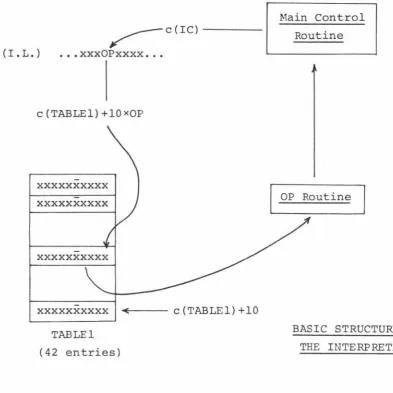
The MUSSEL interpreter, MUSINT, consists essentially of a main control routine together with a number of sub-routines corresponding to the set of operators in the Intermediate Language. The function of this main control routine is to scan the Intermediate Language, picking up the individual operators and branching to the appropriate operator routines. On completion of each of these OP routines
(with the exception of the END routine), control is in turn transferred back to the main control routine which will then proceed to pick up the next operator, and so on.
The I.L. operators themselves (see appendix) are coded sequentially, so that by use of a branching table (TABLEl) and suitable address modification, the main control routine can achieve a quick and efficient (indirect) branch to the appropriate OP routine. When the control routine is entered after the completion of each operator routine, the instruction counter, c(IC), points to the digit immediately to the left of the next instruction to be obeyed. Thus, by incrementing the counter by 2, the routine obtains a pointer to the right-most digit of the particular opcode, from which a branch to the corresponding routine can be obtained.
(I.L.)
~ c ( I C )
..• xxxOPxxxx ...
c(TABLEl)+lOxOP
-xxxxxxxxxx
-xxxxxxxxxx
-xxxxxxxxxx
[image:43.544.68.462.69.462.2]
-xxxxxxxxxx ---c(TABLEl)+lO
TABLEl (42 entries)
Main Control Routine
OP Routine
BASIC STRUCTURE OF THE INTERPRETER
A similar table (TABLE2) is used by the expression operator routine, OP, to branch to each of its individual routines (viz. OR, AND, NOT, LT, LE, EQ, NE, GE, GT, CAT, +, - *,
I, . I. ,
NEG, and * *) •In designing MUSINT, prime consideration has been given to the saving of core, rather than speed of execution. This has meant, among other things, that subroutines have been
created wherever possible. For instance, the subroutine POPTOP, which controls increments or decrements to the Stack pointers
STP and SVP, essentially replaces only 2 instructions in-line. The subroutine is, however, called from about 30 different places in the Interpreter which implies that its use, in spite of increasing execution time, has achieved a considerable
CORE STORAGE MAP OF 1620 DURING MUSSEL INTERPRETIVE
PHASE
1620 Monitor and Tables Interface variables LN,TA,TR,TN,TNO,TNl,TB,TS,TNS, INDA,INDR,ST,STA,VI,UJ,BA,IFJ,
and OP Routines OP branching TABLE2
AND,OR,NOT,EQ,NE,GT,GE,LT,LE, CAT,ADD,SUB,MULT,DIV,INTDIV, NEG,RT,RF,RFWT,RS,CS,CSWB,RAP,
RAF,CP,PE,TLA,TLR,MSF,RE,NP,NL, SP,TAB,I/0 Load, & END Routines
Main Control Routine
Declarations
OP branching TABLEl
Interface routine & I/O over-lay area (for RD,PR,& PRC rou-tines)
Symbol Table
SMF's, Main Arrays, I. L. , and Interpreter Stack
+
+
+
t t t String area
00000-02401 02402-02449 02450-06469
06470-06629 06630-17600
17800-18000
18200-20000
20005-20420
20500-25799
25800-27899
The limited amount of core storage available has also necessitated the overlaying of the bulky I/O routines READ, PRINT, and PRINT CONTROL. These routines are stored on disk, and are called into core by a load routine when needed, the implementation of which feature will be discussed more fully in the appropriate section below.
A core storage map of the 1620 during the interpretive phase is shown on the preceding page. From this map i t can be seen that the Interpreter, together with its various tables, occupies about 28,000 digits of core, leaving only
12,000 digits for the main arrays, I.L., interpreter Stack, and string area. Although this should provide sufficient space for testing the language, and should also cater for
most elementary student programs, more space could readily be made available by overlaying some of the other more bulky routines such as the REPEAT and CASE routines.
3.4. Expression Evaluation
As indicated earlier, source language expressions are translated during Phase I into a reverse polish form similar to that used by Randell & Russell. The evaluation of such expressions is accomplished by using the Stack as a simple
push-down store.
Corresponding to each simple main variable appearing
in an expression an operator of the following form is generated:
TR (Take Result)
a
3 X X X-The parameter here specifies the Symbol Table address
first check to see that the variable is in fact defined - if not, an appropriate error message is printed out. An added complication here is that if the result is in fact a string descriptor, then the corresponding string must be copied in the string area before a descriptor of t h e ~ is placed at the top of the Stack. The significance of this will be
explained more fully in the section on strings.
Corresponding to each constant appearing in an expression an appropriate "take constant" operator, accompanied by the constant itself, is generated in the Intermediate Language.
An alternative method of setting up a special constant table, or of even storing constants in the Symbol Table during the translation phase was considered. However, although this method would indeed save storage space, as each constant would be
stored only once, the added complication of setting up and maintaining such a table would imply a slower production of object code, which is contrary to one of the aims of the system. It was therefore decided to store constants in the stream of the I.L.
The following operators are used:
TN (Take Number)
a
4 X X X X X X X X XThe parameter here specifies a number in floating point form. The function of the corresponding TN routine is to place this number at the top of the Stack, together with a 'number' type digit.
TNO (Take Number Zero) 0 5
TNl (Take Number One) 0 6
For Boolean constants the following operator is used:
TB (Take Boolean) 0 7 X X
The parameter here is a Boolean value (00 represents
FALSE, 01 represents TRUE). 2 digits were used here to define
a field - this is convenient when implementing the system on
the 1620. The function of the TB routine is to place the
Boo-lean value at the top of the Stack, accompanied by a
corres-ponding 'Boolean' type digit.
TS (Take String) 0 8
x
x x x . . . x x O*
The parameter here is the alphameric code for the
constant string itself, terminated by an alphameric record mark. The function of the TS routine is to pack the string
away in the string area, assemble a corresponding string
descriptor, and finally place this descriptor, together with a 'string descriptor' type digit, at the top of the
Stack.
The following special parameterless operator is
generat-ed for a null string:
TNS (Take Null String) 0 9
This merely places the type digit for a null string at
the top of the Stack.
Corresponding to each operator appearing in the source
code expression, object code of the following form is
OP (Operator) 1 9
-
X XThe parameter here specifies code for one of the follow-ing operations: OR, AND, NOT, LT, LE, EQ, NE, GE, GT, CAT,+, -, *, /, . / . , NEG, and**. These operations are coded
sequentially (see appendix) so that by use of a branching
table (TABLE2), which is similar to TABLEl, the OP routine
can transfer control quickly and efficiently to the appropriate routine.
In the case of the unary operation NOT or NEG, the associated routine applies the appropriate operation to the
value at the top of the Stack, after first checking its type.
In the case of each of the remaining binary operations, the associated routine first checks the types of the top 2
Stack values. If they are in fact correct, i t then applies
the appropriate operation to these 2 operands, wipes them
from the Stack, and finally stores the result and type in
their place at the top of the Stack.
It should perhaps be noted here that the relational
operations in MUSSEL can be applied to string expressions
as well as arithmetic expressions (see string section).
Example:
Source code
Intermediate Language
Digit OP Parameter
142 TR A
147 OP 'NEG'
151 TN '12'
162 OP I * I
166 TNl
168 OP
'+'
172 TNO
174 OP 'GE'
178 TR STRING
183 TS 'ABC'
193 OP 'EQ'
197 OP 'OR'
201
..
A 'snapshot' of the Stack immediately before the execu-tion of the instrucexecu-tion 'OP 'GE'' would display the follow-ing situation:
c(STP)
+
22
STACK
c(SVP) + 0
3.5. Assignment Instructions
In the case of an assignment instruction, the Trans-lator produces object code to first assemble the address (or addresses) of the variable (or variables) to be reset at the top of the Stack. To achieve this (for main variables), a
'take address' operator of the following form is used:
TA (Take Address) 0 2 X X X
The parameter here is a 3-digit Symbol Table address. The function of the TA routine is simply to convert this
s.
T. address to an absolute core address which is then placed, together with an 'address' type digit, at the top of the Stack.The Translator follows this by object code to place the assigned value and type at the top of the Stack. One or more of the following store operators then follows:
ST (Store) 1 2
The function of this routine is to store the top Stack type and value at the address contained in the next Stack position. The top 2 Stack units are then wiped.
It should be mentioned here that if in fact the address-ed location contains a string descriptor, then the correspond-ing strcorrespond-ing nodes must first be returned to the AVAIL list before storage takes place (see string section).
-STA (Store Also) 1 3The STA operator is used in the translation of multiple assignment instructions.
Example:
Source code
SET A,B,C TO 0
Intermediate Language
Digit OP Parameter
64 TA A
69 TA B
74 TA C
79 TNO
81 STA
83 STA
85 ST
87
A 'snapshot' of the Stack immediately before the first store operation would display the following situation:
~
c(STP) 2 0 c(SVP)
6 =C=
6 =B= c(IC)=82
6 =A=
Just before the second store operation the situation
would be as follows:
~
~
c(STP) 2 0 c(SVP)
6 =B=
6 =A= c(IC)=84
STACK
3. 6. Main Arrays and Subscripted Variables
Although MUSSEL does provide for dynamic arrays (see procedures section), main arrays, like outer block arrays in ALGOL, must have constant bounds, and are reserved at the head of a program. This enables the system, during the
translation phase, to set aside storage and assemble storage
mapping tunctions for all main arrays . The space reserved is
located immediately following the Symbol Table (see storage
map), and is sufficient to contain the individual storage
mapping functions together with the array elements themselves, stored row-wise. Each such element is similar in form to a
Stack unit i.e. i t contains a value part of 9 digits accomp-anied by a type part of 1 digi t . In this way, not all elements
of an array need necessarily be of the same type.
In the object program, all references to a main array
refer to the appropriate array word, which is stored in the
-X X X t
Array dimension (0 for 1 dimension
1 for 2 dimensions)
-X 4 X X X X
t t
-X X X X X
t
Pointer to AW Rel. addr. Rel. addr. array name type of first of SMF
array elt.
Each of the 2 relative addresses in the value part of the AW must be added to the Symbol Table base address
(c(SYMBAS)) to give an absolute address.
Storage management for arrays in MUSSEL is greatly
simplified by the restriction that they be 1- or 2-dimensional only. The storage mapping function for a 1-dimensional array is of the following form:
-
-X X X X X X X X
t t
lower upper
subscript subscript
bound bound
For a 2-dimensional array, the SMF is of the following
form:
-X X X X t 1st lower bound (LO)
-X X X X t
1st upper bound (UO)
-X X X X t
2nd lower bound (Ll)
-X X X X
t 2nd upper bound (Ul)
-X X X X
t
Cl=Ul-Ll+l
elements would gobble up almost 10,000 digits of core, leaving a mere 200 digits available for the Intermediate Language, Stack, and string area !
The storage arrangement for the main arrays, then, can be illustrated by the fol lowing diagram:
Array
elts. X X X X X X X X X X (stored
row-wise) X X X X X X X X X X
-StorageMapping Function
X X X X X X X X X X
-X -X -X -X -X -X -X -X -X -X
X X X X 4 t
Name pointer
I
1
x
x x xx
x x t1st array SMF element
address
SYMBOL TABLE
I
+ Array
Word
Typical Storage Arrangement for 2-Dimensional
Main array area
6
Array
+c (SYMBAS)
+c (SYMBAS)
X X X X X
t
AW address
It should be noted that arrays reserved in the same segment, for example
RESERVE (A,B,C(l:100))
in fact reference the same storage mapping function.
The method of representation of subscripted variables in the I.L. in MUSSEL is very similar to that employed by Randell & Russell. An 'indexing routine' uses the array word and storage mapping function, together with the values of the actual subscripts, to locate the element of the array to which the subscripted variable refers.
Thus, to obtain the address of an array element, the I.L. must assemble, as data for the indexing routine, the address of the array word, and the value of each subscript expression. This is done by using a TA operator to stack the address of the Symbol Table location which contains the array
word, followed by the normal object program representation of each subscript expression. The operation INDA (Index Address) then follows. This routine works its way down through the
Stack, beginning at the top, identifying the subscript values as numbers, keeping a count of their number, and checking
that their magnitudes are in fact less than 10,000. An initial restriction, also, is that the subscript values be integers. Later the routine should be extended to cater for the rounding of real subscripts.
out.) The routine is then able to process the array word,
storage mapping function, and stacked subscripts to obtain
the address of the array element. During the process, a
check is made to ensure that the subscript values do in fact
lie between their prescribed bounds, which have been stored
in the SMF.
Finally, the array element address is placed in the Stack
unit which contained the address of the array word, and the
Stack pointers decreased so as to make this now the top Stack
unit.
Thus the total effect of the set of operations is just
the same as a TA operation for a simple variable.
To produce the equivalent of a TR operation for a
simple variable, the operation INDR (Index Result) is used.
This works in the same way as the INDA routine, except that
i t finishes by fetching the actual array element type and
value.
Example :
Source code
SET A (I, J *K) TO B ( C ( L, M) )
Intermediate Language
Digit
23
28
33
OP
TA
TR
TR
Parameter
A I
J
Digit OP Parameter
38 TR K
43 OP I* I
47 INDA
49 TA B
54 TA C
59 TR L
64 TR M
69 INDR
71 INDR
73 ST
75
The Stack situation immediately before execution of
the second INDR operation would be as follows:
/ r
~
c(STP) 2 M c(SVP)
2 L
6 =C=
6 =B= c(IC)=72
6 =A(I,J*K)=
3.7. Number Representation and Arithmetic
As indicated earlier, all numbers are represented
internally by MUSSEL as a 7-digit mantissa accompanied by
a 2-digit exponent. A minus sign, for the mantissa or exponent, is indicated by a flag over the low-order digit, the
convent-ion with all fields in the 1620. The reason for reducing the mantissa length from the customary 8 digits to 7 was to
enable a number, together with its type, to be contained in
a Stack unit of 10 digits. It was felt that this small loss
in significance was justified in a student language.
The important feature, however, of the MUSSEL repre-sentation is that the implied decimal point for the mantissa
is to the right. In this way, integers may be treated essentially as a subset of the reals, being distinguished
internally by a zero exponent. The range of integers, there-fore, is from -9999999 to +9999999, while reals may range
from ±E-99 to ±9999999E99. The advantage with this represent-ation, of course, is that i t removes for the student the real - integer type conversion problem present in other
languages, particularly the mixed-mode problem of FORTRAN.
The adoption of this convention in MUSSEL has meant
the creation of the system's own independent arithmetic routines. These routines operate on integers as a special case, thereby bypassing the more involved processing
re-quired for real operands. This is to say that the routines ADD, SUBTRACT, MULTIPLY, and INTEGER DIVIDE, with integer operands, produce integer results, except in the case when the result overflows in 'integer format', and must therefore
be converted to 'real format'.
Also, on the detection of overflow (i.e. when a number's exponent becomes greater than 99), the MUSINT rounding and normalising routine prints an appropriate warning message, and then returns the largest number (in magnitude) that i t can accommodate - a mantissa (together with its partic-ular sign) and exponent of 9's. And on the detection of underflow (i.e. when the exponent of a number becomes less than -99), the routine, having printed a warning
message, continues in a similar forgiving manner by return-ing a result of zero (i.e. zero mantissa and exponent).
3.8. Logical Operations
A Boolean variable in MUSSEL is represented internally by a unit containing the type digit '3', together with a value part of '00' for the value FALSE, or '01' for the value TRUE.
Three Boolean operators are available in the language, the MUSINT routines for which are quite straightforward. The AND and OR routines work on the top 2 Stack units, checking that they are of type 'Boolean', and if so replacing them by the resulting Boolean type and value. The unary operation NOT merely confirms that the top type is 'Boolean', and then changes the top value from TRUE to FALSE, or vice-versa.
The relational operations LT, LE, EQ, NE, GE, and GT work on the top 2 units, which may be either numbers or