Corresponding author
Email address: Helen Willacy: [email protected]
PERSONALISED LEARNING WITH MOBILE TECHNOLOGIES IN MATHEMATICS:
AN EXPLORATION OF CLASSROOM PRACTICE
HELEN WILLACY, AMIE WEST, CAROL MURPHY, AND NIGEL CALDER University of Waikato
New Zealand
Abstract
Personalised learning is generally understood to be of benefit to students’ learning. In addition, the flexible nature of mobile technologies (MTs) and the variety of available apps are seen to respond to the needs of individual students, and hence have the potential to support personalised learning. This paper reports on an aspect of a larger research project that investigated the use of mobile technologies in primary mathematics classrooms. Personalised learning was determined as one theme that emanated from the teachers’ and students’ use of MTs, and this paper aims to investigate how personalised learning was evidenced within the practice of three teachers. Video data of classroom practice were used to analyse the use of MTs within the theme of personalised learning. Four pathways to personalised learning emerged, enabling a more practical understanding of different types of personalisation afforded by MTs.
Keywords
Personalised learning; mobile technologies; primary mathematics
Introduction
Research into the use of mobile technologies (MTs) and their impact on classroom practice is still in early stages. The touch screen of MTs have affordances that differ from those of desktop or even laptop computers (Wang, Towey, & Jong, 2016), and so have the potential to change learning environments and also to enhance students’ learning “… in ways that were previously not possible …” (Clark & Luckin, 2013, p. 2). MTs are tools that enable customisation easily, and so would seem to provide opportunities for students and teachers to personalise learning. To personalise something suggests that there is an opportunity to change that something, or add to it, so that it belongs to, or comes from, a particular person. In this regard, personalised learning is seen as learning that is personally relevant.
MTs may have the potential for such personalised learning experiences, but how are they used in classroom settings? In this paper, our aim is to examine ways that MTs have been used to personalise learning experiences in primary mathematics classrooms. This paper presents data from part of a larger project into the use of iPads and other MTs in primary mathematics classrooms. In particular, we investigate how MTs enabled personalised learning in the practice of three teachers with students from age seven to eleven. Data from video recordings of classroom practice are used to illustrate some ways that MTs supported personalised learning experiences.
Personalised learning—a fuzzy concept
Despite the prevalence of personalised learning, there is no consistent use of the term in classroom practice (OECD, 2006). Whilst personalised learning suggests that the learning is made distinct and relevant to a student, this could happen in many ways, and hence can mean many things. Prain et al. (2013) noted that there has been a general vagueness regarding the distinctive features of personalised learning. Furthermore, current understandings of personalised learning in research literature are often conflicting in relation to who is tailoring the learning. On the one hand, An and Reigeluth (2011) suggested that personalised learning involves teachers paying close attention to individual student’s knowledge and skills to provide personalised experiences and support in learning. In contrast to this, Leadbetter (2005) proposed that personalised learning should focus on motivating students to become engaged in their own learning by allowing them to make choices, and hence, empowering them to make decisions. In this latter interpretation, the focus is not on the choices as much as it is on the motivation and self-regulation of learning. These two views of personalised learning present a contrast in relation to the teacher or the student tailoring the learning.
Other understandings have noted that personalised learning relates to the structured activities students engage in with scaffolding from their teachers, such as “… modelling, guidance in goal-setting and timely feedback” (Waldrip et al., 2014, p. 357). Tomlinson (2009) used the term differentiation to describe this sort of concept, but also to draw on the notion of student choice. She concluded that teaching should be concerned with not only content mastery but also student efficacy and ownership of learning, hence making links between the different views.
These different and contrasting views serve to make personalised learning a ‘fuzzy concept’. This lack of clarity also means that there is a lack of practical knowledge about how personalised learning can be implemented in classrooms. In this study a broad stance is taken in viewing personalised learning as the employment of learning tasks, tools and environments to enable and encourage learning that is personally meaningful through acknowledging and catering for individual differences, and hence providing opportunities for student ownership of learning. A key theme is that personalised learning experiences enable the tailoring of learning to a student’s wants, preferences and needs. There is a sense of controllability and personal value that could increase motivation of the learning task and perceived self-efficacy.
MTs and personalised learning
As discussed, several studies have suggested that MTs have the potential to be customised to suit a variety of situations and interests, hence they have the potential to personalise learning through customisation and through mobility. With this literature in mind, this paper seeks to explore the classroom practice of three teachers; how they and their students used the potential of MTs to personalise learning within the context of mathematics in primary classrooms. In particular, we ask in what ways these teachers used MTs to personalise learning in their mathematics classrooms, and if these different ways can help to further clarify key ideas related to personalised learning.
The study
The data were collected as part of a two-year research project investigating how apps were used in mathematics education at two New Zealand primary schools. In this paper we focus on the first year of the project, when the researchers collaborated with three teachers experienced in using MTs in their classroom programmes. Two of the teachers taught their class of Year 5 and 6 students co-operatively in a large, purpose-built modern learning environment. Every child had access to an iPad that the school provided. The third teacher had a class of Year 4 students in a modern classroom space with an adjoining hallway space that was available as a learning space. In this classroom the students were asked to provide their own device and a selection of apps (BYOD).
[image:3.595.75.271.413.554.2]An interpretive research methodology was used, based on a belief that human reality is multi-layered and complex (Cohen, Manion, & Morrison, 2011). Qualitative data were collected using a range of methods, but for this paper, we focus on the data from video recordings of classroom practice. Regular mathematics lessons were videoed four times during the year to gain an overview of the teaching throughout the year. Video clips were viewed and discussed by the research team at regular meetings with the teachers through the year. Personalised learning was one of the themes identified and subsequent analysis revealed four different types of personalisation when using iPads in mathematics learning. These different elements of personalised learning will be explored in the next section.
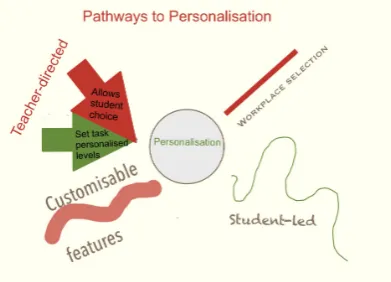
Figure 1:
Pathways to personalised learning diagram.
Examples of personalised learning
In analysing the data, four pathways for personalised learning emerged: teacher-directed, customisable features, workplace selection, and student-led learning. These four pathways are shown in Figure 1. Data that illustrate each of these pathways are presented.
Teacher-directed
needs of an individual student, in this case recall of number facts, and had used this information to create a list of specific apps to target each student’s needs (Figure 3). Each student used this list to choose the order to work on the different apps.
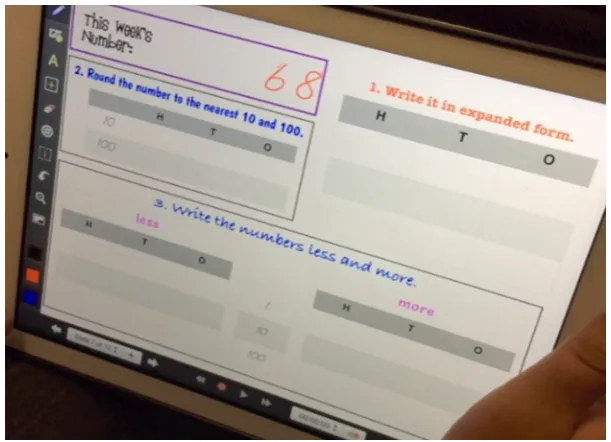
Figure 2:
Teacher directed digital worksheet on place value.
These examples show how learning was personalised through the teachers’ control and direction by providing students with learning according to their needs, as assessed by the teacher. They also show a shift in the way the teacher directed the learning in allowing students to start to make some decisions themselves in choosing the order to use the apps.
Figure 3:
Teacher directed list of apps related to number facts.
Customisable features
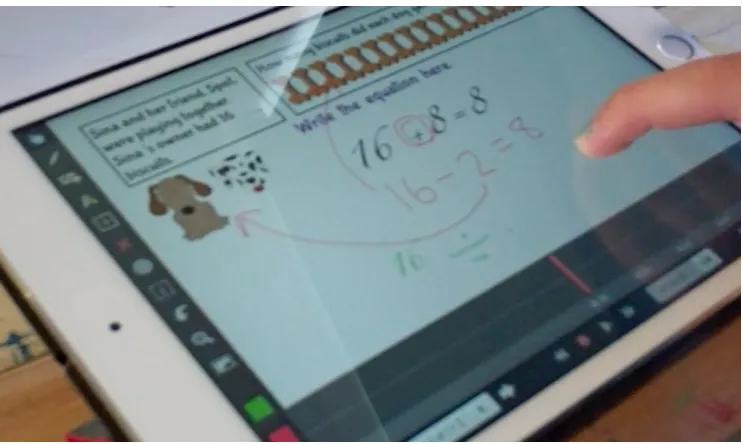
[image:4.595.73.318.418.611.2]Figure 4:
Choosing a preferred image of a dog to solve a division problem.Figure 5:
Choosing the format to present her solution to the division problem.Another student was observed formatting her recording of the division problem 16÷2=8 using different fonts and colours (Figure 5).
These examples show how the customisable features of MTs allowed the students to make choices regarding how they presented their learning and thus making the mathematics personal and relevant to them.
Workspace selection
[image:5.595.73.445.326.548.2]Figure 6:
A variety of spaces to work.
In the Year 4 BYOD classroom, the teacher assigned the students a task on the iPad and told them that they were able to complete this task in whatever location within the classroom they felt most comfortable and able to concentrate, with options such as on bench seats, desks both high and low, the floor and beanbags.
The mobility of iPads also enabled transitions between collaborative and individual work, to suit personal preferences and needs. In another video clip from the Year 5/6 classrooms, a group of students decided to go to a quieter spot to record their learning as a video presentation. These examples illustrate how this pathway enables students to make choices about where to sit, including being able to choose to sit next to someone and collaborate, or to sit and work alone, or to find a space more conducive to completing the task.
Student-led learning
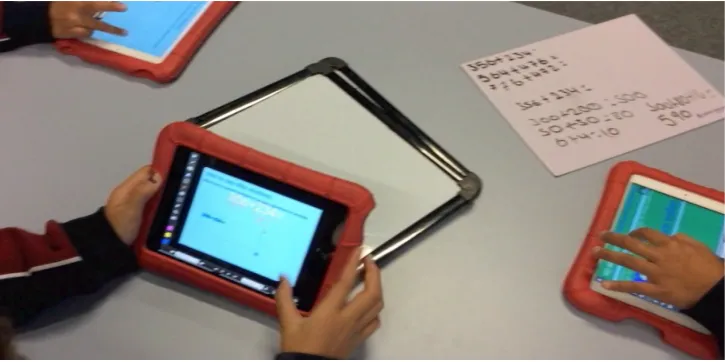
Some video data showed how the teacher had created an environment which allowed students to have an element of control over what they learn, how they learn it and how they present it. In one example from the Year 5/6 classrooms, students were asked to explore a mathematics calculation strategy with a ‘buddy’, creating their own video to explain how their selected strategy worked, and for which problems it would be most effective. Students were observed exploring various strategies, such as equal addition and reversibility. They recorded their strategies in a multitude of ways, such as the use of whiteboards, calculators and discussions, before creating their own video recording on their iPads.
[image:6.595.75.438.563.744.2]These examples show how the student-led pathway is an intentional teacher-created environment that empowers students to have a say in what they learn, along with how they record and present their learning. Such an environment encourages self-regulated learning.
Discussion
The examples of video data were intended to illustrate personalised learning through the different pathways in order to help clarify the fuzziness. As such, these pathways relate to the different views of personalisation as presented in the current literature. The teacher-directed model is akin to An and Reigeluth’s (2011) concept of personalised learning, wherein the teacher creates personalised learning experiences based on their understanding of students’ knowledge and skills. In this pathway teachers used the change in context feature of MTs to choose apps and tasks within apps, to suit specific learning needs (Clark & Luckin, 2013; O’Malley et al., 2013). However, this pathway is limited in the way it represents ideas of personalised learning that relate to student choice or self-regulated learning. In the customisable features pathway, the opportunity to select fonts and images may provide for some student ownership in making the mathematics personally relevant, and hence encourage engagement and interest in their work. This engagement has been seen as a crucial element in learning (Attard, 2011). As such, the use of the change of context feature becomes one that suggests personalisation in relation to preferences and ownership. Similarly, the workplace selection pathway allowed for individual preferences in both place and collaboration. In this case, it is the mobility feature that is enabling preference and ownership.
The student-led learning pathway strongly aligns with Leadbetter’s (2005) concept of personalised learning as a teacher-created environment in which students are empowered to make decisions and to self-regulate their learning. This pathway reflects the potential of MTs and the various apps for personal choice and contrasts strongly with the teacher-directed pathway, where the teachers make most of the choices.
Whilst there is a sense that the student-led pathway best fits the key elements of personalised learning as defined for this study, all the pathways are seen to have their own benefits. The teacher-directed pathway can help to enhance learning in key areas related to learning objectives, something that is not guaranteed when students make choices regarding their own learning. The student-led pathway empowers students in decision-making about what to learn, something no other pathway offers. From these findings, a further question emerges: Can all these pathways be used to enhance the personalisation of students’ learning?
As this was an examination of particular contexts with only three teachers, it is not possible to be confident that these findings would be generalizable to a broader context. It would be valuable for more research on the implementation of personalised learning with MTs, and the encouragement of teachers to create learning environments that support personalised learning through the different pathways. Teachers could use the pathways to understand which form of personalisation they wish to achieve in specific situations. This paper should also serve to provoke teachers in thinking about how they can empower students to lead their own learning, whether through the customisation of features or the selection of learning tasks.
Conclusion
References
An, Y.-J., & Reigeluth, C. (2011). Creating technology-enhanced, learner-centered classrooms: K-12 teachers’ beliefs, perceptions, barriers, and support needs. Journal of Digital Learning in Teacher Education, 28(2), 54–62. https://doi.org/10.1080/21532974.2011.10784681
Attard, C. (2011). “My favourite subject is maths. For some reason no-one really agrees with me”: Student perspectives of mathematics teaching and learning in the upper primary classroom. Mathematics Education Research Journal, 23(3), 363–377. http://doi.org/10.1007/s13394-011-0020-5
Calder, N., & Campbell, A. (2016). Using mathematical apps with reluctant learners. Digital Experiences in Mathematics Education, 1–20. http://doi.org/10.1007/s40751-016-0011-y
Clark, W., & Luckin, R. (2013). What the research says: iPads in the classroom. University of London, England: Institute of Education.
Cohen, L., Manion, L., & Morrison, K. (2011). Research methods in education (7th ed.). Oxon, England: Routledge.
Leadbetter, C. (2005). The shape of things to come: Personalised learning through collaboration. Department for Education and Skills. Retrieved from
http://www.standards.dfes.go.uk/innovation-uni
Looi, C.-K., Wong, L.-H., So, H.-J., Seow, P., Toh, Y., Chen, W., … Soloway, E. (2009). Anatomy of a mobilized lesson: Learning my way. Computers & Education, 53(4), 1120–1132. http://doi.org/10.1016/j.compedu.2009.05.021
Looi, C.-K., Wong, L.-H., & Song, Y. (2013). Mobile computer-supported collaborative learning. In C. E. Hmelo-Silver, C. A. Chinn, & C. Chan, The international handbook of collaborative learning (pp. 420–436). Florence, KY: Routledge. Retrieved from
http://site.ebrary.com/lib/alltitles/docDetail.action?docID=10672597
Ministry of Education. (2007). The New Zealand curriculum. Wellington, New Zealand: Learning Media.
OECD. (2006). Schooling for tomorrow: Personalising education. Paris, France: OECD Publishing O’Malley, P., Jenkins, S., Wesley, B., Donehower, C., Rabuck, D., & Lewis, M. E. B. (2013).
Effectiveness of using iPads to build math fluency. Paper presented at the Council for Effectiveness of using iPads to build math fluency, San Antonio, Texas, USA. Retrieved from http://eric.ed.gov/?id=ED541158
Prain, V., Cox, P., Deed, C., Dorman, J., Edwards, D., Farrelly, C., … Yager, Z. (2013). Personalised learning: Lessons to be learnt. British Educational Research Journal, 39(4), 654–
676.http://doi.org/10.1080/01411926.2012.669747
Robinson, C., & Sebba, J. (2010). Personalising learning through the use of technology. Computers & Education, 54(3), 767–775. http://doi.org/10.1016/j.compedu.2009.09.021
Tomlinson, C. (2009). The goals of differentiation. In M. Scherer (Ed.), Supporting the whole child: Reflections on best practices in learning, teaching, and leadership (pp. 3–11). Alexandria, VA: ASCD.
Waldrip, B., Cox, P., Deed, C., Dorman, J., Edwards, D., Farrelly, C., … Yager, Z. (2014). Student perceptions of personalised learning: Development and validation of a questionnaire with regional secondary students. Learning Environments Research, 17(3), 355–370. http://doi.org/10.1007/s10984-014-9163-0