UNIVERSITY
oFTASMANIA
Mixed anion
lithium complexes - models for
superbases
by
Bryce James Lockhart-Gillett, B. Sc. (Hons)
Submitted in fulfilment of the requirements for the degree of
Doctor of Philosophy
School of Chemistry,
University of Tasmania
-II
-This thesis contains no material which has been accepted for a degree or diploma by the University or any other institution, except by way of background information and duly acknowledged in the thesis, and to the best of my knowledge and belief no material previously published or written by another person except where due reference is made in the text of the thesis, nor does the thesis contain any material that infringes copyright.
~
Bryce Lockhart-Gillett-III
-This thesis may be made available for loan and limited copying in accordance with the Copyright Act, 1968.
Bryce Lockhart-Gillett
IV
-ABSTRACT
The work reported m this thesis describes the synthesis, characterisation, and reactivity of several mixed anion lithium complexes.
Chapter 2 is concerned with the design, synthesis, and characterisation of the mixed phenol/amine containing ligands, which serve as the backbone for mixed O/N anion lithium complexes also described. N-phenylsalicylaldamine, (ONPhH2), N-2,6-diisopropylsalicylaldamine (ONDIPPH2), and N-t-butylsalicylaldamine (ONtBuPhH2), were prepared from their corresponding imine precursors, which were themselves prepared via imine condensation of the appropriate primary amines with salicylaldehyde. Solid state structures were obtained for the amine compounds, which display intermolecular H-bonding networks.
[ {Lh(ONDIPP)}2(TMEDA)2], [ {Li(ONPh) }2(DME)2(THF)2], and [ {Lh(ONDIPP) }2(DME)2] were prepared by exposing the dilithiated THF complexes
to TMEDA and DME respectively.
(TMEDA = N,N,N',N'-tetramethylethylenediamine, DME = 1,2-dimethoxyethane). A
related tetrameric dilithiated complex [ {Lb(ONPh)} 4(THF)4] was obtained from [ {Lh(ONPh) }i(THF)6] by heating in benzene.
Chapter 3 describes further solvent exchanged dilithiated complexes. The complexes
[ {Lh(ONPh) }i(MeOCH2CH20t-Bu)2(THF)2],
[ {Lh(ONDIPP)}2(MeOCH2CH20t-Bu)2], and ([ {Lh(ONDIPP)}2(dioxane)(THF)])oo were obtained by exposing the dilithiated THF complexes to MeOCH2CH20t-Bu and dioxane respectively. This chapter also describes the reactivity of some of the dilithiated complexes towards ether type substrates. Cleavage of both aliphatic and aromatic ether molecules was observed, with predictable stereospecificity correlated to the observed geometry of the dilithiated complex. From this reactivity a further monolithiated complex containing a modified N-methylated ligand was obtained [ {Li(ON(Me)PhH)}4].
Chapter 4 reports the synthesis and characterisation of mixed amide/alkoxide ligands and their complexes. The ligands N-phenyl(2-trimethylsilylmethyl)benzyl amine (NCPhH2) and N-2,6-diisopropylphenyl(2-trimethylsilylmethyl)benzyl amine (NCDIPPH2) were prepared, and lithiated with n-BuLi to yield the monolithiated
complexes [ ( {Li(NCPhH) }2(NCPhH))2] and
[ (N-TMS 2,6-diisopropyllithiumamide )(THF)3].
and serendipitous inclusion of molecular fragments, either into the aggregated complex as in the complex [ {Li(ONtBu)}3Li(OEt)(Et20)3], or a portion of silicon grease incorporated into the dilithiated ligand backbone as in
[ {LhOODIPPSh}(DME)z], [ {Lh(OODIPPSi)}z(TMEDA)2] and
[K2 {Lh(OODIPPSi) }z {Li(ONDIPPH) }z {LiOSi(Me )10 }z(DME)4]. The complex [ {Lh(OODIPPSi)}2{Li(OEt)}z(Et20)2] was also observed, which contains both a molecular fragment as well as a modified ligand.
-
VII-ACKNOWLEDGEMENTS
I would firstly like to thank my principle supervisor Dr Michael Gardiner for his tuition throughout my candidature. His guidance and encouragement has been essential to the completion of this work, and I am sincerely grateful for his assistance. I am also thankful for the assistance from my co-supervisor Prof Brian Yates, whose support and guidance through the theoretical component of my project has been of great assistance.
Thankyou to Dr Craig Forsyth, Monash University, for X-ray crystallography services. Thanks also to Dr Noel Davies, Dr Thomas Rodemann and Dr James Home, Central Science Laboratory, University of Tasmania for GC-MS studies, elemental analysis and NMR studies, respectively. Thanks are also extended to Dr Alireza Ariafard and Dr Nigel Brookes for their assistance with the computational investigations.
I would also like to thank my co-workers from the Gardiner group throughout my candidature, particularly Mr Adam James, Dr Damien Stringer, and Dr Sam Karpiniec whose friendship yielded many of the fond memories I will take away with me. Thanks are also extended to Mr Adam James for his assistance with X-ray crystallography studies.
-
VIII-TABLE OF CONTENTS
Title ... i
Abstract. ... iv
Acknowledgements ... vii
Table of Contents ... viii
ABBREVIATIONS ... xiii
Chapter 1 ... 1
Introduction ... 1
1.1. Organolithium chemistry ... 1
1.2. Structure and bonding of alkyllithium complexes ... 6
1.3. Amidolithium chemistry ... 9
1.4. 'Superbase' systems ... 15
1. 5. General research aim ... 21
Chapter 2 ... 24
Mixed anion O/N ligands and their lithiated complexes ... 24
2.1. 2.2. 2.3. 2.3.1. 2.3.2. Introduction ... 24
Research aim ... 33
Results and discussion ... 34
Ligand synthesis ... 34
2.3.3. Monolithiated O/N complexes ... 42
2.3.4. Molecular structures ... 47
2.3.5. Dilithiated O/N complexes - THF adducts ... 56
2.3.6. Molecular structures ... 61
2.3.7. Dilithiated O/N complexes -TMEDA adducts ... 70
2.3.8. Molecular structures ... 75
2.3.9. Dilithiated O/N complexes - DME adducts ... 80
2.3.10. Molecular structures ... 84
2.4. Theoretical considerations ... 93
2.5. Conclusion ... 102
2.6. Experimental ... 104
2.6.1. Synthesis ofONPhH2 4 ... 104
2.6.2. Synthesis ofONDIPPH2 5 ... 105
2.6.3. Synthesis ofONtBuH2 6 ... 106
2.6.4. Synthesis of [ {Li(ONPhH) }4] 7 ... 107
2.6.5. Synthesis of[ {Li(ONPhH)}4(THF)3] 8 ... 107
2.6.6. Synthesis of[{Li(ONDIPPH)} 4] 9 ... 108
2.6. 7. Synthesis of [ {Lh(ONPh)}2(THF)6] 11 ... 109
2.6.8. Synthesis of [ {Lh(ONDIPP)}2(THF)4] 12 ... 109
2.6.9. Synthesis of [ {Lh(ONPh) }4(THF)4] 13 ... 110
2.6.11. Synthesis of [ {Lh(ONDIPP) }2(TMEDA)2] 15 ... 111
2.6.12. Synthesis of [ {[Li(ONPh)]z(DME)3}oo] 16 ... 112
2.6.13. Synthesis of [ {Lh(ONDIPP) }z(DME)2] 17 ... 112
2.6.14. Synthesis of [ {Lh(ONPh)}2(DME)2(THF)2] 18 ... 113
Chapter 3 ... 114
Reactivity of the dilithiated O/N complexes towards solvents ... 114
3 .1. Introduction ... 114
3.2. Research aim ... 122
3.3. Results and discussion ... 123
3.3.1. Dilithiated O/N complexes-MeOCH2CH20t-Bu adducts ... 123
3.3.2. Dilithiated O/N complex- 1,4-dioxane adduct ... 126
3.3.3. Dilithiated Molecular structures ... 128
3.3.4. Dilithiated O/N complexes - reactions with solvents ... 137
3.3.5. Molecular structure of [ {Li(ON(Me)Ph)}4], 22 ... 150
3.3.6. Theoretical considerations ... 151
3.4. Conclusion ... 158
3.5. Experimental ... 160
3.5.1. Synthesis ofMeOCH2CH20t-Bu ... 160
3.5.2. Synthesis of [ {Lh(ONPh)}2(MeOCH2CH20t-Bu)2(THF)z] 19 ... 161
3.5.3. Synthesis of [ {Lh(ONDIPP)} 2(Me0CH2CH20t-Bu)2] 20 ... 162
3.5.5. Alternate solvates andpolymorphs of[ {Li(ONDIPPH)}4] 9 ... 163
3.5.6. GC-MS quantification of guaiacol.. ... 164
3.5.7. Synthesis of [ {Li(ON(Me)PhH)}4] 22 ... 164
Chapter 4 ... 166
Mixed anion N/C ligands and their lithiated complexes ... 166
4.1. Introduction ... 166
4.2. Research aim ... 168
4.3. Results and discussion ... 169
4.3.1. Ligand synthesis ... 169
4.3.2. NMR characterisation of the N/C ligands···, 172
4.3.3. Lithiation ofNCPhH2, 23 ... 173
4.3.4. Lithiation ofNCDIPPH2, 24 ... 176
4.3.5. Molecular structures ... 178
4.4. Conclusion ... 180
4.5. Experimental ... 181
4.5.1. Synthesis ofNCPhH2 23 ... 181
4.5.2. Synthesis ofNCDIPPH2 24 ... 182
4.5.3. Synthesis of [ {[Li(NCPhH)]z(NC=PhH)}z] 25 ... 183
4.5.4. Synthesis of [(2,6-iPr2C6H3)N(SiMe3)Li(THF)3] 26 ... 184
Chapter 5 ... 185
5.1. Introduction ... 185
5.2. Research outcome ... 190
5.3. Results and discussion ... 191
5 .3 .1. Ethoxide fragment incorporation ... 191
5.3.2. Molecular structures ... 195
5.3.3. Silicon grease :fragment incorporation ... 203
5.3.4. Molecular structures ... 209
5.4. Conclusion ... 216
5 .5. Experimental ... 217
5.5.1. Synthesis of [ {Lh(ONtBu)}3Li(OEt)(Et20)3] 27 ... 217
5.5.2. Synthesis of [ {Lh(OODIPPSi)}i{Li(OEt)}i(Et20)2] 28 ... 219
5.5.3. Synthesis of [ {Lh(OODIPPSh) }i(DME)2] 29 and [K2{Lh(OODIPPSi)}2{Li(ONDIPPH)}2 {LiOSi(Me)20}i(DME)4] 30 ... 219
5.5.4. Synthesis of [ {Lh(OODIPPSi)}i(TMEDA)2] 31.. ... 220
Chapter 6 ... 221
Conclusion ... 221
6.1. Concluding remarks ... 221
APPENDIX ... 230
Experimental Procedures ... 230
A
Anal. Ar bm br B3LYP n-Bu t-Bu CIPE DFT DIPP DME DMF Et GC-MS gCOSY gHMBC gHMQCXIII
-ABBREVIATIONS
Angstrom, 10-10 meters
elemental analysis
aromatic, aryl
broad multiplet
broad
Becke 3-Parameter (Exchange), Lee, Yang and Parr
normal-butyl
tertiary-butyl
Complex Induced Proximity Effect
Density Functional Theory
2,6-diisopropylphenyl
1,2-dimethoxyethane
dimethylformamide
ethyl
diethyl ether
gas chromatography-mass spectrometry
gradient correlation spectroscopy
gradient heteronuclear multiple bond correlation
gHSQC HRMS IR L m M
ut·
Me NMR PMDETA ppm pt R s t TEED A THF TMEDA TMS 8 vgradient heteronuclear single quantum correlation
high resolution mass spectrometry
infra-red
ligand
multiplet
metal
molecular ion peak
methyl
nuclear magnetic resonance
N,N,N',N'',N''-pentamethyldiethylenediamine
parts per million
pseudo triplet
alkyl, aryl
1
Chapter 1
Introduction
1.1.
Organolithium chemistry
Organolithium reagents are today perhaps some of the most widely recognised and utilised organometallic compounds in the field of synthetic chemistry. [I-3l They have become established as standard reagents in both organic and organometallic laboratories. Organolithium compounds are a specific subset of a larger class of compounds, the organoalkali metal compounds. The discovery of organoalkali metal compounds came somewhat later than other corresponding main group organometallic compounds. In 1849 Edward Franklin discovered dimethylzinc as the first main group organometallic compound, E4l but it wasn't until 1914 that the pioneering work of William Schlenk yielded the first organoalkali metal compounds.E5l For a recent review on the development of the synthetic methods for their preparation, see Seyferth. [6, 7l
The chemistry of organolithium compounds is governed by the same distinguishing feature of all organometallic compounds; a metal-organic bond with the metal being more electropositive than the organic bonding partner. Thus, the organic fragment displays anionic characteristics and is nucleophilic. In the heavier organoalkali metal compounds, the metal is so electropositive that the metal-organic bond is considered essentially ionic. In contrast, organolithium compounds retain a degree of covalency in their metal-organic bond. [BJ
Chapter 1 Introduction 2 organometallic compounds of less electropositive metals, as illustrated m Equation 1-1.
UR + MX -7 MR + LiX
(where Mis a less electropositive metal, and X is often a halide).
Equation 1-1 The most common use of organolithium reagents, however, is in the Schorigin reaction;[9l commonly referred to now as a 'metallation reaction'. As shown in Equation 1-2, organolithium complexes, and in particular alkyllithium complexes, are strong enough bases to render the protons of many organic compounds 'acidic' enough to undergo a metal-hydrogen exchange with them, including ones that lack any functionalisation.
R-H + UR' -7 R-U + H-R'
Equation 1-2 In reality this metallation is an equilibrium process, however if the difference in acidities between the two conjugate acids is greater that ea. 10 pH units the reaction is essentially quantitative. For n-BuLi this means that it has a limiting pKa of ~35 for effective reactivity. The metallation reaction is of central importance to synthetic chemistry because it allows for the formation of a new functional group at the site of metallation simply by 'quenching' the organolithium with a nucleophilic substrate, as shown in Equation 1-3.
R-U + R'-X -7 R-R' + UX (where X is often a halide).
Chapter 1 Introduction 3 chemistry and several of the simple alkyllithiums are commercially available; e.g., n-BuLi is available in a variety of aliphatic solvents in concentrations up to 10 M. MeLi, sec-BuLi, and t-BuLi are also widely available. In addition to these alkyllithium reagents, a variety of other organolithium compounds have become utilised synthetically such as amide derivatives including lithium diisopropylamide (LDA), lithium bis(trimethylsilyl)amide and lithium diethylamide, and consequently these are also available commercially. [21 While being weaker bases, these amide derivatives offer alternative advantages such as being non-nucleophilic if sufficiently bulky and able to undergo proton abstractions with high regio- and stereoselectivity. [lOJ
Chapter 1 Introduction 4 relationship between the organolithium compounds and the complexes they form with their substrates, much progress has been made towards achieving targeted metallation reactions of organic substrates. Wheatley provides a relatively recent example of a review of directed lithiation reactions, focusing on the mechanism by which the organolithium complex that is formed in the reaction with the substrate molecule governs the outcome of the reaction. [l?J It is now well established that the effect of aggregation of the reagent on the synthetic outcome ofmetallation reactions is of the upmost importance and has been extensively demonstrated.[lSJ Much new chemistry has resulted from the increased understanding of the way organolithium reagents interact with their substrate molecules. Included are highly specific, unique selectivities that are unlikely to have ever been developed without the systematic knowledge that has been generated through detailed structural studies of organolithium complexes. The best understood systems are still, however, those based on simple organolithium lithium reagents, and much more remains to be investigated in systems that are more complex.
Chapter 1 Introduction 5
0
n-Buli0
hexane (no reaction)
n-Buli
u,
0
hexaneTM EDA
x
Figure 1-1: Reactivity of toluene towards metallation with n-BuLi with and without TMEDA.
Chapter 1 Introduction 6 the synthetic uses to which these and related organometallic bases have been put. Naphthalene and the biphenyl dianion have been used to selectively metalate poly haloalkynes,r211 as well as carbolithiate terminal and strained internal alkenesY21 In the area of arene synthetic manipulations, Rummel reports on the accelerated alkylation of naphthalene and toluene, [231 and Schlosser has written an extensive review titled "regiochemically exhaustive functionalisation" which incorporates various methodologies and organometallic reagentsY41 An important class of organolithium reagents utilised for synthetic chemistry are chiral amidolithiums. Their uses include, but are certainly not limited to asymmetric deprotonation of chiral epoxides and unsaturated ketones, as well as prepare chiral organometallic reagents. They have also been used for chiral epoxide opening and can undergo Michael type reactions. [I5, 25-34l There has also been significant development in the area of regiochemical control of pyridine functionalisation. Investigations into n-BuLi/lithium aminoalkoxide aggregates by Fort have helped develop new powerful reagents for selective functionalisation of pyridines. [35401
1.2.
Structure and bonding of alkyllithium complexes
Organolithium complexes display a huge array of bonding modes in the solid state. [4IJ The work presented in this thesis is primarily concerned with the aggregation of alkyl-, alkoxido- and amidolithium compounds, which have been shown to be largely governed by the concepts of ring stacking and laddering established by Mulvey and Snaith. [2, 31
Chapter 1 Introduction 7 under coordinated. Due to this, as well as the fact that they are hard Lewis acids, they have strong tendencies to aggregate to increase the number of Lewis basic interactions. Several of the simple alkyllithium complexes have been structurally characterised in the solid state and the arrangement of the ions within the aggregated complex were discovered to follow commonly occurring trends in how they were arranged. Many of the alkyllithium compounds aggregate with cores that display an aggregation mode that has been called 'stacking'.[4Zl The two most common stacking modes are the tetramer, as shown in Figure l-2a, and the hexamer, as shown in Figure l-2b. In both of these cases the alkyl anions cap three lithium centres m electron deficient two electron - four centre bonding arrangements.
R-Li
.-{'mR~l
LI
I
I
I
u-
~R
R(,_...Li
Figure 1-2a: Structure of a tetrameric lithium alkyl aggregate.
/
RI ----
Li - - -R
. - R I
I
L1j
1-r-Li
Li-
-R-1-iu
/_,,-u..._V
R
R
Figure 1-2b: Structure of a hexameric lithium alkyl aggregate.
Chapter 1 Introduction 8 maintain a balanced charge on the aggregate. Thus, the self-aggregation process is limited to these oligomers, as the additional lithium centre cannot effectively satisfy its coordination sphere in turn. For a recent review on the structure and reactivity of alkyllithium compounds see Strohmann et al. [IJ
As noted in the previous section, Lewis bases have been intimately involved in the development of alkyllithium compounds as synthetic reagents. In the presence of Lewis bases the tetrameric and hexameric aggregates will often tend to break up into
smaller units. This is due to the competitive complexation of the lithium atoms via electron precise (two electron - two centre) interactions with the typically hard Lewis basic donor atoms (N, 0, etc.) of the solvent which out competes the electron deficient interactions of the µ3-bridging carbon centred alkyl anions. The resulting aggregation type adopted upon the addition of a Lewis base to an alkyllithium system is difficult to predict, but are usually able to be rationalised once known and tend to exhibit recurring trends. The degree of dissociation of the Lewis base solvated aggregates can vary from one extreme to the other; the addition of TMEDA to a solution of MeLi results in the TMEDA adduct leaving the [(MeLi)4] unit unchanged,[461 forming [((MeLi)4(TMEDA)2)ro], I as shown in Figure 1-3a. Where as
a monomeric species is observed for the
N,N,N~N'~N" pentamethyldiethylenediamine (PMDETA) containing complex
Chapter 1 Introduction
(I)
Figure 1-3a: Tetrameric Meli solvated by TMEDA.
1.3.
Amidolithium chemistry
(II)
Figure 1-3b: Monomeric organolithium complex solvated by PMDETA.
9
While alkyllithium compounds are the subset of the organolithium compounds characterised by a C-Li bond, the amido lithium compounds are distinguished by an N-Li bond and formally, amidolithium chemistry is a subclass of these inorganic compounds. Despite this formal distinction between these two classes of compound, there are many overlapping characteristics and amidolithium chemistry is hence generally accepted as part of organometallic chemistry and will be described within this thesis under the term organolithium compound. l2l
Chapter 1 Introduction 10 Amidolithium compounds are used synthetically today in a similar fashion to alkyllithium compounds as strong Bmnsted-Lowry bases. In particular, bulky amidolithium reagents such as LDA and lithium 2,2,6,6-tetramethylpiperidide are very poor nucleophiles and are able to remove relatively non-acidic organic protons without undergoing further reaction. [2, 50l Amidolithium compounds are able to be prepared via a variety of ways, however the bulkier dialkylamido- and disilylamido-complexes tend to be prepared via metallation reactions of the parent secondary amine with an alkyl lithium reagent as shown in Equation 1-4.
Equation 1-4
As for alkyllithium compounds, amidolithium compounds display a huge variety of bonding modes. [5IJ Many of the 'simple' amidolithium complexes have been characterised in the solid state as a result of the ongoing effort by the groups of Mulvey, Snaith, Schleyer, and others. This has allowed the establishment of the ground rules for their aggregation. As mentioned in the previous section, the work presented in this thesis is primarily concerned with the concepts of ring stacking and laddering established by Mulvey and Snaith. [2, 3l
Chapter 1 Introduction
R'
·'
s:.
~R
N.
/ \
M M'
R'
•'s:.
~R
N.I~
M M'
Figure 1-4: Symmetrical binding of an amide bridging two metal centres.
11
As well as having a lone pair, amidolithium compounds differ from alkyllithium compounds in their geometric arrangement of their substituents, which affects the way that they undergo ring aggregation. While alkyllithiums are able to stack, amidolithiums are prevented from stacking by the fixed projection of their substituents above and below the plane of the LhN2 ring formed upon dimerisation, as shown in Figure 1-5.
Figure 1-5: Amidolithium Li2N2 ring formation upon dimerisation.
Chapter 1 Introduction
Lj-~ Li-R ____. : :
R-i..i
Dimer Li-R 11~ ~-~i 'Li-R
I I
R-Li12
~Li-R
R..,.Li~I
l<Rl-L·
L1 ~I
R
Stack
Figure 1-6: Aggregation trends of organolithium fragments, showing face-to-face association
of rings for alkyl and alkoxide anions, and edge-to-edge association for amide anions.
It is evident that due to the difference in how the dimeric rings of lithium amides aggregate, that they are not limited to tetrameric and hexameric structures, as the laddering can in principle continue indefinitely. It was long suspected that many amidolithium systems contained these infinite polymeric ladders, but it was some time before they were confirmed crystallographically. The first polymeric lithium amide structure to be reported was for the important reagent LDA in 1991. [50J It adopts a helical structure rather than laddered dimeric rings, as shown in Figure 1-7 .
iPr iPr iPr iPr iPr iPr iPr iPr
\ I
\ I \ I
\ I
N N N N
j\ ' \
" -:;.j\~
JX
~ ~ (Ill)
: P ( / i
L~ Li Li Li ... Li LI ...
-:.
'
~,
~'
~
~-
~-N N N N
/ \ / \ /\
/ \
iPr iPr iPr iPr iPr iPr iPr iPr
Figure 1-7: Helical polymeric structure of LOA in the solid state.
Chapter 1 Introduction 13 such ladder fragment complexes
[ {LiN(CH2) 4 } 6(PMDETA)2], v.l56' 57l Their structures are illustrated in Figure 1-8. Preparation of lithium piperidide using limited n-BuLi (2:1 piperidine:n-BuLi) results in a similar ladder fragment complex [ {Li[N(CH2) 5](HN(CH2) 5)} 4] VI.l581 This time, however, the terminal lithium centres are solvated by the neutral piperidine remaining in the reaction mixture. The structure of VI is shown in Figure 1-9.
Figure 1-8: Short amidolithium ladder-segment complexes of lithium pyrrolide.
Chapter 1 Introduction 14
(CH3)5NH
\ NH(CH ) (CH) N ; _ / 3 5
2s1--L1
,..
I
/Ll--N(CH2)s(CH2)s~--u/
Li __
I
(VI)/ +
N(CH2)s (CH3)5NHI
NH(CH3)5
Figure 1-9: Short amidolithium ladder-segment complex of lithium piperidide.
In some cases, the unsolvated structure of the lithium amide is not infinite. In the case where the LhN2 rings fuse together in a non-planar way the junctions can be either cisoid or transoid. In the structure of [ {tBuN(H)Li}s][551, VII these junctions are exclusively cisoid, resulting in a cyclic octameric ladder complex. The structure of VII is shown in Figure 1-10.
tBu
\N-Li tBu
/
\,
.../
Li Li-N'N-tBu tBu....J.\ / 'RI~
.
IN LI
tB
-NI
tBu L:iI
(VII) u , , \ / \Li,Li-N /N
"''
N-Li \'
tButsJ
Figure 1-10: Cyclic unsolvated amidolithium ladder complex.
The concept of ring stacking and laddering has now been extended to organic chemistry, in particular in the area of secondary ammonium halides. Two papers by Bond provide a good coverage of how the developments of structural analysis of amidolithium and alkyllithium compounds has helped allow a similar rationalisation of the structural motifs observed in this area. [59
Chapter 1 Introduction 15
1.4.
'Superbase' systems
The term superbase has been used to refer to a variety of different systems. The earliest reports of the term appeared in 1975.l61' 62l What are now referred to as 'classical' superbases are associated with Lochmann and Schlosser and are a mixture of an alkyllithium reagent and a heavier alkali metal alkoxide ('LiCKOR' reagents as they are sometimes called). These were the focus of the Lochmann's extensive investigations and were determined to be the strongest systems with regard to deprotonation ability. It is now accepted, however, that any mixture of bases that interact in a synergistic way to yield a mixture that exhibits properties different to either base in isolation can be referred to as a 'superbase' system. l63l Caubere makes it abundantly clear in his review article that the generalised concept of a 'superbase' reagent is widely applicable and, furthermore, has impact extending far beyond merely proton abstraction as the term 'base' implies. This is true for the more reactive, and more extensively studied heteroalkali metal super bases, but also true for the more synthetically manageable homometallic lithium superbases.
Chapter 1 Introduction 16 the addition of either sodium or potassium alkoxide to a suspension of n-amylsodium in alkane medium increased the rate and yield of the metallation reaction. [67l
Perhaps because it was observed for sodium, rather than lithium, the work of Morton was overlooked by the three groups that rediscovered the alkoxide effect in alkyllithium chemistry 20 years later. Wofford and Schlosser were also working on polymerisation initiation, and discovered that the addition of one molar equivalent of potassium or sodium alkoxide to alkyllithium reagents had the effect of 'activating' the alkyllithium. [7l
Much of the work carried out by Lochmann's group focussed specifically on determining the composition of the mixture arising from the individual components comprising a 'superbase' when they combined together to form the active species. This resulted in many failed attempts to isolate a species from the reaction mixture that was not simply the product of a metal exchange reaction, as shown in Equation 1-5.
R1 Li + R20M -7 R1 M + R20Li (M =Na, K, Rb, Cs)
Equation 1-5
Chapter 1 Introduction 17 improved methods of preparation of many organosodium and organopotassium compounds. [7, 69-71l
More success was had in determining the aggregation behaviour of these mixtures via solution studies. Using thermometric titration and infrared spectroscopy Lochmann determined that a 1:1 complex was formed between t-BuOLi and n-BuLi, t-BuLi, and i-PrLi.[72J The mixture of n-BuLi and t-BuOLi was shown the following year to be a tetramer in benzene solutionP3l It was over a decade until this was
confirmed crystallographically. The structure of
[(n-BuLi)2(t-BuOLi)4(n-BuLi)2], Vill is shown in Figure 1-I 1P4l
t-Bu
t-Bu
n-Bu-\7u
cf
.,...u
Lli< '
t~u
Lli
1n-IBu
:'l'.i
'o-
- L i -
-n-Bu
n-Bu~
u<
o
Li.,(VIII)
\
t-Bu
alkyl
alkoxide
alkyl
Figure 1-11: Solid state structure of [(n-BuLi)2(t-BuOLi)4(n-BuLi)2]. VIII showing segregation
of anion types.
Chapter 1 Introduction 18 n-butyl anions form the outermost faces of the cube stack, adopting geometries very similar to that observed for tetrameric n-BuLi itself
Another rare example of a solid state structure of a mixed anion species is from Snaith's group, shown in Figure 1-12Y51 This compound was prepared serendipitously when diphenylamine was treated with a large excess of n-BuLi. Remarkably, the unexpected product IX was able to be isolated. The complex comprises a mixture of the expected metallated amine (Ph2NLi) and n-BuLi, as well as a dimetallated amine of the type Ph(o-C6H4Li)NLi. This dimetallated amine has arisen from a second lithiation occurring in the ortho-position of one of the phenyl substituents on the parent lithium amide. In hindsight, this reaction was able to be carried out using the correct stoichiometry and resulted in an improved yield of approximately 75 %.
(IX)
alkyl alkyl/amide amide ~---~~~~--'---v---'
n
Cli Nli
=
9-(Ph
Li Li
Figure 1-12: Mixed alkyl/amide aggregated lithium complex illustrating segregation of anion
types.
Chapter 1 Introduction 19 corresponding to the nature of the anions involved within them. The left hand side of the structure is similar to that observed in VIII; a pseudo cube arrangement of two n-BuLi units attached on the interior of the molecule to the carbon atoms from the dilithiated amide units. The right hand side displays ring laddering with a single amide unit forming the exterior of the middle rung of the ladder. The middle section is comprised of two dilithiated amide units with the carbon anions forming the inner portion of the cube motif and the nitrogen anions forming the interior ends of the top and bottom rungs of the ladder portion.
This remarkable compound provides a rare glimpse of the type of structures that may occur in many multilithiation reactions as well as the mixed anion aggregation that occurs during all lithiations. It is particularly remarkable also as it displays incorporation of different aggregation tendencies within the one molecule; ring stacking in the left hand portion and ring laddering in the right hand portion. Though a mixture of anion types are incorporated in complex IX, it is evident that the anions have tended to homoaggregate, and remain segregated as indicated in Figure 1-12. This observation is significant because although heteroaggregation is accepted to be a general phenomenon occurring during lithiation reactions, there are comparatively few structurally authenticated complexes incorporating a mixture of anions, and most of these reported structures are not part of a systematically varying investigation. Thus, it remains that the possible alterations to the chemical properties of the aggregated anions are poorly understood.
Chapter 1 Introduction 20 mixtures of alkali metalsY31 In the area of amidoalkali metal complexes, m particular, several structurally characterised compounds have been reported that include a mixture of alkali metals. [55, 76-791 These complexes have structures that mirror the structural trends identified in the homolithium complexes, with particular variances in some circumstances. These complexes represent a significant achievement in the investigation of organoalkali compounds, as the most potent and selective reagents fall into this category. An understanding of the relationship between structure and property is essential to developing new systems with specific selectivities for organic synthesis.
Chapter 1 Introduction 21
(X)
Figure 1-13: Mixed sodium-magnesium complex achieving selective metallation of toluene at the meta position.
This metallation outcome and some other remarkable results have been achieved using these new mixed metal systems. [85-87] Frequently, these new results indicate enhanced selectivities rather than increased 'strength'. Consequently, there is now a move away from the all alkali metal systems into systems incorporating magnesium and zinc, as noted above, and most recently incorporating new metals such as copper and cadmium to achieve novel selectivities for organic transformations. [88-90l These new systems have been dubbed 'alkali metal mediated' metallation reagents, [9I, 92l as it is :frequently the less electropositive metal that is found to metalate the organic substrate. The alkali metal component is in some way modulating the properties of these normally mild metal reagents. A recent review on 'alkali metal mediated metallation' has been published by Mulvey. [93l These developments demonstrate resoundingly that much can be achieved (more than is conventionally believed) when synergistic behaviour can be harnessed.
1.5.
General research aim
Chapter 1 Introduction 22 organolithium systems they are extensively utilised. [941 Described in this chapter in particular are the areas of organolithium chemistry encompassing mixed metal systems, as well as homometallic mixed-anion systems and how they offer exciting potential as new synthetic tools. It has been established that the phenomenon of mixed anion aggregates forming in solution is widely applicable. [3, 41' 63, 951 and implicit to both the areas of mixed metal systems and homometallic mixed-anion systems is the concept of alteration of chemical behaviour due to aggregation of multiple anion types. As put by Mulvey,[651 "Placing Na+ near
Lt could open the
way to realising new structures/unconventional coordination modes in organolithium compounds, which, in turn, could have a profound effect on the reactivity and selectivity of organolithium reagents."Although much has been learnt about the structural chemistry of organolithium compounds as pure reagents, much remains to understand regarding their behaviour throughout the process of a reaction. It is important to note that during the course of any metallation reaction there must exist a mixture of the reagent and the metallated product. These mixtures may themselves form mixed anion species that have behaviour different to that expected of the reagent itself.
The intended aim of the work presented in this thesis was to undertake a systematic investigation into the synthesis and characterisation of some closely related mixed anion lithium complexes. The intention was to prepare a variety of closely related homometallic mixed anion lithium complexes and compare their reactivities as well as their structure and bonding to allow a formulation of some structure property relationships governing these important systems.
24
Chapter2
Mixed anion O/N ligands and their lithiated complexes
2.1.
Introduction
The great majority of the work done on the structural studies of organolithium complexes has focussed on the nature in which a single component metallated species aggregates and how this aggregation is affected by Lewis basic solvation. From this, the generalised observations that phenoxide anions tend to form stacked arrangements and amide anions tend to form laddered arrangements has been made, as shown in Figure 1-6. Following on from the observations of Morton, and later Schlosser, Lochmann and Wofford, that the 'strength' of these lithiated compounds towards proton abstraction can be increased by the addition of chelating ligands such as TMEDA, as well as the addition of a heavier alkali metal alkoxide. Efforts have been made to better understand the structure property relationships occurring within these reaction mixtures to their observed altered properties.
Significant progress has been made into understanding the effect of TMEDA and other coordinating solvents. It is now understood that they can act to break up the aggregated lithium complex as well as enhancing the nucleophilicity of the anionic centre. It is worth noting, however, while decreasing the degree of aggregation of organolithium reagents can result in higher reactivity, the most reactive species may not be the monomeric organolithium unit, and evidence is emerging to suggest that dimers are amongst the most reactive aggregation states that exist in solution. [44• 96-981
Chapter 2 Mixed anion O/N ligands and their lithiated complexes 25 extensive review of the experimental findings regarding mixed anion superbase systems available in the early 1990's, concluding essentially that it is an area worth investigating in a systematic way to further the understanding of this ubiquitous and potentially very useful chemical phenomena. [631
A relatively small number of solid state organolithium structures containing multiple
organic derived anion types exist; two such examples were discussed in Section 1.4. An interesting example of a mixed anion complex containing a rare structural motif
was obtained by Donkervoort from the reaction of
1,3-bis[l-(dimethylamino)propyl]benzene with n-BuLi.l991 The work was focussed on synthesising chiral ligands based on monoanionic terdentate aryldiamino ligands for stereoselective addition reactions. The lithiated complex is a 2:2 complex incorporating n-BuLi in the core of the complex. Complex XI has an 8 atom LiiC4 core, which is arranged in what has been called a 'ladder' arrangement. The authors note that such an arrangement for the core of their complex is unusual as this aggregation is more familiar for amide anions as illustrated in Figure 1-6.
(XI)
Figure 2-1: Mixed anion organolithium complex with a ladder core.
Chapter 2 Mixed anion O/N ligands and their lithiated complexes 26 Another example of a structurally authenticated mixed anion complex is the dimeric complex of a lithiated methyl ketone containing a siloxy group, co-crystallised with LDA. [IOOJ Williard et al. were investigating the effect of aggregation on the lithiation ofketones and isolated XII from the reaction mixture. The structure of XII is shown in Figure 2-2.
(XII)
Figure 2-2: Mixed organolithium complex with a ladder core.
The complex XII contains two LizON rings, which are fused together along the 0-Li edges, forming a central Lh02 ring. Together the three rings have a similar appearance to complex XI, that of a ladder core. As noted previously, the inclusion of an intramolecular Lewis basic donor atom from one of the anions is likely to be a stabilising influence in the complex, and may contribute to the restriction of the aggregation to a dimer. Each of the lithium centres is only three coordinate; two coordinating to three anions (02N) and two coordinating to two anions and the neutral silyl ether group (02N). As noted in Chapter 1 in the structures of VIII and IX, here in the complex XII there is segregation of the anion types. The alkoxide anions form the inner ring and the amide anions are incorporated in the outer part of the ladder core aggregation.
Chapter 2 Mixed anion O/N ligands and their lithiated complexes 27 insight into the possible effects, such as stereoselective induction, that aggregation may have on a lithiation reaction. It is not typically possible with such aggregated systems, however, to perform a systematic investigation into the effects that the aggregation may have on a reaction. A way to help overcome this problem is to tether the two anions of interest together into a single molecule.
Two particularly interesting examples of lithium complexes where the two anions contributing to the larger aggregate are tethered together into the same molecule are described by ChenY011 Chen's groups' dilithiated ligands are symmetric, each containing two secondary amine groups. They have varied the ligand moieties in several ways: the separation between the ligands (in the length of the aliphatic chain between them), the nature of the spacer between the two anions, as well as the bulk adjacent to the anions. Interestingly, the lithiated ligands both form dimeric aggregates with aggregated cores similar to XI and XII. The structures of these dimers, XIII and XIV are shown in Figure 2-3.
Chapter 2 Mixed anion O/N ligands and their lithiated complexes 28 strapping arrangement of the ligand is noted by the authors, and is particularly evident when the core is viewed in isolation as shown in Figure 2-4.
(XIII)
(XIV)
Chapter 2 Mixed anion O/N ligands and their lithiated complexes
N
/'si
N Li
I
./ 'u /
'N
s1" /--···· e
N (XIII)
Figure 2-4: Illustration of the change in interplanar angles of a ladder core induced by the restricted length of the ligand backbone for a tethered multi-anion complex.
29
The interplanar angles (8) calculated for each structure along the ladder are 129.6 °
and 107.5
° for XIII and XIV, respectively. In particular, 8 in XIV is markedly
smaller than in polymeric lithium amide complexes, including ones of similar length such as [ {LiN(CH2)4}4(TMEDA)z] IV and [ {LiN(CH2)4}6(PMDETA)2] V shown in Chapter 1, in which the three rings are essentially planar. [56' 57l
For the work presented in the following chapters it is relevant to expand and clarify the different ways in which the ligand backbone's interaction with the core of the aggregated complex will be described. Whether a complex is comprised of stacked rings, or laddered rings, the following two distinct ways in which a ligand backbone can be involved are 'edge strapping' or 'face bridging'. These are illustrated in Figure 2-5.
Li(R
R Li
'edge strapping' 'face bridging'
Figure 2-5: Illustration of two possible modes of multi-anion ligand incorporation within an aggregated complex relative to the Li2 R2 ring that they comprise.
Chapter 2 Mixed anion O/N ligands and their lithiated complexes 30 of 'rungs' between the atoms of the ligand incorporated into the core. This is illustrated in Figure 2-6.
L i - - - R - - - U - - - R
R t.:i---R---Li
~~
[image:44.546.211.365.137.254.2]Figure 2-6: Illustration of different lengths of edge strapping possible for a ligand within a ladder complex.
Figure 2-6 is of a four-rung core, with a ligand arranged in a '3-rung' strapping position on the top side, and a different ligand arranged in a '2-rung' strapping position. From this it is clear that, although the anions present in a reaction mixture may have preferred tendencies, the ability of those tendencies to be :fulfilled in the aggregated complex will depend on the ligand backbone; in particular the distance and flexibility between the anions.
Chapter 2 Mixed anion O/N ligands and their lithiated complexes
Xli
n, m
=
0, 1, 2 ... ,X, Y =anion (alkyl, amide, alkoxide)
Figure 2-7a: Generalised multi-anion ligand
scaffold.
Li
..
...
. .
. .
/~~-R
.
.
.
.
X,
~.
.....
.
.
.
R
...
't.iFigure 2-7b: 'Double-butterfly' binding
mode of lithium.
31
This ligand scaffold is primarily based on an o-disubstituted benzene moiety; the inclusion of this rigid backbone would serve to limit the separation of the anions, X and Y, to the extent permitted within the ligand scaffold design and would help to prevent the often observed 'double-butterfly' aggregation mode for lithium complexes for shorter tethers between the metallated heteroatoms, as shown in Figure 2-7b. In the general case, the ligand incorporates two anions of different type, one on each arm extending from the o-phenylene backbone. Combinations of anions of particular interest are those that would be likely to introduce both ring stacking and ring laddering tendencies, e.g. alkyl- and amido- (N/C mixed anion) or alkoxido-and amido- (O/N mixed anion).
Chapter 2 Mixed anion O/N ligands and their lithiated complexes 32 dilithiated monomers could be systematically investigated. Similarly, by altering the bulk adjacent to the anions the effect of this on the aggregation could be investigated.
Schiff bases containing hydroxylated aromatic ring substituents are an example of a particular class of compounds that contain multiple Lewis basic functionalities, and have been widely used as ligands.[lOZ, 103l The general formula for a Schiff base is
shown in Figure 2-8.
Figure 2-8
R
'c=N-R"
R'/
General formula of a Schiff base
cx:N-R
Typical form of aSchiff base ligand
There are many examples in the literature where additional functionalities to increase their denticity have also been incorporated.[104' 105l In particular, the N-substituted salicylideneimine molecules shown on the right in Figure 2-8 have been investigated as ligands to facilitate catalytic hydrogenation[106l and precursors to chiral catalystsY07l The intramolecular hydrogen bond that c!'ln occur in these molecules has also been investigated with relevance to understanding biological processes. [lOSJ
Chapter 2 Mixed anion O/N ligands and their lithiated complexes 33
2.2.
Research aim
The synthetic variability of the imine condensation reaction was to be exploited to allow the production of a variety of ligands based on the amide/alkoxide pairing of potential anion centres with different substituents at the nitrogen atom. It was expected that the imine could potentially either be reduced to the corresponding amine and subsequently deprotonate the two heteroatoms using an alkyllithium reagent, or alternatively there was the potential to carbolithiate across the double bond of the imine intermediate and directly form a related C-alkylated O/N dianionic complex from the Schiffbase.
Following this, it was intended to explore the aggregation modes of these mixed O/N anion ligand scaffolds once lithiated. The intention was to investigate how systematic variations to the system affected the aggregation of the anions and the corresponding structure of the aggregates. Initially the difference between the aggregation of the monoanion ligand scaffold and the dianionic ligand scaffold were to be investigated; it was predicted that the monoanionic compounds would have a strong tendency to form phenoxide based stacked aggregates, however it was unknown what effect solvation might play on altering this aggregation. Further to this, the effect that altering the bulk of the substituent attached to the nitrogen anion (or atom in the mono anion cases) had on the structure and aggregation was to be investigated.
Chapter 2 Mixed anion O/N ligands and their lithiated complexes 34 It was unknown what degree of aggregation would be favoured, or what structural compromises would be observed with the inclusion of the two different anion types within the same ligand scaffold molecule.
2.3.
Results and discussion
2.3.1.
Ligand synthesis
The precursor N-phenyl, ON=PhH 1, N-2,6-diisopropylphenyl, ON=DIPPH 2, and ON=tBuH 3, substituted o-hydroxyphenylene derived imines were prepared using a modified literature method. [I06J They were synthesised via condensation reactions in methanol between salicylaldehyde and aniline, 2,6-diisopropylaniline, and t-butylamine, respectively, as shown in Scheme 2-1. Following this, each of the imines were reduced using sodium borohydride in methanol to yield the corresponding O/N mixed ligands ONPhH2 4, ONDIPPH2 5 and ONtBuH2 6 respectively as shown in Scheme 2-1.
Chapter 2 Mixed anion O/N ligands and their lithiated complexes 35 the yellow colour of the solution is observed to disappear as the amine product is formed. The progress of the reaction is easily monitored by TLC and confirmed as complete by NMR spectroscopy as the imine proton has a characteristic chemical shift downfield from the aromatic protons in all cases.
OH OH OH
H2NR NaBH4 N ,..R
MeOH MeOH
H
A A
r
'
r'
R=
-iD
ON=PhH 1 ONPhH2 4iPr.
-it>
ON=DIPPH 2 ONDIPPH2 5iPr
+f.
ON=tBuH 3 ONtBuH2 6Scheme 2-1: Synthesis for the mixed O/N ligands with abbreviated formulae shown.
Chapter 2 Mixed anion O/N ligands and their lithiated complexes 36 During the preparation of suitable crystals for X-ray crystal structure determination of ONDIPPH2 5, two different crystal types were observed. The main product was the reported compound that crystallised out as a thin fibrous crystalline material. There were also, however, prismatic crystals evident. Structural determination of the latter form identified them as a tertiary amine that has formed from the addition of a second salicylaldehyde unit onto the existing ligand system, N,N-di-(2-hydroxybenzyl)-2,6-diisopropylphenylamine. There was no evidence to suggest that this material was present in the bulk samples of ONDIPPH2 5 prepared. The material used to prepare suitable crystals of the ligand was from of a sample of the ligand 5 that was recovered from larger lithiation reactions, and consequently it is uncertain how the impurity may have been formed and consequently it was not investigated further. The structure of this by-product is shown in Figure 2-9.
Figure 2-9: Molecular structure of (HOC5H4CH2)zNDIPP, with thermal ellipsoids drawn at the
level of 50 % probability.
Chapter 2 Mixed anion O/N ligands and their lithiated complexes 37 resonances in ONPhH2 4 display non-first order coupling and appears as overlapping multiplets. In ONDIPPH2 5 the three aromatic protons on the aniline derived portion of the molecule appear as a single resonance, while the remaining 4 protons from the salicylaldehyde derived ring are resolved into doublets and pseudo triplets. In ONtBuH2 6 the same four salicylaldehyde ring protons are not as well resolved, with only one doublet and pseudo triplet visible while the other two resonances overlap to give a multiplet. The exact appearance of the aromatic region in all cases was somewhat dependent on the concentration of the sample and in many cases the resolution of the peaks was reduced. This is consistent with the H-bonding capabilities of the compounds.
The methylene protons for the three amine ligands 4-6, display a moderate amount of deshielding from the neighbouring aromatic ring and at room temperature are equivalent and appear as singlets. The methylene proton resonance(s) turned out to be a good diagnostic handle for determining the degree of lithiation of the compounds. When dilithiated the resonance remained as a singlet, however in the monolithiated compounds it typically appeared as a triplet. This is discussed further in Section 2.3.3.
In each of the amine ligands 4-6, both of the heteroatom attached proton resonances
Chapter 2 Mixed anion O/N ligands and their lithiated complexes 38 the methylene protons (3Jtttt= 5.7 Hz). This NMR experiment was conducted early on in the research to help confirm the identity of the broad resonance observed and was not repeated for remaining compounds.
In the majority of cases throughout this thesis the aromatic resonances have not been fully assigned as it was often impractical to undertake the assignment and of limited value. What was noted were significant aromatic proton resonance differences between the monolithiated compounds and the dilithiated compounds that became a useful diagnostic handle for investigating the protonation of the dilithiated compounds, as discussed further in Section 2.3.3.
2.3.2.
Molecular structures
Off-white crystals of ONPhH2 4 suitable for X-ray crystal structure determination were grown from a hot solution of 4 in toluene. The crystals belong to the triclinic
space group
PT
(No. 2), a= 5.611(4), b = 7.950(3), c = 11.815(2)A,
a= 90.69(2),~ = 92.09(3), y = 90.08(4) 0
, with two molecules in the unit cell and the asymmetric unit consisting of one molecule ofONPhH2 4. The molecular structure of 4 is shown in Figure 2-10.
Figure 2-10: Molecular structure of ONPhH2 4 with thermal ellipsoids drawn at the level of
Chapter 2 Mixed anion O/N ligands and their lithiated complexes 39 Off-white crystals of ONDIPPH2 5 suitable for X-ray crystal structure determination using the PXl beam line at the Australian Synchrotron were grown with difficulty by evaporation of a concentrated solution of 5 in acetone. The crystals belong to the monoclinic space group P21/c (No. 14), a= 12.406(8), b = 15.113(8), c = 8.925(5)
A,
p
= 105.40(4)
0, with four molecules in the unit cell and the asymmetric unit
consisting of 1 molecule of ONDIPPH2 5. The molecular structure of 5 is shown in Figure 2-11.
Figure 2-11: Molecular structure of ONDIPPH2 5 with thermal ellipsoids drawn at the level of
50 % probability.
Off-white crystals of ONtBuH2 6 suitable for X-ray crystal structure determination using the PXl beam line at the Australian Synchrotron were grown with difficulty by evaporation of a concentrated solution of 6 in 40-60 °C petroleum spirits. The crystals belong to the monoclinic space group P21/c (No. 14), a= 10.8080(16),
b = 10.0970(13), c = 9.733(4)
A,
p
= 96.864(8) 0Chapter 2 Mixed anion O/N ligands and their lithiated complexes 40
Figure 2-12: Molecular structure of 0NtBuH2 6 with thermal ellipsoids drawn at the level of
50 % probability.
The structures of the N-phenyl imine and amine ligands ON=PhH 1 and ONPhH2 4
have been published previously. [io9, 1101
The three amine ligands form an extended hydrogen bonded structure in the solid
state. For compounds ONDIPPH2 5 and ONtBuH2 6 this H-bonding interaction is in
addition to an intramolecular hydrogen bond, as shown in Figure 2-11 and
Figure 2-12. The extended solid state structure of each ligand is similar, forming a
zigzag sheet. The extended structure of ligand 4 is two zigzag layers thick, with each
zigzag H-bonding to each other as shown in Figure 2-13. The other ligands 5 and 6
form a zigzag only a single layer thick, as shown in Figure 2-14 and Figure 2-15. The
ligands 5 and 6 do not alternate orientation within their H-bonding sheets, and are
arranged head-to-head, this is also true of the ligand ONPhH2 4 within each zigzag
layer, however the two connected layers are connected in a head-to-tail fashion.
Portions of each of the extended H-bonded structures of the ligands are shown in
Chapter 2 Mixed anion O/N ligands and their lithiated complexes 41
Figure 2-13: H-bonded structure of ONPhH2 4. Thermal ellipsoids drawn at the level of 20 %
probability.
Figure 2-14: H-bonded structure of ONDIPPH2 5. Thermal ellipsoids drawn at the level of 50 % probability.
Figure 2-15: H-bonded structure of ONtBuH2 6. Thermal ellipsoids drawn at the level of
50 % probability.
Chapter 2 Mixed anion O/N ligands and their lithiated complexes 42 N-2,6-diisopropylphenyl amine ligand 5 the arene rings are nearly co-planar (within 5 °). One may expect that the imine compound would exist much closer to planar across the molecule due the extended n-delocalised system that can extends the
length of the molecule. However, it is known that there are two photochromic polymorphs observed where the rings are not co-planar, as well a planar polymorphY09' IllJ As the imine compounds were not investigated extensively in this work, the occurrence or impact of this was not looked into any further.
2.3.3.
Monolithiated O/N complexes
Each of the two ligands ONPhH2 4 and ONDIPPH2 5 were treated, respectively, with n-BuLi in 1: 1 reactions in petroleum spirits to yield the complexes [ {Li(ONPhH)}4] 7 and [ {Li(ONDIPPH)}4] 9 in 93 and 76 % yield, respectively, as shown in Scheme 2-2.
OH
,...R
N 1x n-Buli
H
pet. spirits
(7) (9)
Q
;j
0 NH
8
'RR
=
phenyl, 2,6-diisopropylphenylScheme 2-2: Synthesis of unsolvated monolithiated O/N complexes [{Li(ONPhH)}4] 7 and [{Li(ONDIPPH)}4] 9.
Chapter 2 Mixed anion O/N ligands and their lithiated complexes 43 of the reaction product in both cases. The products formed as insoluble, finely crystalline white material, isolable via filtration of the mother liquor away from the reaction solution.
Complexes 7 and 9 were characterised by X-ray crystal structure determination, and elemental analysis. Complex 9 was also characterised by 1H and 13C, gCOSY, and gHMQC NMR spectroscopy. Complex 7 was not characterised by NMR spectroscopy as it is insoluble in benzene. It is worth noting that when the attempted sample was run no free protonated ligand was evident in the NMR spectrum.
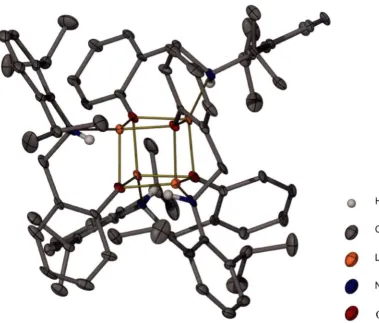
Both of the unsolvated monolithiated complexes 7 and 9 aggregate as tetramers in the solid state, with the phenoxide anions stacking together to form a L404 cubic core. For less bulky anions of this type it is possible to observe either tetramers or hexamers as described in Chapter 1 _[ll It is possible that the presence of the internal coordinating Lewis base within each monolithiated ligand helps to limit the size of these aggregates, and thus tetramers are exclusively observed for the monolithiated complexes. There are several previous reports of similar amino alkoxide complexes comprising both phenoxide and alkoxide anions to give a cubic Li40 4 core. [l l2-119l In
both of the unsolvated monolithiated complexes 7 and 9 the ligands arrange themselves the same way around the L404 core, with two orthogonal pairs of ligand straps shown in Scheme 2-2. This ligand arrangement is typical for these complexes.
Chapter 2 Mixed anion O/N ligands and their lithiated complexes
44
THF
( " ' - Ph
Ph'NH / 0
/LiJtJ
---=rHFPh \
I
'~~u--,_-o
(HN1H/o
Y--..6~\
L"
Ph tHF\ (8)
~
0
HN=
\ Ph
THF
Q
#
0 NH
8
'PhScheme 2-3: THF salvation of the unsolvated monolithiated complex [{Li(ONPhH)}4] 7 to give [{Li(ONPhH)}4(THFh] 8.
Chapter 2 Mixed anion O/N ligands and their lithiated complexes 45 interesting chiral arrangement of the ligands. [120l The arrangement of the ligands around the Lii04 core of complex 8 is shown in Scheme 2-3.
It is worth noting that each of the ligands ONPhH2 4and ONDIPPH2 5 will only undergo single lithiations when reacted with n-BuLi in 40-60 °C petroleum spirits. The frrst attempts to obtain the dilithiated complexes were carried out in 40-60 °C petroleum spirits, as this would have yielded the unsolvated complexes. However, in each case only the monolithiated complex was isolated. This is not surprising as the monolithiated complexes are both insoluble in 40-60 °C petroleum spirits, and the n-BuLi is not as activated by any Lewis basic donors.
Both of the mono lithiated complexes [ {Li(ONPhH)}4] 7 and [ {Li(ONPhH)}4(THF)3] 8 containing the less bulky N-phenyl substituents are insoluble in benzene. NMR data for [ {Li(ONPhH)} 4(THF)3] 8 was obtained by the addition of a small amount of d8-THF to a C6D6 NMR sample. Despite the asymmetric solid state structure observed for 8, the 1H NMR spectrum shows a single ligand type present in solution, suggesting that the structure is fluxional. All of the resonances in the 1H NMR spectrum of [ {Li(ONPhH)} 4(THF)3] 8 were partially assigned. The aromatic region is discernable as resonances arising from pseudo frrst order coupling of the protons on the N-phenyl and phenylene rings and appears between 6.33 and 7.21 ppm. The resonances arising from THF and the methylene linker between the two aromatic rings appear as multiplet and doublet resonances at 1.44, 3.55, and 3.88 ppm, respectively. The N-H resonance is visible as a broadened triplet at 3.36 ppm.
Chapter 2 Mixed anion O/N ligands and their lithiated complexes 46 resolution, with two doublets centred at 6.47 and 6.83 ppm, respectively, and two pseudo triplets centred at 6.37 and 6.61 ppm, respectively, visible in the upfield portion. These four resonances correspond to the four protons of the phenylene ring of the salicylaldehyde derived portion of the monolithiated ligand. The remaining three aromatic protons on the amine substituent ring appear as a narrow multiplet centred at 7.00 ppm. The remaining aliphatic protons however, are each inequivalent, and display unique resonances. One of the methylene proton resonances appears as a pseudo triplet centred at 4.90 ppm while the other resonance appears at 3.22 ppm, overlapping with the methine resonances. The methine resonances form part of a multiplet between 3.04 and 3.39 ppm. There is a broad resonance centred at approximately 2.3 ppm, which was tentatively assigned as the N-H resonance. The inequivalence observed in the methylene and methine proton resonances may indicate that the observed intramolecularly solvated tetrameric solid state structure is maintained in solution. The orientation of the N-2,6-diisopropylphenyl substituent in each monolithiated ligand within the tetramer gives rise to different chemical environments for each 'side' of the N-aryl ring with respect to being closer or further from the L404 core. The separation of the aliphatic protons from within their respective sets was observed to be maintained at 60 °C, with a methylene proton resonance corresponding to a single proton still clearly visible as a pseudo triplet at 4.90 ppm.
Chapter 2 Mixed anion O/N ligands and their lithiated complexes
47
visibly observed to change from a white material to yellow material as it underwent hydrolysis, the appearance of an N-H stretching band in the IR spectrum resulted. However it was observed that the results were variable between samples and in some cases false negatives were obtained, i.e., samples of monolithiated complex showed no N-H absorption band. Consequently, this approach was abandoned and as a result some of the compounds have the IR data reported in the experimental section while others do not.In later work, 1 H NMR spectra were predominantly used to help identify the presence or absence of monolithiated complexes. The regions of interest for this distinction were the shape and chemical shift of the resonance arising from the methylene proton resonance and the chemical shifts of the aromatic resonances. In the N-2,6-diisopropylphenyl substituted monolithiated complex the methylene resonance appearing near 5 ppm appears as a pseudo triplet, whereas in the dilithiated complexes the resonance appears as either a singlet or multiplet arising from two overlapping singlet resonances. In addition, in the monolithiated complexes the aromatic resonance region extends further upfield than in the dilithiated complexes by approximately 0.1 ppm.

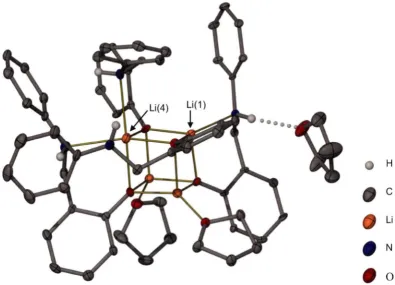
![Figure 2-16: Molecular structure of [{Li(ONPhH)}4] 7 with thermal ellipsoids drawn at the level of 50 % probability](https://thumb-us.123doks.com/thumbv2/123dok_us/8428741.331401/62.545.120.477.296.617/figure-molecular-structure-onphh-thermal-ellipsoids-drawn-probability.webp)
![Figure 2-21: .0 ellipsoids drawn at the level of Top down view of the molecular structure of [{Li(ON=DIPPH)}4] 10 with thermal 50 % probability](https://thumb-us.123doks.com/thumbv2/123dok_us/8428741.331401/68.546.100.488.90.384/figure-ellipsoids-drawn-molecular-structure-dipph-thermal-probability.webp)
![Figure 2-22: VT -10 °C and 1H NMR of the complex [{Li2{0NDIPP)h(THF)4] 12 in toluene-dB between 60 °C](https://thumb-us.123doks.com/thumbv2/123dok_us/8428741.331401/74.544.92.481.335.601/figure-vt-nmr-complex-li-ndipp-thf-toluene.webp)