The complexity of Scotland Yard
Merlijn Sevenster
[email protected]
ILLC, University of Amsterdam
March 8, 2006
Abstract
This paper discusses a case study of the board game of Scotland Yard from a computational perspective. Interestingly, Scotland Yard is a genuine “playgame” with imperfect information. For reasons not completely clear to me, games with imperfect information have es-caped the interest of researchers in Algorithmic combinatorial game-theory. I show by means of a powerset argument, that Scotland Yard can also be considered a game of perfect information, that is sur-prisingly similar to the original game – up to isomorphism, that is. Using the powerset analysis, I show that Scotland Yard has PSPACE-complete complexity be it with or without imperfect information. In fact, imperfect information may even simplify matters: if the cops are supposed to be consequently ignorant of Mr. X’s whereabouts throughout the game the complexity is ‘but’ NP-complete.
1
Introduction
puzzles are usually solvable in NP and many of them turn out to be complete for this class.1 Famous examples include the game of Minesweeper [13] and Clickomania [2]. Alternation kicks in at considerable computational cost: many natural games have PSPACE-hard complexity, such as Go [15] and the semantic evaluation game of quantified boolean formulae [21, 20]. Some even have EXPTIME-complete complexity. Typical examples in this respect are the games of Chess [9] and Checkers [8]. By and large, the games with EXPTIME-complete complexity are of aloopy nature, that is, configurations of the game may occur over and over again. In real-life, loopy games may not be that much fun to play, as they allow for annoyingly long runs in which neither player makes any ‘progress’. Loopy runs are banned from Chess by imposing that no configuration of the game occurs more than three times, roughly speaking.
Amusingly, putting an upper-bound on the duration of the game not only avoids loopy – and boring – sequences of play, but also has considerable computational impact. Papadimitriou [17, pg. 460-2] argues that every game that meets the following requirements is solvable in PSPACE:
• the length of any legal sequence of moves is bounded by a polynomial in the size of the input;
• given a ‘board position’ of the game there is a polynomial-space algo-rithm that constructs all possible next actions and board positions; or, if there is none, decides whether the board position is a win for either player.
Note that Papadimitriou does not even mention the fact that this result concerns games of perfect information. The result goes through due to the fact that the backwards induction algorithm can be run on the game’s game tree in PSPACE, given that it meets the above requirements.
As for games of imperfect information some studies have been performed and their reports are basically a bad news show. In slogan one may put that imperfect information increases the computational complexity of games. Convincing results are reported in [14], in which the authors show that de-ciding whether either player has a winning strategy in a finite, two-player game of perfect information can be done in polynomial time in the size of
the game tree. On a positive note they show that there is a P-algorithm that solves the same problem for games of imperfect information with perfect re-call. However, if one of the players (or both) suffers from imperfect recall the problem of deciding whether this player has a winning strategy is NP-hard in the size of the game tree.
In [19, 18] the authors consider computation trees as game trees. This view on computation trees is adopted from [6], in which Turing machines are considered that have existential and universal states, so-called alternat-ing Turalternat-ing machines. The aspect of alternation is reflected in the compu-tation tree by regarding it a game tree of a two-player game. The nodes corresponding to existential (universal) states belong to the existential (uni-versal) player. So this makes these game two-player games with perfect information. From this viewpoint, non-deterministic Turing machines give rise to one-player game trees. In [19, 18] this idea is extended towards games of imperfect information. The authors define, amongst other devices, pri-vate alternating Turing machines, that give rise to computation trees that may be regarded two-player game trees in which the existential player suffers from imperfect information. It is shown that the space complexity of f(n) of these machines is characterized in terms of the complexity of alternating Tur-ing machines with space bound exponential in f(n). Moreover, it is shown that private alternating Turing machines with three players – two of them are factually teaming up – can recognize undecidable problems in constant space.
Dramatic as these results may be, being general studies they cannot tell us what is the computational impact of the imperfect information found in actual games. That is, games developed to be played rather than to be analyzed.2 It may well turn out that the imperfect information in these
games have little computational impact and that the games themselves match the robust intuitions we have about the computational nature of perfect information games. As I pointed out before, there is but a small number of results games of imperfect information, let alone computational studies of real games. For this reason, I will consider the game of Scotland Yard
that has amused game players ever since 1983.3 The reader familiar with
2Fraenkel makes the distinction between “PlayGames” and “MathGames”. The former being the games that “are challenging to the point that people will purchase them and play them”, whereas the latter games “are challenging to a mathematician [. . .] to play with or ponder about”; cited from [7, pg. 476].
Figure 1: The box of Scotland Yard and its items, amongst which the game board, Mr. X’s move board, and the players’ pawns. This picture is repro-duced with permission of Ravensburger.
Scotland Yard will acknowledge that it is the imperfect information that makes the game an enjoyable waste of time and enthusiastic accounts of players’ experiences with Scotland Yard are easily found on the Internet, for instance [3].
Scotland Yard is played on a game board, that contains approximately 200 numbered intersections of colored lines denoting available means of trans-portation: yellow for taxis, green for buses, and pink for underground. A game is played by two to six people, one of them being Mr. X, the others teaming up and thusly forming Scotland Yard. They have a shared goal: capturing Mr. X. Initially, every player gets assigned a pawn and an inter-section on the game board on which his or her pawn is positioned. Before the game starts every player gets a fixed number of tickets for every means of transportation. Mr. X and the cops move alternatingly and Mr. X com-mences.
During every stage of the game, each player – be it Mr. X or his ad-versaries – takes an intersection in mind connected from his or her current intersection, subject to him or her owning at least one ticket of the appro-priate kind. For instance, if a player would want to use the metro from Buckingham Palace, she would have to hand in her metro ticket. If either player is out of tickets for a certain mode of transportation, he cannot travel along the related lines. The set of tickets of every player is publicly known to all players at every stage of the game.
If a cop has made up her mind on moving to an intersection, this is indicated by her moving the pawn under her control to the intersection at hand. However, if Mr. X made up his mind he secretely writes the number of the intersection at stake at the designated entry of the move board and covers it with the ticket used. Effectively, the cops know what means of transportation Mr. X has been using, but do not know his position. After round 3, 8, 13, 18, and 24, however, Mr. X is forced to show his whereabouts by putting his pawn on his current hideout.
The game lasts for 24 rounds during which Mr. X and the cops make their actions. If at any stage of the game, any of the cops is at the same intersection as Mr. X then the cops win. If Mr. X remains uncaught until after the last round, he wins the game. Cops who have a suspicious nature may want to check whether Mr. X’s secret moves were made consistently with the lines on the game board, when the game is over. To this end, they would match the numbers on the move board with the returned tickets. If it turns out that Mr. X’s cheated halfway, he loses no matter what the outcome of the game actually was.
In view of these game descriptions, the generalization of the Scotland Yard game in Definition 1 should be easy to swallow. The reader will observe that I reduced the number of means of transportation to one and that the game board is modelled by a directed graph. All results in this chapter can be generalized to hold for several means of transportation and undirected graphs, though.
Definition 1 Let G = hV, Ei be a finite, connected, directed graph with out-degree ≥ 1. Let u, v1, . . . , vn ∈ V. Let f : {1, . . . , k} → {show,hide}
be the information function, for some integer 2 < k < |V|. Then, let hG,hu, v1, . . . , vni, fi be a (Scotland Yard) instance. Most of the time it will
be convenient to abbreviate a string of vertices v1, . . . , vn by ~v. Conversely,
If U ⊆ V, then let {u0 ∈ V | E(u, u0), for some u∈U} be denoted by
E(U). If~v, ~v0 ∈ Vn, then write E(~v, ~v0) to denote that for every 1≤ i≤ n,
E(~v(i), ~v0(i)).
The information functionfcontrols the imperfect information throughout the game. If round i has property f(i) = hide, Mr. X hides himself. As we will see the information function gives an intuitive sense to ‘adding or removing’ imperfect information from a Scotland Yard game. For instance, if one restricts oneself to information functions with range {show}, Mr. X shows his whereabouts after every move and one is considering a game of perfect information. Under the latter restriction, one has arrived at so-called
Pursuit or Cops and robbers games. For a exposition of the literature on these games, consult [10].
The aims of this chapter are twofold. Firstly, pinpointing the computa-tional complexity of a real game of imperfect information. Secondly, I go through a reasonable amount of effort to spell out the relation between the Scotland Yard game and a game of perfect information that is highly similar to the former game. More precisely, I show that the games’ game trees are isomorphic, from a natural point of view, and that a winning strategy in the one game is a winning strategy in the other and vice versa. These similarity result may convince the reader that in some cases the wall between perfect and imperfect information is not as impenetrable as one might induce from the scarce literature on complexity of imperfect information games.
In Section 2, I define the extensive game form of the Scotland Yard game to which an instance gives rise. Next I introduce another game, related to Scotland Yard, that is of perfect information: Scotland Yard-PI.
In Section 3, I show that the justly introduced games admit for a bijection between the imperfect information game’s information partitions (actually, an extension thereof) and the histories in Scotland Yard-PI. In this game, Mr. X exchanges the power of hiding for the power of moving sets of vertices. In Section 4, the computational results are presented. In accordance with many polynomially bounded two-player games, Scotland Yard is complete for PSPACE, despite its imperfect information. That is, the computational com-plexity of Scotland Yard does not change when one only considers information functions with range {show}.
2
Two Scotland Yard games
Let sy = hG,hu∗, ~v∗i, fi be a Scotland Yard instance as in Definition 1.
Before I define the extensive game form of the Scotland Yard game to which
sy gives rise, let me recap the game rules tailor-made to suitsy’s particulars. The digraph G is the board on which the actual playing finds place. In the initial situation of the game, we find n+ 1 pawns, named ∀,∃1, . . . ,∃n, positioned on the respective vertices u∗, ~v∗(1), . . . , ~v∗(n) in the digraph. The
game is played by the two players∃and∀overkrounds, and with every round 1 ≤i≤ k in the game there is associated the property f(i)∈ {show,hide}. Note that I converted the n-player game of Scotland Yard, where 2≤n ≤6 into a two-player game in which one player controls all pawns ∃1, . . . ,∃n. Furthermore, for reasons of succinctness I adopt the symbol∀to refer to Mr. X and∃to refer to the player controlling Scotland Yard. Somewhat sloppily, sometimes I will not make a strict distinction between a player and (one of his or her) pawns.
First fix i = 1, u =u∗, and~v =~v∗; now, round i of Scotland Yard goes
as follows:
1. If for some 1≤j ≤n, the pawns ∀ and ∃j share the same vertex, i.e.,
u=~v(j) we say that∀ wascaptured (by∃j). If ∀is captured the game stops and ∃ wins. If ∀ is not captured and i > k the game also stops but ∃ loses.
2. ∀ chooses a vertexu0, such thatE(u, u0). If f(i) = show, he physically
puts his pawn on u0. If f(i) = hide, he secretly writes u0 on his move
board making sure that it cannot be seen by his opponent. Set u=u0.
3. Player ∃ chooses a vector ~v0 ∈ Vn, such that E(~v, ~v0), and for every
1≤j ≤n, moves pawn ∃j to~v0(j). Set~v =~v0.
4. Seti=i+ 1.
Note that these game rules do not consider the possibility of either player getting stuck, as in not being able to move a pawn under his or her control moving along an edge. This goes without loss of generality, as the digraphs at stake are supposes to have out-degree ≥1.
after ∃ has moved and one of her pawns captures ∀, unlike the game rules for the board game of Scotland Yard.
Scotland Yard is modelled as an extensive game with imperfect informa-tion in Definiinforma-tion 2. The upcoming definiinforma-tion and Definiinforma-tion 4 are notainforma-tion- notation-ally akin to the definitions from [16].
Definition 2 Let sy = hG,hu∗, ~v∗i, fi be a Scotland Yard instance. Then, let the extensive Scotland Yard game constituted bysy be defined as the tuple SY(sy) =hN, H, P,∼, Ui, where
• N ={∃,∀} is the set of players.
• H is the set of histories, that is, the smallest set containinghu∗i,hu∗, ~v∗i and is closed under actions taken by ∀ and ∃:
· If hhu, ~vi ∈ H, `(hhu, ~vi) < k, u /∈ {~v}, and E(u, u0), then
hhu, ~vihu0i ∈H.
· If hhu, ~vihu0i ∈H and E(~v, ~v0), then hhu, ~vihu0, ~v0i ∈H.
If h∈H, let `(h)denote the number of rounds in h, that is the number of tuples not equal hu∗, ~v∗i. Define `(hu∗, ~v∗i) = 0. Somewhat unlike custom usage in game-theory, the length `(h) of history h does not coincide with the number of plies in the game. This notation reflects my game rule saying that a history my only terminate after ∃ has moved. Let  be the immediate successor relation on H. That is, the smallest relation closed under the following conditions:
· If h, hhui ∈H, then hÂhhui.
· If hhui, hhu, ~vi ∈H, then hhui Âhhu, ~vi.
A history that has no immediate successor we call a terminal history. Let Z ⊆H be the set of terminal histories in H.
• P : H − Z → {∃,∀} is the player function that decides who is to move in a non-terminal history. Due to the notational convention, the value of P is easily determined by the history’s form, in the sense that
• ∼ is the indistinguishability relation that formalizes the imperfect in-formation in the game. It is defined such that for any pair of histories
h, h0 ∈H, where
h=hu∗, ~v∗ihu1, ~v1i. . .huii and h0 =hu∗, ~v∗ihu01, ~v10i. . .hu0ii (1)
it is the case that h∼h0, if
(a) ~vj =~vj0, for every 1≤j ≤i−1
(b) uj =u0j, for every 1≤j ≤i such that f(j) =show .
The previous condition, considering histories as in (1), defines ∼ only as a relation between histories h in which ∃ has to move: P(h) = ∃. This reflects the fact that it is∃ who experiences the imperfect informa-tion while playing the game. Somewhat unusual, I extend∼to histories in which ∀has to move. The reader is urged to take this extension as a technicality, and not to start looking for deeper explanations (after read-ing Theorem 19). I put as follows: for any pair of histories h, h0 ∈H, where
h=hu∗, ~v∗ihu1, ~v1i. . .hui, ~vii and h0 =hu∗, ~v∗ihu01, ~v10i. . .hu0i, ~v
0
ii
it is the case that h∼h0, if
(a) ~vj =~vj0, for every 1≤j ≤i
(b) uj =u0j, for every 1≤j ≤i such that f(j) =show .
• U : Z → {win,lose} is the function that decides whether a terminal history hhu, ~vi is won or lost for ∃. Formally,
U(hhu, ~vi) =
½
win if u∈ {~v} lose if u /∈ {~v}.
Usually, one has a utility function per player, but as the game is win-loss one had just as well stick to one function.
then h0 ∈ C
i. A standard inductive argument suffices to see that for every
Ci ∈ H and pair of histories h, h0 ∈Ci, the length of h and h0 coincides and
P(h) =P(h0).
I lift the relationÂtoH, using the same symbol: For any pairC, C0 ∈ H,
I write C  C0 if there exists histories h ∈C and h0 ∈C0 such that h h0.
It is easy to see that ifh, h0 are histories in a cellC∈ H, thenP(h) =P(h0).
Thus, the player function is meaningfully lifted as follows: if C ∈ H and h
is a history in C, then P(C) = P(h). Call a cell C ∈ H terminal if all its histories h∈C are terminal.
Since I study an extension of ∼, the set H partitions all histories in H. As I pointed out in the definition of ∼, if histories h and h0 stand in the ∼
relation and belong to ∀, this should not be taken to reflect any conceptual consideration about ∃’s experiences, as it is merely a technicality. Yet, if
h and h0 belong to ∃, to write h ∼ h0 reflects genuine indistinguishability
for player ∃ between the two histories h and h0. In this manner, we see
that a subset of H is an object familiar from game-theory. Consider the set
H∃ = {C ∈ H | P(C) = ∃}, that partitions the set of histories that belong
to ∃. I claim that H∃ is an information set. To prove this claim it suffices
to show that for every information cell C ∈ H∃ no two histories h, h0 ∈ C
can be distinguished on the basis of the actions that ∃can take at hand h0.
Formally, for every C ∈ H and every pair of historiesh, h0 ∈C it is the case
that A(h) = A(h0).
To this end, let
A(hhu, ~vihu0i) = {~v0 ∈Vn|hhu, ~vihu0i Âhhu, ~vihu0, ~v0i}={~v0 ∈Vn|E(~v, ~v0)}
define the actions available to∃afterhhu, ~vihu0i. Lethandh0 be histories as
in (1) sitting in the same cell C ∈ H. Then, by (a)~vi−1 =~v0i−1 and therefore
A(h) = A(h0). Hence,H
∃ is an information set. (Note that information cells
in H∃ are usually called information partitions.) Thus, by modelling the
imperfect information in SY(sy) by the extended ∼relation an object is ob-tained that is still highly similar to the customary objecthN, H, P,hIiii∈N, Ui modelling the game of Scotland Yard induced by sy.
For future reference, lay down the following Proposition:
1. If h1hu1i ∼h2hu2i and f(`(h1hu1i)) =hide, then h1 ∼h2.
2. Ifh1hu1i ∼h2hu2iandf(`(h1hu1i)) = show , thenh1 ∼h2 andu1 =u2.
3. If h1hu1, ~v1i ∼h2hu2, ~v2i, then h1hu1i ∼h2hu2i and ~v1 =~v2.
4. If h1 6∼h2 and h1hu1i, h2hu2i ∈H, then h1hu1i 6∼h2hu2i.
Proof. Readily observed from the definition of∼ in Definition 2. 2
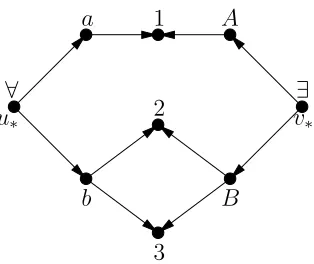
As an illustration of modelling a Scotland Yard instance as an exten-sive game with imperfect information, consider the digraphG×=hV×, E×i,
where
V× = {u∗, v∗, a, b, A, B,1,2,3}
E× = {hu∗, ai,hu∗, bi,ha,1i,hb,2i,hb,3i, hv∗, Ai,hv∗, Bi,hA,1i,hB,2i,hB,3i}.
For a depiction of G×, see Figure 2. Let f× be a function such that f×(1) = hide and f×(2) = show. Let us conclude the construction of the Scotland
Yard instance sy×, by putting u
∗ and v∗ as the initial vertices of ∀ and ∃,
respectively. InSY(sy×), the set of historiesH contains exactly the following
histories:
hu∗, v∗i
hu∗, v∗ihai hu∗, v∗iha, Bih1i hu∗, v∗iha, Bih1,3i hu∗, v∗ihbi hu∗, v∗ihb, Aih2i hu∗, v∗ihb, Aih2,1i hu∗, v∗iha, Ai hu∗, v∗ihb, Aih3i hu∗, v∗ihb, Aih3,1i hu∗, v∗iha, Bi hu∗, v∗ihb, Bih2i hu∗, v∗ihb, Bih2,2i ! hu∗, v∗ihb, Ai hu∗, v∗ihb, Bih3i hu∗, v∗ihb, Bih2,3i hu∗, v∗ihb, Bi hu∗, v∗iha, Aih1,1i ! hu∗, v∗ihb, Bih3,2i hu∗, v∗iha, Aih1i hu∗, v∗iha, Bih1,2i hu∗, v∗ihb, Bih3,3i !
The terminal histories marked with an exclamation mark are winning his-tories for ∃. Because f×(1) = hide, the game that we are dealing with
is a genuine game of imperfect information. This fact is reflected in the set of information cells H, containing the following three non-singletons:
{hu∗, v∗ihai,hu∗, v∗ihbi}, {hu∗, v∗iha, Ai,hu∗, v∗ihb, Ai}, and finally there is {hu∗, v∗iha, Bi,hu∗, v∗ihb, Bi}. (Note that under the customary definition
∀
A
B
∃
1
2
3
a
b
[image:12.595.219.376.121.253.2]u∗ v∗
Figure 2: The digraph G×, allowing for a two-round Scotland Yard game.
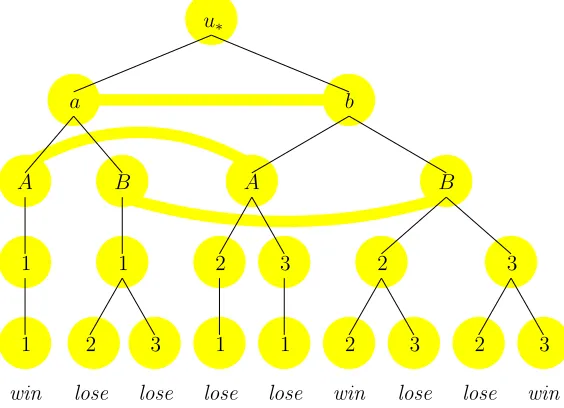
to ∀.) Game-theorists often find it convenient to present extensive games as trees, see Figure 3.
I observed that Scotland Yard is a game with imperfect information and in Definition 2 I modelled it as an extensive game with imperfect information. This model one may find Scotland Yard’s canonical means of analysis, for admittedly, it gives a natural account of the imperfect information that makes Scotland Yard such a fun game to play. Canonical or not, this does not imply, of course, that Scotland Yard can only be analyzed as an imperfect information game. In the remainder of this section I will show how a Scotland Yard instance may also give rise to a game of perfect information. The underlying idea is that during rounds in which ∀ hides his whereabouts, he picks up a set of vertices that contain all vertices where he can possibly be. In case ∀ has to show himself, he selects one vertex from the current set of vertices and announces this vertex as his new location.
Formally,∀’s powers are lifted from the level of picking up vertices to the level of picking up sets of vertices. ∃’s power remain unaltered, as compared to the game with imperfect information that was explicated above.
!! !! !! !! "" "" "" "" ### ### ### ### $$ $$ $$ $$ %%% %%% %%% %%% && && && && '' '' '' '' (( (( (( (( )) )) )) )) ** ** ** ** ++ ++ ++ ++ ,, ,, ,, ,, B A B A u∗
win lose lose lose lose win lose lose win
1 2 3 1 1 2 3 2 3
1 1 2 3 2 3
[image:13.595.163.445.251.455.2]a b
Figure 3: A graphical representation of the Scotland Yard game played on the game board constituted by the digraph G× from Figure 2. A path from
the root to any of its nodes represents a history in the game. For instance, the path u∗, b, A,2 corresponds with the history hu∗, v∗ihb, Aih2i. The
!!! !!! !!! !!! "" "" "" "" ## ## ## ## $$ $$ $$ $$ %%% %%% %%% %%% && && && &&
win lose lose lose lose win lose lose win
A B
{a, b}
u∗
1 1 1 2 3 2 3 2 3
[image:14.595.163.445.252.463.2]{1} {2} {3} {1} {2} {3}
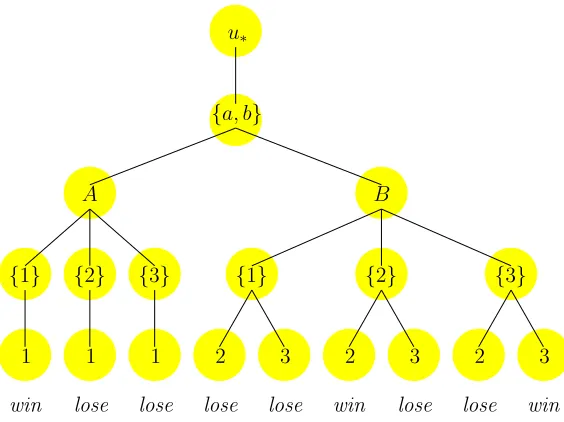
Figure 4: A graphical representation of the Scotland Yard-PI game played on the game board constituted by the digraph G× from Figure 2. A path from
theory, the move to powersets is made when converting a non-deterministic finite automaton to a deterministic one, see [12].
In all three disciplines, however, observe that the phenomenon that was analyzed through powersets is substantially more powerful than the original phenomenon. For instance, in [18] it was shown that three-player games with imperfect information can be undecidable. In the realm of IF logic it was proven [5] that no compositional semantics can be given based on single assignments only. And it is well-known that in the worst case converting a non-deterministic finite automaton makes the number of states increase exponentially.
In view of these results it is striking that one can define a Scotland Yard game with perfect information using a powerset argument, that is highly similar to the same Scotland Yard game with imperfect information. What is meant by ‘highly similar’ is made precise in Section 3. First let me pos-tulate the game rules for the Scotland Yard game with perfect information and define its extensive game form in Definition 4.
Let sy = hG,hu∗, ~v∗i, fi be a Scotland Yard instance as in Definition 1.
The initial position of the Scotland Yard-PI game constituted bysyis similar to the initial position of the Scotland Yard game that sy constitutes. That is, a ∀ pawn is positioned on u∗ and for every 1 ≤ j ≤ n, the ∃j pawn is positioned on ~v(j). In Scotland Yard-PI, ∀ doesn’t have one pawn at his disposal but as many as there are vertices in G. First fix i = 1, U = {u∗},
and ~v =~v∗; roundi of Scotland Yard-PI goes as follows:
1-PI. If U− {~v}=∅, then the game stops and ∃ wins. IfU − {~v} 6=∅and
i > k the game also stops but ∃ loses.
2-PI. Let U0 =E(U − {~v}). If f(i) =hide, then set U =U0 and ∀ positions
a∀ pawn on every vertexv inU. If f(i) = show, then ∀ picks a vertex
u0 ∈U0, removes all his pawns from the board, and puts one pawn on
u0. Set U ={u0}.
3-PI. Player ∃ chooses a vector ~v0 ∈ Vn, such that E(~v, ~v0), and for every
1≤j ≤n, moves pawn ∃j to~v0(j). Set~v =~v0.
4-PI. Seti=i+ 1.
a game of perfect information. For this reason a natural means of analysis is to model it as an extensive game.
Definition 4 Let sy = hG,hu∗, ~v∗i, fi be a Scotland Yard instance. Then, let the extensive Scotland Yard-PI game constituted by sy be defined as the tuple SY -PI(sy) = hNPI, HPI, PPI, UPIi, where
• NPI ={∃,∀} is the set of players.
• HPIis the set of histories, that is, the smallest set containing the strings h{u∗}i,h{u∗}, ~v∗i, that furthermore is closed under taking actions for ∃ and ∀:
· If hhU, ~vi ∈ HPI, `(hhU, ~vi) ≤ k, f(`(hhU, ~vi) + 1) = hide, and
U − {~v} 6=∅, then hhU, ~vihE(U − {~v})i ∈HPI.
· If hhU, ~vi ∈ HPI, `(hhU, ~vi) ≤ k, and f(`(hhU, ~vi) + 1) = show , then {hhU, ~vih{u0}i | u0 ∈E(U − {~v})} ⊆HPI.
· If hhU, ~vihU0i ∈H
PI and E(~v, ~v0), then hhU, ~vihU0, ~v0i ∈HPI. LetÂPI be the immediate successorrelation onHPI. That is, the small-est relation closed under the following conditions:
· If h, hhUi ∈HPI, then hÂPI hhUi.
· If hhUi, hhU, ~vi ∈HPI, then hhUi ÂPI hhU, ~vi.
A history that has no immediate successor we call a terminal history. Let ZPI ⊆HPI be the set of terminal histories in HPI.
• PPI : HPI −ZPI → {∃,∀} is the player function that decides who is to move in a non-terminal history. Due to the notational convention, the value of P is determined by the history’s form, in the sense that
P(hhUi) =∃ and P(hhU, ~vi) =∀.
• UPI :ZPI → {win,lose} is the function that decides whether a terminal history hhU, ~vi is won or lost for ∃. Formally,
U(hhU, ~vi) =
½
win if U − {~v}=∅
These definitions may be best appreciated by checkingSY-PI(sy×), where sy× =hG×,hu
∗, ~v∗i, f×i and G× is the digraph depicted in Figure 2. I skip
writing down all histories in this particular game, leaving the reader with a graphical representation of its game tree in Figure 4.
3
An effective equivalence
In this section, the similarity between Scotland Yard, the game with imper-fect information, and its perimper-fect information variant is established. Making use of this similarity, I prove that for any instance sy, ∃has a winning strat-egy inSY(sy) iff she has one inSY-PI(sy), cf. Theorem 19. In order to prove this result, I go about as follows: Firstly, it will be shown in Lemma 10 that the structures hH,Âi and hHPI,ÂPIi are isomorphic. Secondly, I formally
introduce the notion of a winning strategy and the backwards induction al-gorithms for SY(sy) and SY-PI(sy). This algorithm typically labels every history with win or lose, starting with the terminal histories. Crucially, I show that the backwards induction algorithms correctly compute whether ∃
has a winning strategy in the respective game. Finally, I show that for every history h in SY(sy), the label assigned to it by the backwards induction algorithm for Scotland Yard corresponds with the label assigned to it by the backwards induction algorithm for Scotland Yard-PI. The claim then follows, as the initial histories hu∗, ~v∗i and h{u∗}, ~v∗i carry the same label.
3.1
Scotland Yard and Scotland Yard-PI are
isomor-phic
Main result of this subsection resides in Lemma 10, saying that the structures
hH,Âi and hHPI,ÂPIi are isomorphic. The witness of this isomorphism is
Definition 5 Let SY(sy)and SY -PI(sy)be games constituted by sy. Define the function β :HPI →℘(H) inductively as follows:
β(h{u∗}i) = {hu∗i}
β(h{u∗}, ~v∗i) = {hu∗, ~v∗i}
β(hhUi) = {ghui ∈H | g ∈β(h), u∈U}
β(hhU, ~vi) = {ghu, ~vi ∈H | ghui ∈β(hhUi)}.
The function β is (partially) depicted in Figure 5 mapping the histories from
SY-PI(sy×) to sets of histories fromSY(sy×). The reader may find it useful
to return to this figure to strengthen his or her intuitions.
Proposition 6 states that if in a historyh∈HPI a pawn (owned by either
player) is positioned on a vertex, then also in β(h) there exists a history in which this vertex is occupied by a pawn.
Proposition 6 For every history h0 ∈HPI, the following hold:
1. If h0 = hhUi and f(`(hhUi)) = hide, then it is the case that U = {u | ghui ∈H, for some g ∈β(h)}.
2. If P(h0) =∀ and f(`(h0) + 1) =show , then it is the case that {u | h0 Â
h0h{u}i, for some h0h{u}i ∈ HPI} = {u | ghui ∈ H, for some g ∈
β(h0)}.
3. If h0 = hhUi ∈ H
PI and u ∈ U, then there exists a history g ∈ β(h) such that ghui ∈H.
4. Ifh0 =hhU, ~vi ∈HPI, then it is the case thatβ(hhU, ~vi) ={ghu, ~vi |ghui ∈
β(hhUi)}.
Proposition 7 is the converse of the previous Proposition, as it links up histories in H with histories in HPI.
Proposition 7 For every g0 ∈H, the following hold:
1. If g0 = ghui ∈ H, then there exists a hhUi ∈ H
PI such that g ∈ β(h) and u∈U.
2. If g0 =ghu, ~vi ∈H, then there exists a hhU, ~v0i ∈H
PI such that ghui ∈
! ! ! ! ! ! ! ! " " " " " " " " # # # # # # # # $ $ $ $ $ $ $ $ % % % % % % % % & & & & & & & & ' ' ' ' ' ' ' ' ( ( ( ( ( ( ( ( ) ) ) ) ) ) ) ) * * * * * * * * + + + + + + + + , , , , , , , , - -- -- -- -. . . . . . . . / / / / / / / / 0 0 0 0 0 0 0 0 1 1 1 1 1 1 1 1 2 2 2 2 2 2 2 2 3 3 3 3 3 3 3 3
4 4 4 4 4 4 4 4 4 4 4 4
5 5 5 5 5 5 5 5 6 6 6 6 6 6 6 6 7 7 7 7 7 7 7 7 8 8 8 8 8 8 8 8 9 9 9 9 9 9 9 9 : : : : : : : : ; ; ; ; ; ; ; ;
< < < < < < < < < < < <
= = = = = = = = > > > > > > > > ? ? ? ? ? ? ? ? @ @ @ @ @ @ @ @ A A A A A A A A B B B B B B B B C C C C C C C C D D D D D D D D E E E E E E E E F F F F F F F F G G G G G G G G H H H H H H H H I I I I I I I I J J J
J J J J J J J J J
K K K K K K K K L L L L L L L L M M M M M M M M N N N N N N N N O O O O O O O O P P P P P P P P Q Q Q Q Q Q Q Q B A B A A B
{a, b}
u∗
1 1 1 2 3 2 3 2 3
{1} {2} {3} {1} {2} {3}
u∗
1 2 3 1 1 2 3 2 3
1 1 2 3 2 3
[image:19.595.138.717.169.445.2]Forβ to be bijection between HPI and H, it ought to be the case that β
has range H rather than℘(H). I lay down the following result.
Lemma 8 β is a function of type HPI → H.
The latter lemma is strengthened in the following lemma.
Lemma 9 β is a bijection between HPI and H.
The isomorphism result follows from tying together the previous state-ments.
Lemma 10 The structures hHPI,ÂPIi and hH,Âi are isomorphic.
Proof. Lemma 9 showed that β is a bijection between HPI and H. It
remains to be shown that β preserves structure, that is, for every pair of histories h, h0 ∈ H
PI, it is the case that h ÂPI h0 iff β(h) Â β(h0). Recall
that for C0 ∈ H to be the immediate successor of C ∈ H, there must exists
two histories g, g0 from C, C0, respectively, such that g  g0. The claim is
proved by a straightforward inductive argument on the length of the histories inHPI. I shall omit spelling out the details of the proof, only mentioning the
Propositions on which it relies:
From left to right. Follows from Proposition 6.3 and Proposition 6.4.
From right to left. Follows from Propositions 7.1 and 7.2. 2
The claim that Scotland Yard and its perfect information variant are highly similar is justified by pointing at the structures (game trees) that the games give rise to and the latter lemma, saying that they are isomorphic.
3.2
Backwards induction algorithms
The structureshHPI,ÂPIiand hH,Âiare not only isomorphic, they also
strategy for games with imperfect information, and introduce a backwards induction algorithm that computes whether a structure allows for a winning strategy, for the Scotland Yard game with imperfect information.
I claim that the way of modelling a Scotland Yard game with imperfect information – be it the standard way using information sets hIiii∈N or as in Definition 2 – is immaterial, when it comes to ∃ having a winning strategy.
Definition 11 Let SY(sy) =hN, H, P,∼, Ui be a Scotland Yard game con-stituted by sy. Then, we call the structure hS,Â0i a plan of action for ∃ in SY(sy), if
• S ⊆ H
• {hu∗, ~v∗i} ∈ S
• Â0 = Â ∩ (S × S)
• for every C ∈ S such that P(C) = ∃, there exists exactly one C0 ∈ S such that C Â0 C0
• for every C ∈ S such that P(C) = ∀ and every C0 ∈ H such that
C ÂC0, it is the case that C0 ∈ S.
Call hS,Â0i a winning plan of action for ∃ in SY(sy), if hS,Â0i is a plan of action and every terminal cell C ∈ S only contains histories h such that
U(h) =win.
Before I show that the backwards induction algorithm applied toSY(sy) gives the same result as the standard one applied to SY-PI(sy), for everysy, it needs to be shown that the way of modelling SY(sy) using the extended notion of ∼, does not have an influence. That is, had I modelled the Scot-land Yard game for instance sy as a customary hN, H, P,hIiii∈N, Ui then it would allow for a winning strategy for the cops if, and only if, my backwards inductions algorithm accepts the input SY(sy) =hN, H, P,∼, Ui.
First let me recite the necessary vocabulary in the notation used in this chapter for Scotland Yard games modelled in the customary way. A strategy in hN, H, P,hIiii∈N, Ui is defined, cf. [16], as a function S mapping every information partition I ∈ I∃ to an actionA(h), for some h∈C.4 LetS be a
4Recall that for every pair of histories hand h0 belonging to ∃, ifh andh0 sit in the
strategy inhN, H, P,hIiii∈N, Uiand leth=hu∗, ~v∗ihu1, ~v1i. . .hui, ~vii ∈H be a history, then callh in accordance with S, if for every 1 ≤j ≤i,S(Ij) =~vj, whereIj is the information partition inI∃ containing hu∗, ~v∗ihu1, ~v1i. . .huji. A strategy S inhN, H, P,hIiii∈N, Uiis calledwinning for ∃if every terminal history h in H that is in accordance withS is won for ∃: U(h) = win.
Proposition 12 Let sy be a Scotland Yard instance and let G(sy) equal the tuple hN, H, P,hIiii∈N, Ui be the extensive game with imperfect information
modelling the Scotland Yard game constituted by sy in the customary way. Then,∃has a winning plan of action in SY(sy)iff she has a winning strategy in G(sy).
Proof. It is not so hard to see that every winning strategy S in the extensive game hN, H, P,hIiii∈N, Uican be transformed into a winning plan of action hS,Â0i inSY(sy) and vice versa.
From left to right. Suppose S is a winning strategy in the extensive game G(sy) = hN, H, P,hIiii∈N, Ui. Let HS be all histories in H that are in accordance with S. Let HS be the partition of HS, such that for any two historiesh, h0 ∈H
S, if h∼h0, then there is a cell D∈ HS containing bothh and h0. I claim that T =hH
S, ∩(HS× HS)i is a winning plan of action in
SY(sy). To this end, it needs proof that (i)HS ⊆ H, that (ii)T is a winning plan of action.
To prove (i), one needs to show thatHS is a set of information cells. To this end, it suffices to show that HS is closed under∼: ifh ∈HS and h∼h0, then h0 ∈H
S. I do so by means of an inductive argument. The base case is trivial. Suppose thath∈HS and that h0 is a history such thath∼h0, where
h=h0hu0, ~v0ihu1, ~v1i and h0 =h00hu00, ~v00ihu01, ~v10i.
The other case is trivial and therefore omitted. It needs to be shown thath0is
in accordance withS as well, that is,h0 ∈H
S. Sinceh is in accordance with
S, S(I) = ~v1, where I ∈ I∃ is the information partition holding h. Derive
from Proposition 3.3 that ~v1 =~v10 and that h0hu0, ~v0ihu1i ∼ h00hu00, ~v00ihu01i.
Since h is in accordance withS, so is h0hu0, ~v0ihu1i. Applying the inductive
hypothesis yields that h0
0hu00, ~v00ihu01i is in accordance withS. Hence, S(I) =
~v1 =~v10, implying that h0 is in accordance withS.
From right to left. SupposehS,Â0iis a winning plan of action inSY(sy).
Then, for every C ∈ S belonging to∃ there is oneC0 such that C ÂC0.
Es-sentially similar to Proposition 6.4 one proves that C0 ={hhu, ~v
Ci | hhui ∈
C}, for some ~vC ∈ Vn. Put S(C) = ~vC and for every information partition
C not present in S, put S(C) =~v for an arbitrary vector of vertices ~v that properly extends every history inC. It is readily observes thatSis a winning
strategy in hN, H, P,hIiii∈N, Ui. 2
Definition 13 Let SY(sy) =hN, H, P,∼, Ui be a Scotland Yard game con-stituted by sy. The algorithm B -Ind effectively labels every cell C ∈ H with B -Ind(C)∈ {win,lose} and proceeds as follows:
• every h ∈ Z is painted color(h) ∈ {white,limegreen} in such a way that color(h) =white iff U(h) =win
• every terminal information cell C ∈ H is given the label B -Ind(C) =
win iff color(h) =white, for every h ∈C
• until every cell has been labelled, apply the following routine to every cell C∈ H that has no label, but all of whose successors have:
· If P(C) = ∃ and there exists a successor C0 of C that has been labelled B -Ind(C0) =win, then C gets the label B -Ind(C) =win; otherwise, C gets the label B -Ind(C) = lose.
· If P(C) = ∀ and there exists a successor h0 of C that has been labelled B -Ind(C0) = lose, thenC gets the label B -Ind(C) =lose; otherwise, C gets the label B -Ind(C) = win.
Write B -Ind(sy) to denote B -Ind(hu∗, ~v∗i).
Proposition 14 Let SY(sy) be a Scotland Yard game constituted by sy. Then, ∃ has a winning strategy in SY(sy) iff B -Ind(sy) = win.
Proof. Trivial. 2
!! !! !! !! "" "" "" "" ## ## ## ## $$ $$ $$ $$ %% %% %% %% && && && && '' '' '' '' (( (( (( (( ))) ))) ))) ))) *** *** *** *** ++ ++ ++ ++ ,, ,, ,, ,, B A B A
win lose lose lose lose win lose lose win
lose
lose
lose
lose
win lose lose lose win win
a b
1 2 3 1 1 3 2 3
u∗
1 1 2 3
2 2 3 (a) ---... ... ... ... /// /// /// /// 000 000 000 000 11 11 11 11 22 22 22 22 333 333 333 333 444 444 444 444 555 555 555 555 666 666 666 666 777 777 777 777 888 888 888 888 99 99 99 99 :: :: :: :: ;; ;; ;; ;; << << << << == == == == >> >> >> >> ?? ?? ?? ?? @@ @@ @@ @@ AAA AAA AAA AAA BBB BBB BBB BBB CCC CCC CCC CCC DDD DDD DDD DDD EE EE EE EE FF FF FF FF GGG GGG GGG GGG HHH HHH HHH HHH III III III III JJJ JJJ JJJ JJJ KKK KKK KKK KKK LLL LLL LLL LLL MMM MMM MMM MMM NNN NNN NNN NNN OO OO OO OO PP PP PP PP QQ QQ QQ QQ RR RR RR RR
lose lose lose lose lose lose
win win win
lose lose
lose
lose
lose win win
win lose win
A B
{a, b}
u∗
1 1 1 2 3 2 3 2 3
{1} {2} {3} {3}
{2} {1}
[image:24.595.157.455.130.703.2](b)
Figure 6: The histories in SY(sy×) and SY-PI(sy×) labelled by the
Definition 15 Let SY -PI(sy) = hNPI, HPI, PPI, UPIi be a Scotland Yard-PI game constituted by sy. Then, we call the structure hSPI,Â0PIi a plan of
action for ∃ inSY-PI(sy), if
• SPI ⊆HPI
• hu∗, ~v∗i ∈SPI
• Â0
PI = ÂPI ∩ (SPI×SPI)
• for everyh∈SPI such thatPPI(h) = ∃, there exists exactly one h0 ∈SPI such that hÂ0
PI h0
• for every h ∈ SPI such that PPI(h) = ∀ and every h0 ∈ HPI such that
hÂPI h0, it is the case that h0 ∈SPI.
Call hSPI,Â0PIi a winning plan of action for ∃ in SY-PI(sy), if hSPI,Â0PIi is a strategy and every terminal history h∈SPI has it that UPI(h) =win.
Definition 16 Let SY -PI(sy) = hNPI, HPI, PPI, UPIi be a Scotland Yard-PI game constituted by sy. The algorithm B -IndPI effectively labels every history
h in HPI with B -IndPI(h)∈ {win,lose}, proceeding as follows:
• Every h∈ZPI is labelled B -IndPI(h) = UPI(h).
• Until every history has been labelled, apply the following routine to every history h∈HPI that has no label, but all whose successors have:
· If P(h) = ∃ and there exists a successor h0 of h that has been labelled B -IndPI(h0) = win, then h gets the label B -Ind
PI(h) = win; otherwise, h gets the label B -IndPI(h) =lose.
· If P(h) = ∀ and there exists a successor h0 of h that has been labelled B -IndPI(h0) = lose, then h gets the label B -IndPI(h) = lose; otherwise, h gets the label B -IndPI(h) =win.
Write B -IndPI(sy) to denote B -IndPI(hu∗, ~v∗i).
Proposition 17 Let SY -PI(sy) be a Scotland Yard-PI game constituted by sy. Then, ∃ has a winning strategy in SY -PI(sy) iff B -IndPI(sy) =win.
Proof. Trivial. 2
For an example of the two backwards induction algorithms at work, see Figure 6.
The upcoming Lemma states that β is a bijection respecting the labels of the respective objects.
Lemma 18 For every h∈HPI, B -IndPI(h) =B -Ind(β(h)).
Proof. I prove by induction on the historiesh∈HPI. The most interesting
case is the base step.
Suppose hhU, ~vi ∈ ZPI. Suppose B-IndPI(hhU, ~vi) = win. By definition of B-IndPI applied to terminal histories it follows that (U − {~v}) = ∅. Put differently, every u ∈ U is an element of {~v}. Now consider an arbitrary history ghu0, ~v0i from β(hhU, ~vi). By definition of β, it follows that u0 ∈ U
and that ~v0 =~v. But then, u0 ∈ {~v0} and consequently U(ghu0, ~v0i) = win.
Thus the backwards induction for Scotland Yard paintsghu0, ~v0iwith the color white. Since ghu0, ~v0i was chosen arbitrarily, conclude that every history in
β(hhU, ~vi) is painted white, whence B-Ind(β(hhU, ~vi)) =win.
Conversely, suppose B-IndPI(hhU, ~vi) = lose. By definition of B-IndPI
applied to terminal histories it follows that (U − {~v}) contains at least one object, call it u. By Proposition 6.3 derive that there exists a history ghui ∈
β(hhUi). From Proposition 6.4 it follows that ghu, ~vi is a successor of ghui, since hhUi is a successor of hhU, ~vi. Furthermore, ghu, ~vi is an element of
β(hhU, ~vi). Sinceudoes not sit in{~v}the historyghu, ~viis paintedlimegreen, by the backwards induction algorithm of Scotland Yard. Since one of its elements is painted limegreen, it is the case that B-Ind(β(hhU, ~vi)) =lose.
Suppose hhUi is non-terminal. Suppose that B-IndPI(hhUi) = win, therefore, hhUi has a successor hhU, ~vi, such that B-IndPI(hhU, ~vi) = win.
Applying the inductive hypothesis tohhU, ~viyields thatB-Ind(β(hhU, ~vi)) =
win. Lemma 10 established that β is a order preserving bijection. Hence,
β(hhUi)Âβ(hhU, ~vi) and therefore we may conclude thatB-Ind(β(hhUi)) =
win. The converse case runs along the same line.
Suppose hhU, ~vi is non-terminal. Analogous to the previous case. 2
Theorem 19 Let sy be a Scotland Yard instance. Then, ∃ has a winning strategy in SY(sy) iff she has a winning strategy in SY -PI(sy).
Proof. Follows immediately from Propositions 14 and 17 and Lemma 18, since∃has a winning strategy inSY(sy) iffB-Ind(sy) =winiffB-IndPI(sy) =
win iff ∃ has a winning strategy in SY-PI(sy). 2
4
Scotland Yard is
PSPACE
-complete
LetScotland Yardbe the set of all Scotland Yard instances sy such that
∃ has a winning strategy inSY(sy). As a special case let the set of Scotland Yard instances Scotland Yard♣ equal
{hG,hu∗, ~v∗i, fi ∈Scotland Yard |f has range {♣}},
where ♣ ∈ {show,hide}.
Scotland YardandScotland Yardshow both have PSPACE-complete complexity, as I show in this section. From this one may conclude that the imperfect information in Scotland Yard does not have a computational im-pact. Surprisingly, if ∃ cannot see the whereabouts of ∀ at any stage of the game, the decidability problem ends up being NP-complete. That is, Scotland Yardhide is complete for NP. The latter claim is treated in Sec-tion 5.
Lemma 20 Scotland Yard∈PSPACE.
Proof. Required is a PSPACE algorithm that for arbitrary Scotland Yard instances sy decides whether ∃has a winning strategy in SY(sy). By Theo-rem 19, it is sufficient to provide a PSPACE algorithm that decides the same problem with respect to SY-PI(sy). This equivalence comes in useful, be-cause SY-PI(sy) is a game of perfect information and can for this reason be dealt with by means of the traditional machinery. In fact, the very same ma-chinery provided to us by Papadimitriou cited in Section 1. Papadimitriou, namely, observed that deciding the value of a game with perfect information can be done in PSPACE if the following requirements are met:
• given a ‘board position’ of the game there is a polynomial-space algo-rithm that constructs all possible next actions and board positions; or, if there is none, decides whether the board position is a win for either player.
It is easy to show that SY-PI(sy) meets those conditions. As to the first one, namely, the length of the description of any history is polynomially bounded in the number of rounds k of the game. By assumption k ≤ kVk ≤ ksyk, whence the description of every history is polynomial in the size of the input. As to (2), if hhU, ~vi is a non-terminal history, then its successors are either (depending on f) only hhU, ~vih{w1, . . . , wm}i or all of
hhU, ~vih{w1}i, . . . , hhU, ~vih{wm}i, whereE(U− {~v}) ={w1, . . . , wm}. These can clearly be constructed in PSPACE.
In the worst case, for an arbitrary history hhU, ~vihU0i in which ∃ is to
move there arekVknmany vectors~v0 such thatE(~v, ~v0), wherenis the
num-ber of ∃’s pawns on the game board. This number is clearly exponential in the size of the input. Nevertheless, every vector ~v0 in Vn = {v
1, . . . , vkVk}n
can be constructed in polynomial space, simply by writing down the vector
hv1, . . . , v1i ∈ Vn that comes first in the lexicographical ordering and
suc-cessively constructing the remaining vectors that follow it up in the same
ordering. 2
Hardness is shown by reduction from QBF. To introduce the problem properly, let me introduce some standard terminology from propositional logic. Aliteral is a propositional variable or a negated propositional variable. A clause is a disjunction of literals. A boolean formula is in conjunctive normal form(CNF), if it is a conjunction of clauses. A boolean formula is said to be in3-CNF, if it is in CNF and all its clauses contain exactly three literals. The problem ofQBFhas quantified boolean formulas ∀x1∃y1. . .∀xn∃yn φas instances, in whichφis a boolean formula in 3-CNF.QBFquestions whether it is the case that for every truth value for x1, there is a truth value fory1,
. . ., such that the boolean formula φ(~x, ~y) is satisfied by the resulting truth assignment. Put formally, QBF is the set such that
ψ ∈QBF iff {true,false} |=ψ,
where ψ is a QBF instance.
Proof. Given a QBF instance ψ =∀x1∃y1. . .∀xn∃yn φ, where φ=C1∧
. . .∧Cmis a boolean formula in 3-CNF, it suffices to construct a Scotland Yard instance syψ, such thatψ ∈QBFif and only ifsyψ ∈Scotland Yardshow. To this end, let me construct the initial position of the game constituted by
syψ. The formal specification of syψ follows from this construction directly. Set i= 0. Fori≤n+ 1, do as follows:
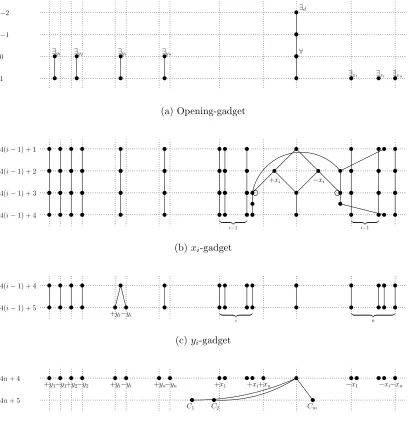
• Ifi= 0, lay down theopening-gadget, that is schematically depicted in Figure 7.a. Moreover, distribute the pawns from
{∃x1, . . . ,∃xn,∃y1, . . . ,∃yn∃d,∀}
over the vertices of the opening-gadget as indicated in its depiction.
• If 1 ≤ i ≤ n, first put the xi-gadget at the bottom of the already constructed game board. Next, put the yi-gadget below the justly introduced xi-gadget. Figures 7.b and 7.c give a schematic account of the xi-gadget and yi-gadget, respectively. (Note that as a result of these actions, every vertex in the board game is connected to at least one other vertex, except for the ones on the top row of the opening-gadget and the ones on the bottom row of the yi-gadget.)
• If i = n + 1, put the clause-gadget (see Figure 7.d) at the bottom of the already constructed board game. This gadget requires a little tinkering before the construction terminates, in order to encode the boolean formula φ by adding edges to the clause-gadgets (not present in the depiction), as follows:
· For every variable z ∈ {~x, ~y} and clause C in φ: If z occurs as a literal in C, then join the vertices named “+z” and “C” by an edge. If ¬z occurs as a literal in C, then join the vertices named “−z” and “C” by an edge.
• Set i=i+ 1.
As I pointed out, the above construction procedure yields a game board, rather than a Scotland Yard instance. But syψ is easily derived from the board game, in the sense that the graph is completely spelt out and so are the initial positions of the pawns. Therefore, syψ is fully specified af-ter putting f : {1, . . . ,4n + 5} → show. Hence, syψ is an instance of Scotland Yardshow.
It remains to be shown that ψ ∈QBFiff syψ ∈Scotland Yardshow.
From left to right. Suppose that {true,false} |= ψ, then there is a way of picking truth values for the existentially quantified variables that renders
ψ’s boolean part φ true, no matter what truth values were assigned to the universally quantified variables. ∃’s winning strategy inSY(syψ) (being wit-ness of the fact that syψ ∈ Scotland Yardshow) can be read off from the aforementioned way of picking. We do so by interpreting moves in SY(syψ) as assigning truth values to variables and vice versa: Actions performed by ∀
from layer 4(i−1) + 1 to layer 4(i−1) + 2 will be interpreted as assigning a truth value to the universally quantified variablexi. In particular, a move by
∀ to the vertex named “+xi” (“−xi”) will be interpreted as assigning to xi the value true (false). Conversely, if ∃’s way of picking prescribes assigning
true (false) toyithis will be reflected inSY(syψ) by moving∃yi to the vertex named “+yi” (“−yi”) on layer 4(i−1) + 5.
Roughly speaking,∃goes about as follows: when she is to chose between moving ∃yi to the vertex named “+yi” or “−yi” she interprets ∀’s previous moves as a truth assignment and observes which truth value is prescribed by the way of picking. Next, she interprets this truth value as a move in
SY(syψ) as above and moves ∃yi to the according vertex. This intuition underlies the full specification of ∃’s strategy, described below:
For 0≤i≤n+ 1 let ∃’s strategy be as follows:
• Above all: If any pawn can capture ∀, do so!
1 0
−1
−2
∃x1 ∃xi ∃xn
∃yn
∃yi
∃y2
∃y1 ∀
∃d
(a) Opening-gadget
4(i−1) + 1
4(i−1) + 2
4(i−1) + 3
4(i−1) + 4
| {z }
i−1 | i{z−1 }
+xi −xi
(b)xi-gadget
4(i−1) + 4
4(i−1) + 5
| {z }
n
| {z }
i
+yi−yi
(c) yi-gadget
C2
4n+ 4
4n+ 5
+y1−y1+y2−y2 +yi−yi +yn−yn +x1 +xi+xn −x1 −xi−xn
Cm C1
[image:31.595.111.520.147.572.2](d) Clause-gadget
• If ∃xi stands on a vertex on layer 4(i −1) + 2, then move it to the vertex on layer 4(i−1) + 3 that is connected to the vertex where ∀ is positioned.
• If ∃yi stands on a vertex on layer 4(i−1) + 4, and the way of picking prescribes assigning true (false) to yi, then move it to the vertex on layer 4(i−1) + 5 that is named “+yi” (“−yi”).
• If ∃d stands on a vertex on layer j that has two successors on layer
j + 1, then move it along the left-hand (right-hand) edge, if j is even (odd).
• If∃z (forz ∈ {~x, ~y}) stands on a vertex on layer 4n+ 4 and this vertex is not connected to a vertex on which ∀is positioned, move it along an arbitrary edge (possibly upwards).
As to∀’s behavior I claim without rigorous proof that after 4n+ 4 rounds of the game (that is, without being captured at an earlier stage of the game) he has traversed a path leading through exactly one of the vertices named “+xi” and “−xi”, for every xi ∈ {~x}, ending up in a vertex named “C”, for some clause C inφ. To see that this must be the case: moving∀upwards at any stage of the game results in an immediate capturing by ∃d. (In fact, ∃d’s sole purpose in life is capturing ∀, when he moves upward.) If∀ is moved to one of the reflexive vertices on layer 4(i−1) + 3 he is captured by ∃xi who moves along the reflexive edge.
Suppose the 4n+ 4th round of the game is over and ∃ played the entire game according to the above strategy, then she the above strategy prescribes a move that makes her win. Concludingly, ∃’s strategy is in fact a winning strategy.
Upon arriving at layer 4n + 4, pawn ∃z (for z ∈ {~x, ~y}) stands on a vertex named “+z” or “−z”, reflecting that z was assigned true or false, respectively. By assumption on the successfulness of the way of picking, that guided∃throughSY(syψ), we have that the truth assignment that is associ-ated with the positions of the pawns ∃x1, . . . ,∃xn,∃y1, . . . ,∃yn makes φ true. That is, under that truth assignment, for every clauseCinφthere is a literal
“C” pawn ∀ moves during his 4n+ 5th move, for at least one z ∈ {~x, ~y} it is the case that∃z can move to this vertex named “C” and capture him there.
From right to left. Suppose that{true,false} 6|=ψ, then there is a way of picking truth values for the universally quantified variables that renders the boolean part false, no matter what truth values were subsequently assigned to the existentially quantified variables. I leave out the argumentation that this way of picking constitutes a winning strategy for ∀ in SY(syψ), as it is similar to the argumentation in the converse direction. But let us note one crucial property of ∀’s winning strategy: it moves pawn ∀ downwards, during every round in the game. Therefore, the only round in which it can be captured is the last one: on a vertex on layer 4n+ 5.
We need to pay close attention, though, to ∃’s behavior. that is, to see that∃cannot change her sad destiny (losing) by deviating from the behavior specified in the rules below. The gist of this behavior is that it results in pawn
∃xi ‘remembering’∀’s moves on layer 4(i−1) + 1 and that after 4n+ 4 rounds the pawns∃x1, . . . ,∃xn,∃y1, . . . ,∃yn all stand on a vertex on layer 4n+ 4. The gist is that just as above the positions of these pawns on vertices on layer 4n+ 4 reflect a truth assignment, that falsify the boolean part.
The rules are as follows:
(1) If ∃xi stands on a vertex on layer 4(i −1) + 2, then move it to the vertex on layer 4(i−1) + 3 that is connected to the vertex where ∀ is positioned.
(2) If ∃d stands on a vertex on layer j that is connected to two vertices below, then move it along the left-hand (right-hand) edge, if j is even (odd).
(3) For every pawn that stands on a vertex on layer j that is connected to exactly one vertex on layer j+ 1, move it to this vertex. (With the same exception as before with regard to ∃xi standing on a vertex on layer 4(i−1) + 3.)
Now, I argue that not behaving in correspondence with (1)-(3) will also result in a loss for ∃:
4(i−1) + 1
4(i−1) + 2
4(i−1) + 3
4(i−1) + 4
+xi −xi
∀
∃d
∃xi
u v
(a)
+xi −xi
∃xi ∀
∃d 4(i−1) + 1
4(i−1) + 2
4(i−1) + 3
4(i−1) + 4
[image:34.595.151.463.153.596.2](b)
connected to the vertex where∀ is positioned (see Figure 8.a). For the sake of the argument let us suppose that∃xi is moved tov. In that case,
∀ may safely move to u. If ∀ continues the game by moving its pawn downwards it wins automatically, since after the final round (round 4n+ 5) its pawn stands on a vertex on layer 4n+ 4, due to the extra vertex sitting in between layers 4(i−1) + 3 and 4(i−1) + 4, without there being any opportunity for ∃ to capture him. As such, the pawn
∃xi is forced to remember what vertex ∀ visited on layer 4(i−1) + 2: the one named “+xi” or “−xi”?
(2) Suppose ∃d stands on a vertex on layer 4(i−1) + 1 and from there moves along the right-hand edge twice (see Figure 8.b). ∀ can exploit this move by moving as he would do normally, except for round 4n+ 5, during which he moves upwards. This behavior results in a guaranteed win for ∀, since none of ∃’s pawns is pursuing ∀ closely enough to capture it, after moving upwards.
(3) Suppose any pawn controlled by ∃ moves upwards instead of down-wards. We see that this can never result in a win for ∃, because ∀
(behaving as he does) can only be captured in the last round of the game, on a vertex on layer 4n + 5. In particular, any pawn ∃z, for
z ∈ {~x, ~y}, the shortest path to a vertex on layer 4n+ 5 is of length 4n+ 5. Now, if ∃z is moved upwards, it cannot (during the last round of the game) capture ∀.
This concludes the proof. 2
The previous two lemmata are sufficient arguments to settle completeness.
Theorem 22 Scotland Yard and Scotland Yardshow are PSPACE -complete.
Proof. Lemma 20 proved that Scotland Yardis solvable in PSPACE. To check whether an instancesyhas a functionfwith range{show}is trivial, therefore, also Scotland Yardshow is solvable in PSPACE.
PSPACE-hardness was proven for Scotland Yardshow in Lemma 21. Since the latter problem is a specialization of Scotland Yard, it follows immediately that Scotland Yard is PSPACE-hard as well.
5
Ignorance is (computational) bless
Intuitively, adding imperfect information makes a game harder. However, if one restricts oneself to Scotland Yard instances in which ∀’s whereabouts are only known at the beginning of the game, then deciding whether ∃ has a winning strategy is NP-complete, cf. Theorem 25. After the proof of this theorem, I show that from a quantitative point of view it is indeed harder for ∃ to win an arbitrary Scotland Yard game.
Lemma 23 Scotland Yardhide ∈NP.
Proof. I make use of the equivalence between the Scotland Yard game and its perfect information counterpart Scotland Yard-PI. It suffices to give an NP algorithm that decides whether∃ has a winning strategy in an arbitrary
SY-PI(sy), where sy’s information function has range {hide}. That is, for every integeri on whichf is properly defined, we have thatf(i) = hide. Let me now repeat the game rule from page 15 that regulates ∀’s behavior in the game of Scotland Yard-PI:
2-PI. Let U0 = E(U − {~v}). If f(i) = hide, then set U = U0 and ∀
positions a ∀ pawn on every vertex v iff v ∈ U. If f(i) = show, then ∀ picks a vertex u0 ∈ U0, removes all his pawns from the
board, and puts one pawn on u0. Set U ={u0}.
Since f(i) never equals show, by assumption, we can harmlessly replace it by the following rule:
2-PI0. Set U0 =E(U − {~v}) and∀ positions a ∀ pawn on every vertex v
iff v ∈U.
But doing so yields a game in which ∀ plays no active rˆole anymore, in the sense that the set U at any round of the game is completely determined by ∃’s past moves. Put differently, any game constituted by an instance of Scotland Yardhide essentially is a one-player game! Having obtained this insight, it is easy to see that the following algorithm decides in non-deterministic polynomial time whether ∃ has a winning strategy in the k -round SY-PI(sy):
• Set U ={u∗},~v =~v∗, and i= 1; then for i≤k proceed as follows:
· IfE(~v, ~vi), then set~v =~vi; else, reject.
· If (U − {~v}) =∅, then accept; else, set U = (U − {~v}).
· Set i=i+ 1.
• If after k rounds there are still ∀ pawns present on the game board, reject.
This algorithm is obviously correct: ∃ has a winning strategy in SY-PI(sy)
iff it accepts sy. Hence,Scotland Yardhide is in NP. 2
To prove hardness, I reduce from 3-Sat, that takes boolean formulae φ
as instance that are in 3-CNF. φ is in 3-Satiff it is satisfiable, that is, there exists a truth assignment of its variables that makes φ true. Henceforth, I make the assumption that no clause in a 3-Sat instance contains two copies of one propositional variable. This goes obviously without loss of generality.
Lemma 24 Scotland Yardhide is NP-hard.
Proof. To reduce from 3-Sat, let φ = C1 ∧ . . .∧ Cm be an instance of 3-Sat over the variables x1, . . . , xn. On the basis of φ we will construe a Scotland Yard instance syφ such that φ is satisfiable iff ∃ has a winning strategy in SY-PI(syφ). In fact, syφ will be read off from the initial game board that is put together as follows.
Set i= 0; for i≤n proceed as follows:
• If i = 0, lay down the clause-gadget from Figure 9.a. The sub-graphs
Hi are fully connected graphs with four elements, whose vertices are connected with the vertices wi.
• If 1 ≤i≤ n, put the xi-gadget to the right of the already constructed game board, see Figure 9.b. It will be convenient to refer to the vertex
qi by means of −i
m+1 and +im+1.
For every 0 ≤j ≤m, do as follows:
Note that C0 refers to no clause, and that −im+1 = +im+1 =qi.
• Set i=i+ 1.
The Scotland Yard instancesyφ is derived from the board game: the di-graph is completely spelt out and the initial positions are as indicated in the gadgets. Therefore,syφ is fully specified after puttingf :{1, . . . ,2m+ 2} →
{hide}. Hence, syφ is an instance of Scotland Yardhide.
It remains to be shown that φ∈3-Sat iff syφ∈Scotland Yardhide.
By Theorem 19, it is sufficient to show thatφ ∈3-Satiff∃has a winning strategy in SY-PI(syφ).
From left to right. Suppose φ is satisfiable, then there exists a truth assignment t : {~x} → {true,false} such that for every clause Cj in φ, there exists at least one literal that is true under t. Let us describe a strategy for
∃ that is based on tand argue that it is in fact a winning strategy for her in
SY-PI(syφ):
• If∃istands on the vertex on layer 0 andt(xi) = true (false), then move it to +i
1 (−i1) on layer 1.
• If ∃i stands on −ij (+ij) and −ij (+ij) happens to be connected to wj, then move it towj. If∃istands on−ij(+ij) and−ij (+ij) is not connected with wj, then move it to dij.
• If ∃i stands on wj, move it to ±ij+1, where ± ∈ {+,−}. Note that this
move is deterministic, since there is an edge from wj to +ij+1 only if
xi occurs as a literal in Cj. By assumption of φ being an instance of 3-Sat, it cannot be the case that also ¬xi occurs as a literal in Cj. Hence, there is no edge from wj to−ij+1.
• If ∃i stands on dij (eij) then move it to −ij+1 (+ij+1). If∃i stands on dim or ei
m then move it to qi.
• If ∃i stands on qi, then move it tosi if t(xi) =true and toti if t(xi) =
false.
Observe that if ∃ plays according to the above strategy, every pawn ∃i will eventually traverse either all vertices −i
∀ Hm H2 H1 u1 v1 u2 v2 u3 vm w1 w2 wm v0 um 0 1 2 3 4
2m+ 2 2m−1
2m
2m+ 1 5 (a) Clause-gadget ∃i −i
1 +i1
fi 1 ei 1 di 1 ci 1 ai
2 −i2 +i2 bi2
fi 2 ei 2 di 2 ci 2 ai
m −im +im bim
di
m eim fmi
qi ri ti si pi ai
3 −i3 +i3 bi3
ci m
[image:39.595.112.478.135.641.2](b)xi-gadget