English Language Teaching in Nepal:
An Investigation of Issues and Challenges
by
Ananda Aryal
B.Ed., MLitt
Thesis Submitted in fulfilment
of the Requirements for the Degree of Doctor of Philosophy
I
This thesis contains no material which has been accepted for a degree or diploma by the University or any other institution, except by way of background information and duly acknowledged in the thesis, and to the best of my knowledge and belief it contains no material previously published or written by another person except where due
acknowledgement is made in the text or the thesis, nor does the thesis contain any material that infringes copyright.
II
The publishers of the book comprising Chapter four hold the copyright for that content, and access to the material should be sought from the respective book publisher. The remaining non-published content of the thesis may be made available for loan and limited copying and communication in accordance with the Copyright Act 1968.
Bibliographic detail of the published chapter:
Aryal, A., Short, M., Fan, S. & Kember, D. (2016). Issues in English language teaching in Nepal. In S. Fan & J. Fielding-Wells (Eds.), What Is Next in Educational Research? (pp.141-155). Sense Publisher.
III
This thesis is not to be made available for loan or copying for two years following the date this statement was signed. Following that time the thesis may be made available for loan and limited copying and communication in accordance with the Copyright Act 1968.
IV
The research associated with this thesis abides by the international and Australian codes on
the Gene Technology Regulator, and the rulings of the Safety, Ethics and Institutional Biosafety Committees of the University.
V
Abstract
Prior to starting the PhD, my personal experience and observations as an English language teacher in Nepal suggested that several issues and challenges impeded English language teaching (ELT) in Nepal. A preliminary exploration (PE) with my lecturers and colleagues in Nepal also raised similar issues and challenges. This research project explores Nepalese
ELT. The research project was guided by the following research questions.
a. What are the issues and challenges that have an impact on English language teaching in Nepal?
b. How can English language teaching in Nepal be improved?
Essentially, with a mixed-methods approach in its methodology, this research solicited the perceptions of Nepalese secondary English language teachers in order to investigate issues and challenges in ELT in Nepal. The qualitative data were drawn from sixteen semi-structured interviews that were conducted in four different districts of Nepal: Kathmandu, Chitwan, Surkhet, and Dailekh. The participants shared their experiences of teaching English language and highlighted the issues and challenges. The interview data were thematically analysed to generate emergent themes. Counting frequency of the prevalence of thematic responses across participants was used to gain initial themes which assisted in developing the theme hierarchy.
For quantitative data, 200 teachers from the same districts completed a questionnaire survey to determine their self-efficacy, motivation and self-reported English language proficiency. The Teacher Sense of Efficacy Scale (TSES) validated by Tschannen-Moran & Hoy (2001) to determine efficacy for classroom management, student engagement, and instructional
VI
language proficiency was derived from Chacon (2005) to assess four language skills: speaking, listening, reading and writing. Finally, sixteen item scales were formulated based on Guajardo (2011) framework of analysis for teacher motivation. The quantitative data were descriptively analysed to gain mean and standard deviation. Bivariate two-tailed correlations were also computed on the survey data.
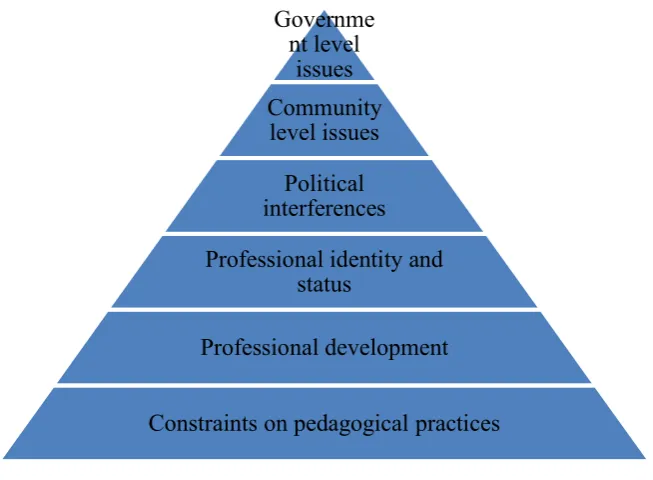
Analysis of the qualitative data indicated that several issues and challenges for ELT in Nepal operate at different levels of the education system. These issues can be observed in top-down hierarchy from macro to micro level; the system level issues on the top and the actual
classroom teaching issues remaining on the bottom. The qualitative data analysis developed a pyramid structured issues hierarchy, presented below, which was fundamental in discussing diverse ELT issues in the Nepalese education system. Nepalese education still follows a top-down approach and accordingly it was also found that the role of the government and the community is very crucial in enhancing ELT quality with definite policies and direction.
VII
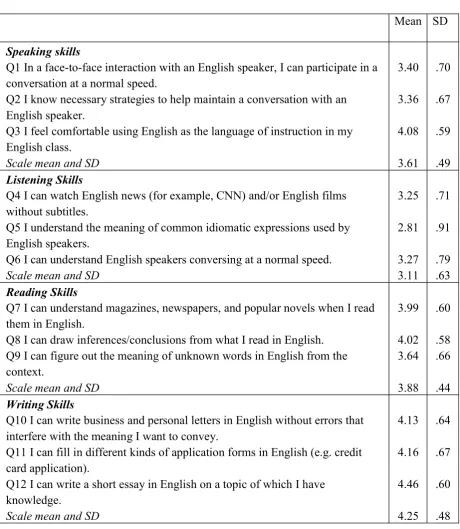
Descriptive analysis of quantitative data to determine self-efficacy of teachers revealed that Nepalese secondary ELT teachers felt that they were less efficacious in student engagement and classroom management than instructional strategies. Similarly, the quantitative findings
-reported English language proficiency suggested that teachers rated themselves less proficient in listening and speaking skills compared to reading and writing skills. These participating teachers rated themselves highly proficient in writing. Moreover, quantitative data also revealed that English language teachers in Nepal are highly
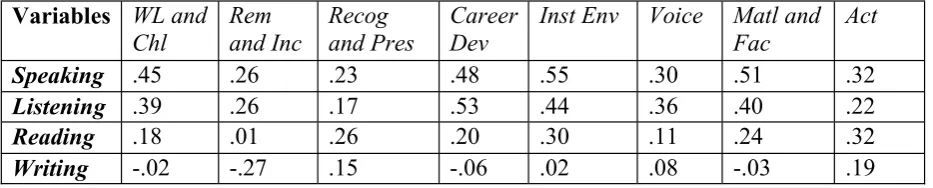
challenges were indicated as the most demotivating factors. Above all, correlation analysis of the quantitative data demonstrated that the dependent variable (teacher self-efficacy) and other independent variables (self-reported English language proficiency and motivation) were strongly correlated.
Government level issues
Community level issues
Political interferences
Professional identity and status
Professional development
VIII
The issues involved in ELT in Nepal do not exist in isolation, rather they are interconnected and complex in terms of their relationship to each other. The pyramid structured model developed via the analysis of qualitative data offers a way of understanding the linkages
- the ineffective policies, limited funding, social and political context and its influence in the classroom practice.
The significant pressures placed upon ELT in Nepal, most notably the policy, social and political, required efforts to improve the quality and outcomes of language teaching. The
-approach to policy level change and an increase in resourcing. The current economic situation of Nepal and the ongoing issues of governance and corruption, however, render this as a very distant possibility. A possible way forward was found in hopes expressed by some of the teachers interviewed for the study who still believe that one teacher or one school can bring positive change. Whilst the issues facing ELT in Nepal are significant, it is suggested that a
IX
X
I am indebted to several people for their contributions in completing this study. First of all, I would like to thank all the participants of this study for their voluntarily participation. Their perceptions on English language teaching in Nepal made this thesis possible.
Secondly, I would like to thank my supervisory team, Dr Megan Short, Dr Frances Fan and Professor David Kember for their continuous guidance, constructive feedback and encouragement. I would also like to thank my fellow higher degree research candidates for their support and valuable insights in formal and informal conversations.
I would like to express my sincere gratitude to my family members for their ongoing financial, moral and emotional support.
Last but not least, I would not have been able to complete this research without
XI
Part A: Introduction
... 1Chapter One: Teaching English in Nepal: Personal Reflection ... 2
Chapter Two: Overview of the Structure of the Thesis ... 8
2.0 Introduction ... 8
2.1 Rational for Qualitative Dominant Mixed Methods ... 8
2.2 Focus of the study ... 9
2.3 Structure of the Thesis ... 11
Chapter Three: The Preliminary Exploration ... 15
3.0 Introduction ... 15
3.1 Inadequate Funding ... 17
3.2 Teacher Training ... 17
-efficacy ... 18
... 18
3.5 Societal Support and Supervision ... 19
3.6 Inadequate/Inappropriate Policies ... 20
3.8 Conclusion ... 21
Chapter Four: Literature Review ... 22
4.0 Introduction ... 22
4.1 The Contextual Overview of English Language Teaching in Nepal ... 22
4.2 Issues and challenges in different ELT contexts... 41
4.3 Theoretical Framework ... 56
Chapter Five: Research Design ... 64
XII
5.2 A Mixed Methods Research Paradigm ... 66
5.3 Data Collection ... 70
5.4 Data Analysis ... 85
5.5 Limitations of the Study... 93
5.6 Conclusion ... 94
Part B: Analysis, Results and Discussion
... 95Chapter Six: Quantitative Data Analysis ... 96
6.0 Introduction ... 96
6.1 Demographic Characteristics of the Participants ... 97
- ... 98
- ... 101
6.4 Analysis of Motivation Level Among the Participants... 104
6.5 Correlations among Participating -reported English Proficiency and Motivation ... 112
6.6 Conclusion ... 118
Chapter Seven: Macro-level Analysis of Qualitative Data ... 120
7.0 Introduction ... 120
7.1 Approaches Employed to Generate Themes ... 120
7.2 Revealing the Main Themes and Sub-themes ... 122
7.3 Development of the Theme Hierarchy ... 125
7.4 Conclusion ... 126
Chapter Eight: Government Level Issues... 128
XIII
8.2 Educational Policies ... 131
8.3 Bureaucratic Malpractice ... 136
8.4 Insufficient Funding for Education ... 141
8.5 Conclusion ... 142
Chapter Nine: Community Level Issues ... 144
9.0 Introduction ... 144
9.1 Community Involvement ... 145
... 151
9.3 Conclusion ... 159
Chapter Ten: Political Interference ... 161
10.0 Introduction ... 161
10.1 Frequent Strikes and Political Pressures ... 163
10.2 Influence on the School Management Committee ... 167
10.3 Interference on Teacher Management ... 169
10.4 Teachers in the Political Unions ... 171
10.5 Conclusion ... 174
Chapter Eleven: Professional Identity and Status ... 175
11.0 Introduction ... 175
11.1 Impacts of Personal Factors ... 176
11.2 Impacts of Social Factors ... 183
11.3 Impacts of Contextual Factors ... 189
11.4 Conclusion ... 200
Chapter Twelve: Issues of Professional Development ... 201
XIV
12.2 Professional Development within the School ... 211
12.3 Social Learning and Collegial Support ... 217
12.4 Conclusion ... 220
Chapter Thirteen: Constraints on Pedagogical Practices ... 221
13.0 Introduction ... 221
13.1 School Related Constraints ... 222
13.2 Teacher Related Constraints ... 230
13.3 Learner Related Constraints ... 235
13.4 Conclusion ... 240
Part C: Conclusion ... 242
Chapter Fourteen: Conclusion and Recommendations for improvement ... 243
14.0 Introduction ... 243
14.1 Overall Conclusion from the Qualitative Results ... 243
14.2 Overall Conclusion from the Quantitative Results ... 251
14.3 Relating the theoretical frameworks with the findings ... 252
14.4 Recommendations for Improvement... 260
14.5 Contribution to New Knowledge ... 277
14.6 Concluding reflection... 278
XV
Figure 2.1: Theme hierarchy developed after analysing qualitative data, also used to structure the chapters in Part B
Figure 7.1: Hierarchical positioning of themes and sub- 26
Figure 8.1: Interrelation of issues at the government 129
Figure 10.1: Factors affecting ELT due to the pol 63
Figure 11.1: Factors affecting professional identity and sta 6
Figure 12.1: Issues of teacher professional d 2
Figure 13.1: Constraints on the pedagogical practic 2
and learning... 38 Figure 14.1: A pyramid structure issues hierarchy developed after the analysis of qualitative
5 Figure 14.2: Relation between the issues from the top to the 51
XVI
Table 4.1: Yearly SLC pass percentage in private and government aided school 30 Table 4.2: Issues and challenges in different ELT context
Table 5.1: Mixed methods design used in this 69
90 Table 5.3: Reliability test for self-effic
Table 5.4: Reliability test for self-reported English langu
Table 5.5: Reliability test for motivation sc
Table 6.1: Frequency of the participants in terms of the
Table 6.2: Overall self-efficacy belief of Nepa
Table 6.3: Overall self-reported English language proficiency of Nepalese EFL teachers...102
Table 6.4: Overall motivation level of Nepal
Table 6.5: Correlations among self-efficacy subscales with other variables of self-reported English language proficiency and m
Table 6.6: Correlations among self-reported English language proficiency with eight
XVII
CALL Computer Assisted Language Learning CLT Communicative Language Teaching DEO District Education Office
EFL English as a Foreign Language
ELT English Language Teaching
ESL English as a Second Language
GDP Gross Domestic Product
ICT Information and Communication Technologies I.Ed. Intermediate of Education
IALL Internet Assisted Language Learning
MoE Ministry of Education
MoF Ministry of Finance
NELTA PABSON
PCF Per Child Fund
PE Preliminary Exploration
SMC School Management Committee
SLC School Leaving Certificate
TPD Teacher Professional Development
TSC Teacher Service Commission
1
2
Chapter One:
Teaching English in Nepal: Personal Reflection
This research is based on my personal experiences of ELT in Nepal for 5 years. Therefore, this chapter will be reflective writing that focuses on my motivation to undertake this research in the Nepalese ELT context.
I grew up seeing my father as a teacher. The way he was respected in the community and regarded by his students always inspired me to join the teaching profession. Therefore, I chose teaching as my career pathway. The emphasis on English language education placed by the government of Nepal and the contemporary society I was living in provided me an insight that English language teachers have or will have more opportunities. For this reason, I
decided to become an English language teacher. After completing my school leaving
certificate (SLC), I got enrolment in Intermediate of Education (I.Ed.) with English language specialisation which has led me to pursue my dream to be a teacher of English.
There are a lot of inspirational quotes for teachers and teaching profession which has inspired not only me but also several others to enter this profession. I would like to mention one of the quotes here:
A good teacher is like a burning candle, it consumes itself to light the way for
others.
-Mustafa Kemal Attaturk
3
At the end of the second year of I.Ed., student-teachers need to go for practice teaching in a school for 45 days. This practice teaching provides opportunities for the student-teachers to gain experience in teaching after micro-teaching and peer-teaching on campus. Student-teachers are either assigned a school or asked to choose a school they prefer to teach during their practice teaching. I chose a public school which was very close to my house and started teaching the students in Grades 6, 7 and 8. I strongly agree that the nature of practice teaching is very beneficial for the student-teachers as they can learn a lot from real-teaching scenarios; however, I have to mention that the pre-service teacher training I received during the course of study did not prepare me to be an effective teacher. I believe the pre-service teacher training I received was more theoretical/hypothetical which had very limited applications in real classroom teaching. I would like to support this with one of the incidents I faced during my practice teaching.
(One day I was teaching in a Grade 8 class. There were nearly 70 students in the
class and I was teaching
Student A: Sir, whatever you are teaching is not right.
The whole class goes wild with laughter which made me very nervous, but somehow I
organised myself and replied:
Me: Well, as a student-teacher, I am not an expert. I also can make mistakes. So,
could you please suggest me the right answer?
Student A, B, C and others: (This time Student A had some other supporters too): We
right.
I was helpless in that circumstance. I felt like weeping but I hold my tears. I also felt
like leaving the class. Anyhow, I managed to survive those 45 minutes. During the whole
4
school, but did not receive much help. I was suggested to ignore or punish the students if they try to create a scene in the class. From that day, I was always hesitant to enter that class.
During the pre-service teacher training, we were taught several theories of language teaching and learning; however, issues that can arise in large class size, handling difficult students, teaching in under-resourced context were not focused. This made me realise that the pre-service teacher training I received lacked ground analysis of the real classroom teaching. What compounded the issue was I had no contact with my supervisor-teacher for those 45 days of practice teaching to discuss the issues I was encountering. It was not only me but other student-teachers also had no contact with their respective supervisor-teachers. What I noticed is that supervisor-teachers are more reluctant to provide follow-up support to the student-teachers. The common belief among the supervisor-teachers that their job is done once the student-teachers are sent for the practice teaching leaves the student-teachers at the crossroad with no or limited support.
After completing my I.Ed. degree, I was lucky that I got selected as a lower secondary teacher in one of the reputed privately owned schools of Chitwan district. Before I was
handed an appointment letter, the school principal including other teachers told me that the school will be unable to provide me salary and benefits as a lower secondary teacher. Rather, my salary benefits will be of primary teacher. Although I knew the school was taking
5
should increase their salary too. It took four months of protests to introduce the increment policy in the schools I was teaching. This indicates that the teachers in privately owned schools, in most occasions, are financially exploited.
I taught in this privately owned school for five years. We always cherished team-work in teaching. I received a lot of support, encouragement and supervision from senior teachers as well as from my colleagues. However, I did not receive any opportunities for formal trainings. During that time, I had no idea about the importance of in-service teacher training. However, I now realise that any opportunities of teacher training would have immensely helped me to be a more effective teacher.
Although I was teaching in a well-known private school, we had very limited infrastructure for ELT. The school administration was reluctant to develop resources and materials needed for ELT. I should acknowledge that the library had sufficient materials for the students, but the support materials needed for the teachers were very nominal. Use of technology has hugely benefited language teaching and learning. Despite this, there were only audio materials available like cassette players, but the use technology like computer and internet did not exist.
Despite being a private school, there were nearly 40-50 students in each class which impacted on my classroom management and use of communicative approach in ELT. Other teachers also had similar issues, thus we requested the school administration to divide the class into different sections, but our request was not heard. The usual answers we received from the school administration was that it needed infrastructure development and recruitment of new teachers to divide the classes into different sections and the school is not in the strong financial position for more investment.
6
homework/notebook, mark exam papers weekly, monthly and tri-monthly, monitor and mark project work and prepare results. Not only the school hours, I had to spare a lot of my daily time to complete the work assigned by the school. This situation is similar to most of the teachers teaching in a privately owned school. Even though I had to perform a lot of extra-duties, I was never paid extra benefits.
Another issue I remember is the limited support from the society. Basically, parents from the privately owned schools hardly praise teachers for their hard work. There is a common belief among the parents that they are paying expensive fees to educate their children; therefore, the school and the teachers need to shoulder responsibility for their children. It is not odd that the teachers receive frequent blames for the failure of the students. I would like to add another incident which happened in the year 2006/07. One of the parents accused me that her son scored less marks and could not secure first position in the class because I intentionally marked him low. I handed her the original exam paper and clarify my stand, but she was still unhappy that her son ranked second in the class. She even complained about me with the school administration. After that, I thought of resigning from the post on the ethical ground, but the school administration did not accept my resignation. They told me that these incidents happen now and again and there is no point of distressing; however, the incident had significant impact on my morale and the image of teacher I see myself.
What I also frequently noticed was that the extreme political interferences have significant impact on teaching and learning. Different political parties are their sister organisations frequently announced strikes, and no teaching and learning activities were possible during the strikes. This seriously impacted my time management to complete the curriculum.
7
teachers too. I believed that identifying the issues and challenges of ELT in Nepal will assist ELT practitioners, educational stakeholders and policy makers to introduce new ELT
practices and policies. This, in a long run, will have positive impacts to enhance ELT quality in Nepal. Therefore, I aimed to answer the following research questions in my PhD research. a. What are the issues and challenges that have an impact on the quality of English
language teaching in Nepal?
8
Chapter Two:
Overview of the Structure of the Thesis
2.0 Introduction
This chapter discusses the structure used in the development of this thesis. First of all, it presents the theoretical positioning of this research. For this, it justifies why this research adopted the qualitative dominant mixed methods approach. After that, it explains how and where the literatures have been placed in this research. It also describes the pyramid structured issues hierarchy framework developed during the process of the data analysis which has a significant role in structuring the discussion section of this research. Finally, it presents the structure of the conclusion section.
2.1 Rational for Qualitative Dominant Mixed Methods
As a methodological approach, this research has used mixed methods. Mixed methods
conducting research (Johnson & Onwuegbuzie, 2004, p. 17). Explaining the usefulness of mixed methods in conducting research, Johnson and Onwuegbuzie (2004) stated:
Mixed methods research also is an attempt to legitimate the use of multiple
approaches in answering research questions, rather than restricting or constraining dogmatism). It is an expansive and creative form of research, not a limiting form of research. It is inclusive, pluralistic, and
complementary, and it suggests that researchers take an eclectic approach to method selection and the thinking about and conduct of research. (p.17)
9
was interested in exploring ELT issues and challenges in Nepal; lived experiences, feelings and behaviour of the participants were my primary source of data. The interpretivists believe that multiple people report, view or describe the same incident differently (Mack, 2010); therefore, qualitatively exploring ELT experiences of the participants from the open-ended interviews became essential where participants could indicate different issues resulting in the richness of data. On the other hand, I also conducted a PE before designing this project. I did contact my colleagues and lectures in Nepal to gain further insights on ELT issues and challenges. The PE indicated that Nepalese English as a foreign language (EFL) teachers have low self-efficacy and motivation. Similarly, English language proficiency of EFL teachers was also questioned. Accordingly, I decided to quantitatively explore self-efficacy, motivation and self-reported English language proficiency of the participating teachers. For this reason, this research has a valid argument employing mixed methods.
Although the usefulness of mixed methods research is widely discussed, researchers should be aware that they need to place their research in one of the methodological traditions of positivism or interpretivism as the principal research paradigm. As the core idea of this research is to explore ELT issues and challenges in the Nepalese education system, it was only possible exploring the lived experiences of the participants. Therefore, I believed that qualitative approach would best answer my research questions. Hence, the methodological stand of this research is interpretive dominant where quantitative results will supplement the qualitative results. Accordingly, the structure of this thesis is also qualitative dominant.
2.2 Focus of the study
10
teacher training (Pant, 2012). These above mentioned researches have outlined the impact of specific issue on ELT; however this research aims to forward comprehensive understanding of issues and challenges limiting effective ELT practice. Instead of analysing and discussing a particular ELT issue, this research intends to provide overall picture of the English
language teaching context of Nepal.
The initial focus of this research was to explore issues and challenges particular to ELT pedagogy in Nepal; however the focus of the research became broader after analysing the findings of the Preliminary Exploration (PE) (see chapter 3.0) and literature on the issues and challenges in different ELT contexts (see section 4.2). Analysis of the PE and literature indicated that the ELT issues and challenges are complex and multifaceted and can be grouped in two categories: Pedagogical issues particular to ELT and overall educational issues. Traditional teaching, extensive use of mother tongue and exam-orientated teaching were prevalent pedagogical issues, whereas policy level shortcomings, wider social and economic structures, social perception of the low status of teachers, professional development practices, low remunerations for teachers, limited funding for educ
11
2.3 Structure of the Thesis
This thesis is divided into three parts (A, B and C) and fourteen chapters. The part A is an introduction section which contains five chapters. This thesis starts with my personal reflection of teaching English in Nepal. The idea of exploring ELT issues in Nepal aroused my interest from my five years of ELT experience. So, the personal reflection chapter discusses the issues and challenges faced by me during my teaching, and provide justifications for conducting this research in Nepalese ELT context.
theoretical positioning of this research. This chapter also unveils methods and techniques employed in structuring this thesis.
experiences will not be appropriate and logical to design this research project. Therefore, I conducted a PE to design this project. I contacted my colleagues and the university lecturers to ask them to express their views on ELT issues and challenges in Nepal. The outcome of the PE is reported in the chapter three.
The chapter four is a Literature review section which presents the contextual overview of ELT in Nepal, brief literature review on ELT contexts around the world and theoretical foundation of this dissertation. In the contextual overview, it discusses the impact of ten years of civil war in ELT and presents the ELT scenario of Nepal. The contextual overview chapter also discusses some of the Nepalese ELT issues identified by the literature. After that, the literature review section highlights the issues and challenges in different ELT contexts. Lastly, it reviews
12
depending on the diverse issues and challenges reported by the participants would interrupt consistency of the thesis. Therefore, literature review has been embedded while discussing the issues and challenges in the discussion sections. This enabled comparison and discussion of issues relevant to ELT in Nepal with the international literature.
The final of part A, chapter f
research methodology, method, data collection procedure and the analytical technique applied in this research. This includes the process carried out to design this research, the settings, the participants of the research, and the methods used to collect data. In the same way, it also details data analysis methods to achieve the aims of this research and limitation of the study.
The part B of this thesis presents analysis, results and discussion in eight chapters. The chapter six which is also the first section of the part B presents quantitative data analysis. In quantitative data analysis, it presents mean and standard deviation of self-efficacy,
motivation and self-reported English language proficiency of questionnaire responses. Similarly, correlation study of these variables is also discussed.
The chapter seven discusses macro-level analysis of the qualitative data. This chapter reveals main themes and sub-themes developed from the qualitative data analysis and
presents the theme hierarchy. On the basis of this analysis, I designed a pyramid structured theme hierarchy to report the data analysis. Based on this pyramid structured theme
13
Figure 2.1: Theme hierarchy developed after analysing qualitative data, also used to structure
the chapters in part B.
This theme hierarchy was developed on the basis of prevalence of themes. The Nepalese education system still follows a top-down approach. The participants of this research reported that the ELT issues are intertwined and positioned from macro to micro level; the system level issues remaining on the top and the actual classroom issues remaining on the bottom. Therefore, this thesis, from chapters 8 to 13, keeps on unveiling the ELT issues prevalent on both the macro-level (system level) and the micro-level (pedagogical level). These chapters explore answers to the main research questions by discussing key findings based on qualitative analyses conducted and integrate quantitative data to support the qualitative discussion.
The part C of this thesis is the conclusion section. This part comprises of two sections: overall conclusion and recommendation for improvement which are included in chapter 14. The first section of the chapter 14 presents concluding ideas and summary of the overall findings of qualitative and quantitative results. After that, it relates, compares and contrasts the findings of this research with the theoretical foundation of this research. Finally, the
Governme nt level
issues Community level issues
Political interferences Professional identity and
status
Professional development
14
15
Chapter Three:
The Preliminary Exploration
3.0 Introduction
I was prompted to conduct this research by my own experiences of teaching English in Nepal. I believed that receiving ideas from other ELT practitioner in Nepal would benefit this research in framing the research focus and research questions. For this, a pilot survey was necessitated. Implementation of a pilot study in research can have several benefits (Kim, 2010; Sampson, 2004; Van Teijlingen, Rennie, Hundley, & Graham, 2001). According to Kim (2010), undertaking a pilot study in a research offers researchers with an advantage to adjust or revise their main study. Moreover, a pilot study can contribute to gain a clear conceptualisation of the focus of the research; thus researchers can expand or narrow their research area (Sampson, 2004; Seidman, 1998) and develop research questions (van Teijlingen at el., 2001). In this research, I conducted a pilot study for the broader
understanding of the issues and challenges limiting ELT in Nepal. Additionally, the pilot study was crucial to conceptualise my research focus, develop research questions and frame questions for the interview.
16
The comprehensive understanding of ELT issues and challenges was believed to be effective to be a foundation for policy and practice level improvement. Consequently, understanding the broader education context of Nepal became the focus of the research. Secondly, the PE was useful to frame interview questions which laid the foundation of the qualitative
dimension of this research. Responses gained from the PE were considered in designing the interview questionnaire. Lastly, the PE added a new dimension in the main study. Initially, exploring self-efficacy, motivation and English language proficiency were not considered in
sense of efficacy, motivation and English language proficiency could potentially influence their English language teaching. Hence, I decided to quantitatively explore these variables reported in the PE.
To receive information on English language education in Nepal, I did contact my previous lecturers and colleague teachers and request them to answer some of the questions. The PE focused on the EFL issues and challenges in Nepal. I emailed two open ended questions to my lecturers and colleagues in Nepal after they agreed to support me. The questions were:
a. What do you see as main issues in EFL teaching in Nepal? and b. What could be done to improve it?
17
3.1 Inadequate Funding
Inadequate investment in the education was reported as one of the major issues. PE also indicated that lack of funding in the education is the influencing factor for other
prevailing issues. It was reported that limited funding has resulted in under-resourced school environment, poor infrastructure development, unavailability of teaching materials and so on. The PE participants recommended that the government of Nepal should allocate maximum annual budget for the education sector. Similarly, it was also advised that the government should primarily focus on the development of infrastructure which will benefit English language teachers and learners.
3.2 Teacher Training
18
-efficacy
In reference to the use of teaching methodology, almost all the participants of this PE stated that EFL teachers in Nepal lack self-efficacy. The participants indicated that EFL teachers in Nepal mostly practice lecture based teaching methodology with root memorising and chorus drill. Similarly, English language is taught as a subject with extensive use of mother tongue. Moreover, teachers dominate ELT classes as an authority rather than being a facilitator.
Efficacious teachers use student-centred approach in teaching and try various new methodologies (Gibson & Dembo,1984), and their self-perceived efficacy to teach directly impact on their teaching practices and students outcomes (Chacon, 2005). Moreover, efficacious teachers persistently assist low achieving students, less criticised students for incorrect answers and manage time effectively compared to low efficacious teachers who spent more time in non-academic activities and fail to guide students to correct responses (Chacon, 2005). The PE indicated that EFL teachers in Nepal are less efficacious; thus I believed that it will be worthwhile to study the self-efficacy of the teachers. Thus, one of the dimensions of this research is to study self-efficacy of the participants.
19
The PE participants also reported that Nepalese teachers are teaching in a very difficult context. Teachers and students sometimes even do not receive textbooks for the whole academic year. Hence, access of other essential materials and infrastructure for EFL teaching has become an unreal dream for Nepalese teachers. Dinham and Scott (1998) reported that infrastructure in the school, class size, workload, support from the school administration and colleague, staff supervision, participation in decision making are key
society, support from the government and other authorised bodies, and workload plays
is research. Hence, it was included in this research.
3.5 Societal Support and Supervision
The PE participants expressed that involvement of the community to enhance teaching and learning is very nominal. According to the PE, frequent monitoring from the community will increase accountability among the teacher; however participation of the wider community in education is not noteworthy. The PE indicated that less educated and uneducated parents cannot supervise the performance of their children and school. Similarly, these parents have to do day to day work for their survival. For this reason, they can hardly spare time to visit schools to monitor the progress of their children and performance of teacher and school.
20
the parents and the community members are reluctant to support schools and teachers.
Explaining the role of community in the education, Uemura (1999) stated that the community members could contribute with teaching materials locally available and more familiar for the learners. Similarly, interaction with knowledgeable community members can be beneficial for the teachers. They can incorporate skills and knowledge gained from the community members into their curriculum which will enhance their teaching.
3.6 Inadequate/Inappropriate Policies
Some of the policy level issues were also identified by the PE participants. They reported that the existing teacher management under decentralisation policy has elevated the issues of equity, favouritism and hierarchy among the teachers. The PE participants indicated that teachers are recruited in different status such as permanent, temporary, contract, relief, Per Child Fund (PCF). Permanent teachers are recruited by Teacher Service Commission (TSC); whereas School Management Committee (SMC) can recruit other contract teachers in consultation with the DEO. These teachers recruited under different status receive different incentives, facilities and recognition. The permanent teachers receive salary purposed by the government of Nepal, while respective SMCs can decide salary and benefits for teachers in other categories which in most cases are nominal. Moreover, the permanent position indicates a sense of identity and power (Khanal, 2011); while contract teacher feel being discriminated. Hence, the existing teacher management policy has increased the issue of equity and
21
categories has increased dissatisfaction among the teachers, hence need immediate amendments.
The PE participants questioned the English language proficiency of Nepalese EFL
introduced with immediate effect. Standardisation of English language proficiency for English language teachers will assure minimal level of English language proficiency among
proficiency should be measured. For this reason, one of the dimensions of this research is exploring self-reported English language proficiency of Nepalese EFL teachers.
3.8 Conclusion
for
copyright or proprietary
reasons.
It has been published as:
Aryal, A., Short, M.,
Fan, S., Kember, D., 2016. Issues in English
language teaching in Nepal. In, S. Fan, J.
Fielding-Wells (eds.), What is next in
64
Chapter Five: Research Design
5.0 Introduction
Research design is one of the most significant factors which guides researchers to achieve their research objectives and determines the accomplishment of a research. It also reveals the theoretical positioning and ideology of the researcher.
This chapter elaborates on research methodology, method, data collection procedure and the analytical technique applied in this research. This includes the process carried out to design this research, the settings, the participants of the research, and methods used to collect data. In the same way, it also details data analysis methods to achieve the aims of this
research. This research aimed to address the following research questions:
a. What are the issues and challenges that have an impact on English language teaching in Nepal?
b. How can English language teaching in Nepal be improved?
This research used mixed methods approach to answer the above mentioned research questions. Mixed methods provide an advantage to the researcher to gain greater
understanding of particular aspects of a phenomenon than a single method do (Cameron, 2011). Therefore, I used mixed methods for the holistic understanding of the ELT issues in Nepal.
This research
65
years, relevant literature review, internet articles, newspaper articles and the PE (discussed in the chapter three) are the base in designing this research.
5.1 The Preliminary Exploration
An online PE was piloted to finalise the research questions of this project. The PE focused on EFL issues in Nepal. Although this research stated with my personal experience of teaching English in Nepal, I believed that one person will not be able to see the different aspects of the whole system. Hence, getting ideas and knowledge from other EFL
practitioners would build further understanding. For this, I requested my lecturers and
colleagues in Nepal to participate in the PE. Two open-ended questions were emailed to them after they agreed to support me. Questions of the PE were:
a. What do you see main EFL issues in Nepal? and b. What could be done to improve it?
The participants of the PE were given three weeks to respond to the questions. At the end of the specified time, eleven responses were received. Responses were thematically analysed and themes related to EFL issues emerged. Issues like traditional teaching, crowded classrooms, lack of resources and trainings, low salaries, overuse of mother tongue and high workloads were reported. Similarly, the PE participants also indicated on low self-efficacy and motivation of EFL teachers in Nepal. Further, the PE participants also reported that the education system lacks policy to standardise English language proficiency of EFL teachers before they enter in the profession which has increased the number of less deserving people in the profession.
66
and motivation as well as questioned the English language proficiency of the teachers. For this reason, I decided to conduct a mixed methods research. The qualitative section uncovers factors impeding ELT in Nepal and the quantitative section explores the level of self-efficacy, motivation and English language proficiency of the participating teachers.
5.2 A Mixed Methods Research Paradigm
Mixed methods research is often referred to as the third methodological movement which offers a logical and practical alternative (Johnson & Onwuegbuzie, 2004; Tashakkori & Teddlie, 2003). Mixed methods research has witnessed a rapid rise in popularity in the last 10 years (Cameron, 2011). The aim of the mixed methods is not to replace either of
qualitative or quantitative approaches of research; rather, it draws positives from each research method and minimises limitations (Johnson & Onwuegbuzie, 2004). Although qualitative research and quantitative research have many paradigmatic differences; both methods use observation techniques to address the research questions. Similarly, both methods describe data, construct explanatory arguments from their data and observe the outcomes (Sechrest & Sidani, 1995). Combining quantitative and qualitative components can be useful in achieving corroborating findings, generating more complete data, and using results from one method to enhance insights attained with the complementary method (Curry, Nembhard & Bradley, 2009).
67
the participants; therefore, I believed qualitative approach will best answer my research questions.
5.2.1 A Mixed Methods Approach
Johnson and Onquegbuzie (2004) have defined mixed methods research as the research in which the researchers mix or combine quantitative and qualitative research methods, techniques, approaches, concepts into a single research. Only qualitative or
quantitative research may restrict researchers with limited choices; however, mixed methods research provides multiple approaches to answer the research questions. Therefore, it can be also termed as the creative form of research which supports researchers to use diverse approaches in their research. Sandelowski (1986) explains that the mixed methods enable researchers to minimise potential bias and invalidity that may exist in every research study.
Using the mixed methods, the researcher collects and analyses data, integrates the finding and draws conclusions (Tashakkori & Creswell, 2007). Similarly, mixed methods research is also useful to indicate the similarities and differences of the particular aspects in a research.
Greene, Caracelli and Graham (1989) have proposed five rationales of conducting mixed methods research which are:
a. Triangulation (i.e., seeking convergence and corroboration of results from different methods and designs studying the same phenomenon);
b. Complementarity (i.e., seeking elaboration, enhancement, illustration, and clarification of the results from one method with results from the other method); c. Initiation (i.e., discovering paradoxes and contradictions that lead to a re-framing
68
d. Development (i.e., using the findings from one method to help inform the other method); and
e. Expansion (i.e., seeking to expand the breadth and range of research by using different methods for different inquiry components).
These rationales are wide-ranging and flexible for data analysis and interpretation; therefore this research aims to closely employ these rationales. The purpose of this research is to explore existing EFL issues and challenges in Nepal and to determine self-efficacy,
motivation and self-reported English language proficiency of EFL teachers. Investigating EFL issues as well as self-efficacy beliefs, motivation and self-reported English language proficiency is a multifaceted and complex process; therefore, the mixed methods became the ultimate choice for this research. During the process of data interpretation, data from each method were constantly compared and contrasted, findings from one method were carefully used to help, inform, elaborate or enhance the finding from another method.
5.2.2 Mixed Methods Design
69
(a) the triangulated design, to obtain different but complementary data, (b) the embedded design, in which one data set provides a supportive secondary role (c) the two-phase explanatory design, which builds or explains quantitative results; and (d) the exploratory
design, which is also two-phased but led by the qualitative.
5.2.2.1 An Exploratory Concurrent Mixed Methods Design
This research is qualitatively-driven exploratory concurrent in nature. The main aim of this research is to explore factors impeding ELT in Nepal. Similarly, it also intended to determine self-efficacy, motivation and self-reported English language proficiency of
[image:46.595.99.522.558.618.2]2003, p. 686) in which data collection takes place in a single phase and analysed separately. The qualitative paradigm was given more emphasis to explore the ELT issues and challenges; where quantitative paradigm supplemented qualitative paradigm for theorising. The mixed methods design used in this research has been illustrated in Table 5.1 below.
Table 5.1: Mixed methods design used in this research.
Timing Purpose Weighting Mixing Theorising
Concurrent Triangulation Quali dominant Integrating Implicit
Drawn from: Creswell, Clark, Gutmann and Hanson (2003) and Leech and Onwuegbuzie (2009) framework.
70
frequently was not possible as there were time constraints on the time period available for gathering data.
In the context of this study, the role of the qualitative data is to gain perceptions, beliefs and experiences of English language teachers regarding issues and challenges they are facing for effective ELT. Hence, voice representation of English teachers in Nepal regarding their beliefs and understandings of ELT would immensely facilitate meaning making process in this research. Although the qualitative research are often blamed for lacking explanation of prevalence and significance; the quantitative portion of this research is expected to fill the gap.
5.3 Data Collection
This section describes the instruments used for the data collection, research sites, nature of the participants, simple size, process of data collection and issues during data collection.
5.3.1 Quantitative Questionnaire
The quantitative questionnaire comprised of demographic questionnaire,
questionnaire to test self-efficacy, motivation and self-reported English language proficiency of the participants.
5.3.1.1 Demographic Questionnaire
Seven demographic items were designed which included participant
71
Demographic Questions (Please tick the correct answer).
I. I am a. Male b. Female
II.
III. I teach in a. Government aided school b. Private school
IV. I teach in a. Urban school b. Remote school
V. My teaching experience is a. less than 3 years b. More than 3
years
VI. I have a degree a. Majoring English b. Other subjects
5.3.1.2 Questionnaire to Test Self-efficacy
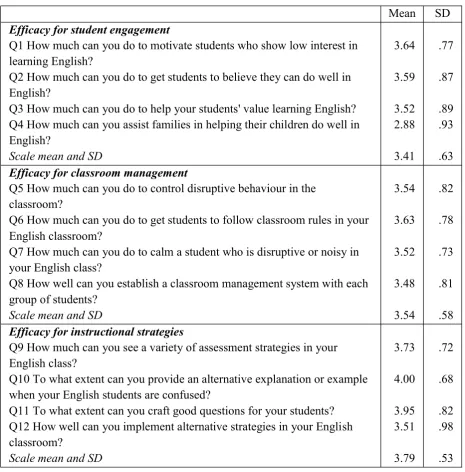
The short version of the TSES validated by (Tschannen-Moran & Hoy, 2001) was adapted in this research. The TSES consists of 12 items including four items for each of the three subscales: efficacy for engagement, efficacy for management, and efficacy for
instructional strategies. The three dimensions of efficacy for instructional strategies,
lives -Moran & Hoy, 2001, p. 801). Thus,
their perceived efficacy on these three dimensions of teaching represents their overall efficacy on teaching.
The TSES items which were also used by Chacon (2005) and Yilmaz (2011) in their respective EFL settings were modified to fit the context of EFL by adding or substituting
72
Please tick or circle the most appropriate number of each statement which corresponds most closely to your desired response.
a. How much can you do to motivate students who show low interest in learning English?
b. How much can you do to get students to believe they can do well in English? c.
d. How much can you assist families in helping their children do well in school? e. How much can you do to control disruptive behaviour in the classroom? f. How much can you do to get students to follow classroom rules in your English
classroom?
g. How much can you do to calm a student who is disruptive or noisy in your English class?
h. How well can you establish a classroom management system with each group of students?
i. How much can you use a variety of assessment strategies in your English class? j. To what extent can you provide an alternative explanation or example when your
English students are confused?
k. To what extent can you craft good questions for your students?
l. How well can you implement alternative strategies in your English classroom?
5.3.1.3 Questionnaire to Test Self-reported English Language
Proficiency
73
Please tick or circle the most appropriate number of each statement which corresponds most
closely to your desired response.
a. In face-to-face interaction with an English speaker, I can participate in a conversation at a normal speed.
b. I know the necessary strategies to help maintain a conversation with an English speaker. c. I feel comfortable using English as the language of instruction in my English class. d. I can watch English news (for example, CNN) and/or English films without subtitles. e. I understand the meaning of common idiomatic expressions used by English speakers. f. I can understand English speakers conversing at a normal speed.
g. I can understand magazines, newspapers, and popular novels when I read them in English. h. I can draw inferences/conclusions from what I read in English.
i. I can figure out the meaning of unknown words in English from the context.
j. I can write business and personal letters in English without errors that interfere with the meaning I want to convey.
k. I can fill in different kinds of application forms in English (e.g., credit card application). l. I can write a short essay in English on a topic of which I have knowledge.
5.3.1.4 Questionnaire to Test Motivation
74
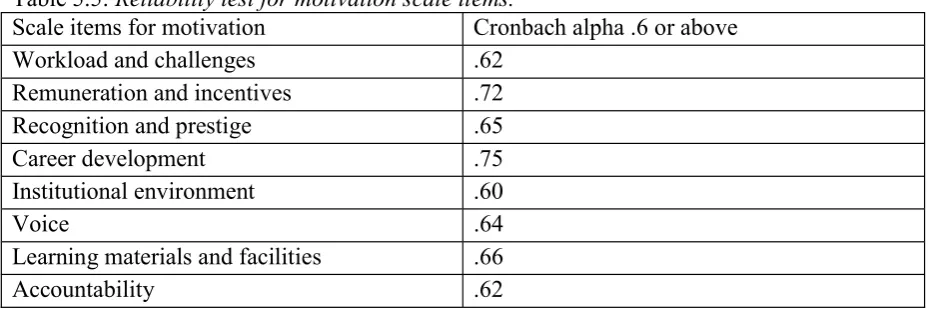
country, I believed that these categories which affect teacher motivation proposed by Guajardo (2011) would fit in the Nepalese context. Hence, I adopted these categories in this research to test the level of motivation among the Nepalese teachers. After extensive
literature review on teacher motivation and Nepalese context, 16 items were formulated based on the above mentioned eight categories. These items were rated on a 5-point Likert-scale: 1-strongly disagree, 2-disagree, 3-undecided, 4-agree, and 5-strongly agree. The items developed to test motivation are detailed below.
Please tick or circle the most appropriate number of each statement which corresponds most
closely to your desired response.
1. Workload and challenges.
a. I find it hard to handle the large classes we have. b. There are lot of out of school duties for teachers. 2. Remuneration and Incentives
a. It is hard to make end meet on the pay of a teacher. b. It is difficult to provide for my family with my salary. 3. Recognition and prestige
a. Teachers are highly regarded in Nepal. b. Teaching is a prestigious profession. 4. Career development
a. I have been well trained for my role as an English language teacher. b. There are good opportunities for in-service training.
5. Institutional environment
a. The school is managed well.
75 6. Voice
a. Teachers have a say in the management of the school. b. There is a chance to participate in decision making. 7. Learning materials and facilities
a. There are adequate learning materials for use in class. b. The school has good buildings and facilities.
8. Accountability
a. There is a punishment and reward system in the school. b. Performance of a teacher is regularly inspected.
5.3.2 Rational for Semi-structured Interview
Semi-structured interviews were conducted for qualitative data. Semi-structured interviews have a list of open-ended questions based on the topic areas the researcher desires to cover (Edwards & Holland, 2013; Mathers, Fox & Hunn, 1998). Similarly, questions in the semi-structured interviews are open-ended in nature which provides opportunities for both interviewer and interviewee to discuss some topics in more detail (Mathers, Fox & Hunn,
76
5.3.2.1 Interview Questions
Seven open-ended questions related to the research area were asked with each
participant. Based on the responses of the participants, several interconnected questions were asked to elicit in-depth understanding of the ELT issues and challenges. The interview questions employed in this research are listed below.
Interview questions.
1. What problems do you encounter as EFL teacher? 2. What support do you need to face those problems?
3. What is your relationship with parents, school principal and your colleagues? 4. Do you feel happy being EFL teacher in Nepal?
5. How do you describe your day as a teacher?
6. Do you believe you received enough training before entering in this profession? 7. Do you believe your English language proficiency has hindered or helped your
classroom performance?
5.3.3 Research Sites
This study was conducted in the schools of four districts of Nepal, i.e. Kathmandu, Chitwan, Surkhet and Dailekh. Characteristics of these districts are described in brief.
77
development is centralised in Nepal, Kathmandu is the most developed city of Nepal. With the only international airport of Nepal in it, Kathmandu is very famous among tourists.
Kathmandu is the pioneer district in education. The first University of Nepal, Tribhuvan University is in Kathmandu district which is a leading University of Nepal.
Several reputed government aided and privately owned educational institutions are located in Kathmandu which has become the first choice to pursue higher academic degrees for
Nepalese students and the students from the neighbouring countries like India and Bangladesh too.
Chitwan is located in central development region and south-western part of Narayani Zone of Nepal with one of the biggest cities of Nepal, Bharatpur in it. Chitwan is one of the developed districts of Nepal which is nearly 150 Km from Kathmandu. It takes nearly 3 to 4 hours drive or 20 minutes flight from Kathmandu to reach Chitwan.
Chitwan has recently developed as a medical city of Nepal with a government
hospital, BP memorial cancer hospital, a few medical colleges and privately owned hospitals. People from different countries visit Chitwan for their medical treatment.
78
5.3.3.3
Surkhet district is located in mid-western development region of Nepal which is approximately 600 Km from Kathmandu. It takes nearly 12 hours drive and 60 minutes flight from Kathmandu to Surkhet.
Birendranagar is the headquarter of Surkhet. It is also the main market place for the people of neighbouring districts like Dailkeh, Humla, Jumla, Jajarkot and so on. Surkhet is one of the least developed districts of Nepal because of its geographical difficulties. It lacks proper road transportation, infrastructure for education and facilities for medication.
However, positive vibes of development can be noticed in recent years. Recently, Mid-Western University was established in Surkhet. The number of government aided and privately owned schools and colleges is also increasing in recent years.
Dailekh is one of the poor and undeveloped districts of Nepal which is located in mid-western development region. It is nearly 670 Km from Kathmandu which takes nearly 15 hours drive. There is very limited transportation facility in Dailekh district due to its geographical difficulty. Similarly, it is also marred by limited opportunities for higher education, proper medication, jobs and so on. Most of the population in Dailekh depend on traditional farming and basic developmental aspects like electricity, transport, the Internet, telecommunication, etc. have not reached in most of the areas yet.
5.3.4 Participants of this Research
79
schooling, training and preparation compared to the Nepalese teachers. Similarly, teachers who were unable or unwilling to provide written consent were not included. Only those teachers who expressed their desire to voluntarily participate in this research were invited to participate. The participants were both from the government aided schools and privately owned schools. Similarly, the participants from urban and remote areas were also taken into consideration.
5.3.5 Sample Size
There are contradicting ideas about appropriate sample size for a statistical analysis to achieve precise recovery of major common factors present in the population. I conducted a descriptive test to achieve mean and standard deviation of the responses using SPSS. Comrey
on the following scale: 50-very poor; 100-poor; 200-fair; 300-good; 500-very good; 1000 or more- -person data collection approach was followed in this research due to limited access to the Internet among English teachers in Nepal; I believe that 200 participants is a realistic and practical sample size to complete the project in the outlined time framework.
-correlation coefficient r between different variables. MacCallum, Widaman, Zhang, and Hong (1999) claimed that sample sizes can be relatively small if communalities are greater than .60 and each factor is defined by several items. I achieved communalities greater than .60 in each factor, thus I believed that the sample size is sufficient for the proposed test.
80
enough if we analyse the data following grounded theory approach. Similarly, Guest, Bunce, and Johnson (2006) found with their study which included 60 interviews that the theme saturation was achieved after 12 interviews. Therefore, I believed that 16 interviews would be sufficient to answer the research questions of this research.
5.3.6 Questionnaire Data Collection
I started the data collection from the Chitwan district of Nepal which is also my hometown. In person data collection method was adopted as Internet access is still limited in Nepal and email contact is not considered to be feasible. First of all, contact details of the schools from the District Education Offices (DEOs) of each district were obtained. After that, telephone contacts were made to the school principals. I also made in-person visit to the school principals whom I could not reach through telephone. During the telephone conversations or in-person visits, I briefly described my research aims and objectives and data collection procedure. I also requested the school principals to allow me to collect data in that school. Only after the agreement of the school principals, I received an opportunity to meet English teachers of that school. The school principal organised a short meeting with the English teachers where I explained the research verbally with the help of information sheet.
81
procedure, those teachers who agreed to participate in this research were provided with the survey questionnaire and a consent form. I followed similar methods for data collection in all research sites. After Chitwan, I did collect data from Kathmandu, Surkhet and Dailekh respectively.
The participating teachers were provided a month to return the survey questionnaire; however, some of them filled the survey questionnaire on the spot and returned that on the same day. Once they had finished filling the survey questionnaire, they were requested to return the survey questionnaire in a sealed envelope to
call to me to collect the questionnaire. The participants had my contact number of Nepal in the information sheet which was used temporarily during the period of data collection only. They were also told that if they did not contact me after a month, I would make a visit to the school to collect the survey questionnaire.
5.3.7 Interview Data Collection
Interview data were collected after completing the questionnaire data collection. An invitation form was provided to the participants during the questionnaire data collection where they could consent to be interviewed later. After receiving the questionnaire forms from each district, I listed names and contact details of those participants who agreed to sit in an interview. After that, I made telephone calls to the participants to make an appointment for an interview. Interviews were conducted agreeing to the best availability of the participants. Sixteen interviews, four from each district, were conducted. The participants of the interview were made aware that the interview would be audio recorded and they had the right not to answer the questions or stop the interview at any point in the process. Similarly, they were also made aware that the interviews data would be anonymous and they would not be
82
s and experiences in Nepal. No questions were asked which would recall painful memories of the participants and there was no intention to emotionally drain or to give any kind of stress to the participants.
The interviews were conducted inside the school area and I chose a quiet place to avoid any disturbances during the interview. I wanted to elicit answers related to school environment, school management, teaching behaviour, relation with school Principal and colleagues from the participants. Answers provided to any questions may have resulted in negative consequences to the participants. Therefore, the interviews were individually conducted so that the confidentiality of the participants could be maintained. I made deliberate efforts to assure that no other school members (teaching or non-teaching staffs) were able to hear their conversation.
Before conducting the interviews, I have had identified my research focus and answers I aimed to elicit from interviewees. Hence, I conducted the interviews with open-ended questions and non-directive way as suggested by Tomlinson (1989). Firstly, I started the interviews with very common questions. Questions like Your name, please?, How long have you been teaching?, How is your day today? were asked to initially engage the
participants in the interview. After that, I asked questions which would address the research questions. Tomlinson (1989) maintained that use of non-directive counselling tactics will minimise framing and influence. Therefore, I used different non-directive counselling tactics
or
answers. During the interviews, I made very brief notes on the research themes the
83
interview. My knowledge and experience of Nepalese teaching context was useful to gain in-depth understanding on the subject matter from the participants. I only moved to the next question once I believed that the participants had answered the question satisfactorily and no new themes would emerge. Although the interview questions were planned and prepared beforehand, it was very beneficial to gain lived-up experiences from the participants.
The interviews lasted for 30 to 50 minutes depending on the depth of the answers of the participants. Some participants were very descriptive to answer the questions while some of them answered very briefly. After completing an interview, I used knowledge and
understanding gained from that interview during the process of another interview.
Even though the participants of this research are English language teachers in Nepal, I assumed that the participants would find it difficult to express themselves due to the language barrier which could have an impact on research findings. Therefore, the interviews for this research were conducted in Nepalese language and later translated into English.
5.3.8 Issues during the Data Collection
84
In person data collection in Surkhet and Dailekh districts was challenging. As there were no public transport facilities available in those districts, so I had to walk for hours to reach the schools.
5.3.9 Ethical Consideration
I obtained ethical approval from the institutional ethical review board of the University of Tasmania, Australia for human research. Before going to Nepal for data collection, I obtained an official letter from the host institute, the University of Tasmania. The letter requested for support and cooperation during the process of data collection.
There was not any ethical approving body for similar research in Nepal; therefore I informed DEOs of each research site about my research. I submitted my research plan and a
DEOs. I only approached research sites after receiving the letter of support from the DEO which was addressed to school principals and participating teachers to cooperate with me during the process of data collection. Data were collected from May 2014 to December 2014. Before visiting the schools, obtaining consent letters was essential to prevent possible interference during the process of data collection. It was necessary to obtain official documents for a few reasons. First of all, the researcher and the participants were not acquainted with each other. For this reason, the participants could have doubts about this research and an official letter would be helpful to clear their doubts. Similarly, it could have been possible that school principals in Nepal may not have allowed research to be conducted in their schools without formal
85
5.4 Data Analysis
This mixed methods research used different techniques to analyse qualitative and quantitative data. The main aim of the analysis was to explore issues and challenges faced by the EFL teachers in Nepal. For this, qualitative data were analysed using different
methodologies in terms of code and category generation and thematic analysis. Basically, qualitative data analysis was the combined procedure of grounded theory framework and
thematic coding. On the other hand,
-correlation coefficient r was computed using SPSS software to analyse quantitative data. This section illustrates the analysis of both qualitative and quantitative data in detail.
5.4.1 Qualitative Data Analysis
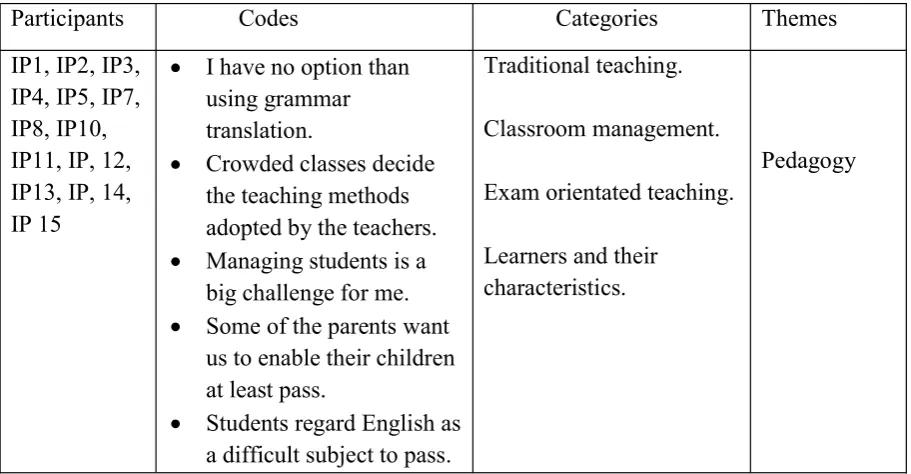
This section discusses the methodological approaches used to analyse the qualitative data. First of all, the interviews were translated into English. After that, thematic analysis method was employed based on grounded theory. For this, the interview transcripts were frequently read to generate codes and form categories.