ACCOMMODATION OPTIONS
FOR RELEASED PRISONERS
WITH COMPLEX NEEDS
By Celia de Winter
Submitted in partial fulfilment of the requirements
for the Degree of Masters of Criminology and
Corrections.
Page _ .
DEDICATION
ABSTRACT
The issue of homelessness or inappropriate housing of people with complex needs is a
serious problem for individuals who have found themselves frequently in the criminal
justice system. Complex needs and challenging behaviours exhibited by those with
mental illness, intellectual disability and or acquired brain injury combined with for
example, family dysfunction, homelessness, poverty, and drug and alcohol misuse of a
cocktail of issues that have been difficult to treat let alone support. Incarceration has
been the alternative for the judiciary with the intention of protecting the individual
offender as well as the community. However it is argued that proper support in the
community may avert the need to seek incarceration as the only option for 'released
prisoners' with complex needs.
This thesis seeks to contribute to the understanding of what it means to be a person with
complex needs and the effect of a short term sentence on the ability to seek stable
accommodation once released from prison. It draws on the extensive literature in the
field for example, with regard to people with disabilities in the criminal justice system
and the housing experiences of ex-prisoners in general and those with complex needs.
Through a number of in depth discussions with stakeholders from both state
government and non-government representative agencies, a critical analysis was
undertaken of the available accommodation options for this cohort in Tasmania. From
these discussions it is evident that, current services either must embrace the needs of
this cohort or a new dedicated service should be developed. However, the new Whole
of Government and Community Sector housing initiative 'Housing Connect',
commencing 1 July 2013, may offer the required support for this group of people with
Page 14
ACKNOWLEDGEMENTS
I would like to thank my supervisor, Dr Max Travers for his guidance, constructive
comments and overall support in the completion of this thesis. I would also like to thank
Associate Professor Roberta Julian and Professor Anne Coleman for their support and
academic guidance throughout this process. Finally, I would like to thank the following
agencies without whom, I would not have been able to undertake this research:
• The Salvation Army
• Centre care
• Anglicare
• The Tasmanian Department of Health, Human Services
• The Tasmanian Department of Justice
• Headway Inc.
• Brain Injury Association of Tasmania
• Richmond Fellowship
• Advocacy Tasmania
• Lifestyle Solutions
• Colony 47
• St Vincent de Paul
STATEMEMT OF AUTHORITY OF ACCESS
This thesis may not be made available for loan or copying.
Page 16
DECLARATION OF AUTHORSHIP
To the best of my knowledge and belief, the thesis contains no material previously
published or written by myself except where reference is made as footnotes within this
thesis.
TABLE OF CONTENTS
CHAPTER TITLE PAGE NUMBER
1 INTRODUCTION 12
2 METHODOLOGY 17
PART ONE: 18
LITERATURE REVIEW
3 RELEASED PRISONERS 19
WITH COMPLEX NEEDS
AND THE CRIMINAL
JUSTICE SYSTEM
4 THE PRISON 34
EXPERIENCE OF SHORT
TERM PRISONERS AND
THE INFLUENCE OF
DE-INSTITUTIONALISATION
PART TWO: 54
QUALITATIVE
RESEARCH AND
ANALYSIS
5 PRE- ARRANGED 55
ACCOMMODATION AND
Page 18
ACCOMMODATION 68
SOUGHT ONCE
RELEASED
ACCOMMODATION 78
OPTIONS FOR
'RELEASED PRISONERS'
WITH SEVERE COMPLEX
NEEDS
PART THREE: POLICY 87
IMPLICATIONS
POLICY IMPLICATIONS 88
FROM THE FINDINGS OF
THIS THESIS
CONCLUSION 96
LIST OF TABLES
3.10.1 DISADVANTAGE, 31
DISTINCTION AND
VULNERABILITY
4.2.1 ASSESSMENT TIERS: 39
TASMANIAN PRISONER
SERVICE
5.1.1 POST RELEASE 57
ACCOMMODATION
SERVICES
5.2.2 DIFFERENCES BETWEEN 59
TASMANIA'S TWO POST
RELEASE
ACCOMMODATION
SERVICES
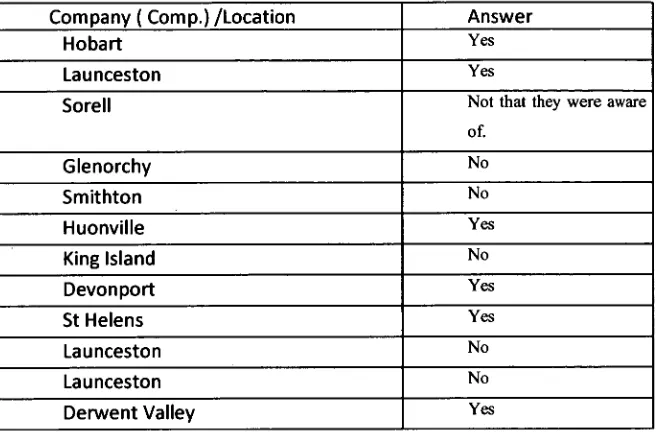
6.4.1 HAVE EX-PRISONERS 74
APPLIED TO YOUR
COMPANY FOR A
RENTAL PROPERTY?
6.4.2 WHAT PROCEDURE 74
WOULD YOU USE TO
APPROVE A LEASE?
6.4.3. HAVE YOU EVER 75
Page 110
AN EX-PRISONER?
6.4.4 HAVE THEY BEEN GOOD 75
FIGURES
3.2.1 DEFINITION OF MENTAL 21
ILLNESS- SECTION 4 TASMANIAN MENTAL HEALTH ACT 1996
3.3.1 AREAS OF DEFICIT FOR A 22
PERSON WITH AN INTELLECTUAL DISABILITY
3.3.2 AREAS OF DEFICIT FOR A 23
PERSON WITH A DEVELOPMENTAL DISABILITY
4.1.1 OFFENCES UNDERTAKEN 35
BY PEOPLE WITH
COGNITIVE IMPAIRMENTS AND COMPLEX NEEDS
4.2.1 GOFFMAN'S DESCRIPTION 47
OF AN INSTITUTION
4.5.1 HOMELESSNESS FACTORS 51
FOR A PERSON WITH COMPLEX NEEDS
5.3.2.1 ELIGIBILITY 61
REQUIREMENTS
6.1.1 SERVICES OFFERED BY 68
S.H.
SERVICES TASMANIA
8.1.1 ELIGIBILITY 90
REQUIREMENTS FOR LINK OUT PROGRAM -
P age 112
CHAPTER ONE: INTRODUCTION
A disability is seen by the general community as external and not intrinsic to the
individual. It is important to understand the person with a disability in their totality as
an equal member of the Tasmanian Community. This has been noted by stakeholders
interviewed and supported by academic research as discussed in the following thesis.
This dissertation discusses the issues of a small but resource intensive cohort of
'released prisoners' with complex needs that present as various combinations of
experiences initially from having a cognitive impairment' which may include mental
illness/ intellectual disability/acquired brain injury, 2 combined inter alia with possible
challenging and or offending behaviours, family dysfunction, social exclusion and
isolation, homelessness, and drug or alcohol abuse. 3 These issues are exacerbated by the
fact that services are reluctant to support people with complex needs relegating them to
the 'too hard basket.' 4 Added to this complexity is the fact that members of the cohort
of this thesis are also 'released prisoners', making re-integration alrnost impossible to
achieve as the community and some service providers are stigmatised and discriminate
against them.
People with complex needs are, according to Douse et.al , "caught in a cycle of social
exclusion and criminalisation resulting in their incarceration and re-incarceration in the
criminal justice system." 5 Homelessness and the need for survival 6 are more realistic
reasons for incarceration than premeditated serious criminal behaviour, as discussed in
Chapter Three of this thesis. However, from a cost benefit analysis it could be argued
that, if the cohorts' needs were addressed proactively they would then break the cycle
by having stable accommodation, thus reducing the rates of recidivism and re-occurring
1 C. Puplick "Issues for People with Cognitive Disability in the Corrections System" Report for the
Office of the Public Advocate, Queensland. May 2005 at p.6
2 M. Hamilton "People with Complex needs and the Criminal Justice System" Current Issues in
Criminal Justice Volume 22 Issue 2010-2011, at p. 307
3
ibid
4 J. Keane Clients with Complex Needs: Inter-professional Practice, Oxford, Blackwell Science, 2001 at p.52
5 L. Douse eta I. "Disabling Criminology: Conceptualising the intersections of critical disability studies and critical criminology for people with mental health and cognitive disabilities in the criminal justice system." Australian Journal for Human Rights,
Volume 15, Issue No. 1, at p. 29
cost to the Tasmanian State Government of re-incarceration. A second argument is that
offenders with complex needs could be re-directed to a therapeutic jurisprudence
alternative as in the Mental Health, Cognitive Impairment, or Drug and Alcohol
Magistrates Court Lists, as opposed to serving a sentence or a period of remand which
could prevent recidivism and homelessness. This alternative has been available to
people with complex needs in Tasmania since early January 2013. However, as there is
insufficient data to form a reasoned opinion as to the success of the therapeutic
alternative it will not be included in the discussion of this thesis. Therefore the
statement posited by this thesis is as follows:
That current pre-release rehabilitation programs and post release and supported
accommodation services are not capable of effectively supporting 'released prisoners'
with complex needs enabling them to break the cycle caused by homelessness and
recidivist criminal behaviour. This thesis is broken up into three parts as follows:
Part One of this thesis is a Literature Review that critically investigates a person with
complex needs and the criminal justice system, initially through defining and discussing
a selection of complex needs and secondly through an investigation into short term
sentences for prisoners with complex needs in Tasmania which is supported by
Literature Review and finally a discussion with regard the effect of
de-institutionalisation on homelessness and re-incarceration for this cohort. Part Two, is an
extensive but not exhaustive qualitative study, of the accommodation options available
to 'released prisoners' with complex needs and released prisoners generally in
Tasmania. Part Three of this thesis examines the policy implications of the issues
identified in this thesis.
There are no statistics in Australia, specifically establishing the number of prisoners or
'released prisoners' with complex needs. However several organisations have collated
issue specific statistics that collectively, allow one to develop a useful picture of the
released prisoner with complex needs. A brief collection of these statistics are
Page
I
141.1Relevant Statistics
1.1.1 Recidivism
In December 2012 the Australian Bureau of Statistics (ABS) found that 61.1% of
prisoners in Tasmanian Prisons were recidivists'. That is 285 men and 17 women of a
total of 494 inmates in Tasmanian Prisons in 2012.8
1.1.2 Intellectual Disability
The NSW Corrections Service found that of the 26,803 offenders in NSW in 2010,
1067 were recidivists with intellectual disabilities seen as having a mild to moderate IQ
of less than 70% and 1389 had a borderline IQ between 70-79%.9
1.1.3 Acquired Brain Injury
There is very limited statistical data relating to prisoners with acquired brain injury
(ABI) and no data with regard to this sub-cohort after release. However in a recent study
by Jackson et.al of 110 male and 86 female sentenced prisoners in Corrections Victoria,
of whom, 64% of male and 73% of female prisoners stated that they had at least one
ABI.1° Throughout their screening it was found that 42% of males had a confirmed ABI
that was an alcohol related or traumatic related brain injury and 33% of females had a
confirmed ABI that related to substance abuse like that of benzodiazepine.11
7
ABS Statistics
8 ibid
9
NSW Prisoner Statistics, 2010
10 M. Jackson et.al. Acquired Brain Injury. Screening, Identification and Validation in the Victorian Correctional System, arbias Ltd and La Trobe University 2010 at p. 6
1.1.4 Mental Illness
The Australian Institute of Health and Welfare (AITIW) in 2010 found that 31% of those
sentenced to Australian Prisons had ongoing mental illness including co-morbidity.I2
For example the Australian Bureau of Statistics (ABS), found that 63% of inmates
misused drugs and also had a mental health disorder 16% were on medication and 14%
experienced high levels of distress.I3 The National Inmate Survey 2010 found that 49 %
had head injuries causing blackouts and unconsciousness. 14 The AliElW, found that
prisoners with mental illness had poorer socio-economic and health characteristics. 2
out of 3 did not complete year 10, were unemployed or unable to work due to their
disability, age or mental condition. They had extensive criminal histories 1 in 3 having
been incarcerated 5 or more times in an adult prison.
1.1.5 Specialist Homelessness Services.
The Specialist Homelessness Services (S.H. Services) Statistics for 2011-2012 found
that, the total number of 'released prisoners' in Australia was 4993. 83% of whom
claimed that they were homeless with 17% at risk of becoming homeless'.I5 The
"central reason why the S.H. Services were contacted was as a result of prisoners
transitioning from prison back into the community, 56% came directly from prison ."16
'80% were single males between the ages of 20 - 35 years of age; 95% independently
sought these services; with 51% needing crisis accommodation 36% requiring
12 Australian Institute of Health and Welfare "The Mental Health of Prison Entrants in
Australia-National Prisoner Health Census" Bulletin 104, June 2012 at p.6
13 ibid
ibid
15 Australian Institute of Health and Welfare "Specialist Homelessness Services- Annual Report 2011-2012" Australian Government, Canberra, 18 December 2012 at p.66
P age 1 16
transitional and 39% requiring medium term accommodation.' 17 People with mental
illness were also in the S.H. Services Data set for this period.
CHAPTER TWO: METHODOLOGY
A Literature Review was undertaken with regard to the elements of complex need for
people with cognitive impairments, their relationship to the Criminal Justice System and
the Tasmanian Prison Service Strategic Plan with regard to prisoners with complex
needs and short term sentences including remand. Finally a discussion surrounding the
argument posed by the Law Reform Commission of New South Wales (NSW) that the
over-representation of people with complex needs in prisons is in part because of
de-institutionalisation that leads to a lack of services for people with complex needs,
homelessness and ultimately potential re-incarceration. I8
Qualitative research methods were utilised in the formulation of the study for this thesis.
In depth discussions were held with a number of stakeholders from both state
government and non-government agencies. It was found however, that the issue of
'released prisoners' with complex needs was not part of the purview of most of those
interviewed in both state government and non-government agencies. This thesis
clarified the fact that there is a representative group of 'released prisoners' who as a
result of their disabilities and attached unmet needs who don't or can't access
appropriate services have been unable to find suitable accommodation upon release
from prison.
As a subsequent line of enquiry for this thesis a small questionnaire was undertaken
with 11 Real Estate Agencies throughout Tasmania with regard to their experiences of
renting to 'released prisoners'. There were minimal results with most companies either
having not rented to 'released prisoners', or the interviewed staff were inexperienced
with limited corporate memory. There were few Agencies with examples of renting to
this group. However it has been a worthwhile exercise to establish a variety of rental
experiences and to compare it with international literature on the subject.
18 Supra at 1 and Law Reform Commission of New South Wales Report on, "People with Intellectual Disabilities in the
P age 1 18
CHAPTER THREE:
RELEASED PRISONERS WITH COMPLEX NEEDS AND
THE CRIMINAL JUSTICE SYSTEM
A lack of stable accommodation for 'released prisoners' with complex needs, is caused
according to researchers in this fieldI9, in part by an inability of the prison system to
adequately provide rehabilitative services to this cohort while in prison, enabling them
to 'survive on the outside.'20 As re-integration in the community becomes more
difficult, French argues that "people with cognitive disability, living in unsupported and
deprived conditions in the community ... may re-offend in order to go back into custody
where they can at least be assured of regular meals, shelter, and some protection from
violence and abuse."2I Problems of re-integration in the community may arise because
of the interaction of the elements of an individual's complex needs that force them into
exclusion and isolation, homelessness, unemployment and thus poverty compelling
them to revert to their previous criminal behaviour.22 It is difficult not to dissect the
stereotypical person or released prisoner with complex needs purely from a medical or
diagnostic basis but it is also important to view these 'labels' so to speak, from both a
sociological and a critical disability studies and critical criminological perspective.23
This was highlighted in recent research undertaken by Douse et.al and.Baldry et.al .
"op cit
20 ibid
21
P. French Disability Justice: The Barriers to iustice for persons with disability in Queensland Disability Studies and
Research Institute for Queensland Advocacy Incorporated, May 2007 at p 38
P age 120
They argue that there needs to be an integration of the two perspectives of critical
disability studies and critical criminology, enabling 'disability' to be "at the centre of
analysis"24 to suggest "a new way to make visible material structures, ideological
discourses and experiences of impairment that fundamentally and differentially
structure an individuals' pathway in two and are often back into the criminal justice
system. They argue that the offending behaviours of a person with complex needs, as
defined below, is not "excused or dismissed but is resituated"25 within the" individual
and social systemic contexts, opening up new ways to identify conceptualisations,
structure and interventions that enable the support and development of new individual,
systemic and political levels of engagement."26
This chapter initially defines and discusses the cognitive impairments27 of an singular,
dual or multi diagnosis of a mental illnesses, intellectual disabilities and or acquired
brain injuries of the cohort of this thesis followed by sociological analysis of a selection
of needs that would make the lives of members of this cohort, extremely complex and
difficult for any one service to support as Hamilton and Keene28 stated. Secondly it
identifies the risk factors and vulnerabilities experienced by people with complex needs
resulting in an interaction with the Criminal Justice System.
24 'bid at p.39 and E. Baldry et.al . Background Paper: "People with Mental Health and Cognitive
Disability: pathways into and out of the criminal justice system," National Legal Aid Conference Darwin 2011
25 ibid
26 ibid
27
Supra at land Supra at 26
3.1 Who is a Person with Complex Needs?
Thus far this thesis has established a statistical picture of a released prisoner with
complex needs as someone who may have numerous life issues for example that of
being homeless and having a cognitive impairment29, which may be a singular, dual, or
multi diagnosis of a mental illness, intellectual disability and or acquired brain injury at
the time of incarceration. Once released, they may also access S.H. Services for long
term or emergency accommodation and for general support services like that of
financial support, or counselling. The three main types of cognitive impairment or
disability are defmed and discussed as follows:
3.2 Mental Illness
A person with a mental illness would have the following presentations and symptoms
according to the definition for mental illness from section 4 of the Tasmanian Mental
[image:21.565.108.452.522.719.2]Health Act 1996.
Figure 3.2.1 Definition of Mental Illness- Section 4 Tasmanian Mental Health Act 1996
(1) A mental illness is a mental condition resulting in-
a) a serious distortion of perception or thought; or
b) serious impairment or disturbance of the capacity for rational thought; or
c) serious mood disorder; or
d) involuntary behaviour or serious impairment of the capacity to control behaviour.
(2) A diagnosis of mental illness may not only be based solely on-Anti-social behaviour; or
a) Intellectual or behavioural nonconformity; or b) Intellectual disability;
c) Intoxication by reason of alcohol or a drug
Page 1 22
An offender with mental illness may frequently present with schizophrenia and
associated with comorbidity issues of drug and alcohol abuse. There is also evidence of
dual diagnosis which includes offenders with intellectual disabilities or developmental
disabilities and acquired brain injuries as discussed below. 30
3.3 Intellectual Disability
A person with an intellectual disability would be someone who has an IQ range from
"50 to 70• 3I Though some specialists in this area, consider 80 to be the cut off and not
70.
A person with an intellectual disability would have a deficit in at least two"32 or
"three"33 of the following areas:
Figure 3.3.1 Areas of Deficit for a person with an Intellectual Disability
a) Adaptive behaviour b) communication c) self- care d) home living, and
e) learning — "receptive and expressive language 0 mobility
g) economic self-sufficiency"
A person with a mild intellectual disability may be someone who "would try cover up
their limitation but who would have great difficulty understanding what was happening
in a court setting and what was required of them without assistance."34 An example of
30 !bid and C. de Winter "Risk and Protective Factors for Offenders with Mental illness and Intellectual Disabilities-Offenders
with Mental Illness and Intellectual Disabilities; An Analysis of "Comments on Passing Sentence" by the Tasmanian Supreme Court' (Unpublished Field Project Report for Masters of Criminology and Corrections, UTAS)
31 httP://WWW.idrS.Org.aa pdf/IDRS %20Introduction intellectual%20disability 17Feb09.pdf, , ibid
32 ibid
" ibid
covering up ones intellectual disability was made by an interviewee for this thesis who
stated:
An external caseworker contacted the prison to ask how her client with an intellectual
disability was going? According to the prison that person didn't have an intellectual
disability. This prisoner was a recidivist who upon re admission to the prison, didn't declare
that he had an intellectual disability. He knew from past experiences that the only way to
survive in prison was to fly below the radar.
The Intellectual Disability Rights Service (IDRS), argues that the effect of the disability
or capacity of the person is a function not only of the disability but also a function of
their environment and the support they receive. The IDRS offers a broader definition of
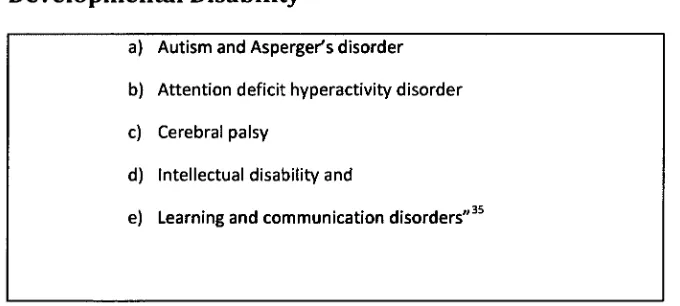
Developmental Disability which includes Intellectual Disability. The definition includes
[image:23.562.105.445.407.560.2]people who have the following:
Figure 3.3.2 Areas of Deficit for a Person with a Developmental Disability
a) Autism and Asperger's disorder b) Attention deficit hyperactivity disorder c) Cerebral palsy
d) Intellectual disability and
e) Learning and communication disorders"35
3.4 Acquired Brain Injury
An Acquired Brain Injury, may be caused by an "assault, stroke, road related accident,
brain tumor, sporting activity, drug or alcohol abuse or medical misadventure. Such an
injury affects a person's everyday memory functions as well as their ability to
Page 124
concentrate. A person with a brain injury may lack motivation become self- centred and
have reduced tolerance to stress."36 Headway Inc., state that the "effects of brain injury
can be devastating on a person's thinking, senses, appearance, physical ability and
personality. Adverse behaviours that develop after brain injury can seriously affect
social and family relationships to such a degree that individuals often become socially
isolated."37 The AIHVV data set on people with acquired brain injury, found that "four
out of five people with ABI had a physical or diverse disability which included
neurological, or cardiovascular disease, cerebral palsy or arthritis."38 Of the disability
data set collected 42% also had psychiatric disabilities and 39% had sensory and speech
disability.39 What is of particular interest here is the fact that people with ABI had
reported to have multiple disabilities and health conditions as opposed to those people
with singular disabilities° like that of an intellectual disability.
3.5 Co-morbidity- Drug and Alcohol Misuse
"Co-morbidity," according to Todd et. al. "was often used interchangeably with the
term 'dual diagnosis'."41 A "dual diagnosis can be that of a mental illness with
substance abuse"42 or with other cognitive impairments. Todd argues that "co-
morbidity more realistically reflects the variety and severity of conditions which in
combination with a substance misuse can have wide ranging clinical, social and legal
36http://headwaytas.net.au/index.php?option=com_content&view=category&layout=blog&id=39&Ite
mid=29
37 ibid
39 Australian Institute of Health and Welfare "Disability in Australia-Acquired Brain Injury" Bulletin 55, December 2007 at p.
8
39 ibid
ibid
411. Todd et.al . "Social Exclusion in clients with co-morbid mental health and substance misuse problems" Social Psychiatry
and Psychiatric Epidemiology, 2004, Volume 39 at 581-587
implications."43 This client group has problems relating to initial diagnosis, focus of
intervention and a general management issues, risk of violence and self- harm, risks of
homelessness, and possibly poorer prognosis."'"
3.6 Challenging Behaviour
Carter defines challenging behaviour as culturally abnormal behaviour of such intensity, frequency or duration that the physical safety of the person or others is likely to be placed in serious jeopardy, or behaviour which is likely to seriously limit use of, or result in the person
• 45
being denied access to, ordinary community facilities. Publick argues that the typology given to people with challenging behaviours conflicts with the stereotypical norms of the care for people with disabilities particularly those with intellectual disabilities." It is clearly difficult for services to support those with challenging behaviours. Many people with these behaviours, as exemplified by case study 4, require resource intensive and costly support to reside effectively in the broader community.47 The Criminal Justice System may at the extreme, opt for incarceration in a general prison population or restrict an offender with complex needs to a psychiatric facility as the ultimate recourse to protect the individual from themselves' and to protect the community." There is a fundamental question that must be addressed, are these people misunderstood?
Publick argues that yes people with challenging behaviours are clearly misjudged. He argues that a person with a challenging behaviour loses community sympathy when they become frustrated and angry." However such behaviour is a reaction to an inability of service providers
" ibid " Supra at 45
45 W.C. Carter. QC Challenging Behaviour and Disability Report to the Hon. W. Pitt M.P. Minister for Communities Disability
Services and Seniors, 2007
Page I 26
_
and the community to understand the relevant issue that has beset the individual.50 Clearly this has exacerbated issues of social exclusion and isolation which reside at the heart of the issues for people with complex needs.
3.7 Social Exclusion and Isolation
Social Exclusion and isolation is a central issue experienced by 'released prisoners' with
disabilities. It was found that loneliness was a common experience with individuals
returning to prison if they were homeless or transient, did not have accommodation
support or felt that it was unhelpful or increased their drug and alcohol addiction." 5I
Gojkovic et.al . stated that 'a lot of female prisoners are used to the routine in prison and
they don't know how to behave outside,' 52 they gave the case example of 'a young
woman who on her first day after having been released from prison was overwhelmed in
the supermarket, and felt thoroughly alone.' 53
Robinson defines social exclusion to mean the "complex compound of disadvantages
which act to marginalise a person in terms of their access to resources and the capacity
to be involved in the community." 54 'Social exclusion experienced by a person with
mental disorders for example may result in homelessness.' 55 She argues that the
importance of "cohesion, belonging and place, addresses the issues that are faced by
50ibid
52 E. Baldry "Recidivism and the role of Social Factors Post Release" Precedent, 2007, Volume 81, at pp.4-7
52
D. Gojkovic et.al . "Accommodation for ex-offenders: Third Sector Housing advice and
provision" Third Sector Research Centre, Working Paper 77, March 2012, University of
Birmingham at p.16
53 ibid 54 C. Robinson
"Understanding Iterative Homelessness: the case of people with mental disorders"
Final Report, Australian Housing and Urban Research Institute UNSW-UWS Research Centre, July 2003 at p. 6
mentally disordered homeless people."156 Such isolation and exclusion may also be the
result of stigma, labelling and discrimination.57
Although the issue of stigma is not discussed at length in this thesis it is important to
understand the social disadvantage that results when people with disabilities are
stigmatised and become victims of labelling and discrimination. Research on these
subjects has been widely undertaken. The most seminal, being the work of Goffrnan,
with regard to the stigma created by the community. He stated:
" By definition, we believe the person with a stigma is not quite human. On this assumption
we exercise varieties of discrimination, through which we effectively if often unthinkingly
reduce his life chances. We construct a stigma theory and ideology to explain his inferiority
and account for the danger he represents. We tend to impute a wide range of imperfections
on the basis of the original one... Further, we may perceive his defensive response to his
situation as a direct expression of his defect, and then see both a defect and response as just
retribution for something he or his parents or try did, and hence a justification for how we
treat him."'
Goffman established the separation of the "us" and the "them" concept which is also
discussed by Link et.al who argue that such "segregation results in status loss and
discrimination leading to unequal outcomes and establishes negative stereotypes." 59
Publick vehemently argues that 'segregation for this cohort in special management or
crisis support units in prisons should be condemned.'6°
'Prisoners and remandees with complex needs may be separated from the general population preventing them from receiving rehabilitative services, and isolating " ibid
57
S. P. Hinshaw The Mark of Shame: Stigma of Mental Illness and an Agenda for Change, Oxford, Oxford University Press, 2008 at p.8
58 E. Goffman Stigma: Notes on the Management of Spoiled Identity New Jersey, Prentice Hall, 1963 at p.1
Page
I
28them in confined hospital settings. Inmates residing in these units are often those with cognitive impairments who present with challenging behaviours.'61
These issues are discussed further in the following chapter. It will become apparent
throughout this thesis that social exclusion, stigma and discrimination continue
throughout the lives of people with complex needs causing severe existential problems
both within the prison environment, and in the broader community. Once released other
complexities arise for the ex-prisoner particularly with regard to family dysfunction.
3.8 Family Dysfunction
In some cases of mental illness or challenging behaviours, 'families have' according to
Robinson been 'unable to support or understand the difficulties experienced by the
individual' 62 Visher, argues, that 'families may provide strong support systems for
returning prisoners, but families may also be victims and not want anything to do with
them.' 63 The 'individual with mental illness may also be a victim of abuse which is
another reason for the reluctance to return to the familial environment.' 64 In a study of
Australian Prison entrants "family dysfunction and parental psychiatric illness" 65 were
seen as seen as possible "causes of an individual developing a mental illness and a
co-morbid substance abuse disorder." 66
61 Supra at 19 at p.24
62 Supra at 57at p.14
63 C. Visher et.al "Transitions From Prison to Community: Understanding Individual Pathways" Annual Review Sociology Volume 29, 2003 at p. 89
64 ibid 65 ibid
La Vigne stated, that 'prisoners expectations of their families were met once released
and exceeded expectations more often than nor. ° However Naser and Bradley argue,
"families were under great strain"68 "especially if the individual was a destabilising
influence"69 and "continued with the same criminogenic crowd and perpetuated their
addiction that had them arrested in the first place". 7° Naser states that, "most simply,
did not want to stay in touch, some saying that they were upset or disappointed and
others were "tired of seeing him going to jail". 71 Robinson also argues that there "needs
to be more research undertaken into the needs of families of returned prisoners, with
more broad based support given to them." 72 Homelessness therefore is a serious issue
for individuals released from prison with no family or friends to rely on. Homelessness
is defined as follows:
3.9 Homelessness
Chamberlain et.al developed the now standard definition of homelessness where
according to Baldry et.al . 'primary homelessness refers to being without conventional
accommodation for example living on the streets, in cars and squats essentially that they
had not proper shelter. Other levels of homelessness, that of secondary or tertiary
according to Chamberlain et.al were frequent itinerancy and unsatisfactory and
unsustainable accommodation: 73 The term chronic homelessness is a common term
that like primary and secondary homelessness, means years of long periods of
homelessness or unsatisfactory accommodation combined with serious illness and
67
N. La Vigne "Chicago Prisoners Experiences Returning Home" , Urban Institute Report, December 2004, at p.18
68 R. Naser et.al "Family Members' Experience with Incarceration and Re-entry" Western
Criminological Review, Volume 7, Issue 2, 2006 at p.26; ibid
69 Supra at 168 " op.cit.
ibid
72 Supra at 57
73 Baldry E. et.al. " Ex-prisoners and accommodation : what bearing do different forms of housing have on social
P age 130
disability.74 This term is used by Common Ground Tasmania, an organisation
attempting to address the homelessness crisis in Hobart and is discussed at Chapter Two
of this thesis.
The definition of a homeless person as defined in section 4 of the Supported
Accommodation and Assistance Act, 1994 (C'th), defines a homeless person as
"Someone who has inadequate access to safe and secure housing". Tamara Walsh
argued that this definition recognised the fact that "not feeling at home is an important
feature of homelessness"75 Robinson provides a useful alternative definition and the
definition of choice for this chapter, regarding chronic, and primary homelessness.
Robinson argues that "most homeless people do not sleep rough on the streets though
they may do so at times."76 Many remain "tenuously housed and at continuous risk of
street homelessness in their cycle through many different forms of tenuous and
unacceptable forms of accommodation such as hostels, licenced and un-licenced
boarding houses, caravan parks, and staying with friends etc."77 The issue of
homelessness and recidivism with regard to people with complex needs is discussed in
Chapters 3.2 and 4.2 of this thesis.
3.10 People with Cognitive impairments and Complex Needs and the Criminal Justice System
A person with cognitive impairments may be disadvantaged in the criminal justice
system because among other things they would have a "reduced capacity to understand
laws, and societal norms, have reduced planning skills and impulse control, be eager to
please and be easily led by criminal forces"78. With reduced communication sIdlls'79
and an increased vulnerability they can incriminate themselves unwittingly with an
http//www.commongroundtas.com.au/ index.php?option=com_content&view=article "50 Lives 50 Homes"
ibid
76 Supra at 57
" ibid
78 Brain Injury Association of Tasmania "Acquired Brain Injury and the Criminal Justice System: Tasmanian Issues August
2007 at p.13
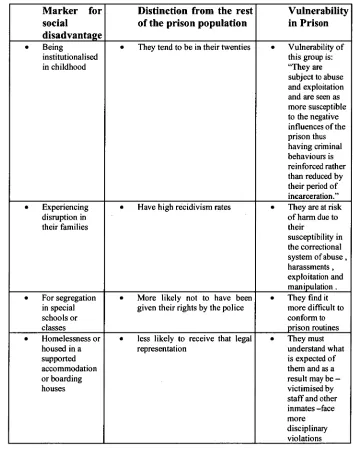
inability to explain their actions to the police or subsequent magistrate. 8° Table 3.10.1
below, has been extrapolated from Publicks' Report for the Office of the Public
Advocate Queensland titled "Issues for People with Cognitive Disability and the
Corrections System". The following three lists identify risk factors experienced by the
cohort of this thesis with regard to the criminal justice system that may aggravate an
[image:31.565.101.454.284.735.2]individual's already complex needs.
Table 3.10.1: Disadvantage, Distinction and Vulnerability
Marker for social
disadvantage
Distinction from the rest
of the prison population Vulnerability in Prison
• Being
institutionalised in childhood
• They tend to be in their twenties • Vulnerability of this group is: "They are subject to abuse and exploitation and are seen as more susceptible to the negative influences of the prison thus having criminal behaviours is reinforced rather than reduced by their period of incarceration." • Experiencing
disruption in their families
• Have high recidivism rates • They are at risk of harm due to their
susceptibility in the correctional system of abuse, harassments , exploitation and manipulation. • For segregation
in special schools or classes
• More likely not to have been given their rights by the police
• They find it more difficult to conform to prison routines • Homelessness or
housed in a supported accommodation or boarding houses
• less likely to receive that legal representation
• They must understand what is expected of them and as a result may be — victimised by staff and other inmates —face more disciplinary violations
Page
I
32• -face greater loss of privileges • Drug and
alcohol problems
• Less likely to be involved in violent crimes ( although some are )
• Rehabilitative programs are not available or inaccessible. 81 • Torture and
trauma or other stresses
• More likely to be involved in crimes such as arson and sexual offending
• Domestic
violence • what goes on in court or even Less capable of understanding why they were arrested
• Addictions • More likely to be denied bail • Financial
management problems
• Serve longer sentences
• Social isolation
and alienation • sentences Are less likely to appeal • Poor
communication & language skills
• Less likely to receive parole
3.11 Summary
Chapter One, drew a sketch of a person with complex needs and his/her relationship to
the Criminal Justice System having established the existence of the cohort statistically
in the Introduction to this thesis. It has been seen that a member of this cohort is
disadvantaged for many reasons, for example because of their distinctive challenging
behaviours, or their family situation that may cause homelessness, social exclusion and
isolation and their vulnerability both within the Criminal Justice System and while
trying to manage to re-integrate themselves back into the community. Douse et.al argue
that social exclusion is the reason that members of this cohort are caught in the cycle of
re-incarceration. It can be argued that this chapter has clearly identified, that yes, social
exclusion is one of a number of central elements or issues that make up the complexity
of issues experienced by individuals with cognitive impairments /disabilities. However
it is the issue of homelessness and a lack of stable accommodation that arguably must
be seen as the essential element for any successful reintegration. People with complex
needs are usually sentenced to short term sentences that in Tasmania prohibits them
from the benefit of rehabilitative or pre- release programs and support. This and the
effect of de-institutionalisation on homelessness and recidivism are discussed in the
Page 134
CHAPTER FOUR: THE PRISON EXPERIENCE FOR
SHORT TERM PRISONERS AND THE INFLUENCE OF
DE-INSTITUTIONALISATION
The latest statistics on Prisoners in Tasmania, found that inter alia, prisoners came from
low socio-economic backgrounds'82. These could also be described as 'disadvantaged
communities.'83 They may have been exposed to 'physical or sexual violence
particularly in their formative years' 84 The offenders may also 'present developmental
disabilities with Attention Deficit Hyperactivity Disorder, intellectual and learning
disabilities, mental illness, and associated substance and alcohol abuse.'85 These were
defined in the previous chapter. Female offenders may "display mental health problems
including personality disorders, psychosis, mood disorders and deliberate self- harm."86
Fisher et al, Baldry et.al, Douse et.al, Publick, and the Law Reform Commission of
NSW, found that 'prisoners with complex needs were over represented in Australian
Prisons' 87 Initially this chapter evaluates the offending behaviour of prisoners with
complex needs to ascertain the reasons for such over- representation, secondly it will
critically analyse the experiences of short term, remand and prisoners with disabilities in
the Tasmanian Prison system with a supporting Literature Review. Finally this chapter
will discuss the statement presented by the Law Reform Commission of NSW, stating
82 Breaking the Cycle Tasmanian Corrections Plan ( 2010-2020) at p16;Background Paper Breaking the
Cycle Tasmanian Corrections Plan ( 2010-2020) at pp.2-4
83 ibid 84 ibid 85 ibid
86ibid
82 Supra at 1, Supra at 5, Supra at 22, Supra at 71,. D. Fisher et.al . "Cohort Report- People with Problematic Alcohol Use,
that homelessness and recidivism is caused by de-institutionalisation and a lack of
suitable community services?
4.1 Offending Behaviour
Offenders with cognitive impairments/complex needs commit a range of crimes but are usually summary in nature as outlined at Figure 4.1.1 below:
Figure 4.1.1 Offences undertaken by people with cognitive impairments and complex needs.
• "High incidences of survival crimes for example stealing food or failing to pay for transport which is often associated with an inability to manage the demands of daily life.
• A high incidence of addiction related crimes for example theft of money or property to sell to generate cash to purchase alcohol or drugs.
• Offences arising from minor anti-social behaviours exhibited in public spaces for example drunkenness urinating in public and smoking.
• Compliance related offences often associated with an inability to understand or act in accordance with legal obligations.
• Offences including those that may involve serious personal violence and sexual assault and major property damage committed on impulse without premeditation.
• Situational offences resulting from environmental stressors.
• Relatively low incidence is of offences of mid-range seriousness
particularly with these are crimes requiring planning." 88
Fisher et.al , Baldry et.al, Douse et.al , French, Publick and the Law Reform
Commission of NSW are among a plethora of researchers in this area, who've argued
that there is an over-representation of offenders with intellectual disabilities and
cognitive impairments in general in the criminal justice system.89 This has been
exemplified by the cited statistics for prisoners with intellectual disabilities in NSW
Prisons in 2010, to found in the Introduction to this thesis. The Commission postulated
three possible hypotheses for this, with academic support as discussed below:
88 ibid
P age 136
1. The susceptibility hypothesis-
Considers, 'that people with intellectual disabilities are more likely to engage in
criminal behaviour because of their impairment.' 9° This suggests a vulnerability for this
sub-cohort. Publick includes those with acquired brain injuries having a similar
vulnerability91. Contiguous with this is for example; "a greater propensity for minimal
impulse behaviour; less ability to manage extreme emotions such as anger; greater
suggestibility; limited intellectual ability, to learn, comprehend, retain and apply
information. Poor problem solving and memory skills and distorted perceptions of
reality are manifested by those experiencing acute mental illness."92 'A person with an
acquired brain injury may have little insight into the effect of their behaviour on others
•
as they don't tend to have physical manifestations to their injunes, ,93 This will affect
their 'process through the criminal justice system'94 and in the wider community once
released. According to Corrections Victoria more people with ABI are incarcerated
because both judges and juries are "unable to confirm that their injury is the precipitator
for the offending action."95
2. The different treatment hypothesis
'States that people with intellectual disabilities are no more likely to commit crimes
than the rest of the community. However it is suggested that this cohort are more likely
to be arrested or detained for minor infringements such as public law and order. With
regard to their suggestibility, they may be persuaded to confess to a crime that they have
not committed. They are more likely to receive a custodial sentence because of a lack
90ibid
91 Supra at 1 at p.16 92 Supra 86 93 ibid
94Victorian Department of Justice "Acquired Brain Injury in the Victorian Prison System" Corrections Research Paper Series
Paper No. 04 April 2011 at p. 9
of alternative placement in the community. They tend to serve longer sentences or a
greater percentage of the sentence before being released on parole96 and finally as noted
by Publick, 'they may require maximum security facilities for segregation and
protection needs within the prison.'97 The commission found that these experiences
were not exclusive to those with intellectual disabilities and were found by persons from
other impairment groups for example those with psychosocial impairments and acquired
brain injuries. 98
3. The psychological and socio-economic disadvantage hypothesis-
This postulates that 'persons with intellectual disabilities ( which could also include
other impairments), are more likely than others to be exposed to environmental factors
where they can become involved in or suspected of committing crimes."99 This theory
suggested that "each impairment is really just a marker to identify an individual's
overwhelming array of psychosocial disadvantages or (complex needs,) in addition to
major educational disadvantages, and childhood institutionalisation, frequent contact
with psychiatric services, disrupted and disturbed family life, alcoholism and drug
addiction and poor social skills." 100
Psychological and environmental factors may also affect an individuals' offending
behaviour. As noted at Figure 4.1.1 above, individuals may commit survival crimes
which exhibit an inability to manage their daily life. Serious consequences may result
when an individual with cognitive impairments finds it difficult to maintain compliance
for example with Centerlink requirements resulting in a termination or suspension of
" Supra at as
Page 138
their income support. They may also spend their income support impulsively and
impractically, resulting in the need to steal food to eat and evade transport fares in order
to get home, 1°1 as discussed at Figure 4.1.1. Typical offences committed by those with
ABI, have been found to be more violence related crimes for men and theft, robbery and
illicit drug offences for women. In a study on this sub-cohort in Victoria it was found
that over 50 % were under the influence of drugs or alcohol when then committed their
offences. 1°2 Mullen found that those with mental illnesses particularly those with
schizophrenia had committed homicides and more serious crimes, 1°3 as opposed to the
more summary crimes committed by people with intellectual disabilities or ABI 1°4.
However there is evidence from the Tasmanian Supreme Court Comments on
Sentencing of offenders with intellectual disabilities having committed more serious sex
related crimes, and been found to be unfit to plead. 105 There are four reasons for the
over-representation of people with complex needs in Australian prisons according to the
Queensland Office of the Public Advocate (QPAI) and the Law Reform Commission of
New South Wales.
Firstly, that "deinstitutionalisation leads to more people with complex support needs
not receiving services. This in turn leads to homelessness, behaviour that attracts police
attention and ultimately criminal charges and conviction" 106 ; Secondly, that "people
1°1 !bid
102 .
arbias Pty. Ltd. et.al . "Acquired Brain Injury Screening Identification and Validation in the Victorian Correctional System" Melbourne 2010 at p. 62
103 Mullen P. "Mental Health and Criminal Justice — A Review of the Relationship Between
Mental Disorders and Offending Behaviours and on the Management of Mentally Abnormal Offenders in the Health and Criminal Justice Services" Criminology Research Council, August 2001 at pp. 9-11
1°4 ibid
105
de Winter C. "Risk and Protective Factors for Offenders with Mental illness and Intellectual Disabilities-Offenders with Mental Illness and Intellectual Disabilities; An Analysis of " Comments on Passing Sentence" by the Tasmanian Supreme Court"( Unpublished Field Project Report for Masters of Criminology and Corrections, UTAS)
with cognitive impairments while no more criminal in nature than other people, may
have traits that lead to their apprehension. These traits include impulsivity, eagerness to
please and an inability to plan and execute a strategy to avoid detection".1°7 Thirdly they
"lack an understanding of social norms and rules and may have poor impulse control
and lack inhibition"108; finally, "they have difficulty with their expression and
comprehension and may have memory gaps and short attention spans." °9 A persons'
disability is not always identifiable and if not identified upon admission to the prison
will 'generally be ignored within the Tasmanian Prison Service' as per a stakeholders
comment supported by research undertaken by Walsh with regard to other Australian
Correctional Centres.11°
4.2 Prisoner Assessment in the Tasmanian Prison System
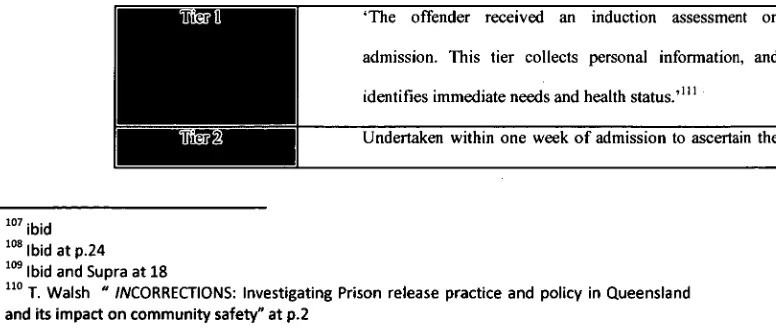
In Tasmania there are three periods during a persons' prison term where individual
needs can be assessed and assistance provided if appropriate. The following periodic
assessments are in line with the length of sentence exemplified by the following Tiers,
[image:39.565.52.440.559.724.2]at Table 4.2.1 below:
Table 4.2.1: Assessment Tiers: Tasmanian Prison Service
Tier 'fl 'The offender received an induction assessment on
admission. This tier collects personal information, and
identifies immediate needs and health status.'I I I
Tier Undertaken within one week of admission to ascertain the
1°7 ibid 7°8 !bid at p.24 7°8 !bid and Supra at 18
710 T. Walsh " /NCORRECTIONS: Investigating Prison release practice and policy in Queensland
and its impact on community safety" at p.2
Page _ _ I 40
prisoner's needs upon release. 112
(if the prisoner is serving a 6 month or greater sentence.)
Uto33 Undertaken within three months- Longer term prisoner as in Tier 2 completes a LS and CMI to ascertain inter alia,
criminogenic and non-criminogenic needs. 113
The Tier 1 assessment is intended to assess the health needs of prisoners upon
admission as stated above. It has been noted by the Brain Injury Association of
Tasmania that no health questions relating to ABI are included in this initial
assessment.114 However it has also been noted by a key stakeholder that there are
questions relating to disabilities on the induction documentation that are not asked to
during this first assessment. This has been supported by comments made by an
interviewee from Risdon Prison who stated that if a disability was not initially
noticeable it would go undetected.
4.3 Short Term Sentences
'Prisoners serving short term sentences are more likely to reoffend,' I15argues Publick.
This proclivity for recidivism is inter alia, a result of an inability to access sentence
planning' services and pre- release programs117. Therefore prisoners in the Tasmanian
Prison Setting, on short term sentences (outlined at Tier one above), have only been
required to give their 'general demographics in the admission interview which is of no
real rehabilitative use' as outlined by a stakeholder. Those on 'short term sentences are
112 Opcit
113 Supra at 18 and Brain Injury Association of Tasmania "Acquired Brain Injury and the Criminal Justice System: Tasmanian Issues August 2007
114 !bid at p.26 116 Supra at 85
116 Social Exclusion Unit "Reducing Re-offending by Ex-prisoners" Report for the Office of the Deputy Prime Minister, London, 2002 at page 9.
released' 118 "without being subject to any formal supervision" I19, unlike that required by
Parolees'. Parolees will not be discussed in this thesis. The Social Inclusion Unit in the
United Kingdom undertook insightful research in the area of the recidivism of short
term prisoners.
According to the Social Exclusion Unit, these prisoners have the highest recidivism
rates. 120 In the United Kingdom it was argued that "short term prisoners were unable to
make any progress regarding courses and general education in their prison term" 121 . It
can be argued that there should be a priority to offer rehabilitative assistance to short
term prisoners thus reducing the risk of recidivism. For example, Kinner and the Social
Exclusion Unit shared the same experiences in both Queensland and the United
Kingdom respectively, where short term prisoners were not allocated a Drug Treatment
Plan because they are part of a Sentence Plan," 122 'that is only available to longer term
prisoners' 123 . This experience correlates with the services provided by the Tasmanian
Prison Service and the Integrated Offender Management Program. 124 The Social
Exclusion Unit stated that "in the United Kingdom significant efforts are being made to
tackle the causes of offending behaviour with dedicated programs but many prisoners
are currently unable to take part in such programmes including many short-term
prisoners, those most likely to re-offend. 125 Borzycki argues "that it is those on short
term sentences who have unmet needs including poor mental health, financial and
118
M. Borzycki et.al "Promoting Integration: The Provision of Prisoner Post-release Services"
Trends and Issues in Crime and Criminal Justice September 2003, Australian Institute of Criminology at p.2
119 ibid 120
Supra 112 at 140
121 !bid at 112 p.65 122 ibid
123 Ibid and S. Kinner " The Post-release Experience of Prisoners in Queensland." Trends and
Issues in Crime and Criminal Justice, No. 325 September 2006 at p.5
124
Supra at 112 and a discussion with the representative interviewee
Pa ge 142
housing issues and alcohol and drug problems with no statutory requirement for
correctional authorities to assist them in their transition back into the community.„126
She also advocates for the development of programs such as the 'continuity of
therapeutic progams within the prison system, addressing the specific risks and needs of
short term prisoners that may reduce the cycle of offending.' 127
To this end, Baldry et.al argue that one of the central policy implications of their study
was that "each and every prisoner has a trained case worker for housing, personal and
advocacy support prior to and post-release."128 However in the Tasmanian reality, the
'continuity' certainly exists, but it could be argued that it is a continuity of neglect, and
of social exclusion for prisoners with complex needs serving any length of sentence.
4.4 Tasmanian Prison Service Strategic Plan 2011-2016: Prisoners with Complex Needs
The intentions of the Tasmanian Prison Service, seems to be in complete opposites to
the services actual 'care' of prisoners with complex needs. Walsh argues that
'correctional policy changes are not undertaken in reality.' 129 The Tasmanian
Corrections Service is to be congratulated, as the Corrections Strategy Discussion
Paper, states that the state government realised that there needed to be "increased
programs and services for offenders with disabilities and that there needed to be an
126 ibid
127 ibid
128 E. Baldry et.al . ” Ex-prisoners and accommodation : what bearing do different forms of
housing have on social reintegration" AHURI Final Report No. 46, August 2003 at p. ii
129
expansion of mental health services to offenders."'" However in the same document
they state the following:
"Offenders with intellectual disabilities or acquired brain injuries are not able to participate in programmes with the other offenders due to their reduced cognitive functioning. Additionally, it is argued that these offenders are less able to carry skills learned in prison programs to the community setting. These offenders may be in-eligible for some services as a result of the complex needs and co-morbidity issues."131
The interviewee from Risdon Prison, highlighted the fact that prisoners with complex
needs do not have access to any prison programs or services apart from the regular
services. Hamilton argues that 'prisoners with complex needs are too higher a risk and
too difficult to support in the criminal justice system.' 132 However isn't the intention of
the Risk Needs Responsivity Principle (RNR) as stated by the Tasmanian Prison
Service Strategy plan'33, to support prisoners who are a high risk of re-offending?'
Clearly those on short term sentences who regularly re-offend are a high risk? It was
cited in the above document that "it may be difficult to source and provide programs
suitable for offenders with intellectual disabilities and acquired brain injuries."134.
However key stakeholders in the community cited earlier overtures to the Prison Service
to attempt to provide training to staff and to provide in-house program support. This has
not been supported by the Prison Service as at the date of submission of this thesis.
130 Tasmanian Department of Justice- Breaking the Cycle: Tasmanian Prison Service Discussion
Paper 2011-2016 at p. 97
131 !bid at p. 43 132
Supra at 10 at p 308
Page
1
44
4.5 Remand for Prisoners with Complex Needs
This is also the case of people with complex needs on remand as seen by the following
example:
"A person with complex needs who may be on remand for an escalating challenging behaviour.., that may have caused them to be homeless due to the inability of his/her family to care for them , and may not be associated with any service for support. The Magistrate puts the person on remand in prison as opposed to being released on bail as there is nowhere for the person
to go...Releasing them could precipitate further offending and harm to the individual." 135
However, a person may be found unfit to plead and may stay on remand in a Special
Needs Unit in Prison or be sent to a Centre' such as the Wilfred Lopez Centre. 'In some
instances in Queensland', 'these people are kept in the barely furnished Suicide Cells
because there is no other accommodation for them away from the general population.
Such accommodation is indicative of a lack of resources but also of a substantial lack of
understanding of the cohort of people with complex needs."I36 Two key stakeholders
highlighted the examples of two offenders with complex 'needs who until recently for
one , and currently for the other, reside in the Risdon Prison Special Needs Unit,
isolated from the general prison population. Both of these gentlemen are discussed as
Case Studies 4 and 5 in chapter five of this Thesis.
It is also unfortunate to understand that according to the prison/ or just the attitude of the
Risdon Prison interviewee, a disability or a complex need is seen as a 'transitional
issue' and not one that is fundamental to the individuals' rehabilitation. This attitude
was also cited by Fisher, and Douse et.al , who've found that disability had a "peripheral
status"I37 as opposed to the 'central' 138 "organising principle in the constructions of an
individuals' identity." 39 If this is the case for the prison staff in general and not just for
the interviewee concerned, then it is no wonder why nothing has been achieved in
prison for the cohort of this thesis.
The tendency to reoffend is, in part, linked to how effectively an offender has been
rehabilitated while in custody and how easily he or she has made the transition back into
the community following release.1 0 4 icinneriai, Borzycki and Baldry 1 42 and BorzyciciI43
state that most prisoners are highly likely to reoffend once released, as established by
the statistics outlined in the Introduction to this thesis. The final discussion picks up on
the point made earlier at section 4.1 of this chapter, by the Law Reform Commission of
NSW, that the over-representation of people with complex needs in prisons is in part,
because of deinstitutionalisation that leads to a lack of services for people with complex
needs, homelessness and ultimately potential re-incarceration".
Thus far this chapter has identified the issue that prisoners with complex needs are seen
as vulnerable and are either isolated from the general prison population in segregated
units or in the general prison prevented from attending programs to assist them once
released. People with cognitive impairments also seen as decision making disabilitiesI45,
1" Supra at 5 at p.1, and Supra at 87, D Fisher et.al at p. 84 138 ibid
ibid
148 !bid at 1 141 Op.cit
142 Supra 67 at p 1
143 Supra at 123 at pp. 7 and 8
P age 1 46
need to be 'creatures of habit'146. They are unable in many cases for example, to
correctly read no-verbal communication which in prison, often results in further
punitive measures and in the community may lead to altercations with police potential
resulting in criminal charges.'47 This need for regularity in the lives of this cohort comes
from the experience of institutionalisation.
4.6 Deinstitutionalisation (or micro- institutionalisation)
Historically, for example as in the Industrial Revolution, people with disabilities were
socially excluded from society in their homes, institutions, asylums or pauper houses.
They were found to be "unproductive and hindered the development of capital
wealth."48 Dramatically Scull stated that those people who were' not so violent so as to
be manageable were confined to their beds in straightjackets and considered to be
lunatics.' 49 Such segregation seems quite familiar to the current accommodations for
prisoners with complex needs as discussed earlier in this chapter.15° Clearly not all
prisoners with complex needs are segregated in such a draconian manner as exemplified
above. However it has been established that there are distinct similarities to institutional
environment for both a residential home for people with disabilities and a prison
environment. This is exemplified by Goffrnan's general description of an institution as
cited by Johnson et.al , outlined at Figure 4.2.1 below.
146 Supra at 116 147 Supra at 109 148 ibid 149 ibid 150